



Abstract
Attempts to circumvent presidential term limits in African countries show a puzzling variation of success or failure. This variation is due to both international and domestic factors. However, how these interact is not yet well understood. This article analyses how international donors and organisations intervened in the attempted term limit circumvention in Malawi from 1999 to 2003. It differentiates between different types of instruments used by donors in democracy promotion, and, by doing so, contributes to the question whether donors in term limit struggles can contribute to genuine democratic consolidation. It employs deductive process-tracing based on an analysis of primary media sources and interviews conducted during field research. The results show that erosion of party support as a proximate and a strong civil society response as a mediate factor were important in saving Malawi’s term limit. Aid conditionality and democracy promotion by donors and international organisations exerted influence on both factors.
Introduction
Term limits are of special interest in the study of African politics. African countries have introduced term limits into their constitutions increasingly since the early 1990s (McKie, 2017). This has reduced the average duration that African presidents stay in office (Dulani, 2011). Observers have taken this as a strong indicator for the end of personalist rule and the institutionalisation of political power (Posner and Young, 2007). Yet for all that, a worrying trend of attempts to remove or circumvent term limits has recently been observed (Tull and Simons, 2017).
International actors, such as international organisations and especially donor governments, often intervene in domestic attempts to remove term limits in order to promote democracy. The research literature on democracy promotion acknowledges two basically different ways of how they do this. They either pursue a rationalist strategy if they use, for instance, aid conditionality to exploit the leverage they have over a country. Or they pursue a social-constructivist strategy if they use public statements and democracy assistance to rather exploit their linkage to a country (Levitsky and Way, 2006). Both leverage and linkage build upon different logics of social action. Earlier contributions trace how external democracy promotion using both strategies developed over time on a macro level for individual countries or regions (e.g. Resnick and Van De Walle, 2013). This article complements these accounts by providing an issue-focused in-depth investigation of how both strategies complemented one another on the meso level in a specific case of constitutional reform. The specific issue of an attempted term limit circumvention is ideal for such an investigation as it directly concerns a country’s democratic consolidation.
Posner and Young (2007: 135) opened the question on the role of foreign donors in term limit circumventions. They hypothesised that aid dependency enables donors to pressure incumbents into abandoning attempts to circumvent term limits. Statistical evidence indeed shows that aid dependency is negatively associated with the likelihood of a term limit removal (Baturo, 2010; Posner and Young, 2018). Findings deduced from case studies corroborate this (Dulani and Van Donge, 2005). Yet others suggest that donors also exert influence through linkage. Carter (2016) forcefully argues that foreign aid also emboldens democratic actors in recipient countries to safeguard term limits besides merely affecting the cost–benefit calculations of incumbents. Statistical evidence also suggests that democracy promotion, rather than economic foreign aid, lowers the likelihood of term limit circumvention, but this evidence is provisory (Dietrich and Wright, 2012, 2013). In-depth case study evidence provides a mixed picture by showing that donors, in their pursuance of strategic interests, often play a rather ambiguous role (Vandeginste, 2016).
The case of Malawi offers a prime example to study different instruments of democracy promotion in attempts to circumvent a term limit. First, Malawi belongs to only the handful of cases in Africa in which a circumvention of a term limit was unsuccessful. Second, democracy promotion could have worked through both rationalist leverage and constructivist linkage in Malawi’s case. At the time of analysis, Malawi was highly aid-dependent (Resnick, 2013). Likewise, it was in the midst of its democratic transformation (Chinsinga, 2008). Muluzi indeed was the first democratically elected president after autocratic rule had ended in 1994. Third, Malawi does not play an important geostrategic role in Africa for donors. Hence, strategic donor interests beyond the case of Malawi itself are unlikely to have confounded donor responses to Muluzi’s attempted term limit circumvention. Finally, analyses of Muluzi’s attempted third term have focused on the roles that party fractionalisation (Dulani and Van Donge, 2005; Von Doepp, 2005a), civil society (Dulani, 2011), and judiciary institutions (Von Doepp, 2005b) played, while an in-depth analysis of the role of external donors has not been undertaken so far. Generally, scholars acknowledge that donors played some role in Muluzi’s third term bid. Dulani and Van Donge (2005) assert the influence of donors on Malawi’s democratic consolidation generally, and Dulani (2011: 196–198) briefly sketches that donors exerted pressure during the third term bid. Von Doepp (2019: 297), too, acknowledges that “the donor community became increasingly involved” and intervened on behalf of important veto players such as the judiciary Von Doepp (2005b: 288), and Resnick (2013: 115) also reports that donors influenced Muluzi and “may have influenced MPs.” However, she also cautions that the exact impact of donors is not clear as Muluzi attempted to go through with his bid. Hence, an important question is still open: What part did external democracy promotion play compared to domestic factors in Muluzi’s attempt for a third term? More specifically, what part did different instruments of democracy promotion play?
This question has important implications for the contribution of democracy promotion to democratic consolidation. Democratic consolidation consists of both preventing democracy from breakdown or erosion and facilitating the completion, organisation, and deepening of democracy (Schedler, 1998). While the former concerns the survival of democratic core institutions, the latter concerns the enhancement of those democratic institutions and actors that reinforce vertical and horizontal accountability and political competition (Resnick and Van De Walle, 2013). Different instruments of democracy promotion fulfil different functions in this regard. While rationalist instruments of leverage can help prevent breakdown or erosion, because they rely on coercion they are less effective in helping genuine completion, organisation, or deepening of democracy (Resnick and Van De Walle, 2013: 38). Instruments of linkage seem to be more important for this positive side of democratic consolidation. This article thus contributes to the larger literature on democracy promotion and democratic consolidation by providing an in-depth process tracing analysis of both instruments in the short-term case event of a term limit bid.
The analysis finds that both leverage and linkage by external donors augmented domestic drivers obstructing Muluzi’s third term bid in Malawi. While an erosion of intra- and inter-party support explains the failure of Muluzi’s third term bid as a proximate factor, international intervention, strong civil society opposition, and, to a lesser extent, judiciary safeguarding were mediating factors causing this erosion. A vivid, foreign-funded civil society that upheld democratic values, norms, and standards exerted pressure on parliamentarians to such a degree that political support for Muluzi’s third term bid eroded. Rhetorical statements and donor conditionality further bolstered the opposition stance towards a removal of term limits.
The next section reviews the theory of donor interventions in democracy promotion – how different democracy promotion instruments work according to different logics – and deduces assessable theoretical mechanisms. The section titled “Analysis: Muluzi’s Attempted Term Limit Circumvention, 1999–2003” presents the analysis, its findings and a brief discussion.
Theory and Assessable Mechanisms
Term limits are important rules of democratic political systems. Through lowering the entry barrier, they ensure that political competition does not devolve into a zero-sum game (Cheeseman, 2010). Because they are increasingly challenged (Tull and Simons, 2017), term limit rules are also a salient topic for the study and practice of democracy promotion. Democracy promotion comprises all the activities of external actors that seek to enable internal actors of a country to establish democratic institutions (Poppe et al., 2019). Its goal is to disseminate and defend democratic norms, attitudes, behaviour, and standards globally. As stated previously, democracy promotion instruments can be sorted broadly into two categories (Levitsky and Way, 2006). If a democracy promoter exploits the vulnerability of another country – for instance, through economic sanctions, political conditionality, and aid withdrawal or even military intervention – this is leverage. If, in contrast, an external democracy promoter uses his ties with another country, such as transnational civil society exchange, multi- or bilateral aid including democracy assistance, or international fora and agreements, this is linkage. Leverage and linkage function according to two different causal logics: the rationalist logic of conditionality and the constructivist logic of appropriateness. Both mechanisms stem from different epistemological traditions. The logic of conditionality, also often known as logic of consequentiality, originates from rationalism that models human behaviour as guided by individualistic rational choice reasoning. The logic of appropriateness, in contrast, originates from social constructivism that models human behaviour as guided by socially constructed norms and expectations. Both epistemologies merit their value, especially concerning the analysis of democracy promotion. While donor–recipient interactions are often characterised by conditionality, democracy promotion is also inherently normative. Hence, there is the need to see both epistemological perspectives as complementary.
Their respective mechanisms both use loss of political support and capital as the ultimate lever. First, the logic of conditionality regards domestic actors in recipient countries as acting rationally in relation to their subjective desires. They assess costs and benefits of their behaviour and act accordingly (Beichelt, 2012). According to this logic, domestic actors need to be incentivised to act democratically. Promising aid in return for a specific policy, or, conversely, threatening to withdraw aid in case a specific political course is undertaken raises or diminishes pay-offs of recipient governments. Resource constraints or gains following from this leads to political elites, such as parties of incumbent governments, withdrawing their support for the removal of a term limit, or alternatively to enduring a resource loss and risk loosening political capital and support.
Second, the socially constructive logic of appropriateness, in contrast, emphasises the importance of socialisation, social learning, and normative persuasion (Börzel and Risse, 2012). Actors’ behaviour is less explained through rationally fulfilling their subjective desires but more through their socially constructed role obligations. Instead of being incentivised, actors act in accordance with their social identity (March and Olsen, 1989). In the long term, instruments that use the logic of appropriateness attempt to nurture democratic role identities through training and diffusing democratic norms. In the short term, the logic of appropriateness may work through addressing the democratic identity of a recipient government or its population through rhetoric approval or disapproval, or through appeals and references to norms, standards, and rules. Condemning or supporting a course of action, democracy promoters can thus mobilise the political elites of a recipient country or its wider domestic population, which then demands democratic behaviour on the part of the political elites. If these demands go unheard, political elites suffer a loss of political capital and support.
The logic of conditionality and the logic of appropriateness broadly describe two different toolboxes donors may use in response to an attempted term limit removal. Following the logic of conditionality, the donor would use her leverage to threaten to withdraw, and eventually indeed withdraw aid; at the same time, she would promise aid in return for keeping the term limit. Following the logic of appropriateness, the donor would use her ties with the country and rhetorically condemn the term limit removal, and support opposing domestic actors both financially and rhetorically.
Because both logics work according to different mechanisms, they come with different observable implications for the cases in which donors employ them (Figure 1). In cases where they employ leverage instruments of the rationalist logic of conditionality, researchers should be able to observe a shifting cost–benefit perception among political elites and the domestic population. This should work best if the recipient country is highly aid-dependent, as this creates greater leverage on the part of donor countries. In contrast, where foreign donors employ linkage instruments of the constructivist logic of appropriateness, researchers should be able to observe domestic demand or mobilisation that calls the incumbent president to act according to his democratic role obligation and to step down.
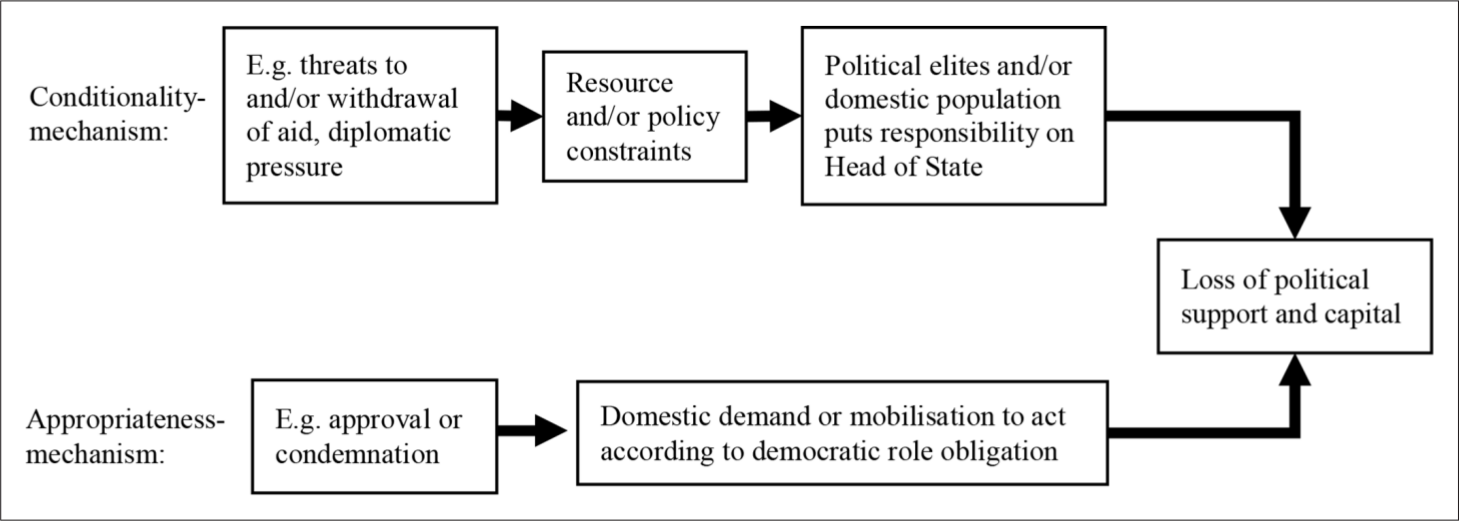
Mechanisms of the Logic of Conditionality and the Logic of Appropriateness.
The two logics of social action are not without problems, however. Although scholars working on donor–recipient country interactions make an analytical distinction between the logic of conditionality and the logic of appropriateness (e.g. Koch, 2015), empirically they are not mutually exclusive. On the contrary, as humans and their motivations vary, donors in fact often use both logics as complementary – for instance, when they withdraw aid and justify this by condemning non-democratic behaviour of the recipient regime in a press statement. Similarly, implied conditionality might lurk behind every public donor appeal to democratic behaviour. How then to separate leverage from linkage and conditionality from appropriateness? The evidence found by the process tracing analysis should make this separation clear as it is gathered to document the entire mechanism and not only donor behaviour, for example, by showing whether opposing domestic actors framed the term limit removal as a breach of democratic standards rather than as something that might provoke donors. Finding evidence that domestic actors emphasised the need to satisfy donors’ demands would hint towards the logic of conditionality. Finding evidence that domestic actors emphasised political elites’ democratic role obligations in contrast would hint towards the logic of appropriateness. Of course, finding both would hint to both logics simultaneously.
In order to evaluate the effectiveness of international democracy promotion, it is necessary to also assess how the logic of conditionality and the logic of appropriateness interacted with domestic explanatory factors. Two major explanations stand out from the scholarly literature on Muluzi’s term limit circumvention bid. First, the literature highlights the importance of within- and between-party power play. In a cross-case comparison of party coherence and fractionalisation, Von Doepp (2005a) shows that political parties in Zambia and Malawi fractionalised and reduced the chances for a successful term limit circumvention, while the contrary holds for Namibia. His analysis is seconded by other studies (Dulani and Van Donge, 2005; Meinhardt and Patel, 2003). The general theoretical implication emanating from this is that political support within the ruling party as well as among the ruling party and its allied parties eroded and ended Muluzi’s third term bid.
Second, judiciary institutions played a role during Malawi’s term limit struggle. Although Dulani and Van Donge (2005) and Von Doepp (2005b) see the role of the Malawian High Court as less pronounced overall, Meinhardt and Patel (2003: 17) indicate that Malawi’s courts acted as important safeguards during the third term debate. This suggests the theoretical implication that judiciary institutions act as important veto players in term limit struggles.
Methodological Approach: Process Tracing
The goal of this case study is to assess to what extent donors effectively employed instruments of the logic of appropriateness and of the logic of conditionality in Muluzi’s third term bid. In order to investigate the role of international actors, this case study employs deductive process tracing as “an analytic tool for drawing descriptive and causal inferences from diagnostic pieces of evidence – often understood as part of a temporal sequence of events or phenomena” (Collier, 2011: 824). It follows the approaches presented by Trampusch and Palier (2016) and Mahoney (2012), as applied by, for example, Busetti and Vecchi (2018).
Table 1 presents causal process observations (CPOs) from the theoretical framework of the logic of conditionality and the logic of appropriateness as well as from the rival explanations based on party fractionalisation and veto player role of judiciary institutions. CPOs are observable implications derived from the theoretical framework and can be seen as its operationalisation (Mahoney, 2012: 571). They specify the events and phenomena that theoretically should be observed and vary according to whether they are necessary or sufficient conditions – or both or neither – to confirm the theoretical explanation. Based on this variation, the CPOs are then checked against the case evidence during the analysis. Assessing the CPOs in light of their evidence provides the foundation for the overall assessment of the theoretical framework and its explanatory power. Appendix 1 provides additional information on how the CPOs in Table 1 as well as their categorisation as necessary or sufficient were derived.
Theoretically Derived CPOs.
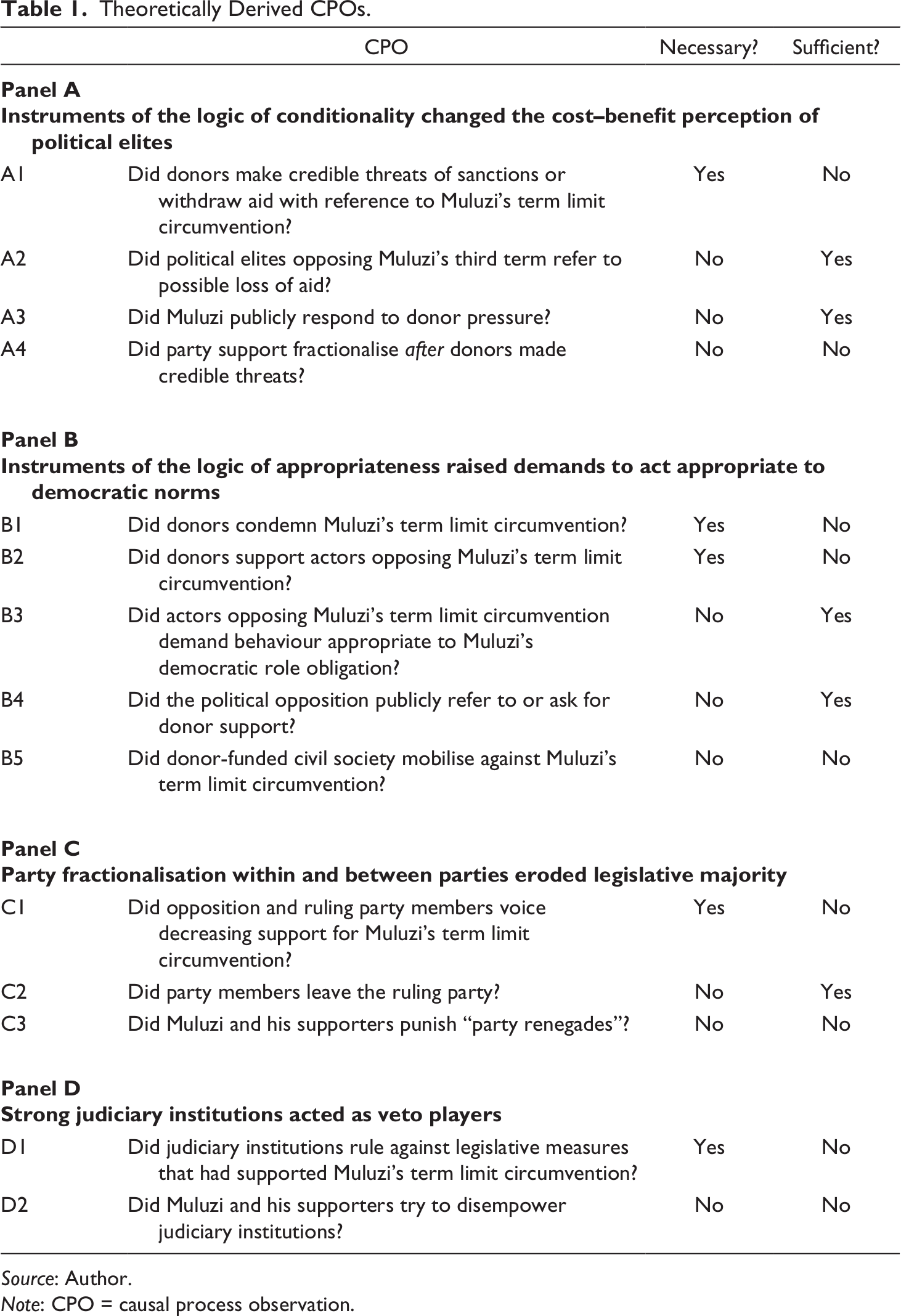
Source: Author.
Note: CPO = causal process observation.
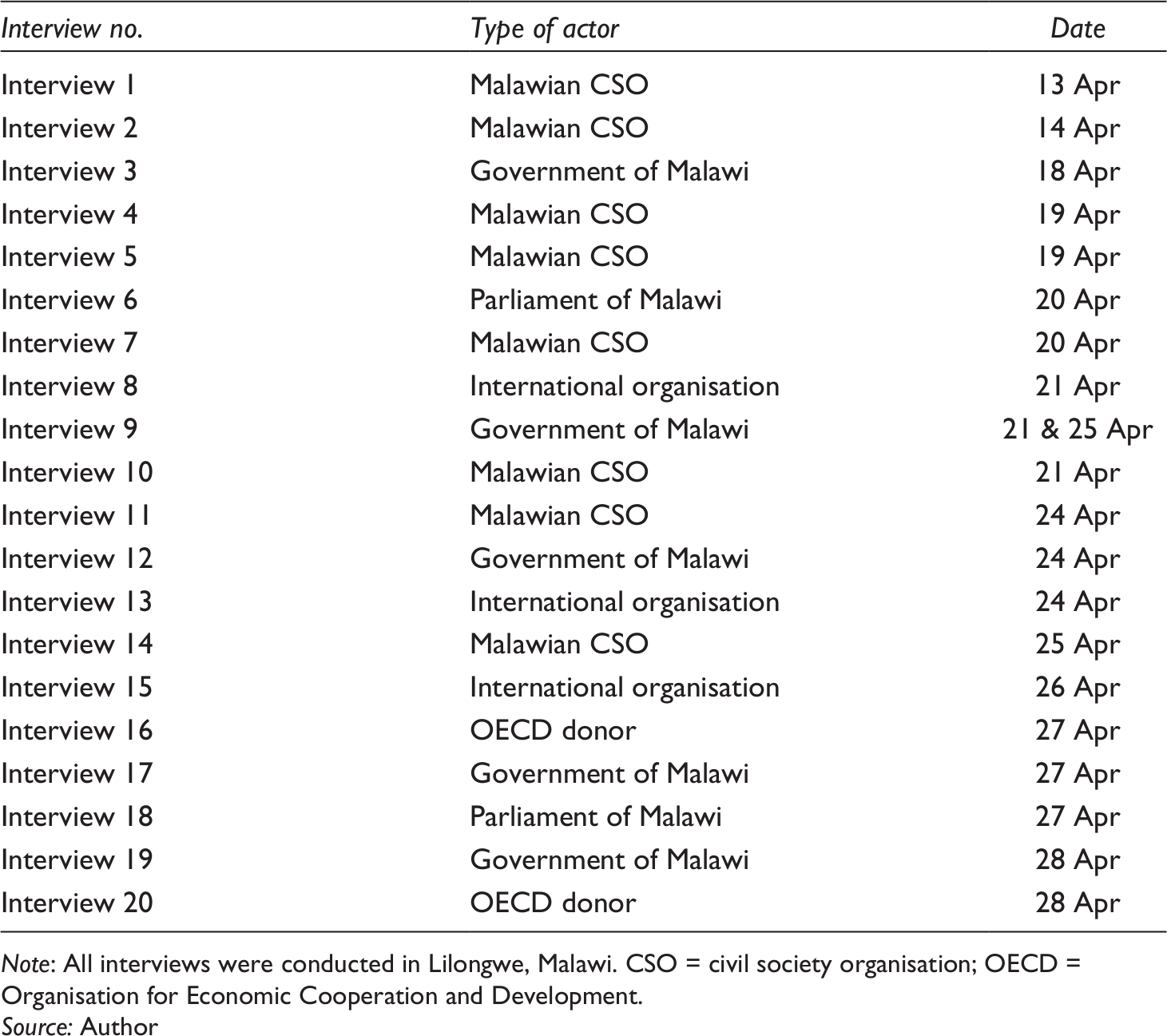
The next section analyses the case evidence for these CPOs. Data used to carry out the process tracing analysis stem from a text analysis of primary media sources. Additional data were retrieved from semi-structured interviews conducted in Malawi in April 2017 with representatives of civil society organisations (CSOs), church leaders, politicians, and state officials (see Appendix 3).
Analysis: Muluzi’s Attempted Term Limit Circumvention, 1999–2003
Malawi transitioned peacefully from autocracy to democracy in 1994. The constitution enacted at that time specified in Article 85 that the President of the Republic of Malawi may serve only for two five-year consecutive terms. Muluzi, co-founder of the political party United Democratic Front (UDF), became the first president of the new republic. Malawi’s voters re-elected him in 1999 for a second, final term.
Muluzi’s attempted term limit circumvention can be structured into three distinct phases. The first phase ranges from 1999 to April 2002 and concerns the preparations Muluzi and his supporters carried out to set up a favourable institutional environment beforehand. During the second phase, from May to July 2002, Muluzi and his supporters started their first attempt by introducing the Open Term Bill, a bill to abolish the constitutional term limit provision entirely. The third and final phase connects to the failure of this attempt. It starts in July 2002 and ends in March 2003. During this final phase, Muluzi and his supporters pushed a recycled version of the Open Term Bill. The so-called Third Term Bill would have changed the constitutional term limit provision from a two-term limit to a three-term limit.
One of the goals of process tracing is to interweave clear and transparent reasoning on causal mechanisms with the temporal chain in which events unfold. Hence, the following analysis is structured by the different temporal phases of the term limit circumvention attempt. The major events taking place are briefly described for each phase.
The Set-Up Phase (1999–April 2002)
Soon after Muluzi’s re-election in 1999, first rumours circulated that he planned to run for a third term (Morrow, 2006). In the two and a half years leading up to Muluzi’s circumvention attempt, he and his supporters tried to alter Malawi’s institutional landscape in such a way to make constitutional changes easier. An important step in this was to give the speaker of Parliament the power to expel MPs if they joined any political organisation after being elected, even if outside of Parliament. This would ensure party cohesion of the UDF. In June, Parliament passed the respective Amendment Act, and the speaker of Parliament expelled seven renegade UDF MPs who had formed the National Democratic Alliance (NDA), a pressure organisation with the expressed goal of lobbying against another term for Muluzi. When the Malawian High Court turned this, Parliament passed a motion in November to remove three of its judges (Dulani and Van Donge, 2005). Throughout these first developments, Muluzi did not officially announce his intent to run a third time for president. But eventually, in March 2002, Muluzi supporters officially formed a committee with the goal to advocate for the removal of the term limit (Banda, 2002).
Conditionality Instruments
Throughout the set-up phase for Muluzi’s term limit circumvention, the relationship between donors and Malawi had gradually worsened. Donors had started to demand more transparency and accountability on the side of Muluzi’s government in the late 1990s (Brown, 2005). Because they did not see their demands met, they started to withdraw aid. The United States and Great Britain suspended sizeable amounts of their development assistance at the end of 2001, and so did the European Union (EU), who also demanded a refund of aid that had already been disbursed. After a diplomatic fallout with the Government of Denmark about how the Muluzi government used aid, the Danish envoy was forced to leave and Denmark decided to withdraw all its aid (Africa Research Bulletin, 2001). Resnick (2013: 114) estimates that donors suspended US$23 million in total in 2001. From March to April 2002, the International Monetary Fund and the African Development Bank (AfDB) also decided to withhold funds due to a lack of transparency and allegations of corruption (Africa Research Bulletin, 2002a). However, only Great Britain and the AfDB linked their withdrawal – although vaguely – to Muluzi’s attempts to twist the institutional landscape of Malawi during this phase. All other donors linked their aid cuts to general mismanagement and corruption. While the AfDB referred to attempts by Muluzi and his supporters to curb the authority of the judiciary (Gama, 2002), Great Britain cited general “political violence” (Africa Research Bulletin, 2001: 15007c) and the impeachment of the High Court judges that Parliament had sanctioned earlier ( Daily Times, 2002).
Appropriateness Instruments
In general, evidence for the effectiveness of appropriateness instruments during the first phase of the circumvention attempt is weak. Throughout the first phase, donors did not issue any statements that approved or disapproved of Muluzi’s course. However, the logic of appropriateness in democracy promotion does not work only through official statements by donor governments. In fact, a large part of it concerns the support of democratic actors within countries. Through this channel, donors indirectly played a role in this first phase through supporting CSOs and non-governmental organisations (NGOs) through funding. Interviewed civil society representatives argued that their organisations would be incapable of carrying out their work without foreign funding (personal interviews 6, 14). An interviewed civil society activist summarised it by stating that “for us to carry out the awareness campaigns, they [the donors] were pumping financial resources, so that we keep on going” (personal interview 11). Already in this first phase, many civil society actors, and especially faith-based organisations (FBOs), kept a close watch on political developments. They became aware that “what we [CSOs] need to do now is to go on the ground, raise public awareness so that people can know what is the real agenda behind this [Muluzi’s third term bid]” (personal interview 11). Among other instances, the Church of Central Africa Presbyterian (CCAP) – which had also played a major role in Malawi’s democratic transition – issued a letter cautioning against the erosion of democracy in general, and a softening of the presidential term limit more specifically, in April 2001 (Morrow, 2006: 93). Civil society also reacted to the removal of the seven renegade UDF MPs. For instance, the Public Affairs Committee (PAC), an umbrella CSO for civic affairs comprising several FBOs across different congregations, called on the High Court to take a ruling on the Amendment Act that had given the speaker of Parliament the power to expel MPs in the first place (Dulani and Van Donge, 2005).
Party Fractionalisation and Judiciary Institutions
The founding of the NDA by the UDF party members attests to the fact that first rifts within the UDF had already appeared in the set-up phase to Muluzi’s circumvention attempt. The founding of the NDA was traced back to a reshuffle of Muluzi’s cabinet. The NDA’s founder was among the ministers who were sacked (Agence France Presse, 2001). The Amendment Act, which vested the power of declaring vacant the seats of MPs who joined political organisations even if these organisations were outside of Parliament, was a measure directed against the NDA (Von Doepp, 2005a). Just after the enactment of the amendment, seven MPs who had joined NDA were expelled from Parliament, indicating that Muluzi and his supporters sensed that party fractionalisation could destroy the necessary majority needed to pass the Open Term Bill.
Judiciary institutions played an important role during the set-up phase. In a strongly articulated ruling, the High Court vetoed the Amendment Act, and reinstated the MPs who had joined the NDA to their parliamentary seats (Dulani and Van Donge, 2005). As Von Doepp (2005b) emphasises, this effectively meant that Muluzi had to fear for parliamentary majority when tabling the Open Term Bill later; because of the High Court’s ruling, a pressure group with the expressed goal to prevent a third term was now represented in Parliament. Because the Open Term Bill was defeated in July 2002 only by a slim margin – it was only three votes short – the fact that the High Court did not give way proved crucial a few months later.
Nevertheless, at the same time, the vulnerability of the High Court also surfaced in this first phase. It was not able to veto an act that restricted NGOs from engaging politically and required them to register, for instance. Most importantly, Parliament passed a motion to remove three of its judges in November in retaliation (Dulani and Van Donge, 2005). This emphasises the vulnerable position of judiciary institutions in the Malawian political context back then, as echoed by broader analyses (e.g. Von Doepp, 2005b).
The Open Term Bill (May–July 2002)
Muluzi’s term limit circumvention started in earnest in late May 2002 when the Open Term Bill was officially gazetted (Mponda, 2002), and when Muluzi declared all demonstrations concerning the term limit question illegal (Integrated Regional Information Network [IRIN], 2002a). At the same time, Muluzi and his supporters started to buy the support of opposition MPs and other influential public figures such as traditional authorities (personal interview 11). The Open Term Bill was eventually tabled in Parliament in early July; however, its passing fell short on a very small margin of three votes.
Conditionality Instruments
At the time of the gazetting and tabling of the Open Term Bill, Malawi’s major donors had already suspended much of their assistance to Malawi. Malawi’s Minister of Finance acknowledged publicly that the Muluzi government was hit hard by the withdrawal of donor aid. In July, he stated before Parliament and on air that the government’s budget would last only until December (Agence France Presse, 2002b). Despite this, the EU exerted more pressure in demanding back aid that had been allocated previously but had been misused (Associated Press, 2002b). Opposing CSOs specifically asked donors to exert such pressure on Muluzi’s government. Knowing that
Malawi is donor-dependent, we [Malawian CSOs] started influencing the donors who fund government to also start speaking the language of our Constitution. So they [the donors] can add pressure to the campaign [against a third term]. […]. They were able to meet with the government. They would threaten not to pour out funding and that was adding some pressure. (Personal interview 11)
In this dire situation, the Malawi government publicly stated that it aimed to decrease dependency on traditional donors (Xinhua, 2002). At the same time, traditional donor governments and organisations could not entirely ignore the disastrous famine that held most Southern African countries in its grip. Hence, project-targeted aid and aid for humanitarian relief was forwarded. Between June and July, the United States Agency for International Development (USAID) issued US$14.6 million to cope with the famine situation in Malawi. Germany and Italy cancelled parts of Malawi’s debt, but linked this with a warning towards the Muluzi government to adhere to democratic practices (Africa Research Bulletin, 2002b).
Despite this, there is not much indication that donor conditionality already played an important role in the political calculus of the MPs. During the session in which Parliament discussed and voted on the Open Term Bill, only one speaker warned: “Yes, let us be constructive in our positions. But we must never allow ourselves to be donor driven” (National Assembly of Malawi, 2002: 81).
Appropriateness Instruments
While donors scarcely made use of public statements during the set-up phase, this changed during the second phase. Donor statements, however, focused on the manner in which the Open Term Bill was rushed to legislation rather than on the actual content of the bill. Donors thus reacted more to Muluzi’s ban on demonstrations than to the Open Term Bill itself.
The United States was the first to issue a public statement that strongly urged “a process of careful consideration of this proposal that provides for the open and unhindered peaceful participation and expression of views of all Malawians” (Africa Research Bulletin, 2002c: 14889A). This was followed, days later, by calls of the British High Commissioner to enable a wider debate. About a week later, the EU also publicised an official statement that acknowledged the right of Malawi to amend its constitution, but urged the Muluzi government to ensure a “wide and informed debate on this important issue conducted openly and with full freedom of expression” (Integrated Regional Information Network [IRIN], 2002c). Muluzi responded in public that the “third term issue” was not the “business” (Associated Press, 2002a) of donor governments, and that he refused to be dictated to. This defiant reaction indicates that he saw the donor statements as threatening to the success of his third term bid.
In the initial aftermath of the defeat of the Open Term Bill in early July, the relationship between donors and the Muluzi government relaxed slightly. Great Britain declared through the British High Commissioner that European donor governments would at some point resume their assistance. However, he also stressed that bilateral donors were reluctant to disburse aid not because of lacking programme implementation, but foremost because of Malawi’s bad record of governance and accountability (Chafunya, 2002).
Civil society actors, too, played a role in this second phase. They reacted strongly negatively towards Muluzi’s move to ban demonstrations. As in the first phase, it was mostly FBOs that led the movement against Muluzi’s third term (African Church Information Service, 2002), but more NGOs and CSOs followed suit this time. Church organisations as well as CSOs issued statements that sharply condemned the Open Term Bill, and reminded of the role of civil society during Malawi’s democratic transition. Like donors, they particularly attacked the ban on demonstrations, calling for a broader and open debate (Ross, 2004). Muluzi’s ban on demonstrations became a crucial issue in the term limit debate when the Roman Catholic Church in Malawi and the Law Society – a non-governmental association of legal experts – called on the High Court to produce a ruling concerning the ban (Mponda, 2002).
Opposition by civil society played an important role for the political calculus of the MPs of Malawi’s parliament. That the role of the civil society as a voice of the interests of the people was a bone of contention during the discussion in Parliament indicates this. MPs arguing against the bill justified their opposition by stating that “it has been rejected by the entire civil society” (National Assembly of Malawi, 2002: 32). Another MP argued that the civil society voiced the interests of the people and as such should be taken into consideration by the MPs:
We should be able to look after the interests of the people of Malawi. The whole country is listening. They have come to suggest. The civil society, Law Society of Malawi, the Churches and all the stakeholders have spoken. The Public Affairs Committee and all those that were in the initiation of this Constitution have come on to plead with us and everybody not to change the Constitution. […]. We use our power wrongly and as a result we end up with wrong conceptions. (National Assembly of Malawi, 2002: 49)
MPs in favour of the bill countered these arguments by arguing that the “clergy, academic, single issue NGOs and other un-elected leaders from civil society” have no “higher political entitlement in a democratic society than elected representative[s]” (National Assembly of Malawi, 2002: 59). They stated that “there is danger and fear being instilled in the minds of the people of this country by some of the organisations” (National Assembly of Malawi, 2002: 63), and further, that CSOs do not voice the popular preferences but “are targeting their pay master. The donors. And not the people of Malawi to give them more reason to fund them. Most of our NGOs are money driven” (National Assembly of Malawi, 2002: 81). In conclusion, the extent to which the role of the civil society was discussed in Parliament testifies to the relevance its opposition had for many MPs.
Party Fractionalisation and Judiciary Institutions
Party fractionalisation actually played into Muluzi’s hand during this second phase. The slim margin by which the Open Term Bill failed speaks to the contingency with which complex social network dynamics infuse political processes. As noted, the Open Term Bill fell only three votes short of its necessary majority. Party coherence was forcibly upheld within the UDF, to ensure that all UDF MPs voted in favour (Von Doepp, 2019: 296). Additionally, a rigorous vote-buying campaign (personal interview 11) ensured fractionalisation of the two opposition parties. Heavy weight MPs of the opposition parties, Alliance for Democracy (AforD) and Malawi Congress Party (MCP), joined those who spoke out in favour of a removal of term limits despite earlier statements to the contrary (Mnela, 2002). That the Open Term Bill was moved as a Private Member’s Bill from an opposition party member (Mponda, 2002) and that its vote was only three votes short testify to how much Muluzi and the UDF had successfully co-opted political opposition.
Just as in the first phase, the role played by judiciary institutions in the second phase emphasises the fragility of formal law in preventing democratic backsliding. After CSOs had called upon the High Court to rule on Muluzi’s ban of demonstrations, the High Court was not slow to react and judged the ban unconstitutional in early June (Agence France Presse, 2002a). However, only two days later, the High Court threw out its initial ruling on the application of a Muluzi supporter, citing irregularities (Integrated Regional Information Network [IRIN], 2002b). These had manifested when the applicants for the initial injunction had demanded a new judge after the first judge, to whom they had presented their claims, had refused them. In either case, this serves as an indicator for how easily the judiciary institutions of Malawi could be swayed at the time of Muluzi’s term limit attempt.
The Third Term Bill (July 2002–March 2003)
Despite the defeat of the Open Term Bill, UDF cadres already agreed in July to push Muluzi’s third term bid through, with a revised bill that would increase the constitutional limit from two to three presidential terms (Dulani and Van Donge, 2005). From July to September, the political climate in Malawi turned more tense as political violence and intimidation was on the rise. A campaign of “political silencing” was initiated by the UDF, “whereby everyone who had stood up to advocate against the agenda [that is, the third term], would have been threatened, would have been beaten up” (personal interview 11). Much of the political violence and intimidation was perpetrated by the Young Democrats, a militant youth wing of the UDF. In August, they clashed with supporters of the NDA in Southern Malawi and attacked the NDA leader at a roadblock (Africa Research Bulletin, 2002d). In mid-September, Muluzi renewed the demonstrations ban, and the police oppressed anti-third term protesters, but spared protests by Muluzi supporters (US Department of State, 2003).
As political support for Muluzi further crumbled, a surprise ensued in October. The Third Term Bill had been officially gazetted on 6 September to be discussed at the next parliamentary session starting in October, but in a surprising move, Muluzi, in his opening speech, asked MPs to defer discussions on the bill (Agence France Presse, 2002e). Eventually, the parliamentary session closed in the beginning of November without having tabled the Third Term Bill (Agence France Presse, 2002g). After the parliamentary session, it was widely expected that the UDF was still busy buying political support and would rush the bill through in an emergency session (the Malawian Parliament meets regularly only twice a year) in December (Namingha, 2002). However, the expected emergency session did not take place during December. To the surprise of the political and civil society opposition, Muluzi eventually called an emergency session on 27 January (Mponda, 2003a). However, two days of heated debate proved that the bill could not garner enough support and was sent back for revision without a specified time frame to Parliament’s Legal Affairs Committee (Integrated Regional Information Network [IRIN], 2003). In early March 2003, Muluzi began denouncing publicly that he ever wanted to run a third time for president and instructed the Young Democrats to stop political violence (Agence France Presse, 2003a). The defeat and failure of Muluzi’s third term bid became final on 30 March, when he announced Bingu wa Mutharika as the sole UDF presidential candidate (Agence France Presse, 2003b).
Conditionality Instruments
In the final phase of Muluzi’s circumvention attempt, donor pressure became stronger due to better general joint coordination between donors. Because they had suspended their aid already, donor governments had not much to cut back on. However, they were able to exert indirect leverage through the IMF and the World Bank. Malawi had been in assessment with these since April, and bilateral donors had announced they would make their own assessment dependent on these results (Gama, 2002). There were talks between the Muluzi government and the IMF and the World Bank in September, and according to Malawian media and opposition politicians, Muluzi stopped the discussion of the Third Term Bill in Parliament’s October session because of these talks ( Chronicle, 2002d; Namingha, 2002).
Anticipation of international and bilateral donors’ reactions played a more overt role in Parliament during discussions on the Third Term Bill than in the earlier discussions on the Open Term Bill. One MP outlined what role it played for his political calculus, clearly stating that he
was interested in the [TV news] yesterday when we were assured by the Resident Representative of the IMF that he will not interfere in any political aspirations […]. Mr Speaker, Sir, with this fact, I stand with conviction that [the constitution] will be amended by having the two terms replaced by three terms. (National Assembly of Malawi, 2003: 23)
Another MP favouring the Third Term Bill argued that “nobody, […], outside this Honourable House should dictate on us what to do or on what to follow. Not even our donors. We are poor yes […], but that should not mean that we can be dancing to their tune every now and then” (National Assembly of Malawi, 2003: 22). Contrasting the earlier discussions on the Open Term Bill, a recurrent motive in the discussions on the Third Term Bill was the allegation that in fact Malawian opposition was behind donor conditionality. The opposition would “lie to donors and tell them not to give money because they want Malawi to go to dogs” (National Assembly of Malawi, 2003: 37) and the opposition would be “assisted by people from outside [donors] by threatening people not to vote what they want to vote” (National Assembly of Malawi, 2003: 38).
Aid conditionality also played a more overt role in the public debate during this final phase. Leading figures of Malawian public discourse, representatives of CSOs, as well as political analysts agreed in their judgement that Malawi’s economy “will […] be plunged into further turmoil with donors pulling out […] should the third term bill be tabled and passed” ( Chronicle, 2003). Finally, statements of former UDF MPs, who feared that the passing of the Third Term Bill would halt aid and hence declared their opposition (Integrated Regional Information Network [IRIN], 2002d), provide another strong indication that aid conditionality played a role especially in the final phase of Muluzi’s third term attempt. Thus, even if Muluzi had not factored donor responses into his own decision-making, it seems that this was at least one of the factors that exerted pressure upon the UDF’s cohesion as a political party in the final phase.
Appropriateness Instruments
Just as during the Open Term Bill phase, bilateral country donors disapproved of Muluzi’s course of action during the Third Term Bill phase. However, their statements were sharper this time and gave more explicit support to civil society actors protesting against Muluzi’s term limit circumvention.
When Muluzi renewed his ban on demonstrations, donors reacted quickly after only one day with a statement. Jointly released by the EU, the United States, Great Britain, Germany, and Norway, it “strongly urge[d]” that the government followed a consultation process free of intimidation “in accordance with democratic principles,” noted with “regret” the rise in political violence and intimidation, and “encourage[d] all those involved in Malawi’s democratic development to play their part in curbing political violence and intimidation […]” (Agence France Presse, 2002c). However, such “appropriateness statements” worked not entirely in and of themselves, but implicitly drew on conditionality for impact. As one interviewee summarised: “From the comments that the donors were making – discouraging Parliament from going ahead assenting that [that is, the Third Term Bill] – you could read into them withdrawing their support” (personal interview 11).
Civil society, too, reacted more strongly. Under the leadership of the CCAP, numerous CSOs, NGOs, and FBOs, came together and formed the Forum for the Defence of the Constitution (FDC) (Dulani, 2011). Jointly they organised a massive demonstration on 1 November in Blantyre just as Parliament was finalising its October session. Despite police presence, Muluzi supporters clashed with the anti-third term protesters, and riot police dispersed the demonstration (Agence France Presse, 2002h). Demonstrations were also held during the course of January in Malawi’s major cities, particularly during the emergency session of Parliament in which it debated the Third Term Bill (Mponda, 2003b). Protests in this third and final phase were generally broader and referred to democratic norms and standards. Academia staff issued sharp statements against “anti-democracy forces” ( Chronicle, 2002c), and students marched in protest (Associated Press, 2003). Comments in the media demanded that “democracy needs to take place” (Makaniki, 2002), and Church organisations emphasised the harm a change of the term limit would do to political competition and called Muluzi a “dictator” (Mumia, 2002).
The increased activity by civil society clearly played a role for the MPs when they discussed the Third Term Bill. While the MPs were discussing the Third Term Bill during Parliament’s emergency sitting, they noted the large FDC demonstration against the Bill close to the parliament building. According to the House’s Hansard, the MPs acknowledged the FDC demonstration with “loud applause” (National Assembly of Malawi, 2003: 50). According to their statements during the parliamentary discussion, many MPs thought that donors and Malawian CSOs influenced popular attitudes against the Third Term Bill considerably. Donors for instance went “into the village, collect all chiefs together […] and tell them what they want to tell them, including material on the Third Term” (National Assembly of Malawi, 2003: 36), and “churches are becoming partisans and taking side and incite people not to do that and do that” (National Assembly of Malawi, 2003: 64). Of all parts of Malawian civil society, the MPs concerned themselves during their discussion especially with the role of religious organisations. The opposition of church organisations made many of the MPs uncomfortable. MPs in their discussion contributions noted that representatives of civil society, especially of the church organisations, were attending the parliamentary session in the gallery stand, and that “they have come here because they feel concerned about this Bill” (National Assembly of Malawi, 2003: 11). Another MP stated: “I don’t want us to appear to be against the church because we are part of the church and we are the church” (National Assembly of Malawi, 2003: 69).
Muluzi responded to the increased pressure by lashing out towards donors and domestic civil society during rallies of his country tour for grassroots support (Mwase, 2002). In one instance, he stated that “donors should keep their money if they want to cause chaos and commotion by funding demonstrations” (Agence France Presse, 2002d). Public announcements by opposition parties that they were now lobbying donor countries for support also signify that Muluzi lost considerable political support in the third phase (Namingha, 2002).
Party Fractionalisation and Judiciary Institutions
After the defeat of the Open Term Bill in July, Muluzi’s support within his own party as well as within the opposition parties crumbled.
The loss of party support had already started in August, when a prominent founding member of the UDF resigned from the party ( Chronicle, 2002a). However, it accelerated in October, after pressure from domestic civil society and international partners had mounted in September. In early October, the UDF MPs formed an informal within-party group opposing Muluzi’s third term bid (Jamieson, 2002). When the FDC issued a statement against Muluzi’s circumvention attempt, a number of UDF MPs also signed it (Dulani and Van Donge, 2005). They were expelled from Parliament; at least ten more UDF MPs allegedly opposed the Third Term Bill but were too afraid to voice this publicly (IRIN, 2002d). In early October, a leading figure of the faction of the opposition party MCP, who had voted in favour of the Open Term Bill in July, changed tack and declared his opposition in public, citing the popular will (Jamieson, 2002).
Opposition to Muluzi’s third term attempt grew broader towards the end of its final phase, when top-ranking politicians, such as the Party Vice President and the State Vice President, attempted to convince him to back down (Matonga, 2016). Finally, during the emergency session in January 2003, scuffles disrupted the debate on the second day, indicating how much political support for Muluzi had eroded since July (IRIN, 2003).
The role of judiciary institutions during the third phase of Muluzi’s attempted term limit circumvention was somewhat less prominent than during the first two phases, but also more clearly against the course of Muluzi’s actions. An important action of the High Court in the third and final phase was its clear injunction against Muluzi’s ban on demonstrations as “unconstitutional and unreasonable” in late October (Agence France Presse, 2002f). This was an important signal for civil society that then started to ramp up protests and demonstrations. The court ruling propelled the FDC’s decision to organise the massive demonstrations of early November (Associated Press, 2002c), and also cleared protest activity later. The High Court was also active in reinstating expelled MPs back to their parliamentary seats, which was important in ensuring that Parliament was not cleansed by third term-supporters. The internal rifts within the UDF as well as between the UDF and opposition parties remained until January, so that no majority on the Third Term Bill could be gained.
Discussion
The evidence gathered through process tracing shows that international actors played an important role within a “chain of causes” connecting all the investigated factors. Clearly, party fractionalisation was the proximate cause in this “chain of causes” that prevented Muluzi’s term bid from success. However, the radical difference between the near passing of the Open Term Bill and the complete withdrawal of the Third Term Bill even before voting on it suggests that Muluzi had lost much political influence in between. More mediating factors must explain this proximate cause, and this is where the influence of international actors comes into play. First, the erosion of party support was at least partly due to donor conditionality. Second, to another extent, it was due to strong civil society opposition, which in turn was materially dependent and normatively supported by donors. This testifies to the mechanism of the logic of appropriateness. Third, while judiciary institutions had no proximate influence, through, for instance, vetoing the proposed constitutional amendments outright, they nonetheless played the mediate role of shielding opposing MPs from being expelled from Parliament and thus enabled further erosion of intra- and inter-party support.
There was not the one decisive factor that determined in a mechanistic fashion the outcome of Muluzi’s attempted term limit circumvention. However, the analysis found evidence that international intervention, civil society opposition, and judiciary safeguarding were mediate and party fractionalisation proximate causes. Table 2 provides an overview of the assessment of the evidence that is discussed in more detail in Appendix 2.
Assessing the Evidence.
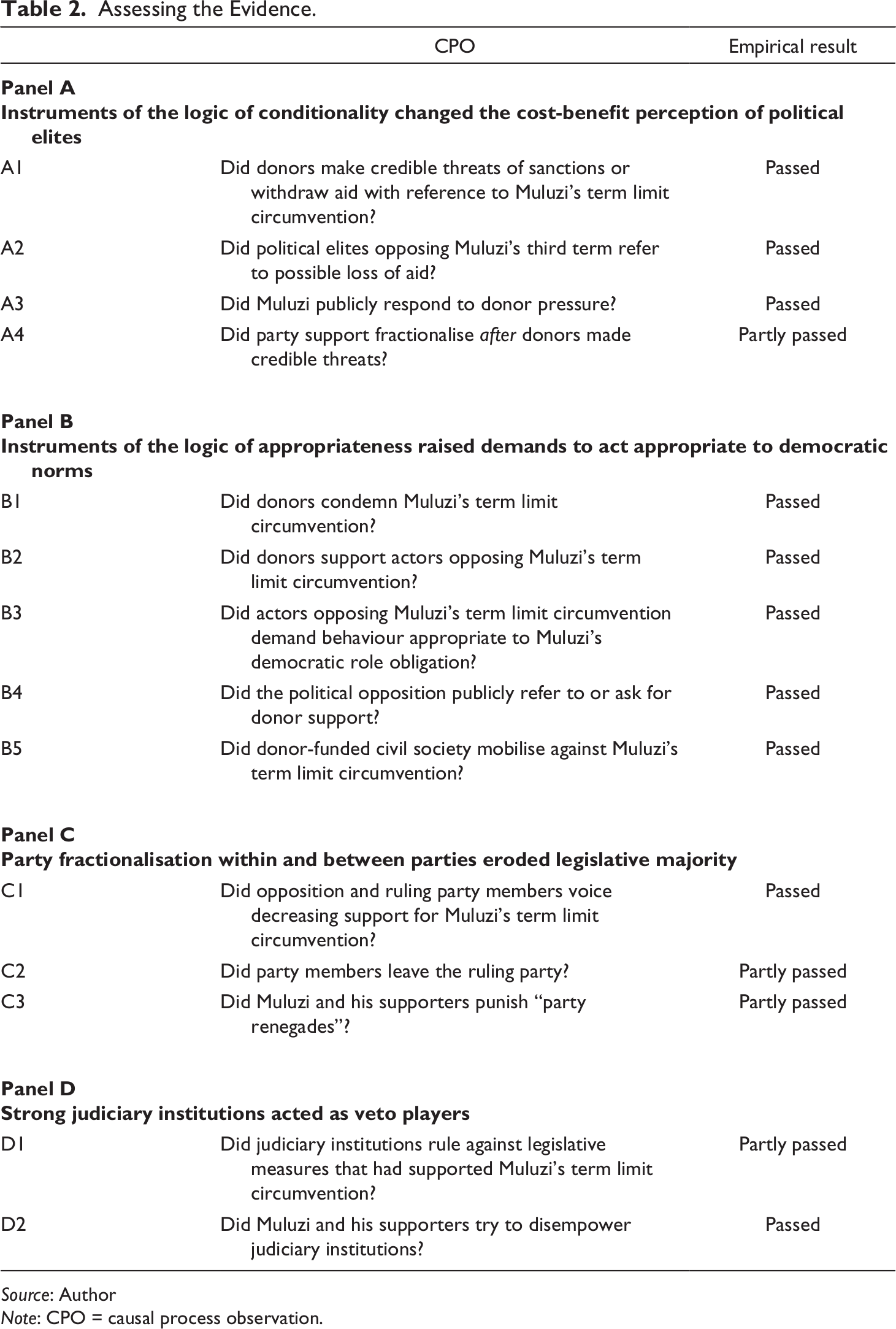
Source: Author
Note: CPO = causal process observation.
The analysis finds that international donors played a role through both leverage based on the logic of conditionality and linkage based on the logic of appropriateness. However, what role did linkage with international donors play for civil society, and how exactly did international donors second and encourage their mobilisation? Interviews with Malawian civil society representatives suggest three ways in which the linkage with donors played out. First, donor funding was key in keeping CSOs operational. Several interviewees of local CSOs stated that the vast majority of their funding comes from donors (e.g. personal interviews 11; 1). This of course also applies for CSOs that are Malawian chapters of international NGOs and even applies for FBOs where one interviewee put the estimate of donor funding at 80 per cent to 90 per cent, even though FBOs can rely more on member funding than single-issue CSOs (personal interview 14). Much of this funding was supplied in the course of democracy assistance projects. Organisations that took over leading roles in the civil society opposition to Muluzi’s third term bid received such funding through, for instance, the United Nations Development Programme (UNDP)-coordinated Democracy Consolidation Programme (Scanteam, 2010). For CSOs, it was important that such funding was earmarked sufficiently broadly: “The funding was not entirely like ‘This is what you are supposed to do’, but they gave us funding to strengthen democracy. Then we could actually take it and apply it in our context” (personal interview 14). Such funding helped to pay costs for materials like poster, leaflets, and flyers, but also financed venues for meetings, conferences, and prayers during which FBOs spoke out against a third term. They also financed community awareness-raising and sensitisation, especially via the radio, as well as community consultation: “Their [donors’] funding is what helped us to go around and solicit the views of the people” (personal interview 14).
Second, but to a lesser extent, donors provided technical assistance and expertise to some CSOs that were particularly central like the PAC: “Apart from that [funding], the technical assistance is also what helped to build the capacity of our people, for example to do research. […]. Especially bodies like PAC received such help” (personal interview 14). Of course, technical assistance in the case of the third term debate was more limited than technical assistance in less politicised issues, and at times only came down to networking (personal interview 4) and advice: “We could have meetings with them [donors] and they would advise us on what steps we should take” (personal interview 11).
Third, through issuing statements and appeals, donors provided additional weight and shielding to civil society. Therefore, CSOs like PAC were proactively and publicly asking for donor support ( Chronicle, 2002b), as an interviewed civil society representative argued: “We were also soliciting the support of national and international partners just to add their voice. When donors are speaking [out] well, it actually gives more voice” (personal interview 11). In addition, from the perspective of CSOs, having ties and access to donors also “acts as a shield, it protects you” (personal interview 4). According to this rationale, knowing that organisations could report to donors, the government would refrain from actions against them that are too overt or violent.
In sum, although it is difficult to assess exactly what role democracy promotion based on linkage and the logic of appropriateness played, like public statements and civil society support through democracy assistance, there is evidence that it was important besides donor leverage. Linkage especially came in through democracy aid in the form of funding and technical assistance as well as by providing additional weight and “shielding” to civil society opposition. The extent to which the relation between donors and the Malawian civil society opposition was discussed in public media (e.g. Ligomeka and Kang’ombe, 2002) as well as by MPs attests to the importance that civil society had during the third term bid, and international support, in turn, had for civil society.
A brief look at other cases where term limit circumventions failed puts some restrictions on the result that donors are crucial in struggles over term limits. In many cases, donors did not play a large role. In Burkina Faso in 2014, donors did not take a strong stance and Compaoré’s bid was thwarted by newly emerged social movements instead (Moestrup, 2019). In Niger in 2009, international condemnation had little effect and former president Tandja was eventually ousted by the military (Baudais and Chauzal, 2011). In Nigeria in 2006, strategic interests in the region and the country overrode stronger reactions to Obasanjo’s term limit bid and, in the end, civil society and opposition parties played crucial roles (Gillies, 2007). However, there are some contrasting cases, too. First, in Zambia in 2001, pressure by civil society supported and encouraged by international donors was important in preventing Chiluba from running for a third term, although lack of party support played an important proximate role, too, as was the case in Malawi (Cheeseman, 2019). In the Democratic Republic of the Congo in 2018, former president Kabila stepped down under the pressure of both social movements and international donors (Reyntjens, 2020). This comparison does not give cause for much enthusiasm. However, it also suggests that civil society, and especially less formalised social movements, can act as focal points for popular protest and opposition, and the case of Malawi provides insight into how important support by international actors for these can be.
Conclusion
The support by external donors was important in championing the role of the Malawian CSOs as “bulwarks against presidential usurpation of power” (Dulani, 2011). A logic of appropriateness through linkage, especially via civil society support, assisted the internalisation and defence of democratic norms, attitudes, behaviour, and standards. In addition, the anticipation of a worsening relation with donors through leverage and instruments of the logic of conditionality changed the cost perception of political actors. For all the same, in a situation in which donors had already cut back much aid citing general mismanagement, support for domestic democratic actors proved to be crucial.
An important lesson emanating from this case study is that donors should not cut back on long-term instruments that function according to the logic of appropriateness. Supporting democratic actors in partner countries, such as democratic civil society and non-government organisations and associations, democratic parties, and the media, financially and rhetorically, in order to help disseminating democratic ideas, norms, attitudes, behaviour, and standards, plays an important role in defending and deepening democracy.
Finally, concerning the dynamics around struggles over term limits specifically and political reform in general, the analysis points to the need for more rigorous research on the social networks in which political action and decisions – the networks of civil society representatives and policymakers – emerge in order to fully discriminate between deep causal and proximate factors. In the case of Malawi, for instance, the analysis shows that eroding party support was only a proximate factor that was substantially increased by strong civil society opposition and a negative response from international donors. More micro- and meso-level analyses are needed for teasing out how and when international democracy promotion, domestic political, and civil society opposition interact with one another.
Footnotes
Appendix 1: Operationalisation of Causal Process Observations
This appendix operationalises CPOs from the theoretical framework under analysis. CPOs are observable implications that should hold if an explanation derived from a theory holds true. A CPO can be necessary, sufficient, or neither. If a CPO is a necessary condition, evidence must be found for it in order for the theoretical framework from which the CPO is derived to hold. Lack of evidence for the necessary CPO strongly disconfirms the underlying theoretical framework, but finding such evidence does not provide confirmation. In contrast, if a CPO is a sufficient condition, finding evidence for it provides some confirmation for the underlying theoretical framework, while not finding such evidence does not necessarily disconfirm the underlying theoretical framework. In other words, the necessary condition CPO has a high true positive and a high false positive rate (known as the “hoop test” in process tracing vocabulary), while the sufficient condition CPO has a low true positive and a low false positive rate (known as “smoking gun test” in process tracing vocabulary). A CPO that is neither necessary nor sufficient is suggestive only (known as a “straw-in-the-wind test” in process tracing vocabulary). For a more detailed explanation, please refer to Busetti and Vecchi (2018: 569).
The theorised mechanisms of the logic of conditionality and of the logic of appropriateness lead to two different observable general implications. According to the hypothesised mechanism of the logic of conditionality, the general theoretical expectation is that external conditionality instruments raised the cost-benefit perceptions of the Malawian political elite. Similarly, for the logic of appropriateness, the general theoretical expectation is that appropriateness instruments mobilised domestic actors opposing a third term to demand that Muluzi adhere to democratic norms, standards, and role obligations. From these two general expectations, a number of more precise CPOs can be derived (see Table 1).
CPOs of the logic of conditionality should show that opposition to Muluzi’s term limit circumvention was fuelled by anticipated and perceived loss of foreign aid (panel A of Table 1). An important necessary CPO for the logic of conditionality is that donors actually made the credible threat to and/or actually withdrew aid (A1). Public statements by opposing political elites that refer to a possible loss of aid in consequence to a circumvention of the term limit are not a necessary indication that conditionality actually worked. They constitute, however, sufficient evidence that conditionality did indeed play a role (A2). The same accounts for public statements to donor pressure made by Muluzi. It is possible that donors exerted pressure on Muluzi without him responding to it publicly. If he did however, it is sufficient evidence that such pressure was indeed put upon him (A3). Finally, if party support for Muluzi fractionalised after donors withdrew or credibly threatened to withdraw aid, this would constitute some evidence that aid conditionality changed the cost–benefit perception of political elites (A4). This would, however, be only suggestive, as the timing could just as well have been coincidental.
CPOs of the logic of appropriateness should in contrast show that donor interventions supported and fuelled demands on Muluzi and his supporters to act appropriately to their democratic role obligations (panel B). For the logic of appropriateness to work, it would have been necessary that donors actually issued condemning statements (B1), and/or that they supported actors opposing Muluzi’s term limit circumvention (B2). If actors opposing Muluzi’s term limit bid made statements calling him and his supporters to their democratic role obligations, this would constitute sufficient and not necessary evidence as alternative explanations, apart from the logic of appropriateness which could explain such statements (B3). Public reference and request by political opposition parties for support from donors would provide ipso facto evidence for an alignment between domestic opposition and external donors (B4). Finally, if donor-funded civil society mobilised against Muluzi’s term limit circumvention, this would constitute suggestive evidence for the logic of appropriateness (B5). Such mobilisation would suggest a localisation of democratic norms that, however, does not exclusively depend on external democracy promotion.
CPOs of party fractionalisation should map the erosion of intra- and inter-party support for Muluzi’s term limit circumvention (panel C). As a necessary implication, public statements about decreasing support of members of the UDF and of opposition parties allied with it should culminate over time (C1). If party members of the UDF left, this would individually provide sufficient evidence for party fractionalisation (C2). If Muluzi and his supporters punished such party renegades, this would suggest that they indeed felt threatened by a loss of party support, but it alone would not prove that party fractionalisation was decisive for the outcome (C3).
Finally, the rival explanation that emphasises judiciary institutions as decisive veto players should necessarily provide evidence that judiciary institutions actually ruled against any measures that aided Muluzi’s third term bid (D1). Similar to the reasoning on C3, if Muluzi and his supporters attempted to disempower judiciary institutions, this would suggest that they regarded a successful bid threatened by them (D2).
Appendix 2: Assessment of Evidence
This Appendix assesses the evidence presented in the analysis against the CPOs derived in Appendix 1 and presented in Table 1. The reader may consult Table 2 as a reference.
Concerning the logic of conditionality, the evidence shows that donors did make both credible threats and actually withdrew aid (panel A). Although some of the aid cuts were related to general governance issues and had happened already before the term limit circumvention entered the domestic agenda, some were clearly timed according to developments in the third term struggle. According to donor statements, these aid cuts were in reference to bad handling of the third term debate by the Muluzi government, such as the ban on demonstrations (A1). Political elites referenced the loss of aid as a negative consequence of a term limit circumvention especially at a later stage (A2). Muluzi, too, responded sharply in public to donor interference, suggesting that he felt pressured (A3). Finally, the CPO that party support eroded after donors had issued credible withdrawal threats passed only partly (A4). The split within the UDF and the founding of the NDA occurred well before donors responded to Muluzi’s third term bid; however, party fractionalisation accelerated especially at a later stage in October 2002 after donors more expressly condemned Muluzi’s attempt to pass the Third Term Bill.
All CPOs concerning the application of a logic of appropriateness pass (panel B). Donors did condemn Muluzi’s attempted term limit circumvention and the increase in political violence to which it led (B1). They supported CSOs and NGOs opposing a third term before as well as during the third term struggle (B2). These organisations mobilised especially during the later stage of the third term bid (B5). They lobbied donors for support in the third term struggle and even the political opposition publicly stated to ask donors for help (B4). Finally, especially during the final stage in which Muluzi tried to pass the Third Term Bill, CSOs framed their demands in terms of respect for democratic norms (B3).
Party fractionalisation clearly played a role for the outcome of Muluzi’s third term bid (panel C). Increasing lack of support in Parliament was the final proximate factor that stopped both the Open and Third Term Bills from being passed (C1). However, a comparison between the slight margin by which the Open Term Bill was defeated with the total loss of support for the Third Term Bill a bit more than half a year later indicates how decisive an internationally supported domestic civil society opposition was. Importantly, a split on the term limit circumvention had occurred already much earlier when a few UDF renegades founded the NDA before Muluzi started his bid in earnest. This, however, did not effectively deter Muluzi and his supporters from trying to abolish the term limit (C2). Additionally, the punishment of these UDF renegades had already happened early on, and actually seemed to have solidified UDF party coercion during the vote on the Open Term Bill (C3). Likewise, large parts of the political opposition had been swayed into voting in favour of the Open Term Bill. It was only when civil society more vehemently protested against the Third Term Bill and the political violence unleashed by Muluzi’s supporters, and when donors responded jointly with sharper disapproval, that intra- and inter-party support crumbled.
Finally, although judiciary institutions were not strong veto players, they fulfilled an important function of keeping the power balance in Parliament. The CPO that judiciary institutions vetoed legislative measures that eased Muluzi’s third term bid passes only partly (D1). On the one hand, the High Court played an important role in re-instituting expelled dissenting MPs to their parliamentary seats. On the other hand, it was insecure in its judgment on Muluzi’s demonstrations ban and did let Parliament pass a law restricting the scope of political action by NGOs. In addition, the High Court itself, too, was subject to measures to curb its power passed by Parliament (D2).
Appendix 3: List of interviews
| Interview no. | Type of actor | Date |
|---|---|---|
| Interview 1 | Malawian CSO | 13 Apr |
| Interview 2 | Malawian CSO | 14 Apr |
| Interview 3 | Government of Malawi | 18 Apr |
| Interview 4 | Malawian CSO | 19 Apr |
| Interview 5 | Malawian CSO | 19 Apr |
| Interview 6 | Parliament of Malawi | 20 Apr |
| Interview 7 | Malawian CSO | 20 Apr |
| Interview 8 | International organisation | 21 Apr |
| Interview 9 | Government of Malawi | 21 & 25 Apr |
| Interview 10 | Malawian CSO | 21 Apr |
| Interview 11 | Malawian CSO | 24 Apr |
| Interview 12 | Government of Malawi | 24 Apr |
| Interview 13 | International organisation | 24 Apr |
| Interview 14 | Malawian CSO | 25 Apr |
| Interview 15 | International organisation | 26 Apr |
| Interview 16 | OECD donor | 27 Apr |
| Interview 17 | Government of Malawi | 27 Apr |
| Interview 18 | Parliament of Malawi | 27 Apr |
| Interview 19 | Government of Malawi | 28 Apr |
| Interview 20 | OECD donor | 28 Apr |
Note: All interviews were conducted in Lilongwe, Malawi. CSO = civil society organisation; OECD = Organisation for Economic Cooperation and Development. Source: Author
Acknowledgements
The author wishes to thank two anonymous reviewers for their valuable feedback. Special thanks also to Jale Tosun of Heidelberg University, Julia Leininger and Karina Mross of the German Development Institute/Deutsches Institut für Entwicklungspolitik (DIE) for helpful advice, as well as to Gerald Kampani, Principal Editor of the Parliament of Malawi, and to all interviewees in Malawi who provided precious insight.
Declaration of Conflicting Interests
The author(s) declared no potential conflicts of interest with respect to the research, authorship, and/or publication of this article.
Funding
The author(s) disclosed receipt of the following financial support for the research, authorship, and/or publication of this article: Research towards this paper was in part funded by the German Federal Ministry for Economic Cooperation and Development under a research grant on Democracy Promotion.

Author Biography
Email: