



Abstract
This article contributes to the emerging field of research on collaborative governance in crises. It asks how social organisations see their contribution of skills and expertise to tackling a wicked problem such as the Covid-19 pandemic. For this purpose, I interviewed representatives of ethnic Chinese organisations about their work and relationships with the local government in Manchester in 2020 and 2021. Ethnic Chinese organisations are an interesting group because they had early access to knowledge about the spread of the virus and its harmfulness. Collaboration with them could potentially have helped to contain the pandemic in the ethnic Chinese community in the city and beyond. Based on semi-structured interviews with representatives of ethnic Chinese organisations and applying the combined theoretical frameworks of social capital and collaborative governance theories, the study identifies five organisational types in terms of their involvement in collaborative governance efforts.
Introduction
The Covid-19 pandemic posed a challenge to governments and societies in all countries. Sustainable solutions were needed to fight the virus and mitigate its immediate and long-term health, social, economic, and political effects. Immediately confronted with the crisis, most governments concentrated decision-making power in the hands of the executive to ensure the safeguarding of public order and large-scale handling of the epidemiological and health aspects of the pandemic. However, in the long run, more complex social and economic problems, such as unemployment, poverty, homelessness, hunger, mental issues, domestic violence, and loneliness, must be dealt with on the ground. Executive governments neither have the means nor the expertise for this.
In ordinary times, governments would reach out to societal actors, social groups, charities, or individual volunteers, to deal with these problems. Currently, collaborative or network governance is the state-of-the-art approach to dealing with the ever-more complex challenges of our time, including very complex or “wicked” problems that governments and societies face. But is collaborative governance also the best choice in crises? Can a collaborative approach involving a wide range of actors from public administration and society provide effective and feasible solutions under high pressure and uncertainty? Is such collaboration happening in real crises? And how do the involved or potentially involved societal organisations perceive the collaborative effort?
A note on terms: In the research literature, network governance and collaborative governance have many common themes, including the idea of collaborative performance in addressing complex problems but also themes such as trust and power relations, and resource dependencies. However, network governance is more interested in the network properties of the relationship between government and societal actors, while collaborative governance often investigates the processes of deliberation and dialogue, joint efforts, and institutional design (Wang and Ran, 2021). This article takes the latter perspective but takes note of the former where it offers insights into the process of coordinating the various actors in collaborative efforts.
This study aims to contribute to the research literature in several ways. First, it puts previous theory about collaborative governance in crisis to the test, by investigating a group of social organisations and their collaborative experiences during the Covid-19 pandemic. Second, it adds to the literature by investigating how ethnic groups are involved in the process of collaborative governance in crisis. Thirdly, it explicitly asks the societal group about their perception of the process of collaboration with the municipal government in the crisis. Most extant research on collaborative governance is concerned about the public administrations’ perspective. The results help to understand how collaborative governance was put into practice in the recent health crisis, how it involved ethnic groups, and how it was perceived by these groups. In addition, it sheds light on where collaborative governance needs improvement. Studying Chinese ethnic organisations outside China in their effort to overcome the Covid-19 pandemic and its direct and indirect effects is of particular interest as an instance of collaborative governance because this group has specific knowledge about the pandemic. The average Chinese was very likely to be much better informed about the seriousness of the pandemic than the average British, European or US citizens because of the closer relations and communication many members of the Chinese Diaspora maintain with Mainland China, Hong Kong, Taiwan, or other Asian countries, depending on where they originate and where parts of their families, friends and business contacts live. Such an information advantage could have been very useful to any municipal government to prevent spreading of the disease and preventing high death rates among the vulnerable parts of the population.
The study aims to add a new perspective on the role of diaspora organisations to the young research on collaborative governance in crises (Nohrstedt et al., 2018). This topic is timely and relevant given the ongoing Covid-19 pandemic, which has immediate direct and long-term indirect repercussions. As the acute health crisis is slowly receding and the social, economic, and political consequences become apparent, the time is ripe for such an investigation. In addition, we already face the next crisis in Europe, the Russian war of aggression on Ukraine and its consequences, including the influx of migrants, economic downturn, and shortages of energy, food supply and other goods. Climate change is another source of additional challenges for our societies. The question of how social agents can contribute to the management of all these crises is therefore of utmost importance.
The remainder of the paper is structured as follows: In the next section a literature review on Chinese diaspora organisations, their relations to the host governments, and about collaborative governance responses to Covid-19 more generally will set the stage. After that, the theoretical framework combining collaborative governance and social capital theories is presented. The data, research method and empirical findings are presented in the ensuing two sections. The results are then discussed. In the final section, the paper is summarised and concluded.
The Chinese Diaspora Organisations, Their Relations to the Host Countries’ Governments and Collaborative Governance During Covid-19
The study of the extant literature on the Chinese diaspora, Chinese organisations abroad and more general on social organisations’ activities during the Covid-19 pandemic reveals that we lack insights into whether and how Chinese diaspora organisations played a role during Covid-19 in societies outside China.
The size of the Chinese diaspora has grown significantly in recent decades, and more studies about it are published. In 2017, about one million Chinese lived in Europe, more than three million lived in Northern America, while almost 62,000, 123,000, and five million Chinese migrants lived in Africa, Latin America and the Caribbean, and Asia (outside China), respectively. These numbers exclude second-generation migrants (Goodkind, 2019: Table 2).
Chinese migration abroad went through different stages. The historian Wang Gongwu (1991) distinguished four categories of Chinese migrants who left China to pursue different objectives starting in the nineteenth century: from the mid-nineteenth century on, merchants (华商, huashang) started to leave China for its neighbour countries in Asia, mainly South East Asia. Workers (华工, huagong) went as labourers to North America, for example, to help build the railway network. Students and scholars (华侨, huaqiao) travelled to Japan, Europe, and North America, mainly for shorter stays for study purposes. The large group of Chinese migrants also includes migrants of Chinese descent and re-migrants (华裔, huayi). More recently Chinese left Mainland China for political reasons, for example, after the founding of the People's Republic by the Communists in 1949 and the crackdown of the democracy movement in 1989. There are also ethnic Chinese migrants from Hong Kong who left the city on the eve of the handover of the Crown colony back to Mainland China in 1997 and after the repression of the democracy movement there in 2019/2020. According to the statistics of the Ministry of the People’s Republic of China (PRC) for Education, as cited for example in Mao and Ye (2021), the number of Chinese students going abroad has also grown steadily in recent decades. Family members have always accompanied the various migrant groups (Goodkind, 2019: 2–3).
Several scholars have studied the situation of Chinese migrants abroad, some of them give broad overviews (Goodkind, 2019; Liu, 2006), while others investigate certain aspects of Chinese migrants, such as talent migration (Miao and Wang, 2017) or diaspora philanthropy (Young and Shih, 2003). Other scholars study Chinese migration in the various receiving countries (Ceccagno, 2003; Giese, 2003; Guerassimoff, 2003; Hsu, 2015; Johanson et al., 2015; Kuang, 2008; Laczko, 2003; Latham and Wu, 2013; H. Liu and Van Dongen, 2016; Y. Liu and Wang, 2020; Moore, 2006; Nieto, 2003; Nyíri, 2003; Nyíri and Breidenbach, 2005; Nyiri and Saveliev, 2020; Pieke et al., 2004; Pina-Guerassimoff, 2006; Sanfilippo and Weinar, 2016; Thunø, 2003; Thunø and Li, 2020; Young and Shih, 2003; Yu and Stoet, 2020; Zhang, 2003; Zhou, 2009). Chinatowns are also investigated, for example, by Christiansen (2005).
Generally, Chinese communities are described as quiet, apolitical and keeping to themselves (Guo, 2020: 39). External factors, such as discriminatory immigration laws in the host countries and in parts ghettoisation, contributed to the isolation of Chinese communities in their host societies for long periods in history (Kuah-Pearce and Hu-Dehart, 2006: 10). However, more recent research shows that the idea of the self-contained, isolated Chinese immigrant societies within their host societies is an outdated perception of what happens among Chinese immigrants today. Chinese diasporic communities have diversified, especially in terms of generations, in terms of native places and the relations to them and their identity (Kuah-Pearce and Hu-Dehart, 2006: 19). Chinese migrants have managed to make the most of their migrant status, in places even achieving the status of a “model minority” but they are still facing racism and resentment, leading to new isolation (Kuah-Pearce and Hu-Dehart, 2006: 21).
Voluntary and charity organisations can play an important bridging function internally within the Chinese community as well as externally between the Chinese community and the host society and its government (GCPI Global Chinese Philanthropy Initiative, 2017; Harper, 2019; Kuah-Pearce and Hu-Dehart, 2006; Zheng et al., 2019; Zhou, 2019: 199). These voluntary organisations are successors of the traditional compatriot associations (会馆, huiguan), which were associations that were formed traditionally in destination cities within China by travellers/migrants from the same region or village when they had to travel or move for imperial examinations, business or other reasons. Historically, the huiguan had several social functions, such as offering an information platform and business networks among the migrants and between them and their native place, providing educational, cultural and religious services, and philanthropic functions that included offering help to compatriots in the host society and at the same time caring for people and infrastructures at the place of origin of the huiguan members. The traditional huiguan is slowly transforming into new types of associations (社团, shetuan) and transnational social and business networks. In contrast, triads or secret societies assembled people with common goals who were marginalised by the other organisations (Kuah-Pearce and Hu-Dehart, 2006: 6).
However, we do not know much about contemporary organisations’ relationships with the local governments of their host localities. Such a relationship may include political participation, interest representation of the organisations towards the local government and providing social services in collaboration with government agencies.
In colonial times, Chinese organisations overseas had political functions regarding their host countries and political developments back in China. For example, in Singapore, the colonial powers used the Chinese diaspora organisations to regulate the Chinese community. The so-called “Kapitan China,” an official representative of the Chinese community, was responsible for the internal functioning of his Chinese community and, at the same time, was the link to the colonial powers, while the members of the community mainly interacted with each other. Chinese organisations’ political actions also aimed to improve the situation of the Chinese immigrants in the final decades of the nineteenth century. At the turn of the last century, diaspora organisations overseas were important actors in Chinese domestic politics. In Japan, Sun Yat-sen founded the Tongmenghui (同盟会), the predecessor organisation of the Nationalist Party (国民党, guomindang). And in North America, he raised the money for the revolution that finally ended the empire (Kuah-Pearce and Hu-Dehart, 2006: 10). Subsequently, many Asian countries and North America prohibited Chinese organisations from engaging in political activity until the 1960s and 1970s (Guo, 2020: 38-39).
More recently, we see increasing political participation in the Chinese communities abroad. In France, the party “La République En Marche” managed to mobilise some Chinese organisations. In the UK, “The British Chinese Project” aims to activate Chinese individuals and organisations to engage in politics and stand up for their rights and interests. In southern Europe, for example, in Italy and Spain, the Chinese are less politically active. In Germany, Chinese political activity is rather a matter of individuals than of organisations. It takes place mainly on the local level, not on the national level (Guo, 2020: 40). Some Chinese organisations engage in lobbying for the interests or national sentiments of the PRC in their host countries. This seems to be particularly true for official student organisations (Tatlow, 2019).
Some initial studies have investigated the role of social organisations in response to the Covid-19 pandemic. Sampugnaro and Santoro investigated how the local state reacted to it in nineteen Italian regional capitals. They pay special attention to the local governments’ cooperation with third-sector organisations. Their results suggest the importance of long-term relationships between local organisations and governments (Sampugnaro and Santoro, 2021: 298). Criado and Guevara-Gómez (2021) studied collaborative digital open innovation initiatives in the initial phase of the Covid-19 pandemic in Spain. They found that while the involvement of private actors was frequent and effective, accountability and legitimacy of the collaborative products were problematic. Hsieh et al. (2021) argue that Taiwan's successful response and control of the pandemic can be explained by the democratic administrative handling of the situation which also included the collaboration between the government and society.
So far, the role of ethnic Chinese organisations as potential partners in collaborative governance outside China has not received any scholarly attention. Ethnic groups have special knowledge and networks in their community at their disposal that could have been especially useful in the government’s response to a crisis such as the Covid-19 pandemic. This study takes Chinese organisations in Manchester as an exemplary case to investigate the role of ethnic groups in collaborative government in crisis from the point of view of the organisations themselves.
Theoretical Frame: The Pandemic as a “Wicked” Problem and Collaborative Governance With Social Capital as a Suitable Response to it
The theoretical framework combines the insights of the theory of collaborative governance in crisis with social capital theory. This section explains the concepts of crisis, wicked problems, collaborative governance and its specific problems in crisis, social capital, trust and the role of facilitation in collaborative governance and how they relate to each other. Based on these insights, three propositions are brought forward that lead this research process and form the basis for the research questions of the study.
The Covid-19 pandemic posed complex immediate problems to local governments and administrations, such as the rapid spread of the illness, overflowing hospitals, and high rates of sick leaves among essential staff in public administration and health institutions, but also indirect repercussions such as economic problems for restaurant owners, entertainment entrepreneurs and cultural workers, problems for traffic and logistics, mental health problems of isolated adults and children, and massive long-term consequences for the education of school kids, environment and climate, to name just a few.
The pandemic constitutes a crisis, that is, “a situation or event that threatens core values and necessitates urgent action in the face of uncertainty” (Parker et al., 2020). Boin and ‘t Hart (2010) distinguish between situational and institutional crises and between functional and political dimensions of crisis management. Situational crises require “activities related to mitigation, planning and preparedness, early warning, decision making, coordination, recovery programs, and lesson-drawing”, and the respective personnel and experts. Political crises need other experts, such as political decision-makers, executives, political office holders, “providing direction, making strategic decisions, and attending to issues of legitimacy, stability and change of institutional order affected by the crisis” (Nohrstedt et al., 2018: 264).
To understand the specific governance challenges posed by the Covid-19 pandemic crisis to national and local governments across the globe, it is helpful to conceptualise it as a “wicked problem.” Rittel and Webber originally referred to more general social policy problems such as large public constructions, crime, tax reform, and education or welfare provision when they described the particular characteristics of “wicked problems” in contrast to “tame problems.” The latter kind of problem, for example, planning problems in military or space programmes, the two authors argued, can be solved by going through certain phases of the planning, including problem definition, information gathering, information analysis, information synthesis and working out the solution. However, that does not work for wicked problems, because “[o]ne cannot understand the problem without knowing about its context; one cannot meaningfully search for information without the orientation of a solution concept; one cannot first understand, then solve.” Instead, wicked problems need solutions “based on a model of planning as an argumentative process in the course of which an image of the problem and of the solution emerges gradually among the participants, as a product of incessant judgement, subjected to critical argument” (Rittel and Webber, 1973: 156).
Can the combined strength of local government and social organisations offer feasible, effective, and efficient solutions to the problems directly and indirectly posed by the pandemic? Or would the local government be better off by controlling crisis response activities and service provision on its own? Ansel and Gash, who conducted a meta-analytical study of the existing literature on collaborative governance by analysing 137 articles, define this approach as: “[a] governing arrangement where one or more public agencies directly engage non-state stakeholders in a collective decision-making process that is formal, consensus-oriented, and deliberative and that aims to make or implement public policy or manage public programs or assets” (Ansell and Gash, 2008: 544). Emerson et al. (2012: 2) define it more broadly “as the processes and structures of public policy decision making and management that engage people constructively across the boundaries of public agencies, levels of government, and/or the public, private and civic spheres in order to carry out a public purpose that could not otherwise be accomplished.” In this article, I adopt the latter broader understanding of collaborative governance. In the organisations in my sample collaborative governance takes either the form of contracting a project to a social organisation or integrating a social organisation in a policy implementation project in other ways.
Managing a crisis such as the Covid-19 pandemic poses a wicked problem which is characterised by incomplete or contradictory information, quickly changing environments and complex interdependencies. Decision-making takes place under conditions of great uncertainty and immense time pressure. On the one hand, such conditions make collaboration between responsible governments and societal actors unlikely. On the other hand, a large variety of professional skills, knowledge and resources are needed in crisis response, therefore they should be a natural field for collaborative governance (Nohrstedt et al., 2018). The literature on network governance and collaborative governance in the last few decades suggests that network approaches are particularly suitable for managing wicked problems. Weber and Khademian (2008) summarise this research which argues that in such networks various kinds of resources and forms of expertise come together: multiple functions of traditional bureaucracies (Kettl, 2015), different policy arenas and sectors (Agranoff, 2003), groups encompassing members of the public, experts, and elected politicians and diverse resources across the networks (Benner et al., 2004; O’Leary et al., 1999). Provan and Kenis (2008) detail the different modes of network governance with different compositions of the networks. Head and Alford add “adaptive management experiences of working at multiple levels with a range of policy instruments” and that “[t]he process of democratic political debate [as] a robust testing ground for sifting the practical merits of options and for assessing support for policy choices” to the benefits of the network approach to wicked problems (Head and Alford, 2015, 712).
Other authors see similar beneficial functions of collaborative networks in emergency management (Kapucu, 2005; Kapucu et al., 2010; Waugh Jr and Streib, 2006; Wybo and Lonka, 2002). The beneficial effects of collaborative governance encompass effects on the process, such as agency survival, network growth, membership interaction and service coordination, and the outcomes, such as range and cost-effectiveness of services and impact on clients (Head, 2008: 741). Collaborative efforts in governance can also effectively address the multiple and sometimes contradicting expectations of stakeholders’ groups (Ran and Qi, 2018: 389), help synergise resources and prevent duplication (Kapucu et al., 2010: 19) and are especially valuable for information sharing and communication (Bigley and Roberts, 2001; Koliba et al., 2011; Moynihan, 2005; Waugh Jr and Streib, 2006).
Addressing wicked problems poses particular problems under any circumstances (Kettl, 2015; Rittel and Webber, 1973; Weber and Khademian, 2008). From the politician's perspective, coordination between the government and social organisations costs time and money, particularly in a crisis where politicians are under high pressure to respond quickly and visibly. In case of collaboration failure, the political decision-makers risk public blaming and have to bear the responsibility for decisions made under the difficult circumstances of the crisis (Nohrstedt et al., 2018: 265). Therefore, in times of emergency and crisis, governments often tend to concentrate power in a few (executives’) hands to respond quickly and efficiently to the immediate challenges because organising cooperative efforts “can be almost as difficult as the problems they are created to address” (Kapucu et al., 2010: 19). The incentives for political decision-makers to avoid collaborative governance are therefore high.
The transaction cost theory of institutional economics explains this problem. Applied to collaborative governance, costs – like money, time, and effort – occur when stakeholders get involved in consensus-based decision-making, lengthy negotiations and other trust-building processes (Scott and Merton, 2021: 1643).
Research shows that to reconcile the downsides of collaborative governance caused by transaction costs in high-pressure situations with its advantages, government agents and societal organisations mainly have three ways to reduce transaction costs and foster collaboration: accumulating social capital, building trust and introducing network facilitators.
First, social capital-building is a long-term process. As Grootaert et al. (2003) explicate in greater detail, social capital research features two schools. The first one looks at the resources (=capital) individuals may produce through their relationships with others (=social). It is associated with authors such as Ronald Burt and Nan Lin (Lin et al., 2001). It analyses networks, the positions of individuals in these networks and the ties therein, which can have different properties, such as weak and strong bonding (between people with similar demographic characteristics), linking (between people equipped with various degrees of power/authority) and bridging (between people who do not share many similar features). The second school, which is mainly associated with Robert Putnam (Putnam, 1993, 2000), studies people's involvement in informal networks and formal organisations and the impact of such behaviour on the persons involved and the entire society (Grootaert et al., 2003). Social capital refers to resources accumulated through certain behaviours, always associated with groups. Research on social capital looks at the quality of the relations and social capital generated in them and its effects on the involved individuals, groups, and society in general. Social capital and networks between government agencies of all levels and among the public and private sectors facilitate effective responses to disasters and emergencies (Kapucu, 2005: 33). Sampugnaro and Santoro (2021) show how social capital smoothed collaborative governance in the fight against the pandemic in Italy. Based on the theory of social capital and recent research on it, the first proposition is:
Second, closely related to social capital is trust-building. Trust can grow based on earlier experience of collaboration in less problematic areas (“small wins”) (Ansell and Gash, 2008), and other fruits of collaboration such as reached agreements, resolved conflicts and delivered commitments (Huxham and Vangen, 2013; Ostrom, 1998; Scott and Merton, 2021). Trust-building has also been proven helpful in levelling power asymmetries in collaborative projects with government agents and societal actors involved (Ran and Qi, 2018). Based on the insights of earlier research on trust-building, the second proposition is:
Third, social capital, trust and collaboration can also be fostered with the help of appropriate governance or facilitating structures (Scott and Merton, 2021: 1643). In particular, collaborative capacity builders and network facilitators in the local government ensure the necessary knowledge exchange between the government and the different societal stakeholders to facilitate the best possible information flow and integration for addressing a wicked problem (Weber and Khademian, 2008: 335). McEvily and Zaheer underscore the network facilitator's important role in collaborative efforts in geographical clusters of firms. With their help, regular patterns of interaction and the development of trust among the firms are created and maintained. These network facilitators provide for actively and purposefully forming inter-organisational trust (McEvily and Zaheer, 2004). They can also help overcome the problem of transaction costs which usually forces collaborative efforts to limit the number of participants for efficient decision-making to overcome the tension between efficiency and inclusion (Scott and Merton, 2021: 1644). Facilitators can be part of the network, for example, one organisation or a local government agent. Provan and Kenis describe a particular form of such facilitation with their Network Administrative Organisation model (NAO model). An NAO may consist of a single person or a formal organisation with more staff (McEvily and Zaheer, 2004; Provan et al., 2004). It has the specific purpose of governing the network and its activities. The NAO or “network broker” plays a core role in coordinating and sustaining the network (Provan and Kenis, 2008: 236). Based on the earlier research on facilitating structures in collaborative governance, the third proposition is as follows:
These three propositions guided the empirical research in this study. The purpose of it is two-fold. First, it aims to find out whether and how collaborative governance was utilised in the fight against the Covid-19 pandemic in 2019 and 2020 in Manchester. Second, it examines what role ethnic groups played in these efforts. For this purpose, this study investigates ethnic Chinese organisations and their relationship with the local administration in the quasi-experimental setting of the Covid-19 pandemic. By observing different organisations of one ethnic minority group and their various forms of collaboration or non-collaboration in the effort to mitigate the effects of the pandemic, it can shed light on the practice of collaborative governance in addressing a wicked problem.
Based on these propositions developed building on earlier research, this paper wants to answer the following research questions: 1. How did social capital facilitate collaboration between social organisations and local government during the Covid-19 pandemic? 2. How did trust between the organisations and local government agencies affect collaboration? 3. Which role do facilitating structures play in the collaboration?
Methodology
I decided to choose a study design with organisations that are less likely to collaborate with the local administration and less easy to manage by the government. Such a study can yield a higher explanatory value in regard to how such collaboration works and why than a study design with easier collaborative conditions. Chinese organisations are traditionally less integrated, as the literature review showed. Therefore, this study focuses on Chinese community organisations in Manchester as units for this exploratory study. Manchester had social problems before, which got worse due to the pandemic and Brexit (e.g. unemployment) (centreforcities, 2021). Consequently, social services for the community are in high demand in the city. In addition, the Mancunian Chinese community is less studied than the one in London. For these reasons, I chose the City of Manchester.
According to the census of 2011, Manchester is home to the largest Chinese population in the UK (or second after London, if all Boroughs are taken together), with 3.4 per cent of all Chinese people living there (Government UK, 2020a). Today the number of ethnic Chinese in the city is estimated to be around 30,000, including the 9,000 Chinese students enrolled in the city's universities (The City Centre Management Company [CityCo], 2022). The Chinese community in Manchester has a history going back to 1851 (Manchester Chinese Centre, 2020; Manchester City Council, n.d.a).
The first larger inflow of Chinese migrants, mostly in the laundry business, happened in the early nineteenth century. Some moved to Manchester from Liverpool where the harbour had attracted Chinese migrants a little earlier. The second larger inflow of Chinese migrants was in the 1940s and 1950s, this time extending the typical Chinese scope of business from the laundry to the restaurant sector. The 1950s also saw an inflow from Hong Kong due to the expansion of the Asian city to the so-called New Territories, which deprived many Hakkanese who lived off their land and source of income. More ethnic Chinese came in the 1970s form Mainland China and Hong Kong. This time, one of the main push factors was the Cultural Revolution. Manchester became even more attractive to Chinese migrants when the Consulate General of the PRC opened there in 1986. The handover of Hong Kong and Macao back to China in 1997 and 1999, respectively, brought more migrants to Manchester. Therefore, a large part of the Mancunian ethnic Chinese group is speaking Cantonese. More recently people from Mainland China, with a large proportion of Fujianese, have come to the North-western British city. These latter migrants speak Mandarin. Manchester's Chinatown is located in the heart of the city, in a rectangle surrounded by Moseley, Charlotte, Princess and Portland Streets. The first shops opened there in the late 1970s. But only a tiny proportion of the Chinese community live and work there. Many Mancunian Chinese live in Longsight, Levenshulme, and Cheetham Hill (Manchester Chinese Centre, 2020).
Although the history and contemporary composition of the Chinese community in Manchester are quite well documented, thanks to the initiative of the Manchester Chinese Centre, identifying and approaching the different ethnic Chinese organisations proved to be rather difficult. There is no official register or complete list of Chinese organisations in Manchester. Our initial desktop research yielded a collection of fifty-nine Chinese organisations in the city, including organisations providing specialised services, compatriot groups, religious groups, business associations and student organisations. Some organisations refused to participate in a research project; others seemed to be little more than “letterbox” organisations without a permanent address and operational business. Finally, we conducted in-depth interviews with eight organisations which were well-established in the city and had actively provided services to contain the Covid-19 pandemic and/or its social impact. In addition, we interviewed two volunteers who engaged individually and in different organisations.
The Chinese organisations in our sample have the following features: (a) Chinese community organisations are generally known for their self-reliance and independence from local governments in host countries (as was shown in the literature review above). (b) Members of Chinese organisations were likely to be better and earlier informed about the scope and significance of the pandemic through their family and business ties to China, where the first outbreak of Covid-19 happened – long before the importance of it was understood outside of Asia. Their knowledge had the potential to make the collaboration especially fruitful and effective. (c) Language and cultural differences complicate collaboration between local government and the Chinese organisations. (d) The ethnic Chinese community faced a double challenge: it not only had to deal with the general problems of social distancing and quarantining, economic repercussions, loneliness and mental health issues, but many of its members had difficulties getting information and help because of language problems or because they were still unfamiliar with local ways of doing things, such as having to see a general practitioner (GP) to get registered with the National Health System (NHS). The fact that growing numbers of migrants reached the city from Hong Kong after the suppression of the democracy movement there in 2019 and 2020 aggravated this problem. (e) Some Chinese organisations (but not all of them) have close relationships with the Consulate General of the PRC in Manchester, which offered information and help kits early into the pandemic. These organisations may have compared the care of the Chinese state for them and the services that they received from the Mancunian City Council. There is already evidence that Chinese (and Italian) residents in the UK were sceptical of the local government policies during the crisis (Yen et al., 2021).
The study wants to answer the research questions from the point of view of the organisations. It takes an inductive, qualitative approach that allows the participants to be involved in theory-building. It aims to allow the participants to express their feelings and explicate their experiences. It does not claim representativity or generalisability of its results beyond the sample.
In total, we conducted ten guideline interviews (eight organisation representatives and two volunteers; see Table 1) about their experiences of collaboration with local government agents during the Covid-19 pandemic in 2020/2021. Based on our desktop research, this selection of organisations is representative of the different types of Chinese organisations in Manchester. Each group in the collection has a strong impact on the overall Chinese community due to their long histories and wide-spread networks. In order to ensure the groups’ and individuals’ anonymity, no more details on their history and purpose are provided in this paper. Each interview lasted a minimum of 45 to a maximum of 105 minutes. The interviews took place in the second half of 2021, and the questions related to the events in Manchester during the period of the acute pandemic, that is, from the end of March 2020, when the first lockdown commenced, until “Freedom Day” (19 July 2021), when the British Government lifted all measures against the pandemic (Institute for Government Analysis, 2021; James, 2021).
List of Interviewees.
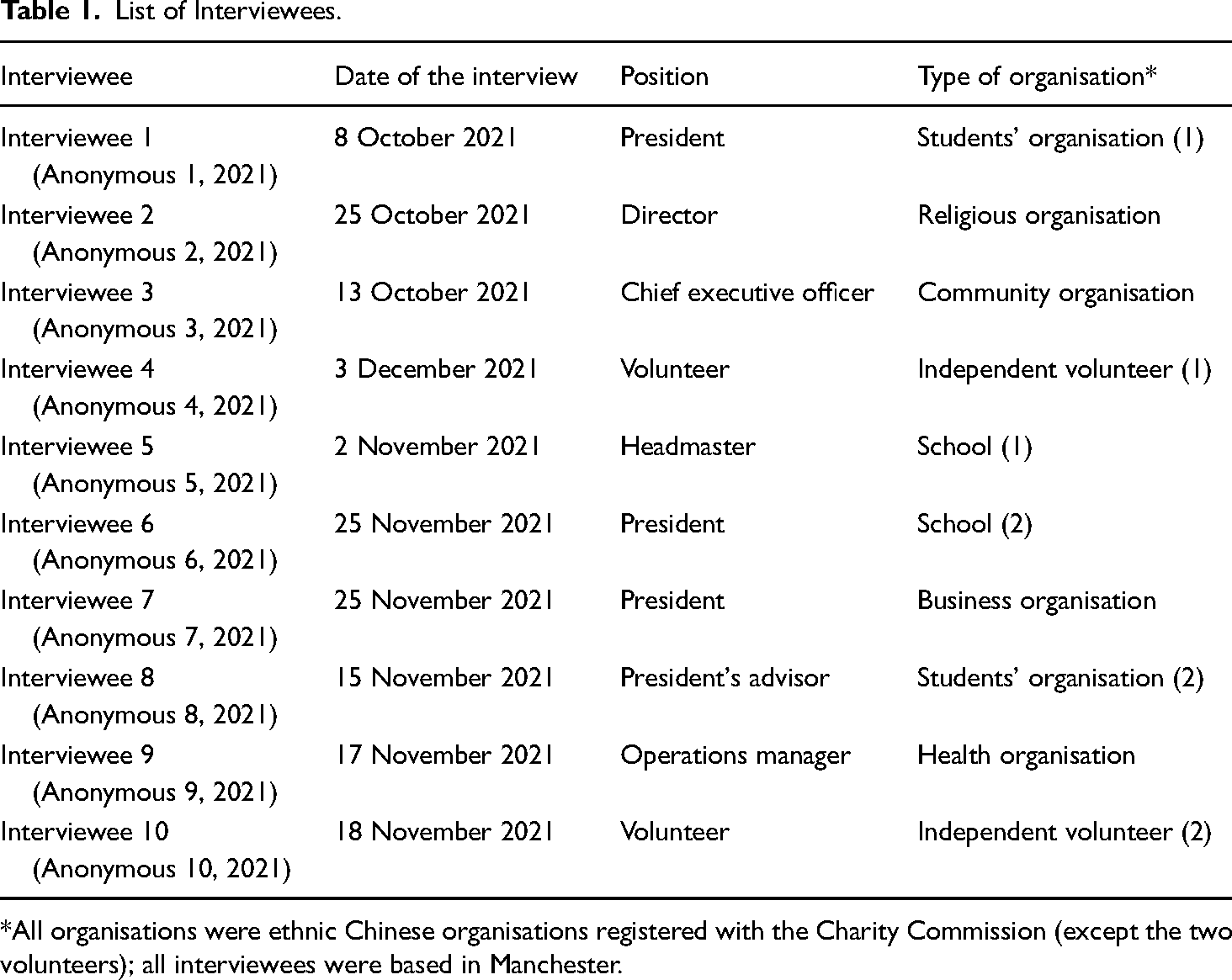
*All organisations were ethnic Chinese organisations registered with the Charity Commission (except the two volunteers); all interviewees were based in Manchester.
The open formulation of the questions was intended to allow for maximum variation in possible responses without limiting them by expectations on the part of the researcher. The set-up of this study is exploratory.
One of the innovative aspects of the study is that it focuses on the perspectives of the organisations and volunteers, which is usually neglected in collaborative governance research. The interviews were conducted partly by myself in English and Mandarin and by a research assistant who originates from Mainland China and speaks Mandarin. Our interview partners had diverse educational and geographical backgrounds, and they spoke English and Mandarin with regional accents. The interviews were transcribed as closely as possible to the original. I then ran a qualitative content analysis of them with the help of the MAXQDA software. In the (partly translated) citations below, I have tried to maintain the original expression as much as possible but had to edit it for comprehensibility. The focus of the conversations lay in the particular problems of the pandemic, the services addressing them, the challenges and opportunities that the pandemic posed to the organisations, and the perceived relationship with the local administration.
Findings
The findings are presented in three parts. First, a general description of the role of Chinese social organisations in Manchester's pandemic response is provided. In this context, the limited role of the Chinese Consulate General of Manchester is also discussed. A general misconception of Chinese organisations in the UK is that they are all closely connected to the Chinese state through its representatives in the UK. However, the interviews show that the relationships between the different organisations and the Consulate in Manchester vary. Second, the results of the analysis of the interviews are presented along the three research questions regarding social capital, trust and facilitating structures in collaborative governance in crisis. Third, the different experiences with collaborative governance of the participants of the study are captured in a typology of social organisations and their relation to the local government.
The Ethnic Chinese Organisations’ Services During the Pandemic in Manchester
The Covid-19 pandemic was primarily a health challenge. In a joint effort, the local administration, the NHS and individual Mancunian volunteers and organisations carried out the primary tasks of controlling the virus from spreading, protecting the vulnerable, organising tests and vaccinations and isolating infected persons. However, the Chinese community was much earlier aware of how dangerous the disease was than the rest of Manchester. Wearing a mask to protect themselves and others was natural for the Chinese but not for the other Mancunians. In the UK (and elsewhere outside Asia), to wear a mask signalled incorrectly to by-passers that the wearer was ill. That posed a serious problem to the Chinese in Manchester as well. They had to cope with harassment, insult, and even physical violence against Chinese and other Asian-looking people (Duff, 2020; Ng, 2020; Yeh, 2020).
In addition, the pandemic had secondary effects beyond the municipal authorities’ immediate concern, which nevertheless posed grave problems to many in the Chinese community. These included mental issues, loneliness, isolation, domestic violence, logistics issues such as buying food during self-isolating, acquiring masks and medicines, managing visits to the hospital or GP and getting help with translation during such visits and getting individual care. In the meantime, the social organisations themselves were busy solving their own problems of rapidly decreasing income and finding ways of operating under the conditions of social distancing. To make matters more complicated, the democracy movement in Hong Kong encountered harsh repressive measures by the Hong Kong administration, leading to an increased influx of Hong Kong citizens into the UK and Manchester who also turned to some of the ethnic Chinese organisations for first orientation.
Chinese social organisations – including charities and associations – and volunteers made great efforts to meet this sudden outburst of different demands. They visited the self-isolating, the elderly and the lonely. They offered shelter to the victims of domestic violence, organised assistance for schooling problems, and offered mental care, dementia care and care for old-aged people. They helped distribute masks, Chinese medicine, and personal protective equipment (PPE). Part of the equipment was provided by the Chinese Consulate General but some of the organisations used their own networks and relationships with Mainland China to organise the procurement of additional equipment. The business organisation in the sample also helped storing these items for the NHS. The organisations provided their community with information about the pandemic and related rules. They communicated with the authorities and the NHS on behalf of the ethnic Chinese in Manchester.
The pandemic had a profound impact on the operations of the organisations, too. Most of them moved their services to the internet. They organised online events (Anonymous 1, 2021; Anonymous 3, 2021), religious gatherings and prayers (Anonymous 2, 2021), teaching and lectures (Anonymous 2, 2021; Anonymous 5, 2021; Anonymous 6, 2021; Anonymous 9, 2021; Anonymous 10, 2021). But offline services for care and logistics were in need as well as described above (Anonymous 3, 2021; Anonymous 7, 2021; Anonymous 9, 2021; Anonymous 10, 2021). Some had to suspend their normal services almost entirely (Anonymous 6, 2021; Anonymous 8, 2021). Even after “Freedom Day,” many organisations and their members still hesitated to return to business as usual (e.g. Anonymous 8, 2021). Others had technical difficulties in taking up their old operations, for example, finding space for teaching (Anonymous 5, 2021) or funding for additional teachers (Anonymous 5, 2021), because the old lines of communication had been interrupted or sources had dried up.
A few organisations were able to continue their services from before the pandemic via online tools. Others discontinued their original services and committed their entire services to Covid-19-related issues. They engaged people, kept them busy and even helped some find a new job.
While the Chinese organisations obviously were ready to take responsibility during the crisis, our interviewees were generally rather disappointed with the local administration's response to the pandemic. For example, one interviewee said: Andy [Burnham (The Mayor of Greater Manchester’s Combined Authority)] […] should for example let everyone wear a mask [in public transport]. (Anonymous 2, 2021)
The only policy that was generally favourably received was the government job retention scheme or “furlough” (Government UK, 2020b). The health organisation (Anonymous 9, 2021), for example, used it to retain their few paid helpers.
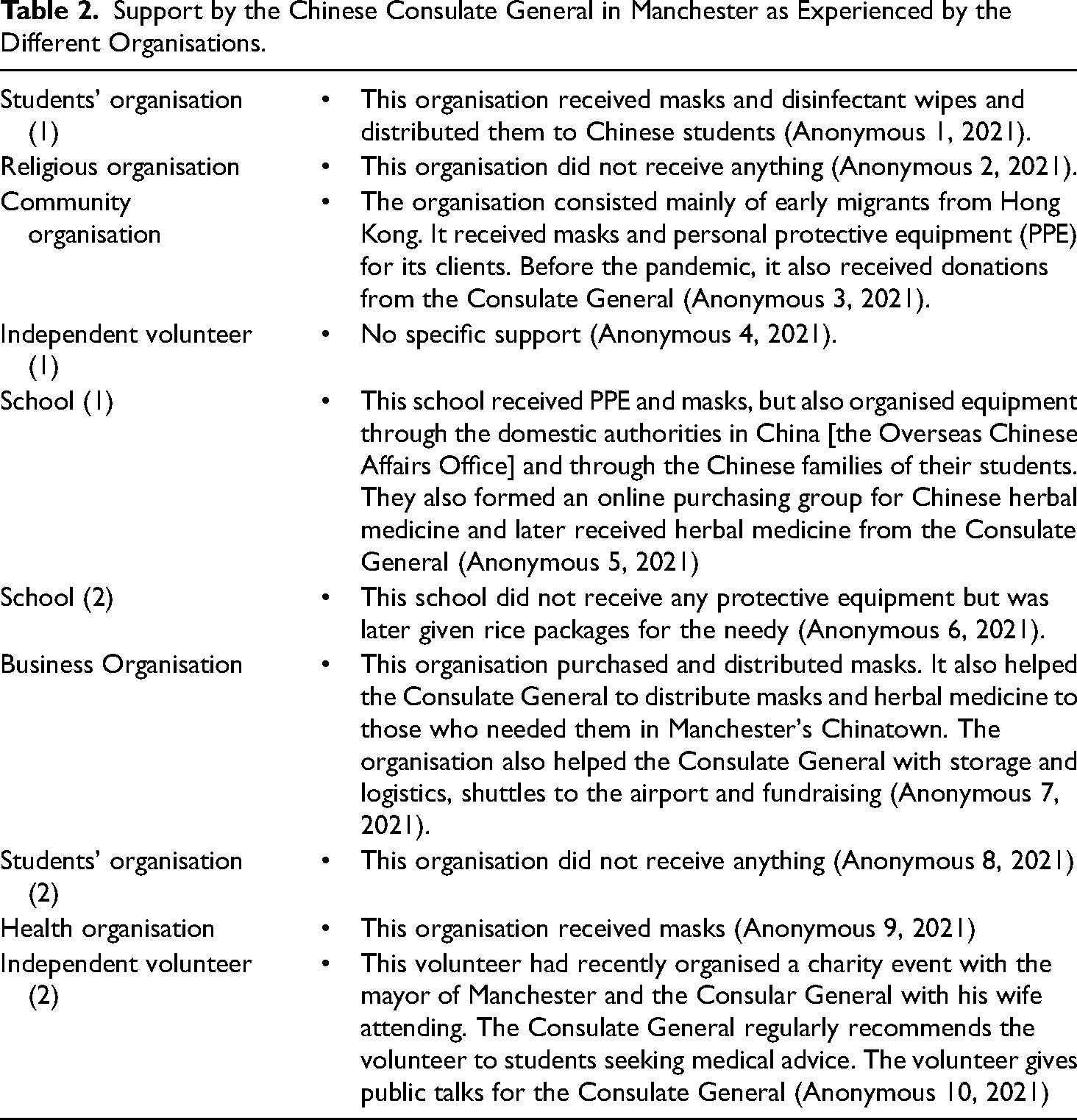
The British anti-Covid 19 policies in general were regarded critically by the interviewees. In contrast, the Chinese Consulate left a generally better impression, even with those organisations of Hong Kong or Southeast Asian roots that do not describe themselves as close to Mainland China. The delivery of masks and equipment by Chinese government or private organisation to Western countries was generally dismissed as “mask diplomacy” in European and British media (Wong, 2020). In contrast, most Chinese organisations in our sample appreciated this service, although not all of them comprise only members from the PRC but assemble ethnic Chinese from all over Asia. The organisations in our sample still experienced the support from the Chinese state differently – from close cooperation to disappointment – and from relying completely on the Chinese consulate to proactively mobilising other resources. Eventually, however, the “care” offered by the Chinese Consulate in Manchester was appreciated by the Chinese organisations. Table 2 summarises these experiences as captured in the interviews.
Support by the Chinese Consulate General in Manchester as Experienced by the Different Organisations.
How did the Chinese Organisations in Manchester Perceive Collaboration or the Potential for Collaboration With the Local Administration During the Pandemic?
The following impressions described by the Chinese organisations about their experiences of collaboration are categorised along the propositions and research questions.
We asked the participants to elaborate on whether there was collaboration and, if yes, their experiences in the collaboration. To find out whether collaboration in its broadest sense took place, we asked the interviewees whether they received any support from the local government or other institutions or organisations during or after the Covid-19 pandemic and whether they had worked together with the municipal administration in any way. The religious organisation (Anonymous 2, 2021) and the business association (Anonymous 7, 2021) made it very clear that they did not wish to have any contact, support, or form of collaboration with the local government of Manchester. The others had either received support from the municipal administration, collaborated with it before the pandemic or showed interest in future collaboration and coordination in service delivery.
In the interviews, we learned of only one incident, where the local administration actively approached a Chinese organisation for help. When the pandemic broke out, the NHS and the City Council were overwhelmed and ill-prepared. The representative of one of the Chinese schools said, [The NHS] didn’t have any protective gear. So, the City Council came to me. They asked, if we Chinese had any of these things [i.e. protective gowns, masks, gloves etc.] to donate to them [the NHS]. So, I tried very hard to ask the volunteers to search for these things. We’ll send them to other places. We also appealed to the Chinese to donate. They donated a lot of money to buy these PPE items for the hospital and we did it. That is, to tell these foreigners [i.e. the British] [that we provide them with] everything they want. [Just] don’t discriminate against us Chinese! (Anonymous 6, 2021)
More interview partners complained that they were not invited to collaborate or otherwise lacked support to offer the urgently needed services. One organisation pointed out that the local government had contacted them before for less urgent questions but did not make use of the specific knowledge of the organisations during the crisis. [Y]ou see, before there was this census, which is when the census was done [in March 2021]. And then […] they were smart enough to contact us directly. […] [But for the pandemic] it […] didn’t feel like they were making any moves [towards contacting us]. (Anonymous 5, 2021)
Some were critical of the administration's response to the pandemic and believed that the authorities should have enforced protective measures more strictly, such as the Chinese government had done in Wuhan. In addition, the beneficial effects of Traditional Chinese Medicine (TCM) were also ignored: The first one, I want to tell them, we need, first of all, […] to tell them how to prevent it apart from a mask. Distance, wash your hands and then some more they need to do. That's not enough. […] they also will need to [protect] […] vulnerable people. […] [TCM can help treat patients according to their individual bodily reactions to the Covid-19 virus]. So, [my] suggestion [to the] government [would be:] if anyone tests […] positive, you should ask them [to stay] together. Like […] in China, build a special […] hospital. You stay there, […] We should [provide them with] free meals, […] free exercises […] and some medicine until [they test] negative […] you’re not [to contact] other people. But now, […] here […] [if] you [are] positive, [they tell you to] stay home, but lots of people don’t stay home. […] if people have high temperature and [are tested] positive, […] they need to take Paracetamol. They say, I don’t have Paracetamol. […] And the next day, they said that they got Paracetamol. So I asked, where [did] you [get] the Paracetamol? They went [out themselves] and bought it. So, […] it doesn’t work. So, you need [to do it] like in China, […] very restricted. If you stay at home, you stay at home. They [have] like […] community people [who] check on you. Are you home? Are you home? Food is delivered [to] your door; it doesn’t cost much […] So, we need [to really stop the] infection [from] spread[ing]. (Anonymous 10, 2021)
Funding was one prominent theme. One organisation complained that short-time funding made long-term planning very difficult (Anonymous 3, 2021). Another said that they lacked the skills and the right connections for successful applications for funding (Anonymous 9, 2021).
The health organisation shared that the reform of public funding in the health sector had reduced the income of their organisation significantly (Anonymous 9, 2021). One of the schools’ representatives expressed their disappointment that the City Council did not treat their school equally to other supplementary schools regarding funding. And they also mentioned that returning to offline teaching caused additional costs (Anonymous 5, 2021). The organisations provide services, sometimes on behalf of other organisations or the City Council, but they feel their contribution is not always appreciated, let alone remunerated (Anonymous 9, 2021).
The fixed costs for activity venues posed a problem for the organisations without a regular income during the pandemic (Anonymous 6, 2021). Incoming donations from local Chinese businesses and restaurants also ceased because they generated little or no income themselves. The head of the school suggested waiving the business rate for volunteer groups (Anonymous 6, 2021). The business rate is a fee tenants have to add when they lease space for non-domestic purposes (Manchester City Council, n.d.a, n.d.b).
Regarding the venues, one head of school complained that the City Council did not manage the available space well. But I believe the government has a lot of space on hand. […] [the City Council] has some vacant places of its own. There are a lot of dilapidated ones here […] [but they] should [make these places available to us. […] [This would be] better [than funding], right? (Anonymous 5, 2021)
We’ve been [running our school] for over 40 years, but [other] people just open [their organisations] for a little while. They [get] the money and opened it for a while and then closed it [again]. [Now, after] it was closed […], nobody cares about it. And this site is just sitting here, you know? I say this is a very unfair distribution of resources, you know? That is, why is there not a government department […] to sort out the resources? [Why is there] no follow-up [after someone has received the funding]? [Someone should] go to [these places and check what the people have been] doing. (Anonymous 5, 2021)
Another aspect related to activity venues was that public space for ethnic communities was shrinking. Do you know the Chinese Library [in the Manchester Central Library]? All the Chinese books and CDs and stuff were in one place. Now, when they rebuilt the library, the Chinese library was closed. The Chinese library is now in the same big library. There is no more Chinese library. So, they will all, how to say, it means that the [library] is now inclusive of all the communities. There is no special service for the Chinese. [That is of course good,] but the other place was very much like […] the Dragon Temple. There's a lot of people there. (Anonymous 6, 2021)
To sum up, relations to the City Council vary but generally, there were no tested and reliable channels of collaboration that could have been used quickly in the crisis.
Discrimination seems to be a factor that affected the possibility of a trustful relationship between the city and the organisations. Interviewees regarded it as a stumbling block for collaboration. Positive discrimination can have the effect that the administration prioritises other ethnic groups because those needs seem to be more urgent. What people, what African […] ethnic groups, whatever ethnic groups. The most money is going to these ethnic groups, Ok? Chinese children […] are number one [in studying] in the UK. They are number one in academia. They get the most A-levels. Get the highest marks. The highest number of people who go to university. Ok? They have the highest academic qualifications. It's not that they, they don’t need help but they can help themselves, right? The [City] don’t even have to pay a dime [for] funding because China is also the richest here. So, this is the most disadvantaged side of us Chinese. It's like, for example, if it's a certain ethnic group, their children are doing illegal things every day. They would say give them more money. They would say give them a little more money. To encourage them and reward them. Go and set them up with different programmes […]. It's strange […] there's no reward for good people. It's the opposite of what you want to reward, which is people who break the law. (Anonymous 6, 2021)
Negative discrimination occurs, too, against the backdrop of generally deteriorating relations between the UK and the PRC and increasingly critical reporting on China. The British [think that] the Chinese government is rich. They wouldn’t dare to donate to us because if they donated their money to us and we fell out of the relationship, they would say that this institution of ours is founded by the Communists, got it? That is to say that the Chinese Communist Party supports us in this institution, so all the things we do are directed by the Communist Party […] When I went for the interview [at the British Ministry of Education to apply for a grant to open a school], the first thing they asked me was, why do you want to establish a communist Chinese school?Why do you want a communist school? I said, there is no, I just had not mentioned anything about communist. Ok? I just said that you can study Chinese in this school, you can also study the normal curriculum lesson plan. Just like the international school. If some white kids want to study Chinese at home, they can speak Chinese, they can internationalise their career. […] So, this means that the school could become something very special, ok? That's how I discussed it with them. But they: No, but Chinese is under the […] the Chinese […] Communists. So, they thought I was to open a communist school. Ok. So, there was no hope for this. I waited to do this for four years. Spent four years on it but did not receive any payment. (Anonymous 6, 2021)
One interviewee thought that public administration prioritised other ethnic groups in funding: I believe that [for the] government, [the problem of discrimination should not exist], but objectively it does exist. It's not that we are treated in this way subjectively, but for example, […] the language, the Chinese who came here in the early years were not good at English, right? […] And then they don’t have the means to communicate with the authorities. To find out what resources are available for this, even our language is not as good as others at the moment. And, so, we are lacking in this area in terms of resources, in terms of discovering these resources, compared to others, compared to other races. And we are lacking in comparison to other races, to India, to some Muslim races, for example. And we don’t have such good resources, and the other thing is that their ethnicity, because they speak the language well, they have more people working in the government than our ethnicity, I believe, don’t they? One other thing is that it has to do with their ratio, right? […] It is because of this objective reason that we didn’t know how to apply for some resources. […] And then I [think], another one [is that] we Chinese […] [tend] to do [things] silently by ourselves. (Anonymous 5, 2021)
To sum up, the relation between the Chinese organisations and the municipal administration lacks trust which makes collaboration in times of crisis, when quick decision-making and smooth cooperation mechanisms are most important.
Some of the negative collaboration experiences described by the interviewees could be solved by facilitating structures, such as a long-term contact person in the local administration, a constantly updated information platform, or regular meetings with participants from ethnic communities, organisations, and local administration.
For example, information flow and frequent rotation of personnel were mentioned as barriers to better communication between the local administration and the ethnic Chinese groups. The organisations think that they could play an active role as a communicator between the Chinese community and the local authorities but do not know how to offer such services to the authorities. And we would like to work with [the City Council]. So, if through this interview, we can get in touch with the government, we can establish the future operation of [our] association, and then we can provide more information, event advice, and news advice. And if we get in touch, if there is a large-scale incident like the Corona pandemic, I think we can also have some advice and suggestions for the government. And then they can also use our advice and suggestions to do something about it. I think it's a two-way street. […] But I think that if we don’t communicate, it's very fragmented and we’re all still minding our own business about what the government has released. […] And I think that not only our community but all communities can contribute in various ways. (Anonymous 8, 2021)
The interviewees also described that the Chinese community especially newcomers from China and Asia lack some basic information that would make integration and collaboration much easier. For some organisations, especially those with a high fluctuation like the students’ organisations, it is sometimes difficult to find answers to their questions about living in Manchester. My impression is that I have been living in Manchester for many years, and […] that I think there are many things that I don’t know systematically. […]. For example, the small matter of littering cigarette butts, […] I didn’t know that there would be a fine. So, I believe that in fact many students who have just come here also do not know. […] Including this year's vaccination, in fact, if they had advertised it to us, we could have contacted the new students. We could have told them about the vaccine. Because we don’t have anyone to contact us, all we can tell people is how to register themselves online and get the vaccine themselves. In this case the implementation is very weak, because if we tell people, they […] maybe will not do it. (Anonymous 8, 2021)
We have always had a very good relationship with [the] City Council, […] and they have come to us for help with anything. […] It is just that they every time forget the contact, you understand? Seems like I know A, this has a very good relationship with me, but if they transfer A to […] another department, then the new B comes, the contact needs to be renewed once more, so this is not too good. […] It's up to the new person to find us again. That's the problem. […] They need to have a structure. […] If you want this thing you need to contact that organisation. If you want that thing you need to contact another organisation. […] There is the African Community, this community and that community. This way you make sure that you have a contact for each of them. (Anonymous 6, 2021)
In a nutshell, there is a lack of facilitating structures that could support collaboration, but the societal actors are ready to collaborate and make a suggestion on how to facilitate it.
Different Types of Organisations and Their Relationships With the Local Government
From the interviews, it became apparent that the organisations and volunteers in this study are heterogeneous regarding their activities, membership and relationship with the PRC and its government. They also varied in their relations with the local government of Manchester. Table 3 shows the five types of organisations and their relationships with the local government of Manchester.
Types of Organisations in Terms of Their Relations With the Government.
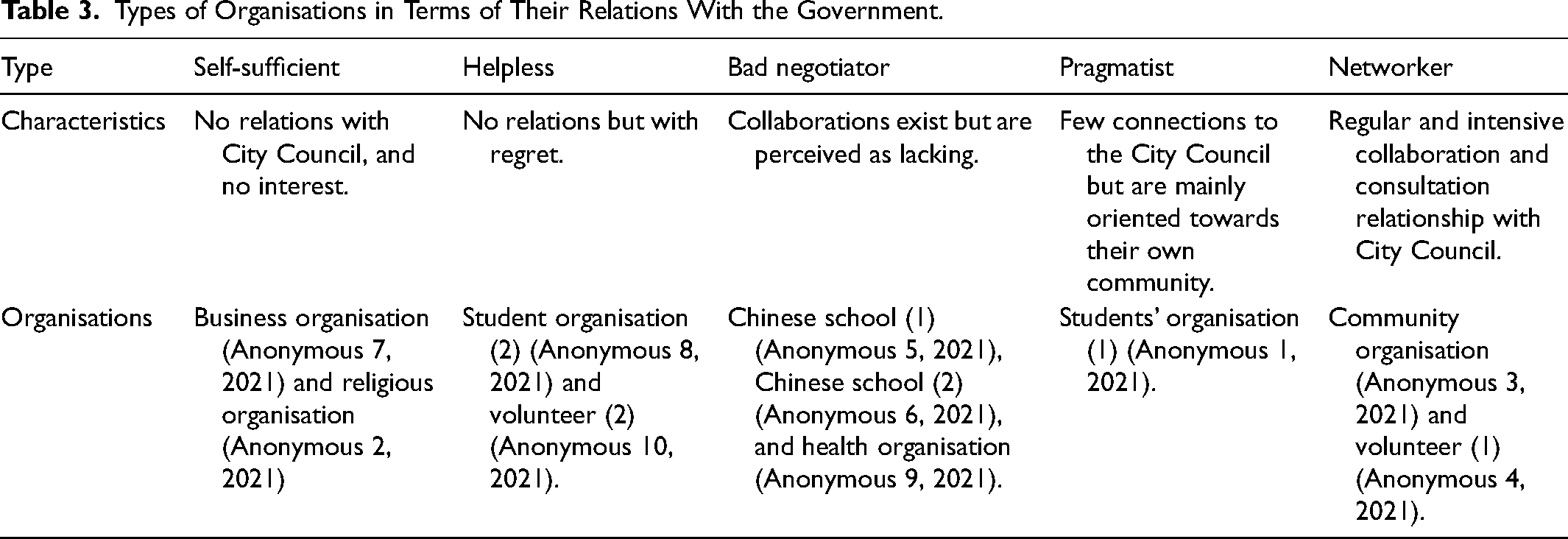
The “Self-sufficient” group contains the business association and the religious organisation. They did not regret the lack of contact and were self-sufficient in funding. The “Helpless” group comprised the student organisation that longed for an opportunity to collaborate with the local government. However, they do not know how to do it and take a passive stance. Due to high fluctuation in their group, there is not much hope for improvement. Volunteer (2) (Anonymous 10, 2021) also belongs to this group. They are “helpless” due to a lack of time or opportunity for better government relations. The “Bad Negotiators” did not manage their relations with the local government well. They do not have the necessary professional skills to secure funding or raise donations, and they also lack the interpersonal skills to maintain relations with the government. However, the three organisations made the impression of three well-established, busy organisations that offered valuable services to the community. The “Pragmatists,” represented by the other student organisation, maintained a minimal relationship with the local government reflected in the regular participation of the Mayor of Greater Manchester in their events. The community organisation (Anonymous 3, 2021) and the other volunteer (Anonymous 4, 2021) are highly efficient “Networkers” with the local government, the Chinese and other ethnic communities and the Consulate General. They also have mastered the skills for applying for grants and fundraising and are the most successful in achieving their organisation's or volunteering objectives.
Discussion
Based on the theoretical debates summarised in the section “Theoretical Frame: the Pandemic as a ‘Wicked’ Problem and Collaborative Governance with Social Capital as a Suitable Response to it,” three propositions were put forward. The empirical evidence collected and analysed in this study partly supports and partly weakens them.
Proposition 1 suggested that social capital facilitates joint collaborative efforts by the local government and the social groups. The interviews show that those with more accumulated social capital, that is, those embedded in large networks that encompass other social organisations, local government officials, Chinese Consulate delegates and with broad target groups going beyond a narrow (ethnic Chinese) clientele were the most successful in achieving funding and securing service contracts with the local government. The “networkers” in the sample stand for this type. However, the “Helpless” and the “Bad Negotiators” also have wide networks and are part of active and broad communities but lack the necessary skills to connect to the right persons and apply for grants successfully. That means that social capital in the sense of embeddedness in networks is a necessary but not sufficient condition for social organisations to be involved in collaborative governance projects. Skills and interest in collaborations are additional factors that facilitate collaboration. The “Pragmatists” and the “Self-sufficient,” for example, are not interested in collaboration.
According to Proposition 2, I expected that long-term experiences of collaboration of the organisations with the local government would result in more trust which again would supplement social capital in facilitating collaborative efforts. Again, this is true for the “Networkers,” who had long years of experience with collaboration. The two student organisations (“Pragmatist” and “Helpless”) had no time to build trust with the local government because of the high fluctuation of their members and board. The two “Self-sufficient” organisations had not spent time on trust-building because they lacked interest in collaboration. The “Helpless” volunteer has a long history of working in the city but not in collaborating with the government. However, the “Bad Negotiators” provide a mixed picture. One of the schools (Anonymous 6, 2021) had been approached by the local government to help out with protective gear. That can be interpreted as a sign of trust in the school to be able to deliver this service. The other school (Anonymous 5, 2021) was disappointed that they were not approached by the administration, possibly a sign of either lack of trust or simply a lack of knowledge of the administration. The health organisation used to work with the local administration and continued to obtain contracting and collaborative projects but was disappointed about the lack of rewards for these.
Proposition 3 is that a formal facilitating structure can enhance collaborative governance efforts. We could not verify it in this study because there was no such facilitator in our sample. However, interviewees proposed establishing a facilitating position to smoothen local government–social organisation exchange and cooperation. Particularly the head of school (Anonymous 5, 2021), a “Bad Negotiator,” suggested having someone in the administration monitor the progress of projects contracted out to social organisations. A facilitator could also coordinate space for schooling, events and activities organised by social organisations. The other school director (Anonymous 6, 2021), also a “Bad Negotiator,” would like to see a person in the local government who knows about the different skills and expertise of the organisations in the various ethnic communities to contact them when needed. The “Helpless” among the student organisations (Anonymous 8, 2021) wished to have a person in the local government to aid incoming foreigners with information about laws and administrative procedures of daily life and the social organisations’ activities. The interviews suggest that a permanent coordinator for the ethnic communities could expand the pool of potential partners for collaborative governance beyond the “Networkers” to the “Helpless” and the “Bad Negotiators.”
Conclusions
This paper investigated the role of ethnic Chinese social organisations in collaborative efforts with the municipal administration to counter the Covid-19 pandemic and their experiences with it. Potentially a systematic effort of collaboration could have prevented deaths and severe illness during the pandemic, because the Chinese community was very early aware of the severity of the virus and the ways to prevent its spreading. However, as the study shows, the ethnic group's specialised knowledge was rarely used by the municipal administration. The analysis of the interviews reveals that the organisations had different skill sets and perceived their involvement in collaborative efforts with the government in different ways accordingly. Observations of the Covid-19 pandemic are especially valuable for the study of collaborative governance in crises, because the pandemic was not only characterised by uncertainty and the requirement for a quick response which are the typical conditions that make collaboration between governments and societal groups so complex and difficult during a crisis. The crisis of the pandemic was also characterised by an unprecedented initial lack of specialised knowledge of the effects of the illness and the ways the virus was spreading. Since the crisis started later in Europe and elsewhere than in China, it would have been wise to listen carefully to what Chinese groups had to say who received daily news about the outbreak from Asia. However, this knowledge was not systematically requested and used. In this crisis, collaborative governance was not able to play out its full potential.
The results also have implications for the organisations’ management. We saw that some of the organisations were involved in collaborative efforts, for example, they received funding to implement social services, and they helped the administration with the purchase of equipment for health workers. Other organisations had difficulties initiating or maintaining collaboration although they manage their own projects very well. The third group of organisations was explicitly not interested in any form of cooperation with the local government. The study has shown that for organisations that want to become visible for local governments in search for reliable partners in crisis, it is not enough to maintain extensive networks and optimise their operations. They should also provide regular and specific skill training to their staff that facilitates them to write successful funding applications, maintain long-term relations with the government and proactively build trust that can serve as a basis for collaboration in crisis.
Looking into the organisations’ relations with the government, we identified five different types, the Self-sufficient, the Pragmatists, the Helpless, the Bad Negotiators and the Networkers who varied in their embeddedness in networks (social capital), their experience in connecting and collaborating with the local government (trust-building) and their general interest in collaboration with the local government. We found that social capital and trust are necessary but not sufficient conditions for successful participation in collaborative governance. In addition, organisations also need an interest in collaboration and the skills of communicating with the authorities and applying for funds. Moreover, from the point of view of the social organisations, facilitators could help expand and coordinate the pool of potential societal partners among the ethnic communities for collaborative governance. That is especially important given the very likely upcoming crises caused by climate change, conflict, or new pandemics.
A few remarks on the limitations of the study: first, this article focuses on the perception of the societal actors in the study. The study does not aim to deliver a full, multi-perspective description of the “case of Covid-19 in Manchester” but rather provide space for the social organisations’ subjective descriptions on how the collaboration proceeded or failed. Second, the study chose to concentrate on the perspective of one ethnic group, the Chinese. One reason for this was the exclusive knowledge of the pandemic that this group owned which could have been a special asset for collaborative governance during the pandemic. Third, this study takes a qualitative, explorative approach. Qualitative research does not strive for generalisability of its results. Rather, qualitative research is interested in the individual responses of the participants that can add new aspects and perspectives to a research field.
Future studies could explore the special knowledge of other ethnic groups that could be valuable for collaborative governance efforts in other crises. They can then take up these new aspects and test them in a larger quantitative study to produce generalisable results.
The typology developed from the interviews and the results of the three propositions of the study may also serve future studies as an initial theoretical foundation to be tested with large-n studies to produce more generalisable results.
Footnotes
Acknowledgement
The author would like to thank the participants of this project for their time and openness in the interviews. I would also like to thank Ms. Ban for her assistance in conducting and transcribing some of the interviews, and the two anonymous reviewers who helped to improve earlier versions of this article. Any remaining errors are the author's.
Declaration of Conflicting Interests
The author declared no potential conflicts of interest with respect to the research, authorship, and/or publication of this article.
Funding
The author disclosed receipt of the following financial support for the research, authorship, and/or publication of this article: This work was supported by Kui Man Gerry Yeung OBE DL, Manchester (in form of a sponsored two-year research fellowship at the Manchester China Institute at the University of Manchester). It was further supported by a research award from UCLA Asia Pacific Center on the occasion of the International Symposium on Global Chinese Philanthropy (19–20 March 2021).
Author Biography
 . Dr Levy is co-author of the book Charities with Chinese Characteristics, published in 2020 by Edward Elgar.