




Abstract
While China’s experience of using special economic zones (SEZs) for advancing economic development is a model increasingly adopted in other developing countries, the processes involved in replicating this model elsewhere and the outcomes of such replication remain little understood. This review article’s nested examination of three relevant strands of literature and two case studies of India and Ethiopia indicates that successful replication of China’s SEZ-led development would involve deliberate processes of adaptation from the original model. Replication must be “smart,” by taking into account the temporal, systemic, and other discrepancies between the Chinese model and the replicating country; replicating the benefits of China’s approach whilst avoiding the drawbacks; and maximising the positive effects of direct Chinese involvement and investments while reducing negative repercussions.
Introduction
There is growing interest among governments of developing countries in adopting aspects of China’s successful – if somewhat unconventional – approach to economic development since 1978, and in no area has this been so evident as in the establishment of special economic zones (SEZs) for the purpose of piloting rapid industrialisation. Interest in China’s model is driven by the ambition to re-create some of the successes of China’s SEZs in boosting exports, attracting foreign direct investment (FDI), enhancing manufacturing and generating massive industrialisation and other economic and social gains. Thus, numerous developing countries have recently set up SEZs in hope of repeating some of China’s successes. China itself is supporting this trend – the Chinese government has been increasingly open to sharing with other developing countries its experience and “wisdom” on how to develop and prosper (Jiang, 2019). Chinese enterprises are also becoming agents in the process of replication, involving themselves directly in establishing, constructing, and operating SEZs in other developing countries, and investing in manufacturing and other productive activities in SEZs across Africa and Asia.
However, the phenomenon of “China-inspired and/or China-supported” SEZs in other countries remains underexplored and insufficiently understood. Little is known about the specific processes involved in replicating China’s model elsewhere and the outcomes of such replication for structural transformation and development, making it difficult for governments in developing countries to capitalise effectively on the lessons to be learnt from China. In this brief review article, we take a first step in addressing this shortcoming by asking the following question: What does the available literature tell us about the viability of replicating China’s model to generate effective and positive outcomes for developing countries?
To explore this question, we adopt an innovative methodological approach, combining a focused analysis of three key strands of relevant literature with two case studies of suitable countries. The three strands deal with (1) China’s prior experience of SEZ-led development, (2) the benefits and drawbacks of (Chinese) SEZs, and (3) direct Chinese involvement and investments. For each strand, we focus on deriving the core insights from the literature, representing them with a selection of key texts, rather than offering a comprehensive review, for which space is too limited.
The two case studies are employed to complement this analysis, offering corresponding evidence on each strand to strengthen validity. We choose India and Ethiopia as suitable cases because both have studied China for insights on the development of new SEZs, have received related Chinese investments, are important for the overseas expansion of Chinese manufacturing supply chains, and are based in separate continents to take account of different geographical situations. In India, the ambition to replicate China has meant establishing a new generation of SEZs since the early 2000s to replace a previous regime of export processing zones (EPZs), which were operating as early as 1965 but failed to propel the manufacturing sector (Aggarwal, 2006; Tantri, 2016). By contrast, Ethiopia had little previous zone experience before Chinese investors launched the country’s first SEZ in 2007, under the aegis of a new government industrial strategy to attract FDI and accelerate development through an ambitious agro-industrial park programme, aimed at the garments, textiles, leather and agro-processing sectors (Nicolas, 2017).
For this analysis, we adopt a broad definition of SEZs as delineated geographic areas offering preferential regimes and separate regulatory frameworks that differ from the rest of a country in order to attract business and foreign investment (UNCTAD, 2019). SEZs have assumed different forms and terminologies, including free trade zones and industrial zones. All these are considered within the scope of this article.
China’s SEZs as a Model
SEZ development was a key feature of China’s reform and opening from 1978, allowing China’s previously internationally isolated economy to gradually engage with the world economy, global trade, and foreign investment. Almost by default, discussions in the literature cover China’s early-reform era SEZs, especially the first four, established in advantageous coastal locations – Shenzhen, Zhuhai, Shantou, and Xiamen. Over time, the zones grew in number and spread along the coast and later into interior regions through a gradual process (Zeng, 2015). With the establishment of SEZs, the central government aimed at attracting foreign capital, encouraging joint ventures and partnerships between local and foreign firms, and promoting exports. It introduced special legal frameworks to protect property rights in the zones, provide tax incentives, and allocate land use rights. At the same time, significant authority over SEZ management was decentralised to local governments (Wang, 2013). Chinese SEZs were often developed as entire cities rather than just industrial parks, encompassing large territory that included housing and social facilities on-site (Zhao and Zhang, 2007).
India has recently followed aspects of this approach, as shown by the fact that its new SEZs are more similar to China’s SEZs than its earlier EPZs. Like China, India combined central government policy direction on SEZs with devolved day-to-day management by local governments (Tantri, 2013). Specifically, India’s 2005 SEZ Act granted state governments much latitude over SEZ development and management, and significant authority was delegated to the local level, often the state development commissioner. The Act’s comprehensive and dedicated legislation replaced the range of policies and ministries that previously governed India’s EPZs. It allowed India’s SEZs to operate under different regulatory frameworks from the rest of the country, with company “self-certification” being introduced to reduce the need for inspections or official attestation (Kennedy, 2014; Singh, 2009). Similar to China, India’s new SEZs were also envisaged as encompassing all the social facilities that make up a small city, which distinguished them from the EPZs’ more modest industrial parks (Aggarwal, 2006; Levien, 2013).
Representatives from both India and Ethiopia made visits to China to learn from its SEZs. For example, the Indian Council for Research on International Economics sent a “fact-finding mission” to China to identify “useful features of Chinese zones that could be adapted to Indian conditions” (Cross, 2014: 37), and the chief minister of Andhra Pradesh referred to the Andhra Pradesh Special Economic Zone in 2002 as a “Shenzhen-style economic zone” (Cross, 2015: 424). Ethiopia also sent officials to visit Chinese SEZs (Bräutigam and Tang, 2014), and China played a crucial role in the process of establishing the management frameworks of Ethiopian zones, which extended to the negotiation of specific articles in Ethiopia’s 2015 Industrial Park Proclamation (Tang, 2019). Nevertheless, the overall governance model in Ethiopia remained highly centralised, resulting in limited local autonomy of Ethiopian zones, an approach that differed from that of China and was also criticised for leading to delays and inefficiencies (Tang, 2019).
Unfortunately, research has yet to evaluate whether such attempts at replicating China’s SEZ policies and structures have worked. A complicating factor is that China’s SEZs were formed under unique political, economic, and social circumstances that were much different from today’s situation. At the time, the SEZs allowed Chinese policymakers to control the entry of foreign companies into China’s previously isolated economy whilst remaining unconstrained by international trade and investment rules such as those of the World Trade Organization (WTO). Intensifying global and regional economic integration provided exceptional opportunities to integrate into emerging international production networks, at first involving the thriving economies of Hong Kong, Macao, and Taiwan (Zeng, 2015). In the process, SEZs capitalised on China’s abundance of cheap labour, providing jobs for hundreds of millions of migrant workers (Yeung et al., 2009). Part of the success of China’s SEZs was therefore due to the right timing, appropriate policy decisions and specific characteristics of China’s economy and society.
India, Ethiopia, and other countries aiming to replicate China’s development model today face a very different context, especially compared to early-reform era China. They enjoy no uniquely favourable circumstances such as those emerging in Greater China during the 1980s, are not internationally isolated, and tend to be more constrained by international obligations. For example, while China was able to apply diverse rules and standards (e.g. on taxation) across its early SEZs, WTO membership requires a more uniform approach (Yeung et al., 2009). Some parallels exist – India, Ethiopia, and many other developing countries enjoy large pools of cheap labour and migrant workers and seek to integrate into global value chains. Ethiopia has yet to join the WTO, though it is nevertheless more internationally integrated than China was in the early 1980s.
In short, the unique economic, political, and social circumstances of the era in which China’s SEZs thrived cannot be repeated. While some parallels can be drawn that could offer a foundation for replication, any processes of replication would need to factor in these temporal, systemic, and other discrepancies between the historic model and the developing countries aiming to replicate it.
Benefits and Drawbacks of SEZs
There is a vast literature discussing the potential social and economic benefits of SEZs, as well as the drawbacks that can result from establishing them. On the one hand, by offering preferential conditions for stimulating exports, attracting FDI, and linking economies to global value chains, SEZs have been found to promote structural transformation, inclusive growth, and economic development. They can generate significant employment, especially in labour-intensive manufacturing, and can facilitate industrial upgrading through transfers of technologies and know-how (Crane et al., 2018; UNCTAD, 2019). Some studies have found wages to be higher in SEZs (Cirera and Lakshman, 2017), and working conditions to be comparatively favourable (Aggarwal, 2007). SEZs might empower women (Hancock et al., 2014), who in many zones form a large part of the workforce (Tejani, 2011), by bringing them into the labour market. Moreover, SEZs have been used as testing sites for broader economic reforms (UNCTAD, 2019). In anticipation of such gains, SEZs have recently proliferated in developing countries (UNCTAD, 2019).
Many Chinese SEZs enjoyed these benefits during the era of economic reforms post-1978. By some estimates, SEZs had contributed 22 per cent of China’s gross domestic product, 46 per cent of total national FDI, and 60 per cent of exports by 2015 (Zeng, 2015: 5). They made China the largest recipient of FDI among developing countries and the world’s largest exporter, especially of manufactured goods. Other positive impacts include technology transfer, the upgrading of human capital, and an increased income level of workers (Wang, 2013). The migrant workers employed in China’s SEZs effectively transferred some of the economic gains to China’s interior, with transformative impacts on rural development (Murphy, 2002). Moreover, SEZs were used as testing sites to advance China’s economic reforms (Zeng, 2015).
Similarly, many of the new Indian and Ethiopian SEZs have already generated encouraging economic results. India’s 223 SEZs have provided employment to over 2 million people as a result of relatively cheap labour, investment, and export growth (Government of India, 2018). Ethiopia, now one of Africa’s leading investment destinations, has experienced high, inclusive growth with significant reduction of poverty over the past decade, in part because of the contributory role of its SEZs (IMF, 2018). When looked at from this perspective, replicating China appears to have borne fruit.
On the other hand, evidence in the literature also points out that the overall effectiveness of SEZs in achieving these benefits remains mixed (Farole, 2011; UNCTAD, 2019). Critics have argued that SEZs generate unequal benefits – expanding business, employment, and development opportunities for some stakeholders privileged by the favourable legal regimes of SEZs, whilst associated land expropriations and other losses of income and livelihoods affect the poor and most vulnerable groups in society (Cotula and Mouan, 2018; Levien, 2011). Labour and working conditions remain substandard in most SEZs (Cotula, 2017; ILO, 2017). Environmental regulations and their enforcement can be laxer within the zones to attract investment, leading to heightened pollution and environmental degradation (UNCTAD, 2019). These and other issues, often caused or exacerbated by poor planning and governance in the process of establishing and implementing SEZs (Gauthier, 2018), have led to disputes and protests in many SEZs.
Accounts of China’s experience with SEZ-led development similarly point to the existence of unfavourable consequences (Tantri, 2013), including the mushrooming of zones, smuggling activities, tax abuses, illegal land confiscations, and violations of land laws (Herlevi, 2017). SEZs in China exacerbated regional disparities, bringing economic prosperity to coastal cities but failing to take off in less-favourably located western and central regions (Crane et al., 2018; Zhang and Zou, 2012). Migrants’ access to education, public services, and social security in urban areas tended to be limited, and working conditions often involved long working hours, health and safety risks, and contractual uncertainties (Chen, 2009; Goodburn, 2015; Li, 2010; Liang, 1999). These conditions gave rise to labour disputes, strike actions, protests and even workers’ suicides (Chan and Selden, 2017).
Neither India nor Ethiopia have been spared from unfavourable consequences similar to those in China. In India, the lack of centrally determined limits and the re-allocation of investments from domestic tariff areas has led to zones mushrooming in number (Tantri, 2014), as happened in China. In both countries, the performances of the zones have been mixed (Azmach, 2019; Tantri, 2014), and, as in China, workers have often faced challenging working and living conditions, including low wages, insecure jobs, unsafe work environments, workplace harassment, insufficient unionisation, poor social security, and a lack of safe, affordable housing (Aidoo and Hess, 2015; Cross, 2015; George, 2015; WRC, 2018). Other observed problems are corruption, rent-seeking, compulsory land confiscations, forced displacements, loss of livelihoods, and localised anti-SEZ protests (Alkon, 2018; Cross, 2015).
The history of SEZs in general, and China’s experience in particular, offer examples of what has and has not worked, and developing countries should consider these experiences when establishing their own zones. Given the parallel existence of both benefits and drawbacks, it is insufficient simply to copy an existing blueprint or model, including that offered by China. Replicating the benefits and avoiding the drawbacks as much as possible will require a smart approach towards past practices that considers the reasons why China was successful in some areas as well as the causes of the problems it experienced.
Direct Chinese Involvement in SEZs
China is now influencing the economic trajectories of developing countries in Asia and Africa directly through its growing trade and investment relationships. Investments include both FDI by China’s multi-national enterprises, especially in manufacturing, and loans given to governments to fund infrastructure, energy, and construction projects implemented by Chinese state-owned enterprises (SOEs).
Chinese FDI has grown rapidly in recent years, backed by state support and involving many SOEs and private firms (Knoerich, 2017; Knoerich and Miedtank, 2018). With labour costs rising rapidly in China, its low-cost manufacturing industries have targeted Asia and Africa to seek new factory locations. In the textile industry, where China is a world leader, Chinese outward FDI has grown by 30 per cent per year since 2008 (CNTAC and Ethical Trade Initiative, 2017).
Compared to FDI, Chinese loans involve much larger financial transactions. Typically, the China Development Bank or Export–Import Bank provide foreign governments with concessional loans (Hackenesch, 2013), which require contracting Chinese SOEs and labour for project completion. The loans can often be repaid over longer periods than typically offered on the market and sometimes in the form of commodities (Lee, 2018). Such projects form part of the Belt and Road Initiative (BRI), China’s flagship foreign policy.
SEZs established overseas by Chinese companies or provincial authorities play an important role in China’s investments abroad. The development of overseas SEZs was pioneered by Chinese investors in the late 1990s and given high priority in 2006, when the Chinese government announced a policy decision to establish up to fifty SEZs globally. The government offers support in the form of incentives, grants, long-term loans, and subsidies to Chinese companies winning competitive bids to build zones (Bräutigam and Tang, 2011). For the future, it has proposed to build “all forms of industrial parks […] and promote industrial cluster development” (Government of China, 2015).
Ethiopia has directly involved China in building its zones. Its biggest industrial zone is the USD 250 million Chinese-built Hawassa Industrial Park, and its Eastern Industrial Zone (EIZ) is owned, developed, and managed by Chinese private companies (Bräutigam and Tang, 2014; Davison, 2017). The latter was established under the “Overseas Economic and Trade Cooperation Zone” programme, launched during the third Forum on China–Africa Cooperation in 2006 (Fei, 2018). India has a small but growing number of Chinese investments. It has yet to host a Chinese-operated zone, but Memoranda of Understanding have been signed between Chinese investors and Indian state government agencies for zones in Maharashtra, Gujarat, and Haryana (Arun, 2017; Yuan, 2016). Once these China-focused SEZs have been built, they attract FDI from Chinese firms, and in some cases enable Chinese firms to form industry-specific clusters (Bräutigam et al., 2018).
There is emerging evidence that Chinese investment has stimulated manufacturing, employment, and income growth in Asian and African countries (Donou-Adonsou and Lim, 2018; Fu et al., 2020; Oya, 2019). It has been a critical driver in expanding textile manufacturing. In Ethiopia, 279 Chinese companies created over 28,300 jobs between 2012 and 2017, including 19,000 in manufacturing (Liben, 2018). Chinese shoemaker Huajian International Shoe City is the largest employer in the EIZ, employing approximately 4,600 Ethiopians (Fei, 2018: 15). In India, Chinese current and planned investments are increasing and have reached USD 26 billion to date, some of them generating considerable employment. Chinese mobile phone manufacturers are expanding operations there, with Oppo in the process of investing more than USD 500 million in the Greater Noida region, and Vivo having pledged similar amounts (Krishnan, 2020).
The ability of such manufacturing operations to transfer know-how and to facilitate skills diffusion is however rather limited. Research in Ethiopia shows, for example, that Ethiopian workers are primarily employed in low-skilled jobs in the Chinese SEZs (Giannecchini and Taylor, 2018; Nicolas, 2017). Concerns have been raised, too, over the negative effects of Chinese loans, investments, and corporate activities. In Africa and Asia, China has emerged as a major financier of large construction projects and a leading external creditor. But the transparency surrounding its loan deals and the viability and financial soundness of some projects are in doubt (Knoerich and Xu, 2018), and China has contributed to increases in indebtedness of some developing countries. In Ethiopia, for example, China accounted for 30 per cent of total new public external debt in 2013–2017 and 90 per cent of new bilateral debt (Hurley et al., 2018: 13). This and other aspects of China’s governance approach, such as its approach to lending with few conditions, may weaken citizens’ ability to hold their governments accountable and undermine pressures for “good” governance reforms (Kjøllesdal and Welle-Strand, 2010; Li, 2017). Moreover, Chinese multi-nationals’ relatively limited experience of overseas operations and lack of understanding of local cultures and business environments can translate into non-compliance with labour, intellectual property, competition, and environmental regulations. In India, such cultural differences have triggered conflicts with local workers (Business Standard, 2018; Patranobis, 2017).
In sum, the construction of SEZs by Chinese companies, and Chinese investments in them, offer opportunities for structural transformation and development in Asian and African countries. Yet here again, there are negative connotations specific to Chinese investments and loans, which can potentially have harmful effects on developing economies. A smart approach to Chinese direct involvement and investments in SEZs is needed, aimed at maximising the positive impacts while making sure to curtail potential negative repercussions.
Conclusions and Future Research
China sees SEZs as “an increasingly important dimension of international co-operation within the framework of the Belt and Road Initiative” (Xinhua, 2019). Its government has increasingly been willing to share with other countries its expertise and experiences with establishing and running SEZs. It has supported and promoted Chinese firms in constructing and operating overseas SEZs and facilitated outward investment into these SEZs. As Chinese firms shift manufacturing to labour-intensive, low-wage production locations, countries in Asia and Africa are provided with a promising opportunity to climb up the industrialisation ladder in a manner similar to China’s previous success. Their governments aim at meeting the demand for cheap labour and low production costs through the replication of Chinese SEZ-led development approaches. It is possible that SEZ projects inspired or built by China in developing countries might succeed where others have failed, not only because of China’s own successful experience with SEZs, but also because of Chinese government backing, the generous incentive packages provided, and the possibility that such zones may be more suitable for conditions in developing countries.
Overall, the findings of this review article suggest that successfully replicating China’s model is a more complex undertaking than simply following similar approaches to those taken by China in the past. As Table 1 summarises, the national and international contexts in which today’s developing countries must industrialise are different from those previously faced by China. While SEZs and associated Chinese involvement and investments in them have promoted industrialisation and development, replicating China’s approach so far does not appear significantly to mitigate the known problems of SEZs, while Chinese advice, support, and investment can both increase the likelihood of positive outcomes but also result in some new negative consequences. We therefore conclude that replication of China’s SEZ-led development model could only be viable if it is “smart” in at least three ways.
First, smart replication needs to factor in the temporal, systemic, and other discrepancies between China and today’s developing countries. This necessitates taking into account the local context of the country aiming to replicate China’s approach, including its economic characteristics, political system, international relations, culture, and institutions. The result will be differences in approaches taken by replicating countries towards China’s SEZ-led development model and variations in the degree of direct Chinese engagement in SEZ construction and operation. Our review already detected differences in approaches between India, which has thus far focused on replicating governance aspects such as China’s decentralised model of SEZ governance, and Ethiopia, which was more open to direct involvement of Chinese companies and investors whilst keeping governance centralised.
Summary of Findings.
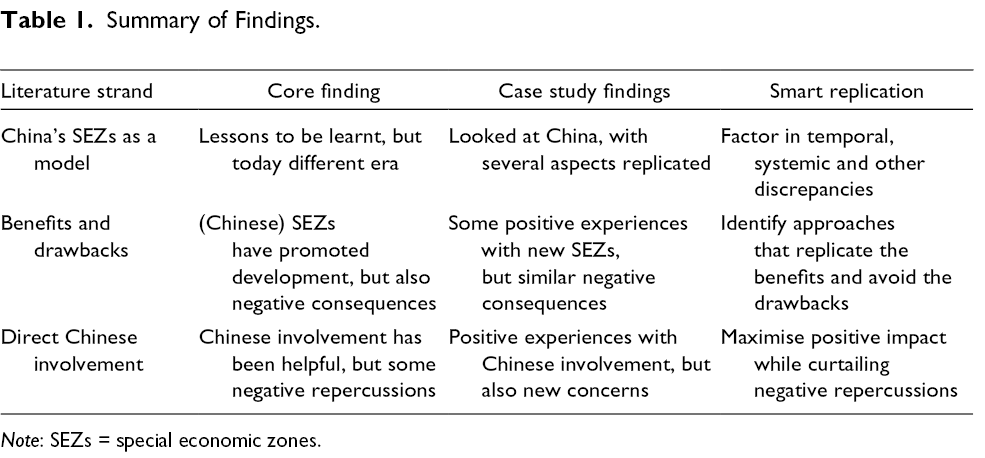
Note: SEZs = special economic zones.
Second, smart replication should identify pathways that replicate the benefits and avoid the drawbacks of China’s experience. This will require juxtaposing the initial conditions and SEZ-related policies and regulations of the Chinese model against those in the replicating countries, to assess the likelihood with which similar benefits or drawbacks to those experienced by China will occur in the replicating countries, before making corresponding regulatory and policy adjustments. This approach could be applied to all kinds of policies and regulations, including how to encourage spillovers, promote supply chain integration, engage with investors, deal with labour rights issues, and so on.
Third, smart replication should maximise the positive impact of Chinese direct involvement and investments while curtailing potential negative repercussions. This necessitates conscious management of China’s involvement in the replicating country, and an understanding of how Chinese-built and Chinese-operated SEZs are developed and managed, including aspects of financing, tailored approaches and regulations, and specific types of impact and behaviours Chinese firms might exhibit in SEZs. The perspectives of local stakeholders and employees could be drawn on as important sources of feedback.
Finally, it will be necessary to measure the effectiveness of smart replication, by evidencing the extent to which replicating China’s approach yields SEZs that are considerably different from previous zones in developing countries. There is still insufficient evidence on whether Chinese-inspired, China-built, or China-operated SEZs function very differently, and whether this yields particularly positive developmental outcomes. Research on this issue should establish which of these differences are notable improvements in the spirit of smart replication, and which are undesirable.
In short, future research and policy analysis must establish how smart replication ideally functions. Academic work should advance theory to further conceptualise smart replication and build a body of empirical evidence of ongoing efforts at replicating China’s SEZ-led development model. Policy analysis should develop procedures to be used for effectively undertaking smart replication.
Footnotes
Acknowledgements
We would like to thank the participants of our workshop on “Chinese investment in developing-country special economic zones: Impacts on labour and migration,” for their insights which supported us in developing this article. The workshop was held on 9 and 10 July 2018 and was organised by the Transnational Law Institute and the Lau China Institute at King’s College London. We would like to thank Claire Reynolds and Yiqin Huang for excellent research assistance and Lorenzo Cotula for his helpful comments on earlier versions of this article.
Declaration of Conflicting Interests
The author(s) declared no potential conflicts of interest with respect to the research, authorship, and/or publication of this article.
Funding
This article benefited from generous support offered by the King’s Together Fund and the King’s Faculty of Social Science and Public Policy.

Author Biographies
Email:
Email:
Email: