




Abstract
This article problematises the traditional conceptualisation of the “citizen diplomat” as being confined only to a single nation state sovereignty. At the nexus of transnational “ethnopreneurship,” dual embeddedness, neoliberalism, and post-materialism, citizen diplomats transcend territorially bound identities and perform unofficial dual-accredited roles in the enhancement of bilateral relationships. The protagonist in this case is a transnational People’s Republic of China ethnopreneur who adopts multiple forms of cultural commodification based on both Thai and Chinese resources. As a result, both territories have benefitted from the ensuing informal diplomatic interactions. Traversing the culturally distinctive city of Chiang Mai in Thailand and several flourishing cities in China, the article elucidates the importance of non-traditional diplomats. Put succinctly, it argues for a re-envisioning of transnational ethnopreneurial diplomacy so as to recognise multiple identities, cultures, and markets wherein positive-sum diplomatic returns are achieved. From an intra-Asian perspective, it seeks to remedy a scarcity in the literature – given that existing migrant studies are largely set in North American and European contexts.
Keywords
Introduction
The following presents a case study of Mr. Zhou Ji (周吉), a transnational People’s Republic of China (PRC) “ethnopreneur” who has adopted an unofficial dual-accredited role as a citizen diplomat enhancing Sino–Thai bilateral relations through multiple forms of cultural commodification, based on both Thai and Chinese resources. This qualitative research-based article elucidates the transformative nature of citizen diplomacy as enacted through transnational ethnopreneurship (Comaroff and Comaroff, 2009: 20) and dual embeddedness (Liu and Ren, 2017) at the nexus between neoliberalism and post-materialism. It seeks to contribute to and expand the current scarce literature on Chinese migrant studies by adopting an intra-Asian lens on entrepreneurship and diplomacy. From an epistemological perspective, the article contributes to citizen diplomacy through the re-envisioning of transnational ethnopreneurial diplomacy. In a world fraught with rising protectionism and global trade competition, the text seeks to articulate an altruistic version of citizen diplomacy wherein non-traditional diplomats are shown to promote a win-win situation in the cultural, socio-economic, and political domains existing across different countries.
The next section provides a literature review, while also problematising traditional conceptualisations of citizen diplomacy and outlining the article’s conceptual framework. Subsequently, a brief historical overview of Sino–Thai state-centric diplomacy is offered. Thereafter the method and data are established, while also introducing the protagonist as an iconic case study. Through the explication of how the protagonist engages in multiple forms of dual cultural commodification while expressing his diplomatic aspirations, the fostering of a new vision in transnational ethnopreneurial diplomacy is argued for. Finally, the article concludes by decrying the delimitation of citizens as fixed within a sovereign state’s fictional production of “a common past and a common future” (Shapiro, 2000: 79; see also Lanoix, 2007: 119). How unofficial transnational locals and foreigners can serve multidimensional diplomatic missions for multiple countries with positive-sum outcomes is advocated instead.
Literature Review and Conceptual Framework
The article problematises traditional citizen diplomacy conceptualisations as neglecting the impact of changing social and geo-economic landscapes, brought about by transnational dual embeddedness and ethnopreneurship. It introduces “transnational ethnopreneurial diplomacy” as a bridging concept mitigating the flawed zero-sum traditional perspective vis-à-vis citizen diplomacy through the interventional facilitation of unofficial dual-accredited diplomatic initiatives by transnational PRC ethnopreneurs, and as a bottom-up approach.
Conceptual Limitations of Traditional Citizen Diplomacy Notions
By traditional definition, citizen diplomacy refers to “how citizens as private individuals can make a difference in world affairs” (McDonald, 1991: 119). Conceptually, Western scholars have dichotomously debated the differences between “citizen-led” (Black, 2010: 13; Sharp, 2009: 287; Tyler and Beyerinck, 2016) and “state-led” (Gregory, 2011: 351–352; Tyler and Beyerinck, 2016) forms of citizen diplomacy. To overcome this dichotomy, some scholars have proposed a variety of options such as (1) “network diplomacy” to depict the greater number of actors involved in the policymaking process (Heine, 2013; Thakur, 2013); (2) “a jazzy dance” of coalitions to achieve specific goals (Khanna, 2011: 22); (3) “communication technologies” to reconstruct diplomacy and make traditional diplomacy address citizens’ concerns (Hochstetler, 2013: 188; Seib, 2012: 106); and (4) “convergence” through the acceptance of citizen diplomats, including students, as “citizen ambassadors” in fulfilling official engagements (Copeland, 2009: 169; Sharp and Wiseman, 2012: 172).
However, such representations unwittingly confine the conceptualisation of citizen diplomats to them being single-accredited individuals whose existence is fixed within the geographical limitations of only a single nation-state sovereignty. While scholars have explored and argued for the invented, imagined, contested, performative, fluid, multiple, flexible, uncertain, and strategic identities emerging under globalisation (Anderson, 1983; Butler, 1990; Hall, 1987; Ong, 1993; Storey, 2003), this existing lacuna persists in the neglect of the complex intricacies of diplomatic initiatives that possibly transcend the unilateral, state-centric approach, while potentially seeking also positive-sum outcomes.
Transnational Ethnopreneurial Diplomacy as an Alternative Paradigm
Against the backdrop of globalisation, Portes et al. (2002: 284) were the first to define transnational entrepreneurs as “self-employed immigrants whose business activities require frequent travel abroad and who depend for the success of their firms on their contacts and associates in another country, primarily their country of origin.” However, this article problematises restrictively seeing the source of their success as situated solely in their country of origin. In Yeung’s (2002: 37) definition, transnational entrepreneurs are “capable of bearing risks and taking strategic initiatives to establish, integrate, and sustain foreign operations.” However, Yeung’s view also fails to take into account the advantages that arise from the transnational dimension (Henn, 2012: 498). In another work, meanwhile, transnational entrepreneurs are defined as those who maintain
business-related linkages with their former country of origin, and currently adopted countries and communities, […] simultaneously [engaging] in two or more socially embedded environments, allowing them to maintain critical global relations that enhance their ability to creatively, dynamically, and logistically maximize their resource base. (Drori et al., 2009: 1001)
Such simultaneous social embeddedness is of interest here, as it bears significance in problematising citizen diplomacy notions to date. Polanyi (1944) first coined the concept of “embeddedness” in his analysis of the emergence of the market economy and the destruction of traditional economies. Granovetter (1985) then adopted the concept to refer to how economic actors are socially entangled, as they exist within intertwined relational, institutional, and cultural contexts. However, such static conceptualisations have been predominantly used within the framework of the nation-state (Granovetter, 1985; Zukin and DiMaggio, 1990). Hence this article employs Liu and Ren’s (2017) “dual embeddedness” notion to describe the involvement of immigrant entrepreneurs in both the societies of origin and settlement, where economic activities are embedded in social relations and institutions.
Rather than fixating on a solitary nation-state domain, immigrant entrepreneurs navigate transnationalism and integration in dual-embedded contexts with the purpose of accumulating economic and social resources for survival and for career development (Liu and Ren, 2017). While Liu and Ren have contributed to remedying the scarcity of work examining new Chinese migrants in the intra-Asian context (Zhou and Liu, 2012), that amid a burgeoning literature on migrants centred on the North American and European contexts (Carling and Hoelscher, 2013; Erdal and Oeppen, 2013), this article specifically seeks to further contribute to intra-Asian Chinese migrant studies with a new lens offered on the role that transnational entrepreneurs play in citizen diplomacy.
Taking things further, this article raises interest in “ethnopreneurship” – a concept first coined by Comaroff and Comaroff (2009: 20) – and refers to the triangulation between culture, identity, and the market. It also makes ethnic identity a crucial component in the market commoditisation of culture (Hau, 2016: 464). In ethnopreneurship, the reproduction and expounding of ethnic identities and their cultural products do not entail the loss of the commodity’s value or the ethnopreneur’s status (Comaroff and Comaroff, 2009: 20). On the contrary, ethnopreneurship can “stoke a sense of pride in ethnic self-identification and culture […] generating new needs, desires, meanings and knowledge, which in turn can be marketed as ‘authentic’ selves and lifestyles” (Hau, 2016: 465).
Within the field of overseas Chinese ethnopreneurship, Hau (2016: 436) has presented case studies of highly successful Southeast Asian Chinese women entrepreneurs “who have parlayed their access to ‘Chinese’ cultural practices into well-publicized, bestselling books that have sold hundreds of thousands and […] millions of copies.” As a form of cultural arbitrage, these ethnopreneurs have converted Chineseness into profitable, career-making ventures where “Chinese culture” is produced for consumption in both national and international markets (Hau, 2016: 483). According to Cohen (1988: 380), meanwhile, commodification is the process through which things and activities become goods and services in the context of trade, namely through their exchange value.
Within the debates on the commodification of culture, some scholars have highlighted the negative aspects hereof – including the destruction and alteration of cultural meaning, authenticity, and human relations (Cohen, 1988; Harkin, 1995; Olsen, 2002; Wang, 1999). On the other hand, others have argued that the commodification of culture brings about positive impacts, including the improvement of well-being (Mbaiwa et al., 2008; Steiner and Reisinger, 2006). However, in the discussion of cultural commodification in ethnopreneurship, this article avoids the narrow view of “instrumentalising” ethnicity in its entirety – where scholars adopting the “situation dependent” view falter in their defining of ethnic interests in material terms and underplay the affective dimensions altogether (Hutchinson and Smith, 1996; Tong, 2010: 5). Hence, it seeks to unravel the hybridisation of the instrumental and affective dimensions by situating PRC ethnopreneurship within the multifaceted, socio-economic interactions occurring – while also seeking unofficial dual-accredited diplomatic positive-sum returns.
Finally, this article sees the dual phenomena of neoliberalism and post-materialism as contextual concepts. Neoliberalism is a form of economy based on the core assumptions of self-regulating markets, the efficient allocation of resources, a reassertion of liberal political economy, and the retreat of state intervention from the national economy (Laungaransri, 2015; Munck, 2005; Saad-Filho and Johnston, 2005). In the Asian context, neoliberalism is “less interested in taking on norms of efficiency, transparency, accountability and individual freedom and is more concerned with encouraging self-actualizing or self-enterprising subjects” (Laungaransri, 2015: 121). The Chinese form of neoliberalism is explicitly proactive, as the PRC encourages transnational entrepreneurship with policies, strategies, and technological telecommunications supporting and facilitating business across borders; the Thai government, however, has been less active in regulating Chinese transnational entrepreneurship in Thailand (Siriphon, 2019). Consequently, Chiang Mai – the largest and most culturally significant city in northern Thailand – has 570 registered Chinese companies, where their entrepreneurs are mobile and flexible – with many travelling throughout Southeast Asia and back to China (Siriphon, 2019). With living expenses and hourly wages relatively cheaper than in Bangkok, these self-actualising Chinese entrepreneurs in Chiang Mai have diverse business interests spanning real estate, tourism, education, digital realms, freelancing, the food and beverage, hotel, and automobile industries, interior design, and other forms of investment besides. These enterprising individuals are also supported with numerous affordable and reputable international schools for their children as they pursue multiple and simultaneous business endeavours in Chiang Mai.
Post-materialism, on the other hand, refers to a value shift in the quality of life, individual autonomy, and creativity occurring when societies have industrialised and modernised (Inglehart, 2008; Zhang et al., 2017: 66). While societies at early stages tend to emphasise economic growth at any price, they begin to emphasise quality of life when they have reached a certain threshold of development (Inglehart, 2000: 19). With 9.9 per cent annual growth between 1999 and 2012, the PRC has experienced a phenomenal rate of economic development (World Bank, 2016). According to some measures, the country has begun to experience post-materialism – but without necessarily abandoning traditional culture (Zhang et al., 2017: 82). According to one empirical study done, the younger members of the PRC’s working, middle, and capitalist classes strongly support post-materialist values (Zhang et al., 2017: 77). The metaphysical quest for quality of life continues to drive transnational PRC Chinese to enter into different sociocultural and national forums. Chiang Mai once stood at number two in the World’s Best Awards survey (Lieberman, 2016) list of “Top-15 cities.” In fact, tourists aside, many respondents testified that it was the sociocultural conduciveness to post-material living that attracted them to stay in Chiang Mai for several months and indeed years. Some have even planned to obtain permanent residence.
Based on the preceding discussion, Figure 1 summarily depicts the conceptual framework utilised in this article. Put succinctly, it reflects how Mr. Zhou strategically embarks on informal dual-accredited diplomacy through the triangulation of cultural commodification, markets, and identifications within his dual embeddedness across China and Thailand – as set against the aforementioned contextual landscapes of neoliberalism and post-materialism.
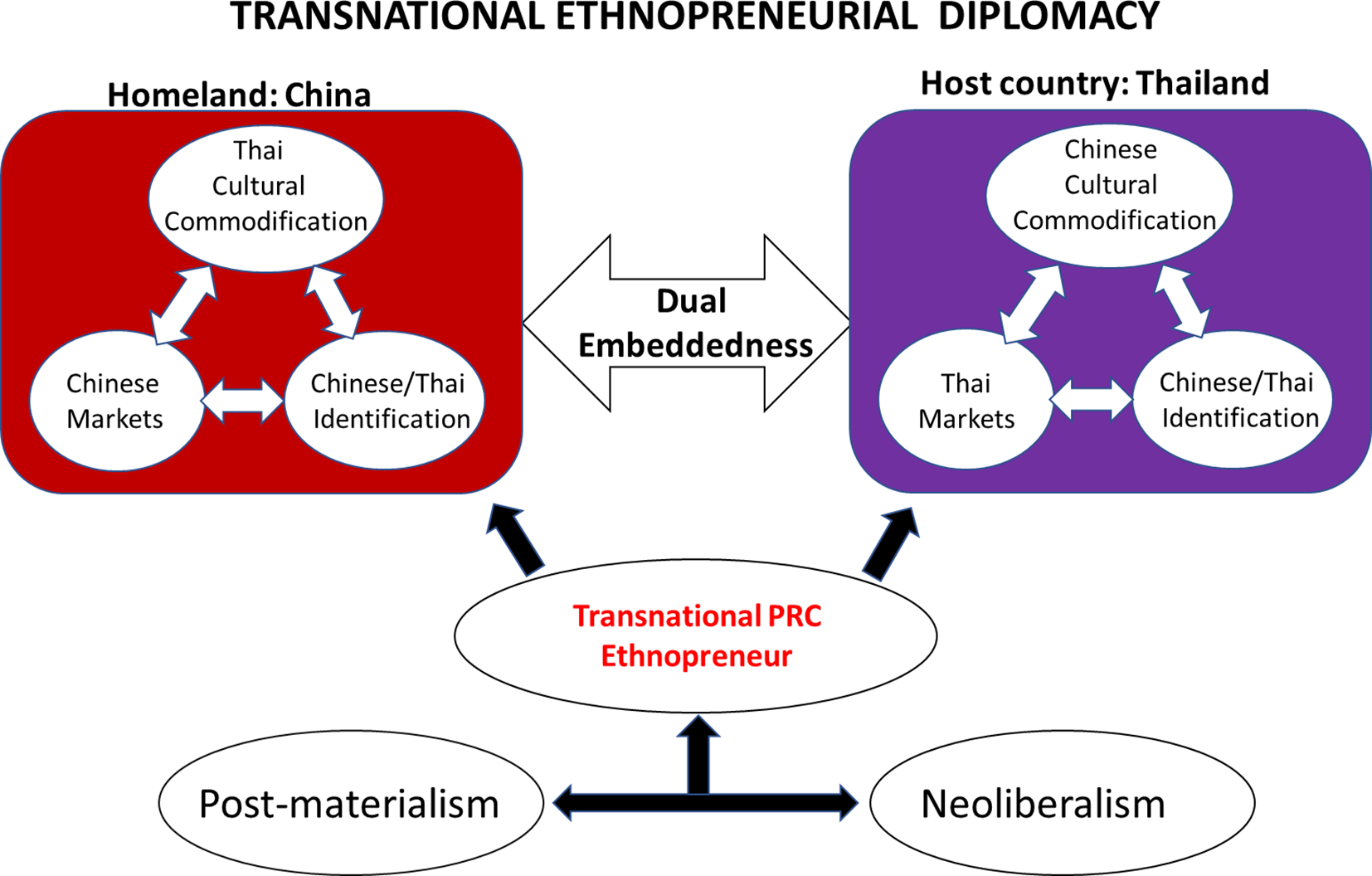
Conceptual Framework. Source: Author’s Own Compilation. Note: PRC=People’s Republic of China.
Method and Data
This article employs qualitative research methods, with extended in-depth interviews and participant observation undertaken. Following Yeung’s (2004: xv, 37) recommendation, it adopts an actor-oriented approach focusing on how a social actor has acted as an agent of change. Taking a bottom-up approach, it thus contributes to remedying the scarcity of research on how a key actor in Chinese capitalism has developed and exhibited different repertoires of entrepreneurial tendencies and practices (Yeung, 2004: 43). While the author as a researcher has previously interacted with several PRC Chinese entrepreneurs keen to promote bilateral relations, the particular case of Mr. Zhou is selected due to the following characteristics: (1) his unique engagement and representation of dual cultural resources, (2) his altruistic commitment to facilitating business and cultural interactions for entrepreneurs and officials from both China and Thailand, (3) his immersive social embeddedness in both countries, and (4) his wide-ranging social influence and recognition across both.
The main protagonist in this article, Mr. Zhou is a 34-year-old PRC Chinese transnational entrepreneur from Qujing, the second-largest city in Yunnan Province, China. Having learnt the Thai language for three years in the PRC, Mr. Zhou first arrived in Chiang Mai when he was only nineteen, in the year 2003. Immediately, he enrolled himself in a Thai bachelor’s degree programme with the Faculty of Business Management, Chiang Mai Rajabhat University. While he was studying, he learnt the ropes of entrepreneurship by opening a shop selling Chinese products – and a Chinese restaurant too. As a result of his business engagement, he quit his studies in his fourth and final year. Nonetheless, by then, he had already mastered the Thai language and become well acquainted with Thai cultural customs.
Subsequently, he returned to the PRC and found himself a tourism-related job in East China and the Pearl River Delta region. During 2012 Mr. Zhou revisited Chiang Mai with his new Chinese wife, to meet with his friends. Upon visiting, he realised that the socio-economic landscape had changed drastically, and there were now more Chinese tourists than before. At that time, Mr. Zhou was facing uncertainty in his working life and was considering a job transition – as the PRC was going through rigorous political reform, which put a dent in his native country’s economic boom. He finally decided to make the radical move of relocating to Chiang Mai in 2014, as he sensed the availability of economic opportunities while also having a deep emotional bond with this Thai city.
To date, Mr. Zhou owns Greater Mekong Sub-Regional (GMS) Exhibition Co. Ltd. (吉姆斯大湄公河次区域会展有限公司, Jimu si da Meigonghe ci quyi huizhan youxian gongsi), which is based in China, and also Thai Elephant (泰吉象, Tai ji xiang), a Thai-registered real-estate company run in collaboration with a Thai national. To obtain credible and substantive field data, the author conducted at least fifteen extended discussions with the main respondent, Mr. Zhou, as well as with other entrepreneurs, such as Ms. Panuumas Gewan, for cross-validation purposes – taking the form of formal interviews, informal interactions, and non-formal participant observation. Besides all that, the author also surveyed public documents, such as the magazine Mekong River, to obtain an objective perspective on the matters at hand. Throughout the data collection and analysis, the author has sought to unravel the primary research question: How does Zhou Ji promote diplomatic Sino–Thai interactions through multiple forms of Thai and Chinese cultural commodification, while traversing between the two countries as a transnational ethnopreneur?
Historical Overview of Sino–Thai State-Centric Diplomacy
This section takes a historical overview of Sino–Thai state-centric diplomacy, with both countries having adopted diplomatic policies centring on their respective state interests. Between the thirteenth century and the late nineteenth century, the Chinese had penetrated and expanded into the entire economy of Thailand (Wu and Wu, 1980: 66). However, from 1939 onwards, Thailand would design and implement “patriotic” measures to restrict Chinese activities in terms of remittances, employment, population control, and joint ventures (Wu and Wu, 1980: 71). This was followed by a long hiatus in diplomatic relations after World War II due to bipolarity, wherein Thailand joined the “free world” while China aligned with other Communist regimes (Sirindhorn, 2015: 1). However, it was the Cambodian conflict (1978–1991) that would bring Thailand and China together once more (Chinvanno, 2015). By 1999, Sino–Thai relations had deepened from a security-focused partnership to trade interactions – culminating with the signing of a “Joint Declaration on the Cooperation Program of the Twenty-First Century” (Chinvanno, 2015; Freedman, 2014).
Since the dawn of the twenty-first century, there has been a re-emergence of the phenomenon of Chinese migrants heading to Southeast Asia (Sung, 2015). This re-emergence has coincided with the PRC’s legitimisation and indeed celebration of social dual embeddedness or “dual allegiance” (Nyiri, 2004: 120) among the Chinese diaspora. By 2009, the overseas Chinese population in Thailand ranked highest in Southeast Asia – with about 7,566,000 such people there (Jacques, 2009: 437). From a global perspective, China’s international strategy has been promoted as the boosting of peace, development, regional stability, and integration while simultaneously seeking to realise the grand “Chinese Dream” (Zhang, 2016). Consequently, these new Chinese migrants have generated more extensive and intensive connections with the local communities, while in tandem maintaining their cultural and political attachments to the PRC as the fatherland (Santasombat, 2015). Recent Chinese migration to Thailand specifically has been driven by economic and political factors stemming from the PRC’s global openness, connection to Southeast Asia through the Greater Mekong Subregion’s regionalisation, and the PRC’s utilisation of soft power strategies (Siriphon, 2015: 150–152).
As the receiving end, meanwhile, Thailand has gradually developed a growing sense of confidence and affection for the PRC through the latter’s many constructive efforts – including buying surplus agricultural products and supplying tourists to buttress the Thai economy in recent years (Chinvanno, 2015). Thailand also stands to gain from the PRC’s current top national strategy, the Belt and Road Initiative (BRI). The BRI targets soft and hard infrastructural connectivity with South and Southeast Asia, Central Asia, Pacific Oceania, Africa, and Europe, intended to forge an integrated and extensive network with the PRC as its hub (Yu, 2017: 117).
With the United States’ withdrawal from the Trans-Pacific Partnership, there is now increasing momentum behind the BRI’s ambitions to accelerate regional – and indeed global – economic cooperation and integration (Yu, 2017: 117). This initiative has inadvertently led to accelerated industrialisation in Thailand, through the PRC’s investment in the Southeast Asian country (Yu, 2017: 120). In 2018 the junta expected Chinese investment in Thailand’s Eastern Economic Corridor, comprising high-speed rail services as well as airports, to be linked with China via the BRI so as to help Thailand grow its automobile, electronics, and information technology industries and thus escape the middle-income trap (Raymond, 2019: 342–343).
However, the BRI is not without its challenges. Over territorial and maritime disputes in the South China Sea, the PRC has been perceived by regional countries as taking a very assertive stance towards its small neighbours (Yu, 2017: 121). This is evident in Beijing’s non-compliance with The Hague-based international tribunal’s unanimous verdict reached in 2016, a response which has damaged the PRC’s reputation as a responsible and law-abiding power (Yu, 2017: 121). Like many Southeast Asian countries, Thailand fears becoming too economically dependent on the PRC and has become suspicious about the latter’s motivations, given the BRI’s ambiguous geopolitical and geostrategic implications (Yu, 2017: 121–122). Against this backdrop of fluctuating and volatile Sino–Thai state-centric diplomatic relations, the article will now articulate the critical mitigating role played by a transnational PRC ethnopreneur in people-to-people interactions on the ground.
Multiple Forms of Thai Cultural Commodification
Since the December 2012 successful release of the Chinese film Lost in Thailand (人再囧途之泰囧, Ren zai jiong tu zhi tai jiong), there has been a phenomenal rise in the number of PRC Chinese tourists visiting Chiang Mai – where more than 80 per cent of the film was shot. In terms of the number of PRC tourists travelling to Thailand as a whole, the figure would jump from 1.7 million in 2011 to 4.7 million in 2013, and then skyrocket to nine million in 2016 (Wolfgang, 2016). Throughout this period, there was a growing demand for Thai products in the Chinese market. In the past, many Chinese stereotypically associated Thailand with shemales (人妖, renyao), rice (大米, dami), Phuket (普吉, Pu ji), and Pattaya (芭提雅, Ba ti ya). However, nowadays, the Chinese would spontaneously list snail white cream (蜗牛霜, woniu shuang), latex pillow (乳胶枕, rujiao zhen), dried longans (龙眼干, longyan gan), essential oil soap (精油皂, jingyou zao), and other local cosmetic products like “Ele” and “Voodoo” as reputable Thai products.
Back then, having discerned an opening for business opportunities, Mr. Zhou launched creative “Thai Cultural Fairs” or “Chiang Mai Cultural Fairs” in China. Between 2014 and 2016, Mr. Zhou organized dozens of exhibitions on different scales in Sichuan, Yunnan, Guangxi, Jiangsu, and other Chinese provinces. These were uniquely constructed so as to replicate the famous tourist attraction “Chiang Mai Walking Street,” thereby presenting the authentic flavour of Thailand to attendees. In order to achieve such a comprehensive display of Thai culture, Mr. Zhou – through his old connections and by word of mouth – had solicited as many as eighty Thai merchants to take part in each of his exhibitions. Conscientious efforts were also made regarding the overall design, with booths’ arrangement and the stage set-up at the physical sites reflecting the unique Thai style. During these events, Mr. Zhou himself would also take the stage to provide a detailed introduction to the cultural heritage behind the Thai products being offered to Chinese attendees. The highlights of selected exhibitions presented in the following text reveal Mr. Zhou’s strategic deployments, diverse engagements, and intensive endeavours elucidating the multiplicity of his Thai cultural commodification.
20–28 June 2015 at Great View Pavilion (大观楼, Da guan lou), Kunming (昆明), Yunnan (云南)
Mr. Zhou and his team co-organised this exhibition with Da guan lou, Kunming in celebration of the Lotus Festival (荷花节, he hua jie). There were about 50 Thai merchants who participated in this exhibition. Uniquely, this exhibition utilised gold-painted containers (集装箱, jizhuangxiang) as a stage, with great acoustic effects. The contemporary design was juxtaposed with traditional Thai dance performances creating an impactful presence, similar to the spectacular New Year’s Eve celebrations.
4–12 July 2015 at Century Square (世纪广场, Shiji guangchang), Kunming, Yunnan
Mr. Zhou shared that this event involved about 70 Thai exhibitors and attracted plenty of visitors. There was a Thai band and traditional dance performances. During the event, Mr. Zhou painstakingly explained the cultural backgrounds of the products one at a time. For instance, he explained the origins of “Made in Thailand” rice noodles to the younger generation of Chinese attending. He shared that due to a war long ago, some Yunnanese had brought their recipes with them when they crossed the Thai border and lived with the local people there. As a result, the subsequent mixed descendants adapted and transformed the noodles into a domesticated Thai version. All in all, Mr. Zhou patiently translated the Thai merchants’ explanations of the cultural origins of their products into Mandarin for the Chinese visitors.
5 October 2015 at Wanda Square (万达广场, Wanda guangchuang), Chengdu (成都), Sichuan (四川)
For this exhibition, Mr. Zhou and his team secured native Thai products – which are renowned across Asia. For instance, they managed to bring in popular items such as Chang Beer, wooden sculptures from Chiang Mai’s Baan Tawai, specialty sesame products from Mae Hong Son Province, and fresh durians from Rayong Province. Besides this, Mr. Zhou sought to provide authentic Thai cuisines, cosmetics, handicrafts, and furnishings at this exhibition. In addition, there were traditional Thai dance performances as well as Thai massage services incorporated into the event.
12 December 2015 at Mobile Phones Mall (手机广场, Shouji guangchang), Qujing (曲靖), Yunnan
For this particular exhibition, Mr. Zhou and his team focused on art installations, whereby they set up signposts such as “Chiang Mai, zero kilometres” and “Nimmanhemin Road” to mimic actual destinations. Moreover, huge multicoloured paper umbrellas and festive lanterns were used as decorations to represent the colourful nature of Thailand. The created ambience formed a microcosm of the diverse cultures of the Southeast Asian country.
Multiple Forms of Chinese Cultural Commodification
Mr. Zhou did not, of course, solely commodify Thai resources. On the contrary, he engaged Chinese economic culture in his interactions with Thai business people. Over the past few years, many of his Thai friends have approached him to promote their Thai products and to seek potential avenues for business partnerships via and with his Chinese connections. Through these encounters, Mr. Zhou diagnosed many of Thailand’s small and medium enterprises (SMEs) as having a common problem. Being critical, he used the terms “conservative” and “backward” to describe them – referring specifically to four aspects: ideas, craftsmanship, management ideas, and the marketing model. Hence, he often shares the nature of Chinese business cultures with Thai entrepreneurs and traders in public seminars that he gives.
In a public seminar held on 13 December 2017 at Chiang Mai University, Mr. Zhou cited an actual example to illustrate how local Thai entrepreneurs could have adopted the Chinese economic culture in dealing with a particular business issue:
I am staying in the small town of Baan Tawai in Chiang Mai. Ten to twelve years ago, this place was famous for northern Thai folk arts and crafts production, and for being a wholesale centre where antique shops and high-quality second-hand goods stores from around the world had attracted many overseas tourists. Tourist buses and transport vehicles were commonplace in this prosperous locality. However, in recent years, business has deteriorated and many merchants have been complaining perpetually. They have conveniently shifted blame to the “global economic downturn” without objectively exploring the root causes of their problems.
In the same seminar, he went on to provide a prognosis:
Apart from good design, these products had previously gained global recognition due to their pure handmade-craft quality. So how has the situation deteriorated to this point, where such promising handicrafts have fled from customers’ memories? In my opinion, due to the rising living standards and tastes of the growing middle class, the market demand has gradually shifted from “quantity” to “quality.” Hence, to begin with, we need to raise the quality of our products. For instance, although the woodcarving crafts and wooden furniture are made of pure natural materials with high quality, the products might not be impeccably produced. This would drastically reduce the value of the products. In addition, there are also changes taking place on the market-demand side. Most of Thailand’s real-estate development projects feature modern European designs. As the profile of consumers shifts towards young, white-collar executives, the existing furniture with its old-fashioned design is losing its appeal.
Mr. Zhou suggested that there is a need to adopt the Chinese idiom yu shi ju jin (与时俱进), which means “keeping up with the times.” With this, he painstakingly explained to his Thai audience that there is a need to freshen up their products or to take a different business track so as to meet the constantly changing demands of consumers.
From an intersubjective perspective, the author conducted an interview (3 February 2018) with Ms. Gewan – who has benefitted greatly from Mr. Zhou’s wisdom. At the age of 42, she first joined his organised exhibition as a Thai entrepreneur in the woodcraft business in 2015. When she was in her early twenties, Ms. Gewan received some money from her parents to establish a wood factory. She then set up her shop named “Worogor” in Baan Tawai, Chiang Mai, which served the huge wood and building materials market in Thailand. At that time, Ms. Gewan would purchase raw materials from Laos and Cambodia. She would then send them to her skilled carpenters for craftsmanship and subsequently to her factory for assembling and mass production before releasing for sale in the market.
For over twenty years, she would conduct her business in this way while relying heavily on European customers. However, about seven years ago, Ms. Gewan noticed that her sales were steadily shrinking, attributing it to a poor economy in Thailand due to political fluctuations. Incidentally at that time, PRC logistic companies started exploring Baan Tawai, a town full of woodcrafts. Thus Ms. Gewan began to consider how she could penetrate the growing market for woodcrafts in China, since proximity and accessibility to that country were advantages that she had.
It was only when she met Mr. Zhou that new opportunities began to materialise. After attending his exhibition in China, Ms. Gewan realised that there was a growing demand for Thai food products – which were deemed to be safer for consumption. Many Chinese had by then started buying Thai dried food products like fried pork skin. With the help of Mr. Zhou, she was introduced to many PRC businessmen and investors – with one of them later becoming interested in collaborating with her in meeting the growing demand for fried pork skin. They discovered that this food item was a popular snack among many nightclub goers. Since production costs and logistics were relatively cheap and more convenient in China, they decided to set up a factory producing fried pork skin in the country.
While the PRC businessman was responsible for setting up the factory, Ms. Gewan looked into the food’s production – with an adjustment of ingredients to suit the taste buds of Chinese people. Ms. Gewan articulated that she has learnt efficiency, future-oriented, and growth-minded perspectives from Mr. Zhou. Instead of being easily satisfied with the status quo, she has learnt to appreciate pressures in life – ones that can motivate her to develop further. In terms of cultural commodification, Mr. Zhou’s impartation of Chinese business cultures to Ms. Gewan has contributed massively to her own business success. This, in turn, has aided Mr. Zhou’s social embeddedness in Thailand, as Ms. Gewan constantly helps his business to grow – as his Thai nominee – and with other aspects of daily life.
There are also times when Mr. Zhou has faced the difficulties of intercultural differences in his attempts to promote Chinese business culture perspectives. In one particular case, Mr. Zhou signed a contract with a city site to organise an exhibition. However, there was an unexpected city government health campaign wherewith officials ordered the sudden cancellation of the exhibition at short notice. That was a crisis moment, as hotel rooms, air tickets, and other transportation-related services had already been booked and paid for. Due to receiving such short notice, Mr. Zhou could not find an alternate location. Consequently, Mr. Zhou suffered massive losses. In addition, he forked out his own money to compensate the Thai merchants involved for the lost opportunity. However, there were some among them who did not appreciate his kind gesture. For instance, one Thai lady chose to abandon her partnership with him after finding other agents who lured her with higher returns. In spite of Mr. Zhou’s caution, she insisted on grasping at immediate benefits without considering long-term development opportunities. Ultimately, she suffered losses as these new agents turned out to be unreliable and offered no strategic prospects for Thai merchants. Mr. Zhou afterwards lamented,
I still respect and treat her like a loved one. However, the problem lies with her way of thinking as she only sees what is in front of her. In fact, this mentality of immediate interest seems to be prevalent among many Thai people. Some others followed in her footsteps in collaborating with those agents who promised them cheap but sparsely populated venues. In the end, they could not sell their products. Indeed, these Thai merchants are timid. They are unlike PRC Chinese entrepreneurs who dare to take loans from banks for investments so that they can expand their businesses and earn more money. In sum, these Thai merchants are not like us who hold lofty ideals and macro perspectives. They only hope to be able to sell more things in China. They simply fall for any immediate benefits, without considering long-term implications. (Interview 3 February 2018)
In a nutshell, Mr. Zhou’s promotion of Chinese business cultures is invariably set on far-sighted goals, while being dependent on how Thai merchants respond or react to his shared perspectives. In both public forums and private domains, Mr. Zhou has sought to use his perspectives as a Chinese ethnopreneur to help his Thai counterparts to improve on their business models – which will ultimately lead to long-term economic benefits for them.
Unofficial Dual-Accredited Roles in “Ideomaterial Consumption”
On almost every occasion, Mr. Zhou has presented himself as an unofficial dual-accredited citizen diplomat in serving the interests of both the PRC and Thailand. Besides his personal interactions and public forums, Mr. Zhou has also actively engaged with institutions that enhance bilateral relations. As a case in point, Mr. Zhou initiated and collaborated with the Chinese consulate in Chiang Mai to set up a chamber of commerce – with the purpose of promoting further economic exchange between the PRC and Thailand. Mr. Zhou noted:
Picture a PRC businessman who would like to import longans from northern Thailand into China. However, this person has several difficulties. First of all, he cannot speak the Thai language. Thus, he needs an interpreter. Besides, he does not understand the geographic landscapes and environmental conditions involved in longan production. Thus, he needs to personally explore many physical sites so as to ascertain the most lucrative location for longan farming. Further, he has to enquire about Thai and Chinese freight, port, and other related taxes. He will need to make several trips to Thailand, and he will require at least a month to consolidate all necessary information. However, all these problems will be resolved if we have such a chamber of commerce to facilitate them. (Interview, 3 February 2018)
By appointment, Mr. Zhou currently holds the position of vice chairman of this association and seeks in this capacity to provide crucial information to assist PRC businesspeople, developers, and retirees looking to settle in Thailand. Under the auspices of this association, Mr. Zhou has organised several meetings and activities for both Thailand and PRC representatives – serving as a platform for enhancing greater cooperation in economic matters as well as closer integration vis-à-vis sharing resources. Mr. Zhou highlighted that he has received massive support from the Chinese consulate, including information related to bilateral policies and the BRI. In recognition of his distinctive contributions, in 2017 Mr. Zhou was named “The Most Influential Person of the Year in the Mekong River Basin” by Mekong River (PRC State Council Information Office, 2017: 17). The latter is a well-known, bilingual, PRC government–sponsored magazine published in Yunnan, one that has been made available in Thailand as well.
Concomitantly, Mr. Zhou has also actively sought to develop ties with Thai state agencies. Although to date he has not received any financial support from Thai authorities such as the Tourism Authority of Thailand, Mr. Zhou has still continued to seek engagement with state officials. At his own expense and of his own accord, Mr. Zhou has previously invited the president of the Chiang Mai women’s association, the director of the Chiang Mai police department, and former Chiang Mai diplomatic officials to join his cultural fairs in China.
Finally, Mr. Zhou’s cultural diplomatic aspirations are rooted in what can be termed his “ideomaterialist” orientation in enjoying Chiang Mai’s conducive living environment. The author has coined the term “ideomaterial consumption” to avoid binaries while hybridising the ideological quest of post-materialism and the neoliberal material quest existing in Chinese capitalism. In one of the interviews, Mr. Zhou explained:
Due to my experience in organising exhibitions, many of my friends might have ascribed me with the honourable status of a Chinese entrepreneur or businessman. However, in my opinion, I am more of an ambassador for cultural transmission. To me, culture is the cornerstone of international and interethnic relations. If international trade were to be developed between countries, then cultural exchange must occur prior to any economic transaction. As for me, the foundation for any progressive international relations will be established when there is a foundation of mutual cultural understanding set in the background. This is similar to our country’s BRI, where the principle of “culture first” has been adopted. Since I was a child, I was raised by my parents – who were music teachers – to be inculcated with the significance of regional and cultural arts. I am not a materialistic person, and my only desire is to spend more time with my loved ones. As my parents are aging daily, I want to acquire a quiet and comfortable place so as to be in the company of them and my loved ones. All things in this world are unpredictable, and life is short. While money may enrich one’s material life, the happiness and well-being of one’s family members is more valuable than anything. (Interview 13 December 2017)
In his speeches, Mr. Zhou consistently reflected his life navigation towards integrating both ideological and material dimensions. As he posited:
I profess that I understand Thai culture. For many Chinese tourists, they only have a superficial awareness due to their short stay in Thailand. Consequently, they have flawed perceptions of Thai people. On the other hand, some Thais have misconceptions with regard to the Chinese. Therefore, I have a responsibility to help people from both countries to eradicate those wrong notions. China and Thailand are neighbouring countries, and their relations with one another are likened to brotherhood. Hence, I must obliterate any existing misunderstandings so that their brotherly bond can be sustained permanently […]. The arrival of more Chinese tourists signalled unlimited business opportunities, especially for Chiang Mai where tourism industry plays a significant economic role. While this might be true, it is important to recognise that people from different countries have cultural differences. If fundamental assumptions are not dealt with, then deeper misunderstandings might develop and become entrenched over time. Therefore in all of my exhibitions, and as long as I have the opportunities, I seek to present a comprehensive, genuine, and factual representation of Thailand in its actual development. At the same time, I seize every opportunity to present a totally different China – with Thai merchants participating in my exhibitions as well as informal gatherings. (Interview 13 December 2017)
In essence, these exhibitions serve as a cultural platform to promote good products from Thailand in China. In addition to satisfying Chinese consumerism, such cultural platforms will allow PRC Chinese to experience Thai culture, which will further enhance mutual understanding. It is only through deepened mutual understanding that one can discover what the other party really needs and what future collaborations can be forged. This will then stimulate more commercial exchanges and partnerships. (Interview, 3 February 2018)
In essence, these quotes accentuate Mr. Zhou’s ambassadorial ambitions through multiple forms of cultural commodification in relation to markets and identities spanning Thailand and China. According to these quotes, the convergence in Mr. Zhou’s forging of cultural collaborations, while also seeking business opportunities, reveals his complex ideomaterial consumption as he performs an unofficial dual-accredited diplomatic role.
Envisioning Transnational Ethnopreneurial Diplomacy
Earlier, the article noted the problematic nature of traditional citizen diplomacy notions – being fixated as they are on single-accredited individuals performing unilateral, state-centric ambassadorial functions. In mitigation, transnational ethnopreneurial diplomacy has been proposed and defended as an alternative paradigm – one set against the transforming socio-economic landscapes of dual embeddedness, neoliberalism, and post-materialism. Through the iconic case study of Mr. Zhou, the efficacy of this model has been succinctly presented as follows: first, he promoted Sino–Thai cultural appreciation through the facilitation of Thai merchants in their commodification of Thai cultural products and activities. This Mr. Zhou did when he organised Thai exhibitions or cultural fairs in various Chinese cities. From a Thai perspective, he has practically extended the transnational business networks of Thai merchants into the PRC Chinese market. From the PRC Chinese side, meanwhile, Mr. Zhou has opened up to his native country’s entrepreneurs potential transnational business collaborations with Thai merchants.
Second, from an institutional perspective, Mr. Zhou helped set up a chamber of commerce in Thailand specialising in facilitating and supporting economic interactions between the PRC and the Southeast Asian country. Out of his own personal funds, he has enabled Thai officials to participate in his self-styled ambassadorial activities – specifically in the form of exhibitions promoting Thai cultural commodities in China. Third, Mr. Zhou’s commodification of Chinese business cultures has also helped some Thai merchants to appreciate Chinese cultural values and enhance their own business development. The example of Ms. Gewan’s successful transnational entrepreneurial venture in China has demonstrated the effectiveness of Mr. Zhou in promoting “Chineseness.” Finally, Mr. Zhou’s diplomatic efforts have been attested to intersubjectively – as he gained recognition in a reputable Chinese–Thai bilingual magazine.
Some scholars have expressed caution about Chinese transnational entrepreneurial practices, with their increasing influence having brought about a “negative reaction from the grassroots and the public, many of whom have become victims of land-grabbing and resource enclosure in the name of development” (Santasombat, 2015: 2). In her critical study of a Chinese neoliberal project in the Golden Triangle Special Economic Zone, Laungaransri (2015: 143) described how China’s “civilizing mission” has “de-territorialized” Lao residents and Burmese workers – leaving them with “little negotiating power in their workplace and little freedom to define their subjectivity.” Yet, there are also those such as Mr. Zhou who positively seek to promote bilateral relations from an unofficial, dual-accredited diplomatic position.
Hence, this article has aimed to rectify the biased notion of predatory Chinese capitalism by introducing transnational ethnopreneurial diplomacy as a new vision in citizen diplomacy. With the now-changing global politics and continuing competition between the United States and China, it is crucial to re-envision new forms of citizen diplomacy and thus escape the Thucydides trap – as denoting “tensions between an established hegemon and the rising challenger” (Santasombat, 2019: 23). Supporting this new vision, the article has articulated the importance of upholding the spirit of working together in order “to rectify and improve the global economic, political, and security challenges” (Santasombat, 2019: 23).
Conclusion
The research findings of this article contribute epistemologically to overcome the limited conceptualisation of traditional citizen diplomacy as fixing “citizens” within a single nation-state sovereignty as well as to rectify overlooking the transformation of embeddedness in view of changing global socio-economic and political circumstances. Through the case study of the article’s protagonist, Mr. Zhou Ji, a re-envisioning of citizen diplomacy through transnational ethnopreneurial diplomacy has been articulated. As a single case study, it does not seek to provide a generalised and complete picture of transnational PRC Chinese in Thailand. The author acknowledges its limitations in capturing the infinitely nuanced variations in PRC transnationalism, as characterised by different generations, genders, occupations, mobilities, and other identification practices in Thailand. Hence, this article recommends that further studies should be conducted on other types of citizens, where public–private engagements for multiple win-win outcomes can also be made across countries.
To reiterate, it has been argued that the effects of dual-embedded transnationalism, neoliberalism, and post-materialism behove a re-envisioning of citizen diplomacy – wherein individuals are spontaneously situated so as to adopt unofficial dual-accredited roles for the enhancement of bilateral relations. In today’s volatile and precarious political and socio-economic landscapes, developing countries are constantly seeking ways to foster sustainable multilateral relations with significant other ones. Departing from a zero-sum game approach, this article argues that countries should tap into the power of the non-traditional, transnational, ethnopreneurial diplomats navigating between multiple identities, cultures, and markets. Instead of conceiving of citizens within a sovereign state’s fictional production of “a common past and a common future” (Lanoix, 2007; Shapiro, 2000: 79), it has been argued that we should consider how transnational locals and foreigners can serve multiple diplomatic missions. For instance, Thailand should consider how to support ethnopreneurs like Mr. Zhou and Ms. Gewan in the extension of its identities, cultures, and markets to China. In the same vein, the PRC government might consider working in partnership with ethnopreneurs like these two individuals – as part of furthering its soft power via cultural diplomacy with Thailand and other countries.
Footnotes
Acknowledgements
I would like to thank the Thailand Research Fund (Contract Number MRG6080207), which supported me in this research under the project titled “Transnational Entrepreneurship and Cultural Diplomacy: Harnessing Multi-Faceted PRC Chinese Transnational Entrepreneurial Contribution in Chiang Mai, Thailand.” I also thank my project mentor Professor Dr. Yos Santasombat, who has provided wise insights. I would also like to express my gratitude to the three anonymous reviewers for their comments. I am additionally immensely grateful to the editorial committee of Journal of Current Chinese Affairs (JCCA) for guiding me through the publication process. However, I alone am responsible for the recommendations and conclusions of this article; any errors are my own.
Declaration of Conflicting Interests
The author(s) declared no potential conflicts of interest with respect to the research, authorship, and/or publication of this article.
Funding
The author(s) disclosed receipt of the following financial support for the research, authorship, and/or publication of this article: This study was supported by Thailand Research Fund (Contract Number MRG6080207).
Author Biography