



Abstract
This article examines the ways in which taxi driving and China's quest for global ascendency are interlinked and enmeshed. Inspired by de Certeau's The Practice of Everyday Life and his conceptual formulation of “strategy” and “tactic”, this article explores how taxi drivers, through their everyday practice of driving, found ways and moments to tactically challenge and appropriate so-called “civility campaigns” and a rising China. By demonstrating the numerous instances of tactics taxi drivers used, I argue that their socio-economic marginality did not, in fact, reduce them to a “powerless” position. I bring in Foucault's analytics of power and governmentality to add to de Certeau's work by helping to explain the intertwined relationship between government and governed to shed light on the complexity implicated in the dynamics of power relations and resistance. I examine the period around the 2008 Beijing Olympics as it involved large-scale attempts to showcase China through (urban) transformation.
Introduction
China's reform and opening policy has made its population wealthier. The number of automobiles – objects that symbolise wealth, modernity and freedom – has since grown exponentially. Up until about one-and-a-half decades ago, the bicycle was the main mode of transportation in Beijing. Today, just in the Chinese capital alone, there are more than five million cars, a number increasing monthly by 66,000 on average (Xinhua 2012). This explosive growth in “automobility” is in tandem with rapid urban transformation and China's accelerating development, yet little has been written on the relationship between the everyday practice of car driving and China's quest for global ascendency. This is rather surprising given the unremitting interest in examining urban changes in China, especially in relation to the 2008 Beijing Olympics (e.g. Acharya 2005; Broudehoux 2007; Donald 2010; Lai and Lee 2006; Marvin 2008; Ren 2009). It is the fact that this everyday practice of car driving so crucial to examining a fast-changing China is so understudied that motivates this study. 1
I would like to express my gratitude to the many Beijing taxi drivers who shared their views and stories with me, the International Institute for Asian Studies (IIAS) for the postdoctoral fellowship, the Netherlands Organisation for Scientific Research (NWO) for the research grant, Jeroen de Kloet, Yiufai Chow, Rebecca Chan and the anonymous referees for their insightful comments and useful suggestions.
This article looks specifically at taxi driving and taxi drivers in Beijing respectively, a practice and a segment of China's urban population that have played vital symbolic roles in the public imaginary as representations of urban transformation since China's reform and opening policy was implemented; yet, as mentioned above, taxi driving and drivers have not received sufficient and sustained academic attention. The 2008 Beijing Olympics represented a key moment for this study, as the preparation for the Games involved large-scale (urban) transformation in showcasing China to its population and to the world. Beijing taxi drivers proved unique figures to study in order to learn how the everyday practice of taxi driving is entangled with a rising China.
Just like the yellow taxi always reminds one of New York, the Beijing taxi is an
important symbol of Beijing, and Beijing taxi drivers are associated with people's
perceptions of Chineseness and China. In the period leading up to the Beijing
Olympics, older taxis in Beijing were replaced by new ones that were given a set of
standardised colours (green, burgundy, or dark blue with yellow). Beijing taxi
drivers, because of their presupposed frequent and direct interactions with
potential visitors to town, were assigned the role of “cultural ambassadors” and
told to display a positive image of China. Yao Kuo ( ), vice-director of the
Beijing Traffic Management Bureau, said:
), vice-director of the
Beijing Traffic Management Bureau, said:
A person's hairstyle and the accessories they wear are their personal business, but cab drivers must remember that their industry is a window [into] China's capital, and they contribute powerfully to the city's image (China Daily 2007).
Beijing taxi drivers are mostly of working-class or rural backgrounds. Dismayed by the thought that their socio-economic background might harm the image of Beijing, China and the Chinese, authorities put forward civility guidelines to shape, instruct and discipline taxi drivers’ behaviour and appearance so that they would transcend from driving a taxi to driving Beijing to the league of presentable global cities.
The drastic makeovers of taxi driving intensified the public's interest in taxi drivers. Media production on taxi drivers (e.g. Women at the Wheel 2006) exists but it was first around 2008 that taxi drivers became a fascinating subject of various media productions: Taxi (2008), Mad about English (2008), Olympic programmes on Radio Television Hong Kong in 2008 and Beijing Taxi (20010). However, there has hardly been any academic study on Beijing taxi driving, except quantitative social psychology research on the subjective well-being of Beijing taxi drivers (Nielsen, Paritski, and Smyth 2010). When taxi drivers are mentioned in academic articles related to the Olympics, they are mentioned in passing and do not have much academic value (see, for example, Ha and Caffrey 2009; Lovell 2008).
Existing literature on taxi drivers is and was written with differing approaches, at different times, and based on different localities. Geremie Barmé's Engines of Revolution (2002) is a historical account of the symbolic meanings assigned to automobiles in China's march to modernity. He singles out the evolvement of taxis as an interesting development in China's automobile history. He argues that the taxi drivers were “liminal figures” (Barmé 2002: 185) who enjoyed relatively more physical and financial freedom and, more important, more political and moral freedom than an average citizen, as they could
declaim on issues of the moment with little thought of being caught out or penalized as they coursed their way around the streets, spreading gossip and generating innuendo as they went (Barmé 2002: 185).
On the other hand, Emily Chao and Beth E. Notar argue that the taxi drivers in their study were marginal figures, who were not empowered by the mobility associated with taxi driving. Chao's Dangerous Work (2003) focuses specifically on gender: She analyses rumours circulating around women taxi drivers in the tourist town of Lijiang in Yunnan. She argues that urban transformation has led to the sexualisation of space and power, and this has given rise to various policing and disciplinary discourses and practices regarding the female taxi drivers. Beth E. Notar's studies of Kunming taxi drivers appeared nearly a decade later. In Off Limits and Out of Bounds (2012a) and “Coming Out” to “Hit the Road” (2012b), she examines whom taxi drivers perceived to be dangerous people and how they narrated their own physical and socio-economic mobility.
Both Barmé and Chao look at how taxi drivers are perceived by others; only Notar focuses on the narrations of taxi drivers themselves. This article seeks to add to the scant research on the narrations of taxi drivers by providing an empirical study of taxi drivers in Beijing; more importantly, it aims to examine how taxi driving, an act that creates “an automobilized person” (Katz 1999: 33), was disciplined and moulded to present a rising China and how taxi drivers tactically appropriated the civility campaigns and China's quest for global ascendency. Regarding the latter, I look at taxi drivers as what Michel de Certeau calls the “users”, those “commonly assumed to be passive and guided by established rules”, to see how they “operate” (de Certeau 1984: xi). Although de Certeau is sceptical that driving can be compared to walking in a similar way (Thrift 2004), I argue below that taxi driving, parallel to the everyday practice of walking – as in his essay “Walking in the City”, a chapter of his The Practice of Everyday Life (1984) – entails “tactics”: means and acts used by individuals to subvert and challenge the dominant orders. I also highlight that talking is a practice enmeshed in taxi driving. I introduce Michel Foucault's analytics of power and governmentality (1991) to supplement de Certeau's formulation of strategies (the dominant/ the strong/ the powerful) and tactics (the weak/ the resistant). This article argues that the taxi drivers under my study might not have a high socio-economic position, but they were by no means passive or docile subjects.
The structure of this article is as follows: I first outline those concepts of de Certeau that are relevant to this study. I argue that driving is an everyday practice that he overlooks but which can shed light on what he means by everyday tactics of “the weak”. I discuss how Foucault's work can eliminate some of the blind spots in de Certeau's work. Then, I give a brief account of the methodological approach, in which I discuss the subjects’ representativeness. Next, I discuss the strategies that disciplined and shaped taxi driving and taxi drivers in the run up to the 2008 Olympics. This is followed by an analysis of the various tactics used by Beijing taxi drivers to appropriate the civility guidelines and China's drive for global recognition. Yet, the data also uncover more complex power relations not captured in de Certeau's work. I then add Foucault's analytics of power and governmentality to de Certeau's model. The article concludes with a summary of my main arguments and a discussion on the theoretical implications of this study.
Theoretical Framework
As Ian Buchanan succinctly states, de Certeau's The Practice of Everyday Life (1984) addresses the “power of the powerless, the activity of the passive [and] the productions of non-producers” (Buchanan 2000: 98). Rather than seeing individuals as simply passive or docile subjects, de Certeau argues that “ordinary” men (also including women) are users, who appropriate the dominant orders imposed on them. He argues that ordinary men are equipped with the ability to find moments and ways to skilfully and creatively disrupt, undermine, challenge, subvert and transgress the established order imposed by the dominant (1984: xvii). This focus is in part a response to his reading of Michel Foucault's earlier work Discipline and Punish (1995). While de Certeau acknowledges Foucault's notion of the generative power, he finds Foucault's analysis tilting heavily towards “the productive apparatus”, which so successfully disciplines and controls every aspect of social life (de Certeau 1984: xiv). In de Certeau's opinion, when the dominant power that controls and subjugates penetrates every facet of social life, the tactics that subvert and transgress it are equally pervasive, as they are “articulated in the details of everyday life” (de Certeau 1984: xiv). He believes that everyday practices, such as reading, talking, walking, dwelling, cooking and so on, are the avenues to locate tactics. To him, everyday life is silent, invisible and hidden away; it is through ways of doing, making and using that the tactics that subvert and transgress insinuates themselves everywhere (de Certeau 1984: xii–xiii).
Strategies and Tactics
“Walking in the City” is often cited as the text that illustrates the essence of de Certeau's work, in particular the conceptual model of “strategy” and “tactic”. De Certeau believes that walking, as a popular everyday spatial practice of the ordinary man, offers an innumerable collection of singular tactics that “weave places together” (de Certeau 1984: 97). He sees walking as a speech act, “a space of enunciation” (de Certeau 1984: 98). The built environment is designed and planned in such ways as to order, organise and shape how people use that space; yet, it is the footsteps of the walkers/ users that give meanings to that space. De Certeau's concepts of strategy and tactic are formulated to distinguish the people (the walkers, the taxi drivers in this study) from the dominant order (the city planners, the officials, the Chinese state, the Olympic organisers, the municipal government). He defines strategy as the institutionalised, inflexible, established and well organised order and dominant form of power whose products include, for example, rules, regulations, laws, rituals and language (de Certeau 1984: xix). Strategies are rationalities used to discipline and control action, behaviour and outcomes. The various requirements related to taxi driving, traffic regulations and the civility guidelines are examples of strategies that intend to produce a proper way of driving a taxi.
A tactic is
a calculated action determined by the absence of a proper locus. […] The space of a tactic is the space of the other. […I]t is a manoeuvre “within the enemy's field of vision” (de Certeau 1984: 37).
When a taxi driver runs a red light, this would be, in keeping with de Certeau, a tactic that challenges the traffic regulation. He posits that ordinary men are not in the position of the “proper” to apply strategies; yet, they also do not simply do as told. A tactic applied by ordinary men does not overtly or purposefully seek to overtake the strategies/ the dominant order/ the strong. A tactic is a practice that relies on chance:
It is always on the watch for opportunities that must be seized “on the wing”. Whatever it wins, it does not keep. It must constantly manipulate events in order to turn them into “opportunities” (de Certeau 1984: xix).
To return to my example, a taxi driver cannot always run a red light; he may do so when he finds the opportunity – for example, when no traffic authorities are around – otherwise he runs the risk of being fined. In this formulation, what de Certeau seeks to examine is not the pattern of resistance but “subtle movements of escape and evasion” (Buchanan 2000: 100).
Walking, Driving and Talking
In “Driving in the City”, Nigel Thrift argues the importance of “driving” and
automobility in studying social life, and he engages with de Certeau's “Walking
in the City”. He pinpoints that de Certeau's preference for studying walking as
“a model of popular practice – and critical process” (Morris, mentioned in
Thrift 2004: 44) has led de Certeau to overlook the importance of driving in
reconfiguring the ways in which people dwell, travel and socialise in more
modern societies. In the chapter called “Railway Navigation and Incarceration”,
de Certeau mentions the train and the bus only with abhorrence: The passengers/
people inside the carriage are reduced to prisoners who are caught in “a bubble
of panoptic and classifying power”, and “there is nothing to do” (de Certeau
1984: 111). This runs in conflict with his general proposition of seeing
individuals as users actively engaging with the social world. Thrift is critical
of de Certeau's perspective on automobility, which is similar to “the classic
account of machine travel as distantiated and, well, machine-like” (Thrift 2004:
45). Thrift argues that driving is “both [a] profoundly embodied and sensuous
experience” (Thrift 2004: 46). In the study of the taxi drivers here, the
civility campaigns and official regulations indicated that the Chinese
authorities also acknowledged that cars/ taxis were extensions of drivers’
bodies. The taxis and the drivers were seen as inseparable entities – “an
automobilized person” (Katz 1999: 33) – that were disciplined in the
Olympics-led civility campaigns. This article not only adds to the argument that
driving is one such everyday practice in which the dynamics between strategies
and tactics unfold, but it also highlights the fact that talking is enmeshed
into the everyday practice of driving in the city. Beijing taxi drivers are
known to be very talkative ( , hen hui
kan), their inclination to chat and their outspokenness not having
gone unnoticed by Barmé (2002). One driver told me,
, hen hui
kan), their inclination to chat and their outspokenness not having
gone unnoticed by Barmé (2002). One driver told me,
We have passengers in our taxis. We drive around the city every day; if no one talks, if we don't talk to any passengers for the whole day, that's very dull (Anonymous 1 2008).
Talking is a crucial component of the everyday practice of driving around the city within a confined yet mobile “taxi-body”. It is within this practice of driving–talking that I seek drivers’ often overlooked, invisible and hidden-away everyday tactics. In a word, this article traces the tactics of taxi drivers based on not only what they do but also what they say – their narrations.
Michel Foucault, Power Relations and Governmentality
De Certeau's distinction between strategies and tactics, however, has its
limitations. First, as Brian Morris indicates, the strict binary differentiation
between the two runs the risk of portraying power relations from a simplistic
top-down perspective, with the oppressed, ordinary men trying to combat the
strategies put forward by the state, its officials and the like (Morris 2004:
681). Second, a corollary of this, de Certeau did not address the differences
among ordinary men or “the struggles and rivalries between the groups comprising
‘the people’” (Frow, mentioned in Morris 2004: 681). For example, not all
drivers on the road are on the same socio-economic footing. Some are more
“extraordinary” than others: Luxury cars or cars with government plates (often
in red letters) enjoy more privileges than taxis; they sometimes, for example,
“bully” other cars by cutting line, especially during traffic jams. Even among
the taxi drivers, those from the city of Beijing would often see those from the
outskirts of Beijing as tubaozi ( ), less sophisticated and
less knowledgeable of the city. The power–resistance dynamic is more diffused
and less clear-cut than de Certeau allows for. Tactics do not always directly
and explicitly target the state. When a taxi driver takes a detour to try to run
up the fare, it is a subversive act that challenges the government-regulated
fee-charging system as well as a “trick” that targets the passengers (the
“haves”). Third, de Certeau's overwhelming interest in exploring moments of
resistance has led him to devote all his energies in this regard to account for
the moments of resistance without also accounting for the possibility that
people may accept the dominant order, or even be abetting it (Morris 2004:
681).
), less sophisticated and
less knowledgeable of the city. The power–resistance dynamic is more diffused
and less clear-cut than de Certeau allows for. Tactics do not always directly
and explicitly target the state. When a taxi driver takes a detour to try to run
up the fare, it is a subversive act that challenges the government-regulated
fee-charging system as well as a “trick” that targets the passengers (the
“haves”). Third, de Certeau's overwhelming interest in exploring moments of
resistance has led him to devote all his energies in this regard to account for
the moments of resistance without also accounting for the possibility that
people may accept the dominant order, or even be abetting it (Morris 2004:
681).
As Buchanan writes, de Certeau's ideas in The Practice of Everyday Life (1984) are tentative and are meant to initiate theoretical discussions to understand the operational logic of culture (Buchanan 2000: 98). I draw on Michel Foucault's analytics of power and governmentality as a supplement to de Certeau's conceptualisation of strategy– tactic (domination–resistance).
Power, according to Foucault, is dispersive and operates in numerous micro-sites in which individuals actively engage in power relations. As Dreyfus and Rabinow elaborate, Foucault's analytics of power is “not meant as a context-free, ahistorical, objective description. Nor does it apply as a generalization to all of history” (Dreyfus and Rabinow 1982: 184). The present study provides a glimpse of the dynamics of power relations in a Chinese context. The disciplinary power that “produces subjected and practiced bodies, ‘docile bodies’” (Foucault 1995: 138) in Discipline and Punish (1995), which is discussed by de Certeau (1984), represents the way Foucault conceptualised power in his earlier work. Disciplinary power requires specific sites and specific bodies to generate the potential acts – how the taxi drivers were trained on the taxi-driving guidelines is an example. It is Foucault's conceptualisation of governmentality in his later work that I find useful to complement de Certeau's work: In Governmentality (1991), Foucault examines the link between the practices of the government and the practices of the self. The word “government”, Foucault elucidates, not only refers to the administration of a state, it also means managing, guiding and regulating the self, one's family, one's children and so on.
The concept examines the continuity between the government of a state and the governed (Foucault 1991: 91). The art of government refers to the art of guiding people to govern both the self and others that shapes the possible actions (Foucault 1991: 91). Power of the state should therefore be evaluated in terms of how it constructs an array of relations that makes the system work. Rather than simply using law and regulations, the state governs via multifaceted layers of social relations running across society.
This should serve as a warning against a binary reading of the state versus the people; how a wide array of social relations help shape individuals’ behaviours needs to be analysed. This does not mean de Certeau's idea of strategy is wrong: Foucault does not write off domination (see, for example, The Subject and Power (1982) and The Ethics of the Concern for Self as a Practice of Freedom (1997)). Rather, what Foucault indicates is that the analysis of government needs to transcend an overly straightforward formulation of the state/ the official and the people. Moreover, the concept helps explain why individuals accept or are even complicit with the dominant order. The findings below illustrate this.
Foucault's governmentality offers a more comprehensive way of understanding the intertwined relationship between the governing and the governed, domination and resistance. However, even though he writes that resistance is implicated in all power relations – that is, virtually everywhere – the notion of resistance remains abstract, and he does not offer detailed or concrete examples of how resistance is made possible in everyday life. This is, however, compensated for by de Certeau's emphasis on everyday practices and the formulation of strategy and tactic.
Methodology
This study draws upon empirical data I collected during fieldwork in Beijing in
2007, 2008 and 2011. Three sets of data are used here. The first set consists of
data derived from ethnographic observations from 99 open-ended interviews with
taxi drivers (18 recorded and 78 with handwritten notes). The second set
contains official materials related to taxi driving: The Beijing Olympic
Games Guidebook for People in the Service Sector ( , Beijing aoyunhui
chuangkou hangyeyuangong duben, hereafter Guidebook), The
Olympic Palm Book for Beijing Taxis (
, Beijing aoyunhui
chuangkou hangyeyuangong duben, hereafter Guidebook), The
Olympic Palm Book for Beijing Taxis ( , Aoyun beijing
dishi zhangzhongbao, hereafter Palm Book), Operational
Safety for Taxi Drivers (
, Aoyun beijing
dishi zhangzhongbao, hereafter Palm Book), Operational
Safety for Taxi Drivers ( , Dishi yunying
anquan, hereafter Operational Safety). The third
set of data comes from a monthly magazine called Taxi (as its
official English title) –
, Dishi yunying
anquan, hereafter Operational Safety). The third
set of data comes from a monthly magazine called Taxi (as its
official English title) –  (Baixing) in Chinese – which is printed in an entertainment
magazine format with eye-catching images. The target readers were passengers, as
it was placed inside the magazine holder in front of the back seat.
(Baixing) in Chinese – which is printed in an entertainment
magazine format with eye-catching images. The target readers were passengers, as
it was placed inside the magazine holder in front of the back seat.
All interviews were conducted while I was being driven in taxis as a paying customer. The majority of the taxi drivers I interviewed were male; I met fewer than ten female drivers during my fieldwork. One female driver I met said that
women are mostly housewives, driving taxi is a physically demanding profession. We drive taxi because there is no better way to earn a living to support our family (Anonymous 2 2008).
This gender composition is rather different from those mentioned in Chao (2003).
Taxi drivers are Beijingers by law as they need to hold a Beijing household
registration ( , hukou). However, two-thirds of taxi drivers I came across
were from the outskirts of Beijing. The length of our conversations depended on
the travel distance and the traffic conditions. The worldwide media had
portrayed China in a negative light since early 2008, causing some taxi drivers
to be more distrustful towards passengers whom they suspected of being
journalists. In the wake of the bad press, some drivers became more cautious
about what they said and whom they talked to. In the scope of the 99 interviews
I conducted, six taxi drivers refused to talk to me entirely; after I asked if I
could record our conversation, 15 refused but were still willing to converse
with me. Requesting to record the interviews often impacts the “flow” of
interviews as interviewees usually become more conscious or cautious about their
words. At times, depending on the length of the journey, I chose not to ask to
record but wrote down the key points either during or after the rides.
, hukou). However, two-thirds of taxi drivers I came across
were from the outskirts of Beijing. The length of our conversations depended on
the travel distance and the traffic conditions. The worldwide media had
portrayed China in a negative light since early 2008, causing some taxi drivers
to be more distrustful towards passengers whom they suspected of being
journalists. In the wake of the bad press, some drivers became more cautious
about what they said and whom they talked to. In the scope of the 99 interviews
I conducted, six taxi drivers refused to talk to me entirely; after I asked if I
could record our conversation, 15 refused but were still willing to converse
with me. Requesting to record the interviews often impacts the “flow” of
interviews as interviewees usually become more conscious or cautious about their
words. At times, depending on the length of the journey, I chose not to ask to
record but wrote down the key points either during or after the rides.
The number of interviews I conducted is hardly exhaustive to represent the more than 67,000 taxis (Beijing Traffic Management Bureau n.d.). It is not my aim to represent all taxi drivers, nor do I claim that what my interviewees said represents an authentic truth, or that my ethnographic observation can capture the entire picture of taxi driving in Beijing. My aim here is to show how taxi driving is intertwined with China's pursuit of global ascendency and how it, like the steps of walkers, provides innumerable tactical ways and moments for ordinary men to navigate the social world.
Disciplining Beijing Taxi Drivers for China's Global Ascendency
The 2008 Olympics were identified by the state as the moment that signified China's
global ascendency. In China, this was discursively presented as China's great
rejuvenation ( ,
fuxing) (Chong 2012), a discourse that echoed the globally
circulated discourse of a “rising China”. The state not only “dressed up” the city
to welcome the world but also paid meticulous attention to shaping and guiding the
conduct of its citizens (de Kloet, Chong, and Liu 2008; Chong 2011). Having
identified the “ills” in taxi driving, the Chinese authorities put forward various
regulations and rules to shape and regulate them. The implementation involved
various institutions such as the city government, the traffic bureau, the judicial
system, the police and the taxi companies. The ways in which the state aimed to
discipline and guide taxi driving and the implementation exemplify what de Certeau
classifies as “strategies” and the disciplinary power identified by Foucault's
earlier work.
,
fuxing) (Chong 2012), a discourse that echoed the globally
circulated discourse of a “rising China”. The state not only “dressed up” the city
to welcome the world but also paid meticulous attention to shaping and guiding the
conduct of its citizens (de Kloet, Chong, and Liu 2008; Chong 2011). Having
identified the “ills” in taxi driving, the Chinese authorities put forward various
regulations and rules to shape and regulate them. The implementation involved
various institutions such as the city government, the traffic bureau, the judicial
system, the police and the taxi companies. The ways in which the state aimed to
discipline and guide taxi driving and the implementation exemplify what de Certeau
classifies as “strategies” and the disciplinary power identified by Foucault's
earlier work.
An ordinance entitled “Operational and Service Guidelines for the Taxi Industry”
( ,
chuzuche yingyun fuwu guifan) was put forward in 2007 by the
municipal government. It addressed taxi driving altogether, seeing taxi drivers, the
taxis and the practice of driving as a whole. The ordinance instructed taxi drivers
to look tidy and neat and to keep their taxis clean. It spelt out the gender
expectations for male and female drivers: Male drivers should not wear sleeveless
shirts, should show no tattoos and have no moustache or beard; they were required to
keep their hair short but not shave it bald; female drivers should not wear heavy
make-up, mini-skirts (Guidebook 2006: 34) or slippers while on duty
(Palm Book 2007: 217). The authorities required all taxi
drivers to wear a set of unisex uniforms from August to October 2008 (Figure 1). This uniform
eliminated individual and gendered characteristics, turning drivers into collective
beings like students in schools, soldiers in an army or nurses in hospitals. This
uniform standardised, regulated and normalised the body, the appearance and the
behaviours of taxi drivers. All these requirements sought to turn taxi drivers into
docile bodies, bodies “that may be subjected, used, transformed and improved”
(Foucault 1995: 136).
,
chuzuche yingyun fuwu guifan) was put forward in 2007 by the
municipal government. It addressed taxi driving altogether, seeing taxi drivers, the
taxis and the practice of driving as a whole. The ordinance instructed taxi drivers
to look tidy and neat and to keep their taxis clean. It spelt out the gender
expectations for male and female drivers: Male drivers should not wear sleeveless
shirts, should show no tattoos and have no moustache or beard; they were required to
keep their hair short but not shave it bald; female drivers should not wear heavy
make-up, mini-skirts (Guidebook 2006: 34) or slippers while on duty
(Palm Book 2007: 217). The authorities required all taxi
drivers to wear a set of unisex uniforms from August to October 2008 (Figure 1). This uniform
eliminated individual and gendered characteristics, turning drivers into collective
beings like students in schools, soldiers in an army or nurses in hospitals. This
uniform standardised, regulated and normalised the body, the appearance and the
behaviours of taxi drivers. All these requirements sought to turn taxi drivers into
docile bodies, bodies “that may be subjected, used, transformed and improved”
(Foucault 1995: 136).

Beijing Taxi Drivers in Uniform Buying Lunch Near the Gated Community Pingod
(,
pingguo shequ)
The goal of these guidelines was to not only discipline the bodies but also shape their ways of being. Hygiene pertaining to taxi driving was a concern. Taxi drivers were asked explicitly to maintain better personal hygiene (shower and clean their bodies regularly, brush their teeth regularly, change their clothes regularly, as suggested in Palm Book 2007: 218; Taxi 2008 (June): 50). They were advised not to smoke or consume garlic, ginger, spring onions or any kind of food that would leave a strong smell before and during work (Palm Book 2007: 218; Taxi 2008 (June): 50). Spitting and littering cigarette butts, whether inside or outside the taxi, was not allowed (Guidebook 2006: 34; Palm Book 2007: 214–216).
Their talkativeness also drew official attention. They were asked
to speak decently and politely
not to gossip about other people complain about their higher-ups or spread rumours,
not to ask passengers for personal information
not to interject themselves into passengers’ conversations and
not to behave with an exaggerated sense of self-importance boast or denigrate others.
Courtesy speech in Chinese and English was an important element here. Drivers were
urged to remember the “ten-character courteous phrases” (10  , shizi limao
yongyu): “Hello” (
, shizi limao
yongyu): “Hello” ( , nin hao),
“Thanks” (
, nin hao),
“Thanks” ( ,
xie xie), “Please” (
,
xie xie), “Please” ( , qing),
“Sorry” (
, qing),
“Sorry” ( ,
duibuqi) and “Bye-bye” (
,
duibuqi) and “Bye-bye” ( , zaijian)
(Palm Book 2007: 221).
, zaijian)
(Palm Book 2007: 221).
Taxis and drivers were considered as a single entity. The taxis were required to meet
the standard of “six cleans, three nos” ( , liujing,
sanwu), the “six cleans” being clean car body, clean interior, clean
seats, clean windows, clean tires and clean car plates, and the “three nos” being no
dust, no dirt and no foul smell (Guidebook 2006: 34; Palm
Book 2007: 208–216). Excessive decorations inside the car were
prohibited. Exceptions were the stickers exhibiting the taxi drivers’
professionalism, such as their licence, the certificate from the annual transport
test, stickers indicating that the taxi offered services in eight different
languages (see Figure 2),
and stickers showing taxi drivers’ dedication to following all of the civility
requirements. Taxis were to provide comfort to passengers, thus car seats had to be
well maintained without damage, and with clean seat covers. To ensure tidiness, all
taxis had to be sterilised regularly (Guidebook 2006: 34).
, liujing,
sanwu), the “six cleans” being clean car body, clean interior, clean
seats, clean windows, clean tires and clean car plates, and the “three nos” being no
dust, no dirt and no foul smell (Guidebook 2006: 34; Palm
Book 2007: 208–216). Excessive decorations inside the car were
prohibited. Exceptions were the stickers exhibiting the taxi drivers’
professionalism, such as their licence, the certificate from the annual transport
test, stickers indicating that the taxi offered services in eight different
languages (see Figure 2),
and stickers showing taxi drivers’ dedication to following all of the civility
requirements. Taxis were to provide comfort to passengers, thus car seats had to be
well maintained without damage, and with clean seat covers. To ensure tidiness, all
taxis had to be sterilised regularly (Guidebook 2006: 34).
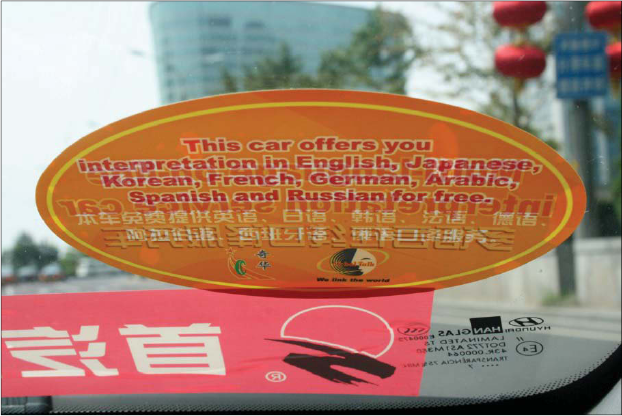
Sticker Inside the Taxi Indicating that the Taxi Offered Interpretation in Eight Different Languages
In terms of driving, the taxi drivers were obliged to attend classes and take examinations on
the English language
directions
driving etiquette
operational knowledge such as driving techniques and
knowledge of road safety and security measures such as how to deal with a robber or a terrorist in the taxi (all mentioned in Operational Safety).
In order to keep their jobs, they had to pass all of these examinations.
These Olympics civility campaigns were not completely lacking historical context: The guidelines that stressed civilised behaviour, like personal hygiene, manners and personal grooming, could be traced back to as early as Sun Yat-sen's foundational speech in 1924 and the Republican era (Brady 2003; Chao 2003). This continuity reveals China's persistent pursuit of modernity, which has been moulded after the Western hegemonic model. It is important to note that these guidelines had never been so specifically spelt out in such a multi-sensory way and targeted at the specific practice of taxi driving. The emphasis on this proper conduct during the Olympics showed that the state was eager to present a rising China that would be up to par with the West.
This drive for global recognition was spelt out in the discourse of China's great rejuvenation. This rejuvenation discourse drew the population's attention to the present and a foreseeable future that was sowed with hope and promises, and it served to boost the population's confidence about China and its current leadership. As Sinologist Vivienne Shue points out,
the present government, as we have all had occasion to note, associated itself most vigorously with the vision of a newly “rising China”, a China that will no longer tolerate the bullying or the disdain of other nations, a China that will one day definitely outstrip the accomplishments of all other competitors (Shue 2010: 51).
The discourse obtained its power from its historical Chineseness and hinted that this rejuvenation – a rising China – would parallel that of the golden eras of the Ming Dynasty (Zheng He's seven voyages), the Tang Dynasty or the Han Dynasty (Chong 2012); China would flourish internally and would exert its influence across the globe – China's global ascendency. China's great rejuvenation also asserted that China would not be weak and humiliated as it was at the turn of the twentieth century.
The civility campaigns that used laws and regulations to discipline, punish and regulate taxi driving were met with numerous instances of tactical manoeuvring, attesting to de Certeau's claim that the ordinary man always manages to appropriate the dominant orders. Yet, it was not the civility campaigns that motivated people to support China's great rejuvenation but, in keeping with Foucault's governmentality, how the state succeeded in managing a set of relations – for example, China's present and future vis-à-vis its past, China and the West, the Chinese and the hegemonic Western “Other” – that brought ordinary men to take on the belief that the Olympics were important for China's global ascendency; thus they would also take on the necessary behaviours to help showcase China's best face to the world.
Driving (in) the City
Tactics of the Marginal
Many who turned to taxi driving in Beijing were once state employees who chose taxi driving for the better income and relative freedom. Yet, this is gradually changing: Today, many taxi drivers come from the outskirts of Beijing. City dwellers in urban Beijing are generally better educated, with better resources that lead to more career choices, and they consider taxi driving physically demanding. Taxi drivers drove on average between 12 and 16 hours a day, seven days a week (alternatively, some choose to take a 24-hour shift and rest the next day), took hardly any holiday and earned a comparatively low salary (their average income was approximately 3,000 CNY per month in 2008 – yet still higher than, for instance, a waitress, who would have earn approximately 900 CNY per month in 2008). Taxi driving, however, offers a better income than farming or other manual labour jobs. Men from rural areas are drawn to taxi driving to supplement their farming income. Similarly, city dwellers resorted to taxi driving when they could not find better opportunities elsewhere. To avoid travelling time and expenses, rural taxi drivers usually rent a sleeping place (approximately 200 CNY per month in 2008) outside the city centre but still closer than their rural homes. Because of long working hours, maintaining personal hygiene and the cleanliness of their taxis are generally not taxi drivers’ priorities and have to give way to making a better living.
Beijing taxi drivers’ socio-economic position could render them as marginal figures; yet, my observations and the drivers’ own narrations show that they are not “powerless”. Taxi drivers resisted the civility campaigns in diverse ways, not necessarily through direct confrontation but through numerous tactics, such as complaining, gossiping, deceiving and transgressing. These tactics mostly operated, to recall de Certeau, “in isolated actions” (1984: 37); they “cannot be said to be symbolic, but neither can [they] be said to be unreal or purely imaginary” (1984: 99). These tactics depended on time; taxi drivers had to seize the moments to act (1984: xix). The tactics were not meant to overthrow the authorities but to create “surprises”. As de Certeau says, at times a tactic can take place “where it is least expected. It is a guileful ruse” (1984: 37).
When taxi drivers found the right moments, such as when the passengers were interested in chatting and listening to what they said, they often grumbled about the demanding civility campaigns imposed on them. One driver said,
They use examinations to make sure that we learn, we are familiar with directions, that's OK – for taxi drivers it's not so much a problem to find the good ways to go, the main issue is your personal appearance, service attitude and the like. (Do you find these demanding? You also need to learn English?) Demanding, very demanding […] how to say it. We need to listen to everything the passengers say. We can't say much. Being in the service industry is like this, isn't it? [But] being too impolite is not acceptable. Impossible demands we are definitely not going to accept. In normal circumstances we normally accept – impossible demands, then we won't agree (Anonymous 3 2008).
By “doing justice” to some of the requirements and by showing his efforts (for instance, it was relatively easier to keep the taxis clean and tidy and to wear a uniform than to meet some of the other expectations proclaimed by the guidelines), this driver made what he saw as unrealistic and harsh requirements salient. Some other drivers described in detail how strictly and harshly the regulations were implemented; for example, the Beijing Traffic Management Bureau had six to seven teams going around the city checking if taxi drivers were meeting the official requirements. In order to have the regulations implemented, punishment and fines were enforced:
If drivers were caught being untidy, breaking traffic regulations, getting passenger complaints, illegally parking, etc. […], apart from paying fines, sometimes taxi drivers would have to spend three days in the taxi company and learn how to “correct” their inappropriate behaviours (Anonymous 4 2008).
Appeals were not possible; there was no union for taxi drivers, and even if there were, a driver said, “Labour union, no use, labour union is also part of the Chinese Communist Party” (Anonymous 5 2008). In complaining about their powerless and subjugated position and gossiping about the Chinese government, these taxi drivers called attention to their marginal position vis-à-vis the authorities. Their vocal opinions challenged the civility campaigns that required a taxi driver to “speak decently” and “not to gossip about other people, or complain about his higher-ups or spread rumours”.
Notar has indicated that the Kunming taxi drivers under her study often felt
ashamed of their socio-economic position (Notar 2012a, 2012b). My findings,
however, showed that the fact of taxi drivers’ marginality led to opportunities
for them to perform tactical manoeuvring. The regulation that obliged them to
speak English caused a lot of commotion. One taxi driver said, “We taxi drivers
belong to the lower strata of the society with little culture and education
( ,
meiyou wenhua, suzhi di), no money and no resources”
(Anonymous 6 2008). His assertive and loud voice while saying this struck me, as
if by speaking up and asserting his marginality, he was claiming to be among
“the bullied”, “the weak” and “the abused”. This marginality was mentioned in
different instances; as another driver said to me,
,
meiyou wenhua, suzhi di), no money and no resources”
(Anonymous 6 2008). His assertive and loud voice while saying this struck me, as
if by speaking up and asserting his marginality, he was claiming to be among
“the bullied”, “the weak” and “the abused”. This marginality was mentioned in
different instances; as another driver said to me,
I studied, but [learning] this English thing is a bit […]. Not possible for those who have only primary education, suddenly you ask them to learn English, [when one reaches] 50 he can't really learn. That is why, those like us who don't have much education, we who work in this industry are lower-class people, lower-class people, means that our education level is particularly low (Anonymous 7 2008).
The representation of the self as powerless can function as a tactical
subversion. By positing their “lower-class” background, these drivers explicitly
questioned this requirement and remarked how ridiculous it was. Also, in
relation to China's growing economic disparity, the drivers would articulate
“unashamedly” that they were poor and wu benshi
( ,
“without ability”). Benshi is a discourse that links one's
ability to one's wealth and normalises the value of achievement regardless of
structural factors. It promotes the governmental ideal of material and economic
success that drives China's growth today. Their “shameless” expression of
marginality mocked the existing inequality, thus subverting the norms that
defined manhood by material wealth and success (Chong 2013).
,
“without ability”). Benshi is a discourse that links one's
ability to one's wealth and normalises the value of achievement regardless of
structural factors. It promotes the governmental ideal of material and economic
success that drives China's growth today. Their “shameless” expression of
marginality mocked the existing inequality, thus subverting the norms that
defined manhood by material wealth and success (Chong 2013).
Other taxi drivers told me that the stringent examinations in the early period of implementation had a very high failure rate, 50 per cent. Those who failed could not work till they passed the English exam. The taxi companies and some officials in the Beijing Traffic Management Bureau came up with plans to help make sure that those who sat for the examination for the second time would pass. But how? One driver said, “Put it this way, [we] managed” (Anonymous 8 2008). He implied that taxi drivers, along with taxi companies and the teachers, cheated on the examination. This instance reflects the ambivalent position of the taxi companies: They helped implement the governmental strategies, yet here they also helped subvert them. This exemplifies one of the limitations of de Certeau's division of strategies and tactics: Power relations are often a lot more fluid and complex than he allows for.
In addition to what they “say”, these drivers also “make” and “do” (de Certeau 1984) in subverting and transgressing the civility regulations. For instance, as shown in Figure 1, even though they did wear the uniform, they did so not as neatly as expected. The majority of them did not use the ties, some did not tuck the shirts inside the trousers; others wore the shirt unbuttoned or had the trousers rolled up as if working in a field. Figure 3 shows a driver taking a nap at a relatively quiet spot in broad daylight in Chaoyang District, Beijing's Central Business District. In taking these actions, they openly subverted the state-defined behaviours of proper taxi driving: The innumerable occasions of tricking passengers by taking detours, gossiping, grandstanding, running red lights, not washing the seat covers regularly, spitting and so on, were instances of tactics.
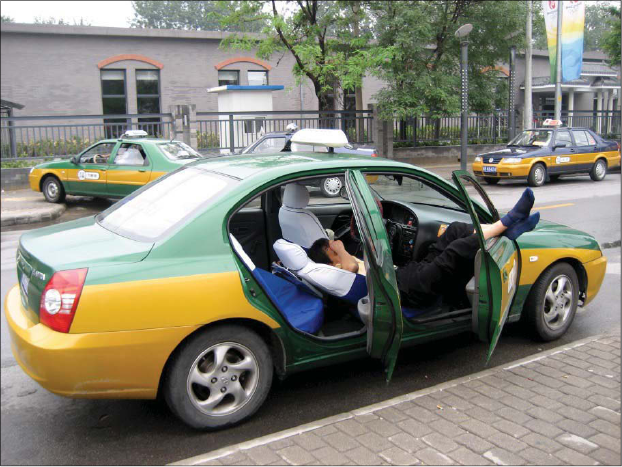
A Taxi Driver in Uniform Taking a Nap in Chaoyang District
These instances of using tactics challenge a common perception that sees the Chinese state as overwhelmingly controlling and ordinary Chinese people as reduced to taking passive and subjugated positions (e.g. Brady 2009). The examples above show that the taxi drivers were, like any ordinary man, never simply passive; instead, they were tactical and creative in creating opportunities to re-appropriate the dominant order in their everyday life.
Nonetheless, these subtle moments and instances of subversion and transgression did not necessarily mean that the taxi drivers rejected the civility campaigns entirely, let alone the Beijing Olympics or a rising China.
Complexities in Power Relations
The majority of taxi drivers I talked to took great pride in China hosting the Olympics – a signifier of China's global ascendency. When talking about the Olympics, drivers often started by saying that hosting this highly prestigious event was not easy. They then brought up the phrase “the sick man of Asia” and how China fell prey to “the West”, which had led to a century of national humiliation and which explained why China needed the Olympics. This belief that China was weak went hand in hand with the belief that “the West” looked down upon China or did not want China to do well. One taxi driver said,
We Chinese value these Olympics significantly. (Yes, why? Why that important?) The Olympics are an important turning point. If the Games are held successfully in China, that means China has ascended, a powerful country, also economically speaking. (Why relying on the Olympics Games?) That is a matter of a nation's power, isn't it? If it's held successfully, that means this country, not only in terms of economy, but also in terms of political power, is comparable to countries like the US and those in Europe. Foreign countries will no longer look down upon you. You saw the events [controversies during the torch relay] right before the Olympics in Europe, France, Britain? Wouldn't you get really mad seeing that? Did you watch television? (Anonymous 9 2008).
The global questioning of China's legitimacy in 2008 helped strengthen these beliefs about China and the West. Another taxi driver said:
The Western media have so many negative reports [about China]; moreover, many Western countries would not like to see China become a developed country, from the bottom of their hearts, they don't want to see China become a strong nation (Anonymous 10 2008).
I was often asked if I was a journalist because I talked a lot and I asked many questions. Some taxi drivers refused to talk to me entirely by, for instance, turning up the radio volume. Others refused to be recorded and said, “That is not necessary […]. Because I don't know what you would use it for […]. I don't know you” (Anonymous 11 2008), “I just don't like it” (Anonymous 12 2008), “I won't feel comfortable, don't know what to say” (Anonymous 13 2008), “I am only a taxi driver, I know nothing” (Anonymous 14 2008) and “What do you want?” (Anonymous 15 2008). Some remained suspicious, one taxi driver saying, “We Chinese must support the Olympics; you are also Chinese, right?” (Anonymous 16 2008). Another taxi driver said, “Some Chinese were hired by foreign journalists to get information from us drivers” (Anonymous 17 2008). Their tactical responses to my interviews could evince both their direct support for China against “the West” and a tactic of self-protection against a stranger whom they distrusted. These are instances that challenge de Certeau's conceptual model: Power relations are much more complicated than the differentiation of the dominant order/ the state/ the official versus ordinary folks/ the weak. These taxi drivers and I were ordinary folks; yet this does not mean that we held the same beliefs or positions, as shown by some of their suspicions towards me. Moreover, in the aforementioned instances, who represented “the weak” and who represented “the dominant” was far less straightforward.
The belief that China was weak, causing “the West” to look down upon China, had led
some taxi drivers to align themselves with the official campaigns on raising the
“quality” of the population ( , tigao renmin
suzhi). Suzhi (
, tigao renmin
suzhi). Suzhi ( ) is literally translated as
“(human) quality” (Anagnost 2004; Kipnis 2007). They agreed that the Chinese need to
be taught and disciplined. According to Anagnost,
) is literally translated as
“(human) quality” (Anagnost 2004; Kipnis 2007). They agreed that the Chinese need to
be taught and disciplined. According to Anagnost,
population quality had become a key term in the party-state's policy statements and directives to cadres, even as it began to circulate more broadly as a general explanation for everything that held the Chinese nation back from achieving its rightful place in the world (Anagnost 2004: 190).
I was surprised that they agreed that the “quality” of Chinese people – in terms of politeness, manners, cultural knowledge and behaviour – was not up to the Western standard:
Why foreigners look down upon us, China, is because of our low
suzhi ( , suzhi
di), because of this. You don't have high suzhi
(
, suzhi
di), because of this. You don't have high suzhi
( ,
gao suzhi). Then hosting an Olympics helps raise most
Beijingers’ suzhi (Anonymous 18 2008).
,
gao suzhi). Then hosting an Olympics helps raise most
Beijingers’ suzhi (Anonymous 18 2008).
The equation of backwardness and uncivilised behaviours with low suzhi was widely held. In response to the civility campaigns, one taxi driver said,
A demanding [requirement] has its advantages. (Why?) Because hosting the Olympics, a person's suzhi has to be better […]. [Suzhi] must be raised, taxi driving belongs to the “window” industry; [suzhi] must be raised to force you [to do so]. (Raising suzhi for foreign visitors during the Olympics? Or, overall for China?) I think both. For China it shows a good image of China, for foreigners taxi driving is a window industry, let foreigners see, right? (Anonymous 19 2008).
Some mentioned it in a “matter-of-fact” way, yet not entirely voluntarily: “It's the Olympics – how can one not learn?” (Anonymous 20 2008). In retrospect, taxi driving in Beijing underwent a drastic makeover around the Olympics and their preparations. I still remember the notorious, strong odour inside the old red taxis; but in 2008, almost all taxis I boarded were clean and tidy (seats with bleached white covers). The once raw and rough Beijing taxis faded into memories of the old days.
De Certeau (1984) argues that ordinary men are never simply subjugated or followers. This has led him to devote efforts to looking for the innumerable instances of tactics in everyday life. Following his arguments, the ordinary men (taxi drivers) I discuss above were then not simply indoctrinated to believe, do and act as they were told. In that case, how would de Certeau explain their support for the state-sanctioned beliefs? How would he explain taxi drivers’ beliefs that “the West” looked down upon China and wanted to tame China's growth and thus felt an imminent urgency for China to showcase its strength by hosting a grand Olympics? De Certeau did not analyse how individuals were brought to accept, heed and abet the dominant order or views.
Using Foucault's analytics of power in terms of governmentality can help fill this gap and explain the continuity between the government and the governed. Instead of forcefully imposing the ideas on individuals as the traditional perception of power implicates, what one sees here is what Foucault calls the productive mode of power and the art of government in managing a wide array of social relations across society (Foucault 1991: 95).
What the taxi drivers said regarding “the sick man of Asia”, national humiliation, and the belief that “the West” did not want China to be strong exemplify how the state governs effectively by other means, not solely by law and regulation. The reappearance of the discourse of national humiliation was, as Callahan (2006) observes, a governing strategy to channel internal discontents to external enemies. In this discourse, China's painful encounter with the foreign powers enabled the state to mobilise national sentiments via the binary construction of “the West” and us, the Chinese. “The West” was reinvented and re-imagined as China's alterity: It is the progressive, modern and desirable, but also threatening “Other” that China loves and hates at the same time. This discursively generated struggle with “the West” exemplifies the government's management of identity practices that helps direct and divert sentiments and channel actions.
It was this intertwined relationship between a rising China, China's “humiliating” past and “the West” that guided taxi drivers to internalise certain state-sanctioned beliefs and act accordingly to discipline/ govern the self and others. The latter was revealed by their consensus that the Chinese had to raise their suzhi and the fact that they, themselves, were monitoring and guiding the interests of the nation by fending off potential harm posed by suspicious passengers. The state's management of belief and perception demonstrates the central theme of governmentality – “conduct of conduct” – “a form of activity aiming to shape, guide or affect the conduct of some person or persons” (Foucault 1991: 2). This also sheds light on the multiplicities of social relations, rather than seeing them straightforwardly as weak versus dominant, as de Certeau suggests. Power relations were never clear-cut. To some of these taxi drivers, their reactions could be tactical responses to the hegemony commanded by “the West” in ordering and shaping the relations between China and the world.
Conclusion
The rise of automobility is both a product of China's spectacular growth and a force that shapes everyday life in China. This article has sought to examine the entanglement of taxi driving and China's aspiration to become a global power. To this end, I have taken the 2008 Olympics as a signifying moment for this study and focused on the taxi drivers to examine how they were affected by China's recent changes and how the everyday practice of taxi driving revealed the innumerable moments and instances of tactics as well as the complexity of power relations.
The focus in de Certeau's work on everyday practice and the formulation of strategies and tactics has helped shed light on the numerous ways and moments Beijing taxi drivers creatively crafted to tactically appropriate, challenge, subvert and transgress the dominant order. Acts of transgression, complaining, deception, gossiping and grandstanding were some of the tactics. Their professional niches as people who knew their way around Beijing meant that they could easily drive the long way round and charge the passengers more. Their talkativeness and knowledge of the city and China subverted the passenger–driver dynamics and empowered drivers to be seen as relevant and distinctive voices of local life and as informants; at other times, this talkativeness would be perceived as grandstanding and therefore not taken seriously, thus exempting drivers from being judged politically even when they complained about politics, gossiped or spread rumours about the state and the politicians. Their “shameless” articulation of their marginality – with little culture and education, wu benshi – challenged the imposed civility requirements and drew attention to the existing inequality produced by China's accelerating growth. All these actions subverted the official plans of making them look good and presentable for Beijing and China.
Through exemplifying the various tactics of taxi drivers, I argue against a reductive reading of ordinary Chinese people, as exemplified by taxi drivers, as “the weak” who are simply dominated, controlled or subjugated by the authorities, the strong.
Nonetheless, in my analysis, I have also pointed out some limitations in de Certeau's differentiation of strategy and tactic. I have brought in Foucault's analytics of power and governmentality to complement his work. Both Foucault's and de Certeau's works indicate that resistance is everywhere. What Foucault adds to de Certeau's conceptual differentiation of strategy and tactic – the latter a formulation of a more conventional sense of power and resistance – is that power relations are never one-dimensional or as straightforward as the dominant versus the weak or the state versus the people. This is because, to Foucault, this would imply that power is a thing possessed by the powerful and that the powerful need to be overthrown as such. Foucault has famously said,
Where there is power, there is resistance, and yet, or rather consequently, this resistance is never in a position of exteriority in relation to power (Foucault 1980: 95).
That is, resistance is enmeshed in power relations. For instance, when taxi drivers claimed their marginality vis-à-vis the state-initiated taxi-driving guidelines, it was in their engagement with the guidelines that they could complain about being treated poorly and therefore assume the representation of the self as the weak. In representing the self as such, they had commanded sympathy and had their voices and complaints heard.
Moreover, de Certeau's dedication to the study of tactics (resistance) led him to overlook the ways in which ordinary men (taxi drivers here) were brought to accept or even advocate the civility campaigns to raise suzhi, the Olympics as a national project and a rising China. Foucault's governmentality has offered productive perspectives that can help us better understand how the state managed to guide the people to its desired ends. Rather than strictly forcefully imposing ideas on the population, the state masterfully managed China's past, national sentiments, international politics and the politics of identity in order to generate acceptance of its larger goals and ideas. When China was severely criticised in the global media in early 2008, these external threats worked to strengthen the discourse that hosting a great Olympics was essential for China to gain international recognition and that all Chinese needed to work together towards this goal. Foucault's work offers a broader and more encompassing way of understanding power relations; yet, he finds it problematic to provide a truth-like universal model on resistance:
But I am not the only person equipped to show these things, and I want to avoid suggesting that certain developments were necessary or unavoidable. […] Of course, there are useful things I can contribute, but again, I want to avoid imposing my own scheme or plan (Foucault 1988: 302).
In Foucault's work, resistance remains intangible, and he has been criticised for writing from the perspective of the dominator (Hartsock 1990; McLaren 2002). This is what I think de Certeau's conceptualisation of everyday practice and the formulation of strategy and tactic can add in terms of tracing practices of resistance on the part of ordinary men. Nonetheless, despite both Foucault's and de Certeau's emphasis on resistance, and despite the numerous tactics I mentioned in this article, it remains important to question and address the structural inequalities and consequences resulting from China's accelerating development.