



Abstract
The Rural Minimum Living Standard is an important component of social security in rural areas of China, as it provides social assistance to poor rural households. The country's size and large development heterogeneities, however, make the policy's implementation a challenging task. Using quantitative and qualitative data from rural households and administrators in five provinces, we identify the pitfalls of multi-level implementation along with the difficulty of measuring income in rural, underdeveloped areas as key sources of an implementation gap that has led to a considerable degree of misallocation of monetary transfers. Changes in the budgeting process and the distribution method might improve the anti-poverty effect of social assistance without having to carry out additional monitoring.
Introduction
Social assistance in contemporary China is rooted in the painful restructuring of
Chinese state-owned companies that began in the mid-1990s and entailed the lay-off
of millions of workers from state-owned enterprises. To alleviate the resulting
poverty, the government of Shanghai and other industrial regions pioneered an urban
welfare system. In 1999 the central government adopted the successful pilot as
national policy under the name “Urban Minimum Living Standard.” After several
regional pilots, the central government also introduced the Rural Minimum Living
Standard ( ,
nongcun jumin zui di shenghuo baozhang, henceforth “rural
dibao”) nationwide in 2007 (Liu 2014) to prevent social
frictions emerging from increasing inequalities (State Council 2007).
,
nongcun jumin zui di shenghuo baozhang, henceforth “rural
dibao”) nationwide in 2007 (Liu 2014) to prevent social
frictions emerging from increasing inequalities (State Council 2007).
In 2014 rural dibao covered nearly 52.1 million individuals with expenses totalling CNY 87 billion. According to official statistics, the average per capita monthly transfer sum among beneficiaries was approximately CNY 129 (Ministry of Civil Affairs 2014a), which corresponds to USD 34.22 PPP (purchasing power parity) and is comparable to similar social assistance programmes in other developing or transitional economies (Barrientos, Niño-Zarazúa, and Maitrot 2010).
With increasing income heterogeneity, the Chinese government has begun to highlight
the importance of targeted anti-poverty policy ( , jingzhun
fupin), which, in contrast to former anti-poverty programmes with
regional coverage, focuses on a certain subpopulation (The Economic
Daily 2015). The term “targeting” in this context refers to both
defining and selecting beneficiaries. The rural dibao programme
mainly targets rural households whose adult members have an average annual net
income below a given local income line, called the “dibao standard”
(
, jingzhun
fupin), which, in contrast to former anti-poverty programmes with
regional coverage, focuses on a certain subpopulation (The Economic
Daily 2015). The term “targeting” in this context refers to both
defining and selecting beneficiaries. The rural dibao programme
mainly targets rural households whose adult members have an average annual net
income below a given local income line, called the “dibao standard”
( ,
dibao biaozhun). Criteria for exclusion from the programme are
existing labour capacity, ownership of certain household assets considered luxury
assets, “immoral lifestyles,” and the existence of relatives who could support the
applicant(s) (State Council 2007).
,
dibao biaozhun). Criteria for exclusion from the programme are
existing labour capacity, ownership of certain household assets considered luxury
assets, “immoral lifestyles,” and the existence of relatives who could support the
applicant(s) (State Council 2007).
The crucial questions we address are as follows: How accurately does the actual distribution correspond to this pre-defined target group? How efficiently are the eligibility criteria implemented? Is the design of implementation directives compatible with the thrust of the programme, or are there systematic impediments? Are the incentives for those involved in the administration and implementation of these directives compatible with the programme's goals?
The majority of existing studies focus on the urban dibao system (i.e. Gao, Garfinkel, and Zhai 2009; Gustafsson and Deng 2011; Chen, Ravallion, and Wang 2006; Wang 2007). For the rural case, one World Bank report evaluated certain properties of implementation in Guangdong (The World Bank 2011), while other studies have focused mainly on the quality of targeting (Yi and Zhang 2011; Zhang, Xu, and Wang 2012) and the impact of transfers (Golan, Sicular and Umapathi 2014). Especially the latter studies found in their samples that, despite amendments to the distribution process and increased monitoring efforts, a considerable portion of funds is captured by non-eligible households (leakage), while an even higher number of eligible households are not yet covered by the system (exclusion). Taken together, we characterise leakage and exclusion as accounting for the totality of mistargeting within the rural dibao programme. Many smaller studies list additional potential problems and make technical suggestions for improving the implementation of the system (e.g. Guo 2009; Li and Jiang 2012; Liu 2008; Zhang and Jiao 2008). However, a careful theory-based analysis of the underlying mechanisms of the reported mistargeting supported by both quantitative and qualitative data is still lacking.
In this article 1 , we provide an in-depth analysis of the dibao implementation, supported by micro-data collected in rural areas in Western China. Getting to the very root of targeting problems in rural communities might also produce insights useful for other regions undergoing socio-economic transformation. In this paper, we first introduce the theoretical background of transfer targeting in general and then discuss specifically the Chinese case. After elucidating our methodological approach and the data used for the analysis, we report on selected results, then review three major challenges and consider possible solutions.
We acknowledge the financial assistance of the German Academic Exchange Service (DAAD) and the National Natural Science Foundation of China (No. 71473239). Further, we would like to thank the guest editor, Dr. René Trappel, along with Prof. Dr. Heike Holbig and two anonymous reviewers for their valuable suggestions, as well as Su Weiliang and Zhou Qi for their indispensable assistance in data collection.
Policy Design of the Rural Dibao Programme
In practice, policymakers use various approaches to select potential targets for a given welfare programme. For example, geographic targeting simply comprises the whole population of a deprived region, which is a solid approach if only minor variance in incomes is present. However, as soon as heterogeneity of household incomes in a region grows – for instance, due to remittances from migrant workers – such geographic targeting becomes very inaccurate. Furthermore, employable individuals’ incentive to work is likely to decrease (Baker and Grosh 1994).
Therefore, policymakers are increasingly utilising targeting methods that focus on the individual eligibility of applicants. Coady, Grosh, and Hoddinott (2004) list three different ways to carry out individual assessments of applicants’ eligibility: The first is means testing, which determines eligibility by directly assessing the relevant household information (for social transfer programmes: household income or expenditure) but requires high administrative capacity. The second approach, proxy means testing, entails evaluators using easily observable household characteristics as proxies to estimate household income or expenditure. However, ill-suited models produce mediocre estimates at the household level. The third option is community-based targeting, whereby community leaders and/or members determine recipients’ eligibility based on their inside knowledge. Coady, Grosh, and Hoddinott (2004) identify certain risks of community-based targeting, which we acknowledge in the analysis of our data. First, community leaders might have hidden incentives in selecting programme targets – for instance, they might favour relatives and friends or otherwise use the programme as an instrument of power. Furthermore, locally defined eligibility criteria tend to become very subjective and might create interregional distortions. In the case of the Chinese rural dibao system, legislators chose a mixture of these three individual targeting approaches: eligibility is determined by an absolute income threshold (dibao standard), certain household characteristics reflecting or influencing welfare (such as labour potential, household assets, and family support), and the subjective evaluation of village administrators and community members.
However, there is a large degree of heterogeneity in the implementation of the system. First, major regional differences exist with regard to the administrative level at which the dibao standard is decided. While the municipalities of Beijing and Shanghai both issue fixed standards, ten provinces allow city or county governments to freely determine their own dibao standard. In five provinces, the provincial government determines a local standard for its cities and counties according to the respective area's development level. In 14 provinces, including our research regions, a minimum dibao standard is set by the provincial government, but can be further raised at the local level (Ministry of Civil Affairs 2014b; Sichuan Provincial People's Government 2015).
Second, there does not seem to be a uniform method for calculating this dibao standard. In practice, it is defined by a commodity-basket-type calculation; as a ratio of the official minimum wage, income, or consumption expenditure of that region; according to the rural poverty line issued by the National Bureau of Statistics; or by a mixture of all these methods. In many cases, this standard is also adjusted to the fiscal capacity of local government (Zhang, Xu, and Wang 2012; Yang 2011). Consequently, considerable variation between standards was observed within many provinces, most prominently in high-income provinces (Jiangsu, Zhejiang, and Guangdong), but also in lower-middle-income provinces where dibao standards were determined locally (Anhui and Sichuan).
Third, we note differences in demographic and welfare eligibility criteria, which are usually explained by regional welfare levels. For instance, Sichuan and Shaanxi regulations allow local governments down to the county level to add further items to the list of admissions criteria, which not only decreases the system's transparency, but might also be used to reduce the number of potential recipients.
The responsibilities that come with this programme design are divided among different
administrative levels. The main administrative levels of the Chinese government are
the central government, provinces, prefectures, counties, and townships. Further,
rural townships are responsible for administrative villages ( , xingzheng
cun). Each village consists of several so-called “small groups” or
“neighbourhoods” (
, xingzheng
cun). Each village consists of several so-called “small groups” or
“neighbourhoods” ( , cunmin xiaozu). Even though villages and neighbourhoods are not
classified as official administrative levels (Chinese Government Web 2014), they are
involved in several tasks of the system's implementation.
, cunmin xiaozu). Even though villages and neighbourhoods are not
classified as official administrative levels (Chinese Government Web 2014), they are
involved in several tasks of the system's implementation.
At the beginning of each dibao-granting wave (usually annually),
households or individuals file an application at the village council or directly
with the township government. Information on applicants and the final decision on
recipients are published on the village community board for community evaluation, a
process that, in smaller communities, can often provide quite accurate information
on true welfare levels (Zhang, Xu, and Wang 2012: 161). Another form of community
control is a process called “democratic discussion” ( , minzhu
pingyi), in which a council consisting of administrators and villagers’
representatives debates and votes on the validity of the applicants’ claims. Any
given council's findings, even though they are technically mere recommendations, are
supposed to be forwarded to township governments and county-level offices of Civil
Affairs, along with the application materials themselves and the results of the
direct evaluation. The households’ statements are verified by officials (usually
from the township or county level), who inspect the applicant households. Based on
their assessment, district- or county-level administrative bodies make a final
decision on the approval of grants. This division of tasks is known as the “2–3
system,” since reviews and decisions about applications are handled only on the
second and third administrative levels (township and county). After the granting
process concludes, national regulations mandate regular monitoring by township and
county administrative staff and, where necessary, the suspension or cuts of grants
in order to avoid idleness, fraud, and the crowding-out of family support by state
transfers (State Council 2007; Zhang, Xu, and Wang 2012). Many details – such as the
sequence of the targeting process, participants of democratic discussion, the
duration of publication, the level of grants, and the frequency of monitoring – are
specified at the province, district, or even county level, and may vary
considerably.
, minzhu
pingyi), in which a council consisting of administrators and villagers’
representatives debates and votes on the validity of the applicants’ claims. Any
given council's findings, even though they are technically mere recommendations, are
supposed to be forwarded to township governments and county-level offices of Civil
Affairs, along with the application materials themselves and the results of the
direct evaluation. The households’ statements are verified by officials (usually
from the township or county level), who inspect the applicant households. Based on
their assessment, district- or county-level administrative bodies make a final
decision on the approval of grants. This division of tasks is known as the “2–3
system,” since reviews and decisions about applications are handled only on the
second and third administrative levels (township and county). After the granting
process concludes, national regulations mandate regular monitoring by township and
county administrative staff and, where necessary, the suspension or cuts of grants
in order to avoid idleness, fraud, and the crowding-out of family support by state
transfers (State Council 2007; Zhang, Xu, and Wang 2012). Many details – such as the
sequence of the targeting process, participants of democratic discussion, the
duration of publication, the level of grants, and the frequency of monitoring – are
specified at the province, district, or even county level, and may vary
considerably.
Challenges of Multi-Level Implementation of Rural Dibao Policy
As argued by Hooghe and Marks (2003), the multi-level implementation of policy described above ensures flexibility in dealing with regional differences, but comes at the cost of severe coordination problems between the several administrative levels. We argue that this conflict is at the root of many implementation and targeting problems described by the literature.
One crucial issue concerns the policy's finances. Measured by the ratio of subnational to national government expenditure, the People's Republic of China is fiscally highly decentralised, even compared to federal countries like the United States, Russia, and Germany (Zhang 2006; Xu 2011). Due to the tax exemption of household-level agricultural production, the tax base of agriculture-based regions with little industry from which to collect tax revenue is weak (Zhang 2006), and rural townships are especially dependent on intergovernmental tax transfers (Kennedy 2007a). To make up for financial imbalances, approximately two-thirds of the total dibao expenses (60.1 per cent in 2011) are provided by the central government. The remainder is provided by the province, district, or county levels, whereas township and village levels are exempt from any financial responsibilities (Ministry of Civil Affairs 2014a; Ministry of Finance of the People's Republic of China 2013; Zhang, Xu, and Wang 2012). According to regulations, each autumn, Civil Affairs units on each of the listed government levels must estimate the following year's budget requirements for the dibao programme and report it to the responsible financial units. Financial units at each level incorporate these funds into the budget plan, which is then presented to the respective levels’ People's Congresses for approval. The amount of the central government's subsidies is based on information like the number of dibao recipients in the respective region, dibao standards, subsidy levels, and budget surplus carried forward from the previous year.
However, in the case of certain agricultural subsidies a study found that the allocation of intergovernmental transfers is not always adequate, which leads to scarcity of funds and personnel in impoverished regions and reduces the redistributive impact of the pro-poor subsidies (Lin and Wong 2012). Also, in the case of rural dibao, a certain share of funds still has to be covered locally, even though the payments from the central government help to equalise regions with different welfare levels. Furthermore, administrative costs related to programme implementation are not covered by central government transfers but have to be met with local funds (Ministry of Finance of the People's Republic of China and Ministry of Civil Affairs 2012), which places an additional burden on the budgets of poorer regions.
Another crucial issue is the incentive structure of rural cadres, which, as some
studies claim, produces an imbalanced implementation of certain policy goals (Ran
2013). Generally, the Chinese central government has means at its disposal for
providing incentives to administrators by monitoring their performance. The
performance of local cadres down to the township level is measured through a complex
evaluation system assessing both policy implementation ( , mubiao
kaohe) and personal performance (Heberer and Trappel 2013). However,
prioritisation of specific political goals by policymakers at higher governmental
levels might lead to unbalanced incentives for local leaders. Consequently, local
leaders’ compliance might vary depending on the particular policy area (Edin 2003;
Kennedy 2007b). As long as higher governmental levels still prioritise economic
development, the incentive for local leaders to focus on social policy
implementation might be low (see O'Brien and Li 1999). In addition, the size of the
incentive might be influenced by the extent to which the successful implementation
of this policy is measurable (Göbel 2011). Unfortunately, the success of
dibao implementation turns out to be rather hard to quantify,
especially compared to economic performance. Moreover, local leaders might choose to
put their resources into projects that are more likely to succeed (also termed “sure
policy” by Heberer and Trappel 2013: 1061) or more prestigious, or that will
probably yield immediate results (Eaton and Kostka 2014).
, mubiao
kaohe) and personal performance (Heberer and Trappel 2013). However,
prioritisation of specific political goals by policymakers at higher governmental
levels might lead to unbalanced incentives for local leaders. Consequently, local
leaders’ compliance might vary depending on the particular policy area (Edin 2003;
Kennedy 2007b). As long as higher governmental levels still prioritise economic
development, the incentive for local leaders to focus on social policy
implementation might be low (see O'Brien and Li 1999). In addition, the size of the
incentive might be influenced by the extent to which the successful implementation
of this policy is measurable (Göbel 2011). Unfortunately, the success of
dibao implementation turns out to be rather hard to quantify,
especially compared to economic performance. Moreover, local leaders might choose to
put their resources into projects that are more likely to succeed (also termed “sure
policy” by Heberer and Trappel 2013: 1061) or more prestigious, or that will
probably yield immediate results (Eaton and Kostka 2014).
However, for village administrators there are considerable incentives not to comply
with regulations concerning the distribution of dibao funds. Beyond
any electoral consideration (in contrast to village party secretaries, village
leaders are elected rather than appointed), rural social traditions seem to be a
dominant factor: traditional Chinese society, just as many other kinship-based
societies with strong rural foundations, is closely knit through constant
reciprocity between its members. This flow of favours is the basis of a network of
social connections, guanxi ( ), which bears a strong
emotional component (Kipnis 1997) but is clearly also based on shared interests and
material benefits (Yang 1994). A large pool of good social connections
(guanxi) upon which one can occasionally draw to redeem favours
is of eminent importance for gaining access to scarce resources (Yang 1994; Yan
1996; Kipnis 1997). Indeed, it might help not only to avoid falling into poverty
(Garcia and Kazepov 2002) but also to secure social assistance in situations of
need. Although, social and moral necessity require dedicating large amounts of time
to meeting the expectations and needs of one's kin and friends. Failing these
expectations would indicate either a lack of authority to command scarce goods or
the violation of implicit rules of reciprocity, and lead to a loss of “face”
(
), which bears a strong
emotional component (Kipnis 1997) but is clearly also based on shared interests and
material benefits (Yang 1994). A large pool of good social connections
(guanxi) upon which one can occasionally draw to redeem favours
is of eminent importance for gaining access to scarce resources (Yang 1994; Yan
1996; Kipnis 1997). Indeed, it might help not only to avoid falling into poverty
(Garcia and Kazepov 2002) but also to secure social assistance in situations of
need. Although, social and moral necessity require dedicating large amounts of time
to meeting the expectations and needs of one's kin and friends. Failing these
expectations would indicate either a lack of authority to command scarce goods or
the violation of implicit rules of reciprocity, and lead to a loss of “face”
( ,
lian or
,
lian or  , mian; Ho
1976: 873; Yan 1996). According to Sahlins (1972: 207), a person of rank in small
kinship-based communities is expected to be generous since “to be noble is to be
generous.” Conversely, this exercised generosity further strengthens the rank
system, as “to be generous is noble.” Following this logic, guanxi
requirements also change the incentive system of village leaders as their leadership
entails implicit liabilities in the form of material or immaterial favours to their
kin, friends, and clients. Even though similar patron–client relations also exist in
other rural societies (Powell 1970), they seem to be especially persistent in rural
China, having adapted to severe social and political transformations (Oi 1989;
Kipnis 1997; Esherick and Rankin 1990; Yang 2002). Indeed, recent studies – such as
Liu (2013) – report on the distribution of social assistance funds to kin and
clients of the respective administrative agents (
, mian; Ho
1976: 873; Yan 1996). According to Sahlins (1972: 207), a person of rank in small
kinship-based communities is expected to be generous since “to be noble is to be
generous.” Conversely, this exercised generosity further strengthens the rank
system, as “to be generous is noble.” Following this logic, guanxi
requirements also change the incentive system of village leaders as their leadership
entails implicit liabilities in the form of material or immaterial favours to their
kin, friends, and clients. Even though similar patron–client relations also exist in
other rural societies (Powell 1970), they seem to be especially persistent in rural
China, having adapted to severe social and political transformations (Oi 1989;
Kipnis 1997; Esherick and Rankin 1990; Yang 2002). Indeed, recent studies – such as
Liu (2013) – report on the distribution of social assistance funds to kin and
clients of the respective administrative agents ( , renqing
dibao). With increasing coverage of the system, the distribution of
surplus funds sometimes assumes the characteristics of an additional source of power
for village leaders (Guo 2009; Liu 2008). It is even argued that the distribution of
government funds like dibao grants have become a replacement for
the power that village leaders lost with the abolishment of the agricultural tax
system (Liu 2008).
, renqing
dibao). With increasing coverage of the system, the distribution of
surplus funds sometimes assumes the characteristics of an additional source of power
for village leaders (Guo 2009; Liu 2008). It is even argued that the distribution of
government funds like dibao grants have become a replacement for
the power that village leaders lost with the abolishment of the agricultural tax
system (Liu 2008).
In effect, village leaders, who are the only administrative agents with clear information about the true welfare level of households, sometimes have obvious incentives to avoid community conflict and maintain “face” by supporting kin and friends, which might override the weaker incentives set by the central government to comply with regulations concerning the distribution of dibao funds. Beyond inaccurate policy implementation or the concealment of households’ true welfare levels, village leaders might even actively favour their clients to the disadvantage of other households. At this point, we are not even taking into account the problem of leaders capturing funds for their private benefit, as has been described, for instance, by Zhang and Jiao (2008). Some village leaders might, in fact, not take advantage of their superiors’ weak control, but rather comply with targeting regulations out of a sense of professional ethics, without necessarily receiving direct compensation or appreciation; they may even dedicate an excess of resources to their work (DiIulio 1994). Hence, as both compliance and non-compliance are well defendable on behavioural grounds, their factual relevance remains to be empirically assessed.
Data and Methodological Approach
To answer our research questions, this study builds on the 2011 Rural Development Survey (RDS) dataset. The survey, which was conducted by the Center for Chinese Agricultural Policy of the Chinese Academy of Sciences (Center for Chinese Agricultural Policy 2012), gathered data on household characteristics and dibao transfers for approximately 2,000 households and their respective villages and townships in five Chinese provinces, among which were 186 dibao recipients. Beyond household characteristics, the dataset provides some information on programme participation, though data regarding details of the programme's implementation in the respective locations was not available. Some additional information on the system's implementation was collected in 1,240 of the original sample households (among them, 119 dibao recipients) during a 2014 follow-up survey in 62 villages by the Center for Chinese Agricultural Policy (Center for Chinese Agricultural Policy 2014). In this survey, households were mainly asked about the implementation of distribution and monitoring and their perception of incidences of mistargeting. Village leaders were questioned on monitoring, the availability of dibao funds, the selection process of targets, and the publication of the identities of dibao recipients at the village level.
To supplement this information, we conducted open interviews in four of the counties covered by the original dataset in Sichuan and Shaanxi, where poverty is most prominent and the dibao system has been of major importance. For the selection of villages, we tried to ensure a certain variation in local conditions and legislation, while at the same time representing a spectrum of rather typical cases: while the local dibao standard in 2012 was between CNY 1,860 and 2,700 per capita per year in these regions, the average annual per capita income in the eight selected villages was between CNY 1,200 and 6,500, and between 1.6 and 7.4 per cent of the villagers were recipients of dibao. In addition to the economic situation, differences existed in terms of distance to urban centres and natural conditions for agriculture.
Methodologically, these interviews followed an embedded, multiple-case design as described in Yin (2003). The multiple-case design required that the situation be examined in no less than two provinces, which allows us to encounter the desired contrasting conditions and produces substantial analytical benefits. The embedded design entailed collecting information on different statistical and administrative levels, which is necessary for testing and contrasting the information given by up- and downstream levels of local government and households.
During the first stage of data collection, we conducted exploratory interviews with several Chinese scientists and administrators, during which our initial hypotheses on the reasons for the mistargeting of social assistance were discussed. In these expert interviews, different potential causes of mistargeting in the areas of policy funding, policy design, and implementation of national and provincial policy at the local level were discussed. In the second stage, we conducted semi-structured interviews with six township-level administrators, eight village leaders, and 43 households in two provinces. During these interviews, we focused on the fields that we had identified in the prior expert interviews. In addition, we collected written implementation guidelines and policies on all levels of administration in these two provinces.
For data analysis, we used the strategy of triangulation and compared different perspectives on our research question. Sometimes we were confronted with statements from households that conflicted with those of administrators on different levels; we also came across conflicting statements between households and between administrators. In the following section, we will present some general results from our quantitative survey before we focus on the detailed mechanisms of mistargeting that were identified during the qualitative interviews.
Incidence of Mistargeting and Reliability of Control Measures
As the table in the Appendix shows, households that received dibao transfers had, on average, fewer household members and fewer children and were more likely to belong to vulnerable groups (such as elderly people without adult children, single parents, or households with female heads). Dibao households had on average a lower education rate, lower expenditures for children's tuition, a smaller labour force than other households, and fewer household members generating income in non-agricultural work (local and migration labour not connected to agricultural production) or as migrant workers. Further, there were fewer healthy adults in these households, a higher percentage of family members were handicapped, and health expenditure was considerably higher. Dibao households were also less likely than non-recipient households to own household appliances and assets, and their houses were smaller and more likely to be built of inferior materials. The significant differences between non-recipients and dibao households in many socio-economically important aspects give rise to the assessment that, by and large, dibao allocation succeeds in targeting less advantaged households. However, in the follow-up survey with 1,240 households, more than one-third of the respondents reported incidences of mistargeting in their village. Specifically, leakage was reported by respondents from 432 households (35 per cent), while exclusion errors were mentioned by 465 households (38 per cent). Exclusion was mainly perceived by potential recipients to stem from a lack of contacts, insufficient public funds on the local level, and a dearth of information. Leakage was nearly exclusively perceived as originating from strong personal ties (guanxi) between administrators and (ineligible) recipients (400 cases; see Figure 1). Although subjective, these statements hint that nepotism might indeed be a main problem of programme implementation.
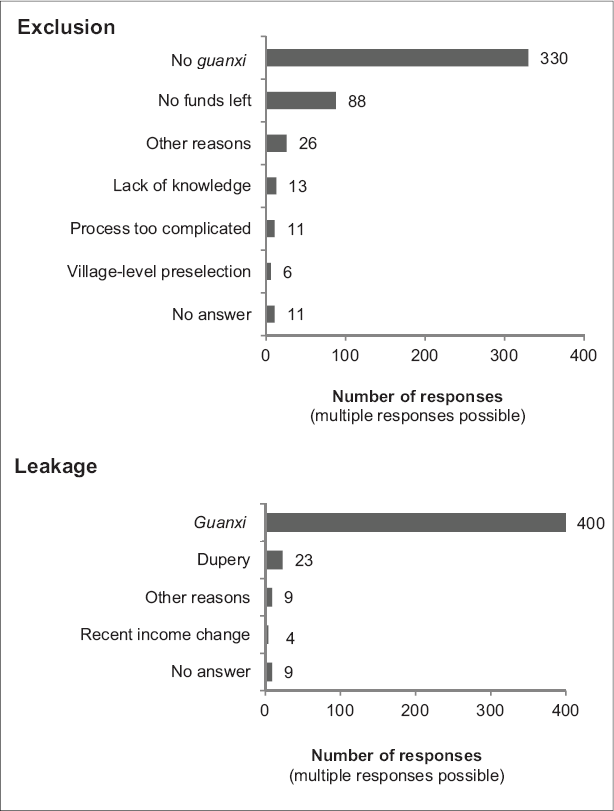
Perceived Reasons for Mistargeting of Funds (Follow-Up Sample, 2014)
Judging from the leakage and exclusion cases observed during the case study, mistargeting in our sample seemed to occur mostly among households close to the poverty line. Between 2011 and 2014, extreme cases had become less frequent and present misallocation was mostly not so obvious that it called for the immediate attention of township authorities. Typically, “leakage” households fulfilled certain requirements of the system, but could just as well have been supported by their income-generating relatives. While this breach of rules might not be considered too severe, under limited resources these leaked grants were lost to other, more needy households.
The distribution process itself is designed to prevent exclusion and leakage. As mentioned, villages and townships are instructed to publish details on applicants and recipients at publication boards near the town hall. In 46 (= 74 per cent) of the villages, information on applicants was published in this way, and practically all villages published a list of recipients (95 per cent). Villagers are encouraged to anonymously report any irregularities, especially suspicions of fraud, via a direct telephone number to the township government. However, the secluded location of some town halls, the rather short duration of publication, and disinterest on the part of villagers often reduced the effect of this anti-fraud measure. The inefficiency of the measure is reflected in the fact that approximately half of the villagers we talked to in open interviews had not seen any information on a publication board (either they did not check or the information was not there when they did check). Reporting might, on the one hand, be motivated by honest indignation over leakage and local capture. On the other hand, individuals might report others in the hopes of attaining the dibao funds for themselves once they have been withdrawn from the previously named recipient. Nevertheless, these motives can still be outweighed by the (sometimes well-founded) fear that complaints might not remain anonymous in a small community. Indeed, complaints about irregularities in the distribution of funds were, according to township authorities, rather rare.
The aforementioned “democratic discussion,” reportedly held in 97 per cent of the villages, is another important tool to fight fraud. The general public participated only when these meetings were held on the neighbourhood level rather than the administrative village level, which served to increase the information level of villagers. However, administrators in several townships reported that small-group-level “democratic discussions” resulted in fights between villagers over the distribution of funds. In one village, local leaders even stated that votes were often given to well-connected and popular households (instead of needy households), and the resulting conflicts had to be mediated by village or even township personnel.
According to township governments, monitoring dibao recipient households is supposed to not only prevent fraud by households but also serve the purpose of supervising village leaders’ implementation of the system. Leaders in 55 (= 89 per cent) of the follow-up sample villages stated that ex-post monitoring was taking place (usually once per year), though in 23 (= 42 per cent) of these villages this monitoring was solely done on the village level (by village leaders, village committee members, party secretaries, or members of the village representation). This procedure not only contradicts the 2–3 system (not conducting selection and monitoring of targets at the village level), but also precludes the possibility of monitoring village leaders’ performance.
Further, survey responses on the household level left the impression that household visits and monitoring by the local township and county was not as comprehensive as demanded by regulations: in 2013, 39 (= 33 per cent) of the 119 dibao households were not examined by township or county officials during the application, and ex-post monitoring by county or township administrators was not conducted in 67 (= 56 per cent) of the households. For some of these households, monitoring might not have been scheduled because the unalterable character of their poverty rendered repeated inspections superfluous (e.g. recipient has a permanent handicap). However, the lack of monitoring beyond the village level often seemed to be due to understaffing of township- and county-level MCA offices: in each of the township governments that we visited, only one or two people were responsible for the whole township's dibao work, which meant covering 15 villages and approximately 1,800 recipients in the average sample township; by many administrators’ own assessments there were too many recipients to collect new data every year. One bureau had tried to hire an office assistant for months, but failed to find qualified personnel willing to take such a troublesome job for the low wage that local government could offer. This understaffing might be explained by the downsizing of local governments following the tax reforms from 2000 on (Li 2006), and that administrative costs of the dibao system have to be covered by the township government themselves.
Overall, our data shows that the rural population did perceive there to be considerable mistargeting of funds. The data also indicates that township and county-level administrations occasionally disregarded regulations specifying that certain aspects of implementation not be taken on by (possibly biased) village administration: in several cases, township administrations delegated distribution and monitoring tasks to the village level. Furthermore, at least regionally there were considerable gaps in administrative capacity to achieve the ambitious policy aims.
Assessment of Households’ Material Welfare
As we mentioned above, eligibility is directly connected to a locally defined absolute poverty line. However, there is a strong contrast between theory and practical feasibility, the main problems being the definition of income components, their measurement, and the reliability of self-stated income. These measurement problems were noted by an officer of a township MCA office:
The biggest challenge in the dibao work at the moment is the estimation of the household income, as income of rural households comes from farming and part-time jobs and is hard to clearly define since it is not fixed. Especially for old people, it's difficult: their own income is very small and the support by their children is irregular and hard to determine, which makes it difficult to count it into the old people's household income. (Anonymous 1 2014)
On the one hand, village leaders did know about the cornerstones of income measurement – for instance, the concept of net income:
For example, if a household's yearly income suddenly goes up, the people's representation knows that, they know how much you earned a year. They subtract the expenses and if you get below that standard, you get [dibao]. If you don't come [below] the standard, you don't get it. (Anonymous 2 2014)
On the other hand, however, it was questionable whether the regulations were followed in the actual implementation of targeting. Some leaders admitted to determining eligibility in a relative fashion by simply comparing the living standard of villagers and using severe disease or old age as additional qualification criteria:
It is hard to calculate the income. […] Normally the village committee knows a lot about the current situation of this village. They know who has a lower income, who got a severe disease. Another way is through [asking the household to present] hospital bills [as proof] of severe diseases. (Anonymous 3 2014)
The reason for this implementation gap might be the structure of income in poor rural communities, where the large share of hard-to-determine agricultural income and remittances in total household income made precise income measurement rather difficult. In addition, leaders might be aware that self-stated income is not necessarily reliable, as the connection between income statements and eligibility for dibao transfers is well known and creates a clear incentive to under-report household income. In fact, McKay (2000) mentions that respondents might answer untruthfully if they even only suspect a connection to income taxes. An additional issue is the qualification of elected village leaders or local party members who conduct income measurement. In only one of our case-study villages did leaders claim to have received training on income measurement. In the remaining villages, leaders might simply be unaware of specific income-measurement approaches. Consequently, the dibao standard (i.e. the absolute poverty line) was not very relevant for dibao targeting in some underdeveloped regions, where poverty and need seemed to be defined rather subjectively. Therefore, a part of the resulting implementation gap might in fact be caused by the need to adapt central policy better to the grassroots level, as argued by Li (2006).
Scarcity of Dibao Funds
One main principle of dibao is the “distribution according to need”
( ,
yingbao jinbao), the assignment of grants to all eligible
applicants without any general restriction of funds. However, some sources (i.e. Li
and Jiang 2012; Liu 2012) mention a so-called “limitation of quotas”
(
,
yingbao jinbao), the assignment of grants to all eligible
applicants without any general restriction of funds. However, some sources (i.e. Li
and Jiang 2012; Liu 2012) mention a so-called “limitation of quotas”
( ,
ming'e youxian). The usual translation of
,
ming'e youxian). The usual translation of  (ming'e) as
“quota” is misleading in this case. Literally,
(ming'e) as
“quota” is misleading in this case. Literally,  reads as “name list” and
should instead be understood as the number of individuals admitted to a system or
programme. In practice, though, this term is also used in the sense of an
entitlement to some benefit, which can either be obtained (
reads as “name list” and
should instead be understood as the number of individuals admitted to a system or
programme. In practice, though, this term is also used in the sense of an
entitlement to some benefit, which can either be obtained ( , dedao
ming'e) or be unavailable when funds are exhausted (i.e.
, dedao
ming'e) or be unavailable when funds are exhausted (i.e.
 ,
ming'e yongwanle).
,
ming'e yongwanle).
Indeed, during our case study we found hints that in some regions there was an upper limit to available dibao funds or the number of dibao beneficiaries, even though official regulations do not provide for or mention any limitation of number of recipients. In our interviews, four out of seven administrators at the township level openly admitted that a maximum number of recipients (quota) had been imposed in their region by higher governmental levels. In two further cases, township levels reported that the supply of funds was unlimited, but these reports were contradicted by village sources. In 29 villages (= 47 per cent) from the follow-up sample, village leaders reported that a fixed quota for dibao existed in their village, in terms of either number of recipients or amount of total funds. In 20 (= 69 per cent) of the 29 sample villages that had limited funds, this quota was deemed insufficient by village leaders and resulted in the exclusion of eligible households. The shortage of funds might result from administrators deliberately or accidentally underestimating the demand for local dibao funds (see, also, Cai 2000 on the reliability of local income statistics) or from some sort of upper limit for transfers imposed by higher governmental levels.
The limitation of funds per region need not have a detrimental effect, per se. In some of the villages from the 2012 sample (Center for Chinese Agricultural Policy 2012), the dibao quota set was somewhat linked to the general economic situation of each region. However, in 36 of the original 101 villages, there was a quota distributed as a fixed percentage of village population. These cases are alarming as this procedure might create an oversupply of funds in richer regions, resulting in leakage, and an undersupply of funds in poorer regions, resulting in the exclusion of poor households. In addition, a low quota might complicate the selection of targets for village leaders, as they may feel exposed to the fury of households that do not receive social assistance but that perceive themselves (sometimes correctly) as no less eligible than other households that do receive social assistance. In addition, eligibility based on official criteria seemed to often be overruled by social relations during the necessary preselection at the village level.
Ambivalent Role of Local Leaders
As mentioned before, the decentralised implementation of the dibao policy entrusts village leaders with great responsibility concerning the selection of target households. Even though recent efforts have been made to shift all targeting responsibilities to higher administrative levels, village leaders’ knowledge is still indispensable in poor, remote communities. This created space to adapt national policy to meet local constraints; during our fieldwork, we encountered several ways that village leaders chose to cope with scarce funds. First of all, in some villages households were informed about the limited character of funding: in 27 cases, households had refrained from applying, because household members either knew or assumed that all available spots were already taken. Sixteen households reported that quotas were distributed without any formal application and thus did not even apply. In 24 cases, the reasons for non-application were based on household members’ incorrect assumptions about eligibility criteria; for instance, they wrongly assumed that possessing land-use rights on agricultural land or being young would exclude them from the system, which hints at village leaders tightening eligibility criteria to regulate the number of applicants (see “Tightened eligibility criteria” in Figure 2).
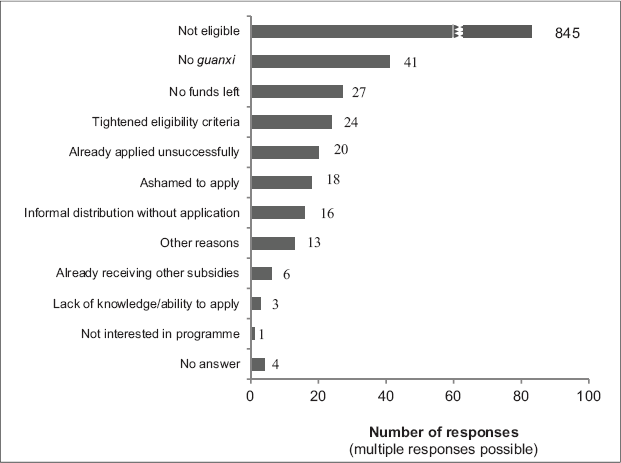
Reasons for Non-Application of Households (Follow-Up Sample, 2014)
Another round of selection took place after applications had been filed with village authorities, as can be understood from villagers’ statements concerning the reasons for their applications being rejected (Figure 3). The majority of non-applications were due to a perceived or actual lack of eligibility. However, as we expected from previous results, a considerable number of households (13 cases) stated that their applications were rejected due to the scarce quota. Moreover, we also learned that when the maximum number of recipients was set beforehand, some village leaders felt the need to match the number of applications that would be forwarded to the township level with the assigned quota. Our interview partners gave us the impression that this selection was made during the “democratic discussion,” which is actually supposed to sort out only non-eligible households. In our sample region, the assembly made a selection from a larger group of all households that were interested in filing an application by majority vote. In other cases, village leaders introduced additional eligibility criteria to further reduce the list of potential applicants: even though land entitlement is not an official eligibility criterion and in virtually all of the examined villages local leaders were well aware of that fact, three households were rejected for precisely that reason.
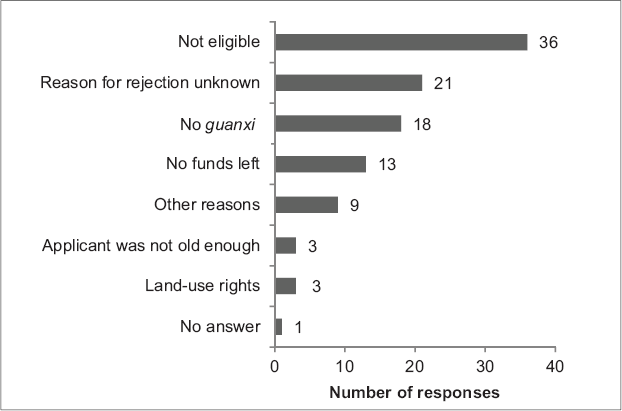
Reasons for Rejection of Applications (Follow-Up Sample, 2014)
If they could not control the number of recipients, village leaders were creative in finding other solutions: in some villages, the low average amount of transfers raised the suspicion that leadership, in an attempt to prevent discord among villagers, simply split the money of the registered recipients equally among all eligible households. Five households in our case-study interviews reported that quotas were distributed by village leaders in some sort of rotation system, in which only the most deprived households received social assistance every round and the remaining households alternated annually, though the same households were reported as being official recipients every year.
In such an environment, social connections may become a major factor in gaining access to scarce social transfers. Even if we assume that some responses wrongly attributed a failed application to a lack of social connections, the total number of applications that were reportedly rejected due to a lack of social connections, or guanxi, is still substantial (see Figure 3).
As observed in our sample villages, social isolation that comes with age, illness, and poverty can also lead to exclusion in early steps of the application process. First, a lack of initiative to apply for funding, a lack of information on the application, and a lack of support by authorities in the application process prevented applications right from the start in some cases. Indeed, we found that even though all villagers we interviewed had heard about the policy in general, not all of them knew about the general procedure and many had only a vague perception of the eligibility criteria. Furthermore, we found that most of the older people – who are the main targets, after all – relied on their relatives to file the application. Second, a lack of social connections might also decrease the probability of an application being successful. This is closely connected to the issue of scarce quotas mentioned above and the different ways in which village leaders dealt with them. Also, during the “democratic discussion,” households with a denser personal network were reportedly more likely to be selected as targets.
How Can the Implementation Gap be Narrowed?
Admittedly, the data presented above reflects the situation in only a very limited number of communities. However, their accordance with theory and previous research seems to permit the diagnosis of a certain policy gap, which is very likely not limited to our sample. We argue that certain characteristics of undeveloped regions facilitate the development of patterns of local distortions and adaptions of policy, which might counter the goal of “precise anti-poverty targeting.” Theory and empirical evidence suggest that in the current implementation, well-connected families might have an advantage over marginalised households, especially in poor regions and communities where public funds are scarce. Information asymmetries between village-level and higher-level administration, however, make it difficult for higher-level authorities to evaluate the efficiency of targeting or even to conduct independent implementation. Backed by these insights, we proceed by discussing some measures that might help to narrow the implementation gap.
The first and most straightforward course of action is to enforce policy
implementation through village leadership. As shown by Heberer and Trappel (2013),
cadre evaluation could serve as both an incentive (since evaluation results are
decisive for further career options) and a control mechanism (by defining leaders’
scope of action, communicating the central government's expectations, and
disciplining cadres). Introducing direct evaluation of village cadres (see, e.g.,
Wang and Zhang 2004) with a strong emphasis on policy implementation goals could
change local administrators’ incentives. Some township governments conduct regular
external dibao monitoring by appointing non-local cadres to
dedicate part of their time to working in one specific village – so-called
“stationed cadres” ( , Zhucun
ganbu). While these cadres have more access to information than normal
township administrators, they do not experience the same level of social obligation
and pressure felt by those leaders who permanently reside in the village. The
downside of monitoring, cadre evaluation, or external supervision is these measures’
considerable cost, for which especially poor townships and counties do not seem to
be able to raise the necessary funds. Many township governments are already
understaffed and struggle with the current range of monitoring tasks. One
alternative to monitoring by authorities is to more deeply involve villagers in
assessing the justification (in terms of the need of recipients) of
dibao transfers, as was also proposed by O'Brien and Li (1999).
The central government is increasingly promoting the idea of getting villagers more
deeply involved in policy assessment, a topic already addressed in other policy
contexts (Heberer and Trappel 2013). If certain technical shortcomings can be
overcome, such community involvement may help to reduce some of the above-mentioned
problems of selective and uneven policy implementation, despite considerable
concerns surrounding the confidentiality and stigmatisation of recipients. In any
case, information on programme mechanisms, eligibility criteria, and recipients has
to be communicated to villagers, whose knowledge of the issue was often found to be
rather poor. The “democratic discussions” helped to spread information and prevent
any major leakage of funds, but only when a substantial number of villagers
participated. The system of traditional publication boards could serve the same
purpose, but only if they become more accessible to and convenient for remote
households, or if they are modernised – for instance, using push notifications that
are received via SMS by all registered users. Such a system does not require modern
smartphones and could increase the dissemination of necessary information on
application periods, criteria, applicants, and meetings; it might also prevent
misconceptions and resulting conflicts between community members.
, Zhucun
ganbu). While these cadres have more access to information than normal
township administrators, they do not experience the same level of social obligation
and pressure felt by those leaders who permanently reside in the village. The
downside of monitoring, cadre evaluation, or external supervision is these measures’
considerable cost, for which especially poor townships and counties do not seem to
be able to raise the necessary funds. Many township governments are already
understaffed and struggle with the current range of monitoring tasks. One
alternative to monitoring by authorities is to more deeply involve villagers in
assessing the justification (in terms of the need of recipients) of
dibao transfers, as was also proposed by O'Brien and Li (1999).
The central government is increasingly promoting the idea of getting villagers more
deeply involved in policy assessment, a topic already addressed in other policy
contexts (Heberer and Trappel 2013). If certain technical shortcomings can be
overcome, such community involvement may help to reduce some of the above-mentioned
problems of selective and uneven policy implementation, despite considerable
concerns surrounding the confidentiality and stigmatisation of recipients. In any
case, information on programme mechanisms, eligibility criteria, and recipients has
to be communicated to villagers, whose knowledge of the issue was often found to be
rather poor. The “democratic discussions” helped to spread information and prevent
any major leakage of funds, but only when a substantial number of villagers
participated. The system of traditional publication boards could serve the same
purpose, but only if they become more accessible to and convenient for remote
households, or if they are modernised – for instance, using push notifications that
are received via SMS by all registered users. Such a system does not require modern
smartphones and could increase the dissemination of necessary information on
application periods, criteria, applicants, and meetings; it might also prevent
misconceptions and resulting conflicts between community members.
A second measure that might help to narrow the implementation gap would be the abolishment of any limitation in terms of dibao recipients or funds, as such limits contradict the principle of yingbao jinbao, according to which all eligible households should receive transfers. However, we should take into account a practical reason that local governments might decide to limit funds: an upper limit of recipients may be intended not only to guard against leakage of funds (Zhang, Xu, and Wang 2012) but also to serve as a relative poverty line. This relative poverty line can ease the targeting process for local leadership in regions where administrative capacity is low, if we assume that ranking households according to their relative wealth is a much easier task than assessing each applicant's poverty status according to his or her respective income level. In any case, it is necessary to at least ensure that this quota is closely and only (!) connected to the respective region's poverty level. The quota should never be set based on the insufficiency of local funds, as this would clearly contradict the principle of yingbao jinbao. In the same fashion, administrative funds should be adapted to local poverty levels and, where necessary, be co-funded by higher governmental levels.
A third path is to rethink the suitability of income-based eligibility assessment for underdeveloped rural regions. Overly ambitious policy design may sometimes impede accurate implementation, as argued by Li (2006). Examples from high-income countries show that social assistance based on means testing methods remains a difficult task, as informal employment and concealment of income persist even when there is comprehensive income documentation. As stated above, there is no centralised collection of income data (e.g. for tax reasons) in China's rural areas. However, centralised collection is essential for a social assistance system based on means testing that aspires to achieve general coverage among the eligible population. A customised income assessment is costly and error-prone, labour-intensive for administrators at the local level, and requires proper training of evaluators. Self-reported income data is rendered useless by the clear incentive for households to understate their income. Therefore, targeting schemes based on means testing might not be appropriate in the most deprived regions where reliable and documented income data is not available. In fact, many local leaders in practice do emphasise demographic eligibility criteria. The connection between demographic characteristics and poverty seems to be strong in remote rural areas of China and might justify demographic targeting approaches. On the one hand, this approach seems simpler and cheaper since it avoids measuring income and focuses on visible, easily quantifiable manifestations of wealth and demographic characteristics. On the other hand, demographic targeting requires clear, objective, and universal definitions of criteria for need and eligibility, a point in which existing regulations leave considerable room for interpretation. One example is the important exclusion criterion of family members’ ability to provide support: At what income level or degree of relationship should a person be expected to support his or her relatives? What degree of handicap or disease results in total loss of labour capacity and qualifies a household for income transfers? The current regulations clearly allow considerable leeway for local implementation; while this flexibility does acknowledge local heterogeneity, it also decreases transparency and might cause additional distortion.
Summary
In this article, we presented findings from a case study on the rural dibao system, which is a pillar of comprehensive rural social security and which represents a big commitment towards supporting those who were least able to benefit from the economic growth of recent decades. However, our analysis showed that there is still room for improvement in terms of the commitment of local administrators, sufficient financial and personal endowment, and the practicability of income measurement. Deficiencies in these three areas drive local administrators to adapt policy and entice individuals to make personal gains.
Three findings are particularly notable: First, the incentive system of village leaders seems to be a core problem of dibao implementation, which can be countered by both increased monitoring on the part of higher administrative levels and increased participation of villagers. Strengthening the monitoring by independent auditors and the community itself might be the key to decreasing the mistargeting that originates from the realities of rural society. Second, we found that not all regional governments are endowed with sufficient funds and enough administrative capacity to meet the implementation tasks resulting from sophisticated policy design, which contributed to imperfect policy implementation. Finally, we argue that in regions with a high poverty level, low regional administrative capacity and sketchy information on household income levels, a means-testing procedure is not a very well-suited targeting method and should not be communicated as such to the local levels. A stronger focus on carefully chosen, precisely defined and meaningful demographic eligibility criteria would prevent leakage and safeguard the yingbao jinbao principle while maintaining the implementability of the dibao policy.
Footnotes
Summary Statistics of Households Surveyed in 2012
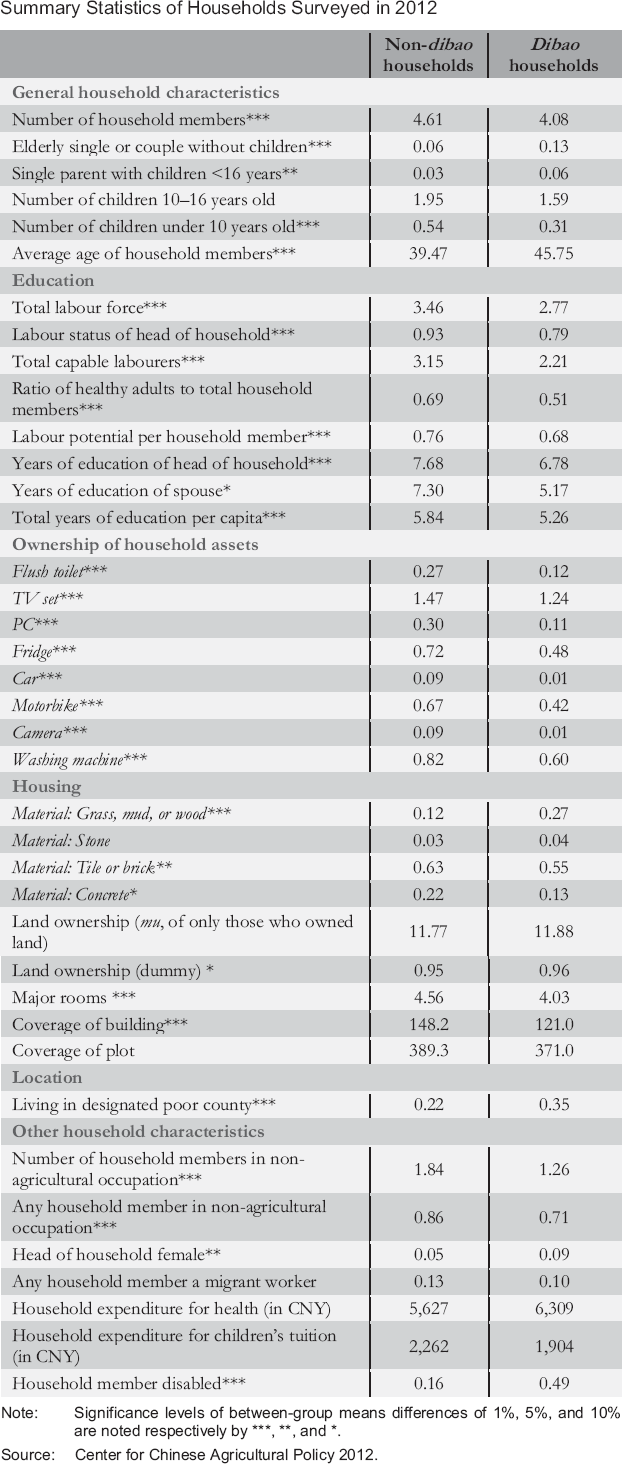
| Non-dibao households | Dibao households | |
|---|---|---|
| General household characteristics | ||
| Number of household members*** | 4.61 | 4.08 |
| Elderly single or couple without children*** | 0.06 | 0.13 |
| Single parent with children <16 years** | 0.03 | 0.06 |
| Number of children 10–16 years old | 1.95 | 1.59 |
| Number of children under 10 years old*** | 0.54 | 0.31 |
| Average age of household members*** | 39.47 | 45.75 |
| Education | ||
| Total labour force*** | 3.46 | 2.77 |
| Labour status of head of household*** | 0.93 | 0.79 |
| Total capable labourers*** | 3.15 | 2.21 |
| Ratio of healthy adults to total household members*** | 0.69 | 0.51 |
| Labour potential per household member*** | 0.76 | 0.68 |
| Years of education of head of household*** | 7.68 | 6.78 |
| Years of education of spouse* | 7.30 | 5.17 |
| Total years of education per capita*** | 5.84 | 5.26 |
| Ownership of household assets | ||
| Flush toilet *** | 0.27 | 0.12 |
| TV set *** | 1.47 | 1.24 |
| PC *** | 0.30 | 0.11 |
| Fridge *** | 0.72 | 0.48 |
| Car *** | 0.09 | 0.01 |
| Motorbike *** | 0.67 | 0.42 |
| Camera *** | 0.09 | 0.01 |
| Washing machine *** | 0.82 | 0.60 |
| Housing | ||
| Material: Grass, mud, or wood *** | 0.12 | 0.27 |
| Material: Stone | 0.03 | 0.04 |
| Material: Tile or brick ** | 0.63 | 0.55 |
| Material: Concrete * | 0.22 | 0.13 |
| Land ownership (mu, of only those who owned land) | 11.77 | 11.88 |
| Land ownership (dummy) * | 0.95 | 0.96 |
| Major rooms *** | 4.56 | 4.03 |
| Coverage of building*** | 148.2 | 121.0 |
| Coverage of plot | 389.3 | 371.0 |
| Location | ||
| Living in designated poor county*** | 0.22 | 0.35 |
| Other household characteristics | ||
| Number of household members in non-agricultural occupation*** | 1.84 | 1.26 |
| Any household member in non-agricultural occupation*** | 0.86 | 0.71 |
| Head of household female** | 0.05 | 0.09 |
| Any household member a migrant worker | 0.13 | 0.10 |
| Household expenditure for health (in CNY) | 5,627 | 6,309 |
| Household expenditure for children's tuition (in CNY) | 2,262 | 1,904 |
| Household member disabled*** | 0.16 | 0.49 |
Note: Significance levels of between-group means differences of 1%, 5%, and 10% are noted respectively by ***, **, and *.
Source: Center for Chinese Agricultural Policy 2012.