



Abstract
In this paper we evaluate three projects with the participation of 40 supplier firms in several Chinese coastal provinces representing multi-stakeholder efforts to provide alternative channels through which workers can voice their concerns. The supplier firms took on these projects to reduce worker dissatisfaction and employee turnover. The projects fill an institutional void in employer–employee relations within Chinese supplier firms as they provide alternative channels for workers to voice their concerns. The role of civil society organisations focusing on labour interests was a crucial feature of the projects, through capacity-building for workers and by providing independence. The supplier firms and their workers have benefitted as firms take measures to enhance worker satisfaction, while the reduced employee turnover positively impacted firm performance. We propose that these collaborative socially responsible practices are a potential way to strengthen the positions of workers and supplier firms in global supply chains.
Keywords
Introduction
In recent decades, China has become strongly integrated into the world economy and Chinese firms now play a key role as suppliers in global production chains. This success is partly attributable to a focus on low-cost manufacturing of mature products, significant FDI flows, and an abundant and relatively cheap workforce (Rodrik 2006; Brandt, Rawski, and Sutton 2008; Zhang et al. 2009; Deng and Li 2012). The continuation of economic growth is increasingly dependent on the ability of Chinese firms to create more value and increase innovativeness (Altenburg, Schmitz, and Stamm 2008; Zhang et al. 2009; Yue and Evenett 2010; Barrientos, Gereffi, and Rossi 2011; Deng, Hofman, and Newman 2013). This challenge also has implications for labour relations in Chinese firms. The management of Chinese firms will find there are increasingly strong arguments to shift their relationship towards the workforce from a mostly exploitative one to a more supportive one as it becomes more important to attract a skilled workforce, invest in workers and their skills, and improve retention of workers (Zhang et al. 2009; Jiang, Baker, and Frazier 2009). Apart from being driven by the desire and need to improve the position of supplier firms within global value chains, this process is also motivated by domestic forces, such as workers increasingly voicing their concerns – as illustrated by rising conflicts between workers and employers, increasing strikes and labour shortages in China's coastal provinces (Chen and Estreicher 2011; Friedman 2012) – increasing labour costs, and domestic policies to nurture innovation in Chinese firms (Zhang et al. 2009). Given that employer–employee and broader industrial relations (including roles of unions, government and civil society organisations) are an important part of corporate social responsibility, this paper 1 explores the role of CSR practices as a potential win-win for both employers and employees in Chinese supplier firms.
The authors are grateful for financial support from the University of Nottingham's Research Development Fund and the Integrating Global Society (IGS) Priority Group Seedcorn Fund. These funds allowed the authors to initiate the project, to hold mutual visits in Nottingham and Shenzhen and to conduct a pilot survey in a number of Chinese export manufacturing firms in the summer of 2011. Special thanks to Professor Andreas Bieler in the School of Politics and International Relations and to Professor Jonathan Beaverstock, coordinator of the IGS, for their support of this project.
We have evaluated three projects involving the participation of 40 supplier firms in the Chinese coastal provinces of Guangdong, Jiangsu and Zhejiang. These projects represent efforts to take into account the interests of workers, including a capacity-building and goal-setting programme for employees, and the organisation of both workers’ committees and a confidential hotline for workers. The projects were joint efforts between Chinese and international civil society organisations, Western TNCs and Chinese supplier firms. Chinese supplier firms have mostly been confronted with corporate social responsibility through the requirements set by buyer firms’ codes of conduct. Several studies have indicated that Chinese supplier firms view CSR and buyers’ codes of conduct as being externally imposed and that most firms’ strategies were focused on circumventing the rules of TNCs’ codes of conduct in order to reduce labour costs or implement more rigorous “Taylorist” production regimes for their workers (Sum and Pun 2005; Jiang 2009; Yu 2008). More recently, some evidence has shown that supplier firms have a more intrinsic interest in developing CSR practices as they realise the potential positive impacts on their workers in terms of loyalty and motivation (Pun and Yuen-Tsang 2011; Yin and Zhang 2012; Hofman and Newman 2014). The present paper extends this discussion by identifying key elements and mechanisms in the three CSR projects in terms of involved stakeholders, the specifics of organisation, process and outcomes, and the way these impact workers and employers. This contribution addresses the following key questions: Do CSR practices that focus on worker empowerment and development lead to increased loyalty, higher attractiveness and reduced conflicts for firms? What are the relevant features of these CSR projects that enhance involvement of workers and legitimacy of these CSR practices for the workers?
The paper starts by sketching the contemporary setting regarding the position of (migrant) labour in Chinese supplier firms. The following section identifies potential ways to strengthen the position of workers in supplier firms and to strengthen the position of these firms in global supply chains. The next section introduces three projects in which CSR-oriented practices were implemented in a range of supplier firms through the joint efforts of various stakeholders. We then proceed to draw key lessons and implications from these projects and end with a concluding section.
The Position of (Migrant) Labour in Chinese Supplier Firms
China's economic achievements since the 1980s are largely based on the mobilisation
and full utilisation of its human resources, especially its hundreds of millions of
so-called “rural migrant workers” who have moved from the countryside to
non-agricultural employment in urban areas but have retained their rural identity
due to their fixed rural hukou ( ) registration (Chan 2010).
While migrant workers have made an important contribution to China's
industrialisation, urbanisation and especially the growth of its export-oriented
economy, they have generally been rewarded with low wages (albeit higher than those
in the rural areas from which they migrated), long working hours, poor working
conditions and social discrimination (Chan and Siu 2010; Chan 2010; Pun, Chan, and
Chan 2010). This arrangement, which was based upon a growth model that utilised
cheap migrant labour, lasted for more than two decades, but seems to be approaching
its end due to the shortage of migrant workers and to soaring wages (thus stronger
competition from other low-cost and labour-intensive production sites) and
increasing discontent with rising inequality in China, as evident from the
unprecedented growth in labour unrest and conflicts in recent years (Pun, Chan, and
Chan 2010; Chan 2012; Deng and Li 2012). An assessment of recent developments in the
nature of (1) labour disputes, (2) rate of employee turnover, (3) lack of workplace
dignity and (4) worker strikes gives insights into these sources of worker
dissatisfaction. Understanding these sources provides the basis for a consequent
section of this paper in which we focus on aspects of more responsible practices
towards workers that can help reduce dissatisfaction.
) registration (Chan 2010).
While migrant workers have made an important contribution to China's
industrialisation, urbanisation and especially the growth of its export-oriented
economy, they have generally been rewarded with low wages (albeit higher than those
in the rural areas from which they migrated), long working hours, poor working
conditions and social discrimination (Chan and Siu 2010; Chan 2010; Pun, Chan, and
Chan 2010). This arrangement, which was based upon a growth model that utilised
cheap migrant labour, lasted for more than two decades, but seems to be approaching
its end due to the shortage of migrant workers and to soaring wages (thus stronger
competition from other low-cost and labour-intensive production sites) and
increasing discontent with rising inequality in China, as evident from the
unprecedented growth in labour unrest and conflicts in recent years (Pun, Chan, and
Chan 2010; Chan 2012; Deng and Li 2012). An assessment of recent developments in the
nature of (1) labour disputes, (2) rate of employee turnover, (3) lack of workplace
dignity and (4) worker strikes gives insights into these sources of worker
dissatisfaction. Understanding these sources provides the basis for a consequent
section of this paper in which we focus on aspects of more responsible practices
towards workers that can help reduce dissatisfaction.
Labour Disputes
The number of labour disputes in China has increased significantly in the past decade. According to data provided by the Chinese Ministry of Labour and Social Security, there were 1,287,400 cases of labour disputes reported in 2010, compared to 930,000 in 2008, 314,000 in 2005 and 19,098 in 1994 (HRSS 2008, 2011). The increase in the number of cases is related to the implementation of the 2008 Labour Contract Law and the 2008 Labour Dispute Arbitration and Mediation Law. These laws represent an effort by Chinese government to enhance the protection of workers’ rights and provide more means for workers to bring their cases and grievances to mediation and arbitration committees.
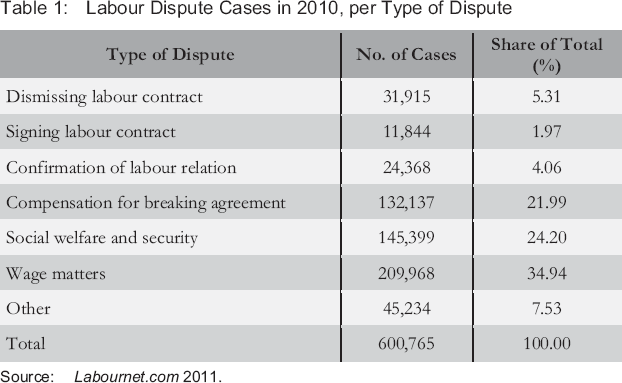
Despite increasing efforts to solve cases through mediation, in 2010 the total
number of cases going to arbitration was approximately 600,000, 81.13 per cent
of which were related to wage and social welfare issues (see Table 1). Various
studies have also indicated that the new Labour Contract Law and the Labour
Dispute and Arbitration and Mediation Law have led to an increase of workers
claiming their legal rights, while most of the cases involve disputes regarding
overtime pay, wage delays or employers not paying full wages to workers (Su and
He 2010; Li 2011; Feng 2012). Studies have also indicated that the number of
workers without a written labour contract has decreased with the new labour
contract law, but can still account for up to 40 per cent of workers in private
SMEs as the implementation and enforcement of the labour laws is limited due to
lack of capacity, resource limitations and guanxi
( ) of
employers (Ho 2009; Li 2011). However, the broader picture is that most workers
do not use the mediation and arbitration committees for their grievances as they
are not aware of this channel, lack the time and opportunity to pursue it,
believe it is biased towards management of the firms, or have broader demands
for higher wages and better work conditions (Su and He 2010; Li 2011; Friedman
2012).
) of
employers (Ho 2009; Li 2011). However, the broader picture is that most workers
do not use the mediation and arbitration committees for their grievances as they
are not aware of this channel, lack the time and opportunity to pursue it,
believe it is biased towards management of the firms, or have broader demands
for higher wages and better work conditions (Su and He 2010; Li 2011; Friedman
2012).
Labour Dispute Cases in 2010, per Type of Dispute
Source: Labournet.com 2011.
Employee Turnover
Employee turnover in Chinese firms tends to be high, particularly for Chinese supplier firms (Zhang et al. 2009; Jiang, Baker, and Frazier 2009). This indicates that workers mostly adopt an exit strategy rather than voice their dissatisfaction with poor working conditions and low wages towards employers. In an empirical study of 210 export-led factories conducted from 2008 to 2009, the average annual turnover rate of employees exceeded 50 per cent in firms in the Pearl River Delta and Yangzi River Delta (Liu, Rooker, and Wu 2013). Employee turnover was significantly higher in electronics factories. Research in 15 electronics firms located in Guangdong from December 2010 to March 2011 showed an average annual turnover rate of 89 per cent (Liu, Rooker, and Wu 2013). Other studies have also reported high turnover levels and confirmed the link between turnover and employee dissatisfaction (Jiang, Baker, and Frazier 2009; Tian-Foreman 2009). These studies indicate that migrant workers feel an only limited commitment to their employers because they are not treated well by their supervisors and employers. This is accompanied by limited potential for further personal and career development within firms, given that migrant workers are mostly considered temporary personnel, in many cases without official contracts (Pun, Chan, and Chan 2010; Cooke 2011a). This lack of belonging to the firm and the local community is also maintained through the existing hukou system and the lack of local government and union support for migrant workers (Chan 2010; Cooke 2011a). While turnover also tends to be high for skilled workers, their situation is different from that of migrant workers as the former tend to be able to obtain residential status and are also in high demand. An increasing number of Chinese supplier firms, such as those in the electronics sectors, are trying to improve their position in the global supply chain and aiming to capture more value by increasing the quality and innovativeness of their products (Zhang et al. 2009; Yue and Evenett 2010). Low retention of workers is a problem for supplier firms, especially when those firms seek to increase quality and innovativeness through training programmes that can enhance the skill levels of their workers.
Workplace Dignity
There was widespread shock within China and among the international community at a series of suicides at Foxconn production plants in 2010, concentrated at its Longhua and Guanluan facilities in Shenzhen, the largest electronics manufacturing establishments in the world. This tragedy drew public attention to the fragile life of Chinese workers; it also represents an opportunity for the public, industrial leaders, academic scholars and policymakers in China and beyond reconsider labour costs for suppliers in less developed economies in general and the limitations of the current labour regime and cheap labour strategy in particular. Foxconn is a subsidiary company of Hon Hai Precision Industry Company Ltd., which was founded by Terry Gou in Taiwan in 1974 with 7,500 USD, and started its business in mainland China in 1987, operating out of a small factory (fewer than 200 workers) in Shenzhen. It has since developed it into a global corporation currently ranked 109th on the Fortune Global 500, with 900,000 employees in mainland China in 2010, 420,000 in Shenzhen alone. The company's 2010 fiscal report states that its manpower increased by 9.7 per cent from 2008 to 2009, but its total labour cost was reduced by 28 per cent, and its labour cost-to-capital ratio sank by 34 per cent (Foxconn 2010: 68).
More than 80 per cent of Foxconn's employees are migrant workers. Foxconn is an original equipment manufacturer (OEM) and produces components for such global brand names as Apple, Nokia, Motorola, H&P, Sony and Dell. In a study conducted in July 2004, which included interviews with Foxconn's workers, interviewees indicated they endured long working hours for low wages and limited benefits, experienced poor communication within the firm and would suffer serious punitive measures if they did not follow the company's rules (Liu and Deng 2005). Interviewed workers stated they have dull lives and repetitive jobs, often having to continuously repeat a simple, routinised action for 10 to 12 hours every day like a machine without any space to socialise. Research conducted after the events in 2010 confirms that workers are disciplined quite harshly and are subject to an extreme production regime with very little room for social contact (Pun and Chan 2012). The research by Lucas, Kang, and Li (2013) indicates that workers are treated with little respect and experience a lack of workplace dignity. An independent team of researchers from China, Hong Kong and Taiwan concluded that suicides are the result of the total desperation, alienation and isolation felt by several migrant workers at Foxconn (Pun and Chan 2012). Their research also uncovered the use of underage workers recruited as interns from schools, a system supported by local school and government officials who would receive certain benefits in return (Pun and Chan 2012). Investigation of labour practices was also conducted by the Fair Labour Association (FLA) after Foxconn's major client, Apple, became a member of the FLA. The FLA found serious and pressing instances of non-compliance with the FLA's code of conduct, as well as with Chinese labour law (FLA 2012). Foxconn has undertaken several measures to address these issues (FLA 2012). In a broader assessment on labour practices, the FLA reports that excessive working hours are widespread among Chinese supplier firms in the garment industry and electronics manufacturing, with detrimental effects on productivity, quality and loyalty (FLA 2011). They suggest adjustments in labour practices that can reduce these detrimental effects; in addition to reducing working hours, this includes a focus on training and strategies to increase retention, which is another area of focus in subsequent sections.
Worker Strikes: Collective Action against Poor Working Conditions
An increasing number of strikes in China over the last decade indicate rising discontent of workers with their working conditions (Chen 2010; Chan 2009, 2012; Friedman 2012). These collective actions are more sensitive than individual actions and are prohibited inside and outside factories. Aware of their limited rights and possible consequences, Chinese workers would try to avoid striking unless they felt there was no alternative. Most grievances were focused on wage, welfare and termination compensation, as well as compensation for work-related injury and occupational disease. A new phenomenon that has emerged in recent years is that, in some strikes, workers raised more fundamental rights issues, including regarding the selection or re-organisation of trade unions to represent their interests (Chen 2010; Chan 2012; Chan and Hui 2012). A typical case was the 2010 strike at the Nanhai Honda factory in Foshan, Guangdong Province, where workers went on a 17-day strike, demanding “a wage increase of 800 CNY, a seniority subsidy, a better promotion system, and a democratic reform of the enterprise trade union” (Chan 2012: 319). Initial negotiations between the workers, the factory union (unknown to most workers) and the firm's management broke down and, when the factory fired the two workers who initiated the strike, it became a broader movement. Although the enterprise union tried to resolve the issues, it failed as the workers felt the union was not representing them but mainly the management of the firm. It was only after the workers were allowed to elect several representatives who became involved in the negotiations with the firms’ management and were assisted by external experts that a solution was reached involving a wage rise of 500 CNY (32.4 per cent) for workers. Later in 2010, elections of trade union representatives took place under the supervision of the provincial trade union federation, although workers’ voiced concern that candidates were controlled by management. However, in 2011 a new round of negotiations of the newly elected enterprise trade union with the firms led to an agreement on a further rise in wages of 611 CNY (Chan and Hui 2012). The initial strike in Honda received widespread media coverage as it led to the halting of production in several Honda factories that depended on components from the Nanhai Honda plant. It also triggered a wave of strikes in other plants linked to Honda, Toyota and several other firms (Chan and Hui 2012). In 2012, a further direct election of trade union representation took place at an electronics firm in Shenzhen, Guangdong, after workers had demanded wage increases and reform to a more democratic union (Nanfang Daily 2012; Hui 2012). The Nanfang Daily newspaper also reported that direct elections of union representatives and collective wage-bargaining at another electronics firm in 2011 led to a reduction of employee turnover and increased loyalty (Nanfang Daily 2012). According to Chan and Hui (2012), the movement towards direct union elections and collective bargaining has been controlled by government intervention; for example, by repressing key activists and activists’ organisations and by getting more involved in wage-bargaining. Overall, the emergence of workers’ collective action indicates that Chinese workers are increasingly aware of their rights and the potential strength of mobilising their efforts, while several firms have also negotiated deals that have led to increased loyalty among workers. Although these cases are still fragmented and mostly isolated, they show some potential for strategies that focus on increasing channels for workers to voice their concerns towards employers instead of relying mostly on exit options.
Providing Channels for Workers’ Voice: Towards a Collaborative Stakeholder Model
The previous section suggested that there is significant and increasing dissatisfaction among workers about how they are treated within Chinese firms. There is also evidence that it is more difficult for firms to ignore this dissatisfaction, as workers’ availability has become less abundant while the government has become more responsive to and less inclined to suppress the workers’ claims. New labour laws were intended to enhance workers’ rights and to strengthen processes of conflict resolution within and outside of firms. The effects of these laws have been mixed: While they have created more scope for workers to claim their rights, they have also led firms to circumvent the new rules by firing workers who were on the verge of a permanent contract and by increasing the use of external employment agencies for their employees or so-called “dispatch workers” (Cooke 2009; Friedman and Lee 2010; Li 2011). Moreover, the practice of not establishing formal contracts has continued for millions of migrant workers (Cooke 2011b; Li 2011). Implementation and enforcement of the new labour laws has also been mixed and mostly at the discretion of the local governments, which tend to prioritise economic development and the interests of employers over those of workers (Su and He 2010). Overall, the strong reliance on the rule of law and its top-down implementation has had only a limited positive effect on employees because they perceive that there is a lack of support on the local level, specifically from local government and the trade union.
Nevertheless, there are also signs that a range of firms have increasingly taken the employees’ interests into account, in some cases as a way to solve or reduce conflicts. Several cases of improved employer–employee relations have relied on channels being provided for workers to express their voice and concerns, which were then taken seriously by management. Several studies have identified supervisors’ exploitation, ill treatment and ignorance of workers and their interests as major sources of dissatisfaction and exit (Jiang, Baker, and Frazier 2009; Tian-Foreman 2009; Pun and Yuen-Tsang 2011; Lucas, Kang, and Li 2013). Academic research has provided evidence that a stronger voice will enhance work satisfaction (Morrison 2012; Si and Li 2012). Only limited research has been conducted with the purpose of understanding the various channels through which employees can express themselves and voice concerns, investigating workers’ awareness regarding communication channels available to them and their legal rights in voicing legitimate concerns. This is particularly relevant in the Chinese context as the role of the union as a traditional channel for employee voice is much more limited due to both its primary function of supporting management in achieving a productive enterprise and the perception of it as an extension of government (Benson et al. 2000; Chan 2009; Cooke 2011b; Friedman and Lee 2010). In other cases, there has been a stronger focus on the development of workers so that they feel their work is providing opportunities for further personal and career development. In a recent study, Si and Li (2012) found that comprehensive training reduced employee turnover and a focus on developmental performance appraisal increased employee loyalty.
Our study extends the previous research on the relationship between employee voice, worker development and employee satisfaction. We investigate a number of projects in which the focus was on enhancing workers’ empowerment through various avenues. The projects included a combination of capacity-building and creating channels for workers’ voice. The projects involved multiple stakeholders such as domestic civil society organisations focusing on labour issues, international NGOs, industry associations, multinational corporations, supplier firms, local managers, employees and migrant workers. The rationale behind the projects is to convey the idea of mutual interest in strengthening the position of workers within supplier firms. Our key assumption is that a process of empowerment of workers will increase worker satisfaction and lead to reduced turnover, which will benefit employees and employers. Elements in the process of empowerment include capacity-building to raise workers’ awareness of both their own rights and potential channels through which they can raise their concerns, and increase understanding of workers regarding nature of employees’ and employers’ obligations and rights, including the right to negotiate for better wages and working conditions. A further element is the creation of an environment where workers are not confronted with direct reciprocal action from employers following the voicing of concerns. This implies that the organisation of this voicing channel must have some independence relative to the employer if it is to be able to gain trust from the workers. A final element includes some level of coordination and communication between different stakeholders involved in capacity-building and the creation of channels for workers’ voices and the supplier firm. The basis for the success of this collaborative model is that employers and employees treat each other with respect, and that legitimate concerns expressed by workers be dealt with by the employers. Overall, we propose this as a model of collaborative socially responsible practices (see Figure 1) to enhance the position of workers in global supply chains. This model can be successful if the following conditions are met:
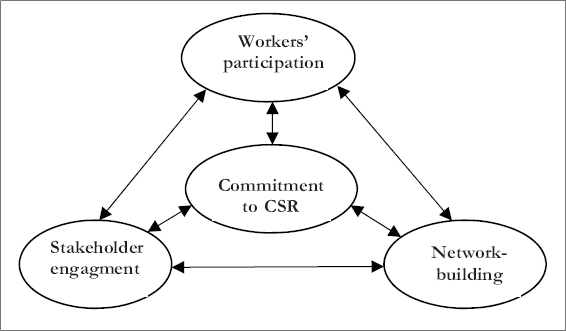
A Model for Collaborative Socially Responsible Practices
Meaningful worker participation: Workers, as the most important stakeholders, should be prioritised in communication, interaction and cooperation in order to ensure that the actions and solutions developed reflect their concerns and needs. Without direct participation and contribution from workers, any measures or incentives, even those that have workers’ interests in mind, such as wage increases or improvement of workers’ welfare, are likely to fail if they do not take the concerns, needs and priorities of workers into account. Various studies have indicated that although wage issues are important for workers in several ways related to being treated with respect, workers felt that the potential for personal and career development along with the opportunity to have meaningful representation were more important.
Engagement of multiple stakeholders: Several studies have suggested that workers’ concerns have not been taken seriously by employers, unions, local governments and CCP branches within factories. The engagement of stakeholders such as labour CSOs, international NGOs, transnational corporations and international industry associations or labour associations seems to be crucial for constructive communication and the establishment of some level of trust between Chinese workers and employers.
The creation of network mechanisms for coordination and communication between relevant stakeholders: The core of the network-building is mutual trust and respect between stakeholders, particularly between workers and employers. It is never easy to build up mutual trust and respect due to differing interests and values alongside a relatively large power distance between employers and employees. Regular meetings and periodic reports about voiced concerns and actions, either taken or planned, demand a significant level of transparency. Trade unions, labour NGOs or other competent civil society organisations can play a positive role in this regard as their knowledge, experience and skills, despite significant gaps at the moment, are suitable for initiating and maintaining such a process.
Commitment to corporate social responsibility: The active role of supplier firms and their management in the proposed projects demands commitment to more socially responsible practices. The basis of the projects is the commitment of employers to take the interests of workers more into account. The various mechanisms created within the projects help workers define their interests more clearly and provide pathways for employers to develop responses.
In the next section, we introduce three projects that are based on this model. The various aspects of the projects are introduced, followed by an evaluation of the process and its outcomes and a discussion of further implications.
Stakeholder Collaboration to Strengthen the Voice of Workers in Practice
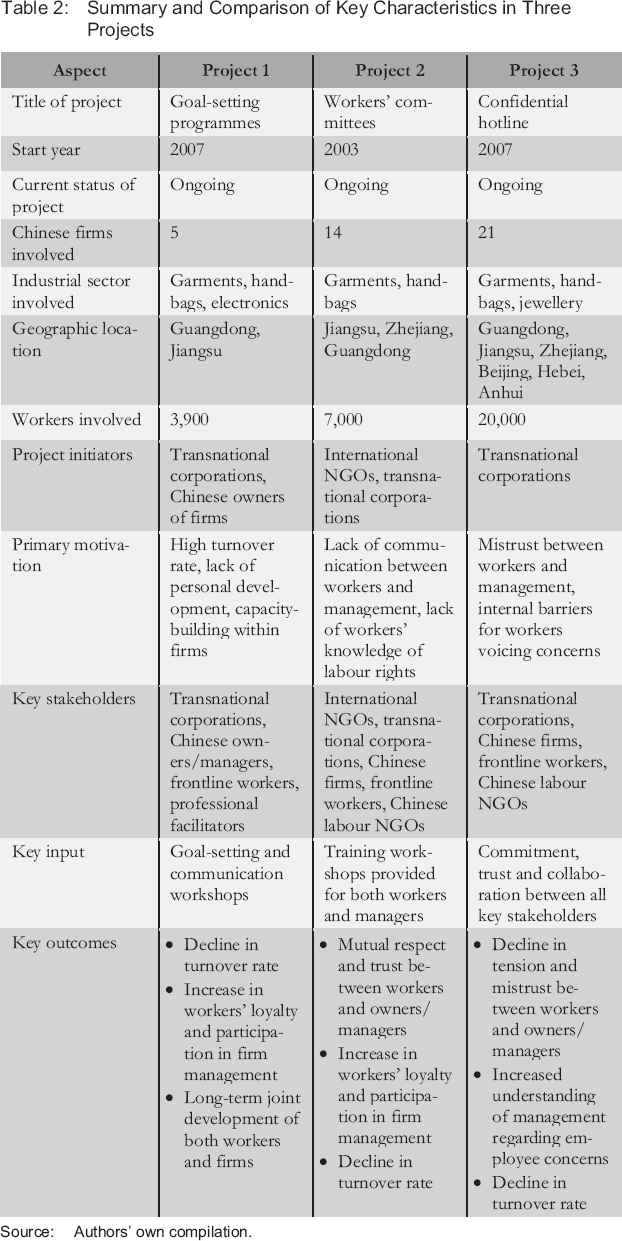
We report on three projects with the participation of 40 supplier firms in the Chinese coastal provinces of Guangdong, Jiangsu and Zhejiang that represent efforts to take workers’ interests into account, including a capacity-building and goal-setting programme for employees, the establishment and development of workers’ committees, and setting up a confidential hotline for workers. The projects were joint efforts by Chinese and international civil society organisations, Western TNCs and Chinese supplier firms. The purpose of the projects was to demonstrate to relevant stakeholders the feasibility of the previously introduced collaborative model. The intention was to demonstrate to employers that investment in workers would not only generate benefits to employers in the short and long term, as it would also enhance sustainable business development and cultivate a more harmonious relationship between workers and employers. The projects focused on different aspects of workers empowerment, including worker representation, participation and voice along with workers’ capacity-building for long-term sustainable development of enterprises. Table 2 summarises and compares the key characteristics of three projects. The three projects are described in more detail below.
Summary and Comparison of Key Characteristics in Three Projects
Source: Authors’ own compilation.
Capacity-building and Goal-setting for Employees
For centuries, traditional Chinese culture and the Chinese educational system have not encouraged independent thinking among developing youth. The result is that few young people know how to independently develop long-term personal and career goals in their life or how to reach these goals. This is particularly the case for migrant workers who come from the countryside and move to urban areas with so many uncertainties and an environment of social discrimination, who have no real plans apart from aspiring to a modern life in an urban community. Developing suitable skills and methods for their career plan and personal development can be beneficial not only for migrant workers to reduce the costs of their integration into the local community but also for employers to increase retention rates of migrant workers, which has become more relevant as employers face increasingly serious labour shortages. The project focused on capacity-building by helping workers to identify feasible goals and the constraints they experience in reaching them, but also to think about shared goals between employers and employees in factories that can benefit both employers and employees. The project commenced in 2007 in a small garment factory and was extended to four other factories in Guangdong and Jiangsu Provinces that were involved in the manufacturing of garments, handbags and electronics. By 2012, close to 4,000 employees had participated in this programme, approximately 80 per cent of whom were migrant workers. The training programme in each factory consisted of the following three stages:
A communication workshop takes place to raise workers’ awareness of their jobs, their personal goals and the company's objectives. Workers from production lines discuss their key issues and concerns related to their work. At the end of the one-day workshop, participants are able to recognise the needs of employees and employers, while a priority list of key concerns is developed based on the input of all employees. Workers have also identified potential gaps between the existing situation and their expectations and have thought about ways to reduce this gap.
A goal-setting workshop is set up with the following four aims: (a) to organise teams of employees that formulate goals (not more than ten persons per team) and work towards these goals over a period of several months; (b) to coach team members to use professional tools for measuring their strengths, weaknesses, opportunities and threats (SWOT) in order to understand what are important personal objectives for them; (c) to build up a network of support between the team members; and (d) to collect data of personal goals and individual SWOTs from participants of the workshop in order to assess their needs and design training modules that can help employees reach their goals.
A process of capacity-building then takes place in which the project facilitators provide support to the various worker teams based on their specific needs and work towards realising set goals and the implementation of an action plan agreed upon by the employees and the employer that will aid in the employees’ long-term development and contribute to the factory's business. This comprehensive capacity-building programme for both employers and workers includes elements to improve working conditions, such as courses related to physical and mental health, anti-corruption and personal finance, while implementation of the agreed action plan takes place over a period of ten months.
We report on the outcomes for one of the participating factories that had invited the Institute for Contemporary Observation (ICO), a labour CSO located in Shenzhen, to carry out this programme as it was facing high rates of employee turnover. In the spring of 2010 the factory had 300 employees, but this number had declined to 125 by August 2010. An investigation carried out at the start of the project, late 2010, showed that 95 per cent of interviewees (migrant workers) prepared to leave the factory after the Chinese New Year of 2011 due to dissatisfaction with working conditions, such as low wages and long working hours compared to other factories in the region, a lack of leisure opportunities and poor catering facilities. With the two workshops taking place in December 2010 and employee teams having formed in the process of capacity-building, employee satisfaction increased significantly and turnover was reduced. The communication workshop helped the company to identify key concerns of employees and priority areas for improvement of worker conditions. By the end of February 2011 (after Chinese New Year), 92 per cent of employees had returned (the highest rate of return after the Chinese New Year for the company) (BP Bag 2011: 37), and by April 2011 the number of employees in the firm had returned to its previous 300. As the director of the firm was able to reduce delays in delivery of products to its clients, the firm was able to expand its business. As a result, workers in the factory were able to increase their wages based on a new salary and welfare plan that was introduced, and became more aware of opportunities for developing their skills as part of their personal and career development. The company expanded leisure time and recreation facilities for its employees, and also produced its first sustainability report in 2011 (reporting on the year 2010) with specific attention to the capacity-building project and its outcomes (BP Bag 2011).
The Establishment and Development of Workers’ Committees
The workers’ committee project provides support for Chinese workers to exercise the rights of association and collective bargaining through joint training for workers and managers. This was a collaborative effort by four organisations, led by Social Accountability International (SAI, an international NGO based in New York) and including the ICO, the International Textile Garment and Leather Workers’ Federation of Trade Unions (ITGLWF, with headquarters in Brussels, Belgium) and the Chinese Working Women's Network (CWWN, a labour CSO based in Hong Kong). The first firms to participate in the project (from 2003 to 2005) were five Chinese subsidiary factories of MNCs from the United States. Workers’ committees were set up in the subsidiary firms. The four organisations responsible for the implementation conducted training of workers and facilitated the independent election of worker representatives in the workers’ committees. Workers were trained on how to exercise their rights and how to communicate and/or negotiate with factory managers. Managers were also provided with courses on how to respect and cooperate with workers’ representatives in order to achieve a win-win situation. This was not an entirely straightforward process, as is documented in the more detailed case study by Ma (2009) on one of the companies involved in the project. The management of the company had to be convinced to join the project following significant effort, time and negotiations from SAI. Important arguments that led the company to proceed with the project included the use of a preliminary cost–benefit analysis that showed how such a project could help reduce employee turnover and flexibility in training dates to minimise interruption to the production process (Ma 2009: 13). Also, workers were initially reluctant to actively participate in the training sessions and share their concerns. As the trainers were able to gain the trust of the workers, they started to speak up about problems in the firm. Worker teams started to identify problems related to their work and workplace and voiced some of these concerns to line supervisors and managers (Ma 2009). This created unease at the management level as “managers began to feel that the enlightened and mobilised workers were likely to challenge the existing management structure” (Ma 2009: 16). The management hindered the formation of workers’ committees by not specifying a date for workers’ elections. It was only through further meetings with managers and after inviting ideas from management on how to improve communication with workers that the company decided to continue with the programme and the workers’ committee was set up (Ma 2009: 16–17).
The project team established several criteria to be able to evaluate the outcomes of the project, related to issues such as wages, working hours, productivity, quality, worker satisfaction, employee turnover, recruitment cost, training cost, delivery time and firm profits. When the project was wrapped up in December 2005, evaluation of the results showed that working conditions and performance, including quality control, productivity and profitability, had all improved for the five participating firms. For the exemplary case provided by Ma (2009), average job tenure increased from 12 months before the project to 25 months after the project, while the company also had a significant reduction in late delivery, which had a positive effect on profitability (Ma 2009: 20).
Starting in 2006, another nine factories in Jiangsu, Zhejiang and Guangdong Provinces joined the programme, with similar outcomes. When workers became more aware of their rights, they were more likely to exercise these rights via the committee they elected and increase communication with management in order to improve working conditions. The workers’ committees established a more balanced interaction between workers and managers, and both sides found that they shared certain goals and interests, which led to increases in factory profits and worker satisfaction. As a result, all of these nine participating factories have not only enhanced their reputation towards workers and towards their clients, but also attracted more orders and profits in the competitive markets in which they operate.
The results of the project indicate that the establishment of workers’ committees, the strengthened position of workers and the increased respect for workers’ rights and interests in the participating firms can enhance returns, for both employers and employees.
Workers’ Confidential Hotline
Coordinated by Business for Social Responsibility (a San Francisco-based organisation that promotes corporate social responsibility), the ICO collaborated with five multinational corporations (Nike, Adidas, Reebok, Sears, and Li & Fung) to establish a workers’ hotline project in March 2002 at 500 of their supplier firms in Guangdong Province. The hotline was intended for two-way communication. It aimed to transfer relevant knowledge, laws, regulations and resources to frontline workers, while also helping workers file complaints to local government agencies, including the local labour bureau, governmental legal aid agencies, the labour arbitration court and the court of justice. Workers could approach a team of advisors through the hotline, which facilitated their communication about specific concerns to outside NGOs, CSR managers of international companies, as well as to local governmental agencies. This direct communication and interaction on workers’ concerns with the broader public and various outside organisations led to an increasingly negative image of these firms. Because the participating firms felt a strong negative bias in the communication and public image, they decided to block the initiative. Based on the lesson learned from this development, a confidential workers’ hotline was launched instead. The confidential hotline was intended to complement employer–employee interaction and communication and provide a channel for communication between employers and workers. Issues that could be discussed were not limited to working conditions or management issues within the selected factories, but could also include personal issues or concerns such as psychological pressure or family matters. After voicing a concern or issue, the worker would be able communicate about the issue with a representative from the hotline team within 12 hours. The information collected through the issues and concerns raised by the workers would be shared by the various stakeholders in the project to help assess pressing needs of workers, but the anonymity of callers was guaranteed.
After the launch of the confidential hotline in 2007, 21 Chinese factories participated in the project and more than 21,000 workers raised issues and concerns through the hotline. The hotline was welcomed by workers but also appreciated by relevant participants, including international trade associations and Chinese factory owners and managers. From 2007 to 2012, the confidential hotline dealt with 1,055 specific cases; 46 per cent of these were related to legal issues, 30 per cent addressed work-related concerns, 14 per cent were about mental and physical health problems and 10 per cent pertained to other private issues. The confidential hotline has facilitated better communication between workers and relevant stakeholders and has given the participating firms a better understanding of their workers’ interests and concerns. Since the firms joined the programme, no strikes have occurred at the participating firms. Interviews with factories’ managers have shown that they find it easier to recruit workers relative to other factories because workers know there is a hotline (a monitoring channel) at their factories, and they have also observed a reduction in employee turnover. The workers’ confidential hotline has provided a channel for workers to voice their concerns. It is also an alternative channel for Chinese factory owners and managers, local governments, international players, and civil society organisations to learn about the needs and concerns of migrant workers.
Evaluation and Discussion
In a recent paper, Weihe Guo (2012) was mostly critical of the increased focus on corporate social responsibility in Chinese firms and argued that it is mainly driven by outside pressures and largely symbolic. Other studies have also indicated that CSR in Chinese supplier firms is mostly driven by buyers’ codes of conduct and is therefore largely externally imposed. Consequently, most supplier firms tend to focus on CSR for reasons of image, but in reality tend to develop practices that circumvent the standards imposed by codes of conduct in order to maintain a harsh labour regime of minimal investment in improving worker welfare, wages and work conditions (Sum and Pun 2005; Yu 2008; Jiang 2009). The projects we introduced and the socially responsible practices implemented by Chinese supplier firms in collaboration with labour-oriented civil society organisations and international stakeholders indicate that some supplier firms are changing their mind-set towards more intrinsic and substantive CSR. Although the practices implemented in the three projects are mainly instrumentally driven, they represent an improvement in the position of employees in global supply chains, while the results of the projects also indicate a strengthening of the performance of the supplier firms. Other studies have also provided initial evidence that a stronger orientation of Chinese firms on the interests of workers can generate positive impacts in terms of increased loyalty and motivation (Pun and Yuen-Tsang 2011; Yin and Zhang 2012; Hofman and Newman 2014).
In analysing the three projects, the following observations can be made about the nature of employer–employee relations, the importance both of workers having a voice and of capacity-building, and the types of stakeholders involved in the projects.
The Nature of Employer–Employee Relations
The review showed that a critical element in employer–employee relations in Chinese firms is the limited scope of workers to voice their concerns towards employers. In developed Western economies, trade unions play a crucial role in this regard. However, workers in China do not perceive this channel as viable or legitimate because trade unions are not independent from government (the CCP) or management. As Chinese firms tend to be characterised by relatively hierarchical management and large power distance, the main option for dissatisfied workers is to exit the firm, as management often reciprocates punitively to voicing concerns. The projects make an important contribution as they show the relevance and feasibility of developing alternative channels through which workers can communicate their concerns. Based on the issues raised, the management of the supplier firms gained insights into the key concerns of their workers and were able to develop plans and measures to mitigate these concerns.
The Importance of Capacity-building within the Projects
Apart from providing a platform for raising their direct concerns, the projects also served as a pathway for capacity-building and personal and career development of workers. This observation points to the importance of the projects’ principles and platforms in triggering a feeling of empowerment among the workers, which can increase their self-esteem and their loyalty to the organisation (Blanchard, Carlos, and Randolph 1996; Wilkinson 1998). The combination of the opportunity to voice short-term concerns and to develop more long-term capabilities had a positive effect on retention and motivation of workers. This, in turn, had positive effects on the performance of the participating firms.
The Nature of the Stakeholders Involved in the Projects
Intermediary organisations played a crucial role in the projects alongside transnational corporations that played a leading role in initiating the projects. The channels through which workers could voice their concerns were managed by labour-oriented civil society organisations. The workers viewed these as credible, independent and legitimate actors, which meant the workers were prepared to voice their concerns without worrying about negative reciprocal actions. From the perspective of corporate social responsibility, this is a critical aspect of the projects. In traditional Western-based corporate social responsibility, firms take into account the interests of their workers mostly through internal processes (unions, internal meetings, team-building, etc.). One of the key issues in Chinese organisations is that subordinates are not likely to voice their concerns as they feel this might be met by negative reciprocal action, while unions are not seen as legitimately representing the interests of workers. Therefore, the success of the socially responsible practices relied to a significant extent on the introduction and use of a credible and legitimate intermediary organisation. This indicates that collaborative socially responsible practices are more feasible than launching these practices internally in supplier firms, although it is possible that the trust in these internal practices increases over time. This insight also points to the relevance of emerging civil society organisations in China and the potential of network governance (Fulda, Li, and Song 2012; Chan 2013), where the projects that combine credibility and legitimacy of a more diverse set of actors are more likely to be successful; however, this also creates more complexity in terms of developing and implementing an effective project (Hartman, Hofman, and Stafford 1999).
Limitations and Suggestions for Further Research
Overall, the projects indicate the potential of collaborative socially responsible practices in addressing the needs and interests of workers more effectively and in contributing to the long-term performance of the supplier firms. However, we would caution against drawing overly broad generalisations from these cases. The companies that participated in the project were mostly preferential suppliers of transnational corporations, so their participation might be partially explained by their position in the supply chain. Further and broader research is needed to assess the extent to which supplier firms with a different and, for example, less prominent role in the supply chain can benefit from similar projects and practices. Moreover, most of the projects were initiated by international stakeholders such as NGOs, labour associations and transnational corporations, and were subsequently embraced by a particular set of supplier firms. Further research is needed to identify similar practices in which supplier firms have taken the lead to understand key driving factors underlying some of these emerging practices. The location of the projects and companies is mostly confined to the more developed coastal provinces of China. This creates a need for further research that assesses the extent to which similar practices are emerging and can be successful in other regions of China that are now gaining prominence as manufacturing bases in global supply chains. Finally, recent research has indicated that upgrading in Chinese supplier firms so as to increase the value they capture along global supply chains has differential effects on workers and workplaces. In a study on firms in the garment and LED industries, Butollo (2013) reported a transition from labour-intensive to more capital- and knowledge-intensive production models. Increased automation in these industries tends to lead to increased detachment between knowledge-intensive work and labour-intensive work, while the labour-intensive production processes continue to use unskilled manual labour without enhancing skill requirements, or in some cases are replaced by automated production lines (Butollo 2013: 164–165). The extent to which these changes in the workplace can go hand in hand with collaborative socially responsible practices should be further investigated. Overall, differences in the nature of supplier firms and their position in global supply chains calls for a better understanding of how worker voice arrangements can be appropriately designed to enhance employee–employer relations.
Conclusion
In the introduction and our review of the position of workers within supplier firms, we argue that workers have often been treated poorly and are mostly unable to voice their concerns effectively to employers and other groups. In more developed Western economies, trade unions, courts, NGOs and sometimes (local) governments tend to provide institutionalised mechanisms through which workers can raise their concerns. However, these channels are mostly absent or ineffective within China as they are either biased toward employers or difficult for migrant workers to access. Our research, including the literature and empirical review, has revealed that Chinese workers, especially migrant workers, have limited channels to voice their concerns because existing actors such as trade unions and local government tend to be mostly concerned with the interests and performance of the supplier firms. In other words, there seems to be an institutional void in employer–employee relations. The projects introduced in this paper fill this void within Chinese supplier firms as they provide alternative channels for workers to voice their concerns. Both the supplier firms and their workers who participated in the projects have benefit-ted as firms take measures to enhance worker satisfaction, while the reduced employee turnover has a positive impact on firm performance. The emergence of socially responsible practices by Chinese supplier firms, in collaboration with labour-oriented civil society organisations and international stakeholders, indicates that supplier firms are changing their mind-set towards more intrinsic and substantive CSR. Further research is needed to assess how these emerging practices are challenging or blending with mainstream practices. The role of civil society organisations focusing on labour interests was a crucial feature of the projects, in terms of both capacity-building for workers and independent operation relative to the management of the firms; thus, the involvement of labour CSOs provides legitimacy to the practices in the eyes of the workers. While our study indicates benefits of these practices for both employees and supplier firms, our sample of firms does not fully capture the differentiated nature of supplier firms and their position in global supply chains. Further research should delve into the extent to which these collaborative socially responsible practices can be a way forward in various types of supplier firms.