



Abstract
China's welfare system is a typical “residual welfare regime”, which did not manifest too many flaws in the planned economy era. However, economic reform and market-oriented transformations in recent decades have shaken the original well-balanced “residual” and “needs” pattern. The decline of the “work unit system” has led to two consequences: First, it radically transformed the social and economic structures, which gave rise to increased and diversified needs of social welfare. Second, the government is being pressed to shoulder more responsibility for social welfare provisions. This article adopts a case study approach to examine changing social welfare needs and expectations in Guangzhou, a relatively developed city in southern China. With particular focus on the major strategies adopted by the Guangzhou government in addressing people's welfare needs, this article critically examines how far the new measures have met the changing welfare expectations of citizens in mainland China.
Policy Context: Economic Reform, Social Change and Impact on Social Welfare
American policy expert Glazer (1986) identified two types of social welfare. The
first type provides welfare services to all people on the basis of absolute and
universal rights. The second type offers selective, remedial welfare services to
those most in need, usually identified by household surveys. Given its much narrower
conception of welfare, many scholars (Wong 2001; Leung and Nann 1996; Wang 2009)
argue that China employs a system of “remedial social welfare” (the second type).
During the planned economy era – in which the state monopolised all important social
resources (e.g. financial wealth and goods) and significantly determined urban
people's living conditions and career development – remedial social welfare did not
exhibit too many flaws. In such a highly organised, integrated, centralised and
unitary social structure, every urban labourer's basic living security and social
welfare was taken care of by his or her work unit ( , danwei).
This is what we call the “work unit system” (Lu 1989) and what Walder (1986) refers
to as the “organised dependence” phenomenon in China. Under the leadership of
Chairman Mao during the early years of the People's Republic of China, the state
implemented the “life-long employment system” in urban areas and established town
workers’ employment security. In 1951, China issued “labour insurance regulations”
instructing work units to provide comprehensive welfare for their workers. Although
this system divided and segmented China's social welfare system due to the
differences between distinct units, it effectively shared the responsibility of
social welfare provisions with the state. With the respective work units taking care
of the social security of the majority of urban people, the state needed only attend
to those who neither qualified for the unit system nor were sufficiently supported
by the units – the number of the former was relatively small and the latter's living
difficulties were mainly inflicted by natural disasters and poverty. The state could
therefore focus on the macro-regulation of unit operations and personnel
arrangements. It is against this backdrop that the welfare services offered by the
state were remedial and narrow in nature (Leung and Nann 1996: 182–183). At that
time, the cooperation of the state and work unit system in offering welfare services
successfully maintained social stability, resolved many social problems (e.g.
inflation, unemployment, crime, etc.) and secured people's living standards. All of
these welfare arrangements were regarded as the embodiment of the socialist system's
superiority (Leung and Nann 1996: 182–183).
, danwei).
This is what we call the “work unit system” (Lu 1989) and what Walder (1986) refers
to as the “organised dependence” phenomenon in China. Under the leadership of
Chairman Mao during the early years of the People's Republic of China, the state
implemented the “life-long employment system” in urban areas and established town
workers’ employment security. In 1951, China issued “labour insurance regulations”
instructing work units to provide comprehensive welfare for their workers. Although
this system divided and segmented China's social welfare system due to the
differences between distinct units, it effectively shared the responsibility of
social welfare provisions with the state. With the respective work units taking care
of the social security of the majority of urban people, the state needed only attend
to those who neither qualified for the unit system nor were sufficiently supported
by the units – the number of the former was relatively small and the latter's living
difficulties were mainly inflicted by natural disasters and poverty. The state could
therefore focus on the macro-regulation of unit operations and personnel
arrangements. It is against this backdrop that the welfare services offered by the
state were remedial and narrow in nature (Leung and Nann 1996: 182–183). At that
time, the cooperation of the state and work unit system in offering welfare services
successfully maintained social stability, resolved many social problems (e.g.
inflation, unemployment, crime, etc.) and secured people's living standards. All of
these welfare arrangements were regarded as the embodiment of the socialist system's
superiority (Leung and Nann 1996: 182–183).
However, the market-oriented economic reform and transformation which proceeded in the late 1970s and early 1980s radically altered the well-balanced structures of the security system's “residual” and “needs” pattern. According to Kapstein and Mandelbaum (1997), the old social security system was falling apart in the process of market transition, leading to a decline in living standards of society's most vulnerable groups. Enterprises, under the guidance of “efficiency first” philosophy and oriented to the objectives of economic production (especially after the full implementation of the national labour contract in 1986), were no longer the guarantors of their workers’ welfare provision – rather, they were only contractors assuming “limited” protection responsibilities. It is in this context of wider market transition that we have witnessed large-scale reforms of state-owned enterprises taking place in Chinese cities. This development has deprived a large number of unemployed workers of the social services they previously enjoyed under the traditional welfare arrangements provided by their work units (Wong, Mok and Lee 2002). Due to the weakened social security functions of the units, the Chinese government had to take on more social welfare responsibilities. As a consequence, calls to “bring the state back in” became increasingly louder (Painter and Mok 2010).
In view of the above changes, the Chinese government has begun to establish a series of social welfare programmes to help the country's poor. These programmes include the minimum living standard guarantee system, health care security, education assistance, housing security, employment assistance and judicial assistance. However, as China's social welfare is not grounded on sound and well-resourced public finance expenditure, the development of these welfare programmes has been constrained. Although China's disadvantaged groups have experienced improved living conditions in recent years, they are still socially marginalised (Wong 2001: 223–225). This is partly because the Chinese government does not believe that poverty and the unequal distribution of wealth can be effectively managed by a Western model of welfare.
Even though we have seen more measures being adopted by the government to improve social service delivery and social protection for Chinese citizens, it seems that the current Chinese social welfare system still has a strong remedial feature in terms of social protection.
Like other East Asian countries, China's economic and social transformation has increasingly accelerated since the 1997 Asian financial crisis. Social issues such as unemployment, inflation, the ageing population, the declining birth rate and the demise of the nuclear family have resulted in the growth and diversification of Chinese people's welfare needs. However, as some scholars have already pointed out, China's current social welfare system is unable to meet the basic needs of its people – it urgently requires a comprehensive re-evaluation.
The present article 1 is set out against the political economy background discussed above and seeks to critically examine the major challenges confronting China's social welfare system in Guangzhou – one of the most economically prosperous areas in the mainland. Based upon our field interviews conducted in Guangzhou, policy, documentary data analysis and secondary data analysis, this article examines how Guangzhou urban residents evaluate the social services provided by the government. More specifically, this paper reports the welfare expectations of Guangzhou urban residents through focus group discussions.
Research Framework and Research Methods
The research objectives of this paper are to:
investigate the emerging basic welfare needs of certain social groups, especially disadvantaged groups;
examine the government's response (e.g. coping strategies and policy priorities) to these emerging welfare needs;
assess the public's level of satisfaction with specific social welfare policies; and
explore the implications of the new government-citizen dynamic for the future development of the welfare system.
In our analysis, we are very aware of the fact that distinct social groups and individuals from diverse backgrounds and living in different environments will have diverse subjective evaluations of government policies. Figure 1 presents our analytical framework.
The authors thank The Hong Kong Institute of Education for providing research funds and some of the data (from project GRF HKIEd 751510) used for this paper.
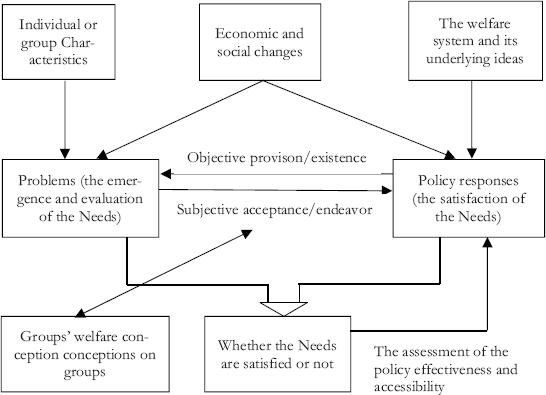
Analytical Framework
This study is primarily concerned with how urban residents in Guangzhou perceive their welfare needs (in relation to the minimum living standard, health care security, housing security and education service) and how they evaluate the municipal government's policies and measures in addressing these needs. In terms of research methods, we first carried out literature and policy analyses of the government's policy strategies, priorities and preferences in the aforementioned areas of welfare provision. Second, on 10 June 2010 at Sun Yat-sen University, we conducted in-depth interviews on the welfare system and policy measures of Guangzhou in particular and China in general – participants included Chinese and foreign experts and scholars on social policy, education policy, social security, health policy, political sociology, public administration, and so on. Third, we conducted focus group discussions with urban residents in Guangzhou. Since the numbers of our respondents and target samples were quite large in our qualitative study, “purposive sampling” was deployed rather than “random sampling” (Kuzel 1992; Morse 1989) in order to enhance the credibility of the research (Patton 1990). Therefore, we followed the “funnel principle” to narrow down the range of samples from the urban area to specific streets. The focus group discussions consisted of urban residents of various age groups, with different occupations (e.g. students, fresh graduates, unemployed persons, retirees, etc.), from different family backgrounds (e.g. low-income households, single-parent families, etc.) and with other socio-economic characteristics. We conducted the focus group interviews in three different communities in Guangzhou (Table 1). The interviews were carried out in Chinese, and the English transcripts in the present article were translated by the authors. Apart from the qualitative data collected from interviews and focus group discussions, we also collected and analysed quantitative data from the government and several research institutions. As Rossman and Wilson have pointed out, these two kinds of data can complement each other through triangulation and thus enhance an analysis (Rossman and Wilson 1984). We therefore adopted such an approach for our data collection.
Focus Group Discussion Arrangements
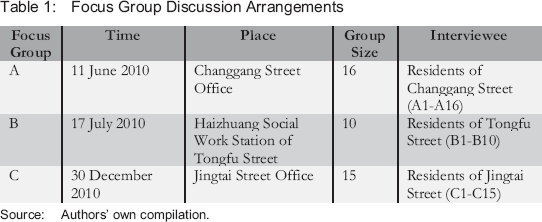
Source: Authors’ own compilation.
Major Findings
Minimum Standard of Living
Generally speaking, low-income people are those in urgent need of social welfare (Gu 2008: 4). Therefore, the household survey identifies this group of people as the foundation of the social welfare system. Meanwhile, because the minimum living standard guarantee system is often associated with other relief programmes, it is the core element of the social safety net and the key to guaranteeing disadvantaged people their social welfare rights. However, based on the overall social welfare values and the features of the social welfare system, China's minimum living standard guarantee system still focuses on the “minimum” level (Wang 1999) or, in Yang's (2004) terms, the “survival” level. In 1995, Guangzhou established the system of minimum standard of living for urban residents. By 2011, it had adjusted the standard level six times – 200 CNY in 1995, 240 CNY in 1997, 300 CNY in 1999, 330 CNY in 2005, 365 CNY in 2008, 410 CNY in 2010, and 480 CNY in 2011. To determine whether the standard is high or low, we compare it to the local residents’ average income (Gu 2008: 7). In 2008, for instance, the minimum standard of living in Guangzhou was set at 365 CNY per person per month (that is 4,380 CNY per person per year) compared to residents’ annual per capita disposable income of 25,316.72 CNY (Statistics Bureau of Guangzhou Municipality 2008). Thus, the minimum standard of living was equivalent to 17.3 per cent of local residents’ annual per capita disposable income in that year. Some local and foreign social policy literature has set the “extreme poverty line” at 30 per cent of residents’ median income, the “severe poverty line” at 40 per cent, the “moderate poverty line” at 50 per cent and the “near poverty line” at 60 per cent. According to this international academic standard (Behrendt 2002; Smeeding and Phillips 2001; Gu 2008: 7), we can say that the families receiving allowances in Guangzhou are still living in conditions of extreme poverty.
In recent years, like elsewhere in China, Guangzhou's inflation has continued to rise and is expected to remain high. In 2008, Guangzhou's annual urban consumer price index increased by 5.9 per cent (Statistics Bureau of Guangzhou Municipality and Guangzhou Investigation Team of National Bureau of Statistics 2011). Realising the pressure of inflation on the living standards of low-income households (which are more sensitive to price fluctuations than the other groups), Guangzhou promulgated The Pilot Scheme of the Adjustment of the Minimum Living Standard in Guangzhou in December 2010 and established a “linkage growth mechanism” that adapts the standard of “minimum living” to price fluctuations. However, the pilot scheme sets quite rigorous starting conditions for the “growth mechanism”; namely, only when “the price index of low-income consumers rises to a certain level (4 per cent or more) and lasts for 6 months” will the adjustment mechanism be launched. Consequently, the adjustment of the standard of “minimum living” will always lag behind the changes in prices and consumption. Our interviewee C4 (female, 42 years old) is a single mother with a son in junior high school and was receiving the minimum living standard guarantee for Jingtai Street. In the face of inflation, the minimum living standard guarantee obviously could not meet their basic needs. According to C4:
the allowances we received were only more than a hundred yuan at the beginning stage, which could barely help us. Later, it rose to more than 500 yuan, and now it is 603 yuan. But the changes cannot match the rises in prices. When the allowance level began to rise, I felt very happy. However, prices rose even faster. My son is now growing up and needs to eat more meat, so I have to let him have my share as well (Anonymous 6).
The reasons that many families have become low-income households are complex (e.g. members suffering from physical disabilities and/or chronic illnesses, the increasing burden of the children's education, etc.). For them, the financial assistance provided by the minimum living standard guarantee is insufficient. In recent years, Guangzhou has implemented a series of supporting measures such as medical aid and student aid to further support those families. However, these relief measures – which set strict limitations on the amount of allowances and entail rigorous application procedures – are still unable to cater for those low-income households with special difficulties. Interviewee B6 (female, 44 years) has a son who has had a heart disease since a very young age. She explained the difficulties they faced:
[My son] had heart surgery. At the same time when he was in hospital, the government had just begun to launch the student health insurance programme. Therefore, the insurance was covered by Bureau of Civil Affairs of Guangzhou Municipality. However, when my son left the hospital, I went to the Bureau of Social Security of Guangzhou Municipality to apply for this insurance, the officer turned me down and explained that the insurance policy did not cover the period in which my son was in hospital. The policy took effect on 1 July, while my son had already left hospital on 22 June. So we could not get even a penny of subsidy. […] We turned to the neighbourhood committee for help, then it sought help from the Civil Affairs Bureau, and they just replenished us 1,000 yuan. They said they have already done their best. […] Our family now owes more than 50,000 yuan for the cost of surgery. The few 100 yuan we received from the government could do nothing to alleviate our living burdens (Anonymous 5).
In fact, according to a survey in 2009, the degree of dissatisfaction towards “the social assistance of disadvantaged people” in Guangzhou was up to 32.6 per cent – an increase of 8.8 per cent compared to 2008 (Guangzhou Social Facts and Public Opinions Research Center 2010a: 288). Our field interviews and observations confirm the result of this survey, providing more details of the living difficulties of Guangzhou urban residents.
Health Care Services
The economists Kornai and Eggleston have pointed out that “compared with anything else, health, survival and the relief of physical pain possess unparalleled unique values” (Kornai and Eggleston 2003). Disease not only deprives people of the ability to work and thus limits their employment opportunities and incomes, it also sends many wealthy families into poverty. Therefore, health care provision is one of the most important aspects of social welfare. According to the World Health Organization's evaluation of the performance of 191 countries’ health care systems, China's was ranked 144th ( Aibai.com 2001). Currently, a priority of Guangzhou's health care services is to extend its coverage. Apart from extending health care provision to urban workers, Guangzhou has also issued specific policies to expand basic health care coverage to flexible employees, rural-to-urban residents, and non-Guangzhou registered employees in various ways. By the end of 2010, the number of people with health care coverage in Guangzhou was 6.784 million, amongst which were 809,000 retirees (Statistics Bureau of Guangzhou Municipality and Guangzhou Investigation Team of National Bureau of Statistics 2011). A recent random sample survey of 1,001 residents from 12 Guangzhou districts revealed that the percentage of people who were registered in the “medical social insurance” programme was 53 per cent (Guangzhou Social Facts and Public Opinions Research Center 2010b: 282). Health care provision in Guangzhou is amongst the most extensive in China.
The financial model of medical institutions in China is a combination of government resource allocation and business operations. This mechanism established in the planned-economy era has now undergone significant changes amidst the marketisation of public-service provision and delivery. With the reduction of government resource allocation, medical institutions have had to enlarge their commercial operations in order to cover their costs and maintain service quality. Nowadays, the main source of funding of medical institutions comes solely from the business sector, while government resource allocation only accounts for a small share (Liang and Zhao 2007). This will inevitably lead to a rise in medical fees. Further worsening the situation is the lack of cost-efficiency mechanisms and incentives in medical institutions, which makes the rise of medical costs hard to control (Zuo and Hu 2001). For example, although Guangzhou has adopted effective efforts in expanding the degree of medical coverage, the benefits of these efforts have been offset by excessive medical costs – a situation that has reduced public satisfaction with the health service. According to a recent survey, 80 per cent of Guangzhou residents thought that medical expenses were “too high” or “high” (Guangzhou Social Facts and Public Opinions Research Center 2010b). Meanwhile, a survey on Guangzhou social insurance status in 2009 revealed that 54.1 per cent of the public thought that medical insurance offered little or no help in relieving the financial burden on people suffering from “serious illnesses”, whereas 56 per cent thought that it provided little or no help in relieving the financial burden on people suffering from “minor illnesses” (Figure 2 and 3) (Guangzhou Social Facts and Public Opinions Research Center 2010c: 311–312).
In addition to the increase in medical costs, another challenge facing China's health care system is the change in demographics. Due to the declining birth rate and increasing life expectancy, both the total number and the proportion of the elderly population in China are growing. The elderly are one of the most physically vulnerable groups, with many of them suffering from hypertension, diabetes and other chronic diseases. They are in desperate need of medical provision. Interviewee A12 (male, 70 years old), a hypertension patient, described his situation:
I have to spend between 700 and 800 yuan a month on medical check-ups and medicines, while I receive only 100 yuan in subsidies a month and 300 yuan reimbursement for health care security. There is a very large gap between them (Anonymous 1).
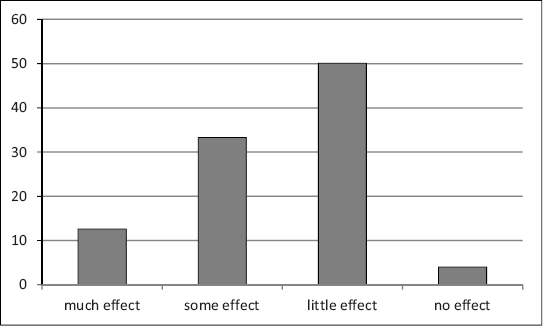
Public Evaluation on Medical Insurance in Relieving the Financial Burden of People Suffering from “Serious Illnesses” (in %)
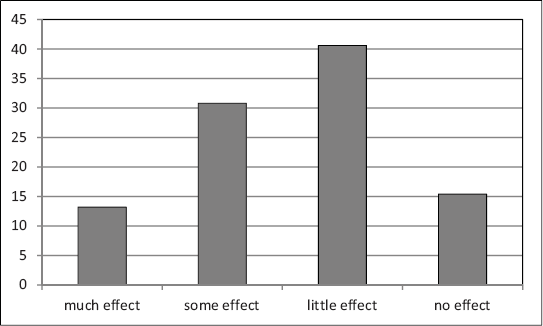
Public Evaluation on Medical Insurance in Relieving the Financial Burden of People Suffering from “Minor Illnesses” (in %)
To the elderly population, who regards health care security as the most important social welfare, the current scope of health care security is not sufficient. As interviewee A16 (female, 78 years old), a resident of the Changgang Street, said: “If we old people got sick, medical spending would be uncontrollable” (Anonymous 2).
Housing Services
According to Marshall, the prominent social welfare scholar, housing is one of the six social rights of citizens in modern society because of its direct impact on the welfare of citizens (Marshall 1975). Spending beyond means on housing can drive people into financial difficulties, so housing benefit is an important safeguard against poverty for disadvantaged groups (Ritakallio 2003: 81–101). In the planned economy era, the Chinese government acted like “parents” by allocating housing and providing housing benefit for urban residents. In the late 1970s, the government started to reform the housing system along the lines of marketisation and monetisation, which transferred power from the government to the market (Zhu 2007). As a result, the pressure on the government to supply housing and provide housing benefit decreased. With less government subsidies now on offer, people have had to venture into the real estate market to buy their houses. However, due to a lack of governmental control, house prices have soared in recent years to a level beyond many people's financial capabilities. As a consequence, a house has become an expensive commodity, rather than a basic and easily accessible living necessity. For example, the average price of primary housing exceeded 15,000 CNY per square meter in some ten districts in Guangzhou in October 2010 ( Chinanews.com 2010), while the per capita disposable income of urban residents in Guangzhou in the same year was only 30,658 CNY (Statistics Bureau of Guangzhou Municipality and Guangzhou Investigation Team of National Bureau of Statistics 2011) – meaning the average person can only afford two square meters of local residential area with a whole year's disposable income.
Similarly, other studies point out that the beneficiaries of housing reform are
usually the people with higher levels of political and social status and more power
and institutional resources. Little evidence is provided showing that
market-oriented reforms can lessen social stratification (Logan, Bian and Bian
1999). The people at a disadvantage under the old housing welfare system remain so
in the real estate market. In this regard, the government should place more emphasis
on housing welfare for this large section of society. In Guangzhou,
government-subsidised housing consists of affordable houses ( , jingji shiyong
fang), low-rent houses (
, jingji shiyong
fang), low-rent houses ( , lianzufang)
and capped-price houses (
, lianzufang)
and capped-price houses ( ,
xianjiafang). However, the income threshold for housing
subsidies is too low (Table
2 and 3),
and the scope of potential recipients of housing welfare is narrow. Such strict
application requirements have created a large group of people called the “sandwich
layer” – those ineligible for government low-rent housing but also financially
unable to purchase private houses.
,
xianjiafang). However, the income threshold for housing
subsidies is too low (Table
2 and 3),
and the scope of potential recipients of housing welfare is narrow. Such strict
application requirements have created a large group of people called the “sandwich
layer” – those ineligible for government low-rent housing but also financially
unable to purchase private houses.
Application Requirements for Low-Rent Houses in Guangzhou
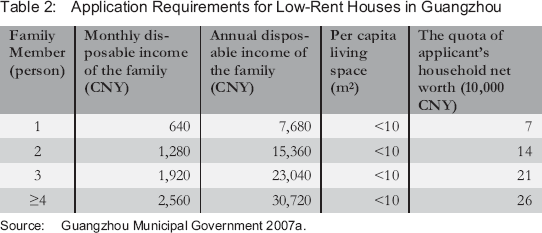
Source: Guangzhou Municipal Government 2007a.
Application Requirements for Affordable Houses in Guangzhou
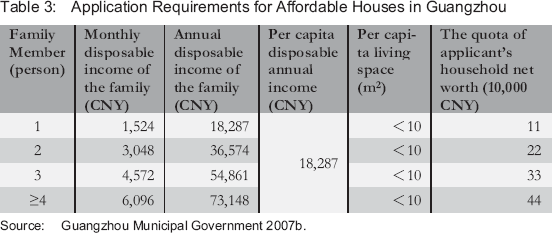
Source: Guangzhou Municipal Government 2007b.
Even university graduates (regarded as the potential middle class) are being affected by rising house prices. In the late 1990s, China increased the level of college enrolment. This saw a rise in the number of college graduates and made job competition fiercer. According to the Chinese Academy of Social Sciences, the monthly salary of college graduates declined between 2006 and 2009; in 2009, the average monthly salary of college graduates was 2,703 CNY (Netease 2010). In this case, the vast majority of college graduates are unable to purchase property in the private market and also find it quite difficult to meet the rigorous application requirements for low-rent or affordable housing. These students are the typical “sandwich layer”. Interviewee B5 (female, 23 years old) graduated from college in 2009 and is now working in an NGO in Guangzhou with a monthly salary of more than 2,000 CNY. She claimed that “young people are the most suffering group. [They] are not only unable to afford housing but are also not eligible for low-rent houses” (Anonymous 4). Her colleague and our interviewee B4 (female, 24 years old) is also a university graduate, who is very frustrated about the housing problem:
We are forced to face the housing problem especially after marriage, aren't we? Although the government has introduced a number of policies about affordable houses, the application requirements are extremely harsh for us. And even if my future husband and I are eligible to apply for the affordable houses, I think we may not be able to buy it, because I know that we have to pay a large sum of money beforehand (Anonymous 3).
Besides housing prices, citizenship rights also affect urban residents’ eligibility
to apply for government subsidised housing. As in many other parts of China,
Guangzhou's low-rent houses and affordable houses are only offered to urban
residents with local household registration; non-permanent urban residents are
excluded. Although according to active policy regulation, all of the economic
organisations and work units shall undertake the deposit of the housing provident
fund ( ,
zhufang gongjijin, an important part of housing welfare) at the
managing centre of housing provident fund for their workers and staff, the benefit
ratio the workers and staff can enjoy is dependent on the employing unit's payment
and deposit ratio (Zhu 2009: 236). As Zhu pointed out,
,
zhufang gongjijin, an important part of housing welfare) at the
managing centre of housing provident fund for their workers and staff, the benefit
ratio the workers and staff can enjoy is dependent on the employing unit's payment
and deposit ratio (Zhu 2009: 236). As Zhu pointed out,
China's housing security system is neither universal and non-occupational nor entirely related to one's income level. It is indeed related to one's identity and his/ her working unit. It is a social exclusion with Chinese characteristics (Zhu 2009: 236).
Discussion and Conclusion
The changing welfare needs and expectations emerging in mainland China have clearly driven the Chinese government to rethink how best to manage such needs during the rapid market transition. Realising the old welfare arrangements of privatisation and marketisation of social welfare and social policy was unproductive for the promotion of social harmony and political stability (Mok and Ku 2010), the Chinese government has tried to revitalise the role of the state in social service delivery and welfare policy-making (Painter and Mok 2010). Like many other newly industrialising economies in East Asia, China is also regarded as a “productivist” welfare regime, in which social policies and social welfare are subordinate to the logic of economic development and productivity growth (Holliday 2005: 148). The Chinese government has been a reluctant welfare provider in the post-Mao era and has tried to make use of market forces to resolve people's welfare and social needs (Shi and Mok 2012). In fact, the top priority of this welfare regime is to foster social investment rather than to promote social protection (Gough 2004: 190). However, as Holliday argues, social policies under a productivist welfare regime are not insignificant, rather they are essential to nurturing productive workers, maintaining social and political stability, and ensuring the smooth operation of the labour market (Holliday 2005: 148).
Although there is extensive research showing that China has rapidly expanded social welfare in recent years and made phenomenal improvements in health care and pension coverage (World Bank 2012; The Economist 2012: 21–23; China Development Research Foundation 2012), we still notice that the concepts of “economic efficiency first” and residual welfare have not changed the paradigm of social welfare provision. Like many other East Asian countries or regions, China has maintained relatively low social welfare spending during its transitional period. The state only provided basic protection and necessary residual services for the poorest and most disadvantaged groups. Since economic reform, state-owned enterprises and work units have gradually abandoned their responsibilities of providing social welfare to employees, while the state has not fully taken up those responsibilities. Such power has been gradually transferred to the market, which is evident in the adoption of welfare programmes like social insurance. However, without a sound and comprehensive blueprint for the development of social insurance, the government's premature “withdrawal” from social security has had harmful repercussions for the most vulnerable. Wong also maintains that there is a large gap between social insurance and relief – a gap that needs to be bridged (Wong 2001).
This study has reviewed the current welfare system in Guangzhou following the logic of “supporting the poor and relieving the needy”. Policy priorities tend to target the most disadvantaged. Yet in face of rapid economic, social and demographic changes, policy-makers also have to be alert to the difficulties faced by the general public, especially in the area of medical, educational and housing services. Although Guangzhou's municipal government has already taken certain measures to address the changing needs of their residents in the past few years (however, without big changes in the underlying policy philosophy), the outcomes of these policies have been piecemeal and limited. Nowadays, various experts are advocating social policy that is based upon needs assessments or evidence-based conditions in order to address the imbalance between social welfare provisions and social policy. Cook (2001), from the United Nations Research Institute for Social Development, maintains that China's social policies must better respond to the needs of society and also remain consistent with China's system of truth. She also argues that the provision of social welfare in China should be based on the specific needs of certain groups (Cook 2001). However, neither academia nor the government has reached a consensus on how best to formulate the content of policies based on needs assessment and define the relationship between needs assessment and the institutional framework.
In view of welfare regionalism, coupled with growing citizen concern about the variation in social services across China, the central government and local governments should work together to improve social welfare provision for the people. The one question that remains unanswered is whether the current welfare model adopted by the Chinese government will be durable enough in the long run to manage people's heightened welfare expectations and to handle the complex and negative social consequences of rapid social, economic and demographic changes. Based upon our above analysis, we conclude that the Chinese government is under tremendous and continued pressure to improve not only people's economic conditions but also sustainable livelihood and sustainable development. In order to assert its legitimacy, it is crucial that the Chinese government shows itself capable of identifying new models of governance that can effectively manage changing welfare and social needs without jeopardising social harmony and political stability.
Finally, we have to acknowledge the limitations of our study. First, due to space restrictions, we only discuss three policy areas: minimum standard of living, medical security, and housing security and education assistance. These are important issues for Guangzhou urban residents, but they are certainly not the only ones. Second, we mainly adopted a qualitative research method in assessing the subjective welfare needs of Guangzhou local residents. Therefore, the findings cannot be generalised to the whole population in Guangzhou, let alone the whole of China. Nevertheless, this study is just the beginning of a series of related efforts to examine the nuanced social needs of people in Guangzhou in particular and China in general. In this study, we highlighted the core issues regarding social welfare needs, but have not yet measured in detail the degrees of these needs. All in all, we look forward to more research and more extensive research tools in order to help us more fully understand these issues.