



Abstract
In recent years, the security risk to Chinese citizens overseas has become an increasingly prominent issue owing to a rapid increase in the number of Chinese citizens moving and travelling abroad. Protecting the legitimate rights and interests of Chinese citizens abroad has become a key priority within the overall field of protecting China's overseas interests. This article uses an alternative sample analysis to perform a quantitative interpretation of the “Special Notices for Chinese Citizens Abroad” issued by the Ministry of Foreign Affairs of the People's Republic of China from 2008 to 2010. It analyses the distribution characteristics of the risks posed to Chinese citizens overseas in terms of geographical distribution, various risk categories. Based on the results, the article concludes with a summation of the main features and causes of security risks to Chinese citizens overseas.
Introduction
In 2000, the number of Chinese citizens (excluding those from Hong Kong, Macau and Taiwan) travelling abroad had reached 10 million. Since then, this number has been growing at an average annual rate of 18.5 per cent, and reached 57.39 million in 2010 (Shao 2011). As increasing numbers of Chinese citizens travel abroad for various reasons – for instance, for holidays, business, to study and/ or on official duties – their personal security, property and legitimate rights are being exposed to a wide variety of threats in foreign countries. Since 2006, the Ministry of Foreign Affairs (MFA) of the People's Republic of China (PRC) has been dealing with almost 30,000 consular protection cases a year for its citizens abroad (CCTV 2006; Li 2007; International Herald Leader 2010; Meiri Xinbao 2011: 21). The ratio of consular protection cases to the total number of Chinese citizens abroad is no less than that of those developed countries that have more citizens travelling abroad. For instance, in the fiscal year from April 2008 through March 2009, the number of British citizens going abroad reached 68.5 million, and the British Foreign & Commonwealth Office handled 34,443 overseas civil protection cases (British Foreign & Commonwealth Office 2009: 4). Therefore, protecting Chinese citizens abroad more effectively in all areas, including but not limited to security of their person, property and legitimate rights, has become an extremely important task for the Chinese government, especially for the MFA. As early as 2004, President Hu Jintao made statements that the Chinese government should “enhance the capacity to protect China's overseas interests”, and stressed that diplomacy should “enthusiastically serve our citizens and legal persons abroad” (People's Daily Overseas Edition 2004: 1). Foreign Minister Yang Jiechi has also stressed repeatedly that it is necessary for China's diplomatic service to effectively protect the legitimate rights and interests of Chinese citizens and corporations in foreign countries (Yang 2009: 1).
In recent years, China has set up an overseas citizens’ consular protection mechanism with the primary aim of preventing incidents, while also providing solutions in their aftermath (China Youth Daily 2005). This mechanism focuses on emergency response and coordination following an incident, and puts greater emphasis on the prevention of incidents in the future (Xia 2009: 34). The Chinese government has made concrete progress in recent years in terms of expanding its capacity to provide overseas consular protection, achieving its principle of “diplomacy for the people”. In the field of overseas consular protection, however, there is still a “missile gap” between China and the more experienced developed countries, particularly in regard to the credibility of early warnings about risks to citizens abroad (International Herald Leader 2010).
As the successful experiences of developed countries have proven, the cornerstone of the credibility of early-warning mechanisms in protecting overseas citizens is a comprehensive understanding and deep insight into the variety of risks facing citizens overseas. For example, the statistical data on consular protection cases for the last fiscal year disclosed in the Consular Annual Report issued by the British Foreign & Commonwealth Office are calibrated to single-digit levels. Moreover, the data are also analysed monthly, divided into ten categories. By contrast, apart from some rough statistics on the scale of the thousand-digit level, Chinese authorities have rarely disclosed detailed information about consular protection cases – for instance, the content of cases, detailed scenarios, or casualty figures. Therefore, due to the lack of related details, most research conducted by Chinese scholars and research institutes is based on analyses of typical cases with the result that such research hardly reveals the whole picture, but instead is likely to give a biased conclusion that is somewhat removed from the actual situation.
Since complete data on the risks to overseas Chinese are not available, this paper will attempt to deduce some principal features of these risks by making an analogical reference to a group of data with similarity to the complete data of risks. Based on the concept of plausible reasoning (or plausible inference), analogical reasoning plays a major role in discovery (Polya 1954). If two systems are analogous, we can deduce characteristics of one from characteristics of the other in some way – for instance, statistical inference, or the study of statistical procedures that utilise information to obtain a description of the practical situation (Barnett 1973). Statistical inference is often applied in order to draw inferences based on the examination of only a part of the whole (Casella and Berger 2002). In this research, the key is to find a set of data with enough similarity among all potential groups of data. In statistical terms, it is necessary to select an optimum sample, which is representative of the population with proper measures. The sample, as the possible representative (or estimator), should possess a number of desirable properties: unbiasedness, consistency, efficiency and sufficiency (Garthwaite, Jolliffe, and Jones 2002). In general, the fundamental principle of this procedure could be followed through the “equal probability of selection method” (EPSEM). In following the EPSEM principle, the sample should be formed so that every element or case in the population has an equal probability of being selected (Healey 2009). Thus, in order to ensure that the sample is suitable for statistical inference, the quality of data in the sample should meet some basic requirements: integrity, accuracy, comparability and consistency (Li 1990).
Although it is impossible to find public information on the consular protection cases of Chinese citizens abroad with as much detail as that on British citizens abroad found in the British Consular Annual Report, one public information system used by the Chinese government to disseminate information about emergencies and accidents, either transnational or within a particular country, that poses significant risks to the security of Chinese overseas citizens, merits analysis. This is the “Special Notices for Chinese Citizens Abroad” (hereafter referred to as the “Special Notices”), which have been issued continuously by the MFA and made public on the MFA's website and other public media since 2000.
The “Special Notices” aim to provide information to overseas Chinese citizens and those who are en route to foreign countries in advance; they include security warnings, reported security incidents, and reports on accidents in which Chinese citizens abroad have suffered loss of life and injury. The “Special Notices” may contain information relating to the various risks that might threaten the security and interests of Chinese citizens abroad, ranging from natural disasters to social unrest, terrorism attacks, criminal cases, traffic accidents, labour disputes, economic interest conflicts, and high-profile mass events with security risks across the world. As far as accessible information from the official website of the MFA is concerned, the “Special Notices for Chinese Citizens Abroad” initiative dates back to 2000; however, it was not until 2003 that the release of information was continuous and regular. This being the case, we can test whether the system meets the basic requirement of consistency as a sample by performing a basic correlation analysis of the amount of information released annually and the number of Chinese citizens who went abroad during the period from 2003 to 2010 (see Figure 1). The analysis is based on the following assumption: Given the premise that the probability of security incidents involving overseas Chinese citizens is a constant (in other words, the probability of occurrence is a constant that is seldom subject to accidental interference), the increase or decrease in the number of items of information released can to a large extent reflect the overall trend in security incidents. Furthermore, the content of the information can reveal some characteristics of both the geographic distribution of these incidents and the noticeable problems.
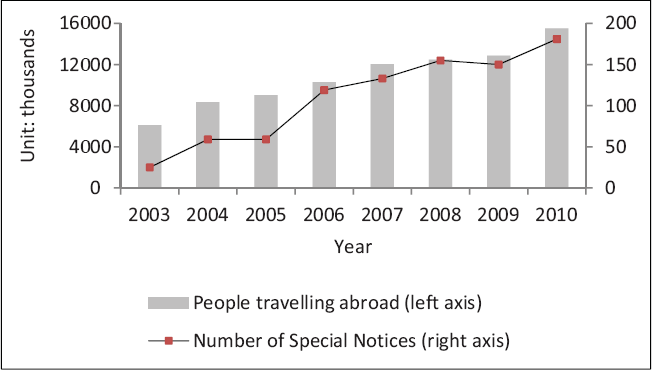
Number of People Travelling Abroad from Mainland China and the Number of “Special Notices”, 2003–2010
The results of the correlation analysis show that the number of “Special Notices for Chinese Citizens Abroad” has increased in line with the overall increase in the number of Chinese citizens going abroad.
Furthermore, the “Special Notices” are always issued in a fixed format and with highly standardized wording. These two features offer at least two advantages: one is that it facilitates the timely update of the information by the MFA so as to guarantee the efficiency of information dissemination, and the other is that the notices are more easily readable and understood by Chinese people. This suggests that the “Special Notices” are “produced” following a rigorous internal processing procedure. We can assume that the processing procedure is designed and maintained to facilitate the MFA's working practices in the field of consular protection for maximum efficiency.
In short, the “Special Notices for Chinese Citizens Abroad” could be considered a relevant data source that can to a large extent reveal the main features of the risks, both reported and potential, faced by Chinese citizens overseas. By utilising a quantitative analysis of the “Special Notices”, this research attempts to explore the overall risk situation confronted by the Chinese overseas citizen.
The Security Risk Status of Chinese Citizens Abroad
The Consular Protection Center at the Chinese Ministry of Foreign Affairs was founded in August 2007. Its establishment meant that the protection of Chinese citizens abroad was given greater attention by the authorities. In consideration of the comparability principle in statistics, this article 1 is based on a whole-sample analysis of the “Special Notices for Chinese Citizens Abroad” during the period from 2008 to 2010. The search results show that from 1 January 2008 through 31 December 2010, the total number of “Special Notices” released on the official website of the MFA was 486, three of which did not relate to the analysis of risks. Thus, 483 of the total 486 notices can be considered information relevant to the risks to Chinese citizens abroad and, therefore, constitute the samples within the whole-sample analysis of this article.
Of the 483 “Special Notices”, at least 177 incidents involved de facto damage and/ or threats to Chinese overseas citizens’ person and/ or property, as well as to their legitimate rights and interests. At least 23 incidents resulted in the deaths of Chinese citizens, at least 28 incidents resulted in the injury of Chinese citizens, at least 74 incidents resulted in property damage, at least 14 incidents resulted in Chinese citizens being detained by foreign authorities, and at least 20 incidents resulted in Chinese citizens being denied entry to countries upon arrival or their being repatriated. An analysis of the sample on the basis of year group resulted in a roughly upward curve; more precisely, the total number of incidents in 2009 and 2010 was higher compared to that of 2008, particularly in the cases of injury, property loss, and the denial of entry upon arrival. Analysis on a yearly basis also resulted in a subtle downward trend with regard to the number of deaths and the number of arrests of Chinese citizens abroad, with the numbers of deaths and arrests in 2010 being lower than those of 2008 and 2009. The reduction in the number of incidents in these two categories accounted for the decrease in the overall number of incidents in 2010 compared with 2009; however, the number of cases in other categories increased to varying degrees (see Figure 2).
The author of this article would like to express his sincere appreciation to all the anonymous reviewers of this article for their precious comments and remarks. Of course, the writer is responsible for the consequences of this article. Also, the author would like to especially thank Dr. Ana Cristina D. Alves, Ms. Alexandra Begg, Dr. Karsten Giese, Mr. Ji Xiaoyu, Ms. Liu Zongyuan and Ms. Petra Brandt for their help in the articulation and expression of this article.
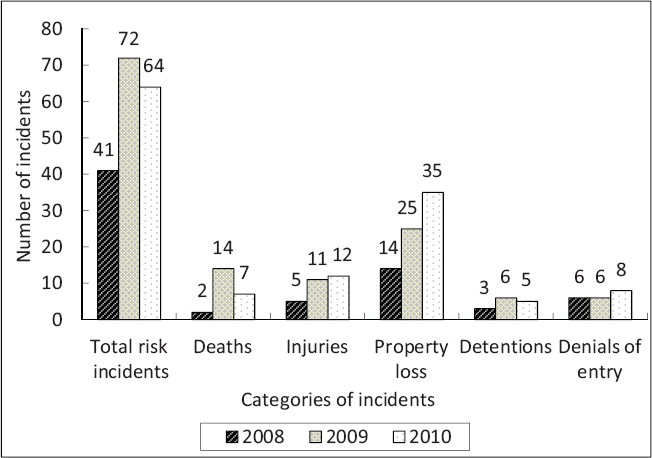
Distribution of Incidents Involving Personal Injury or Property Damage to Chinese Overseas Citizens, 2008–2010
Admittedly, for obvious reasons, we can hardly draw a complete picture of the risks posed to Chinese overseas citizens from the 483 items of relevant information released in the “Special Notices”, but given the reasons mentioned earlier in the article, we are still able to gain an understanding of the distribution characteristics of the various types of risks based upon a whole-sample analysis of the “Special Notices for Chinese Citizens Abroad”.
The Geographical Distribution of Risk
The 483 “Special Notices” examined within this study cover a total of 137 countries and regions. From 2008 to 2010, approximately 80 countries/ regions were taken into consideration each year. This reflects a stable distribution. Notably, a statistical analysis of the Chinese consulates mentioned in the “Special Notices” shows that the number of consulates mentioned increased over the period of study (see Figure 3).
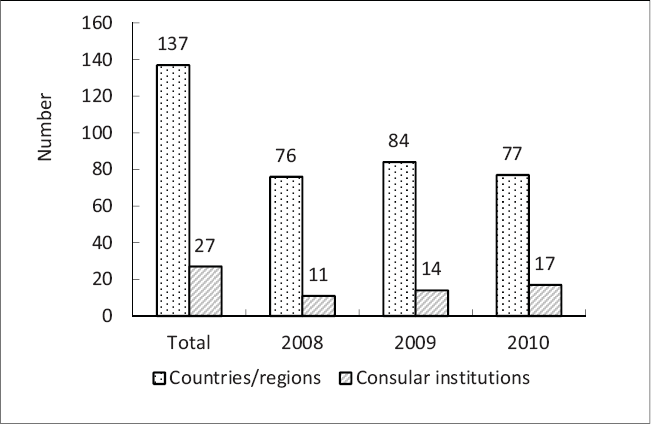
“Special Notices” Relating to Countries/ Regions and the Distribution of Consular Institutions, 2008–2010
Given that consulates are institutions that are established in non-capital cities to provide non-political services to citizens abroad within a specific region, it is safe to say that the increase in the “supply” of consulates reflects the “demand” or need of overseas citizens. Therefore, the incrementally diversified distribution of Chinese consulates within the countries mentioned in the “Special Notices” may imply a growing outflow of Chinese citizens to non-capital destinations abroad and, more importantly, it could also imply that foreign country destinations are becoming increasingly diversified and the purpose of the trips may be becoming more individual.
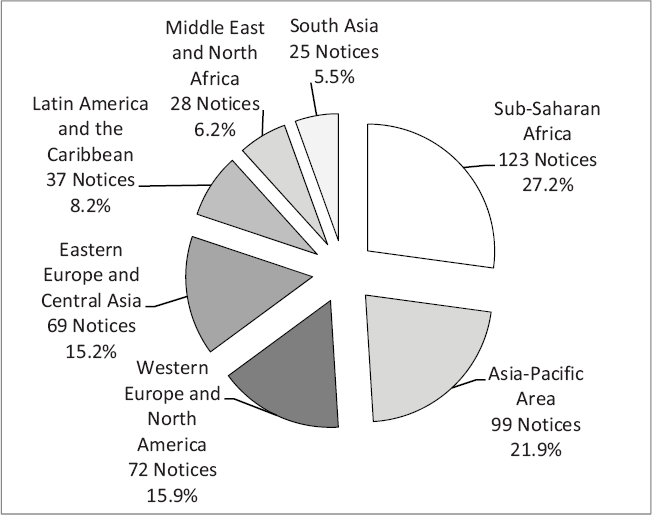
Intercontinental Distribution of “Special Notices”, 2008–2010
In terms of the intercontinental distribution of the “Special Notices” (see Figure 4), apart from 24 of the 483 notices relating to a general international level and six of the 483 notices relating to specific countries or regions regardless of geographical division, the remaining 453 notices were placed into seven different categories based on geographical location:
sub-Saharan Africa: 123 notices (accounting for 27.2 per cent of the total 453 notices)
Asia-Pacific region (Western Pacific and Oceania): 99 notices/ 21.9 per cent
Western Europe and North America (including Northern Europe, excluding Mexico): 72 notices/ 15.9 per cent
Eastern Europe and Central Asia (including Southeastern Europe): 69 notices/ 15.2 per cent
Latin America and the Caribbean (including Mexico): 37 notices/8.2 per cent
Middle East and North Africa: 28 notices/ 6.2 per cent
South Asia: 25 notices/ 5.5 per cent
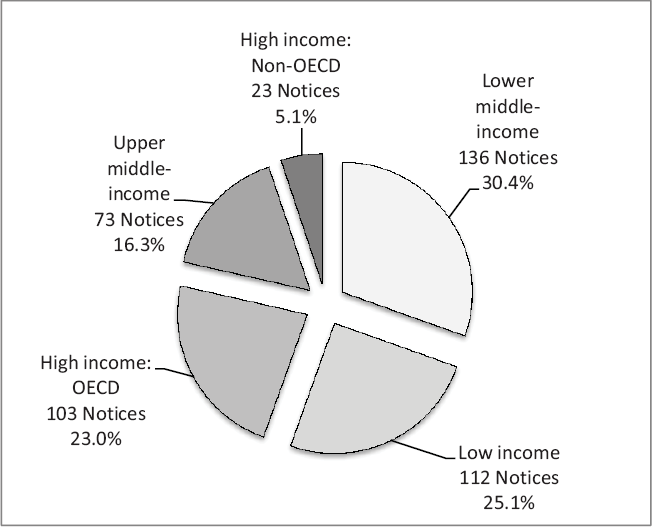
Distribution of “Special Notices” by Income Level of Countries/ Regions, 2008–2010
On the level of economic and social development, the economies of the countries and regions visited by Chinese citizens abroad were divided into five groups in accordance with country/ territory classification standards based on per capita income levels (World Bank 2009). The five groups were:
low income: per capita income of 1,005 USD or less
lower-middle income: per capita income between 1,006 and 3,975 USD
upper-middle income: per capita income between 3,976 and 12,275 USD
high income: per capita income of 12,276 USD or more (Note: These economies could be categorised into two groups: high-income OECD countries and high-income non-OECD countries.)
Most OECD members fall within the high-income group, with the exceptions of Turkey, Mexico and Chile, which are classified as being in the upper-middle-income group. In addition, there were some high-income countries/ regions that are not OECD members. In line with this country/ territory classification, low-income countries were mentioned in 112 notices, accounting for 25.1 per cent of related samples; lower-middle-income countries: 136 notices/ 30.4 per cent; upper-middle-income countries: 73 notices/ 16.3 per cent; high-income non-OECD countries: 23 notices/ 5.1 per cent; and, notably, high-income OECD countries: 103 notices/ 23 per cent (see Figure 5). At first glance, this appears to be contrary to expectations that there would be fewer risks in high-income OECD countries, but it makes more sense once the deeper subdivision of risk categories is taken into account in the following discussion, which allows for a more in-depth analysis.
The Distribution of All Categories of Risks
For the purposes of this study, 21 types of risk were identified and these were grouped into four major categories:
the risk of personal injury,
the risk of legal and cultural conflict,
the risk of damage to economic interests, and
the risk of accident or natural disaster.
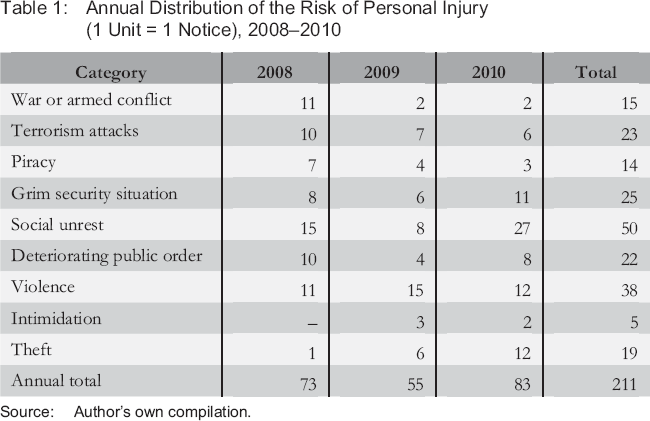
Moreover, of the “Special Notices”, 23 had to do with national or public holidays and general reminders that implied little or no risk; therefore, these notices are not included in the following analysis. Of the 460 “Special Notices” (excluding the aforementioned 23 low- or no-risk notices), 211 notices in total related to the risk of personal injury, which thus comprised nearly 45.9 per cent of all risk notices. This category of risk can be viewed as the primary type of security risk to Chinese citizens abroad. This was followed by the risk of legal and cultural conflicts and the risk of accident and natural disaster, accounting for 28.5 per cent and 19.3 per cent, respectively. Finally, 29 notices (6.3 per cent) related to the risk of damage to economic interests, nearly half of which concerned overseas workers involved in labour disputes and labour fraud.
Of the risks identified within the “personal injury” category, those with the most severe consequences, such as war, armed conflict and terrorism attacks, significantly decreased on a year-by-year basis from 2008 to 2010 (see Table 1). However, the risks of encountering social unrest and a grim security situation (for instance, mass turmoil, declaration of a state of emergency, munity, etc.) increased.
Annual Distribution of the Risk of Personal Injury (1 Unit = 1 Notice), 2008–2010
Source: Author's own compilation.
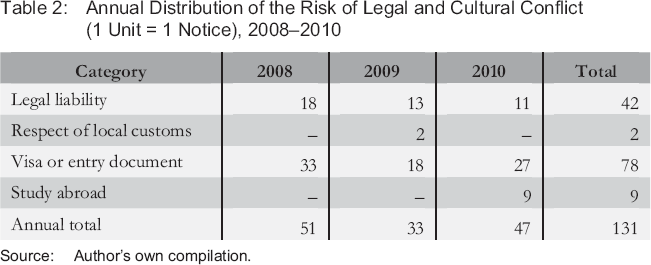
In the category “risk of legal and cultural conflict” (see Table 2), many of the notices within the “legal liability” risk type reminded Chinese citizens that different destinations have their own unique set of laws and regulations, and warned them against committing illegal acts in specific destinations based on the circumstances of actual cases; for instance, cases relating to entry and exit prohibitions and declarations, specifically prohibitions against the purchasing and carrying of wild animal products, and the need to abide by local laws. Over half of the events in the “visa or entry document” risk type related to confusion among Chinese overseas travellers over which European countries could be entered under the Schengen visa system.
Annual Distribution of the Risk of Legal and Cultural Conflict (1 Unit = 1 Notice), 2008–2010
Source: Author's own compilation.
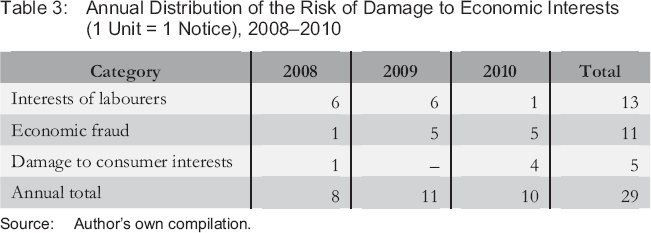
In the category “risk of damage to economic interests” (see Table 3), nearly half (13 out of a total 29 notices from 2008 to 2010) of the notices related to Chinese workers abroad, mainly in Southeast Asia, Central Asia, the Middle East, Africa and Eastern Europe. A wide range of economic fraud was also evident: from financing to spouse-brokering services. However, unlike the risks to the interests of labourers, most incidences of economic fraud occurred in developed economies (8 of 11 notices from 2008 to 2010).
Annual Distribution of the Risk of Damage to Economic Interests (1 Unit = 1 Notice), 2008–2010
Source: Author's own compilation.
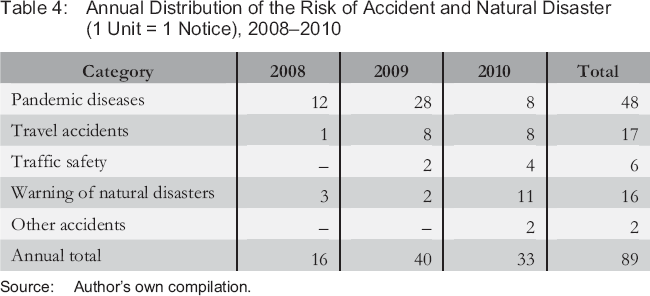
In 2009, there was a worldwide outbreak of H1N1 swine flu. The number of notices about “pandemic diseases” was exceptionally high in this year compared to other years. In addition, the heavy snowfall and extreme wintery conditions in the UK at the end of 2010 also resulted in a higher than normal number of notices relating to natural disasters that year, as many Chinese students in the UK were affected and the Chinese government paid close attention to their situation (see Table 4).
Annual Distribution of the Risk of Accident and Natural Disaster (1 Unit = 1 Notice), 2008–2010
Source: Author's own compilation.
As the region with the highest incidence of war and armed conflicts in the world, sub-Saharan Africa was determined to be the most dangerous geographic area, despite the long-standing friendship between China and most countries in this region. Several countries in Southeast Asia and Australia (included in the Asia-Pacific geographic division) came next (see Table 5).
Geographical Distribution of Four Major Categories of Risks (1 Unit = 1 Notice), 2008–2010
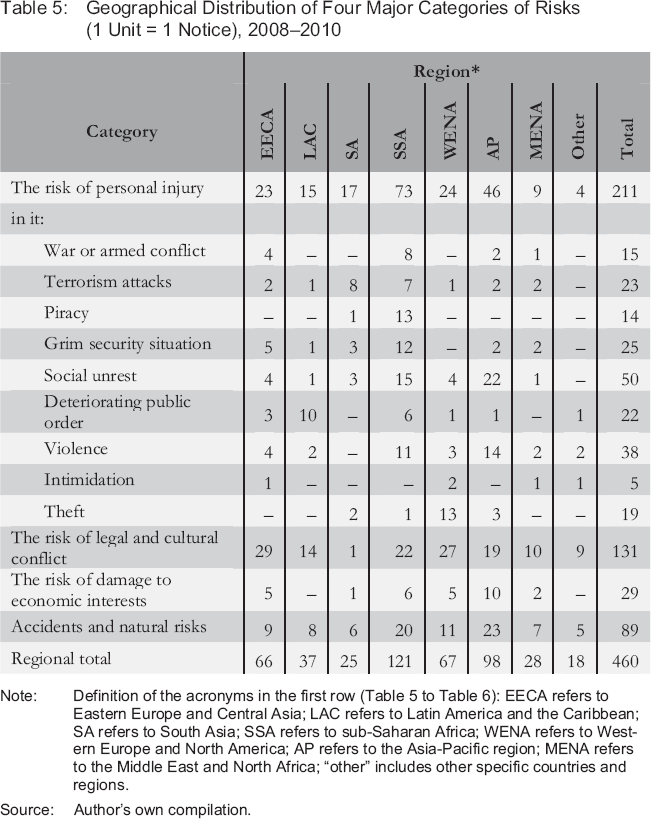
Note: Definition of the acronyms in the first row (Table 5 to Table 6): EECA refers to Eastern Europe and Central Asia; LAC refers to Latin America and the Caribbean; SA refers to South Asia; SSA refers to sub-Saharan Africa; WENA refers to Western Europe and North America; AP refers to the Asia-Pacific region; MENA refers to the Middle East and North Africa; “other” includes other specific countries and regions.
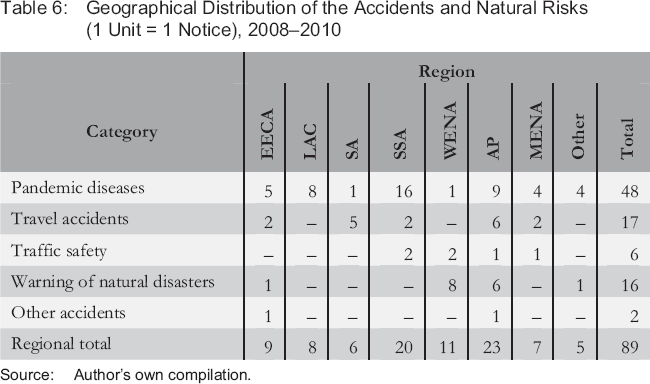
Geographical Distribution of the Accidents and Natural Risks (1 Unit = 1 Notice), 2008–2010
Source: Author's own compilation.
Source: Author's own compilation.
Sub-Saharan African countries and other poor nations have long suffered from outbreaks and epidemics of such diseases as cholera and dengue fever, among others. Acute infections like these have been one of the main causes of death among Chinese visitors in these areas. From 2008 to 2010, 60 per cent of the “Special Notices” on pandemic diseases related to low-income and lower-middle-income countries, and one-third related to sub-Saharan Africa. In Southeast Asia and Australia, which are two of the prime destinations for Chinese outbound tourism, drowning has been the chief cause of accidental death of Chinese tourists (see Table 6).
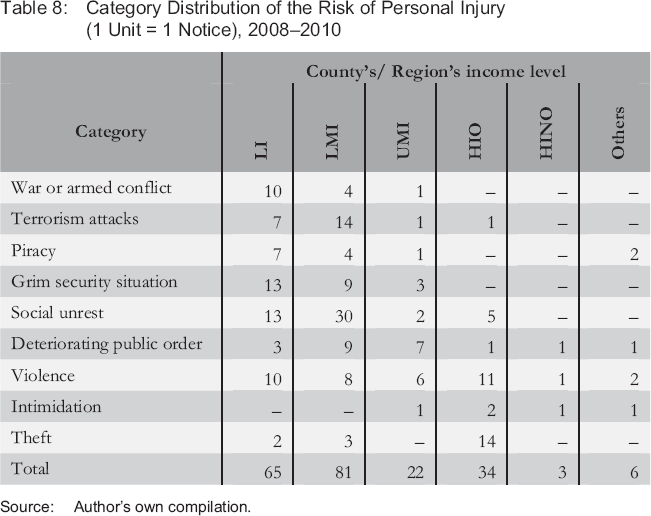
Countries and regions with lower income per capita usually have less stable social conditions and a higher probability of conflicts and wars, and thus pose a higher risk to Chinese overseas visitors’ security. These countries and regions tended to be located in sub-Saharan Africa and South Asia (see Table 7 and Table 8).
Distribution of Four Major Categories of Risks (1 Unit = 1 Notice), 2008–2010
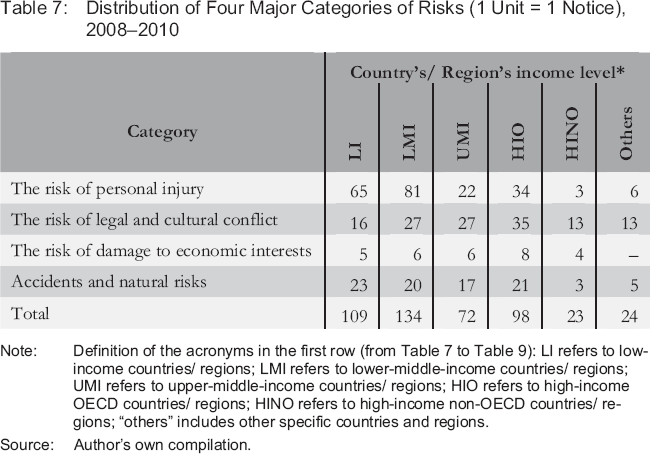
Note: Definition of the acronyms in the first row (from Table 7 to Table 9): LI refers to low-income countries/ regions; LMI refers to lower-middle-income countries/ regions; UMI refers to upper-middle-income countries/ regions; HIO refers to high-income OECD countries/ regions; HINO refers to high-income non-OECD countries/ regions; “others” includes other specific countries and regions.
Source: Author's own compilation.
Category Distribution of the Risk of Personal Injury (1 Unit = 1 Notice), 2008–2010
Source: Author's own compilation.
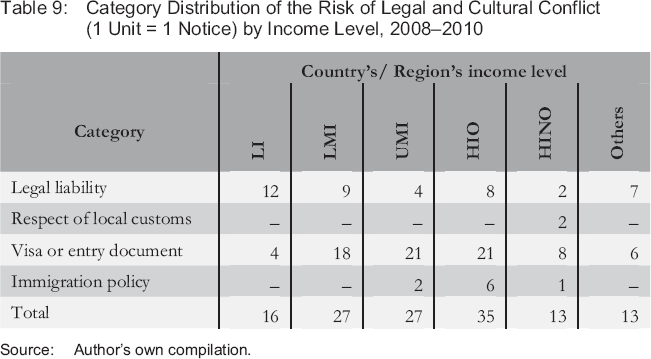
Category Distribution of the Risk of Legal and Cultural Conflict (1 Unit = 1 Notice) by Income Level, 2008–2010
Source: Author's own compilation.
Whereas war and social unrest tended to be the main threats in low- and lower-middle-income regions, legal infringement, whether intentional or not, posed the main threat in high-income OECD countries, which are located mainly in Western Europe and North America and have quite different legal systems from China; laws may also be enforced more strictly. As a result, Chinese travellers were often punished for their sometimes unintentionally illegal acts (see Table 9).
The Main Features of the Security Risks Faced by Chinese Citizens Abroad
Based on the preceding analysis, this section aims to determine the main characteristics of the security risks faced by Chinese overseas citizens.
First, although the geographic scope of risks is expanding and the nature of risks is deteriorating, the scale and intensity of risk events has not increased significantly. A comparative analysis of the results on a year-by-year basis indicates that, with the rapid increase in the number of Chinese citizens engaging in business travel and work overseas, the geographical distribution of risks has expanded and the purpose of overseas travel has become more individualised. Regardless of any change in the probability of risk occurrence, however, the increasing number of Chinese citizens abroad will inevitably lead to an increase in the absolute number of incidents. Moreover, diversification of foreign destinations increases the probability of Chinese citizens’ exposure to and involvement in conflict. This is supported by the data, which indicate a rapidly increasing growth in risks faced by Chinese overseas citizens. Overall, however, these incidents are limited to low-intensity, small-scale conflicts between individuals. Even in more challenging situations where threats are expected to be more numerous due to the lack of security and the risk of social unrest, there has not been a large influx of reports covering organised or direct threats against China or Chinese citizens abroad, and reports of physical violence against Chinese citizens or the violation of their rights have been extremely rare. There was no significant increase in the number of “Special Notices” relating to those events that cause the most concern among the general public – for instance, war or armed conflict, terrorism attacks, piracy and the like.
Furthermore, reports warning of pandemic diseases are also important in security warnings for Chinese citizens abroad. Since 2009, the global outbreak of influenza A (H1N1) accounted for nearly half of the warnings about pandemic diseases. This was followed by information about the prevention of cholera and dengue fever, mainly provided for sub-Saharan Africa, Latin America and other regions with poor health conditions; however, Chinese overseas victims of such infectious diseases were rarely reported.
Second, generally speaking, there is an inverse relationship between the probability of risk to Chinese citizens abroad and the level of socio-economic development of the host country/ region. The higher the socio-economic level of development, the lower the intensity and possibility of risk, and vice versa. Of the risks published in the “Special Notices” from 2008 to 2010, low-income countries/ regions and lower-middle-income countries/ regions featured in about one-fourth of the notices, while upper-middle-income countries/ regions accounted for less than one-sixth, and high-income OECD countries about one-fifth, which seems somewhat unusual. However, the security risks in OECD countries were mainly low-risk cases relating to legal and cultural conflict and a small number of criminal cases, including violence and theft-based crime. The vast majority of high-intensity wars or armed conflicts, terrorism attacks, piracy, grim security situations and social unrest took place in low-income and lower-middle-income countries/ regions. Furthermore, income levels and the standard of social welfare and public health systems are closely related to the prevalence of disease risk.
Third, accidents are an important cause of injuries and deaths among Chinese citizens abroad, with violent theft being a large part of the problem. In fact, a large number of injuries to overseas Chinese citizens resulted from traffic accidents, travel accidents and ordinary criminal cases. Over the past few years, traffic accidents and other accidental injuries have become the main threat to the safety of Chinese citizens abroad. With growing numbers of Chinese citizens travelling abroad, travel safety is becoming a major concern and the number of victims of violence has also escalated rapidly. The “Special Notices” from 2008 to 2010 listed 23 incidents resulting in the death of Chinese citizens, including nine cases of drowning while on holiday, eight cases of attacks by criminals, and four cases of death resulting from traffic accidents.
Theft has been the main type of incident occurring in some of the most popular travel destinations. From 2008 to 2010, there were 19 anti-theft warning notices, 13 of which related to tourists or touring groups in developed European countries and North America.
Fourth, a large proportion of incidents of damage to economic interests related to undermining the interests of labourers. During the sample period, 29 incidents of damage to the individual economic interests of overseas Chinese citizens were reported in the “Special Notices”. Nearly half of these involved workers abroad, mainly in Southeast Asia, Central Asia, the Middle East, Africa and Eastern Europe. The cases ranged from employers withholding wages, passports being seized, labourers working and living under poor conditions, and contractors threatening to detain workers and prevent their return to China. Even more serious was the fact that some criminals at home and abroad use fake advertisements to lure Chinese citizens into work abroad and charge high deposits and fees. More often than not, the trapped overseas Chinese workers cannot be provided with legal work visas and thus are forced to work illegally. This criminal activity puts workers abroad in a dangerous situation with either no work and no social security network, or with illegal work and often long working hours. Since 2008, the global financial crisis has affected many countries, resulting in a sharp deterioration in employment conditions and a large increase in the number of labour disputes and the amount of labour fraud. During this time, there have been a number of cases involving overseas workers who have resorted to Chinese consulates abroad to seek help in returning to China and/ or to request consular protection for their interests.
Fifth, there is the outstanding issue of Chinese citizens having to bear much of the responsibility for the risks relating to border entry and the period following border entry. Of the “Special Notices”, 131 related to legal liabilities and the risk of cultural conflict, ranking second-highest out of the four categories. Of these, 60 per cent were “before reaching the border” and related, for instance, to visa applications and other immigration documents. A considerable proportion of Chinese citizens had applied for a Schengen visa to enter various European countries; however, a huge number of Chinese visa holders were refused entry or forced to repatriate because of their confusion over which countries are included on a Schengen visa. There were 11 “on-the-border” warnings or immigration declaration warnings, most of which were related to Chinese travellers being fined for not declaring foreign currency (cash) when entering the host country. There were 31 “across-the-border” notices, warning Chinese citizens to comply with local laws – for instance, obeying smoking laws, not purchasing or carrying contraband (such as ivory and other endangered animal products), and complying with local business and employment regulations. These warnings were not specific to any particular geographic region or ruling style of a particular country/ state, but mostly served to warn Chinese citizens abroad or those about to travel abroad that it is their own responsibility to familiarise themselves with local laws and regulations. For example, substantial parts of visas or entry documents relate to whether the applicant has a valid work visa or not. In addition, the “Special Notices” remind Chinese travellers that airport police checks on passport signatures are very stringent in some European countries. Should a passport contain no signature, it would be deemed invalid and the passport holder would receive a fine. By contrast, the relevant government authorities in China have a more relaxed approach and rarely enforce this regulation; consequently, most Chinese passport holders ignore the requirement to sign their passports. The warnings also commented on the basic personal qualities of Chinese citizens; for instance, three “Special Notices” referred to Chinese citizens who were punished for smoking on aeroplanes.
Finally, it deserves to be pointed out that the Ministry of Foreign Affairs’ consular protection response has been improving in recent years. The shorter the time lag between the occurrence of an incident and the release of information about the incident, the more effective the emergency information. Empirical experience shows that improving the transparency of information can help the people involved to have clearer expectations, ease unnecessary tensions and strengthen the coordination of relevant work, thereby improving the efficiency of early warnings and promoting effective responses to incidents. An analysis of the “Special Notices” in recent years shows that the response capacity of China's diplomatic protection for overseas citizens has improved significantly. There has been increased transparency in the information provided, greater accessibility to information, and greater initiative shown in searching for relevant information. This clearly helps to improve the efficiency of reaction, and also partly explains the increase in the autonomy and initiative of overseas agencies.
The Main Factors behind the Rise in the Number of Security Risks to Chinese Citizens Abroad
The rapid increase in the number of security risks to Chinese citizens abroad is somewhat unavoidable. It is a result of the recent surge of Chinese nationals going abroad and it is also a reflection of the profound changes that China is undergoing in terms of both its position in the world economy and its internal social structure. The increase in the number of Chinese citizens abroad may also reflect China's gradual rise to become a bigger player on the international stage.
To elaborate on this first major factor behind the rise in the number of security risks to Chinese citizens abroad, one could say that this follows a fairly universal trend occurring in many countries as they have developed economically. As with citizens of these countries, increasing levels of income in China have promoted enthusiasm among ordinary Chinese citizens to travel abroad, and this has consequently led to a significant increase in the probability of security incidents involving Chinese citizens abroad.
The number of Chinese citizens going abroad is currently growing rapidly, and personal travel comprises a large portion of total travel by Chinese nationals. This is partly due to the improved living standards in China and the increase in Chinese peoples’ disposable income, both of which arose following the reform and opening-up policies of the Chinese government. Since the mid-1990s, the number of Chinese citizens going abroad on public affairs has remained between five million and six million people annually. In 1996, over 5.17 million people travelled abroad on public affairs (usually with passports for public affairs) and in 2009, the number was over 5.44 million, demonstrating an increase of 5.26 per cent over twelve years. By contrast, in 1996, over 2.41 million people undertook personal trips abroad (usually with ordinary passports), which was less than half the number of the people who travelled abroad on public affairs. However, by 2000, the number of people travelling abroad for personal reasons had exceeded the number of people travelling abroad on public affairs, and had reached over 5.63 million people, or 53.8 per cent of the total number of people travelling abroad that year. In 2010, nearly 51.51 million Chinese people travelled abroad on personal affairs; excluding the destinations of Hong Kong, Macau and Taiwan, this number was still over 10.63 million people (within China's official statistics, Hong Kong, Macau and Taiwan are usually defined as “overseas” due to their also having seats in the World Trade Organization). One of the main purposes for personal travel abroad is simply tourism. Statistics show that in recent years, the annual growth rate for the number of Chinese people travelling abroad has remained above 20 per cent and China has become Asia's largest tourist exporter. Reports by the World Tourism Organization (UNWTO) have ranked China fifth in the world in terms of international tourism consumer spending (UNWTO 2009).
By the end of 2010, excluding data for Chinese travellers from Hong Kong, Macau and Taiwan, the destinations for China's outbound tourism included over 140 countries/ regions (Shao 2011). The main destinations are concentrated in the surrounding Asia-Pacific region. Statistics from the National Tourism Administration of the People's Republic of China show that, in 2010, the top eight destination countries/ regions for Chinese travelling abroad (excluding to Hong Kong, Macau and Taiwan) were Japan, South Korea, Vietnam, the United States, Malaysia, Thailand, Singapore, Russia, Australia and Indonesia (China National Tourism Administration 2011). At the same time, increasing numbers of Chinese students and service personnel are travelling to Southeast Asia and the Oceania region, and this is why so many overseas risk warnings have occurred in the Asia-Pacific region. Within Europe, Germany, France and Italy are the most popular destinations for Chinese citizens to travel and study (UNWTO 2008). These countries’ societies are more stable, but they have quite different legal systems from China's. Consequently, legal issues relating to entry and exit procedures and low-intensity security incidents constituted the main risk warnings in this region.
The second major factor behind the rise in the number of security risks to Chinese citizens abroad is China's unique pattern of development, which features a highly export-oriented economy and puts increasing numbers of Chinese citizens at risk through the high volume of Chinese goods and capital going out across the world. China's stunning economic growth is increasingly heavily dependent on large-scale international economic cooperation. In particular, with China's “going-out” economic policy as one of the supreme national strategies initiated in 2000, the high-speed expansion of both foreign trade and outward investment has also led to overseas security risks emerging at the same speed or faster.
A major feature of China's economic development is its high dependence on foreign trade. Growth rates of import and export trade have been more than twice that of China's GDP. The major driving force behind China's GDP growth is export trade. In recent years, the import of foreign resources to support China's economic development has become increasingly important. Over the past decade, with its “going-out” strategy, China's outward foreign direct investment (FDI) has grown at an average annual rate of 50.8 per cent (Wang and Liu 2011).
The huge volume of imports and exports, and the rapid development of outward FDI have resulted in China becoming the world's largest trade and maritime country. Currently, 93 per cent of China's foreign trade is dependent on marine transport. More than 3,300 ships fly the Chinese flag or are controlled by Chinese corporations. China ranks fourth in the world in terms of the size of its fleet, which engages about 510,000 Chinese seamen in maritime transport. In addition, according to incomplete statistics, China has exported about 40,000 seamen every year and these seamen account for about 5 per cent of the world market crew. One of the two main Chinese ocean shipping routes is through the Suez Canal to Europe: the Gulf of Aden–Red Sea–Suez Canal–Mediterranean, which is the most convenient channel for Chinese merchant ships to take to Europe and also the best line to North African countries (Nanfang Daily 2009: 5). This route means that Chinese ocean transportation has become a high-risk industry.
In addition to piracy events, which have had a tremendous impact and serious consequences on China's shipping industry, the more substantial and frequent infringements of personal and property security incidents were experienced by local Chinese-funded enterprises, businessmen and labourers. The “Special Notices” list 24 incidents that are related to looting and 21 notices that are related directly to Chinese people, 12 of which state that the targets of looting were local, Chinese-funded institutions, and Chinese engineers and technicians. The incidents all took place in sub-Saharan Africa and Latin America, which are key areas of China's outward FDI. Many of these countries and regions have been shrouded in war, riots, political instability and endemic diseases over the years, which means that Chinese companies seeking resources and investing in these areas overseas are not only high-risk, but also exposing themselves to danger.
A third factor is the global financial crisis, which has aggravated security risks for Chinese citizens abroad in terms of personal safety and property. Since 2008, the global financial crisis has caused many countries and regions to suffer from deteriorating economic and social situations. These have frequently spiralled out of control, increasing the security risk to Chinese overseas citizens’ personal safety and property. From 2008 to 2010, the “Special Notices” contained 22 notices relating to the risk of a “deteriorating public order”, ten occurrences of which were noted in 2008, four in 2009 and eight in 2010. A total of 50 notices related to the risk of “social unrest”: 15 in 2008, 8 in 2009, and then the number suddenly rose to 27 notices in 2010. In terms of the risk of a “grim security situation”, 25 notices featured this type of risk, eight of which occurred in 2008, six in 2009 and eleven in 2010. The trends associated with these three types of risk reflect the spread of the financial crisis around the world.
The spread of the financial crisis has resulted in a deterioration in some countries’ social security situations and an increase in the number of incidents of Chinese overseas citizens being hurt and robbed, causing personal injury and property damage. Furthermore, financial crises often disrupt the funding chain of overseas projects and damage the interests of Chinese personnel involved in project business, particularly labourers. Finally, difficult economic situations often lead to incidents of local xenophobia. Foreign-operated supermarkets, shops and restaurant become the target of such violence, including looting and repeated theft. During the period studied, the losses of Chinese interests were often reported in the newspapers. Consequently, the Consular Department of the Ministry of Foreign Affairs has repeatedly reminded Chinese overseas citizens and institutions to contact them should they require support and to improve security measures and strengthen their self-protection in a bid to reduce the occurrence of damage and looting.
A fourth major factor that was identified as contributing to a major security issue was the personal conduct and circumstances of Chinese citizens abroad. In addition to various types of emergencies, as well as force majeure, a considerable proportion of the security problems experienced by Chinese citizens overseas were the individual's responsibility. In fact, the MFA has determined that out of all consular protection cases dealt with (about 30,000 cases a year), about half were due to Chinese citizens’ own misconduct (Shen et al. 2008).
In the case of labour disputes and fraud cases, some Chinese overseas workers did not ascertain in advance whether the service agencies they were relying on were legal or not; they did not know that they should sign a formal labour contract, or that they should apply for work visas. This ignorance of basic employment terms and conditions meant that they were placed in a disadvantaged position from the outset. In addition, some tourists did not equip themselves with the necessary information and knowledge about foreign travel. They were not vigilant against common security risks (for instance, pick-pocketing) during travel, carried too much cash on their person and did not keep their passports in secure locations, thereby making themselves vulnerable to local thieves. In addition, there were also a considerable number of Chinese citizens who lacked respect for local laws and regulations, or who took their disregard of rules and regulations abroad and clashed with local law enforcement officers. Instead of safeguarding their legitimate rights, they were often charged with obstructing justice or assaulting the local police. There is also the common problem of Chinese tourists who behave in an uncivilised and unlawful manner, as discussed earlier.
Conclusion
This analysis suggests several conclusions about the features of the risks faced by Chinese citizens around the world and contains a general reflection on the Chinese consular protection mechanism.
First, a quantitative analysis of the “Special Notices for Chinese Citizens Abroad” from 2008 to 2010 shows that, of the seven intercontinental regions, sub-Saharan Africa was the highest-risk region to the security of Chinese abroad, followed by the Western Pacific and Oceania. The “Special Notices” referring to both these regions accounted for half of the total notices from 2008 to 2010. Although the number of “Special Notices” involving Western Europe and North America ranked third, in fact, the risks there were generally less damaging than elsewhere. Correspondingly, with regard to the geographical distribution of risk in terms of the economic and social development of the countries/ regions in the sample, the probability of security incidents occurring in economies with lower per capita incomes was generally higher than in economies with higher per capita incomes. However, as in the intercontinental distribution mentioned above, it is interesting to note that the probability of risk in some high-income countries was higher than in some middle-income countries. This phenomenon is contrary to common sense, but can be explained by the tendency of Chinese travellers to choose developed nations as tourist destinations.
Second, in terms of risk categories, the risk of personal injury had the greatest attention and comprised nearly half of total “Special Notices”. The risk of legal or cultural conflict followed, with the risk of accident or natural disaster coming next. The risk of damage to economic interests was mentioned fewer times, and nearly half of the notices concerned overseas workers in labour disputes and labour fraud. As the system of “Special Notices” is one of the most important components of the protection mechanisms for Chinese citizens overseas, the proportional distribution of the categories of risk can be seen as a reflection of the priorities of the Chinese authorities in their consular protection work. The analysis also showed that the efficiency of information transmission has improved in recent years. The information appearing in the “Special Notices” was clearer and more precise, and was released with a shorter time lag. Furthermore, the sources of information were more diverse. To some extent, these changes indicate that the Chinese consular protection system is improving its productivity.
It should be pointed out that, although security events resulting in severe damage – for instance, war or armed conflict, terrorism attacks, piracy, among other events – tend to cause the most concern among the general public, it is more mundane incidents like traffic accidents, travel accidents and ordinary criminal cases that actually cause the most casualties among overseas Chinese citizens.
Third, generally speaking, the increasing risks to Chinese citizens abroad are an unintended but unavoidable result of China's economic growth, in that improvements in people's income levels and the development of national “grand foreign affairs” encourage citizens to travel overseas. In a way, these are some of the inevitable consequences faced by all rising powers. Some scholars have found that the depth of involvement in international affairs by major powers inevitably leads to risks, and the challenges in combating these must be faced (Hoffman 2001: 6). In addition, the Chinese development model of an export-oriented economy increases the probability of risks. In particular, based on China's national “going-out” strategy, Chinese companies and businesses are increasingly marching into developing regions with higher risks, especially the risk of personal injury. This means that the personal safety of Chinese citizens abroad will be at a far higher risk as a result of such economic pursuits. Undoubtedly, the risks are also aggravated by the instability of host countries or destinations, such as the riots and chaos in certain locations resulting from the global financial crisis since 2008. However, Chinese citizens must also take some responsibility for their own misconduct.
The preceding discussion has led to some reflections about the deeper causes of the risks resulting from China's own interests, and the more essential steps taken by China and the Chinese to meet the challenges.
The analysis shows that the main and most common risks do not only come from external threats, but also from Chinese themselves. From the Chinese government's perspective, the risks are measured in whether or not it has the ability to reform its operating mechanism to meet the new challenges. From the perspective of Chinese citizens travelling around the world, the risks depend on whether or not they can educate themselves about systems and societies in the rest of the world and become well-informed travellers or residents. For the whole of China, the risks depend on whether or not the nation can adapt to its new role as an emerging power in the global community and whether or not it is ready to understand and accept a formerly unfamiliar outer world and integrate itself into that world.
In the past 30+ years, almost all parts of Chinese society have experienced vast changes in all areas – not just economic growth – at an unprecedented, breakneck speed. The changes are happening at such a rapid pace that the Chinese government, society and ordinary people have found it hard to respond quickly and to adapt to the new circumstances. In other words, the modulation of China's social management mechanism and its people's ability to adapt often lag behind the emerging change in many fields, and risks tend to rise from maladjustment or maladaptation.
In November 2008, after nine Chinese petroleum workers were taken hostage and several were killed in Sudan, The Economist published an article stating that “as China's rise continues, its understanding of the security predicament that goes with being a superpower may yet improve” (The Economist 2008). The problem comes in attempting to determine what measures the state and its citizens should take in the face of such increasing risks.
Over the years, China has made significant efforts to develop its consular protection service. According to information released on the website of China's Ministry of Foreign Affairs, there are now 165 Chinese embassies and at least 79 consular agencies around the world. The Consular Department of the MFA has become the largest operational division of the MFA, with more than 300 staff members (People 2010). These are the basic steps in institution-building to provide effective protection to Chinese citizens abroad.
In recent years, there have been more than ten consecutive missions of Chinese naval escorts in the Gulf of Aden, and large-scale evacuations with quick response times and zero casualties, such as the stunning action of evacuating 35,860 Chinese citizens from Libya during that country's civil war in March 2011. These dramatic acts of heroism admittedly suggest that China's overseas civil protection mechanism has made great progress in developing its resource mobilisation and government support. However, it seems that it is a much more formidable task for Chinese consular offices to deal with low-intensity security events – for instance, accidents and non-political criminal cases, as already mentioned. My analysis indicates that these events are the chief culprits in causing overseas Chinese casualties, but they have been given insufficient weight. These events are petty, but happen daily in large numbers; furthermore, they are difficult to predict and take precautions against, thus they merit greater attention and the allocation of more significant resources to deal with them. However, at least for now, the provision of adequate diplomatic protection to overseas Chinese to deal with this type of event may be beyond the abilities of the Chinese government.
Thus, the gap between the embedded risks and the amount of attention paid to them by the authorities make these low-intensity security events the main challenge to the safety of Chinese abroad. Protecting Chinese citizens overseas should be considered routine work, rather than just an emergency service; therefore, the mechanisms to protect Chinese citizens abroad need to be realigned with the Chinese government's aim of real “diplomacy for the people” through more pragmatic approaches. Moreover, the number of official reports on embarrassing or inappropriate behaviour by Chinese travellers in other parts of the world is evidence that Chinese citizens need to regulate themselves more closely in order to be more warmly welcomed or at least accepted across the globe. Thus, knowledge about foreign places and their norms and customs will be one of the most effective ways for overseas Chinese to protect themselves. As a high-ranking official at the Consular Department of the Ministry of Foreign Affairs said,
The systematic engineering to protect overseas Chinese citizens and corporations’ security and legitimate rights should be undertaken not only by the government, but also by citizens, enterprises, and other areas of society (Meiri Xinbao 2011: 21).
Although this typically Chinese-style official pronouncement sounds like a cliché, it does in fact reveal some truth. Clearly, as China continues to rise on a global level, China's government and its nationals have a long road ahead in which to jointly explore better protection mechanisms.
Finally, historical experience since the reform and opening-up period has repeatedly shown that China always manages to improve itself in the process of understanding, accepting and then integrating itself into an amicable external world. In this sense, it could be said that the process of improving the protection mechanisms for Chinese citizens abroad might also be a process of “setting the clock” for China and the world. In other words, it is indispensable for China and the rest of the world to synchronise (mutual) understanding and expectations. It is possible for China to accept more international norms and universal values, but only if the world continues to be non-hostile toward China.