



Abstract
This article argues that a certain type of Shanghai film of the Republican
period, exemplified by 1937's Street Angel ( , Malu
tianshi), makes use of a specific mode of spatial organization,
modelled on the theatre, to represent the urban environment. In the case of
Street Angel, and later on in 1964's Stage
Sisters (
, Malu
tianshi), makes use of a specific mode of spatial organization,
modelled on the theatre, to represent the urban environment. In the case of
Street Angel, and later on in 1964's Stage
Sisters ( , Wutai
jiemei), the interaction between performers and audiences
characteristic of the Shanghai theatre experience serves as a crucial ground on
which to base calls to political action. For a variety of related reasons, both
the city of Shanghai and this mode of spatial organization so closely associated
with it vanish from the big screen in the 1980s and 1990s, and begin to make a
return only at the turn of the new century.
, Wutai
jiemei), the interaction between performers and audiences
characteristic of the Shanghai theatre experience serves as a crucial ground on
which to base calls to political action. For a variety of related reasons, both
the city of Shanghai and this mode of spatial organization so closely associated
with it vanish from the big screen in the 1980s and 1990s, and begin to make a
return only at the turn of the new century.
Introduction
It is difficult to think of Shanghai without movies: The first movie screening in
China took place in Shanghai only a year after cinema was invented in Paris;
Shanghai was known not only for its grand movie theatres, but also for its movie
industry, and the city proved to be an inspirational setting for domestic and
foreign directors and producers alike. Yet for an interesting period in late 1980s
and early 1990s, roughly coinciding with the height of the “Fifth Generation” wave,
Shanghai was nearly absent from the big screen; even Zhang Yimou's Shanghai
Triad ( , Yao a yao, yao dao waipo qiao, 1995) includes only the briefest
view of the Bund from across the Huangpu River as its sole outdoor city scene. This
is in striking contrast to Beijing, which featured prominently during this period as
a distinctive urban setting in a wide variety of films, including
Troubleshooters (
, Yao a yao, yao dao waipo qiao, 1995) includes only the briefest
view of the Bund from across the Huangpu River as its sole outdoor city scene. This
is in striking contrast to Beijing, which featured prominently during this period as
a distinctive urban setting in a wide variety of films, including
Troubleshooters ( , Wan zhu,
1988), Black Snow (
, Wan zhu,
1988), Black Snow ( , Ben ming
nian, 1990), Looking for Fun (
, Ben ming
nian, 1990), Looking for Fun ( , Zhao le,
1993), Beijing Bastards (
, Zhao le,
1993), Beijing Bastards ( , Beijing
zazhong, 1993), In the Heat of the Sun
(
, Beijing
zazhong, 1993), In the Heat of the Sun
( ,
Yangguang canlan de rizi, 1994), and Sons
(
,
Yangguang canlan de rizi, 1994), and Sons
( ,
Erzi, 1996), among others. Shanghai was favoured as a setting
for television series in the 1980s and ‘90s, and returned in force to the big screen
at the end of the 1990s in films ranging from mainstream productions like
Beautiful New World (
,
Erzi, 1996), among others. Shanghai was favoured as a setting
for television series in the 1980s and ‘90s, and returned in force to the big screen
at the end of the 1990s in films ranging from mainstream productions like
Beautiful New World ( , Meili xin
shijie, 1999) to more avant-garde works like Suzhou
River (
, Meili xin
shijie, 1999) to more avant-garde works like Suzhou
River ( , Suzhou he,
2000), underlining its unusual absence from the movies in the years immediately
preceding. This filmic neglect of Shanghai is no coincidence; it can be best
explained through analysis of a particular mode of cinematic production and
consumption, tied to a specific understanding of urban space that has been
characteristic of Shanghai since the 1880s.
, Suzhou he,
2000), underlining its unusual absence from the movies in the years immediately
preceding. This filmic neglect of Shanghai is no coincidence; it can be best
explained through analysis of a particular mode of cinematic production and
consumption, tied to a specific understanding of urban space that has been
characteristic of Shanghai since the 1880s.
Working off of Miriam Hansen's concept of “vernacular modernism”, Zhang Zhen's study
of early Chinese cinema, An Amorous History of the Silver Screen,
breaks important new ground in the study of urban film by tying the analysis of film
form to a multiplicity of screen practices that helped to constitute a culture of
movie-going in 1920s and ‘30s Shanghai. Zhang makes a compelling argument for the
significance of an early “cinema of attractions” and suggests that amusement halls
such as Great World ( , Da shijie)
and New World (
, Da shijie)
and New World ( ,
Xin shijie) “mobilized” the gaze of urban residents who were in
the process of becoming moviegoers (Zhang 2005: 58–64). But although Zhang notes, in
passing, the significance of the Shanghai theatre as a precedent for cinema – most
of the grand, new-style cinemas built in the 1920s included the word “theatre”
(
,
Xin shijie) “mobilized” the gaze of urban residents who were in
the process of becoming moviegoers (Zhang 2005: 58–64). But although Zhang notes, in
passing, the significance of the Shanghai theatre as a precedent for cinema – most
of the grand, new-style cinemas built in the 1920s included the word “theatre”
( ,
xiyuan) in their names – she does not explore these connections
in detail (Zhang 2005: 123–127). It is precisely this imbrication of theatrical and
cinematic spectatorship – mediated through images of the urban alley
(
,
xiyuan) in their names – she does not explore these connections
in detail (Zhang 2005: 123–127). It is precisely this imbrication of theatrical and
cinematic spectatorship – mediated through images of the urban alley
( ,
lilong, or
,
lilong, or  , longtang)
– that this article will argue constitutes a distinctively Shanghainese mode of
representation in films of the 1930s and ‘40s, exemplified by Yuan Muzhi's
Street Angel (
, longtang)
– that this article will argue constitutes a distinctively Shanghainese mode of
representation in films of the 1930s and ‘40s, exemplified by Yuan Muzhi's
Street Angel ( , Malu
tianshi, 1937), and revisited in Xie Jin's Stage
Sisters (
, Malu
tianshi, 1937), and revisited in Xie Jin's Stage
Sisters ( , Wutai
jiemei, 1964). This mode continues to generate formal echoes more than
half a century later, even in films such as Beautiful New World
(cf. Palmer 2007).
, Wutai
jiemei, 1964). This mode continues to generate formal echoes more than
half a century later, even in films such as Beautiful New World
(cf. Palmer 2007).
Street Theatre
We begin with two images published in Shanghai in the early 1890s that mark a new way of perceiving and representing urban space. These images are not of skyscrapers built according to European specifications along the Bund, nor are they vistas of the broad commercial avenues filled with horse-drawn carriages in the English Settlement and the French Concession. The scale is much smaller and more intimate, yet the urban space we find in these lithographs represents change at a much deeper level than the mere broadening of streets or the construction of buildings in monumental styles that were then fashionable in London or Tokyo. The first of these images tells a generic tale of petty deception, but the space in which it unfolds – a back alley or lilong typical of Shanghai – is presented in distinctive fashion (see Figure 1).
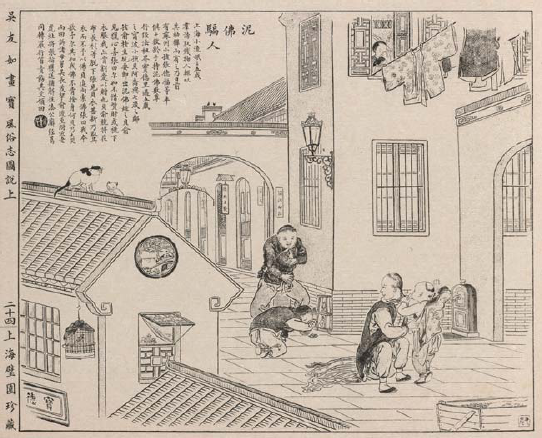
An Illustrated Explanation of Local Customs
The central space is hemmed in by buildings on all sides, but each portion of each wall that we see has either a door or a window, suggesting constant interaction between “inside” and “outside”, as in the case of the woman leaning out to hang her laundry to dry over the alley. Indeed, our own view of the scene might be from a window or balcony looking out over the alley. The second image, a lithographic print like the first, focuses more simply on a woman looking down from a balcony to observe the goings-on in the alley below (see Figure 2).
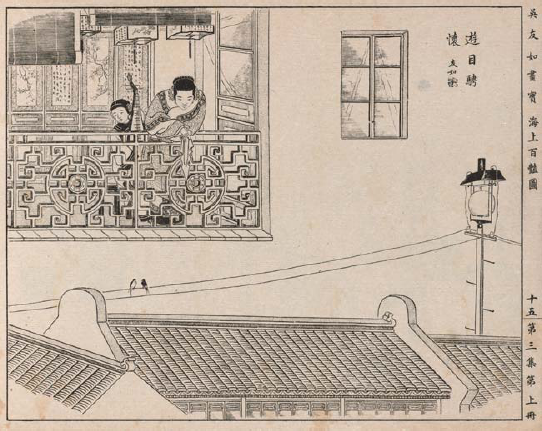
A Hundred Beauties of Shanghai
In this case, the viewer is clearly positioned at the same level as the woman, as though looking across from a building two alleys away. An intervening lower building screens the object of the woman's gaze from the viewer, ensuring that the second-level view across is the focus of the print.
The printing and dissemination of these types of images in illustrated periodicals
from the 1880s forward, as well as in collections like An Illustrated
Explanation of Local Customs ( , Fengsu zhi tushuo)
and A Hundred Beauties of Shanghai (
, Fengsu zhi tushuo)
and A Hundred Beauties of Shanghai ( , Haishang baiyan tu), works
to construct a distinct type of interactive urban space, an arena in which windows
look out onto other windows, barriers between one rooftop laundry space and the next
are insignificant or non-existent, and the sounds and smells of the city waft easily
in even through closed shutters. Urban crowding and the associated interconnection
of sensory landscapes had of course been common in literary representations of
Chinese metropolises like Suzhou, Yangzhou and Nanjing for centuries (Gu 2005). The
novelty of these Shanghai images lies primarily not in their faithful recording of a
sudden and unprecedented “modern” urban reality – although the built structure of
the lilong does differ in important ways from the alleys in other
Chinese cities (Lu 1999: 138–185; Liang 2008) – but rather in the adoption of a new
model for the representation of urban streets and alleys: the
theatre.
, Haishang baiyan tu), works
to construct a distinct type of interactive urban space, an arena in which windows
look out onto other windows, barriers between one rooftop laundry space and the next
are insignificant or non-existent, and the sounds and smells of the city waft easily
in even through closed shutters. Urban crowding and the associated interconnection
of sensory landscapes had of course been common in literary representations of
Chinese metropolises like Suzhou, Yangzhou and Nanjing for centuries (Gu 2005). The
novelty of these Shanghai images lies primarily not in their faithful recording of a
sudden and unprecedented “modern” urban reality – although the built structure of
the lilong does differ in important ways from the alleys in other
Chinese cities (Lu 1999: 138–185; Liang 2008) – but rather in the adoption of a new
model for the representation of urban streets and alleys: the
theatre.
Theorists of American and European film have tended to draw a sharp distinction
between presentational (“theatrical”) style, in which the action is seen primarily
from one (frontal) angle, as though a stage performance were being filmed, and
representational (“cinematic”) style, which makes use of the classic cinematic
techniques that we have come to expect in narrative film: shot/ reverse shot
structure, tighter focus on individual characters, editing for narrative coherence,
and so on. Scholars of Chinese film have developed a similar dichotomy,
distinguishing between films that seem closer to theatrical productions or shadow
puppet shows – “theatre people's cinema” ( , Xiren dianying)
– on the one hand, and those which employ a style “appropriate” to film
production on the other, suggesting that there is a generalized teleology governing
the progress of cinematic production across national boundaries (Semsel, Xia, and
Hou 1990; Zhang 2005: 99–100). My use of theatricality as a way to understand city
space and cinematic representation in twentieth-century Shanghai differs from this
approach. Rather than setting up two reified paradigms based on staging and camera
placement that can be used unproblematically to classify diverse production styles,
I am interested in investigating a kind of space which may be unique to a single
city in its full historical specificity and contingency, showing how the production
of such a space powerfully affects filmmakers' attempts to rework and appropriate
the city, with particular attention to the relationship between audiences and the
show.
, Xiren dianying)
– on the one hand, and those which employ a style “appropriate” to film
production on the other, suggesting that there is a generalized teleology governing
the progress of cinematic production across national boundaries (Semsel, Xia, and
Hou 1990; Zhang 2005: 99–100). My use of theatricality as a way to understand city
space and cinematic representation in twentieth-century Shanghai differs from this
approach. Rather than setting up two reified paradigms based on staging and camera
placement that can be used unproblematically to classify diverse production styles,
I am interested in investigating a kind of space which may be unique to a single
city in its full historical specificity and contingency, showing how the production
of such a space powerfully affects filmmakers' attempts to rework and appropriate
the city, with particular attention to the relationship between audiences and the
show.
By “theatrical space” I mean very literally a structure that 1) coincides in part with the physical form of the late nineteenth- or early twentieth-century theatre; and 2) also includes a set of less immediately tangible constraints on and attractions for the spectator. For a variety of specific historical reasons, theatre in Shanghai grew radically in economic and cultural significance between 1860 and 1890, and by the turn of the century, Shanghai competed with Beijing for primacy in the Chinese theatre world (Ōno 1983; Goldstein 2003; Meng 2006: 66–67, 88–100). This was not, however, Broadway theatre, in which the strangely passive audience remains immobile and mostly silent in row after row of darkened seats. The lighting systems in Shanghai theatres – gas in the 1880s, electric from the 1890s on – illuminated actor and spectator alike, making the audience itself a very active part of the spectacle. As Joshua Goldstein notes,
the teahouse's social (audience) and representational (stage) spaces were approached as mutually permeable or continuous. Rather than pretend the audience did not exist, the actors often addressed it directly (Goldstein 2003: 768).
The place of the female spectator at the theatre is of particular interest. Scholars who address questions of Republican-era urban public space in terms of gender have tended to underestimate the presence and significance of female audience members – including those “of good families” – in the turn-of-the-century theatres, especially in Shanghai, whether by drawing overly clear distinctions between different types of female audiences, or by overstating the contrast between earlier theatres and the amusement halls that would follow in the Republican era (Goldstein 2003: 765; Zhang 2005: 37, 56–57, 60). One of the primary concerns both British and Chinese authorities had about Shanghai theatres was in fact the degree to which women – not only courtesans, but also unmarried younger women, and even wives of prominent families – attended operas. The authorities hired undercover agents to attend performances, and closed down those that seemed immoral. But the real problem was that these female spectators made their interests in the (male) actors (especially those playing martial roles) abundantly clear, even when the production itself was quite chaste. Stories of women pelting actors who caught their fancy with trinkets, handkerchiefs, and other small objects, and even coming to blows for the privileges of sitting in the best seats, are staples of both fiction and non-fiction accounts of Shanghai. By the early 1900s, unaccompanied women were barred from the seats closest to the stage due to their regular interruptions of the show (Des Forges 2007: 64).
As all of the roles in local, Huizhou, and Peking opera were played by men, male spectators with heterosexual orientations could only turn to these same women in the audience and compete for their attention. One could roughly divide the theatre space (excluding backstage) into three areas: on stage, ground floor audiences, and spectators with box seats at the second level or higher (Goldstein 2003: 760–765). The gazes criss-crossing the theatre space could find their point of origin and their object of interest in any of these three areas. In another illustration from Wu Youru's Hundred Beauties of Shanghai, the women in attendance at a theatre may be watching the action on stage, or perhaps in the “orchestra level” seats below (see Figure 3).
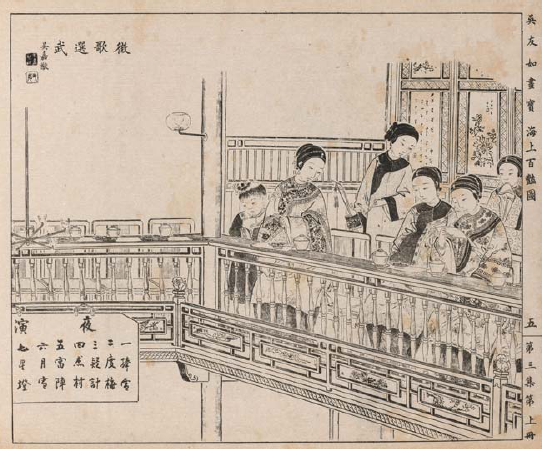
A Hundred Beauties of Shanghai
In any case, their gaze down from the box seats to a spectacle below reminds us of the view from second-floor windows and balconies overlooking alleys; as an element common to both theatrical space and the street environment, this gaze suggests that Shanghai alleys – as represented in illustrations of the turn of the twentieth century – can be understood as fundamentally theatrical in nature.
The sudden appearance of alleys as spaces of constant exchange and theatrical
interaction is most evident in lithographic illustrations; but this kind of street
space also plays a central role in countless newspaper articles and novels from the
1870s forward. In Dreams of Shanghai Splendor ( , Haishang fan hua
meng, 1898–1903), for example, courtesans living in adjacent apartments
on an alley feud across the porch railing, casting insults back and forth with
abandon (Sun 1991). Conversations of a different sort between a shy young man and
the saucy courtesans and maids across the way appear in Bao Tianxiao's memoir of the
same period, Recollections of Bracelet Shadow Studio
(
, Haishang fan hua
meng, 1898–1903), for example, courtesans living in adjacent apartments
on an alley feud across the porch railing, casting insults back and forth with
abandon (Sun 1991). Conversations of a different sort between a shy young man and
the saucy courtesans and maids across the way appear in Bao Tianxiao's memoir of the
same period, Recollections of Bracelet Shadow Studio
( , Chuanying
lou huiyilu). Living in the tingzi jian (
, Chuanying
lou huiyilu). Living in the tingzi jian ( ) room (second floor, back of
the building; see Liang 2008: 487), Bao couldn't look out his window without
catching sight of neighbours just across the alley. If we take his word for it, he
would be deep in his books (working hard professionally just like the actor on
stage), but finally unable to ignore the noisy teasing directed at him (Bao 1974).
Clearly the figure of the interested and disruptive spectator, especially the
interested and disruptive female spectator, is of real significance
in late nineteenth- and early twentieth-century Shanghai cultural production. It is
worth noting briefly here the link between this kind of window-to-window interaction
– one level up from the street – and the conventional representation of
streetwalkers (
) room (second floor, back of
the building; see Liang 2008: 487), Bao couldn't look out his window without
catching sight of neighbours just across the alley. If we take his word for it, he
would be deep in his books (working hard professionally just like the actor on
stage), but finally unable to ignore the noisy teasing directed at him (Bao 1974).
Clearly the figure of the interested and disruptive spectator, especially the
interested and disruptive female spectator, is of real significance
in late nineteenth- and early twentieth-century Shanghai cultural production. It is
worth noting briefly here the link between this kind of window-to-window interaction
– one level up from the street – and the conventional representation of
streetwalkers ( ,
yeji) on the sidewalks below as positively fearsome in their
attempt to snag male customers.
,
yeji) on the sidewalks below as positively fearsome in their
attempt to snag male customers.
Clearly this active solicitation is incompatible with what we now think of as a
movie-going experience, in which carrying on a running exchange with characters on
screen is (with a few exceptions) considered unacceptable. What happens when the
room in which this disruptive spectator sits goes dark, and when the show is images
projected on a screen rather than actors moving around on stage? In Chapter 40 of
Tides of Shanghai ( , Xie Pu
chao, 1916–21), for example, the alley spectator-ship has already taken
a significant step toward what we might see as a more conventional kind of cinema:
An unscrupulous woman sets a trap for her neighbour and his paramour, inviting the
neighbour's estranged concubine, the husband of the neighbour's paramour and
numerous acquaintances to an empty apartment across the street from which they have
a clear view of the adulterous activities once the lights go on at night. Instead of
a lively audience interacting with performers on stage, these individuals are
watching from a dark room, unable to turn away from the brightly lit sight in front
of them, shushing each other to ensure that no one inadvertently alerts the couple
on display (Zhu 1991).
, Xie Pu
chao, 1916–21), for example, the alley spectator-ship has already taken
a significant step toward what we might see as a more conventional kind of cinema:
An unscrupulous woman sets a trap for her neighbour and his paramour, inviting the
neighbour's estranged concubine, the husband of the neighbour's paramour and
numerous acquaintances to an empty apartment across the street from which they have
a clear view of the adulterous activities once the lights go on at night. Instead of
a lively audience interacting with performers on stage, these individuals are
watching from a dark room, unable to turn away from the brightly lit sight in front
of them, shushing each other to ensure that no one inadvertently alerts the couple
on display (Zhu 1991).
Lively interaction and joking exchange between the two sides seem in this case to be replaced by the unilateral voyeuristic gaze that Laura Mulvey identifies as characteristic of the mainstream “cinematic” experience, by the rapt attention to the unfolding story that Miriam Hansen reads as an indicator of the transformation of audiences into spectators in 1910s United States, and by the “more interiorized film viewing experience” that Zhang Zhen finds to be typical of the “cinema of narrative integration” that replaces the “cinema of attractions” in early 1920s Shanghai (Mulvey 1989; Hansen 1994; Zhang 2005: 118). One might suppose that this passage in Tides of Shanghai is the result of a new mode of cinematic spectatorship – a literary record of new ways of seeing movies – but the situation is in fact more complicated: This chapter of Tides of Shanghai was most likely published in installments in 1918 or 1919, and as Leo Lee reminds us, the movie theatre in early 1920s Shanghai was still
a communal setting […], and most likely [the spectators'] viewing habits were not so different from the act of watching a local opera; a truly private experience of watching a film in the dark was not yet possible in these early years (Lee 1999: 117; for further evidence of the mid-1920s transition from brightly-lit halls to darkened halls with brightly lit screens, and from talkative audiences to quieter spectators see Zhang 2005: 125, 131).
This example, together with other instances of “anticipation” – of the zoom lens and
the voice-over – in Bi Yihong and Bao Tianxiao's Hell in This World
( ,
Renjian diyu, 1922–24) reminds us that the mode of
spectatorship that we may identify as “cinematic” is not necessarily tied to the
material technology of cinematic production, but may in fact predate that technology
and help to call it into existence (Des Forges 2007: 173–174; see also Musser
1984).
,
Renjian diyu, 1922–24) reminds us that the mode of
spectatorship that we may identify as “cinematic” is not necessarily tied to the
material technology of cinematic production, but may in fact predate that technology
and help to call it into existence (Des Forges 2007: 173–174; see also Musser
1984).
Lilong on Screen: Street Angel
So how does Shanghai appear on film in the 1920s, ‘30s, and ‘40s? Movies set in the
city during this period often make use of its unusual spatial characteristics, from
the intensely “foreign-looking” architecture of large buildings in the International
Settlement, to broad streets filled with crowds and vehicles throughout the
concession areas, to the smaller-scale intimacies of strangers brought together in
the small alley townhouses and apartments. The advertisement for the film
Yan Ruisheng ( , 1920) already emphasizes
its use of “real settings” like the First-Class Taste restaurant (
, 1920) already emphasizes
its use of “real settings” like the First-Class Taste restaurant ( , Yi pin
xiang) and Hundred Flowers Alley (
, Yi pin
xiang) and Hundred Flowers Alley ( , Baihua li)
(Lee 1999: 116–117). In Crossroads (
, Baihua li)
(Lee 1999: 116–117). In Crossroads ( , Shizi
jietou, 1937), a man and a woman who share a single rented space with a
thin partition down the middle eventually fall in love; in Crows and
Sparrows (
, Shizi
jietou, 1937), a man and a woman who share a single rented space with a
thin partition down the middle eventually fall in love; in Crows and
Sparrows ( , Wuya yu
maque, 1949), almost all of the action takes place in a cramped alley
dwelling that has been subdivided and rented out in parts to a diverse group of
residents, all of whom are exploited by their landlord.
, Wuya yu
maque, 1949), almost all of the action takes place in a cramped alley
dwelling that has been subdivided and rented out in parts to a diverse group of
residents, all of whom are exploited by their landlord.
The most remarkable of these movies is Street Angel, directed by Yuan Muzhi in 1937, which refers the viewer to the theatrical heritage of Shanghai entertainment and Shanghai urban space in striking fashion even as it explores the new possibilities of the cinematic genre in detail. After a brief montage of Shanghai sights in the opening minutes, the camera's focus shifts to a wedding procession passing through a small neighbourhood that could have been located almost anywhere in the city. The camera moves back and forth between the procession itself and people crowded along the sides of the alley and leaning out of windows and over balconies to watch. Many of the shots of the second-floor spectators are pitched at dramatic angles, suggesting the glimpses that the members of the procession might catch as they move by. Soon, however, there is a level shot of a balcony, distinct from the canted framings immediately preceding it, signalling the beginning of the narrative proper. A young woman joins people already on the balcony as the procession approaches, and looks down towards the street below. Her attention is caught when she recognizes two of the marchers: a trumpet player and his friend. The young woman (Xiao Hong, played by Zhou Xuan) and the trumpet player (Xiao Chen, played by Zhao Dan) enjoy a brief exchange, after which he realizes that he has completely lost his place in the procession, and must rush ahead to catch up. She waves goodbye with a handkerchief as he vanishes. This is our first view of a couple who will be romantically linked through the entire film; in its formal presentation, it forcefully reminds the Shanghai viewer of the romances between female spectators and the actors they attempted to distract in earlier decades.
Watching as the scenes in this movie unfold, the viewer is almost without exception located firmly within the space of the alley and its adjoining buildings; in addition, many shots come from second-storey windows, reminding us not only of the lithographed illustrations discussed above, but also, as a consequence, of the view from the box seats in the theatres of previous decades. Eavesdropping and spying, often key motifs in urban movies from this period, take on a new sophistication here as the younger protagonists attempt to find out what will happen to them. But in keeping with earlier practices of theatrical spectatorship, those who watch on screen are not merely passive: There are tour-deforce scenes throughout the first two-thirds of the movie in which the camera moves back and forth between Xiao Hong and Xiao Chen's second-floor rooms that are separated only by the narrowest of alleys. The viewer sees Xiao Hong from Xiao Chen's room and Xiao Chen from Xiao Hong's room, often in consecutive shots – there is even in one case a 180-degree pan from one room to the other – establishing a certain equivalence between his attention to her and her attention to him even as it reminds the viewer of flirtatious exchanges between men and women in box seats, above the action, in the theatres.
Each of the protagonists is a performer: Xiao Chen commands the camera's attention by playing his trumpet, doing magic tricks and strutting around in his uniform. Xiao Chen's very appearance in his own window is likened in the stage directions explicitly to the raising of the curtain and the appearance of an actor on stage (Jiao 1990: 25). The primary recipient of the heterosexual gaze throughout the film is not the female figure (Xiao Hong), but Xiao Chen; he is able to attract not only Xiao Hong, but also Xiao Yun and two landladies in succession. Radiating a jokey and hyperactive sexuality, he reminds us of the actors playing martial roles that women swooned over at the turn of the century and continued to follow with intense interest into the 1930s. (It is worth noting that news and gossip about male opera stars continued to occupy a leading position on the entertainment pages of Shanghai tabloids, rivalled only by items concerning dancing girls, into the late 1930s (Field 1999: 102).) Unlike Rudolph Valentino, who could function as an object of female desire in 1920s American movies only by himself seeming less masculine, and whose popularity inspired much critical comment, Zhao Dan's masculinity is never cast into question, even as he is clearly the one to be looked at.
Xiao Hong's presence is less striking than Xiao Chen's, but she does appear as the object of prolonged unilateral, spectatorial attention twice when she sings for money; in these two scenes, the structural relationship resembles that found in classical Hollywood cinema, with a gaze gendered as male directed at a female object of the gaze. These appearances are staged as fundamentally problematic, however, representing in the first instance male desire that is to be morally condemned (the audience includes a gangster who will attempt to purchase Xiao Hong against her wishes), and in the second, a painful romantic misunderstanding (Xiao Chen mistakenly believes that she is happy with this arrangement; with the aim of humiliating her, he pays for her performance at the local teahouse in cash and watches silently).
Against these problematic scenes where Xiao Hong serves as object of the gaze, we must remember not only the many points at which Xiao Chen is objectified with much happier results, but also, and more significantly, the scenes in which Xiao Hong and Xiao Chen exchange performances on a reciprocal basis. At one point, Xiao Hong is asked to sing, but responds that she will do so only if Xiao Chen performs a magic trick first; when she sings to him alone, he accompanies her on the erhu. When he performs magic tricks for her, she is not a passive spectator, but instead attempts to disrupt his performance by tossing a towel through his window, flashing sunlight off of a mirror into his eyes, and so on. This sets the relationship between “performer” and “audience” up as a type of exchange, interaction, or collaborative effort, quite different from the structured gaze characteristic of the majority of Hollywood films popular in 1920s and ‘30s Shanghai. The film maintains this dichotomy between performative exchange (seen most often between Xiao Hong and Xiao Chen, and valued positively) and commodified performance (in which Xiao Hong is objectified, valued negatively) throughout, constituting in this way a practical critique of the conventions of Hollywood cinema.
It is clear both from the sophistication with which Yuan Muzhi sets up this contrast and from the technical virtuosity with which performative and spectatorial practices belonging to the theatre or to the alley space rewrite cinematic conventions, that this is not a case of remnants of a timeless Chinese “traditional” or “folk” theatricality persisting even as “the modern” begins to appear. The very modernity of Street Angel is to be found specifically in this conscious appropriation of local constructions of urban space as a means of challenging and reinterpreting the conventions of the cinematic medium, which themselves in turn are merely local constructions that happen to have spread more widely. As a result, these very conventions are defamiliarized, and the constraints “inherent” in a given technology of cultural production are revealed not as unchanging rules but rather as obstacles to be overcome in dialectical fashion. As soon as cinematic production begins to thematize its own formal limitations, those same limitations can be transcended.
Calls to Action: Street Angel and Stage Sisters
The theatrical engagement of the spectator in the action is reiterated most
meaningfully in the brief but significant sequence in which Yuan Muzhi thematizes
his project as cinema – as a projection onto a screen. This sequence begins with a
trumpet call, the beat of a drum and marching feet, just as the movie as a whole
did, alerting the viewer to the possibility that the scenes to follow may stand in
for the movie as a whole. Indeed, as Xiao Chen's friend Lao Wang draws the curtain
across his window, Xiao Chen prepares a shadow-play ( , yingxi)
for Xiao Hong, who is watching from her window across the alley. With the light
behind them, Xiao Chen and his friends cast silhouettes against the curtain, acting
out a brief mime of masses rising up in rebellion. It is after seeing this cinematic
presentation that Xiao Hong decides to take action and abscond with Xiao Chen. The
reception of this shadow-play allegorically represents the consequences that Yuan
Muzhi envisioned for Street Angel: If, as most critics have
concluded of 1930s left-wing cinema, characters like Xiao Hong are metonyms for the
entire category of the oppressed, then this yingxi which calls her
to action clearly refers the viewer to the film as a whole (yingxi
in the Shanghai context referring to cinematic presentations as well as more
conventional shadow-plays from the 1890s forward (Youxi bao 1897;
Lee 1999: 85–86, 116)). By staging a challenge to the divide between actor and
audience throughout the film, Yuan Muzhi (like Xiao Chen) uses a screen to attempt
to urge the exploited to take action and to dissolve the distinction between those
who do and those who merely watch. This cinematic call to a passive audience to wake
up is in the end predicated on the willingness of spectators to model themselves on
Xiao Hong and insert themselves into the action – to behave as though they are
Shanghai residents at the theatre instead of Los Angeles residents at the movies. A
fuller treatment of the generally subversive energies at work in Shanghai theatres
of the late Qing, from riots among theatre audiences to theatre managers who doubled
as fugitives or arms dealers, appears in the third chapter of Meng Yue's
Shanghai and the Edges of Empire (Meng 2006: 65–105); our focus
here is confined to the slippage that Yuan Muzhi proposes from active spectator to
potential activist. As Haiyan Lee observes in her careful investigation of
discourses of love in the first half of the twentieth century, personal attachment
is taken to constitute the ground of possibility for political identification (Lee
2007); instead of presenting private sexual pleasure as the ultimate goal, Yuan
appropriates certain conventions proper to the pursuit of this pleasure to call
spectators to action in service of a broader mobilization for social change.
, yingxi)
for Xiao Hong, who is watching from her window across the alley. With the light
behind them, Xiao Chen and his friends cast silhouettes against the curtain, acting
out a brief mime of masses rising up in rebellion. It is after seeing this cinematic
presentation that Xiao Hong decides to take action and abscond with Xiao Chen. The
reception of this shadow-play allegorically represents the consequences that Yuan
Muzhi envisioned for Street Angel: If, as most critics have
concluded of 1930s left-wing cinema, characters like Xiao Hong are metonyms for the
entire category of the oppressed, then this yingxi which calls her
to action clearly refers the viewer to the film as a whole (yingxi
in the Shanghai context referring to cinematic presentations as well as more
conventional shadow-plays from the 1890s forward (Youxi bao 1897;
Lee 1999: 85–86, 116)). By staging a challenge to the divide between actor and
audience throughout the film, Yuan Muzhi (like Xiao Chen) uses a screen to attempt
to urge the exploited to take action and to dissolve the distinction between those
who do and those who merely watch. This cinematic call to a passive audience to wake
up is in the end predicated on the willingness of spectators to model themselves on
Xiao Hong and insert themselves into the action – to behave as though they are
Shanghai residents at the theatre instead of Los Angeles residents at the movies. A
fuller treatment of the generally subversive energies at work in Shanghai theatres
of the late Qing, from riots among theatre audiences to theatre managers who doubled
as fugitives or arms dealers, appears in the third chapter of Meng Yue's
Shanghai and the Edges of Empire (Meng 2006: 65–105); our focus
here is confined to the slippage that Yuan Muzhi proposes from active spectator to
potential activist. As Haiyan Lee observes in her careful investigation of
discourses of love in the first half of the twentieth century, personal attachment
is taken to constitute the ground of possibility for political identification (Lee
2007); instead of presenting private sexual pleasure as the ultimate goal, Yuan
appropriates certain conventions proper to the pursuit of this pleasure to call
spectators to action in service of a broader mobilization for social change.
Street Angel anticipates the radical social change that would follow
in 1949; Xie Jin's Stage Sisters ( , Wutai
jiemei, 1964) looks back on the years leading up to the revolution from
the other side, suggesting through its epilogue that the injustices noted explicitly
and implicitly in the earlier film are now being addressed. Like Street
Angel, Stage Sisters provides viewers with a detailed representation of
Shanghai spaces, both interior and exterior, and thematizes the complex
relationships both between performers and their audiences and between
representations on stage narrowly defined and the larger stage that is society as a
whole. Tracing the close friendship between two Yue opera actresses as they relocate
from the countryside to Shanghai, go their separate ways, and then are eventually
reconciled, the film extends Street Angel's approach in crucial
ways: The performances and the politics are public and open rather than private and
concealed, the protagonist ends by taking positive political action rather than
fleeing, and the liberation alluded to is complete and general rather than partial
and contingent. Perhaps the most striking difference is in the gendered objects of
the audiences' attention: Street Angel's emphasis falls heavily on
the male lead, Xiao Chen, while Stage Sisters presents viewers with
two female leads who play an opposite-sex couple on stage; the focus here is on
Chunhua, who plays the female role on stage. Xie's sensitivity to the gender
dynamics of the Republican-era Shanghai stage is clear: In choosing to focus on a
woman stage performer, he is in a sense constrained to Yue opera as the one major
genre during this period that was performed primarily by women.
, Wutai
jiemei, 1964) looks back on the years leading up to the revolution from
the other side, suggesting through its epilogue that the injustices noted explicitly
and implicitly in the earlier film are now being addressed. Like Street
Angel, Stage Sisters provides viewers with a detailed representation of
Shanghai spaces, both interior and exterior, and thematizes the complex
relationships both between performers and their audiences and between
representations on stage narrowly defined and the larger stage that is society as a
whole. Tracing the close friendship between two Yue opera actresses as they relocate
from the countryside to Shanghai, go their separate ways, and then are eventually
reconciled, the film extends Street Angel's approach in crucial
ways: The performances and the politics are public and open rather than private and
concealed, the protagonist ends by taking positive political action rather than
fleeing, and the liberation alluded to is complete and general rather than partial
and contingent. Perhaps the most striking difference is in the gendered objects of
the audiences' attention: Street Angel's emphasis falls heavily on
the male lead, Xiao Chen, while Stage Sisters presents viewers with
two female leads who play an opposite-sex couple on stage; the focus here is on
Chunhua, who plays the female role on stage. Xie's sensitivity to the gender
dynamics of the Republican-era Shanghai stage is clear: In choosing to focus on a
woman stage performer, he is in a sense constrained to Yue opera as the one major
genre during this period that was performed primarily by women.
At the same time, it is worth noting the choice to centre the film on stage performers rather than movie actresses. Gina Marchetti's reading of Stage Sisters notes its similarities to the “epic theater” championed by Bertolt Brecht, in which the illusion of the fourth wall is destroyed, and performers make it clear that they are aware of their audiences and ready to interact with them (Marchetti 1989). To have chosen a film actress as the protagonist would have made it much more difficult for Xie Jin to suggest this type of awareness of and interaction with audiences – a type of interaction that, as we have seen in Street Angel, lends itself particularly well to calls to action. In Stage Sisters, this interaction lays the crucial ground for the appeal by Jiang Bo (a heroic leftist journalist) to Chunhua to pose her challenge more broadly: The stage that Chunhua performs on is contained within a larger stage that is society, and any progressive change realized on the more restricted stage will not last without corresponding social change. The interaction between performers and audiences also provides the tools with which Chunhua can begin to bring about broader changes in society.
Street Angel's appeal to spectators conceived of as both bourgeois and proletarian to unite in action is allegorical and indirect; Stage Sisters wears its politics on its sleeve, but is nonetheless complex in its representation of 1940s Shanghai. After 1949, however, most such appeals to the audience to act were much more straightforward, playing a central role in cinematic production in the People's Republic; Stage Sisters itself was not released into broad distribution until after the Cultural Revolution. If we follow Chris Berry's suggestion that audiences attending films that can be considered “classic Chinese cinema” (made in the People's Republic between 1949 and 1976) underwent a “communal viewing experience”, then interaction between audience members in the 1950s, ‘60s, and ‘70s was not eliminated, but rather repressed and reformed into a kind of group focus on particular aspects of each film that had important consequences in the realms of political and cultural production (Berry 1994). While such a generalization would go too far in neglecting the very real differences in class background, gender and political status that individual audience members brought to such films, it has the virtue of reminding us of the extent to which film-viewing was understood in this period as a means of mobilizing an audience – involving individual spectators in an active communal project. Spectators who felt alienated from this collective viewing process were in many cases precisely those individuals who had recently been isolated as “inferior” members of the collective (or who would soon be so isolated), the targets of political campaigns that derived part of their force and structure from the film-viewing experience. This characteristic “communal viewing experience” may well have persisted in the reception of films critical of the Cultural Revolution and similar mobilizations that began to appear in the early 1980s.
Shanghai Leaves the Stage: Fifth Generation Filmmakers Turn Away from the City
One such film, Under the Big Bridge
 , Daqiao
xiamian), was given an identifiably Shanghai setting, even to the
extent of having minor characters speak partly in Shanghai dialect, and was quite
popular in the years following its release in 1983 (Clark 1987: 177ff). I remember
the excitement that film caused at the time, but there were few films with a focus
on Shanghai urban space to rival it in popularity or to receive general critical
acclaim over the next fifteen years. Despite the rehabilitation of 1930s left-wing
cinema in the early 1980s, and subsequent renewed distribution of films with
Shanghai settings like Street Angel, Shanghai never became a
desirable setting for Fifth Generation filmmakers. Wu Yinxian – Street
Angel's cinematographer – was vice-president of the Beijing Film
Academy and head of its cinematography department from its founding, in 1956, to the
mid-1970s; one could see his retirement prior to the arrival of the class of 1982 on
campus as one indicator of the changes to come (Ni 2002: 69–71).
, Daqiao
xiamian), was given an identifiably Shanghai setting, even to the
extent of having minor characters speak partly in Shanghai dialect, and was quite
popular in the years following its release in 1983 (Clark 1987: 177ff). I remember
the excitement that film caused at the time, but there were few films with a focus
on Shanghai urban space to rival it in popularity or to receive general critical
acclaim over the next fifteen years. Despite the rehabilitation of 1930s left-wing
cinema in the early 1980s, and subsequent renewed distribution of films with
Shanghai settings like Street Angel, Shanghai never became a
desirable setting for Fifth Generation filmmakers. Wu Yinxian – Street
Angel's cinematographer – was vice-president of the Beijing Film
Academy and head of its cinematography department from its founding, in 1956, to the
mid-1970s; one could see his retirement prior to the arrival of the class of 1982 on
campus as one indicator of the changes to come (Ni 2002: 69–71).
There are three related reasons for Fifth Generation filmmakers' neglect of the city. First, in the mid-1980s, the rural landscape served as a powerful resource for filmmakers interested in raising political, cultural and aesthetic questions (Ni 2002: 198–199). Chen Kaige, for example, announced his intention to initiate a revolution in Chinese film by beginning in the impoverished northwest, a region that he understood as the source of political revolutions in previous historical eras (Chow 1995: 39). While the 1950s creation of film studios in Guangxi, Xi'an, Chengdu and elsewhere reduced the Shanghai studios to first among equals as a site of film production, it was the 1980s Fifth Generation fascination with the “primitive” that removed Shanghai as object of cinematic representation from the screen. It was, of course, the experience of “going to the countryside” in the 1960s and 1970s – crucial to many of the Fifth Generation directors – that mediated between relocation of the film studios in the 1950s and the fascination with the rural in the 1980s. Ni Zhen provides a telling case-study of the complex interaction between hierarchies within the film studios, the work assignment process and the interests of class of 1982 graduates in chapter four of his Memoirs from the Beijing Film Academy, with a particular focus on Guangxi Film Studio (Ni 2002: 147–187).
Second, over the course of the 1990s, the national pedigree of newer films by Fifth
Generation directors became increasingly questionable even as it was more and more
crucial as a means of attracting financial support (Yang 1993). Since the middle of
the nineteenth century, Shanghai has been discursively imagined by a wide variety of
interested groups and individuals as a space between “East” and
“West” whose identity is predicated on the concept of cross-cultural trade and
interaction (Des Forges 2007: 21–22, 38–43, 114–121). For directors like Zhang Yimou
and Chen Kaige, whose international acclaim and associated ability to find funding
for new projects was closely tied to their articulations of a
national identity, the city could only have been a setting to
be approached with trepidation. In Temptress Moon ( , Feng yue,
1996) and Shanghai Triad, the city itself is not sufficient as the
setting for a movie – it appears only in brief glimpses against a backdrop of rural,
“feudal,” and “traditional” scenes to ground the film and make its Chineseness clear
to any who might otherwise doubt it. The city is at best junior partner to the
authentic countryside in a complementary set of exoticisms exhibited with the aim of
attracting a distinctly voyeuristic gaze.
, Feng yue,
1996) and Shanghai Triad, the city itself is not sufficient as the
setting for a movie – it appears only in brief glimpses against a backdrop of rural,
“feudal,” and “traditional” scenes to ground the film and make its Chineseness clear
to any who might otherwise doubt it. The city is at best junior partner to the
authentic countryside in a complementary set of exoticisms exhibited with the aim of
attracting a distinctly voyeuristic gaze.
In her rigorous analysis of the dynamics of the gaze in the movies of Zhang Yimou, Rey Chow suggests that the mode of visual production in these films is not primarily voyeuristic, but rather exhibitionistic. What must be noted, however, is the degree to which exhibitionistic self-display, whether subversive or not, tends to rely on a pre-existing voyeuristic gaze to have its effect. I would suggest that the prior conceptualization of this voyeuristic gaze goes beyond a director's reasoned imagination of what censors in the bureaucracy and critics and audiences elsewhere in the world might find compelling: Zhang's own position is not only that of an exhibitionist, but also that of a voyeur, his identification with “peasants” notwithstanding (for an instance of this identification, see Yang 1993: 305). As we have seen in discussions of the interaction between state modernization efforts and intellectual work in general in the 1980s, the educated director of a movie about “the primitive” past or present may on occasion align with the bureaucratic administration of the 1980s and 1990s as well as with overseas audiences in his or her gaze at the impoverished interior and “feudal past” of China (Wang 1996; Zhang 1997). By the time Fifth Generation movies began to appear, state discourse had already shifted to embrace the Four Modernizations and the value of education; the bureaucracy had already begun to reintroduce discourses of cultural level and individual quality as a means of denigrating “rural tradition” as a drag on the forward movement of the nation. When bureaucrats attempted to block Zhang Yimou's representation of the countryside and the feudal heritage, it was not so much that they disagreed with his assessment, but rather that they felt it should not be aired publicly in this fashion. Indeed, just as the stories told in those of Zhang's movies that have been most popular in Europe and the United States are set in confined spaces – the mill, the warlord's castle in Shanxi, the gilded interior of a Shanghai mansion and a tiny island cut off from any interaction with the outside world – these movies themselves cannot move beyond the voyeuristic/ exhibitionistic structure of obsessive observation and painful self-display.
As we have seen in the discussion of Street Angel, it is precisely this voyeuristic/ exhibitionistic structure, with its presumed dichotomy between actors and passive viewers, that left-wing cinema of the 1930s and ‘40s struggled against in the attempt to mobilize mass audiences. That struggle finds formal expression in Street Angel (and to a lesser extent in other movies from this period) in the choice of a Shanghai setting which demands a flexible and interactive relationship between actor and audience, and not coincidentally, one in which the male performer attracts the spectator's gaze as much if not more than his female counterpart. This theatrical urban space is fundamentally resistant to the voyeuristic/ exhibitionistic structure: Through its emphasis on interaction and exchange and its ready accommodation of gazes gendered as female, it throws into question Mulvey's classic explanation of visual pleasure, and even some of the more restrained formulations of suture as a cinematic effect. It is precisely this theatrical urban space that Xie Jin puts to use in Stage Sisters, selecting as his female protagonist not a film star, but a Yue opera duo, in a story in which a performer's potential to move her audience to political action through performance (specifically, that of a Yue opera based on Lu Xun's story “New Year's Sacrifice”) is taken as a given. The link between Shanghai space and a theatrical mode becomes even more evident when we realize that the shift of the camera lens away from Shanghai in the 1980s occurred shortly after several influential film theorists issued new calls for film to declare its independence from theatre (Semsel, Xia, and Hou 1990; see also Ni 2002: 58–60, 94). The Fifth Generation display of ethnic detail and testimony about China that resulted in part from this new independence is incompatible with the heritage of visual interaction understood to be characteristic of Shanghai streets and alleys.
Writing in response to the prevailing psychoanalytic-semiotic and neoformalist
paradigms in the field of film studies, Miriam Hansen proposes the concept of
“vernacular modernism” in an attempt to restore a historicist dimension to the study
of cinematic form. One of her early mentions of this term comes in a short article
on Shanghai silent film, in which she critiques existing approaches to Chinese film
of the 1920s and ‘30s and suggests that Shanghai, like other film capitals,
manifested a type of vernacular modernism that is clearly responding to classical
Hollywood cinema, but not derivative of it (Hansen 2000). Hansen's brief discussion
of Daybreak ( , Tianming,
1933) does not so much substantiate her points as hint at directions in which
inquiries into a Shanghai vernacular modernism could be pursued, but her broader
point that filmmakers frequently lay claim to intellectual and aesthetic high ground
by posing their own works as “modernist” even as they question or ignore the
modernism of films with broader appeal is well taken (Hansen 2000: 11). In the
readiness of the Fifth Generation filmmakers to declare independence from “theatre”,
and more generally from the conventions of socialist cinema, even as they affiliate
with international trends in the art film world, we see a similar set of tactics at
work. Whether Street Angel and Stage Sisters are
best read as examples of vernacular modernism or not, they stand in the same
relation to Fifth Generation preferences and tendencies as the Hollywood films that
Hansen sees as representatives of vernacular modernism do to European and American
experimental and avant-garde film.
, Tianming,
1933) does not so much substantiate her points as hint at directions in which
inquiries into a Shanghai vernacular modernism could be pursued, but her broader
point that filmmakers frequently lay claim to intellectual and aesthetic high ground
by posing their own works as “modernist” even as they question or ignore the
modernism of films with broader appeal is well taken (Hansen 2000: 11). In the
readiness of the Fifth Generation filmmakers to declare independence from “theatre”,
and more generally from the conventions of socialist cinema, even as they affiliate
with international trends in the art film world, we see a similar set of tactics at
work. Whether Street Angel and Stage Sisters are
best read as examples of vernacular modernism or not, they stand in the same
relation to Fifth Generation preferences and tendencies as the Hollywood films that
Hansen sees as representatives of vernacular modernism do to European and American
experimental and avant-garde film.
Shanghai space as represented in films of the first half of the twentieth century
poses problems for theoretical generalizations based on Hollywood productions not
because it contains elements drawn from an order that is fundamentally “other” – as
Noël Burch maintains in his study of Japanese cinema – but rather because of the
historical specificities grounding the development of theatre and cinema in two
different cities, Hollywood and Shanghai, in the late nineteenth- and early
twentieth-century transnational setting. The resistance we can find in movies like
Street Angel to these theoretical formulations stems not from
any essential “Chineseness” of the movies themselves, but rather from a partial
rejection of Hollywood codes in response to specific local political necessities and
conventions of spectatorship, and the inability of film theory itself to move beyond
the fetishization of canonical Hollywood products and understand the degree to which
cinematic production is fundamentally transnational from its earliest moments (e.g.
the popularity of ombres chinoises in nineteenth-century France,
and the influence of Chinese and Japanese aesthetics on Sergei Eisenstein's
theorization of montage). Similarly, the inability of movies like Ju
Dou ( , 1990), Raise the Red Lantern (
 , Da hong denglong
gaogao gua, 1991), and Temptress Moon to transcend the
voyeuristic/ exhibitionistic obsession and include a broader variety of
representational styles and spaces derives in part from straightforward material
concerns (who's financing the movies and who will buy the tickets?) but also in part
from a fundamentally selective sense of the possibilities of the cinematic
medium.
, Da hong denglong
gaogao gua, 1991), and Temptress Moon to transcend the
voyeuristic/ exhibitionistic obsession and include a broader variety of
representational styles and spaces derives in part from straightforward material
concerns (who's financing the movies and who will buy the tickets?) but also in part
from a fundamentally selective sense of the possibilities of the cinematic
medium.
Filmography
Beautiful New World ( , Meili xin
shijie) (1999), directed by Shi Runjiu.
, Meili xin
shijie) (1999), directed by Shi Runjiu.
Beijing Bastards ( , Beijing
zazhong) (1993), directed by Zhang Yuan.
, Beijing
zazhong) (1993), directed by Zhang Yuan.
Black Snow ( , Ben ming
nian) (1990), directed by Xie Fei.
, Ben ming
nian) (1990), directed by Xie Fei.
Crossroads ( , Shizi
jietou) (1937), directed by Shen Xiling.
, Shizi
jietou) (1937), directed by Shen Xiling.
Crows and Sparrows ( , Wuya yu
maque) (1949), directed by Zheng Junli.
, Wuya yu
maque) (1949), directed by Zheng Junli.
In the Heat of the Sun ( , Yangguang canlan de
rizi) (1994), directed by Jiang Wen.
, Yangguang canlan de
rizi) (1994), directed by Jiang Wen.
Ju Dou ( , Ju Dou)
(1990), directed by Yang Fengliang and Zhang Yimou.
, Ju Dou)
(1990), directed by Yang Fengliang and Zhang Yimou.
Looking for Fun ( , Zhao le)
(1993), directed by Ning Ying.
, Zhao le)
(1993), directed by Ning Ying.
Raise the Red Lantern ( , Da hong denglong
gaogao gua) (1991), directed by Zhang Yimou.
, Da hong denglong
gaogao gua) (1991), directed by Zhang Yimou.
Shanghai Triad ( , Yao a yao, yao dao
waipo qiao) (1995), directed by Zhang Yimou.
, Yao a yao, yao dao
waipo qiao) (1995), directed by Zhang Yimou.
Sons ( , Erzi)
(1996), directed by Zhang Yuan.
, Erzi)
(1996), directed by Zhang Yuan.
Stage Sisters ( , Wutai
jiemei) (1964), directed by Xie Jin.
, Wutai
jiemei) (1964), directed by Xie Jin.
Street Angel ( , Malu
tianshi) (1937), directed by Yuan Muzhi.
, Malu
tianshi) (1937), directed by Yuan Muzhi.
Suzhou River ( , Suzhou he)
(2000), directed by Lou Ye.
, Suzhou he)
(2000), directed by Lou Ye.
Temptress Moon ( , Fengjue)
(1996), directed by Chen Kaige.
, Fengjue)
(1996), directed by Chen Kaige.
Troubleshooters ( , Wan zhu)
(1988), directed by Mi Jiashan.
, Wan zhu)
(1988), directed by Mi Jiashan.
Under the Big Bridge ( , Daqiao
xiamian) (1983), directed by Bai Chen.
, Daqiao
xiamian) (1983), directed by Bai Chen.