



Abstract
This paper describes the transformation of Macau's urban image in the first decade after the “handover” of the Portuguese enclave to the People's Republic of China (PRC). In the pre-handover years and the first years of the newly established Macau Special Administrative Region (MSAR), urban interventions created an image thought to assure the continuity of Macau's Eurasian identity along with future financial stability. In 2002, with the governmental decision not to renew the local gambling monopoly, Macau's urban image was radically transformed. The liberalization of the gambling industry after Macau's return to the PRC was combined with the deregulation of building heights, developer-friendly land sales, a growing number of migrant workers, and the liberalization of travel restrictions for mainland visitors. These deregulations were based on decisions by the MSAR and the PRC governments, respectively, and led to the exponential growth of Macau's GDP within only six years. This paper describes how, through these decisions, Macau's urban image and space have been transformed.
Introduction
Since the introduction of the “open door” policy in 1978, China's cities have been fundamentally transformed. In this rapid and competitive process, the making and selling of city images has played a central role (Broudehoux 2004; Campanella 2008). In the 10 years since Macau's handover to the People's Republic of China in December 1999, a cultural landscape more than 450 years in the making has been radically changed. With approximately two-thirds of government revenue generated by gambling-related tourism, the making and marketing of Macau's image to attract visitors has been a key component in securing the government's budget. Parallel to its decision to liberalize the gambling industry, the Macau government also applied for the listing of its historical sites as world heritage sites. In 2005, after a revision of its application following the advice of International Council on Monuments and Sites (ICOMOS) experts and backed by the Chinese central government, the “Historic Centre of Macao” was declared a UNESCO World Heritage site. The preservation and marketing of the heritage sites is part of Macau's image construction and overlays its image as gambling centre.
The following investigation focuses on how Macau's mental and physical images have changed and, concomitantly, how different constructions of meaning about the city have been evolving. The paper 1 also asks what the price of this transformation has been for the living spaces of Macau's residents.
The author wishes to thank the two anonymous reviewers for their constructive comments and suggestions.
The Making and Marketing of City Images
City images play a central role in location marketing in the global economy in order to attract visitors, employees, and investors (Ashworth and Voogd 1990; Kearns and Philo 1993; Broudehoux 2004). As theoretical background for the study of city images, Henry Lefebvre's differentiation of three dimensions of produced space is helpful. Lefebvre distinguishes between perceived space (“espace perçu”), representation of space (“représentation de l'espace”), and space of representation (“espaces de représentation”). 2 According to Lefebvre, all three dimensions of the production of space create a contradictory, dialectical whole, and only in their interplay is urban space created (Lefebvre 1974; Schmid 2006). Similar to the production of urban space, the creation of city images can also be differentiated into physical and mental constructions and the constructions of meaning. These constructions are contested and disputed because they involve various actors: politicians, institutions, private developers, designers, communities, and individual residents (Biskup and Schalenberg 2008). City images can be shaped by media campaigns and tourism advertisements as well as by physical interventions in the built environment through infrastructure, urban renewal, or preservation projects. The promotion of urban images and places in Chinese cities has recently been studied for the cases of Shanghai (Wu 2000, 2003; Gaubatz 2005; Wai 2006), Beijing (Broudehoux 2004), and Guangzhou (Xu and Yeh 2005).
The perceived space is related to the material elements which constitute space and can be experienced with our five senses. However, the perception of space requires a prior mental construction, a conceived space (“espace conçu”). Mental constructions and concepts of space are based on social conventions determining which elements are related to each other and which remain excluded. These conventions can change over time and are often controversial and disputed. Conceived space is a result of social production processes which are related to the production of knowledge and power structures. The conceived space is a representation of space created by discourse encompassing verbalized forms such as descriptions, definitions, and scientific theories of space, as well as maps, plans, and information transmitted by images and signs. The third dimension of produced space for Lefebvre is the space of representation, indicating “something” which is not the space itself but something beyond it, such as a divine power, the state, etc. This dimension of space production is related to the creation of meaning through the imposition of a symbolic content on a particular space. Symbols of this space can be taken from nature, such as trees or specific formations, or artifacts, such as buildings and monuments; they also can be combined for instants in cultural landscapes. This aspect of space is experienced in the everyday life of people (“espace cécu”) (Lefebvre 1974).
Macau's Urban Images before 1999
The construction of Macau's urban images reaches back to the beginning of the Portuguese enclave in the sixteenth century, when its urban landscape was shaped by the placement and design of religious and civic institutions. Following the tradition of Portuguese cities, these institutions were designed as impressive monuments and placed on the highest points of Macau's peninsula. The Chinese temples were built, in contrast, on lower ground close to the water and were protected by the hills from typhoons. Over centuries, the Chinese and especially Portuguese institutions represented the religious and political order of the enclave. The Portuguese institutions were connected with streets which, in contrast to Spanish and British colonial cities, were not laid out according to a rigid grid but rather carefully adjusted to the existing terrain (Pinheiro, Yagi, and Korenaga 2005). Macau's specific form of public spaces (the “Largos”) was created by enlarging streets in front of religious and civic institutions, thus underlining their importance in the city. Due to their skilful design, their well-proportioned size, and their integration within the topography, these spaces gained a quality which went beyond a mere representation of power. Many of these spaces became public living rooms for quotidian life. Historical representations and contemporary photos show them being used for a wide range of activities by Macau's different communities and visitors. They can be understood as conceived spaces in Lefebvre's sense.
The small number of representations of colonial power in Macau – an exception described below – was related to the dependence of the enclave on agreements with and the goodwill of the Chinese provincial government in Canton. The construction of Macau's image as a destination for gambling-related tourism began in 1962 when Stanley Ho, Henry Fok, Yip Hon, and Teddy Yip, with their Sociedade de Turismo e Diversões de Macau (STDM), won the enclave's gambling concession. However, gambling was established in the enclave long before this date. As early as the eighteenth century, the entertainment district around Rua da Felicidade attracted customers with music, dance performances, gambling, prostitution, and opium. In the 1850s, when Macau's sea trade moved to Britain's newly established colony Hong Kong, Macau's government awarded the first gambling concessions (Pons 2002: 109–120). In the 1950s, Macau's image as a sinful place dominated by gambling, corruption, and sexual seduction inspired Josef von Sternberg and Nicholas Ray's movie Macao (1952). The new image promoted by STDM from the beginning of the 1960s differed from the earlier one as it complemented Macau's known seductions with images of speed and futuristic technology. In a place which had previously been known mainly for its slow pace, STDM promoted greyhound, horse, and car races, and introduced hydrofoils and helicopters for fast passage from Hong Kong and later Shenzhen. Before the term “experience industry” was coined, Stanley Ho offered experience travels with strip shows and gambling on his ferries as a prelude to the arrival at the casinos in Macau (Pons 2002: 126). In 1988, the STDM under Stanley Ho created the Orient Foundation, which became involved in heritage projects such as the renovations of the S. Rafael Building, Casa Garden, and the Hotel Bela Vista (Prescott 1993: 27–47).
In contrast to the British colony of Hong Kong, which in the 1970s had transformed into a modern high-rise city, Macau, despite its newly promoted, futuristic image, continued to consist of old and dilapidated streetscapes. In the 1970s many of the residents worked in Macau's industries, which were not part of the official image. The industrial buildings were located in the north-western part of the peninsula and on Taipa Island and therefore remained invisible to most visitors.
Macau's image as a gambling heaven had its downsides too. It was associated with the negative aspects surrounding the casinos such as gambling addiction, money laundering, prostitution, and organized crime. These aspects did not disturb short-term visitors heading for the windowless gambling halls; however, they affected middle- and high-income professionals in their search for a place of residence. In the 1980s, with the creation of the Zhuhai Special Economic Zone, new challenges and opportunities arose. Macau's industrial production started to move over the border to save on labour costs. An initial building boom ensued, bringing new bank and hotel buildings. Their towers appeared within the historical centre. In 1982 Macau's government, under Governor Almeida e Costa (1981–1986), founded the Instituto Cultural of Macao, which began to address heritage issues. The government reacted with an urban planning strategy which combined the preservation of discrete parts of the historical centre with new land reclamations for a modern service industry district at the Outer Harbour (Novos Aterros do Porto Exterior – NAPE) and low-cost residential areas in Macau's north.
The NAPE district was planned by the Palmer & Turner Group (P & T Group) from Hong Kong, which teamed up with renowned Portuguese architects Álvaro Siza Vieira and Fernando Távoras. For the historical areas the team developed an urban intervention plan which included height limitations at the Avenida Almeida Ribeiro (Prescott 1993) and the protection of key historical areas. The P & T Group was already renowned for its bank buildings in Shanghai's Bund district and in Hong Kong's central business district. In Hong Kong, the firm had developed a cluster of modern high-rise towers connected with foot bridges. However, for Macau the planning team chose a more European model, in the tradition of Marquis Pombal's reconstruction of Lisbon after the earthquake in 1755 or of contemporary plans for the International Building Exhibition in Berlin. 3 Their plan for the NAPE district was based on street blocks with height restrictions and design guidelines (Prescott 1993: 52–53).
Álvaro Siza Vieira, who delivered early sketches for the NAPE district, participated at the same time in the IBA Berlin with his housing project “Bonjour Tristesse” (1980–84).
After the Joint Sino-Portuguese Declaration in 1987, Portugal's and Macau's governments concentrated on issues of cultural identity in connection with the future handover of the enclave to the PRC. In the following years, during an economic downturn after the overproduction of office spaces, they invested in public projects such as the Cultural Centre of Macau, the Museum of Sacred Art and Crypt at St. Paul, and the Museum of Macau, thus promoting Macau as a “City of Culture” (Cheng 1999: 213). Simultaneously, sculptures were placed in important view axes of the city which underlined a harmonious Sino-Portuguese relationship.
Another important initiative was the revitalization and pedestrianization of public spaces such as the Senate Square. These spaces linked a selection of Macau's historical monuments. The projects aimed to maintain a positive image of Portugal's legacy, to support the continuation of the local Macanese culture, 4 and to advertise Macau as an enjoyable place for tourism and living. This strategy was in line with the international recognition of the economic relevance of a place's cultural value in the global competition among cities for visitors, investors, and well-trained professionals (Clark 2004).
The Macanese culture resulted from the fusion of Portuguese, Chinese, Japanese, and other South East Asian cultures, mainly through intermarriage, etc. For a definition of the Macanese identity, the Catholic belief system and the culture's specific cuisine play an important role.
Many of these initiatives followed the recommendations of the 1994 task-force study Macao: Tourism in Transition by the Pacific Asia Travel Association (PATA), undertaken in collaboration with the Macau Government Tourist Office (MGTO). This task force, led by Australian tourism experts, underscored the importance of constructing a Macau image distinct from Hong Kong in order to establish Macau as an independent short-break destination. The report evaluated Macau's existing image in 1994 as a “mélange of gambling, night life, and being adjunct to Hong Kong” which is:
Created by word of mouth, the positioning reflected in the combined Hong Kong/Macau visitor guides, the MGTO advertisements in Hong Kong, and newspaper stories about crime and gambling. The image has not been crafted or managed; rather, it has been left by default to tour operators and the marketplace (PATA 1994: 17).
The study differentiated between “the ones that mainly come for Gambling and Nightlife and others which are looking for a convenient get-away from the hectic pace of life in Hong Kong”, who could be attracted to extended stays by Macau's “green spaces, historic neighborhoods, the relaxed pace and small size” (PATA 1994: 12).
The study also proposed the creation of a “Little Portugal”, which should be a clearly defined place that exemplifies the Portuguese/ Macanese society, culture, and history in Macau. […] It should be a place that the Portuguese will be proud, enthusiastic and committed to leave behind, and, equally or more importantly, the new community will embrace and maintain. […] Macau should seize the opportunity of making good on its statement that it is a “City of Culture” (PATA 1994: 36).
In this context the study also proposed the establishment of new museums. The study did not yet mention a later application for UNESCO World Heritage status but did recommend the formation of distinct heritage precincts:
The leadership to form the precincts should be taken by the Cultural Institute, with funding from the government and the private sector. The benefits will be long range and contribute directly to community development in Macau. The mistakes made in Singapore will not be repeated thus saving untold amounts of money in trying to recapture the ambience both residents and tourists enjoy (PATA 1994: 46).
In the following years, the Macau government realized several of these recommendations. For instance, the newly pedestrianized heritage areas added more quality of life for visitors and residents. However, this well-intended image of Macau was called into question in the late 1990s due to the Asian financial crisis and violent triad fights (de Pina-Cabral 2002: 205–220). The triad wars ended with the handover, but the threat of gambling-related crimes remained. One recommendation of the Macao: Tourism in Transition study was to attract film productions to Macau in order to promote its image. However, it was primarily the dark side of Macau's identity which attracted Hong Kong film directors, who produced films on the triad fights and police corruption of the final years before the handover, for example, Yau Tat-chi's The Longest Nite (1998) and Johnnie To's Where a Good Man Goes (1999).
Changing “Perceptions of Space”: From the “City of Culture” to the “Asian Las Vegas”, 1999–2008
It was on the vacant blocks of the NAPE district that, after the liberalization of the gambling monopoly, the first casinos belonging to international casino corporations were built. Within a few years, these constructions had diverted the original plan of the district and with it Macau's promoted image of the 1980s and 1990s. The north-east side of the just-completed Cultural Centre, facing the ferry terminal, had originally been reserved for a waterfront park. Now it was given to the Las Vegas Sands Corporation for its first Macau casino, The Sands. One year after the casino's completion in 2004, the Fisherman's Wharf theme park opened on newly reclaimed land. This theme park was the biggest investment in Macau's tourism sector in these years. The 1994 task-force study had included a recommendation for a theme park. What was intended was a water theme which would take advantage of Macau's natural relationship to the water. Instead, the newly created park was based on copies of street façades and monuments from around the world used for shopping and gambling. Today, this theme park and The Sands are the first impressions visitors receive when arriving with ferries from Hong Kong and Shenzhen. Located behind them, the Cultural Centre has almost disappeared.
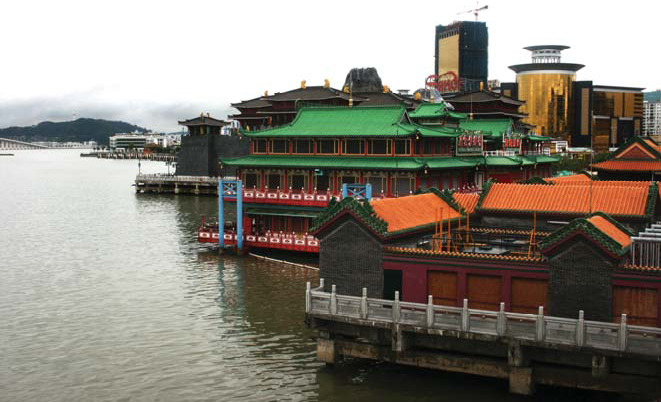
Fisherman's Wharf Theme Park and The Sands Casino
In the following years, also at the south-west end of the NAPE district, casinos were built which today extend over several blocks and interrupt streets originally conceived of for local traffic and air circulation. The new casinos have also altered the intended streetscape as their shops are not open to the streets.
The first casinos by Las Vegas corporations, such as The Sands and The Wynn, more or less respected the height of the surrounding buildings. But as of 2006, with the Galaxy Star World and a year later the Grand Lisboa, a new scale of buildings has been introduced.
When the MSAR government decided not to renew STDM's gambling monopoly and to attract Las Vegas casino corporations, one reason was to bring the latter's family-friendly and diversified casino model (MICE) to Macau. This strategy brought new kinds of events and conventions to Macau; however, it did not erase the roots of the problems surrounding casino gambling. The luxurious and clean image of the new casinos developed by American and Australian investors helps to mask their unpleasant effects.
Today, visitors might be confused by the Portuguese palaces in the Fisherman's Wharf (du Cros 2009), with restaurants offering “authentic Portuguese cuisine”, or the “Grande Praça” in the new MGM Grand Macao. The assimilation of casino resorts and the revitalized heritage areas results in an increasingly homogenized, continuous landscape of consumption in which the boundaries of the two blur. In marketing campaigns for casino and property developments (for example, “One Central”) Macau's UNESCO World Heritage status is used to attract wealthy residents. Meanwhile, The Venetian casino attracts visitors with a detailed reproduction of World Heritage city Venice. However, after the end of the “World Heritage Year 2006”, which promoted Macau's UNESCO nomination to international visitors, most information posters at the border gates disappeared. Now, arriving visitors are immediately lead by hostesses to the waiting shuttle buses which take them free of charge to the various casinos.
A Space of Competing Representations: The Praça de Ferreira do Amaral
The Praça de Ferreira do Amaral is the central space of representation and the focal point of image construction of the Macau peninsula. The Praça was created after a land reclamation in 1927 in Macau's Outer Harbour. Its importance for Macau's urban image is based on its waterfront location close to the historical centre and its connection to the Taipa Bridge and four important streets, among them the Avenida do Infante D. Henrique, which is the extension of the Avenida Almeida Ribeiro, Macau's main street (Cody 1999).
Under Portugal's fascist dictatorship, Macau's government inaugurated the equestrian statue of João Maria Ferreira do Amaral (1803–1849), the most controversial governor of the enclave, on the Praça in 1940 (Cheng 1999; de Pina-Cabral 2002). His political decisions had polarized the Portuguese and Chinese communities. Using the weak position of the Qing Dynasty after the First Opium War, he planned the extension of Macau's territory towards the north and put Chinese residents under the jurisdiction of Macau's senate in contradiction of a long-standing agreement with China. These actions eventually provoked his assassination in 1849. In preparation for the handover, the Portuguese government gave in to the pressure of the PRC State Council's Office for Hong Kong and Macau Affairs, disassembling the monument in October 1992 and transporting it back to Portugal (Cheng 1999: 28; de Pina-Cabral 2002: 51–78, 76).
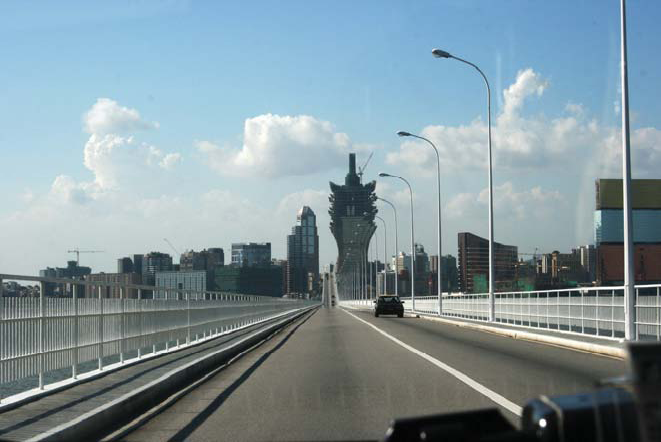
View to the Praça de Ferreira do Amaral. In the Centre, the Bank of China and the Grand Lisboa Casino Hotel; to the Right, the Casino Hotels The Wynn and the MGM
At the beginning of the 1970s, after the tensions of 1967 between pro-PRC groups and Macau's government (the “123 Incident”) had cooled down, STDM opened its flagship casino, Casino Lisboa, next to the Amaral statue. The conflict had weakened the Portuguese position in the enclave and shifted power to the pro-China faction and the Hong Kong-based casino monopolists, who had their own connections to Beijing's central government.
The location of the Casino Lisboa reflected the powerful role of STDM in Macau. It also had the advantage of offering sufficient space in the surrounding to create a large cluster of further casinos and hotels in the following three decades. The cluster profited from the relocation of the Hong Kong-Macau Ferry Pier from the Inner to the Outer Harbour. 5
In 1984, STDM connected their Macau casino cluster to Stanley Ho's new Shun Tak Centre in Hong Kong using their ferries. The centre is a combination of border gate, ferry terminal, heliport, shopping mall, car park, and two office towers (one originally planned as a hotel). With its twin towers, the centre followed the model of New York's World Trade Center (completed 1973). One of its mirrored-glass towers was named the “China Merchants Tower”.
In 1987, just after the Sino-Portuguese Joint Declaration, the planning for Macau's Bank of China began. It opened in 1991 on the Praça de Ferreira do Amaral, just opposite the Casino Lisboa. From the last years before the handover until the end of the gambling monopoly in 2001 it remained, with its 37-storey tower, the focal point of Macau's skyline, just like I.M. Pei's Bank of China tower in Hong Kong. Macau's Bank of China was designed by Swiss-born architect Remo Riva of the P & T Group (P & T Group 1998: 78–81). For the façade of the tower Riva used a cornerstone motif, which together with the symmetrical entrance and the octagonal plan of the tower gave the project a more massive and traditional outlook than Riva's earlier design for Hong Kong's Exchange Square, almost as if the design had to compensate for the weaker standing of Macau's finances. In the year of the handover, the Casino Lisboa already looked like a relic from the past compared with the newly completed museum and bank buildings. In 2006, the casino resort The Wynn opened on the opposite side of the old Casino Lisboa. Like The Sands, it was designed in a bland late-modern style. Its curved volume swings back, making room for a large open space with a great fountain, drawing attention from the old Casino Lisboa to the new casino resort.
Stanley Ho, together with his son Lawrence and daughter Pansy Ho, countered in the following years with their own large projects. Of their already completed buildings, the most important are the Grand Lisboa, which opened in 2007, and the Ponte 16, which opened a year later. For both projects, they were able to secure the most strategic locations. Like the Casino Lisboa, the new Grand Lisboa was positioned on the Praça de Ferreira do Amaral. It grows from a site opposite the Bank of China building and, with its 58-storey tower, significantly overarches the bank. The casino is visible from most places on the peninsula and the north of Taipa Island. Despite the visual impact on Macau's World Heritage area, Stanley Ho presented his project as a symbol of continuity and himself as a protector of the community against foreign casino capitalists. However, for a further extension of the Grand Lisboa, he planned to demolish the Portuguese School of Macau, 6 a modern building designed by Chorao Ramalho in 1963 with noteworthy architectural qualities and significance for Macau's Portuguese speaking community.
Stanley Ho: “The school should have been demolished and I should be allowed to rebuild it anywhere else” (Pinto 2007: 30).
Asked by journalist Ricardo Pinto two years after the inscription of the historical core of Macau as a UNESCO World Heritage site if he felt nostalgic about anything from old Macau, Ho answered:
I remember particularly those old days when I first started my business here. It gives me great pride to see Macau turning from a fishing village into a modern city. Memories are good, but at the same time, I also look forward to joining efforts with the Macau people in building a new Macau (Pinto 2007: 32).
Stanley Ho's influence and his understanding of his role in Macau are reflected in the position, size and symbolism of his new projects. Asked why the Grand Lisboa at the Praça de Ferreira do Amaral should become a landmark in its own right, he answered, “[a]s you can see, the appearance of the hotel tower resembles that of a lotus flower, a symbol shown on the Macau SAR flag. There you have the symbolism” (Pinto 2007: 30). The golden tower of the casino rises up behind a lower part of the building in an egg shape containing the main gambling halls.
While at the beginning of the 1990s the extension of the Casino Lisboa with a 30-storey tower was refused by the government, after the liberalization of the gambling monopoly – and despite the UNESCO World Heritage status – the local government compromised its policies, complying with the growing requests of the casino industry in order to boost its own revenue. Many of the questionable decisions made after the gambling liberalization about building permissions and land sales were connected with the high profile corruption case of ex-secretary for transport and public works Ao Man Long (Lo 2009). Their effects are mirrored in the transformation of Macau's skyline and urban landscape.
Macau's Contemporary “Conceived Space”: Playing the Game of Identity
In his book Asian Godfathers: Money and Power in Hong Kong & South East Asia journalist Joe Studwell notices how Asian tycoons and in particular Eurasian Stanley Ho play out their multiple identities according to particular situations (Studwell 2008: 19). Due to the continuing and strong influence of the casino tycoon, this play of identities is also an important aspect of Macau's urban image.
For the Grand Lisboa, Stanley Ho reused the name of the Portuguese capital but employed it as his own brand name. All other references made by the project underline “Chineseness”. Joe Studwell noticed that:
One more thing that appears to be an expression of insecurity among Chinese godfathers is an obsession with demonstrated ‘Chinese-ness’ […]; this has only become more apparent recently as China has re-emerged as a regional power (Studwell 2008: 51).
The advertisement for the Grand Lisboa's opening, shows an image of the casino tower with Kong Fu fighters next to it, in front the silhouette of a Chinese mountain. It reads:
Where the spirit rules. Refining the art for half a century in the resolute spirit of Asia. Only a player can prevail over the ultimate test of time and show the true spirit of success (MacauCloser 2007: back cover).
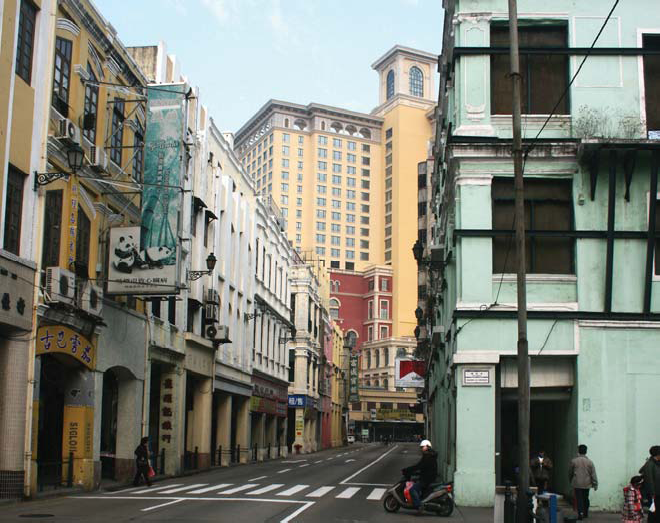
Avenida Almeida Ribeiro and Ponte 16 Casino Hotel
In the same year, to ensure his good relationship to the central government in Beijing, Ho paid 8.9 million USD for a bronze horse head stolen by French troops 147 years ago from the Yuan Ming Yuan palace and announced its donation to a Chinese museum. In the meantime, the horse head is presented in the entrance foyer of the Grand Lisboa. He explained his acquisition as follows: “With this move, I hope to encourage more people to take part in preserving Chinese artifacts and to promote patriotism and nationalism” (Lee 2007).
For the second grand casino resort, Ponte 16, in Macau's Inner Harbour, a southern European theme was selected. The resort is 51 per cent operated by Stanley Ho's Sociedade de Jogos de Macau (SJM) and 49 per cent by Macau Success Limited, a Hong Kong-listed company. The 20-storey casino resort not only dominates the western end of the Avenida Almeida Ribeiro but is also easily visible from the Chinese shore on the opposite side of Macau's Inner Harbour. Seen from the Chinese shore, the European theme distinguishes the resort from the mainland. It also allows for a distinction from the new American and Australian competitors. In his game of identities, Stanley Ho did not mention that the resort was designed by an American expert for shopping malls (John Jerde) and that it is located in Macau's traditionally Chinese and not European district. This district is particularly threatened by new developments because it was not included in the UNESCO World Heritage area.
The resort borrows its name, Ponte 16, from former Hong Kong-Macau Ferry Pier which is adjacent to it. This idea of integrating the old pier building and to making its name into a casino brand name can be connected with the protests of Hong Kong's residents against the demolition of the Star Ferry Pier building in 2006. Star Ferry Pier became the central reference point for heritage movements in Hong Kong and Macau.
At the opening of the casino Ponte 16 in 2008, Hong Kong resident Stanley Ho declared:
As the only gaming concessionaire rooted in Macau, SJM is proud to offer Macau this new development, Ponte 16, which links the past with the present and the future. The Ponte 16 Resort Development is the only resort complex in the Inner Harbour, which has such a charming waterfront location near to the historic centre of Macau, looking on one side, across the narrow waterway to the China Mainland and, on the other, down the main avenida to the city centre. It is in this old district of Macau, full of history and the fond memories of residents, that we are fulfilling our responsibilities to society, in co-ordination with the Macau SAR government, in the revitalization and creative development of this old urban district of Macau (Ponte 16 2008).
Two years before, visualizations had showed the project as having a spacious piazza to the waterfront framed by buildings only five storeys high. But under pressure from the new casino developments, the project was significantly changed after the MSAR government approved its expansion from a total gross floor area of 63,584 sq. m to 126,500 sq. m in 2006 (Macau Success Ltd. 2006: 22).
Generally, the new development could help to revitalize Macau's dilapidated Inner Harbour, but due to the doubling of its volume it now blocks the entire access to and view of the waterfront. The only open space with a view of the water is a terrace for hotel guests on top of a closed seven-storey parking and casino structure.
The examples of the making and marketing of Grand Lisboa and Ponte 16 show how the casino developments were sold to the local community and the government using both Chinese patriotism and references to Macau's Eurasian identity, thereby securing them advantages over international competitors. To the world, the Grand Lisboa represents Macau's Chineseness, and to mainland China, Ponte 16 represents Macau's European distinctiveness.
When the Las Vegas casino corporations entered the market with The Sands, The Wynn, and The Venetian, they transplanted the already-existing images of their Las Vegas casinos to Macau instead of developing new images for the Asian market. In this way they assured that their Macau casinos would be recognized as products belonging to internationally renowned brands. An exception is Macau's MGM Grand Casino. It is run as a partnership of MGM Mirage and Stanley Ho's daughter Pansy Ho, the managing director of Shun Tak Holdings Ltd. The outside of the casino has a modern and dynamic appearance, with its three stacked, rectangular building sections and coloured, undulating glass façades. The two golden lions at the entrance are part of both MGM's brand image and of Chinese culture – lions can be found in front of many temples. However, inside the casino, the central “Grande Praça” is inspired by traditional Portuguese architecture.
Buttressing the New “Spaces of Representation”: Infrastructure for a Landscape of Consumption
Since the beginning of STDM's involvement in Macau, infrastructure has been a central part of the construction of Macau's image as a modern leisure destination, for instance, the already mentioned futuristic looking hydrofoils used for passenger connections between Macau and Hong Kong. Another example is the construction of the Macau Tower. This tower, built by STDM, followed the design of Auckland's Sky Tower. It mainly serves as a landmark and is promoted for bungy jumping and skywalks at a dizzying height on a platform without handrails. At the same time, public mass transport, hospitals, and schools in Macau have developed only slowly.
Whereas Hong Kong opened its first metro line (MTR) in 1979, Macau only started to plan an efficient mass transport system after the turn of the century when its traffic situation became increasingly severe. As early as 1994, the PATA Task Force study mentioned traffic congestion and pollution as major problems for Macau's future. In 2002, the Hong Kong Mass Transit Railway Corporation (MTRC) was commissioned by the MSAR government to study the possibility of building an efficient subway system in Macau. One year later, Secretary for Transport and Public Works Au Man Long declared Macau did not yet need such a massive infrastructure project. Then in 2006 the government declared that planning for a light rail system would begin, even though the subway system would have been more efficient for residents and would have had fewer negative effects on Macau's vulnerable streetscape (Liu 2006: 149).
However, the elevated (hence visible) light rail can now become another sign of Macau's commitment to infrastructural development. 7 It will offer a visual experience similar to Disney World's Epcot Park and its Chinese imitations (captured, for instance, by Jia Zhangke's film The World in 2004). With the new light rail, after a short stop in the northern district along the eastern waterfront, Macau visitors will travel past the ferry terminal, the Grand Prix Race Track, and Fisherman's Wharf with its images from the Tang Dynasty, Tibet, Rome, New Orleans, and Lisbon. In the background, the golden glass façade of The Sands will shimmer. The travel will continue through the NAPE district to the Praça de Ferreira do Amaral, with the The Wynn, the new Grand Lisboa, and the soon-to-be-redeveloped Casino Lisboa. From here the passengers will continue past the Macau Tower and the A-ma Temple, Macau's oldest temple and the southern edge of the World Heritage corridor. The light rail will continue to Taipa Island, passing STDM's horse racing stadium and arrive at the Cotai Strip. After a quick glance at the Macau East Asian Games Dome, the visitors will be able to reach Macau International Airport.
Thomas J. Campanella reported on the case of Shanghai, where the photogenic Nanpu Bridge was built despite the fact that traffic experts had recommended a tunnel and the bridge construction required the eviction of the residents of an entire district (Campanella 2008: 77).
When built, the light rail will link all important entry points to the territory with the main tourist attractions, especially those created after 2002. It will help to ease the pressing traffic problems. In 2007, 27 million visitors arrived at Macau's barrier gates. But whether the railway will be able to alleviate the future traffic increase brought about by the planned Hong Kong-Macau-Zhuhai car bridge is questionable (Tieben 2008).
In any case, the light rail will create a missing link between the scattered and competing projects, connecting them into a landscape of consumption in which project after project appears in a cinematographic sequence seen from a smoothly moving and air-conditioned vehicle. This trip will offer visitors a sanitized image of Macau removed from the life of the residents on the ground.
Another example of this kind of infrastructure development is the first completed part of the Cotai Strip. None of the many planted palm trees can protect pedestrians there from Macau's hot and rainy weather. Their function is to be a symbol of leisure. In contrast, in the late nineteenth century trees such as the Árvores de Pagoda (Pagoda trees) were planted in Macau as parts of the public infrastructure for a wide range of reasons such as:
purifying the atmosphere, the drainage of excess water […], and the balancing of meteorological conditions. Another no less deserving consideration [was] the beautifying of cities and the comfort […] trees give the traffic during the hot part of the day (da Conceição 1998: 232).
Furthermore, the new illuminated fountains on the strip will not enhance the life quality of residents and visitors because they are situated in the middle of traffic circles and therefore cannot be accessed. Whoever tries to walk, despite the hot climate, along an expansive reflecting pool to The Venetian realizes that its Italianized façades are closed. A vast amount of open public space serves as a stage set for photos from passing vehicles. The images are interchangeable with those of other Venice replicas in Las Vegas, Orlando, Beijing, Shenzhen, or Dongguan.
Before the land reclamation between Taipa and Coloanne became the main site of “Asia's Las Vegas”, it was imagined as a new town. Early plans by a team lead by architects Lima and Soares envisioned this town housing approximately 150,000 residents, thereby easing the congestion in Macau's overcrowded residential districts (Gaspar 1999: 51). Macau and Las Vegas both have a similar population size with more than half a million inhabitants, but while Las Vegas has a density of only 1,604 inhabitants per square km, Macau leads the list of the most densely populated countries of the world with 18,428 inhabitants per square km. The adaptation of the Las Vegas model of space-consuming casino resorts for Macau should, therefore, be questioned. While the Cotai reclamation was used to create an “Asian Las Vegas”, due to land scarcity the height of new residential developments in the already overcrowded residential districts has increased from 30 to 56 storeys (for example, The Praia). At the Cotai Strip a spacious, green, and ordered space is in production. It promotes an image of Macau which is contrary to the congested, polluted, and chaotic day-to-day urban space of most Macau residents.
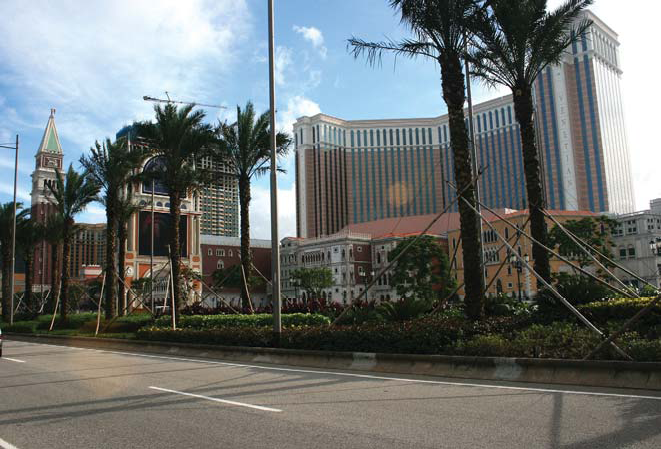
The Cotai Strip and The Venetian Casino Resort
Macau's Image in the Pearl River Delta
The construction of Macau's new image has to be seen in the context of the region's relationship to neighbouring Zhuhai, Hong Kong, and other cities in the PRC and South East Asia. In aerial photos of recent years (for example, Macau Focus 2000: aerial map), Macau and Zhuhai already appear to create one metropolitan space. With continuous land reclamations, the two cities have grown together. In Macau's north, they are almost one continuous urban space and are divided only by a shallow moat and a low border fence. Here, after the Sino-Portuguese Joint Declaration, Macau constructed a public park as a memorial to Dr. Sun Yat-sen, the founder of modern China, and in 2004, a joint Zhuhai-Macau transregional industrial park was opened. However, most other projects of the government and the casino capitalists underline Macau's uniqueness in the region. This is in accordance with both the recommendation of the 1994 task force and the slogan of the Macau government's tourist office: “A world of difference, the difference is Macau”.
In the last two decades, Zhuhai has created facilities which have doubled Macau's infrastructure projects and tourist attractions: an airport, a racecourse, and even monuments, such as a small replica of the façade of St. Paul's Church and the Senate Square for photo-taking in the Wanzai district (Breitung 2007: 42). Like Macau it has promoted itself as a leisure destination, using the slogans “Zhuhai Garden City” (Orff 2001: 347–396), and “City of Romance”. In competition with Macau, it has used its advantage of more available space, wide tree-lined streets, and luxurious residential developments, one of them built just next to Macau's most congested northern district and the squatter settlements of former mainland refugees. With its Yuan Ming Yuan theme park and its monumental border gate with its big red roof, Zhuhai is able to demonstrate its “Chineseness”.
At the time of the handover, it was unclear how – given its spatial constraints, higher industrial wages, triad wars, and unclear political future – Macau could compete with other cities in the region. After the casino boom of the last decade, Macau has challenged Zhuhai and started to compete with Hong Kong for qualified staff for its tourism, entertainment, and construction industries. The new 100,000 sq. m convention centre in The Venetian is larger than the 90,000 sq. m exhibition area in Hong Kong's Exhibition and Convention Centre, even after the latter's recent extension. Since the liberalization of Macau's gambling monopoly, Hong Kong's Jockey Club has lost a large portion of its betting profits (Fraser 2008: 64–67). The shopping arcade of the One Central development in Macau, planned by Hong Kong Land Ltd. and Shun Tak Holdings, aims to provide high-end shopping opportunities previously offered mainly in Hong Kong.
In the competition with its regional neighbours, Macau plays up its UNESCO World Heritage status; the international brand names of its new casinos, hotels and shops; and the names of world stars, such as The Police or Céline Dion, who perform in its event venues. To further extend its leisure facilities, the MSAR government and international investors have discussed the possibility of using parts of Hengquin Island, originally part of Zhuhai, with the central government and Zhuhai.
However, the fast growth has also created concerns. In 2008, the central government and the Guangdong government started to revise the Individual Visit Scheme to limit the number of visitors to Macau and to push Chief Executive Edmund Ho to grant no further gambling concessions for the time being. With the corruption case of Ao Man Long, the secretary for transport and public works, and the growing inequality between rich and poor, Macau's role as a model for Taiwan's future has begun to be questioned. At the same time, the interventions of the central government demonstrate Macau's dependence, despite the officially promoted “one country, two systems” status.
The construction of casinos in Singapore might have a negative impact on Macau's casino industry. Given such an impact, Macau remains flexible in the way it develops and promotes its image: as a World Heritage city; as the “Asian Las Vegas”; or as a “diversified tourist destination”, which would integrate its different identities. However, Legislator Au Kam-san has questioned the government's willingness to deliver on its promise to diversify Macau's economy:
This [diversification] is in everyone's mouth, but all I see is the stretching of policies related to the gaming industry. They talk about MICE (Meetings, Incentives, Conventions and Exhibitions) and tourism but I only see Venetian [Macao] […] No one is able to compete with [the] Venetian in those areas, so I wonder where is [the] diversification? This is not development – this is a new monopoly (Pina 2007).
Due to Macau's vulnerable situation in the global market, the 1994 PATA task force study Macao: Tourism in Transition recommended reacting opportuneistically to the new flight connections at Macau's International Airport (PATA 1994: 17). However, it also underlined the importance of enhancing quality of life for both residents and visitors.
The downside of the transformation of Macau into an “Asian Las Vegas”, or more generally into a landscape of consumption which integrates tourism, gambling, and heritage, is its effect on Macau's communities. Local businesses have faced problems paying their staff, students have ended their studies to earn quick money in the casinos, local workers have had to cope with escalating rents, and public spaces and heritage sites have become overused by visitors.
The financial melt down on the international stock markets in October 2008 was a sudden blow to Macau's overheated development. Having attracted huge amounts of foreign investment, it was strongly affected by the global financial crisis. After losses on the American stock market, Las Vegas's Sands Corporation put its construction works on the Cotai strip on hold and laid off approximately 10,000 members of its foreign work force. Further effects of the crisis remain to be observed. At present the ambitious plans for the Cotai strip have been particularly affected and development may remain fragmented for the coming years.
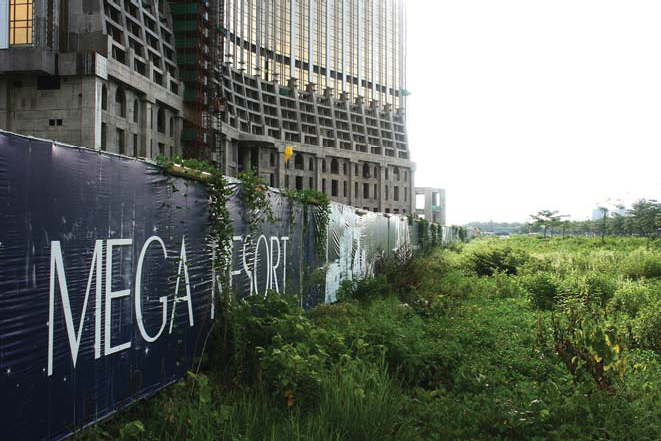
Casino Construction on Hold at Macau's Cotai Reclamation
Conclusion
In the years since the handover, important parts of Macau have been transformed into a landscape of consumption. Large portions of land in the highly congested city have been reserved exclusively for the gambling and tourism industry. Through this process, the spaces of visitors and local residents have become increasingly divided.
The transformation process demonstrates similarities to the transformation of other Chinese cities. In Shanghai (Wu 2000) and Hong Kong (Lee and Ng 2007), local governments have concentrated their efforts on creating “world cities”, justifying this aim with the goal of global and regional competition. Similarly ambitious, Macau's new government began in 1999 to plan and promote the city as an “Asian Las Vegas”. The scholars Jiang Xu and Anthony G.O. Yeh have observed that the competition between Chinese cities often has been used as an excuse for construction and the enhancement of property values rather than the improvement of living conditions. According to them, this process is primarily driven by two elite groups: the local government and commercial interests. Both tend to use the physical alteration of the city to secure their gains through quick and visible actions and to divert public spending from basic services for the disadvantaged (Xu and Yeh 2005).
The corruption case of Macau's ex-secretary for transport and public works, Ao Man Long, can be seen as an example of this trend. However, corruption in Macau reaches back to the time before 1999. The strong growth of the gambling industry under Chief Executive Edmund Ho has also helped to improve Macau's traditionally difficult financial situation. This could allow his successor, set to begin his term in June 2009, to better balance the benefits between casino developers, visitors, and residents. The economic crisis could be taken as an opportunity to reconsider, generally, the direction of development. This could, in turn, allow Macau to more rigorously follow the promises made by the government in its UNESCO World Heritage application. In their comments on Macau's first application, which only included single monuments representing the Sino-Portuguese past, the ICOMOS experts advised also including the revitalized public spaces, thus shifting the attention more strongly to the life of Macau's communities. Such genuine consideration of the living spaces of Macau's inhabitants would give Macau a healthier future.