




Abstract
This article examines recent reforms to restructure rural public finance in China and their impact on local-government finance. The focus is on how fiscal income and financial expenditure are managed by local-level governments, particularly at the county and township levels, and how rural public and social services are financed. The article also looks at the development of intergovernmental transfers, ongoing administrative reform, more recent initiatives to extend public finance to cover rural residents as part of the comprehensive rural reform, and a new campaign to build a new socialist rural China.
Introduction
Public finance deals with how and how much revenue is raised as well as the ways money is spent through public expenditure in order to meet essential societal needs. Generally speaking, rural public finance has to do with issues related to both fiscal (taxation) and financial (budget) administration that affect farmers, agriculture and rural areas. Its primary concern is how local governments' fiscal income and financial expenditure are managed and how rural public and social services are financed.
This paper argues that rural public finance in China is still in a state of flux, with the ultimate outcome still hanging in the balance. Though it is still evolving, its basic structure came into existence as a result of a series of reforms: the 1994 tax-assignment reform, the 2000 tax-for-fee reform, the 2002–2003 adjustment of the tax-sharing system, the 2006 abolition of agricultural taxes, and the more recent expansion of intergovernmental transfers. In this dynamic process of chain reactions, the unexpected consequences of earlier reforms precipitated ever-deepening reforms that led not only to major changes in rural public finance but also to an overhaul of local institutions of governance.
The series of fiscal reforms in recent years has aimed to restructure rural public finance. First, the tax-for-fee reform was a major effort by the central government to reassert greater control of the chaotic situation in local-government finance, which had led to mounting burdens on farmers and rising discontent in rural China. While these reforms helped reduce farmers' burdens, they also precipitated a severe budget crisis that threatened the fiscal viability of local governments in rural areas, especially at the grass-roots level. Subsequent reforms have been introduced in response to the problems resulting from earlier reforms as the central government has begun to realize that rural public finance at the grassroots level has faced severe constraints that must be dealt with within the broad framework of a comprehensive rural reform.
One essential part of the comprehensive rural reform is the deepening of the ongoing administrative reform in order to supplement and consolidate what has been accomplished through reforms of the fiscal system. Major experiments currently under way include direct provincial supervision of county financial management and the restructuring of county-township fiscal systems through county management of township finances. The ultimate purpose is to gradually reduce the administrative hierarchy from the current five tiers to three, at least in terms of the organization of the fiscal system. Finally, as part of the campaign to build a new socialist rural China, new initiatives are also being undertaken to promote urban-rural integration through the extension of public finance to cover rural areas. The goal is to transform the role and function of government at the local level in order to better provide public goods and services to rural residents.
In this paper, I will first review the tax-for-fee reform and its impact on rural public finance. The focus will be on county and township finance and the relations between the two. Next, I will look at intergovernmental transfers and other efforts to ease local governments' financial stress. I will then examine new experiments in the ongoing administrative reforms that are regarded as an essential part of the restructuring of rural public finance. Subsequently, I will look at new policy initiatives to extend public finance to cover rural areas. Finally, I will close with some conclusions.
This paper is based largely on archival research encompassing Chinese newspapers, journals, magazines, government statements, government documents, and new media outlets such as websites. The data has been accumulated over the years through the daily reading of major Chinese media sources and publications on rural issues by major Chinese research and government institutions. These sources have been supplemented and verified through several field trips to Chinese rural areas over the years, most recently in the central provinces of Henan and Hebei in the fall of 2006. On these trips I conducted numerous interviews with farmers, including my childhood friends from several villages in eastern Henan (where I grew up) in October 2006; migrant workers; and local officials. Lastly, the paper draws insights from journal articles and books in both English and Chinese publications.
Tax-For-Fee Reform and the Reorganization of Rural Public Finance
Tax-for-fee reform started as part of the government response to the deepening agrarian crisis prior to and in the immediate aftermath of China's accession into the WTO. This crisis was reflected in the growing number of farmers' protests, petition movements and sporadic riots. At the core of the agrarian crisis were stagnant income growth and increasing burdens for Chinese farmers (Lu 1997; Li 2003; Lin 2005).
Even before China's entry into the WTO, state-farmer relations were strained. The old problems of excessive taxation and illicit fees, charges and fines were causing widespread discontent and growing instability in rural areas (Bernstein and Lu 2003; Michelson 2008; Cai 2008; O'Brien and Li 2006; O'Brien 2008). The WTO accession only increased pressures to reform the existing tax system and, consequently, to restructure local governance institutions, which had imposed heavy financial burdens on farmers. Seen in this light, tax-for-fee reform is especially important because it has been used not only as a way to reduce farmers' burdens but also as an effort to rationalize China's rural public-finance system by bringing extra-budgetary (yusuan wai) and off-budgetary revenues (zhidu wai shouru) and expenditures at the local level into the framework of the budget (World Bank 2007: 19; Wang, Lu, and Zhou 2009: 8).
Hailed as a third revolution (after land reform and the household responsibility system), tax-for-fee reform aimed, in essence, to replace various taxes, fees and charges with a simplified tax system. In Anhui, where it began in 1993, only two taxes remained after the initial reform: a seven per cent agricultural tax (or an equivalent tax on specialty agricultural products) and an agricultural tax plus, which was set at no more than 20 per cent of the agricultural tax. With the two combined, the overall tax was approximately 8.4 per cent. Slaughter taxes, “expenses” (tongchou) imposed and used by local governments, and rural education fees (funding for rural education taken over by higher levels of government) were abolished, and “duty labour” was phased out over three years. The construction of water-control projects, bridges, roads and other public projects was to be decided upon by villagers' general meetings on a case-by-case basis. Tiliu, an elastic “deduction” that households had to pay for using land and other facilities belonging to the collective, were to be collected as the agricultural tax plus. This fund is to be used to maintain the continuous function of the village government and pay for those rural residents without other forms of support (wubaohu) (Banyuetan 2000). The new tax system was much simplified and reduced farmers' financial burdens in many areas. With the expansion of this reform across the country from 2000 on and with various later schemes to cut agricultural taxes, the tax-for-fee reform soon built up a momentum of its own that eventually led to the abolition of agricultural taxes and related charges in 2006.
The government also began to provide direct subsidies to farmers for grain production, the use of improved seeds, and farm equipment purchases in order to offset the rising costs of grain production. In 2008, these four kinds of subsidies totalled 102.86 billion CNY (Che and Dong 2008). With the allocation of an additional 95 billion CNY to support grain production in response to rising international food prices in early 2008, total agricultural support reached 657.5 billion CNY in the same year (approximately 9.5 per cent of total government expenditure for that year).
The New Fiscal System and Its Impact on Local-government Finance
While these reforms have helped reduce farmers' burdens and improve their welfare, they have also served to weaken local institutions of governance. The 1994 tax-assignment reform and the 2000 tax-for-fee reform had already eroded local governments' slim revenue base. The cancellation of agricultural taxes and various fees has only worsened the budget crises at the local level, threatening the continuous functioning of many local governments, especially in poor agricultural regions, where “aside from agriculture, there is little economic activity to tax” (World Bank 2007: 22).
Provinces and Villages
The new fiscal system has reinforced the centre's fiscal position, but it has also precipitated a scramble for financial resources among different levels of government. At the top of the subnational levels of government are the provinces, which as part of the 1994 tax-assignment reform gained the authority to decide how local taxes are shared among levels of government under their jurisdiction. The position of the provinces is so dominant under the new system that they can manipulate the division of local financial resources to their advantage. As Chen An points out,
after the reform, each provincial government attempted to imitate the center's fiscal arrangement with the provinces in its own dealings with sub-province governments, which in turn followed suit by shifting revenue losses and expenditure burdens down the administrative ladder. The lower the administrative layer, the less it retained in taxes and the greater its reliance on NTR (non-tax revenue) (Chen 2008: 314).
At the grass-roots level are the villages. While not a level of government in the five-tier administrative system in China, villages perform an important function in the implementation of government policies and village officials are generally regarded as government officials. Traditionally, village officials are not part of the civil service, but this has begun to change recently with initiatives by the central government to send college graduates to serve as village officials (cun guan), often as the assistants to village heads.
Except in the case of a few superstar performers such as Huaxi Cun and Nanjie Cun, village revenues are very limited, especially in the interior agricultural regions. Financial constraints have been exacerbated as a result of the tax-for-fee reform and the abolition of agricultural tax and related surcharges. Under the new system, village infrastructural investment is to be financed through consultation with villagers on a case-by-case basis (yishi yiyi). But this policy often does not work due to collective-action problems in rural communities (Interviews in Henan, 2006). Before the reform, villages could rely on various surcharges, fees and penalties as sources of income, but these venues are now largely closed off as a result of the above-mentioned reforms. Under these circumstances, villages have few options other than to become increasingly dependent on transfers from higher-level governments (World Bank 2007: 72, 77). The other means for villages to raise revenue is through sale of or rentals of land and other assets (Interview in Henan, 2006). While these funds help villages make up for some of the revenue loss, the arbitrary and opaque nature of land-related deals and the distribution of income has become a major source of conflict in rural areas. The chaotic situation has prompted some places, such as Anhui, to place village finances under township management (cuncai xiangguan) (Shi et al. 2009: 8, 11–13).
County and Township Finance (Xianxiang caizheng tizhi)
Even more important than the provincial and village levels is the impact of the new fiscal system on rural public finance at the county and township levels. Located at the bottom of Chinese administrative hierarchy, the counties' and townships' importance in the reorganization of China's rural public finance cannot be exaggerated. As part of a series of reforms, the fiscal position and authority of the county-level governments have been strengthened somewhat vis-à-vis both township and municipal-level governments over the last decade (World Bank 2007: 88). This trend will continue with the new initiatives to place county financial management under the direct supervision of the provinces (sheng guan xian – bypassing municipal-level governments) and to restructure county-township fiscal systems through county management of township finances (xiangcai xianguan).
Despite all these changes, county-level finances are still under severe stress. County-level governments have been left with few financial resources after the central government's takeover of the consumption tax and three-quarters of value-added taxes, the two biggest taxes for county finance, in the 1994 tax-assignment reform. Furthermore, in 2002 the central government reclassified business and income taxes as shared taxes, and by 2003 its share of these two taxes had been raised to 60 per cent (Wang, Lu, and Zhou 2009: 4). Of the various taxes remaining, some are of limited relevance and others are technically difficult to collect (Chen 2008: 311–312). With the continuation of many expenditure responsibilities, the elimination of agricultural taxes has created serious constraints on rural public finance, especially in the predominantly agricultural regions. Many local governments have fallen deep into debt. The gap between expenditure responsibility and revenue sources has had to be compensated for through transfers from higher-level governments.
Given these circumstances, it has not taken long for county government officials to realize that they too could shift some of the financial burdens to townships by pushing the flow of revenue upwards and the expenditure responsibilities downwards. This has left township finances in a dire situation (Chen 2008: 319).
Since the 1994 tax-assignment reform, county and township fiscal relations have been characterized as “a mixture of the old contracting system (baogan) and the new tax-sharing system in many areas” (Chen 2008: 319). Under the mixed system (shuang gui zhi), the basic principles governing revenue sharing have remained fairly constant. Townships have quotas for tax revenues that are shared with the upper levels; they collect and turn over all revenues that are designated as central taxes and keep those revenues designated as local taxes. However, a township's tax revenue is first sent up to the county, and the county then returns funds to the township according to set rules. With these revenues, townships must then balance their own books. In the 20 townships in Oi and Zhao's study, 19 used this system, called “divided tax contracting, balancing one's own accounts” (fenshui baogan, ziqiu pingheng) (Oi and Zhao 2007: 76).
With dwindling revenue resources as a result of the increasing centralization of the fiscal system, the fiscal position of townships has been seriously weakened (World Bank 2007: 80–83). Within the new fiscal structure, township finances are largely determined by the “county-township fiscal system”. There is no central policy regarding how the system works; therefore, it is highly discretionary and can vary from place to place. Usually, a “contract” is negotiated between a county and the townships under its jurisdiction. Typically these contracts include a base (jishuo) for expenditures that is “usually made on the basis of the salaries and operational expenses” of a township; a formula “for sharing local revenues[;] rules for the sharing of the surplus or deficits between actual” collection and projected revenue incomes; a certain amount of
‘system remittances’ or ‘system subsidies’ to close the gap between the revenue base and expenditure base; and rules on how often the system and bases should be revisited (World Bank 2007: 81).
The lack of clear rules regarding the county-township fiscal system, while possibly creating opportunities for local initiatives, leaves townships in a vulnerable position vis-à-vis the county-level government. As Hussain and Stern point out, under the circumstances
the division of costs among government tiers is determined largely by their relative power. As a result, lower government tiers tend to end up with expenditure responsibilities in excess of the revenue at their disposal (Hussain and Stern 2008: 22).
For example, as tax-for-fee reform and the abolition of agricultural taxes have drastically changed the revenue bases across different levels of rural government, a policy that permits counties to set the terms over the sharing of new revenues with the townships leaves the door open for counties to grab more revenues from townships or transfer expenditure responsibilities downwards (World Bank 2007: 4). This, in turn, leaves townships more dependent on transfer payments from higher levels of government. But transfer payments from the central and provincial governments have to travel a long distance through the administrative hierarchy before they reach the township level, and it is not uncommon that funds designated for local governments are diverted by higher-level governments for their own convenience (Chen 2008: 323).
In such a situation, when higher-level governments undertake initiatives that require matching funds from local governments, many townships have few options but to rely increasingly on borrowing. Not surprisingly, many townships have fallen deep into debt (World Bank 2007: 85).
According to various reports, by 2000/2001 the total accumulated debt at the township level across the country was estimated to be in the range of 200–400 billion CNY, an average of more than 400 million CNY for each township (Development Research Center 2002; Renmin Ribao 2005). 1 One report estimated that the combined government debt at the county and township levels could be as high as 1,000 billion CNY (Nongbowang 2004a; Jingji Cankao Bao 2005). In their study of 20 townships, Oi and Zhao found that 16 had an average debt of 2.8 million CNY. For many townships and villages, the debt burden is already greater than the total annual revenue (Oi and Zhao 2007: 78–79). As a consequence, many township and village governments do not even have funds to pay their employees and teachers.
As Oi and Zhao point out, nobody knows the exact amount of township debt. Also, township government revenues vary based on their economic conditions and regions. Of the 20 townships in their study, three or 15 per cent had revenues under one million CNY, six or 30 per cent between 1–2 million, seven or 35 per cent between 2–3 million, two or 10 per cent between 7–9 million, and another two have 10 million or more (Oi and Zhao 2007: 78).
For many years, scholars and the central government have blamed local governments for the problems in the countryside and have argued for strengthening the capacity of the state to extract more financial resources. What has been neglected is the spending end of the equation, especially the “downward trend of dividing expenditure responsibilities among levels of government” (Lee 2000: 1022). Through the 1994 tax-assignment reform and the subsequent recentralization of the management of extra-budgetary funds in 1997 (Zhang 1999: 116–117, 138; Wang, Lu, and Zhou 2009: 10),
central government had augmented its tax base and modified the rules of the game in order to raise the central share of national budgetary revenues, and at the same time transferred expenditure responsibility downwards to lower-level governments (shouru yu zeren weiyi) (Lee 2000: 1021).
As the central government has transferred more and more of its obligations to local governments, local budgets, especially those in the poor agrarian regions, have become increasingly squeezed between the “centralisation of revenues and the simultaneous decentralisation of expenditure responsibilities” (Lee 2000: 1009, 1023).
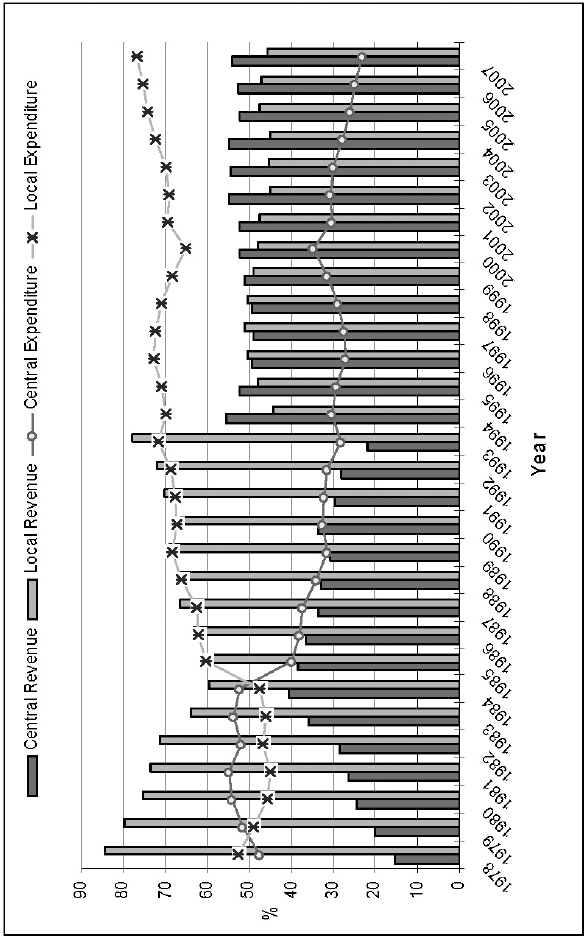
Ratio of Central/ Local Government Budget Revenue and Expenditure (1978–2007)
The mismatch of revenue and expenditure responsibilities is particularly stark at the county and township levels, which are responsible for providing the bulk of public services such as basic education and healthcare (Ong 2006: 380).
The imbalance between resource extraction and the obligations of service delivery makes it difficult
to create an effective intergovernmental fiscal system, because the level of spending a local government is to undertake to implement national policies is unclear (Dollar and Hofman 2008: 46).
Often, the central government sponsors various programmes without providing sufficient funds and these unfunded mandates simply translate into various fees and charges for the farmers. For example, although overstaffing of local bureaucracies does exist, the largest item in local budget outlays is education, which, on average, constitutes approximately half of local budgets. According to Hussain and Stern, counties and townships account for 70 per cent of budgetary expenditures on education (Hussain and Stern 2008: 21). Part of the education expense comes from local obligations to implement central government-sponsored programmes promoting nine-year compulsory education (pujiu dabiao). While the central government promulgated a law on compulsory education in 1986 and another law on education in 1995, its share of expenditure on compulsory education by 2002 was only approximately two per cent compared with 78 per cent for township governments, nine per cent for county governments and 11 per cent for provincial governments (Jingji Cankao Bao 2002; Nongbowang 2003).
Given the cancellation of rural education fees and other ad hoc charges as part of the tax-for-fee reforms together with the worsening township budget crises, many rural schools have experienced severe financial difficulties (Kennedy 2007). Many teachers have resigned because they are either underpaid or not paid at all. This, in turn, has caused the quality of education in many rural areas to deteriorate. In response, the State Council has decided to place responsibility for rural compulsory education, in particular the payment of teachers' salaries (yi xian weizhu), with county-level governments (Xie 2002; Guowuyuan 2002). But county-government budgets are not necessarily in better shape, especially in the poor agrarian regions in the interior. For example, by the end of 2003 the total debt burden for the county-level governments alone in Anhui stood at 18.1 billion CNY, with an average of 229 million CNY for each county (Nongbowang 2004b). According to a researcher from the Ministry of Finance, in 1998 and 1999, respectively, 31.8 per cent and 35.5 per cent of county-level government budgets nationwide were in the red (Xue 2002).
Intergovernmental Transfers and Rural Public Finance
To compensate for local governments' revenue losses, the central government has substantially increased subsidies through intergovernmental transfers. According to a World Bank study, transfers took up approximately 70 per cent of central government revenues between 2000 and 2004 and “financed half of the total budgetary expenditures of sub-national governments” in 2004 (World Bank 2007: 50).
Intergovernmental transfers take several forms. Shah and Shen classify them into two broad categories: general-purpose transfers and specific-purpose transfers. Within general transfers, there are revenue-sharing transfers; tax rebates; and equalization transfers, which were set up in 1995 to ease widening regional disparities. Specific-purpose transfers include grants for increasing the wages of civil servants, grants to support rural tax-for-fee reform, grants for minority regions and other ad hoc transfers or earmarked transfers (Shah and Shen 2008: 130–131). The structure of provincial-local fiscal transfers and subprovincial transfers is similar in form and includes both the general-purpose and specific-purpose transfers. According to Shah and Shen, in 2004, the three largest transfers were revenue-sharing transfers (469.5 billion CNY), tax rebates (404.97 billion CNY) and earmarked transfers (322.33 billion CNY). Together they constituted more than 80 per cent of all the central-provincial transfers (Shah and Shen 2008: 131).
Within the current structure for intergovernmental transfers, both the revenue-sharing and tax rebates are highly disequalizing because they go mostly to rich coastal regions with a strong tax base. While the central government established the equalization transfer in 1995 and the fund has grown rapidly, its impact is minimal given the grant's small pool, which in 2004 accounted for only approximately five per cent of total central transfers (Lou 2008: 160; Shah and Shen 2008: 136, 141; Yep 2004: 57–60; Shi et al. 2009: 13). The remainder of central transfers are largely ad hoc or earmarked transfers (Shi et al. 2009: 17; Wang, Lu, and Zhou 2009: 7). These funds often have their own purposes and implementation mechanisms. The use of earmarked funds in part reflects central government's distrust of local officials and fears that the transfer funds will be diverted for purposes other than their designated targets (Liu and Tao 2007: 181–182). However, the proliferation of earmarked funds puts more constraints on local-government budgets because they often require matching funds. Also, their ad hoc and opaque nature not only leaves plenty of loopholes for corruption but also undermines any meaningful autonomy in local budget decisions (Wang, Lu, and Zhou 2009: 8–9).
While central government transfers have increased substantially, they are still far from adequate to make up for lost revenue and cover the current expenditure needs of local governments (Ong 2006: 380). In addition, China's current intergovernmental transfer system is not efficient. Because they have to filter through multiple layers of the administrative hierarchy, the growing number of transfers has increased the complexity and inefficiency of financial management at the local level (World Bank 2007: 98). The amount of transfers to support rural public finance is small to begin with, and even less trickles down to the grassroots level. With the absence of clear rules for sharing between different levels of governments, many of the funds may well get lost in filling the fiscal gaps of higher-level governments (Chen 2008: 314). As Oi and Zhao have found,
some of the money never reached their intended targets. One township had no direct access to its share because the county held and allocated the funds. In another township, funds were sent directly to the villages, with the township receiving nothing (Oi and Zhao 2007: 84).
Given the mismatch between declining revenue resources and the continuation of expenditure requirements, the proliferation of projects initiated from above has pushed local officials to frantically seek new sources of revenue, particularly through the sale of land and other assets to developers and investors. According to Han Jun of the Development Research Center of the State Council, in some counties and municipalities land transfer fees constitute approximately 35 per cent of local government revenue and in some places this number can be as high as 50 per cent. Also, in some counties and municipalities between 60 and 70 per cent of funds for local infrastructure construction comes from land sales. Often, local governments confiscate land from farmers at low prices and then transfer it cheaply to local firms or at a higher price to commercial developers (Han 2006). According to Lin, Han, Duan and Qin, approximately 60–65 per cent of funds from land sales goes to local governments. Collectives receive approximately 25–30 per cent of the funds, while farmers are left with only 10–15 per cent. Thus, land has become a major source of revenue for many local governments (Lin et al. 2007).
The seizure of land without proper compensation to farmers has been the main cause of a new wave of disputes and even violent clashes between local officials and farmers in rural China. According to a study by the Development Research Center of the State Council, approximately 80 per cent of farmers' petitions to higher levels of government are related to land disputes (Xie 2006).
In response to the growing number of land-related conflicts, the government issued a “State Council Memo on Strengthening Adjustment and Control of Land” in September 2006, stipulating sufficient compensation and resettlement fees for rural residents when their land has to be taken away for public use. The remainder of the funds obtained from the sale of land should be used mainly for rural development and infrastructure construction (Lin et al. 2007). However, given the severe financial stress experienced by local governments, it is very unlikely that local officials will be able to abide by these rules.
Deepening Administrative Reform
Given the circumstances, there is increasing pressure to restructure local governance institutions through the reduction of staff and mergers of townships in order to cut down administrative costs and consolidate the reforms of the fiscal system. Since 1998, more than 7,400 townships have either been eliminated or merged. In 2005 alone, more than 1,600 townships were eliminated. This was followed by another cut of 798 more in 2006 (Zhongxinwang 2007). However, this task is very challenging in the poor agricultural regions in the interior. With limited alternative employment opportunities and continuing pressure from higher-level governments to find employment for college graduates and demobilized military officers, cutting the number of personnel at the township and county levels turns out to be much more difficult than reducing the number of administrative units (Interview in Henan, 2004, 2006).
To deal with this problem, the central government decided in 2005 to provide subsidies as an incentive to local governments based on the number of townships reduced and personnel cut. For each township eliminated, the subsidy was 400,000 CNY. For each person cut, it was 3,000 CNY (Jingji Ribao 2005). More recently, the award has increased to 500,000 for each township eliminated and 4,000 CNY for each person cut (Caizheng bu 2008). According to a report in the Renmin Ribao, between 2005 and 2007 the central government transferred a total of more than 70 billion CNY to local governments in order to support tax-for-fee reform and the cancellation of agricultural taxes and to restructure local governance institutions (Renmin Ribao 2007a).
As an essential part of the comprehensive rural reform, more reforms are currently under way to further streamline local institutions of governance. As mentioned previously, major experiments include direct provincial supervision of county financial management and county management of township finances. The former reform was first introduced in Zhejiang and, with positive results, is now being piloted in 24 prov-inces/ municipalities. It is to be expanded to cover the whole country, except the ethnic minority autonomous regions, by 2012 (Zhongguo Jingji Zhoukan 2007).
Having already been adopted in 29 provinces/ municipalities, county management of township finances is regarded as being key to the success (or failure) of the ongoing reform of the rural public-finance system. Given the difficulty of reducing the number of employees, county management of township finances is intended to force townships to streamline the number of employees and cut personnel costs (Xin-huanet 2009; Sheng 2009; Shishi Zhongguo 2009).
As noted above, the objective of these reforms is to reduce the current five-tier administrative system to a three-tier system. The hope is that by cutting the number of layers in the Chinese administrative hierarchy, personnel costs can be reduced, thereby relieving local governments from their current financial stress and improving government efficiency.
Extending Public Finance to Cover Rural Residents
The focus on the reduction of administrative personnel could, however, divert attention away from pending crises in other important areas, in particular the provision of public goods and services. Since county and township governments bear the primary responsibility for providing public goods and services for rural areas, a lack of sufficient funds could undercut their ability to carry out these responsibilities (Hussain and Stern 2008: 21; World Bank 2007: 32).
Already, due to years of neglect and lack of funding, basic social services in rural areas and infrastructure such as irrigation and flood control have deteriorated greatly. For example, according to a study of 129 townships in Hunan province, 89 per cent suffer from serious debt problems. Strapped with debt, 74 per cent of them rarely provide assistance to the rural poor and needy, and 15 per cent have never provided any help. Furthermore, 68 per cent of these townships rarely invest in basic infrastructural projects such as country roads and water-control systems; nine per cent have never done so (Chen Wensheng 2006; Wang 2008).
According to another report by a researcher from the State Council, of the 402 large, designated irrigation projects of the Ministry of Water Resources with a size of over 300,000 mu, 2 114 have not been modified with water-saving technology due to a shortfall of four million CNY. Of the medium-sized irrigation projects over 10,000 mu, 5,000 are still short of funds. And despite a plan initiated in 2000 to provide rural areas with clean drinking water and an investment of 20 billion CNY between 2004 and 2005, 320 million rural residents still had no access to clean drinking water by 2006 (Ye 2006).
1 acre = 6.07 mu.
The seriousness of the decay of rural infrastructure and rural public services is partly reflected in disastrous floods, ongoing severe drought in most parts of China, overcrowded rural schools and public health crises such as AIDS and avian flu. According to Chen Xiwen, each year approximately 50 billion catties of grain are lost due to natural disasters (Chen Xiwen 2006). The budget crisis at the local level and the low morale of officials caught up in the restructuring of the local administrations only makes the situation worse.
In response to the crisis of the rural public service, the government formally launched an initiative to build a new socialist countryside in 2006. The objective is, in Premier Wen Jiabao's words, “to extend public finance to cover rural areas” as an important part of urban-rural integration. Key to this new policy is increasing funding for rural education, expanding the new cooperative health care scheme to help cover the cost of major illness for rural residents, and building up rural infrastructure.
First, as early as 2005, in response to the dire situation of rural education, Premier Wen Jiabao announced that all poor students undergoing compulsory education in counties designated by the government for poverty-relief would be exempted from book fees and miscellaneous charges and would be given lodging allowances in boarding schools (liangmian yibu). In 2006, tuition and fees for compulsory education were eliminated for rural students in the western region; from 2007 this policy was extended to cover all students in rural areas across the country. 3 In addition, students from poor families in these areas began to receive free textbooks 4 and supplementary allowances for their living expenses at boarding schools. 5 As part of an equalizing effort, the funding of these programmes is based on a formula where the central government covers 80 per cent of the costs of the exemption from miscellaneous fees for the western regions and 60 per cent for the central region in addition to all the free textbooks for both regions. The central government will provide funding for some eastern regions based on their specific financial conditions. The remainder of the costs are to be shared by provincial and local governments. To date, most of this funding has been provided by provincial governments (50 per cent in the central and eastern regions and 100 per cent in many western regions) (Renmin Ribao 2007b). The government has also revised its financial aid policy to support college students from low-income families.
This policy began to cover urban areas from the fall of 2008.
This policy was extended to cover all rural areas from the fall of 2007.
From the fall of 2008, the same treatment will be extended to cover students from urban poor families as well.
Second, in 2003, the central government began the construction of a new cooperative health care scheme (xin nong he) in rural areas. Under the new system, each participating farmer contributed 10 CNY and the central and local governments contributed 10 CNY each, for a total of 30 CNY per year. From 2006, the central and local governments increased their contributions to 20 CNY each for any participant in the western and central regions. With farmers' own contributions of 10 CNY, the total was then 50 CNY (Interviews in Henan and Beijing, 2006). In 2008 the central government decided to further increase the contribution from both the central and local governments to 40 CNY each and farmers' contributions to 20 CNY, creating a pool of 100 CNY (Zhou et al. 2008). According to the Ministry of Health, by mid-2008, 2,679 counties, approximately 98.2 per cent of all counties with a sizable rural population (or 93.6 per cent of all counties in China), had been covered under the new cooperative health care scheme – more than 804 million people or 91.1 per cent of the total rural population (Weisheng bu 2008).
In addition, in 2007 the government also began developing a basic social security scheme to provide a basic social-safety net in rural areas. By September 2008, more than 31 provinces, autonomous regions and municipalities were already participating in the experiment, which at that time covered 37 million poor rural residents. The annual coverage is between 600 and 2,560 CNY depending on the basic needs of a particular region. Currently, the annual average payment is 857 CNY per person. This will be adjusted based on corresponding changes in the costs of living. So far, funding for this project has come mostly from provincial and local governments. In the first half of 2007, the central government contributed 3.08 billion CNY while local government contributions were as high as seven billion CNY (Minzheng bu 2007; Pan 2007; Nongmin Ribao 2007).
At the same time, both the central and local governments have begun to increase investment in rural infrastructure such as roads; electricity; clean drinking water; sanitation; new energy, such as biogas; and environmental protection, including garbage disposal and new latrines (Ma 2006). In 2006 governments at various levels invested a total of 45 billion CNY 6 to build and improve 119,200 kilometres of road (96,000 kilometres in east and central China and 23,200 kilometres in western China); the central government contributed 17.5 billion CNY (Gao 2007; Chen 2007). In 2006/2007, with the support of 2.5 billion CNY from the issuing of government bonds, approximately 9.5 million rural households became users of biogas (Dong 2008).
In another report by Chen Xiwen, it is 43 billion CNY (Chen 2007).
The problem with so much investment is that the promised funding has to travel a long way to reach the targets. This often opens the doors for corruption. A 2008 audit found that central government ministries “misused or embezzled” more than 600 million USD in 2007 and that another six billion USD in government funds were “mismanaged” (New York Times 2008). A more recent audit of ten provinces found that approximately 2.7 billion CNY designated for rural development projects has been diverted to other uses, including 58.37 million CNY for the purchase of apartments and cars (Cui 2009).
Conclusion
In recent years, China's central government has introduced a series of reforms to restructure the rural public financial system. Fiscal reforms have included tax-for-fee reform, the abolition of agricultural tax, an increase in intergovernmental transfers to compensate local-level governments for lost revenue, the extension of public services to cover rural residents, county management of township finances, and direct provincial supervision of counties' financial management. At the same time, as an essential part of the comprehensive rural reform, parallel reforms of the administrative system have also been under way in order to support and complement the reform of the rural public financial system. The goal is to streamline local institutions of governance through the merging and elimination of administrative layers and units in order to cut personnel costs, which have severely constrained local-government finance.
While these reforms have drastically reduced farmers' burdens and improved their welfare, they have also precipitated a debt crisis that threatens the fiscal viability of many local governments, especially those in poor regions. To ease the financial stress of local governments and to stabilize the countryside, a comprehensive reform that defines and rebalances expenditure assignments to match responsibilities with financial and management capacities is required. This would entail the revamping of the intergovernmental fiscal system so that local governments would have sufficient resources through their own taxes, user fees or intergovernmental transfers to perform their assigned responsibilities (World Bank 2007: 103). The World Bank also recommends the creation of a responsible system for local borrowing (World Bank 2007: 4, 7, 104). However, due to the possibility of abuse by local governments, current experiments in this direction are very cautious. The Ministry of Finance recently issued bonds on behalf of several provinces. Given that local governments are already laden with debts, the market has not responded very enthusiastically.
The dire situation of rural public finance and the growing instability in the countryside have exposed a deep structural problem in the Chinese political economy: the discrepancy between extraction demands and service obligations. On the one hand, local officials are continuously subjected by the cadre evaluation system to certain performance criteria that require them to be proactive (Whiting 2001: 100–118). On the other hand, their ability to live up to these criteria is increasingly hemmed by the political and fiscal constraints resulting from the recentralization of financial resources and the promotion of village elections, the tax-for-fee reform and the abolition of agricultural taxes. Recent experiments with direct provincial supervision of county financial management and county management of township finances could further erode local governments' fiscal autonomy. As Yep points out, Beijing cannot continue “to reduce the rural crisis as an agency problem”. Such
political expediency can be costly in the long run, as it obscures the knowledge that the root of growing tension runs deeper than the cadre discipline problem (Yep 2004: 68).
Yep argues that
malaise in rural China is simply a symptom of a more pertinent problem of declining state capacity. For the local state, the extractive capacity has been significantly weakened by the demise of the collective framework and the inherent compulsory grain procurement system (Yep 2004: 69).
This has been made even worse by recent, and somewhat contradictory, efforts to restructure rural public finance. “The mismatch between extraction modes and the changing locus of income growth” has led to “the paucity of financial resources for rural administrations and hence weaken[ed] the state capacity for redistribution and regulation” (Yep 2004: 69). The weakness of local institutions of governance has opened the door for the emergence of a rather chaotic situation in the countryside. What is worse is that farmers' expectations might already have been raised too high as a result of the many benefits and promises given to them. The discrepancy between growing expectations, raised by higher-level authorities, and the inability of local agents to fulfil promises due to lack of resources can be partly blamed for the recent flare-ups of instability in rural China and beyond. Many parts of rural China have already descended into a state of anarchy (Zheng 2009).