




Abstract
In March 2006, China's National People's Congress officially promulgated the central government's intention to “build a new socialist countryside”, a new policy initiative and approach to rural development. Drawing on fieldwork conducted in two Chinese counties in 2008 and 2009, this article investigates how the new policy is being substantiated and implemented at the local level. It argues that by combining China's new fiscal system of transfer payments to poor local governments with administrative reforms, intensified internal project evaluation, and efforts to increase the rural income through a mixture of infrastructural investment, agricultural specialization, the expansion of social welfare, and accelerated urbanization, “building a new socialist countryside” constitutes more than a political slogan and has the potential to successfully overcome rural poverty and the rural-urban divide.
Introduction
The intention to “build a new socialist countryside” (shehui zhuyi xin nongcun jianshe, hereafter XNCJS) was proclaimed at the end of 2005 during the fifth plenary session of the Sixteenth CCP's Central Committee and officially approved as a government policy by the National People's Congress in March 2006. To outside observers it appeared to be yet another abstract “vision” issued under the leadership of Hu Jintao and Wen Jiabao, similar to “building a socialist harmonious society” (shehui zhuyi hexie shehui). However, we argue that XNCJS is more than just a political slogan – though less than a substantial policy change – for tackling the “three rural issues” (sannong wenti): agriculture (nongye), villages (nongcun) and farmers (nongmin) (see e.g. Li 2001 and 2002; Wen 2005).
XNCJS should be regarded as a policy framework or macro-policy. We use the term macro-policy to denote a policy framework that features a central stimulus in terms of slogans and rough guidelines for implementation, while delegating the main work of policy concretization to local governments. Taken in this sense, XNCJS prompts the local governments to reorganize, streamline and focus their efforts to promote comprehensive rural development, which is primarily understood as infra-structural and agricultural modernization linked to ecological sustainability, and the provision of public goods such as social welfare and basic education. Some authors argue that this practice of merely launching a programmatic cap may result in uncoordinated implementation activities (see e.g. Linda Chelan Li 2007) or the simple re-labelling of existing measures at the local level. Still, we have found that this “practice” is just as capable of entailing coordinated and efficient policy implementation. The central aspects of XNCJS are an increase in rural incomes and the transformation of the countryside through the promotion of urbanization and a gradual reduction of the rural population. The XNCJS policy cannot be separated from China's fiscal reforms since the early 2000s: The rural Tax-for-Fee Reform, the subsequent abrogation of various agricultural taxes and most rural fees, and the gradual conversion of the Chinese fiscal system into a transfer system that channels central government funds to local governments – instead of forcing them to finance the provision of public goods and investment in rural development by themselves – have been key to the implementation of XNCJS.
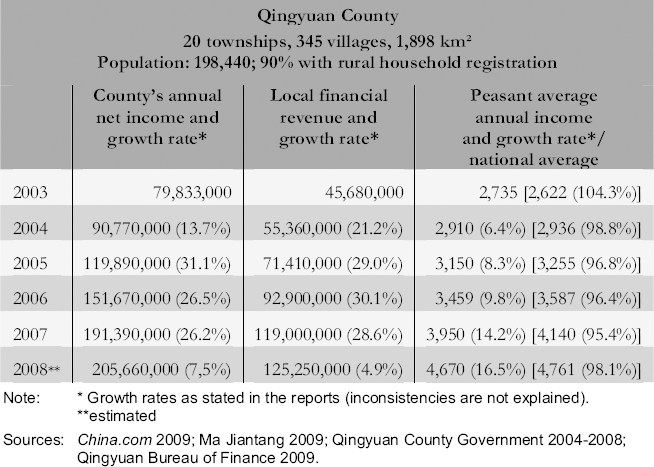
Note:
Growth rates as stated in the reports (inconsistencies are not explained).
estimated
Sources: China.com 2009; Ma Jiantang 2009; Qingyuan County Government 2004–2008; Qingyuan Bureau of Finance 2009.
Basic Economic and Social Development Indicators for Mizhi and Qingyuan Counties (CNY)
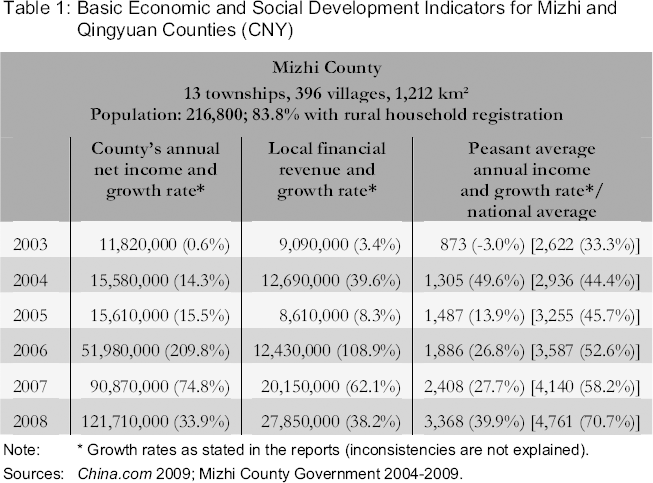
Note:
Growth rates as stated in the reports (inconsistencies are not explained).
Sources: China.com 2009; Mizhi County Government 2004–2009.
Qingyuan County XNCJS Project Evaluation Undertaken by Lishui City, 2008
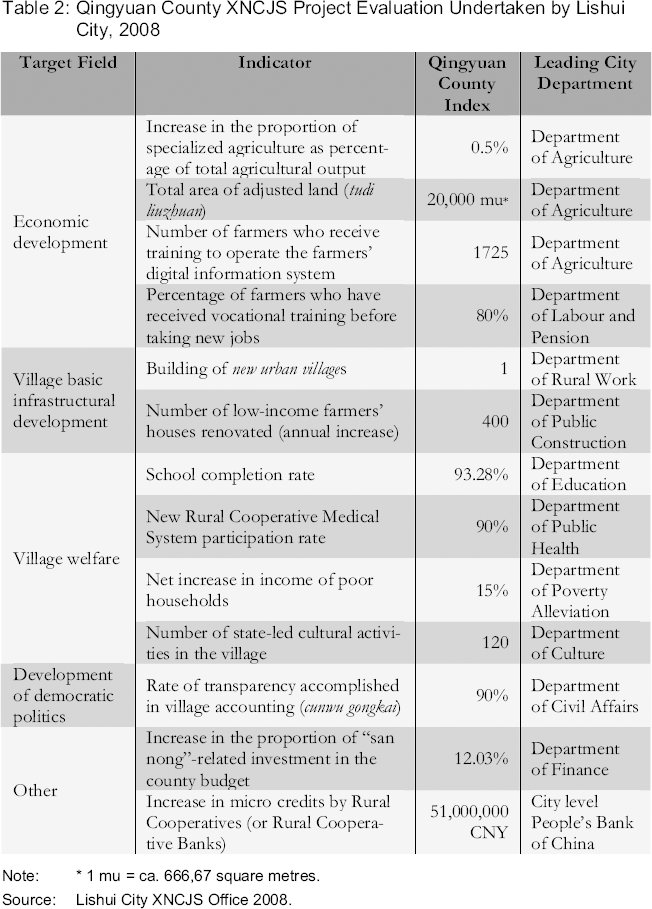
Note:
1 mu = ca. 666,67 square metres.
Source: Lishui City XNCJS Office 2008.
By drawing on qualitative and quantitative data gathered in two Chinese counties, this article 1 focuses on the formulation (agenda setting) and implementation of XNCJS at the county and lower administrative levels, as it is here where its empirical effects become most visible. We describe the concretization of the central government's framework through the formulation, implementation and evaluation of local projects. We then present preliminary findings from our ongoing project concerning local development strategies, project funding (including the fiscal allocation of project funds through the administrative hierarchy) and official project assessment. We conclude with a summary of our findings and a tentative conclusion on how to adequately understand the central government's XNCJS policy.
The findings presented in this article stem from a research project on strategic groups, rural transformation and local policy-making with a special focus on the county and township levels, led by Gunter Schubert and Thomas Heberer (University of Duisburg-Essen) and sponsored by the German Research Foundation (DFG). We wish to thank Björn Alpermann, Christian Göbel and René Trappel for their comments on earlier drafts of this article.
Fieldwork for this article was conducted in August and September in both 2008 and 2009 in Mizhi County, located in the north-western province of Shaanxi, and two of its townships (including two villages in each township) and in Qingyuan County, located in the south-eastern province of Zhejiang, with an equal number of townships and villages. Mizhi is classified as a national-level “poor county” (pinkun xian). Though Zhejiang Province abolished the “poor county” category in the late 1990s, 10 out of twenty townships in Qingyuan County were still classified as “lacking development” (qian fada) at the time of our field-work. In 2008, the average annual per capita income was 3,368 CNY in Mizhi and 4,670 CNY in Qingyuan, whereas the national average for that year was 4,761 CNY (China.com 2009) (see Table 1). Almost 90 per cent of people living in both counties held a rural household registration (hukou).
In both years we talked to some 30 local cadres at the county, township and village levels at each of our fieldwork sites; assembled data on local budgets and public finances; and collected official documents and statistics concerning the implementation of XNCJS projects, with respect to planning, funding and evaluation (kaohe). We also conducted supplementary interviews with cadres at the city and provincial levels and gathered XNCJS-related materials and public finance statistics at those levels as well. All interviewing was based on semi-structured questionnaires, adjusted to the specific circumstances of the different administrative layers. We asked our interviewees to speak freely on, among other topics, their interpretation of XNCJS and its impact on local development, XNCJS-related agenda setting and local development strategies, the process of project application and funding, and project evaluation. Finally, we spoke with a number of scholars specialized in rural development and public finance who were affiliated with research institutions and universities in Beijing, Xi'an and Hangzhou.
Policy Formulation
XNCJS has been officially defined according to five overarching objectives summarized by 20 characters (ershi zi mubiao) that are meant to guide the formulation of project initiatives: advanced production (shengchan fazhan), rich life (shenghuo kuanyu), civilized (local) atmosphere (xiangfeng wenming), clean and tidy villages (cunrong zhengjie) and democratic management (guanli minzhu) (see State Council 2006; Li Jiange 2007). These objectives are then substantiated by the provincial governments, which set up a broad development programme to be handed down for further specification by the cities and the counties. The counties are assigned the task of translating these guidelines into specific projects to be executed, at least theoretically, in close cooperation with the townships and villages (see below).
Over the course of our interviews, it became apparent that local cadres at both of our fieldwork sites did not see a substantial change between the pre- and post-XNCJS eras in terms of project formulation and context. Instead, they tended to make a functional distinction between two dimensions of XNCJS, as was most clearly spelled out by the director of the Department of Finance (caizhengbu) in Mizhi:
The meaning of XNCJS is very complex. Basically, you have to distinguish between a narrow (xiayi) and a broad (guangyi) conception of the term. In the narrow sense, XNCJS means nothing more than our government departments' daily work, such as the construction and maintenance of retaining dams, the provision of sanitary services, etc. In the broader sense of the term, XNCJS does not necessarily refer to the formulation and implementation of specific projects. It means much more the comprehensive development of a new rural society, including education, public sanitation, social welfare and measures to increase the rural income, that is, a complex setting which must be negotiated between the relevant departments. This comprehensive approach is the “New” in the term “Constructing a New Countryside”. The most important manifestations of XNCJS are (1) the concretization of policies passed down from above in order to facilitate local implementation, (2) an increase in the absolute and relative volume of central government subsidies (butie) for rural development, and (3) the strong emphasis in our work on rural construction (Interview, September 9, 2008).
Our interviewees, who worked in the different bureaus and offices of the county and township governments concerned with implementing XNCJS projects, often enumerated a whole array of different measures regarded as integral components of the task of constructing a “new socialist countryside”. These included the following:
Agricultural specialization, intensification and technological modernization
Reallocation and consolidation of agricultural land holdings
Resettlement of peasants to new apartment blocks in nearby towns
Reforestation
Water reservoirs and irrigation
Enhancement of quality of potable water
Improved energy efficiency, for example, through the building of small biogas plants (zhaoqichi) in the villages
Road construction and maintenance
Improved sanitation
Expanded social welfare services, most importantly comprehensive medical insurance and minimum allowances for jobless villagers
Provision of micro-credit schemes
Vocational training for peasants and migrant labourers
“Digitization” of villages and the provision of comprehensive cable television and Internet access to all rural areas
Construction of schools with on-site dormitories
Strengthening of accounting transparency (cunwu gongkai) and democratic decision-making in the villages
Advocacy schemes to support model villages (shifan cun, mofan cun) as local development leaders
Naturally, the specific content and design of these measures on the ground depends on the foci of the development plans (fazhan guihua) as defined by individual counties, as well as on each county's fiscal resources and ability to mobilize the townships and villages to participate in project formulation and project applications (see below).
In both of our counties, XNCJS figured prominently as a terminological reference to the two respective rural development strategies; as a matter of fact, the counties' conception of XNCJS was fairly identical. On the one hand, as our interviewees at the county level almost unanimously stressed, XNCJS delivers extended funding and has led to the significant restructuring of previously existing developmental initiatives; on the other hand, it enables the county governments to launch new projects. Mizhi has focused on poverty reduction and the development of the local infrastructure, mainly through the construction of roads, water reservoirs, and small biogas stations attached to village households. Moreover, the county is pursuing agricultural intensification and specialization, mostly in terms of “one village, one product (yi cun yi pin)”. The financial upgrading of the New Rural Cooperative Medical System (NRCMS) (nongcun xinxing hezuo yiliao zhidu), launched in 2003 (see e.g. State Council 2003 and Klotzbücher 2006), and the gradual expansion of the Rural Minimum Allowance System (zui di shenghuo baozhang zhidu, or dibao) (see e.g. China.com 2007; Xinhua 2008) over the past few years were also described to us in Mizhi, as they were in Qingyuan, as core achievements attributable to the central government's XNCJS policy.
Qingyuan promotes a multidimensional approach to rural development. While the intensified production of a limited range of agricultural products (tese nongye) with modern technology is being pursued – similarly to what is being done in Mizhi – we also encountered strong efforts to encourage the creation of farmers' cooperatives (nongmin zhuanye hezuoshe) and small-scale ecologically sustainable rural industries (shengtai gongye). Moreover, and in contrast to Mizhi, an urbanization model directly related to XNCJS is being applied. The most remote and underdeveloped villages along the mountains surrounding Qingyuan are slated to be “abandoned”. Inhabitants are being encouraged to move to “new villages (xin cun)” at the outskirts of Qingyuan town. As a matter of fact, the county government encourages all villagers to move down to the city and find jobs in the local industrial and service sectors, thus relieving the county from the pressure to allocate money to areas where economic development is unlikely to be successful for geographic and/ or demographic reasons. Furthermore, eco-tourism is being vigorously promoted, as Qingyuan was classified as “China's No. 1 Eco-environment County” (Zhongguo shengtai huanjing diyi xian) in 2004 and a “National Ecological Model County” (guojiaji shengtai shifanqu) in 2005. An expressway that will link the remote county to the coastal metropolises is under construction and, as the local cadres repeatedly emphasized, will spur the transformation of Qingyuan into to a modern rural county.
Finally, Qingyuan has begun to set up so-called service centres or stations (fuwu zhongxin/ zhan) in each township and village in order to better respond to the people's administrative requirements and livelihood needs. This scheme was introduced in 2004 to give substance to the idea of service-oriented (fuwuxing) local government and skilled (jinengxing) cadres. It was claimed by our respondents to be the result of the rural Tax-for-Fee Reform, which did away with the township and village cadres' main task of collecting taxes and fees. These cadres were then assigned to receive special training (peixun) in rural work assistance (nongcun gongzuo zhidao), industrial development (gongye fazhan), social stability and mediation (weiwentiao). Qingyuan also installed “integrated party and government offices” (dangzheng zonghe bangongshi) in every township, putting together different administrative units in order to enhance service efficiency for the villagers. Interestingly, this “Qingyuan model” also operates under the label of grass-roots party-building (jiceng dangjian) and one of its main objectives is the reduction of township personnel (see Zhu 2008; Zhejiang Party School (n/a); Qingyuan County Organization Department 2006).
Both counties have a couple of model villages (shifan cun) that figure as showcases of their rural development strategies. In Mizhi, there are now 30 county-level model villages for agricultural development. Among them, Gaoxigou and Liujiawa have received particular renown (see e.g. Meng 2006). Concurrently, there are a number of city-level model villages that partially overlap with those that already enjoy model status at the county level. Zhejiang Province began to gradually abolish the practice of establishing model villages in 2008. Still, we identified the existence of special funding and incentive structures for focal villages (zhongdiancun) at both the county and city levels, that is, villages that figure as models with respect to specific policies or projects. In relative terms, all these villages seem to receive the largest portion of XNCJS funds passed down to the county, though this is hard to prove, as the corresponding figures remain inaccessible to external observers. These special project funds or incentive payments are usually separated from other XNCJS-related monies in the county government's accounts and are administered by the Party Bureau of Rural Works.
All cadres emphasized that the local government did not neglect the other villages and that the authorities pursued a strategy of homogeneous development. However, they also admitted that the model villages are at an advantage when it comes to successful applications for project money each year, since their performance sheets are usually far better than those of villages that do not hold “model” status.
Though most of the projects today designated as XNCJS measures in Mizhi and Qingyuan were decided upon and in the process of implementation before 2006, when the policy was “sanctioned” by the central government, some of them were introduced afterwards. Most importantly, however, the county governments see themselves as being forced to bring all their development initiatives together within a coherent local policy framework that highlights their engagement in putting XNCJS into practice. This framework rests on three pillars: project application, project funding (that is, implementation) and project evaluation.
Policy Implementation
As emphasized above, according to the XNCJS guidelines stipulated by the central government (State Council 2005), policy implementation must be part of an integrative approach that links all individual initiatives in the most coherent way possible. Hence, in the eyes of our respondents, what distinguishes XNCJS from previous development efforts is, to begin with, the new degree of interdepartmental coordination throughout the process of policy formulation and implementation. For this purpose, Mizhi and Qingyuan counties have established two coordinating bodies: the XNCJS Office (xin nongcun bangongshi or xinnongban) and the Leading Small Group for XNCJS (xinnongcun jianshe lingdao xiaozu). The XNCJS Office, though formally an independent unit in the government hierarchy, is actually attached to the Party Department of Rural Works (nonggongbu). 2 Its major tasks are the administration of specific XNCJS measures (usually in the realm of agricultural development), the coordination (xietiao) of projects related to the competencies of different government departments, and the gathering of data and statistics to document project implementation. The XNCJS Office functions, in a way, as the standing body of the Leading Small Group, which is the decision-making centre in the XNCJS policy process. 3
The designation nonggongbu is still predominant in Shaanxi Province. In Zhejiang Province, however, this unit is called nongcun gongzuo bangongshi, or nonggongban.
While the XNCJS Leading Small Group is mainly responsible for the coordination and administration of project work, in Mizhi it is assisted by a Leading Small Group for the Integration and Coordination of Rural Support Funds (zhinong zijin zhenghe xietiao lingdao xiaozu), which operates at the city level and oversees the appropriate and effective distribution of project funds (see Ma Weiji 2009: 36).
The Leading Small Group is usually led by the county party secretary (shuji), the county commissioner (xianzhang), their deputies, and representatives of the major government bureaus in charge of XNCJS implementation – most notably the Bureau of Agriculture, the Bureau of Public Construction, the Bureau of Transport, the Bureau of Public Health, the Bureau of Civil Affairs, the Reform and Development Commission (fazhan he gaige weiyuanhui, or fagaiwei) and the Bureau of Finance. The Leading Small Group meets only once a year to determine the allocation of funds earmarked for rural development in the broad sense defined above (see Figure 1). Obviously, both the XNCJS Office and the Leading Small Group are closely monitored by the County Party Committee (xian changwu weiyuanhui).
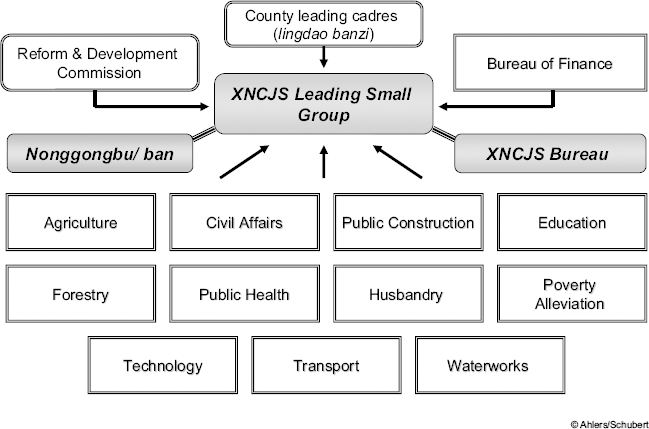
XNCJS-related Government Bureaus and Coordinating Agencies at the County Level
How are measures declared as XNCJS projects put on track? As mentioned above, the county defines a development strategy or plan (guihua) that is broadly determined by XNCJS regulations passed down from the provincial and city governments (which must set up their own development strategy) and then spelled out in more detail to respond to local conditions and priorities. This process tends to be quite time-consuming. It is steered by the county's Development and Reform Commission and finally decided by the County Party Committee. It is then up to the villages and townships to decide on specific projects that correspond to the county blueprint and apply for project funding. At first glance, project design and application thus appears to be a bottom-up process by which the township governments communicate to their villages the eligibility of different projects for application; the villages decide which specific projects to implement and then report back to the townships, which eventually select the villages they deem qualified to apply for funding. This information is ultimately forwarded to the county. The selection of villages, however, cannot completely circumvent the county government's opinions, especially if this choice is linked to the promotion of (new) county-level model villages.
The application process, including the period of preliminary project design at the village and township levels, usually takes three months (from January to early March). Following this period, the county government's Reform and Development Commission screens the proposals and, following intensive bargaining and coordination (xietiao) between all bureaus concerned, which are later required to administer the project funds according to their formal competencies, submits an allocation proposal to the Leading Small Group. This body decides which projects will be implemented. Afterwards, the selection results are passed on to the city (in the case of Mizhi) or provincial (in the case of Qingyuan) government's own Reform and Development Commission and XNCJS Leading Small Group, the latter of which has the final say on the project list and disburses the funds to the responsible county departments.
During our fieldwork, we came across two slightly diverging patterns of XNCJS implementation in our two localities, mainly due to the different status of the two prefecture cities (dijishi) “leading” (zhidao) our counties. While Yulin City exerts overall top-down control over Mizhi County, Lishui City does not rank above Qingyuan County in terms of fiscal policy. This difference is due to an administrative innovation which was adopted in Zhejiang Province on an experimental basis in the mid-1990s as the first among a handful of other provinces where it was tentatively put into practice. The reform placed the county under the direct financial supervision of the provincial government, thus minimizing the city's authority over the county level (as is normally the case in the usual “one-level-down” fiscal system). However, as we were told by Lishui officials, the city still exercises a certain degree of authority via financial incentives for selected projects and, most importantly, through its oversight of the cadre evaluation system. This set-up, termed “the province administers the county (sheng guan xian)”, is supposed to reduce transaction costs and spur county-level development. The reform's success has initiated continuing discussions about nationwide implementation, for which the eleventh five-year plan in 2006 made further provisions (see Lin and Hu 2006; Liu 2008). For an outline of the two different approaches to project application and funding see figures 2 and 3.
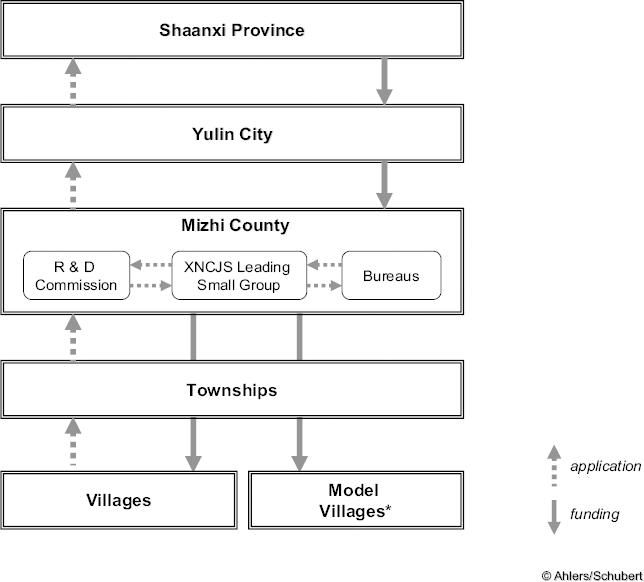
Application Process and Funding of XNCJS-related Projects: Mizhi County
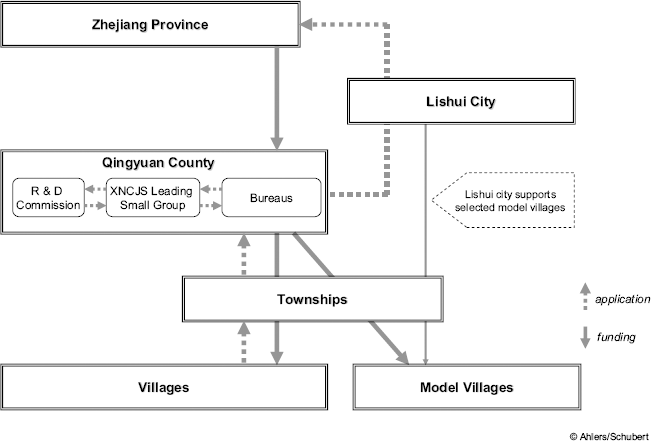
Application Process and Funding of XNCJS-related Projects: Qingyuan County
Because both Mizhi and Qingyuan are designated “poor counties”, all XNCJS-related project funding is completely channelled through the fiscal transfer system (zhuanyi zhifu zhidu) established in the course of the rural Tax-for-Fee Reform – that is, the termination of most local taxes and fees since the start of the decade (see e.g. Shah and Shen 2008). Since the reform, the flows of fiscal transfers to both Mizhi and Qingyuan counties have increased steadily, allowing the county governments to expand the scope of and financial backing for their local development strategies rather substantially. Official figures for transfer payments to the local governments are unavailable as this is a politically sensitive issue. Since there exists no transparent regulation on how these funds should be calculated, much depends on negotiation and, quite probably, personal relations (guanxi) between officials, making it advisable for local governments not to include them in their local budget statistics. However opaque the numbers may be, the increase in transfers and the resulting expansion of projects was cited by our interviewees at both the township and county levels as the major reason for the absolute and relative increase in average rural per capita household income over recent years, though other factors – most notably money transferred by migrant workers to their families or funds from non-agricultural activities – must be factored in here as well (see Table 1).
A special feature of XNCJS-related funding, not unknown to local governance in many countries, is the practice of matching (peitao) funding. After the successful application for project funding, the city (provincial) government transfers not all but rather only a portion of the estimated project budget to the county finance department. If this transfer is, say, 70 per cent, the county must “supplement” it with the missing 30 per cent but is usually entitled to apply for reimbursement (baoxiao) following the successful completion of the project. This practice is strictly applied to infrastructure projects such as road and dam building in particular, but is part of most other projects as well. In poor counties such as Mizhi or Qingyuan, the matching requirement is rather moderate in comparison to that in more affluent localities or is even fully discarded with small-scale measures. However, no county can escape the obligation to mobilize part of project funding. The county government, for its part, passes the matching requirement further down to the townships, and the townships then pass it on to the villages, though the extent of such funding is adjusted to the overall economic conditions at each level and locality.
The rationale for the matching funding is as obvious as the county's reaction to circumvent it: From the perspective of the higher levels, county governments should be forced to apply only for projects that have a high local priority. Also, the mobilization of county-level funds under conditions of scarcity is supposed to avoid the abuse of the transfer system; for example, when counties apply for more money than a project actually requires and use the remaining funds to hire extra staff or “eat up” (chi fan) the money by spending it for other non-transparent administrative purposes. However, the effects of the matching funding on increasing implementation efficiency are dubious. Chinese scholars have repeatedly pointed to those strategies that enable county governments to siphon off part of the earmarked funds: spending less project funds than officially stated before applying for reimbursement; allowing different government departments to apply for the same projects and thus gaining a “finance reserve” through the resulting overlap of allotted money; or shifting money between the different departments, to the benefit of some projects and the detriment of others. Though all our respondents at the county and city level refuted the possibility of this behaviour, given strict budgetary regulations and the threat of legal prosecution in the case of an offence, there are a fair number of studies that confirm the described practice (see e.g. Liu et al. 2009). Chinese scholars whom we interviewed did so as well.
It is hardly possible for the higher levels to completely rein in the counties concerning this “budgetary creativity”, as control at this level entails high transaction costs. The densely knit networks within the cadre bureaucracy from the village to the city level, and between county governments and local companies assigned to realize infrastructural projects, are difficult to penetrate or monitor. At the same time, higher-level interest in discovering accounting malpractice may be limited as this casts a damning light on XNCJS project implementation and management, thereby putting both higher- and lower-level cadre careers in jeopardy. This brings us to another important aspect of the current XNCJS framework: policy evaluation, that is, project assessment.
Policy Evaluation
Project evaluation (xiangmu kaohe) and cadre evaluation (ganbu kaohe) are inseparable from the process of policy implementation in China (see e.g. Edin 2003a and 2003b; Whiting 2004; Heimer 2006; Zhao 2006). This also holds true for the implementation of XNCJS, which is internally evaluated by the party authorities at the county and city or provincial levels at regular intervals. In both Mizhi and Qingyuan, the realization of XNCJS has indeed become an integral part of project evaluation in recent years. This means that the performance of the bureaus and offices at the county and township levels is screened by city or provincial authorities using a set of indicators (zhibiao) and sub-indicators designed to assess XNCJS project implementation and management in both quantitative and qualitative terms. Performance is quantified numerically by allocating points (dafen) related to a benchmark figure for each category evaluated. In Lishui City, which administers Qingyuan County, XNCJS implementation was evaluated in 2008 using five major indicators: economic development, basic village infrastructural development, village welfare, the development of democratic politics, and “other”. Each of these indicators was subdivided into additional indicators, resulting in a total of 35 indicators for that year's XNCJS evaluation. The following table summarizes the evaluation of all counties administered by Lishui City in 2008 by taking a selection of indicators from Qingyuan County as examples (see Table 2).
A horizontal performance or target evaluation (mubiao kaohe) is also carried out within each county bureau, and counties also undertake a vertical evaluation of the township offices. The townships, for their part, conduct a horizontal evaluation of their offices and a vertical evaluation of the village cadres. Moreover, there is a regular horizontal and vertical evaluation of individual cadres which is divided between the evaluation of cadres with and without bianzhi and of the group of leading cadres (lingdao banzi). Bianzhi usually refers to a certain number of official (or authorized) personnel within a unit, office or organization and can be translated as “establishment” or “established posts”. To be a bianzhi cadre means to belong to a privileged hierarchy, enjoying special salary and allowance benefits and being entitled to move up to leading posts in the government or party apparatus. The core cadres of a certain administrative unit, such as a county government, form the lingdao banzi of that unit (see e.g. Brødsgaard 2002, 2009: 79–82; Burns 2003; Kim 2005). XNCJS project evaluation and bureau performance assessment are managed by the Evaluation Office (kaohe bangongshi), which formally exists at each governmental level (though it is often a subdivision of the Party Organization Department), whereas cadre evaluation is directed by the Party Organization Department. The comprehensive kaohe of XNCJS implementation was only introduced after 2006 and now overlaps with bureau and cadre performance evaluations, causing a heavy workload for the local bureaucracies due to preparations for the necessary reports, documents and statistics and for higher-level inspection tours, which, as our interviewees claimed, are unheralded in most cases. Moreover, cadre evaluation is still dominated by yipiao foujue indicators, which measure performance related to birth control, social stability, economic development, party work and ideological attitude. Though we managed to get a number of internal documents listing the results of bureau performance evaluation at the county and township levels, cadre performance is a clandestine matter which is not usually explained in great detail to scholars.
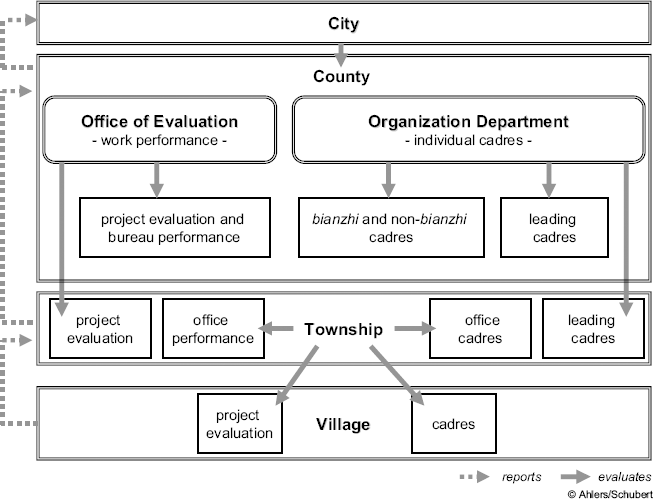
The System of Local Cadre Evaluation
It is difficult to judge how much the Party's internal kaohe actually influences the efficiency of policy implementation. Though the system is highly standardized, complex, and comprehensive with respect to the set of different indicators, it may suffer from the fact that there is no public participation in or control over the process. Interestingly, the 2009 regulations for all project and cadre evaluations in Mizhi County (Mizhi County Party Committee 2009) stipulate that review procedures must include public opinion surveys (minyi diaocha) to test the degree of public satisfaction with both project and cadre performance. However, there are no detailed specifications for conducting these surveys. Apart from this measure, public opinion constitutes only one of several approved methods for annual reviews. Obviously, internal assessment by leading government and party cadres at different administrative levels and in different organizational settings is assigned greater importance. However, a township head in Qingyuan County explained to us that public opinion is an important factor in the evaluation of each project, as villagers are asked to comment frankly on the different initiatives that have been implemented in their locality and their views are taken seriously (Interview, September 2009).
Preliminary Findings in the Field
Having described the formal process of XNCJS policy formulation, implementation and evaluation, we now turn to our own observations in different townships and villages in Mizhi and Qingyuan, which suggest that XNCJS has been rather effective in terms of both the broad goals set by the national government and in its local enactment. Though both counties operate on very tight budgets, the conversion to a system of transfer payments (zhuanyi zhifu) and the earmarking of funds (zhuanxiang buzhu) for specific XNCJS measures have alleviated fiscal pressure considerably and granted new leverage to counties in their rural development investments. This has translated into systematic XNCJS planning at the county level: earlier projects administered by the government's different bureaus are now run under the auspices of XNCJS and new projects are defined as XNCJS initiatives. As mentioned earlier, particular emphasis has been placed on basic infrastructural development (for example, road construction and dam building), the intensification of agriculture, and the extension of social services in the villages; in Qingyuan, the construction of new housing for peasants “coming down from the hills” (xia shan) as well as the training of a skill-based (jinengxing) township administration better qualified to provide rural consultancy have also been emphasized. As far as we could observe, all planning measures had been subsequently implemented, and we sensed that cadres were highly motivated to make use of the new possibilities offered to them by the top-down transfer payments under the XNCJS framework. Though we refer to figures from internal working reports at the village, township, and county levels, which may be more reliable, we are well aware that official Chinese data are most often whitewashed and inflated. At the very least, we would argue that these figures reveal broader trends in local development and should thus not be disregarded.
The overall impression we gained from statistics, our respondents' individual assessments and local site visits was that – while, for example, 30 per cent of rural households in Mizhi county were still classified as poor (with an annual net income below 1,500 CNY) in 2007 (see Yu, Wang, and Gao 2008) – rural income had increased and overall economic development had accelerated in the two counties (though to quite different degrees) since the beginning of the rural Tax-for-Fee Reform (see Table 1). More specifically, investment in basic infrastructural development had been fortified in both counties. Liu et al. (2009) have confirmed this observation in a cross-national survey of 100 villages in five provinces which also found that the quality of the new infrastructure is better than is usually claimed by critics of China's rural development policy. Education and social welfare (especially in terms of the introduction of comprehensive medical insurance or the minimum living allowance) seem to have all been positively affected by XNCJS implementation. In Mizhi, 87.2 per cent of the total rural population reportedly joined the new insurance scheme at the end of 2008. A total of 10,877 rural households with an annual income below 800 CNY receive monthly income support (dibao) of 65 CNY per person, as compared to 2,975 households in the urban areas of Mizhi County that receive 165 CNY per person (Du, Du, and Ji 2008). In Qingyuan, the NRCMS participation rate has reached 95 per cent as of 2009, as stated by the director of the Bureau of Public Health (Interview, September 13, 2009). A total of 3,488 households in Qingyuan with an income below 1,500 CNY receive monthly dibao payments of up to 166 CNY per person, as compared to 236 urban households that receive 276 CNY per person (Interview with the Director of the Bureau of Civil Affairs, September 15, 2009). These figures were broadly confirmed by the villagers with whom we spoke. We did not conduct systematic interviews with peasants, but talked to them casually when walking through the villages we visited. However, their satisfaction with the increased provision of basic public goods is hardly astonishing, given the weak basis of such infrastructure to date.
As described above, XNCJS funds are allocated according to a top-down process by the province or city to the county government, and by the county to the townships. Villages and townships apply jointly to the county government for project-related funding, and the county does the same at the city or provincial level. Formally, the allocation of funds is determined at each level by the general development strategy that has been formulated there, and by the quality of the applications received from the subordinate level. However, we also identified an important informal element in the process of allocating funds, as decisions regarding the recipients of funding are not completely determined by objective development indicators or previous evaluation results. As a matter of fact, such an allotment would hardly be a good idea, as well-performing villages would always have the upper hand in the allocation of project funding, resulting in a widening development gap within the county. For this reason, the policy of promoting XNCJS model villages in Qingyuan County was terminated in 2008, in accordance with province-wide regulations, as the county began to place more emphasis on advocating model projects that would extend across a number of villages. In Mizhi, however, promoting model villages is still the dominant strategy for pushing forward development.
Interestingly, the cadres in Mizhi had a hard time explaining to us how these villages could best be emulated by others, given the differences in natural conditions, historical trajectories and the degree of economic development. It was quite obvious that model villages served as showcases for successful policy implementation to boost the cadres' legitimacy. As many of our respondents confirmed, funding decisions also depend in part on the degree of “peaceful” cooperation within a village (between the village and party committees), which ensures smooth project implementation on the ground, and on the quality of communication between the cadre bureaucracies at the village, township and county levels, which translates into a clear advantage for villages and townships that have established a good working relationship with the county bureaus and the county lingdao banzi.
With regard to township-village relations in our two counties, it was obvious that by linking decisions on the allocation of funds to a village to the management skills of village cadres and their performance in guaranteeing social stability and solidarity (tuanjie) among villagers, townships (and counties) possess quite a powerful instrument for enforcing compliance. This makes the lack of conflict between these two levels less surprising than it would first appear: as the villages in Mizhi and Qingyuan fully depend on the townships for their funding according to the principle of “townships govern villages” (xiangzhen guan cun), consequently reducing the work of the village accountant to mere recordkeeping (baozhang), there is indeed not much to argue about. Thus, elected village committees and village representative assemblies have little say in project implementation, though they do decide which projects the village would like to see realized during the fiscal year. Village participation is necessary, as it is the villagers who will ultimately provide the supplementary funds (peitao) that each project requires. This burden cannot simply be imposed upon the villagers by the townships. After it deliberates and reaches a decision, the village's proposals are submitted to the township government for further consideration. In that sense, at least theoretically, village democracy works in Mizhi and Qingyuan, though we also found that villagers in both counties do not seem too concerned with participating in village governance structures or democratic means to control their cadres. Thus, the extent to which villagers actually participated in XNCJS-related policy formulation remained unclear (see also Ye 2006).
Cadre responsiveness to internal evaluation was generally positive. All our interviewees emphasized that the kaohe was the only way to ensure sound project implementation. Certainly, there are very few motives to resist this control mechanism. First, government funding from above is substantial and further increases are foreseen for the future. Simply stated, money increases the likelihood of getting results. Second, the annual project evaluation and target assessment of all government bureaus and offices in county- and township-level assessments explicitly refer to XNCJS-related performance and thus must be taken seriously by the cadres – though the ganbu kaohe is definitely more important to their careers. Positive performance reviews promise special bureau funding and also personal benefits (higher salaries, promotion). Sanctions in the form of budget cuts for a government bureau or lower individual bonus payments, in the event of failure to fulfil the set targets, did not seem to be particularly troublesome or problematic for our interviewees – suggesting that they had not often been plagued by such sanctions. In Mizhi, projects are evaluated continuously during several implementation stages, a process which often entails painful budget cuts in cases of mismanagement (Interview with the vice-director of the county's Bureau of Finance, September 4, 2008). One township vice party secretary in Qingyuan explained that project evaluation is subject to consultation between the township and the county government, especially when townships think they will not be able to fulfil evaluation guidelines issued with project funding and set targets (Interview, September 23, 2008). Additionally, the abolition of taxes and fees has not only ameliorated peasant-cadre relations tremendously but has also forced the local bureaucracy to engage in new activities to prove their efficiency in interfacing with the higher levels. Especially in Qingyuan, county cadres insisted that since being relieved of the painstaking task of collecting taxes and fees, it had now become highly important to nurture a new “service attitude” and “can-do mentality” vis-à-vis the people – qualities that certainly help XNCJS implementation as much as they help personal promotion.
According to our preliminary findings, relative autonomy in XNCJS implementation and evaluation is high at the county level and low at the township and village levels. The townships we visited had no visible autonomy vis-à-vis the county level and could only execute orders or guidelines passed down from above. Like the villages, they did not hold authority over any funds and could only administer the accounts of the villages on behalf of the county government, which exerted ultimate control. In that sense, the implementation of XNCJS is a top-down process that gives the county the most discretionary power in the local government hierarchy. As a matter of fact, the county has gained much more leverage through the promulgation of XNCJS and the concurrent introduction of a fiscal transfer system, making it by far the most important administrative layer in the Chinese local state (see also Li Youzhi 2007).
Final Remarks
“Building a new socialist countryside” (XNCJS) should be understood as an intentionally vague but holistic policy framework initiated by the central government to be adapted to local conditions. It targets the sannong wenti and, arguably, aims to bring about a comprehensive transformation of the Chinese countryside which sees poor villages slowly disappear and commercialized agriculture prevail. At the same time, all rural surplus labour is to be gradually absorbed by the urban industrial and service sectors. XNCJS is not new in terms of rural policy implementation and evaluation per se, but it has introduced a new dynamic into these processes. This dynamic primarily stems from the new quality of government spending on rural development and public goods provision that the rural Tax-for-Fee Reform and the subsequent changes to the fiscal system have entailed: poorer areas are now provided with annually increasing transfer payments that allow county governments not only to expand their prior measures but also to launch new projects. XNCJS figures as a terminological reference for both types of undertaking, but its comprehensive approach to rural transformation serves to distinguish it from earlier efforts to overcome rural poverty and stalled or absent development.
All in all, at this stage it seems to us that XNCJS is not just an empty slogan but a macro-policy with meaningful implications for rural development and the socio-economic well-being of villagers. Based on the insights drawn from our fieldwork in two poor counties, we find that XNCJS does not simply highlight the state's focus on overall rural development; more importantly, through its links to the new “transfer logic” of China's reformed fiscal system, XNCJS finally gives substance to the fight against the sannong wenti. Therefore, it offers a real chance for China's poorer areas to free themselves from the grips of poverty and find their paths toward development. 4 At the same time, XNCJS manifests a development model that varies little from, or even mimics, the historical experiences of Europe and industrialized East Asia in overcoming rural poverty, that is, agricultural specialization, social stratification and increasing urbanization.
However, observers may come to different conclusions in other localities where rural income is higher and dependence on the transfer system lower, as local cadres have more discretionary power to disburse local funds and may engage in activities which do not focus on rural development.