




Abstract
In this article, we assess the effects of and responses to the Covid-19 pandemic in the Brazilian peripheries by relying on resilience theory and the experiences of peripheral actors during the first year of the pandemic. We consider these experiences to examine whether the initial responses to the crisis had the potential to bring about long-term positive change. We rely on thematic analysis of 80 interviews with leaders of grassroots organizations of different nature all over the country between October 2020 and January 2021. We argue that we cannot speak of resilience and system change unless we engage with the voices of those most affected by adversity. While in its first year the pandemic brought important traces of structural violence to the surface, providing an opportunity for structural change, peripheral views at that moment cast doubts about the extent to which those changes could lead to long-term structural changes.
Introduction
As of 16 October 2022, Brazil has an accumulated total of 34,736,653 confirmed cases of Covid-19, standing below the United States (95,529,625) and India (44,623,997). The cumulative number of confirmed deaths caused by the virus has reached 687,026 compared to 1,052,823 in the United States and 528,857 in India, keeping these three countries in the top three of the global ranking (WHO website). As in other parts of the world, however, the effects of the pandemic have been very asymmetrical within the country, with peripheral and marginalized groups, such as urban peripheries, indigenous and black populations being much more affected than the white middle class. Indeed, a literature review on the effects of the Covid-19 pandemic in Brazil reveals that the most affected by the pandemic are those who are also most subject to structural and symbolic violence (De Oliveira et al., 2020; Gaia, 2020; Ortega and Orsini, 2020; Pereira Neto et al., 2020; Peres, 2020; Pinheiro et al., 2020). This, in turn, reflects the broader and huge social-spatial inequalities that exist in the country (De Albuquerque and Ribeiro, 2020; Peres et al., 2021; Ranzani et al., 2021).
Factors such as lack of access to basic infrastructure (especially water and sanitation), the prevalence of informal jobs (and thus the inability to stop working during social isolation), the need to use public transport are some of the factors pointed in the literature that explain these asymmetrical effects (De Sousa and Rodrigues, 2020; Ortega and Orsini, 2020; Pereira Neto et al., 2020; Peres et al., 2021; Pinheiro et al., 2020). Moreover, given the fact that most of the peripheral populations in Brazil are black, some studies have further stressed the racial aspect underlying the uneven effects of the pandemic, noticing that even hospitalization and death rates have a clear racial profile (Gaia, 2020; De Oliveira et al., 2020; Peres et al., 2021). This situation has led many authors to assess the effects of the pandemic through the lenses of necropolitics—the “subjugation of life to the power of death” (Mbembe, 2003: 39)—since the management of life and death strongly affects one specific segment of the population: those already destituted and perceived as “disposable” in a system that is characterized by exploitation (Alfonsin et al., 2020; Da Silva and Da Silva, 2020; Fernandes et al., 2020).
At the same time, while acknowledging the problematic state response to this scenario, several authors have also highlighted the role of civil society and solidarity in responding to the pandemic (Abers and Von Bülow, 2021; Alfonsin et al., 2020; Andion, 2020; Fernandes et al., 2020). The way these actions have been studied has varied. Some authors have referred to them as acts of resistance (Alfonsin et al., 2020) or a contestation to neoliberal practices (Fernandes et al., 2020); others have questioned whether they may constitute an expression of a new democratic experiment in public policy (Andion, 2020). Offering a more nuanced analysis, Abers and Von Bülow (2020, 2021) have argued that the context of polarization during the pandemic may have disturbed these actors’ perceptions of threats and opportunities; therefore, while some civil society organizations have perceived this context as a threat and have mobilized their resources and contacts to help people in need, others saw an opportunity to connect the health crisis with their historical sectoral agenda, stressing the importance to tackle structural demands.
In this article, we share the concerns with the asymmetrical effects of the pandemic in Brazil and the responses to it (both by the state and civil society). That said, differently from the existing approaches, we are interested in assessing the effects of and responses to the Covid-19 pandemic in the Brazilian peripheries through the lenses of resilience theory and by focusing on the experiential domain. That is, we consider the point of view of peripheral actors to examine whether these responses have the potential to bring about enduring positive change.
The concept of resilience has become widely popular over the last decades, leading to the development of theories that cross fields such as ecology, psychology, disaster relief, and international relations. Despite variations, a dominant aspect of resilience theory today is its emphasis on complexity and the ability of a system to persist and maintain its identity in the face of adversity (Barrios, 2016; Cretney, 2014; Folke et al., 2010; Olsson et al., 2015). As we discuss in detail in the next section, one of the main issues of debate in the resilience literature is the extent to which resilience is good or not (and for whom). Given the global scale of the Covid-19 pandemic—a main expression of adversity—and its asymmetrical effects between and within countries, we argue that the analysis of resilience must consider different levels of analysis (or different systems) and differentiate between short-term and long-term effects. Also, it is very important that resilience is discussed through different narratives, so that marginalized voices are put on the front stage of the analysis.
Specifically, in the case of Brazil we consider two systems: the peripheries, and the broader system that is responsible for their very existence, that is, the Brazilian social, political, and economic system (that reproduces and maintain historical inequalities). Our understanding of the concept of peripheries stems from the work of Tiaraju Pablo D’Andrea (2020) and goes beyond the more traditional approach based on territory and urban poverty (Kowarick, 1993; Telles, 2010). D’Andrea has advanced the idea of a peripheral consciousness, which stands in antagonism to the elites and the police (who represent the center), reflecting a strong character of denunciation of precarious and unfair social conditions, which applies not only to urban peripheries, but also to a wide range of populations who struggle with the same conditions. We thus define peripheries as vulnerable groups denouncing the negligence of the state, the absence of protection policies and police violence, independently of their conformity into a specific territory. This includes urban peripheral groups, as well as other vulnerable groups, such as indigenous and quilombola 1 communities, rural population, women, homeless, landless, and so forth.
While these two systems—the peripheries and the Brazilian social, political, and economic system—are clearly interrelated, focusing on one or the other may lead to different assessments regarding the effects of the pandemic and the resilience of the peripheries. In fact, as the very existence of the peripheries (and their situation of higher vulnerability) depends on the resilience of the current system, one may argue that the resilience of the latter may not be beneficial to the former. On the contrary, the long-term resilience of peripheral populations may be contingent on the very transformation of the Brazilian social, economic, and political system. From this perspective, the Covid-19 pandemic could be seen as an opportunity for transformation. The key point in this article is that this evaluation must consider the voices of those most affected by the pandemic, that is, the peripheral populations.
In this regard, our investigation is based on three questions that are here answered based on the detailed experience of selected peripheral leaderships:
Have the responses to the pandemic forged resilience of peripheral communities? Has the pandemic provided an opportunity to rethink the system that keeps the peripheries at bay? What is the potential of these responses to contribute to a deeper transformation of the system?
Our analysis is based on 80 interviews conducted with leaders of grassroots formal and informal peripheral organizations of different nature spread across the 26 Brazilian states and its Federal District, between October 2020 and January 2021. Given the nature and extension of our data, this article provides an important contribution to the understanding of the Covid-19 pandemic in Brazil, especially in its first year. Indeed, while there have been many quantitative studies assessing epidemiological aspects in the country, as well as many small scale case studies (focused on specific peripheral communities or cities), we bring together different groups from all across the country and focus on their own assessment of their experience during this crucial period of social isolation. In this regard, our contribution does not aim to provide a generalization of the effects of the pandemic and responses to it. On the contrary, it aims to highlight the experiential domain and the voices of those most affected by the pandemic. Ultimately, we argue, we cannot speak of resilience and change (or sustainability) of the system unless we engage with these voices. It is at the microlevel where we can observe obstacles and innovations that are often blinded in big national projects. So, while the pandemic brought important traces of structural violence to the surface, providing an opportunity for structural change, the views of the peripheral leaderships casts doubts about the extent to which these changes may lead to more fundamental long-term structural changes.
The article is divided into five sections, besides introduction and conclusion. In the following section, we provide an overview of the literature on resilience, discussing its relevance for the analysis of the pandemic in Brazil. Next, we detail the research methodology. The following three sections provide an in-depth analysis of the empirical data, discussing the effects of the pandemic in the peripheries and the state and community responses to it, all based on the accounts of the local leaderships. Finally, based on these accounts, we examine whether the responses to the pandemic have provided an opportunity for deeper social transformation.
Resilience Theory and Its Application in the Context of the Covid-19 Pandemic
Resilience has become one of those buzzwords that have pervaded both academia and the policy realm. It crosses different fields of knowledge, most notably psychology, ecology, disaster-relief, and engineering (De Bruijne et al., 2010; Walker and Salt, 2012). Given these very different areas of engagement, the meaning and theories of resilience are many. Nevertheless, over the years there has been a broad and interdisciplinary discussion stemming from the work of ecologist Crawford Holling. In 1973 Holling established a distinction between “engineering resilience” and “ecological resilience,” the former originating from then mainstream mathematical ecology and the latter embracing complexity theory (Walker and Cooper, 2011). In the case of engineering resilience the main concern is stability, or the ability of a system to “bounce back to normal” after a shock or disturbance (De Bruijne et al., 2010). Differently, by embracing complexity, Holling stated that “Resilience determines the persistence of relationships within a system and is a measure of the ability of these systems to absorb change of state variable, driving variables, and parameters, and still persist” (quoted in Olsson et al., 2015: 2). The key point here is the idea that resilience is related to the ability of a system to maintain its identity notwithstanding external shocks and adversity (see also Barrios, 2016; Cretney, 2014; Folke et al., 2010; Olsson et al., 2015).
Other definitions of resilience focus on this logic. For instance, Boin et al. (2010: 9) define resilience as “the capacity of a social system (e.g. an organization, city, or society) to proactively adapt to and recover from disturbances that are perceived within the system to fall outside the range of normal and expected disturbances.” Similarly, Walker and Salt (2012: 3) define resilience as “the capacity of a system to absorb disturbance and reorganize so as to retain essentially the same function, structure, and feedbacks—to have the same identity.”
The idea of identity is crucial here: there are thresholds that define the system's identity, so if shocks are too intense and cross these thresholds then this identity changes and the system becomes something else. This understanding of resilience leads to an important differentiation between adaptation (the system's capacity to avoid crossing the thresholds and retain its main features) and transformation (when the system becomes a different system) (Cretney, 2014; Folke et al., 2010; Olsson et al., 2015; Walker and Salt, 2012).
Importantly, while resilience is often depicted as good, especially in the policy realm, this is not necessarily the case. Indeed, there are systems that are damaging to society (or the environment, or a specific community, etc.) that are very resilient (Olsson et al., 2015; Walker and Salt, 2012), in which case the desirable path would be transformation—and in which case adversity could provide an important opportunity for transformation or reinvention (Van Assche et al., 2020).
On this, several authors engaging with different arenas of social sciences have stressed the need to include political and conflictual aspects in the analysis of resilience, moving away from more traditional ecological approaches (Barrios, 2016; Cretney, 2014; Olsson et al., 2015; Van Breda, 2018). This is particularly relevant in the case of resilience policies, which are often detached from important discussion around political economy, colonialism, and post-coloniality (Barrios, 2016), leading to practices and discourses that reinforce neoliberal policies by focusing on the individual level and self-sufficiency (Braga, 2020; MacKinnon and Derickson, 2012; Van Breda, 2018; Walker and Cooper, 2011). Speaking from the point of view of social work, Van Breda (2018: 7) observes that, "if the individual is responsible for her or his own well-being, the state is free to disregard adverse social systems and dynamics, such as poverty, racism, lack of access to resources and poor-quality education. Individuals are, in effect, made responsible for dealing with collective challenges that should be dealt with by collective structures, such as the state".
Several authors have stressed the need to critically assess the nature of the systems and who benefit from their resilience (Barrios, 2016; Cretney, 2014; MacKinnon and Derickson, 2012; Van Breda, 2018). This literature further stresses the importance of clearly delimiting the system(s) under analysis considering what needs to be changed. These reflections point to the need to clearly identify the system(s) to engage with in resilience analysis and, in the case of a multilevel analysis, think of how these systems interact and how this interaction affects the resilience of the different systems. In this regard, Van Breda's definition of resilience, as a “multilevel processes that systems engage in to obtain better-than-expected outcomes in the face or wake of adversity,” is particularly helpful. As he explains, “multilevel” “means that the resilience processes occur across multiple domains or levels of the social ecology or person-in-environment,” whereas “systems” “is used so that the definition can be scaled across different-sized systems, such as cells, individuals, families, organisations and communities” (Van Breda, 2018: 4–5).
When it comes to understanding the effects and responses to the Covid-19 pandemic in the peripheries, these considerations are extremely important. Indeed, it is possible to assess the resilience of a social group by focusing exclusively on how its members have responded to the effects of the pandemic and how these responses may be improved in the context of a similar event (such as a different pandemic). This could lead to policies aiming at improving preparation, response management, and recovery (Boin et al., 2010), but it would leave asides broader considerations, such as the structural reasons why in the same country the levels of resilience were so diverse across the population.
As Sakurai and Chughtai (2020) observe, the problem of social inequalities and how it affected social responses to the pandemic is a universal problem, having affected also developed countries such as the United States, the European Union and the United Kingdom, where policymakers “ignored issues related to everyday lives (e.g. ethnic and racial disparities, inequality of risk), resulting in a delay of initial responses and questionable outcome related to treatment of marginalised and vulnerable populations” (Sakurai and Chughtai, 2020: 590). This means that even within developing countries there were different levels of resilience according to different segments of the population.
With this in mind it seems particularly important to assess these different levels of resilience considering the different kinds of adversity that different populations are subject to and how they relate to each other.
In this article, we borrow a useful distinction between chronic adversity and acute life events, by Bonanno and Diminich (2013) in the field of psychology. Chronically aversive circumstances include, for instance, chronic poverty, civil war or other forms of daily violence, as well as natural disasters. Conversely, acute life events would include specific events of relatively brief duration but with long-term impact (such as an assault, or a personal trauma). If we think of peripheral populations, we must consider that they are subject to different kinds of chronic adversity (such as unemployment, food insecurity, violence, etc.) and the Covid-19 pandemic was an additional event that affected these previous patterns of chronic adversity. So, while the pandemic is qualitatively different from a single event, as it spreads over a long period of time, it is still different from a form of chronic adversity as it presents a clear beginning leading to sudden change and disruption regarding what was the normal state of affairs until that point. Given the different nature of chronic adversities and acute life events, Bonanno and Dominich argue that responses to these different situations lead to different manifestations of resilience: emergent resilience would apply to cases where chronic adversities are addressed, whereas immediate responses to sudden disruptions would lead to minimal impact-resilience.
An important matter here is how can we assess whether resilience is emergent or minimal-impact. A thorough examination of resilience regarding the effects of the Covid-19 pandemic in Brazil would require, first of all, the end of the pandemic (which has not yet occurred), so we could assess its long-term effects and responses. Secondly, given the size of the country and its vast social/economic/geographical differences that affect regional patterns of adversity and vulnerability, any study would have to consider national and subnational responses in a systematic way. That said, another crucial aspect, in our view, is the consideration of the experiential domain of different groups of people, especially the most vulnerable ones, and their own narratives about what has been taking place. While these accounts alone cannot lead to broader generalizations, they can provide important insights regarding the receiving end of policy response (as well as the everyday effects of the pandemic). From this perspective, we can examine the extent to which resilience has been experienced as potentially emergent or minimal-impact.
Methodology
The analysis presented here is a partial output of an ongoing project entitled "The Margins of the State in the Covid-19 Pandemic: peripheral experiences of human (in)security in Brazil" , developed by the Center for Conflict and Peace Studies (CCP) , linked to the International Relations Research Center (NUPRI) of the University of São Paulo, in partnership with the Perseu Abramo Foundation (FPA, in Portuguese), through their project "Peripheries Reconnection" , and with the financial support from the Center for Human Rights and Humanitarian Studies at (Watson Institute, Brown University). In its original format, the research leading to this paper was mainly inductive. Its starting point was our interest in listening from peripheral populations their assessment of the impact of the pandemic in their own lives, as well as the responses to this crisis (both from the state as well as from civil society).
Access to different community leaderships was possible thanks to our connection to the FPA. Their project "Peripheries Reconnection" engages specifically with Brazilian peripheries and just before the start of the pandemic they had developed a database through snowballing process with over 800 contacts of peripheral organizations and collectivities of different nature all over the country. At the time of our first contact the FPA researchers were about to start a series of interviews for a parallel project related to culture and sociability, so we partnered with them and added seven questions related specifically to the Covid-19 pandemic.
The sample included 80 community leaderships, or about 10 percent of the organizations identified in their national mapping. This selection was representative of the wider database, and included eight organizations from the South region of Brazil, nine from the Center-West, 14 from the North, 24 from the Northeast and 25 from the Southeast. As the nature of these collectivities and organizations was different (themes they engaged with included, among others, arts and culture, race, gender, development, LGBTQ + , homeless, landless, human rights, environment, religion, violence prevention, and poverty), the sample was designed considering the representativeness of these different groups and themes. Also, while 44 of these organizations were formalized (i.e. they have legal existence, pay taxes, can receive financial resources, and have employees), 36 were not, and only one in ten of them had a paid representative, which means that most of the work developed in these organizations was volunteer, with their activities being based mostly on capacity building and communication strategies.
The interviews were conducted by both research teams through phone or videocalls between October 2020 and January 2021, with each interview lasting between one and two hours. While the questions related to the Covid-19 pandemic were open, the interviews included closed questions, many aiming at systematizing the types of activities carried by these actors. Some of these were used in the analysis that follows. We used the online platform SurveyMonkey to complete the interview and worked with the final Excel data sheet to analyze the answers. As the questions related to the pandemic were open, we used content analysis, identifying and regrouping categories and subcategories for each question.
Aside from the pandemic, we did not determine beforehand what patterns of adversity affected these populations. Instead, participants were asked about the problems they were experiencing and how they were coping with them. The answers revealed that most of the problems they were dealing with preceded the pandemic, but were dramatically intensified by it. Also, while some of these patterns were similar across the different groups, some also differed according to location and socio-economic aspects.
The analysis that follows relies on Van Breda's (2018) model of resilience, which consists of three basic elements: adversity, mediating processes that aim at generating resilience (resilience as a process), and better than expected outcomes (resilience as an outcome). The next section focuses on adversity as narrated by the interviewees; the following two sections describe the state and communities’ responses to the pandemic (mediating process); and the concluding section discusses resilience as an outcome, by focusing on the potential of the responses for generating emergent resilience vis-à-vis the peripheries and the Brazilian social, political, and economic system.
The Effects of the Covid-19 Pandemic in the Peripheries: Adversity from the Perspective of Community Leaderships
When asked about the effects of the pandemic in their communities, participants referred to numerous factors that fall broadly into four dimensions, namely social, economic, cultural, and political, with the former two gaining prominence in the responses. While there is no doubt that the Covid-19 pandemic triggered many of the problems reported, the intensity of the adversity was also related to previous conditions that we may assess as chronic patterns of adversity that existed long before the pandemic. In many cases, these populations were living in a thin line between human security and insecurity and the pandemic ultimately pushed them back into a situation of extreme insecurity.
The dimension most referenced in the interviews was the economic one. In total, 72.5 percent of the interviewees referred to the effects of the pandemic in terms of work (unemployment, suspension or shutdown of the organization's activities, social precariousness, and income reduction). If precariousness and informality (expressions of chronic adversity) are usual features of peripheral economies, this was accentuated with the pandemic, as many people found themselves suddenly without any regular income, having to look for alternatives in the informal market. As a member of an arts organization in Belo Horizonte pointed out, “Many people used to work in family homes or buildings and were fired because their bosses did not want contact with people who live in the favelas, as in these spaces there is a lot of contact among people.”
This scenario was aggravated by the economic crisis that accompanied the pandemic, leading to the sudden increase in food prices, loss of purchase power, poverty increase, all topics that appeared repeatedly in the answer. Many participants further referred to how the pandemic has increased social inequality, reinforcing existing social asymmetries. In the words of a representative of deliverymen in São Paulo, “One of the main impacts of the pandemic was to show that Brazil is a country full of people with privilege. Some had the privilege to do quarantine, given the color of their skin, their living, and financial conditions. It became clear to people that if tomorrow the world starts to end, the first ones to die will be us.”
In the social sphere the main factor of concern was the effects of the pandemic in the communities’ health, a topic explored by 52.5 percent of the interviewees. Some of the key problems identified were: the high number of deaths (especially in the northern state of Amazonas), the increasing difficulties of healthcare access related to Covid-19 (given the lack of access to resources such as tests, professionals, and medications—a fact that was not exclusive of the peripheries), the cancelling of assistance to health issues not related to Covid-19, and the effects of the pandemic on people's mental health. In the words of an interviewee in Salvador, “if before there was no health in the peripheries, now it's even worse.”
The lack of assistance in other health areas was a factor of great concern and here we can see a difference in terms of peripheral and non-peripheral populations, as the former are highly dependent on the public health system, whereas the Brazilian middle class usually relies on private health insurance. 2 An interviewee in Florianópolis who works with LGBTQ+ reported that there were constraints in the case of HIV exams, and in the context of the Pink October campaign for breast cancer awareness all exams were delayed. Other participants referred to the problem derived from the reallocation of health posts, as many started to work exclusively with Covid-19 patients, so those in need of other services had to walk/drive longer distances, an obstacle to health care access.
Many interviewees also referred to the effects of the pandemic on mental health, mentioning factors such as “lots of fear and lack of perspective regarding the future,” the increase of prejudice and stigma linked to social isolation, as well as the case of “young people hopeless about their future, a factor further linked with an increase in alcohol and drugs” consumption.
Related to health, again reflecting long-term patterns of chronic adversity, was the lack of access to basic needs, such as food, water, and shelter (consequence of the increase of evictions and of homeless people), reported by 30 percent of those interviewed. In some cases, access to the emergency aid (auxílio emergencial), a financial benefit to guarantee a minimum income to Brazilians in the most vulnerable situation during the Covid-19 pandemic (provided by the federal government as a result of the pressure of social movements and political parties from the left in Congress), and other sources of support were essential for these people's survival during the first months of the pandemic. Notwithstanding this, there were cases where the emergency aid took a long time to arrive, even in urban centers, as interviewees in São Paulo and Goiânia reported. This led many people to stay out in the streets, looking for informal work and, thus, being exposed to Covid-19 and contributing to the spread of the pandemic and the overburden of the public health system. In Florianópolis, a community leader mentioned that “the help that was supposed to come from the state was almost insignificant” and that “there just wasn’t hunger in the community thanks to the work of volunteers from all over the city that helped collecting food and setting up basic food baskets in an effort to respond to the communities’ needs.”
In other cases, the situation was more dramatic. A respondent from the northern city of Porto Velho explained that health assistance in indigenous territories was suspended, so many people who went to the cities in search of provision got contaminated and died without assistance. Another group highly impacted was the homeless, who increased in numbers since the beginning of the pandemic. In the words of an interviewee in Curitiba,
“Before the pandemic, besides the fact that the number of homeless people was smaller, shops were open … anyone could get help and eat, either getting a change, a snack or a lunch box. Today it's the contrary. Most times people already have less money … and they probably won’t use what they have to help a homeless person”.
Another key topic that emerged in the social sphere and which, again, reflects pre-existing deep social asymmetries in Brazil, was education, which appeared in 33 percent of the responses. The answers pointed to the setbacks in the educational system due to schools’ closure and the problems of relying on distance learning, given the communities’ lack of access to computers and the internet. This was aggravated in the case of rural communities and groups who live more isolated like the quilombolas.
Participants also referred to the problem of learning deficit, linked to many parents’ difficulty in helping their children to study at home, as well as to kids repeating the year or even abandoning school altogether, often to look for precarious informal work and help their families. An interviewee in Aracaju stressed that “the school is also an escape environment from complicated family situations,” therefore schools’ closure has repercussion that go beyond education alone. In sum, access to education constitutes a realm that contributes to the enhancement of social asymmetry favoring those who have more resources and pushing peripheral youths further back in the social strata, feeding the loop of chronic adversity.
Finally, appearing in 18 percent of the answers were the effects of the pandemic in the cultural and political spheres. In the first case, sociability was the area most affected, and included changes in the practices of traditional conviviality (especially in the case of indigenous communities), the impact in the cohesion of many communities, and the case of the youth, who often replace these spaces of conviviality with the use of alcohol and drugs. As for the political sphere, many answers pointed to effects of the pandemic in the field of communication and information (all assessed as confused, imprecise, when not misleading), and the support measures and their limitations (more detail in the next sections). There were also critiques regarding the constant changes of Health Ministers, the lack of clear and unified government directives on how to deal with the pandemic, as well as the obstacles to measures that could have helped vulnerable groups.
Overall, the information provided by these different leaderships confirm some of the trends pointed in the literature review, specifically regarding the increase of vulnerability of peripheral populations, leading to the increase in the already huge national social asymmetry. A common element in the responses is the fact that most problems reported preceded the pandemic, but were intensified by it. That is, previous patterns of chronic adversity in fields as various as social security, basic infrastructure, education, access to information technology, and healthcare lead to much harsher effects of the pandemic in these peripheral communities, leaving them with less room for managing adversity as compared to the wealthier strata of the Brazilian society. Moreover, the answers also point to a strong interconnection between the different spheres (social, economic, cultural, and political) and how the failure in one of them affects the others. For example, the economic crisis stimulated school dropping, the reduction of spaces of conviviality affected mental health, technological asymmetry led to further social and economic asymmetry, and so forth.
That said, the interviews also revealed some variation according to the different regions and zones in the country. For example, the impact in terms of employment was mostly highlighted by respondents in the regions North, Centre-West and South (Chart 1). Concerns with the impact of the pandemic on education were more prominent in the Centre-West and North regions, while reference to lack of social protection were stronger in the South and Southeast, which are also the most urban and densely populated regions.
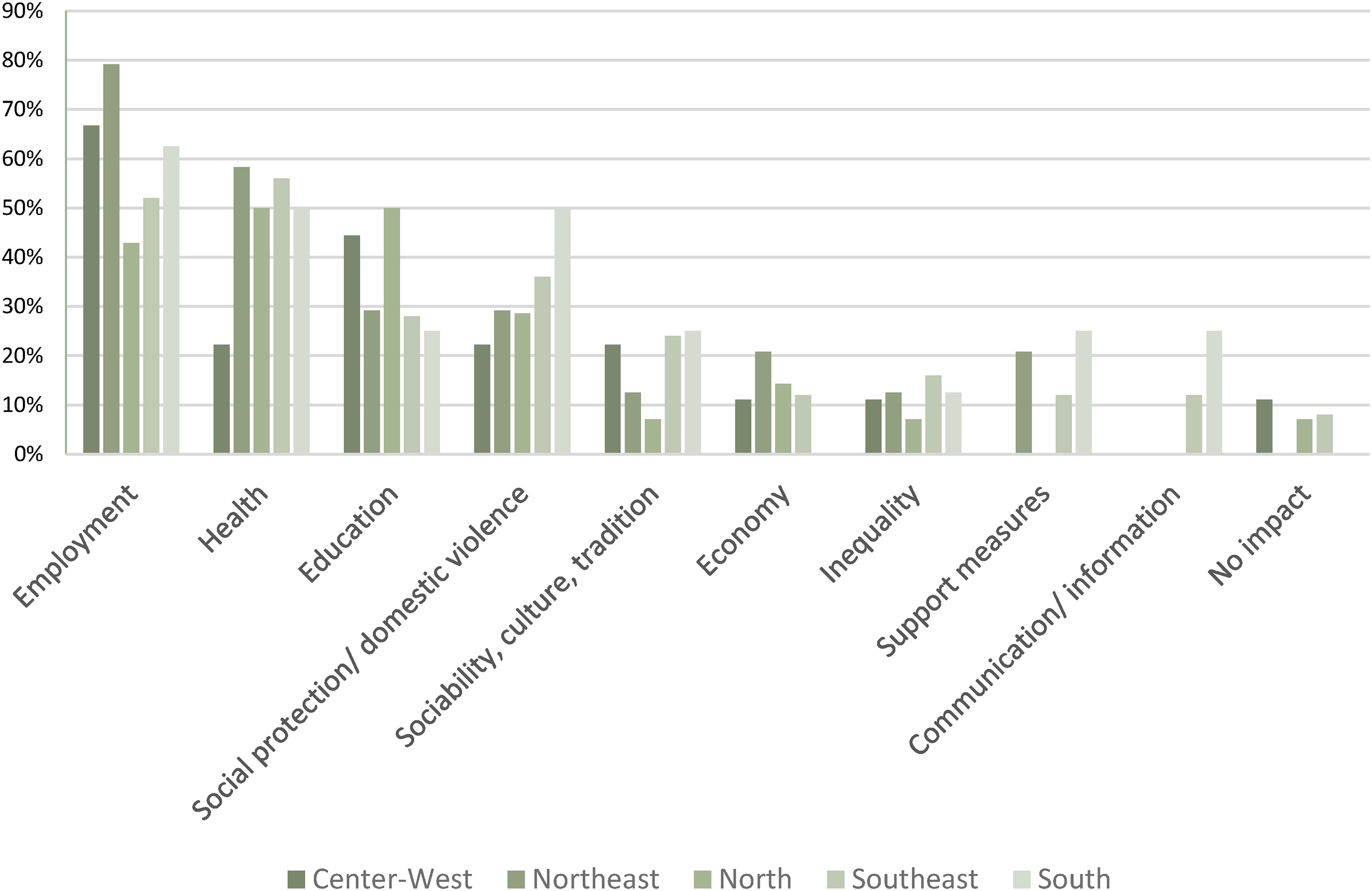
Area of impact per region.
Regarding the zones (see Chart 2), the impact of the pandemic in the work sector was felt more strongly in urban or urban/rural zones, as opposed to urban areas. The opposite was the case for education. These differences seem to reflect previous patterns, as access to technology is indeed much more problematic in rural areas in Brazil, while, in the case of work, urban settings are much more competitive, including in the informal sector.
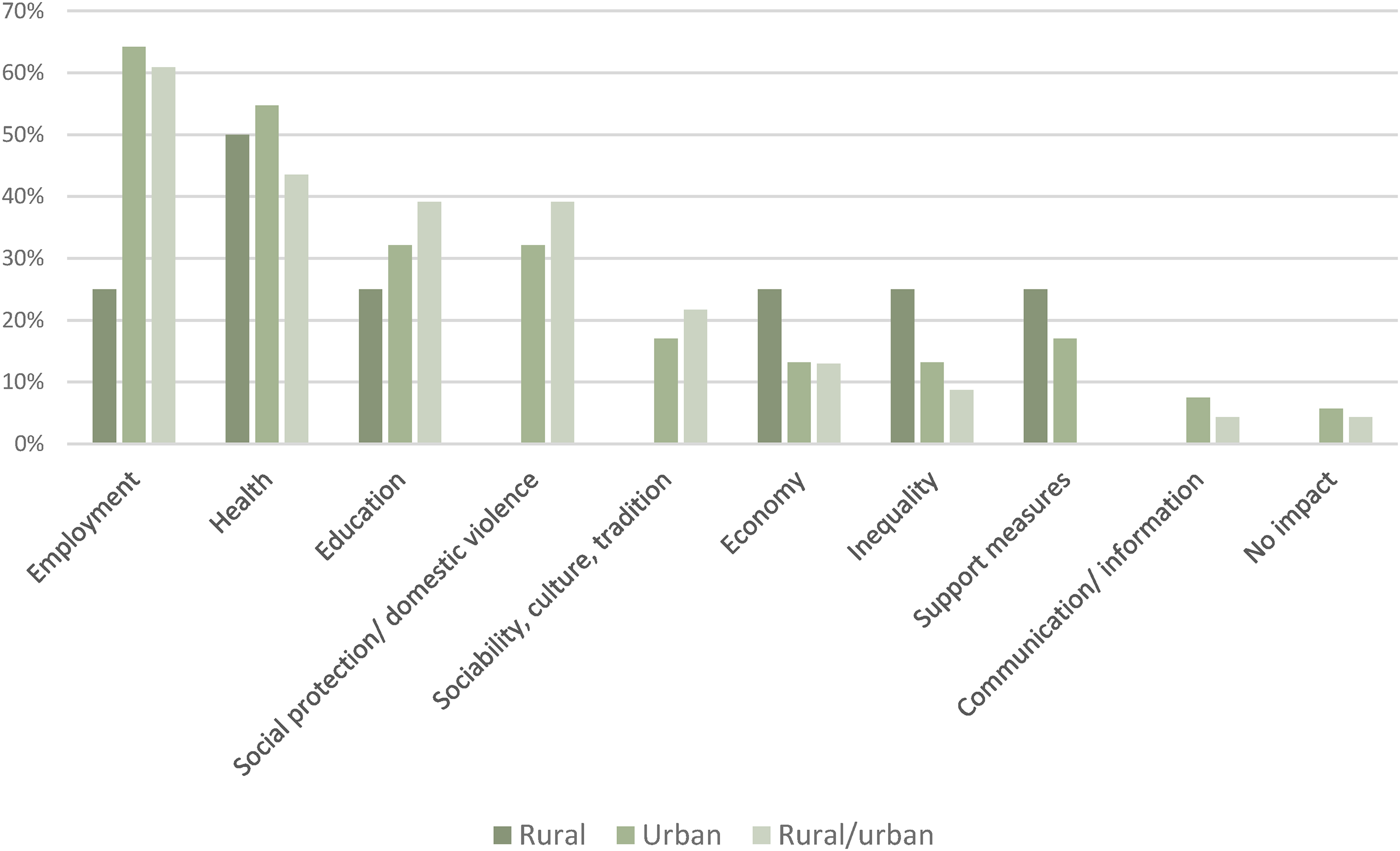
Area of impact per type of zone.
In the next section, we look at how the participants experienced and assessed the state's responses to these problems.
Mediating Process: The State's Presence and Absence According to the Peripheral Leaderships
In this section, we discuss the mediating process of resilience by looking at if and how the state responded to the communities’ demands in the context of the Covid-19 pandemic, considering the narratives and experiences of the peripheral leaderships. We examine how the state was present (in which shape and through which actions) and how effective those actions were perceived by the community in terms of generating resilience.
We asked the community leaders about actions implemented by public authorities that were benefiting the community since the pandemic was declared and the answers fell broadly into four groups. First, according to 48 percent of the interviewees, public authorities did adopt measures that benefited the community during the pandemic, but these were insufficient. Second, 23 percent admitted that no action was taken. For a third group, 16 percent, public authorities took measures to benefit the population in general, but these measures did not reach their own community. Finally, and surprisingly, five percent of the leaders affirmed that the state response was satisfactory. Six percent of the answers were disregarded in the analysis for not being complete or intelligible.
In the majority group of leaders who recognized that the state did implement measures to tackle the effects of the pandemic, those most frequently mentioned were the emergency aid—cited by more than half of the members of this group—and the basic food baskets and snack kits distributed to the families. “The emergency aid and the lockdown benefited the population and made people think more about the pandemic,” commented a leader of the Maranhão Women's Forum.
Importantly, a term widely used to refer to the state was “public authorities,” a term vague enough to encompass not only actions by the three levels of government (federal, state, and municipal power), but also actions by state agencies not linked to the Executive branch. In fact, agencies linked to the Judiciary (Public Ministry and Public Defender's Office) were also cited as direct donors, or as agencies that helped mediate the relationship of the communities with the local governments.
In the group of leaders who believe that the public authorities did not strive at all in undertaking actions that would reach the periphery, there were mentions to solidarity actions from the community, donations from the general public and even from private companies to the communities, to the detriment of actions by the public departments, which did not occur according to these interviewees. There were also those who mentioned that everything that reached the community was through judicial measures (that is, the inaction was from the executive, but not necessarily from other branches of state power). For example, according to a leader of a collective of black women from the North region:
The organizations and social movements had to demand policies from the public authorities, especially regarding health and the hospitals’ capacity to provide care. The municipal hospitals couldn't cope with the care, and the social movements went to court to demand the functioning of the hospital that was created especially for the coronavirus. Nothing came from the government directly, everything came through judicial measures.
Still in this group, there were mentions of erratic actions from the state, which, while benefiting part of the population, were limited in scope, not reaching certain portions of the periphery and/or ignoring specific demands of peripheral communities.
Regarding the third group of answers, the emergency aid was cited as a government action that reached some people, but not all who needed it. A leadership of an entity that organizes artisan women's fairs in Tocantins, for instance, stated that they did not receive food baskets from the municipality because they were not MEI (acronym for legal individual microentrepreneurs, in Portuguese). The municipality favored formal small entrepreneurs, and most of the craftswomen who make up the association are informal, so they weren't entitled to the benefit. Another interviewee affirmed that her organization did not benefit from any public action and that “in the territories it is a minimum state of law, we had water shortages in the communities at a time when water was of utmost importance for hygiene. We had police incursions. We had more problems than solutions from the state for the community. In the communities what we see is only the armed face of the state”.
In summary, the answers in this group show that, while leaders recognized that there had been state responses, they also regarded many of these responses as inadequate, deficient, and even negative toward the periphery.
In the last group, which is residual compared to the previous ones, are those leaders who informed that they were satisfied with the state's actions in their communities. They include four participants from three states: two from Maranhão, one from Piauí, and another from Amazonas. Interestingly, at the time of the interviews, the states of Maranhão and Piauí were governed by parties in opposition to the federal government. In the absence of a coordinated action by the federal government, and given its resistance to follow the measures recommended by the World Health Organisation (Barberia and Gomes, 2020), these states, along with others from the same region, created a coalition of the Northeast state governments to face COVID-19, with their own scientific committee (Rossi and Silva, 2020).
Participants were also asked about possible solutions and actions that could have been implemented by public authorities and that would have helped peripheral communities. Lockdowns and incentives to social isolation were by far the most mentioned, but there were important references to income and employment measures, such as the need for a basic and minimum income for the peripheral population as well as the need for the government to think about actions to generate employment and income and help small entrepreneurs in the periphery. More radically, one interviewee stressed the need “to turn the emergency aid into a basic income policy”.
These answers point to actions that are not necessarily linked to Covid-19 specifically, showing that the social and economic problems of the peripheral communities predate the pandemic and that solutions need to address structural problems. However, at this stage, according to these testimonies, public policies were mostly geared to resolve the immediate effects of the pandemic and re-establish the previous state of affairs. This suggests that the communities experienced some degree of resilience, but mostly minimal impact.
Mediating Process: Local Responses and Trying to Fill the State Gaps
In this section, we continue to discuss the mediating process of resilience by looking at how the local organizations responded to the effects of the Covid-19 pandemic in the first months. The first thing to note is that many of these organizations and their actions are geared toward social change. They do so by strengthening the communities they serve through capacity building in different areas, by promoting awareness campaigns, consultations with the public, among many other activities. While 27.5 percent of the participants reported engaging with social assistance, this was not their main modus operandi. That is, if we think of resilience promotion in the context of chronic adversities, many of these organizations have been acting precisely in this domain by fostering the rights of minority groups (e.g. by engaging with women's’ rights, LGBTQ+ rights, campaigning against racism, and so forth).
With the advent of the pandemic and its dire effects in the first months, the work of these organizations was directly impacted. For starters, there was a sudden shift in terms of priorities: responding to the proliferation of Covid-19 and its economic and social effects, these organizations carried out different actions focusing on immediate relief, prevention, and information campaigns. As seen in Chart 3, actions ranged from the collection of food and hygiene products to the dissemination of data on the pandemic and complaints and charges to public institutions.
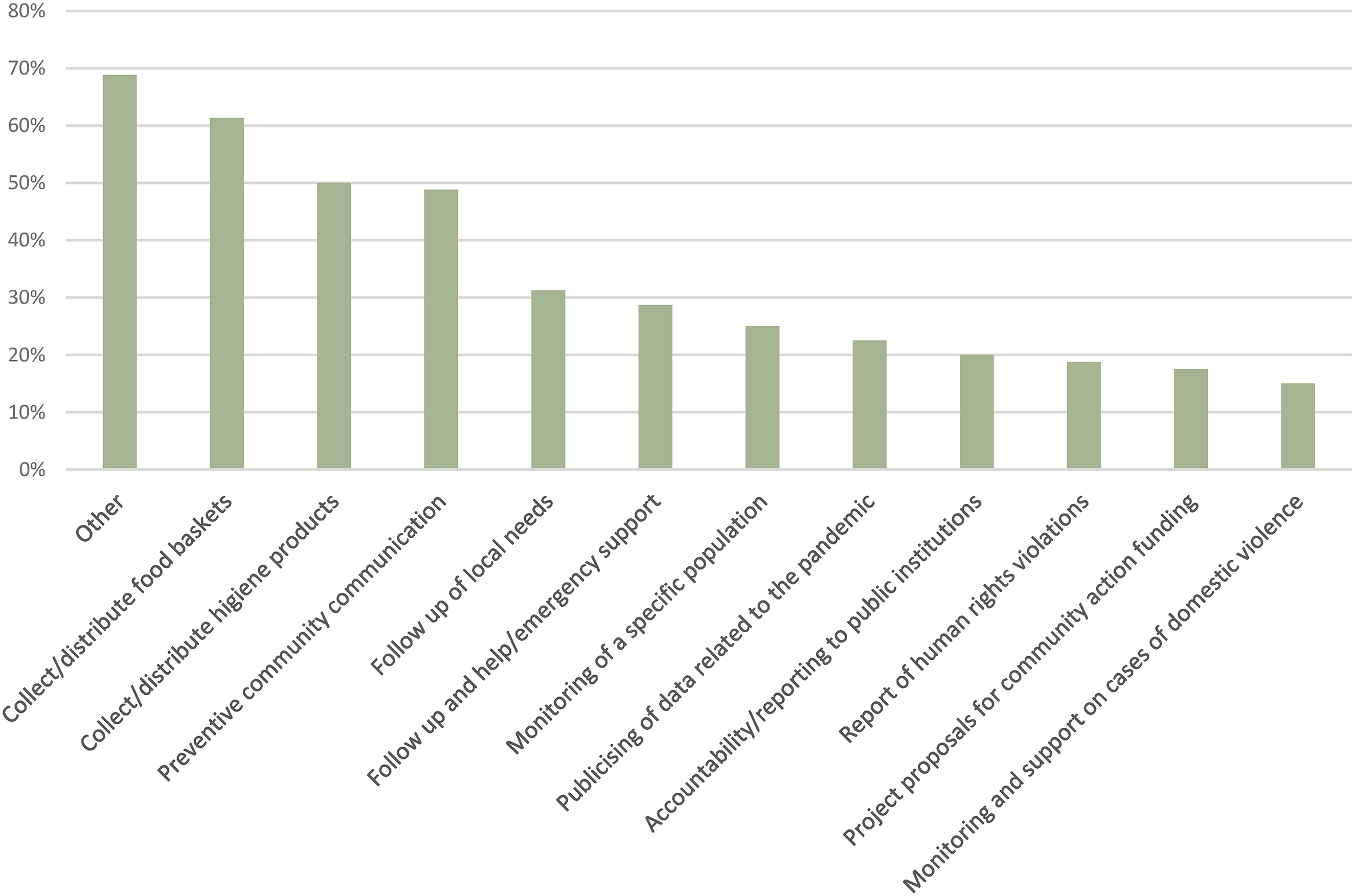
Measures taken by the organizations to cope with the effects of the pandemic.
The interviews revealed that, given the limited ability of the state to respond to the immediate urgent needs of the peripheral communities, these actions have proved crucial at the local level to promote some resilience (minimal impact) in the sense of allowing these communities to maintain a minimum of security in difficult times. However, as the pandemic endured, it ultimately affected the capacity of these organizations to keep delivering their services. Indeed, 79 percent of respondents stressed the deleterious effects of the pandemic in their organization, with the most common being the partial or total suspension of their activities (64 percent). Also, 30 percent reported problems related to the organizations’ relationship with their target population, such as reduced interaction and subsequent difficulty in monitoring their situation, given the lack of access to information technology.
This last issue is linked to one of the most significant changes for these organizations: the migration to remote work on online platforms (56 percent). If, on the one hand, in some cases (10 percent), this change created an opportunity for recycling processes and new investments aimed at technological adaptation (often enabling greater visibility of the organization), in general this brought numerous limitations to the work of various organizations, especially those that work with the most vulnerable groups, such as homeless people, quilombola or landless communities. In the words of a cultural leader in Porto Alegre, “the people who most needed to hear from us and speak [to us …] are not there [online], they are on the streets.” A similar testimony came from a town in the state of Ceará: “the organization was implementing production projects when the pandemic started and, to protect families in the countryside, it had to stop. This also [generated] a very big impact for the families, who are not receiving materials, technical advice and visits in the communities.”
Regarding the effects associated with the migration to online activities, cultural, education, and sports organizations were the most affected since the digital format did not generate the same appeal as face-to-face activities. And even when there was an appeal, there were limitations related to access to technology. According to an interviewee in Salvador: “In the first months, the soirees were held and the public was reached through the internet. Then the population was left with no access to internet data and it was not possible to reach the audience through social networks. Theatre activities have been cancelled.”
In this regard, we observed an increase in asymmetries within the organizations, with those dealing with culture, arts and sports being more affected than others. Importantly, these organizations play a fundamental role in promoting people's mental health and sociability, but they were the ones that suffered the most financial impact. In the words of an interviewee from a cultural society in São Luis, “[the pandemic] almost destroyed us, physically separated us, separated us from activities with our audience, both the consumer audience of our music, our products, our CDs, our shows and also the communities in which we were doing our work, it hasn't been easy until now. We are having a hard time even thinking about how to return, such an impact it has had”.
A similar situation was observed in cultural associations of capoeira, in the case of a jongo organization that was unable to generate fundraising activities, and in a batuque collective in Fortaleza. In all these cases, there was a sudden drop in revenue, leading to the stoppage of activities, affecting in some cases the very survival of the members.
An important aspect to consider here is that these organizations are part of the peripheries: they are run by peripheral actors who work closely with their communities, their agendas are concerned with raising the voices and needs of their communities, and their purpose is transformation. This is what confers them legitimacy. At the same time, because they are peripheral they often suffer from similar constraints as the communities they attend to, such as the lack of a steady flow of financial resources, as well as access to a reliant system of information technology.
In other words, although we can observe numerous efforts to adapt organizations and their leaders to the new context, there were significant limitations due to pre-existing structural factors. In the words of one interviewee, “The pandemic brought to light something that was off people's radar, it brought exploitation, which intensified in the pandemic.” The case of homeless people is perhaps one of the most representative, since in many states there were not even policies aimed at this vulnerable population. In this scenario, it is not surprising that many organizations have significantly altered their program of action, some (ten out of 80) clearly shifting the emphasis from their work to emergency assistance in their communities.
In sum, the role of these peripheral organizations and collectivities was important to alleviate to some extent the impact of the pandemic, and promoting some degree of resilience of their communities in the short-term. Nevertheless, the fact that these organizations were also deeply affected in their ability to pursue their agendas and many had their own survival put at risk is a matter of great concern as many of them had an important role in addressing long-term patterns of chronic adversity. In this regard, based on these shared experiences, the pandemic seems to have forced a trade-off between immediate relief (minimal impact resilience of the communities) and addressing deep structural aspects affecting these peripheries (emergent resilience).
Due to the ongoing state of the pandemic, and the representativeness of the sample (which corresponds to ten per cent of all the mapped actors), new data would be necessary to confirm this interpretation and consider whether it is a more general pattern. That said, it is also important to highlight that in the context of 80 very different organizations spread all across Brazil many narratives point to common experiences, and this is significant.
Resilience as Outcome: Adaptation or Opportunity for Transformation?
Having discussed the first two elements of Van Breda's (2018) model of resilience (the adversity and the mediating processes) from the perspective of local experiences, in this concluding section we now turn to the discussion regarding the potential of these responses for a broader process of systemic transformation. Here we go back to the three questions outlined in the introduction.
Regarding the first question—have the responses to the pandemic forged resilience of peripheral communities?—the responses show that in the first months of the pandemic collective action was crucial to help these communities survive and have access to basic goods, from food baskets, to hygiene products and reliable information. At that point, the emergency aid provided by the federal government was considered extremely important, yet not sufficient to attend the communities’ needs. Concomitantly, the posture of the executive branch was perceived as troubling regarding the provision of information and unsupportive of important safety measures such as social isolation. In this context, collective action (including the cooperation from other branches of the state and the private sector) was seen as fundamental to mobilize resources to help the most vulnerable. Therefore, looking at the experiences of these groups, we can infer that there was some degree of resilience of the peripheries which we could portray as minimal impact, as immediate concerns were addressed, and there was a process of adaptation to the sudden disruption caused by the pandemic.
That said, as many of these grassroots organizations had to change their program of action to attend essential needs in a time of emergency, many of the important agendas they engaged with had to be postponed or interrupted due to lack of resources and, in some cases, the inability to migrate their work to an online format. In this regard there was a forced trade-off between immediate relief (minimal impact resilience of the communities) and addressing deep structural aspects facing the peripheries (emergent resilience), as the original agendas of these organizations entailed.
These findings partially contrast with those from Abers and Von Bülow (2020, 2021). In their research with social movements during the pandemic in Brazil, they found that many organizations saw this period as an opportunity to build bridges between the most immediate problems revealed by the sanitary emergency and their programmatic agenda, therefore, reinforcing their advocacy during the pandemic. We suspect that this different picture may be related to the size of the organizations considered in the analysis. In our case, these were mostly grassroots, very local, many informal, most dependent on volunteer work, and strongly community-based; they were part of the peripheries they represented and to a certain extent suffered from similar limitations in terms of resources and other forms of capital. These different findings reinforce the relevance of engaging with different narratives regarding the experience of the pandemic.
Moving on to the second research question—has the pandemic provided an opportunity to rethink the system that keeps the peripheries at bay?—the experiences analyzed pointed to the persistence of deep-rooted problems of inequality in the context of the peripheries.
For example, the rural/urban divide influenced the way these populations were able to benefit from information technology or access to health. Also, we saw that organizations that engaged with arts and sports were much more affected than others, which, in turn, also affected the domain of mental health and conviviality of the communities. These differences seem to mirror broader structural dynamics, such as the state limitation in providing for rural populations. That said, many interviewees underlined how the pandemic has escalated the degree of social asymmetries, making them more visible than ever. From their perspective, the pandemic showed to the general public the extent of the problems they have been experiencing over a lifetime, which, presumably, opened the floor for a wider debate on social issues in the country.
On this, it is worth stressing that in the months that followed the data collection for this article, and largely because of the devastating social effects of the pandemic, a discussion has developed in Brazil regarding the need for a policy of permanent basic income. In their work, Abers and Von Bülow (2020, 2021) discuss this issue, highlighting how a network of social movements created a campaign to turn the emergency aid into a basic income permanent policy. This was perhaps the greatest example of how some civil society organizations seized the opportunity of the pandemic crisis to push their own agenda, transcending the emergency context of the pandemic. As we write, this topic is being discussed in the political agenda, having become a key element of the presidential elections campaign. Going back to the resilience debate, if this policy is implemented, this could be a turning point in the Brazilian social landscape, as a regular basic income could be a crucial way to reverse patterns of chronic adversity and, thus, foster emergent resilience of the peripheries in the long run (and, in this case, leading to a significant change in the country's social, political, and economic system).
This links with the third question: what is the potential of the responses to the pandemic in terms of contributing to a deeper transformation of the system that keeps the peripheries at bay? As the basic income policy is still under discussion, it is too soon to draw any conclusions on the potential of systemic transformation brought by the pandemic. In the context of the data used in this article, while participants mentioned the emergency aid and many identified the need for a permanent basic income, this discussion did not affect their agenda, as at that stage they had to focus on assisting people (including helping them have access to the emergency aid).
From another perspective, while some authors have examined these solidarity actions as forms of resistance and contestation to the broader social system (Alfonsin et al., 2020; Fernandes et al., 2020), or even as expressions of an expanded democratic governance (Andion, 2020), based on the answers for this research, respondents did not show optimism regarding a possible systemic change in the medium- or long-term. On the contrary, they were very concerned with day-to-day survival and how to best help their communities while making their organizations endure through the pandemic.
This is important: if these very organizations had the resources to endure perhaps they could have put more effort toward a more coordinated agenda geared toward structural change and long-term resilience, adding to the efforts of more formalized and funded civil society organizations. Unfortunately, being peripheral they also risk being under-represented in such an important discussion.
Going back to the discussion on resilience, this also brings back the need to question the very theories of resilience, what kind of policies they inform and who they represent (what kind of resilience and for whom).
Footnotes
Acknowledgments
This article is part of a collaborative research project—“The Margins of the State in the COVID-19 Pandemic: peripheral experiences of human (in)security in Brazil”—started in 2020 at the Centre for Conflict and Peace Studies (CCP/NUPRI) of the University of São Paulo, in partnership with the think-tank Perseu Abramo Foundation (FPA) and their project Peripheries Reconnection, and with the support from the Center for Human Rights and Humanitarian Studies (CHRHS) at Brown University. The data used in this paper was collected in the context of the collaboration between these institutions. We are deeply thankful to our research partners Camila Braga and Joana Ricarte (with whom we started this project) and the research team at Peripheries Reconnection for their constant collaboration, especially through their parallel project "Sociability Spaces and Movements in the Peripheries". Preliminary versions of this paper were presented at the XII Congreso Latinoamericano de Investigación para la Paz in August 2021, and at the 45th Meeting of the Brazilian National Association of Graduate Studies and Research in Social Sciences (ANPOCS) in October 2021. We are grateful for the many comments we received in each event.
Declaration of Conflicting Interests
The author(s) declared no potential conflicts of interest with respect to the research, authorship, and/or publication of this article.
Funding
The author(s) disclosed receipt of the following financial support for the research, authorship, and/or publication of this article: Roberta Holanda Maschietto's research is being funded by the Foundation for Science and Technology (Fundação para a Ciência e Tecnologia, FCT) from Portugal, grant reference SFRH/BPD/124190/2016. Ana Maura Tomesani is developing her current research on Covid-19 and access to rights voluntarily, but with the material and logistic support of NUPRI, Perseu Abramo Foundation and Brown University.
