



Abstract
Between 2016 and 2020, a group of activist generals successfully plotted the Brazilian military's gradual return to the political center stage with powers unseen since the dictatorship. They achieved this without formally breaking the law, suspending the democratic process or overthrowing the government. We call this a “stealth intervention,” an incremental yet systematic attempt to redesign politics without causing a rupture, that fits neither in the existing typology of coups nor in the literature on democratic backsliding. We argue that Brazil’s stealth intervention, built upon the military’s existing tutelary prerogatives and driven by an unreformed praetorian worldview that resurfaced amidst a sustained crisis of democracy, challenges the prevalent view of the armed forces as a reactive force that intervenes in civilian politics only when its institutional interests are threatened. Finally, we show that democratic backsliding in Brazil started under Bolsonaro’s predecessor, Michel Temer, and point to the generals’ understudied role in this process.
Introduction
In their recent article for the Journal of Democracy, Pion-Berlin and Acácio argued that the current wave of military activism in Latin America did not threaten civilian control or the survival of democracy. “There is a range of military behaviors,” they wrote, “most of which occur at the behest of democratically elected executives.”
The motive is no longer national-security ideology or the soldiers’ quest for political power. […] This is not to say that these actions are wise or cannot have deleterious consequences; the point is simply that we are not talking about autonomous military decisions.
In this article, we challenge this assertion, which reflects a well-established view in the literature, by examining Brazil, where autonomous military decisions taken by ideologically driven officers on a quest for political influence have indeed threatened both civilian control and democracy. Since the mid-2010s, as Brazil faced economic recession, political instability and social unrest, a group of active-duty and retired generals mostly from the Army successfully plotted the Armed Forces’ return to the cockpit of politics in Brasília by progressively weighing in on government affairs, interfering in judicial and electoral processes to support their preferred presidential candidate, and taking control of a large number of ministries and federal institutions beyond the military’s usual areas of interest. In the process, they deepened the military’s existing prerogatives and carved out new powers.
Remarkably, the generals achieved this feat while remaining within their legal/constitutional remit, appearing to respect democratic institutions, speaking out against coup-mongering, and even constructing an image among the country’s anxious democrats and international observers as a force for moderation and rationalism in the face of instability and the populism of President Jair Bolsonaro. By the time the COVID-19 pandemic struck Brazil, the military was more engaged in national politics than at any time since re-democratization, with powers unseen since the height of the dictatorship.
We call this a “stealth intervention”; the gradual yet systematic attempt to interfere in and redesign national politics without formally stepping outside the law, suspending the democratic process, or overthrowing elected leaders. Because of its incremental nature and the absence of a clear rupture, this kind of intervention does not fit into the existing typology of coups (Marsteintredet and Malamud, 2019). Nor does it fit in the recent literature on democratic backsliding by elected civilians due to the central and pro-active role played by the men in uniform. Because a stealth intervention does not only risk having “deleterious effects on democratic quality, accountability and civil liberties” (Kuehn, 2017), but can potentially present a threat to the survival of democracy, it calls for closer scrutiny and conceptualization.
While the scholarship on civil–military relations during democratic transitions and consolidation is extensive, 1 there is still a need for new research on the military’s role during democratic regressions. The questions Pion-Berlin posed two decades ago remain relevant today: “If the military is more compliant today than it was a decade or two before, how deeply rooted is that compliance? Is it unconditional and professionally grounded or contingent on the civilians’ politics or performance? If civilian control is conditional or partial in nature, can democratic regimes sustain themselves nonetheless?” The generals’ renewed activism in Brazil—a third wave democracy praised not long ago for its economic growth and inclusive social policies—provides insights into these questions. We suggest a causal relationship between earlier periods of democratic transition and stability and the subsequent backsliding, and point to the long-term fragilities of transitions from military dictatorship that leave important tutelary prerogatives untouched.
The article makes three contributions to the civil–military and democratization literatures. First, we introduce the concept of “stealth intervention” as a distinct type of military contestation that can neither be explained as “resistance” nor a “coup event” (Kuehn and Trinkunas, 2017). Secondly, in contrast to the prevalent view in the literature, which sees the military as a reactive force that intervenes in civilian politics only when its interests are threatened, we argue that officers with unreformed praetorian worldviews can assume a pro-active role even when the military’s institutional prerogatives are not threatened. Finally, we show that democratic backsliding in Brazil started before Bolsonaro’s election and point to the generals’ understudied role in this process.
In the next section “Military Activism, Tutelage and Stealth Intervention,” we discuss stealth intervention in the framework of civil–military relations and democratization literatures. In the section “The Making of Brazil’s Stealth Military Intervention,” we discuss the three causal factors—one military-internal push factor that serves as a permissive condition, and two military-external pull factors, which are our independent variables—that enabled the military’s stealth intervention. These are an incomplete transition from military dictatorship in the 1980s that left intact a dormant tutelary structure and praetorian worldview; an environment of sustained politico-economic crisis that eroded public confidence in the civilian political establishment and democracy; and finally, the cooperation of two successive presidents, Michel Temer and Jair Bolsonaro, who relied on the generals to stay in power and implement their political agenda, albeit driven by different motivations. Next, we present evidence for the regression in civilian control of the military in Brazil between 2016 and 2020 using the multidimensional framework developed by Croissant et al. (2010). We conclude by summarizing the article’s findings, revisiting its contributions, and proposing an agenda for future research.
Military Activism, Tutelage and Stealth Intervention
Twenty years ago, Pion-Berlin described the state of civil–military relations in Latin America as “not so much apocalyptic as it is unsteady.” Noting the progress made towards democratic consolidation, he underlined the persistent challenges, including signs of military displeasure with “missions, budgets, governmental policy and political ineptitude,” and the tendency to carve out special tutelary privileges and prerogatives (Pion-Berlin, 2001). This observation reflected the tone of civil–military studies for the next two decades. With the number of military regimes and coups steadily declining around the world, scholarly attention turned to issues of civilian control of the armed forces, and more recently, to the relationship between civilian control and military effectiveness (Alagappa, 2001; Bruneau and Croissant, 2010; Croissant and Kuehn, 2015; Linz and Stepan, 2016, Kuehn et al., 2016). In the process, the military came to be seen as a reactive force that intervenes in civilian affairs only when its institutional interests are threatened (Stepan, 1988; Zagorski, 1992; Arceneaux, 2011; Kuehn and Trinkunas, 2017).
Even as the focus in democratization scholarship shifted to the backsliding in both third wave and established democracies, the prevalent approach to civil–military studies has not changed, mainly because the chief culprits of democratic backsliding in the vast majority of cases have been not soldiers, but civilian politicians, whether elected executives or conspiratorial legislators (Schedler, 2006; Diamond, 2015; Bermeo, 2016; Levitsky and Ziblatt, 2018). While militaries have not been absent from the frequent civilian versus civilian clashes in Latin America, such as in Paraguay in 2012, Brazil in 2016, and Bolivia in 2019, they have not been the main protagonists either (Pion-Berlin and Trinkunas, 2010; Pitts et al., 2016; Pérez-Liñán and Hecimovich, 2017; Kuehn and Trinkunas, 2017).
In many countries around the world, national militaries were the original order-setting agents, who only moved away from their praetorian missions as democratic norms and mechanisms compelled them to do so during the third wave of democratization. As these norms and mechanisms are eroded across the globe under economic pressures, xenophobic nationalisms, new forms of disinformation and electoral manipulation, and challenges such as climate change or the COVID-19 pandemic, would it be far-fetched to assume that some members of those institutions might once again endeavor to play an order setting role in a changing world?
Post-2016 Brazil serves as a case for such political activism through a type of contestation that can neither be described as a coup in any established sense, nor merely an instance of periodic muscle flexing by reactive officers. Unlike traditional, post-modern, or parliamentary coups, the defining feature of a stealth intervention is the absence of a rupture in the shape of a government collapse. We call these interventions “stealth” not because they are plotted and carried out in secret, but because—like the recent examples of civilian-led democratic backsliding—their gradual nature and lack of rupture make them difficult to identify and react to, by the general public and scholars alike, despite taking place in plain view. In Brazil, this incrementalism helped shield the generals from the reputational risks and political pressures that often follow a traditional coup.
From a methodological perspective, this means a stealth intervention cannot be detected by focusing on a single event or moment in time, but requires tracing changes in civil–military relations over a longer period. This can be done by using Croissant et al.’s (2010) multidimensional framework, which conceptualizes civilian control not merely as an absence of coups, but an interaction between the leaders of the armed forces and political elites across five distinct decision-making areas: elite recruitment, public policy, internal security, external defense, and military organization. During the period under examination, the Brazilian military significantly expanded its control over four of these areas, while maintaining its extensive autonomies in the fifth area; military organization.
The Brazilian case suggests three ingredients are necessary for a stealth intervention. The first—an unreformed tutelary structure and praetorian worldview—is a military-internal “push” factor, which we treat as a permissive condition. A stealth “intervention” is not simply the case of soldiers being sucked into politics as passive agents of militarization because they were following orders of civilian governments. It implies active intent on the part of at least some members of the armed forces to play an enhanced political role. Those officers who still harbor a praetorian worldview and face relatively low barriers of entry into politics due to existing tutelary prerogatives can more readily become pro-active players under favorable conditions. These prerogatives pertain both to the internal organization of the armed forces and the wider legal/institutional setting in which it operates (Stepan, 1988). While the former includes issues of doctrine, education, training, and recruitment, which shape officers’ worldview, sense of mission, and internalization of democratic norms, the latter encompasses the laws, regulations, and informal rules that restrict or facilitate the military’s ability to enter civilian politics. Soldiers may be willing but not able to act on their political ambitions if they calculate the costs of politicization to be too high (for instance, if the only path to power is via a traditional coup or if they risk prosecution).
When do politically inclined officers become actively involved in national politics, instead of maintaining a reactive posture and minding their institutional interests? Two military-external “pull” factors—a sustained socio-political crisis that erodes public confidence in democracy and boosts support for increased military activism, and the presence of civilian politicians who seek a pact with the soldiers—provide societal and political incentives that draw the military into politics, and work as the independent variables of a stealth intervention. The motivation of civilians in seeking such a pact may further inform the scope of the intervention. While political weakness and opportunism alone compel civilians to make concessions to the military, a shared habitus (i.e., common social, educational, or professional background) can provide an ideological basis and informal networks that enable more extensive cooperation and far-reaching intervention. 2 We discuss this distinction in the context of the Temer and Bolsonaro presidencies below.
Although the period under study was not the first major crisis Brazil experienced since re-democratization, it is the first to fully satisfy the two external conditions presented above. The country did come close to a stealth intervention in the early 1990s, following President Collor’s impeachment due to corruption. Collor’s vice president, Itamar Franco, took over the presidency without the support of a political party in the midst of a severe economic crisis. Hence, similar to Temer after 2016, Franco leaned on the military for support, catering to the generals’ institutional interests in return, and granting them a high number of ministries (Neto, 2014: 12; Zaverucha, 2000: 113). However, as noted by Castro and D’Araújo (2001: 29), in these early years of democratization, when the memory of the dictatorship still presented the generals with a credibility problem, there were no major societal groups calling for military intervention, without which the Armed Forces historically avoided taking political action. Hence, despite their considerable clout, the generals largely refrained from assuming a central role in national politics, limiting their focus instead to preserving their (already extensive) prerogatives.
Are there other cases of a stealth intervention in Latin America? Two close examples are Peru under Fujimori and Venezuela under Chavez/Maduro, where the armed forces steadily increased their political presence and supported elected populists based on shared interests. In both cases, the militaries also supported the presidents’ self-coups (Fujimori in 1992 and Maduro in 2017). That the Brazilian generals apparently rejected a similar demand by Bolsonaro amidst the country’s pandemic-induced political crisis hints at a fundamental difference between the stealth intervention in Brazil and the militarization of government in Peru and Venezuela (Gugliano, 2020). In the latter cases, despite occupying key positions, the armed forces actually lost institutional autonomy to civilian authorities (Obando, 1996; Trinkunas, 2012). In contrast, between 2016 and 2020, the Brazilian military not only maintained its internal autonomies, but also expanded its influence over civilian politics.
In the next section “The Making of Brazil’s Stealth Military Intervention,” we unpack the main components of the Brazilian military’s stealth intervention. We show that the generals involved in it were driven by a political agenda aimed at preventing the Workers’ Party’s (Partido dos Trabalhadores, PT) return to government and setting the country on the “right” path under a patriotic leadership. This agenda was built upon the military’s existing tutelary prerogatives and ideological worldview, activated in an atmosphere of sustained politico-economic crisis, and realized with the institutional support of two presidents.
The Making of Brazil’s Stealth Military Intervention
Unreformed Tutelage and Praetorian Worldview
Like many of their contemporaries in South America, the officers that overthrew the Brazilian monarchy in 1889 developed a worldview that considered the Armed Forces the country’s most patriotic, capable, and rational institution, in contrast to immature, undisciplined, and corruption-prone civilians (Nunn, 1983; Zaverucha, 2000). During the twentieth century, this praetorian worldview and self-appointed modernizing mission combined with anti-communism and underpinned the military’s authoritarian republicanism, manifested either as support for a strong and interventionist executive, or as direct rule (Stepan, 1988; Fausto, 2006; De Carvalho, 2019).
Brazil’s managed transition to democracy in the 1980s subordinated the soldiers to civilian authority, but also left important tutelary privileges and prerogatives intact. Article 142 of the 1988 Constitution confirmed the President’s supreme authority over the Armed Forces, while conferring upon the latter the duty to “guarantee the constitutional branches, and, on the initiative of any of them, law and order.” The Amnesty Law of 1979, which prohibits the prosecution of dictatorship-era crimes, was kept in place. In 2010, the Supreme Court voted against revoking the law, calling it the “foundation of Brazilian democracy.” The military courts preserved extensive remit. The generals maintained control over education and training, promotions and retirements, salaries and pensions, and enjoyed influence over the defense budget. Finally, the new system did not bar active-duty officers from occupying civilian positions. In the absence of a Ministry of Defense, force commanders served as ministers responsible for defense policy. These prerogatives meant Brazil could at best be considered a semi- or tutelary democracy (Zaverucha, 2000; Gilbert and Mohseni, 2011; Garcia, 2014; De Carvalho, 2019).
An important albeit brief period of security sector reforms under President Fernando Henrique Cardoso (1995–2002) gave rise to the optimistic view that, despite challenges, Brazil was consolidating its democracy. These reforms included, alongside the decline in the number of soldier-ministers from the mid-1990s onwards, the limitation of the jurisdiction of military courts in 1996, the publication of the first National Security Strategy Document with civilian input in 1998, and the establishment of a civilian-controlled Ministry of Defense in 1999 (Martins Filho and Zirker, 2000a; Zaverucha, 2003). Hunter (1997) argued that democratic competition had gradually expanded popular sovereignty and tipped the civil–military balance in favor of the former. Castro and D’Araújo (2001) observed that the generals had lost “strength and influence in the new Brazilian political order” and accepted “a new standard in civil-military relations.”
Rather than setting a new norm, however, Cardoso-era reforms proved to be the exception. Conscious of the conservative generals’ distrust of their party, which was born out of the leftist opposition to the dictatorship, PT presidents Luiz Inácio Lula da Silva (2003–2010) and Dilma Rousseff (2011–2016) avoided antagonizing the military and made concessions to keep the barracks happy and busy. 3 In those few instances when the PT timidly confronted the military’s prerogatives, such as with the creation of a Truth Commission in 2011 or the proposal to establish civilian control over promotions and retirements in 2015, the generals were able to push back with the minimum amount of contestation. 4 Overall, the military refrained from interfering in policy issues beyond those concerning its institutional interests; hence, playing a reactive role. The optimistic view of civil–military relations thus persisted up to the mid-2010s. “The barracks are no longer a threat to democracy in Brazil,” argued Amorim Neto in 2014. (Neto, 2014: 22). “Brazil is clearly a consolidated democracy,” wrote Bruneau and Tollefson, “and […] operates similarly to other democracies, this time in the realm of civil–military relations” (Bruneau and Tollefson, 2014: 119).
Yet without a comprehensive process of introspection and reform, akin to those in post-dictatorship Argentina and Uruguay, military tutelage and the praetorian worldview underpinning it did not disappear (Garcia, 2014). They simply became “dormant” at a time of popular governments overseeing economic growth before the onset of a “third wave of autocratization” (Lührmann and Lindberg, 2019). As these conditions changed, the underlying tutelary structure served both as a motivating factor and launching pad for the generals’ stealth intervention. Without the military’s institutionalized roles in internal security and public policy areas, for instance, it would have been very difficult, if not impossible, for members of the Armed Forces to assume control of key ministries and state institutions without breaking the law or suspending the democratic process. Although both the scope of the Guarantee of Law and Order (GLO) operations and the number of active-duty officers in civilian posts reached new heights after 2016, the soldiers’ presence in these areas was neither unprecedented nor norm-shattering.
Likewise, the military’s autonomy over internal “software” issues, such as education and promotions, and the legal impunity afforded by the Amnesty Law, enabled the Army top brass to be dominated by officers who still subscribed to the dictatorship’s ideological worldview. This worldview came in full display after 2016. “We are always reminded of the 1964 period,” said General Eduardo Villas Boas, Commander of the Army between 2015 and 2019 and a key architect of the Armed Forces’ return to active politics, referring to the coup that initiated the dictatorship. “The Army is still the same as that period, with the same values, the same principles and the same objectives. But the circumstances changed considerably” (Odilla, 2017). In March 2020, the Ministry of Defense officially marked the 1964 coup as a “milestone for Brazilian democracy.” A federal court order for the text’s removal from the ministry’s website was overruled by the President of the Supreme Court, citing “freedom of expression” (Freitas, 2020).
The generals’ opposition to the PT was also more ideologically driven, predicated upon a passionate anti-leftwing tendency rooted in the Cold War-era anti-communism, than by a credible threat to the military’s institutional interests. Studies of civil–military frictions under populist governments in Latin America tend to exclude the PT, as the party does not fit contemporary definitions of populism (Kuehn and Trinkunas, 2017). Indeed, even at the height of its power, the PT governments pursued a decidedly more centrist and conciliatory politics compared to their left-wing counterparts in the continent (Singer, 2012). Following Rousseff’s 2016 impeachment, the party was in no position to threaten the military’s interests, nor did it demonstrate any such intention. While in prison, Lula even made attempts, in vain, to reach out to the generals via his former defense ministers, signaling his willingness to cooperate with the military once again (Monteiro, 2018).
Nevertheless, top Army representatives both shared and, as we elaborate in the next section, openly contributed to the imagination of the PT among conservative sections of society as corrupt and treacherous lefties bent on subverting Brazil’s traditional values and institutions, and turning it into another Venezuela. This ideological antagonism was explicitly articulated by Villas Boas as a retrospective justification of the military’s renewed activism: Also decisive [in the generals’ unsympathetic view of the left] was the fact that the left, deprived of an agenda since the collapse of communism, adhered to the “politically correct” [sic]. […] The politically correct […] has become a tool of modern imperialism. […] Greater the emphasis on gender theories, greater the homophobia; when there is more gender equality, there are more femicides; the more we fight against racial discrimination, the more it increases; the greater the environmentalism, the more the environment is harmed; and, the stronger the indigenism, the worse the living conditions of our Indians become.
Riding a Wave of Right-Wing Fury
From the mid-2010s onwards, as the political, economic, and international conditions that restricted military activism eroded rapidly, so did the self-restraint that the generals exercised in relation to government affairs. Following Rousseff’s narrow re-election in October 2014, conservative civil society groups started organizing mass protests against the PT government, calling for the president’s impeachment. The protests escalated on the back of deepening recession, rising urban violence, and a major corruption probe known as Operation Car Wash that targeted prominent government and business figures. Anti-corruption provided a seemingly apolitical platform on which a wide range of right-wing causes from Christian family values to opposition to racial quotas in public institutions could be vocalized (Messenberg, 2017). It was in this environment that Bolsonaro emerged from the political fringes with an unapologetically tough-on-crime and anti-leftwing discourse to become the right’s leading candidate for the 2018 election.
The same period saw a notable rise in the support for the Armed Forces in opinion polls. Thirty-eight percent of the respondents to the 2017 Pew Global Attitudes Survey said they were in favor of military rule. In contrast, in 2013, 81 percent had said it was important for the military to be under civilian control. According to the same surveys, satisfaction with democracy had dropped from 66 percent in 2013 to just 16 percent in 2018. 5 Another poll found 62 percent support for military involvement in government in January 2019, when Bolsonaro took office, up from 32 percent in May 2014. 6
Manifestations in favor of a coup mushroomed in this context. A search in the national media for pro-coup events since 2010 shows that the first “significant” organization with several hundred participants took place in March 2014, ahead of the
In this permissive environment for military activism, the generals followed a two-pronged strategy. On the one hand, top representatives of the Armed Forces consistently ruled out the possibility of a coup and reaffirmed the military’s commitment to democracy and the constitution. Following the invasion of the Congress by pro-coup demonstrators in December 2016, Villas Boas remarked “only lunatics would support an intervention” and there was “zero chance” of such a move by the military (Cantanhêde, 2016). In May 2018, General Sérgio Etchegoyen said there was not “the slightest possibility of a military coup” and that he saw “no officer of the Armed Forces considering this scenario” (Ramalhoso, 2018). Officers who did talk about a coup openly, such as Bolsonaro’s future vice president, General Hamilton Mourão, were formally reprimanded. 7
On the other hand, often in the same breath as they rejected a coup, the generals expressed sympathy with the protestors’ grievances, voiced concern about the country’s direction, and placed the onus on civilian politicians. In September 2017, General Edson Leal Pujol, then head of the Southern Military Command, who succeeded Villas Boas as Army chief in 2019, praised anti-government protestors in Venezuela and encouraged Brazilians to take to the streets: “There is a general dissatisfaction in the nation and I am not satisfied either,” he commented. “If our representatives are not meeting our expectations, let’s change [them]” (Veja, 2017). “There is an awareness among the public that the military can put this house in order,” said influential retired general and Bolsonaro ally Augusto Heleno in early 2018. “We are fully aware a coup is not the way forward. The path will be the next election” (Brooks and Boadle, 2018). In October 2018, the former director of the Officers’ Improvement School and the final commander of the UN mission to Haiti, General Ajax Porto Pinheiro published a video, in which he warned about “the communist threat” facing the nation and the military (“if [the PT] return, they will do what their ideology did to countries like Venezuela”) and urged every citizen with “ideals and faith” to campaign for Bolsonaro. 8
These were not isolated statements, but part of a coordinated strategy to influence public opinion. “We believe we need to alert those in positions of responsibility publicly and privately and call them to reason,” said an unnamed senior officer interviewed by the daily Estadão (Waack, 2018). “I set a goal for the Army to be heard naturally again,” explained Villas Boas. “We had to break the cycle where every time a military man spoke, it was labeled as a breach of discipline or threat of a coup” (Castro, 2021). By legitimizing and amplifying the protestors’ cause but distancing themselves from their call and pointing to the ballot box as the solution, the activist generals contributed to the swelling anti-establishment tide, which they rode into the heart of politics, all the while cultivating an image of rationalism, restraint, and respect for democracy. This image provided an effective cover and appearance of legitimacy to the military’s ongoing interference into judicial and electoral processes and growing presence inside the federal executive.
State Capture with Presidential Cooperation
The third ingredient in Brazil’s stealth intervention is the cooperation between presidents and generals. This relationship has been particularly important in Brazil, where the armed forces do not wield tools of indirect control of the executive branch, such as formal veto powers through the National Security Council, appointment rights to the high judiciary, or reserved seats in the legislature. To systematically influence decision-making, the generals need direct access to the executive branch, either via a compliant president or by taking over the government by force. The generals’ growing control of ministries, intelligence functions, and law and order provisions after 2016—elaborated in the next section—were made possible with presidential consent, as these areas are not formally reserved for the military. This was an interdependency borne out of converging interests; not a relationship where one side imposed their will against the other’s wish. Just as Temer and Bolsonaro depended on the military, the generals also relied on presidential cooperation for their stealth intervention.
We should, however, distinguish between the nature of the generals’ relationship with Temer and Bolsonaro. Unlike Bolsonaro, Temer sought the barracks’ support, not for ideological reasons, but because, lacking a popular mandate and facing corruption charges, he was weak and compromised. Judging by their continued support for anti-corruption protests after Rousseff’s impeachment, the generals were not particularly fond of Temer, although they seized the opportunity to use his access to government. Temer revealed in his autobiography that the two top military commanders of the time, Villas Boas and Etchegoyen, held secret meetings with him throughout 2015 and 2016, in which they discussed plans for the post-Rousseff scenario. 9 As such, the Temer government served as another instance of expanding military tutelage in times of weak civilian leadership and crisis. 10
In contrast, the Bolsonaro presidency was underwritten and sponsored by active and retired generals, most of whom were trained in the same military academy (Agulhas Negras in Rio) as Bolsonaro in the 1970s, and shared with him a worldview and agenda (Gielow, 2020). This informal elite network linked the president with other retired and active-duty officers and allowed the generals to circumvent the formal institutional boundaries separating the civilian realm from that of the military. As Bolsonaro lacked the organizational support of a coherent party apparatus, it was this wider military network that formed the backbone of his government, even as the military-as-institution remained in the barracks.
That being said, the relationship between Bolsonaro and the generals was also a “complicated” one (Winter, 2019). A renegade soldier before retiring with the lowly rank of captain, Bolsonaro was known for his extremist discourse as a politician, much of which was spent on the margins of the national spotlight. The involvement of his unruly sons in his administration and the family’s association with Olavo de Carvalho, an ultra-conservative anti-globalist conspiracy theorist, created tensions inside his cabinet from early on. 11 Conversely, these tensions allowed the better disciplined soldiers to maintain an image of civility and moderation in the eyes of many domestic and international observers, who appeared shocked by the discourse and behavior of the president, his sons, and the “Olavistas.” Vice President Mourão, one of the most interventionist officers of his generation, who repeatedly eulogized a notorious dictatorship-era torturer as “my hero” (Suhet, 2018), received praise in diplomatic circles for being “the adult in the room” (Stuenkel, 2019). Instead of causing alarm, for those who feared an institutional meltdown under Bolsonaro, the military’s presence in government became a source of relief, effectively blessing the generals’ stealth intervention.
In the final analysis, the interdependency between the president and the military in Brazil exposes both the fragilities of nominal civilian control of the armed forces and the non-permanent nature of the military’s presence in government, given that a popular future president with higher regard for civilian control can push back against the generals’ activism. Unless the existing institutional structure is reformed through legal/constitutional means—either by formally establishing reserved seats and functions for officers in government, or by prohibiting active-duty officers from assuming civilian posts—the military’s presence in and influence over government in Brazil is likely to fluctuate based on the political strength of elected presidents, their normative view of civil–military relations, and societal perceptions of the armed forces and democracy at a given period.
Regression in Civilian Control of the Military in Brazil (2016–2020)
In this section, we present evidence for the regression in civilian control of the armed forces in Brazil by using Croissant et al.’s multidimensional framework to analyze civil–military relations. The weakening of civilian control following Rousseff’s impeachment in May 2016, illustrated in Table 1, appears dramatic even for Brazil, where full civilian control was never established. Under Temer and Bolsonaro, the generals did not only reclaim or reinforce their traditional “reserved domains” in the internal security and national defense realms, but also expanded their influence in an unprecedented way over elite recruitment and public policy, interfering in judicial processes, manipulating democratic elections, and packing strategic government positions with soldiers.
Civilian control of the military before and since Rousseff’s impeachment.
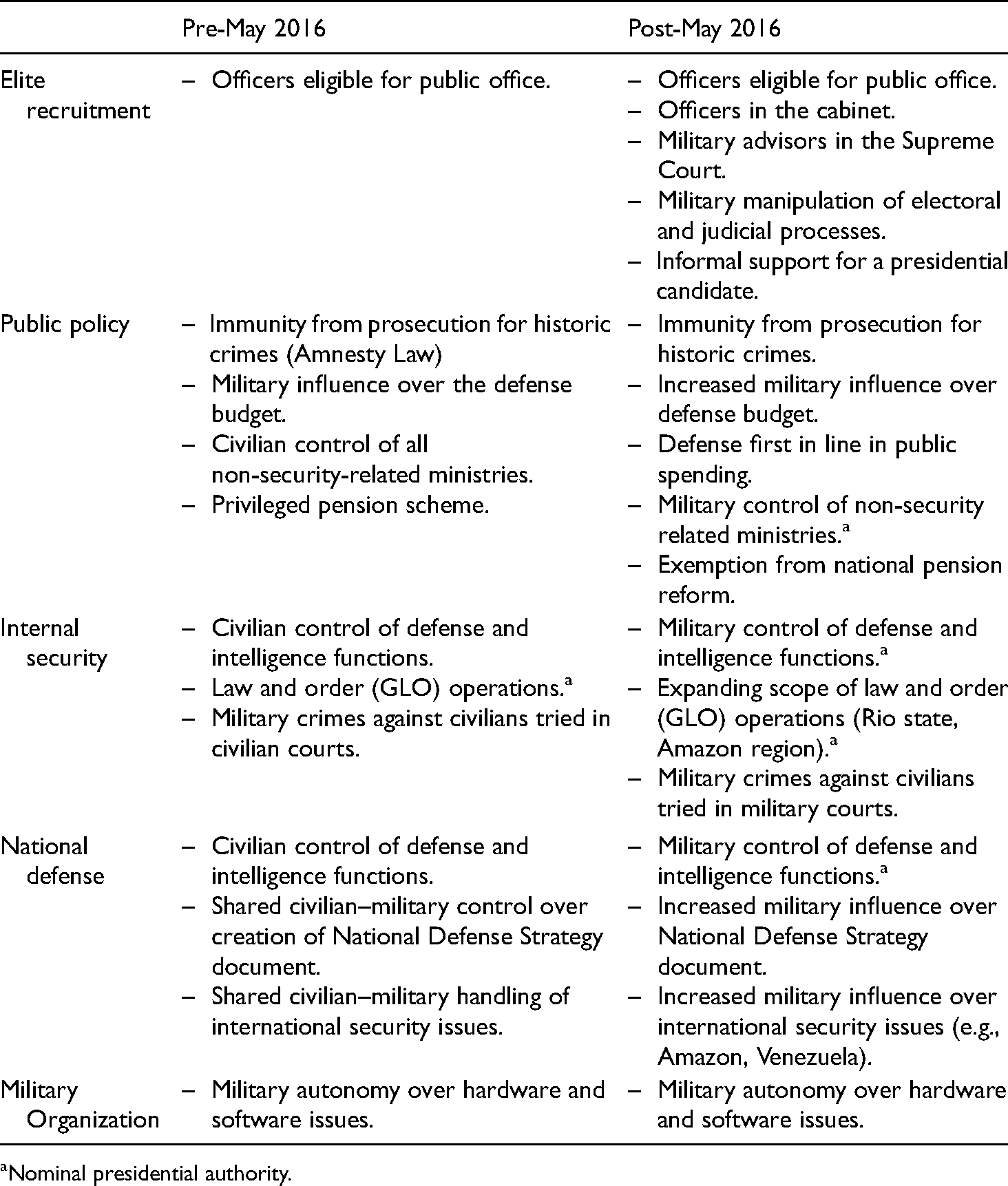
Nominal presidential authority.
On the day he became acting president, Temer recreated the Institutional Security Office—an executive cabinet office traditionally held by the military that Rousseff had dismantled the previous year—, elevated it to ministry status, and transferred to it total coordination power over intelligence gathering, including control of the Brazilian Intelligence Agency (ABIN). 12 Not even during the dictatorship had a single body assumed complete control of all intelligence functions in the country. To head this “super ministry,” Temer named recently retired General Etchegoyen, who became “the strongman” of his administration (Araújo, 2018). Upon his election, Bolsonaro handed the ministry to General Heleno, who transformed it into the military’s headquarters inside the executive branch, with 1142 active-duty officers working in it as of June 2020. 13 Temer’s appointment of General Joaquim Silva e Luna as his defense minister marked the first time a soldier held the post since the ministry’s creation. Despite the continuing economic crisis, the ministry’s share in the federal budget increased by 36 percent during Temer’s first year (Gielow and Patu, 2017), eventually overtaking those of education and health under Bolsonaro (Azevedo, 2020).
In October 2017, under pressure from the barracks, the Temer government signed into law a bill that gave military courts the authority to try crimes against civilians committed during military operations, thereby undoing the 1996 reform of the military judiciary. The law came into effect as the Armed Forces took charge of public security in the state of Rio de Janeiro. Lasting over a year and a half, this was the longest GLO operation with the widest jurisdiction since re-democratization, which the commanding general and Bolsonaro’s future chief of staff, Walter Souza Braga Netto, called a “laboratory for Brazil” (Kawaguti and Lang, 2018).
The military also strengthened its influence over the Amazon region. 14 Both Temer and Bolsonaro appointed the same general, Franklimberg Ribeiro de Freitas, to preside over the National Indian Foundation (Funai), the federal agency overseeing policies regarding indigenous communities. In February 2020, the National Council for the Amazon, the body that coordinates governmental actions in the region, was transferred from the Ministry of Environment to the Vice Presidency (under Mourão, a former commander of troops in the Amazon) and its commissions were packed with soldiers (Valente, 2020). Bolsonaro also intensified government monitoring of NGO activities in the Amazon and issued GLO decrees putting the Armed Forces in charge of managing the refugee influx from Venezuela, fighting outbreaks of fire, and taking action against environmental crimes, at the expense of other agencies with relevant competencies, such as the environmental and renewables agency Ibama and the Ministry of Foreign Affairs.
Under Villas Boas, the military’s involvement in judicial matters transformed from a reactive role, limited to issues surrounding the Amnesty Law, to a pro-active one, principally aimed at influencing the outcome of the 2018 presidential election. The most brazen interference came ahead of the Supreme Court ruling on former president Lula’s request for a preventative habeas corpus so as not to be arrested on corruption charges before exhausting his appeals options. The day before the trial, Villas Boas issued a thinly veiled ultimatum on Twitter, assuring “the Nation that the Brazilian Army shares the desire of all good citizens to repudiate impunity and respect the Constitution, social peace and Democracy, as well as keeping an eye on its institutional missions.” 15 The following day, after a tense 11-h trial, the Supreme Court decided by six votes to five against Lula’s habeas corpus. Two days later, the former president was arrested and effectively ruled out of the election, in which he was the PT’s candidate and the leading name in opinion polls.
In June, the chief of the Southern Military Command, General Geraldo Miotto, visited the regional tribunal overseeing Lula’s case, after which Villas Boas praised the “synergy” between the two institutions. 16 In August, shortly after suspending a release order for Lula, the president of the same tribunal gave a lecture at the Military Club in Rio upon the invitation of then vice-presidential candidate Mourão, who praised the judge for “asserting, with firmness and determination, the rule of law” (Rezende, 2018). In November, reflecting on his Twitter ultimatum before the habeas corpus decision, Villas Boas said, “we felt that things could get out of our control if I did not express myself.” Suggesting the possibility of military action had Lula remained free, he added: “Prevention is better than the cure” (Gielow, 2018). Confirming the institutional nature of the intervention, Villas Boas later revealed that the ultimatum was not a personal initiative of his, but had been planned and coordinated within the military high command (Castro, 2021).
In September 2018, the new president of the Supreme Court, José Antonio Dias Toffoli, appointed as advisor a general indicated to him by Villas Boas: Fernando Azevedo e Silva, who was the Chief of Staff of the Armed Forces before retiring the previous month. The press suggested that the appointment of a military man, hitherto unprecedented, was a strategic move that would allow the judges to “measure the temperature” in the barracks shortly before the election (Vasconcelos, 2018). Silva was not a politically neutral figure: a close associate of generals Mourão and Heleno, he had participated in the weekly meetings of a group of retired officers and conservative academics that formulated policy proposals for Bolsonaro (Brígido and Sassine, 2018). After the election, when Silva became Bolsonaro’s defense minister, Toffoli replaced him with another recently retired general, Ajax Porto Pinheiro, also suggested by Villas Boas.
These interventions ultimately shaped Brazil’s political trajectory. With his main rival eliminated, Bolsonaro won the presidential race. On the day he took office, the new president praised Villas Boas as “a true soldier of the country, who influenced the fate of the nation” and was “more than partly responsible for my being here” (Bresciani, 2019). Following his retirement, Villas Boas became a senior advisor in Bolsonaro’s Institutional Security Office.
Finally, we should note the growing trend of soldiers appointed to civilian posts in the federal government under Temer and Bolsonaro. In just over four years, the number of active-duty officers working in the executive branch increased by 40 percent, from 1834 in February 2016 to 2558 in July 2020, despite a reduction in the number of ministries from thirty-one to twenty-three during the same period (Bragon and Mattoso, 2020). As demonstrated in Table 2, the increase was much steeper in appointments made to strategic managerial and advisory positions, serving as evidence for both the direct role the military has been gradually assuming in policymaking and the reliance of Temer and especially Bolsonaro on the soldiers for governing. 17
Active-duty officers appointed to middle and senior management and advisory posts in the federal executive.
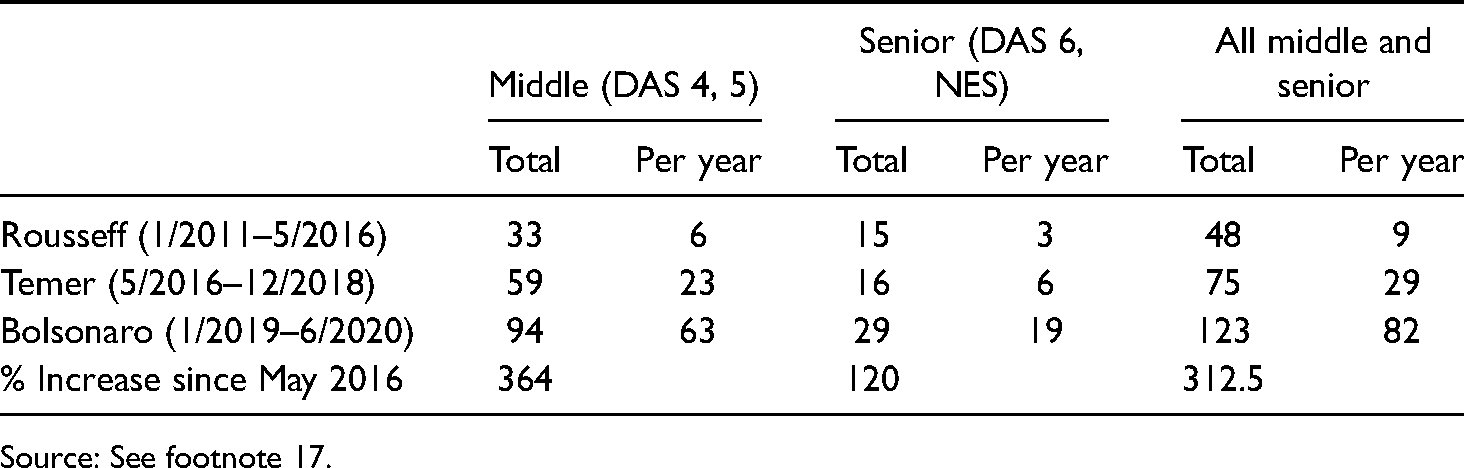
Source: See footnote 17.
By July 2020, ten of the twenty-three ministries in the Bolsonaro government were headed by active-duty or former officers; the second highest ratio of soldier-ministers in government since 1946, surpassed only by the peak of the dictatorship in 1975–1977 (Neto, 2014). Officers have been appointed as directors of key state institutions, such as the oil giant Petrobras, Postal Service (Correios), the National Department of Transport Infrastructure (DNIT) or the National Institute of Colonization and Agrarian Reform (INCRA), and to strategic posts in the Ministry of Justice and Public Security, the Ministry of Education and the Ministry of Environment. In Petrobras, the number of officers in senior management positions went up from nine in January 2019 to ninety-two in March 2021 (Seabra and Garcia, 2021).
The story of the Ministry of Health is illustrative of the state of affairs inside the government amidst the COVID-19 pandemic. After clashing with and losing two health ministers in a month, in May 2020 Bolsonaro appointed an active-duty officer with no experience in the health field, Army General Eduardo Pazuello, as interim minister. In turn, in less than a month, Pazuello named fifteen active-duty officers to managerial and advisory positions of the ministry. 18 This was the first time soldiers occupied strategic posts in the Ministry of Health at least since 1999. 19
Bolsonaro’s controversial handling of the public health emergency created a public backlash, alienated many of his allies, and sparked clashes with the Congress and the Supreme Court, making it costlier for the military to support him. While key figures like Mourão and Heleno have publicly stood by the president, others, such as the Army Commander Pujol, expressed discomfort with the military’s association with a crisis-ridden government, suggesting an emerging gap between retired and active-duty officers. Senior officers from the Navy and the Air Force became increasingly critical of the generals’ political activism (Godoy, 2020), bringing to surface institutional tensions between the two forces and the more dominant and conservative Army, which has been heavily favored by Bolsonaro. 20 In March 2021, the commanders of the Army, the Navy and the Air Force resigned after Bolsonaro abruptly sacked his defense minister, General Azevedo e Silva, for resisting the president’s growing demands for personal loyalty from the military. While the new high command appeared more inclined to appease the president, the press reported that a proposal in the Congress to ban active-duty officers from government positions had garnered support from senior officers, who were concerned about the reputational damage to the Armed Forces (Gielow, 2021).
Conclusion
Between 2016 and 2020, the Brazilian military gradually expanded its control of civilian institutions and amassed political influence unseen since the height of the dictatorship. This was achieved without formally breaking the law, suspending the democratic process, or overthrowing the government; an incremental process whereby the military assumes a central political role and redesigns politics without causing a rupture. We call this a “stealth intervention,” which we introduced in this article as a distinct kind of military contestation, separate both from the existing typology of coups, and the erosion of democratic norms and institutions via executive aggrandizement. The stealth nature of the intervention in Brazil allowed the activist generals to project an image as protectors of democracy even as their actions directly undermined it, and avoid the kind of domestic and international backlash that a traditional coup would trigger.
Brazil shows that in a sustained crisis of democracy, ideologically motivated members of the armed forces can seek to play a pro-active role in politics and impose order in a country seen as “out of order.” This challenges the prevalent view of the military as a reactive force that contests civilians only when its interests are threatened. Indeed, the presence of military-external “pull” factors should not let us overlook the eagerness of the group of generals, who were trained at the height of the dictatorship and maintained its Cold War-era worldview, to influence Brazil’s political trajectory and set the country on the “right” path.
As Levitsky and Ziblatt rightly noted, democracies today often die “at the hands not of generals but of elected leaders—presidents or prime ministers who subvert the very process that brought them to power” (Levitsky and Ziblatt, 2018). The Bolsonaro presidency is a case in point for this type of backsliding. But Brazil’s predicament is also a warning not to count out the generals. Brazil shows that a stealth intervention by the military and executive aggrandizement by elected politicians can go hand in hand, especially as both happen incrementally. What we argue is that the first is not necessarily an addendum to the second: the military’s intervention into politics—and Brazil’s democratic backsliding—started before Bolsonaro’s ascent to the presidency, in which the generals played a crucial role. While the end of Bolsonaro’s embattled presidency would likely mean a reduced military presence in government, as long as the military’s tutelary prerogatives remain in place, this presence can regrow and activist officers can intervene in politics again when the two independent variables reemerge in the future.
This process provides insights into the question posed by Pion-Berlin two decades ago about whether military compliance is “unconditional and professionally grounded, or contingent on the civilians’ politics or performance” by emphasizing the long-term fragilities of democratic transitions that leave important tutelary prerogatives untouched. All transitions from dictatorship in South America involved some kind of compromise between the military and the reformers. But while Argentina, Chile, and Uruguay eventually confronted their troubled pasts, Brazil ran from it—and ended up in the arms of the generals, who, as Villas Boas put it, maintained “the same values, the same principles and the same objectives” but adapted their tactics to changing circumstances.
To be sure, the military is not a monolithic institution, and the actions and beliefs of the generals that led the stealth intervention, even if they comprised the Army top brass, do not necessarily reflect those of the entire officer corps. Indeed, the growing internal criticism and emerging divisions within the Armed Forces since 2020 might suggest varying levels of professionalism and compliance with democratic norms. These differences, in turn, can play a role in the long-term fate of Brazil’s democracy. One critical juncture is the 2022 presidential elections, where the Armed Forces could play a decisive role in case Bolsonaro loses and claims voting fraud, as he has hinted numerous times (Stuenkel, 2021). Further research should thus explore the evidence for factionalism in the Brazilian military, and the evolving relationship between the Army, the Navy and the Air Force, between retired and active-duty officers, between junior and senior officers, as well as between the military and its auxiliary forces, such as the military police, where Bolsonaro enjoys significant personal support (Castro, 2020).
Finally, future research should focus on the role of civilian actors, particularly in the legislature, the judiciary, and the media, in the re-militarization of government and democratic backsliding in Brazil. These are complex institutions that shape Brazil’s high politics and represent diverse interest groups. As the scholarship on civil–military relations has amply demonstrated, strategic support from civilian quarters is crucial to propping up military rule. In Brazil, civilian support for the military, both popular and political, helped sustain the dictatorship, preserve the generals’ privileges after re-democratization and propel them back to the political center stage after 2016. Ultimately, it will be the civilians who will decide the fate of the country’s democracy.
Footnotes
Acknowledgments
The authors would like to thank Mert Arslanalp, Izabela Corrêa, Flávio Rocha de Oliveira, Marcus Rehm, Orçun Selçuk and the two anonymous reviewers for their valuable feedback and comments on the earlier drafts of this article.
Declaration of Conflicting Interests
The authors declared no potential conflicts of interest with respect to the research, authorship, and/or publication of this article.
Funding
The authors received no financial support for the research, authorship, and/or publication of this article.