




Abstract
Rightwing parties in many Latin American countries were historically linked to military dictatorships. Recent studies on the far-right in Latin America underline support for iron-fist policies as a key factor. We assess if identification with the Republicanos Party (PRC) in Chile is associated with support for iron-fist policies, and with authoritarian values. We use a national poll from 2022 to test four hypotheses. There is a positive association between preference for a military government (iron-fist policies) and a negative association between preference for an authoritarian government and identification with the PRC. Unlike other rightwing parties that have distanced themselves from the legacy of the dictatorship, the PRC's positive view of that regime might lead its sympathisers to associate support for iron-fist policies with a military government. In turn, as the PRC is strongly against leftwing governments elsewhere in Latin America, its sympathisers are more likely to oppose authoritarian regimes.
The rise of far-right political parties has attracted scholarly attention in recent years. Studies have focused on the radical right in industrialised democracies and, increasingly, in emerging democracies, such as those in Latin America. Studies distinguish between the populist radical right and the extreme right, with the former being loyal to democracy and the latter expressing support for authoritarian values (Mudde, 2019). In Latin America, as nativism has not been a central feature of far-right parties, the differences between the two groups is more blurred (Borges and Zanotti, 2024; Zanotti and Roberts, 2021). High levels of crime and a growing perception of insecurity in the region have been associated with support for iron-fist policies and, indirectly, with stronger identification with far-right parties. Given the memory of rightwing dictatorships in several Latin American countries, partisanship with far-right parties might also reflect support for authoritarian values.
Here, we explore whether partisanship with the far-right Republican Party of Chile (PRC, Partido Republicano de Chile) is explained by support for iron-fist policies and/or support for authoritarian values. The PRC, which has been often labelled as far-right (Díaz et al., 2023; Zanotti and Roberts, 2021), was created to challenge other established rightwing parties (Melendez et al., 2021; Mella Polanco et al., 2019). In the 2021 presidential election, its candidate, José Antonio Kast, made it to the runoff. We explore the association of support for iron-fist policies (in the form of support for a military government) and support for authoritarian values with support for the PRC and for other rightwing parties. We also explore whether socio-demographic traits and religious adscription are associated with identification with the PRC.
In what follows, we postulate four hypotheses on the determinants of identification with far-right parties in the context of Latin America. We test them using the PRC and two leading rightwing parties in Chile. We rely on an online national poll conducted in September of 2022. We then present the methodology, the case and the results. There is a strong association between support for a military government and opposition to the notion that an authoritarian government is sometimes preferable with identification with the PRC. To account for that apparent contradiction, we argue that support for a military government is a proxy of support for iron-fist policies and opposition to an authoritarian government reflects the rejection by PRC sympathisers of leftwing authoritarian governments that exist elsewhere in Latin America.
Our study contributes to the literature on the rise of far-right parties in Latin America by distinguishing between support for a military government, as a proxy for iron-fist policies and a law-and-order message, and support for an authoritarian government, which might be associated with the absence of competitive elections more than with the government's anti-crime policies. As the growth of far-right parties in Latin America has occurred in the context of competitive elections (although not necessarily on a level-playing field), we highlight the distinction between supporting an iron-fist government and supporting a government which does not gain legitimacy through competitive elections.
The Rise of Far-Right Parties in Latin America
The rise of far-right parties has triggered a contentious debate on what distinguishes the right from the far-right (Bale and Kaltwasser, 2021; Coffé et al., 2007), including in Latin American party systems (Kaltwasser, 2022; Luna and Kaltwasser, 2014). We define far-right parties, following Mudde (2019) and (Golder, 2016: 481), as those that espouse a more radical or extreme version than mainstream rightwing parties.
Golder (2016) associates support for far-right parties with modernisation and cultural and economic grievances on the demand side, and with the political opportunity structure and party organisation on the supply side. Others focus on the institutional rules, including electoral rules, that facilitate the rise of parties that cater to discontented electoral minorities (Norris, 2005). Some associate the far-right with extreme policy positions on immigration or moral values (Green-Pedersen and Odmalm, 2008; Rydgren, 2008; Veugelers, 2000). Others link the rise of radical right parties with support for a punitive approach to law and order (Carter, 2018; Mudde, 2019) and with authoritarian values (Kitschelt and McGann, 1997; Mudde, 2007). By appealing to polarised beliefs and espousing an anti-establishment discourse, far-right parties give voice to those who would otherwise feel they are too extremist to be represented (Golder, 2016; Mudde, 2019, 2007; Van Spanje, 2010, 2011).
Most studies on the radical right have looked at industrialised European democracies or emerging democracies in Eastern Europe (Golder, 2016; Mudde, 2019, 2007). European far-right parties adopt strong anti-immigrant positions and advocate iron-fist policies (Cole, 2005; Mazzoleni and Ivaldi, 2022; Van Spanje, 2011). Latin America presents a unique context with its history of rightwing military dictatorships that, in many cases, advocated for conservative values, economic freedom, and populism. Historically, part of the Latin American right has advocated for free trade, foreign investment, and market-driven solutions (Dornbusch and Edwards, 1992). Thus, it comes as no surprise that some contemporary Latin American far-right leaders also embraced a combination of those views, as Jair Bolsonaro did in Brazil and Javier Milei has done in Argentina.
In the interplay between populism and democracy in Latin America, far-right populists challenge traditional political elites claiming to represent the “will of the people” (Panizza and Miorelli, 2009). The rise of far-right populism tests the compatibility of a populist rhetoric with democratic principles and individual rights (Kestler, 2022). More recently, the resurgence of far-right parties has been associated with grassroots movements that support free markets and promote restrictions on abortion and on LGBTQ+ rights (Mayka and Smith, 2021). The recent electoral notoriety of Bolsonaro in Brazil and Kast in Chile underlines this pattern (Kestler, 2022).
Many contemporary conservative parties in Latin America support past rightwing dictatorships (Loxton, 2021) and promote iron-fist policies (Levitsky, 2018). In Chile, the end of the Pinochet dictatorship was linked to a social cleavage that aligned the party system along an authoritarian–democratic divide, with rightwing parties supporting authoritarian values and leftwing parties promoting democratic values (Tironi and Agüero, 1999; Valenzuela, 1999). An intense debate in the following years kept that debate alive (Angell, 2003; Bargsted and Somma, 2016; Bonilla et al., 2011; De La Cerda, 2022; Huneeus and Maldonado, 2003). Although the evidence shows that Chilean rightwing parties support democratic values, authoritarian beliefs linger among some who identify with the right (Bonilla et al., 2011).
Democratic Values and Support for Far-Right Parties
A common paradigm about far-right voting is that authoritarianism is a key foundation of support (Mudde, 2007). Vasilopoulos and Lachat (2018) found an association between authoritarianism and vote choice for the far-right in France. Others report strong support for authoritarianism among conservative voters in Japan (Higuchi and Matsutani, 2016). Similarly, in the United States, Van Assche et al. (2019) find an association between authoritarian values and explicit support for Donald Trump. In this view, any behaviour, including moral behaviour, that can be seen as a disturbance of society is perceived as threatening the social order and, thus, punishable (Mudde, 2007).
Studies on the rise of rightwing parties in Latin America also underline their leaders’ support for authoritarianism. But the history and context of authoritarianism is different in Latin America than in industrialised democracies. Authoritarian values in Latin America are often conflated with support for, and identification with, past military dictatorships (Hunter and Power, 2019). But also with support for law-and-order and iron-fist policies, especially in a context of rising crime and high perception of insecurity (Visconti, 2020).
The recent rise of far-right parties in Latin America requires distinguishing between authoritarian values and iron-fist policies. Authoritarian values are associated with the absence or weakness of democratic values (Carlin, 2018; Navia and Osorio, 2019; Pérez-Liñán and Mainwaring, 2013), while support for iron-fist policies is associated with respect for authority and with punishment for those who violate rules – a position strongly defended by far-right parties (Carter, 2018; Mudde, 2019; Pirro, 2023).
Support for iron-fist policies, for adherence to the rules, and for law-and-order views are tenets of a rightwing ideology and do not necessarily entail weak democratic values. People who support strong anti-crime policies might also oppose authoritarian regimes. Even when they support iron-fist policies, they might justify that support on the need to secure the freedoms and liberties associated with democracy (Borges and Zanotti, 2024; Rosen, 2021; Visconti, 2020).
In turn, weak democratic values are not necessarily associated with support for far-right parties. In fact, in several Latin American countries, contemporary authoritarian governments are leftwing regimes (De La Torre, 2016; Levitsky and Loxton, 2018; Mainwaring and Pérez-Liñán, 2023: 159–160; Weyland, 2013). While sympathising with authoritarian regimes and justifying governments that violate democratic norms were associated primarily with rightwing values in the 1970s and 1980s, contemporary authoritarian governments are currently also associated with the left, as the cases of Cuba, Venezuela, and Nicaragua make patently clear (Mainwaring and Pérez-Liñán, 2023). As a result, many leftwing parties and leftwing sympathisers find themselves in a tough spot when discussing leftwing regimes in the region. Even in Chile, where President Gabriel Boric has been an outspoken critic of the Maduro regime in Venezuela, several parties in his leftwing government have failed to criticise the Venezuelan dictatorship.
The current association between the left and authoritarian governments in Latin America gives rightwing parties an opportunity to shift the historical blame for having supported authoritarian regimes. Precisely those rightwing parties and sympathisers that are seen as closest to the authoritarian legacy of past military dictatorship – as the PRC in Chile – can seize on the opportunity to whitewash their reputation by accusing the left of supporting authoritarianism. After being identified with the authoritarian legacy early in the 1990s (Tironi and Agüero, 1999; Valenzuela, 1999), traditional rightwing parties in Chile have distanced themselves from the authoritarian legacy and have embraced democratic values (Alenda, 2020; Angell, 2003; Angell and Reig, 2006). More recently, the PRC has been aggressive in accusing leftwing parties of supporting authoritarian regimes in Cuba, Venezuela, or Nicaragua. As those two concepts – support for authoritarianism and support for iron-fist policies – are not the same, we propose two hypotheses:
Those who express support for a military government (a proxy for iron-fist policies) are more likely to identify with the PRC than with other rightwing parties.
Those who express weaker democratic values, in the form of support for authoritarianism, are less likely to identify with the PRC than with other rightwing parties.
Other Determinants of Support for Far-Right Parties
Since levels of identification with political parties, or partisanship, are relatively low, studies often use voting, or the broader concept of identification with a party, as a proxy for support. In industrialised democracies, support for traditional rightwing parties is stronger among higher income persons (Lind, 2010). However, since far-right parties embrace anti-establishment views, their support base might not be among better off voters. Those who are socially and economically marginalised are more likely to support populist or far-right parties (Gidron and Hall, 2017; Rovny, 2013; Röth et al., 2018). In fact, “the typical far right voter is a young male, with a low level of education, who is either unemployed, self-employed, or a manual worker” (Golder, 2016: 483).
In Chile, rightwing parties are associated with stronger support among the middle and upper class while far-right movements are associated with support among lower class and marginalised voters (Alenda, 2020). Yet, others have also shown that the far-right competes with established rightwing parties for traditional conservative voters (Campos Campos, 2021; Díaz et al., 2023; Melendez et al., 2021). This leads us to a third hypothesis:
While those of higher socio-economic status are more likely to identify with other rightwing parties, socio-economic status is not a strong predictor of support for the PRC.
Support for far-right parties has been associated with conservative family values, traditional gender roles, and stronger religious beliefs (Wodak, 2019). Far-right parties embrace beliefs and practices that are distinctly masculine and thus, tend to attract stronger support among men (Ralph-Morrow, 2022). In Latin America, religious groups historically played a crucial role in supporting rightwing parties (Dodson, 1979). More recently, conservative values have been associated with the rise of evangelicals more than with Catholicism (Boas, 2023; Hunter and Power, 2019). This is also the case for Chile (Raymond, 2021; Raymond and Feltch, 2012). Yet, others have found that evangelicals are not more likely than Catholics to vote for conservative values (Sendra, 2023), as what really matters is church attendance. Those who attribute more importance to religion are more conservative (Audette et al., 2020; Rodrigues-Silveira and Cervi, 2019). Consistent with prior findings, we would then expect that:
Evangelicals and those who attend church more often are more likely to identify with the PRC than with other rightwing parties.
The Republican Party of Chile
Since the mid-twentieth century, the Chilean party system has been aligned on a left-right scale (Valenzuela and Scully, 1997). In 1988, a plebiscite sanctioned the return to democratic rule when a majority voted to end the military dictatorship. The legacy of that regime (1973–1990) shaped the transition to democracy and the party system. Since 1990, Chile has a presidential system and multiparty coalitions in the legislature, with most parties siding either with a left or rightwing candidate in the runoff election – which has happened in 6 consecutive presidential contests since 1999. Leftwing parties, in power between 1990 and 2010, and rightwing parties, which first reached power in 2010, became more moderate. Leftwing parties abandoned their support for state-centred economic policies and rightwing parties distanced themselves from the legacy of the military dictatorship (Sehnbruch and Siavelis, 2014).
Between 1990 and 2013, the party system was comprised of 7 large parties that formed two stable coalitions. In 2013, the centre-left Concertación – Socialist Party (PS), Party for Democracy (PPD), Radical Party (PR) and Christian Democratic Party (PDC) – added the Communist Party (PC) and became the New Majority coalition. On the right, National Renewal (RN) and the Independent Democratic Union (UDI) comprised the Alianza (which has used different labels over time).
Until 2013, electoral rules for the bicameral legislature used an open-list proportional representation system with two seats per district. For the 2017 elections, an electoral reform increased the seats in the Chamber of Deputies from 120 to 155, reduced the number of districts to twenty-eight and increased the district magnitude to a range of three to eight seats per district. The Senate, elected by halves in staggered eight-year terms, increased from thirty-eight to fifty members, elected in sixteen districts ranging from two to five. Accompanying reforms to the party system rules made it easier for new parties to register, introduced public funding for political parties, and established a candidate gender quota of 40 per cent at the national level (Gamboa and Morales, 2016).
Those electoral reforms led to party system fragmentation. In 2017, sixteen parties won seats in the Chamber of Deputies, representing 6 multiparty coalitions. The adoption of moderate positions by the two dominant coalitions generated a political space for new far-right and far-left parties to attract voters on both ends of the left-right scale. In the 2017 election, the Broad Front (FA) emerged as a far-left coalition and J.A. Kast, a former legislator from UDI, launched a presidential bid as a far-right candidate. In 2021, the presidential candidates from the two leading coalitions received a combined vote of just 53.7 per cent.
Kast started his political career as councilmember in Buin (1996–2000), a rural municipality south of Santiago. After one term in office, Kast ran for the Chamber of Deputies in 2001 in District 30, which included Buin. He replaced Pablo Longueira, a long-time UDI leader who switched districts. This highlights Kast's proximity to UDI leaders and his origin as a party insider. After winning the seat in 2001 (35.5 per cent vote share), Kast won re-election in 2005 and 2009 with 31.7 per cent and 35.1 per cent respectively.
As an UDI legislator, Kast defended conservative causes. He opposed LGBTQ+ rights 1 and the morning after pill. 2 In 2010, Kast unsuccessfully challenged the founding UDI leaders in an internal election for control of the party. As one of UDI's most recognised leaders, he became the caucus leader of UDI's 40-member delegation in the Chamber of Deputies in 2011. In 2013, Kast attempted to run for the Senate, positioning himself as the successor to long-time leader Pablo Longueira, who left his Senate seat to join Piñera's cabinet as Minister of Economics. After internal bickering within the rightwing coalition, Kast was forced to run again for the Chamber of Deputies in a different district, where he won a seat with 18.7 per cent. A campaign finance scandal in 2014 forced the resignation of UDI president, Ernesto Silva, a young legislator close to the UDI founding members. That led Kast and a few other prominent politicians to resign from UDI in 2016.
After coming in fourth place in the 2017 presidential election, Kast formed the Republican Party of Chile (PRC). The party first ran in the 2021 election for the constitutional convention as part of the traditional rightwing coalition, fielding only eleven candidates among the 150 candidates of that coalition and winning three seats. In the concurrent gubernatorial and municipal election, the PRC ran its own list, challenging Chile Vamos candidates in some rightwing strongholds. Most PRC candidates lost, and in some districts, the divided rightwing vote even helped leftwing parties win those races. In the late 2021 presidential election, the PRC ran its own list, challenging the Chile Vamos, with Kast as its presidential candidate.
The PRC views, outlined in Ruta Republicana (Edwards, 2021), see law and order as well as liberty as central values. The party states a commitment to democratic rule, a compromise that, given the history of the far-right in Chile, implicitly seeks to differentiate the party from the authoritarian legacy. The PRC distinguishes between conservative, liberal/libertarian, and patriotic/republican rightwing views, respectively associated with family values, economic freedom, and the wellbeing of the nation and the republic (Edwards, 2021). The PRC criticises the failure of traditional rightwing parties to resist an alleged hegemonic rise of leftwing progressive policies and identity politics (Edwards, 2021: 28). The party promotes lower taxes, decentralisation, a smaller state, tougher immigration policies, fighting terrorism, stronger security policies and more funding for the armed forces and police. The PRC also promotes market-friendly values and private property – which in Chile are directly linked to the neoliberal economic imposed under authoritarian rule.
PRC patriotic values are also related to the storytelling behind Pinochet's dictatorship. In the 2017 presidential campaign, Kast proudly said that “If Pinochet was alive, he’d vote for me.” 3 In 2018, on the commemoration of the 1973 military coup, Kast tweeted that “Chile chose liberty on September 11th. The country we have today is thanks to the men and women that rose to prevent the Marxist revolution in our land.” 4 More recently, Luis Silva, another PRC leader – who received a high vote share in the election for the constitutional council in 2023 – referred to Pinochet in a television show as “a statesman who built up a broken country.” 5
Previous studies claim that the two traditional rightwing parties (RN and UDI), that trace their origin to the authoritarian period, became more electorally competitive as they adopted more moderate views when democracy was restored (Aubry and Dockendorff, 2014; Barozet and Aubry, 2005; Mella Polanco et al., 2019; Rovira Kaltwasser, 2019). In the two Piñera terms (2010–2014 and 2018–2022), the rightwing coalition embraced more moderate policies, creating a space in the far-right for a new party to emerge and build support among discontent conservative voters who felt let down by the rightwing government (Campos Campos, 2021; Kestler, 2022; Melendez et al., 2021). The irruption of Kast in 2017 has been associated with the rise of the far-right (Díaz et al., 2023; Zanotti and Roberts, 2021) and his electoral support was linked to the mobilisation of evangelical voters (Raymond, 2021). The PRC has been regularly classified as a far-right party (Díaz et al., 2023; Gartenlaub González, 2023; Zanotti and Roberts, 2021).
The 2019 social uprising produced a degree of polarisation that favoured the PRC's strong law-and-order message built on the claim that, under authoritarian rule, Chile had low levels of crime (Durán and Rojas, 2021). The ensuing political polarisation proved to be a fertile ground for the PRC to win support among conservatives who felt that Chile was moving too far left.
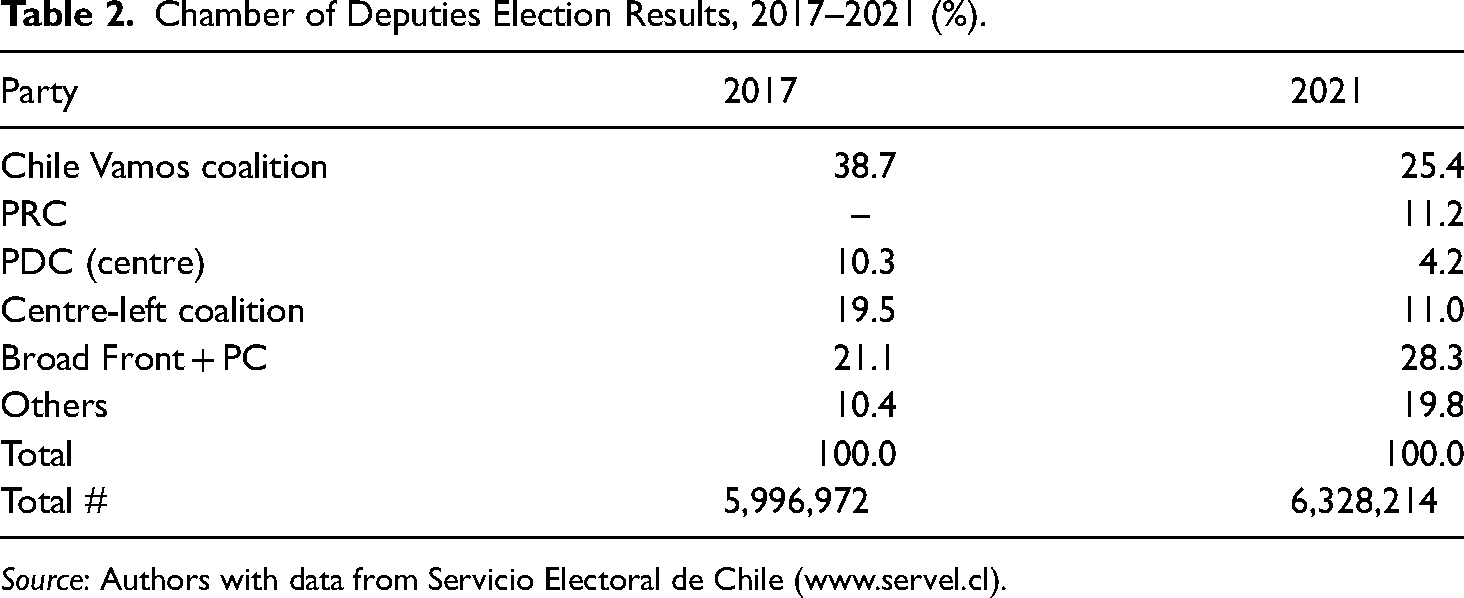
Table 1 shows the election results in 2017 and 2021 presidential elections. In 2017, Kast obtained 8 per cent vote in the first round, ending in fourth place among eight candidates. In the runoff, Kast supported Sebastián Piñera, the main rightwing candidate, but Kast did not join the Piñera government. Instead, he focused on strengthening his own party, largely by criticising the government from the right. One rightwing UDI legislator and two RN legislators joined the emerging PRC. In 2021, Kast made it to the presidential election runoff and transformed the PRC into a major contender. In turn, Table 2 shows the results for the Chamber of Deputies elections. The vote for the traditional rightwing coalition declined between 2017 and 2021 by roughly the same vote share received by PRC in 2021. In the 2023 election for a second constitutional convention, the PRC won a plurality of votes (35.4 per cent), winning twenty-three of the fifty seats for the convention. Traditional rightwing parties won another eleven seats, giving rightwing parties a vetoproof majority in the constitution writing body.
Presidential Election Results in Chile, 2017–2021.
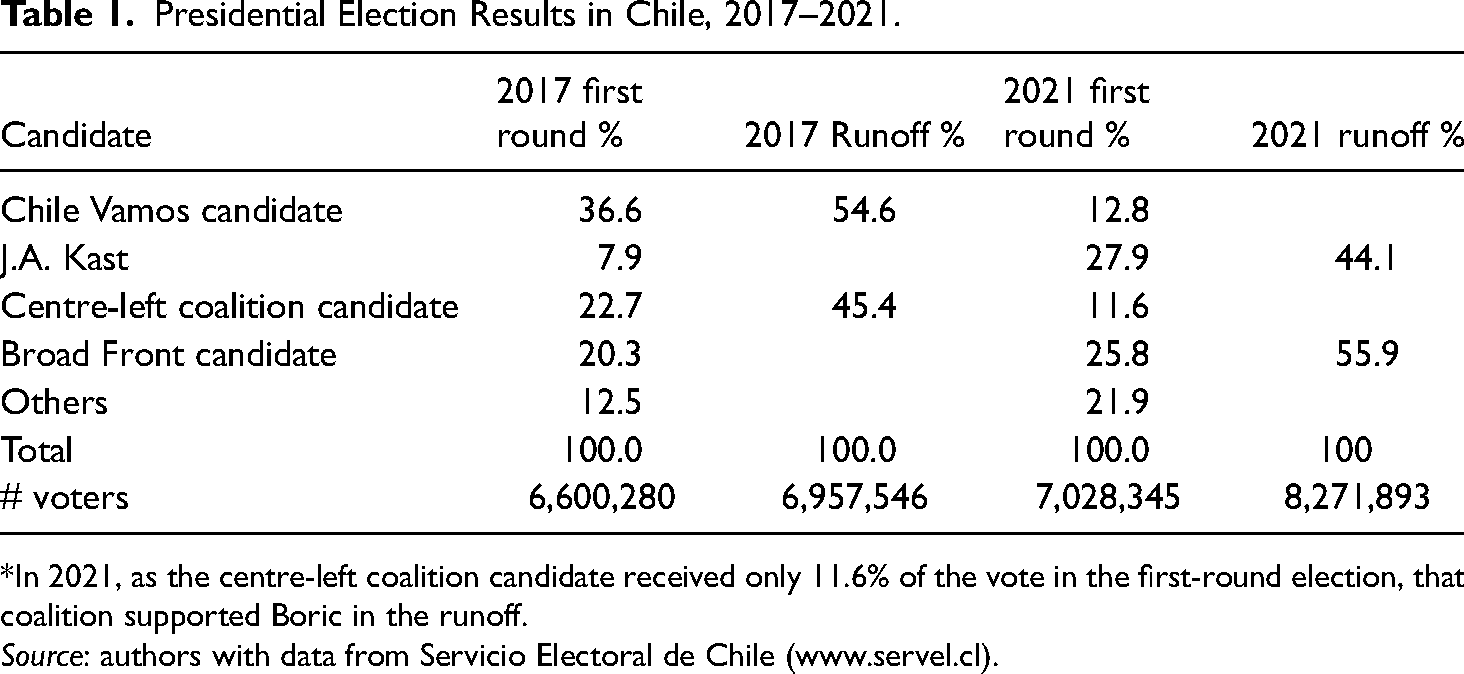
*In 2021, as the centre-left coalition candidate received only 11.6% of the vote in the first-round election, that coalition supported Boric in the runoff.
Source: authors with data from Servicio Electoral de Chile (www.servel.cl).
Chamber of Deputies Election Results, 2017–2021 (%).
Source: Authors with data from Servicio Electoral de Chile (www.servel.cl).
Methodology
To assess partisanship with the PRC in Chile, we use a national online poll commissioned by the Millennium Nucleus Center for the Study of Politics, Public Opinion and Media (MEPOP) and conducted by Netquest, a private polling company. 6 The non-probabilistic online poll was conducted in late August and early September of 2022, a few days before the constitutional referendum, and included 2,117 respondents. Similar polls conducted by Netquest have been used to study the rise of Brazilian rightwing leader Bolsonaro (Layton et al., 2021) and, in Chile, to assess intergroup trust across ethnic groups (Carlin et al., 2022), ideational populism (Aguilar and Carlin, 2017) and the association between the perception of crime and vote choice in the 2022 constitutional plebiscite (Berg Bilbao and Navia, 2025).
Other widely used polls either no longer ask about partisanship (as LAPOP) or when they ask about partisanship, very few people report identifying with a party. In the 2023 Latinobarómetro poll, only 20.8 per cent identified with a party and although the Republicanos was the fourth most popular party in the country, only 2.6 per cent of the sample identified with them. In the nationally representative poll conducted by the Center for Public Studies (CEP) in November of 2022, those who identified with the PRC were 2.2 per cent of the sample, a difference within the margin of error from those who identified with RN (3.6 per cent), UDI (2.6 per cent) and Evopoli (0.5 per cent), the other rightwing parties in Chile. Other parties with relevant identification rates were the PS (5.4 per cent), PC (2.8 per cent), PDG (2.0 per cent) and the Christian Democratic Party, PDC (3.4 per cent). 7 The MEPOP online poll has the advantage of being conducted shortly before an important and highly polarising popular vote. Moreover, precisely because few Chileans identify with political parties, the large N (2,117) for the poll allows us to test hypotheses on the determinants of partisanship with the PRC.
Our dependent variables are partisanship with the PRC, RN, and UDI. We use this question in the poll: “of the following parties, which party do you identify or sympathize with?” Respondents were offered a list of nineteen parties, and they could also choose “other,” “none,” or “no answer.” We use a dichotomous variable to identify those who sympathise or identify with each of the three largest rightwing parties. For each party, we compare those who identify with the party (1) with everyone else in the poll (0).
In the poll, the PRC had the highest identification (5 per cent), surpassing RN (3.9 per cent), UDI (2.5 per cent) and a smaller liberal right party, Evopoli (1.5 per cent). Other parties with significant levels of identification were the leftwing Socialist (PS) and Communist (PC) parties, with 3.6 per cent and 3.1 per cent, respectively, and the centrist populist Party of the People (PDG) (2.2 per cent). All other parties had a level of identification of less than 2 per cent. Altogether, 35.4 per cent of respondents identified with a political party.
Our independent variable for hypothesis 1 is support for iron-fist policies and support for law-and-order. In the absence of a better indicator that signals support for a candidate that will embrace iron-fist policies, we use support for a military government as a proxy for support for iron-fist policies and for a law-and-order message. Given a context of growing levels of crime and perception of insecurity in the region (Carreras and Visconti, 2022; Visconti, 2020), the growing support for iron-fist policies can be expressed in support for a leader with military experience that can impose law-and-order policies. The election of former military officer Jair Bolsonaro in Brazil was associated with, among other things, support for iron-fist policies (Geliski et al., 2024). The rise of Nayib Bukele in El Salvador in 2019 was associated with his strong law-and-order program and iron-fist policies (Meléndez-Sánchez and Vergara, 2024; Perelló and Navia, 2022). Notice that support for a military government is not mutually exclusive with the presence of democratic elections. People can democratically elect a former military leader.
Using support for a military leader as a proxy of support for iron-fist policies, we rely on a question that has been historically included in the World Value Survey polls: “I’m going to describe various types of political systems and ask what you think about each as a way of governing this country: having a military government” (WVS Question 237). Whereas the WVS has a set of answers from 1 to 4 (Very good, fairly good, fairly bad, very bad), the MEPOP poll had a 1–5 scale from disagreement/agreement with the statement.
For hypothesis 2, support for authoritarianism, we use three indicators. First, we use two questions that are also normally included in the WVS. Respondents are asked about their agreement with the statements: “having a strong leader who does not have to bother with parliament and elections” (WVS Question 235) and “having a democratic political system” (WVS Question 238). Preferring a strong leader who does not have to bother with elections or preferring a democratic political system is directly associated with a democratic form of government. For our third indicator, we use a question, normally included in the Latinobarómetro polls, that asks people to choose among three statements: “democracy is preferable to any other form of government”; “in some circumstances, an authoritarian government may be preferable to a democratic one”; and “for people like me, it does not matter whether we live in a democratic or non-democratic regime.” We created a dummy variable for those who responded that, in some circumstances, an authoritarian government is preferable. We expect that those who express stronger authoritarian values will be more likely to identify with the PRC than with other rightwing parties. To be sure, the question for use for support for law-and-order policies and the questions used for support for authoritarian values are weakly positively correlated. That suggests that respondents do not treat them as interchangeable questions.
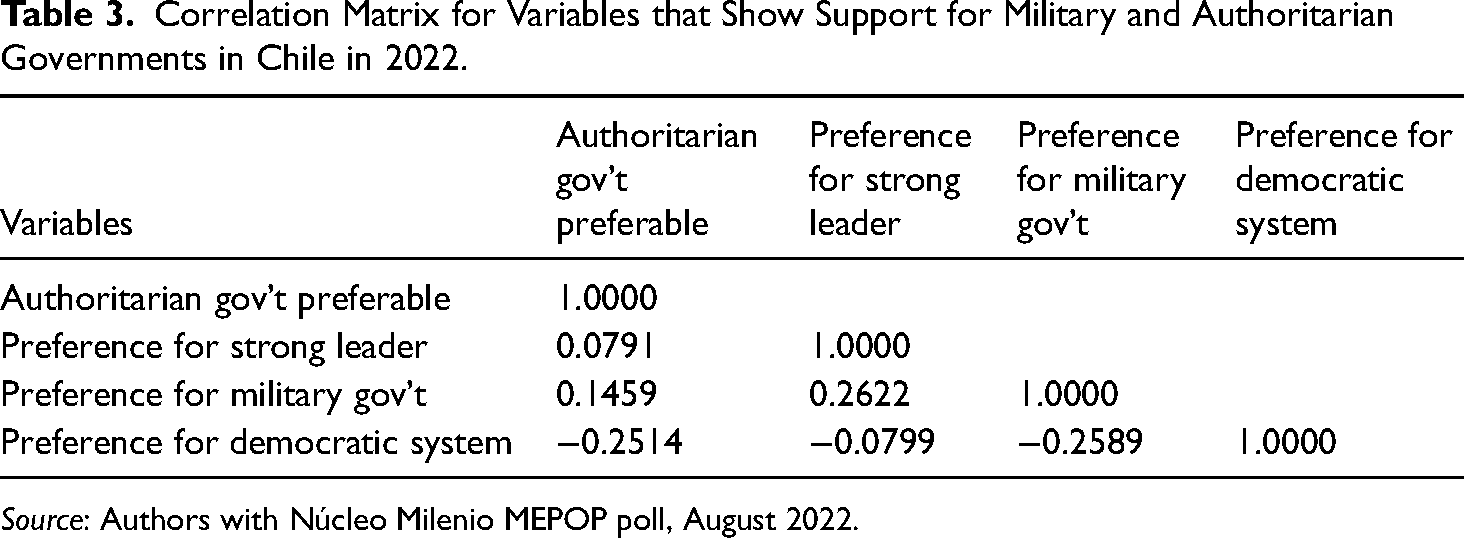
Table 3 shows a correlation matrix for the responses to the questions we use as independent variables for hypotheses 1 and 2. As expected, agreement with the assertion that an authoritarian government is sometimes preferable is positively correlated with preference for a strong leader and preference for a military government. In turn, agreement with the assertion that an authoritarian government is sometimes preferable is negatively correlated with preference for a democratic system. But in all cases, the values for the correlation are low, which signals that people do not understand those questions as meaning the same thing. Chileans see support for an authoritarian government as meaning something different than support for a strong leader or support for a military government.
Correlation Matrix for Variables that Show Support for Military and Authoritarian Governments in Chile in 2022.
Source: Authors with Núcleo Milenio MEPOP poll, August 2022.
The independent variable for hypothesis 3 is socio-economic status. We expect that traditional parties will attract more support among people of higher socio-economic status, but the support for PRC will not be explained by socio-economic status. The poll classified respondents from highest to lowest socio-economic status (SES) in 5 categories (ABC1, C2, C3, D and E). We coded the variable to reflect from lower to higher socioeconomic status (1 to 5).
We have two indicators for the independent variable for hypothesis 4. First, we include whether the respondent identified as an evangelical, Catholic, or other (other Christian denominations, other religions, or no religion). Second, we include a question on the frequency of attending religious services, a five-point scale from never to very frequently.
As control variables, we included a question on self-identification on the 0–10 left-right scale. Since an overwhelming majority of those who identified with political parties placed themselves on the scale, we exclude those who did not identify on the scale. That brings our number of cases down to 1,605 respondents. Since most respondents who identify with political parties also identified on the left-right scale, the reduced sample includes almost all respondents who identified with the PRC and with other rightwing parties.
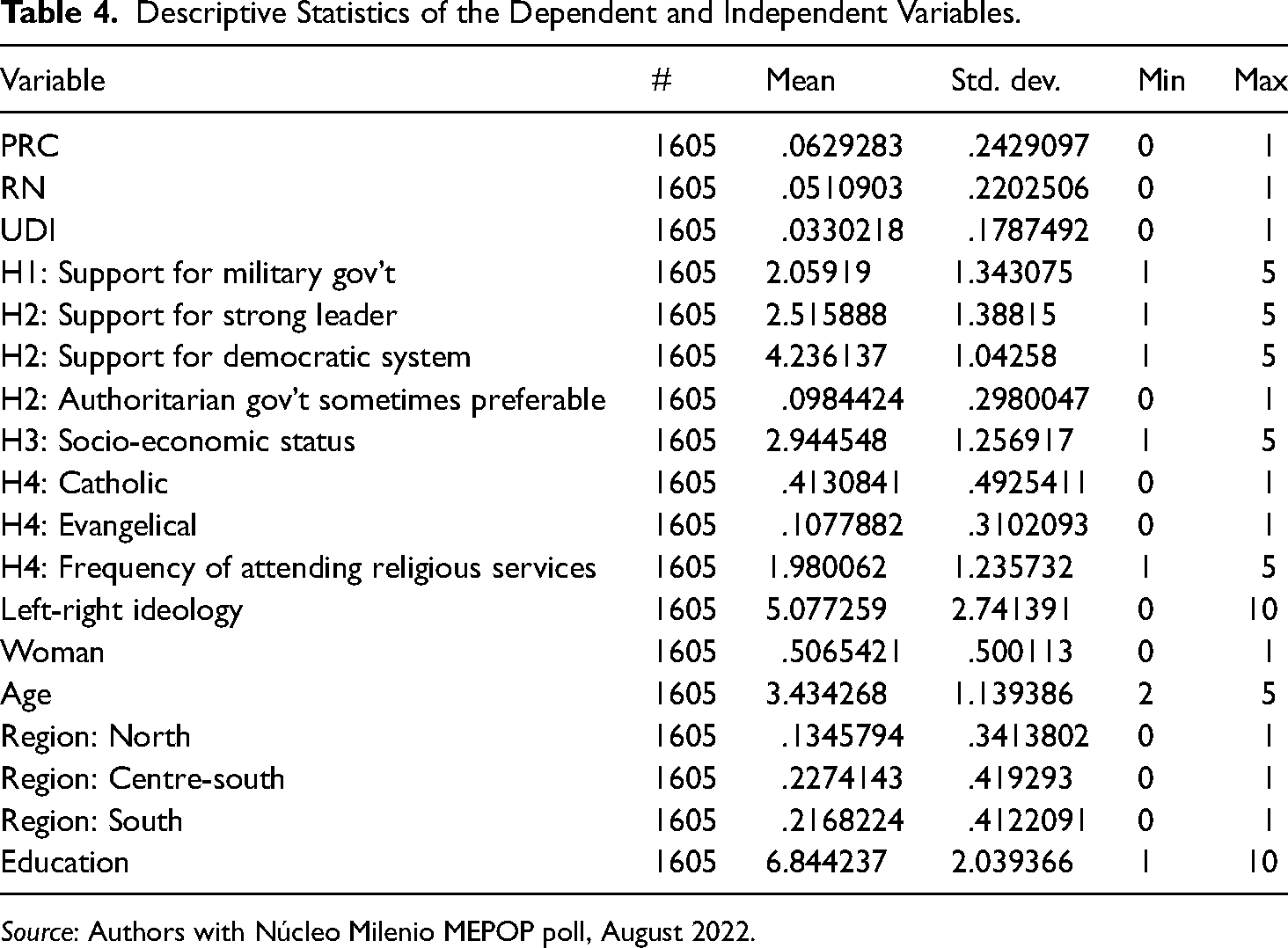
We included indicators for gender, age, education and region of residency. Prior work has shown that although men are more likely than women to support radical right parties (Norris, 2005: 145) and that women are less likely to vote for far-right parties – at least in some countries (Harteveld et al., 2015). The poll classified respondents in four age groups (18–34, 35–44, 45–59, and 60 and over). We treat this variable as a continuum as well. For region of residency, we use North, Centre-South, and South with the central Metropolitan Region as the reference category. Table 4 shows the descriptive statistics for the dependent and independent variables used in the models. Notice that 6.2 per cent, 5.1 per cent and 3.3 per cent of the sample identified with the PRC, RN, and UDI, respectively.
Descriptive Statistics of the Dependent and Independent Variables.
Source: Authors with Núcleo Milenio MEPOP poll, August 2022.
Results
Table 5 shows the results of 5 logit models on the determinants of party identification with the PRC (models 1–3) and with RN and UDI (models 4 and 5). The appendix includes a multinomial logit model where we compare identification with the PRC, other rightwing parties, other parties and those who do not identify with any party. The results are mostly consistent.
Logit Estimations on the Determinants of Identification with Rightwing Parties in Chile in 2022.
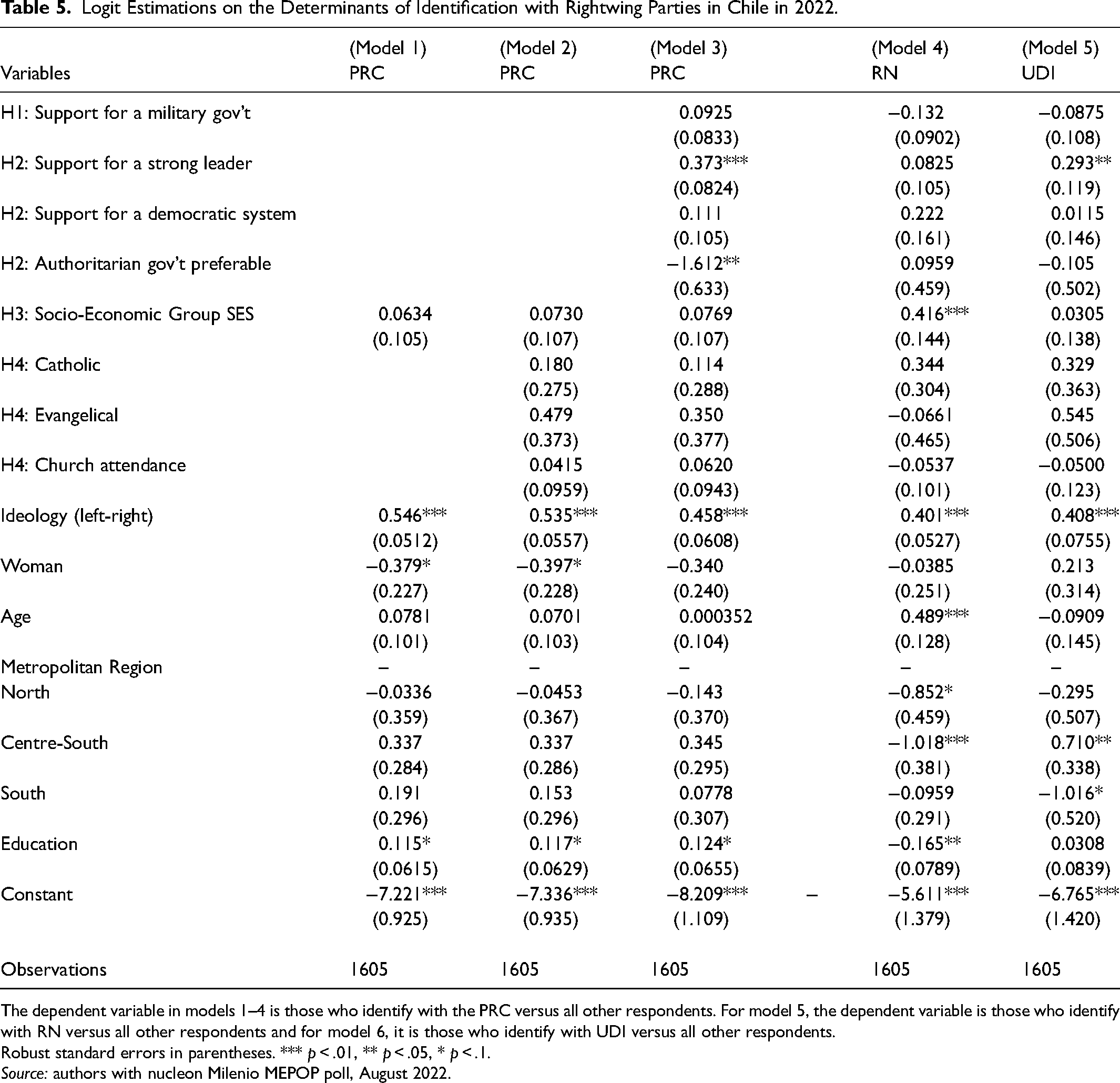
The dependent variable in models 1–4 is those who identify with the PRC versus all other respondents. For model 5, the dependent variable is those who identify with RN versus all other respondents and for model 6, it is those who identify with UDI versus all other respondents.
Robust standard errors in parentheses. *** p < .01, ** p < .05, * p < .1.
Source: authors with nucleon Milenio MEPOP poll, August 2022.
Hypothesis 1 suggests that support for a military government – as a proxy for an iron-fist candidate – is associated with identification with the PRC more than with identification with other rightwing parties. Models 3 and 4 in Table 5 show that those who identify with the PRC are firmly in favour of having a military government.
Hypothesis 2 associates authoritarian values with a higher probability of sympathising with the PRC than with other rightwing parties. The models in Table 5 show that to be the case in only one of the three indicators that we use to assess democratic values. While there is no association between more support for a strong leader who does not care about elections, or between support for a democratic system with identification with the PRC over identification with the traditional rightwing parties, those who are more strongly opposed to an authoritarian government are more likely to identify with the PRC than with traditional rightwing parties.
PRC sympathisers are different than sympathisers of traditional rightwing parties. Support for iron-fist policies, in the form of backing a military government, and the variables that indicate support for authoritarian values do not impact support for RN. Backing a military government is positively associated with identification with UDI, but support for authoritarian values has no association with identifying with UDI. Thus, in the dimension of support for iron-fist policies, PRC and UDI voters express similar preferences. However, PRC and UDI partisans disagree in their support for an authoritarian government. While opposition to an authoritarian government is a strong determinant of identification with the PRC, that variable has no effect on identification with UDI.
Hypothesis 3 suggests that those of higher socio-economic status will be more likely to identify with other rightwing parties, but socio-economic status will not explain identification with the PRC. Yet, the evidence only weakly supports that claim. While partisanship with RN is positively associated with socio-economic status, partisanship with the UDI is not explained by socio-economic status. As expected, partisanship with the PRC is not explained by socio-economic status. Thus, while the data supports our claim that socio-economic status should not be a good predictor of partisanship with the PRC, the data also fails to show that socio-economic status is a strong indicator of partisanship with traditional rightwing parties.
Hypothesis 4 suggests that evangelicals – the second largest religious group in Chile, after Catholics – would be more likely to support the PRC. As the PRC espouses more conservative moral views than the other two rightwing parties on issues like abortion and same-sex marriage, evangelicals – who are also more likely to hold morally conservative views – would be more inclined to support the PRC. Yet, the evidence at the time of the referendum fails to show a significant impact of religious identification or the frequency of attending religious services on partisanship with any rightwing party.
The effects of the control variables present interesting results. As expected, as people identify more strongly with rightwing views, identification with the PRC, UDI and RN increase. But the magnitude of the coefficient is only slightly stronger for the PRC. The three rightwing parties in Chile are competing for the same rightwing electorate. While the PRC receives a stronger support as people identify further to the right, RN and UDI also have their bases of support among right-of-centre Chileans. Consistently with what has been reported for far-right parties elsewhere, women are less likely to support the PRC than men, but there is no gender difference in partisanship with RN or UDI. Age is a relevant factor in identification with RN, not with the PRC or UDI. There are regional differences in partisanship for RN and UDI, but the PRC is not particularly stronger in any specific region, which might be associated with its emerging condition as a party. Those with higher educational levels are also more likely to identify with the PRC.
As mentioned, we include in the appendix a multinomial logit model estimation on identification with PRC and traditional rightwing parties, where the reference category is those who do not identify with political parties. The models show that those who identify with the PRC are more likely to reject authoritarian governments than those who identify with traditional rightwing parties (RN, UDI, Evopoli). Those who identify with the PRC and those who identify with traditional rightwing parties are also more likely than the rest of the respondents to support a military government. In turn, only PRC sympathisers, unlike sympathisers of traditional rightwing parties, are less likely to support an authoritarian government. Thus, while those who identify with the PRC and traditional rightwing parties are similar in the dimension of support for iron-fist policies, PRC sympathisers are more likely to oppose an authoritarian government than sympathisers of traditional rightwing parties or the rest of the population.
Figure 1 shows the predicted probabilities of identifying with the PRC, RN, and UDI by the self-placement on the left-right scale. Those in the far-right of the ideological scale are not more likely to identify with the PRC than with RN or UDI. Although the rise of the PRC might have been triggered by the move to the centre of Chile Vamos, the ideological base of the three parties remains similar.
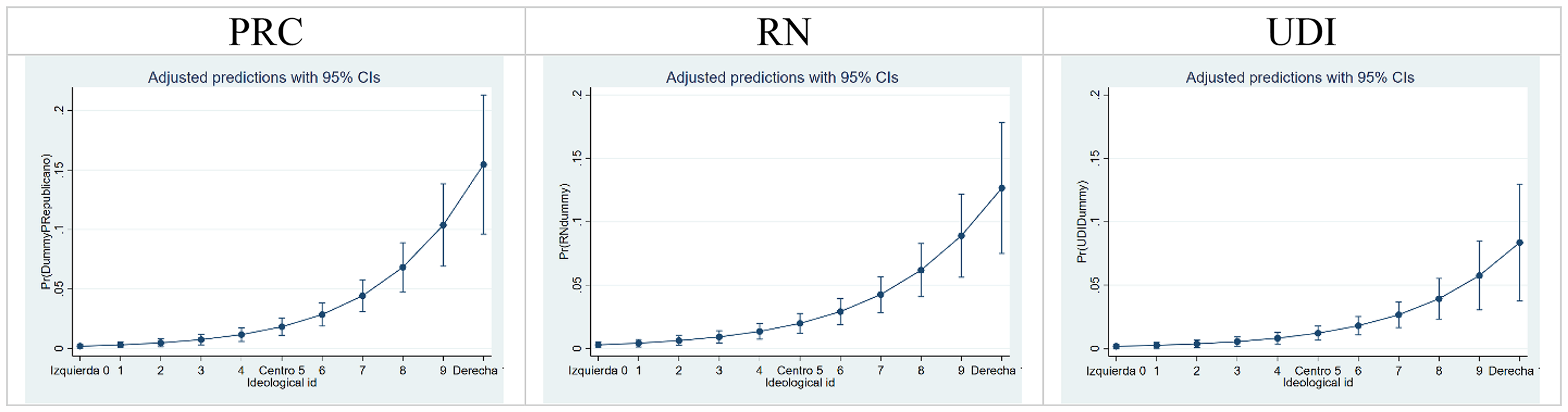
Predicted Probabilities of Partisanship with PRC, RN, and UDI by Ideological Identification.
Figure 2 shows the predicted probabilities of the effect of support for a military government and for authoritarian values on partisanship with PRC, RN, and UDI. We plotted the predicted probability values of identifying with each party estimated from the corresponding models in Table 5 based on people's ideological identification on the left-right (0–10 scale) and based, for the graphs in the top row, on whether they think that having a military government is either very bad or very good. For the bottom row, we distinguish between those who think that, sometimes, an authoritarian government is preferable and those who think that it is not.
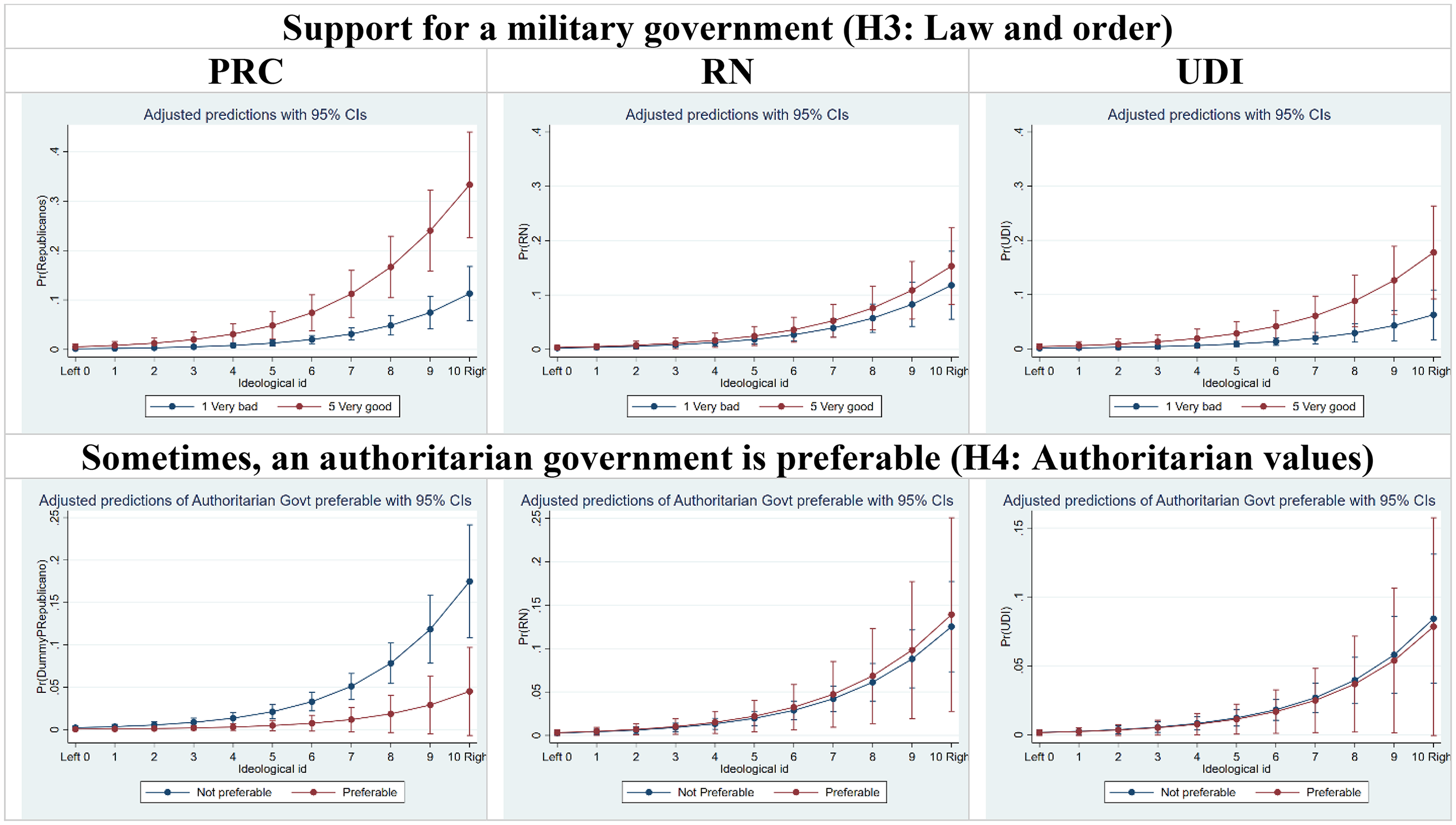
Predicted Probabilities of Identifying with PRC, RN and UDI by Support for a Military Government and Authoritarian Values.
First, support for a military government – an indicator of iron-fist policies – is more strongly associated with PRC partisanship than with RN or UDI. To be sure, RN and UDI partisans are also to the right of the ideological spectrum, but they do not express stronger preferences for a military government as they identify farther to the right. In turn, among those who identify with the PRC, there is stronger support for a military government as they identify farther to the right.
Second, among those who agree with the statement that an authoritarian government is sometimes preferable – an indicator of authoritarian values – there is a lower probability of identifying with the PRC, but not with RN and UDI. As we discuss below, that might be associated with the difference attributed by PRC sympathisers to a military government (Pinochet, a good government) and to an authoritarian government (for example, current left dictatorships).
Discussion
We contend that PRC partisans understand support for a military government and support for an authoritarian government as expressing different things. That finding is consistent with our claim that while the concept of a military government is associated with iron-fist policies—something that PRC sympathisers are strongly in favour – the concept of an authoritarian government is associated with a left dictatorship, a type of government that PRC sympathisers strongly oppose. PRC sympathisers want a strong government – with the military being a symbol of iron-fist policies – but they are not in favour of leaders who disregard other institutions of democracy.
In the Chilean context, military government is a common short-cut reference to the Pinochet dictatorship. That would suggest that those with more favourable views of the Pinochet regime are more likely to sympathise with the PRC and UDI. In turn, supporting a military government can be associated with support for iron-fist policies, a priority that has become increasingly important for public opinion in Latin America (Visconti, 2020).
In the context of Latin America today, the notion of an authoritarian government can be more directly associated with current non-democratic leftwing governments – like the Venezuelan regime of Maduro, the Cuban long-term communist dictatorship, and the Nicaraguan dictatorship of Ortega – rather than with the past rightwing authoritarian experience in Chile. This would explain why, when explaining identification with the PRC, the effect of supporting a military government is positive while the effect of the variables that indicate support for authoritarianism is either negative or non-significant.
Future studies ought to differentiate between support for authoritarian values and support for a military government, as the latter might be seen as a proxy of support for iron-fist policies. While elsewhere in the world, support for an authoritarian government and for a military government could be construed as being the same thing, in countries with a history of a past military dictatorship, and as crime levels rise and the demand for law-and-order policies increase, the two concepts might mean different things for voters. Particularly in Latin America, where all the present authoritarian governments are identified as leftwing, conservative voters might be making a clear distinction between support for a military government – as a proxy of law-and-order policies – and support for an authoritarian government (one which does not hold or respect elections).
Conclusions
In Latin America, growing demand for iron-fist policies might be linked to the growing popularity of far-right parties that espouse a law-and-order message. Since several Latin American democracies experienced rightwing military dictatorships in past decades, the rise of far-right parties there might also be associated with support for authoritarian values. In Chile, a presidential democracy with an institutionalised party system, and with a past experience of a rightwing military dictatorship, the rise of the PRC offers a remarkable opportunity to assess the association between support for iron-fist policies and support for authoritarian governments with the identification with far-right parties.
We find that the PRC and traditional rightwing parties RN ad UDI attract support from rightwing Chileans, but the PRC does not attract more support among those of higher socio-economic status or evangelicals. The main driver in support for the PRC, in addition to ideology, is support for a military government and strong disagreement with the notion that, sometimes, an authoritarian government is preferable. Thus, while those who express strong support for a military government – something that we argue is associated with preference for iron-fist policies – are more likely to identify with the PRC, those who express opposition to an authoritarian government – a view that is likely conditioned by the presence of leftwing authoritarian governments in Latin America today – are also more likely to identify with the PRC. Rather than a contradiction, we suggest that support for a military government in Chile today can be understood as support for iron-fist policies, but not as a defence of authoritarian values. In a region where authoritarian governments have been most recently associated with leftwing regimes, those with far-right views do not view military and authoritarian (presumably leftwing) governments as equivalent.
The implications of our study shed light on the reasons for the rise of far-right parties in emerging democracies with institutionalised party systems. While several countries might still struggle with the painful legacies of past dictatorships, rising levels of crime and the widespread perception of insecurity pose new challenges. Among those challenges, the increasing popularity of far-right parties that embrace iron-fist policies and, paradoxically, express them in the form of support for a military government and, at the same time, express their rejection of leftwing authoritarianism requires that we revisit how people perceive military and authoritarian governments.
Footnotes
Declaration of Conflicting Interests
The authors declared no potential conflicts of interest with respect to the research, authorship, and/or publication of this article.
Funding
The authors disclosed receipt of the following financial support for the research, authorship, and/or publication of this article: This work was supported by FONDECYT: [Grant Number 1231627]; ANID-Millennium Science Initiative Program: [Grant Number NCS2024_007].
Notes
Author Biographies
 . Munita is the chair of the Public Administration undergraduate program at Universidad Nacional Andrés Bello. He is also a PhD candidate in Communication Sciences at Pontificia Universidad Católica de Chile. He holds an MA in political management from George Washington University and an MA in Sociology and a law degree from Pontificia Universidad Católica de Chile.
. Navia is full professor of political science at Universidad Diego Portales and a clinical professor of liberal studies at New York University. He is the head of the Political Electoral Observatory at Universidad Diego Portales and the director of the Millenium Nucleus for the Study of Media, Public Opinion and Politics.
. Bo Guzmán is a political scientist from Universidad Diego Portales. She holds a master's degree in public policy and a master's degree in political analysis from the Universitat de Barcelona. She has previously published in the Revista Española de Ciencia Política.