




Abstract
As decentralisation reforms devolved greater responsibilities to local governments, improving local governance has become central to strengthening democracy. With the promise of increasing citizen representation and government transparency at the local level, in 2015 El Salvador implemented a new electoral system. The new system allowed for the election of opposition parties in municipal councils for the first time. In the context of El Salvador, we examine how opposition parties’ numerical representation influences the views of governing and opposition party members about multi-party councils’ effectiveness to improve local governance. To test our hypotheses, we rely on data from an original elite survey of 303 municipal councillors in 101 municipalities, which we complement with qualitative information. Contrary to what the literature suggests, we do not find evidence that a stronger opposition leads to more negative evaluations among members of governing parties, notwithstanding the country’s polarised party system.
The decentralisation reforms that swept Latin America during the third wave of democratisation sought to bring the government “closer to the people” with the goal of increasing citizen representation and government transparency (e.g. Bardhan and Mookherjee, 2006; Faguet, 2012; Fox, 1994). The first step in this process was to reform electoral systems to elect local governments through popular vote. By 2001, over 13,000 local governments in Latin America were elected through popular vote compared to 3,000 in 1973 (World Bank, 2001). Since then, most countries in the region have also amended municipal laws to promote citizens’ influence over local governance (e.g. Wampler, 2008). One recent reform aimed at improving government transparency and citizen representation – and therefore broadening access to public goods – was implemented in El Salvador in 2015.
The country reformed its local electoral system from a restrictive party bloc system designed to create single-party municipal councils to a more permissive one that allows for the election of more than one political party – that is, the constitution of multi-party councils. With this reform, all democratic countries in the region now have electoral systems that make the election of opposition parties possible in local government. Yet, we still know little about how the presence of opposition parties in councils impacts local governance. In particular, one of the questions that remains understudied is whether individuals at the forefront of local governments, namely elected councillors, perceive trade-offs between governability and the likely benefits brought about by more inclusive councils. Examining this question is of great importance for the continuity and success of multi-party councils in the long run. If elected officials do not perceive multi-party councils as a valuable institutional arrangement, they might be more willing to support initiatives that seek to establish single-party local governments. Additionally, members of governing parties who do not perceive a benefit in multi-party councils might be more inclined to block the opposition, reducing the chances that multi-party councils improve citizen representation and government transparency. In short, examining the opinions of local politicians on this topic is quintessential for our understanding of democracy at the local level.
However, the preferences and opinions of elected local government officials have only rarely been studied systematically. 2 Most of the literature has focused on exploring the processes of decentralisation (e.g. Falleti, 2010) and its impacts on citizen representation and participation (e.g. Campbell, 2003; Hankla and Downs, 2010) and public service delivery (e.g. Boulding and Brown, 2014; Touchton et al., 2017). In this article, we contribute to the decentralisation literature by exploring how the numerical representation of the opposition shapes elected officials’ opinions on multi-party councils’ effectiveness to improve local governance.
On the one hand, previous studies suggest that a higher representation of opposition parties in legislative bodies maximises permissive electoral rules’ potential of producing more inclusive and transparent governments (e.g. Helms, 2008; Morgenstern et al., 2008). On the other, extant literature posits that it is precisely when the opposition occupies a high percentage of seats that there can be a threat to governability (e.g. Jones, 2010; Schmidt, 2002). We examine whether elected local officials perceive a strong opposition in municipal councils as a threat or as an opportunity for improving local governance.
We test our theoretical insights in the context of Latin America – the region of the world that underwent “the most radical changes due to decentralisation” (Falleti, 2010: 6), and where electoral rules have historically allowed for the emergence of multi-party municipal councils in most countries (Molina, 2007). In 2013, El Salvador, the only democratic country in the region with a restrictive electoral system designed to result in one-party councils, passed legislation that allowed for multi-party councils. The recent reform in El Salvador gave us the unique opportunity to empirically assess municipal councillors’ opinions about the performance of multi-party councils in a highly polarised party system, where having more than one party is likely to be perceived as a threat to governability. Our empirical analysis relies on original data from an elite survey we carried out in El Salvador in 2015, 1 after the first election under the new rules. We interviewed 303 elected local officials across 101 randomly selected municipalities. We complement our quantitative analysis with qualitative information from in-depth interviews with legislators and local elected officials, as well as from transcripts of municipal councils’ meetings (actas).
First, we examine councillors’ general assessments about whether having multiple parties in municipal councils results in positive effects on local governance despite potential governability challenges. Having explored councillors’ overall perceptions of multi-party council performance, we then examine their opinions on two specific outcomes: improvements in local government transparency and broader citizen access to public goods. Examining councillors’ evaluations in the abstract and then on two specific dimensions of governance allows us to evaluate if their opinions differ depending on the particular issue-area in question.
The results of our empirical analyses are more nuanced than we anticipated. We find that, as expected, in councils with a strong opposition, members of opposition parties hold more positive opinions about the benefits of multi-party councils compared to cases in which the opposition only holds a small share of seats. However, contrary to what we predicted, among members of governing parties, a larger share of seats controlled by the opposition does not result in more negative perceptions of multi-party councils’ overall performance, despite El Salvador’s highly polarised party system. In fact, when asked specifically about multi-party councils’ benefits for transparency and broader access to public goods, a strong opposition improves perceptions of multi-party councils among both opposition and governing party members. Taken together, the results suggest that members of governing parties recall more positive experiences with multi-party councils when they are asked specifically about benefits for these two dimensions of governance. Remarkably, when the opposition shares a higher percentage of seats, governing party members tend to have more positive views of multi-party councils’ benefits for transparency than members of the opposition. Our research suggests that when the opposition is strong – and consequently plays an important oversight role – governing party members see an opportunity to credibly disassociate themselves from corruption.
Overall Performance Evaluations of Multi-Party Councils
We develop a theoretical framework that allows us to draw hypotheses about councillors’ opinions about multi-party councils’ performance in contexts of high political polarisation, where the formation of governing coalitions is highly unlikely. Although a proportional representation (PR) or mixed electoral system is more permissive and can create more inclusive governing bodies (Norris, 1997), when no party holds the number of votes needed to pass important legislation governability can be threatened. Policy adoption might take longer or “initiatives might even get stuck in a blocked decision-making process” (Schmidt, 2002: 150). To reduce threats to governability in more permissive electoral systems, governing parties are expected to seek to form coalitions with the opposition, leading the way to “negotiated” or “consensus” democracies (Lijphart, 1999). However, as scholars indicate, the formation of coalitions is unlikely in contexts of high political polarisation (e.g. Jones, 2010: 35), such as in the case of El Salvador. 3 We argue that in these contexts, the opposition is likely to play an oversight role and that councillors’ opinions of multi-party councils are mainly driven by self-interest and the numerical representation of the opposition.
The literature on electoral reforms has long noted that self-interest largely drives politicians’ views of electoral systems (Bowler et al., 2006; Gilljam and Karlsson, 2015; Lehoucq, 2000; Remmer, 2008). This literature suggests that members of parties who are less likely to win majoritarian or plurality elections have more positive opinions about the implementation of permissive electoral rules than those in parties that have a greater probability of winning (Boix, 1999; Leemann and Mares, 2014). This is because a mixed or proportional electoral system increases smaller parties’ chances of being elected.
Consequently, we posit that under a more permissive electoral system, governing party members will be less likely to perceive benefits in multi-party councils, since they are more likely to lose seats to the opposition. This sentiment should be particularly strong among governing parties in El Salvador, where political polarisation is high and these parties never before had to share council seats with the opposition. By contrast, we expect elected members of opposition parties to express more positive opinions about multi-party municipal councils. That is, self-interest, gaining a seat in the municipal council, in this case for the first time, is likely to drive the opinions of opposition parties.
Yet, the composition of municipal councils is also likely to shape members’ opinions on the performance of multi-party councils. The numerical representation of the opposition largely determines the opposition’s ability to effectively influence public policy and play an oversight role (García Díez and Barahona Martínez, 2002; Morgenstern et al., 2008; Norton, 2008; Rodríguez, 2015). This suggests that opposition members will hold more favourable views about multi-party councils when their share of seats is relatively large. As the opposition gains bargaining power, they are more likely to enjoy the benefits of elected office (Strøm, 1990), including the ability to deliver on promises made to their constituents. Hence, self-interest coupled with more political leverage will improve the opposition’s rating of multi-party councils’ performance. As the percentage of seats by the opposition increases, however, governing party members are expected to become less likely to hold positive views of multi-party councils. Not only are they losing more seats, but they are more likely to be concerned about governability and oversight. Considering these theoretical arguments, we derive the following hypotheses:
Evaluation of Impacts on Transparency and Access to Public Goods
Having established our expectations about opinions on multi-party councils’ performance in the abstract, we turn our attention to views on two specific dimensions of governance, government transparency, and broader citizen access to public goods. As mentioned above, the reform in El Salvador was expected to improve local governance along these two dimensions.
Perceptions of Multi-Party Councils’ Effects on Government Transparency
At the national level, scholars have emphasised the importance of opposition parties’ oversight role for government transparency (e.g. Garritzmann, 2017; Norton, 2008). At the local level, opposition parties also have an incentive to uncover wrongdoings and “publicly hound incumbents for their misdeeds” (Blair, 2000: 28). The opposition’s motivation for demanding answers from and identifying the misdeeds of those in power rests on its desire to present voters with a viable alternative (e.g. Fox, 1994). The presence of opposition members in council meetings and participation in key committees can facilitate access to government information. As a result, incumbents are likely to face higher oversight in multi-party councils. Governing parties, however, are likely to resist this threat, particularly in places where abuse of power and corruption are common, such as in El Salvador.
Although governing party members have an incentive to keep absolute control over the municipality’s finances, a strong opposition can arguably be more effective at making the governing party accountable. The opposition’s ability to oversee the government will most likely depend on the composition of municipal councils since the strength of the opposition determines the extent to which it can be an effective actor. As a result, we posit that only when the opposition has the leverage to force concessions from the governing party will opposition parties be able to successfully act as watchdogs. Without this leverage, incumbents can easily marginalise and sideline the opposition. Thus, members of the opposition should be more successful at overseeing the governing party when they hold a larger percentage of seats.
When this is the case, we expect to observe more positive assessments among opposition members about multi-party councils’ performance in improving the transparency of local finances. Having a stronger opposition, however, should not improve governing party members’ assessments. As we argued above, members of governing parties should be more sceptical of the benefits of multi-party councils, particularly when the opposition is strong. When this is the case, concerns over governability coupled with the fear of being overseen likely outweigh views of possible benefits for transparency:
Perceptions of Multi-Party Councils’ Effects on Public Good Access
A core assumption of decentralisation was that by bringing the state closer to the people, citizens would have greater access to government and thus more opportunities to influence public policy. To fulfil this goal, and consequently improve citizen representation, decentralisation reforms opened and institutionalised important channels for citizen participation and the exercise of direct democracy. Neighbourhood associations, in particular, have become an important venue for voicing citizens’ policy preferences (e.g. Campbell, 2003; Eaton, 2012).
Previous literature, however, has shown that merely introducing formal channels of participation does not necessarily result in broad citizen participation (Goldfrank, 2011). The incentives of elected local officials to engage citizens are partly determined by perceived political benefits, such as “improved relationships with community representatives and higher popularity” (Speer, 2012: 2384). Consequently, political interest largely drives local officials’ decisions about which neighbourhoods they will mobilise and encourage to participate in the planning of local policy. For example, in the case of El Salvador, Bland (2011: 869) documents that the execution of broad participatory budgeting initiatives does not always take place, because “some mayors reportedly either convened meetings only with their party members or objected to the inclusion of ideologically opposed groups in the planning process.”
These dynamics suggest that governing parties anticipate little electoral gains from granting a voice and providing services to residents in neighbourhoods where they enjoy low support. As Bland (2011) indicates, this bias is particularly likely when opposition parties are not represented at all in municipal councils – as was the case in El Salvador prior to the 2015 election. The reform to facilitate the election of multi-party councils gives a chance to opposition parties to address the needs of their constituents and make them part of the policymaking process, especially if opposition parties hold a large percentage of seats. That is, the election of opposition parties in municipal councils can arguably facilitate access to public goods to populations that otherwise would probably be excluded from such benefits.
First, we theorise that opposition parties have a strong incentive to keep close ties with non-government sympathisers and grant them benefits during their period in office. Cultivating the vote of residents in neighbourhoods where the governing party lacks strong support can result in a future electoral advantage. Second, opposition parties are arguably more effective at mobilising neighbourhood associations and their members when they hold seats in municipal councils. Members of opposition parties enjoy more credibility among the public as potential agents of change when their party is part of the council. Thus, not only can they use institutionalised channels of participation, such as assemblies (e.g. cabildos abiertos) or participatory budgeting initiatives, but they also enjoy more legitimacy as actors with some leverage to influence public policy.
The strength of the opposition, however, should influence the opposition’s ability to mobilise its constituency and benefit them with public goods. A stronger opposition has more leverage with the governing party, creating more opportunities to press for the demands of non-government sympathisers. In the absence of a strong opposition, members of the governing party have little incentive to engage non-sympathisers and deliver public goods in neighbourhoods where they lack political support. Hence, members of opposition are more likely to perceive that multi-party councils broaden citizen access to public goods when they hold a larger percentage of seats in municipal councils. Once again, as H1 and H2b posit, compared to opposition members, members of governing parties should be less optimistic about the benefits of multi-party councils, particularly when the opposition is strong. Members of governing parties will see more obstacles than benefits of having a strong opposition and be less likely to admit that the presence of the opposition is necessary for broadening access to public goods:
The 2013 Reform in El Salvador and the Emergence of Multi-Party Municipal Councils
In Latin America, local elections are generally competitive and often have high stakes (e.g. Escobar-Lemmon and Funk, 2018; Goldfrank, 2011). In this context, opposition parties have an incentive to oversee the actions of governing parties and denounce misbehaviour, presenting voters with an alternative programme. Moreover, to improve their chances of winning the next election, opposition parties have an incentive to mobilise their base and potential voters while in office. We see our theoretical insights applicable to countries such as those in Latin America, where members of opposition parties are likely to impose checks and balances on the incumbent as they seek to maximise their electoral gains. We test our hypotheses in the context of El Salvador, a country with a long history of political polarisation that dates back to a prolonged civil war that ended with a peace accord signed in 1992 between the guerrilla and the government. During the post-war period, local governments have had increasing influence in the implementation of public policies that seek to address some of the most pressing problems the country faces, which include widespread poverty and unprecedented criminal violence.
Since the country’s transition to electoral democracy in 1994, two polarised parties have dominated the political system. On the one hand, the ex-guerrilla party, the Frente Farabundo Martí para la Liberación Nacional (FMLN), has controlled almost exclusively the political space on the left side of the ideological spectrum. The Alianza Republicana Nacionalista (ARENA), on the other hand, has held the largest vote share on the conservative side. At the national level, it was only in the 2019 presidential election that a viable alternative to these two parties emerged. At the local level, at least until 2020, the two polarised parties continue to predominate.
Until 2015, the local electoral system gave the winning party complete control of the municipal council. Employing a party bloc system, political parties presented a list of candidates for an at-large district in which each municipality was the electoral district. Parties presented closed lists that were headed by the mayoral candidate and chief of staff (síndico), followed by as many candidates for council members as there were seats. 4 The mayor and síndico have the executive and administrative roles within councils, respectively, and are the only two members with full-time positions. Under the party bloc system, winning parties controlled all municipal council seats even when the difference between them and the second-place party was marginal.
The result of this electoral system was that, before the reform, no local politician had any experience in dealing with opposition parties in municipal councils. Governing parties made critical decisions that affected the lives and security of citizens without any oversight in how they governed. As a prominent legislator, and ex-mayor described, in a system with no checks or balances, the mayor “comes to believe that he is sovereign over the local government” (authors’ interview, June 2015).
The debate over reforming municipal elections gained traction in 2012, when the threat of action from the Chamber of the Supreme Court for Constitutional Affairs pressured legislators to adopt more inclusive electoral rules. In favour of introducing PR, and thus a more permissive electoral system was a coalition that included the FMLN, civil society organisations, and members of the international community. The coalition argued that the election of multi-party councils would improve transparency and representation in local governments. Those who were less supportive of the reform, or opposed it completely, were most of the conservative parties, including ARENA. However, across the ideological spectrum, party leaders were concerned that with high levels of polarisation and no experience in governing with another party in the council, local government would quickly become dysfunctional (authors’ interviews, June 2015).
The political elite compromised by creating a more permissive electoral system, without going so far as adopting PR. The new mixed system manufactures a majority government while allowing for the possibility of opposition parties. The reform passed in March of 2013 (Electoral Code, section VI, Article 219). In the new system, the district (municipality) remains at-large, but is now multi-membered. Political parties continue to present a closed list of candidates headed by the mayor and síndico. Citizens continue to cast one vote for local governments, but because the municipality is now a multi-member district, more than one party can be elected to the councils.
In the new system, the mayor and síndico posts are allocated first to the party with a plurality of votes. To distribute the council seats and avoid minority governments, the mixed system includes two counting rules. The first one establishes that, if the winning party receives more than 50 per cent of valid votes, council seats are distributed under a PR system. The majority party receives its allocated seats first, and the remaining seats are distributed to the other parties based on their vote share. The electoral quotient is calculated using the largest remainder formula – that is, taking the total number of valid votes and dividing this by the number of seats (not including the mayor and síndico seats). For example, in the first election after the reform, in 2015, the FMLN received 72.9 per cent of votes in the municipality of El Paisnal. The party was automatically allocated the mayor and síndico posts. The remaining six council seats were allocated as follows: with 3,645 of the 4,998 total valid votes, the FMLN was awarded four council members, and the remaining two seats were allocated to ARENA, which had 1,138 votes.
The second rule establishes that when the party with a plurality of votes receives less than 50 per cent of votes, council seats are allocated using the same PR formula, but the winning party receives enough extra seats that, with the mayor and síndico, it has a simple majority. For example, in 2015 the FMLN won the municipality of Nejapa with 36.85 per cent of the vote. The party was automatically awarded the mayor and síndico posts. The remaining eight seats were allocated with an election quotient of 1,426.25, which gave the FMLN, with 4,174 votes, three seats. In addition, following the second rule, the FMLN was allocated a fourth seat. This secured a simple majority for the party with a total of six seats (four council members plus the mayor and síndico posts). The remaining four seats were distributed using PR to the next three parties based on their vote share.
The national legislature also reformed the municipal code to ease government action. The code established that unless specified, binding decisions require a simple majority (i.e. half of the council members, plus one). This internal voting rule favours the governing party in most cases and does not create an incentive for it to co-govern with the opposition, especially in the context of the highly polarised politics of El Salvador. However, the code does outline two instances when legislation requires a qualified majority (two-thirds of votes), and three when it requires a special qualified majority (three-fourths of votes) (Municipal Code, section IV).
A qualified majority is required to remove a council member from office (Ibid., Article 28) and to undertake a popular consultation (Ibid., Article 117). A special qualified majority is needed to transfer the ownership of municipal holdings (Ibid., Article 62), to take on national or international loans (Ibid., Article 67), and to transfer ownership of goods received through donations or loans (Ibid., Article 68). Because of the competitive nature of municipal elections, in these five instances, the governing party needs the support of the opposition in most municipalities. For example, in our sample, in 88 per cent of the municipalities, the governing party does not enjoy a qualified majority.
The ability of the governing party to secure loans is particularly important in the context of El Salvador and gives the opposition political leverage. According to a recent report, “the lack of self-financing, due to low tax collection and technical capacity, has led local governments to use loans as a recurrent source of funding. As a result, each year the debt is higher. During the period 2006–2017, local governments’ debt quadruple” (Pérez, 2019: 25). Given that only a few governing parties have enough votes for the special qualified majority needed to acquire debt, most governing parties need to secure the support of the opposition for these decisions.
In short, the new electoral system, while not a pure PR system, is more permissive than the previous one, which was one of the most restrictive systems possible. The new mixed system allows for the possibility of opposition parties in local government for the first time. While the municipal code includes provisions that facilitate government action, the vote of the opposition remains key in important areas, granting it political leverage. The end result is an electoral system that includes opposition parties in local government and rules that disincentivise governing parties from co-governing with the opposition. As we report below, the qualitative evidence is unequivocal. Given the rules adopted and the highly polarised and competitive nature of the Salvadoran party system, members of the opposition play a forceful oversight role in municipal councils, particularly when the opposition holds a large percentage of seats.
As we hypothesised above, we expect that the composition of municipal councils matters a great deal. When the opposition does not have a strong presence in councils, it is likely to lose its influence and be less effective at overseeing and making the governing party accountable. This is especially likely in the case of El Salvador because legislators did not reform the municipal code to mandate specific rights or roles for the opposition. Unlike their counterparts in Colombia (Political Constitution, 1991), 5 for instance, the opposition in El Salvador does not have the right to access information, although the municipal code does state that citizens, in general, can petition the government for information and that the government has to respond promptly (Municipal Code, Article 125).
Moreover, the code lists the roles of the alcalde and síndico and council members but does not attribute specific roles to opposition members (Ibid., Articles 48, 51, and 53). According to the code, the mayor’s duties include convening council meetings, serving as the representative of the municipality, and ensuring that the municipality abides by the law. An important role of the síndico is to “examine and supervise municipal finances, proposing measures that avoid…abuses” (Ibid., Article 51). For councillor members, the code only establishes that they should participate in council meetings and in the commissions “to which they were designated” (Ibid., Article 53). Unlike countries such as Bolivia (Municipal Law, 1999) and Colombia (Municipal Law, 2012), for example, the Salvadoran municipal code does not mandate a role for the opposition in the council’s leadership nor in any specific commissions. 6 Our in-depth interviews suggest that when the opposition is strong, their members have more freedom to choose and joined specific commissions.
Data and Methods
To test our hypotheses, we rely on original elite survey data (Elite Survey of Municipal Councillors, ESMC) gathered in El Salvador following the March 2015 municipal election, when the electoral reform first went into effect. The fieldwork took place between September of 2015 and March of 2016. We conducted face-to-face survey interviews with 303 municipal council members in 101 of the 262 municipalities. The selection of municipalities was carried out randomly within each of the fourteen regions in the country based on a probability proportional to size (PPS) sample design. In our sample, 40 per cent of the municipalities are governed by ARENA, 35 per cent by the FMLN, and the remaining 25 per cent by a third party or coalition. This distribution matches closely with the national results of the 2015 municipal election. The percentage of seats won by opposition parties in the sample varies from 16.7 per cent to 42.9 per cent. Given the new electoral rules and the competitive nature of local elections, in 2015 opposition parties won seats in all 262 municipalities in the country.
Our criteria for selecting elected local officials in municipal councils followed two rules: (1) interview two members of the governing party in each municipality, with at least one interview conducted with the mayor or síndico, and (2) interview one member of the opposition in each municipality. To achieve this quota, the fieldwork often involved multiple visits to municipalities. The map below displays the location of the 101 municipalities where we conducted interviews (see Figure 1).
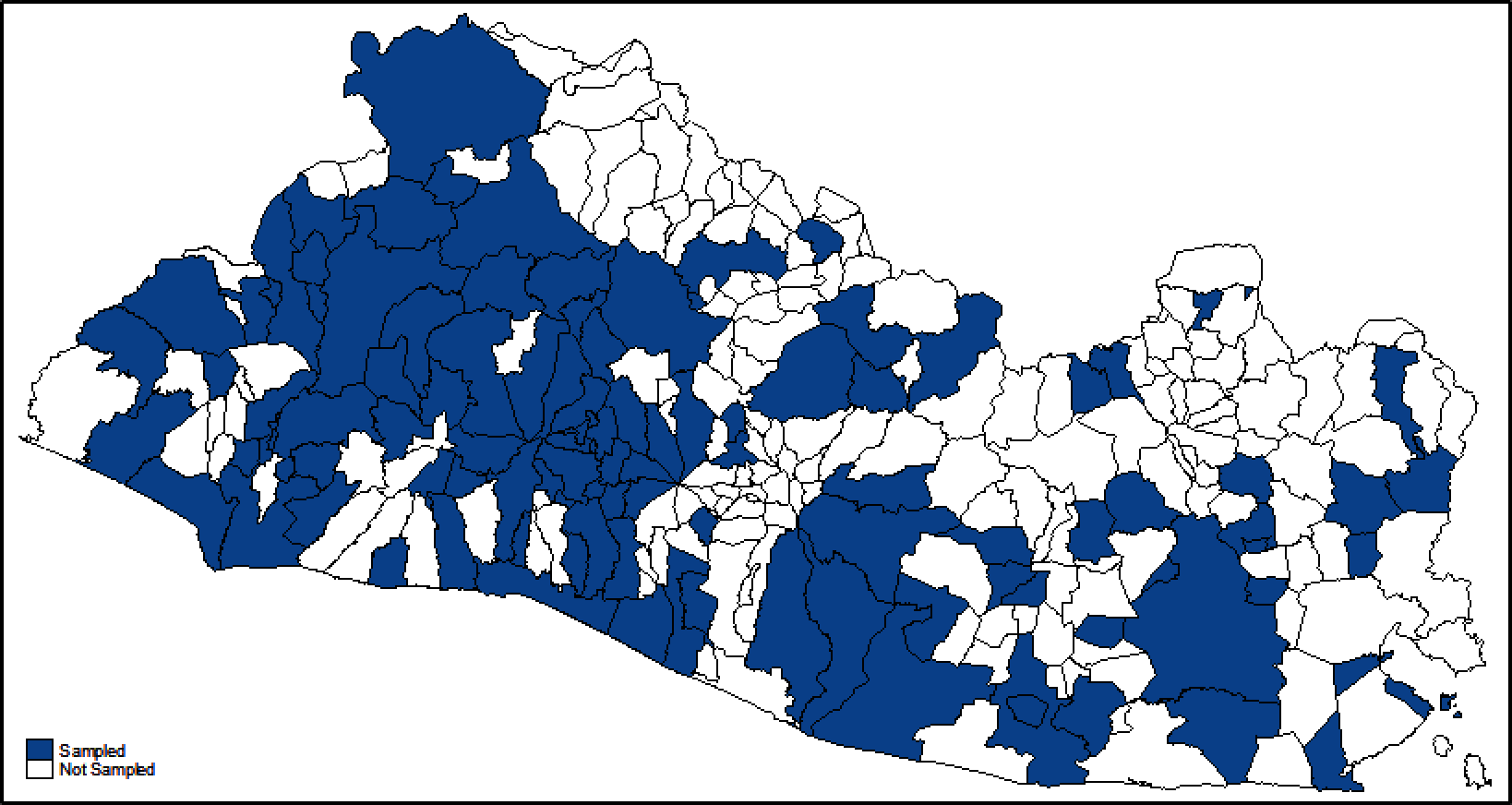
Municipalities Included in the Sample.
To complement the quantitative data, we also conducted a total of fifteen in-depth interviews with legislators and local elected officials in 2015 and 2017. In addition, to better understand the internal dynamics of councils, we reviewed publicly available transcripts of municipal councils’ meetings (actas) randomly selected from the municipalities of Izalco, San Salvador, and San Miguel, corresponding to 2018–2020.
Dependent Variables
First, we explore elected local officials’ assessments of multi-party councils’ overall performance using the following question: on a scale from one (strongly disagree) to seven (strongly agree), to what extent do you agree that “having more than one political party represented in the municipal council creates more opportunities than disadvantages for the governability of this municipality”?
The second part of our empirical analysis explores opinions on two specific dimensions of local governance: transparency and broader citizen access to public goods. We assess elected local officials’ views on the role of opposition members as guarantors of government transparency using an index based on two questions: on a scale from one (not beneficial at all) to seven (very beneficial), “how beneficial has it been to have a multi-party council in [name of municipality] to improve the transparency of public finances?” and “how beneficial has it been to have a multi-party council in [name of municipality] to improve the transparency of contracting private companies to run projects.” 7
Lastly, we examine opinions on multi-party councils’ role in improving access to public goods among non-government sympathisers using the following item: “to what extent do you agree with the following statement, the representation of multiple political parties in the municipal council of [municipality name] facilitates the work of the local government in neighbourhoods where most residents do not sympathise with the political party of the mayor, do you (4) very much agree, (3) agree somewhat, (2) do not agree much, or (1) do not agree at all?”
Independent Variables
To explore the effect of municipal council composition on the opinions of municipal councillors, our models include an interaction term between two core independent variables. The first variable is measured at the municipal-level and indicates opposition parties’ share of municipal council seats. 8 The second variable is an individual-level indicator coded one if an elected local official is a member of the governing party or zero if she is a member of the opposition. Our models also control for the possibility that members of the FMLN in government could be more optimistic about the benefits of multi-party councils than those of other parties. Since the FMLN was particularly supportive of the electoral reform, its elected officials are likely to share more positive views about multi-party councils even if they hold the majority of seats. As such, we include an interaction term between a variable indicating the political party in power and the variable that identifies whether the interviewee is a member of the opposition or governing party. The models also control for elected government officials’ party leadership using a question that asked respondents if they held a post within the party. Arguably, those in a leadership position might have stronger opinions about multi-party councils because they are more likely to follow party lines. Finally, the models control for individual-level socio-demographic characteristics, including councillors’ education, age, and sex. As we note in the robustness test section, we also include several other variables in the models to further evaluate the statistical significance of our results.
Model Specification and Methods
To account for the nested structure of our data (i.e. councillors


Findings
Perceptions of Multi-Party Councils’ Overall Performance
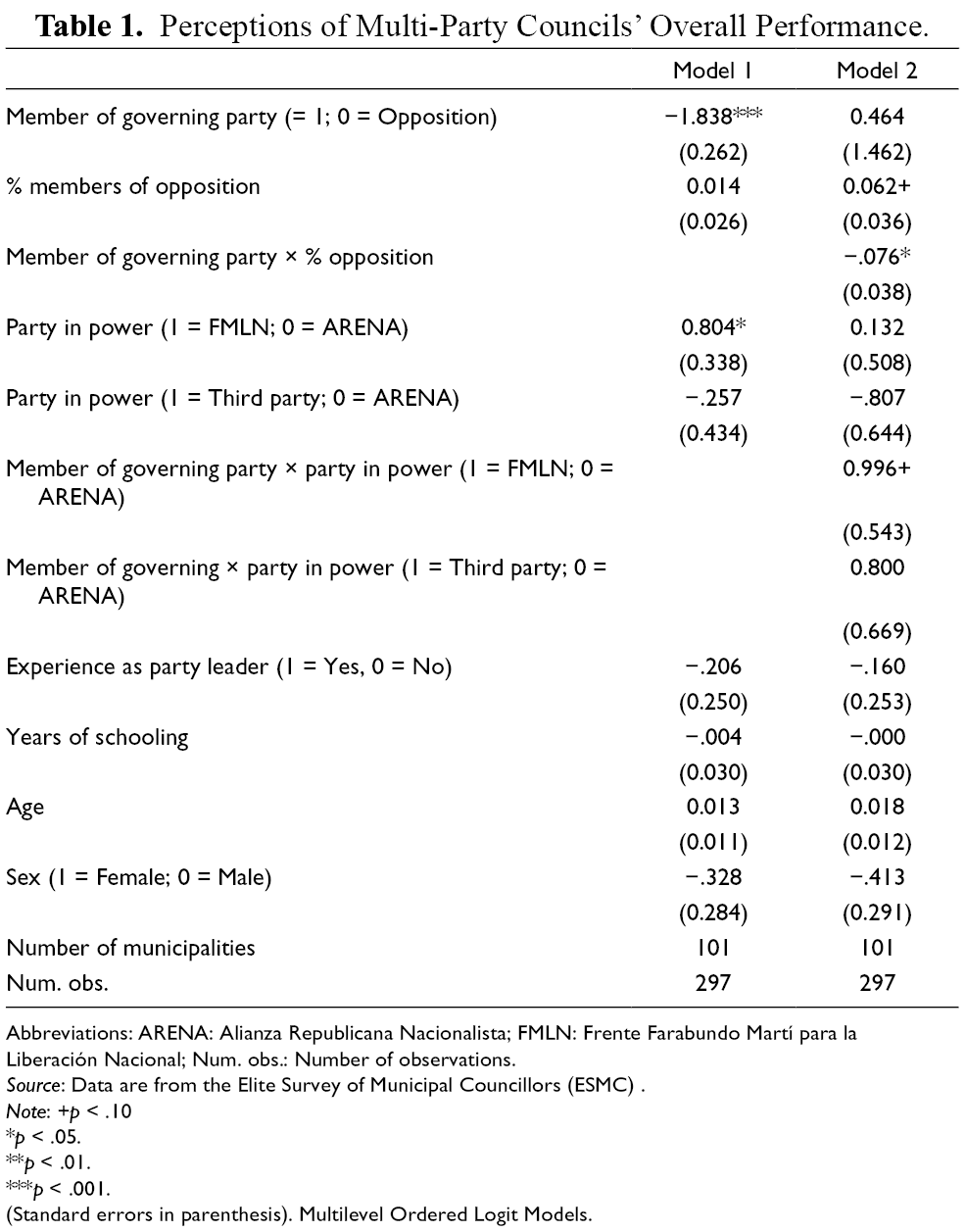
The baseline model in Table 1 (Model 1) shows that the co-efficient of the member of governing party variable is negative and statistically significant (p < .001). However, the results from Model 2 suggest that this effect is moderated by the strength of opposition parties in municipal councils (p < .05). To examine the substantive meaning of this effect, based on Model 2, we estimate mean predicted probabilities and present the results graphically.
Perceptions of Multi-Party Councils’ Overall Performance.
Abbreviations: ARENA: Alianza Republicana Nacionalista; FMLN: Frente Farabundo Martí para la Liberación Nacional; Num. obs.: Number of observations.
Source: Data are from the Elite Survey of Municipal Councillors (ESMC) .
Note: +p < .10
*p < .05.
**p < .01.
***p < .001.
(Standard errors in parenthesis). Multilevel Ordered Logit Models.
Panel A in Figure 2 presents the mean predicted probability of strongly agreeing that multi-party councils create more opportunities than disadvantages for governability among governing and opposition party members. Panel B examines the statistical significance of differences in opinions between members of governing and opposition parties. When confidence intervals cross the line set at zero, differences in opinions are not statistically significant. Panel A in Figure 2 shows that the opinions of governing and opposition party members start to diverge as the percentage of seats held by the opposition increases. Contrary to what H1 suggests, the opinions of opposition and governing party members coincide in municipal councils where the opposition only shares a small percentage of seats. Thus, although the regression results in Model 1 indicate that, on average, the opposition holds more positive views about multi-party councils’ overall performance, this is not the case in all municipalities.
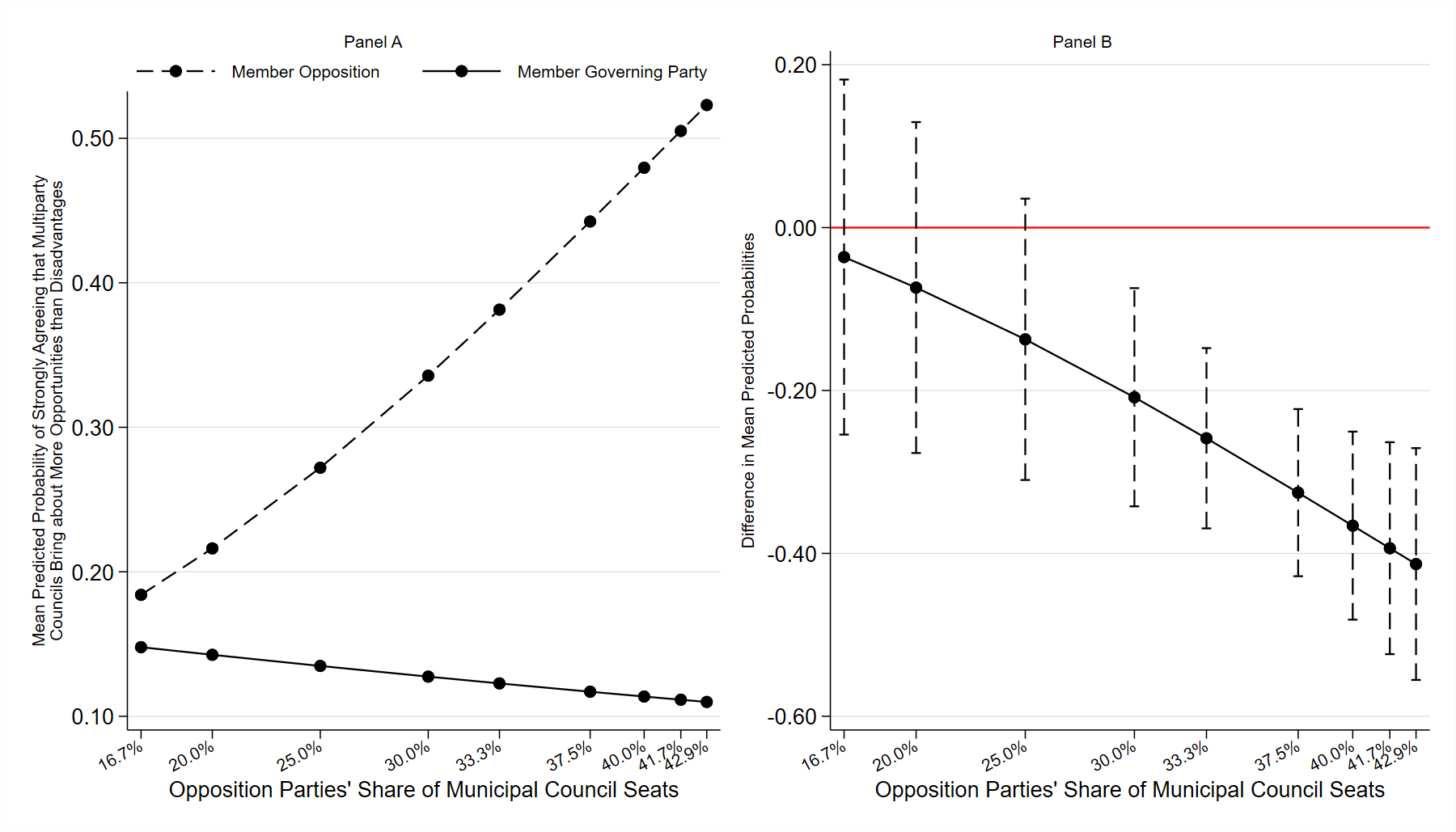
Perceptions of Multi-Party Councils’ Overall Performance.
In municipalities with a stronger opposition, members of the opposition have more optimistic views about the overall performance of a multi-party council for their municipality. The probability that members of the opposition “strongly agree” that a multi-party council has had a positive net effect on local governance increases by nearly 34 percentage points (from 18.4 per cent to 52.2 per cent) as one moves from the lowest (16.7) to the highest (42.9) share of seats held by the opposition – this effect is statistically significant at p < .05. By contrast, although we observe a slight decrease among governing party members, this effect is not statistically significant. The probability remains low and relatively constant among members of governing parties, independent of the strength of the opposition. Panel B shows that it is only when the opposition holds 30 per cent of seats or more that opposition members become more optimistic about multi-party councils than governing party members. As we can observe, below this threshold, confidence intervals associated with differences in mean predicted probabilities cross the zero line.
As opposition members gain bargaining power, they appear more likely to enjoy the benefits of elected office and consequently have more positive perceptions of multi-party councils. Whereas when the opposition has little leverage over government, its members are less likely to evaluate multi-party councils positively, as H2a predicts. In contrast to H2b, we do not observe that having a strong opposition undermines general performance perceptions among members of the governing party. Although those in government have an overall low rating of multi-party councils’ performance, their opinion does not change when they face a stronger opposition. Having a stronger opposition does not translate into a more negative perceptions among governing parties, despite the leverage that a strong opposition has within councils, particularly on issues that affect municipalities’ operations, such as the acquisition of loans.
Perceptions on Benefits for Transparency and Access to Public Goods
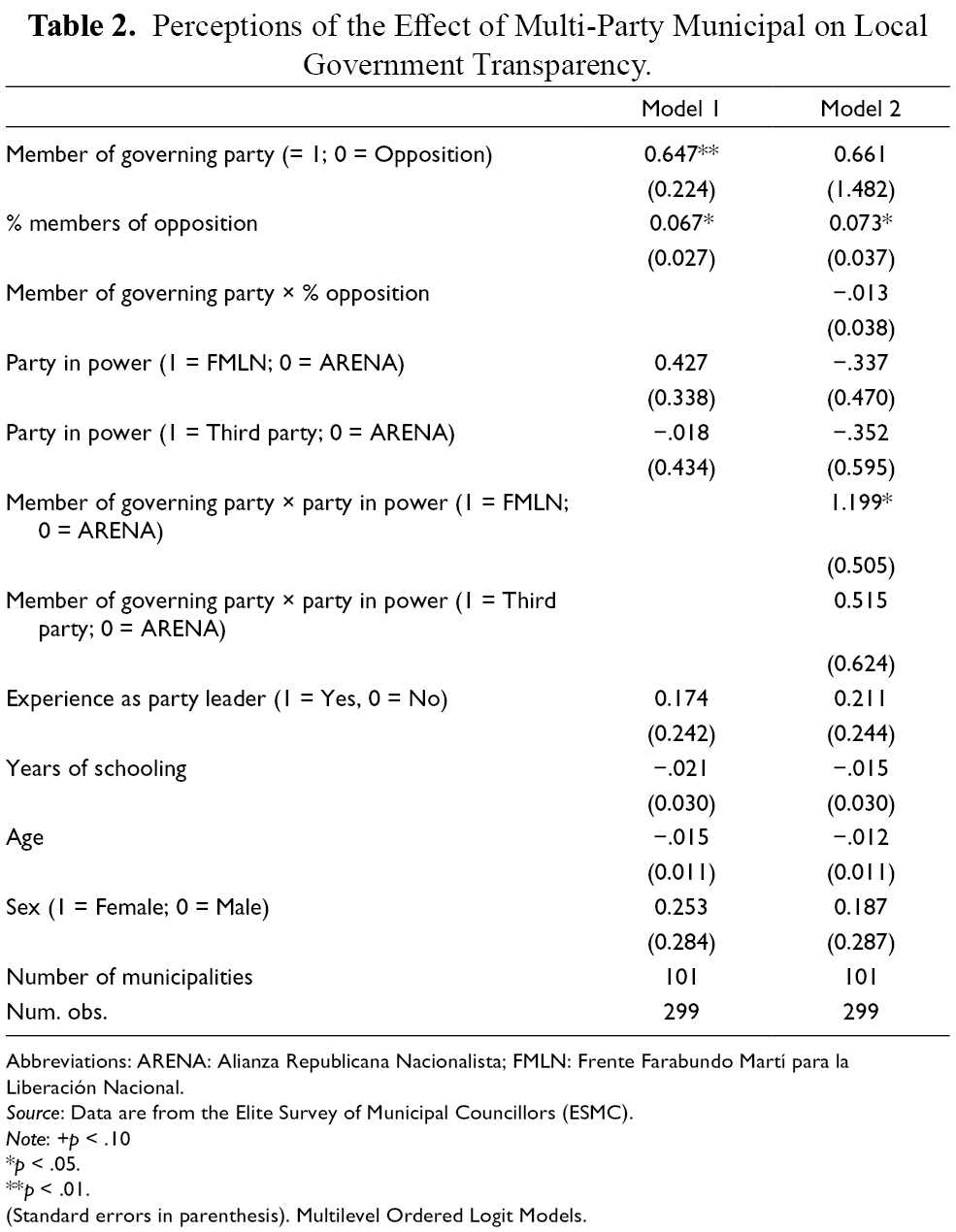
Table 2 presents the results for the models that examine opinions on the benefits of multi-party councils for government transparency. Our first examination of the data (Model 1) shows that the co-efficients associated with the governing party member and percentage of opposition variables are positive and statistically significant. In Model 2, only the latter variable remains statistically significant, and co-efficient of the interaction term between our two core variables is not statistically significant. However, the co-efficient of the interaction per se does not allow us to assess if there are statistically significant effects at some points of the distribution of the percentage of opposition’s seats. Based on Model 2, we proceed to estimate predicted probabilities to assess this possibility. Figure 3 uncovers the substantive meaning of the results.
Perceptions of the Effect of Multi-Party Municipal on Local Government Transparency.
Abbreviations: ARENA: Alianza Republicana Nacionalista; FMLN: Frente Farabundo Martí para la Liberación Nacional.
Source: Data are from the Elite Survey of Municipal Councillors (ESMC).
Note: +p < .10
*p < .05.
**p < .01.
(Standard errors in parenthesis). Multilevel Ordered Logit Models.
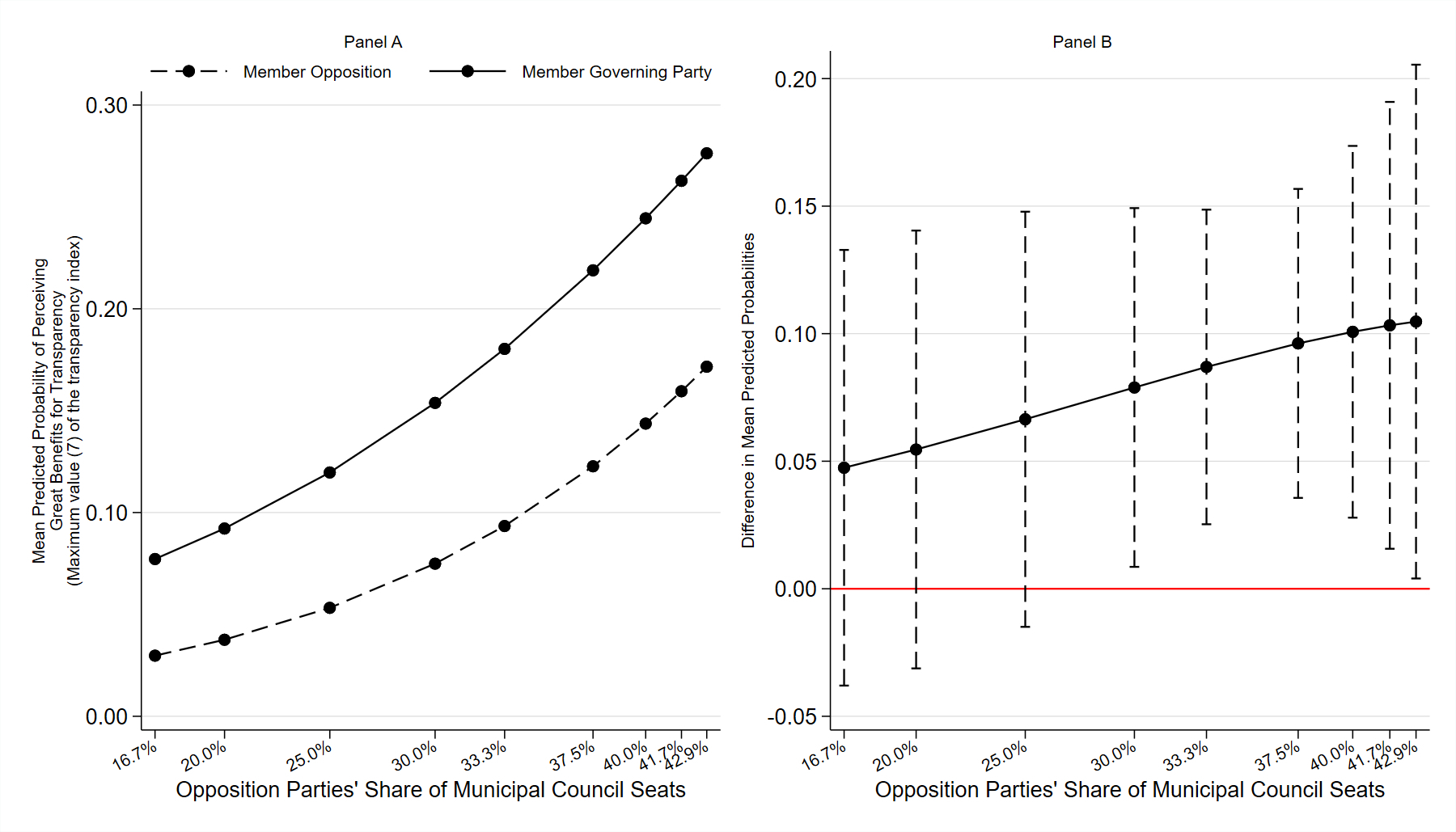
Perceptions of Multi-Party Councils’ Benefits for Transparency.
Panel A shows that, as the opposition’s share of seats goes up, the probability that the index on transparency takes the highest value (7 points) increases sharply for both opposition and governing party members. The difference in predicted probabilities at the lowest and highest value of the percentage of opposition’s seat variable is around 14 and 20 points for the opposition and governing party members, respectively (p < .05). However, depending on the percentage of seats by the opposition, governing party members can have similar or even more positive opinions about the benefits of multi-party councils for improving local government transparency. Panel B shows the differences in predicted probabilities between the two groups and their statistical significance along the percentage of opposition’s seats. We observe that when the percentage of opposition’s seats is lower than 30 per cent, the opinions of governing and opposition party members are statistically similar (i.e. the confidence intervals cross the zero line). However, as the opposition’s share of municipal seats increases, opinions start to differ, showing more positive opinions among governing party members than those in the opposition. In short, we find support for H3a, but not for H3b.
We interpret these results as suggesting that members of governing parties perceive a benefit in having a robust opposition as it permits them to disassociate themselves from corruption. When the opposition has a significant presence in municipal councils, governing party members can more credibly argue that their government is not corrupt, and thus claim transparency in public finances. Evidence from our qualitative interviews lends support to this thesis. For example, in one municipality with a strong opposition where we carried out an in-depth interview (authors’ interview, June 2015), the síndico told us explicitly that multi-party councils were beneficial for transparency, stating that,
critiques emerge when people do not know how public funds are managed, thinking that the mayor has a desk with a drawer full of money that can be spent here and there…now they [opposition members] know how the [disbursement] process works…which increases people’s confidence that the process is transparent…when something fraudulent is done, the person involved is discovered and punished.
Our review of municipal meetings’ transcripts (actas) also indicates that members of governing parties see an instrumental value in multi-party councils. In the municipality of Izalco, for example, after an opposition member refused to vote for the acquisition of debt to build a plaza, the acta notes that the síndico asked her to at least be part of the transparency commission for the project, because this would allow them “to demonstrate more transparency to citizens” and thus legitimise the investment (Izalco, 26 September 2019). Taken together, our interviews and reading of numerous actas make it clear that heated disputes take place between opposition and governing members, and consequently that in general the opposition is playing a critical oversight role, fulfilling one of the promises of the reform. Governing party members, however, acknowledge that there are benefits to having the opposition play this role, and consequently in having multi-party councils.
Finally, Table 3 presents the results for our last dependent variable, perceptions of the benefits of multi-party councils for broader access to public goods. Model 1 shows statistically significant effects associated with the governing party member and percentage of opposition variables (p < .01), depicting a negative and positive co-efficient, respectively. Similar to the previous results, Model 2 does not show a statistically significant interaction effect between these two variables. However, to fully assess the significance of the results, we examine the predicted probabilities for governing and opposition party members along the distribution of the opposition’ share of seats.
Perceptions of Multi-Party Councils’ Benefits for Broader Public Good Access
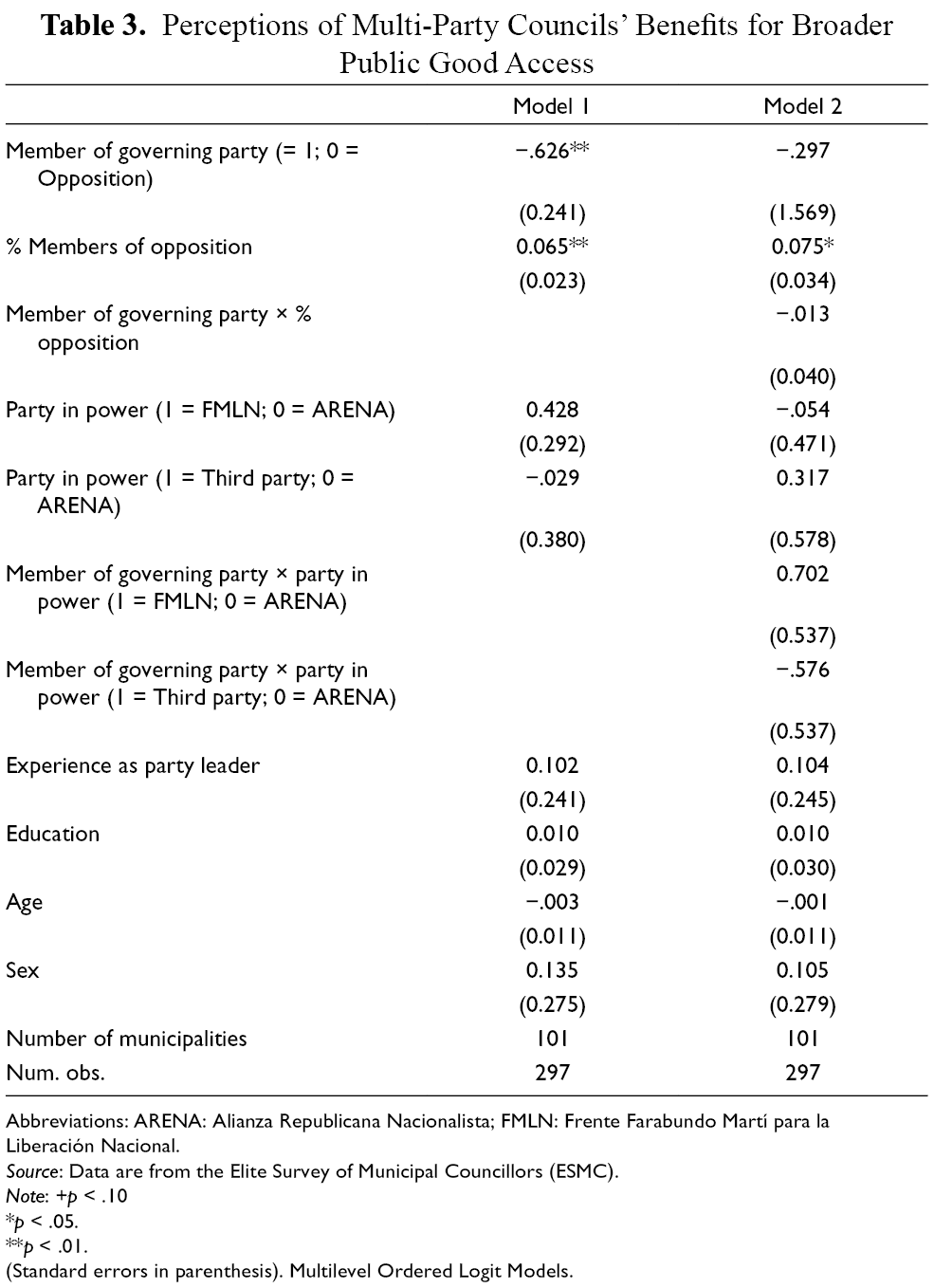
Abbreviations: ARENA: Alianza Republicana Nacionalista; FMLN: Frente Farabundo Martí para la Liberación Nacional.
Source: Data are from the Elite Survey of Municipal Councillors (ESMC).
Note: +p < .10
*p < .05.
**p < .01.
(Standard errors in parenthesis). Multilevel Ordered Logit Models.
Panel A in Figure 4 shows that, once again, when the opposition has a small percentage of seats, opinions on the benefits of multi-party councils are similar among governing and opposition party members. As the percentage of opposition’s seats increases, we observe that both governing and opposition members are more likely to regard multi-party councils as beneficial for getting the local government to work in neighbourhoods where the governing party does not enjoy support. The difference in predicted probabilities at the lowest and highest value of the percentage of opposition’s seat variable is around 26 and 15 points for the opposition and governing party members, respectively (p < .01). Although we observe that members of the opposition are more likely to perceive this benefit, it is noteworthy to see that governing party members also acknowledge the importance of multi-party councils for bringing the government closer to all neighbourhoods when the opposition is strong. Thus, we find support for H4a but not for H4b.
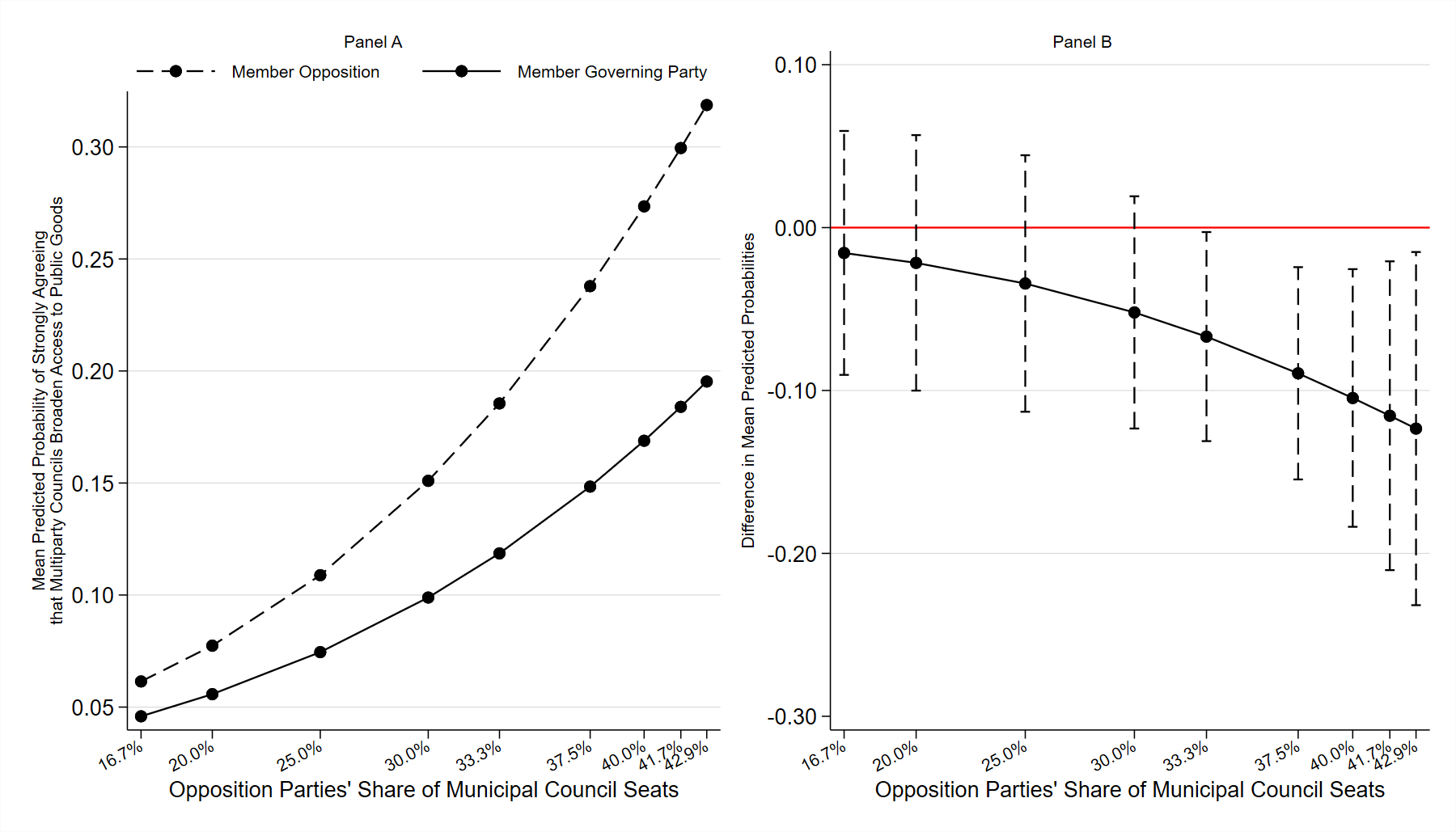
Perceptions of Multi-Party Councils’ Benefits for Broader Public Good Access.
Panel B presents differences in mean predicted probabilities between the opposition and governing members as the strength of the opposition increases. Although both groups have more positive opinions as the opposition’s share of seats increases, we observe statistically significant differences in opinions only when the opposition occupies at least 30 per cent of the seats. 10 At this threshold and higher values, opposition members have a higher probability of strongly agreeing that multi-party councils are beneficial for broadening access to public good, compared to governing party members. As such, these results suggest that the opposition sees multi-party councils as a strategic institutional configuration to reach out to their constituency and increase their access to public goods.
Our qualitative interviews in a municipality with a strong opposition, where tensions between the two main parties (FMLN and ARENA) run high, highlight how having the opposition in councils benefits neighbourhoods that might otherwise be excluded from accessing public goods. Both members of the opposition and governing party noted that the opposition and its supporters now use the council to request the implementation of projects in their neighbourhoods. Moreover, the mayor acknowledged that the opposition is a necessary intermediary for project implementation in neighbourhoods where community leaders are members of the opposition party. At the same time, the opposition has also functioned as a watchdog ensuring that the governing party does not only serve its constituency. As a member of the opposition noted, members of his party “refuse to support projects that only seek a political gain and increase municipal debt” (authors’ interview, July 2017).
Finally, Models 2 in Tables 1 -3 allow us to examine differences across party lines. As stated above, we explore the possibility that members of the FMLN, the party that initially pushed for the reform, are particularly supportive of multi-party councils even if their party holds the majority of seats in a given council. We find that, when the FMLN is in power, their elected members are more likely to express positive opinions about multi-party councils compared to ARENA members in government (online Appendix A). There are no significant differences along party lines among those expected to be optimistic about multi-party councils’ performance, namely opposition members. The party’s initial support for the reform, however, positively influenced the opinions of FMLN members in government.
Robustness Tests
We also examine whether the strong positive effects associated with the opposition’s share of seats we find above remain robust after we account for the extent to which the opposition is fragmented. When one party controls all opposition seats in a municipality, co-ordination problems are minimised, whereas a fragmented opposition faces more co-ordination problems. This can affect the opposition’s ability to oversee government action and block proposals (Best, 2013) and shape performance evaluations of multi-party councils. Our measure of fragmentation is the effective number of opposition parties (OENP) in each council calculated based on Laakso and Taagepera’s (1979) formula. As we show in the online appendix, when we estimate predicted probabilities based on models that account for the opposition’s fragmentation, the percentage of seats of the largest opposition party, and poverty rates, we observe similar effects as those presented in Figures 2 -4 (online Appendix B).
Besides municipal-level variables, we also examine the robustness of our results to the inclusion of additional variables at the individual level. First, we control for a binary variable coded 1 if the interviewee is the mayor or síndico or 0 otherwise. Arguably, the mayors and síndicos are more likely to oppose multi-party municipal councils as they are the ones in charge of running municipalities on a daily basis, and thus might perceive that the opposition interferes with their ability to implement municipal projects. We find that the opinions of mayors and síndicos do not differ from that of other municipal councillors across our dependent variables and that our results remain similar (online Appendix C).
Second, we control for a variable indicating whether interviewees were part of a municipal council prior to the electoral reform that brought about multi-party councils. Councillors who held a seat in single-party councils might be less optimistic about multi-party council performance compared to those who have only experienced multi-party councils. We find that this is the case when asked about multi-party councils’ benefits for transparency and broader public good access. Yet, our core results remain similar (Online Appendix D). Finally, we explore the possibility that councillors’ perceptions of multi-party councils’ performance are driven by the time elapsed since the inauguration of multi-party councils at the time of the interview. We find that over time, councillors’ opinions about multi-party councils’ benefits for transparency become less optimistic, but that this effect is weak (p < .10) and driven by opposition party members. Independent of the time elapsed since the inauguration of multi-party councils, our core results for all dependent variables remain similar to those shown in Figures 2 -4 (online Appendix E).
Conclusion
With the Salvadoran electoral reform, all countries in Latin America are now able to elect municipal councils where the opposition can potentially play an important role. With a focus on El Salvador, we carried out a systematic examination of council members’ assessments about the benefits of multi-party councils for local governance.
The findings highlight the importance of a strong opposition. First, our results consistently show that the mere presence of the opposition in municipal councils does not make opposition members’ more optimistic about the benefits of multi-party councils. Contrary to our expectations, when the percentage of seats by the opposition is low, both members of the opposition and governing parties share similar poor evaluations of multi-party councils’ performance. It is only when the opposition’s share of seats is high that their members are more likely to perceive overall positive benefits, while the opinions of governing party members remain similar. Moreover, when we move away from the more abstract evaluation and explore specific areas of governance, perceptions of transparency and increased access to public goods, we find that governing party members’ opinions become more positive as the oppositions’ share of seats increase. This is contrary to what we theorised. Our analysis of qualitative data suggests that having a strong opposition allows governing parties to claim financial integrity as well as perceive increased access to public goods for non-supporters.
The opinions of municipal councillors emphasise the importance of the strength of the opposition for making inclusive councils improve local governance. As such, our findings carry with them important implications. Our results suggest that when the opposition is not strong, its members can be easily marginalised. To increase the chances that opposition members can play a meaningful role even if the opposition is electorally weak, municipal codes should include provisions that specify rights for opposition members. For instance, legislation can reserve a seat for the opposition in the council’s leadership and key commissions to facilitate its oversight role.
Opening up spaces for the opposition by law has the potential to improve local governance where the opposition lacks a strong electoral presence as well as where it is strong. Establishing roles for the opposition, similarly to Bolivia and Colombia, would institutionalise who gets a seat at the table, has access to information, and influence over decisions. In Central America, however, no countries include specific rights or roles for the opposition in their municipal codes (Fundación DEMUCA, 2015).
Given the current political trends in El Salvador, the lack of provisions in the municipal code that grant specific rights and roles to the opposition risks reducing the effectiveness of the opposition in municipal councils. Since President Bukele took power in 2019, the country has seen democracy indicators decline sharply. 11 Despite this, Bukele’s newly formed party enjoys great popularity and is likely to do well in the 2021 legislative and municipal elections. In this context, without institutional protections at the local level, we fear opposition parties will face a greater challenge in their ability to influence policy and play an oversight role. Not only because opposition parties might receive a lower percentage of council seats across municipalities, but also because efforts by the president’s new party to sideline the opposition at the national level might become prevalent at the local level as well.
All in all, our research shows that rather than worrying about governability issues, when there is a strong opposition, all council members perceive benefits in the existence of multi-party councils for democratic governance. Our findings also suggest that the mere presence of opposition parties in municipal councils is unlikely to advance local democratic governance unless the opposition is a relevant actor. In the absence of a preestablished rights and roles for the opposition, when the opposition is weak, governing and opposition party members are less likely to perceive benefits in having multi-party councils. In the opinion of municipal councils, an empowered opposition is quintessential for bringing about the theorised benefits of decentralisation for democratic governance.
Supplemental Material
online supplementary file 1 - Supplemental material for Do Multi-Party Municipal Councils Improve Local Governance? Municipal Councillors’ Opinions in El Salvador
Supplemental material, online supplementary file 1, for Do Multi-Party Municipal Councils Improve Local Governance? Municipal Councillors’ Opinions in El Salvador by Abby Córdova and Annabella España-Nájera in Journal of Politics in Latin America
Footnotes
Acknowledgements
The authors would like to thank Virginia Oliveros and participants at the Kellogg Institute for International Studies’ Democratization Theory Research Cluster Workshop and the Southeast Latin American Behavior (SeLAB) Consortium for their excellent feedback on previous drafts of this article. The authors are also grateful to the editors and anonymous reviewers for their insightful comments, and would like to thank the team of interviewers who collected the data and the municipal councillors who participated in the study.
Declaration of Conflicting Interests
The author(s) declared no potential conflicts of interest with respect to the research, authorship, and/or publication of this article.
Funding
The author(s) received no financial support for the research, authorship, and/or publication of this article.
Supplemental Material
Supplemental material for this article is available online.
Notes
Author Biographies
Email:
Email:
References
Supplementary Material
Please find the following supplemental material available below.
For Open Access articles published under a Creative Commons License, all supplemental material carries the same license as the article it is associated with.
For non-Open Access articles published, all supplemental material carries a non-exclusive license, and permission requests for re-use of supplemental material or any part of supplemental material shall be sent directly to the copyright owner as specified in the copyright notice associated with the article.
