




Abstract
This article explores Ghana’s preventive measures for stemming the spread of the COVID-19 disease among its population and the socio-economic impact of these measures in urban marketplaces. It argues that Ghana’s COVID-19 approach in marketplaces was characterised by (1) improving hygiene conditions through disinfection of all markets, (2) closing down markets to enforce social distancing among traders, and (3) imposing a lockdown to decongest densely populated marketplaces. Yet the micro-geographies of Ghana’s marketplaces complicated the implementation of these preventive measures. The socio-economic impacts of the COVID-19 pandemic in marketplaces were evident in the increased food prices, the economic hardships associated with the lockdown directive, and the forceful relocation and decongestion exercises to enforce social distancing among traders. The hostile nature with which municipal authorities implemented the COVID-19 preventive measures in marketplaces is akin to how they sought to decongest inner cities prior to the emergence of COVID-19.
Introduction
Since its emergence in January, 2020, the impact of the COVID-19 pandemic has been deeply felt across the length and breadth of nations and continents around the globe. However, major cities have been hit the hardest. This is clearly evident in the fact that major cities have become the epicentres of the COVID-19 disease, as they serve as entry points for most international travel. In Africa for instance, major cities such as Lagos, Accra, and Johannesburg have recorded the highest numbers of cases of COVID-19 disease in Nigeria, Ghana, and South Africa respectively, altering their everyday social, economic, and political lives. Notably, within most African cities, one urban space that deserves particular attention during an infectious disease pandemic is the open-air marketplace.
Urban marketplaces are characterised by thousands of close exchanges of locally produced and imported goods between traders and shoppers in densely packed spaces, which could facilitate a quick spread of an infectious disease. However, marketplaces are difficult to shut down in order to control the transmission of a disease because they provide the essential services of feeding and clothing cities on a daily basis (African Centre for Cities, 2015; Asante and Helbrecht, 2020). Moreover, several studies have indicated that marketplaces employ the majority of the urban population in many cities across Africa (Asante and Helbrecht, 2019c; Debrah, 2007; Goodfellow, 2012). This employment supports and sustains the livelihoods of not only traders and their families but also vulnerable groups such as head porters and truck pushers. Lastly, it is well established in the literature that the marketplace is the largest source of daily revenue for city authorities in Africa (Asante and Helbrecht, 2019b; Gombay, 1994). This means that the urban development in Africa is highly dependent on the continuous operation of marketplaces.
The primary objective of this article is to explore Ghana’s measures to stemming the spread of the COVID-19 disease and the socio-economic impact of these measures in urban marketplaces. This study builds on the existing literature on the economic impact of infectious diseases on food prices in Africa. We argue that similar hygiene and public health concerns characterise state-led decongestion exercises motivated by social distancing and pre-COVID-19 attempts by the state to ensure a clean inner city. Notably, we observed that the aggressiveness with which municipal authorities deploy the preventive measures of COVID-19 disease, coupled with the displacement of some traders to other locations to enforce social distancing in marketplaces, is synonymous with the age-old decongestion or crackdown exercises and redevelopment-related displacements in the inner city.
Ghana’s COVID-19 Pandemic Measures
Before Ghana recorded its first two cases on 11 March 2020, state authorities had monitored, for a few weeks, the spread of COVID-19 in Asia, Europe, and North America and the measures that affected countries were putting in place to contain the virus. Some expected that African countries would adopt the same measures taken by the developed nations. However, Ghana was mindful of the fact there is no one-size-fits-all approach to the COVID-19 pandemic. Therefore, it decided to adapt the WHO guidelines to suit its unique situation. Ghana’s unique strategy focused on measures such as the suspension of public gatherings; disinfection of market facilities; strict enforcement of social distancing and good personal hygiene; closure of all land, sea, and air borders to human traffic; and lockdown of the epicentres of the disease.
To start with, the President of Ghana, in a nationwide address on 15 March 2020, announced a ban on all public gatherings for the next four weeks. Although urban market centres are also public gatherings, they were excluded from the suspension due to the essential services they provide. Rather, he directed the Ministry of Local Government and Rural Development (MLGRD) to co-ordinate, with all municipal authorities in Ghana, measures to enhance conditions of hygiene in markets across the country. Over the years, several scholars have reported the insanitary and unhygienic conditions in many markets across Africa, but little has been done by municipal authorities to regularly disinfect them (see Asante and Helbrecht, 2019a; Awuah, 1997; Battersby and Watson, 2019; Lindell et al., 2019). In putting the Presidential directive to action, the MLGRD in collaboration with municipal authorities in Ghana developed a national timetable, spanning 23 March to 6 April 2020, to disinfect and enhance hygienic conditions in all 1,806 market centres in Ghana (Table 1). In line with the timetable, all markets in Ghana were closed down on the day of disinfection. Generally, the disinfection of markets and other public places in Ghana and elsewhere is informed by the idea that infectious diseases such as COVID-19 spread rapidly in insanitary conditions. Traders across the country were happy about the exercise and called for regular disinfection of the markets during and after the pandemic.
National Programme for Market Disinfection Exercise in Ghana.
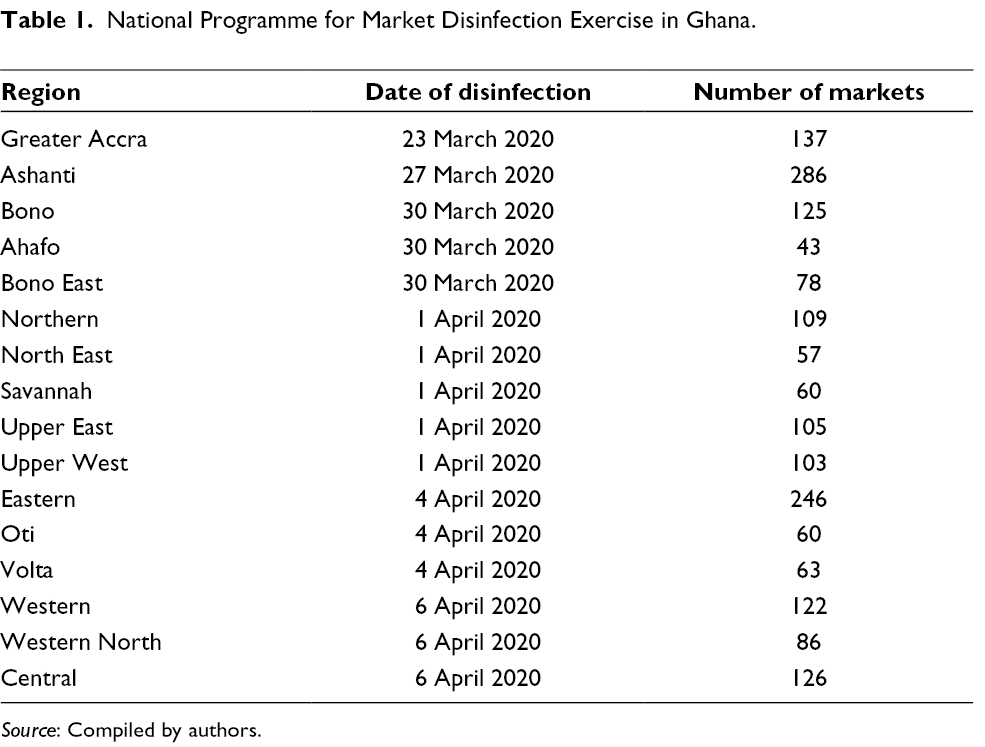
Source: Compiled by authors.
Aside from the ban on public gatherings and the market disinfection, the Ghanaian authorities advised citizens to strictly adhere to good personal hygiene and observe social distancing in order to prevent community spread of the disease. This was particularly important in urban marketplaces due to the regular cash-based transactions and the close person-to-person contact between traders and shoppers. Due to the pandemic, Ghana took steps to switch from cash-based transactions to digital forms of payment. For instance, the Bank of Ghana agreed with mobile network operators that, effective as of 20 March 2020, all mobile money transfers of GHȼ100 (US$18.16) 1 and below would attract no charge. The daily transaction limit was also increased. However, marketplace transactions were still largely cash based. Therefore, in many markets across the country, all traders and shoppers were obliged to wash their hands before entering and the same when exiting (Nyarko, 2020). Outside the market, all persons were advised to regularly use alcohol-based hand sanitisers to keep good personal hygiene. In addition to hygiene, every Ghanaian, including traders, was to strictly observe social distancing, by maintaining a distance of at least 1 metre (or 3 feet) from other persons, whether the person was showing symptoms or not. These preventive measures notwithstanding, new cases continued to emerge.
Therefore, the state took the additional measure of closing of all land, sea, and air borders to human traffic for the following two weeks, beginning midnight of Sunday, 22 March 2020. However, we must be quick to point that the border closure did not apply to goods, supplies, and cargo. While the border closure may have stopped the importation of the disease into Ghana, it could not halt community spread, as recent travellers continued to interact with people. By 27 March 2020, when the President delivered his fourth nationwide address, the number of cases had soared to 141. At this point, the two largest cities in Ghana had emerged as the epicentres of the disease. Perhaps, this was due to the concentration of economic activities in these two cities. As a result, the President, on 27 March, announced a partial lockdown of the hotspots of the COVID-19 disease in Ghana, Greater Accra, and Kumasi, pursuant to the powers granted him under the Imposition of Restrictions Act, 2020 (Act 1012). The partial lockdown was to take effect at 1 a.m. on 30 March 2020, forty-eight hours from the time of announcement.
The partial lockdown required that residents of the city regions of Greater Accra and Greater Kumasi stay home for the following two weeks. 2 More so, all passenger travels between the restricted areas and other parts of Ghana were prohibited. In anticipation of the strict enforcement of the partial lockdown and its attendant hardship, a considerable number of informal workers and homeless people fled to their hometowns between 28 and 29 March 2020. However, luck eluded a group of about thirty head porters who were caught in Ejisu – an adjoining town to Kumasi – travelling in a truck heading to the northern part of Ghana. As they were travelling after the partial lockdown had taken effect, the security officers returned the truck driver and the head porters to Greater Accra where they had originated. A group known as the Northern Development Forum requested, as a matter of urgency, that the state identify and test all persons who had travelled from Greater Accra and Kumasi to the other parts of the country within the last forty-eight hours, but this fell on deaf ears.
Like every lockdown around the world, there were exemptions. People were allowed to go out to get essential items such as food, drugs, and water, to undertake banking transactions, or to use public toilet facilities. Private vehicles and aircraft providing essential services and those carrying cargo were allowed to operate. This was to ensure that market traders received regular supplies of fresh produce. Intra-city commercial vehicles were allowed to operate, but with the condition of reducing the number of passengers in order to observe appropriate social distancing and hygiene protocols. Market traders, who fell within the category of individuals who provide the essential services of production, distribution, and marketing of food, beverages, pharmaceuticals, medicine, paper, and plastic packages, were exempted from the partial lockdown while all other traders were to stay home.
The Impact of COVID-19 Pandemic in Marketplaces in Ghana
The socio-economic impacts of the COVID-19 pandemic in marketplaces were evident in the increased food prices, the police brutality meted out to some traders, the economic hardships associated with the lockdown directive, and the aggressive relocations and decongestion exercises to enforce social distancing among traders.
To start with, market trading in Ghana is heavily reliant on imported goods from neighbouring countries like Burkina Faso and Nigeria as well as further away countries like China, India, and Vietnam. Amidst the shortage in supplies caused by the global surge of COVID-19 cases, there were sharp increases in food price in urban markets across the country. This was evident in many markets in Greater Accra and Kumasi on 28 March, a day after the President announced the partial lockdown of these two cities. Prices of food items doubled and, in some cases, tripled. 3 The price increases were not only limited to imported food but also locally produced items. Many shoppers were surprised at the exponential increase in prices because urban marketplaces guaranteed urban dwellers access to affordable food. The high prices meant that shoppers could buy fewer items than they had planned or had to spend more to buy the same items.
Several shoppers indicated that the traders had deliberately increased food prices to take advantage of the panic buying. Nevertheless, traders argued that suppliers had increased the prices of items, and hence the corresponding increase in prices. It is also important to state that similar increase in food prices characterised market trading in Liberia and Sierra Leone during the Ebola virus epidemic (Glennerster et al., 2016; World Bank, 2014). However, the current situation may be worse across the import-dependent African nations due to the impact of the COVID-19 pandemic on the economic activities and purchasing power of the urban poor as well as the production and supply logistics of major exporting countries and companies.
Secondly, as earlier indicated, only market traders involved in the production, distribution, and marketing of food and beverages were exempted from the partial lockdown in Greater Accra and Kumasi. Although marketplaces were opened for business, the President of Ghana tasked officers of the Ghana Police Service and Ghana Armed Forces to strictly enforce the lockdown. In order to avoid the usual heavy traffic in the city centres, the Ghanaian authorities indicated that, during the lockdown, individuals should purchase food items in their neighbourhood markets. However, some of the urban poor did not comply with the lockdown directive, as they travelled from far to purchase affordable foodstuffs in the central markets. To make matters worse, they travelled in commercial vehicles without observing social distancing. This compelled security officers to turn some of them away, brutalise and torture a few, and prosecute others. Sadly, some security officers began to extend their brutality to some traders who were permitted under the lockdown directive to purchase bulk items from the central market to stock in their stores in the neighbourhood markets. 4
Several studies have noted that this kind of brutality characterised the enforcement of orders by national and city authorities in markets across many African countries, long before the emergence of COVID-19 pandemic (see for instance Asante and Helbrecht, 2019a; Goodfellow and Titeca, 2012; Monteith, 2015; Obeng-Odoom, 2013; Resnick, 2019). This is largely because traders and their so-called informal economic activities are often perceived by city authorities as stains soiling the image of the modern African city (Adaawen and Jorgensen, 2012; Asante, 2020; Lindell and Ampaire, 2017; Monteith, 2015). However, traders have different perceptions of themselves and their economic activities. In the face of the harsh economic conditions, traders consider their businesses as their everyday source of employment, means of income and wealth accumulation, and the backbone of their family’s livelihood (Beek and Thiel, 2017; Lindell and Ampaire, 2017; Sowatey et al., 2018).
Furthermore, during the partial lockdown, most traders experienced some form of economic hardship. Traders across the various central markets in Accra and Kumasi complained of poor sales because security officers would not allow shoppers to enter the market if they were unable to prove beyond reasonable doubt that they live few metres away. Those in the neighbourhood markets had similar concerns, as shoppers avoided their expensive items. Studies have shown that poor sales in trading activities have ripple economic (loss of capital, low savings, and inability to meet immediate family responsibilities) and socio-psychological effects on traders (Asante and Helbrecht, 2019c). What is more, traders in Accra and Kumasi, who were asked to stay home during the three-week partial lockdown, were in a more precarious financial situation. As indicated by Kazeem (2020), ‘with business ventures that require daily activity to earn income, a weeks-long hiatus from work can translate to financial peril’. By staying home for so long, most poor people either had no access to affordable food or had completely run out of money to buy food. There were concerns that if government did not intervene quickly, hunger would kill more vulnerable people in Ghana than the COVID-19 disease. In response to these concerns, the Ghana government and some private organisations distributed dry food packages and hot meals to needy households and communities in the restricted areas of the lockdown. Additionally, the state paid for water supply to all Ghanaians at no cost for the months of April to June 2020 (see Adomfmonline, 2020). The severe impact of the lockdown on the livelihood of traders and the urban poor was one of the major considerations why the President of Ghana, to the surprise of many world leaders, took the decision to lift the lockdown on 21 April.
Lastly, prior, during, and post-lockdown, the Ghana government has been very particular about ensuring the strict adherence to social distancing in marketplaces, especially in the epicentres of Greater Accra and Kumasi. However, of all the government’s COVID-19 preventive measures, the one that has been extremely difficult to enforce in Ghanaian marketplaces is social distancing, as traders continue to engage in close interaction among themselves and with their customers. For this reason, many municipal authorities in Greater Accra, Kumasi, and many parts of the country forcefully sacked traders and closed some marketplace until further notice. A considerable number of studies have indicated that traders in Ghana and Africa, more broadly, have been victims of harsh policies and interventions of city authorities over the years (Lindell and Appelblad, 2009; Obeng-Odoom, 2013; Owusu-Sekyere et al., 2016). In resolving the issue for traders to return, municipal authorities adopted two approaches to reduce the number of traders in the marketplace, with the ultimate aim of enforcing social distancing. One approach was to relocate some traders to another location in the city. In Takoradi, for instance, the municipal authority compulsorily relocated all petty traders at Takoradi Market Circle to Jubilee Park, the location of Ghana’s independence celebration in the city. The other approach sought to divide commodity groupings into small groups, so that they could alternate the market days. We have witnessed a variation of the latter approach in India, Nigeria, and Uganda (see Bagnetto, 2020; Ssejjoba, 2020). However, these approaches have achieved very little compliance in respect of social distancing among traders in many African markets.
Rather than the impatient closure of markets, it is important for municipal authorities to understand the micro-geographies of Ghana’s marketplaces. The crucial question is: Why are traders flouting the government directive of social distancing? We contend that spatial, social, and economic reasons account for the consistent violation of social distancing in marketplaces. To begin with, the physical space of most market infrastructure in Ghana and some parts of Africa are heavily congested and densely populated. This spatial challenge is succinctly captured by a trader interviewed by Bagnetto (2020): ‘if each of us is working, and you ask me to shift, I’m shifting into somebody’s space. That space is not mine. So who moves? Social distancing is very difficult’. Secondly, a trader’s location in the marketplace is an economic resource. As noted by Asante and Helbrecht (2020), many traders in African markets have traded in the same spot for several decades. When a trader is known for a particular location, he/she is able to obtain goods from suppliers on credit, to secure loans from financial institutions to expand her businesses, to keep regular customers, and to get referrals from loyal customers. Due to this economic feature, it is very difficult for traders to adjust their location in the marketplace. Lastly, the African market, from time immemorial, has been a space where meaningful social action and interaction occur (Ayittey, 2006; Storr, 2008). It provides an indispensable venue for social intercourse: to meet people, to gossip, and to discuss and keep abreast with local issues (Ayittey, 2006). Studies have shown that the close interaction among traders is an important social resource that helps them to obtain sales and purchases, free transport of goods, and a variety of small aids in their business (Asante and Helbrecht, 2020). Social distancing affects these trader-to-trader and trader-to-customer relations and limits market interactions to purely economic transactions. Owing to these spatial, economic, and social factors, it is important for municipal authorities to be patient with the traders and work closely with market leadership, as adjusting to the new protocol of social distancing would take a while.
Concluding Remarks
This article set out with the objective of examining Ghana’s COVID-19 pandemic measures to curb the spread of the disease and the socio-economic impact of the measures in marketplaces. It has demonstrated that Ghana’s COVID-19 pandemic measures in marketplaces focused mainly on disinfection of markets, enforcing social distancing among traders, and imposing partial lockdown to decongest marketplaces. The implementation of these preventive measures was challenging for both the state and the traders due to the spatial, economic, and social micro-geographies of the marketplace. We have noted a number of socio-economic impacts of the COVID-19 pandemic in marketplaces. Countries, like Ghana, who are heavily reliant on imported food items have experienced increase in the prices of food. This has trickled down to lack of access to affordable food for the urban poor and their families. The strict enforcement of disease control protocols – partial lockdown and social distancing – at the epicentres of the disease has resulted in low sales for traders dealing in food items while causing severe financial distress for traders and vulnerable groups who have had to stay at home. We have argued that the ‘machoistic’ disciplinary governmental interventions to enforce public health protocols in marketplaces is synonymous with the persistent crackdown exercises by city authorities to reduce the perceived insanitary conditions created by traders. It has been argued that the harsh implementation of activities may not necessarily yield the desired result. Rather, it is important for authorities to develop an in-depth understanding of the micro-geographies of the marketplace to inform the planning and implementation of their policies in this urban space.
These findings have implications for access to affordable food in Ghana and other African countries going forward. To start with, some countries have come to the realisation that their heavy reliance on imported goods is not sustainable for their growing economies. In the heat of the COVID-19 pandemic, we have already seen the President of Ghana, for instance, direct the Food and Drugs Authority to collaborate with local pharmaceutical companies and corporate institutions to begin the production of alcohol-based hand sanitisers and personal protective equipment for frontline health workers and the general population. Therefore, post-COVID-19, local production will extend to agricultural and manufactured goods required to meet a high proportion of local demand. As a result, while imports will resume after the pandemic, we expect that a considerable percentage of basic food items such as rice, tomatoes, and onions, among others, in the various marketplaces should be supplied by local farmers. However, local production of foodstuffs will only increase if the top-down policies devised and implemented by national and municipal governments are effective. It is also important for governments to involve local farmers and communities in co-producing lasting solutions that are effective and do not increase inequalities.
Moreover, we expect to see changes in the spatial set-up of marketplaces across Africa. In other words, market centres will be less crowded or congested. The shift system adopted by some municipal authorities in Ghana is a promising approach, which is likely to be replicated in other African countries and may continue to be the norm post-COVID-19. This will ensure the preparedness of countries in the event of a future disease pandemic that will require social distancing. We must be quick to point out that keeping social distancing in marketplaces would require a strong collaboration between municipal authorities and trader associations.
Lastly, municipal authorities are likely to undertake regular disinfection of market centres and may institute measures for traders to devote some days within every month or week to clean their trading spaces and the market surroundings. This will lead to a significant improvement in sanitary conditions in marketplaces. Ultimately, cleaner and less crowded marketplaces will reduce concerns about public health and gradually eliminate the need for crackdown exercises and harsh interventions of the state. Indeed, while the devastating effect of COVID-19 pandemic on the global economic and health infrastructure cannot be underestimated, its local impact and consequences in Ghana and Africa are mixed.
Footnotes
Declaration of Conflicting Interests
The author(s) declared no potential conflicts of interest with respect to the research, authorship, and/or publication of this article.
Funding
The author(s) received no financial support for the research, authorship, and/or publication of this article.

Notes
Author Biographies
E-mail:
E-mail: