




Abstract
Studies on party system change in Latin America commonly label similar processes as constituting dealignment or realignment. To clarify the boundaries between both concepts, we distinguish between abrupt and gradual realignments. While both imply change, they differ in the number of election cycles involved. Abrupt realignments occur in a single election cycle, while gradual realignments take place in two or more. We apply this conceptualisation to Costa Rica, Latin America’s longest-running democracy, and a country where the party system has decayed without collapsing. To better identify the type of change that has taken place, we use canton-level election data from 1958 to 2018 and public opinion surveys from 1978 to 2018. The evidence contests the notion of electoral dealignment. Instead, we show that the party system experienced an abrupt realignment in the 2002 election and gradual realignment in more recent election cycles.
In 2018, Carlos Alvarado, from the centre-left Citizens’ Action Party (Partido Acción Ciudadana, PAC), was elected president of Costa Rica. He defeated conservative firebrand Fabricio Alvarado (no relation), from the National Restoration Party (Restauración Nacional, RN), in a second-round vote. The election reflected the extent to which Costa Rica’s party system has changed. For the first time since 1953, the top two vote-getters in the presidential election did not come from the ranks of the National Liberation Party (Partido Liberación Nacional, PLN) or the Social Christian Unity Party (Partido Unidad Social Cristiana, PUSC). Carlos Alvarado is the second consecutive president from the PAC – now an established party that rivals the PLN and PUSC. Furthermore, the National Assembly is the most diverse in modern history, and among the electorate, the percentage of those not identifying with political parties is at a record high.
Scholars have labelled party system change in Costa Rica as representing dealignment (Sánchez, 2003, 2004; Pignataro, 2017a) and realignment (Carreras et al., 2013). Drawing on the concept of critical elections (Campbell, 1960; Key, 1955), we claim that the 2002 contest marked an abrupt realignment from a two-party to a multi-party equilibrium. However, recent election cycles point to a gradual realignment as the party system has grown increasingly fragmented – with some conventional political divides weakening and new ones emerging.
In the following section, we review the theory on party system change and distinguish abrupt from gradual realignments. We then apply that distinction to Costa Rica’s party system. In the next section, we describe the methods and the data. We use canton-level presidential election results from 1958 to 2018 and public opinion surveys from 1978 to 2018 to test for the presence of an abrupt realignment in 2002 and a gradual realignment since. Thereafter, we present our statistical results and analysis. The conclusion summarises our findings.
Theory
Since Key (1955) introduced the concept, critical elections have been a recurrent component in the study of party system change. Some polls turn out to have more historical consequences because they either reflect or trigger a change in the party system. Thus, labelling some elections as critical helps identify moments when shifts in the party system coincide with the electoral process – even if prior events trigger them.
Studies distinguish between stable alignments, realignments, and dealignment. Party system competition can be steady (alignment) or susceptible to various degrees of change (ranging from realignment to dealignment). Scholars examine the type of party system in place (two-party or multi-party), the vote share of established parties, and the determinants of support for contenders (Carreras et al., 2013; Key, 1955, 1959; Lipset and Rokkan, 1967; Roberts, 2014; Sundquist, 1983). Studies on alignments, realignments, and dealignments are common in Western Europe (Lipset and Rokkan, 1967) and the United States (Key, 1955; Sundquist, 1983), but they are comparatively novel in Latin America (Carreras, 2012; Carreras et al., 2013).
Since the third wave of democratisation, scholars have stressed the unstable nature of Latin American party systems (Mainwaring and Scully, 1995; Mainwaring, 2018). Early studies argued that dealignment was most prevalent in the region. Dix (1989) claimed that party systems in Latin America did not conform to the long-term cleavage structures expressed by Lipset and Rokkan (1967). Due to frequent regime breakdowns, parties and cleavages were not constant. Ten years later, Hagopian (1998) concluded that dealignment – both partisan and electoral – was more common than realignment. The concept of party system instability was deeply rooted in studies on cleavages and linkage formation (Collier and Collier, 1991; Coppedge, 1998a; Roberts, 2002a, 2002b), and electoral volatility (Coppedge, 1998b, 2001; Roberts and Wibbels, 1999).
Yet more recently, scholars have voiced the rare nature of dealignment and party system collapse (Lupu, 2016a, 2016b: 42; Mainwaring et al., 2018: 29; Morgan, 2011, Seawright, 2012: 48). In turn, studies point to the more frequent presence of realignment (Carreras, 2012; Carreras et al., 2013). Nevertheless, there is ambiguity on how to distinguish dealignment from realignment. For example, during much of the twentieth century, Colombia was home to a two-party system, with competition between the Conservative and Liberal parties. In the late 1990s, the party system experienced a significant transformation, which authors designate differently. Morgan (2011) argues that the party system collapsed between 1998 and 2002. Carreras et al. (2013: 679) describe the shift from 1982 to 2010 as one from “alignment to non-alignment.” Albarracín et al. (2018: 227) define it as a deinstitutionalisation case without collapse. The examples of Peru, Bolivia, and Guatemala provide similar inconsistencies (Carreras et al., 2013; Morgan, 2011; Roberts, 2014; Seawright, 2012).
In sum, although initially considered widespread, dealignment resulting in party system collapse is rare. In Latin America, party breakdowns and deinstitutionalisation within a realignment framework have been more prevalent. To deepen the conceptualisation of party system change in the region, we turn to distinguish between types of realignments. In this vein, we differentiate between stable alignments, dealignment, and realignments, contrasting gradual realignments, which occur in two or more election cycles, and abrupt realignments, which happen in a single election cycle.
Stable Alignments, Dealignment, and Realignments
On one side of the party system change spectrum, stable alignments occur when there is continuity in the parties that compete in elections, in their vote share, and in the divisions that determine inter-party competition. On the opposite side, dealignment represents the collapse of a party system. Voters turn their backs quickly on existing parties and vote for new or fringe parties (Mainwaring, 2018). Dealignment marks a shift in the divisions of party competition (Carreras, 2012).
Realignments are in between both ends of the spectrum, but they can unfold quickly (Campbell, 1960; Key, 1955; Nardulli, 1995) or gradually (Dalton et al., 1984; Key, 1959; Sundquist, 1983). Key (1955, 1959) formulates a widely known realignment classification, distinguishing critical elections from secular realignments. Critical elections constitute “a realignment within the electorate both sharp and durable” (Key, 1955: 11). Secular realignments are “a movement of the members of the population category from party to party that extends over several presidential elections and appears to be independent of peculiar factors influencing the vote at individual elections” (Key, 1959: 199).
Since high electoral volatility (Roberts and Wibbels, 1999) and low levels of partisanship (Lupu, 2015) characterise party systems in Latin America, we adopt Key’s (1955, 1959) proposal to distinguish between gradual and abrupt realignments. Gradual realignments imply a decay – covering multiple election cycles – of established parties, resulting in a change in the number of interacting parties, their vote share, and political divisions. For a gradual realignment to occur, the vote share of established parties must steadily fall as an emerging or fringe party grows.
In turn, abrupt realignments also involve a change in the number of parties, which those parties are, and divisions of competition. Unlike gradual realignments, abrupt realignments occur rapidly, in a single election cycle, at times coinciding with the breakdown – but not full disappearance – of established parties. Thus, in an abrupt realignment, established parties survive, and at least one new party receives enough votes to become a significant contender immediately. For an abrupt realignment to occur, a country must experience a critical election that combines a sudden change in competitive dynamics and determinants of support for parties.
We apply that conceptualisation to examine party system change in Costa Rica. We argue that the country experienced an abrupt realignment in the presidential election of 2002 – when a multi-party equilibrium suddenly replaced a two-party system. Since 2006, the party system has undergone a gradual realignment, as the equilibrium that emerged in 2002 has slowly unravelled. Our findings speak to a broader debate on party system change in Latin America – and emerging democracies elsewhere. In recent years, party systems across the region have been under stress. In Central America, notoriously stable party systems have experienced sudden and substantial changes – at times, sharply and durably. General elections in Panama (2009), Honduras (2013), and El Salvador (2019) have resulted in the rapid emergence of new contenders. Tellingly, none of those elections led to the collapse of the party system, but rather to the breakdown of traditional parties and realignment. As Latin America’s longest-running democracy, Costa Rica provides exceptional insights to refine the theory on realignments and party system change in Latin America.
For Costa Rica to have experienced an abrupt realignment in 2002 and a gradual realignment since 2006, we expect three features to occur. First, there should be stability in the dynamics of competition before the election of 2002. By dynamics, we refer to the extent to which parties compete at the subnational level, the effective number of parties (ENP), and determinants of support for parties. Second, there should be an abrupt change in those dynamics in 2002. Since the PAC supposedly emerged as a strong contender from the left, support for the main parties should reflect an ideological divide. Third, although initially stable, the competitive dynamics that arose in 2002 should begin to unravel in recent election cycles – as the PAC evolved from being an emerging challenger to an established party.
Party System Change in Costa Rica
Costa Rica is home to Latin America’s longest-running democracy (Booth, 2008; Pettiford, 1999). The exact origins of democracy in the country remain a source of debate (Booth, 1998; Lehoucq and Molina, 2002; Mahoney, 2001; Paige, 1997). Booth (1987, 1998, 2008) argues that even though Costa Rica never developed a quasi-feudalistic hacienda system with coercive labour, authoritarianism was the norm in the nineteenth century. The development of democracy is associated with the early adoption of elections – even if flawed – and elite factions that represented embryonic forms of political parties (Booth, 2008; Lehoucq and Molina, 2002).
In the 1930s, the middle class’s expansion facilitated the emergence of new political actors. After President Rafael Calderón (1940–1944) alienated his support base, the communist People’s Vanguard Party (PVP) joined the government and successfully pushed for social reforms. Calderón loyalists, who retained a considerable influence of the National Assembly, cried foul when Calderón lost the 1948 election, triggering a brief civil war when a group led by José Figueres rose in arms. Eventually, Figueres transferred power to the winner of the 1948 election. In 1953 Figueres became president, running as a candidate for the recently formed PLN, a social-democratic party. The 1958 election, when Mario Echandi was elected president on an anti-PLN coalition, laid the foundation for peaceful alternations in power. A two-party system gradually emerged, with the PLN competing against what eventually became the more conservative PUSC.
From 1986 to 2002, there was a stable two-party system (Figure 1). Since the early 1950s, the country has held seventeen consecutive presidential and legislative elections (including second-round votes in 2002, 2014, and 2018) and an equal number of local elections (also known as regidurías). Departing from dictatorial trends elsewhere in Central America, Costa Rica avoided democratic breakdowns. Yet democracy in the country has suffered from a loss of support (Lehoucq, 2005; Pettiford, 1999; Seligson, 2002), and its party system, once an example of institutionalisation (Jones and Mainwaring, 2003; Stokes, 2001; Yashar, 1995), has endured fragmentation and lower levels of partisanship (Sánchez, 2002, 2003, 2004).
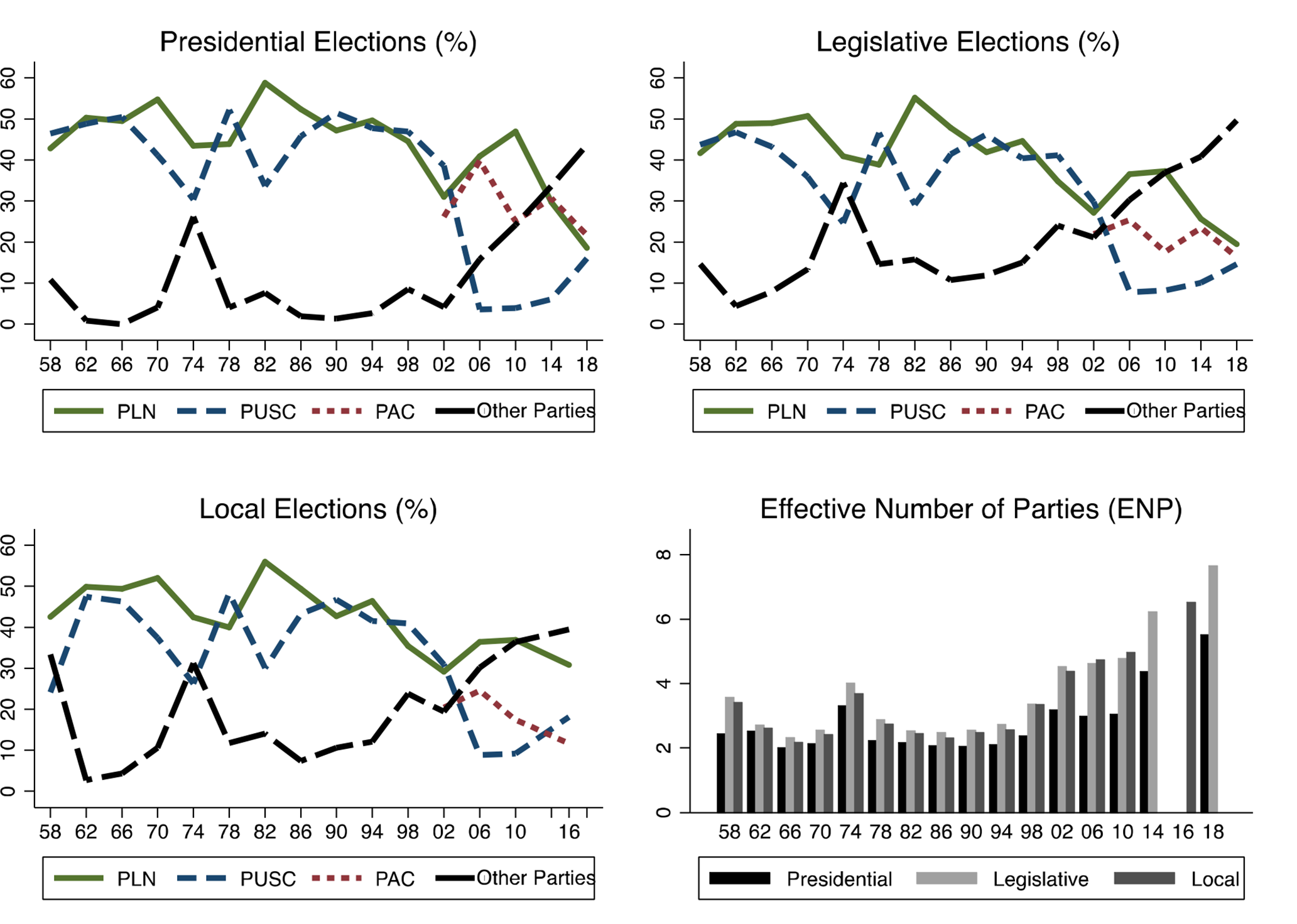
Selected Election Indicators.
In the 1980s, an economic crisis forced the social-democratic PLN government to embrace neoliberal reforms (Wilson, 1994, 1999). The implementation of pro-market reforms led to a programmatic convergence between the leftist PLN and rightist PUSC (Roberts, 2014). By the late 1990s, as the economic policies resulted in growing discontent with the PLN and PSUC, a crisis of representation became evident (Rosenblatt, 2018). As Appendix 1 shows, there was an eleven-point drop in voter turnout in the 1998 elections. Growing levels of corruption also took a toll on traditional parties (Lehoucq, 2005).
In 2002, decades of two-party dominance suddenly ended. The PAC, a new centre-left party with origins in the PLN, received 26 per cent and 22 per cent in the presidential and legislative elections. The PAC’s performance forced the first presidential run-off in the country’s history, between the PLN and PUSC, which the latter won. Since then, the PAC has consolidated as an established party, in competition with the PLN and PUSC.
High-profile corruption scandals that included the 2004 arrests of former PUSC presidents Rafael Ángel Calderón (1990–1994) and Miguel Ángel Rodríguez (1998–2002) led to a profound crisis with the PUSC. In 2006, the PUSC broke down after receiving 8 per cent in the legislative election and 4 per cent in the presidential contest. PAC turned into the PLN’s chief rival, which took a rightist ideological shift. In 2010, PLN candidate Laura Chinchilla became president with 47 per cent. The PAC landed in second place. The PUSC received less than 10 per cent in the presidential and congressional contests. In 2014, Luis Guillermo Solís won a plurality in the first-round vote and obtained 78 per cent in the run-off, becoming the first president from the PAC’s ranks. Smaller parties, including the leftist Broad Front (FA) and Libertarian Movement (ML), also had a strong showing.
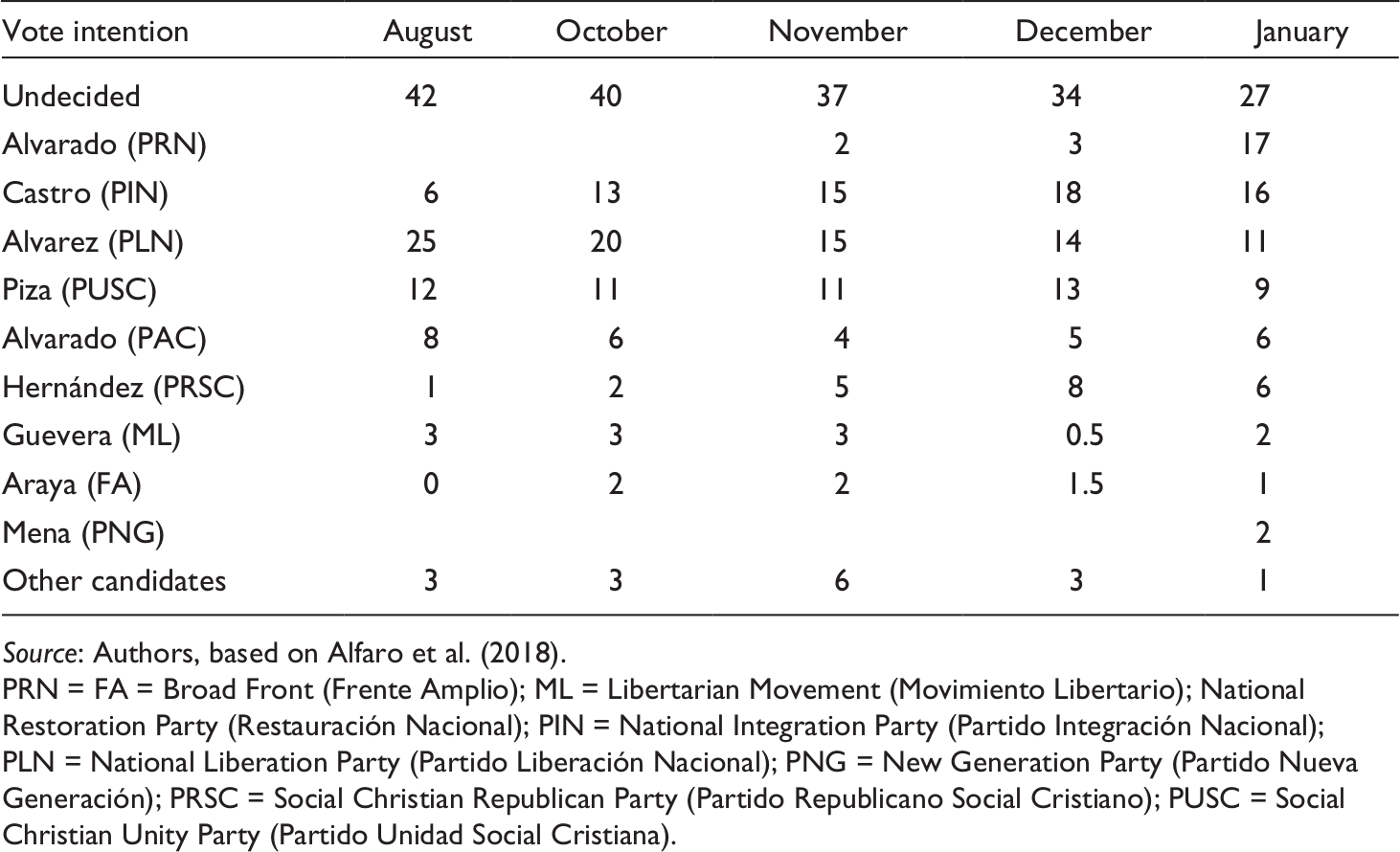
Months before the 2018 election, a corruption scandal – known as El Cementazo – affected officials from the PLN, PUSC, PAC, and the smaller ML, impacting their electoral prospects. Simultaneously, a few weeks before the poll, a ruling from the Inter-American Court of Human Rights (CIDH) – following consultation from sitting president Solís – mandated Costa Rica to legalise same-sex marriage. The verdict immediately boosted conservative firebrand candidates’ popularity, including Fabricio Alvarado and Diego Castro. As a result, pre-election polls revealed uncertainty, with PAC candidate Carlos Alvarado trailing with less than 10 per cent vote intention (see Appendix 2). In the first-round vote, Fabricio Alvarado won a plurality (24.9 per cent), and Carlos Alvarado surprisingly landed second (21.6 per cent). In the run-off, Carlos Alvarado won 60.1 per cent of votes after drawing on public support from the ranks of the PLN, PUSC, and independent voters.
Figure 1 shows changes in Costa Rica’s party system since the late 1950s. There was a stable two-party system during much of the second half of the twentieth century, with the exception of 1974. Then, in 2002, the PAC abruptly entered the scene. In 2006, with the PUSC breaking down, competition centred on the PLN versus the PAC. Support for alternative parties also increased. As Figure 1 shows, there is evidence of vote-splitting in presidential, legislative, and, mostly, local elections. The PLN and PUSC have retained local electoral strength despite losses at the national level. Their ability to maintain local support falls in line with the theory of how parties adapt at the subnational level in the wake of national-level defeats (Cyr, 2017).
Despite differences in presidential, legislative, and local contests, results indicate that the party system has become increasingly fragmented. The bottom-right plot in Figure 1 shows the ENP for each contest. The ENP has consistently grown since 2002, peaking in 2016 for local contests (6.5) and 2018 for presidential (5.5) and legislative (7.7) contests. Whereas the PLN, PAC, and PUSC remain the largest parties, their combined vote share has declined. This outcome supports the claim that there is an ongoing party system change. Yet among the new parties that entered the electoral arena since 2002, only the PAC has remained truly competitive in two or more consecutive elections. A new political equilibrium, marked by competition between the PLN, PAC, and to a lesser extent the PUSC, drastically emerged in 2002. In more recent election cycles, the party system has fragmented further.
Costa Rica embodies the confusion surrounding the debate on dealignments and realignments. While some view it as partisan and electoral dealignment (Pignataro, 2017a; Sánchez, 2002, 2003, 2004), others label it as electoral realignment (Carreras et al., 2013). Studies that point to dealignment emphasise falling partisanship and fragmentation (Sánchez, 2002, 2003, 2004). Sánchez (2003) argues that partisan dealignment, which combines an erosion of party identification that runs parallel to partisan independence, precedes an electoral dealignment. In turn, growing absenteeism, decreasing support for traditional parties, increased vote-splitting, and rising electoral volatility condition electoral dealignment. Pignataro (2017a: 428), who views party system change as part of a broader era of dealignment, shows that partisan dealignment resulted in the postponement of the vote among individuals with lower levels of partisanship. More recently, Pignataro and Treminio (2019: 258) identified significant religious and cultural differences in electoral preferences in the 2018 election.
While there is evidence of dealignment in the party system, there are strong realignment signs. Foremost, the party system has not collapsed. Even though the PLN and PUSC have lost electoral support unevenly – especially when the PUSC broke down in 2006 – both parties remain active competitors at the national and subnational levels. The PLN won the presidency in 2006 and 2010. The party also passed on to the run-off in 2014 and fell short from doing so again in 2018. The PUSC also made a comeback in 2018 (Pignataro and Treminio, 2019: 247).
Another sign of realignment is that a new political party, the PAC, has become an established party (Carreras et al., 2013; Roberts, 2016). Roberts (2014, 2016) argues that the shift from state-led development to market liberalisation resulted in a programmatic dealignment in Costa Rica. Since the social-democratic PLN implemented pro-market reforms (Carreras et al., 2013, Roberts, 2014, 2016; Stokes, 2001), the support basis for that party experienced a shift to the right. This swing seemingly led to the diminishing relevance of party brands, a concept described in detail by Lupu (2016a, 2016b), for Argentina and Venezuela, which facilitated the emergence of a robust left-wing contender. The high-profile corruption scandals (Booth, 2007) led to the breakdown of the PUSC, and the PLN expanded its base as a catch-all party. In the words of Roberts (2016: 74), the PLN “was outflanked on the left by a new rival but displaced the conservative Social Christian Unity Party (PUSC) in order to remain electorally competitive.”
Carreras et al. (2013: 10), perhaps the first to empirically document the presence of realignment – not dealignment – in the country, define Costa Rica as a case of realignment favouring a new party:
the transformation of the party system in Costa Rica was the result of a split in an existing traditional party (the PLN) which helped give rise to a new party, Partido Acción Ciudadana (PAC). The PLN moved from its center-left position in the 1980s to embrace neo-liberal economic reform in the 1990s, thus blurring the ideological difference between the PLN and another traditional party, Partido de Unidad Social Cristiana (PUSC). This move left created an ideological space for a new political party, which the PAC occupied.
A third element that points to realignment is the change in partisanship and vote choice. While electoral volatility increased in 2002 (Sánchez, 2003, 2004), it has fallen in recent elections (Carreras et al., 2013: 679). Moreover, election results suggest a new political equilibrium where established parties (PLN, PUSC, and PAC) combine to receive an absolute majority of votes in all presidential, legislative, and municipal elections from 2002 to 2018. Still, their combined vote share has gradually declined. Costa Ricans continue to vote for established parties despite falling levels of partisanship (Pignataro and Treminio, 2019; Sánchez, 2002, 2003, 2004). Notwithstanding the author’s initial description that party system dealignment was taking place, Pignataro (2017b: 19–21) shows how partisanship, among those who sympathise with parties, was a strong predictor of vote choice in 2010 and 2014.
Though accounts in the aftermath of the 2002 election reported party system dealignment, the survival of established parties calls that claim into question. The party system has not collapsed. It experienced a sudden change in 2002 and gradual change since then. In 2018, support for non-established parties (those other than the PLN, PUSC, and PAC) increased, and a candidate from a previously fringe party made it to the second-round vote. Since the party system reflects a tension between the multi-party system equilibrium that emerged in 2002 and gradual fragmentation, we argue that the best way to describe party system change in Costa Rica is with the concepts of abrupt realignment in 2002 and gradual realignments in subsequent elections.
Data and Methodology
We use election and survey data to examine the type of party system change in Costa Rica. The election data come from the Supreme Electoral Tribunal (Tribunal Supremo de Elecciones de Costa Rica, TSE), with vote share for all parties at the canton level since 1958. Using correlation matrixes, we examine vote choice for parties in sixteen presidential elections from 1958 to 2018. We use the data to assess whether the dynamics of electoral competition abruptly changed in 2002.
Building on previous studies that examine individual-level determinants to explain party system change (Lupu, 2016a, 2016b; Morgan, 2007), we employ survey data to explore electoral support for parties before and after 2002. We use public opinion surveys conducted from 1978 to 2018 to study electoral support determinants in ten out of seventeen presidential elections from 1953 to 2018. These surveys are part of the Latin American Public Opinion Project (LAPOP). The five polls from 1978 to 1995 represent urban areas and have few respondents (N < 1000). The five surveys from 2002 to 2018 are representative of the adult population (N > 1000). All surveys, except for the 2012 poll, were conducted in the same year or a year after presidential contests. We do not estimate individual-level determinants of vote choice in the 1998 presidential election due to a lack of data. Although the 1998 election saw an impressive drop in voter turnout, the election was held in a period still very-much characterised by a two-party system (Figure 1).
We use binary probit models to estimate the determinants of support for parties from 1978 to 2018. We also present multi-nomial probit models from 2002 to 2018. For each survey, we use this question to code our dependent variable: Whom did you vote for president in the first-round election of the latest presidential election? Respondents can select candidates listed along with their political party or choose a different answer (including blank, null, and did not vote). While prospective voting is another measurement of party system change, most LAPOP surveys only distinguish between the government and the opposition. Hence, the wording of the question does not allow for appropriate tracking of vote choice in a multi-party system.
In our binary probit models, the dependent variable equals one (1) if a respondent voted for the PLN, PUSC, and zero (0) for other voting options, including blank and null. We also include a model that contrasts electoral preferences for the PLN against the PUSC, equal to one (1) and zero (0). With this model, we can assess whether statistically significant differences existed in supporting traditional parties. We code all remaining responses as missing values.
We use multi-nomial probit models for all elections since 2002. In 2002, we contrasted the reference category, PAC voters, with PUSC and PLN voters. In the other polls (2006, 2010, 2014, and 2018), we compare PAC voters with the combined vote for traditional parties (PLN and PUSC) and the combined vote for alternative parties. We do this to report differences between traditional parties and the PAC, and between the PAC and other parties (Table 2).
We use self-placement on the left–right ideological scale to determine whether the party system change coincided with a growing ideological divide (Carreras et al., 2013; Roberts, 2016). We normalised scales to range from zero (0) for the left to one (1) for the right. We also include control variables widely discussed in the literature of vote choice in Latin America (Carlin et al., 2015; Carreras et al., 2013) and Costa Rica (Pignataro, 2017a, 2017b; Pignataro and Treminio, 2019). The controls include partisanship, education, religion (dummies for Catholics and Evangelists), the region of residence (urban or rural), age, and gender. We normalise all responses to range from zero (0) to one (1). Since the surveys conducted from 1978 to 1995 represent urban areas, we do not include the urban/rural divide as a control. The binary probit models include fixed effects for the year of each survey wave. We do not add fixed effects for the multi-nomial probit models, because they contrast voter preferences for individual survey waves (2006, 2012, 2014, and 2018). Tables 1 and 2 summarise the election and survey data, respectively.
Summary of Election Data.
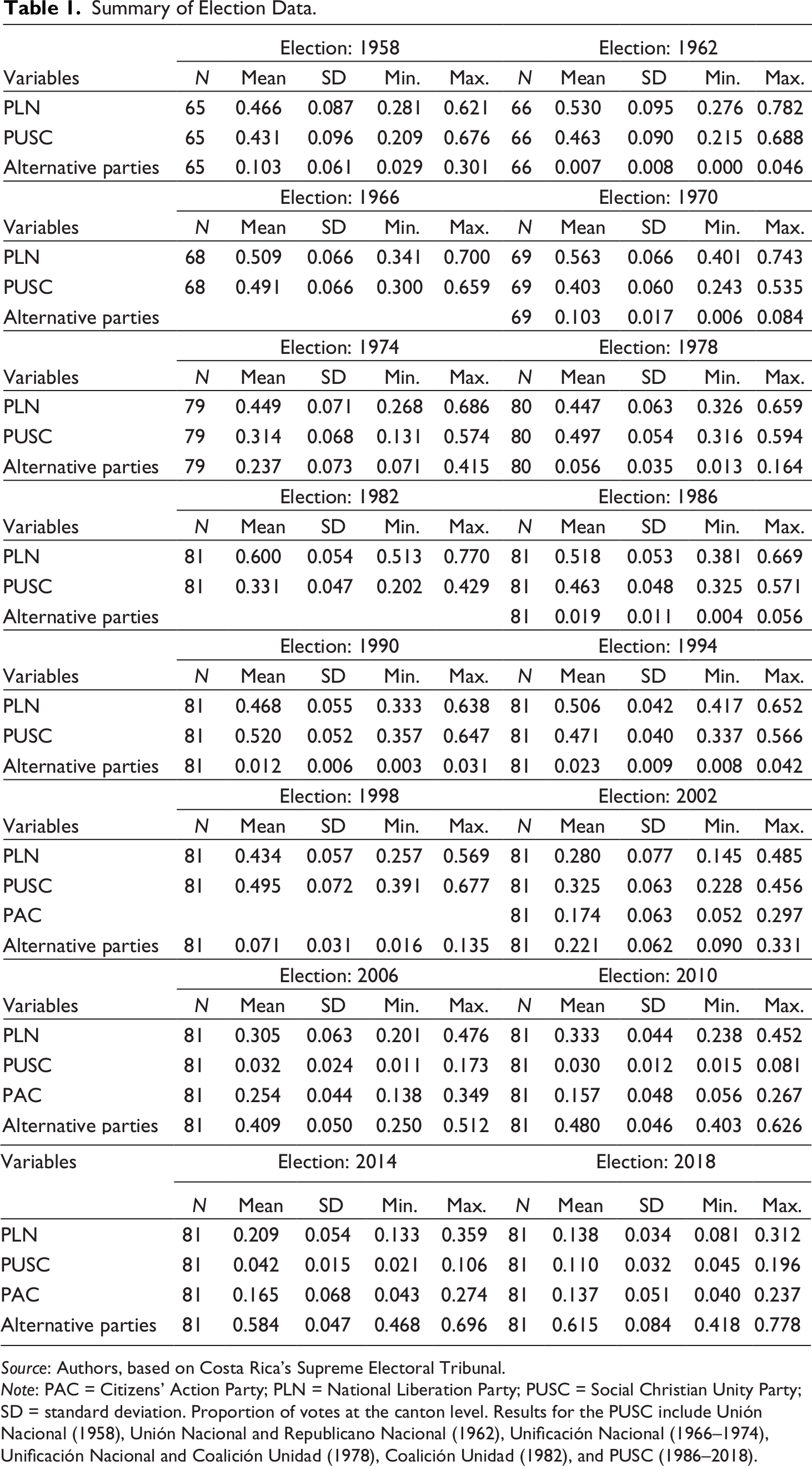
Source: Authors, based on Costa Rica’s Supreme Electoral Tribunal.
Note: PAC = Citizens’ Action Party; PLN = National Liberation Party; PUSC = Social Christian Unity Party; SD = standard deviation. Proportion of votes at the canton level. Results for the PUSC include Unión Nacional (1958), Unión Nacional and Republicano Nacional (1962), Unificación Nacional (1966–1974), Unificación Nacional and Coalición Unidad (1978), Coalición Unidad (1982), and PUSC (1986–2018).
Summary of Survey Data.
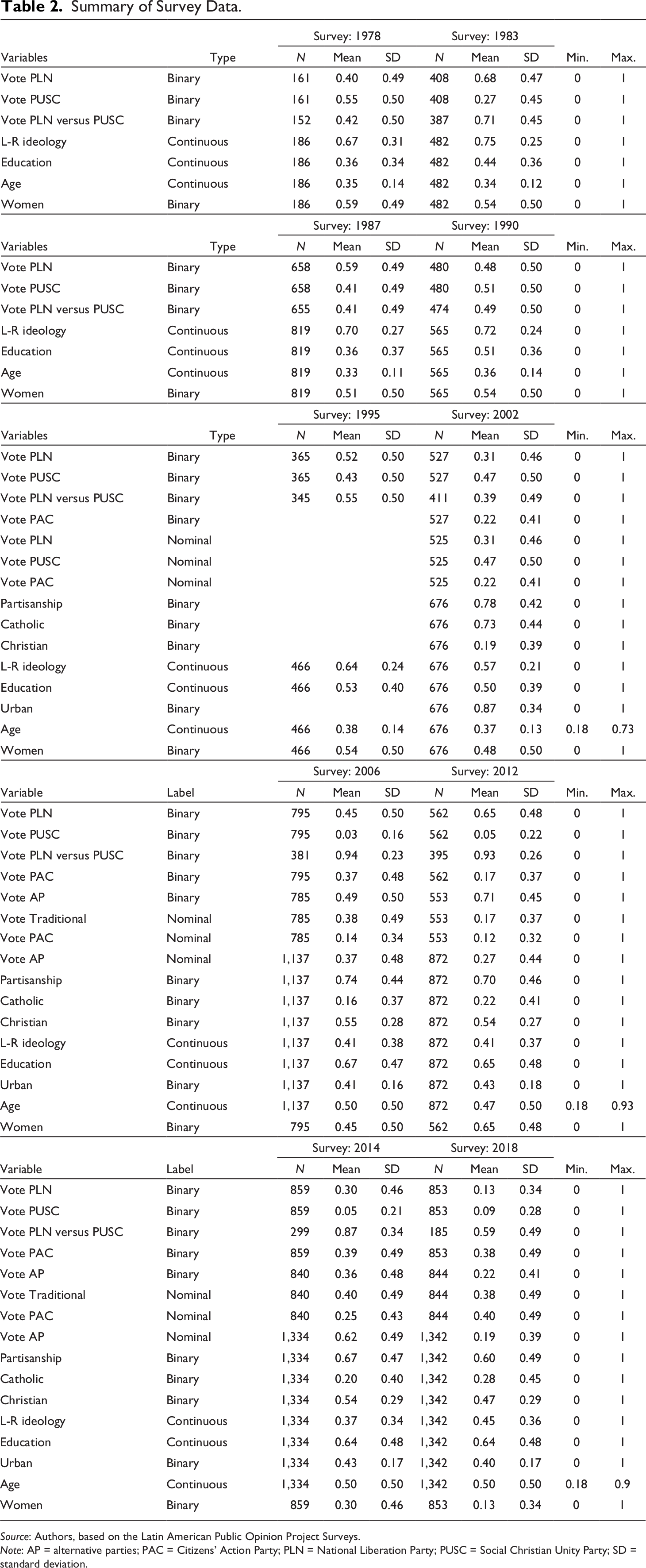
Source: Authors, based on the Latin American Public Opinion Project Surveys.
Note: AP = alternative parties; PAC = Citizens’ Action Party; PLN = National Liberation Party; PUSC = Social Christian Unity Party; SD = standard deviation.
Analysis and Results
Figure 2 shows correlation matrixes that contrast the proportion of presidential votes by parties at the canton level. From 1958 to 1998, the correlation matrixes display vote results for the PLN, PUSC, and alternative parties. From 2002 to 2018, the correlation matrixes show data for the PLN, PUSC, PAC, and alternative parties. We only present and analyse first-round votes (excluding the second-round polls of 2002, 2014, and 2018).
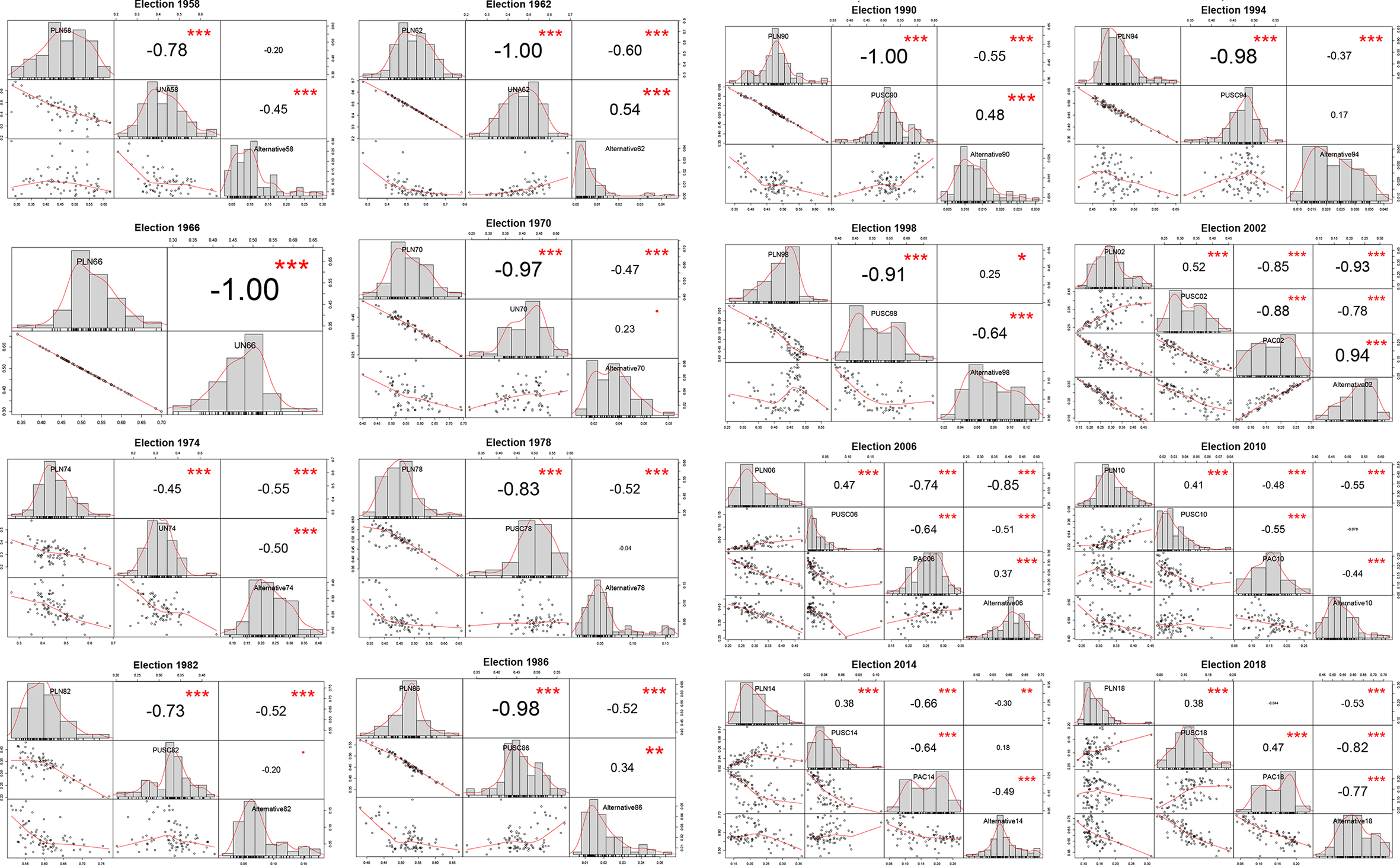
Correlation Matrixes for Presidential Elections, 1958–2018.
The results reveal the extent of change in the party system. From 1958 to 1998, there was a stable two-party competition, as there is a negative and significant relationship between the vote shares for PLN and PUSC. Except in the 1974 presidential election, in which alternative candidates Jorge González and Rodrigo Carazo received 10.9 per cent and 9.1 per cent of votes, the bulk of electoral competition was between the PLN and PUSC.
The election of 2002 reveals drastic shifts. The relationship between the vote shares for PLN and PUSC turns positive and significant, as electoral competition suddenly changes from traditional parties to traditional parties against new challengers, including the PAC. The relationship remains relatively stable for the PLN and PUSC in 2006, 2010, 2014, and 2018.
A similar result is present in 2006, as evidenced by the political division between traditional and emerging parties (including the PAC). Trends, however, begin shifting in 2010. While the relationship between the PLN, PUSC, and PAC remains similar, the PAC started competing against alternative parties. The 2014 election repeats the outcome, as the bulk of electoral competition was between the PAC – by then an established party – and alternative parties.
The results of the 2018 presidential election further point in the direction of realignment. Former rivals PLN, PUSC, and PAC no longer compete against each other. Instead, the main division is between established (PLN, PUSC, and PAC) and alternative parties, which often change from one election to the next. There is no significant relationship in the competition between the PLN and PAC, while the coefficient between the PUSC and PAC turns positive. Conversely, the relationship is negative between alternative parties and the PLN (r = −.53), PUSC (r = −.82), and PAC (r = −.77).
Figure 3 shows the selected survey indicators for partisanship and ideological self-placement. Total levels of partisanship have experienced fluctuation. In 2002, 79 per cent sympathised with a party. This figure dropped to 34 per cent and 28 per cent in 2006 and 2008, respectively. In 2010, partisanship increased to 47 per cent in an election year but fell again to 25 per cent in 2012. In 2014, another election year, partisanship rose to 62 per cent. More recently, partisanship decreased to historic lows, below 20 per cent, in 2016 and 2018 (another election year).
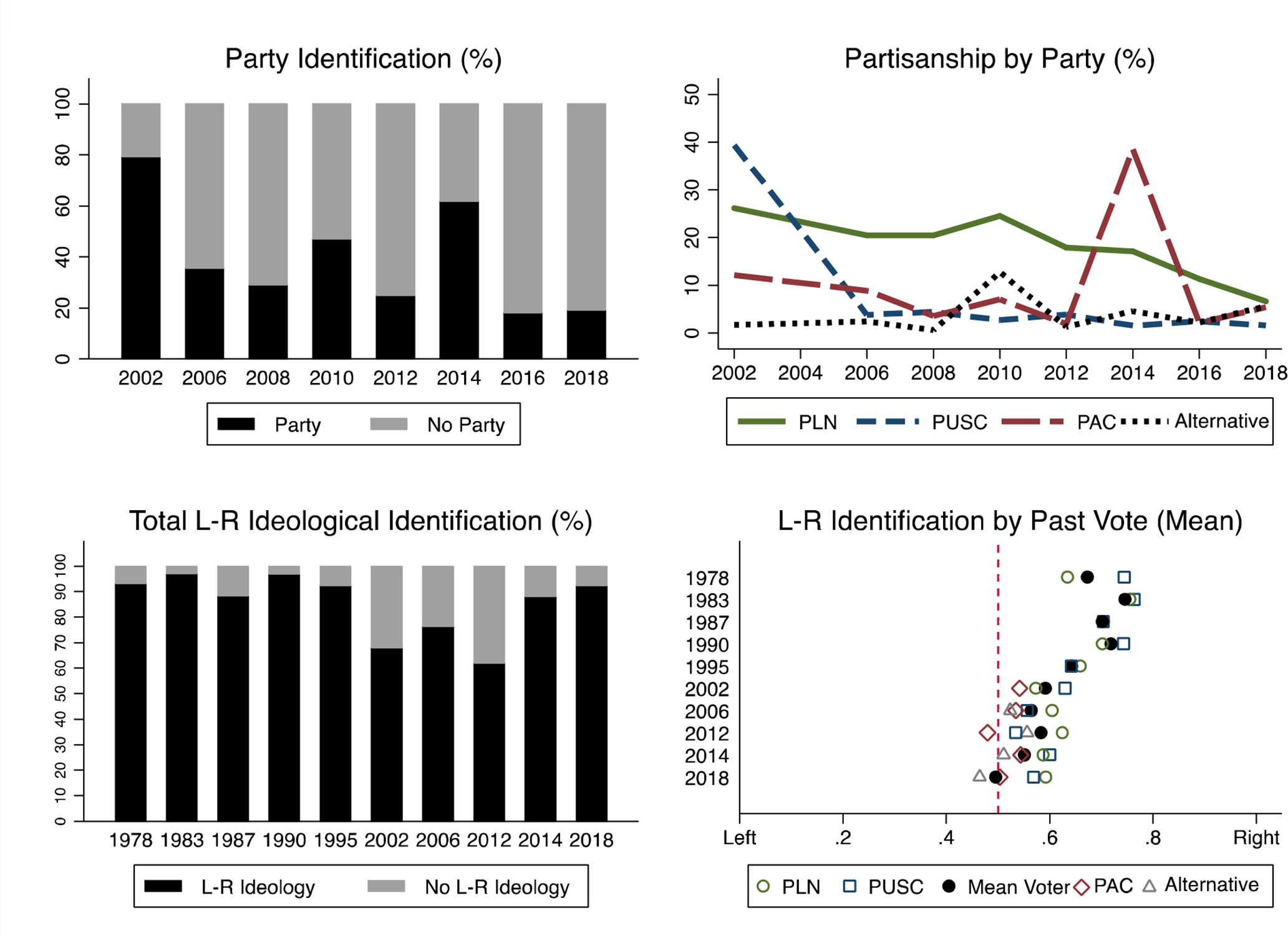
Selected Survey Indicators.
The distribution of partisanship by political parties underlines the transformation of the party system. Partisanship with the PUSC fell from 39 per cent in 2002 to less than 5 per cent since. Partisanship with PLN gradually declined from 26 per cent in 2002 to 7 per cent in 2018. There was a slight increase in 2010 when a PLN candidate won the presidency. Yet the decline in partisanship with traditional parties has not translated into growing support for new parties. The PAC, the most successful contender, has low partisan attachment, except for 2014, when the PAC candidate won the presidency, and over 40 per cent of respondents identified with the party. Partisanship with alternative parties has remained in the single digits.
Figure 3 also shows the ideological self-placement of respondents. A majority of Costa Ricans identify ideologically. In 2002, identification levels fell to 68 per cent. Subsequent surveys reveal lower ideological identification in 2006 (76 per cent) and 2012 (62 per cent) and an increase to 88 per cent and 92 per cent in 2014 and 2018, respectively.
Figure 3 also shows respondents’ mean ideological self-placement by their past vote choice. The mean voter shifts away from rightist ideological positions in the early years (especially from 1978 to 1990) to the centre starting in 2002. PLN and PUSC voters’ ideology is almost indistinguishable in various surveys, particularly before 2002. In 2002, there was a growing ideological divide between PLN and PUSC voters, as the former shifted towards the centre. Tellingly, in 2014 and 2018, PLN and PUSC voters became once again ideologically indistinguishable. Party system fragmentation has coincided with growing centrist views.
In short, the party system change in Costa Rica shows a generalised decrease in levels of partisanship. While falling at uneven rates, the decline in support for established parties has not led to a surge in partisanship with new contenders. Second, the mean ideological self-placement has gradually shifted from the right to the centre, as new parties provide more ideological diversity, and traditional parties have also become more centrist.
Individual-Level Results
We now examine the individual-level determinants of support for political parties in presidential elections. We hope to find substantial changes in the ideological determinants of support before and after 2002, and a gradual unravelling of determinants in recent election cycles.
Table 3 shows the results for surveys covering elections from 1978 to 1994. There were no statistically significant differences in the past vote for the PLN, not even in ideological terms. Results for the PUSC tell a slightly different story. Left–right ideological self-placement is positive and significant, translating into the PUSC receiving more substantial support among conservative voters. However, the third model reveals no differences between traditional parties. Thus, the results indicate that, before the 2002 election, ideological divisions did not determine competition between traditional parties.
Determinants of Support for Parties in the Past Election, 1978–1995.
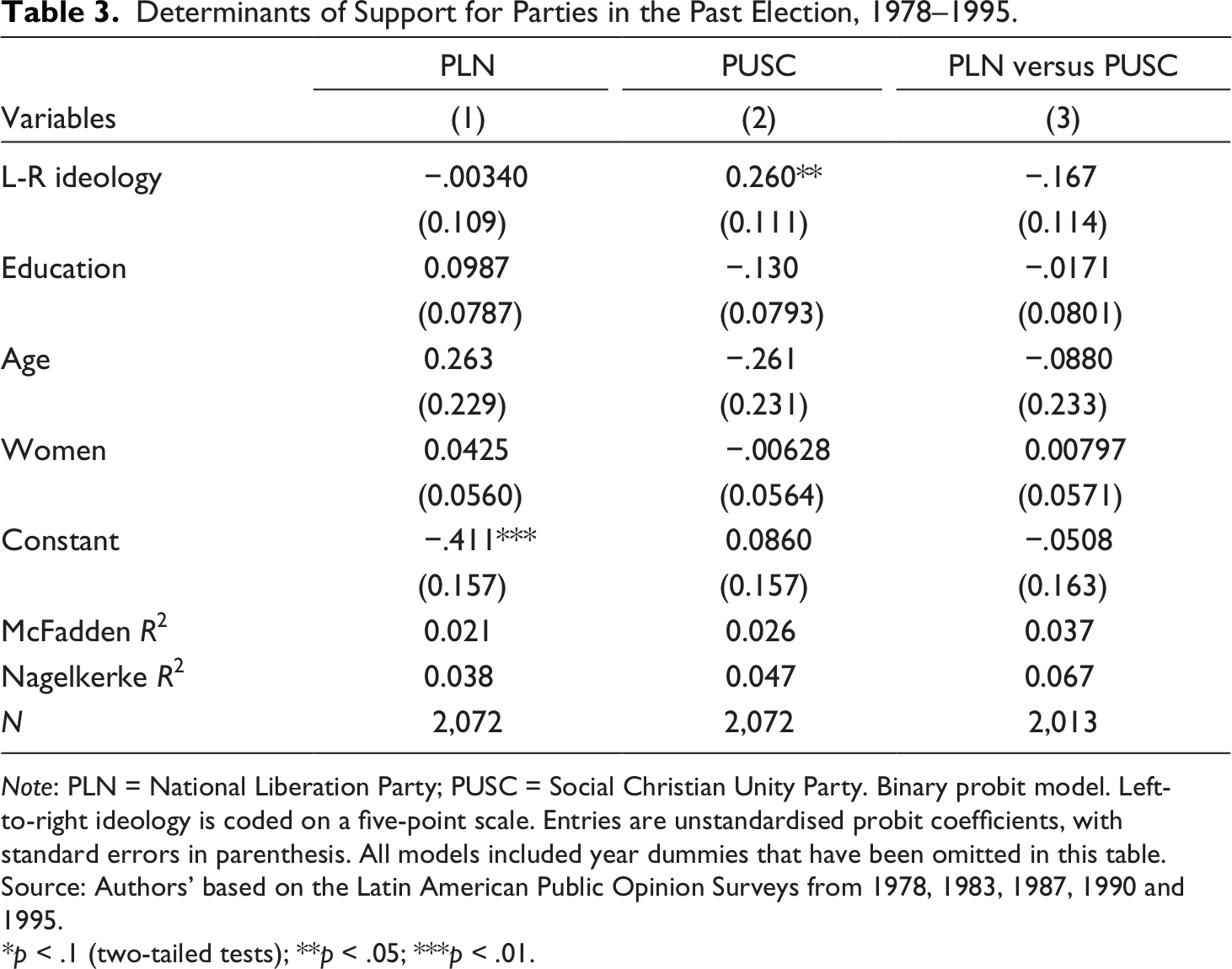
Note: PLN = National Liberation Party; PUSC = Social Christian Unity Party. Binary probit model. Left-to-right ideology is coded on a five-point scale. Entries are unstandardised probit coefficients, with standard errors in parenthesis. All models included year dummies that have been omitted in this table.Source: Authors’ based on the Latin American Public Opinion Surveys from 1978, 1983, 1987, 1990 and 1995.
*p < .1 (two-tailed tests); **p < .05; ***p < .01.
Table 4 presents binary and multi-nomial estimates on the determinants of support for parties in the critical election of 2002. PAC supporters are the reference category. When taken as a whole, individuals who identified with the ideological right were substantially more inclined to vote for traditional parties. Yet the effect was only statistically significant for the PUSC. In the 2002 election, ideological divisions suddenly emerged, with more conservative voters flocking the PUSC and leftist voters dividing their preferences between the PLN and PAC. The model shows differences in the effect of control variables. Individuals with lower education levels were more likely to support traditional parties, and women voted in greater numbers for the PLN. Older individuals also voted in higher numbers for traditional parties.
Determinants of Support for Parties in the Past Election, 2002.
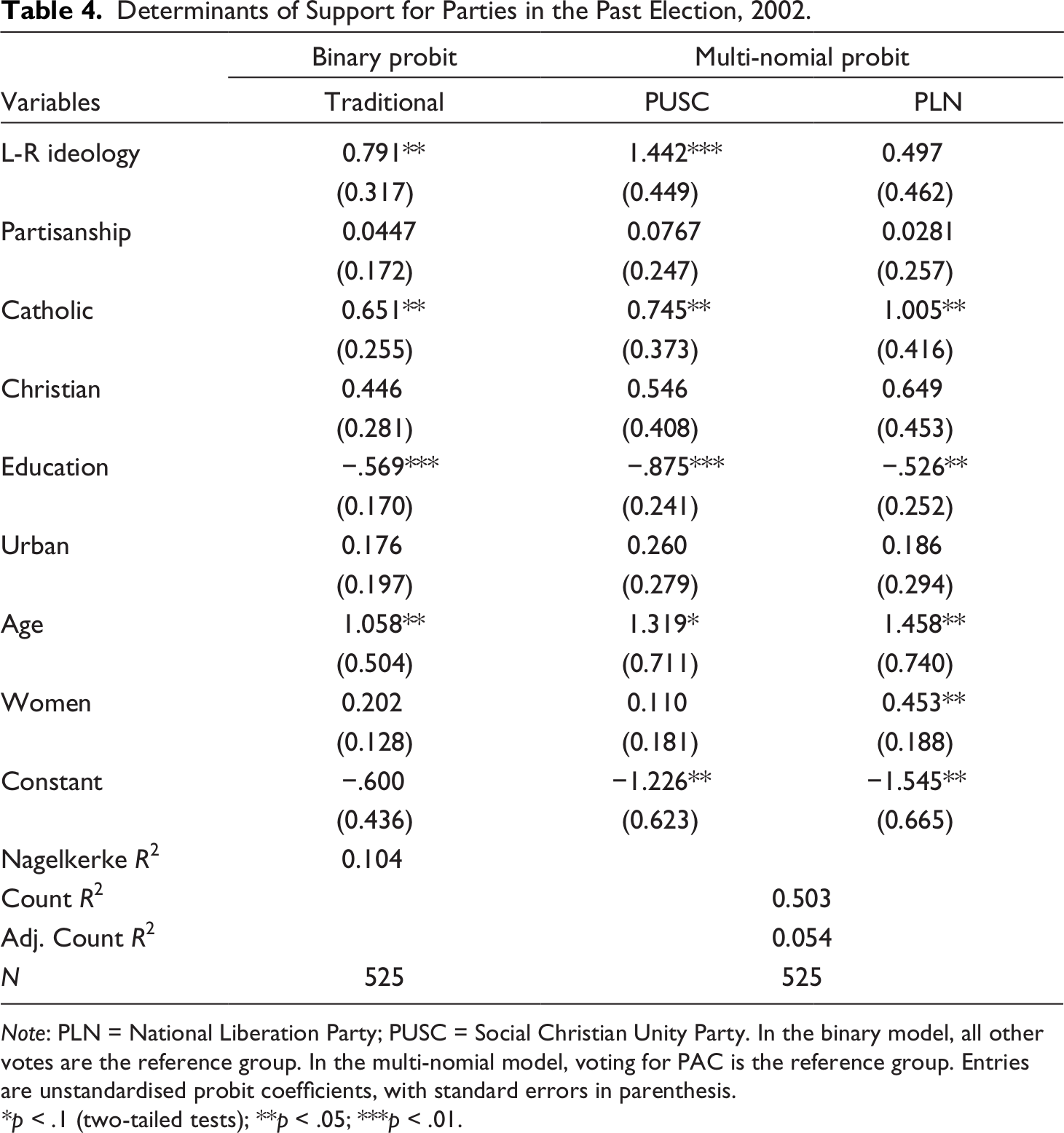
Note: PLN = National Liberation Party; PUSC = Social Christian Unity Party. In the binary model, all other votes are the reference group. In the multi-nomial model, voting for PAC is the reference group. Entries are unstandardised probit coefficients, with standard errors in parenthesis.
*p < .1 (two-tailed tests); **p < .05; ***p < .01.
To confirm an abrupt realignment, the political divisions that surfaced in 2002 should be present in subsequent elections. Simultaneously, for a gradual realignment to be in the making, the results should reveal the incremental weakening of some determinants and the emergence of new ones. In order to test whether that was the case, we assess support for parties from 2006 to 2018.
Tables 5 and 6 show multi-nomial probit models. Once more, vote choice for the PAC is the reference category. Ideological self-placement remains a stable variable when contrasting support between the PAC and traditional parties in 2006 and 2010. Tellingly, the variable has weaker explanatory power in 2014 and becomes insignificant in 2018. The declining relevance of ideological identification in recent elections differs from the sudden rise of ideology in the 2002 election. Conversely, there are no statistically significant ideological differences between those who voted for alternative parties and PAC. Since ideology is positive in 2006 and 2012, and negative in 2014 and 2018, the evidence points to a silent shift. Alternative parties seem to be outflanking the PAC from the left – similar to what the PAC did to the PLN in 2002.
Determinants of Support for Parties in the Past Election, 2006–2010.
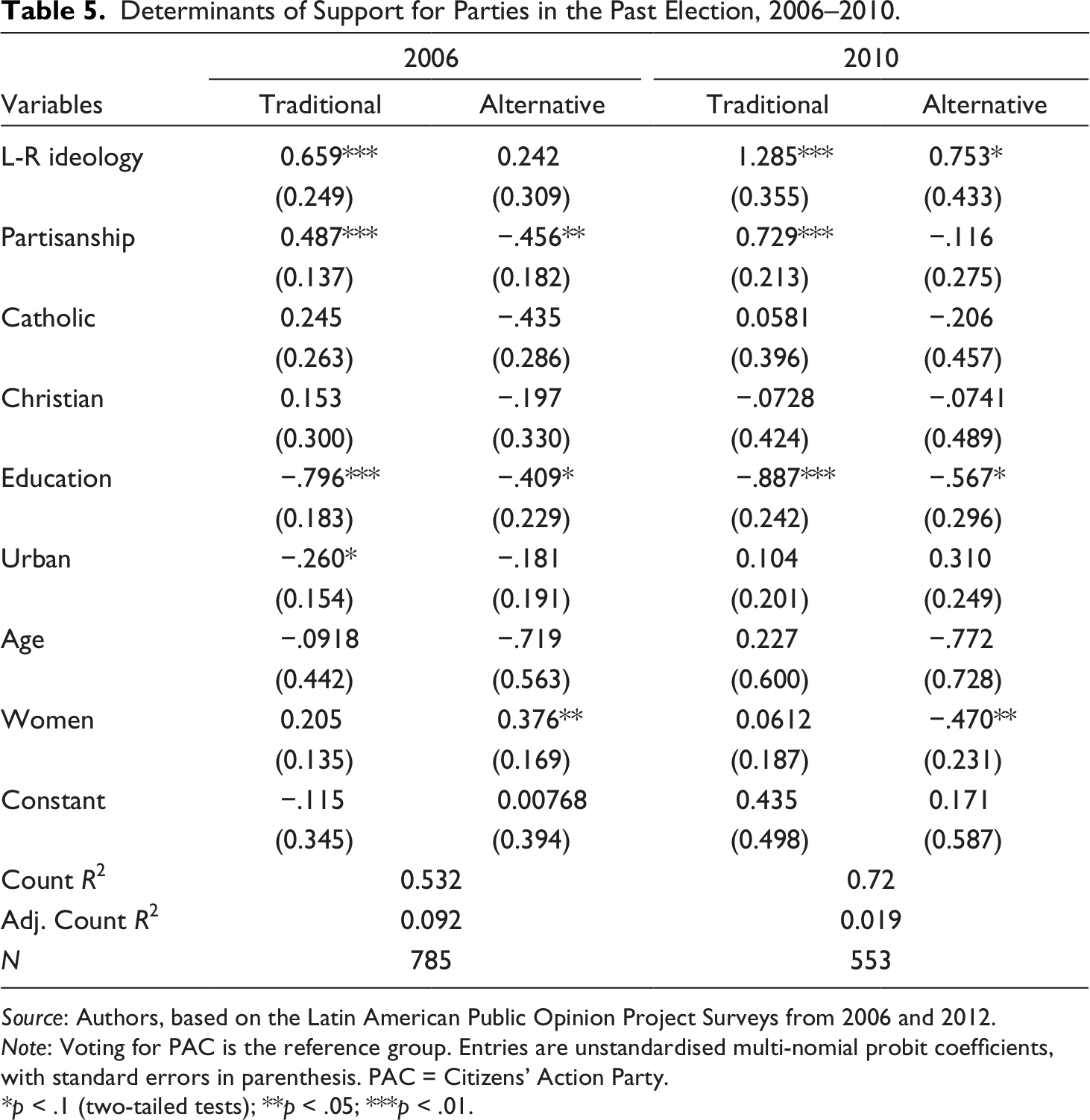
Source: Authors, based on the Latin American Public Opinion Project Surveys from 2006 and 2012.
Note: Voting for PAC is the reference group. Entries are unstandardised multi-nomial probit coefficients, with standard errors in parenthesis. PAC = Citizens’ Action Party.
*p < .1 (two-tailed tests); **p < .05; ***p < .01.
Determinants of Support for Parties in the Past Election, 2014–2018.
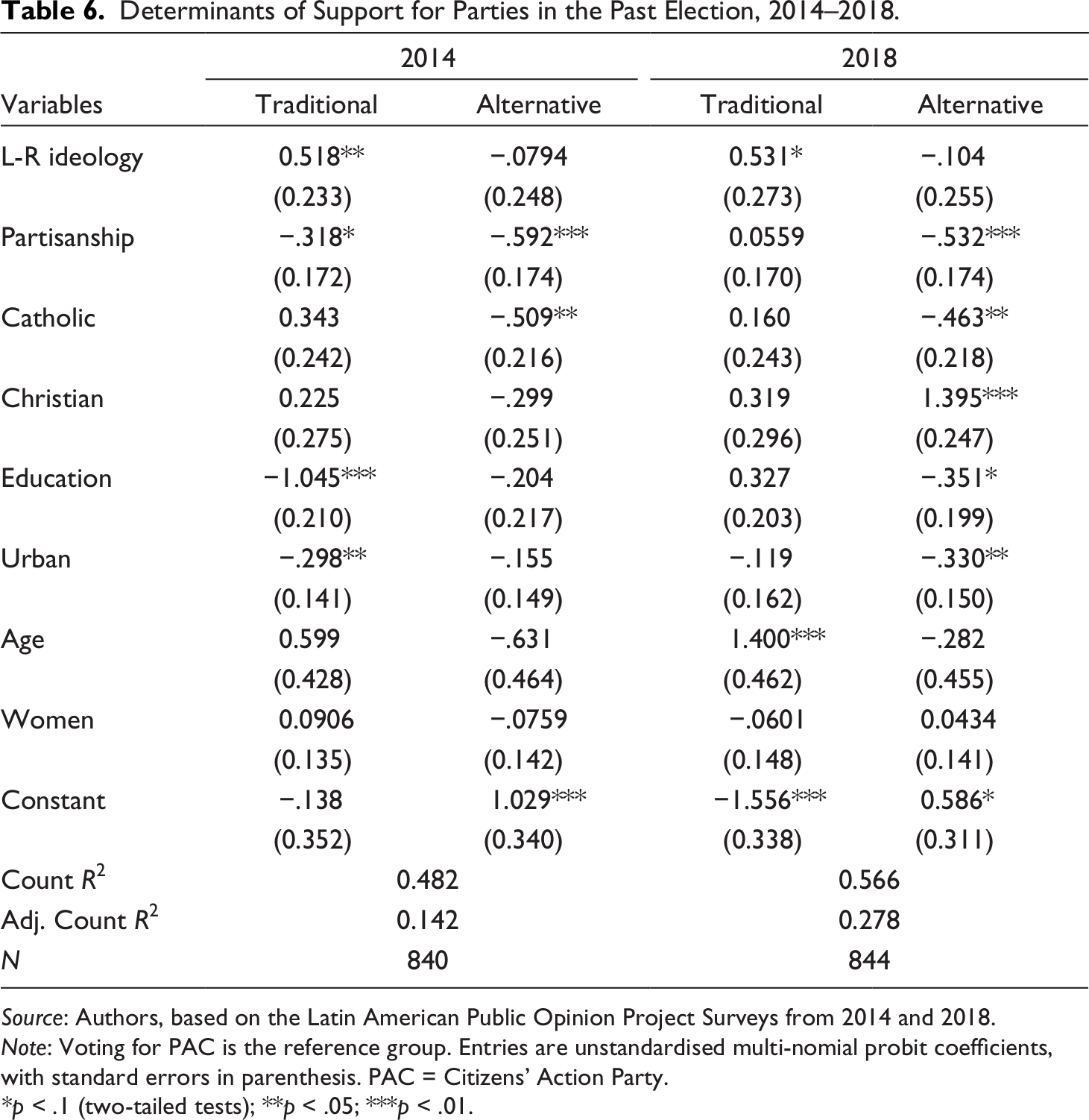
Source: Authors, based on the Latin American Public Opinion Project Surveys from 2014 and 2018.
Note: Voting for PAC is the reference group. Entries are unstandardised multi-nomial probit coefficients, with standard errors in parenthesis. PAC = Citizens’ Action Party.
*p < .1 (two-tailed tests); **p < .05; ***p < .01.
The models show substantial differences in the effect of partisanship on vote choice. While partisanship statistically increased support for traditional parties in 2006 and 2010, those differences disappear in 2014 and 2018. Concurrently, except for 2010, individuals who support alternative candidates are also less likely to be partisan than PAC voters. The effect of socio-demographic controls reveals further change. From 2006 to 2014 – but not 2018 – individuals with lower education levels were more likely to support traditional parties. Meanwhile, education is not a strong predictor of support for alternative parties. The differences in the effect of the other socio-demographic controls on vote choice for traditional parties and PAC decreased in 2014 and 2018. In 2018, only being older increased support for traditional parties in comparison to the PAC. That year, there were growing differences in the determinants of support for alternative parties compared to PAC. For the first time since 2002, religion influenced vote choice. In 2018, being Christian Evangelicals increased the likelihood of voting for alternative parties. Fabricio Alvarado’s profoundly religious campaign likely influenced this outcome. Catholics and residents of urban areas were also less likely to support alternative parties than the PAC.
We also plot predictive margins for ideological self-placement using the multi-nomial probit estimates. In Figure 4, the plot on the left shows the predicted probabilities for the past vote from 1978 to 1994 (Table 3). The plot on the right does the same for the multi-nomial probit estimate for 2002 (Table 4). The figure confirms the lack of ideological differences in electoral support for the PLN from 1978 to 1994. Identifying with the right increased the likelihood of voting for the PUSC. The margins for 2002 show a sudden ideological gap. While identifying with the right continues to explain support for the PUSC, support for the PLN shifted leftwards. Identifying with the left also increased the likelihood of voting for the PAC.
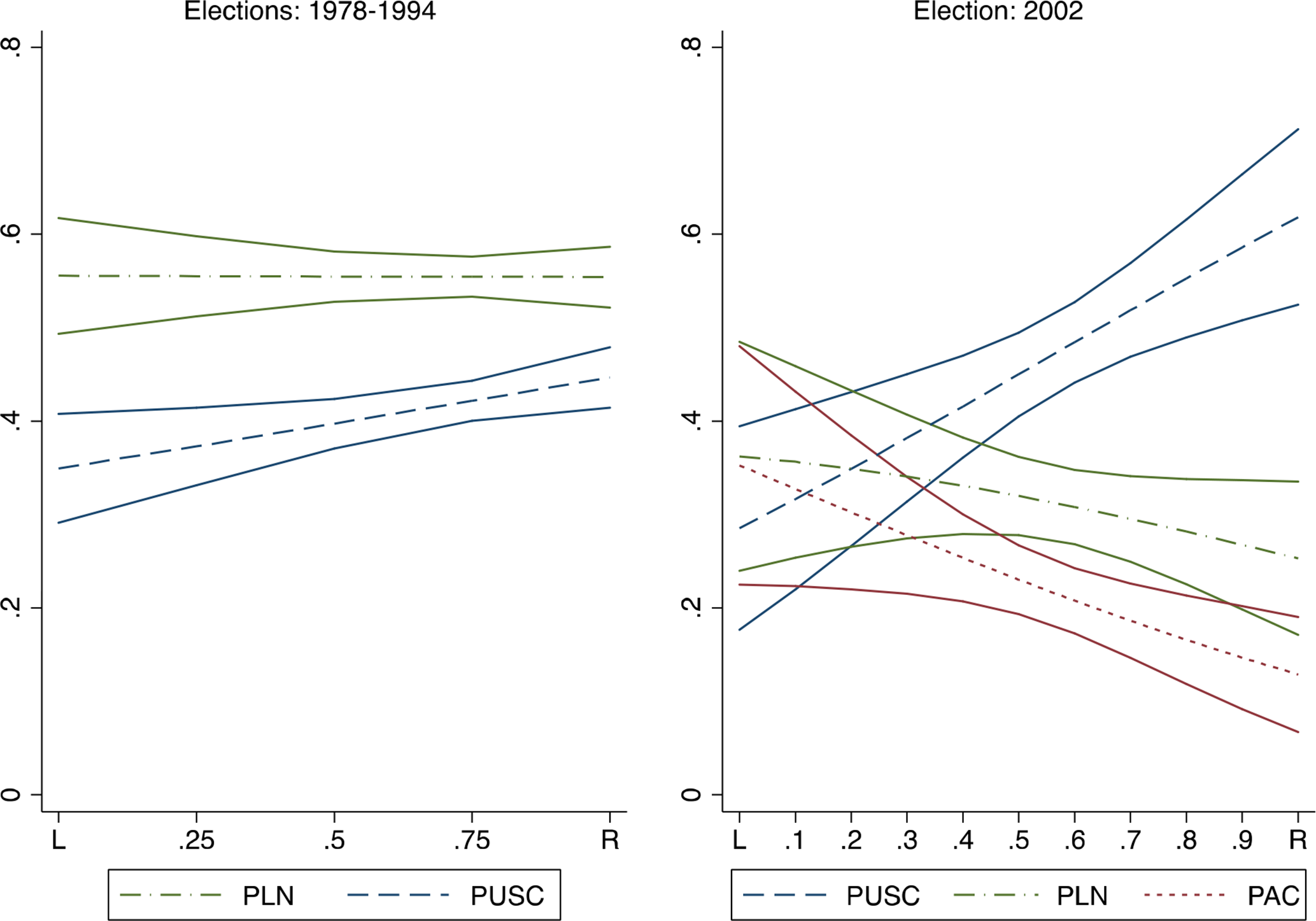
Predictive Margins for Ideological Self-Placement, 1978
Figure 5 shows the results for the elections from 2006 to 2018. The predictive margins indicate that identifying with the right always increases the likelihood of voting for traditional parties. The outcome only varies in the proportion of support for those parties (which are comparatively higher in 2006 and 2010, when the PLN won the presidency). The figures confirm that the PAC emerged as a leftist contender. In 2006, 2010, and less so in 2014, identifying with the left increased PAC support. In 2018, the plot revealed no substantial ideological differences in voting for the PAC. Conversely, in 2006 and 2010, there were no ideological differences in support for alternative parties. In 2014, and more so in 2018, alternative parties drew more substantial support among left-wing voters.
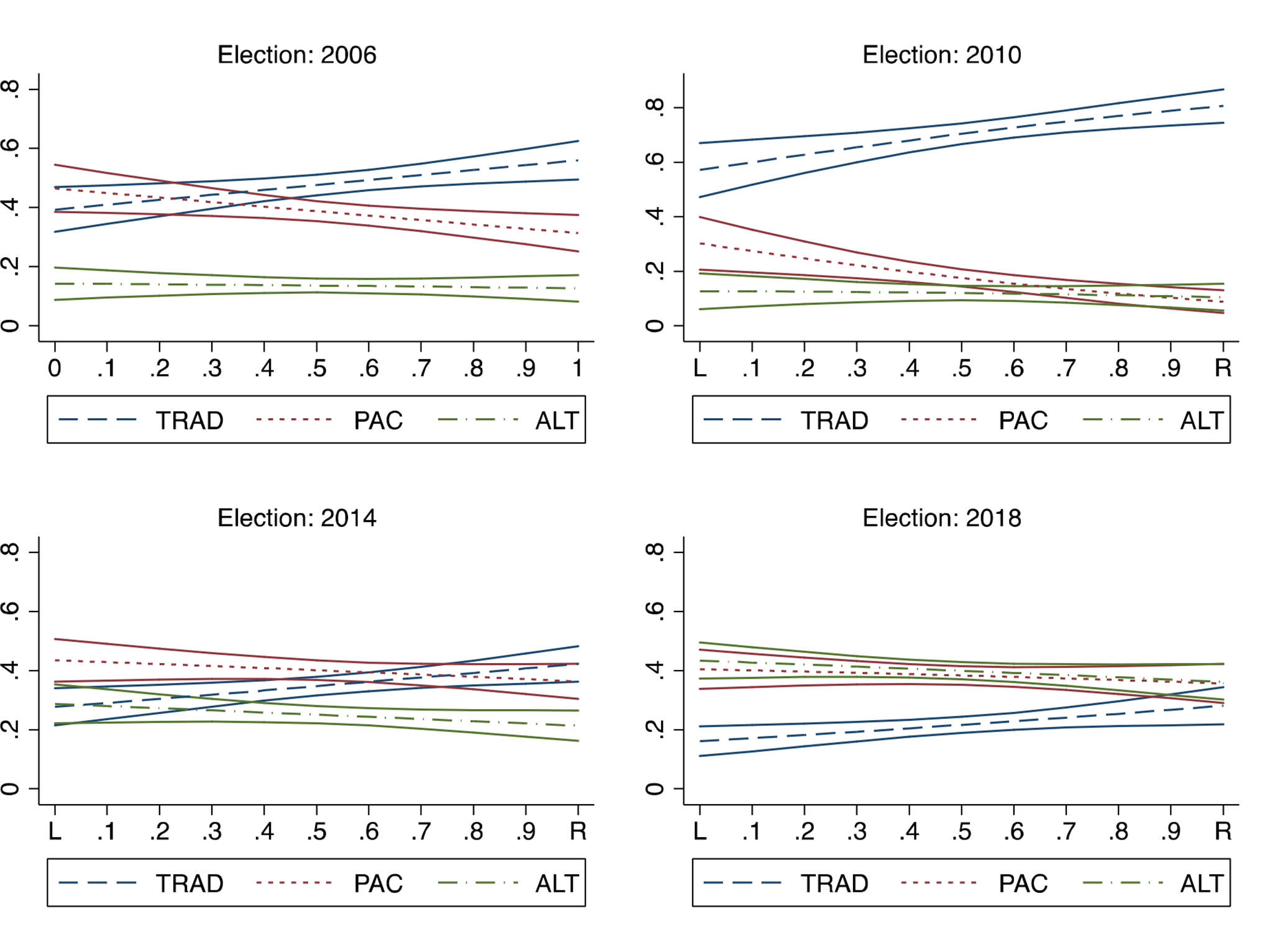
Predictive Margins for Ideological Self-Placement, 2006–2018.
In sum, the models display no meaningful differences in the bases of support for the PLN and PUSC before 2002. The results for 2002 suggest the emergence of an ideological divide between the PAC, a leftist contender, and traditional parties, with the PUSC firmly located to the right. Yet in the years after the 2002 election, the determinants of support for parties have gradually changed. Foremost, identification on the left–right scale has lost substantial explanatory power in recent election cycles. In 2018, ideological identification does not explain well past voting for the PAC and for traditional parties. The same occurs with most other variables, including partisanship. Age is the only variable that has strong explanatory power to distinguish past votes for traditional parties and PAC in 2018. Older voters are more likely to vote for traditional parties. However, differences between PAC supporters and those who vote for alternative candidates and parties become more salient. As the PAC electorate gradually begins to resemble those who vote for traditional parties, we find growing differences between PAC supporters and supporters of alternative parties, especially in 2018. Hence, the individual-level determinants point to an abrupt realignment in 2002 and a gradual realignment since. As PAC has joined the PLN and PUSC as a member of the established party system, the determinants of support for the three parties have become more similar, while the determinants of support for alternative parties continue to be different.
Conclusion
In Costa Rica, the decline of partisanship and the party system fragmentation have fuelled notions of dealignment. Yet the survival of traditional parties and the consolidation of the PAC challenge that idea. Hence, we claim that Costa Rica’s party system experienced an abrupt realignment in 2002 and a gradual realignment in more recent election cycles.
Costa Rica had a stable two-party system from 1953 to 1998, with the PLN competing against the PUSC. The PUSC was slightly more conservative, but in general, both parties adopted a catch-all strategy. In 2002, a new contender, the PAC, broke with the two-party system in a single election cycle. The emergence of the PAC marked an ideological tipping point for the PLN, as the party first shifted to the left and then moved back to the right. The PLN and PUSC stopped competing against each other at the canton level in 2002. The emergence of a new multi-party equilibrium revealed an abrupt realignment in which traditional parties rivalled the PAC with stable ideological determinants of support, particularly from 2006 to 2010. Since 2006, a gradual realignment has also taken place as partisanship levels have declined, and the party system has become more fragmented. This gradual realignment became even more evident in 2018, when the three established parties (PLN, PUSC, and PAC) experienced increased competition from alternative parties. Perhaps most importantly, PAC voters have begun resembling the supporters of traditional parties. There is a growing divide between them and individuals who vote for alternative candidates and parties.
Our findings speak to the broader debate on party system change in Latin America and emerging democracies elsewhere. While research has fuelled notions of dealignment and party system collapse, the case of Costa Rica reveals that party systems in the region can experience different types of realignment – or realignments at different speeds. While the eruption of a challenger party that becomes institutionalised might define a critical election, like that of 2002 in Costa Rica, the gradual decline in support for established parties – including recently institutionalised ones – points to a different kind of realignment. This realignment does not require a critical election as it slowly alters the composition of the party system. Thus, studies on party system change should incorporate the notion that different types of changes can occur concurrently and at different speeds.
Footnotes
Appendix 1. Voter Turnout in Costa Rica,1958–2018
Appendix 2: Pre-Electoral Polls for Vote Intention in the 2018 Presidential Contest
| Vote intention | August | October | November | December | January |
|---|---|---|---|---|---|
| Undecided | 42 | 40 | 37 | 34 | 27 |
| Alvarado (PRN) | 2 | 3 | 17 | ||
| Castro (PIN) | 6 | 13 | 15 | 18 | 16 |
| Alvarez (PLN) | 25 | 20 | 15 | 14 | 11 |
| Piza (PUSC) | 12 | 11 | 11 | 13 | 9 |
| Alvarado (PAC) | 8 | 6 | 4 | 5 | 6 |
| Hernández (PRSC) | 1 | 2 | 5 | 8 | 6 |
| Guevera (ML) | 3 | 3 | 3 | 0.5 | 2 |
| Araya (FA) | 0 | 2 | 2 | 1.5 | 1 |
| Mena (PNG) | 2 | ||||
| Other candidates | 3 | 3 | 6 | 3 | 1 |
Source: Authors, based on Alfaro et al. (2018).
PRN = FA = Broad Front (Frente Amplio); ML = Libertarian Movement (Movimiento Libertario); National Restoration Party (Restauración Nacional); PIN = National Integration Party (Partido Integración Nacional); PLN = National Liberation Party (Partido Liberación Nacional); PNG = New Generation Party (Partido Nueva Generación); PRSC = Social Christian Republican Party (Partido Republicano Social Cristiano); PUSC = Social Christian Unity Party (Partido Unidad Social Cristiana).
Acknowledgements
The authors thank the two anonymous reviewers, the participants of the MPSA panel on Parties and Electoral Behavior in Latin America (April 7, 2019), and David Plotke for their comments and suggestions on previous drafts of this article.
Declaration of Conflicting Interests
The author(s) declared no potential conflicts of interest with respect to the research, authorship, and/or publication of this article.
Funding
The author(s) received no financial support for the research, authorship, and/or publication of this article.

Author Biographies
E-mail:
E-mail: