



Abstract
Rally-round-the-flag events are short-term boosts of government approval during crises, and the COVID-19 pandemic produced such an effect in many countries. But why did some people join the rally while others didn’t? Using public opinion data from Costa Rica, this paper tests two hypotheses: first, that threat increases government approval at the outbreak of the pandemic; second, that electoral predispositions shape approval. Results indicate that COVID-19 contagions, as a measure of the threat, are not associated with approval, while past voting patterns are. Positive assessments of the economy and the relief measures also predict higher support for the government. In brief, Costa Rica's rally-round-the-flag event did not overcome the partisan divisions or the ordinary drivers of approval.
Introduction
At the start of the COVID-19 pandemic, surveys revealed that many heads of government were receiving a boost in their approval ratings (Noack, 2020; Yam et al., 2020). At first glance, this might sound paradoxical: if things are going badly, why are people more positive about their leaders? There is, however, a theoretical explanation for this popularity surge in the wake of the pandemic: a rally-round-the-flag effect (Jennings, 2020). A rally occurs when people give extraordinary support to their governments during crises (Mueller, 1970). Usually, rallies are identified during major international events, such as the September 11 attacks and the Falklands/Malvinas War (e.g. Hetherington and Nelson, 2003; Norpoth, 1987). Yet being COVID-19 different from a terrorist attack or a military conflict, questions emerge about what drives rallies during this pandemic and who rallies behind presidents and prime ministers.
This paper examines a rally-round-the-flag event in Costa Rica, where the government of President Carlos Alvarado enjoyed a substantial 57-percentage point surge in its approval ratings at the start of the COVID-19 pandemic – almost three times the 19-point average increase of support in the European countries (Wondreys and Mudde, 2020). This rally effect is significant for two additional reasons. First, being a country with no army and seldom involved in international conflicts, Costa Rica is not the typical case where rally-round-the-flag effects are to be found. 1 Second, the government of President Alvarado was largely unpopular before the pandemic. He won the 2018 runoff election after finishing in second place in the first-round. But he did not enjoy the traditional “honeymoon” period during his first months in office and his party does not command a majority in congress. All in all, this is a politically weak presidency, making the rally more intriguing.
Given that the rally occurs at the outbreak of the COVID-19 pandemic, where almost everything else remains constant, the puzzle is not whether the pandemic causes the rally, but who rallies and why? The health and economic emergencies may spark extraordinary and patriotic support for the president (Kritzinger et al., 2021), as the most solid explanation of rallies suggests (Hetherington and Nelson, 2003). But there are also political and electoral predispositions that influence who is more likely to express approval or disapproval during a rally event (Edwards and Swenson, 1997). Interestingly in the case of Costa Rica, the intensity of the pandemic during the rally and the political support for the party in government are correlated, since the number of coronavirus contagions was higher in urban and densely populated areas, also where the party in government gathered more votes in the 2018 election (Tribunal Supremo de Elecciones, 2018). Thus, there are two contending (and not mutually exclusive) explanations: the pandemic threat as a trigger of support, and the politically motivated reasoning as a driver.
In the next section, I summarize prior research findings on the political consequences of COVID-19, to later hypothesize why government approval should be related to the threat of the pandemic and to electoral behavior. I then present some relevant features of the Costa Rican case and the data employed in the empirical analysis. The results show that the number of contagions, as a measure of the pandemic threat, does not have a distinguishable effect on approval, but aggregate level support of the president's party in the last election does. In brief, Costa Rica shows that short-term national unity during COVID-19 does not override past electoral predispositions.
COVID-19 and its Political Effects
There is abundant research about the political consequences of the COVID-19 pandemic (see Devine et al., 2021 for an early review), although there are sharp disagreements in their findings.
Some scholars see in COVID-19 a “rare moment” of cross-partisan consensus between elites and the mass public (Merkley et al., 2020). But others observe that partisan divisions regarding public support to the government persist during the COVID-19 crisis (Kritzinger et al., 2021; Shino and Binder, 2020). And while some sustain that people rally due to the level of threat implied by the enforced lockdowns (Bækgaard et al., 2020; De Vries et al., 2021), others state that the rally is an emotional response caused by the pandemic (Yam et al., 2020), not the lockdowns. Schraff (2021), for instance, finds that the cumulative number of COVID-19 cases in Netherlands had a positive effect on political trust, while the lockdown none.
Likewise, there is mixed evidence regarding the impact of contagions on public support for the incumbent. Leininger and Schaub (2020) see that the number of infections in the counties of Bavaria (Germany) increased the electoral support for the incumbent party, the Christian Social Union (CSU), arguing that people vote for the incumbent expecting higher future assistance from the federal government. Yet Warshaw et al. (2020) estimate that the number of COVID-19 fatalities reduced the approval ratings of President Donald Trump and the prospective electoral support for Republican candidates. Later research finds that the pandemic indeed depressed the vote for Trump in the 2020 election (Clarke et al., 2021). However, the cross-national study of Bol et al. (2021) concludes that the number of deaths attributed to the virus did not influence the vote intention for the incumbent's party in 15 Western European democracies.
Within this discussion, it is important to underscore that political context matters, and it might account for the contradicting findings. Not every country experienced the COVID-19 rally and, in those that did, rallies were not uniform regarding their magnitude, duration, and effects. As Sosa-Villagarcia and Hurtado Lozada (2021) show, the rally effects in four Latin American countries depended on the political environment and the specific policy responses of each government. Also, Kritzinger et al. (2021) maintain that the different public reactions to the pandemic in Austria and France can be attributed to their political contexts. The health threat provoked a rally in Austria, but not in France, where partisan divisions were sharper and the pre-pandemic level of trust in government was lower. Hence, polarization and partisan orientations before the pandemic are likely to affect the ensuing public response.
Hypotheses
The literature cited above points that the COVID-19 pandemic effects government approval, trust, and voting behavior. These empirical contributions signal opposing political consequences, nonetheless. In some cases, the spread of the virus hurt politicians. In others, the threat drove people to rally behind their leader.
The most accepted interpretation of rallies states that, in moments of crises, support for the leader increases as national unity becomes more necessary (Hetherington and Nelson, 2003). COVID-19 creates such a crisis by posing threats to people's well-being, especially in terms of personal health and finances (Kritzinger et al., 2021; Schraff, 2021). And people do perceive these threats. While public opinion does not usually pay attention to politics, “at some unusual times large numbers care about something unusually important or visible” (Stimson, 2015: 12). The COVID-19 pandemic is, without doubt, a visible and unusual event. As De Vries et al. (2021) demonstrate, this pandemic signaled a widespread crisis, even in countries where no lockdowns were enforced (such as Costa Rica). Consequently, people provide the government with their support expecting an effective response for the unfolding crisis (Leininger and Schaub, 2020).
Even in national crises, however, not everybody rallies (Edwards and Swenson, 1997). Therefore, one might explain the individual variation in approval according to the level of threat that people experience. The threat might be more visible in people's close surroundings rather than at the national scale. Indeed, Druckman et al. (2021) find that political attitudes are conditioned by severe outbreaks of COVID-19 in the local context (i.e. counties in the U.S.). Thus, I hypothesize that the higher the local level of threat, the higher the likelihood of approving of the performance of the government during the rally. Conversely, as time passes, and the COVID-19 emergency becomes the “new normal”, the threat effect disappears, and the “ordinary drivers of government support” return (Johansson et al., 2021: 323).
Partisanship and vote behavior are some of such ordinary sources of government support (Bartels, 2002; Donovan et al., 2020; Edwards and Swenson, 1997). If the rally is a national response that overcomes partisan predispositions, then past voting behavior should not matter (Merkley et al., 2020). And since the rally is a short-term event, the effect of past electoral predispositions might be stronger when the rally is not alive anymore and the ordinary sources of approval prevail (Johansson et al., 2021). However, in polarized political contexts (as is the case in Costa Rica), electoral forces may be too strong to overcome, even during national emergencies (Kritzinger et al., 2021; Shino and Binder, 2020). Consequently, the second hypothesis posits that in a polarized context, past electoral support for the government is associated to government approval, during a rally event and after it. These two hypotheses will be tested with the public opinion data from Costa Rica.
The Costa Rican Case
Costa Rica has been an uninterrupted democracy since 1949, making it an exception in Latin America. Moreover, its political stability is paired with a unique social insurance system that is both unified and universalistic (Martínez Franzoni and Sánchez-Ancochea, 2014). Although a middle-income country, Costa Rica has higher life expectancy than the United States and the other Latin American countries, which can be attributed to a good primary care access and the near universal health coverage that protects low-income adults (Rosero-Bixby and Dow, 2016).
Even so, President Carlos Alvarado took office in 2018 facing severe political and economic challenges (Pignataro and Treminio, 2019). Despite winning a polarized runoff election with 61 per cent of the vote, Alvarado's party (Partido Acción Ciudadana, PAC) obtained only ten of the 57 seats of a congress divided among eight parties, plus independent legislators. Although party identification is low, the current party system is more fragmented and polarized than some decades ago when two large parties dominated the political landscape (Perelló and Navia, 2021).
On top of that, the four-year term presidency in Costa Rica is weak due to a combination of limited powers of executive decree and veto, and prohibited consecutive reelection (Carey, 1997). Under these political and institutional restraints, the Alvarado government faced slow GDP growth, unemployment rates over 10 per cent since 2018, and high public deficit (Muñoz-Portillo, 2020). And then, on March 6, the first confirmed infection of COVID-19 in the country was announced.
Initially, the Alvarado administration controlled the pandemic with considerable success, and Costa Rica was seen as an example of a well-handled pandemic (Brooks, 2020; Taylor and Berger, 2020). Equipped with a limited number of constitutional tools to manage the pandemic, the president declared a state of emergency but could not enact curfews or lockdowns. Through executive decrees, the government restricted the transit of vehicles, prohibited gatherings in public spaces, and regulated business hours (Treminio, 2020).
Responding to the early economic effects of the pandemic, on March 19, 2020, President Alvarado signed into law (No. 9830) a temporary tax relief bill that managed to get support in congress. The government also implemented a targeted monetary relief program called Bono Proteger, consisting of a cash transfer of around 600 USD per person. It covered people unemployed or experiencing reductions in their work hours, but excluded families that were already recipients of other cash transfer programs. The transfer's low amount, along with its partial coverage, meant that the initiative had limited impact (Blofield et al., 2020).
Without enforcing a lockdown, three months after the first detected case of COVID-19, the Ministry of Health registered 1263 confirmed cases and only ten deaths in a population of approximately five million (Ministerio de Salud, 2020). Although the number of cases rose substantially in the following months, the mortality rate remained low (1.2 per cent as of September 6, 2021; Ministerio de Salud, 2021). Sociologist Juliana Martínez-Franzoni explained that the strong and unified health care system, a fast and effective government response, and citizens’ trust and high compliance were behind Costa Rica's success during the first months of the pandemic (Taylor and Berger, 2020). Health officials stated that early detection of cases and follow-up by health workers reduced the number hospitalizations and mortality rates (Brooks, 2020).
Despite the political weaknesses of the government, the public “rallied ‘round the flag” when the pandemic started. According to the Center for Research and Political Studies (CIEP) of the University of Costa Rica, between the last available survey in November 2019 and April 2020, government approval soared from 19 per cent to 76 per cent (57 percentage points) (Figure 1). Since August 2020, however, approval ratings regressed to their average levels, which highlights the short-term nature of the rally.
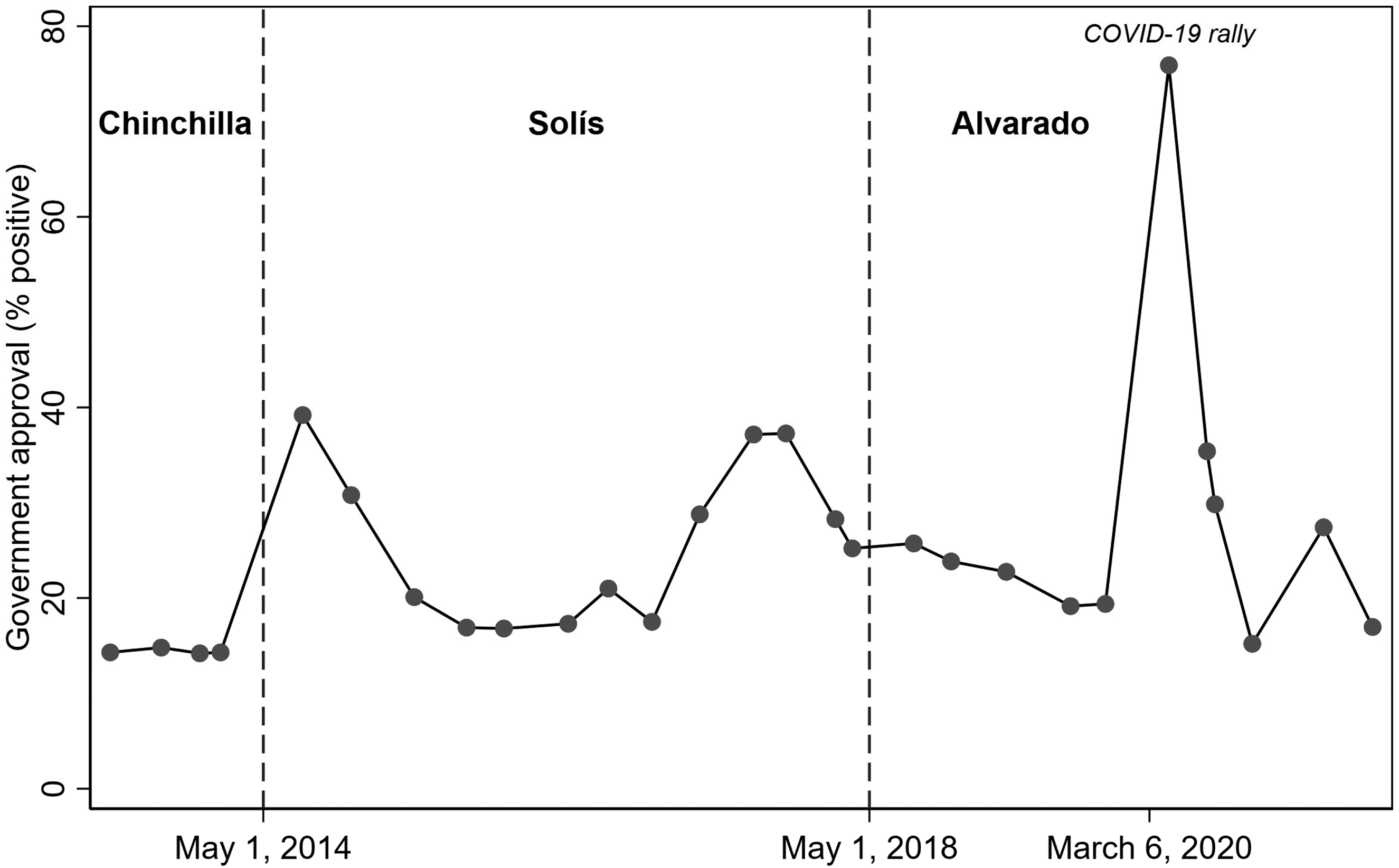
Government approval (“good” and “very good” responses) in Costa Rica by president. Source: Author's compilation of CIEP surveys from April 2013 to August 2021.
Data and Measurement
To test the hypotheses related to government approval, I employ two cross-sectional surveys of CIEP. The first one (N = 1042) was conducted between April 13 and 22, 2020, and registers the rally-round-the-flag moment during the first months of the pandemic. The second survey (N = 877), from August 3 to 11, 2020, measures lower support for the government as COVID-19 infections climb (Figure 2). 2 Using two surveys at different points during the pandemic provides an insight into whether the effect of the local threat is higher during the rally (April survey), and if the electoral predispositions prevail during the rally and afterwards (August survey).
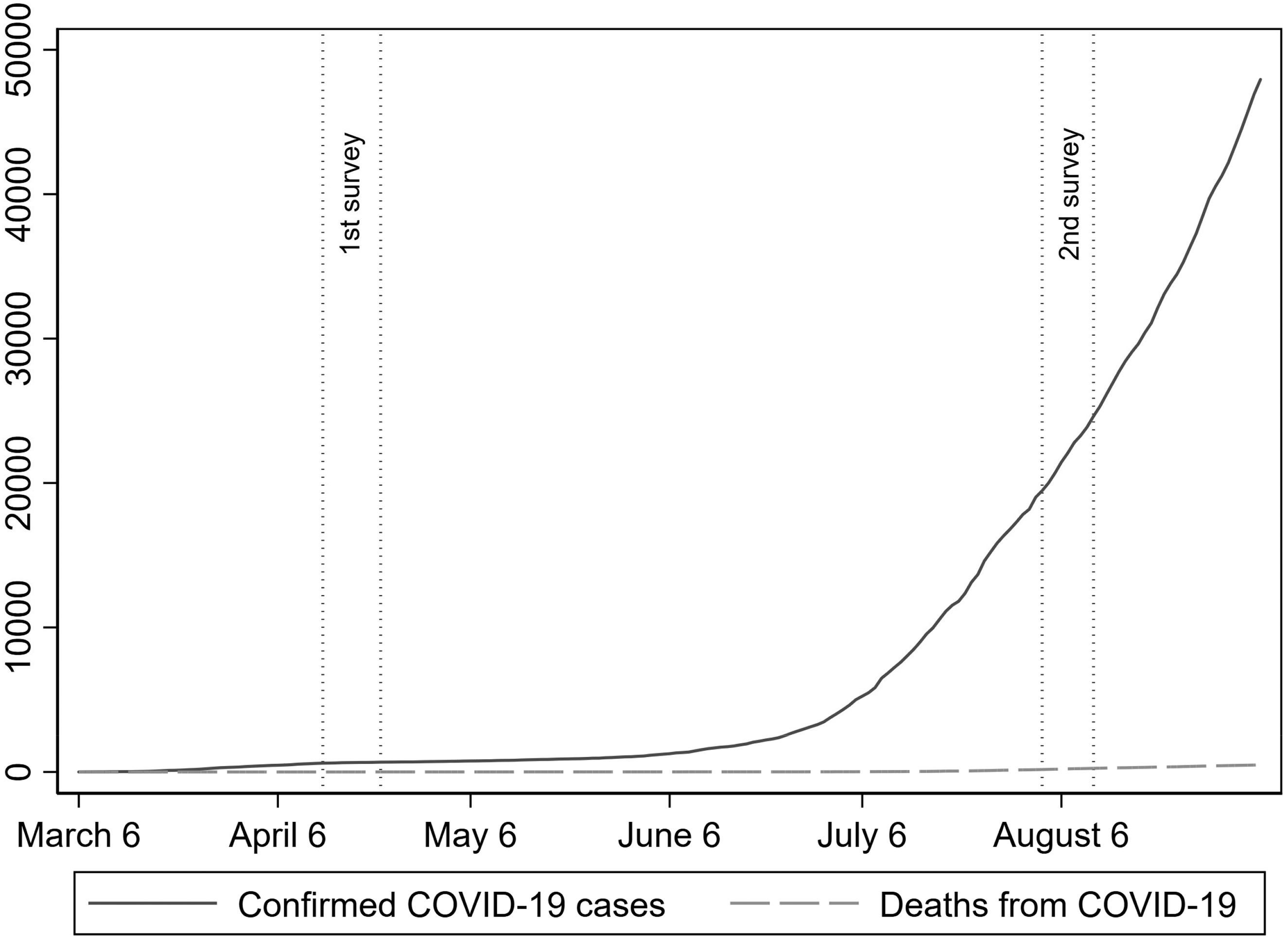
Surveys employed and evolution of COVID-19 in Costa Rica, 2020. Source: Observatorio Geográfico en Salud and Ministerio de Salud (2021).
The dependent variable is national government approval. Responses to the question “How do you rate the performance of the current government?” were recoded into positive (“very good” and “good”) and else (“regular”, “bad”, “very bad”, “don’t know”, and “don’t answer”). 3
To measure the local threat posed by the pandemic, I use the number of confirmed COVID-19 cases in each respondent's community as a proxy. Because the CIEP survey identifies the canton of residence, I was able to match the survey respondent with the cumulative number of cases of COVID-19 reported for her or his canton the day prior to the interview. 4 The number of confirmed cases of COVID-19 per canton ranges from 0 to 89 in the April survey and from 0 to 5718 in the August survey. With the April sample including people living in 78 of the 82 cantons, and the August sample 81 of the 82, responses are well-distributed throughout most of the country.
To account for the political support prior to the pandemic, I use the proportions of votes for the president's party in 2018 (first round and runoff) in the canton. The higher the support for PAC in the canton, the higher the probability that the person voted for PAC. Unfortunately, the April survey does not include vote recall or party identification that might have been preferrable to an ecological measure. However, while vote recall could be endogenous to approval, that is, people saying they voted for PAC because they now approve of the government's performance, and not the other way around, electoral support in the canton is strongly exogenous as it is not affected by current approval. This ecological measure also works as an important control for the first hypothesis, since cantons with higher number of infections are those where support for PAC was higher in the 2018 elections (i.e. urban and more densely populated cantons).
Based on the established theories of approval, I choose controls related to the economy and relief policies to account for the ordinary mechanisms of accountability that influence evaluations of job performance.
Economic voting theory predicts that people blame the government for the effects of worsening economic conditions (Lewis-Beck and Stegmaier, 2013). Beyond this normal mechanism of political accountability, the pandemic negatively impacts people's economic well-being, particularly poor informal workers in unequal societies (Carreras et al., 2021). Hence, I include the assessment of the national economy, measured by a five-point scale from “very bad” to “very good”, a dummy variable that indicates if the respondent is currently unemployed, and a measure of the economic impact of the pandemic comprising two items registering whether a family member has lost his or her job or has experienced a reduction in his or her work hours, summarized into one scale ranging from 0 to 1. 5
It is important to consider the government's responses to the pandemic as well. Past studies on natural disasters show that, while people are indifferent to preparedness funds, they reward the government for relief spending (Healy and Malhotra, 2009). Governments answer to the pandemic with both sanitary (lockdowns, tests, vaccination) and economic measures (monetary transfers, such as the above-mentioned Bono Proteger). Therefore, the models employ assessments of the health and economic measures taken by the government during the pandemic, with five-point scales from “very bad” to “very good”.
Additionally, the models include gender, age in years, and education in three categories as demographic controls. The Supplementary Appendix contains the descriptive statistics of all variables (Table A1) and the questions asked in the survey (Table A2).
Results
Table 1 shows the results from the regression models with the surveys of April 2020 (during the rally-round-the-flag event) and August 2020 (no rally). I employ logistic regression, since the outcome is dichotomous, and cluster-robust standard errors to account the intercorrelation of respondents within cantons. 6 Government approval is regressed on the logged transformation of COVID-19 cases, 7 the vote shares of the party in government (PAC) in the last presidential election (two rounds), and the set of controls. Due to collinearity, vote shares from the first round and the runoff election are included in different models.
Logistic models of approval.
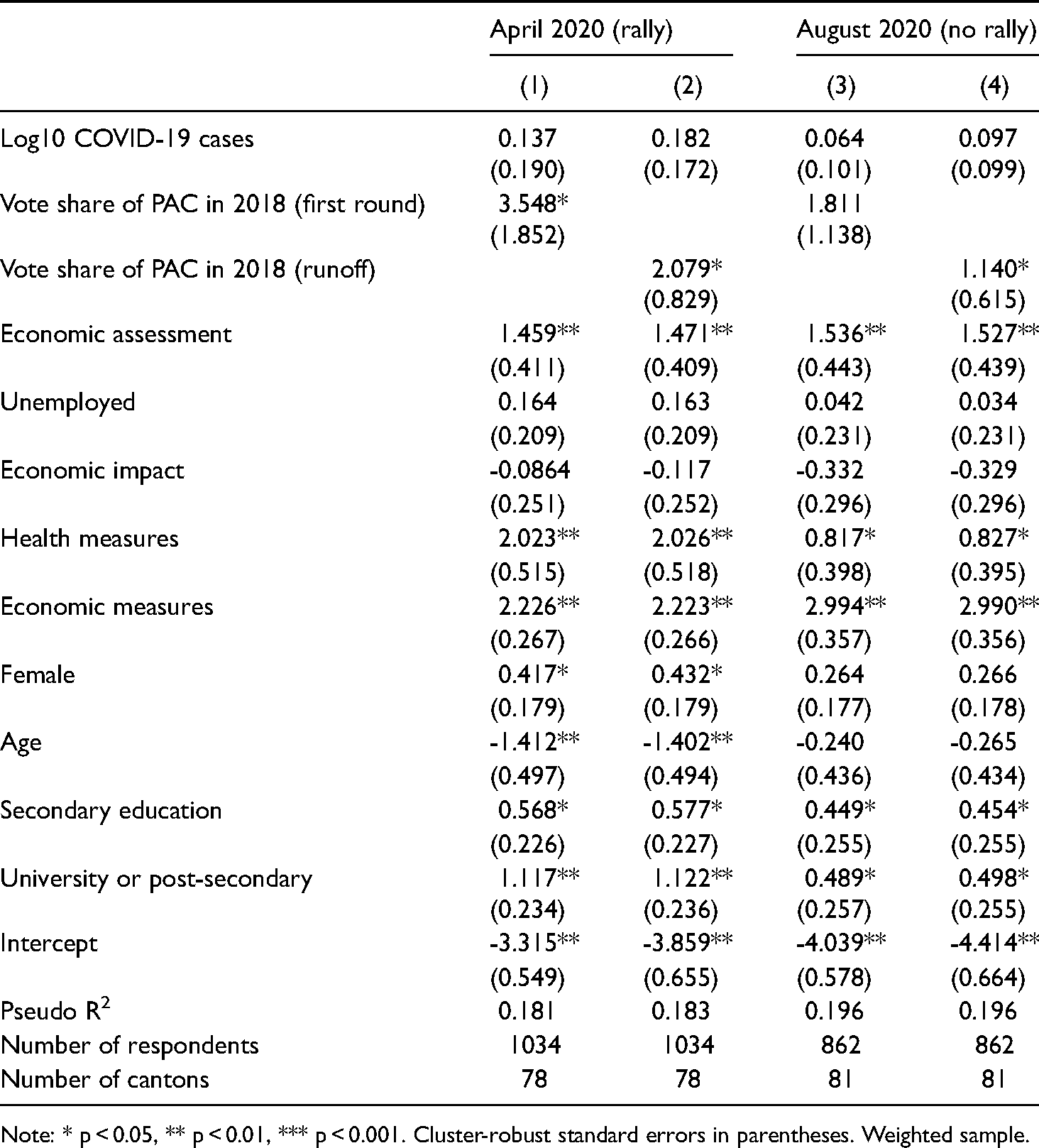
Note: * p < 0.05, ** p < 0.01, *** p < 0.001. Cluster-robust standard errors in parentheses. Weighted sample.
In none of the estimated models does the coefficient of the logged number of COVID-19 cases reach statistical significance – using the raw number of cases leads to a non-significant coefficient as well (results not shown). This means that approval was not driven by the level of threat, as measured by the number of contagions in the cantons. The first hypothesis that claims that the higher the local level of threat, the higher the likelihood of approval of the performance of the government during the rally is not supported by the models.
Conversely, the electoral support for PAC in both the first round and the runoff of 2018 have a positive and significant effect on approval in the April survey (Models 1 and 2). In August, only the coefficient of the runoff election reaches a conventional threshold of statistical significance (Model 4). The models confirm the second hypothesis that, in a context of political polarization, past electoral support for the government is associated to government approval during the rally and after it. That is, the rally-round-the-flag event did not imply a non-partisan consensus, since it was driven by politically motivated reasoning. After the rally, when the ordinary sources of approval prevail, the geographic patterns of voting still show a significant association, although of lesser magnitude.
The control variables deserve attention as they say much about how people evaluate the government. First, in all four models, a more positive assessment of the economy predicts approval, although being unemployed or negatively impacted by the pandemic does not reveal a significant negative effect. Second, satisfaction with health and economic relief measures makes people more likely to approve of the government in April and August. Finally, among socio-demographics, women, and younger people judge the government more positively in April (Models 1 and 2) but not in August when there are no statistically significant differences (Models 3 and 4). A higher education level increases the likelihood of approval in both surveys.
It is worth mentioning that, although women are more inclined to rally in April 2020, there was no gender gap in the 2018 election. Age poses a more convoluted relationship since PAC attracted younger voters in the first round, mirrored during the rally, but not in the runoff. Overall, the only stable demographic covariate of approval and vote is education, as higher education also predicted voting for PAC in 2018 (Pignataro and Treminio, 2019: 256–258)
Figure 3 displays the change in the probability of having a positive opinion toward the government. The left panel shows average marginal effects from Models 1 and 3 that included the vote share for PAC from the first round; the right panel from Models 2 and 4 with the vote share from the runoff.
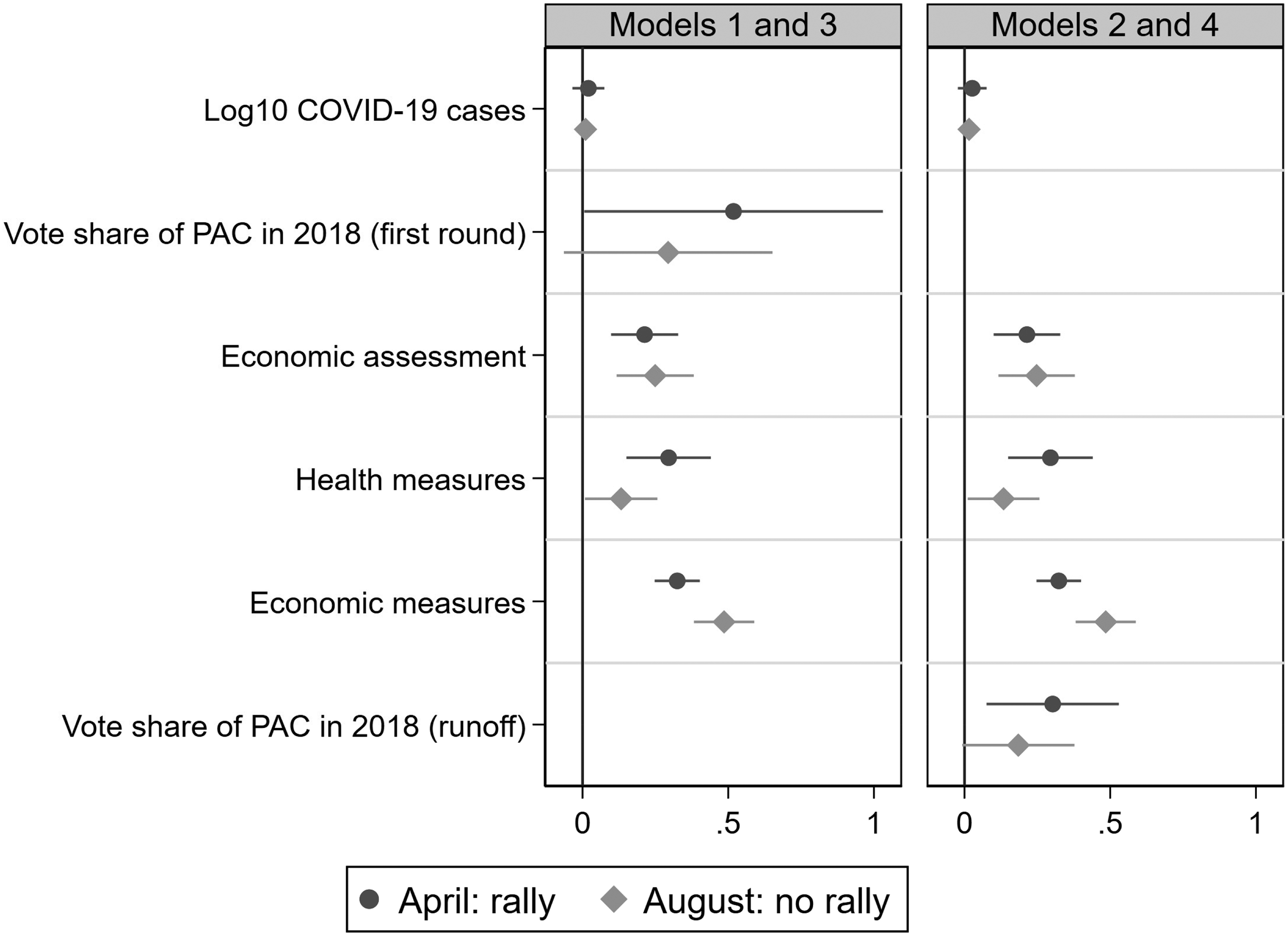
Estimated average marginal effects from the models in table 1. Note: Error bars represent the 95 per cent confidence interval.
In all models, the marginal effects of the logged number of COVID-19 infections are not different from zero. Instead, the vote share of PAC by canton does predict that changing the votes for PAC from 0 to 100 per cent in the first round increases the probability of approving of the government's performance 52 percentage points in April; the average marginal effect is not significant in August. The vote share in the runoff increases the probability of a positive job evaluation by 30 points in April and 18 points in August (the latter being significant at 10 per cent; see Table A4 from the Supplementary Appendix).
The assessment of the economy, perhaps the most stable predictor of popularity, reveals the expected effect: changing from the lowest to the highest evaluation, the probability of approving of the government increases 21 percentage points in April and 25 percentage points in August. The evaluation of government responses has even larger effects. In April, health and economic responses increase approval 29 and 32 percentage points respectively. In August, economic relief measures have a 49-percentage point effect on approval, while health measures a 13-percentage point effect. The larger effect of economic relief measures in August compared to April suggests that the economic issues become more salient as the pandemic advances (as in Singer, 2021), even though contagions and fatalities increase.
Discussion and Conclusion
The COVID-19 pandemic has, and will have in the future, political consequences. During the outbreak, the most visible one was the boost in approval for many political leaders, which is identified as a rally-round-the-flag effect. With the purpose of explaining government approval during the COVID-19 pandemic, this paper proposed two hypotheses. One posits that people living in areas of higher threat, measured as confirmed COVID-19 contagions, are more likely to approve of the government's performance during the rally. The second suggests that, in polarized contexts, past electoral support to the president increases the likelihood of approval, during and after the rally. Both hypotheses were tested using two cross-sectional surveys in Costa Rica, where the government experienced a dramatic 57-percentage point surge of approval.
Against expectations, the number of contagions is unrelated to the probability of approval. This implies that the threat was perceived to be national and not conditioned by the local threat. Instead, approval depends more on the pre-pandemic electoral support for the president and his party: the higher the vote for the party in government in 2018, the higher the support in 2020, during the April rally-round-the-flag event at the outbreak of the pandemic, and four months after it.
The Costa Rican case leads to two main conclusions. First, finding that past electoral behavior is associated to current levels of political support is telling of how and where context matters, given that party identification in Costa Rica has decreased (Perelló and Navia, 2021), but polarization has run high (Pignataro and Treminio, 2019). In the United States, where both polarization and partisanship are intense, partisan divisions persist during the pandemic (Shino and Binder, 2020), even though Democrats and Republicans might find common ground in counties with large outbreaks of COVID-19 cases (Druckman et al., 2021). Hence, polarization, more than partisanship, seems to condition the effect of electoral predispositions on approval.
Second, electoral priors matter both during normal periods of public life (Bartels, 2002; Donovan et al., 2020; Edwards and Swenson, 1997) and in crises such as the coronavirus pandemic. Thus, the cross-partisan consensus identified in other countries (Merkley et al., 2020) is not universal. In this sense, Costa Rica is closer to France, where electoral divisions prevailed, than to Austria, where the health threat motivated the COVID-19 rally (Kritzinger et al., 2021).
Additionally, this paper expands our understanding of rally-round-the-flag events in several ways. Notwithstanding past studies, dramatic rallies are not limited to terrorist attacks or foreign military interventions, and gathering support does not require a strong executive, expected to respond promptly to the crises. Lacking a majority of seats in congress that limited the policy responses, and under severe constitutional constraints of the executive power, e.g., without authority to impose lockdowns, Carlos Alvarado's presidency in Costa Rica was a suitable case to disclaim these assumptions as scope conditions.
Moreover, being a Latin American country with exceptional political stability, Costa Rica is a novel case to test theoretical arguments that were formulated for established, high-income democracies. Even at the outbreak of the pandemic, results show that the ordinary popularity function works (Lewis-Beck and Stegmaier, 2013): positive assessments of the economic predict a better evaluation of the government performance. In addition, people in Costa Rica deem relief measures important when evaluating the government, as is to be expected during natural disasters (Healy and Malhotra, 2009). Consequently, the external validity of these theories is expanded with data on Costa Rica.
An empirical limitation is that the paper does not include mortality data, since the death toll in Costa Rica was low at the time of the surveys. Because previous research states that war casualties dampen approval (Geys, 2010), as does COVID-19 mortality in the U.S. (Warshaw et al., 2020), other analyses should include fatalities to test how blame drives government approval.
Footnotes
Acknowledgments
I would like to thank Andrea Cuadra, Ilka Treminio, Juan Manuel Muñoz, and the three anonymous reviewers of this journal for their helpful comments to this paper. I am also grateful to Ronald Alfaro and Jesús Guzmán for sharing with me the CIEP surveys.
Declaration of Conflicting Interests
The author(s) declared no potential conflicts of interest with respect to the research, authorship, and/or publication of this article.
Funding
The author(s) received no financial support for the research, authorship and/or publication of this article.

Notes
Author Biography
Supplementary Appendix for:
Sources of Government Approval During the COVID-19 Pandemic: Threat or Electoral Predispositions?