




Abstract
Latin American democracies have developed institutions to empower citizens against the state. This article brings attention to an often overlooked, but key, actor in these processes: the legal complex. I argue that the content of reforms designed to strengthen the rule of law partially reflects the interests of politically influential collective legal actors. Political influence is defined as a function of alliances with civil society and embeddedness within decision-making arenas of the state. To develop this argument, the article analyses the slow building of Brazil’s Public Defenders’ Office (PDO). I argue that the office’s initial institutional weakness resulted from defenders’ fragile political position relative to that of prosecutors and the bar during Brazil’s constitutional transition. Its eventual strengthening sixteen years later resulted from changes to the legal complex alliance in its favour, the formation of connections between defenders and civil society, and increased PDO access to policymaking spaces.
Introduction
Brazil’s public system of legal aid has evolved in spurts since democratisation. The 1988 constitution that replaced the previous authoritarian structure identified the Defensoria Pública (Public Defenders’ Office, or PDO) as an institution “essential for the administration of justice.” This language broke with the past, as previous documents had acknowledged the right to legal aid without identifying an agency to enforce it. The new constitution did not, however, demand political, budgetary, and administrative autonomy for the office. This omission had significant consequences. Brazil is a federation with twenty-seven members, and after 1988 the number of states adopting a public defender grew steadily. Yet, most new PDOs lacked the capacity to properly advance the legal rights of the poor. Uneven institutional development was the norm until 2004, when a constitutional amendment that implemented sweeping changes to the country’s judicial structure also extended guarantees of autonomy to the PDO. Over time, this second reform helped solidify the public defender’s current position as primary guarantor of access to justice in the Brazilian states.
The evolution of Brazil’s PDO suggests a path-dependent model of institutional change. The office has evolved in gradual, self-reinforcing ways after critical junctures that triggered transformative reforms. What, however, were the causal forces that shaped the choices made at each of these junctures? In 1988 and 2004, reformers decided to enhance the defensoria rather than maintain the status quo, which suggests the presence of similar factors or conditions, but reformers’ failure to mandate PDO autonomy in 1988 indicates that something changed between the assembly and 2004. Why did these processes produce institutionally transformative, yet distinct, outcomes?
I argue that these institutional choices reflect variation in the scope and relative political influence of legal complex coalitions favouring reform. The “legal complex” refers to “all legally trained personnel in a society who undertake legal work, including prosecutors and civil servants involved in the administration of justice” (Halliday et al., 2007: 7). My central theoretical claim is that these actors are effective promoters of legal-institutional change, and that the outcomes of critical junctures reflect their input significantly. The legal complex is not a homogeneous body, however, but an assortment of collective entities who mobilise to advance distinct, and potentially competing, institutional interests. For that reason, explanations of reform require an assessment of the goals and political influence of different legal coalitions. Political influence is a function of two structural conditions: alliances with civil society and embeddedness within decision-making arenas. Proposals defended by broad legal complex coalitions that have built strong connections to societal organisations and gained direct access to policymaking spaces are more likely to shape institutional outcomes than proposals by narrow coalitions that have not done so.
This argument suggests that legal complex supporters of a PDO mobilised to shape the changes adopted during 1988 and 2004, and that their mobilisation was necessary for the observed outcomes. It also suggests that these actors were more politically influential leading up to the 2004 reforms than leading up to the reforms of 1988. To support this assertion, the article engages in a theoretically-guided narrative appropriate for the analysis of critical junctures (Capoccia and Kelemen, 2007: 357–358). First, it describes the historical evolution of the PDO, with particular attention to the choices made during the reformist processes of 1988 and 2004. It also shows that each of these decisions put the PDO on a new developmental path. The article then outlines competing explanations for these changes, and develops the legal complex argument sketched above. Finally, it relies on primary and secondary sources to identify the collective legal actors present at these moments, uncover their institutional goals, measure their relative levels of political influence, and contrast the outcomes of reform with their original positions. 1 The analysis shows that PDO defenders in the legal complex were crucial for the 1988 reform, but that their coalition was small and politically weak in relation to coalitions that favoured alternative institutional arrangements. In the years after the convention, a broadening of the legal complex coalition supporting the PDO, the ascension of public defenders and their advocates to policymaking spaces, and the formation of connections between defenders and civil society created the conditions for the inclusion of PDO autonomy in the reform that passed in 2004.
The article contributes to the literature on the empowerment of legal institutions in Brazil and elsewhere (see Da Ros and Ingram, 2018). From a theoretical standpoint, it fits within a body of work that challenges political science’s tendency to understate the centrality of the legal complex in the process of institutional change (Halliday, 2013). Scholars have emphasised that electoral competition, ideas, and societal activism induce elected officials to create and strengthen institutions to enforce the rule of law. In contrast, this article shows that these variables represent causal factors that facilitate change but cannot fully explain institutional outcomes without an assessment of how legal complex coalitions condition reform (see Hilbink, 2007 and Aguiar-Aguilar, 2019 for similar arguments). From an empirical perspective, the article adds to a body of work that has moved beyond analyses of high courts (Ingram and Kapiszewski, 2019). Public defenders, in particular, have been relatively understudied in comparison to judges and prosecutors. Given the uneven reach of the rule of law in Latin America, these institutions are likely to increasingly become key elements in the building of a more liberal political order. Brazil, where the gap between promises of legal equality and the reality on the ground is particularly pronounced, is a good case study for developing an explanation for how and why an institution designed to legally empower the poor gets built and strengthened over time.
Critical Junctures, Path Dependency, and Brazil’s PDO
Institutions periodically undergo major reforms that place them on new developmental paths (see Pierson, 2004). These transformations tend to occur during critical junctures, defined as brief periods when normal political constraints are sufficiently relaxed as to increase the probability that reformers select from a range of options normally unavailable (Capoccia and Kelemen, 2007). Reformers can decide to maintain the status quo, but if change occurs it triggers positive feedbacks that lower the probability of institutional reversal. Institutions continue to transform, but gradually and in self-reinforcing fashion until the next juncture. 2
The constituent assembly of 1987–1988 represented such a moment for many of Brazil’s current institutions. Regarding legal aid, the assembly had the opportunity to radically transform a patchwork of delivery models. Brazil had first constitutionalised the right to legal aid in 1934, but had never specified whether public or private entities should facilitate its enjoyment (Alves, 2005). In 1988, only fourteen of the country’s states operated public agencies of legal aid (Moreira, 2016: 37–39). Of these, three employed career public defenders, and eleven attached these offices to the local executive and did not require aid providers to pass a civil service examination. 3 The thirteen remaining states assigned the service to attorney generals and/or public-funded private lawyers. 4 In drafting a new constitution, Congress could have chosen to elevate any – or none – of these models. Instead, it prioritised the public defender model. Article 5 requires states to provide legal aid to the disadvantaged, and Article 134 identifies the Defensoria Pública as essential for the administration of justice.
In line with path-dependent expectations, we observe a steady growth in the number of states with PDOs after 1988 (Graph 1). In particular, we observe sudden surges of institutional creation after the constitutional ratification and after Congress passed legislation to enable the constitutional text in early 1994. Despite this expansion, however, Brazil’s defensorias were not on a path towards greater institutional effectiveness; as late as 2004, PDOs in most states were underfunded, understaffed, and absent from more than half of judicial districts (Ministério da Justiça, 2004).
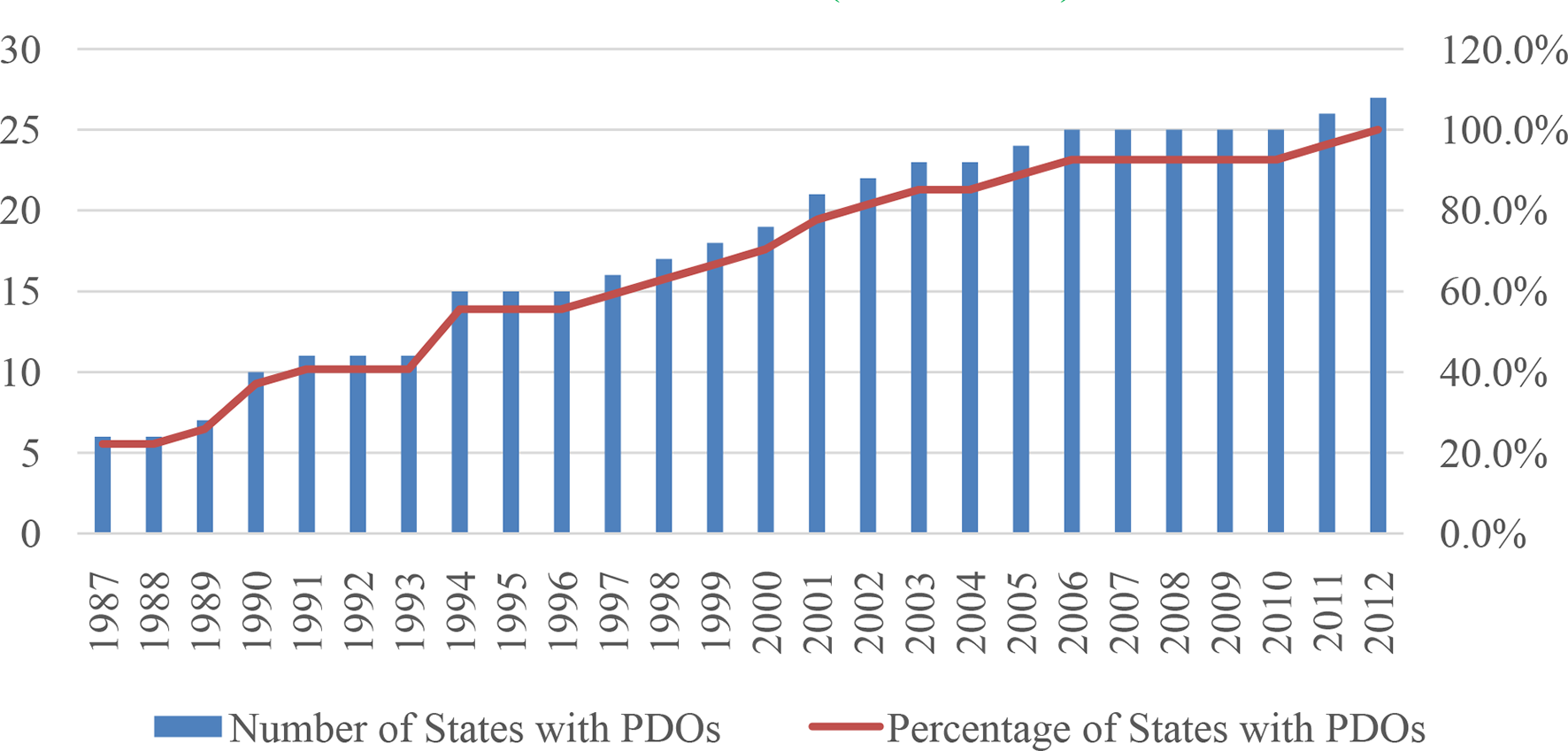
Adoption of a PDO model of Legal Aid in the Brazilian States (1987–2012).
Institutional underdevelopment is partially attributed to the constitution’s silence on PDO autonomy. Autonomous defensorias are those whose members select candidates for the position of Public Defender General, who in turn can create new posts, hold competitive civil service examinations, set wages, and impose disciplinary sanctions. Autonomous PDOs also enjoy protections afforded by organic laws, maintenance funds, and higher councils. In the absence of a constitutional mandate, states resisted the adoption of these attributes (Madeira, 2014).
The context surrounding a 2004 judicial reform represented a second critical juncture for the PDO. Sweeping changes to Brazil’s legal institutions had been debated since the 1990s, but Congress only approved them after a temporary agreement between government and opposition (Nunes, 2010). The central goal was to modify the system of constitutional review and build a judicial oversight council, so reformers could have ignored the institution. Instead, they amended Article 134 to require states to grant PDO autonomy. The consequences of this reform are clear. In 2004, only 18 per cent of existing offices ranked as fully autonomous, but five years later over 40 per cent of them ranked as such (Madeira, 2014). This second major reform also triggered legislative outputs and court decisions that reinforced the commitment to the building of autonomous PDOs across the territory. A 2009 law enabled the new constitutional text, a 2012 Supreme Court decision mandated the creation of a PDO in the holdout state of Santa Catarina, and a 2014 constitutional amendment demanded the presence of public defenders in all judicial districts within an eight-year period. The office has continued to struggle to properly fulfil its responsibilities (e.g. De Moura et al., 2013), but in 2004 the institution’s path shifted towards the direction of greater capacity as indicated, for example, by the exponential increase in the number of citizens serviced by PDOs since that year (Ministério da Justiça, 2015: 68).
A critical-juncture analytical perspective can explain the timing of the transformative reforms analysed here by emphasising the permissive political contexts of 1988 and 2004. But why choose this model of legal aid in 1988, and grant autonomy to the office in 2004? Critical junctures do not operate in a historical vacuum, but in environments conditioned by factors preceding the relaxed political moment. Such “critical antecedent conditions” (Slater and Simmons, 2010: 889–891) combine with causal forces during critical junctures in ways that influence institutional choices. It is reasonable to assume that the presence of public defenders in a few Brazilian states prior to 1988 influenced the decision made at the convention, and that the content of the 2004 reform was conditioned by the expansion of a weak defensoria model in intervening years. But which causal forces translated these pre-existing conditions into specific outcomes, and why? The next section develops the argument that political interests, political ideologies, and civil society contributed to this translation, but that the relative political influence of collective legal actors defending the public defender model is the crucial causal factor that determined institutional decisions about Brazil’s PDO. 5
The Legal Complex and Institutional Change
Democratisation in Latin America entailed the drafting of constitutional regimes to regulate interactions between citizens and the state. Constitutions have generally assigned the upholding of these regimes to third-party controllers and facilitators (Brinks and Botero, 2014). The former enforce rules, and the latter support parties in their interactions with controllers. Public defenders are third-party facilitators, which are crucial to the building of a more impartial rule of law in economically unequal settings, but why would office holders choose to strengthen an institution that empowers citizens against the state? The literature on legal institutions provides compelling answers to this question, but the PDO experience in Brazil suggests that they are incomplete.
Interest-based approaches emphasise that electoral uncertainty creates political incentives for the promotion of legal institutions. They come in two shapes: the incentive to win votes from populations sympathetic to reform (e.g. Beer, 2006), and the incentive to build insurance against future office holders (e.g. Finkel, 2008). From an electoral perspective, the number of disadvantaged voters set to benefit from a defensoria represented sufficient motivation for the constitutional elevation of the office in 1988. However, drafters had no incentive to mandate PDO autonomy because they could amass short-term electoral benefits by simply announcing the creation of the office. This incentive was also absent from an insurance perspective because courts and public prosecutors – which, as seen below, emerged from the convention in a stronger institutional position than the PDO – represent more efficient mechanisms of political constraint than public defenders. Yet, neither incentive can explain the choice to constitutionalise the PDO rather than an alternative model of legal aid. Also, neither incentive can explain why Congress revisited the issue in 2004. Politics in Brazil were highly uncertain in 1988, but the second reform took place in the second year in office of a highly popular left-wing president, Luis Ignácio “Lula” da Silva of the Workers’ Party, who had a majority governing coalition in Congress. Given the low level of electoral uncertainty in 2004, reformers had no electoral or insurance incentives for reform.
An explanation that emphasises the influence of programmatic beliefs on institutional change fills some of these gaps (e.g. Woods and Hilbink, 2009). From this perspective, the likelihood of reform increases when actors with principled commitments to legal equality dominate institution-making processes. According to Ingram (2015), leftist parties and parties that emerge in opposition to authoritarian rule are the more likely reformers in Latin America because of historical support for reforms that “expand public access to legal aid for ordinary citizens, and that make democratic citizenship more extensive and inclusive” (ibid., 41). In this view, the limited reform of 1988 likely stemmed from an ideological balance during the proceedings. Although former military regime supporters and conservative politicians held a majority of convention seats, groups that had opposed the military controlled most leadership positions (Gomes, 2006). This perspective would associate the 2004 reform, in turn, with the already mentioned dominance of a leftist president boasting a large congressional base. But again, this perspective is ill-suited to explain the specific content of the 1988 reform. Furthermore, and as seen below, demands for PDO autonomy had entered the reform project prior to the Lula administration. A leftist government might have facilitated the changes, but it was not directly behind their inclusion in the proposal.
Finally, a third approach suggests that institutional variation stems from variation in civil society mobilisation and objectives (e.g. Chavez, 2008). According to this view, the weaker reform of 1988 was likely because institutional reform in Latin America is not immune to socio-economic realities on the ground: the poor have successfully demanded the entrenchment of formal rights in the region, but in highly unequal settings states develop institutions that realise the rights of privileged groups (Brinks and Botero, 2014). Accordingly, the 2004 reform must have been due to shifting priorities among privileged social actors. Brazilian social movements coalesced in opposition to military rule in the 1980s, but in the 1990s they supported a goal of inclusive citizenship that demanded dialogue with the socially excluded (Hochstetler, 2000). It is unclear, however, why civil society would focus its efforts on PDOs as opposed to other institutional arrangements.
My explanation borrows from a literature that has uncovered the centrality of the legal complex for historical processes of political liberalisation (e.g. Halliday et al., 2007; Karpik and Halliday, 2011). The promotion of a liberal project is an inherently legal exercise, which requires input from law professionals during proposal, drafting, and implementation processes. Explanations for the specific institutional choices made to support political liberalism, therefore, must include an assessment of the mobilisation and institutional goals of the legal complex (Halliday, 2013). Since institutions to provide legal aid to the poor are, at heart, part of such a project, we should expect legal professions to be an influential force behind the design and strengthening of a PDO as well.
Why does the legal complex mobilise for reform? Arguably, it does so out of a programmatic commitment to political liberalism. As Hilbink (2007) suggests, exposure to legal ideas from abroad can broaden understandings of the law in societies under authoritarianism to include the belief that legal institutions can, and should, play a role in the pursuit of liberal ideals. In Latin America, this belief strengthened during the late twentieth century as legal actors found their institutions and doctrines ill-suited to address societal demands for effective rights (López Medina, 2004). The emergence of these beliefs is crucial because beliefs motivate action; they lead actors to develop institutional blueprints and build coalitions for reform (Blyth, 2002: 34–45). We should stress, however, that these programmatic motivations may operate alongside more material interests as well. Political liberalism, after all, heightens the professional relevance of collective legal actors (Brinks, 2007). These two sets of motivations are not mutually exclusive and may be difficult to disentangle, but the assumption of self-interest suggests that legal actors committed to liberalism will support institutional arrangements expected to also heighten their professional standing.
This last point is crucial because the complex is a diverse cluster of collective actors working in law-related fields who may disagree upon the necessity of political liberalism (Karpik and Halliday, 2011). Assuming that they agree on this project on principled grounds, we should still expect the professional interests of different legal groupings to potentially collide during reform processes that impact the allocation of limited resources and responsibilities. Interest-based divisions invariably lead some collective legal actors to support particular institutional changes, some to oppose them, and others to display indifference (Halliday et al., 2007). For that reason, a particular reform is not simply a function of legal complex willingness to promote change, but more precisely a function of shifting patterns of alliances and influence within the legal complex. The likelihood of a particular set of institutional reforms increases when legal actors are united in its favour, and decreases in the presence of deep divisions. Crucially, it increases when proponents of change are more politically influential than their opponents.
I claim that collective legal actors become politically influential by developing alliances with civil society and ties to the state. If and when civil society and the legal complex share a commitment to political liberalism, we observe the formation of alliances that facilitate reforms expected to advance that goal (e.g. Epp, 2012). Different from society-driven perspectives, a legal complex approach associates these alliances with the purposeful actions of collective legal actors. Popular organisations may push legal actors to act towards a particular goal, but the legal professions are often behind civil societal mobilisation through positions of leadership (Halliday et al., 2007: 18–19). Furthermore, the legal complex has the technical knowledge to identify issues related to rule of law enforcement, and to develop potential solutions. Finally, assuming that civil society is biased towards the privileged, collective legal actors who expect to benefit from greater rule of law are the more likely initiators of societal activism towards reforms that benefit the poor.
Alliances with civil society increase the amount of external pressure that the legal complex can impose upon the state, but pressures for reform can also come from within decision-making arenas. Here, the notion of political embeddedness developed by Michelson (2007) to explain the conditions under which lawyers thrive professionally in China proves useful. Political embeddedness refers to the degree to which legal practitioners enjoy ties to the state apparatus through similar career histories or shared social networks. Modified to the analysis of collective mobilisation for institutional reform in a democratic context, the concept refers to the extent to which the legal complex is represented within arenas of decision-making authority such as legislative bodies and influential bureaucratic posts. If members of the legal complex get elected or ascend to high-level bureaucratic positions, we should expect an increased likelihood that reforms will reflect the preferences of the collective legal groupings to which they declare membership or support.
The empirical implication of these arguments is that we should observe legal complex mobilisation in favour of a PDO prior to 1988 and 2004, as well as some equivalency between legal complex proposals and actual outcomes. We should also, however, observe that PDO supporters displayed more political influence prior to the second reform. The remainder of the article assesses the validity of these statements.
Legal Complex Mobilisation and Brazil’s 1988 Constitution
This section identifies the legal groupings that mobilised during Brazil’s constitutional convention. The list includes actors identified as key elements of the complex: the bar, prosecutors, other civil servants (here represented by public defenders), and judges (Karpik and Halliday, 2011). The objective is to assess the relationship between their distinct demands and the institutional outcomes of 1988, with special reference to the PDO.
Unsurprisingly, the few defensorias that predated the constitution mobilised in favour of stronger prerogatives for their institution. The state of Rio de Janeiro first created the position of public defender in the 1950s, and in subsequent years its members promoted the ideas that would eventually influence the constitutional text in multiple conferences and professional meetings (De Moraes and Da Silva, 1984). When the military announced competitive elections for state-level offices in 1982, Rio’s defenders founded a professional association designed to promote their interests vis-à-vis newly elected governments (Rocha, 2004). In 1984, while popular mobilisation across the country demanded free presidential elections, Rio’s PDO motivated the creation of the National Federation of Public Defenders (Federação Nacional dos Defensores Públicos, or FENADEP). This federation sent representatives to the constituent assembly, who argued in favour of constitutional language to elevate the agency’s status and to grant it with guarantees of political and budgetary autonomy similar to those requested by prosecutors.
Brazil’s Public Prosecutor’s Office (Ministério Público, or MP) has been at the forefront of attempts to facilitate citizen complaints against the state. Until 1988, the agency was attached to the executive, but its responsibilities were not limited to criminal prosecution. As written in Brazil’s civil code, the MP should intervene in civil cases involving an “incapacitated” party. According to Arantes (2002: 29–30), this charge justified MP mobilisation for an expanded list of duties. In 1973 a civil code reform delegated the protection of the “public interest” to the ministério; in 1981, Congress elevated the office to the status of essential for the defence of societal interests; and in the early 1980s, a series of laws authorised the MP to file public civil actions in the defence of collective interests (ibid., 44–51). Having achieved an inflated institutional importance during military rule, the MP mobilised during the assembly in favour of budgetary and political autonomy from the executive. The National Confederation of the MP, or CONAMP, was a central collective actor in this process (Kerche, 1995).
The Brazilian Bar (Ordem dos Advogados Brasileiros, or OAB) also mobilised for greater institutional relevance. The OAB first emerged in the 1930s and had initially supported the coup that installed a military regime in 1964, but it soon began to openly and dangerously oppose the regime (Taylor, 2008: 111–311). The OAB is socially and economically heterogeneous, and within it we identify multiple groups with contrasting backgrounds and professional goals (De Almeida et al., 2018). Yet, the organisation has historically displayed a unity of purpose aimed towards the dual pursuit of lawyers’ professional interests and the defence of the juridical order (Bonelli, 2003). To pursue the former, the OAB mobilised for a monopoly over the legal profession and for a prominent role in the exams for judges and prosecutors. To fulfil the latter, it supported the creation of a new Constitutional Court, and an expanded list of actors legitimised to request judicial review (Taylor, 2008: 113–114).
Institutional reform is more likely in the presence of broad agreements between distinct collective legal interests, but the FENADEP had few allies during the constitutional proceedings. As Moreira (2017) shows, prosecutors resisted the idea of institutional equivalency between the MP and the PDO. In their view, such an outcome would entail unwarranted competition for resources and responsibilities. The fact that prosecutors provided legal aid in states where the service was attached to the attorney general likely amplified this resistance. The OAB, in turn, saw the defensoria as a threat in the legal labour market. Prior to the assembly, the order had acknowledged the state’s responsibility to provide legal aid, but in 1981, it argued that a PDO should be a secondary option for the fulfilment of that responsibility (Alves, 2005). This concern reflected not the preferences of the OAB as a national organisation, but the interests of OAB chapters in states that funded the private provision of legal aid (Moreira, 2017). Chief among them was the powerful state of São Paulo, Brazil’s wealthiest and most populous, which often tried to dictate the positions of the national bar (De Almeida, 2006).
Judges in general, and the Supreme Court in particular, could have mobilised in support of the PDO, but the Supremo Tribunal Federal (STF) was concerned primarily with its own institutional survival. The military regime had expanded judicial review authority while simultaneously eroding the Court’s independence (Arantes, 1997: 97–100). During the transition, the justices mobilised to protect their authority from attempts to create a new high tribunal, to entrench stronger guarantees of autonomy and independence, and to avoid the broadening of access to judicial review (Koerner and Freitas, 2013). Judges’ associations, in turn, mobilised primarily to block a proposed mechanism of judicial oversight (De Carvalho, 2017). The judiciary, in short, seemed indifferent towards the PDO in 1988.
Of these collective actors, the FENADEP was the least successful. The OAB secured many of its corporatist demands, as well as the broadening of access to judicial review. The OAB could not overcome STF opposition to a new constitutional court, but the creation of a new superior tribunal of justice all but transformed the STF into a de facto constitutional tribunal. The MP also secured many demands. Not all of them were adopted – partially due to opposition from other collective actors such as police officers – but the level of autonomy enjoyed by prosecutors after 1988 represents close to an abdication of political oversight by elected officials (Kerche, 2007). Clearly, this outcome contrasts with those related to the PDO. Public defenders inserted their institution in the constitution against numerous odds. For example, halfway through the proceedings, an alliance of conservative drafters changed procedural rules to push forth an alternative document that completely eliminated any mention of the PDO. This sudden change triggered a flurry of lobbying activity by the FENADEP that successfully reintroduced the defensoria into the text (Rocha, 2004: 160–161). Despite this achievement, defenders failed to secure any guarantee of autonomy.
The institutional outcomes of the convention mirrored the demands of collective legal actors in substantive ways. Clearly, these actors benefited from a context that lent itself to the strengthening of institutions designed to constrain office holders and empower citizens. First, the constitutional assembly was characterised by political fragmentation and electoral uncertainty, both of which create positive incentives for the legal complex proposals described above. Second, drafters with a history of opposition to military rule chaired many of the proceeding’s committees (Gomes, 2006). As Kerche (1995) points out, the MP benefited from drafters that were ideologically committed to an institutional arrangement that encouraged alternative venues for the exercise of citizenship. Finally, civil society was actively involved in the process (Martínez-Lara, 1996). But why did these conditions trigger the empowerment of some institutions, but not others? The fact that other legal groupings opposed the PDO for their own professional reasons contributed to this outcome, but a full explanation requires an assessment of their relative political influence.
Political Influence and Institutional Outcomes
Political influence is conditioned by a collective legal actor’s degree of political embeddedness and alliances with civil society. Political embeddedness stems from the presence within arenas of decision-making authority of individuals who boast a history of mobilisation in favour of a distinct legal grouping. Arenas of decision-making include the elected branches and key bureaucratic agencies. Alliances between the legal complex and civil society, in turn, stem from historical patterns of interaction between specific legal actors and societal organisations.
Legal Complex Embeddedness and the Constituent Assembly
The MP and the OAB were better represented inside the 1988 assembly than the FENADEP. Biographical information of the 559 drafters shows that at least thirteen of them, or slightly over 2 per cent of the total, had a professional background in the MP. 6 Furthermore, at least four drafters had held positions of leadership at either the national or local chapters of the OAB. The MP and the OAB also held key positions within the structure of the assembly: a former prosecutor served as relator 7 of the subcommittee that wrote the first draft for the chapter on administration of justice, and a former OAB president served as relator for the integration committee that released the first full constitutional draft for deliberation. In contrast, the analysis did not uncover drafters with a background in any of the few PDOs in existence at the time. 8
Two aspects of the assembly point to the relevance of these contrasting levels of embeddedness. First, over 40 per cent of assembly members had a law degree, even if most were not legal practitioners (Fleischer, 1988). In other words, they were individuals likely to rely on other legal actors when making decisions about the administration of justice. Finally, states that possessed a PDO were underrepresented in the proceedings when compared to states where attorney generals and/or private lawyers provided the service (Table 1). A third of the assembly represented states that had offices of legal aid, but these were attached to local executives and without much capacity for mobilisation. The assembly, in short, lacked a significant number of drafters who could serve as agents of the defensoria, or who could potentially be subject to effective lobbying by the FENADEP.
Lower House Composition by Legal Aid Provider in the State of Origin (1987–1988).
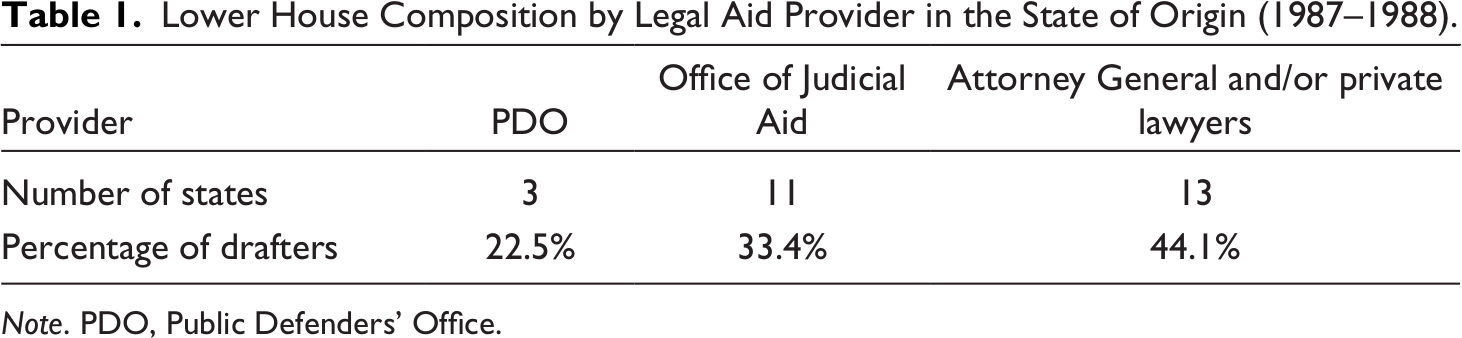
Note. PDO, Public Defenders’ Office.
Process tracing analysis of the proceedings further illustrates the potential impact of legal complex embeddedness on reform. 9 Proposals surrounding the defensoria started inside the Sub-committee on the Judiciary and continued through two more committees before heading to the full assembly for deliberation. The subcommittee upheld all FENADEP demands, but defenders lost ground at each subsequent step. The Separation of Powers Committee removed guarantees of autonomy from the text, for example, and the Systematising Committee removed the guarantee of earnings equivalency between defenders and prosecutors. As expected, likely defensoria supporters were numerically stronger in the subcommittee. Of nineteen members, ten originated from states with a pre-existing public office of legal aid. Drafters from some of these states worked arduously to include language favourable to the PDO, and succeeded despite opposition by the MP-associated relator mentioned above and by another drafter with a background in São Paulo’s attorney general’s office (Moreira, 2017). 10 But as the number of drafters required to approve a constitutional provision increased, the institutional prerogatives of the PDO decreased. The movement from committees into the full assembly also watered down the MP’s demands – they failed to secure the prosecutor-general’s exemption from political oversight, for example – but less radically (Kerche, 1995).
Civil Society and the Legal Complex
Numerous groups attempted to influence constitutional drafters through lobbying, media appearances, and propaganda targeting public opinion. These groups included labour unions, businesses, the peasant movement, and a broadly defined “popular movement” of grassroots organisations (Martínez-Lara, 1996: 74–87). As expected, the OAB and the MP also had an advantage over the FENADEP.
The OAB is itself a civil societal organisation committed to the defence of the legal order, and in the late 1970s, it joined forces with the Brazilian Press Association and the National Conference of Brazilian Bishops to oppose the military regime (Skidmore, 1988: 180–188). These were elite sectors of society, but they created space for the mobilisation of students, labour unions, and community organisations. The objective of this cross-class alliance was the establishment of direct elections for president, to which end they staged massive protests in 1984. The coalition collapsed after the military secured an indirect presidential election through the senate, but not before the OAB cemented its status as “spokesperson” of civil society (Alves, 2001). During the months leading up to the assembly, the OAB helped organise “popular movements” for constitutional reform in multiple states (Michiles, 1989: 40–44).
The MP benefited from the compatibility between its institutional goals and the interests of social movements. Chief among them was the environmental movement, which had lobbied for the public civil action act that transformed prosecutors into promoters of collective interests in 1985 (Maciel and Koerner, 2014). A collection of societal organisations with a national presence, environmentalists were also active during the constitutional proceedings. Environmentalists demanded clauses aligned with their interests – such as the demarcation of protected natural areas – and the expansion of mechanisms for popular participation in the policymaking process (Hochstetler, 1997). Expecting an autonomous MP to facilitate public civil actions in environmental causes, the movement willingly supported prosecutors’ institutional objectives in the assembly and in the media (Maciel and Koerner, 2014).
The FENADEP did not enjoy a history of civil society connections, or a commonality of interests with influential social movements. A young organisation, it was at best a marginal actor in the pro-democracy movement. The defensoria received support from the Institute of Brazilian Lawyers (Alves, 2005: 291), but the institute had weaker prestige and influence than the OAB (Bonelli, 2003). Also, the FENADEP’s project lacked support from the “popular movement” as indicated by an analysis of all 122 proposals from civil societal actors such as professional, religious, and business associations (the list of popular amendments is included in Michiles, 1989: 117–159). The only popular proposal to address access to justice did not mention the PDO and did not make it to the assembly for discussion, likely because it did not secure enough signatures from interested citizens (ibid., 103). Assuming that these proposals reflected organised societal support for a particular idea, the provision of legal aid to the poor ranked low in the list of concerns at the time.
To summarise, the gains made by the OAB and the MP in 1988 were contingent on the compatibility between their projects and the democratising context of the time, but also on their relative political influence. The FENADEP, a newer organisation, was operating in a highly uneven playing field where other legal actors displayed resistance to its project. To acquire the institutional prerogatives for which they mobilised during the transition, public defenders would need to expand the legal complex coalition in their favour, build connections to civil society, and become politically embedded.
Legal Mobilisation, Political Influence, and PDO Autonomy
The 2004 constitutional mandate for the autonomy of state-level PDOs was one element of a broader project of judicial reform. Congressional proposals on the topic emerged in the early 1990s and targeted three aspects of the judicial system: judicial review, judicial accountability, and access to justice (Sadek and Arantes, 2001). These were contentious debates. First, political actors questioned the proposal to centralise judicial review authority in the STF, which would limit the ability of opposition parties to activate the broader judicial system against the government. Second, political and legal actors questioned whether a National Justice Council to oversee the judicial system would have an adverse effect on judges’ autonomy. These two controversies largely explain the length of the reform process, which only came to fruition after the left-wing Workers’ Party won the 2002 presidential election. Having resisted the centralisation of judicial authority when in the minority, the party changed its position when in control of government (Nunes, 2010). In the first years of Lula’s presidency, the conditions were ripe for a transformative reform of Brazil’s legal institutions.
Proposals to expand access to justice were the least contentious of the process (Arantes, 2003). The political dominance of a left-wing party likely facilitated approval of this aspect of the reform in 2004, but there were other plausible reasons as well. First, strengthening the defensoria would have little to no impact on the distribution of political power between government and opposition. Also, Brazil’s fiscal health began to improve in the mid-1990s, thus lowering the expected cost of an agency with budgetary autonomy. The country’s growing prison population arguably served as an incentive to strengthen mechanisms of defence for the underprivileged. Finally, and as seen above, state PDOs were woefully underdeveloped despite the constitutional elevation of the office in 1988.
These conditions facilitated the reform’s approval during the critical juncture of 2004, but they cannot fully account for the introduction of the defensoria into the project. The contours of the amendment were first delineated during a 1993 meeting of both congressional houses to debate constitutional revisions. It was then that the controversies surrounding centralisation of judicial authority and mechanisms of judicial accountability first emerged (Sadek and Arantes, 2001). The reformist process began in earnest with the creation of a lower house special committee on judicial reform in 1995, which released a heavily criticised and promptly archived project. A new iteration of the committee convened after the 1998 elections, and released two projects for congressional appraisal in the following year. These were the first to include the guarantee of institutional autonomy to state PDOs, which remained in the text approved by the house in 1999 (Arantes, 2003). It was the text drafted in 1999 that served as the basis for the 2004 amendment. The following sections show that the addition of this language followed shifts in attitudes towards the office from other collective legal actors, and an increase in PDO political influence.
Legal Complex Mobilisation and Support for Reform
Public defenders continued to mobilise for reform after 1988, but they found new allies within the legal complex. For example, providers of legal aid in states that lacked a defensoria began to mobilise in its favour after the constitutional elevation of the office. Mobilisation was driven by a commitment to effective legal representation for the poor, but also by the expectation of greater professional benefits (Moreira, 2016). Local-level mobilisation occurred alongside mobilisation by the National Association of Public Defenders (Associação Nacional de Defensores Público, or ANADEP). A re-branded FENADEP, this association had become larger due to PDO expansion during the 1990s: as the number of offices increased so did the number of state-level associations of public defenders. Among other activities, the association engaged with Congress during debates surrounding the passing of the 1994 enabling law of the PDO mentioned above (Rocha, 2004: 164–168). In 1999, ANADEP’s president participated in a public audience with the special lower house committee on judicial reform where he expressed and justified the association’s request for autonomy and other changes. 11
Transcripts from these audiences show that, in the late 1990 s, the PDO enjoyed more legal complex support than during the constitutional convention. The lower house committee also heard from the OAB, the CONAMP, the Association of Federal Judges, the Brazilian Association of Magistrates, and the then-Chief Justice of the Supreme Court. Of these, the association of magistrates and the Chief Justice expressed outright support for granting autonomy to the PDO. 12 If the judiciary had expressed indifference towards the PDO in 1988, eleven years later the position of key actors within the judicial structure had shifted. Panellists from other legal institutions or associations did not include any mention of the PDO in their interactions with the committee. In fact, the OAB’s judicial reform proposal completely ignored the defensoria (Ordem dos Advogados do Brasil, 1999). In 2004, during public audiences inside the senate, we again observe no criticisms of PDO strengthening by any of these actors. Tellingly, Brazil’s public prosecutor-general – the head of the MP – claimed that Congress should grant public defenders with the same institutional status as his own agency. 13 Having secured autonomy in 1988, prosecutors were likely no longer concerned about loss of resources to other agencies.
The OAB’s indifference likely stemmed from internal divisions regarding the desirability of autonomous public defenders in the states. Some OAB chapters, for example, wanted to protect the professional interests of lawyers who received public funds for the service (Moreira, 2016). The state of São Paulo, in particular, represented a key barrier for PDO autonomy because it boasted a saturated market of legal services where poorer lawyers relied heavily on agreements with the state to guarantee their professional survival. This concern over the market for legal services encouraged the local OAB to oppose a defensoria and attempts to encourage pro bono work by corporate lawyers (De Almeida et al., 2018; De Sá e Silva, 2018). As a former head of the Office for Judicial Reform stated, São Paulo’s OAB represented the strongest opposition to the inclusion of the PDO in the reform. 14
Political Influence
Public defenders were more influential during the judicial reform process than they had been in 1988. First, the introduction of the PDO in the project followed changes to the composition of the special committee. The committee that had first introduced the PDO to the project shared a crucial similarity to its predecessor: its proportion of law-degree holders was greater than the proportion of law-degree holders in the entire house (Sadek and Dantas, 2000). Yet, the first committee had greater representation from states without a PDO and from states where public funds financed the private provision of legal aid (Table 2). São Paulo, in particular, was overrepresented, whereas Rio de Janeiro had no presence in that initial special body. Rio’s representation increased markedly in the second committee. More crucially, one of its representatives was a former career public defender. This individual drafted the constitutional language strengthening the PDO that the committee adopted in 1999, and actively defended the institution in public audiences. 15 The introduction of the defensoria in the project of judicial reform, in other words, followed a shift in the composition of the committee that increased the potential for effective lobbying by PDO supporters, and that embedded a former defender into the decision-making process.
Composition of Special Lower House Committees on Judicial Reform.
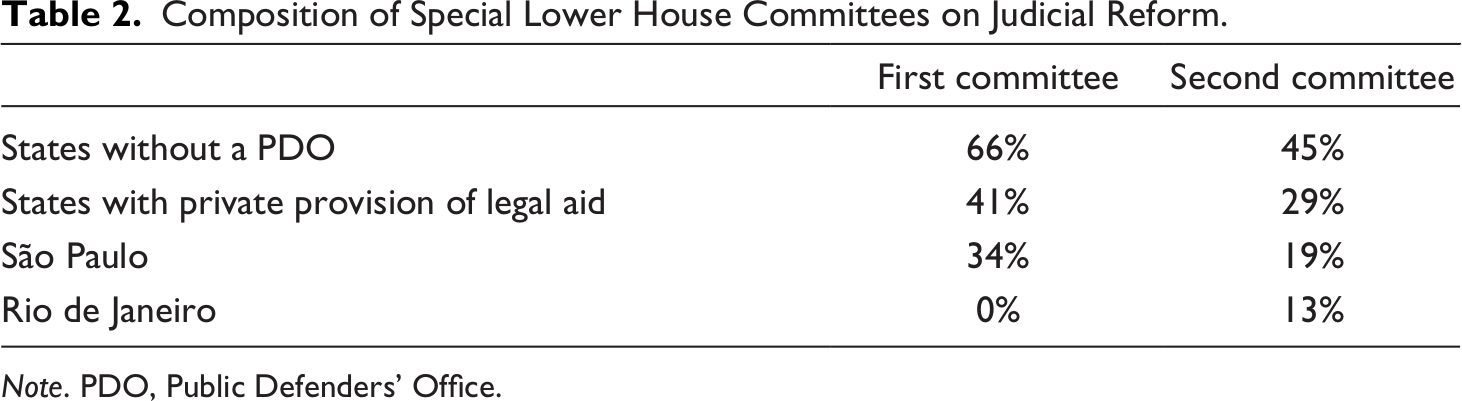
Note. PDO, Public Defenders’ Office.
The maintenance of the defensoria in the project also benefited from greater PDO influence within the bureaucracy. Judicial reform passed in 2004 due in no small measure to the actions of justice minister Márcio Thomaz Bastos, a criminal lawyer from São Paulo and former OAB president. Until Lula’s victory in 2002, the justice ministry had been used as currency in the building of congressional alliances, resulting in a staggering sixteen ministers between 1990 and 2003. Bastos, however, was not a career politician, remained in the post for the duration of Lula’s first term, and during his tenure, the ministry enjoyed great technical capacity and bureaucratic autonomy (Nunes, 2015). To move the amendment forward, he established an Office of Judicial Reform designed to build social and political support for the proposed changes. Bastos, however, also had informal ties to the PDO dating back to before the Lula government. In 2001, he had sponsored the creation of São Paulo’s Pro-Bono Institute, an NGO that advocated for voluntary legal work among Brazil’s growing corporate legal class. São Paulo’s Bar opposed pro bono expansion, and in 2001 enacted regulation placing limits on the practice. PDO advocates were also suspicious of the pro bono movement, but the two became allies once it became clear that they faced the same opponent (De Sá e Silva, 2018). When asked about his position on PDO independence by the senate’s committee on judicial reform, Bastos stated that he “believes it is absurd that São Paulo has not built a Public Defenders’ Office. I have participated, and continue to participate, through a non-governmental organisation, in a movement for the construction of the public defender in São Paulo.” 16 Through Bastos, a towering figure in the legal complex, the PDO had acquired influence in one of the most crucial arenas of decision-making in Brazil.
The building of an alliance between defensoria and pro bono advocates in São Paulo is an example of increased connections between the agency and civil society as well. After 1988, public defenders began to actively court societal support for their institutional goals. As a former president of the ANADEP stated, the defensoria had to “introduce” itself to society; without civil society, “we cannot accomplish anything.” 17 Given the key role played by São Paulo’s OAB in the opposition to PDO autonomy, the formation of an alliance between defenders and non-governmental organisations in that state greatly contributed to the strengthening of defenders’ political influence.
This alliance emerged as follows (see Haddad and Soares, 2009). In the 1990s, members of São Paulo’s office of legal aid defended the idea of an autonomous PDO against intense opposition from within their own institution. These individuals had a history of involvement in human rights movements, and in 2001 pursued contacts with civil society organisations and academic institutions to develop a unified front in favour of adapting São Paulo to the 1988 constitutional mandate. According to a former movement leader, advocates identified leadership figures in civil society and presented them with a legislative proposal to be presented to the state legislature. 18 This process culminated with the creation of a Movement for the Public Defenders’ Office by more than 440 societal organisations (De Moura et al., 2013). The relationship was not without consequences for the PDO, as social actors pressured for the inclusion of an ombudsman and other mechanisms of social accountability in the structure of the office (Cardoso, 2010). Yet, the fact remains that the movement’s genesis required direct action by individuals within the system of legal aid.
The importance of support from the justice ministry and civil society cannot be understated. Given changes to legal complex attitudes towards the defensoria, it became unlikely that its opponents would successfully exclude the office from the amendment. Yet, the possibility for a weaker reform was still possible. During the final stages of debate inside the lower house, for example, a proposed amendment would allow states to employ private lawyers to represent the poor as needed. Tellingly, the proposal came from a former president of São Paulo’s OAB. PDO supporters in the committee blocked this measure by a single vote (see Brasil, 1999b). Much like it happened in 1988, constitutional language supporting the PDO out of committee could still be weakened by Congress.
Final Remarks
This article does not assume that public defenders are the most effective means by which societies can improve access to justice. Latin America’s defensorias have drafted legislation to force adherence to international treaties, investigated abuses by security forces, and demanded public protection of diffuse interests (Ungar, 2002: 36–39 and 196–199). Yet, and as suggested elsewhere, this approach to access to justice is only one among many, and often not the most effective (Garth and Cappelletti, 1978). In fact, Brazil alone boasts multiple institutional structures and mechanisms designed to level the legal playing field and facilitate the enjoyment of rights by the underprivileged (Sadek, 2001). The purpose of this analysis is simply to draw attention to the key role that the politics of the legal complex plays in processes of rule of law reforms in democratic regimes. In doing so, it does not discount the impact of political competition, ideology, and civil society on institutional change. Rather, it shows that when moving beyond explanations for the creation of mechanisms of accountability and rights protection to explanations for the actual design and content of reforms, scholars need to consider the impact that a particular collective actor, the legal complex, has on these outcomes.
This is not an insignificant suggestion. Focusing on the provision of legal aid alone, we observe increased international commitment to the expansion of access to justice as a tool of social transformation, as well as great variation in how countries seek to adhere to this new global mandate (UNDP and UNODC, 2016). Different social, economic, and cultural realities suggest that there is no one-size-fits-all solution to the problem of unequal enforcement of legal rights. Not all democracies find it easy to adapt their institutional structures to their specific requirements, even in the presence of permissive political contexts. This article suggests that as reformers seek to adapt institutional structures of legal protection to local needs, they must evaluate the preferences of legal actors and the relative distribution of political influence among them.
Footnotes
Declaration of Conflicting Interests
The author(s) declared no potential conflicts of interest with respect to the research, authorship, and/or publication of this article.
Funding
The author(s) disclosed receipt of the following financial support for the research, authorship, and/or publication of this article: Research for this article was funded by a St. Edward's University Presidential Research Grant.

Notes
Author Biography
E-mail: