



Abstract
Civil society has exploded in Latin America as democratization has continued over the last 30 years. Civil society organizations (CSOs) are thought to improve governance and oversight and to increase social capital. Nonetheless, we have limited knowledge about what motivates CSOs’ political strategies, which include participating in formal political institutions, attending demonstrations, and providing services. We build knowledge here by evaluating data from a unique survey of nine hundred CSOs across seven Brazilian cities. Our findings showcase several parallel processes: poorer CSOs continue to rely on the state and actively participate in political processes despite protesting at greater rates than wealthier CSOs; therefore, we contend that institutional and political process arguments better explain poorer CSOs’ behavior. We also argue that relatively wealthy CSOs’ disengagement reflects greater resource mobilization, more professionalization, and an increase in social capital. Our results show that multilayered explanations improve our understanding of CSO behavior and state-society relations in Brazil and Latin America.
Introduction
The ongoing mobilization of citizens and civil society organizations (CSOs) profoundly marks national and local politics across Latin America and the developing world. In the twenty-first century, citizens and CSOs) now have access to an expanded repertoire of political activities that they can employ to influence public officials, private corporations, and their fellow citizens (Oxhorn 2011). These political activities include protesting and engaging in contentious politics; being involved in campaigns and elections, party politics, and clientelistic exchanges; forming community organizations; lobbying government officials; and working within incremental policy-making decisions (Escobar and Álvarez 1992; Fox 2007; Friedman and Hochstetler 2002; McAdam, Tarrow, and Tilly 2003; Abers and Keck 2013; Lavalle, Acharya, and Houtzager 2005). Citizens and CSOs are now able to link themselves to each other and to a wider array of organizations by taking advantage of new democratic institutions, the partial protection of basic liberties, expanded educational opportunities, and decreased transportation and communication costs (Avritzer 2002 and 2009; Pires 2011). Citizens form and join CSOs to advance both narrow and broad interests, from improving public security to challenging extractive industries to installing infrastructure in their respective streets to improving basic education and health care (Jacobi 1989).
In this article, we ask how CSOs engage the state, public officials, and new democratic institutions. We draw from an original survey of 863 CSO leaders across seven Brazilian cities to evaluate three distinct strategies: engaging in contentious politics, entering into direct contact with public officials (elected and civil servants), and participating directly in participatory policy-making institutions. The data we use in this article enables us to better explain why certain CSOs are likely to pursue specific strategies. This in turn provides us with a window into the broader issue of how Brazilian state-society relations are being reconstituted as a result of the civil liberty protections often afforded to protestors, the expansion of contracting and outsourcing, and the implementation of a wide architecture of participatory institutions.
We employ a pluralistic and expansive understanding of civil society, which we define as the sphere of social and political associational activity separate from the state, the market, and the family (Cohen and Arato 1992). Jeffrey Alexander argues that “civil society is a sphere of solidarity in which individual rights and collective obligations are tensely intertwined” (Alexander 2006: 53). “Bonds of solidarity” thus help organized groups to forge ongoing alliances in order to pressure government officials, public and private corporations, and their fellow citizens in pursuit of their political and policy goals. “Civil society organization” is an umbrella concept that incorporates a wide range of collective groups; social movements, community-based organizations, and “third-sector” organizations are all prominent within this category. These organizations have diverse sets of interests – organizing communities and potential allies, establishing a coherent political and policy agenda, and working to achieve social change (McAdam, McCarthy, and Zald 1996). The umbrella concept of the CSO allows us to recognize the diversity of organizational type and interest as well as explain strategic choices in each area.
Three interrelated political processes now frame civil society organizing in Brazil. First, the return of representative democracy in the mid-1980s and the subsequent extension of basic protections permitted many CSOs to engage in contentious political activity. 1 Second, the expansion of participatory institutions now allows CSOs to have unprecedented contact with public officials as well as their fellow CSO leaders in public policy-making processes. Third, Brazil moved toward a neodevelopmentalist state and invested much more heavily in social welfare policies during the country's economic expansion between 2000 and 2009 (Sugiyama 2012; Montero 2014). These political processes influence CSOs’ political and organizational opportunities and, in turn, the strategies they use to pursue their interests.
Of course, we must bear in mind that rights protection varies across regional, state, municipal, and class lines in Brazil and that rights are not fully guaranteed in many circumstances.
Our analysis reflects two distinct types of CSO activities. First, “community-based” CSOs from poorer cities – whose leaders have lower socioeconomic status (SES – as measured by income, level of formal education, and race) and do not hold government contracts to provide social services – are most likely to engage the state through direct contact with public officials, be involved in participatory institutions, and use contentious protest. It is noteworthy that CSOs from the poorest communities engage in a wide range of political activities. Surprisingly, they also appear to have a more diverse set of political strategies than CSOs from wealthier cities and those with leaders that have higher SES. We argue that the renewal of civil society, the creation of a new party system, and the establishment of new democratic institutions explain why relatively resource-poor organizations are now using a diverse set of strategies (Heller 2012; Sandbrook et al. 2007).
Second, third-sector CSOs in relatively wealthy cities – whose leaders have relatively high SES and hold government contracts to provide social services – are less engaged with participatory institutions, have limited formal contacts with public officials, and eschew protest activities. These organizations meet the profile of third-sector associations, which typically provide social services through government contracts (Bresser-Pereira and Spink 1998; Bresser-Pereira and Grau 1999; Lavalle, Acharya, and Houtzager 2005). Third-sector CSOs tend to be nonpartisan but often leverage their professional and technical know-how to shape and implement public policies. We anticipate the leaders of these organizations will be able to use preexisting networks (e.g., they went to the same high school or university) to engage public officials and to mobilize resources.
The broad field of “social movements” includes many smaller organizations that work toward similar goals. Thus there may be, writ large, a health “movement” or a housing “movement” that is comprised of many CSOs. Although CSOs in such movements may come together for specific public demonstrations or strategic planning, they have their own political and policy agendas at the local level. CSOs themselves can also include a range of organizational types, such as community-based organizations, service-providers, national organizations, and/or advocacy think tanks. Our challenge is to identify these CSOs and explain their strategic choices, given the increasing number of options at CSOs’ disposal in Brazil.
We draw from an original survey of 863 CSO leaders across seven Brazilian cities to create a series of statistical models of CSO activities. We find that the combination of three factors most accurately explains CSOs’ political/policy strategies. First, at the macrolevel, the wealth of the city influences CSOs’ strategies. Wealthier cities have greater levels of public resources to spend on social service contracts, a broader middle class, and a more robust administrative structure to support the proliferation of participatory institutions. The results of our regression analyses indicate the wealth of the city has a significant effect on the strategic actions CSOs take.
Second, at the individual level, we find that CSO leaders’ socioeconomic status also significantly affects CSOs’ strategies. In our models we use household income as our proxy for socioeconomic status and our central individual-level explanatory variable. 2 Thus, the individual characteristics of CSO leaders are important because of the leaders’ formal and professional training, their personal networks, and the intangible aspects of social status that are related to power in Brazil.
Household income is highly correlated with education level (0.86) and race (0.81).
Third, at the mesolevel, we examine whether CSOs hold a contract to deliver state services. This is a mesolevel factor because it implies that CSOs are (a) formally registered with the state, (b) have the infrastructure and skills to provide social services, and (c) have political leaderships that can secure government contracts. It thus falls between the individual characteristics of CSO leadership at the microlevel and city wealth at the macrolevel. The results of our regression analysis show that holding a government contract also has a significant effect on CSOs’ strategic actions.
Table 1 captures distinct patterns of CSOs’ political and policy activities. We find that the level of wealth in a CSO's city, the level of wealth of a CSO's leadership, and whether a CSO has a government service-delivery contract are strongly associated with a CSO's political strategy. 3 The final column in Table 1 classifies the type of organizations associated with each political strategy.
Brazilian Civil Society Organizations’ Characteristics, Strategies, and Type
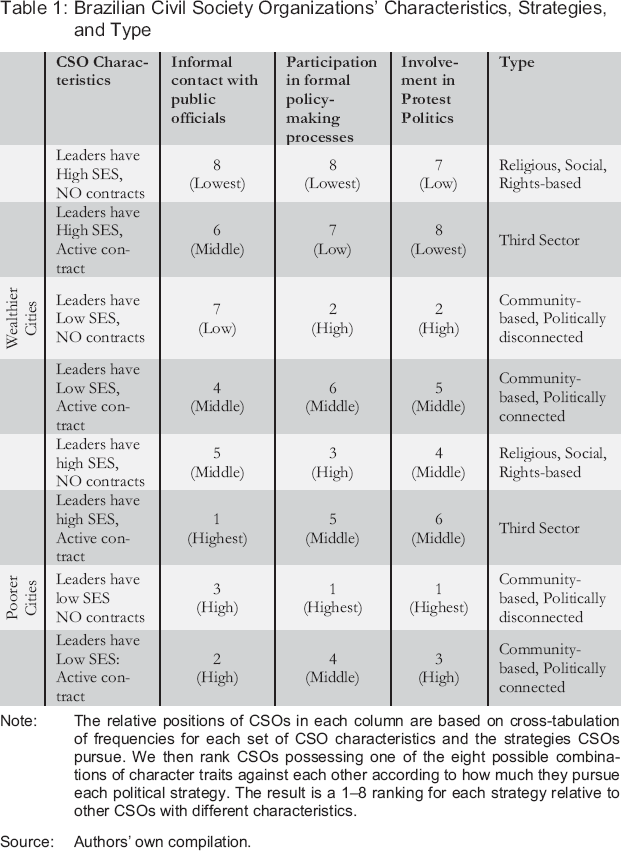
Note: The relative positions of CSOs in each column are based on cross-tabulation of frequencies for each set of CSO characteristics and the strategies CSOs pursue. We then rank CSOs possessing one of the eight possible combinations of character traits against each other according to how much they pursue each political strategy. The result is a 1–8 ranking for each strategy relative to other CSOs with different characteristics.
Source: Authors’ own compilation.
It is important to note that the cities included in the survey do not represent the poorest parts of the country. The cities in our sample are not representative of the largest cities in the country either.
In this article we show how the protections provided by the reestablishment of democratic rule, the creation of participatory institutions, and the expansion of the welfare state best explain why CSOs select specific political activities to pursue their political interests. These theoretical frameworks map onto the micro-, meso-, and macrolevel causal mechanisms we identify as crucial for explaining CSO behavior based on variation in the CSOs and the sociopolitical context in which they operate. Although this article focuses on seven Brazilian cities, we argue that our approach is sufficiently broad that our insights can be applied to patterns of political organizing across the region.
The paper proceeds as follows: First, we briefly describe the expansion and changes to Brazil's civil society during the 1980s and 1990s. Second, we focus on the changes in the political opportunities and institutional structures that altered the terrain of civil society organizing. Third, we present the Brazilian context, discuss our data, and describe the strategies we use to analyze our data. Fourth, we report and discuss our results with respect to broad debates in the field.
Four interrelated processes best explain the heterogeneity of Brazil's civil society today: (i) the renewal of civil society during the 1970s and 1980s; (ii) the creation of a new party system, especially the predominance of two reform-oriented parties (the Workers’ Party (Partido dos Trabalhadores – PT) and the Brazilian Social Democracy Party (Partido da Social Democracia Brasileira – PSDB)) at the center of presidential contests; (iii) the establishment of a new democratic architecture; and (iv) the expansion of social policy provisions in the years 2000–2009, which followed the economic stabilization of the 1990s (Kinzo 1996).
First, the renewal of civil society during the 1970s and 1980s ushered in new ways of conducting politics (Dagnino 1994 and 1998; Avritzer 2002; Dagnino and Tatagiba 2007). Specifically, the growth of new social movements and new forms of labor organizing contributed to new forms of engagement (Álvarez 1990; Avritzer 2002). For example, the liberation theology movement and Paulo Freire's critical pedagogy influenced citizens to organize around demands for civil, political, and social rights. Citizens also began to use democratic procedures within their organizations, including deliberative processes and elections. The expansion of civil society also fostered the creation of new political alliances and groups. These alliances potentially circumvented the clientelistic relationships of the past and offered groups new opportunities to pursue their interests. Furthermore, the increasing density and diversity of civil society allowed these groups to engage public officials in unprecedented ways (Avritzer 2002; Hochstetler and Keck 2007; Wolford 2010).
Second, the creation of a new party system, especially the growth of two reformist political parties (the PT and the PSDB), was directly relevant in generating new forms of participation and engagement (Keck 1992; Hunter 2010). The PT not only built itself on the infrastructure of new social movements and labor organizations but also linked itself to progressive sectors of the middle class, thus incorporating new interests into the PT coalition. The PSDB grew out of the Brazilian Democratic Movement (Movimento Democrático Brasileiro – MDB) and the Brazilian Democratic Movement Party (Partido do Movimento Democrático Brasileiro – PMDB) (political parties formed in opposition to the military dictatorship) and its original political base consisted of São Paulo's middle classes. Thus, the two dominant political parties created in postdictatorship Brazil (occupying the presidency from 1994–2014) emerged from an effort to reform the basic political and social institutions that govern the country. 4
Of course, both parties have changed their positions since the mid-1990s. The PSDB established the highly successful economic growth model, and the PT changed its position to be closer to the PSDB model while still focusing on social policies and redistribution.
Third, Brazil's establishment of a new constitutional order dramatically increased the number of citizens formally engaged with the state (Avritzer 2009; Abers and Keck 2009). Brazil's 1988 Constitution is a broad, sweeping document that includes a wide range of rights and a new distribution of authority. It offered concessions to conservative political groups (Hagopian 1996) as well as to newly organized civil society groups (Avritzer 2002). The 1988 Constitution introduced two specific changes that are pertinent to our research: First, it mandated an extensive municipalization of authority and resources. Second, the legislation that accompanied the new constitution required municipalities to establish specific types of participatory institutions and permitted local governments to experiment with other new forms of participation. As a result, the surface area of the state broadened, thus allowing citizens a greater number of entry points into the state (Heller and Evans 2011).
Fourth, Brazil's economic stabilization during the 1990s and subsequent economic expansion during 2000–2009 made new revenues available and allowed the government to increase overall spending levels. Elected officials at the federal and subnational levels also used these new resources to expand social-service delivery. Some of the results of this shift have been a real reduction in extreme poverty, a broadening of the working class, and an increase in access to basic consumer goods (World Bank 2014; UNDP 2010 and 2013). While income and asset inequality remain quite high, economic expansion increased the middle class's absolute wealth and created a much larger working class. Relevant to our argument here is that economic growth created a group of professionalized CSOs, which are led by individuals with much-higher-than-average income and education levels and represent relatively wealthy constituencies.
Citizens and civil society organizations, as the political opportunity literature on social movements has shown, modify their strategies in response to changes in the social, political, or institutional environment (McAdam, McCarthy, and Zald 1996; Tilly 2004). Tarrow argues that
differences in patterns of state building produced differences in the opportunity structures of social movements […]. Tocqueville's underlying message was that state-building creates an opportunity structure for collective action of which ordinary people take advantage (Tarrow 1998: 55–56).
We argue that the reestablishment of representative democracy, the implementation of new participatory institutions, and the expansion of social-service spending altered the opportunity structure for political engagement, thus inducing CSOs to utilize a wide range of activities in pursuit of their political and policy goals.
The first analytical pillar of our argument is that the return to representative democracy was accompanied by an increased protection of basic civil liberties, including the right to hold public demonstrations. Political protest is an integral part of political organizing in Brazil as excluded groups have traditionally used contentious politics as a way to place their interests on the public agenda (Álvarez 1990; Escobar and Álvarez 1992; Wampler 2007). As a result, an increase in public demonstrations following the democratic transition is not surprising, because contentious politics often accompany democratic state building. In this sense, democracy frees ordinary citizens to use disruptive, direct action to ensure public officials and their fellow citizens hear protesters’ demands (Tarrow 1998). Politically marginalized citizens have long used contentious politics to expand their rights, gain the attention of public officials and their fellow citizens, and access scarce public resources. Extensive use of contentious politics allowed new political coalitions to develop, pushed new leaders into the centers of political power, and highlighted the ability of outside groups to successfully promote significant institutional reform during recent transitions to and the establishment of democratic regimes during the 1980s, the 1990s, and the period 2000–2009 (Yashar 2005; Baiocchi 2005; Grindle 2002; Wampler and Avritzer 2004; Baiocchi, Heller, and Silva 2011). 5
The ability of citizens and CSOs to exercise these rights still varies widely across the country as well as among different socioeconomic classes (Abers and Keck 2013; Hochstetler and Keck 2007). Wealthier middle-class individuals holding demonstrations in central areas of large cities have greater protection than poorer citizens organizing protests far away from media outlets (Arias 2009). Nevertheless, Brazilian protesters are generally better protected under the democratic regime than they were prior to the transition.
The second analytical pillar of our argument is that new democratic institutions are part of a larger democratic state-building effort designed to overcome perceived deficiencies with representative democracy such as passive voters with little information, the lack of accountability among elected officials, a limited public sphere, and misallocations of scarce public resources (Avritzer 2002; Stepan 1989; Castañeda 1993; O'Donnell 1994; Fung and Wright 2003; Wampler 2007; Barczak 2001; Pate-man 1970 and 2012). Specifically, participatory institutions are designed to enhance the quality of democracy and improve the basic delivery of public goods to those groups historically excluded from all but the most minimal levels of state resources (Touchton and Wampler 2014). The establishment of participatory democracy is best conceptualized as a new moment of democratic state building, whereby intermediary bodies are established to further decentralize where, when, and by whom binding decisions are made.
Democratic state-building through participatory institutions is not uniform across Latin America or within each country due to the fragmentation of local and national states’ capacities, the diversity of rules that guide participatory institutions, the repertories of strategies available to CSOs, and elected officials’ interests (Goldfrank 2007; Migdal 2001; Scott 1998; Van Cott 2008; Wampler and Avritzer 2004; Wampler 2007; Fedozzi 2001).
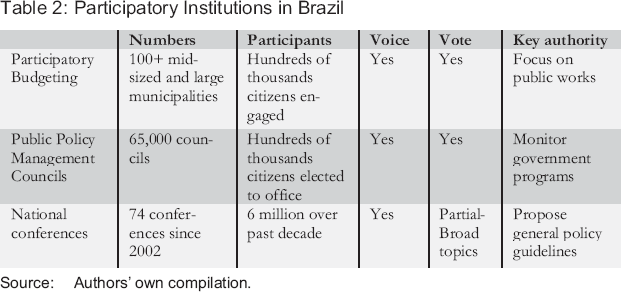
In Brazil the three most common participatory institutions include the widely established public policy management councils (conselhos), policy conferences (confêrencias), and participatory budgeting (orçamento participativo). There are now at least 65,000 municipal-level councils and hundreds of thousands of elected citizens that participate in these councils (Victora et al. 2011). One-quarter of medium-sized and large municipalities continue to use participatory budgeting as a policy-making and democratic tool. Presidents Lula and Dilma invested heavily in the national conference system, inducing more than 6 million people to participate over the past decade.
Participatory Institutions in Brazil
Source: Authors’ own compilation.
The establishment of participatory governance is now transforming when, where, and how contentious politics can be used, thereby encouraging us to modify Tarrow's definition of how contentious politics develop.
Collective action becomes contentious when it is used by people who lack regular access to institutions, who act in the name of new or unaccepted claims, and who behave in ways that fundamentally challenge others or authorities (Tarrow 1998: 3. Italics added).
Although participatory institutions now provide regular institutional access for large numbers of Brazilians, the Brazilian masses continue to use contentious politics as part of their political engagement repertory. This suggests that while regular access to participatory institutions increases the political opportunities available to citizens, it does not remove customary avenues of engagement.
The third analytical pillar of our argument is that Brazil's return to a neodevelopmentalist state was accompanied by an expansion of the social welfare state (Montero 2014; Sugiyama 2012). Federal, state, and municipal governments greatly expanded the number of social contracts they were able to provide. For many Brazilian CSOs, their mantra during the 1970s and 1980s was “autonomy,” which reflected CSOs’ efforts to maintain a healthy distance between themselves and public officials. Importantly, the overarching theme shifted to “partnership” or “cogovernance” during the first and second decades of the twenty-first century as CSOs sought to align themselves with the state and elected governments in order to secure public contracts.
In terms of accessing state contracts, middle-class CSO leaders have policy and personnel networks as well as professional skills that allow them to gain access to the expanded public resources. Thus, a combination of meritocracy (expert knowledge), know-how (ability to provide services and to “win” complex service-delivery contracts), and personnel networks (ties to political appointees, elected officials, and high-level civil servants) permits these CSOs to gain access to resources that sustain their organizations.
Conversely, social movements and CSOs whose leaders have lower SES must pursue a much more overtly politicized set of strategies in order to secure funding. These CSO leaders often lack professional skills, but instead have access to elected officials and to the poor. These CSOs are also more likely to be susceptible to co-optation because they are much more economically insecure than middle-class organizations.
In sum, Brazil's current democratic regime induces civil society leaders to play multiple formal and informal roles, acting as legislative aides, campaign workers, service delivery providers, party activists, elected representatives in participatory institutions, and community organizers. The boundaries between these roles are fluid, which means that in some venues community leaders represent the state; in other venues, a political party; and in others, the interests of their community organizations or social movements. There is now a blurring of the interests CSO leaders purportedly represent in any given venue, which is why it is vital to study cogovernance venues as one institutional process embedded in broader economic and political contexts. Within democratic regimes, especially when there are competitive local elections, the cooperation of CSOs and public officials is widespread, making it necessary to conceptualize contentious politics as one political tool in a broader repertoire of political strategies employed by CSOs to pursue their political, policy, and organizing goals.
We administered a survey to CSO leaders in seven Brazilian municipalities in 2009 and 2010 to collect data on the connections between the state and civil society. 6 One of the cities selected, Belo Horizonte, is the state capital of Minas Gerais and has a population of roughly 2.5 million residents. The other six cities are midsized, with populations between 100,000 and 250,000 people. We opted to study a greater number of midsized cities because we know much less about the interactions between the state and civil society there than we know about those in the large capital cities. These cities include Juiz De Fora, Lages, Montes Claros, Sorocaba, Uberlândia, and Vitória Da Conquista. We limited our sample to one southern city (Lages), one city in the state of São Paulo (Sorocaba), one city in the state of Bahia (Vitória Da Conquista), and three cities from the state of Minas Gerais (Juiz De Fora, Montes Claros, Uberlândia). We selected these specific cities because they exhibit considerable variation based on wealth, regional and state politics, local party system, and the configuration of civil society. We argue this variation increases the chances that any relationships we find in the data using all seven of these cities will reflect the average experience of many similar Brazilian municipalities.
Dr. Brian Wampler worked with Dr. Leonardo Avritzer (Federal University of Minas Gerais) to administer this survey. Financial support to administer the survey came from multiple sources, including the Federal University of Minas Gerais, Boise State University, the Civil Society Consortium of the University of Massachusetts, and the Research Foundation of the State of Minas Gerais (FAPEMIG).
Our survey captures civil society leaders’ activities and attitudes. These leaders are the crucial conduits linking the state to citizens and CSOs in each city. First, we obtained each city's lists of registered organizations. Then we contacted each organization and surveyed its president or another leader. The sample is comprised entirely of CSO leaders who are engaged in participatory organizations or civil society organizations that register with the municipal government to remain eligible for state contracts (convenios). 7 Our survey population thus includes a wide variety of professional organizations as well as local voluntary associations.
In each city we contacted the municipal government to secure lists of CSOs formally registered with the municipal state. CSOs are registered with the different public policy councils, the policy conferences, and with specific departments. We attempted to contact approximately 1,200 CSOs from all seven cities. We then surveyed all 863 CSOs that responded to our initial contact. In five of the seven cities, we employed student research assistants to administer surveys to CSO leaders in person in the leaders’ respective neighborhoods. We administered the survey via telephone in Belo Horizonte and Lages.
The survey asks questions about the structure of the CSO, its connection to the state, its connection to civil society, and the demographics of its leadership. For example, the survey requests information regarding whether the CSO elects or appoints its leaders, whether they have a contract to provide services with an outside organization (e.g., the state, a private firm, another nonprofit), how frequently the CSO meets. We also ask questions concerning the frequency with which the CSO has contact with local government representatives and participatory democratic institutions and about what activities the CSO pursues (e.g., street protests, council meeting attendance). A total of 863 CSO activists responded to the survey in our seven-city sample. The resulting database represents one of the largest, broadest cross-sectional surveys of CSOs in Latin America and therefore offers unique opportunities to test hypotheses and examine the conventional wisdom surrounding state–civil society relations.
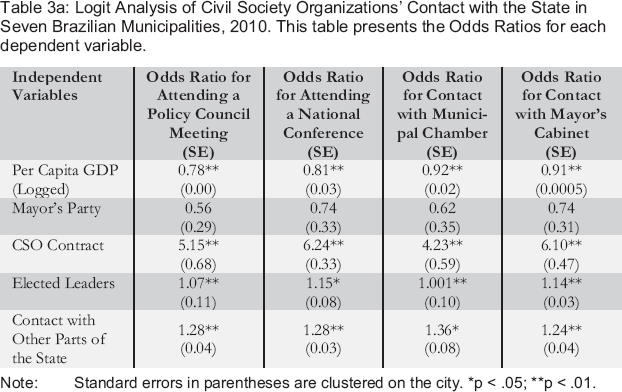
We specify seven logit models with standard errors clustered on the city to explain CSOs’ connection with the state and the form of political participation they use to pursue their interests. In each case we present the dependent variable from each set of models, discuss the independent variables and our specific hypotheses connecting them to the dependent variable, and then present the estimation results for each individual model. We report the raw coefficients for relationships between the independent and dependent variable and include the odds ratio for each variable in the Technical Appendix (see Tables 3a–7a). We construct the first set of models to answer questions about whether CSOs have contact with municipal councils, legislative assemblies, and/or members of the mayor's cabinet.
Our data captures the range of contact CSOs had with municipal, state, and federal institutions in the form of participatory democratic institutions, the municipal legislative council, the state legislature, and the mayor's office for the two months prior to responding to the survey. We use the responses to generate four dichotomous variables with scores of 1 indicating that participation or contact has occurred and 0 indicating that it has not. Out of the entire sample, 77 percent of CSOs attended participatory council meetings, 65 percent attended national conferences, 48 percent contacted the municipal legislature, and 63 percent contacted the mayor's office.
We use CSO leaders’ formal participation in state institutions and informal contact with different government officials to measure overall engagement between the state and civil society. Explaining the frequency with which CSO leaders participate in formal policy-making bodies and contact different branches of the state can help us understand the motivation behind CSO activities and also provides an indication of the current configuration of state–civil society relations in Brazil.
Key Independent Variable: The City's Wealth
We first want to know whether a city's wealth accounts for CSOs’ political activities. We hypothesize that CSOs in relatively wealthy cities are likely to engage the state less than CSOs in relatively poor cities, thus revealing a wealth dimension to clientelistic exchanges. For instance, CSOs in poorer municipalities rely on state institutions and public and party officials to secure scarce resources in order to help their community members get access to basic services. In contrast, CSOs in wealthy municipalities have more resources, are more professionalized, and have more connections with civil society than in poorer cities. They will therefore find it less necessary to rely on the state for support. Though state support may offer benefits, it may also carry a cost that CSOs in wealthier cities do not need to pay.
We use the log of each municipality's local GDP/capita as the first proxy for access to resources. We recognize, however, that this is an incomplete proxy for the wealth of a CSO's membership or the resources CSOs themselves might have. Brazilian cities feature populations representing diverse economic experiences. Wealthy cities contain many poor neighborhoods and poor cities contain wealthy neighborhoods. Accounting for the particular submunicipal context in which a CSO operates is important to assess whether a CSO's relative wealth impacts its behavior. We therefore use the household income of the survey respondents as an additional proxy for our CSOs’ economic contexts. Although this measure provides more refined information about CSOs’ submunicipal economic environments, it still requires two different assumptions about the CSO leaders’ household incomes. First, we assume that leaders with higher incomes are associated with “professional” or third-sector NGOs and thus work on behalf of an issue or community without necessarily being a potential recipient of the public good. Second, we assume that low-income respondents are working with a “community-based organization” in which they seek to secure public goods that would directly benefit their communities.
Key Independent Variable: The CSO Administrator's Household Income
We collect data on the monthly household income of each CSO administrator that responded to our surveys. This variable takes on the values of different salary bands corresponding to the following monthly household income levels: (1) up to USD 250, (2) USD 251 to USD 500, (3) USD 501 to USD 1,000, (4) USD 1,001 to USD 1,750, (5) USD 1,751 to USD 2,650, and (6) above USD 2,651. Our data show that 16 percent fall within salary band 1; 22 percent, in band 2; 34 percent, in band 3; 12 percent, in band 4; 8 percent, in band 5; and 8 percent, in band 6.
Control Variables
The Mayor's Party: New forms of democratic participation and the strengthening of civil society have been the centerpiece of the PT's national agenda over the last decade. PT mayors and CSOs often share a pro-poor bias and are thus likely to cooperate at greater rates, on average, than CSOs and non-PT mayors. Furthermore, poorer populations targeted by CSOs and the PT are almost always disengaged from politics. Incorporating the poor and politically disengaged into the city's policy-making architecture would theoretically increase the likelihood of poorer citizens voting in city elections. These new voters would most likely vote for left-wing parties who propose downward redistribution of city revenue. Conventional wisdom therefore suggests that left-wing mayors would champion CSO programs not only because their downwardly redistributive, poverty reducing policy platforms are popular with many CSOs, but also because they want to bring new left-wing voters to the polls.
In general, we expect PT mayors to have greater opportunities to support state-society interaction and CSO engagement than non-PT mayors both through resources from the national government and the party and through a greater motivation to align with ideological policy. We anticipate CSOs in municipalities with PT mayors will have greater interaction with the state, will be more likely to elect their leaders than CSOs operating in municipalities with non-PT mayors, and will be less likely to use protest as a form of political participation. If the “protest” part of our assumption is correct, it suggests that the PT's longtime base will change their political strategies when the PT is in power, thus raising the likelihood of co-optation. We use a dichotomous variable to test whether CSOs in municipalities with PT mayors (coded 1; accounts for percent) behave systematically differently from CSOs in municipalities with non-PT mayors (coded 0; accounts for 54 percent).
Whether CSOs Hold Government Contracts
We collect data on whether CSOs are contracted to provide services for an external entity. This entity is almost always one tier of Brazil's federal system, but it could also be a foreign government, a domestic charitable organization, or an international nonprofit – even the Catholic Church.
We hypothesize that CSOs with state contracts are likely to have more interaction with the state due to such contracts. We also think that CSOs with government contracts are less likely to protest against the state; this may be due to having a contract with the state in some cases, but may also be due to the professionalization that comes with having a contract to provide services. The direct responsibilities to fulfill contracts become relatively more important compared to some of the CSOs’ other long-term missions. For example, a contract creates a financial incentive to focus on providing services and may not leave time for political protest. Simply put, a contract for service delivery can transform CSOs from crusaders into managers. Furthermore, CSOs that receive contracts are likely to be the most professionalized and the most focused on service delivery and are most likely to pursue their missions through means beyond public protests in the first place.
We employ a dichotomous variable to ascertain whether CSOs are under contract (coded 1; accounts for 46 percent) or not (coded 0; accounts for 54 percent).
Whether the CSO Elects its Leadership
We expect CSOs’ organizational structure to impact their contact with the state and their form of political participation. Broadly speaking, some CSOs elect their leaders, whereas others appoint them from their membership. Elected leaders may have different incentives driving their behavior than appointed leaders. For example, an elected leader may have a strong incentive to mobilize CSO membership for a protest because public protest is a highly visible way to demonstrate a leader's commitment to action on behalf of the organization. Additionally, organizations that elect their leaders may have a natural affinity with democratically elected state representatives. These similarities may lead to greater contact between CSOs with elected leaders and the state than between CSOs with appointed leaders and the state. Similarly, elected CSO leaders may be ambitious and interested in using their positions to network with public officials, gain experience with the state, and/or expand their career opportunities. Finally, internal CSO elections allow ordinary participants to hold their leaders accountable, as candidates for CSO leadership positions must demonstrate their engagement in a variety of policy venues – possibly beyond protest activities.
To test these hypotheses, we use a dichotomous variable to determine whether CSOs elect their leaders (coded 1; accounts for 14 percent) or appoint their leaders (coded 0; accounts for 86 percent).
Contact with other State Entities
We anticipate that CSOs inclined to work with one state entity will have a greater chance of contacting and attempting to work with another state entity. This may occur if a CSO's initial state contact does not produce the expected outcomes, thus leading the CSO to solicit help from another state entity or patron. The CSO could also pursue contacts with multiple state entities at once to generate better outcomes as a client or simply because the first state entity is not able to resolve a CSO's problem or provide it with a service.
We code a variable that measures the number of state entities a CSO reports having had contact with during the six months prior to our survey (not including the branch of the state for the DV in Tables 3 and 4). The minimum amount of contact is 0 and the maximum is 5. The mean number of entities with which CSOs interact is 1.57 and the standard deviation is 0.46.
Logit Analysis of Civil Society Organizations’ Contact with the State in Seven Brazilian Municipalities, 2010
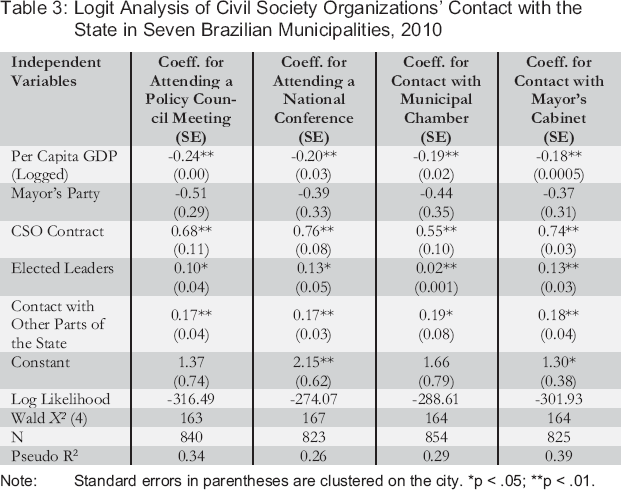
Logit Analysis of Civil Society Organizations’ Contact with the State in Seven Brazilian Municipalities, 2010
Note: Standard errors in parentheses are clustered on the city.
p < .05;
p < .01.
Logit Analysis of Civil Society Organizations’ Contact with the State in Seven Brazilian Municipalities, 2010 (Using CSO Administrators’ Household Incomes)
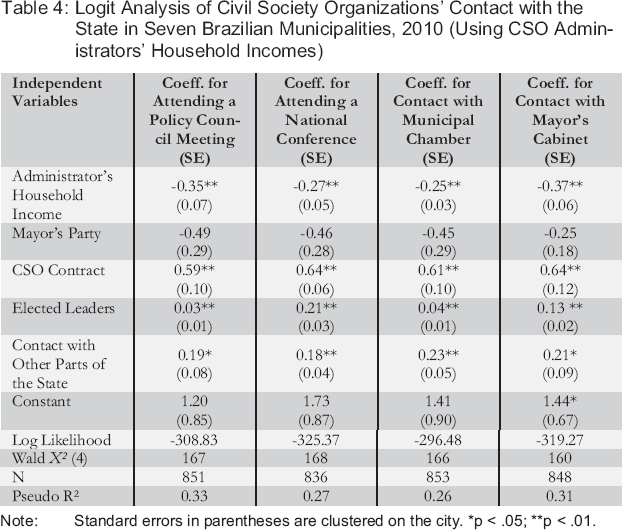
Note: Standard errors in parentheses are clustered on the city.
p < .05;
p < .01.
First, the results in Tables 3 and 4 indicate that both formal and informal CSO contact with participatory democracy decreases as the city in which CSOs are located gets wealthier. Similarly, CSO engagement with the state decreases as CSO administrator household income increases. The direction of these relationships is consistent across model specifications and statistically significant in each case. The relationships hold for CSO contact with other branches of the state as well: the odds of CSOs having recent contact with public officials decrease as city wealth and CSO administrator household income increase – in some cases, by almost 40 percent per unit increase. This suggests that compared to CSOs from municipalities with a mean level of logged GDP/capita, those with logged GDP/capita of one standard deviation above the mean are estimated to have on average up to 32 percent less contact with the state when holding all other variables constant at their means. This finding provides support for the resource mobilization argument: CSOs become less dependent on the state as the wealth of their community grows (Buechler 1993; Jenkins 1983).
Second, the results in Tables 3 and 4 show that CSOs with elected leaders are more likely to have contact with participatory democracy and other state entities than are CSOs with appointed leaders. This is important because it suggests that CSO members expect leaders to show evidence of their organizations’ progress and represent members’ interests to the state. The willingness of elected CSO leaders to interact with the state (controlling for the CSO leaders’ SES) might reflect high expectations and accountability as CSO leaders who fail to showcase their efforts through interaction with the state may be voted out of office. This is updated evidence for the “participatory publics” argument, which draws attention to the use of democratic practices inside of CSOs (Avritzer 2002; Wampler and Avritzer 2004).
Third, the results in Tables 3 and 4 indicate having a contract increases the likelihood of contact with the state by approximately five times relative to organizations without a contract. This suggests that contracts not only provide CSOs with payments for services but also create and strengthen connections between the state and civil society. We create an interaction term for CSO leaders’ income and for whether the CSO has a state contract. The results of the estimation presented in Table 5 show that CSOs with relatively wealthy leaders and state contracts are more likely to engage with the state than are CSOs with only wealthy leaders.
Logit Analysis of Civil Society Organizations’ Contact with the State in Seven Brazilian Municipalities, 2010 (Using an Interaction between CSO Administrators’ Household Incomes and State Contracts)
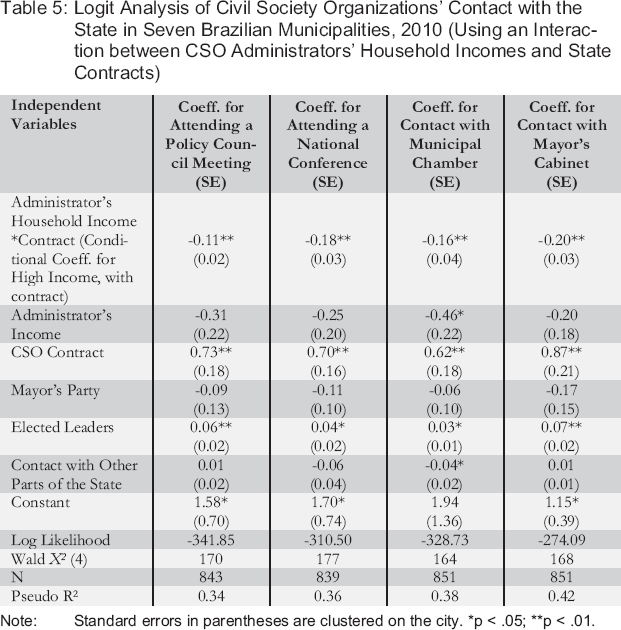
Logit Analysis of Civil Society Organizations’ Contact with the State in Seven Brazilian Municipalities, 2010 (Using an Interaction between CSO Administrators’ Household Incomes and State Contracts)
Note: Standard errors in parentheses are clustered on the city.
p < .05;
p < .01.
We also evaluate CSO assessments of learning following state contact and participation in state institutions. The results in Table 5a of the Technical Appendix help corroborate some of our arguments about wealth and CSOs’ reliance on the state. CSOs from wealthier cities and with wealthier administrators are less likely to feel that attending educational workshops is beneficial than are CSOs in poorer cities and with poorer leaders. Thus the CSOs with potentially fewer resources have more contact with the state and they express satisfaction with regard to that contact – at least in the form of claiming to have gained beneficial knowledge of how government works by attending workshops. In contrast, CSOs with potentially more resources are, on average, less likely to have contact with the state and less likely to find that contact beneficial in terms of workshops.
Our data reveals a general trend where CSOs in wealthier cities and with wealthier leaders are distant from formal politics. It appears that wealthier CSOs already have the resources, knowledge, and connections to pursue their interests without relying on the state. CSOs in wealthy areas and with wealthy leaders are likely to be more professionalized and perhaps have organizational advantages, which means that they do not need the state as much as CSOs in poorer cities and with poorer leaders do. However, the relationships we find in the data could also stem from state officials’ attempts to shield themselves and their agencies from pressure. Under this conceptual framework public officials might reasonably expect CSOs with more resources to make greater demands, deploy greater resources, and use greater connections in government to pursue their interests compared to CSOs with relatively fewer options. Interactions with well-resourced CSOs may therefore present public officials with more political trouble than benefits.
Finally, we assess what drives CSOs to participate in public demonstrations. Public demonstrations represent a visible but blunt form of political participation. Mass protest can also potentially have an outsize impact relative to its cost due to the high visibility of demonstrations and the large voting blocs the poor represent in Brazil, where other forms of participation are relatively closed to poorer citizens.
Dependent Variable: CSO Participation in Protests
We collect data on whether CSOs organized or participated in a public demonstration in the previous six months. The variable is coded 1 if such participation occurred in the six months prior to the survey (42 percent of CSOs) and 0 if it did not (58 percent of CSOs) did not. We specify two additional models to identify the determinants of protest participation among CSOs.
Key Independent Variable: Wealth of Cities and CSO Administrators
Citizens and CSOs in poorer cities are likely to rely on the state more than CSOs in wealthier cities. As a result, politicians may be vulnerable to public pressure because their ability to retain office in these cities often depends on maintaining majority support of the poor – the largest group of Brazilian voters. CSOs in poorer cities or communities will therefore be more likely to use public protest to participate and to put political pressure on the state than CSOs in wealthier cities and communities. However, CSOs in poor cities, whose leaders have low SES, may protest because they lack other means to express their grievances, not necessarily because they are more dependent on public services. Our point here is that much like with CSO-state interaction above, more professional CSOs have different ways of engaging public officials and do not need to use mass protest to achieve their goals.
Logit Analysis of Civil Society Organizations’ Participation in Protests in Seven Brazilian Municipalities, 2010
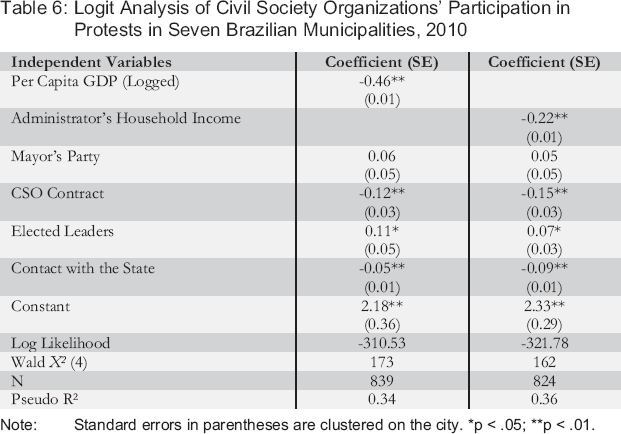
Logit Analysis of Civil Society Organizations’ Participation in Protests in Seven Brazilian Municipalities, 2010
Note: Standard errors in parentheses are clustered on the city.
p < .05;
p < .01.
We find several important connections between CSOs’ characteristics and their likelihood of protesting. First, the probability of protesting decreases as city wealth and CSO leader household income increase. This is similar to our finding with regard to contact with the state, in the sense that CSOs with access to more resources do not need to use public demonstrations to pursue their goals. Relatively well-resourced CSOs may see such protests as inefficient types of political participation and use them only as a last resort when its resources, knowledge base, and connections fail. In contrast, CSOs in poorer cities and with poorer leaders may have fewer options and may thus find protests attractive due to the attention they generate and the familiarity they have with this form of participation. Our results draw connections between wealth, contact with the state, and participation in protests. The implication is that CSOs in poorer cities are still using one of two strategies that have maintained them for decades: protest or clientelism (Roniger 2004). These organizations have not abandoned political contestation, because it remains a viable means for them to pressure the state and because the new democratic institutions may not be working as well as they should be.
Second, we find that CSOs with contracts are less likely to protest than are CSOs without contracts. This provides added support for the argument that CSOs in the poorer cities still use protest or clientelism. The results also suggest that civil society has undergone a process of professionalization and that the state has possibly co-opted CSOs through the offer contracts, as CSOs with contracts are engaged in participatory democratic institutions, not street protests.
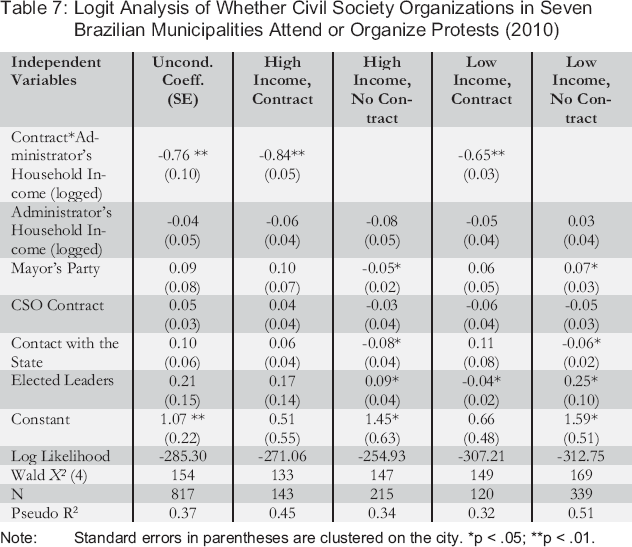
The government contract and wealth variables let us assess whether wealth, professionalization, or co-optation drives CSO strategies with regard to political participation. We interact CSO administrator household income with CSO contract to determine whether wealthy CSOs with contracts are less likely to protest than (i) CSOs with poor leaders and contracts, (ii) CSOs with poor leaders but without contracts, (iii) or CSOs with wealthy leaders but without contracts. The model below allows us to generate estimates for different configurations of CSO administrator household income and CSO contracts.
CSOs with relatively wealthy leaders and contracts are less likely to protest than (i) CSOs with poor leaders and contracts, (ii) CSOs with wealthy leaders but without contracts, and (iii) CSOs with poor leaders but without contracts. This provides some evidence of professionalization, rather than of co-optation in terms of contracts, likely CSO resources, and participation in protests. CSOs whose administrators have household incomes one standard deviation above the mean and who have state contracts are the least likely to have attended a protest, all else being equal.
Logit Analysis of Whether Civil Society Organizations in Seven Brazilian Municipalities Attend or Organize Protests (2010)
Note: Standard errors in parentheses are clustered on the city.
p < .05;
p < .01.
CSOs whose administrators’ incomes are one standard deviation above the mean but do not have state contracts are the next least likely to have attended a protest. CSOs with relatively poor administrators but that have contracts are the next least likely to protest, which is a 16 percent lower probability than the CSOs most likely to protest – those without contracts and with relatively poor administrators. The diminished likelihood of political protest by poorer CSOs with contracts suggests that state co-optation may also be present in Brazil's new participatory environment.
We perform a series of robustness checks to assess the stability of our results and thoroughly test our hypotheses. 8 First, we create new interaction terms to assess whether the mayor's party exerts a different level of influence on relatively wealthy CSOs compared to relatively poor CSOs. None of these interaction terms have a statistical impact on CSOs’ interaction with the state or the likelihood of CSOs participating in a protest. We also assess whether a left-leaning council majority influences the behavior of CSOs by coding a variable to indicate a left-leaning council majority relative to a non-left-leaning council majority – again with no results. This implies the mayor's party has little impact on CSO behavior in our sample – no matter how we construct the variables in our models. We also use CSO administrator education levels as a proxy for CSO memberships’ relative education and wealth to check our primary models’ measures. CSOs’ frequency of state contact and protest decrease as the respondent's education increases. Our results for all models thus remain broadly similar with or without professional CSOs in the dataset. Finally, the low correlations among the independent variables in Table 8 of the Technical Appendix suggest there are no concerns about multicollinearity in our models. 9
These models are available in the Technical Appendix.
Our variables’ variance inflation factors (VIFs) are all under 5 as well.
Logit Analysis of Civil Society Organizations’ Contact with the State in Seven Brazilian Municipalities, 2010. This table presents the Odds Ratios for each dependent variable.
Note: Standard errors in parentheses are clustered on the city.
p < .05;
p < .01.
This article captures how Brazil's recent political reforms frame the interactions between the state and civil society. The extension of civil liberties protection under representative democracy, the establishment of participatory institutions, and the growth of state services provided by CSOs all influence how Brazilian CSOs engage with the state. Our results reflect politics throughout Latin America, where civil society organization has expanded among poor and middle-class communities (Ox-horn 2011; Schönwälder 2010). Democratization, institutional reform, and the growth of the middle class offers CSOs new opportunities to pursue their interests in ways distinct from earlier civil society mobilizations under authoritarian governments (Fox 1996; Rueschemeyer, Huber Stephens, and Stephens 1992). In this case, Brazilian civil society has been “thickening” over the last 20 years as it has been in many other middle-income Latin American democracies, such as Argentina (Friedman and Hochstetler 2002), Chile (Oxhorn 1995), Colombia (Romero 2002; Hurtado, Kawachi, and Sudarsky 2011), Costa Rica (Carneiro, Matos, and Husted 2015), Mexico (Haynes 2013), and Uruguay (Burt, Amilivia, and Lessa 2013). CSOs in these countries now have new opportunities, which are also likely conditioned by their particular representational environment – as Friedman and Hochstetler found in their comparison of Brazil and Argentina (2002).
Our empirical findings suggest that in Brazil CSOs in poor cities and those in wealthy cities but with low-income leaders pursue a combination of direct contact with public officials, participatory democracy, and contentious demonstrations. CSOs from relatively poor cities and with relatively poor leaders engage with the state at greater rates than CSOs in relatively rich areas and with richer leaders even though conventional wisdom suggests they would not do so (White 1999; Lavalle, Acharya, and Houtzager 2005). This set of results reflects scholarship on contentious politics in a new moment, where the state is newly and heavily involved in the political life of the poor (Tarrow 1998). Direct involvement in new democratic institutions does not decrease the likelihood of direct action (protests and contentious activities). Rather, it relies on government contracts (outsourcing), which has the larger effect of decreasing CSOs’ likelihood of using protest as a political strategy.
Our results also suggest that CSOs in wealthier cities and with wealthier leaders are evolving into third-sector organizations that provide services or distance themselves from the state as private financial resources become more prevalent through economic growth. This finding illuminates the importance of opportunities within Brazil's neodevelopmentalist state, which leads middle-class CSO participants to use their expert knowledge and technical skills to engage public officials in new ways rather than resorting to contentious politics. CSOs in poorer communities are not necessarily abandoning clientelism or contentious politics, but they are moving beyond a narrow set of choices in order to pursue their interests. Although the state has expanded and engages with the poor in some areas, the poor continue to seek the state out to make their voice heard and gain voting power at the same time.
Finally, these results support scholarship on the reconfiguration of civil society in Latin America following democratization (Brysk 2000; Booth and Richard 1998; Wampler and Avritzer 2004). New repertories of political action are now available to CSOs, including involvement in party politics, campaigns and elections, incremental policy making, contentious politics, and economic boycotts, inter alia. Opportunities to engage in collective action are more readily available in the current democratic environment, especially in comparison to the extreme difficulties experienced under military dictatorships. New challenges for collective action correspond to the broad diversity of activities CSOs find necessary to achieve their goals. For instance, CSOs must mobilize citizens, engage in incremental policy making, work on campaigns and elections (but not get too close to party officials), and develop broader social and policy networks. Achieving these goals has gained relevance in recent decades as CSOs build stronger connections between democratic states and society. Understanding how and why CSOs build these connections is thus critical to understanding how democracy works – particularly at the local level. We argue that Brazilian CSO strategies depend on the interaction between a political community's wealth, the protection of basic civil liberties, the proliferation of new democratic institutions, and the outsourcing of state contracts. In this respect, our research describes and explains important connections between Brazilian democracy and civil society. It also provides a framework for exploring these connections elsewhere in Latin America and, potentially, around the world.
Footnotes
Technical Appendix
PT mayors may privilege the expansion of civil society relative to mayors from other parties and may therefore encourage CSO-state interaction and promote CSO contracts among wealthy and poor CSOs. We want to know if CSOs in relatively wealthy cities with PT mayors have more interaction with the state than under other political circumstances. Similarly, we want to know if CSOs in relatively poor cities protest less when the mayor is from the PT (and thus potentially supports pro-poor policies) than when there is a non-PT mayor in office. Table 3a.1 presents the results of estimation using these variables.
One might reasonably believe these professional organizations with mostly salaried employees are distinct from volunteer organization in terms of their resources, connections and professionalism. We have no quarrel with the general argument on this count and we remove the professional organizations from the dataset to determine if the results of estimation change in their absence. We find the results, presented in the technical appendix, are similar without the professional organizations, indicating there are no systematic differences between professional and non-professional CSOs in our dataset. Our results also remain broadly similar when any one city is removed from the dataset providing evidence the results are not driven by one particular Brazilian municipality.
We also want to know what explains whether CSOs value their interaction with the state and pursue external opportunities for training in support of their mission. We collected data on whether CSOs report learning valuable information or improving their understanding of how government works from attending workshops, conferences or meetings with state officials. We believe wealthier CSOs have relatively more professional experience and knowledge of how to pursue their organizations’ missions than poorer CSOs. Thus, these wealthy CSOs may not feel like they learn a lot from their contact with the state or their attendance of workshops, conferences, etc. because they already have this information. The perceived educational value of interacting with the state provides another opportunity for us to assess why CSOs pursue particular strategies of participation and forms of interaction. We therefore specify a second broad model to explain the determinants of CSO learning.
The dependent variable reflects CSO administrators’ assessments of how much they learned about government through attendance of state-supported educational/information workshops forums. These workshops take on different forms, but they most often offer a combination of a political history of the new policymaking venues and basic policymaking information. The sessions are typically geared toward individuals with high school or less education in order to help them gain the necessary knowledge to better engage incremental policymaking processes. It is coded “0” if the respondent did not believe attending educational meetings increased knowledge of how government works or how best to pursue their groups’ interests and “1” if attendance increased knowledge in these areas. 19% of respondents believed attendance did not increase knowledge while 81% believed it did.
We believe CSOs from wealthier communities will be less likely to report beneficial educational experiences from attending workshops for the same reasons relatively wealthy CSO administrator's will have less contact with the state. These relatively wealthy, professional, knowledgeable organizations have the resources, connections and education to use the state. They may report relatively small knowledge gains from the workshops because they already have more of the information to begin with, thus making attending workshops a less productive experience. Table 5a presents the results of estimation using CSO learning as the dependent variable.