



Abstract
While scholarship on the politics of labor market divides and labor law in Latin America has bloomed in recent years, this literature rarely looks at the role of public opinion. Using data on public attitudes towards labor law for 18 Latin American countries, we start filling this gap. We follow the literature on labor market divides to see how far those at the margins of the formal labor market differ in their opinions from the formally employed. We find that large segments of the people perceive labor law as protective for workers, but there are also important divides: Whereas formal sector workers indeed assess the protective function of labor law positively, informal sector workers are more sceptical. Moreover, we find feedback effects of labor law on these differences of opinion. We conclude with a discussion how these divides in attitudes also have political effects, especially on voting behavior.
Introduction
The last decade has seen a resurgence in scholarly debates about the politics of labor market divides (Murillo and Schrank, 2005; Rueda et al., 2015). In Latin America, these debates have often focused on informality (Carnes and Mares, 2014, 2015, Berens 2015a, 2015b), in turn building on older work on the informal sector (Hart, 1973; Perry et al., 2007; Portes and Hoffman, 2003; Portes and Sassen-Koob, 1987). Yet divides and insidership are mainly discussed in terms of social exclusion rather than labor market exclusion. Somewhat surprisingly, for both the European and nascent Latin American debates, the role of labor law is an area less covered. When we say surprising we mean that in many theories labor law acts as the linchpin for much of the differentiation into insider-biased or dualised labor markets (Saint-Paul, 2000; Kemmerling, 2009). Labor law defines the individual and collective rules and regulations that aim at protecting or representing workers’ rights in firm relationships. Yet, especially in empirical research on the micro level, the role of regulation falls behind when compared to issues of redistribution and risk exposure (Rehm, 2009).
When it comes to studying the politics of labor regulation, most approaches are macro in nature. For Latin America, there is a lot of literature on the linkages between political parties, unions, and labor regulation (Collier and Collier, 2002). Matthew Carnes has developed a fascinating account about the historical origins of labor law (e.g. Carnes, 2014b). Others, such as Maria Victoria Murillo or Layna Mosley, have sharpened our understanding of recent reforms of labor codes (Mosley and Uno, 2007; Murillo, 2005; Murillo and Schrank, 2005). While our knowledge of the origins and reforms in labor laws in Latin America has improved, we know much less about their political consequences, especially on the level of voters and public opinion. What does the public think about these laws, who really benefits or loses, and who supports or vetoes reforms of labor markets in Latin America?
Resistance against labor reforms is clearly high, despite the bout of the liberalising economic reforms in many other areas during the 1990s. And we see remarkable variation in the extent and configuration of these laws throughout the region and that many countries avoided the liberal reform pressure in the domain of labor market regulations (Murillo, 2005). This calls for a closer inspection of what people think of these labor codes.
We will look at public opinion on labor laws in Latin America to find out who are potential beneficiaries or losers. While the idea of labor laws is to give protection to employed people, huge problems of legal coverage and informality in Latin America make us believe that certain types of labor laws only work for parts of the population. The unemployed or informal sector workers, in particular, might think of labor laws differently. Moreover, this divide itself could depend on existing levels and types of regulation. Finally, some individuals may have found means to protect themselves against labor market risks in other ways so that they depend less on the role of institutions: class, education, or political connections may function as substitutes or complements to coverage in the legal system. For all these reasons, different employment groups may differ in how they see labor regulation, and even how they react politically to it.
To show this, we look at public attitudes towards job laws and whether or when people perceive them as protection for workers. We sharpen our expectations by surveying the literature on labor regulation in Latin America (“Labor Market Divides, Informality, and the Demand for Regulation” section). Next, we use Latinobarometer (LAB) data for up to eighteen countries and run a battery of multi-level regressions to understand the determinants of public opinion (“Empirical Determinants for Public Opinion on Labor Laws” section). On the micro level, we find that individuals at the fringe of the formal labor market (unemployed and informal workers) think laws are less protective (“Results” section). On the macro level, we show that feedback effects play a role: labor law shapes the divide in public opinion, since the divide increases in countries with better (effective) protection. We perform several robustness checks to see whether the results remain stable in different models (“Sensitivity Analysis: Varieties of Labor Law and Robustness” section). Finally, we discuss the larger political implications of our findings, making a stylised example about labor market divides and voter turnout (“Discussion and Conclusions” section).
Labor Market Divides, Informality, and the Demand for Regulation
Up until recently, Latin American labor markets saw nearly two decades of buoyancy, thanks to rising global demand (World Bank, 2013). So strong had the effects been they even left their mark on (reducing levels of) inequality (Lustig et al., 2013) and arguably facilitated much of politically delicate social and labor reforms in this period. Yet, not everyone profited from this growth to the same degree, and not every country to the same extent. While much of these differences are due to socio-economic factors beyond the narrow reach of politics, the institutional setup of Latin American labor markets remains a controversial political topic across the region.
Labor laws can entail many different aspects of regulating the work life of people. A first important aspect, especially for most economists, is matters of hiring and firing. A second type of laws regulates wages, working hours, and working conditions directly. Both aspects are sometimes summarised as “individual labor laws” affecting the working conditions of employees individually. Another aspect of labor law covers workers’ rights to collectively organise and bargain on wages and working conditions. The literature on corporatism and wage bargaining institutions has shown that not all these types of labor regulation move in close correspondence and that different countries put different degrees of importance on different aspects of the law (Boeri, 2011; Carnes, 2014a).
We know that Latin American countries diverge markedly in these forms of labor laws. The reasons for these different trajectories have been extensively researched for advanced and Latin American economies. There are those who put emphasis on legal traditions (Botero et al., 2004), or the role of left political parties and unions (Collier and Collier, 2002), or those highlighting institutional complementarities and skill needs (Carnes, 2014a; Schneider and Karcher, 2010). For more recent reforms, Murillo (2005) has shown how left parties have pushed for better protection even against the tides of globalisation and structural adjustment (also Mosley and Uno, 2007; Murillo and Schrank, 2005), whereas conservative or non-democratic governments have aimed at deregulating labor law (Collier and Collier, 2002;Geddes, 1994). Most of these approaches work on the macro level of institutions or the meso level of parties and interest groups. Naturally, such accounts give voters and the public opinion less prominence. And yet, given the broad resistance against seemingly ineffective laws in countries with huge gaps in legal coverage, public opinion on labor laws is an interesting dimension to be explored.
In this respect, the literature on demands for regulation and redistribution, and theories of labor market divides in particular, may be better suited to tease out the contribution of the individual level to the politics of labor law. After all, labor laws are the linchpin of regulation that may drive visible wedges between those with standardised work contracts and those without. Implicitly or explicitly labor regulation is the focal area of the literature on labor market dualisation (Boeri, 2011; Emmenegger et al., 2012). It also relates closely to the idea of labor market insiders and outsiders (Rueda, 2005; Saint-Paul, 2000). However, these theories have not remained uncontested. Some people have criticised them since the divide between insiders and outsiders is not always so clear (Emmenegger, 2009). Others have argued that, for richer countries, left parties and trade unions do not really act exclusively in the interests of their core workers (Huo et al., 2008).
Perhaps more remarkably, the literature on labor market divides turned more directly to questions of redistribution and insurance rather than of regulation (but see Marx, 2014). On the empirical level, much of the discussion concentrates on the insider–outsider divide in preferences for redistribution and spending. 1 One of the reasons for this turn is that good internationally comparable data on preferences of labor market protection are hard to come by. This is particularly true for Latin American countries.
The main labor market divide in this context is usually formal versus informal work. This divide is extensively studied in Latin America (Perry et al., 2007; Portes and Hoffman, 2003; Portes and Sassen-Koob, 1987). More recently, scholars have used this divide to explain policies of redistribution and insurance, such as the recent move towards tax-financed minimal pensions (Carnes and Mares, 2013), or to analyse attitudes towards public versus private healthcare and pension provision (Berens, 2015a). One puzzling finding from this literature is, however, the “non-divide” on these issues (Berens, 2015b; Baker and Velasco-Guachalla, 2018). And yet, since jobs have a much larger meaning in people’s lives than just the instrumental value of generating income, it is worth looking at how people position themselves on the regulative questions about labor and how far the actual divide is about labor law rather than social policy. For this, we need to go one step back and ask the primordial questions: what does the public think about labor laws and can we find traces of conflicts of interests and interpretation between those who benefit and those who do not?
These questions are difficult to answer. A first, pertinent problem is data quality. Questions about labor law are rarely asked in general surveys and wording issues are considerable (see below). More importantly, labor laws face huge implementation problems in Latin America (Mosley and Uno, 2007; Ronconi, 2015). Indeed, the enforcement of labor laws is itself a political problem (Feierherd, 2017; Holland, 2016), a factor which can divide labor markets even further. In this sense, the problem of implementation rather reinforces the logic of labor market divides. The fact that organisations such as trade unions successfully mobilise against the deregulation of labor markets in many Latin American countries is just one empirical piece of evidence that political actors take these laws seriously despite issues of implementation.
A second reason why the effects of labor laws on public attitudes may be complex is that the laws do not affect everyone in the same way. Different income groups, education levels, or occupations and sectors will be differently governed by these laws. These insights are consistent with the literature on insidership and labor market divides. In the strong notion of insidership, labor law might mean excluding others, a barrier to entry, so that labor law is not only about protection but also exclusion. This strong notion has been criticised in the literature, since it depends on several crucial assumptions. Does labor law really create strong barriers? And if it does, do outsiders really oppose these barriers and would rather prefer no regulation? A weaker notion of insidership is based on the idea of asymmetric divides, in which certain types of regulations are more beneficial to some type of workers than others (Kemmerling, 2009). Finding traces of a conflict of interest is therefore not as straightforward as it seems on first sight.
Thirdly, defining insiders is not trivial, since job protection can come in many forms: some employees have stronger market power (especially those in buoyant economic sectors or those who are hard to replace), or have better political contacts to receive political protection (Calvo and Murillo, 2004). Outsiders are usually defined as those vulnerable segments in the labor market which are not covered by regulation and which therefore also benefit less directly from it. These segments may consist of the unemployed, temporarily employed, or those working in the informal sector and who are ipso facto not under the coverage of formal regulation. As argued above the boundaries between formally employed and the informal and unemployed may be blurred in some instances so that it becomes an empirical question how strong such divides really are. For these reasons, we formulate as a first hypothesis:
An interesting further complication arises if there are policy feedbacks from existing laws to public opinion. Feedback effects work through individual experiences in the labor market when some people have more difficulties to find a job or to keep a job than others due to existing levels of regulation. Such policy feedbacks have been found in numerous cases (e.g. Gingrich and Ansell, 2012). One literature in which such feedback effects feature prominently is how existing institutions affect public perceptions of labor market vulnerability. Interestingly, this literature is somewhat divided. On the one hand, Anderson and Pontusson (2007) find that tougher employment protection legislation does reduce what they call cognitive job insecurity in Organisation for Economic Co-operation and Development (OECD) countries. This would imply a positive feedback effect from existing institutions to the effectiveness and support of these institutions. Others, however, have found the opposite to be true (Clark and Postel-Vinay, 2009), which would imply a negative feedback effect. Kemmerling (2016) also finds patterns which are more consistent with the latter view, but more so for an effect on the divide itself, that is, different segments in the labor market diverge more strongly in a country where job protection is tougher.
Empirical Determinants for Public Opinion on Labor Laws
To investigate the public perception of labor laws, we make use of the standardised public opinion survey LAB. The LAB contains a relevant item about the public perception of labor law for the years 1997, 2000, 2001, and 2005. Since only the LAB 2005 has all items needed to specify our estimation model, we use this for our main analysis, but calculate robustness texts for previous years (available on request). 2 Observations at the individual level are clustered in countries so that standard errors could be biased downward (Gelman and Hill, 2007; Steenbergen and Jones, 2002). Our analytical interest also gears special interest towards the existing levels of labor regulations at the macro level. For these reasons, we apply a linear hierarchical regression model and allow the intercept to vary. 3 We start the analysis of microlevel components before we subsequently add cross-level interaction terms between employment status and an indicator of labor regulation.
Dependent Variable: Labor Law Scepticism
Our dependent variable is a survey item (p86st) that asks the respondent how far he or she thinks that workers are protected by labor law. 4 Four possible answer categories are provided: (1) “very protected,” (2) “fairly protected,” (3) “a little protected,” or (4) “not at all protected.” Higher values, thus, indicate a dissatisfaction with or a scepticism about labor laws.
This variable is in some sense sociotropic and therefore particularly interesting for our purposes: it loads the dices against finding clear individual-level differences between insiders and outsiders. For instance, different types of workers respond to the question differently depending on how they perceive their own situation and which type of workers they associate “trabajadores” with. 5 Only if informal workers judge the protective function of labor law for formal workers differently than formal workers evaluate these laws for themselves, we would run into a possible bias. Otherwise we will underestimate the effect, since informal workers will then see the protective function of the law when thinking about formals in ways similar to the way formal sector workers view these laws.
In addition, the item is very close to the original literature on insidership which focuses precisely on the type of (blue-collar) workers for which employment regulation was originally developed. What the item does, however, is to introduce a sociotropic element into the analysis, since people are asked about their belief in the capacity of laws to protect (other) workers. 6 Indeed, we can see this sociotropic element by looking at standard egotropic measures such as one’s own subjective perception of job security (p85st): how far the respondent worries to be left without work in the next 12 months. For 2005, the dependent variable (DV) and this type of subjective unemployment risk are only weakly correlated with ρ = 0.103. A crucial advantage of our DV is that it is asked to the whole population and not only those (formally) employed. Hence, our variable not only measures something more than only the subjective assessment of one’s own situation but also asks people about their assessment about the general capacity of labor law to protect workers. 7
Figure 1 displays the distribution of the DV for each country, highlighting both the cross-country and within-country variation. We treat the item as a continuous variable, since a linear model specification comes with lower statistical complexity and demands on the data structure compared to a hierarchical ordered probit regression. However, given the peak around the third category, we also run a robustness test with a dichotomised (1 = labor law scepticism) variable. 8
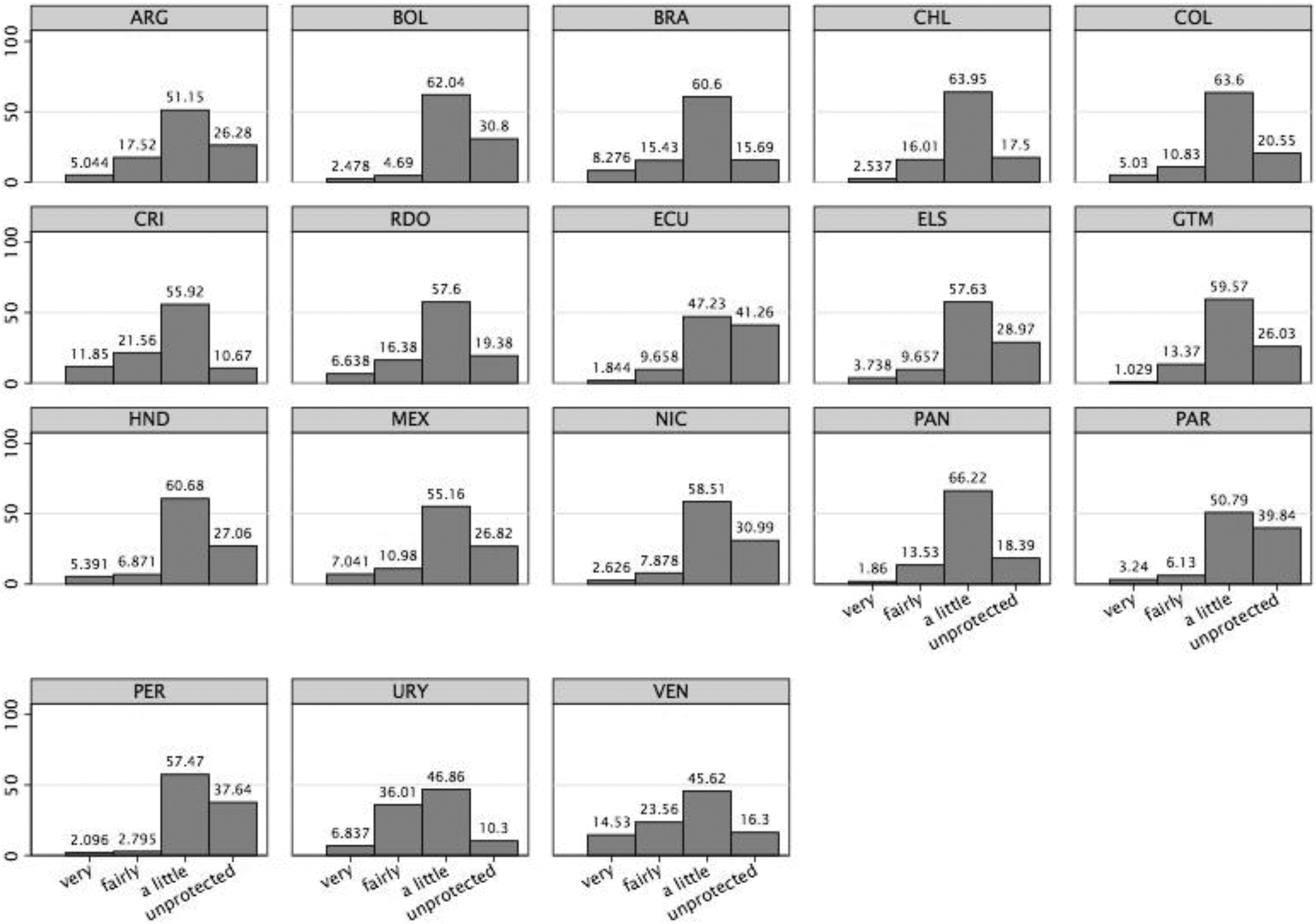
Scepticism about Labor Law (LAB 2005).
Employment Status
In the scholarly literature, the main forms of labor market divides are related to employment status. The LAB contains information whether the respondent is currently “self-employed,” a “salaried employee in a public company,” a “salaried employee in a private company,” “temporarily out of work,” “retired,” “responsible for shopping and house work,” or a “student” (LAB 2005, s13a). 9 To study the effect of employment status, we use workers who are employed in the private sector as reference category in the estimation models below. Private employees are a rather well-defined category and are the main ‘protagonists’ in theories of labor market divides.
We are particularly interested in the group of informal workers as labor market outsiders, for which we create a dummy variable. 10 Identifying informal workers is particularly challenging as informality comes with an extra-legal status (Perry et al., 2007) so that respondents are less inclined to reveal belonging to this sector. Drawing upon Loayza and Rigolini who claim that “in most countries there is a strong association between self-employment and informal activity, as most self-employed workers tend to be low-skilled and unregistered workers” (2011: 1508), we use the employment category “self-employment” as first indicator for informal labor (see also Hart, 1973; Schneider and Enste, 2000). Similar to Berens (2015b), we only deem those self-employed respondents as informal who also indicate to lack health insurance (item s16). Those who respond to have public health insurance are coded as formal self-employed. 11 While this operationalisation is not without criticisms, it is a robust proxy for a critical chunk of individuals working in informality and frequently used in empirical analyses.
Labor Law
Independent of the individual’s socio-economic outlook and individual characteristics we assume labor law to exert an impact on labor law scepticism. Given the recent work on non-enforcement and implementation (Feierherd, 2017; Holland, 2016; Ronconi, 2015), we mainly rely on a de facto measure of employment law using Mosley’s 2010 labor rights (LRs thereafter) indicator. 12 LR focuses on collective LRs that provide workers with the right to mobilise and to collective bargaining. It is based on the following information: “freedom of association and collective bargaining, related liberties, the right to establish and join worker and union organisations, other union activities, the right to bargain collectively, the right to strike, and rights in export processing zones” (Mosley, 2010). The index is based on information about violations of these rights for the period from 1985 to 2002 for a large set of developed and developing countries. Higher values mean “better collective labor rights.” The measure is, thus, not (only) an assessment of de jure but (also) de facto rights, as the implementation of the law is considered as well. 13 The average value is 18 (standard deviation of 4.2) for the Latin American sample. The last available year is 2002 which we use in the analysis of the LAB 2005. Figure 2 illustrates the distribution of the country’s performance on collective LRs together with our DV scepticism about labor law for the available LAB survey information. It shows that on the aggregate level, there is a weak trend: countries with stronger laws have a more benign public attitude towards these laws.
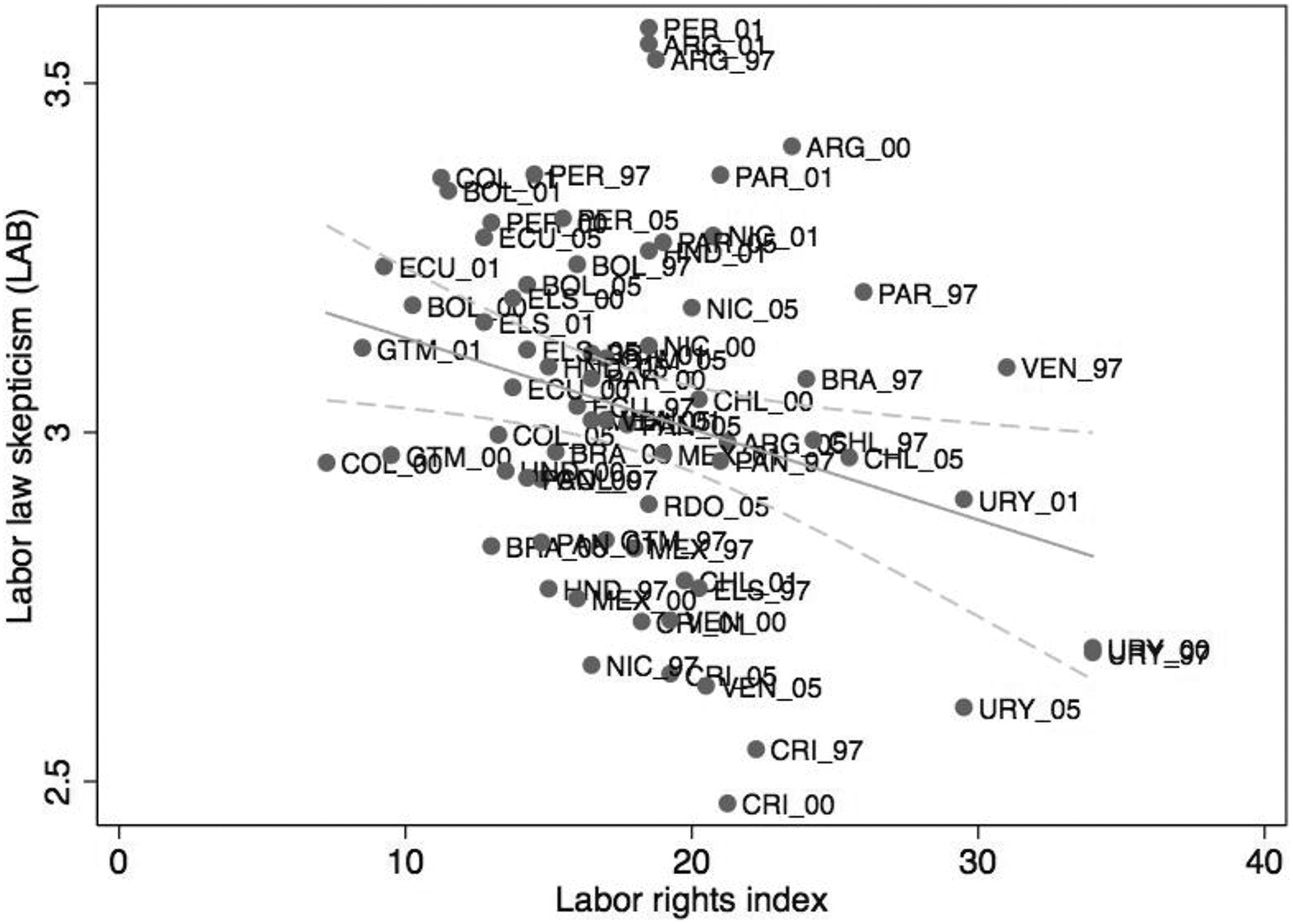
LRs Index (Mosley, 2010) and Scepticism about Labor Law (LAB 1997, 2000, 2001, 2005).
Control Variables
Public opinion on labor laws may depend on many more determinants than employment status. We therefore introduce a set of micro- and macro-level factors that are relevant for the individual’s perception of job protection of workers. Lower income earners should be more sensitive to job protection. Since the LAB lacks information on the respondent’s income, we make instead use of asset information and compile an objective indicator of wealth quintiles using multiple correspondence analysis (see Filmer and Pritchett, 2001). 14 We add information on gender (male equals 1), head of household, marital status, education, and age. For educational attainment, we group the individual’s response on schooling into three categories: primary (illiterate, incomplete primary, complete primary) as reference category, secondary (incomplete and complete secondary), and tertiary education (incomplete higher and complete higher education). As individuals who are not the head of the household could be less sensitive to job protection issues due to intra-household redistribution (Häusermann et al., 2016), we add dummy variables for household head and marital status. Moreover, we factor in if the respondent lives in a rather rural or urban area (1 = rural to 8 = living in a capital city) since access to protection and stability of employment might vary between the center and the periphery.
Additionally, we add a batch of political control variables. First, a respondent’s ideological affiliation to a party on the left or right scale might influence how they think about labor laws. We use the ideological self-placement of the respondent (1 = right to 10 = left). Second, we think that people sympathetic to unions should agree more with the statement, especially when labor unions have close ties to the government (Collier and Collier, 2002; Murillo, 2005). 15 The correlation between union members and respondents who have high confidence in trade unions should be high. As with all attitudinal items, there may be causality issues. For this reason, we add these only at a later stage. 16 Third, drawing upon Holland (2016) and Feierherd (2017), laws might be in place without being enforced so that individuals only respond to labor law when it is really enacted. We use an item on the respondent’s perception on the state’s ability to “enforce laws,” measured on a scale from 1 = “unable to enforce any” to 10 = “able to enforce all.”
Moreover, we take political or, possibly even clientelist, linkages at the micro level into account. Respondents report the frequency of contacts with public officials, the local government, officials at higher level, and elected legislative representatives in the LAB. 17 Drawing upon the vast literature on clientelism in Latin America, such contacts can be read as indicators of clientelistic relationships (Auyero, 1999). Booth and Seligson (2009), among others, have argued that the contact with politicians could imply several logics such as voicing criticism or support, but they agree that those seeking a clientelistic bargain are the ones most likely to make contact. We use an additive indicator of political activism, higher values reflecting stronger political ties. 18 If political ties may yield informal forms of employment insurance, they may relate to concerns about labor law.
Finally, at the macro level, we control for social policy supply. A generous welfare state based on universal social policy programs should reduce labor insecurity concerns as unemployment insurance can compensate income loss in economic hard times (see Carnes and Mares, 2015; Huber and Stephens, 2012). In contrast, a less generous welfare state often treats the formal sector with stable employment histories preferentially and places individuals who do not match these high standards at extreme risk of poverty in times of job loss. We use social security expenditures as share of GDP (CEPAL 2016) as measure for the welfare state. As free parameters at the macro level are limited (see the discussion of Stegmueller, 2013), we restrict the number of macro-level controls to a minimum and add macro-level variables only one at a time. 19 Descriptive statistics are reported in Table 1A of Appendix 1.
Results
Table 1 presents the results for the micro-level variables of interest: employment status and informality. As expected, we find that unemployed workers are more sceptic about labor laws compared to private employees, and so are the self-employed. These findings are robust to different specifications of the model, so that H1 finds some empirical support. In terms of effect size, the unemployed are the ones who express strongest concerns about labor law. That public employees hold a positive view on the protective function of labor law, as indicated by a negative coefficient in M1, is not surprising, but the effect is not significant. When we switch to M2, we see the strength of the labor market divide between formal and informal workers. Informal workers are more sceptic about labor law compared to the formally employed, though the size of the effect is smaller than for the unemployed. The coefficient is significant and robust to adding controls such as the individual’s perception of his or her unemployment risk (M5 and M6). Finally, also respondents who indicate to take care of housework are more sceptical about labor law. Women who take care of their children and consider themselves as homemakers often also produce handwork which would count as informal labor (Perry et al., 2007), so that this category is likely to contain informal workers as well. We therefore take this finding as further support for the dividing capacity of labor law regarding labor market insiders and outsiders.
The Determinants of Labor Law Scepticism.
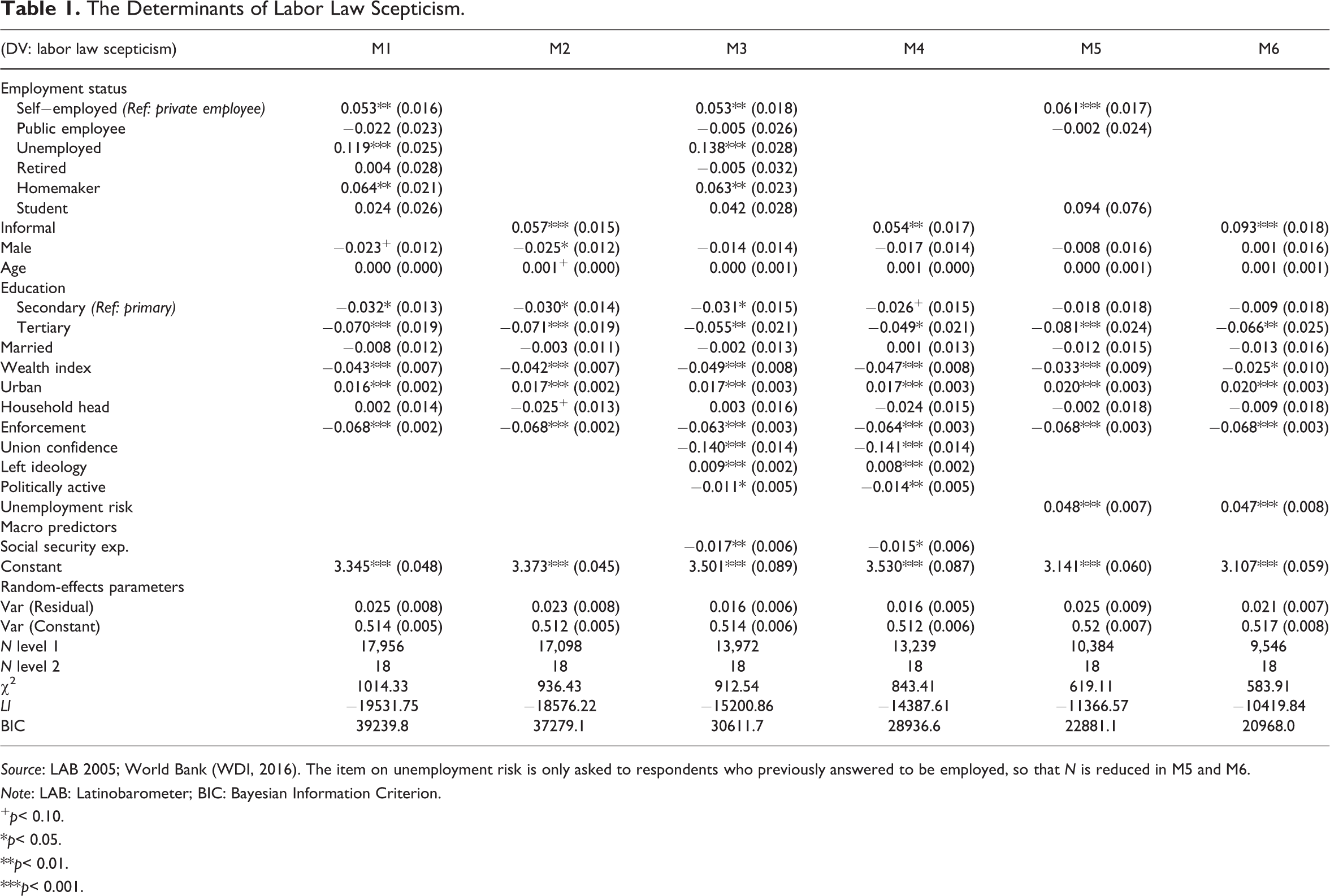
Source: LAB 2005; World Bank (WDI, 2016). The item on unemployment risk is only asked to respondents who previously answered to be employed, so that N is reduced in M5 and M6.
Note: LAB: Latinobarometer; BIC: Bayesian Information Criterion.
+ p< 0.10.
*p< 0.05.
**p< 0.01.
***p< 0.001.
Some control variables deserve further notice. Women and older people perceive the labor law to be less protective. In contrast, higher earnings and a better educational background strongly diminish this concern. People living in cities are more sceptical about the effects of labor laws. When we look at the magnitude of the coefficients, sympathising with unions entails the strongest impact. Having confidence in trade unions decreases scepticism by 0.140 and is significant at the 0.1 per cent level. Compared to this, the effects of political ties are smaller, but still significant: M4 illustrates how greater engagement with public officials and office holders goes in line with greater confidence in job protection through current labor law. However, if this is a sign of clientelism or rather illustrates individuals who are particularly active in voicing criticism cannot be fully resolved with our measure.
While we have seen that labor market divides (unemployment and informality in particular) do shape people’s perception of labor law, we are also interested in the feedback effects of laws on people’s attitudes to labor regulation (H2). Hence, we now turn to such feedback effects. Table 2 reports estimation results adding the strength of labor law (LR). Better collective LRs decrease the average individual’s scepticism about labor laws (M7). Labor codes that allow workers to organise, to form unions, and collectively bargain tariffs and wages lead more people to believe in their usefulness for workers. The finding is very intuitive. However, when we look at cross-level interaction terms between the different types of employment status and LR, we find that the effect does not hold across the range of labor market participants. While we see no significant effect on public employees or non-employed such as the retired or students, we find a positive and significant effect for the unemployed. Better LRs that strengthen the position of employees against the enduring vagaries of markets make the unemployed express greater scepticism about its usefulness for workers (see M8). Studying the impact on informal wage earners, which is a similarly sensitive group, depicts the same pattern (see M9). Increased LRs could, thus, be a source of labor market divides. Labor codes which strengthen organised labor seem to make informals and unemployed more concerned about lack of job protection through law. They could lead to a polarisation between different segments. Figure 3 summarises the two average marginal effects for becoming unemployed and working in the informal sector at different levels of the strength of collective LRs on scepticism about labor law. 20
Cross-Level Interactions: Employment Status and Labor Law.
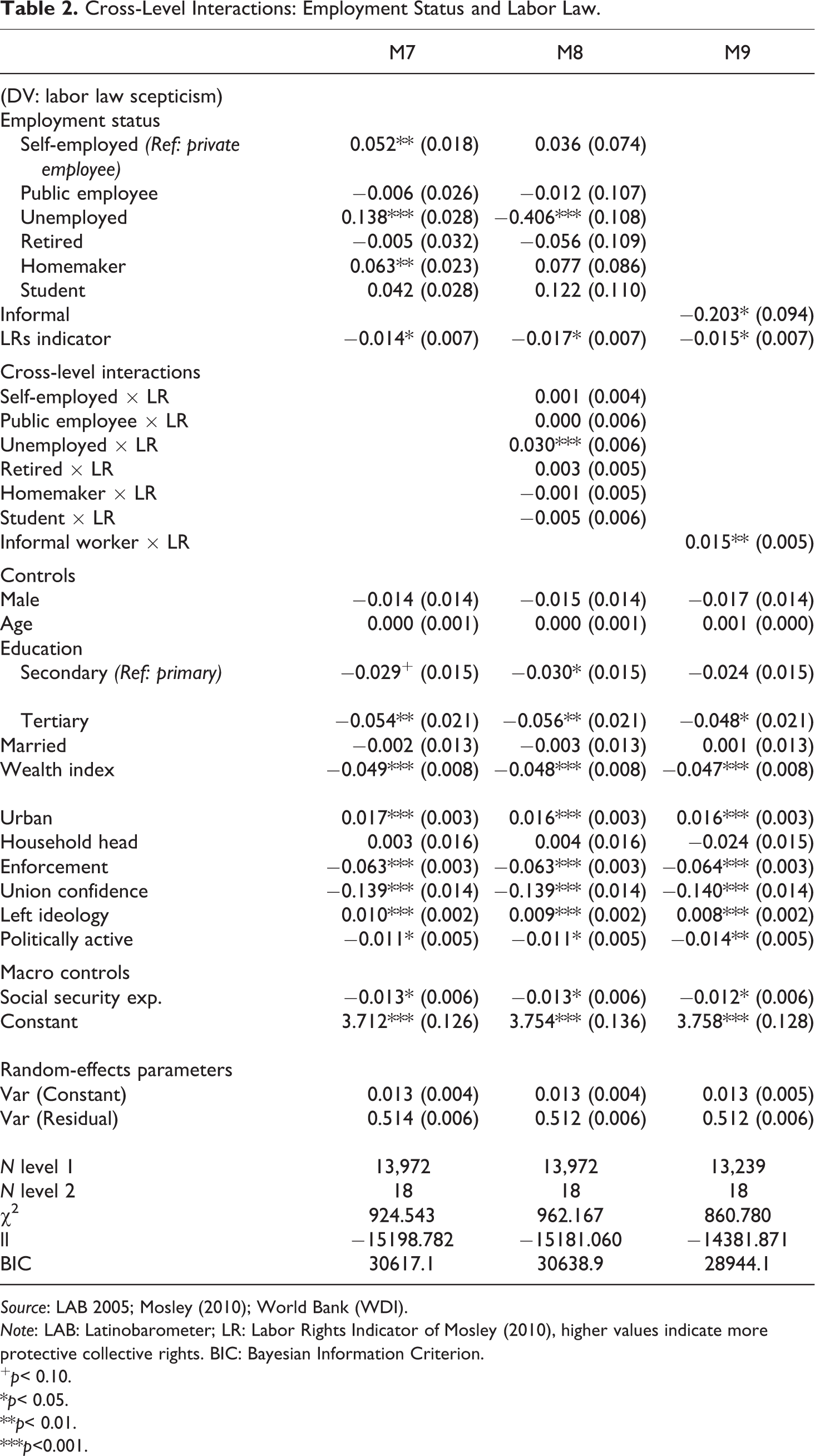
Source: LAB 2005; Mosley (2010); World Bank (WDI).
Note: LAB: Latinobarometer; LR: Labor Rights Indicator of Mosley (2010), higher values indicate more protective collective rights. BIC: Bayesian Information Criterion.
+ p< 0.10.
*p< 0.05.
**p< 0.01.
***p<0.001.
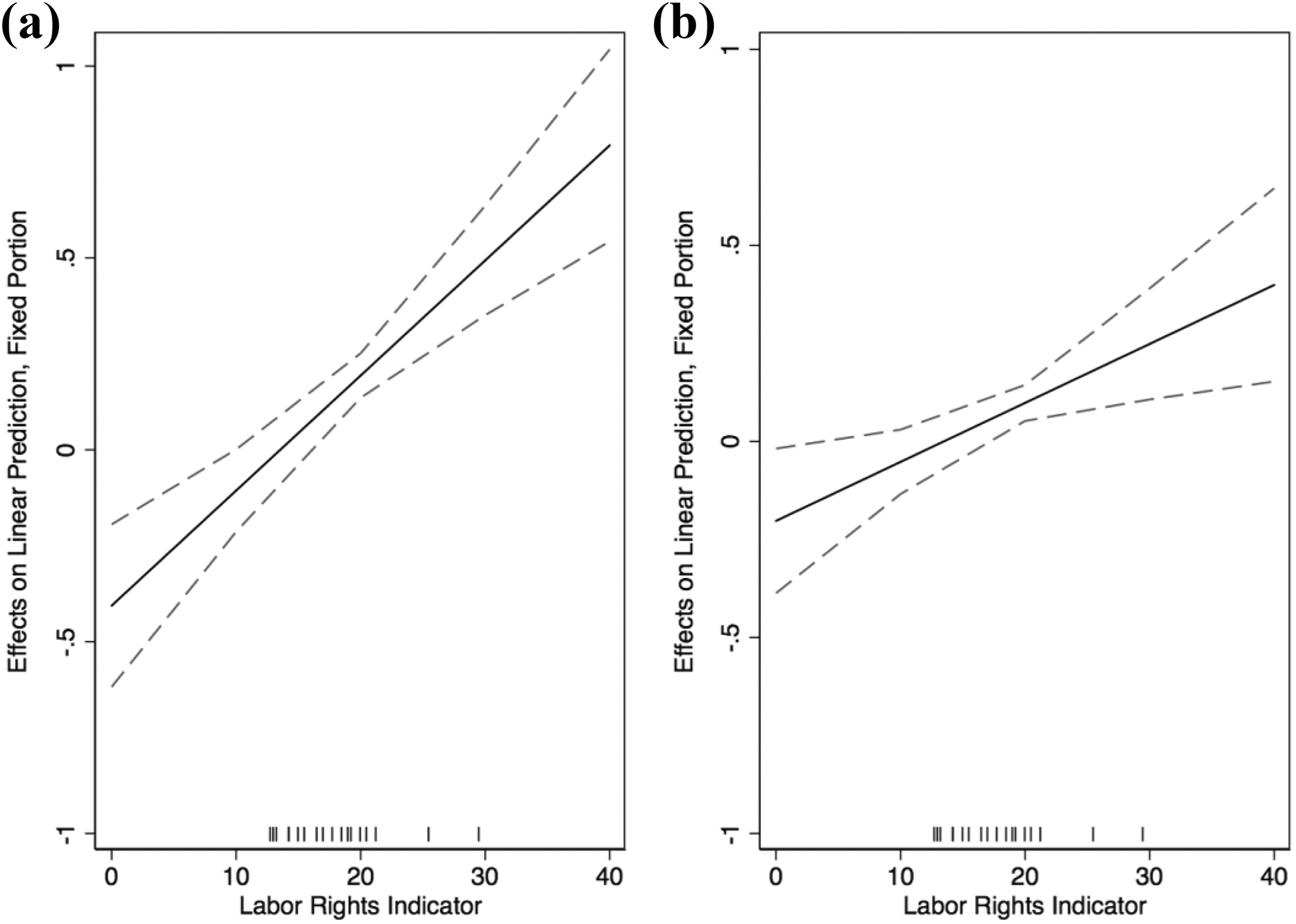
Average Marginal Effect of (a) Unemployed and (b) Informal Workers on Labor Law Scepticism (M6–M7) at Different Levels of LR.
Sensitivity Analysis: Varieties of Labor Law and Robustness
While we find that the average effect of labor law on the public attitudes is negative (see model M7), that is, stronger laws reduce scepticism, it may also be that not all types of labor laws work in the same direction (see Carnes, 2014a). Those labor laws which make it more difficult to hire and fire people on an individual basis are sometimes assumed to have a negative macroeconomic impact on the economy, and the informal sector is then frequently used as buffer zone in periods when formal sector jobs fall short (Perry et al., 2007). Knowing that it will be difficult to enter the formal sector again after one had to leave decreases the attractiveness of such an “insurance” mechanism and thus should increase concerns about the protective function of labor law. Hence, it might be that not all aspects of labor law are equally important when looking for feedback effects.
The job security index (JS hereafter) of Heckman and Pagés (2000) provides information on labor regulations which affect job security of employees individually. The index is based on information on advance notice periods, dismissal costs, and severance pay (2000: 27) for the late 1990s and early 2000s (on a range of 1–5, with higher values representing stricter protection). In contrast to the LR indicator, this measure is based on de jure information, which reduces the comparability with the LR indicator and introduces more questions about implementation. 21 In a simple bivariate plot, the scepticism about labor laws increases with the JS across countries (see Figure 4). A more regulated labor market in terms of stricter hiring and firing rules increases the perception that workers are not protected, which would constitute a negative feedback effect based on barriers to entry to the market. 22 Due to the lack of macro-level data on different types of labor laws for a larger set of countries and a larger period of time, a more thorough analysis of the effects of the labor law variety is however, unfortunately, limited.
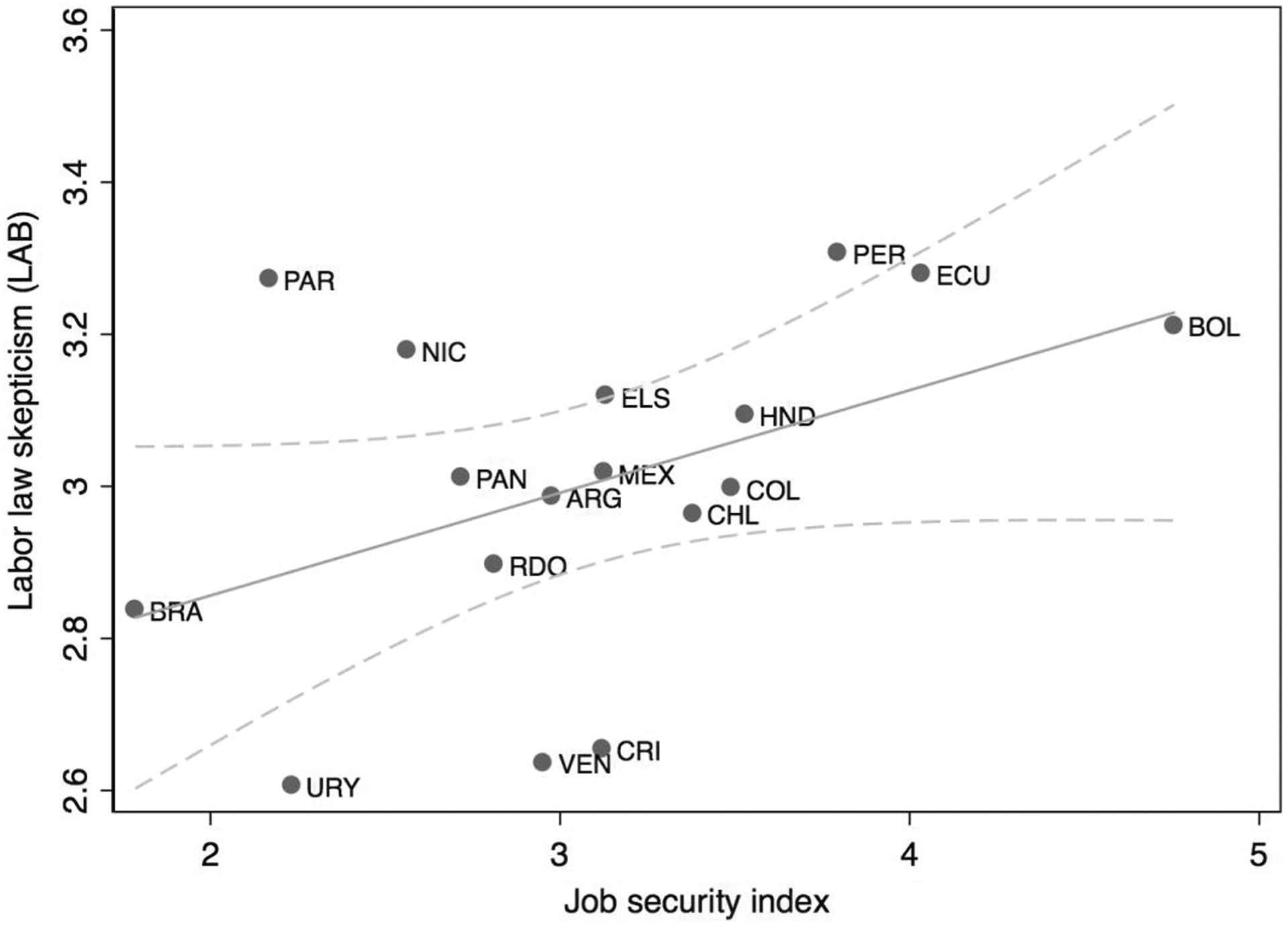
Job Security Index (Heckman and Pagés, 2000) and Scepticism about Labor Law (LAB) for 2005.
Another source of concern for our findings might be that they are driven by non-randomness of the macro data. Bootstrapping resamples the original sample, and thus artificially takes the observed sample as population. We do this to account for the fact that the macro-level observations are few and specific countries might pose a large influence on the findings. 23 We use the cluster function to indicate the sampling structure of individuals within countries with 1,000 repetitions. The effect for the LR indicator remains robust with a coefficient of −0.014 and a bootstrapped standard error of 0.007 (estimation table not displayed). Also, the finding for the interaction term between LR and unemployment and informality remains robust (M8 and M9 in Table 2).
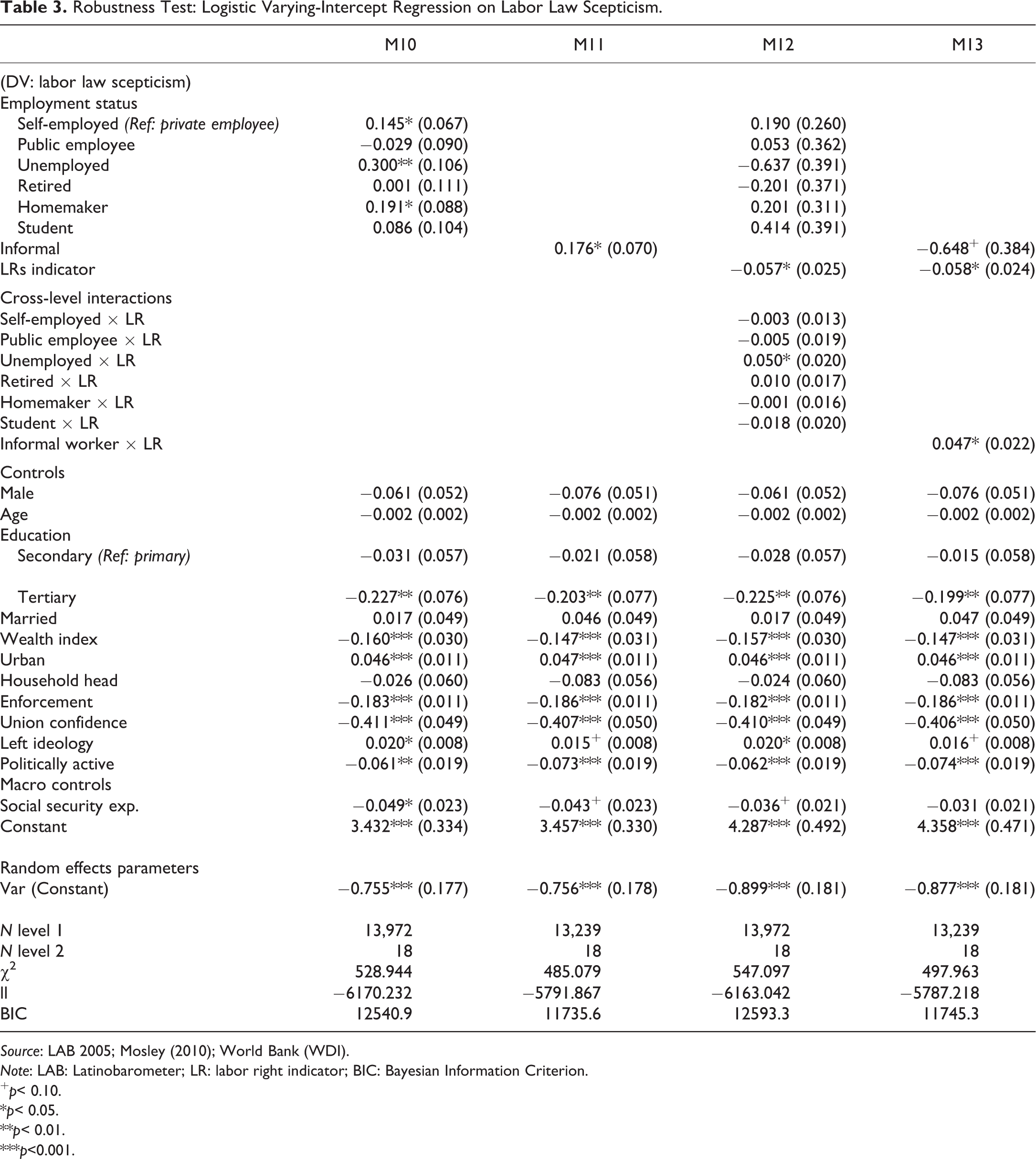
A third potential issue is that we have treated the dependent variable as metric. Therefore, we apply a logistic model for a simplified dummy variable (see above). Table 3 presents logistic coefficients for the model specification that are most interesting for our analytical goal. The finding for LR is robust with the maximum likelihood specification of the model (M10 and M11). The effects of the interaction terms also remain stable (M12 and M13).
Robustness Test: Logistic Varying-Intercept Regression on Labor Law Scepticism.
Source: LAB 2005; Mosley (2010); World Bank (WDI).
Note: LAB: Latinobarometer; LR: labor right indicator; BIC: Bayesian Information Criterion.
+ p< 0.10.
*p< 0.05.
**p< 0.01.
***p<0.001.
Discussion and Conclusions
The results of the empirical analysis have revealed three aspects of the politics of labor regulation. First, there are clear cross-country differences in the general perception of labor laws. Second, there are clear differences between employment groups, with the unemployed and those working in the informal sector seeing employment laws differently from the rest of the labor force. Third, there is some indication that the two levels interact with each other in the form of feedback effects from existing labor laws to public perception.
Our study has clear limitations. Our data on perceived vulnerability were stopped in 2005 and do not cover the recent downturn in Latin American labor markets. The operationalisation of labor market divides is naturally limited due to data restrictions. Moreover, some critics may be concerned about the “subjective” nature of the dependent variable. The study of political consequences of insider–outsider dynamics is still in its infancy, especially for Latin America and better (survey or experimental) data will yield stronger conclusions in future research. Nonetheless, we think that our findings show important aspects of an increasingly relevant research agenda. While labor laws are clearly aiming at protecting workers against the vagaries of capitalism, it is not always guaranteed that all types of laws fulfill this property for all types of people.
Hence, we believe that our findings are not only interesting for understanding the politics of labor market reforms in Latin America but also for the general literature on the politics of labor divides in other regions. According to the literature, findings about labor market divides also will have implications for political behavior. For instance, Lindvall and Rueda (2014) have linked the politics of insidership–outsidership to its electoral consequences. They find that Swedish Social Democrats swing between policies favouring insiders and outsiders to differing degrees and that their electoral support traces these changes. In more general terms, the literature on new labor market divides has shown how these divides affect and sometimes even repress traditional forms of political contestation.
Holland (2016) and Feierherd (2017) reveal for the Latin American context that especially left parties benefit from varying the degree of labor law enforcement to reach out to both insiders and outsiders. This could explain why labor market segmentation does not seem to polarise on questions of social policy (Carnes and Mares, 2014, 2015; Berens, 2015a, 2015b) nor to other clearly distinguishable voting patterns (Baker and Velasco-Guachalla, 2018). Would this also be true for the dividing line along the protective function of labor law? We would think that dissatisfaction with labor law is what might stimulate dualisation and, thus, more complex electoral responses.
Just to illustrate this argument, one might think that our item on the public opinion on labor law is related to electoral participation. We would expect labor market divides on labor law in less developed countries to have consequences for vote abstention and vote choice. Of course, discontent with labor market polices could drive workers to the polls (see Agarwala, 2008), but it might also alienate them. Moreover, if labor laws “function to divide, rather than unite, workers” (Carnes, 2014a: 1), we might see this polarisation being translated into differing degrees of political activism.
Taking a quick glance at aggregated correlations between labor law scepticism and abstention (=0) versus voting (=1) as hypothetical scenario supports our intuition that labor market segmentation is manifested in labor law in Latin America. Respondents who have a high level of labor law scepticism seem to be less willing to cast a vote in elections. The pattern is particularly discernible in Brazil, Dominican Republic, El Salvador, Honduras, Mexico, Nicaragua, Panama, Peru, and Venezuela.
Clearly, this is only a snapshot and causality issues loom large into our interpretation of Figure 5. We would need further confirmation from a thorough regression analysis over time and a large set of countries (see Singer, 2016 for insights on economic voting among informal workers). And yet, the results indicate that concerns about the protective function of labor law may have substantive, political effects. When voters feel the differential effects of labor regulation, polarisation might affect many forms of political behavior: from electoral participation to partisan vote.
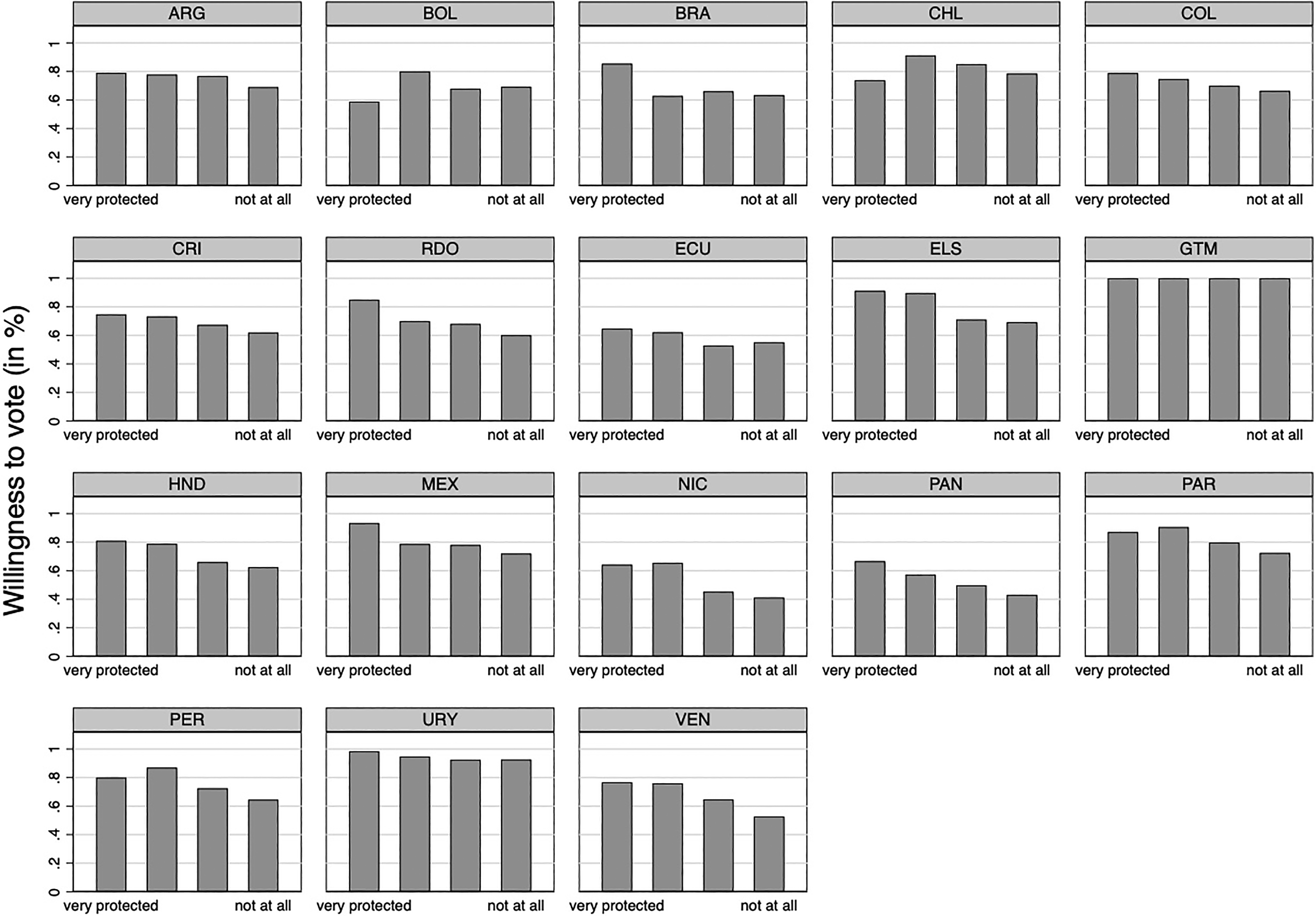
Labor Law Scepticism and Turnout by Country (LAB 2005).
Supplemental Material
Supplemental Material, Supplement_file2 - Labor Divides, Informality, and Regulation: The Public Opinion on Labor Law in Latin America
Supplemental Material, Supplement_file2 for Labor Divides, Informality, and Regulation: The Public Opinion on Labor Law in Latin America by Sarah Berens and Achim Kemmerling in Journal of Politics in Latin America
Footnotes
Acknowledgements
We thank Andy Baker, Matthew Carnes, David Doyle, German Feierherd, Candelaria Garay, Santiago López-Cariboni, Soledad Prillaman, David Rueda, Cesar Zucco, the participants of the workshop “New Approaches to the Political Economy of Social Policy” 2016 at the University of Cologne, and the Political Economy Research Group of Central European University, especially Imre Szabó and Bastian Becker, for helpful comments and critical thinking. The paper also benefited from comments received at APSA 2016 and LASA 2017.
Declaration of Conflicting Interests
The author(s) declared no potential conflicts of interest with respect to the research, authorship, and/or publication of this article.
Funding
The author(s) received no financial support for the research, authorship, and/or publication of this article.
Supplemental Material
Supplemental material for this article is available online.
Notes
Appendix 1
Descriptive Statistic.
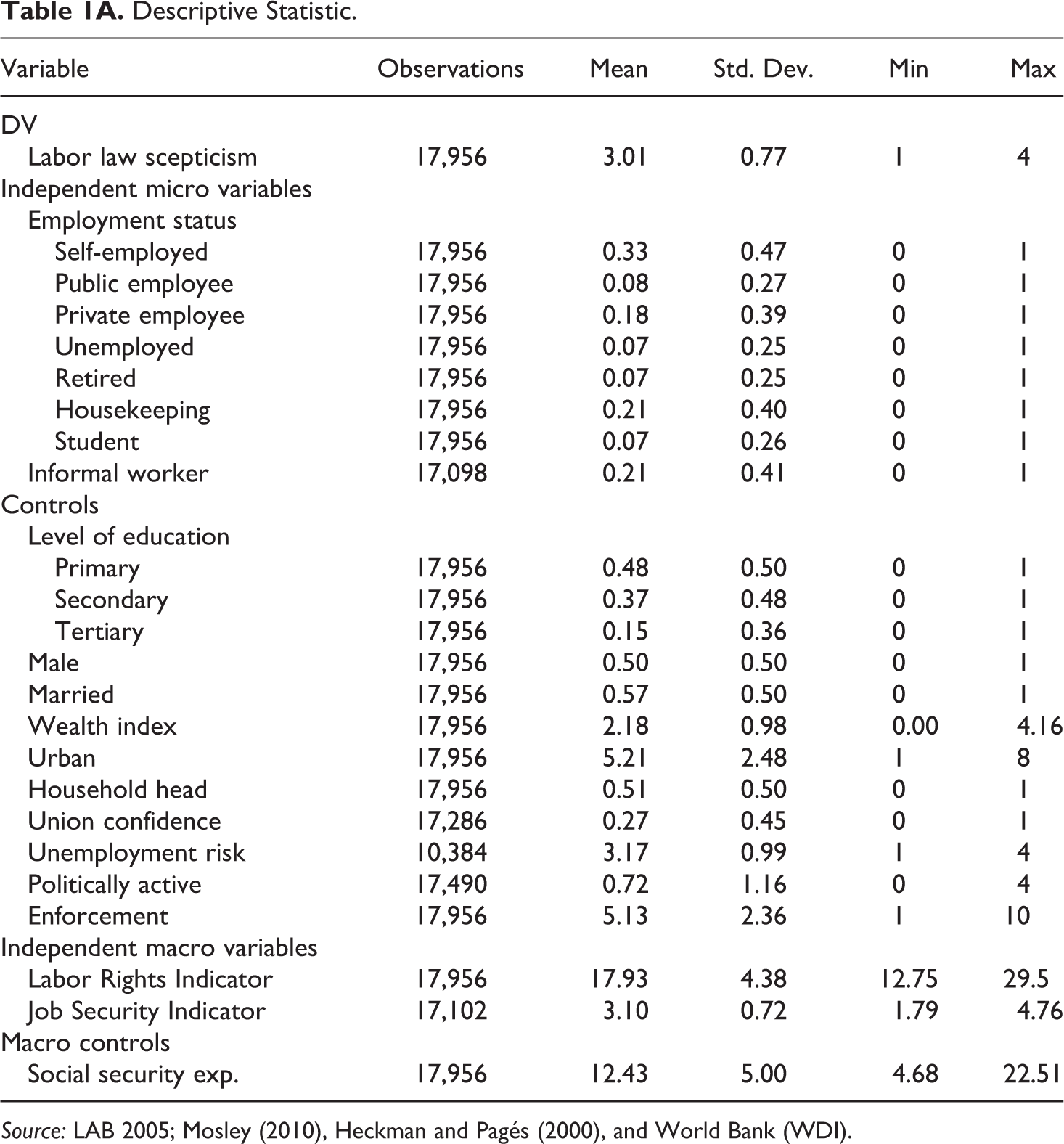
| Variable | Observations | Mean | Std. Dev. | Min | Max |
|---|---|---|---|---|---|
| DV | |||||
| Labor law scepticism | 17,956 | 3.01 | 0.77 | 1 | 4 |
| Independent micro variables | |||||
| Employment status | |||||
| Self-employed | 17,956 | 0.33 | 0.47 | 0 | 1 |
| Public employee | 17,956 | 0.08 | 0.27 | 0 | 1 |
| Private employee | 17,956 | 0.18 | 0.39 | 0 | 1 |
| Unemployed | 17,956 | 0.07 | 0.25 | 0 | 1 |
| Retired | 17,956 | 0.07 | 0.25 | 0 | 1 |
| Housekeeping | 17,956 | 0.21 | 0.40 | 0 | 1 |
| Student | 17,956 | 0.07 | 0.26 | 0 | 1 |
| Informal worker | 17,098 | 0.21 | 0.41 | 0 | 1 |
| Controls | |||||
| Level of education | |||||
| Primary | 17,956 | 0.48 | 0.50 | 0 | 1 |
| Secondary | 17,956 | 0.37 | 0.48 | 0 | 1 |
| Tertiary | 17,956 | 0.15 | 0.36 | 0 | 1 |
| Male | 17,956 | 0.50 | 0.50 | 0 | 1 |
| Married | 17,956 | 0.57 | 0.50 | 0 | 1 |
| Wealth index | 17,956 | 2.18 | 0.98 | 0.00 | 4.16 |
| Urban | 17,956 | 5.21 | 2.48 | 1 | 8 |
| Household head | 17,956 | 0.51 | 0.50 | 0 | 1 |
| Union confidence | 17,286 | 0.27 | 0.45 | 0 | 1 |
| Unemployment risk | 10,384 | 3.17 | 0.99 | 1 | 4 |
| Politically active | 17,490 | 0.72 | 1.16 | 0 | 4 |
| Enforcement | 17,956 | 5.13 | 2.36 | 1 | 10 |
| Independent macro variables | |||||
| Labor Rights Indicator | 17,956 | 17.93 | 4.38 | 12.75 | 29.5 |
| Job Security Indicator | 17,102 | 3.10 | 0.72 | 1.79 | 4.76 |
| Macro controls | |||||
| Social security exp. | 17,956 | 12.43 | 5.00 | 4.68 | 22.51 |
Source: LAB 2005; Mosley (2010), Heckman and Pagés (2000), and World Bank (WDI).
References
Supplementary Material
Please find the following supplemental material available below.
For Open Access articles published under a Creative Commons License, all supplemental material carries the same license as the article it is associated with.
For non-Open Access articles published, all supplemental material carries a non-exclusive license, and permission requests for re-use of supplemental material or any part of supplemental material shall be sent directly to the copyright owner as specified in the copyright notice associated with the article.
