




Abstract
Since the 1980s, the number of Pentecostal candidates elected to the Brazilian legislatures has grown remarkably. Literature has argued that the phenomenon is related to Pentecostal churches’ support for particular candidates. To date, however, this claim has been based only on ethnographies or studies relying on a few cases of elected candidates. Drawing from a new data set of Evangelical (Protestant) candidates for the Federal Chamber of Deputies and state legislative assemblies, I try to answer the following questions: Do Pentecostal candidates raise fewer campaign resources than other candidates? What is the effect of being a Pentecostal candidate on the vote in Brazilian legislative elections? Is the structure of the church relevant to this effect? Using OLS regression models, I show that being a Pentecostal has a negative, though not significant effect on campaign spending. Additionally, there is a positive statistical relationship between being a Pentecostal and receiving votes, and between having the support of more centralized churches and receiving votes. Qualitative evidence of six Pentecostal politicians who lost their churches’ support at some point between elections, attempted reelection, and performed considerably worse than before reinforces the importance of having the support of a Pentecostal church.
Introduction
In recent decades, Evangelical electoral mobilization in Brazil has grown remarkably. Evangelical candidates obtained third place in the 2002, 2010, and 2014 presidential elections. In 2015 a Pentecostal representative was elected speaker of the Chamber of Deputies. In the 2016 municipal elections, a bishop from the Universal Church of the Kingdom of God was elected mayor of the city of Rio de Janeiro. The Evangelical presence has strengthened since the 1980s, when Pentecostal churches adopted the strategy of supporting official candidates. Since then, the number of elected Evangelicals has grown considerably, especially those supported by Pentecostal churches. 1
I would like to thank Paolo Ricci, George Avelino, Claudia Cerqueira, Natalia Bueno, Sergio Simoni Jr., Guadalupe Tuñon, Paulo Baia, and the JPLA anonymous reviewers for their helpful comments. Any remaining errors are mine alone. Some of the material presented here was delivered at seminars at the University of São Paulo and at the 41st Annual Meeting of ANPOCS in Caxambu, Brazil. The data set and replication materials are available from the author upon request.
The political impact of Evangelical growth in Latin America has received scholarly attention since the late 1960s. Part of the social science literature investigating the phenomenon has stressed how Pentecostal churches use clientelistic practices harmful to democracy, having strong electoral support from their faithful, depicted as the “herd vote” for these politicians (D'Epinay 1970; Bastian 1994; Chesnut 1997; Gaskill 1997). The first Pentecostal churches arrived in Brazil at the beginning of the twentieth century, and, just as the mainline Protestant churches, had a discreet political presence. However, from the 1980s on, Pentecostal churches began to mobilize electorally and politically, thereby garnering more academic attention (Mariano and Pierucci 1992; Freston 1993; Pierucci and Prandi 1995; Fernandes 1998; Oro 2003; Borges 2009; Mariano and Oro 2011; Reich and Santos 2013; Machado and Burity 2014; Smith 2016; Cerqueira 2017). This mobilization, combined with the growth of the Evangelical population, the electoral system of open-list proportional representation, and the high magnitude of Brazilian electoral districts, contributed to the Evangelical electoral success. In 1998 just 29 Evangelical candidates were elected to the Chamber of Deputies, but by 2014 this number had reached 67, representing almost 15 percent of the federal legislature (Lacerda 2017). Although underrepresented in the Brazilian parliament, the political representation of Evangelicals is greater than that of other minority groups, such as women and Afro-Brazilians.
Brazil is home to the world's fourth-largest Evangelical population (Pew Research Center 2011). 2 The last Brazilian Census (2010) found just over 42 million Evangelicals (22.2 percent of the total population), and this number has grown since then. According to a sample survey conducted in October 2017, 32 percent of Brazilians declare themselves Evangelicals (Institute Datafolha 2017). However, and despite a growing literature on Evangelical political mobilization in Brazil, few studies have provided evidence of the impact of churches’ support on Evangelical candidates. Among the exceptions are Fernandes (1998), Bohn (2004), and Boas (2014). The reason for this lacuna is, at least in part, the difficulty in obtaining data on Evangelical candidates and churches. Moreover, the few existing studies are based on surveys. There is no quantitative study of Brazilian Evangelical candidates that uses electoral data and includes non-elected candidates. The lack of more accurate research on the support of churches for Evangelical candidates, as well as on Evangelical electoral performance in general, renders any statement about the electoral strength of Evangelicals an untested assumption. Drawing from a new data set of Evangelical candidacies for the Chamber of Deputies and state legislative assemblies, I try to fill this gap by offering new evidence for the debate on political representation of Evangelicals in Brazil. In particular, I try to answer the following questions: Do Pentecostal candidates raise more or fewer campaign resources than other candidates? What is the effect of being a Pentecostal candidate in Brazilian legislative elections? Is the structure of the church relevant to this effect?
In this article, I use the term “Evangelical” as a synonym for “Protestant,” as most Latin American evangélicos do.
The findings of this paper shed new light on the understanding of Evangelical political representation. I present evidence that it is actually uncompetitive Evangelical candidates who use religious titles (e.g. “pastor,” “bishop”) in their official electoral names. I show that candidates supported by Pentecostal churches have a lower “voting cost” – that is, spend less money per vote received – than other candidates. Using OLS regression models, I find there is a negative, though not statistically significant association between being a Pentecostal candidate and campaign spending. From these tests, I also find that there is an effect of being supported by a Pentecostal church on the number of votes received, and that this effect is stronger than that of merely being an Evangelical candidate without church support. Finally, the effect of being supported by churches with larger and more centralized structures is greater than that of being supported by other churches. The tests do not completely isolate the mechanism explaining the effect of being Pentecostal on the vote. It is not possible, for example, to affirm that such an effect is due only to the church support, and not also to Evangelical identity, which could have an heuristic effect on Evangelical voters, inclining them to vote for candidates belonging to their own social group. I present data from six cases of Pentecostal politicians who lost their churches’ support throughout the term, but still ran for reelection. The fact that none of them succeeded in being reelected, and all of them got far fewer votes than they had when supported by the church, serves as a counterfactual to reinforce the conjecture on the importance of the support of a Pentecostal church.
Although this work focuses on Pentecostal churches in Brazil, its findings contribute to a broader debate on religion and comparative politics. Despite the predictions of secularization theories that religions would become more and more privatized and suffer a slow and gradual decline, the empirical evidence that supports these two hypotheses has been challenged. Since the 1970s, religious movements have demonstrated growing vitality and increased political activism. The Iranian Revolution, the performance of liberation theology in Latin America, and the rise of the New Christian Right in the United States are some of the best-known examples (Casanova 1994). With regard to religious practice and belief, strong evidence suggests that there is no decline in these indicators, but, on the contrary, perhaps even growth (Stark 1999). This paper, while not directly addressing the debate on secularization, contributes to the discussion of the vitality and political role of religions in liberal democracies.
The rest of the article is organized as follows. I first provide an overview of the debate on Pentecostals and legislative elections in Brazil. I next develop the theory and hypotheses, demonstrating the data and variables used. After presenting the results and findings, I offer qualitative evidence of candidates supported by churches who lost their support throughout the term, decided to run for reelection, and were not reelected. This evidence serves as a counterfactual argument that, were church support absent, Evangelical candidates would not have been elected. Finally, in the last section I discuss the findings and present final comments.
Pentecostals and Elections
The growth of the Evangelical population in Latin America during the twentieth century has aroused the interest of social scientists as to the causes and possible consequences of the phenomenon. From the outset, one interest of researchers was the relationship between Pentecostal growth and Latin American politics. Pentecostalism is a branch of Evangelicalism that emphasizes the gifts of the Holy Spirit. Pentecostal churches tend to be more sectarian than mainline Protestant churches, although since the 1970s they have become more open to liberal secular culture. In addition, their members have a different profile, having on average lower income and education levels than mainline Protestants. From the beginning, the studies presented different visions and prognoses. While some have suggested that the growth of Evangelicalism could have positive effects on the region's democracies (Willems 1967; Stoll 1990; Martin 1990; Mariz 1992; Smith 1994; Dodson 1997), others have highlighted the possible negative effects (Epinay 1970; Bastian 1994; Chesnut 1997; Gaskill 1997). In this view, Pentecostal churches would enter politics by promoting clientelistic and harmful practices to democracy. Pentecostal leaders would act as brokers, supposedly controlling the votes of their congregations and using them in order to maintain unjust social structures. In the case of Brazil, bishops and pastors would be recruited by political parties – usually from the center or right – to run for legislative elections. Once elected, they would benefit their churches with pork. The argument is based on the assumption that a church's congregation would offer a considerable degree of electoral support to its leaders.
According to the 2010 Brazilian Census, more than 22 percent of Brazilians declared themselves Evangelicals, divided among Pentecostals (13.3 percent), mainline Protestants (4.0 percent), and unaffiliated Protestants (4.8 percent). The growth of the Evangelical population was accompanied by the rise of Evangelical political representation. Since the 1990s, studies on the Brazilian case have noted that the entry of Evangelical leaders into electoral contests was a phenomenon circumscribed to a small set of Pentecostal churches. The process began with the Assembly of God (AG) and the Universal Church of the Kingdom of God (UCKG) and was later emulated by other churches. Despite organizational differences, these churches have started to support “official candidates” for legislatures (Freston 1993).
In Brazil, federal and state elections are held concomitantly and every four years. They elect a president, 513 federal deputies, and 81 senators at the federal level, and a governor and a varying number of state deputies at the state level. Legislators can run indefinitely for reelection, but the Brazilian open-list proportional representation (OLPR) electoral system makes reelection far more uncertain for incumbents than, for example, for US politicians. Despite the fact that the presidential election is the contest that structures and influences all the rest (Limongi and Cortez 2010), Brazilian multiparty presidentialism makes it important for chief executives to have a strong base within the legislatures.
The growing number of Pentecostal representatives from the 1980s onwards led social scientists to ask about the “strength” of Pentecostal candidates, as well as the degree of support of the congregations for their leaders. 3 From a sample survey applied in the metropolitan region of Rio de Janeiro that focused exclusively on Evangelicals, Fernandes (1998) revealed that 87 percent of AG churchgoers reported that they voted in the 1994 elections for candidates supported by their church. In the case of UCKG churchgoers, the corresponding data point was 95 percent. Respondents from the Baptist Church and other mainline churches said they voted for more Pentecostal candidates than candidates of their own denominations. This evidence was, however, not supported by a 2013 Datafolha Institute sample survey, according to which only 18 percent of Pentecostal voters said they had at some point voted for a candidate supported by their church. 4
For the sake of simplicity, I use the term “Pentecostal candidate” as an equivalent of “candidate supported by a Pentecostal church.” In Brazil, most of the larger Pentecostal churches mobilize electorally and promote candidates to their congregations.
Datafolha 2013. These results should be viewed with caution. Due to a desirability bias, many respondents are likely to say they have never followed the orientation of their church or pastor, even though they have already done so.
The growth of Evangelical political representation in Brazil has mainly been due to the success of Pentecostal candidates supported by their churches. To date, the most illustrative cases cited by researchers have been those of the AG, UCKG, and the Church of the Foursquare Gospel (CFG). However, other Pentecostal churches have also received media attention for their support of their own official candidates (see, for example, O Globo 2014, and Gospel Prime 2015). It is worth noting that in Brazil, it is illegal to carry out political advertising in churches and other places of worship (Lei 9,504/97, Art. 37). In fact, the prohibition is not restricted to places of worship; rather, there is a general ban against political propaganda in public places, including cinemas, clubs, stores, and shopping centers. The statute is vague, providing considerable lee-way for discussion of what activities and speeches constitute political propaganda and where they can or cannot be made.
In general, the electoral performance of Pentecostal candidates seems to be related to the type of church that supports them. Some variables are of particular relevance, such as church size (number of individual churches, number of members), media structure, hierarchical centralization, and emphasis on candidate support. In other words, the larger the church is in terms of structure and number of believers, the greater and more emphatic the institution's support for its candidates is, and the more centralized its structure, the greater the likelihood of electoral success. Church centralization is also related to the process of candidate selection. In a church where there is strong decision-making centralization, candidates are selected by the hierarchy and the non-selected are left aside. Accordingly, the absence of centralization makes the selection process less controlled, allowing those who have not been officially selected to compete for the congregation's votes.
The UCKG appears to be the prototypical case of corporate Pentecostal representation. Founded in 1977 by Edir Macedo, it is not only one of the largest Pentecostal churches in Brazil, but also known to be more emphatic in supporting its candidates than other churches, and certainly has one of the most centralized ecclesial structures among Evangelical churches (Oro 2003a; Mariano 2004; Barbosa 2015). The AG, on the other hand, being the largest Evangelical church in Brazil, is divided among several ministries, and, at least until 2014, did not have rigorous candidate-selection control. The church permits some members to run as candidates despite having been defeated in church primaries. Hence, the congregation's votes may end up dispersed among several candidates (Borges Jr. 2010). Finally, the CFG boasts membership numbers close to those of the UCKG, but, despite its organizational structure and support for official candidates (Schoenfelder and Paz 2006), its admissions process does not seem as controlled as the UCKG's, and does not seem to apply the same amount of “pressure” to its members as the UCKG does to its members.
The hypothesis that there is a relationship between the performance of Pentecostal candidates and the type of their church assumes that the votes received by candidates come from their own congregations. However, there is evidence to suggest that some of their votes come from members of other churches. 5 In Brazilian OLPR elections, the number of candidates who use Evangelical titles (“bishops,” “pastors,” “apostles,” etc.) in their official electoral names has grown. This increase suggests that such a strategy could serve as a religious “cue” to attract Evangelical voters, signaling the candidate's Evangelical identity. The strategy could be explained by the characteristics of the Brazilian political system: high party fragmentation, parties with diluted “brands,” a high number of candidates (due to the high district magnitude), and expensive campaigns.
Maranhão representative and leader of Assembly of God Costa Ferreira states in an interview with Borges Jr. that “95% of his votes come from the Evangelical milieu” (Borges Jr. 2010: 75). Similarly, Representative Eliziane Gama, also from AG of Maranhão, says that “90% of its voters are also Evangelicals” (Borges Jr. 2010: 75). The statements are unclear, but suggest that the AG congresspeople would receive votes not only from AG constituents, but also from other Evangelical voters.
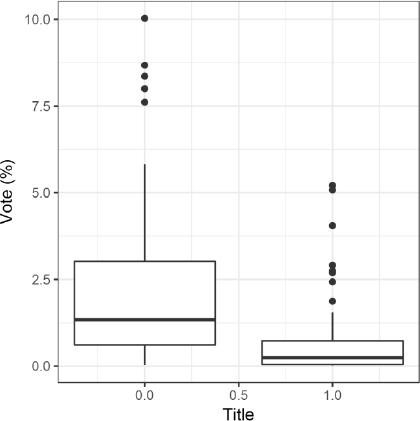
Whether because they receive their congregations’ votes or votes from Evangelicals to whom they signal their religious identity, Pentecostal candidates running for legislative seats in Brazil could, in theory, count on winning a considerable share of votes and comparatively lower campaign expenses. The relationship between votes received and campaign spending was investigated by Netto and Speck (2017). The authors used data from the 2014 elections for the Brazilian Chamber of Deputies and state legislative assemblies and considered all of those who used religious titles (“bishop,” “pastor,” etc.) in their electoral names to be Evangelical candidates. There is, however, a problem in using religious titles as a proxy for Evangelical candidates. Many Evangelicals do not use titles in their electoral names, and certainly the use of a religious title is not random, but rather correlated with other variables. Figure 1 (below) shows the dispersion of the percent of valid votes for Evangelical candidates in the 2014 election for the Chamber of Deputies.
Votes for Evangelical Candidates
Candidates are divided between those who use religious titles in their electoral names (value 1) and those who do not (value 0). The percentage of votes for Evangelical candidates without religious tides is superior to those with tides. The top quartile (the upper part of the box) of Evangelicals without tides far exceeds the maximum value of Evangelicals with tides. I considered only candidates who had 0.02 percent or more of the votes in the election (which totals 150 Evangelicals). However, if one considers the total number of Evangelical candidates, the difference between the two groups would be even greater. It is not rational to assume that candidates choose to use religious tides that will cause them to lose votes. The most plausible hypothesis, on the contrary, is that religious tides are a resource used by less competitive Evangelical candidates, being unnecessary (or even counterproductive) for the more competitive ones.
In this way, any model that uses religious titles as a proxy for Evangelical candidates will be biased. The example of the UCKG corroborates this: in 2014, from 19 candidates supported by the church for the federal legislature, only two used religious titles.
Theory and Hypotheses: Pentecostals, Churches, and Campaign Spending
An ideal experiment measuring the causal effect of being supported by a Pentecostal church on electoral performance would need to randomly assign, in any given district, the support of identical Pentecostal churches (the treatment group) to a given group of candidates and compare their performance with that of another group who had not received such support (control group). For several reasons, this research design is unfeasible. People do not convert to Pentecostalism in a random way, nor do they ascend randomly in the church hierarchy. Therefore, official support from the church is not given randomly. In addition, there is extreme diversity among the Brazilian Pentecostal churches. They differ in terms of territorial extension; number of churches, pastors, and congregations; and doctrine and theological vision, among other factors. Thus, support for candidates is neither random nor given by identical churches.
Instead, I offer an observational study based on electoral data from the federal and state legislatures, through which I intend to estimate the effect of being supported by a Pentecostal church on electoral performance. To date, the difficulty in obtaining data on Evangelical candidates, as well as their relationship with churches, has prevented researchers from successfully addressing the electoral effect of churches’ support with multivariate analyses. Based on new data (detailed in the next section), I intend to contribute to filling this gap.
Assuming there is a positive association between being a Pentecostal candidate and electoral performance, the phenomenon could be explained in different ways: One basic explanation relies on Evangelical identity. Social identities based on race, gender, and religion, among other grouping factors, may generate political cohesion and be relevant to electoral contests (Huddy 2013; Green, Palmquist, and Schickler 2002). There is evidence that, in addition to candidates and parties, social groups are one of the main ways in which individuals organize their general political cognition (Miller, Wlezien, and Hildreth 1991). In the case of Brazilian legislative elections, the use of religious titles in electoral names would be an example of how certain candidates seek to signal their Evangelical identity to voters.
A second explanation is based on the support that a church offers to its “official” candidate, giving him a more or less assured contingent of votes (or facilitating access to that contingent). The church leaders – pastors and bishops – promote the candidate to the faithful in a variety of ways, for instance by taking him or her to the pulpit, placing banners with his or her photos in or near the church, presenting him or her to the churchgoers in personal meetings, and distributing political flyers (Oro 2003b; Santos 2013; Valle 2013; Barbosa 2015). Since the church is an institution that encompasses several spheres of the lives of the faithful, it is understandable that the confidence entrusted to the institution is easily transmitted to the candidates supported by it. In addition, the sectarian structure of each Pentecostal church makes them inclined to seek to keep the faithful within their church and likely to oppose their members’ participation in spheres beyond the church's control (Freston 1993). This contributes to a high attendance at Pentecostal places of worship vis-à-vis those of other religions (Bohn 2004).
The support of a church led to the emergence of a new type of Evangelical candidate, whose historical emergence was set out in the 1980s during redemocratization (Freston 1993). While it is theoretically possible to think of the two explanations above (religious identity and church support) as distinct, the distinction is made more difficult in practice, since “official” church candidates can receive votes from Evangelicals belonging to other churches, and unofficial candidates can win votes from churches that “officially” support another candidate.
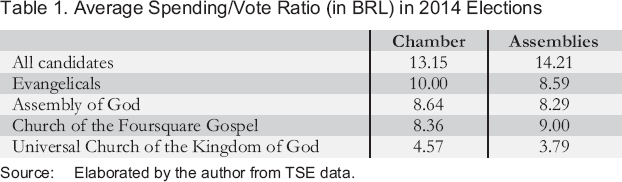
In any case, the two basic explanations for the positive association between being a Pentecostal candidate and good electoral performance allow different conjectures about the campaign spending of these candidates. It may be argued that, whether through “religious cues” or through official church support, Pentecostal candidates need to spend proportionately less money on their campaigns. However, it would also be plausible to bring forth a competing explanation – namely, that Pentecostal candidates receive more resources from parties and/or donors with the expectation that (in comparison to other candidates) they would more easily convert resources into votes. It should be noted, then, that the two explanations suppose that Pentecostal candidates have a comparatively lower voting cost than other candidates – or at least a voting cost that makes them competitive candidates for the elections (see Table 1 below).
Average Spending/Vote Ratio (in BRL) in 2014 Elections
Source: Elaborated by the author from TSE data.
Therefore, one conjecture to be tested is whether Pentecostal candidates collect (and, by extension, spend) more or less money than the other candidates. A second conjecture concerns the difference between Evangelical and Pentecostal candidates. Official support from Pentecostal churches is an institutional resource that can make the candidates of these churches more competitive by offering them facilitated access to a contingent of voters. This should differentiate official Pentecostal candidates from Evangelical candidates. Thus, it is plausible to suppose that being an official Pentecostal candidate has a positive effect on the number of votes received, and that this effect is greater than that of being a non-Pentecostal Evangelical.
As discussed in the previous section, Pentecostal church support is a resource related to the church type. Thus, a third conjecture would be that churches with greater structure, decision-making centralization, and emphasis on candidate support will have a greater effect than other churches on candidates’ electoral performance (Rodrigues and Fuks 2015). From this reasoning, I present below, in a simplified way, the hypotheses to be tested.
Hypothesis 1. Being a Pentecostal candidate has a negative effect on campaign spending.
Hypothesis 2a. Being a Pentecostal candidate has a positive effect on the number of votes received.
Hypothesis 2b. Being a Pentecostal candidate has a greater effect on the number of votes received than that of being a non-Pentecostal Evangelical candidate.
Hypothesis 3. Being a Pentecostal candidate supported by a church with larger structure, decision-making centralization, and emphasis on support has a greater effect on the number of votes received than being a candidate of other churches.
Data
The data set used here comes from two sources. The electoral data, including most of the independent and control variables, come from the Tribunal Superior Eleitoral (TSE). However, in order to test the aforementioned hypotheses, I had to complement this data with information from the linkage between candidates and churches. This implied a dedicated effort of more than one year of data collecting that could not be automatized. More than 17,000 candidates ran for federal and legislative seats in Brazil in 2014. Although it is relatively easy to identify elected Evangelical candidates, the same cannot be said for the non-elected. Some Pentecostal churches do not publicize their (often illegal) support for candidates. The churches’ National Registry of Legal Entities (Cadastro Nacional da Pessoa Jurídica, CNPJ) is not helpful, because most Evangelical candidates are not church employees. 6 Hence, I had to rely on different strategies for identifying Evangelical candidates and their linkages to churches.
I thank Claudia Cerqueira for bringing this fact to my attention.
First, I examined the literature on Evangelicals and elections in Brazil, which offers valuable information on Evangelical politicians. Second, I utilized the information contained in the TSE data about candidates’ occupations and their electoral names. Many Evangelical candidates with ecclesial positions declare their occupation as “priest or member of religious order or sect.” In addition, many also use religious titles in their electoral names. Third, I contacted the churches. Few, however, contributed to the research; most ignored my requests for information about which candidates they supported in elections. Fourth, I searched newspapers and internet news sites that had information about the religious identity and/or church to which the candidate was linked.
While the identification of Evangelical candidates can be difficult, and some of them may have not been identified, there are reasons that allow a strong degree of confidence in the data used here. First, the social profile of Evangelicals makes it very plausible that, like other minorities, they are underrepresented as a share of the total number of candidates. Therefore, almost certainly a smaller share of the more than 17,000 candidates would be Evangelical than the share of Evangelicals in the overall population.
Second, as the literature has pointed out, the phenomenon of Evangelical political representation is to a large extent a product of church-sponsored Pentecostal candidates (Freston 1993; Reich and Santos 2013; Cerqueira 2017). Church corporate representation is a phenomenon circumscribed to a few large Pentecostals churches (mostly the AG, UCKG, and CFG). These are highly centralized churches that do not encourage the political participation of the laity as candidates (except of those members “officially” endorsed by the churches). Few “unofficial” laypersons of these churches will become candidates. The fact that the vast majority of candidates linked to large churches are corporate candidates makes their identification much easier. At the same time, other churches, such as the Christian Congregation in Brazil and the God Is Love Pentecostal Church, do not encourage any kind of individual member participation in electoral politics. One would probably find no candidates representing them. Hence, a significant share of Pentecostal voters probably does not have representatives among political candidates.
Third, several case studies reinforce the conjecture that Pentecostal churches support relatively few candidates per state, which is in accordance with the data used here (Oro 2003b; Schoenfelder and Paz 2006; Cuyabano 2009; Borges Jr. 2010; Valle 2013). In any given state, the number of church-sponsored candidates will be limited by the church's total number of followers registered to vote and willing to support its candidates, as well as by the district's minimum share of valid votes necessary to get elected.
It is necessary to stress that despite the exhaustive work of identifying Evangelical candidates and their respective churches, it is still difficult to identify whether or not a Pentecostal candidate was “officially” supported by his church, and to discern what differentiates a candidate with official support from one who, without official support, tries to win the votes of his congregation. Such a difficulty does not exist in the case of the UCKG, since it does not permit unofficial challengers, but it is considerable in the case of the AG, Brazil's largest Pentecostal church. I opted to identify the candidates “associated” with the churches; although, in many cases, I do not know precisely if the connection involved official support or not. Strictly speaking, I am assuming that candidates associated with Pentecostal churches can be a proxy for Pentecostal “official candidates.”
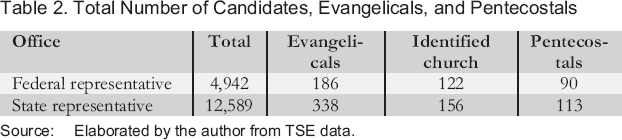
The data set units of analysis are the candidates. The total number of candidates for the Chamber was 4,942, and for the state legislative assemblies, 12,589. An initial matter to be taken into consideration concerns which candidates should be included in the analysis. Using all the candidates for federal and state legislatures in the 2014 elections would imply considering in the analysis even those non-competitive candidates who received few or no votes and few or no resources for their campaigns. As noted by Samuels (2001a), most of the contestants in the US and Brazilian legislative elections are largely irrelevant. However, if they were included in the analysis, they would create a bias towards increasing incumbent advantage, since incumbents would be compared to all other candidates. For this reason, Samuels argues, only competitive candidates should be considered.
But the problem is not just the bias in favor of the incumbents. It is a broader one and concerns to what extent certain observations should influence the estimation of the regression parameters. Let us suppose two candidates, A and B, both ran for a seat as federal representative for São Paulo. Candidate A declared campaign spending of BRL 5 and got 10 votes. Candidate B, in turn, declared an expenditure of BRL 170,000 and obtained 12,000 votes. In terms of electoral success, it is clear that the relation between spending and voting of the first candidate (A) is far from the true relation between spending and voting in the district in question. However, if it is included in the analysis, it will influence the parameter estimation.
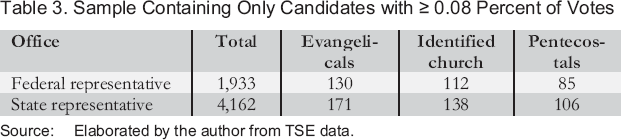
To circumvent this issue, I opted to work with a sample containing only those candidates who received 0.08 percent or more of the total valid votes in their districts. It should be remembered that, in Brazilian OLPR legislative elections, candidates are elected with much lower percentages than would be required in a majority contest. As an example, the candidates elected in 2014 with the lowest percentage of votes received 0.1 percent of the valid votes for the Federal Chamber and 0.12 percent for the state legislative assemblies. The limit of 0.08 percent is, therefore, well below the minimum percentage of votes of those who were elected. It excludes a considerable number of non-competitive candidates, but does not exclude any elected candidates and still allows for the presence of a significant contingent of unelected candidates. Limiting the data in this way also makes it more reliable. If there are cases of missing data (Evangelical candidates who could not be identified), they would certainly be located among the less competitive candidates. 7
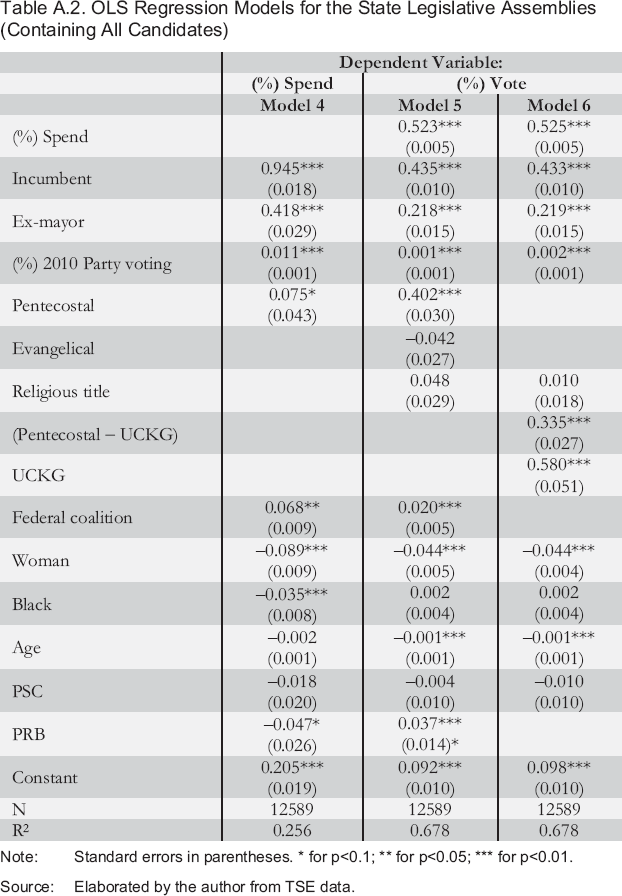
Tables with OLS models containing all candidates are presented in the Appendix. I found small differences in some of the controls, but most of the independent variables remained the same. The exception is the “Pentecostal” variable, which becomes positive in the models containing all candidates. However, it still has a low effect on spending.
Among the candidates for the Chamber, I identified 186 Evangelicals. Of that number, I was able to define 90 as Pentecostals and able to determine the church affiliation of 122. Among the candidates for the state legislative assemblies, I identified 338 Evangelicals, 113 of whom were Pentecostals; churches were identified for 156 of the candidates. For the sample of competitive candidates, the number of Evangelicals is smaller, as shown in Tables 2 and 3, below. However, it should be noted that the number of Pentecostals in the two samples is similar, which indicates that almost all Pentecostal candidates received a percentage equal to or greater than 0.08 percent valid votes in their respective districts.
Total Number of Candidates, Evangelicals, and Pentecostals
Source: Elaborated by the author from TSE data.
Sample Containing Only Candidates with ≥ 0.08 Percent of Votes
Source: Elaborated by the author from TSE data.
Dependent Variables
Campaign Spending
This is a dependent variable for the test of the first research hypothesis and an independent variable for the other hypotheses. Campaign spending is a key aspect of candidates’ electoral performance. 8 In the case of the analysis of the Pentecostal candidates, it is necessary to investigate to what extent they collect more or less money than other candidates. Like Samuels (2001a, 2002b) and Speck and Mancuso (2014), I chose to define this variable as the percentage of spending, meaning the percentage of each candidate's total campaign expenditure in a particular district. 9
For a good partial review of the literature on campaign spending, see Stratman (2005). For a good review of the Brazilian case, see Mancuso (2015).
It is worth mentioning that, in 2014, the Brazilian Federal Police began an investigation (called “Lava Jato”), which has since revealed one of the largest corruption scandals in the world. Investigations revealed that a considerable percentage of Brazilian politicians (whether from executive or legislative branches) were elected using illegal financing. To date, however, as far as I know, there are no studies measuring the impact of the now known illegal financing on the candidates’ performances.
Votes
This is the dependent variable that will be used in the test of most hypotheses, and that measures the candidates’ electoral performance. I chose to set it as the percentage of valid votes each candidate received in his or her district. Another possibility would be to work with a binary dependent variable that would distinguish those who were elected from those who were not. Although there are good arguments for using a binary variable (see, for example, Speck and Mancuso 2014), my goal in this study can be best achieved by working with a continuous variable.
The use of a binary variable would end up disregarding candidates’ ability to perform well even if they are not elected. In Brazilian legislative elections, the best non-elected candidates become “substitutes” (suplentes) – that is, they head a list of those who will take up a position if and when those who were elected resign their mandates to take on other positions. It would be difficult not to consider a good “snplência” as a good electoral performance. This situation is properly captured when working with a continuous variable, but would not be captured with a binary variable. Take, for example, the case of the UCKG in the Brazilian state of Mato Grosso in 2006 (see Cuyabano 2009). The church supported two candidates for the Legislative Assembly of Mato Grosso and one for the Federal Chamber of Deputies. None of them was elected. However, they all received a good number of votes and good positions as substitutes (in fact, one of them was the third substitute). A second justification for using the percentage of valid votes in opposition to the “elected” and “non-elected” categories is that, in elections for Brazilian legislatures, candidates do not depend only on themselves. The possibility of electoral coalitions in high-magnitude districts with OLPR means that some candidates receive comparatively fewer votes but are still elected thanks to the coalition votes. This would be a problem if the variable were binary, but it will not be a problem as long as the variable is continuous.
Independent Variables
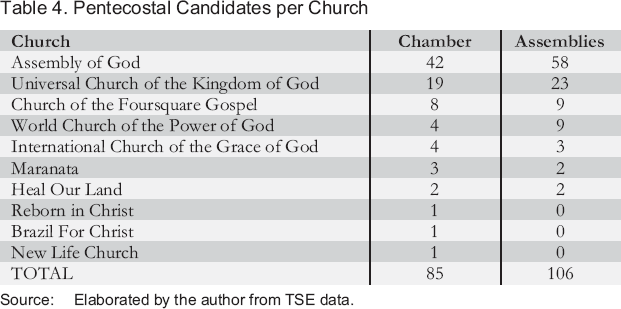
In this study, I use three main independent variables, all binary. The first and most comprehensive identifies whether or not the candidate is an Evangelical. The second and most important is whether the candidate is linked to a Pentecostal church, which I use as a proxy to identify whether or not the candidate is supported by a Pentecostal church. The proxy is necessary because, as mentioned above, it is not always possible to distinguish candidates supported de facto by churches from those who, although related to them in some way, did not receive support. Table 4, below, shows the Pentecostal churches included in the variable and the number of candidates attached to them.
Pentecostal Candidates per Church
Source: Elaborated by the author from TSE data.
Finally, the third independent variable identifies whether or not the candidate is supported by the UCKG. It will be used to test Hypothesis 3: if being a Pentecostal candidate for a church with a larger structure, decision-making center, and emphasis on support for political candidates has a greater effect on the number of votes than being a candidate for other churches. The UCKG is the best choice for this, since it is the best example identified by the Pentecostal literature of a large church with a centralized structure and emphatic support for its candidates. Each of these three variables – Evangelical, Pentecostal, and member of the UCKG – presents a value of “1” when candidates belong to the interest categories and “0” when they do not.
Control Variables
While the argument presented here is focused on the impact of being a Pentecostal candidate on campaign spending and electoral performance, other factors may affect that relationship. One important factor is the use of a religious title. Many Evangelical and Pentecostal candidates use religious titles (“pastor,” “bishop,” “apostle,” etc.) in their electoral names to attract Evangelical voters. As I have argued, the use of religious titles is not random, but is more often used by less competitive candidates, presumably to activate their Evangelical identity. The strategy of electorally focusing on Evangelical voters, even if it makes one lose votes among non-Evangelicals (see Boas 2014), is rational in an OLPR system with a high number of competitors. I included in the models a dummy variable to identify candidates who use religious titles. Approximately 25 percent of Pentecostal candidates for the Federal Chamber used religious titles. In the case of state legislative assemblies, the corresponding share was 38.4 percent.
In the literature on legislative elections, perhaps the most important factor for the performance of candidates is incumbency. Jacobson (1978, 1985, 1990) argued that, in US elections, challengers must spend more money on their campaigns than incumbents, and that the challenger's spending has a stronger effect on his performance than the incumbent's on his. In the case of Brazil, the discussion also exists. Samuels (2001a, 2001b) found no significant difference between the effect of spending on the two groups. Speck and Mancuso (2014), however, suggest there is a difference: spending tends to be more significant for Brazilian challengers than for incumbents. Lemos, Marcelino, and Pederiva (2010) also stress that incumbents receive and spend more money than incumbents.
It is important to remember that in the Brazilian OPLR electoral system several incumbents and several challengers compete within each district. In the 2014 legislative elections for the state of São Paulo, for example, the contests for federal deputy included more than 1,000 challengers and 58 incumbents (the state has 70 representatives). It is true that most of the challengers are uncompetitive candidates. Still, in theory, Brazilian incumbents need to compete with each other and with several competitive challengers.
The importance of incumbency is justified by two basic assumptions that are, to some extent, related: The first is that incumbent candidates can use their resources during their terms to become known to voters, which allows them to start the electoral campaign ahead of their rivals. The second is that incumbents are presumably stronger candidates with greater political capital, whether due to their personal charisma, their political ability, or other factors. However, in the case of Brazil, it can be assumed that many candidates with greater political capital are not necessarily already part of the legislative branch. It is common, for example, for former mayors to compete for seats in state and federal legislatures. The Brazilian political system offers incentives such that politicians do not necessarily seek to build careers in legislatures (Leoni, Pereira, and Rennó 2003). Offices in the local and state executives can be more interesting than a seat in a state legislative assembly or even in the Chamber of Deputies, since more power is concentrated in them and they provide greater political payoff. So, it seems reasonable to take into account not only whether the candidates are incumbent, but also whether they have already been mayors. Thus, I added to the models two dummy variables, one to identify incumbents, and another to identify those candidates who were elected mayors in 2004 and/or 2008. Just over one-third of Pentecostal candidates competing in 2014 were incumbents, but only two of them were former mayors.
Another important factor to consider is the candidate performance in the previous election. It is true that, of the total number of candidates analyzed, only a small fraction are seeking reelection. Most did not run in previous elections. However, it is possible to use as a control the performance of the candidates’ parties in the last elections. This factor may account for holding voter preferences in their respective districts constant. Thus, I include a control variable with the percentage of votes for the candidate's party in the 2010 elections. The percentages refer to the elections to the Chamber of Deputies, in the case of candidates for federal representative, and to the state legislative assemblies, in the case of candidates for state representative. It is worth emphasizing that most studies on the relation between spending and voting in the US congressional elections use some hind of control for constituency preference (Stratman 2005). 10
In the case of parties registered after 2010, such as the National Ecological Party (Partido Ecológico Nacional, PEN), the Republican Party of Social Order (Partido Republicano da Ordem Social, PROS), and Solidarity (Solidariedade, SD), the value attributed was “0.”
The literature on the Brazilian case also highlights another relevant factor – namely, the party's belonging to the federal coalition (Pereira and Rennó 2001, 2007; Leoni, Pereira, and Rennó 2003). The assumption is that candidates would benefit from belonging to the federal government coalition, either for the benefits that membership could grant to their mandates in the case of candidates for reelection, or for a possible coattail effect that could benefit the candidates related to the coalition base. 11 This reasoning could also be valid for state government coalitions, given the supposed power that Brazilian governors have over state and municipal political leaders (Abrúcio 1998). However, as Pereira and Rennó (2007) argue, the institutional changes that occurred throughout the 1990s, such as the end of state banks and the approval of the Fiscal Responsibility Law, have diminished the power of state governments, making their influence less certain. Thus, I included in the models only a dummy variable to control for belonging to the federal coalition in 2014.
It is worth remembering that, despite the fall in the popularity of President Dilma Rousseff between March and June 2013, she ended 2014 with relatively high approval ratings. See, for example, Agência de Notícias CNI 2014).
Another factor stressed by the literature that deserves attention is that of political parties. In the debate on the relationship between spending and voting in US congressional elections, the models incorporate variables specifying candidate parties (e.g., Jacobson 1978; Green and Krasno 1988). However, not all studies on the Brazilian case use parties as controls. The relevance of the party depends, of course, on what one wants to investigate. In the case of the relation between expenditure and vote, the candidate's political party is a variable related to both spending and voting; therefore, it should be incorporated. However, the focus of this study is not exactly the relationship between spending and voting, but rather between being a Pentecostal “official candidate” and voting.
It is reasonable to suppose that the performance of Pentecostal candidates does not depend much on parties. The literature usually characterizes Brazilian parties as weak and having diluted “brands” (Main-waring 1992; Samuels and Zucco 2013). The exceptions would be the Workers’ Party (Partido dos Trabalhadores, PT) and, to a lesser extent, the Brazilian Social Democracy Party (Partido da Social Democracia Brasileira, PSDB) and the Brazilian Democratic Movement Party (Partido do Movimento Democrático Brasileiro, PMDB). However, as shown in Table 5 (below), Pentecostal candidates tend to be disseminated into small, comparatively unstructured parties with diffuse ideologies. These parties are, in general, center or center-right, but their “brands” signal little to voters. In addition, parties that host Pentecostal candidates are likely to contribute less to their candidates’ campaigns than stronger parties such as the PT or the PSDB. The literature's characterization of Pentecostal candidates implies that they are little dependent on their parties, since in theory they could count on their “electoral corrals.” These arguments could justify the exclusion of the parties from the statistical models of this study. However, based on Table 5, I chose to include dummies only for the parties with the highest concentration of Pentecostal candidates: the Brazilian Republican Party (Partido Republicano Brasileiro, PRB) and the Social Christian Party (Partido Social Cristão, PSC).
Pentecostal Candidates per Party
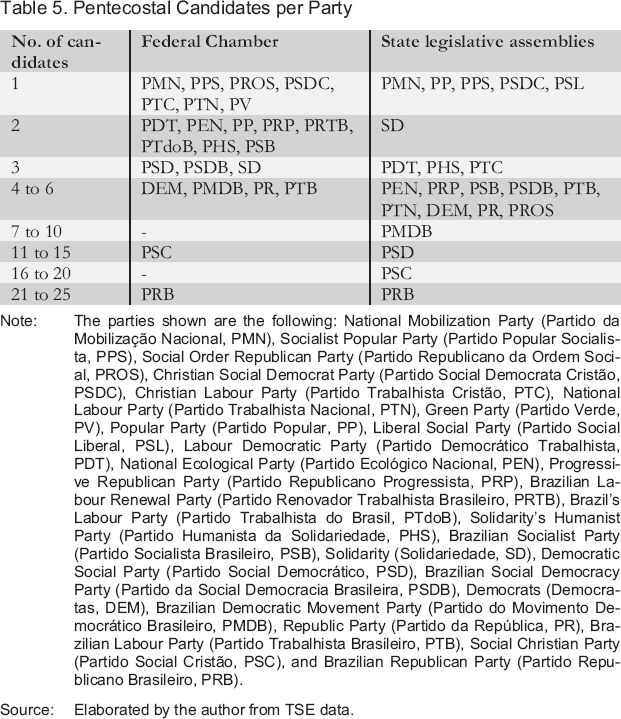
Note: The parties shown are the following: National Mobilization Party (Partido da Mobilização Nacional, PMN), Socialist Popular Party (Partido Popular Socialista, PPS), Social Order Republican Party (Partido Republicano da Ordem Social, PROS), Christian Social Democrat Party (Partido Social Democrata Cristão, PSDC), Christian Labour Party (Partido Trabalhista Cristão, PTC), National Labour Party (Partido Trabalhista Nacional, PTN), Green Party (Partido Verde, PV), Popular Party (Partido Popular, PP), Liberal Social Party (Partido Social Liberal, PSL), Labour Democratic Party (Partido Democratico Trabalhista, PDT), National Ecological Party (Partido Ecológico Nacional, PEN), Progressive Republican Party (Partido Republicano Progressista, PRP), Brazilian Labour Renewal Party (Partido Renovador Trabalhista Brasileiro, PRTB), Brazil's Labour Party (Partido Trabalhista do Brasil, PTdoB), Solidarity's Humanist Party (Partido Humanista da Solidariedade, PHS), Brazilian Socialist Party (Partido Socialista Brasileiro, PSB), Solidarity (Solidariedade, SD), Democratic Social Party (Partido Social Democrático, PSD), Brazilian Social Democracy Party (Partido da Social Democracia Brasileira, PSDB), Democrats (Democratas, DEM), Brazilian Democratic Movement Party (Partido do Movimento Democratico Brasileiro, PMDB), Republic Party (Partido da Republica, PR), Brazilian Labour Party (Partido Trabalhista Brasileiro, PTB), Social Christian Party (Partido Social Cristão, PSC), and Brazilian Republican Party (Partido Republicano Brasileiro, PRB).
Source: Elaborated by the author from TSE data.
Finally, I add to the models control variables for gender, race, and age. The first two are dummies and the last one is continuous. In the case of gender, the variable assumes a value of “1” for women and “0” for men. In the case of race, it assumes “1” for black or brown (pardo) people and “0” for others. 12 It is worth saying that, in the 2014 elections for federal and state legislatures, a quarter of the total number of candidates were women. Among Pentecostal candidates, this proportion was just one tenth. Regarding race, the proportion of blacks and browns within the total number of candidates is similar to that found in the subset of Pentecostal candidates (just under 40 percent in both groups). The underrepresentation of women and blacks in the Brazilian legislatures, as well as their lower potential for campaign financing (Sacchet and Speck 2012), suggests the importance of including controls for gender and race in the models.
I use the term “brown” as a translation of “pardo,” which refers to Brazilians of mixed race. From now on in this article, the term “black” will cover both black and brown candidates.
Results
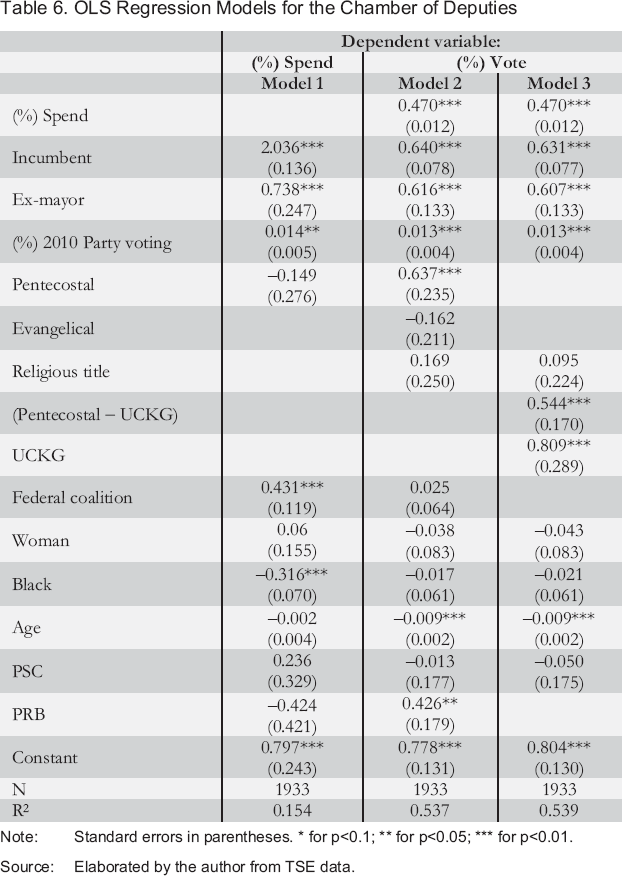
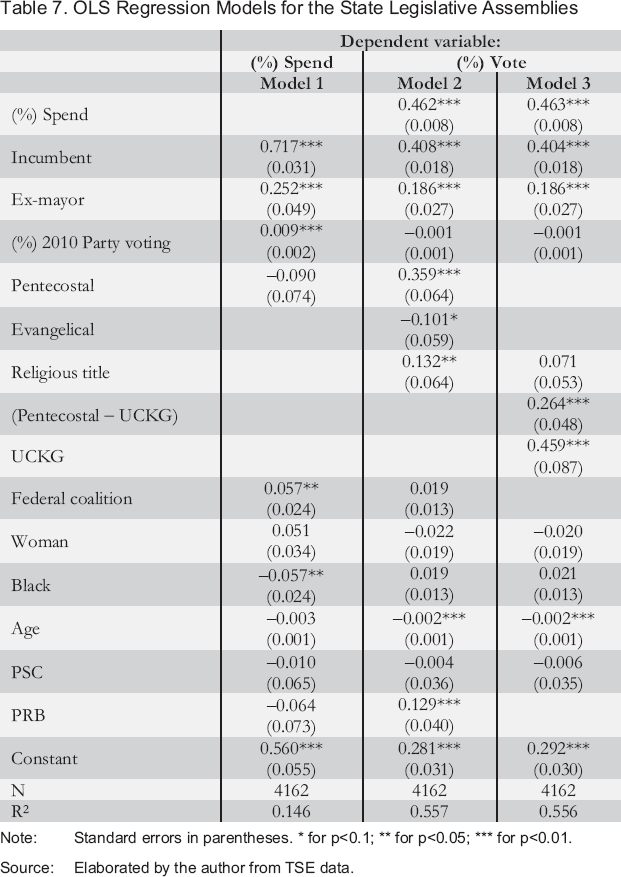
In order to test the hypotheses stated above, I use OLS regressions to estimate three models, replicated for the Federal Chamber (Table 6) and state legislative assemblies (Table 7). Model 1 is used to test the first hypothesis, that being a Pentecostal candidate would have a negative impact on campaign spending. The dependent variable of Model 1 is the percentage of expenditure. Model 2 refers to the second hypothesis, that being a Pentecostal candidate would have (a) a positive effect on the number of votes, and (b) a greater effect on the number of votes than being Evangelical. The dependent variable is the percentage of votes.
OLS Regression Models for the Chamber of Deputies
Note: Standard errors in parentheses.
for p<0.1;
for p<0.05;
for p<0.01.
Source: Elaborated by the author from TSE data.
OLS Regression Models for the State Legislative Assemblies
Note: Standard errors in parentheses.
for p<0.1;
for p<0.05;
for p<0.01.
Source: Elaborated by the author from TSE data.
Finally, Model 3 is used to test the third hypothesis, that being a Pentecostal candidate for a church with a larger structure, more centralization, and more emphasis on support would have a greater effect on the number of votes than being a candidate for other churches.
Again, the dependent variable is the percentage of votes. Each of the models is presented in two versions, one for the Federal Chamber, the other for the assemblies.
The main variable for the first model is “Pentecostal,” which specifies whether or not the candidate is supported by a Pentecostal church. The results suggest a low and negative effect of being Pentecostal on expenditure for both the Chamber and the state legislative assemblies. However, neither of them is statistically significant.
The second hypothesis finds support in Model 2. In this case, the variables of major interest are “Pentecostal” and “Evangelical.” Regarding Hypothesis 2a, there is a strong positive and statistically significant effect (always at 0.01) of being Pentecostal on the percentage of votes, for both the Chamber and the assemblies. The effect holds even when incumbency, candidate party's performance in previous elections (2010), belonging to the federal government coalition, gender, race, age, religious title, and even the parties with the highest number of Pentecostal candidates – the PRB and PSC – are controlled for.
Hypothesis 2b supposes the comparison between the coefficients of “Pentecostal” and “Evangelical.” As summarized in Figure 2, the confidence intervals of the Chamber coefficients overlap slightly. However, a Wald test reveals that the hypothesis of coefficient equality can be rejected at a significance level of 10 percent (Prob > F = 0.0562). 13
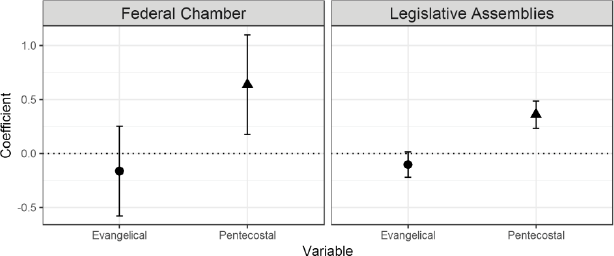
Estimated Effect of Being Evangelical or Pentecostal on Vote (Model 2)
All Wald tests were made with the post-estimation command of Stata 12.
The assemblies’ coefficients do not overlap, indicating that the difference between them is statistically significant (see StatNews #73 2008). Hence, the results corroborate the conjecture that the effect of being a Pentecostal candidate is different from that of being Evangelical.
The third hypothesis, tested with Model 3, states that the type of church is relevant to the effect of being a Pentecostal candidate. A church with greater structure, centralization, and emphasis on support would have a greater effect than other churches on candidates’ votes. To test this conjecture, I compared the effect of being Pentecostal to the effect of being supported by the UCKG. For this comparison, I created a new variable, “Pentecostal – UCKG,” which is, as the name suggests, the same “Pentecostal” variable, but without candidates belonging to the UCKG. The reason is that, without this, it is not possible to obtain a coefficient for the variable “UCKG.” 14
I also opted not to include controls for the PRB and belonging to the federal coalition simply because all UCKG candidates were in the PRB, and the PRB, in turn, was part of the federal coalition.
Figure 3 presents the results. For both the Chamber and the state legislative assemblies, the coefficient of “UCKG” is higher than that of “Pentecostal – UCKG,” but their confidence intervals overlap. The result of the Wald test for the Federal Chamber reveals that the hypothesis of equality between the coefficients cannot be rejected (Prob > F = 0.4186). Regarding the state legislative assemblies, the hypothesis that the two coefficients are equal can be rejected at a significance level of 5 percent (Prob > F = 0.0407).
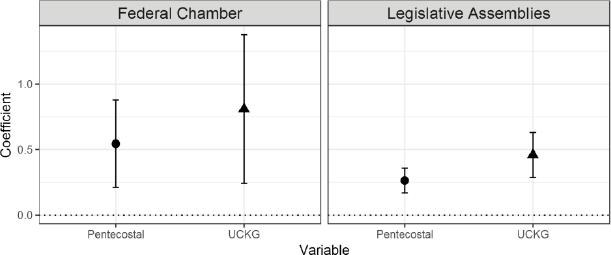
Estimated Effect of Being Pentecostal or Member of UCKG on Vote (Model 3)
Thus, in the case of Hypothesis 3, the effect of being a candidate supported by the UCKG is greater than that of being supported by other churches, but the difference between the effects is statistically significant only for the assemblies.
Finally, it is worth mentioning that the results of the coefficients of the control variables for the Chamber and state legislative assemblies were similar. For all models, the effect of campaign spending was positive and significant. The same goes for incumbency and being a former mayor. The percentage of the party's votes in the last election has a positive and significant effect, yet almost null, for all Chamber models, but is negative and non-significant for Model 2 and Model 3 of the assemblies. Belonging to the federal coalition has a positive effect and is statistically significant both for Chamber and assemblies, but only for the first model. Finally, it is worth mentioning that the effect of being a woman, in general, is low and presents no statistical significance. The same holds for the effect of being a black candidate. The exception is the first model for the Chamber, in which the coefficient of being black is strong, negative, and statistically significant.
Qualitative Analysis
One could object that I do not measure the support of the churches as an institutional resource, but rather certain skills (acquired or innate) of the Pentecostal candidates, such as personal charisma, social capital, and so on. Perhaps the identified effect of being a Pentecostal candidate on votes, despite all the controls used in the regression models, actually reveals certain capabilities of these candidates that would not have been properly controlled for. Perhaps they are the same capacities that made them rise in the hierarchies of their churches, for example. I do not deny that there are factors related to these candidates that have not been controlled for in the above models. However, I will argue here that, despite the alleged abilities of Pentecostal candidates, their electoral performance is largely due to the support of the churches, and that the effect of being Pentecostal on the vote wanes or disappears when church support is absent.
To this end, I offer in this section qualitative evidence of six Pentecostal candidates who were elected with the support of their churches, split from them throughout their term, and still ran for reelection. Such evidence can serve as a counterfactual basis for thinking about what the performance of these candidates would have been if church support were absent. Each of them had a marked decline in their votes received, and none of them were reelected. As far as I know, these are the only cases between 1998 and 2014 of Pentecostal politicians who have split with their church during their term. Therefore, as far as I know, there are no cases that have resulted in equal or better electoral performance.
Conclusions
According to some of the literature on Pentecostal growth and politics in Latin America, the entry of Pentecostal churches into politics is detrimental to democracy. By having control over the votes of their congregation members, Pentecostal leaders could get themselves or others elected to legislatures, thereby benefiting their churches from parochial bills. Such an argument is based on the assumption that Pentecostal candidates would gain a considerable degree of support from their churches.
This work contributes to a better understanding of the relationship between churches, candidates, and legislative elections in Brazil. Drawing on new data, I offer important quantitative evidence to evaluate the above argument and others in the literature on Pentecostalism and politics. It is the first work to use data for Evangelical candidates other than those based on religious titles. As has been seen, the use of religious tides is a resource used mostly by less competitive candidates. Most competitive Pentecostal candidates do not rely on it, which indicates that identifying Pentecostal candidates only by means of the titles in their electoral names will necessarily lead to biased models.
The literature review made clear the importance of investigating the relationship between campaign spending and election performance. I argued that, from a theoretical point of view, it is plausible that Pentecostal candidates could spend more or less on their campaigns than other candidates. I then showed that Pentecostals of the Assembly of God, the Church of the Foursquare Gospel, and the UCKG have a comparatively lower voting cost than other candidates, with the UCKG's voting cost being considerably lower than that of other churches. The vote of Pentecostal candidates costs less than the others, and that of the UCKG candidates costs less than all other Pentecostals.
Through OLS regression models, I tested whether there was a negative relationship between being a Pentecostal candidate and campaign spending. The results suggest that the relationship is indeed negative, but not statistically significant. When controlling for incumbency, previous party performance, and belonging to the federal coalition, among other factors, being a Pentecostal does not have a significant effect on expenditure.
Then I inquired whether there would be an effect of being Pentecostal on votes received, and whether such an effect would be superior to that of being an Evangelical candidate. The results confirm the two hypotheses. The effect of being a Pentecostal candidate on votes received is strong even when controlling for factors such as incumbency, spending, previous party performance, belonging to the federal coalition, gender, race, age, and belonging to the PRB or PSC. There is, therefore, strong evidence to confirm the conjecture that the support of Pentecostal churches contributes significantly to the electoral performance of their candidates. This could also explain why Pentecostals are less underrepresented in Brazilian legislatures than other minorities.
To reinforce my argument, I offered qualitative evidence for counterfactual reasoning: How would Pentecostal candidates perform were church support absent? Between 1998 and 2014, there were at least six cases of Pentecostal candidates who, elected with the support of their churches, broke with them over the term, but nevertheless decided to run for reelection. All of them had considerably lower performances, and none was reelected.
It is also important to note that, while holding constant the effect of being Pentecostal, the effect of being Evangelical on the vote is negative for both the Chamber and the state legislative assemblies – though not statistically significant. This result is intuitive and may indicate that, controlling for the effect of being supported by a Pentecostal church, being Evangelical does not bring any electoral benefit to the candidate.
Through Model 3,1 also tried to test whether the type and structure of the church matters in supporting candidates. To this end, I investigated whether the effect of being supported by the UCKG would be greater than the effect of being Pentecostal. The effect is, in fact, greater, although the difference between them is statistically significant only in the tests for the assemblies. The low number of UCKG candidates causes the standard error of the coefficient to be high. Even so, the evidence gathered here is in line with the conjecture that churches with greater structure and centralization contribute more to the electoral performance of their candidates than do the other churches, in addition to having a lower voting cost.
Evangelicals owe their growth in the Federal Chamber and state legislative assemblies to church-sponsored Pentecostal candidates. Churches that have adopted the corporate model of political representation have been remarkably successful (Lacerda 2017). The evidence presented here reinforces the importance of church support for Pentecostal candidates.
Finally, it should be noted that the results presented here are based only on the 2014 elections. Strong as they are, they have a limited power of generalization. New investigations should retake these tests with new elections and, if possible, also examine municipal legislatures.
Footnotes
Appendix
OLS Regression Models for the State Legislative Assemblies (Containing All Candidates)
| Dependent Variable: | |||
|---|---|---|---|
| (%) Spend | (%) Vote | ||
| Model 4 | Model 5 | Model 6 | |
| (%) Spend | 0.523 *** (0.005) | 0.525 *** (0.005) | |
| Incumbent | 0.945 *** (0.018) | 0.435 *** (0.010) | 0.433 *** (0.010) |
| Ex-mayor | 0.418 *** (0.029) | 0.218 *** (0.015) | 0.219 *** (0.015) |
| (%) 2010 Party voting | 0.011 *** (0.001) | 0.001 *** (0.001) | 0.002 *** (0.001) |
| Pentecostal | 0.075 * (0.043) | 0.402 *** (0.030) | |
| Evangelical | -0.042 (0.027) | ||
| Religious title | 0.048 (0.029) | 0.010 (0.018) | |
| (Pentecostal – UCKG) | 0.335 *** (0.027) | ||
| UCKG | 0.580 *** (0.051) | ||
| Federal coalition | 0.068 ** (0.009) | 0.020 *** (0.005) | |
| Woman | -0.089 *** (0.009) | -0.044 *** (0.005) | -0.044 *** (0.004) |
| Black | -0.035 *** (0.008) | 0.002 (0.004) | 0.002 (0.004) |
| Age | -0.002 (0.001) | -0.001 *** (0.001) | -0.001 *** (0.001) |
| PSC | -0.018 (0.020) | -0.004 (0.010) | -0.010 (0.010) |
| PRB | -0.047 * (0.026) | 0.037 *** (0.014) * | |
| Constant | 0.205 *** (0.019) | 0.092 *** (0.010) | 0.098 *** (0.010) |
| N | 12589 | 12589 | 12589 |
| R2 | 0.256 | 0.678 | 0.678 |
Note: Standard errors in parentheses.
for p<0.1;
for p<0.05;
for p<0.01.
Source: Elaborated by the author from TSE data.