




Abstract
Since the return of democracy, party identification has been declining sharply among the Chilean public. We seek to understand this process by applying an age-period-cohort analysis to survey data from 1994 to 2014. In light of the elite-driven and socially uprooted character, or what we call the encapsulated nature, of the Chilean party system, we hypothesize that cumulative electoral experience has had a negative effect on party identification and not the positive effect that Converse's (1969) social-learning model would predict. Our findings support these expectations but also reveal large period effects that have shrunk the overall level of partisan identification and significant cohort effects whereby generations born after the 1950s have become less partisan. We also uncover important nuances that occur across the various mainstream political parties. We conclude that all three sources of social change are leading toward the extinction of mass partisanship from Chilean society.
Introduction
During the past three decades, several Latin American countries have experienced dramatic dealignment processes whereby significant portions of the population have ceased supporting or affiliating themselves with any of the existing political parties (Lupu 2014; Morgan 2007). In Chile this trend has been most noticeable. According to national surveys conducted by the Center of Public Studies (Centro de Estudios Publicos, CEP) in 1994, more than 70 percent of the Chilean adult population mentioned identifying or sympathizing with a political party. By 2014, however, this figure had dropped to 32 percent. Although some fluctuations have certainly occurred throughout the years, the trend of a strong decline is indisputable (see figure 1a). The magnitude of this change surpasses similar tendencies observed in advanced democracies. 1 Interestingly, and consistent with recent findings from Navia and Osorio (2015), these aggregate trends are not equal across all major Chilean parties. As figure 1(b) reveals, the Christian Democratic Party (Partido Demócrata Cristiano, PDC) was the only party to experience a strong decline in supporters up to 2005. In contrast, identification with right-wing parties (Independent Democratic Union (Unión Demócrata Independiente, UDI) and National Renewal (Renovación Nacional, RN)) and center-left parties (Party for Democracy (Partido por la Democracia, PPD), Socialist Party (Partido Socialista de Chile, PS), and Social Democratic Radical Party (Partido Radical Social Demócrata, PRSD)) remained stable and even increased slightly. Nonetheless, identification with these parties also started to systematically decrease after the 2005 presidential election.
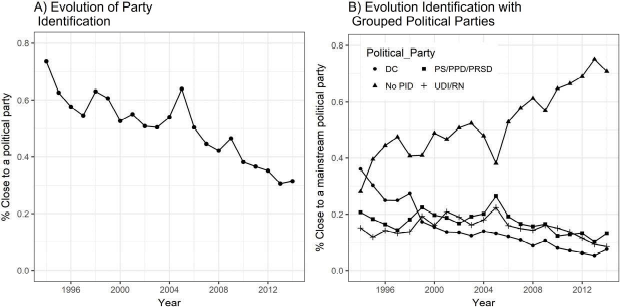
Party Identification in Chile by Year, 1994–2014
Dalton (2016) provides some trends in party identification in the United States, the United Kingdom, France, and (West) Germany that span several decades. The country with the sharpest drop is Germany (from slightly more than 80 percent in mid-1970s to around 60 percent in recent years).
This decline of partisanship has not gone unnoticed among scholars (Luna and Altman 2001; Navia and Osorio 2015; Segovia 2009; Siavelis 2016). Unsurprisingly, many of them have expressed deep concerns about the possible negative implications it might have for the Chilean political system.
Weakly supported political parties are expected to encounter more difficulties when performing tasks that are essential to a democracy, such as gathering political support for new policies, recruiting prospective political candidates, mobilizing voters to participate in the democratic process, and articulating heterogeneous social and political interests (Dalton, McAllister, and Wattenberg 2000).
The objective of this article 2 is twofold. First, we seek to understand how this process of partisan decline took place. We do this by conducting an age-period-cohort (APC) analysis of repeated cross-sectional survey data from 1994 to 2014, which allows us to identify the sources of change behind the aggregate decline. Such an analysis entails distinguishing whether this process occurred through generational replacement or through individual-level attitudinal change, or a combination of both. By identifying the microlevel sources of aggregate change, we shed light on a dimension of partisan decline that is commonly left unexplored. Furthermore, on the basis of these methodological advantages, we exploit Chilean democracy as a diachronic single-case study (Gerring 2006) that allows us to identify APC effects and controlling for macro explanations of partisanship, such as economic performance and political stability.
Acknowledgments: Previous versions of this article benefited from the comments of participants at the 2014 Regional Conference of the World Association for Public Opinion Research (Santiago, Chile), attendees at the seminar hosted by the Institute of Political Science of the Pontificia Universidad Católica de Chile, as well as those made by Carolina Segovia, Mauricio Morales, Nicolás Somma, and our anonymous reviewers.
Funding: This research was supported by a CONICYT–FONDECYT Initiation Grant (No. 11140746) provided by the Chilean Ministry of Education and the Centre for Social Conflict and Cohesion Studies (Chilean grant CONICYT/FONDAP/15130009).
Second, we look to analyze these trends in light of Converse's (1969) influential social-learning model, which contends that individuals’ propensity to identify with political parties should increase as they accumulate electoral experience. We claim that the process of partisan decline that has occurred in Chile is, in fact, at odds with Converse's (1969) model. As many authors argue, following the country's democratic transition, it witnessed the rapid consolidation of a highly institutionalized multiparty system (Castiglioni and Kaltwasser 2017; Kitschelt et al. 2010; Mainwaring and Scully 1995) that not only resembled the party system in place before the democratic breakdown in 1973 (Siavelis 1997; Valenzuela and Scully 1997) but also remained stable until recently. Therefore, following Converse's (1969) model, the Chilean party system's stability during the period under observation should have promoted, all else being equal, the rise of partisan attachments, not their decline.
We argue that this anomaly can be explained if one considers the particularities of the Chilean party system. Following recent literature, we claim that the current Chilean party system has also become increasingly elite-driven and socially uprooted, or – as we put it –encapsulated. Chilean citizens have taken notice of this phenomenon and have become deeply distrustful of political parties and their practices. Consequently, we contend that the accumulation of electoral experience (i.e., voters’ direct interaction with parties) will decrease voters’ propensity to identify with parties, not increase it as Converse's (1969) model suggests. This theoretical assertion leads us to expect a negative association between aging and party identification, and not a positive relationship as virtually all comparative political behavior research has previously shown (Alwin and Krosnick 1991; Claggett 1981; Dalton and Weldon 2007; Dinas 2014). By testing this microlevel implication, the present study shows that the development of party identification is conditional on the links between parties and citizens that characterize the political context. As such, we believe this study contributes to our understanding of determinants of mass partisanship in new and old democracies. Moreover, studying the development of partisanship in a nonadvanced democracy such as Chile enables us to examine the explanatory factors suggested by the literature in new contexts and thus reevaluate the explanatory power of theories (e.g., social-learning hypothesis).
Our statistical results confirm our expectations. Contrary to Converse's (1969) social-learning hypothesis, they uncover moderately sized negative aging effects whereby voters’ propensity to identify with parties decreases as they become older. Although the sign of this aging effect is consistently negative, its magnitude varies across parties, with left-wing parties experiencing the sharpest declines. We also find strong period effects that have shrunk levels of party identification for all age groups simultaneously; though these also show relevant differences across party groups. Finally, we find negative cohort effects, with generations born after the 1950s having become progressively less partisan. Based on these findings, we conclude that all three sources of social change have consistently led to the extinction of mass partisanship from Chilean society. Given the importance of political parties in democratic systems, these simultaneous trends could cause some worrisome problems in the near future for the Chilean political system.
The article is organized as follows: In the next section, we review the nature of the postauthoritarian Chilean party system. We then review Converse's (1969) learning model and consider the relationship between cumulative experience and partisanship in light of the nature of the current Chilean party system. The section after that details all relevant information about our APC methodology, research design, and statistical specification. After this, we review the empirical results before discussing them and concluding in the final section.
Since redemocratization in 1989, the Chilean party system has revolved around two multiparty coalitions: the center-left Coalition of Parties for Democracy (composed of the PS, PPD, PDC, and PRSD and originally created to oppose the military regime) and the center-right coalition Alliance for Change (composed of the RN, UDI, and various small rotating political organizations and supporter of the military regime). The Coalition of Parties for Democracy governed between 1990 and 2010 before being defeated by the Alliance. In 2014 the New Majority – a renewed version of the center-left collation that also included the Communist Party (Partido Comunista de Chile, PCC) – defeated the Alliance to take back power.
Up until 2015, the Chilean party system strongly resembled the party system in place before the democratic breakdown of 1973, albeit with some important differences (e.g., its less polarized nature). Many of the parties that dominate the political spectrum are the same ones that did so prior to 1973, while others were founded toward the end of the military dictatorship but retained clear connections to previous party organizations (Garretón 1990). 3
For example, the electoral records of the PRSD, formerly known as the Radical Party, trace back to the nineteenth century. The PDC was founded in 1957 and led the Eduardo Frei Montalva government between 1960 and 1964. The PS and PCC (founded in 1933 and 1922, respectively) were the main supporters of the Popular Union coalition that governed between 1970 and 1973.
Both party systems also share a similar left–right ideological alignment, with one or two electorally relevant parties situated on the right, the PS and the PCC located on the left, and the PDC located in between (Valenzuela and Scully 1997; Siavelis 1997; Navia and Osorio 2015), though ideologically closer to the left-wing parties (Bonilla et al. 2011).
As many regional specialists argue, the Chilean party system is among the most institutionalized of Latin America (Luna and Altman 2011; Mainwaring and Scully 1995; Payne et al. 2006). One reason for this claim is that since the return of democracy, Chile has experienced low levels of electoral volatility, which is a common indicator of party system institutionalization (Mainwaring and Torcal 2006). As shown in figure 2(a), Chile had some of the lowest volatility levels in Latin America between 1990 and 2010.
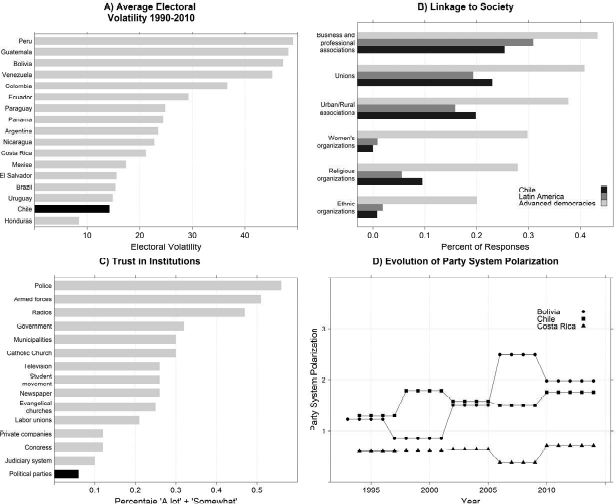
Comparative Features of the Chilean Postauthoritarian Party System
Following the prominent work of Kitschelt et al. (2010), the Chilean party system also stands out due to its high levels of programmatic structuration. 4 In each of the indicators that Kitschelt et al. employ to measure this concept, the Chilean party system systematically ranks highest or among the highest in their sample of 12 Latin American countries. For instance, they found that the average level of ideological cohesion of political parties (measured using within-party similarity of legislators’ opinions on several issues) was highest among the Chilean sample of representatives (Kitschelt et al. 2010; see chapter 5). Despite these favorable traits, several weaknesses of Chile's postauthoritarian party system have become increasingly apparent to scholars.
This refers, in rough terms, to the extent to which political competition is structured around coherent and substantive policy alternatives that parties offer, and the degree to which citizens cast their votes based on the programmatic proposals of parties, as opposed to clientelistic incentives (Kitschelt et al. 2010).
Some resemble the elements that Levitsky, Loxton, and Van Dyck (2016) identify as increasing the chances of party-building in Latin American countries, such as developing strong levels of organizational cohesion and sustained linkages with citizens; others are more specific to the Chilean reality.
A first relevant element refers to the low levels of internal democracy among Chilean political parties. 5 This can be observed in the selection of party leadership and legislative candidates. Regarding the latter, several scholars argue that the selection of congressional candidates has been a party-dominated and elite-driven process (Field and Siavelis 2011; Luna and Mardones 2010; Navia 2005). In fact, with a few rare exceptions, up to the general election of 2013, the party elites of both major coalitions consistently nominated legislative candidates with hardly any feedback from party members or activists, whether through election primaries or any other internal democratic decision mechanism. 6 Some scholars claim that this lack of consultation stemmed from the complexities of the former binomial electoral system, which encouraged party elites to retain their grip on the nomination process (Navia 2008; Siavelis 2009). 7
Strictly speaking, the following description applies up to 2015, the year in which Congress passed the Strengthening and Transparency of Democracy bill, which devised a series of measures aimed at reinforcing the internal democratization and transparency levels of political parties in return for state-sponsored financing.
A proportional representation system replaced the binomial system in 2013. The new system was employed for the first time in the 2017 general election.
According to Navia (2008) and Field and Siavelis (2011), some parties of the Coalition of Parties for Democracy, particularly the PDC, experienced primaries during the 1993 and 1997 legislative elections, although these were exceptional. For the 2013 general election, only one of the six major parties (RN) elected candidates through open primaries in 10 out of 60 districts.
The selection of party leadership follows a similar pattern. According to press information (Del Solar 2015), during the internal party leadership elections between 2014 and 2015, only the PS saw more than a quarter of its registered members actually vote. The other large parties only saw between 11 percent and 17 percent of their members vote. The right-wing UDI, the party with the largest number of parliamentary members up to 2017, used registered members’ votes to elect its leadership for the first time in 2016.
A second weakness refers to the fact that party elites have been reluctant to renew their leadership ranks. Incumbents are normally granted the right of renomination or, in the worst-case scenario, are asked to compete in other electoral districts (Navia 2008). The Political Elites in Latin America (PELA) parliamentary survey provides some evidence to support this point. According to data published in the Bulletin number 8, 61.4 percent of Chilean congress members between 1994 and 2006 were serving for at least a second legislative period; the Latin American average was only 33.4 percent.
Third, the Chilean party system is loosely connected to society in the sense that parties have very few ties with civil society organizations (Luna and Altman 2011). As Garretón (1990) anticipated, the deep imbrication between political parties and social organizations observed during the preauthoritarian period has not been reproduced in the current era. The Democratic Accountability and Linkages Project (Kitschelt 2013) provides some evidence to support this point. A total of 1,397 experts from 88 countries were asked whether their countries’ main parties “have strong linkages to one or more of the following civil society organizations.” The results for Chile, Latin America, and a group of advanced democracies are shown in figure 2(b). Although the levels of linkage between parties and different social organizations in Chile and Latin America are similar, they are remarkably lower than those observed in advanced democracies.
The binomial electoral system arguably reinforced this negative assessment of Chilean parties, which – according to Siavelis (2009, 2016) – limited the impact of voters’ preferences on electoral outcomes. With only two members being elected in each district, and with the rule that a polling coalition can obtain both seats only if it doubles the number of votes obtained by the second-placed list, candidates of the major coalitions were able to secure both legislative seats with very few exceptions. Consequently, the binomial system made electoral outcomes predictable, thus limiting competition and eroding the degree of accountability of the political system.
These negative traits have led scholars to seriously doubt the comparatively favorable nature of Chile's party system. Luna and Altman (2011) argue that although it certainly is stable, it has become uprooted from society. Taking into account the strong control that elites have over their parties and the low levels of citizen involvement, Luna and Mardones (2010) claim that the political system increasingly resembles Dahl's notion of a “competitive oligarchy.” Siavelis (2009) similarly describes the Chile's current party system as an emerging “partyarchy” in the sense that political parties co-opt all relevant routes of political representation and policy development to the point that the political system's accountability appears to be under threat. Although political stability has not been compromised, Chilean parties have systematically failed to build strong ties with society, promote their own legitimacy and accountability, and guarantee citizen involvement in their decision-making processes. In summarizing these arguments, we suggest that the current party system has become encapsulated in a double sense – that is, it has become frozen at the elite level and also increasingly unattached to the rest of society.
In this scenario, it is hardly surprising that the reputation of political parties has suffered dramatically. Figure 2(c) shows the percentage of the adult population that mentioned trusting various political and nonpolitical institutions “a lot” or “somewhat” in a July 2014 CEP survey. What is surprising is not that political parties ranked lowest, as they have done this since the 1990s (Huneeus 2014: 434), but that only 6 percent of the entire sample mentioned trusting them. An April 2015 CEP survey asked respondents about their perceptions of how political parties manage their internal affairs. One question asked whether “political parties take into account the views of its members when making decisions,” to which only 14 percent of respondents agreed. More dramatically, when asked whether “the decisions made by parties are transparent,” only 8 percent of the respondents agreed. These results are reinforced by Carlin's (2014) Q-method analysis of respondents’ answers to a set of items gauging perceived levels of integrity, competence, and responsiveness of Chilean political parties. His analysis identifies three cognitive rubrics of political party trustworthiness – one of which refers specifically to how parties manage their internal affairs and power struggles. Compared to the other two cognitive rubrics, respondents’ scores on this rubric were the most highly correlated with a 4-point scale of trust in political parties. Thus, there is clear evidence that Chileans’ overall assessment of political parties is not only negative but is also deeply tied to the way parties conduct their internal affairs.
Lastly, figure 2(d) shows the evolution of another element, ideological polarization levels of the Chilean party system between 1994 and 2014 (estimated by Singer (2016) using data from the PELA parliamentary surveys). 8 As a contrast, we added the countries with the lowest (Costa Rica) and highest (Bolivia) levels of fluctuation in levels of polarization across time. As can be seen, ideological polarization levels in the Chilean party system are very stable and are more similar to the patterns observed in Costa Rica than in Bolivia. In fact, according to Singer's (2016) estimates, Chile ranks fourth among the sample of 17 Latin American countries as having the most stable levels of ideological polarization. This result is very relevant given the importance of ideological convergence in explaining the processes of brand dilution and partisan decline observed in advanced and some Latin American democracies (Berglund et al. 2004; Lupu, 2014, 2015a; Levitsky, Loxton, and Van Dyck 2016). We will come back to this point in the final section of the article.
Ideological polarization is measured by the level of dispersion in the left–right position of political parties, which is captured by representatives’ responses to the left–right scale.
In his classic account Converse (1969) proposes a theoretical model which depicts party identification as a social habit, where the degree of subjective attachment with a preferred party increases with cumulative electoral experience (denoted as Ip), and consequently, is highly correlated with aging. He formalized this assertion in the following way:

According to Converse (1969), R = a/(100-a) where a is the difference between the age of the voter and the age at which he or she became eligible to vote.
An important feature of Converse's (1969) model is that the positive effect of cumulative electoral experience is expected only in countries with stable and long-lived party systems. Meanwhile, in countries with new or young democratic regimes, citizens have not had the opportunity to accumulate electoral experience. Consequently, the relationship between partisanship and age is expected to be flat. This correlation can even be negative in countries with brief democratic experiences (10–15 years) because younger people develop partisan identifications at higher rates than do older individuals, who are subject to lower learning rates. However, this last argument assumes the existence of an entirely new party system devoid of any noticeable similarities with the previous party system. It also presumes that the political experience accumulated by citizens prior to the democratic breakdown does not influence their odds of recovering or updating their attachments following the restoration of democracy.
A sizable portion of empirical research during that past few decades, conducted principally in the United States and Europe, supports Converse's life-cycle hypothesis (Alwin and Krosnick 1991; Barnes et al. 1985; Dalton and Weldon 2007; Dinas 2014; Green, Palmquist, and Schickler 2002; Markus 1983; Tilley 2002; see Lupu 2015a for clear empirical support in Latin America). However, and quite unsurprisingly, several scholars claim that the positive association between partisan strength and age corresponds, in fact, to cohort or generational effects that stem from the characteristics of the political environment in which individuals grew up (Abramson 1976, 1979; Dalton 2014). What is surprising about this debate is how few of these studies actually contrast Converse's (1969) propositions against a cohort-based explanation in order to simultaneously account for the possible confounding effects of year of birth, current age, and period of time (for a few exceptions, see Dassonneville 2012; Lisi 2015; Tilly 2002).
What can we expect for the Chilean electorate in light of these arguments? First, one may believe that Converse's (1969) life-cycle hypothesis can be applied in general terms. The key element, of course, is the existence of a consolidated and institutionalized party system. Even though electoral politics had been discontinued in Chile between 1973 and 1988, the postauthoritarian party system strongly resembled the system that existed before the democratic breakdown (Garretón 1993; Valenzuela and Scully 1997) and thereby facilitated the renewal of previous partisan feelings among the adult population.
However, we believe that this is not the case. Converse's (1969) model assumes not only the existence of a stable and consolidated party system but also that political parties have reasonably positive reputations among the electorate. In other words, it assumes that citizens positively value party brands. Otherwise, why should they be inclined to develop affective ties with parties or express public support for them? Even if identification with a party dramatically reduces the cognitive burden of dealing with political affairs (Shively 1979), it is unlikely that people will develop a sense of attachment to attitudinal objects that are widely associated with negative traits. Furthermore, as Chilean voters participate frequently in elections and interact more directly with political parties, they can more easily register negative and frustrating experiences, such as nomination processes repeatedly favoring the same candidates or party decisions being monopolized by unaccountable party elites. Personal experiences such as these will, presumably, strengthen negative evaluations of parties and consequently increase the chances that they will experience a decline in identification. In summary, given the Chilean party system's encapsulated nature, we expect that the more that individuals cumulate experience with the Chilean parties, the less willing they will be, all being else equal, to express partisan preferences. In our statistical analysis we cannot directly estimate the impact of voters’ negative experiences with parties, but the empirical implication is straightforward: as people cumulate more electoral experience with encapsulated parties, the probability they will identify with these parties decreases.
From an APC perspective, two main sources of social change exist: individuals who themselves change and the changing composition of a population. Change among individuals can be divided into two types: aging effects and period effects. In the context of this article, aging effects refer to changes in partisan identification that occur during an individual's life course due to the accumulation of experience with the party system. Period effects reflect variations over time (years in our analysis) in levels of partisan identification among all age groups simultaneously. These effects synthesize the impact of macro- or system-level events, such as economic crises, elections, corruption scandals, and institutional changes (Yang and Land 2013). The second source of social change is captured via what is known as cohort effects. These reflect, in our context, changes in the levels of partisan identification across groups of people who experience the same historical and social events at similar ages.
Given our research objective, we believe that an APC methodological approach has important advantages over Converse's (1969) original empirical specification, which – like much of the research that has continued this line of research (see, for example, Claggett 1981, 1989; Dalton and Weldon 2007; Rico 2010) – is based on individual-level survey data being aggregated at the cohort level. In this approach scholars calculate cohorts’ average levels of partisanship and electoral experience and enter these variables into their statistical models. This entails canceling all intracohort variation with regard to levels of partisanship and electoral experience and makes it impossible to simultaneously estimate aging, cohort, and period effects. Converse (1969) attributes all of the association between cohort-level electoral experience and partisanship to a life cycle process, but the same results are equally attributable to a generational replacement process or, more broadly, to some unknown combination of aging, cohort, and period effects. In contrast, an APC analysis based on repeated cross-sectional, individual-level data can simultaneously differentiate between aging, period, and cohort effects and can achieve this while controlling for relevant cofounders, such as respondents’ levels of educational attainment or political engagement (Yang and Land 2013).
Using individual-level data also makes unnecessary the troublesome calculation of the p component of Converse's (1969) model, which is usually approximated (quite roughly) as the average turnout level for a cohort, or even a country, during the last election (see, for example, Dalton and Weldon 2007 or Rico 2010). This obviously requires that all members of a single cohort or, even worse, all citizens in a country are considered to have an equal propensity to vote. Chilean voting rules and CEP data provide us with more leverage. Instead of calculating Ip, we use respondent age as an indicator of cumulative experience; however, we restrict our analysis to people who have a high propensity to participate in national elections and have interacted with the country's political parties. Cumulative experience, as captured by age, thus necessarily entails cumulative electoral experience. We can easily identify these respondents for the period 1994–2012 because voting was compulsory for those registered in the Chilean Electoral Service during that time and because the CEP surveys included an appropriate registration question. As voting was compulsory, voters were compelled to participate in all subsequent elections once registered. 10 For the period after 2012, when new legislation made registration automatic and voting voluntary, we identify people with a high propensity to vote as those who participated in the latest (concurrent) legislative and presidential elections. 11 Preliminary evidence confirms that voters who participated in a presidential election had a high propensity to vote in other elections as well. For example, according to the November 2015 CEP survey, 86 percent of all the respondents who voted in the 2013 national election (67 percent) also participated in the 2012 municipal election.
The relevant CEP question is as follows: “Are you registered in the electoral service in order to vote?” Not all registered voters actually cast votes during each election, although the probability of doing so was very high (Pr[Vote=1 | Inscription=1]=0.92) and remained relatively stable across time. In section C of the appendix, we provide the details of these calculations. It should be noted that registration rates declined from 89 percent in 1988 to 57 percent in 2009 (Contreras and Navia 2013). During the period 1994–2012, 75 percent of CEP respondents were registered voters.
Although questions were worded somewhat differently across surveys, the most frequently used question was as follows: “Did you vote in the last presidential and legislative election of (YEAR)?” In 2002 the electoral registration question was not asked, but participation during the 1999 presidential and legislative elections was inquired about. In our sample we included respondents who responded affirmatively to this question. If they had voted, they were necessarily registered voters during this period of time.
We base our empirical analysis on data from the CEP surveys conducted between 1994 and 2014. These surveys use a probability multistage cluster sampling design that is representative of Chilean adults aged 18 and older. Using all datasets that contain the required variables for our analysis, we employ a total of 29 cross-sectional surveys that span 21 years. 12 The pooled data set contains information for 32,733 individuals. 13
The CEP (<www.cepchile.cl>) is an internationally recognized nonpartisan think tank that has been fielding public opinion surveys since 1987. We must constrain our analysis from 1994 onward because the party identification question was first introduced in 1993 and because they only began covering rural areas in 1994. Information about response rates is available in section A of the appendix.
After applying list-wise deletion to all missing responses in the covariates included in the statistical models, our analysis dropped 3.6 percent of the available cases.
In the CEP surveys identification with a political party was captured with the following question: “Of the following political parties mentioned in this card, with which one do you identify or sympathize more?” Respondents who refused to mention a single party were asked this follow-up question: “Well, to which party do you feel a little closer?” (Section B of the appendix contains the original questions in Spanish.) To predict whether respondents identified with parties, we simply recode their answers into a binary variable with a value of 1 for those who mentioned a political party either in the first or follow-up question and 0 otherwise. To predict individuals’ preferred party group, we create a nominal variable with the following four options: (a) right-wing party identification for those who mentioned feeling close to RN or UDI, (b) center party identification for those who mentioned feeling close to the PDC, (c) center-left identification for respondents who mentioned feeling close to the PS, PPD, or PRSD, and (d) no party identification for those who did not mention feeling close to any party. 14
For this part of the analysis, we dropped respondents who mentioned feeling close to small parties, such as the Communist Party, Humanist Party, and others. These accounted for 4 percent of all responses.
The three key independent variables for the APC models are respondent age, survey year (period), and birth cohort. Age is measured using respondents’ chronological ages. In our analysis we only include respondents who are younger than 85 years of age because sample sizes for older age groups are very small. Twenty-one time points from 1994 to 2014 capture the period effects. With respect to birth cohorts, some studies distinguish between broad classes of generations that capture different political formative eras (Grasso 2014; Mannheim 1952). The problem with this strategy is that it requires theoretical assumptions about the definitions of critical periods of socialization. To avoid these kinds of modeling assumptions, we adhere to the common practice in demography (Mason et al. 1973; Yang and Land 2013) and construct 15 five-year birth cohorts, ranging from the cutoff years 1924 or before to 1990 or after. Therefore, and given the more disaggregated nature of this measure, our cohort indicators should capture any clustering of birth cohorts of more broadly defined generations.
We include gender and years of education as control variables. Previous comparative research and local studies indicate that these variables correlate with both cohort membership and partisan identification (Dassonneville 2012; Segovia 2009). 15 Lastly, we include an additive index of political news consumption as a proxy of political interest, which enables us to capture survey respondents’ subjective inclination toward political affairs. 16
Years of education is measured as an ordinal variable with nine levels: 0 years, 1–3 years, 4–7 years, 8 years, 9–11 years, 12 years, 13–16 years, 17 years, and 18 years or more.
The survey question was as follows: “For each activity that I mention, can you tell me if you do it frequently, sometimes, or never: (a) Watch political news on television?; (b) Read news about politics?” Both items share a polychoric correlation of 0.76.
Empirically differentiating between cohort, age, and period effects constitutes a challenging methodological problem and has generated much research (Glenn 2005; Neundorf and Niemi 2014; Yang and Land 2013). In recent years Yang and Land (2013) proposed estimating APC effects using hierarchical cross-classified models. This approach, which is particularly useful for analyzing repeated cross-sectional survey data, simultaneously captures cohort and period effects as random effect variables and the influence of age through a fixed-effect coefficient.
Despite its flexibility, the cross-classified multilevel model has a significant weakness. To identify APC effects, it is necessary to assume that the random effects of cohorts and periods are uncorrelated with individual-level predictors. Therefore, unless the cohort effects deviate strongly from linearity, age and cohort random effects will be strongly correlated, which can lead to biased estimates (Wooldridge 2010).
Given this problem, we alter the specification that Yang and Land (2008; 2013) suggested and employ a simpler hierarchical random intercept model where both age and cohorts are included as fixed effects. This allows us to avoid the independence assumption between cohort random effects and age. We also decompose period effects into a linear time-trend covariate, which is included as a fixed effect in the model, and a residual random effect variable that captures the yearly deviations of the linear time trend variable. Therefore, the basic model is as follows:

Respondent age was also divided by 10 to facilitate convergence. While analyzing the data, we noticed that the APC estimates, particularly those of cohorts, were sensitive to the cutoff year used to define the oldest five-year birth cohorts. Consequently, we estimated different model specifications that varied the cohort-coding scheme. In the article we present the results from the model that best fit the data. Full details about this procedure and the results from different specifications are available in section D of the appendix.
To test whether the influence of cumulative electoral experience is similar across the different political parties, we use a Bayesian multinomial logistic hierarchical model for equation 1, which allows us to predict identification with political parties grouped according to their ideological positions. 18 The model has a very similar specification to equation 1, save for one difference. Taking into account the aggregate trends of the right-wing and left-wing party groups observed in figure 1(b), we modeled the time trend of the period effect component by using two linear spline variables. The first spline corresponds to the year of the survey (centered on its minimum value – namely, 1994), while the second spline corresponds to 0 for all years between 1994 and 2004 and enumerates the number of years since 2005 (which is the year from which aggregate identification with these parties started to decline). Accordingly, the second spline coefficient captures how much the influence of the years 2005–2014 changes with respect to the period 1994–2004.
The estimation of this model employed MCMC techniques. Section E of the appendix contains all relevant details about estimation and convergence diagnostics.
Results from the random intercept logit models predicting partisanship are shown in table 1. The second column of the table contains the estimates of the random effects model with a linear age specification. The third column shows the results with the added quadratic age term.
Hierarchical Logit APC Models for Party Identification
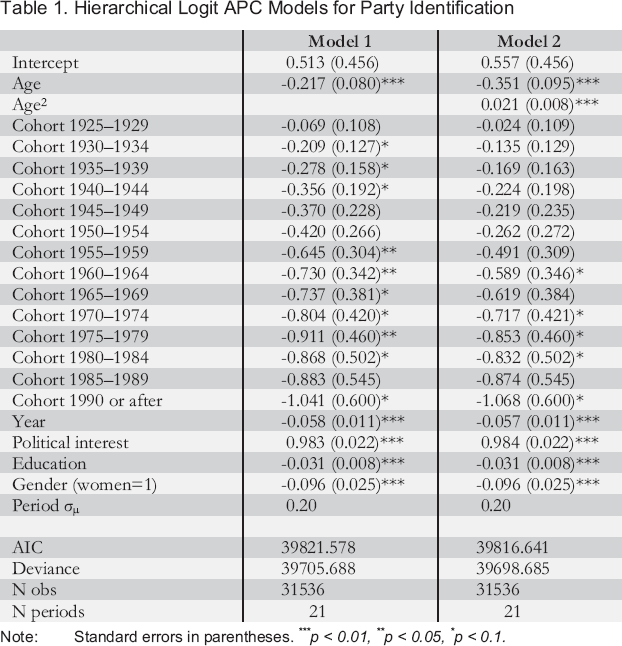
Hierarchical Logit APC Models for Party Identification
Note: Standard errors in parentheses.
p < 0.01,
p < 0.05,
p < 0.1.
The estimates from both models reveal a negative relationship between age and party identification, while controlling for birth cohort and survey period. Model 1 indicates a statistically significant (p<0.01) negative linear relationship whereby a 10-year increase in cumulative experience leads, on average, to a 19 percent reduction (e-0.217 =0.81) in the odds of mentioning a political party. Model 2 indicates that the negative effect of age tends to become smaller as respondents accumulate more experience, evidenced by the statistically significant positive coefficient of the quadratic term.
To convey a more intuitive sense of these results and those of the other key variables, in figure 3 we illustrate the predicted probabilities of identifying with a party by age, cohort, and period. These predicted probabilities are calculated using model 2 from table 1 and following the observed values approach (Hanmer and Ozan Kalkan 2013). 19 As can be seen in figure 1(a), the probability of identifying with a political party decreases as voters become older, although a slightly curvilinear pattern indicates that the effect of each additional year becomes marginally smaller. The expected difference in identification levels between 85-year-old and 18-year-old respondents corresponds to 0.31 points on the probability scale. This confirms that Chilean voters tend to abandon their party identification the more they have been exposed to the party system. These results contradict Converse's (1969) social-learning hypothesis but nicely confirm our own hypothesis: the accumulation of electoral experience contributes to increasing levels of partisan detachment in Chile.
To obtain confidence bands of the predicted values, we drew samples from the posterior distribution of the coefficients and random effects. Full details about this procedure are available in section F of the appendix.
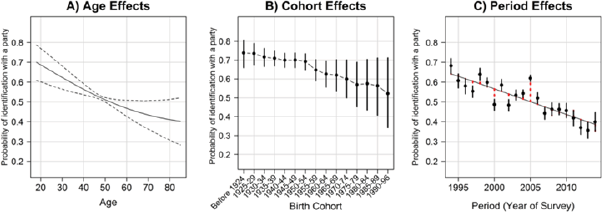
Estimated Probability of Identifying with a Political Party by Age, Cohort, and Period
In table 1 we can also see that negative cohort effects increase in size as respondents were born more recently. Only a few birth cohorts contain marginally significant coefficients, but the overall effect of birth cohorts is relevant. We carried out a likelihood ratio test that contrasts model 2 with a nested model that drops all birth cohorts; it indicates a significant overall effect (χ 2 = 24.5; df = 14; p = 0.04). The predicted probabilities of birth cohorts are also shown in figure 3(b). Although all cohorts born before 1955 show very similar levels of partisanship, those born thereafter progressively become less partisan. These point estimates contain a large degree of uncertainly (they account for variation in both the coefficients and the random effects), but the differences are sizable. While the probability of identifying with a party is 0.69 for the 1950–1954 birth cohort, this decreases almost linearly to 0.52 for those born in 1990 or after. This result is important because it confirms that the decline in mass partisanship occurs not only through individual-level change but also through societal-level change, where younger and less partisan cohorts slowly replace older and more partisan cohorts.
As mentioned in section 4, period effects are decomposed into a linear trend component, which is captured through the coefficient of the year variable, and residual random effects, which are captured – in turn – via the variance parameter σμ. The coefficient of year is not only highly significant (p<0.01) but also large. However, having captured the linear time trend, the variance component of 0.20 shows that an important amount of residual variation remains. The predicted probabilities of both of these elements are shown in figure 3(c). The straight line represents the linear time trend, whereas the points indicate the yearly deviations from the trend (with their associated confidence bands). The time trend reveals a large decrease in partisanship among all age groups as time has passed: from an average probability of identification of 0.64 in 1994 to 0.39 in 2014. At first glance, it appears that the residual random effects tend to oscillate aimlessly; however, there is in fact a clear cyclical pattern related to presidential election years.
Indeed, the positive hikes of 1994, 1999, 2005, and 2009 all occurred either during a presidential election year or the year after (as in the case of 1994, though the election was held in December 1993). This result shows that electoral cycles may have a positive influence on partisan identification in the short run; though this pattern decreases in the long run. Moreover, if one compares the largest boost to partisanship (2005) with the next ones occurring in 2009 and 2014, it seems that the short-term increases become progressively smaller.
Table 2 illustrates the estimates of the multinomial logit random intercept model predicting identification with parties grouped by their ideological orientation. This model yields three particularly important results. First, both the linear and squared age coefficients have the same signs for all party groups, although the magnitude and statistical significance of the coefficients vary. While the linear and quadratic coefficients are highly significant in predicting identification with right-wing and center-left parties (p<0.01), they are not significant in terms of predicting identification with the PDC. These trends are illustrated in the probability scale in figure 4. The decline in identification associated with aging is most pronounced for center-left parties, followed by right-wing parties; it is least pronounced for the PDC. There is a decline of 21 percentage points in the probability of identifying with left-wing parties across the entire age range. The respective decline in identification with right-wing parties indicates a more curvilinear pattern: the probability of identification decreases from 0.22 among 18-year-old voters to 0.12 among 65 year olds and then increases two points among 85 year olds.
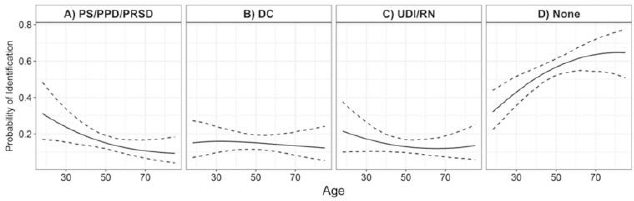
Estimated Probability of Identifying with Mainstream Political Parties by Age
Multinomial Hierarchical Logit APC Model for Identification with Mainstream Parties
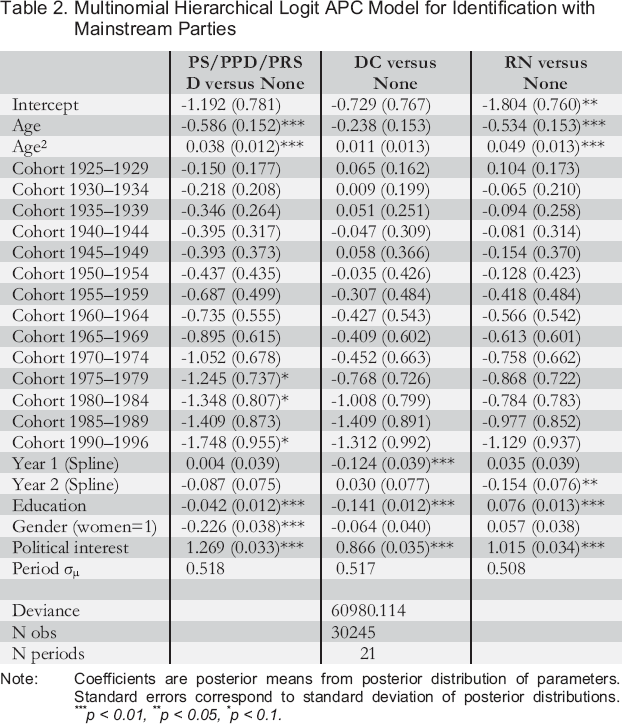
Note: Coefficients are posterior means from posterior distribution of parameters. Standard errors correspond to standard deviation of posterior distributions.
p < 0.01,
p < 0.05,
p < 0.1.
In terms of identification with the PDC, there is a difference of only four percentage points between those with the highest propensity (35 year olds; 0.16) and the lowest propensity (85 year olds; 0.12). It is important to note that although these differences may not seem particularly large, they are in fact at odds with Converse's (1969) prediction of a positive trend. The cumulative decline in levels of identification adds up to a sizable increase in the probability of not identifying with any of the mainstream parties: from 0.32 among 18 year olds to 0.65 among 85 year olds. All of this implies that cumulative electoral experience, as captured with the aging coefficient in our APC analysis, applies to all of the major Chilean political parties – though the magnitude of this effect varies across party groups.
A second key result concerns period effects. Given that year spline variables cannot be easily interpreted, we focus on the predicted probabilities shown in figure 5. These show that the probability of identification with the PDC decreased strongly (from 0.31 to 0.06) for all age groups between 1994 and 2014. In contrast, identification with right-wing and center-left parties was less affected by period effects. In fact, between 1994 and 2005, identification with right-wing and center-left parties increased eight and four percentage points, respectively, and then declined nine and five percentage points, respectively, up to 2014. Therefore, the overall decline in party identification attributable to period effects is due, to a significant degree, to the decline in identification with the PDC in particular among all age groups. Right-wing and center-left party identification has rather been more prone, comparatively speaking, to aging effects.
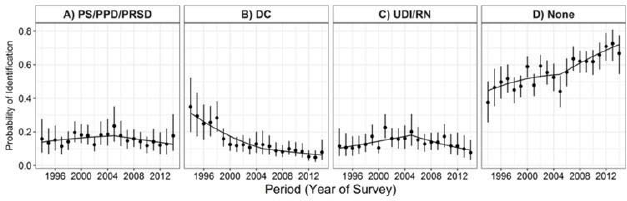
Estimated Probability of Identifying with Mainstream Political Parties by Year of Survey
These results are not only consistent with Navia and Osorio's (2014), they also extend them. Just as Navia and Osorio (2014) show, the decline in PDC support was the sharpest among all Chilean parties; though its erosion occurred principally through period effects. In contrast, the decline in identification with left-wing and right-wing parties occurred to a greater extent through cumulative experience, as captured by the aging coefficients. In other words, all Chilean parties have experienced less support over time, but the relative weight of each source of change has been different.
Finally, cohort effects tend to be similar across party groups. They all indicate that more recently born voters have become progressively less partisan. Some differences exist in the magnitude of the coefficients, with center-left parties showing the most negative trend; however, these differences appear to be smaller than those observed for aging effects and especially period effects.
In this paper we used an APC analysis to examine partisan identification with the aim of better understanding its sharp decline in Chilean society during the past two decades. We found that all three sources of social change had negative effects, but there are some important nuances between the different political parties. First, period effects stand out as having dramatically lowered mass-level partisanship for all voter age groups. Our decomposition of these effects demonstrates that partisanship has been responsive in the short term to electoral cycles, which implies that elections tend to produce a boom-and-bust pattern, but has also clearly experienced a long-term linear decline. Disaggregating this trend by party group, we observed that a sizable portion of the decline from 1994 to 2005 occurred among supporters of the PDC, whereas right-wing and center-left parties slightly increased their levels of support during this period. In contrast, after 2005, support decreased for all mainstream Chilean parties among all age groups.
Second, we found negative cohort effects, which indicate a certain discontinuity among the population born before and after the birth cohort of 1950–1954. Although partisanship remained relatively stable among those born prior to 1950–1954, net of period and aging affects, subsequent cohorts revealed progressively lower levels. Third, and most theoretically relevant, we found that as respondents’ age, and consequently cumulate more electoral experience, their probability of identifying with a party decreases – a result that openly contradicts Converse's (1969) classic social-learning model. Our results also demonstrate some important differences between party groups. For instance, the age-related decline in partisanship is most pronounced for center-left parties, followed by right-wing parties, and then the PDC. However, identification with party groups decreases with aging in all cases.
These results imply that all three sources of social change are consistently and rapidly leading toward the extinction of mass-level partisanship in Chilean society. Given that several authors believe mass partisanship has a positive influence over political engagement and system stability (Campell et al. 1960; Green, Palmquist, and Schickler 2002; Wattenberg 1998), the potential consequences of these trends are worrisome. The decline in partisanship might be behind, at least in part, the dramatic drop in electoral participation that occurred during the same period (see Contreras and Navia 2013 for a full description of this trend) and the rise of strong independent presidential candidates during the 2009 and 2013 presidential elections. Likewise, the disastrous electoral performance of the PDC and PPD in the 2017 congressional elections (each party lost around a third and half of its elected representatives in the lower Chamber) seems consistent with Lupu's (2014) assertion that party breakdowns are anteceded by clear processes of eroding party support. It remains to be seen whether or not these turbulent times will persist for the established parties in the coming years.
Conceptually, we believe that the negative aging effects we uncovered should be considered very carefully. While they are clearly at odds with Converse's (1969) hypothesis about the role of an enduring and stable party system, they also confirm his more general claim that the association between aging and partisanship depends critically on a party system's configuration. In light of the Chilean experience, our findings appear to indicate that a stable and long-lived party system is necessary but not sufficient to secure rising levels of mass partisanship. The Chilean experience seems to suggest that when political parties adopt an encapsulated configuration, the result can be a massive attitudinal defection from parties – which we believe is indicated by long-term negative period and aging effects.
Although it is impossible to conclusively demonstrate this connection with a case-study like ours, it is important to note that one of the contextual variables most commonly used to explain processes of partisan decline – namely, decreasing levels of ideological polarization (Berglund et al. 2004; Lupu 2015b) – is unlikely to be relevant in the Chilean case because the levels of ideological polarization have remained remarkably stable in the country (see section 2). Consequently, one of Lupu's (2014) key mechanisms for explaining processes of party decline and breakdown in Argentina and Venezuela is not likely to apply in Chile. Of course, our interpretation of the configuration of the Chilean party system does not contradict the relevance of ideological polarization; rather, it suggests that there is another potential theoretical mechanism that causes partisan identification levels to decline sharply in both new and old democracies.
Our research findings also call for further comparative research not only on how the institutional settings or general attributes of party systems influence the development of long-term partisan orientations but also on how specific features of the internal workings of political parties might promote party identification. Factors such as internal democracy levels, linkages to social organizations, and reelection rates of representatives might influence both people's willingness to identify with parties and whether their identification will endure in the long term.
Finally, it is important to point out that this article focuses on how certain conditions promote negative experiences with parties. Consequently, we only tested the empirical implications of this explanatory mechanism. Thus, future research based on panel or experimental data could provide a more direct assessment.
Footnotes
Appendix: Party Identification in an Encapsulated Party System: The Case of Postauthoritarian Chile
The following appendix contains further details about measurement, survey data, and the statistical analysis carried out in this article. Section A provides information about response rates of CEP surveys; section B details the survey items employed to measure partisanship and political interest in Spanish; section C provides details about the association between voting in presidential/legislative elections and electoral registration in Chile during the period between 1997 and 2012; section D reports all relevant information about model selection; section E provides all relevant details about the estimation of the multinomial hierarchical logit model; and section F describes how confidence bands of Figure 3 through 5 were calculated.