



Abstract
This paper proposes that dissident leaders aiming to build mass opposition movements follow the mainstream press to help them gauge government tolerance for anti-government mass actions in repressive authoritarian regimes. Under conditions of censorship, media–state interactions serve as a barometer of the government's disposition toward and capacity to impede public displays of dissent. Observing trends in coverage and the government's reaction to this coverage helps activist leaders assess when it should be safest to plan anti-government mass actions, such as demonstrations, marches, or strikes. Using original data derived from coding content from the Brazilian newspaper Folha de São Paulo over the period of 1974–1982, I test whether opposition mass actions followed trends in taboo content and government treatment of the press during the period of political liberalization of Brazil's military regime.
Introduction
Since Dilma Rousseff began her second term as president on 1 January 2015, hundreds of thousands of citizens have protested in the streets of Brazil's major cities, condemning the government's poor economic performance and pervasive corruption. Many participants in these protests called for Rousseff's impeachment 1 (see Watts 2015). A small but noticeable contingent of protesters even sought the military's intervention. 2 Although the military did not oust the government, nor does it seem inclined to do so, on 12 May 2016, Michel Temer became the interim president of Brazil, replacing Rousseff during her impeachment trial in the Brazilian Senate on charges of having committed crimes of responsibility. Rousseff's ouster, in turn, led to counter-protests supporting Rousseff and referring to her removal as a non-military coup. While Brazilians have flooded major thoroughfares in 2015 and 2016 with little fear of government repercussions, this has not always been the case. During Brazil's military dictatorship (1964–1985), public expression of anti-government sentiments often triggered repressive government responses.
On 31 August 2016, the Brazilian Senate voted 61 to 20 to strip Rousseff of the presidency for having violated budget laws.
Articles about protests that occurred throughout the year mention protesters who wanted the armed forces to intervene. For example, see Watts (2015), along with Johnson and Magalhães (2015).
Throughout much of the dictatorship, the military enjoyed the support – and positive coverage – of the majority of the Brazil's mainstream media (Amaral and Guimarães 1994; Matos 2008), yet the government persecuted journalists and editors from alternative publications who dared to challenge the regime (Kucinski 2003). In addition to repressing journalists and suppressing media freedom, the Brazilian government and paramilitary forces routinely responded to dissent with brute force, torturing and killing members of the proscribed opposition (Moreira Alves 1985; Skidmore 1988; de Freixo and Freitas 2008). Despite the “culture of fear” these actions fostered, the anti-government opposition developed a mass movement and organized public mass actions, including street protests, marches, and strikes, particularly after the government began to ease the reins on freedom of expression during the period of political liberalization (Moreira Alves 1985). Similar circumstances reigned in countries throughout much of Latin America during the 1970s and 1980s, and continue today in many countries around the world.
Although some authoritarian regimes go to great efforts to control media content, others tolerate or even encourage partly free media (Egorov, Guriev, and Sonin 2009; Whitten-Woodring 2009; Whitten-Woodring and James 2012; VonDoepp and Young 2013). Authoritarian governments with relatively high state capacity, such as China, can manage censorship strategically, allowing the regime to identify foci of dissent and try to repress or appease these groups (King, Pan, and Roberts 2013; Lorentzen 2014). Press freedom varies, not only across authoritarian regimes, but also within regimes over time. Since the media influence public opinion, even amid censorship (Stein 2013), public support for authoritarian rule, along with the regime's legitimacy, may wax and wane with the changing nature of media content.
In the Brazilian case, the military government imposed a strict system of censorship from 1969 through to the mid-1970s. The government allowed media outlets that offered favorable coverage of the regime – which comprised the majority – to carry out censorship themselves. By contrast, the government subjected the opposition media, including both alternative papers and a few mainstream media outlets that began to challenge the regime, to prior censorship. Those publications subjected to prior censorship had government censors carrying out and enforcing restrictions on content. According to Carlos Azevedo, a journalist and an activist for Ação Popular (Popular Action), 3 by the end of the 1970s “[t]he dictatorship started to lose the political battle against the newspapers. […] For a long time the press did not oppose the dictatorship.” 4 The loosening of press restrictions occurred in part because Brazil's president at the time, Ernesto Geisel, had initiated a “slow, gradual and secure” process of political liberalization (Alston et al. 2016: 65), 5 and partly because internal divisions arose among hardliners and softliners – Geisel was a member of the latter group – that made enforcement of such restrictions sporadic and less systematic.
Ação Popular was a Catholic leftist movement that participated in the armed resistance to the military regime.
Stated in interview with the author on February 2, 2005, São Paulo. Father Agostinho Pretto made a very similar comment in his interview with the author in Nova Iguaçu, Rio de Janeiro (exact date unknown): “So I could figure out the right way to act and how to react.”
Geisel first described the political opening in these terms in a speech in August 1974 (Kucinski 1982, cited in Stepan 1988: 29).
The media's potential influence on advancing political liberalization extends beyond the information they provide; the media can help open space for other forms of expression by pushing the boundaries themselves. Political scientist Maria Helena Moreira Alves explained in her book, State and Opposition in Military Brazil, that as the Brazilian military regime loosened the noose on the media “(w)ith the breaking of silence, civil society responded, and people tended to take recourse to the new public forum to voice protests against government brutality” (1985: 171).
Opposition leaders can reduce inefficient use of human and material resources by organizing anti-government mass actions when the risk of repression is relatively low and thus likely to draw more participants. In order to do so, however, opposition leaders must have access to good information on the nature of the regime. Dissident leaders, despite knowing that dictatorships censor mainstream media and that journalists and editors practice self-censorship, seek out and read the full range of news coverage, including pro-government newspapers, rather than disregarding censored material. Mino Carta, an editor and journalist for several mainstream publications who earned the trust of many members of the military regime as well as participants in the opposition, described the mainstream media in Brazil as opposition leaders’ “bread and butter.” He explained that reading the mainstream media “was very important for [political activists]. Even when censored, the press works as a thermometer.”
I interviewed 6 political activists and journalists who had been active during the dictatorship and asked if, knowing they were subjected to stringent censorship, militants 7 read newspapers for their actual content or to try and draw their own conclusions about the situation. Many responded that people active in the opposition read the newspapers critically and with skepticism. Several interviewees remarked that over time journalists learned to say certain things without being explicit, just as readers learned to “read between the lines” and take note of what did not appear in the papers. 8 Carlos Azevedo responded:
Acknowledgments: I carried out this research with funding from the International Institute of Education and the Fulbright Commission of Brazil. I also had support from the Shorenstein Center on the Press, Politics and Public Policy at Harvard University's Kennedy School of Government, where I wrote an earlier version of this paper when I was a pre-doctoral scholar-in-residence in 2007. I am indebted to the journalists and activists who shared their stories with me. A list of their names appears in Table A1 of the appendix. I also greatly appreciate the terrific research assistance of Daniel Develly and Fábio Cardoso Andrade in Brazil and Germán Sturzenegger in Cambridge, Massachusetts, whose help allowed me to complete this research. Additionally, I thank the faculty and fellows at the Shorenstein Center, Barbara Geddes, Matthew Baum, Daniel Hallin, Richard Frank and Matthew Jacobsmeier, as well as anonymous reviewers for excellent advice. If I failed to follow their suggestions, I accept the blame for mistakes that persist.
In Portuguese, people use the term “militante” (militant) more than they use “ativista” (activist) to describe those who fought against military rule, regardless of whether they picked up arms or merely took to the streets in protest. I use the terms interchangeably through this paper and will specify when I intend to refer to the armed guerrilla organizations.
Carlos Azevedo, Carlúcio Castanha, A. C. Fon, Carlos Alberto Lobão, Dulce Maia, Frederico Mazzuccheli, Renaldo Morano Filho, and Raimundo Pereira each described reading newspapers critically, referenced reading between the lines or making conclusions from what did not appear. See the list of interviews in Table A1 of the appendix for a list of names of interviewees, along with dates and locations of these interviews.
Our own goal was to make our own conclusions […] We looked for information. We evaluated how good it was by comparing different papers. We wanted to understand what was going on, which forces were stronger so we would know how to act on public opinion. (Stated in interview with author on 2 February 2005, São Paulo, Brazil)
I argue – with support from many of those whom I interviewed – that the media inform leaders of opposition movements in non-democratic environments, both directly via their content and indirectly via their interactions with government and the opposition. Amid conditions of censorship, the tug of war that occurs between journalists – some of whom challenge government media restrictions – and state actors reveals information about the regime to attentive observers. These interactions inform dissident leaders about the nature or disposition of the regime at given points in time. Information gleaned from observing media-state interactions helps supplement and substantiate information that opposition activists acquire through their own dealings with the state, individual journalists, and with other opposition movements. Opposition leaders rely on these observations to help gauge government tolerance for public dissent when planning and promoting mass protests.
To further understand the connection between media liberalization and anti-government mass actions in dictatorships, I examine whether and how the evolution of anti-government expression corresponded to the dynamics between the media and the state and between the media and opposition leaders. In this study I have focused primarily on the mobilization of unarmed opposition groups to Brazil's military regime during the period of political liberalization. Brazil represents an ideal case in which to explore these dynamics because, along with the military regime promoting systematic censorship, it also initiated a prolonged process of political opening that lasted 10 years. While Brazil has long since democratized, I anticipate that lessons garnered from Brazil's past authoritarian experience highlight the potential importance of media for popular movements around the world who continue to struggle against authoritarian rule.
In the following section, I review the relevant literature. I then articulate my theory, drawing from past literature and interviews I conducted with activists and journalists, offering a series of testable hypotheses. After a brief historical overview, I empirically test the implications of my argument. I conclude by reviewing the study's key findings and discussing their implications for other citizens hoping to mobilize against less-than-democratic regimes.
The fact that people participate in risky activities despite the purported irrationality of such behavior has been framed as the paradox of collective action (Olson 1965). Even if an individual wants and supports political change, that person should not, rationally, participate in risky actions; his or her individual contribution is unlikely to affect the movement's success, but by participating he or she risks arrest, injury, or worse. Nevertheless, it is widely recognized that if all people behaved in this manner, change would never occur, even with majority support (Finkel, Muller, and Opp 1989). This paradox – that people do in fact join protests despite its presumed irrationality – has spawned several lines of research to explain why and when people participate in risky mass actions. Seeking explanations, authors have considered motivating factors, resources, participants’ relative costs to benefits, and opportunities.
Some scholars disagree with Olson's underlying assumption about individual rationality, arguing that as social beings, people make collectively rational decisions to protest (Finkel, Muller, and Opp 1989; Brockett 1993; Rasler 1996). They note that individuals’ decisions to participate depend on the behavior of others (Kuran 1991; Siegel 2009). Charles Brockett argued that “(r)eal individuals are usually enmeshed in social networks, which might lead them to different perceptions, calculations, and behavior” (1993: 462).
Accepting that people participate in collective actions, but recognizing that most individuals prefer to maximize the benefits while reducing the costs of their participation, some social movement scholars have focused on how primarily exogenous factors can generate conditions favorable to protesters – political opportunities – that consequently promote participation (Kitschelt 1986; Goldstone and Tilly 2001; Meyer and Minkoff 2004; Brockett 2005). Some opportunities arise from structural changes in the underlying conditions, while other opportunities emerge from actions following perceived changes in the situation (Gold-stone and Tilly 2001; Meyer and Minkoff 2004).
Relationship between Repression and Protest
The regime's potential to use repression weighs in opposition leaders’ assessment of political opportunities. However, repression does not always deter political action. Regime violence smothers popular mobilization under some circumstances, but provokes it under others (Lichbach 1987; Mason and Krane 1989; Opp 1994). Whom the government targets with repression (Mason and Krane 1989) and the intensity of such repression may affect people's decision to participate (DeNardo 1985; Lichbach 1987). Other researchers have noted that governments’ variable use of repression and concessions creates countervailing motivations for participation. Repression discourages participation by generating fear, but simultaneously encourages mobilization by motivating people to join the opposition (Mason and Krane 1989; Rasler 1996). Conversely, the regime's employment of concessions can simultaneously appease active protesters and demonstrate to others the usefulness of such tactics (Lichbach 1987; Rasler 1996; Ginkel and Smith 1999).
While many arguments imply that opposition leaders calculate political opportunities, current scholarship does not adequately explain how leaders gauge opportunity, where they derive their information, and why and when early participants willingly take to the street.
Information Needs and Risk Assessment
In order for opposition activists to properly assess risk, which varies depending on the government's willingness and capacity to suppress rights or engage in repression, activists must have good information. However, authoritarian regimes frequently restrict citizens’ access to information through both explicit and implicit media restrictions (Curry and Dassin 1982).
John Ginkel and Alastair Smith suggested that opposition leaders receive “noisy” information about the government's disposition from its actions (1999). Incumbent governments know “that opponents can use information to coordinate action” and, therefore, “will try to control the open circulation of information” (VonDoepp and Young 2013: 37). Nevertheless, dictators occasionally permit moderately free media (Egorov, Guriev, and Sonin 2009; Whitten-Woodring 2009; Whitten-Woodring and James 2012; King, Pan, and Roberts 2013, Lorentzen 2013, 2014) and sometimes tolerate public protest because media coverage and political mobilization provide information to political leaders about the depth and breadth of public dissatisfaction (Lohmann 1993; Lorentzen 2013).
News coverage also helps opposition leaders communicate with the masses and can facilitate the coordination of protest (Gamson and Wolfsfeld 1993). Furthermore, mainstream media coverage of protests helps generate “common knowledge” (Chwe 2001) about the protest's occurrence and the (lack of a) government response. The public nature of information disseminated via mass media informs the audience that others also know of the protests; individuals predisposed to support the opposition become more likely to participate because they know they would be unlikely to do so alone (Lichbach 1994).
The Interaction of Violations of Civil Liberties and Physical Integrity
In studying the effectiveness of coercion on autocrats’ survival, Abel Escribà-Folch distinguished between the use of violent repression (such as violations of personal integrity) and non-violent repression (for example, restrictions on civil liberties) to constrain opposition efforts.
Restrictions [of civil liberties] attempt to deter collective action by limiting the coordination and mobilization capacity […] by explicitly prohibiting a given set of behaviors and activities and constraining others. Alternatively, violations of personal integrity [e.g. physical repression] aim at eliminating those individuals or groups who the regime suspects of having surpassed those limits or being likely to do so, by killing or imprisoning them. (Escribà-Folch 2013: 547)
Other studies also have treated the restriction of rights and the violation of physical integrity as independent tools of dictators (Davenport 2004; Frantz and Kendall-Taylor 2014), yet dictators’ use of restrictions on civil liberties should only serve their intended purpose if accompanied by the credible threat of physical repression. In the following section I articulate this paper's theory and expound on governments’ dynamic use of both physical repression (henceforth, merely repression) and restrictions on liberties. I suggest that these dynamics provide an important source of information for opposition leaders constructing mass opposition movements.
Theoretical Discussion
In order to force policy changes or hasten a regime's collapse, mass actions must demonstrate visually to the regime the level of support for the opposition or, conversely, the strength of the threat against the regime. Therefore, opposition leaders aim to maximize attendance at these events because higher attendance signifies greater strength and increases the chance of attracting media coverage.
To grow their movements, leaders must regard with the utmost importance the security of potential participants, who are unlikely to take to the street or barricade themselves in a classroom if they perceive these actions as futile or excessively dangerous. Luiz Momesso, a former union activist and journalist during the Brazilian dictatorship explained, “for actions like a demonstration at the Praça da Sé, we had to make sure that there would be so many people that the police wouldn't be able to do much.” 9
The Praça da Sé is a principal public space in the center of São Paulo. Stated in an interview with the author on 3 March 2005, Recife, Brazil.
Opposition leaders face two types of uncertainty that act as impediments to collective action: uncertainty about (1) the government's cohesion and strength, and (2) the masses’ inclination to participate. To reduce the first type of uncertainty, in addition to their own interactions with government, opposition leaders seek information by observing the government in other arenas (Ginkel and Smith 1999). I suggest that one key way in which opposition leaders gain insight on government cohesion and strength is by following media coverage and observing media– state interactions. Jonicael Cedraz de Oliveira, a student activist in Bahia during the dictatorship, supports the supposition that observing the state's treatment of journalists offers militants useful information, stating: “What a journalist couldn't do, neither could we.” 10 Subsequently, once leaders initiate mass actions they gain more information and can adapt their group's strategy based on turnout and how the government responds to mass actions once initiated.
Stated in an interview with the author on 28 February 2005, Salvador, Bahía.
My argument builds on previous theories of political opportunity and mobilization. I specifically focus on the role the media play in (a) generating opportunity and (b) helping leaders to recognize opportunities. Several activists interviewed for this project indicated that opportunities strongly determined the type and timing of anti-government actions. 11 If opposition leaders seek opportunities to plan mass actions when the regime is weak or more tolerant of dissent, this implies that they can identify opportunities when the risk associated with participation is low and publicize them. When asked how his student organization decided when to plan mass actions, former student activist Gustavo Zimmermann explained that “(i)t was always possibility meeting opportunity. Our goal was to involve the most people in the activities […].” 12
Several interview subjects mentioned that their organizations planned political actions based on opportunities, including Carlúcio Castanha and Renaldo Morano Filho in interviews with the author, conducted on 3 March 2005, Recife, Pernambuco and 2 February 2005, São Paulo, respectively.
Stated in an interview with the author on 7 December 2004, Campinas, São Paulo.
Reinaldo Morano Filho, an activist and member of one of the armed organizations, clarified that the armed movements operated under a different set of rules than larger popular organizations. Whereas popular movements “observed the political moment” timing their actions with political occurrences such as a vote in Congress or the arrest of professors, actions of the armed movements, “[l]ike raising funds by robbing banks […] had nothing to do with opportunities; they were a matter of planning and logistics.” 13
Stated in an interview with the author on 2 February 2005, São Paulo.
According to Ginkel and Smith (1999: 299), opposition leaders “act as information providers” and persuade the masses of the value of engaging in mass actions. To maintain the trust of the masses – and sustain mass opposition movements – opposition leaders must provide the participants with good information, which is a scarce resource in dictatorships.
The quality of media content in dictatorships depends on a combination of the government's permissiveness and the tenacity of journalists and their editors. Even at pro-government newspapers, some editors and journalists try to report as honestly as possible. Afonso de Albuquerque (2012) noted that conservative newspaper owners in Brazil – wanting to modernize their papers – granted journalists on their staff considerable autonomy during the military regime. Audálio Dantas, a journalist and former president of the São Paulo journalists’ union explained that while censorship made journalists cautious, they still “were able to write some important pieces [… they] were careful, but [they] kept trying.” 14
Stated in an interview with the author on 2 February 2005, São Paulo.
Under conditions of limited press freedom, more information is available than one might initially presume. Editors and publishers want to placate the government – or at least remain free from prosecution – but also want to sell more newspapers to citizens eager for substantive news. Thus, a natural tension arises between the government's desire for control and journalists’ desire to act as the public's watchdog. This forces the regime to make a choice: it can prohibit the critical information via prior censorship, respond harshly ex post, or let the incident pass.
The manner in which the government reacts to a defiant press reveals to observers the likely risk of challenging the regime. When newspapers publish an increasing number of reports or editorials that address taboo topics and the regime does not suppress the content or respond with repressive actions against the journalists and editors, opposition leaders infer that the regime is either (a) more tolerant of anti-regime expression or (b) in a weakened position and unable to impose its desired constraints on the press. In either case, the risk to participants diminishes, creating an optimal time for opposition leaders to plan anti-government mass actions.
Ceteris paribus, the number of anti-government mass actions increases following increases in the number of stories on taboo subjects.
The government's response to mass actions – offering concessions and/ or employing repression – may influence other groups’ subsequent decisions to take or avoid further action.
However, if journalists who challenge the regime face repression, such as arrests or beatings, or journalists’ material is censored or seized, I suggest that opposition leaders will surmise that the regime is intolerant of anti-regime expression and has the political will to repress it. In these circumstances, opposition leaders should heed the cue and hold off on initiating new actions.
When increases in taboo content are accompanied by repressive or suppressive actions against the media, the subsequent initiation of mass actions declines.
For example, when asked if the imprisonment of a journalist for something he wrote might influence activists’ plans for subsequent political actions, one activist replied emphatically, “Yes, of course.” 15
Dulce Maia, who was a member of the Popular Revolutionary Vanguard (VPR), one of the armed opposition movements, said this in an interview with the author on 20 January 2005, Cunha, São Paulo. Note, however, that Maia participated in armed actions, then lived in exile, and only returned with the amnesty granted in mid-1979; it is not entirely clear whether this comment referred to all types of opposition actions, or armed actions specifically.
Weary of attracting few participants, opposition leaders instead might draw from their repertoire of less risky actions, such as circulating petitions or issuing manifestos. When a government ceases to repress the media and allows them to publish freely, the media no longer serve as a reliable barometer of the government's disposition. As censorship declines, the relationship between mass actions and media coverage should begin to dissipate.
The above hypotheses suggest that dissident leaders rely on the media as a barometer of the government's disposition toward dissent in planning mass actions. Nevertheless, other underlying factors beyond media coverage will inspire participation in anti-government mass actions. Economic downturns may mobilize anti-government demonstrators; so, too, can economic success if the gains are not distributed well among the masses. Particular government actions may also galvanize active support for the opposition. Nevertheless, the overall pattern of such events in relation to trends in news coverage should demonstrate the media's leading role.
Instead, activists may take to the streets first and pave the way for journalists to increase their critical coverage. From this perspective, journalists publish more openly only after the opposition begins to protest and the government has demonstrated its tolerance for anti-regime expression; this implies that:
Increases in taboo content should follow increases in mass action, all else being equal, and
(a) Taboo content should increase after mass actions to which the government responds with concessions, whereas (b) taboo content should decline following government repression of mass actions.
Alternatively, journalists and activists may respond independently to a third factor or actor, perhaps taking cues directly from the regime's actions or statements.
Mass actions and critical coverage should trend together.
In the latter case, journalists are likely to react more rapidly than political activists, who need time to mobilize participants. If this were the case, the patterns of mass action and taboo content might mimic the same pattern highlighted by my theory. However, if journalists and activists react directly to regime actions, I should capture this through measures of government repression and concessions to protesters included in the model. I also include controls for both positive and negative government actions (that is, signals), such as acts of political liberalization (for example, the release of activists, return of exiles or regaining of suspended political rights) and repressive tactics against opposition not exclusive to mass actions (such as arrests, torture, kidnapping, killing, etc.). In the next section I describe the context shaping political behavior of the media and opposition during military rule in Brazil.
Military Rule in Brazil
The Media under Military Rule
Initially, with rare exceptions, the mainstream newspapers reflected the views of the military regime, partly due to the threat or reality of censorship, but also because newspaper owners held the same ideological beliefs as government elites (Skidmore 1988; Smith 1997; Alves de Abreu 2002; Gentilli 2008).
Nearly five years into military rule, the dictatorship initiated its most repressive phase via the implementation of the Fifth Institutional Act (AI-5), which the opposition referred to as the “coup within the coup,” (de Freixo and Freitas 2008: 10). 16 Under the powers created by AI-5, the military passed Decree-Law 1.077 in January 1970 that instituted prior censorship – when government censors reviewed and rejected material before it went to press. Before implementing prior censorship, the Brazilian government issued notices, known as bilhetinhos, listing prohibited topics (Marconi 1980; Smith 1997; authors’ interviews 2004–2005); the government euphemistically referred to this system as self censorship because the government expected editors and news producers to implement these restrictions themselves. 17
Mino Carta used this term in his interview with the author on 31 January 2005, São Paulo. Elifas Andreato, a graphic designer for alternative publications, referred to it as “the greater coup” in his interview with the author on 31 January 2005, São Paulo.
Mino Carta noted that prior to the bilhetinhos, the editorial staff received menacing phone calls explaining these prohibitions (stated in an interview with the author on 31 January 2005, São Paulo).
The emergence of alternative publications in the late 1960s and early 1970s offered members of the opposition other information outlets. The government subjected the legal alternative press to heavy-handed censorship, and pursued and persecuted those groups responsible for underground publications (Kucinski 2003; Kushnir 2004). The alternative press lacked the resources and access of the mainstream press, inhibiting their ability to regularly report on critical issues and news of the day. Despite censorship, the alternative press and even some publications among the mainstream media managed to challenge the voice of government. Raimundo Pereira, a founder and chief editor of the alternative news magazines Opinião and Movimento, explained:
We couldn't denounce tortures, murders, prohibitions. But, for instance, the economy section wasn't censored that much. So, while conservative newspapers avoided subjects such as the rural reform, the country's economic situation and such, we wrote about it and managed to do a useful job. 18
Interview with the author on 14 December 2004, São Paulo, Brazil.
At the start of the 1970s, most mainstream press still remained strongly tethered to government. Opposition media, by contrast, continued to battle the dictatorship, facing onerous forms of censorship. In 1975, soon after the regime initiated a political opening, the military withdrew its censors from the mainstream publications like Estado de São Paulo and select alternative publications. The government completely ended prior censorship in June 1978. Nonetheless, the regime and its allies continued to threaten journalists and their editors with physical harm, lawsuits, confiscations, and other forms of intimidation to discourage journalists from overzealous coverage with their newly found freedom (Kucinski 2003).
Some observers felt that the mainstream media were acquiescent throughout most of the period of dictatorial rule (Smith 1997). Others have contested this generalization and suggested that some editors and journalists resisted government constraints, even at pro-government publications including Folha de São Paulo. In interviews with the author, journalists Mauricio Azêdo and Mino Carta and activist Dulce Maia each touted Claudio Abramo, who severed as editor-in-chief of Folha de São Paulo from 1973 through mid-September, 1977, as an example of someone willing to push the implicit boundaries (see Table A1 in the appendix for interview dates). Abramo reformed the paper, professionalizing both its appearance and content, such as adding editorial pages. In September 1977, Abramo pushed the limits too far, publishing a blank space in place of the newspaper column of a Folha columnist who recently had been arrested. Under pressure from the government, Octávio Frias de Oliveira, the paper's owner, forced Abramo to step down as editor-in-chief. 19
Carta discussed Abramo's departure from Folha de São Paulo in his interview with the author on 31 January 2005.
While public contestation existed in restricted form from the regime's inception since it maintained semi-competitive legislative elections, in the early-to-mid 1970s, opposition actions shifted from insurgency, which the regime had successfully repressed, to civil disobedience. The less institutionalized opposition, comprised of students, intellectuals, Catholic bishops, labor unions, and neighborhood and professional associations (Moreira Alves 1985; Skidmore 1988), burgeoned as censorship waned. Massive student protests in 1977 marked the first wave of mass actions subsequent to the implementation of the AI-5; soon after, metalworkers initiated strikes, and other mass movements followed suit. Mass actions became more common in the latter half of military rule. Although the regime attempted to repress or at least limit these actions, they were constrained by their official position of supporting a détente and eventual political opening.
Opposition and Acquisition of Information under Military Rule
According to many activists and journalists who I interviewed, leaders of opposition movements gained information through a variety of means, including government leaks, personal contact with journalists, and from reading the mainstream news as “a habit.” 20 Many activists relied on personal relationships with journalists, usually those who worked for the alternative press. These opposition journalists, often activists themselves, received inside information from their contacts in the mainstream press that they passed along to members of opposition movements. Dulce Maia described journalists as conduits who would receive information from activists and deliver information to activists (stated in her interview with the author on 20 January 2005 in Cunha in the state of São Paulo).
Renaldo Morano Filho stated this in an interview with the author on 1 February 2005 in São Paulo.
Opposition leaders could become aware of actions taken against the media by noticing a publication's absence at the newsstands, learning of it through personal contact, or reading about it in the news. As the process of political liberalization progressed, mainstream news outlets that had been long aligned with the regime were able to publish more critical information, 21 even including information on instances of censorship or confiscation. Editorial writer Alberto Dines, who served as the media critic, had a Sunday column in Folha de São Paulo, titled “Jornal dos Jornais” (the Newspaper of Newspapers), in which he reported on such incidents (Magalhães 2001). 22
As evidence of this, censors cut stories submitted by the alternative publication Opinião, that had already been printed in Folha de São Paulo. (Fernando Gasparian, owner of Opinião, described this in interview with author on 29 January 2005 in Rio de Janeiro, Brazil).
For example, some opposition groups had access to newspapers prior to being censored; some media distributed cut material by hand or circulated it in newsletters. In his interview with the author on 14 December 2004 in São Paulo, Brazil, Raimundo Pereira, who edited Movimento, explained that the editorial team distributed a report on censored material to their 500 investors around the country, which the investors could then redistribute to newsstands and other interested parties.
Model Specification
Opposition leaders in Brazil relied heavily on a broad selection of print media. Though radio and television played an important role in entertaining and informing the masses, newspapers were disproportionately influential relative to their circulation (Smith 1997); radio and television required government licenses and broadcast journalists were far less likely to challenge the regime (Waisbord 2000). To test whether the mainstream media served as a barometer influencing the timing of political actions (H1 and H2), I coded content from the Folha de São Paulo (Folha), one of the main daily newspapers. I take the content of Folha as a sign of the general mainstream media environment. While there was some variation in content among mainstream media outlets, the government forced those that held ideologically divergent views out of business early in the regime or placed them under heavy-handed prior censorship Raimundo Pereira, the journalist and editor of two of the most prominent publications in the alternative press, noted that
in the beginning, the strong repressive acts destroyed the biggest paper in the country, Última Hora, and all the publications of the left from the Communist Party, the Catholic Left, from UNE [Student organization …] but this happened with the coup. 23
Interview with the author on 14 December 2004, São Paulo, Brazil.
Other publications operated under the less oppressive form of “self-censorship,” with the implicit threat of prior censorship if they violated these directives.
In this work I have focused specifically on how the leaders of the opposition movements gathered information on risk. Based on my interviews, leaders of the opposition movements read several sources from the mainstream press. As then-student-activist Frederico Mazzucchelli explained, he “read the [mainstream press] to try and figure them out even though (he) knew they'd been through censorship.” 24 A. C. Fon, a journalist and political militant, stated that they
Mentioned in interview with the author on 7 December 2004.
couldn't just read what activists wrote. There was a lot to grasp from conservative journalists as well. When information is your instrument, you must read it all.
Many of those whom I interviewed specifically mentioned reading Folha de São Paulo. 25 I chose to code Folha de São Paulo rather than the other mainstream newspapers because, while it remained closely tied with the ideology of the government – never falling subject to prior censorship like its main rival O Estado de São Paulo – it maintained a reputation for contesting the regime, at least on the margins, compared to O Globo, the Rio de Janeiro-based newspaper that befitted greatly from its ties to the military regime.
A few of those who specifically mentioned Folha were Maurício Azêdo, Carlos Azevedo, Carlos Alberto Lobão, Dulce Maia, Luiz Momesso (see Table A1 in the appendix for interview dates).
The Folha Group represented a profound contradiction. On one hand, the Frias de Oliveira family, owners of the media group, aligned ideologically with the military regime and offered the repressive agencies material support. 26 On the other hand, the Folha Group newspapers were known for employing many well-educated leftist journalists. 27 Therefore, journalists at Folha de São Paulo (Folha) had personal incentives to push the limits of government tolerance and were given some leeway by their owners (de Albuquerque 2012). While Folha developed a reputation for challenging the government, they earned this in large part due to their coverage of the Diretas Já campaign in the final years of the military dictatorships, after the period I have examined in this research. For a brief period at the beginning of the political opening, under the direction of Editor-in-Chief Claudio Abramo, Folha began to reform itself and take a more independent, professionalized approach to its news coverage. Nevertheless, based on the coding of the Folha for “taboo content,” described in more detail later in this section, the newspaper only began increasing its coverage of such “off-limits” topics in 1977 at the end of Abramo's time as editor-in-chief (see Figure 1 in Section 5.2). Coverage of taboo content increased under the subsequent editor-in-chief, Boris Casoy, who described his replacement of Abramo as one of survival for the paper because it needed to censor itself (Kushnir 2011: 177–178). I interpret this as an indication that shifts in topic do reflect shifts in the regime's disposition more so than a shift in the position of the editor or owner exclusively.
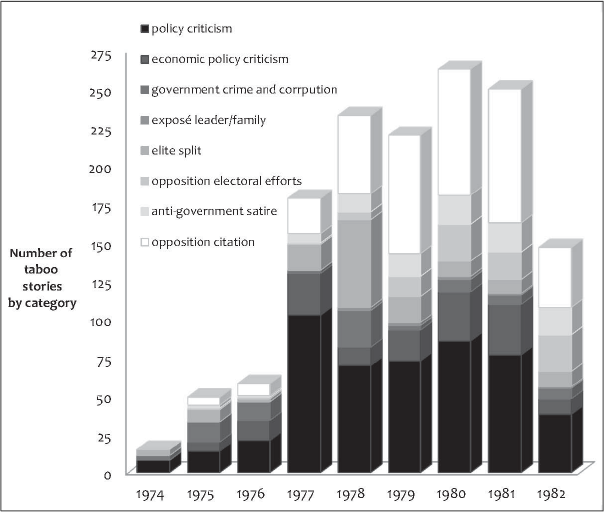
Taboo Content in Folha de São Paulo by Topic, 1974–1982
See Beatriz Kushnir's book (2004) for a more elaborate description of the Folha Group's relationship with the military regime. Kushnir notes that at some point Folha da Tarde's editorial staff included politically active leftists as well as members of the military apparatus (Kushnir 2007: 28).
Luiz Momesso stated this in an interview with the author on 3 March 2005, Recife, Pernambuco. Ricardo Azevedo, a student activist and member of Ação Popular (Popular Action), also noted that, for a time, many progressive journalists worked at Folha da Tarde, the Folha Group's afternoon edition (stated in an interview with the author on 7 December 2004 in São Paulo). However, the DOI-CODI, the Brazilian intelligence agency, eventually controlled the newsroom at Folha da Tarde under the direction of Antônio Aggio from July 1969 until May 1984 (Kushnir 2011). (Also mentioned by Ricardo Azevedo, Dulce Maia and others in their interviews with the author. See Table A1 in the appendix for interview dates.)
Furthermore, based on these interviews, I assume that the leaders of opposition movements observed more than one mainstream newspaper and were likely to have been exposed directly or indirectly to content from Folha. 28 Additionally, one activist noted that once one paper reported on an issue, the others would follow or risk losing readers. 29 Papers outside the principal cities relied heavily on wire services and therefore had similar content, often drawn from the papers in São Paulo and Rio de Janeiro. If the media responded to and reflected regime dynamics, content changes at Folha should accurately reflect the state of the regime at given points in time during the period of political liberalization.
I favored a paper from São Paulo over Rio de Janeiro, not only because the former is the largest city in Brazil and the financial center, but also because it was the center of political opposition movements in the late 1970s and early 1980s.
Jonicael Cedraz, at the time a student activist in Bahía, stated this in an interview with the author on 28 February 2005, Salvador, Bahia.
I coded every 10th day that the newspaper was published from 1974 through 1982, reading everything except the international, sports, and classified sections. 30 The sample covered all seven days of the week, avoiding bias due to systematic variations in coverage across days, and the 10-day interval remained close enough that I did not risk missing major events.
I hired research assistants in Brazil to help with coding newspaper content. We initially double-coded every 10th date coded, but less than a month into this work, a strike closed the national library for an extended period during my fieldwork. Therefore, I had to complete the coding at the Library of Congress upon my return. Copies of the original coding sheets are available upon request.
For each issue of the newspaper, n i , that I coded, I registered any mention of mass actions. 31 I define mass actions as acts requiring many participants’ physical presence, exposing them to the risk of direct and immediate government reprisals. Strikes, marches, sit-ins, and demonstrations qualify as mass actions, whereas publishing an open letter or circulating a petition would not. If provided in the article, I recorded who participated, the participants’ demands, when the event began and how long it lasted. The dependent variable is the total number of Mass Actions, initiated over a 10-day period, ti, appearing in the sampled newspaper content. 32
To allay concerns of under-reporting due to censorship of anti-government actions, note that the article did not need to have appeared immediately after the protest.
A research assistant coded foreign news sources, including Facts on File, The New York Times, The Economist, Newsweek and U.S. News and World Report, for mentions of anti-government activity in Brazil. Folha covered events that appeared in the foreign press, but provided greater detail and also covered incidents absent in the international press. Therefore, I have relied solely on data from the Folha for the dependent variable.
As a count of the number of mass actions initiated, these data violate the assumptions of ordinary least squares (OLS) regression because they only consist of non-negative integers heavily weighted toward zero. The negative binomial model, like the Poisson model, allows for a count dependent variable; unlike Poisson, however, it also corrects for overdispersion due to contagion or time dependence (Barron 1992). 33 The inclusion of the lagged dependent variable, Mass Actions during ti-3, as an explanatory variable was theoretically relevant to capture movement dynamics, and it also helps correct for autocorrelation that occurs from a lack of independence between time periods (Pickering 2002; Meyer and Minkoff 2004).
Running the models with auto-regressive Poisson does not change the results.
The key independent variable measures the number of articles, editorials, and cartoons that addressed “taboo” subjects appearing in an issue n i of the newspaper. I defined Taboo Content as any material that addressed one of the following eight categories: (1) criticism of economic policy or mismanagement of the economy, (2) crimes and corruption by top government officials, (3) negative information or exposés about the leader or his family, (4) splits within the ruling group, (5) citations of the non-sanctioned opposition, (6) opposition electoral efforts, (7) anti-government satire, and (8) criticism of government bodies or non-economic policies (Collings 2001). 34 Taboo content and all subsequent independent variables, unless otherwise noted, were lagged by 30 days, ti-3. While elite cues in the press can immediately affect public opinion, it logically takes longer for activists to translate information into mass mobilization. 35
For a description of coding rules, see the online appendix.
Text messaging and social networking media that exist today likely have reduced the time needed to organize mass actions by alleviating some costs of coordination.
To corroborate the assumptions I used for coding – and to gain greater insight into the relationship between journalists and activists – I conducted interviews with media personnel and a broad range of people involved with the opposition to the Brazilian dictatorship. During each interview, I suggested that authoritarian regimes prohibit coverage of certain topics and listed the categories of taboo content above. When asked if the Brazilian dictatorship considered these topics off limits, the majority of interviewees agreed with this list, although a few felt that journalists could report on economic performance or government policy at some points during military rule.
To control for the government's treatment of the media, I rely on two variables derived from the content analysis. Anti-Media Acts measures actions taken against media outlets, including incidents of censorship and intimidation, confiscation of printed material, publication closures, bombings of press offices and newsstands, and other actions such as lawsuits. This variable sums the number of these incidents that took place during the 10-day period ti. 36 While these events were sometimes reported well after they occurred, I adjusted them to the date they occurred because I believe the opposition would have noticed newspapers or magazines missing from all newsstands.
We did not limit anti-media acts and journalist attacks exclusively to Folha and the journalists who worked there. Not only were we trying to capture the overall environment, but also, since many journalists did not sign their articles, it was not always transparent who was responsible for particular pieces.
Since I theorized that the media serve as a barometer of the government's tolerance of anti-regime expression through their content and via the government reactions these challenges provoke, it is not the arrest of a journalist per se that signals activists that it is unsafe to protest, but rather the perception that government repressed or suppressed the media in response to shifts in content. Therefore, I included two interaction terms:
Although the fact that the media could report on these issues calls into question the regime's depth of control over the press, it is important to remember that this research focuses on the period of political liberalization that then-President Ernesto Geisel formally had declared. The regime also benefited to some degree from coverage of their repressive actions by relaying to other members of the press what fate they or their publication might meet should the push the implicit boundaries to far. Ultimately, even if repressive actions against the press indicated a split within the regime between softliners and hardliners, journalists and activists needed to take heed so long as the hardliners controlled some or all of the repressive apparatus.
I also controlled for the government's response to protesters or strikers and to their demands, including concessions made to participants and repression used against them. I documented whether participants were injured, arrested, or killed in the course of taking action and whether the government offered any concessions. If the government fully conceded to demands, I scored
I included two additional variables to capture possible government “signals.” The variable
I included two dummy variables that note whether the observation fell while the Fifth Institutional Act (
In line with literature on grievances, I controlled for economic conditions that might motivate or deter protests, including
DIEESE, online: <www.dieese.org.br/cgi-bin/wwwi32.exe/[in=bmacessa.in]> (10 August 2016).
Despite President Geisel's 1974 proclamation of political opening, at the onset of political liberalization the media's coverage was benign from the government's perspective. Figure 1 illustrates annual taboo content, broken down by topic, from 1974 through 1982. As political liberalization progressed, the media published more freely with fewer threats of government reprisal. When the government completely abandoned prior censorship in June 1978, the media were already reporting somewhat critically of the regime. While taboo content generally continued an upward trend beginning in 1977, coverage of taboo subjects reversed course in 1982. 38 The decline of taboo content in 1982 may reflect the fact that political dialogue shifted its focus to the newly direct gubernatorial elections. Since I did not code coverage after 1982, I cannot tell if the decline was temporary.
Party reform in 1979 posed a dilemma for coding citations from the opposition. Prior to the reform, the military regime sanctioned an opposition party, the MDB. I did not code citations by members of the MDB because the party played by the military's institutional rules. As part of the 1979 mandated reform, the MDB reformed itself as the PMDB, losing some members to newly formed parties. After party reform I include citations by members of all the opposition parties, including the PMDB, because these parties now challenged the rules introduced by the military regime. I ran results excluding quotes from the PMDB in taboo content; no changes occurred in the direction of coefficients and the coefficients maintained their statistical and substantive significance.
The data show that the government repressed the media and suppressed media content more frequently during the first years of political liberalization when mass actions remained rare. The initiation of mass student protests began in 1976 and became more frequent in 1977, prior to the termination of prior censorship. After this time, the government and paramilitary groups continued to harass and intimidate the press, although the press had greater autonomy.
To determine with greater certainty the relationship between activism and media coverage, as well as the mediating effects of anti-media acts and journalist attacks, I conducted statistical analyses controlling for some factors that were likely to influence both media coverage and political activism.
The results of the statistical analyses are consistent with the hypothesis that the media served as a “barometer” for political activists planning mass actions throughout the period of political liberalization (1974–1982) in Brazil (see columns 1 to 4 in Table 1). These models indicate that when the newspaper printed more taboo content in an issue, i, the number of protests tended to increase during the period ti-3. This supports hypothesis H1 that portends increases in the number of mass actions following increasing taboo coverage, and allows me to reject the null hypothesis that no relationship existed between protests and media content.
How Media Coverage and Government Treatment of Media Influence Subsequent Mass Actions
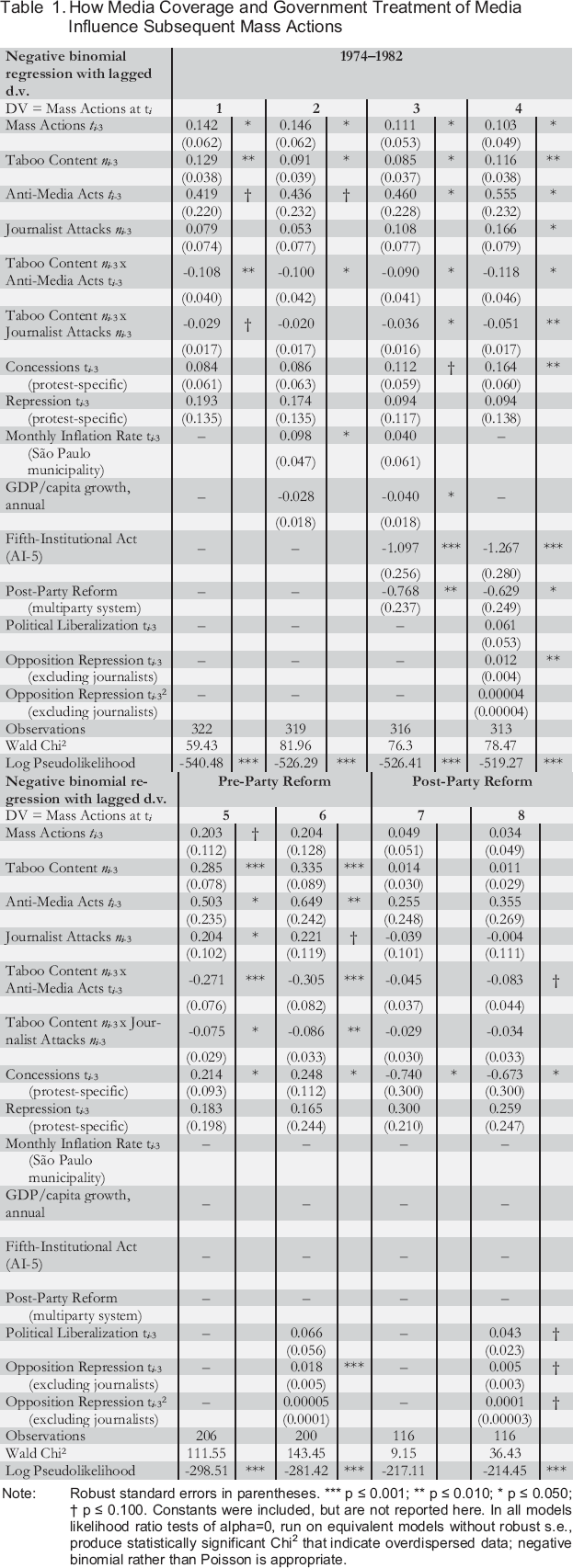
How Media Coverage and Government Treatment of Media Influence Subsequent Mass Actions
Note: Robust standard errors in parentheses.
p ≤ 0.001;
p≤ 0.010;
p ≤ 0.050;
p s 0.100.
Constants were included, but are not reported here. In all models likelihood ratio tests of alpha=0, run on equivalent models without robust s.e., produce statistically significant Chi2 that indicate overdispersed data; negative binomial rather than Poisson is appropriate.
The effect of taboo content on mass actions depended on the incidence of censorship, confiscation of published material, closure of media outlets, along with other anti-media acts. The negative coefficients for the first interaction term, which remain statistically significant across all four models, indicate that when actions against the media accompanied increases in taboo content, protesters initiated fewer mass actions during the 10-day period one month later. This finding supports H2 that predicts that opposition leaders should refrain from organizing new protests when the government employs suppressive tactics against media outlets as critical coverage increases. Providing additional support for this hypothesis, the negative coefficients for the second interaction term between attacks against media personnel and taboo content show that when both increased simultaneously, the number of new protests during a 10-day period tended to decline the following month. The coefficient for the second interaction term becomes statistically significant at standard levels only when I include additional controls in the model. Interestingly, the seemingly arbitrary nature of anti-media acts, when unaccompanied by increases in taboo material, led activists to initiate more mass actions during the 10-day period beginning in the subsequent month. 39
The lag between the dependent variable and independent variables was precisely 30 days, which I refer to as a month in the discussion.
According to these models, when the government conceded to protesters’ demands, subsequent protests increased, supporting a demonstration effect, although the variable only reaches statistical significance in some models. Repression against participants in mass actions had no statistically significant relationship to subsequent protest.
Columns 2 and 3, which include controls for economic conditions, offer mixed support for the assertion that people respond to material grievances. The positive coefficient for monthly inflation indicates that high inflation motivates protest. However, the inclusion of period dummies for AI-5 and after party reform causes inflation to lose statistical significance. Since monthly inflation was unavailable at the beginning of 1974, I dropped inflation from subsequent models; the n increases slightly and the findings remain consistent. Annual growth in GDP per capita was negatively correlated with subsequent protests, as one might expect, but only becomes statistically significant with the inclusion of the period dummies reported in column 3. Both period dummies had statistically significant negative coefficients, indicating that fewer mass actions occurred during AI-5 and when Brazil reverted to multipartism.
Column 4 incorporates three variables meant to capture potential government signals. While acts of political liberalization had no statistically significant relationship with subsequent protest, government repression of opposition members motivated increases in subsequent protest.
As mentioned previously, the media's barometer effect should diminish after the government ended censorship and largely ceased its intimidation and repression of journalists. To better grasp this distinction, I ran the model specifications presented in columns 1 and 4, but divided the data into two periods: pre-party reform (see Table 1, columns 5 & 6) and post-party reform (see Table 1, columns 7 & 8). 40 In order to break up the opposition party, which had gained substantial ground in the two prior elections, the government instituted party reform in November 1979, a little more than a year after the end of prior censorship and 10 months after the end of the Fifth Institutional Act. Although party reform did weaken the sanctioned opposition party, it also offered new venues for people who sympathized with the opposition to express their grievances through the government's formal institutional system rather than taking to the streets in protest. Lifting censorship also evened the playing field as mainstream newspapers covered more of the oppositions’ efforts.
This eliminates the need for period dummy variables. Results hold using AI-5 and post-AI-5 as the divider rather two periods.
The model that focused on the pre-party reform period (columns 5 & 6), from January 1974 through October 1979, accentuates the “barometer effect” of the media. The coefficients for lagged taboo content remain positive and increase in magnitude. The negative coefficients for the interaction between taboo coverage and both anti-media acts and journalist attacks lend further support to the theory that media–state relations serve as a barometer for opposition leaders planning mass actions. During this period, government concessions led to the increased initiation of mass actions the following month.
In the period following party reform (columns 7 & 8), from November 1979 through December 1982, few variables have a statistically significant relationship with subsequent protests. The interaction of taboo content and anti-media acts still corresponds to a decline in subsequent protest when both variables increase simultaneously; however, it only reaches statistical significance at the 0.90-level and only with additional controls. The sign for government concessions, which previously was positive, becomes negative and is statistically significant. This indicates that in the latter period the level of subsequent protests declined after the government granted concessions. Perhaps concessions no longer demonstrated their usefulness, but rather appeased active protestors’ demands.
To offer a more informative way to interpret the model presented above, Figure 2 depicts the interacting effect of shifts in taboo content and anti-media actions at t i-3 on the expected number of mass actions for the 10-day period, t i , when the changes occur either in isolation or simultaneously. To generate Figure 2, I set the other variables to their means (except for the interaction terms that must be adjusted in accordance with taboo content; see Brambor, Clark, and Golder 2006) and I set the dummy variables to the period of AI-5. 41 I excluded combinations of values for anti-media acts and taboo content that were unlikely to have occurred as indicated by the sample data.
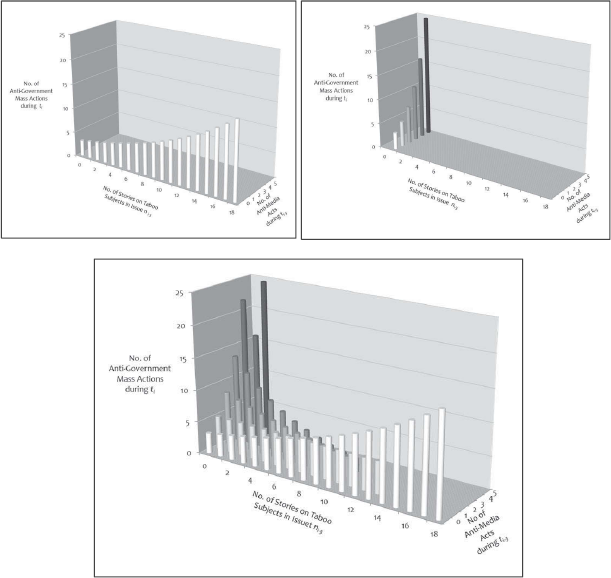
Expected Number of Mass Actions during t i
See Table 3 in the online appendix for summary statistics of the variables used in the statistical models.
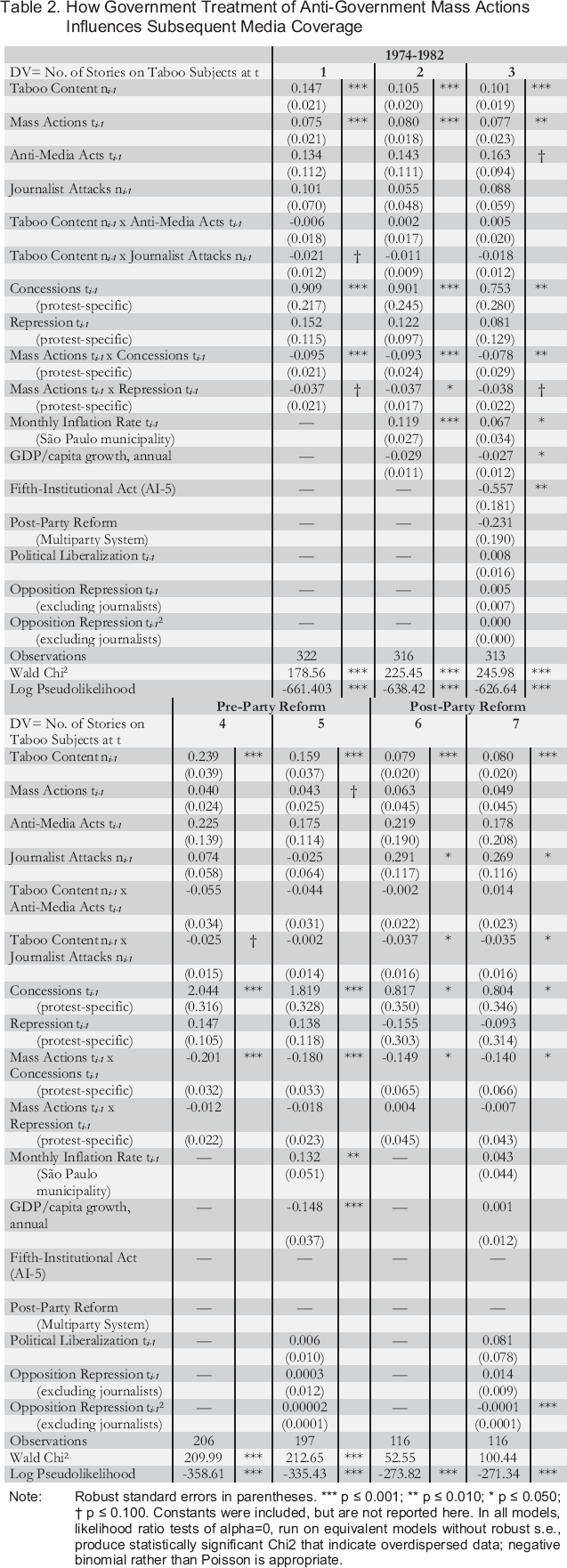
How Government Treatment of Anti-Government Mass Actions Influences Subsequent Media Coverage
Note: Robust standard errors in parentheses.
p ≤ 0.001;
p ≤ 0.010;
p ≤ 0.050;
p ≤ 0.100.
Constants were included, but are not reported here. In all models, likelihood ratio tests of alpha=0, run on equivalent models without robust s.e., produce statistically significant Chi2 that indicate overdispersed data; negative binomial rather than Poisson is appropriate.
The top panel in Figure 2 demonstrates that holding anti-media actions at zero, increasing taboo content corresponds to an increasing number of expected mass actions the following month. The middle panel illustrates the independent effect that the government's anti-media actions have on the expectation of subsequent protests in the absence of taboo content. The bottom panel of Figure 2 depicts the “barometer effect”; when taboo content increases and the government also sanctions the media (moving toward the top right of the graph's floor), fewer subsequent protests are expected to occur, supporting the proposition that opposition leaders interpret the co-occurrence of taboo coverage and anti-media acts as a sign of the government's intolerance of public dissent.
In order to determine whether the media lead the way in challenging the regime or take cues from the success or failure of activists’ public opposition, I present various specifications of a model with taboo content at t
i
as the dependent variable and anti-government mass actions and the government response to those actions for the 10-day period t
i-1
as the key independent variable. I used a shorter lag because journalists are less dependent on coordinating their actions with others and can react quickly to signals of risk. I test the model using the full time period and broken down by periods relative to party reform. If the alternative explanation were correct, taboo content should increase following increases in mass action, particularly when these actions win concessions and do not meet repression, in which case journalists should avoid contentious content. I include interaction terms between
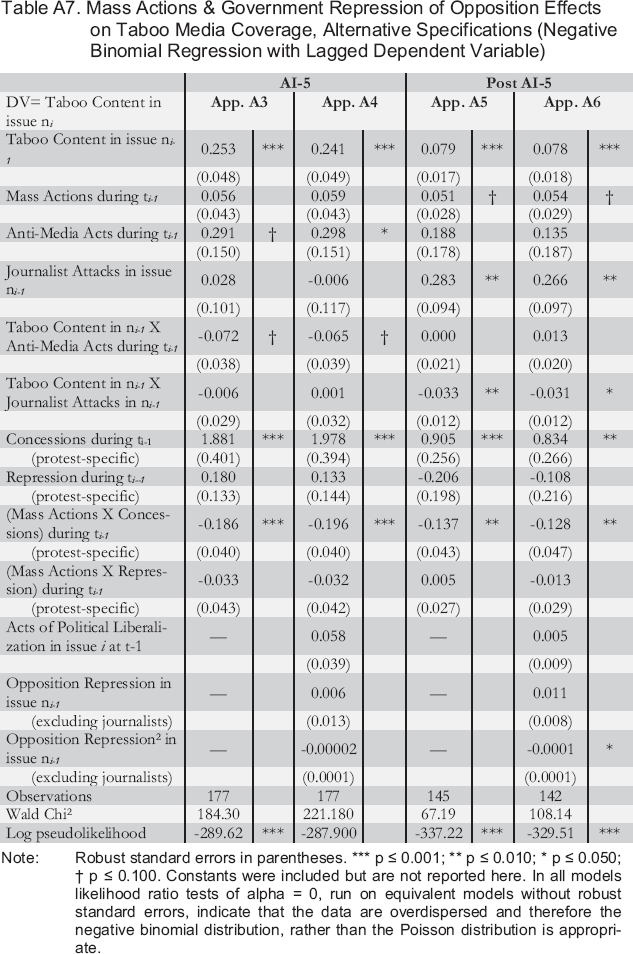
The models do not offer strong support that journalists heeded cues from repressive government actions against other members of the opposition; the coefficients for opposition repression only reach statistical significance at the 0.10 level. Given that journalists communicated among themselves and worked directly with government censors, they had little need to rely on activists for cues. Columns 4 and 5 and columns 6 and 7 report a basic and an expanded model testing the reverse causal relationship, broken down by pre- and post-party reform periods, respectively.
Based on the results in Tables 1 and 2, I believe the media reacted to political and economic conditions, rather than taking cues from opposition activists. Activists, on the contrary, appear to have observed media-state relations in planning anti-government mass actions, even if just to validate any signals they received directly from government actions that implied the regime's increased tolerance for public dissent. Neither model strongly supports the third alternative hypothesis (AH3), in which media and mass opposition leaders react independently to the same factors when assessing risk.
Conclusion
In this paper I proposed that activist leaders in authoritarian regimes, who aim to encourage greater participation among the masses, must rely on indirect sources of information in order to gauge the level of risk of participation in mass political actions. The data coded from the content of the Folha de São Paulo revealed that the information the media provided extended beyond the news they covered. When journalists and editors offered more critical coverage, publishing content that previously was considered taboo, they forced the government to decide whether to suppress, repress or ignore these challenges. In making these decisions, the government revealed its tolerance for anti-regime expression and/or its ability to combat these challenges. In line with the expectation that the media serve as the opposition's “barometer” of the regime's disposition, opposition leaders in Brazil tended to initiate more mass actions following successful challenges by the media (that is, when the press published more taboo coverage while suffering few, if any, repercussions for its actions).
The relationship in which the media help guide activists in planning their opposition tactics should interest scholars and policymakers interested in democratization and democratic consolidation. With reduced oversight from the media, politicians remain less accountable to the public and can co-opt or coerce other actors, such as the police or courts, who might otherwise offer the opposition protection. If state-sponsored repression increases, leaders of the opposition may turn toward the media to test the waters for government tolerance of public dissent before encouraging their supporters to take to the street for anti-government protests.
The findings in this paper suggest that supporting the development of a free and diverse media environment is essential to democratization and the sustenance of liberal democracy. By encouraging journalists to challenge government – and protecting those who do – media can inform citizens of government policy and actions. This information can improve the planning of and thus participation in mass opposition actions, which in the case of contemporary Latin America may prevent further democratic backsliding.
Footnotes
Appendix
Mass Actions & Government Repression of Opposition Effects on Taboo Media Coverage, Alternative Specifications (Negative Binomial Regression with Lagged Dependent Variable)
| AI-5 | Post AI-5 | |||||||
|---|---|---|---|---|---|---|---|---|
| DV= Taboo Content in issue n i | App. A3 | App. A4 | App. A5 | App. A6 | ||||
| Taboo Content in issue ni-1 | 0.253 (0.048) | *** | 0.241 (0.049) | *** | 0.079 (0.017) | *** | 0.078 (0.018) | *** |
| Mass Actions during ti-1 | 0.056 (0.043) | 0.059 (0.043) | 0.051 (0.028) | † | 0.054 (0.029) | † | ||
| Anti-Media Acts during ti-1 | 0.291 (0.150) | † | 0.298 (0.151) | * | 0.188 (0.178) | 0.135 (0.187) | ||
| Journalist Attacks in issue ni-1 | 0.028 (0.101) | -0.006 (0.117) | 0.283 (0.094) | ** | 0.266 (0.097) | ** | ||
| Taboo Content in ni-1 X Anti-Media Acts during ti-1 | -0.072 (0.038) | † | -0.065 (0.039) | † | 0.000 (0.021) | 0.013 (0.020) | ||
| Taboo Content in ni-1 X Journalist Attacks in ni-1 | -0.006 (0.029) | 0.001 (0.032) | -0.033 (0.012) | ** | -0.031 (0.012) | * | ||
| Concessions during ti-1 (protest-specific) | 1.881 (0.401) | *** | 1.978 (0.394) | *** | 0.905 (0.256) | *** | 0.834 (0.266) | ** |
| Repression during ti-1 (protest-specific) | 0.180 (0.133) | 0.133 (0.144) | -0.206 (0.198) | -0.108 (0.216) | ||||
| (Mass Actions X Concessions) during ti-1 | ||||||||
| (protest-specific) | -0.186 (0.040) | *** | -0.196 (0.040) | *** | -0.137 (0.043) | ** | -0.128 (0.047) | ** |
| (Mass Actions X Repression) during ti-1 | ||||||||
| (protest-specific) | -0.033 (0.043) | -0.032 (0.042) | 0.005 (0.027) | -0.013 (0.029) | ||||
| Acts of Political Liberalization in issue i at t-1 | — | 0.058 (0.039) | — | 0.005 (0.009) | ||||
| Opposition Repression in issue ni-1 | ||||||||
| (excluding journalists) | — | 0.006 (0.013) | — | 0.011 (0.008) | ||||
| Opposition Repression2 in issue ni-1 | ||||||||
| (excluding journalists) | — | -0.00002 (0.0001) | — | -0.0001 (0.0001) | * | |||
| Observations | 177 | 177 | 145 | 142 | ||||
| Wald Chi2 | 184.30 | 221.180 | 67.19 | 108.14 | ||||
| Log pseudolikelihood | -289.62 | *** | -287.900 | -337.22 | *** | -329.51 | *** | |
Note: Robust standard errors in parentheses.
p ≤ 0.001;
p≤ 0.010;
p ≤ 0.050;
p ≤ 0.100.
Constants were included but are not reported here. In all models likelihood ratio tests of alpha = 0, run on equivalent models without robust standard errors, indicate that the data are overdispersed and therefore the negative binomial distribution, rather than the Poisson distribution is appropriate.