



Abstract
This article provides an explanation of major civil upheaval and violent political turmoil – hereinafter referred to as “active political factionalism” – that take place in the Mexican state of Oaxaca. More specifically, this work identifies the main causes of extra-institutional protest politics or uncivil modes of political action that seriously affect political stability and undermine democratic advancement. The analysis focuses on the effects of two groups of explanatory factors: i) deteriorated socioeconomic conditions (such as poverty and inequality), and ii) institutional limitations (corruption, electoral exclusion, a weak rule of law, among others) in a context of “sub-national authoritarianism.” The study also examines some of the mechanisms through which these variables operate and interact with other factors (resources, opportunities, government actions, etc.) to generate political factionalism. This work finally assesses the relative importance of these two groups of explanatory factors. Evidence presented here shows that institutional factors are the primary sources of political factionalism in Oaxaca, while socioeconomic factors are quite significant but not predominant.
Introduction
This article explains major popular upheaval and violent political turmoil – hereinafter referred to as “active political factionalism” (APF) 1 – in the poor, unequal and divided state of Oaxaca, Mexico. The concept of APF refers to extra-institutional protest politics or uncivil modes of political action that seriously affect political stability and undermine democratic advancement. The principal explanations of political factionalism in developing democracies are related to matters of “economic exclusion” (particularly inequality) and institutional limitations (mainly problems of “electoral exclusion”). In particular, this work describes the mechanisms through which these factors cause APF in Oaxaca, and tries to determine whether causes of major political conflict are essentially socioeconomic or institutional in nature.
I took this term from Polity IV Project: Political Regime Characteristics and Transitions, 1800–2006. Dataset Users’ Manual (Marshall and Jaggers 2007: 2–3).
For this purpose, the author analyzes data on high-intensity political conflicts in the state, and examines an important recent instance of political factionalism in Oaxaca: the “insurrection” of the Popular Assembly of the Peoples of Oaxaca (Asamblea Popular de los Pueblos de Oaxaca or APPO) in 2006. The analysis of data on high-intensity political conflicts is done to identify the main factors motivating the action of rebellious groups in this Mexican state. Data analysis is complemented by information from a series of interviews with diverse actors involved in major protest activities or violent political actions, as well as with government authorities and scholars focusing on these topics. 2
Relevant field research was carried out in Oaxaca City and nearby communities during the summer of 2007. The author conducted thirty five interviews with government officials, representatives of the main political parties, academics, journalists, and representatives of Oaxaca's major social and political movements.
Evidence presented here shows that the roots of major political conflicts and factionalism in Oaxaca during the last few years have had more to do with electoral exclusion, political patronage, corruption, and old political rivalries than with leftist ideology or economic exclusion. In fact, contemporary manifestations of violent political conflict and massive anti-government protest have an essentially institutional origin. Notwithstanding the great relevance of structural economic factors – such as the economic exclusion of certain groups or economic inequality – in any explanation of active political factionalism, the rules of the political game and other political conditions have a greater impact on the incidence of political violence and major civil strife in today's Oaxaca.
The first part of this article provides a careful description of the variables utilized in the study (dependent, independent, and intervening variables), and briefly mentions the causal mechanisms that are most often invoked by scholars attempting to explain political factionalism and rebellion. The second part introduces the case of Oaxaca. This section analyzes Oaxaca's social and economic structures, as well as the quality of its political/ electoral institutions in a context of subnational authoritarianism. In the subsequent section, the author describes the main instances of APF taking place in Oaxaca during the years 2000–2006, and examines a database on conflicts to identify the main demands of and factors motivating Oaxacan dissident groups involved in major protest actions or violent political acts.
Subsequently, the author assesses the relative importance of the different predictors of active political factionalism in contemporary Oaxaca. The fourth section of this article analyzes in depth the case of the APPO “insurrection” of 2006. The article concludes with a model that explains APF, and with a general assessment of the relative importance of institutional versus socioeconomic explanations of this phenomenon. The major finding in this work is that institutions are key to explain political factionalism in extremely poor, unequal and semi-authoritarian states, such as Oaxaca; socioeconomic factors are quite significant, but not predominant.
Understanding Political Factionalism: Variables and Causality
The Dependent Variable: Active Political Factionalism (APF)
APF refers to major manifestations of popular discontent and anti-government actions that seriously affect political cohesion and have a negative impact on democratic advancement and consolidation. Specifically, this concept includes, among other actions:
the assassination of political competitors; attacks against the liberty, physical integrity, and property of political adversaries; the violent intimidation of voters and candidates […] and the expressive destruction of public property.
Additionally, the notion of APF incorporates the presence of groups or individuals who
do not accept the outcomes of democratic elections but rather mobilize extra-institutional protest, boycott elected assemblies, or take up arms to overthrow elected authorities by force (Schedler 2001: 71).
These actions can be accompanied by violent responses from the government, or its implementation of restrictive (coercive) measures to retain power. 3
It is important to mention that the term “factionalism” here does not refer to party politics or intra-party dynamics. The study of political party factionalism is a dominant analytical approach in political science represented by the works of V. O. Key, Maurice Duverger, Giovanni Sartori, Raphael Zariski, Richard Rose, Frank. P. Belloni, Dennis C. Beller, and others. These works refer to a different phenomenon than the one analyzed in this article, which has to do with non-institutional forms of political action. On the work of the aforementioned authors and their perspectives on political party factionalism see Boucek (2009).
Causality and Relevant Variables
What are the main factors that cause major protest actions, cycles of violent protest, and vast societal crises in fragile democracies? In other words, what are the main causes of active political factionalism in relatively weak or developing democracies? Several scholars have offered theories to explain some forms of extra-institutional protest politics, including major civil upheaval and violent political turmoil. Popular explanations are frequently related to the presence of deteriorated socioeconomic conditions, such as widespread poverty, poor economic performance, and high levels of inequality (e.g., Cloward and Piven 1977; Gurr 1970; Yates 1962). However, it is not obvious that economic conditions are the ultimate cause of APF-related phenomena. In similar socioeconomic contexts, some groups violently rebel, while other groups with comparable social and economic characteristics do not.
Deteriorated economic conditions and/or problems of economic exclusion are apparently major causes of APF in the current era. Among these conditions, economic inequality has been identified as crucial to explain AFP-related phenomena (Auvinen and Nafzinger 2002; Brown and Tulchin 2002; Alesina and Perotti 1996). In several regions of the world, distributive conflicts are a significant source of political factionalism. However, high (and, in some cases, increasing) economic inequality is not necessarily the only – nor even the most important – cause of popular rebellion and political violence. An alternative group of studies centers on the presence of institutional limitations (including electoral exclusion and corruption) as major causes of political conflict and instability (Trejo 2010, 2005; Colomer 2004; Powell 1982). Additional factors, such as population pressures, ethnic and religious differences, international conditions and other external influences, also seem to have an impact on the occurrence of major political upheaval.
In short, a diversity of factors interact in complicated ways to produce what is defined here as APF; there is no simple (much less exclusive) economic or political explanation of the occurrence of AFP-related phenomena in developing democracies. Rather, the presence of violent political conflict, massive anti-government mobilizations and vast societal crises involve intricate interactions among structural, institutional, strategic, and individual leadership factors. None of these factors alone seems to determine the occurrence of APF, and the degree of causality varies according to each independent/ explanatory variable.
Two main groups of variables are often identified as producing APF in fragile democracies: deleterious socioeconomic conditions and institutional weaknesses. However, the presence of socioeconomic or institutional limitations – poverty, inequality, electoral exclusion, etc. – is apparently “necessary” but “not sufficient” for the occurrence of APF. The impact of these two broad classes of phenomena is mediated by other factors, such as: political leadership and choice; organizational factors available to rebellious groups; and other external shocks that have an impact on the behavior of dissident groups or the government. Additionally, there are other explanatory variables that do not always seem to be “necessary” conditions for the occurrence of APF, but that often encourage major political conflict. This could be the case of certain cultural factors, demographic characteristics or international influences.
The present study focuses on the two broad classes of variables that essentially provoke APF: 1) deteriorated socioeconomic conditions and associated problems of economic exclusion (particularly unequal distribution of incomes and wealth), and 2) institutional limitations (primarily problems of electoral exclusion, including fraud, repression, or manipulation of the electoral process). Which of these variables has a greater impact on political factionalism? How do inequality and electoral exclusion translate into APF in the current era? Who are the main actors involved in this process? What are the specific mechanisms that explain APF in a context of ineffective political/ electoral institutions, on the one hand, and of economic inequality, on the other? The following account focuses on the Mexican state of Oaxaca in an attempt to provide answers to these questions.
Political Factionalism in a Mexican State: The Case of Oaxaca
Oaxaca is one of a number of Mexican states where major political conflict takes place, as well as where economic conditions are unfavorable, and institutions – particularly electoral ones – are relatively ineffective. In these states, extremely high levels of inequality and marginalization seem to be closely associated with recurrent massive popular protest and political violence. At the same time, institutional limitations seem to have a significant impact on the frequent presence of APF-related phenomena.
Oaxaca in Comparative Perspective
Political factionalism is a characteristic shared by certain Mexican states, as well as by several regions, countries, and subnational units in the developing world, where economic exclusion, electoral exclusion and a weak rule of law also prevail. Such characteristics, especially the presence of severe political violence and massive popular protest, seem to inhibit democratic consolidation. Oaxaca, with its traditionally high levels of political violence, anti-regime rebellion and civil conflict, is a case in point. These phenomena have visibly escalated in recent years. Moreover, the state has recently registered the most intense and violent post-electoral conflicts in Mexico.
Oaxaca is also an extreme example of socioeconomic inequality and of what Edward Gibson (2010, 2005) defines as “subnational authoritarianism.” The latter phenomenon refers to various institutional characteristics and political strategies within the federal system that have been used to maintain local hegemonic party control. In a number of developing countries, subnational regimes with authoritarian characteristics have successfully maintained control despite national democratization. Like other Mexican states (such as Tamaulipas, Coahuila, and Veracruz) and further subnational units in the developing world, Oaxaca could be considered an authoritarian state in a nationally democratic country. Such a situation looks like the current state of affairs in other parts of the world, such as some regions of India and Russia, the state of Bahia in Brazil, or the Argentine province of Santiago del Estero, among others. 4 Subnational authoritarianism in developing nations is closely related to the phenomenon of political factionalism. Hence, a detailed study of Oaxaca to determine the relative importance of the two main explanatory factors causing political factionalism in a semi-authoritarian state is illustrative for the purposes of generalization.
Experiences of subnational authoritarianism in different parts of the world can be found in Durazo-Herrmann (2010), Gervasoni (2010), Gibson (2010, 2005), Giraudy (2010), and Gelman (2010).
Oaxaca's Economy and Society
Oaxaca is located in the southern part of Mexico, west of the Isthmus of Tehuantepec (see Figure 1). With an area of 95,364 km2, it is the fifth largest state in the country. Oaxaca has more than 10,000 communities, and is divided into 570 municipalities in which seventeen different languages – sixteen indigenous languages plus Spanish/ Castilian – are spoken. According to 2010 Mexico's Population and Housing Census, the state has a population of 3,801,962 people, a large part of which is indigenous and lives in rural areas (INEGI 2010).
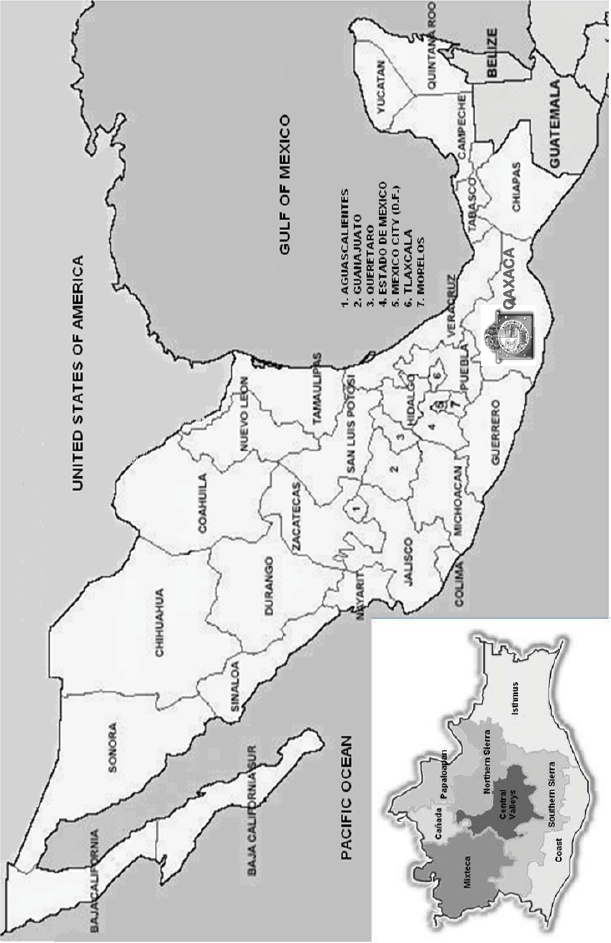
Map of Oaxaca
With 570 municipalities, Oaxaca contains nearly a quarter (23.2 percent) of all Mexico's municipalities (2,438). Such a division is the product of a complex “regional system of domination” that was designed in colonial times to ensure Spanish control of the new territories, and their indigenous inhabitants (Bailón 2000). Since then, it has continued to allow dominant groups to maintain control over the Oaxacan territory and indigenous communities (Blas 2007). Today, the relationship between Oaxaca's indigenous peoples and government authorities (including caciques 5 ) displays similar features to those observed during colonial times (Gómez 1998).
Cacique is a pre-Hispanic figure utilized by Spanish conquerors to extend their control over the colonies. Such figures were in charge of collecting tributes and delivering them to the Spaniards. From this time until nowadays, the figure of cacique has been recreated and preserved in several parts of Oaxaca, particularly in the poorest and most marginalized areas. The continued prevalence of caciques during contemporary ‘democratic’ times has generated disputes for local power and intensified post-electoral crises, and makes evident the arbitrary nature of political power in the state.
A number of authoritative indices of development shows Oaxaca to be among the worst off of the Mexican states. Along with Chiapas and Guerrero, Oaxaca is one of the poorest states in the country, 6 and according to UNDP's statistics, it occupies the second to last place among the Mexican states in terms of human development (UNDP 2005). The state's per capita income is less than a third of the national average. According to the General Development Index, 7 Oaxaca occupies the last (thirty second) position among all the states in Mexico.
According to some statistics, more than 70 percent of Oaxaca's population lives in extreme poverty, and more than a half of the state's population earns less than the national minimum wage. Only half of the state's inhabitants “have access to basic services, such as electricity and running water and fewer than 40 percent of Oaxacans have the opportunity to study beyond elementary school” (Denham and C.A.S.A. Collective 2008: 27).
The index was created by the Mexican consulting firm aregional S.A. de C.V. (see www.aregional.com;). This measure considers urban population GDP, level of education, households’ basic services, and infant mortality, among other dimensions.
In terms of industrial development and foreign investment, Oaxaca also occupies the last position (Blas 2007: 42). Inequality is extreme in Oaxaca. In fact, this state registers one of the most unequal income distributions in the country; Gini index figures for 2000 place Oaxaca as Mexico's third most unequal state, while the Theil index places Oaxaca in the second worst position (Correa 2010). Differences in levels of human development among certain municipalities are also very significant (UNDP 2005). While the municipality of Santa María del Tule (located in the Central Valleys) has a Human Development Index (HDI) of 0.86, Coicoyán de las Flores's HDI is just 0.39. 8 Similarly, Guelatao's municipality (in the Northern Sierra) shows levels of education comparable to those of Mexico City, whereas San Simón Zahuatlán and San Martín Peras (both located in the Mixteca region) show indicators similar to those observed in Burkina Faso or Sierra Leone (Meyer 2006).
Coicoyán de las Flores is located in the Mixteca region. Oaxaca is divided into eight socio-cultural regions: the Coast, Papaloapan, Cañada, Isthmus, Mixteca, Northern Sierra, Southern Sierra and Central Valleys. The capital city of Oaxaca is located in the Central Valleys and this region is relatively more affluent that others in the state. The Mixteca, on the other hand, is among the poorest regions in the country; it is located northwest of the city of Oaxaca.
Politics and Democracy in the State of Oaxaca
The state of Oaxaca has a tradition of communitarian political decisions. Interestingly, such a model was reinforced by the passage of electoral reforms in the 1990s, which legalized the “traditional” electoral system – the so-called system of usos y costumbres (or usages and customs) – for the appointment of municipal governments (mayorships). Nowadays, 418 of the state's 570 municipalities (encompassing more than 35 percent of Oaxaca's population) select their municipal authorities through customary practices, rather than by holding secret-ballot multi-party elections (Owolabi 2003). Such practices are present in several indigenous communities, and are based on a communitarian model of participatory democracy in which the municipal president and other local government officials are elected openly and directly through a public community assembly and without the intervention of political parties.
Overall, traditional social and political institutions have been maintained in the state of Oaxaca. And as already mentioned, in Mexico's “new” democratic times, Oaxaca can still be considered a semi-authoritarian state. In fact, until very recently, Oaxacan governors had perpetuated provincial authoritarian practices so that while Mexico was democratizing, in Oaxaca the old authoritarian regime survived. Recent Oaxacan governors sought to strengthen hegemonic party rule over provincial politics through “coercion, intimidation of opposition groups and the press, appropriation of public resources for clientelism and partisan activities, and electoral fraud” (Gibson 2005: 128). Through the utilization of such measures, Oaxaca endured more than eight decades of uninterrupted rule by the Institutional Revolutionary Party (Partido Revolucionario Institucional, PRI). After eighty one years of uninterrupted rule, the PRI was finally defeated in the 4 July 2010 gubernatorial elections by a coalition of parties. 9
On this date, Oaxacans elected governor, 42 local deputies, and 152 municipal presidents (through the system of political parties).
In Oaxaca there had not been a clear separation of powers. Oaxacan governors’ control over the state legislature had given them control over the state judiciary, which had not challenged their use of funds, assaults on municipal autonomy, or use of unfair electoral practices. The local executive had also had almost total control over municipal politics and leaders. What is more, PRI governors had freely used a constitutional prerogative, the “power of intervention,” to remove municipal authorities that challenged their rule or questioned their actions (Blas 2007). At the same time, the state and municipal governments used to create or strengthen certain pressure groups in order to maintain political power. 10 Similarly, indigenous elites – closely linked to the PRI and in control of municipal power in several areas of Oaxaca – had managed to influence elections and decision-making processes, and made alliances with governors. Such relationships contributed to the maintenance of existing power relations in the state.
Among these pressure groups are the Worker-Peasant-Student Coalition of the Isthmus of Tehuantepec (Coalición Obrera Campesina Estudiantil del Istmo, COCEI), the Unified Movement for Triqui‘s Struggle (Movimiento Unificado de Lucha Triqui, MULT) in the Mixteca Sierra, the Emiliano Zapata State's Coordinator of Communities and Organization (Consejo Estatal Campesino de Oaxaca “Emiliano Zapata”, CECOEZ), the Labor, Peasant and Popular General Union (Unión General Obrera, Campesina y Popular, UGOCP), and the Emiliano Zapata Labor and Peasant Organization (Organización Obrero Campesina Emiliano Zapata, OOCEZ).
But Oaxacan political institutions are still quite ineffective in general. Even now, authoritarianism, arbitrariness, and corruption characterize Oaxaca's government. The local justice system is highly dysfunctional. Local legislative power shows severe limitations as well, and does not always adequately represent Oaxaca's citizens. Some of the local legislators are practically unknown to a great part of the electorate, and the local executive generally controls the legislature, thus marginalizing citizen participation.
Oaxaca's Electoral Process: Electoral Exclusion and other Shortcomings
In recent years, the institutional landscape that had guaranteed continued hegemonic party control of Oaxaca gradually changed, and the system finally opened. The legitimacy of the once-hegemonic party eroded during the 1980s and 1990s; but the most severe decline occurred in the last couple of years. On 4 July 2010 elections in Oaxaca, the coalition United for Peace and Progress (Unidos por la Paz y el Progreso) – comprised of the National Action Party (Partido Acción Nacional, PAN), the Revolutionary Democratic Party (Partido de la Revolución Democrática, PRD), the Workers Party (Partido del Trabajo, PT), and Convergencia party – defeated the PRI, winning the governorship and the mayorship of Oaxaca's capital city, and obtaining a majority in the local Congress. 11
The governor-candidate of the coalition, Gabino Cué, beat the PRI candidate, Eviel Pérez, by a margin of eight percentage points. Voter turnout was of approximately 56 percent.
The PRI-rule was maintained in Oaxaca for more than eight decades. The local PRI in this state had triumphed thanks to the local electoral structure and public expenditure oriented toward the manipulation of the electoral process. Even today, democratic institutions in Oaxaca are quite ineffective and do not always seem to adequately represent the political preferences and interests of the Oaxacan majority. Such ineffectiveness is evident in problems with recent elections, as well as in the numerous drawbacks of local electoral institutions.
The PRI's hegemony over the Oaxacan political system had been reinforced by high levels of electoral abstentionism. In general, there has been great skepticism, confusion, and dissatisfaction towards the electoral process amongst Oaxacans; this has led to voter absenteeism rates as high as 70 percent (see Oaxacan Network of Human Rights and Citizen Movement for Democracy 2001). Turnout in the most recent elections for local deputies and municipal presidents was especially low. Such a phenomenon has historical causes related to Oaxacan political culture and the impact of more than eight decades of hegemonic-party rule. Other factors that have contributed to electoral abstentionism in Oaxaca are internal divisions among the opposition; lack of viable alternative economic and political projects; disengagement of opposition leaders from the electorate; and candidates’ low levels of knowledge about key legislative matters.
Vote buying and coercion by PRI-members had also been frequent practices in the state of Oaxaca. Numerous reports on this process document the occurrence of several other “illegal” procedures, such as “wide-scale electoral manipulation, diversion of federal funds to partisan activities, fraud, clientelistic vote buying, and co-optation and intimidation of the opposition” (Gibson 2005: 117). The opposition in Oaxaca had historically competed in elections where judges and state election-monitoring agencies were controlled by PRI authorities, the governor was unrestrained in the direction of public funds to electoral campaigns, and “the patronage machine of the ruling party diligently discharge[d] its assignments throughout the countryside” (Gibson 2005: 130). PRI Oaxacan governors had had ample control over local party nominations. At the same time, local opposition parties in Oaxaca had been generally weak and discredited, lacking resources, and had often been co-opted by the state's governor. Additionally, in indigenous communities, certain political parties were used to divide the electorate and manipulate the vote. 12
This is the case of the Popular Unity Party (PUP) that supported Héctor Sánchez's candidacy in the 2004 gubernatorial race. The PUP is allegedly indigenous and was created to divide opposition votes. It has been argued that then governor, José Murat, organized and financed the PUP, using Héctor Sánchez to peel votes away from the strongest opposition candidate, Gabino Cué (Grayson 2004: 28).
Active Political Factionalism in Oaxaca
“Uncivil” Society and Extra-institutional Protest Politics in Contemporary Oaxaca
Political factionalism in Oaxaca is higher than in most states of the Mexican Republic. Violent land disputes, violent conflicts for municipal power, local struggles for autonomy and resource control, political assassinations, and occupations of municipal palaces, public offices and public spaces, are examples of events registered quite frequently throughout this southern Mexican state. Violence has been a constant in Oaxaca's political life. With regard to this situation, Cuauhtémoc Blas (2007) comments:
Adding up the number of dead and wounded people in this type of conflicts, one could claim that Oaxaca lives a low intensity permanent war. There are 570 municipalities in the state, but conflicts among communities can reach the number of 750, with recurrent bloody results (Blas 2007: 217).
The twentieth century in Oaxaca was punctuated by periods of instability and major political conflict. Many governors failed to complete their terms – consider the cases of Edmundo Sánchez (forced to withdraw in 1947); Manuel Mayoral (who left in 1952); Manuel Zárate (resigned in 1977); and Pedro Vázquez (resigned on 29 November 1985). Massive anti-government mobilizations were also recurrent during these years. Political factionalism is still a feature of the state in the present times. The most relevant manifestations of APF in today's Oaxaca include: agrarian disputes, indigenous conflicts, the teachers’ conflict, 13 guerrilla movements, electoral and post-electoral conflicts, political violence in the so-called Triqui Zone, 14 among other instances of severe political conflict and mass mobilization.
Recently, APF in Oaxaca has been promoted by teachers, particularly by those belonging to Section 22 of the National Education Workers Union (Sindicato Nacional de Trabajadores de la Educación, SNTE). Social demands have been frequently channeled through the teachers’ union, which plays a significant role in the dynamics of constant agitation in Oaxaca. Almost annually (for the past 29 years), Oaxacan teachers of SNTE's Section 22 had organized strikes, sit-ins, and participated in other forms of anti-government mobilization. These actions had been recurrent but not violent. However, the latest dispute (which extended beyond salary demands to old political rivalries) descended into a severe conflict.
The Triqui Zone – located in the Mixteca Sierra – is one of the most violent areas in Oaxaca. Conflict in this area has its origins in 1948 when the Triqui municipality of San Juan Copala lost its free status. Since then, extreme violence among Triqui communities in this area has killed hundreds of people. The problem in the Triqui Zone has complex roots in issues of autonomy, agrarian disputes, fights over natural and economic resources, access to political power, among other factors. Political parties, caciques, and other less well defined interests are involved in the extreme violence taking place in this extremely poor zone of the Oaxacan Mixteca.
New social movements and regional pressure groups have strengthened in recent years; and serious electoral conflict started to take place as soon as the PRI's hegemony began to dwindle – and opposition parties became stronger and more successful. Actually, a great number of violent conflicts in the state of Oaxaca in the first years of the twenty-first century arose from electoral disputes. Assassinations of leaders of regional social organizations have also intensified during local electoral periods. The first years of the twenty-first century have displayed especially high levels of conflict. Active political factionalism in Oaxaca was particularly severe in 2006. In fact, in the last year of Vicente Fox's sexenio, Oaxaca experienced severe social and political conflicts that left several people dead, and resulted in economic losses of around 45 thousand million pesos.
Political Factionalism in Oaxaca: Multiple Stories of Resistance
Why, in certain instances, do Oaxacan peoples rebel? What exactly causes political factionalism in this poor, unequal, divided and semi-authoritarian Mexican state? Recent books and analyses on the topic of political factionalism/ conflict/ contention in Oaxaca mention a variety of explanations. In fact, the Oaxacan people organize and revolt for a number of reasons, from income redistribution and institutional reform to regional autonomy. The multiple demands of Oaxaca's rebellious groups were particularly visible in 2006, when thousands of Oaxacans “raised their voices against the abuses of the state government: grinding poverty, widespread human rights violations, and rampant government corruption” (Denham and C.A.S.A. Collective 2008: 25).
The most recent mobilizations and protest movements in Oaxaca
represent an unprecedented attempt to address the cultural, economic, social and political marginalization that [had] accompanied eighty years of single-party rule by the PRI (Denham and C.A.S.A. Collective 2008: 25).
Oaxacans are now demanding direct democracy, participatory budgeting, respect for human rights, wealth redistribution, community-based media, employment, and educational reform. Recent popular uprisings in Oaxaca have been organized
in response to decades of political violence, state repression of popular initiatives, the exploitation of indigenous peoples and their cultures and lands, and state neglect of schools and other public services (Yannakakis 2006: 227).
Authors who write about the recurrent massive popular protest and political violence in Oaxaca recognize the effects of poverty, and social and economic inequality. In particular, Mexican authors focus on socioeconomic explanations of what is defined here as political factionalism (e.g., Blas 2007; Osorno 2007; Gómez 1998). Among these explanations, analysts seem to be particularly interested in the collective responses to social and economic inequalities. In fact, every account of Oaxacan politics recognizes the negative impact that socioeconomic inequality has had on democratic stability and consolidation. What is more, it is widely recognized that socioeconomic inequality in Oaxaca “has changed little since the end of the colonial era” (Murphy and Stepick 1991: 5).
Several other sources acknowledge the relevance of Oaxaca's colonial antecedents (Hernández 2007; Yannakakis 2006; Bailón 2000). According to these accounts, the “exploitative nature of colonialism, based on a hierarchy of race, produced a society characterized by gross inequalities, traceable along cultural and ethnic lines” (Yannakakis 2006: 4). They have recognized as well the persistent conflict between local autonomy and colonial control that has had a significant impact on popular resistance and rebellion in the Mexican state of Oaxaca.
Recently, and especially since the so-called Oaxacan “insurrection” of 2006, analysts have focused on the institutional explanations of massive political conflict (Gibson 2010, 2005; Denham and C.A.S.A. Collective 2008; Deniss 1987), and the role of the government in managing conflict and in attempting to address some of its causes (Sotelo 2008; Martínez 2007). Even if they mention poverty and inequality as significant causes of massive popular protest and rebellion in the state, analysts emphasize other aspects, such as electoral fraud, the perpetuation of a patronage system, human rights abuses, repression of social organizing, and criminalization of dissent.
For example, some sources claim that the “contradictions of shimmering wealth amidst the dull shade of widespread poverty and marginalization have led to periodic waves of social revolt” (Denham and C.A.S.A. Collective 2008: 28). But at the same time, they recognize the fact that the PRI-dominated authoritarian state was “[u]nable and unwilling to address the root causes of social inequality,” and “has long relied on repressive tactics to contain popular dissent” (Denham and C.A.S.A. Collective 2008: 28). Moreover, they identify specific institutional sources of rebellion and conflict in Oaxaca, including
the disregard for freedom of expression, the lack of transparency and consultation in the use of public funds, widespread corruption, a history of infiltration of indigenous self-governance structures and the ongoing repression of social movements (Denham and C.A.S.A. Collective 2008: 26).
Many of the aforementioned accounts could serve as useful tools to explain patterns of active political factionalism in the southern Mexican state. However, it is worth noting that most of these works are mainly descriptive and of relatively limited scope. Moreover, they often fail to clearly explain the specific mechanisms of transmission through which the different variables function and interact to produce major political conflict. In several of these studies, one can observe problems when linking theory with data, which often presents an obstacle to theoretical generalization. The present work represents an important effort to overcome such deficiencies; it investigates causal mechanisms and thus refines existing theories, broadens their scope, and provides additional elements to study massive popular rebellion and political violence.
The Nature of Major Political Conflict in Oaxaca: Using a Database on Conflicts
In order to assess the relative importance of the various causal factors implicated in APF, it is important to know the specific reasons why people involved in APF-related events decided to participate, as well as the incentives of elites and political leaders. Particularly important would be to approach the subject of APF from the point of view of political activists, to consider their interpretations and the reasons why they take part in certain dissident movements, contentious activities, or violent political actions. With the aim of determining whether the major demands of rebellious groups are mainly redistributive, or if they are more related to political/ institutional issues, the present study utilizes (and assesses) information taken from a database on conflicts – compiled by the Mexican consulting firm Gea-Structura (GEA) – which includes key statistics on diverse types of conflicts in Mexico (excluding those events related to organized crime). 15 Among the information included in this database are the “types of demands” that motivated those actors participating in registered conflicts or protest activities. 16
This database records every single dissident activity in the country reported in national newspapers during the years 1995–2006 (1 December 1994–1 December 2006). The newspapers consulted are: Crónica, Diario Monitor, El Economista, Excélsior, El Financiero, La Jornada, Reforma/El Norte, El Sol de México, El Universal, Diario de México and Milenio Diario.
The specific information provided by this database comprises: i) date; ii) actors involved in protest activity, massive demonstration or violent political act; iii) place (state and municipality); iv) brief description of conflict (type of actions); v) type of demand; vi) level of conflict; and vii) actor/ institution against whom the demand was made. Conflicts reported are classified according to six types of demands: a) economic, b) political, c) political-economic, d) social, e) social-economic, f) social-political (sociopolitical), and g) social-economic-political.
GEA's database considers three levels of conflict: ‘Level I’ refers to non-violent manifestations of popular unrest, such as strikes, peaceful anti-government demonstrations, and other minor conflicts that happen just once and do not have further negative consequences; ‘Level II’ includes civil conflicts or non-violent extra-institutional protest actions that happen more than once and sometimes take place recurrently in the course of several years; and ‘Level III’ is assigned to major manifestations of popular protest, or internal violent conflicts – including guerrilla warfare; widespread riots; violent popular uprisings; political assassinations; violent attempts to overthrow elected officials, etc. Level III conflicts are related to what is defined here as active factionalism, therefore the present work focuses on this last type of conflicts.
This analysis of the main causes of APF in Oaxaca covers the first six years of the twenty-first century. 17 According to the information on conflicts recorded in GEA's database, the main causes behind APF in Oaxaca (Level III conflicts) are of two basic kinds: a) socioeconomic; and b) related to rules or institutions. In fact, active political factionalism in contemporary Oaxaca seems to derive essentially from distributive conflicts, electoral disputes, corruption and abuse of power (see Figure 2). 18 In an extremely poor and unequal state such as Oaxaca, distributive conflicts are particularly significant. Distributive conflicts in this state are generally related to agrarian issues; redistributive labor policies; demands for higher wages; tax issues; or demands for greater social spending, government support and subsidies.
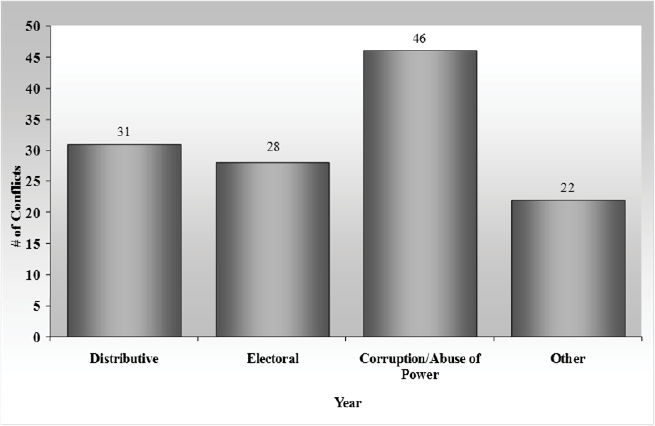
Level III Conflicts in Oaxaca – Active Factionalism –, 2000–2006 (by Nature of Conflict)
The analysis finishes on 1 December 2006, when Felipe Calderón Hinojosa assumes the Mexican presidency.
The author utilized the information included in GEA's database to create an alternative classification of conflicts. This new classification focuses on the “nature of conflicts.” The new categories of conflicts are: 1) distributive, 2) electoral, 3) conflicts related to corruption or abuse of power, and 4) conflicts related to “other” causes.
However, distributive demands do not seem to be the “most essential” causes of conflict in Oaxaca during the early twenty-first century. According to GEA's database, active political factionalism is more related to institutional issues, and particularly to corruption, abuse of power, and electoral matters. There is a greater number of Level III conflicts that are more related to the ineffectiveness of Oaxaca's political institutions, compared to those arising essentially from redistributive demands and other economic motivations (see Figure 2). 19 Electoral disputes and post-electoral conflicts in the years 2000–2006 were recurrent, and many of them (nearly one-fourth) involved indigenous groups that elected municipal authorities through the scheme of usos y costumbres. 20 But the main sources of major political conflict during this period were essentially related to accountability matters, and specifically to corruption and instances of power abuse. Hence, the present analysis provides some evidence of a greater relevance of institutional limitations as key predictors of active political factionalism in Oaxaca. The following case study offers an occasion for that analysis.
It is worth noting that Level II and Level III conflicts demonstrate this same pattern. See Correa (2010).
The legalization of the traditional electoral system of usos y costumbres supposedly represented an important democratic advancement that would produce consensus and higher levels of political stability. In the case of Oaxaca – and due to the presence of a variety of authoritarian practices, and other factors – the municipalities that adopted this scheme experienced the opposite situation, that is, higher levels of political factionalism. On the complexities and effects of the legal adoption of usos y costumbres in local elections of some municipalities of Oaxaca, see Recondo (2007).
Exploring the Mechanisms that Produce Political Factionalism: Analyzing the 2006 “APPO Insurrection”
The “APPO insurrection,” a massive political conflict that took place in Oaxaca in the second half of 2006, is clearly an example of active political factionalism. The conflict started as a confrontation between the local government and a section of the national teachers’ union (SNTE's Section 22). A history of abuses, repression and repeated mistakes by local authorities led to the escalation of the conflict, as opposition to local government became massive and generated a conflict of unprecedented dimensions that involved almost every sector of the Oaxacan society. A close analysis of this recent major instance of APF in Oaxaca suggests that the main causes of APF are of institutional nature, but also involve socioeconomic factors.
The 2006 insurrection began on 22 May, with a teachers’ strike demanding higher wages. The teachers occupied several buildings and streets in Oaxaca's capital city (Oaxaca de Juárez). On 14 June, the local police violently broke up one of the teachers’ demonstrations. Protesters then expanded their demands to include the resignation of then-Governor Ulises Ruiz. Numerous civil and political organizations – human rights associations, agrarian movements, indigenous organizations, members of political parties, radical leftists groups, unions, students, women's groups – joined the teachers’ movement, forming the Popular Assembly of the Peoples of Oaxaca (Asamblea Popular de los Pueblos de Oaxaca, APPO). The APPO was also supported by some Oaxacan entrepreneurs, former governors, local caciques, opposition parties (such as the PRD), and other relevant actors (Osorno 2007). While the main stated objective of the APPO was the immediate resignation of Governor Ulises Ruiz, this movement also called for broader economic and political transformations in the state.
What began in May 2006 as an annual teachers’ demonstration for better pay, 21 quickly escalated into full-fledged civil unrest. This extremely violent protest movement shut down Oaxaca's downtown for five months, prevented around 1.3 million students from attending classes for months, and left about twenty people dead. 22 The conflict ultimately reached national dimensions and involved multiple actors – teachers, the APPO, the federal government, the Oaxacan government, political parties, paramilitary forces, guerrilla groups, the Church, and other social organizations from around the country. In fact, the urban-popular rebellion in Oaxaca was transformed from a local conflict into a manifestation of national pathology, and was at some points considered a “low-intensity urban war.” In order to regain control of the capital city, then-president Vicente Fox, in his final month in office, ordered the intervention of the federal riot police in Oaxaca. 23 In late November of 2006 many protesters (around 150) were arrested. A new president of Mexico, Felipe Calderón, took office on 1 December, and as part of his inaugural strategy, key APPO leaders were detained. 24 The APPO movement was then defeated. The frequency and size of demonstrations fell, but the conflict remained latent.
2006 was the twenty-fifth consecutive year that Oaxaca's teachers staged a strike. In previous years these strikes lasted for a week or two; normally teachers received a small wage raise, and then resumed their normal activities. The demonstrations were sometimes violent and occasionally caused some damage in the City's downtown.
There is no consensus on the number of people killed in the 2006 Oaxacan conflict. By the end of the year, the International Civil Commission for Human Rights Observation (CCIODH) reported 23 deaths (http://cciodh.pangea.org;). Meanwhile, the National Human Rights Commission (CNDH) reported 20 people dead in 2006 – eleven killed in situations directly related to the conflict, 349 people imprisoned and 370 injured.
About 4,000 federal police members moved into the city of Oaxaca on 29 October 2006. Fox ordered the federal troops in after three people, including an independent New York City journalist (Bradley Roland Will), were killed in Oaxaca the evening before. Mr. Will's death was a critical turning point in the Oaxacan conflict.
Top leaders of the movement, including Flavio Sosa (a visible figure and controversial APPO leader), his brother Horacio, Ignacio García and Marcelino Coache were arrested on 4 December 2006.
Main Causes of the 2006 Insurrection
The APPO conflict was particularly uncivil. The 2006 uprising in Oaxaca was unprecedented in terms of scope, strategies, and the number of actors involved. How can we explain this phenomenon? Romualdo F. W. Mayrén (‘Father Uvi’), parish priest of Santo Tomás Xochimilco and Coordinator of Oaxaca's Diocesan Commission of Justice and Peace, characterizes it as the result of “the confluence of a major social and political crisis […] with a situation of structural economic backwardness.” 25 Another way to say this, is that in Oaxaca's conflict of 2006 structural problems and the vices of the old regime – such as inequality, poverty, corruption, authoritarianism, ancestral cacicazgos, and a series of historical abuses against Oaxaca's most underprivileged people – together with the mistakes, ineptitude and corruption of local authorities, transformed a local union problem into a conflict of national dimensions (Denham and C.A.S.A. Collective 2008; Martínez 2007). Such a conflict reflects the contradictions and limitations of leaders and the inability of the political system to attend to the demands of an extremely poor and unequal society that is distrustful of governing elites and political institutions (Meyer 2006).
Romualdo F. W. Mayrén, interview by author, Santo Tomás Xochimilco church, Oaxaca, Oaxaca, 25 July 2007.
Concerns related to inequality and poverty were motivations for numerous groups participating in Oaxaca's conflict. Deplorable socioeconomic conditions in several areas of the state, as well as a generalized situation of social injustice, apparently motivated several actors to participate in the APPO movement (Blas 2007; Denham and C.A.S.A. Collective 2008). In the discourses of several movement leaders and many participants, considerations of inequality and social exclusion frequently appeared. For example, student leader René Trujillo declared:
We are here to change the economic situation of our people. We are here to combat abuses against poor Oaxacans by the rich elite and other transnational powers. We are here to fight against neoliberalism and terminate those practices that only generate misery and inequality in our state. 26
René Trujillo, interview by author, Universidad Autónoma “Benito Juárez” de Oaxaca (UABJO), Oaxaca, Oaxaca, 28 July 2007.
Most people recognize the impact of socioeconomic factors in the 2006 Oaxacan crisis. However, Oaxaca has always been an extremely poor and unequal state; major protest actions and vast societal crises have not always occurred. Moreover, Oaxaca's recent crisis was essentially urban (Osorno 2007), and poverty is concentrated in the state's rural areas.
Then, what developments could have set off this conflagration? The PRI's authoritarian practices (which define Oaxaca's institutional framework) and the alleged fraud committed in the 2004 local elections were certainly significant factors that contributed to this massive conflict. 27 According to Gabino Cué, current governor of Oaxaca, “recent-past abuses, the 2004 fraud and government repression’ were the main elements that provoked the 2006 conflict.” 28 Professor Carlos J. Sorroza highlights the presence of “a generalized discontent with the existing order and PRI-government style,” 29 while Salomón Nahmad, Regional Director of CIESAS 30 Pacífico Sur, mentions “fights among Oaxacan elites in a context of political liberalization at the national level and endurance of authoritarian structures at the local level,” as main causes of the 2006 insurrection. 31
Ulises Ruiz won the governorship in August 2004 elections. The strongest opposition candidate was Gabino Cué, supported by the multiparty alliance ‘We are All Oaxaca’ (Todos Somos Oaxaca) formed by the PAN, PRD and Convergencia party. Cué was defeated by a narrow margin amid reports of widespread fraud. Ulises Ruiz garnered 474,758 votes, and won with 47.2 percent of the total votes; Gabino Cué received 448,264 votes (44.6 percent). This was the first instance of such a close and contested election in Oaxaca's history. Six years later, Cué finally won Oaxaca's governorship.
Gabino Cué, interview by author, Cué's office in Oaxaca, Oaxaca, 11 July 2007.
Carlos J. Sorroza, interview by author, Institute of Sociological Research (UABJO), Oaxaca, Oaxaca, 13 July 2007.
CIESAS stands for Centre for Research and Higher Education in Social Anthropology.
Salomón Nahmad, interview by author, CIESAS Pacífico Sur, Oaxaca, Oaxaca, 15 July 2007.
Similarly, changes in the negotiation mechanisms between the government and social organizations, as well as the local government's attempt to modify its traditional relationships with the teachers’ movement, are key factors that contributed to the violence and political instability of that time. Unprecedented levels of corruption were also behind the generalized discontent that caused, in the second half of 2006, major political factionalism in Oaxaca (Martínez 2007). During the administrations of former governors José Murat (1998–2004) and Ulises Ruiz (2004–2010), corruption reached scandalous levels.
These factors all seem to be related to the extreme weaknesses and ineffectiveness of Oaxaca's political institutions. In a national context where democracy is starting to function and alternation in power is possible, Oaxaca maintained its authoritarian structures (Durazo-Herrmann 2010). The abuses, repression, corruption, and authoritarian practices that had always been part of Oaxaca's political life became intolerable in a new national political environment. The 2004 gubernatorial elections represented for Oaxacans a unique opportunity to change the authoritarian structures that had prevailed for centuries, but the results were not as they expected. 32 PRI's electoral machinery, widespread corruption and fraudulent electoral practices did not allow the democratic transition that an important part of Oaxaca's society had hoped for. After a history of abuses and a series of mistakes by local government authorities, diverse groups decided to form the APPO and express their demands through extra-institutional means.
However, the PRI observed a clear decline in local elections that same year. In 2004, the party lost six positions in the Oaxacan Congress and 15 municipal presidencies.
Organizational Factors and Government Responses to Popular Protest in 2006 Oaxaca
Some of the factors that contributed to produce the 2006 Oaxacan insurrection were organizational or strategic in nature. Among them were: key political opportunities, sufficient material and organizational resources, as well as appropriate forms of organization. The local government's response to the teachers’ protests in June and the intervention of the federal riot police in October were decisive for the development of 2006 Oaxaca's conflict. The role of the media was also crucial. These factors made possible the creation of the APPO and, later on, contributed to its decline.
Political Opportunities after a Story of Repeated Abuses, Repression and Corruption
Oaxaca's history has been plagued by corruption, repressive government actions, and a series of abuses against indigenous peoples and underprivileged groups. These practices reached unprecedented levels during the administration of José Murat, and continued – and in some respects even worsened – under Ulises Ruiz. Most sectors of the Oaxacan society were discontented with governmental mismanagement. But there were several events that exhausted Oaxacans’ patience and contributed to the massive conflict that took place in the second half of 2006. Among these events were multiple acts of repression directed against persons, groups and any form of popular mobilization that opposed the local government. Examples include: attacks against critical communication media (such as Noticias newspaper or Nandía radio). The alleged fraud in the 2004 gubernatorial elections, as well as the attempt to imprison Gabino Cué after this controversial electoral process were also part of the background events that gave rise to the 2006 insurrection.
Many of the groups involved in the 2006 conflict were discontented because Ulises Ruiz had cut off the flow of state patronage to their organizations. In fact, Ruiz stopped financing social organizations that used to have “cozy relationships” with previous administrations, particularly that of José Murat. Resources derived from these relationships were not always transparent, and were often utilized as means to control certain sectors of society. The claim that some of those cuts facilitated diversion of funds to Roberto Madrazo's (PRI's candidate) presidential campaign in 2006 caused further discontent among important sectors of Oaxaca's society. Another factor that contributed to further discontent among Oaxacans was a perceived assault against the architectural heritage of the capital city. By destroying some historic sites located in downtown Oaxaca, Ruiz's government was seen as demonstrating its indifference to the history and identity of the people it was supposed to govern.
As a result, the PRI suffered in the 2 July 2006 elections, losing important positions. In this context, and without a coordinated plan or well-designed strategy, government authorities confronted and repressed the powerful teachers’ union, SNTE's section 22, which had been the most influential pressure group in the state and had not been threatened by any previous administration. Consequently (and considering this event a unique opportunity) a great variety of discontented groups decided to join the teachers’ fight (Osorno 2007).
Resources and Forms of Organization
Groups involved in the movement also took advantage of the PRI's recent decomposition and exploited divisions among the Oaxacan political elite. For example, several groups supporting the APPO were linked to former governor José Murat, who had by then distanced himself from his successor. In fact, multiple dissatisfied groups and resentful politicians joined forces and decided to form the APPO. The conflict was sustained for several months, largely because of the availability of resources coming from diverse sources – including former governors, resentful politicians, “teachers seeking a large salary increase, out-of-favor politicians hoping to forge a new party, Marxists who wanted to incite a violent, leftist revolution,” and many other dissident groups (McKinley and Moynihan 2006). But old political rivalries were at the centre of the conflict between the APPO and the local government. In particular, as ‘Father Uvi’ recognizes: “the divergent groups supporting the movement organized around one main objective: the resignation of Ulises Ruiz.” 33
Mayrén, interview.
Before the creation of the APPO, Oaxacan people had not found strong political leadership, or the appropriate channels to express generalized frustration with the PRI-government. In other words, Oaxacans were incapable of channeling key demands through institutions or a well-defined movement. The APPO movement – formed by people who were against the authoritarianism, arbitrariness, repression, and corruption of Ruiz's government – was capable of unifying, for a short period of time, even those elements of the opposition that were apparently incompatible.
At some point, the movement was so strong that it reached national dimensions. At that time, discrepancies among the multiple groups involved were diluted so as to form a unified block to achieve APPO's central objectives. After a while, the relevant differences were again emphasized, thus contributing to APPO's failure and gradual disintegration. In the words of researcher Carlos J. Sorroza: “The failure of the APPO movement was a result of the unification of multiple forces that started operating separately and in an unorganized way.” 34 What is more, there was no clear leadership within the APPO that might have been able to mitigate these contradictions. 35
Sorroza, interview.
Some characters, like Flavio Sosa, Felipe Martínez (UABJO's ex-rector), and Lázaro García (President of the Popular Revolutionary Front, FPR), attracted media attention for their participation in the movement at certain crucial moments. However, among APPO members, they were not recognized as leaders.
The Media
Framing processes – the collective processes of interpretation, attribution, and social construction that mediate between opportunity and action – are also crucial to explain the development of social movements in general (McAdam, McCarthy, and Zald 1996). In the case of Oaxaca's 2006 conflict, communication media were key to creating such frames and keeping the movement alive. Throughout Oaxaca's history, communication media had been controlled by caciques and local government authorities. In 2006, popular forces took over key local communication media and, for the first time in Oaxaca's history, utilized them for organizational purposes.
The APPO took over several radio stations, as well as the official local TV channel (channel 9). These unprecedented events certainly consolidated and strengthened the movement. When a group of Oaxacan women took over TV channel 9, the APPO acquired greater force and cohesion. As journalist Diego Enrique Osorno 36 observes,
Osorno was then a correspondent for Milenio newspaper and was present in Oaxaca City throughout the conflict.
for the first time in Oaxaca's history, ‘real’ Oaxacan men and women appeared on TV expressing the peoples’ demands. This fact contributed to incorporate further citizens into the APPO movement. TV worked as mirror, where ‘people’ saw themselves reflected on, and thus felt identified with the movement and decided to participate. 37
Diego E. Osorno, interview by author, La Habana Café, Mexico City, 19 July 2007.
Local radio was the most effective means for manipulating public opinion during the conflict; it was even more important than television, because radio is mobile and not everybody in Oaxaca has a TV set. Through radio, the Oaxacan people were informed about the prevailing situation, APPO's agreements and relevant strategies; they were also able to denounce abuses, and communicate values and common symbols (including APPO's anthem). People immediately responded to orders transmitted by local radio. As Spanish writer Víctor García recognizes: “The power of local radio was unquestionable; it was the most effective instrument for organizing the multiple different groups involved in the conflict.” 38 Messages transmitted by radio also contributed to fuel hatred and violence between the APPO members, local government authorities, and other actors involved in the conflict. There were two main radio stations that contributed to further social polarization and political factionalism in the state: a) Citizen Radio (Radio Ciudadana), associated with Ruiz's government; and b) Perversity Radio (Radio Perversidad), managed by students and professors of Benito Juárez of Oaxaca Autonomous University (Universidad Autónoma “Benito Juárez” de Oaxaca, UABJO), and linked to the APPO movement.
Víctor García, interview by author, Oaxaca's Museum of Philately, Oaxaca, Oaxaca, 20 July 2007.
Government Responses to Popular Protest
The repression of the Oaxacan teachers’ movement by the local government on 14 June 2006 constituted a turning point in the state's recent history, giving rise to what has been called the “first insurrection of the twenty-first century Mexico” (Osorno 2007). In fact, the actions of the Ruiz government prompted the creation of the APPO and were decisive in the development of the 2006 conflict. 39 Political analyst Gustavo Esteva highlights the influence of government authorities in generating violence and furthering political factionalism: “local government, through its violent and arbitrary actions, generated further polarization and discontent that incited the APPO to radicalize its strategies.” In Esteva's view, “Oaxaca's social movements are essentially peaceful and democratic. Oaxacan peoples are not violent by themselves.” For him,
The APPO appears on 17 June, just three days after the teachers’ repression.
violence comes from the State; it is generated from the allegedly institutional side, that is, from the government. Thus, violence in Oaxaca is really violence of State; it is a kind of violence that comes from above […] not from the people. 40
Gustavo Esteva, interview by author, Universidad de la Tierra, Oaxaca, Oaxaca, 24 July 2007.
Similarly, responses to popular protest by local and federal government authorities were crucial to bringing an end to the situation of “ungovernability” and extreme violence that had developed in Oaxaca. The strategy to defeat the APPO movement was carried out by both state and federal governments, and included: arbitrary and sometimes violent methods, including the entrance of the federal riot police into Oaxaca City; arbitrary detentions of hundreds of people; enforced disappearances; incarceration of key APPO leaders; infiltration of PRI members and government sympathizers into the APPO with the aim of discrediting the movement; and other tactics designed to cause fear among movement participants and APPO sympathizers.
Understanding Political Factionalism in Contemporary Oaxaca
The Key Role of Institutions: The Experts’ View
Interviews with several experts on Oaxacan politics seem to support the idea that political factionalism is mainly caused by the absence of adequate rules and underdevelopment of political/ electoral institutions. Social mobilization and political agitation are frequent practices in every region of Oaxaca. Political violence is also recurrent throughout the state. In current times, the conflict that involves the APPO is not the only social and political problem prevailing in Oaxaca. Oaxaca's most conflict-ridden zones are the Southern Sierra and the Triqui Zone (located in the Oaxacan Mixteca). Although both regions are extremely poor, it cannot be claimed that APF is concentrated exclusively in Oaxaca's poorest regions. Actually, as Diódoro Carrasco, governor of Oaxaca in the period 1992–1998, recognizes:
Conflicts in the state are not concentrated in specific areas – such events are dispersed throughout the state and they are not exclusive to any particular ethnic group. It is just Oaxaca City that now registers, proportionally, a higher number of conflicts; but this is due to its character as an ‘echo chamber’ (caja de resonancia) of conflicts that take place in other parts of the state. 41
Diódoro Carrasco, interview by author, Carrasco's office in Mexico City, 20 April 2007.
Even when asked directly about the role of economic inequality and poverty, some political analysts contend that these are not the primary factors explaining uncivil modes of political action in Oaxaca. According to UABJO's researcher Víctor R. Martínez, for example, poor socioeconomic conditions are not the main sources of political violence in the state. In his view, “Oaxaca has always been extremely poor and unequal […] and people do not always rebel.” 42 Similarly, in the view of Gerardo Albino, Oaxaca's former Secretary of Planning (1996–1998), poverty does not necessarily determine extra-institutional protest or basic manifestations of uncivil society. He mentions the case of Coicoyán de las Flores, which is Oaxaca's poorest municipality, but does not register the highest levels of conflict and political violence. For Albino, the main roots of these problems are, rather, institutional in nature. Additionally, in his view,
Víctor R. Martínez, interview by author, Institute of Sociological Research (UABJO), Oaxaca, Oaxaca, 11 July 2007.
successful protest movements are those organized by groups showing greater political presence, as well as better organizational capacities – including more adequate organizational structures, enough material resources, and effective leadership. 43
Gerardo Albino, interview by author, Albino's office in Mexico City, 20 April 2007.
Interviewees who highlight institutional explanations of APF recognize the importance of designing adequate formal channels of negotiation among groups, as well as the necessity of clearly defining property rights, in order to solve major disputes and promote political cohesion. Ex-governor Diódoro Carrasco, for example, recognizes the government's need to negotiate with the different groups involved in episodes of massive popular rebellion or political violence. According to him, “political agreements are indispensable for maintaining cohesion and assuring compliance with current legislation.” 44 Several analysts and political actors interviewed for this research also mentioned the importance of improving electoral institutions in order to promoting political cohesion and strengthening democracy in Oaxaca.
Carrasco, interview.
It is worth noting that the main institutional explanations of APF in contemporary Oaxaca are not only related to matters of electoral exclusion, but often have to do with broader political limitations. Several informants highlighted the key role of corruption when explaining the presence of political factionalism in the state. Others referred to divisions among the political class as a major cause of conflict in Oaxaca. In a context of breakdown of the once-hegemonic PRI, several groups have fought for political positions, causing factionalism in local governments. Moreover, old political structures (including the prevalence of certain local caciques in some Oaxacan regions) have often had a negative impact on recent institutional developments, as well as on the state's political stability and social peace. The perpetuation of traditional political elites in Oaxaca has certainly contributed to deepen political and economic inequality, as well as to further massive popular protest and political violence.
The acknowledgement of the fundamental role of institutional causes does not undermine the significance of economic explanations of political factionalism. What is more, there is a clear link between economic and institutional explanations of APF. Inequality, in particular, has a strong negative impact on institutional development. In this regard, UABJO's researcher, Carlos Sorroza, explains:
inequality is economic, political and social. Political inequality is re-produced by economic elites who have access to power and greater resources. Political and economic inequality generates unequal institutions and unequal social relations. The resulting social exclusion has frequently been a source of political conflict.
In his view,
to assume that institutional/ electoral/ political reforms in general are enough to solve the current social crisis in the state is a big mistake. The problem of inequality must be effectively addressed as well. 45
Sorroza, interview.
Professor Sergio Aguayo also recognizes the correlation between poor socioeconomic conditions and limited institutional development. According to him: “In a liberal democracy, poverty erodes citizenship because the poor are willing to sell their votes, and they become the social base for violence.” 46 In the same regard, researcher Margarita Dalton comments: “Poverty in Oaxaca is political […] and Oaxacan politics is extremely poor.” In her view,
Sergio Aguayo, interview by author, El Colegio de México, Mexico City, 13 June 2007.
it is impossible to separate politics from economic development. Poor people cannot fully participate in political processes due to hunger and misery; they are subject to vote buying, electoral fraud, corruption […]. And such a situation reproduces inequality […] it widens already enormous differences between the poor and the elites. 47
Margarita Dalton, interview by author, CIESAS Pacífico Sur, Oaxaca, Oaxaca, 10 July 2007. Closely related.
Concluding Remarks
In sum, Oaxaca is an extremely poor and unequal state with deficient and ineffective political institutions, as well as deep social, economic and political divisions. A great part of the Oaxacan society is still excluded from economic progress and development, as well as from the possibility of effectively participating in the political/ electoral process. Colonial structures still determine social and political relations, and active political factionalism is a key feature of political life in this Mexican state. Political violence and massive civil conflict have intensified in the last few years, and reached unprecedented levels in the second half of 2006.
The present study of contentious politics in Oaxaca focused on the effects of two main explanatory factors (economic and institutional), and examined some of the mechanisms through which these variables operate and interact with other factors to generate the relevant phenomena. Evidence presented here confirms the greater relative weight of institutional variables in explanations of political factionalism in Oaxaca. In this Mexican state, social demands or redistributive issues were significant explanatory factors, but were not apparently the major motivations of political factionalism during the first six years of the twenty-first century. Major civil conflict and political violence in this state seem to be more related to institutional limitations – and particularly to corruption, electoral exclusion, low electoral turnout, and a weak rule of law –, than to economic conditions. Several problems in Oaxaca in the most recent years have resulted from the constraints on electoral participation that have regularly excluded an important part of Oaxaca's population from the political process. These problems reflect a more general institutional weakness associated with the prevalence of subnational authoritarianism, cacique-style social structures, and high degrees of corruption.
It should be noted that the presence of the two main explanatory variables identified here is a “necessary,” but “not sufficient” condition to cause major political conflict. One must also take into account two basic “intervening” or “mediating” variables: i) the organizational capacities available to rebellious groups – material resources, political opportunities, adequate choices and strategies of political leaders, effective use of communication media, and so on; and ii) government reactions to popular protest – particularly, government repression.
Finally, there exists a fair degree of correlation amongst the two main explanatory variables identified here. It seems that economic conditions have a crucial impact on the design of political institutions. And causality also operates in the opposite direction: a weak institutional framework – characterized by electoral exclusion, a fragile rule of law, high levels of corruption and abuse of power – directly affects the economy. Unstable political conditions make Oaxaca an unsafe place for economic investment. Hence, economic proposals and the generation of infrastructure are insufficient if they are not supported by a strong institutional framework. In sum, if the absence of effective channels to express social and political demands is accompanied by an economic context that is incapable of promoting employment and social mobility, the ground will be more fertile for the occurrence of major civil conflict and political violence.
The present model and evidence showed here suggest that economic growth (distributed at least to some extent) and, essentially, the construction of effective institutionalized channels of participation are key factors to maintain political stability and cohesion. Thus, a key lesson for the conflictive southern state of Oaxaca, Mexico would be to build effective political institutions dedicated to constructing a stronger economy, as well as a more equal and just society. The new governor of Oaxaca, Gabino Cué, his cabinet, the new members of the state's congress, as well as recently elected municipal presidents, face today unprecedented challenges. The new local administration should make a special effort to end up with widespread and entrenched corrupt practices of the Oaxacan political system. What is more, it needs to create truly democratic and strong institutions The end of more than eight decades of uninterrupted PRI-rule represents a unique opportunity to achieve peace, stability and political cohesion in this poor southern Mexican state.