



Abstract
NGOs have proliferated in the developing world, assuming key political roles as intermediary organizations representing public interests. Yet at least in the three Latin American countries examined here, the proportion of the NGO sector focused on postmaterial issues massively outpaces the proportion of the mass public that considers these issues highly salient. This article demonstrates this “postmaterial disjuncture” and theorizes that international donors help drive it by favoring NGOs that pursue postmaterial issues. This hypothesis is evaluated by analyzing a unique dataset containing information on over 700 NGOs. Organizations pursuing postmaterial issues are more than three times likely to receive international funding than are otherwise identical NGOs pursuing material issues. While international donors may be well intentioned, their postmaterial agendas shape the issue orientation of the NGO sector, resulting in potentially adverse consequences for its ability to effectively represent mass interests.
Introduction
Nongovernmental organizations (NGOs) have multiplied in Latin America and other developing regions during the last decades. This trend has spawned a huge outpouring of research, two lines of which are particularly critical for the concerns of this article. First, many recent studies have explored the political and social roles played by NGOs. While early research tended to focus on service provision, more recent scholarship has also highlighted the political activities of NGOs, which consist of lobbying elected officials, serving on official policy-making and governance boards, managing public awareness campaigns, engaging in electoral activities in support of partisan allies, and attempting to enhance the accountability of governments to their citizenry (Bratton 1989; Clark 1991; Carroll 1992; Edwards and Hulme 1996; Hulme and Edwards 1997; Brown, Brown, and Desposato 2002, 2007; Boulding and Gibson 2009; Collier and Handlin 2009; Boulding 2010; Brass 2012a; Brass 2012b; Rich 2013). Studies thus suggest that the NGO sector constitutes an important and powerful set of actors in the polities of the developing world. Second, many studies have explored the role of international donors – such as United Nations agencies, the European Union, the bilateral aid agencies of individual Western governments, international nongovernmental organizations (INGOs) and transnational social movements, and major private foundations – in driving the proliferation of NGOs in developing countries and the unexpected consequences that have sometimes resulted regarding the operation and nature of this newly important NGO sector (Hulme and Edwards 1997; Henderson 2002; Stiles 2002; Ebrahim 2003; Bebbington 2005; Reimann 2006; Bano 2008; Boulding 2013).
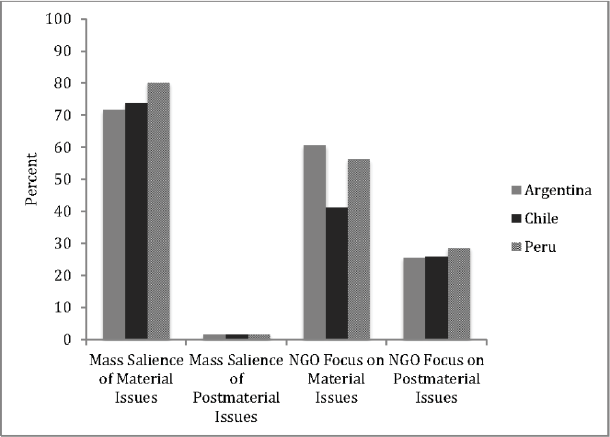
This article makes the case for another unexpected consequence that has gone largely unrecognized: the existence of a significant disjuncture between the salience of “postmaterial” issues within the NGO sector and the salience of these issues among the mass public. The proportion of the NGO sector in Argentina, Chile, and Peru primarily devoted to pursuing postmaterial issues such as environmental protection, human rights, citizenship and civil society promotion, and racial and gender equality vastly outpaces the proportion of citizens that consider these issues to be of particularly high salience. While about 27 percent of the NGO sector across the three countries is primarily oriented toward postmaterial issues, less than 2 percent of the population in each country considers one of these issues to be of greatest import to them – a conventional measure of issue salience. This disjuncture raises questions about the capacity of the NGO sector to effectively channel and represent the interests of mass publics. It is also normatively troubling in Latin America given the region's high levels of material deprivation and some countries’ massive problems with citizen security, which are issues of much greater concern to these populations. In sum, there are many good reasons to recognize the existence of this postmaterial disjuncture, open a scholarly conversation about its implications, and explore its roots.
The broader theoretical argument of this article is that international donors have helped to drive this disjuncture. As noted, many scholars argue that international donors have provided crucial financial and logistical resources to NGOs in developing countries, spurring their proliferation. I argue that international donors, considered in aggregate, strongly favor postmaterial NGOs when bestowing these resources and thus drive their relative proliferation. To be clear, international donors fund NGOs pursuing many different issues, including classic material concerns such as social services, poverty, and employment. However, many international donors – for example, INGOs focused on environmental issues and human rights, private foundations geared toward helping “advocacy NGOs,” and foreign governments channeling money to NGOs for the purposes of democracy assistance – are especially likely to support postmaterial NGOs. Taken as a whole, international donors therefore contribute not just to a rapid increase in NGOs in general in the developing world, but also to a specific growth of postmaterial NGOs vis-à-vis other kinds of organizations.
To test the hypothesis that international donors favor postmaterial NGOs, this article draws upon a unique dataset containing information on over 700 NGOs in Argentina, Chile, and Peru. Most studies of NGOs in developing countries take the form of in-depth case studies or statistical analyses of a moderate number of organizations involved in the same issue area. Neither of these approaches adopts a broad enough perspective on the NGO sector to adequately assess its aggregate degree of emphasis on certain kinds of issues or explore the relationship between issue orientation and the receipt of foreign funding. The dataset utilized in this paper therefore offers an unusual perspective on the question.
The results presented in this article strongly support the theory. Postmaterial issue orientation is a powerful predictor of foreign funding, a relationship robust to the inclusion of various combinations of control variables and to the analysis of the full sample or each country subsample. Further, the effect of postmaterial issue orientation on the likelihood of receiving foreign funding is huge. Postmaterial NGOs are over three times more likely (a probability of .25 versus .08) to receive foreign funding than are otherwise identical NGOs pursuing material issues. De facto disparities between postmaterial and material NGOs are even more substantial if we examine the likelihood of funding not just across issue orientation but also consider the related concerns of the socioeconomic profiles of communities in which NGOs operate. A postmaterial NGO based in an upper-middle-class neighborhood, a location common for many such organizations, is nearly seven times more likely (a probability of .34 versus .05) to receive foreign funding than is a material NGO – for example, a soup kitchen – based in a poor barrio, a location much more typical of these organizations given their need to operate among in-need populations.
The NGO Sector in Developing Countries and the Postmaterial Disjuncture
The last decades of the twentieth century saw an explosion of NGOs in developing countries and a corresponding surge in academic interest. Determining the exact number of NGOs in a given country is notoriously difficult. There is no universally recognized definition of an NGO and scholars often disagree on what kinds of organizations should be placed under this rubric. 1 Moreover, data on the existence of NGOs is usually unavailable and, when available, generally unreliable. Nevertheless, scholars point to an array of evidence suggesting a huge expansion of the NGO sector in developing countries during the last few decades (Brat-ton 1989; Clark 1991; Carroll 1992; Edwards and Hulme 1996; Hulme and Edwards 1997; Reimann 2006). Consequently, the rise and role of the NGO sector has been a major focus of research on new democracies and the politics of development.
There is broad agreement that certain kinds of organizations such as businesses, churches, universities, and chambers of commerce should not be counted even if they are technically “nongovernmental” organizations. Within the more limited subset of organizations, scholars disagree on whether the NGO rubric should extend to all such groups, including grassroots organizations, or whether it should be reserved specifically for more institutionalized organizations. Following much of the literature, this article adopts the more encompassing definition.
Research on this trend has increasingly focused on the roles of NGOs in domestic politics. Scholars have examined the influence of NGOs in lobbying governments and serving on policy boards – activities that have seen NGOs compared to organized interest groups in advanced democracies (Clarke 1998; Brass 2012a; Rich 2013). Some researchers have looked at the ability of NGOs to mobilize public opinion and shape electoral outcomes (Brown, Brown, and Desposato 2002, 2007; Boulding and Gibson 2009). Others, meanwhile, have focused on the link between NGOs and other forms of popular participation and protest (Boulding 2010). In short, researchers increasingly concur that NGOs play important roles as representatives or intermediary organizations in the interest systems of the younger democracies of the developing world. This line of scholarship is particularly well developed in Latin America, where studies even suggest that networks of NGOs form the basis of an entirely new pattern of postindustrial interest politics and have supplanted labor unions as the key organizations of popular-sector interest intermediation (Collier and Handlin 2009).
Given its political significance, issue orientation within the NGO sector has great theoretical and substantive implications. A major claim of this article is that the salience of postmaterial issues within the NGO sector in the three Latin American countries for which data is available – and perhaps elsewhere as well – is strikingly higher than among the mass public, reflecting a consequential disjuncture between intermediary organizations and the populations whose interests they often seek to represent. This claim is relatively novel, such that one contribution of this paper is simply to draw attention to this descriptive finding.
The concept of postmaterialism has been frequently deployed in the social sciences to capture a set of values and issues that rose in salience in the advanced industrial countries in the postwar era. Contrasted specifically with materialism, which centers on economic and physical security, postmaterialism connotes – at an abstract level – values that are fundamental to “quality of life,” such as rights, autonomy, and self-expression. When deployed at the more specific level of issues, post-materialism has been most associated with human rights, the deepening of democracy and popular participation in governance, environmental protection, and social equality along the lines of race/ethnicity, gender, or sexual orientation. In a series of pieces on postmaterialism that established the research agenda, Inglehart argued that the increasing affluence in advanced industrial countries was the principle driver of the rising salience of postmaterial values and issues (Inglehart 1971, 1977, 1987). As greater proportions of the population saw their material needs met, they were free to place more emphasis on postmaterial values, which ultimately translated into postmaterial issues increasing in salience. 2 Importantly, then, postmaterialism is a concept that captures a specific set of nonmaterial values and issues, not the broader category of all values and issues that are not material in nature.
Inglehart's work on postmaterialism has stirred significant debate, with scholars raising questions about his thesis (Brooks and Manza 1994) and his measurement strategy (Davis and Davenport 1999). For the purposes of this article, however, these debates are not particularly consequential.
To empirically assess the possibility of a postmaterial disjuncture, we need to measure the salience of these postmaterial issues among NGOs and the mass public. For these purposes, I consider a postmaterial issue to include any of the following: environmental protection, human rights, women's rights, racial and ethnic equality, the deepening of democracy through the promotion of citizenship and participation, and support for civil society. Following a huge tradition of behavioral research, I treat (for an individual or NGO) a salient issue to be one deemed particularly important relative to others. The inherently relative nature of the salience concept deserves emphasis. A salient issue is not just one that an individual cares about in the abstract, but is one the individual cares more about than others and is willing to highly prioritize.
To assess postmaterial issue salience among mass publics, I utilize data from the 2003 Latinobarómetro. This particular year was chosen in order to match the data (described below) available on NGOs and to also compare these findings with the Latin American Public Opinion Project (LAPOP). The Latinobarómetro survey asks respondents to name the political issue that is most important, producing responses coded by the survey firm into 21 different categories. I then recoded these responses to “postmaterial” (the set of issues mentioned above), “material” (issues related to employment, poverty, infrastructure, or basic services such as health and education), or “other” (issues that fit neither the “material” nor “postmaterial” categories, such as crime and violence, corruption, and partisan activism). 3 While we might imagine other ways to measure issue salience, there are three reasons for using the “most important” measure used in this article. First, this is an extremely common measure of issue salience in public opinion research in the United States as well as in comparative politics (McCombs and Shaw 1972; Soroka 2002; Singer 2011). Second, the measure is most directly comparable with the available data (see below) on issue salience among NGOs, which likewise ascertain what respondents believe to be the most important issue that they address. Finally, cross-national surveys such as Latinobarómetro and LAPOP simply do not provide the data necessary to construct alternative measures, such as those that ask respondents to rank-order issues in a list. Importantly, it should be emphasized that we should not necessarily conclude that those who do not list a postmaterial issue as most important do not care about such issues at all. Rather, as with other research on issue salience, the goal is to measure whether an individual considers a postmaterial issue particularly important relative to others.
In categorizing postmaterial and material issues, I followed common practices in scholarship on postmaterialism as much as possible. While the proper categorization of most issues is clear, other issues present thornier problems. For instance, education might be plausibly linked to postmaterial values such as “self-expression.” Yet the quality of education also bears directly on labor market outcomes, and improving educational quality is often seen as a cornerstone of “propoor” social policy in the developing world. In my judgment, the latter dynamics outweigh the former with regard to NGO participation in the education sector in Latin America; therefore, education was treated as a material issue. Nevertheless, it is important to acknowledge that, at least in some cases, postmaterial issues may have material implications and vice versa.
Assessing issue salience among the NGO sector is more difficult. Because the NGO rubric covers a large number and wide variety of organizations, comprehensive lists of NGOs, out of which one might randomly sample in order to draw inferences about the entire population, simply do not exist. While a great deal has been written about NGOs, studies almost never seek to make inferences about entire populations of NGOs. Even more importantly, given that this study is motivated by the NGO sector's status as an important set of interest organizations shaping politics, a representative sample of the entire population of NGOs is actually not desirable. For example, this kind of sample treats a tiny NGO in a small rural town, which serves a small population and is likely divorced from centers of political power, as equivalent to a large NGO in the capital city, which likely caters to a much larger population and is potentially capable of influencing national-level policy makers. Just as studies of labor politics rarely seek to randomly sample all labor unions and locals in a country or make inferences about the national population of unions, concentrating instead on groups of unions and federations that are particularly large and politically connected, this study explicitly seeks to make inferences about only a core segment of the NGO sector. For both pragmatic and theoretical reasons, then, this article examines the postmaterial disjuncture using survey data from a large sample of NGOs from the capital cities of Argentina, Chile, and Peru. 4 The sample is intended to capture many of the most politically important and active NGOs in each country, while being drawn from cities that themselves contain wide swaths (26–33 percent) of the national population. In this survey, leaders of each NGO were asked to name the most important issue for their organization, mirroring the question utilized to assess postmaterial issue salience among individuals. I then recoded these responses to the “postmaterial,” “material,” or “other” categories using the identical coding rules utilized for the individual-level data. 5
This survey was conducted in 2003, with samples in each country generated through a stratified chain-referral technique designed to generate 240 response NGOs. In each capital city, chain-referral samples of 30 NGOs were gathered in eight different districts (which were chosen to maximize variation on both political and socioeconomic variables). Researchers started at a preselected initial NGO and then selected further NGOs to interview based on referrals. Notably, the initial starting NGOs in each country were all devoted to material issues. Therefore, the chain-referral nature of the sample was likely biased against finding such a high proportion of postmaterial NGOs. For more information on how the districts were selected and other aspects of the chain-referral sampling procedure, see the appendices in Collier and Handlin 2009.
In some cases, the issue cited by an NGO as most important was impossible to reliably categorize – one example is “programming for youth and children.” In these cases, I utilized a follow-up question on the second most important issue in order to categorize the NGO.
With these two data sources, we can compare the level of postmaterial issue salience among individuals to that among NGOs. The two leftmost bar clusters in Figure 1 show the proportion of individuals in each country who consider a postmaterial or material issue to be most important to them. Mass publics in these countries are overwhelmingly most concerned with material issues, with 72–80 percent of each population listing one such issue as their primary preoccupation. In contrast, postmaterial issues barely register, with less than 2 percent of the population in each country considering a postmaterial issue to be their primary concern. 6 These extremely low levels of issue salience can also be found in other surveys. For example, data from LAPOP's 2006 America's Barometer (the LAPOP survey temporally closest to the 2003 NGO survey) suggests that only 2.2 percent of Chileans and 3.1 percent of Peruvians considered a postmaterial issue most important. 7 Research on issue salience using data from the Comparative Study of Electoral Systems reaches similar conclusions about the extremely low salience of these issues in Latin American cases (Singer 2011: 294–295).
The relative salience of postmaterial issues among the mass public might be higher if other measures were available, such as one asking respondents to list their two or three biggest concerns rather than their single most important issue. But this is also true of the NGOs.
The America's Barometer did not cover Argentina in 2006. Later surveys that did extend to Argentina suggest similarly low levels of postmaterial issue salience.
Postmaterial Bias in the NGO Sector
The two rightmost bar clusters in Figure 1 display the proportion of the NGO sector in each country primarily oriented toward postmaterial and material issues. Postmaterial NGOs make up a substantial 26–29 percent of the NGO sector in each case. As one might expect, material NGOs outnumber postmaterial NGOs in all three countries – but only by an aggregate proportion of almost exactly 2:1. Thus the gap between material and postmaterial NGOs is surprisingly small. The substantial proportion of postmaterial NGOs, both in raw terms and in comparison to material NGOs, is particularly noteworthy given that the starting points for the chain-referral sample in each country were material NGOs. The sampling strategy was therefore biased against finding such a high proportion of postmaterial NGOs. 8 A chain-referral sample in which the starting points were postmaterial NGOs would likely have found an even higher proportion of such organizations.
No one issue dominates in the “postmaterial” category. The most frequently cited postmaterial issue was the promotion of citizenship and participation, making up roughly 5 percent of the total NGO population. Therefore, changes to the coding rules for postmaterial issues are unlikely to produce different conclusions regarding the extent of the postmaterial disjuncture.
A significant disjuncture therefore exists between postmaterial issue salience among the NGO sector and among the populations those organizations seek to represent, which has significant implications for scholars studying the NGO sector in Latin America and other developing regions. Research on NGOs and civil society has become more circumspect over time. Rather than reflexively lionizing NGOs, scholars highlight their strengths and weaknesses as intermediary organizations and political actors. This article contributes to this trend by illuminating the postmaterial disjuncture. 9 This characteristic is particularly critical because NGOs often cast their missions specifically in terms of the representation of public interests, and because scholars sometimes portray the burgeoning NGO sector as filling gaps in mass representation that are not well addressed by other intermediary organizations.
Material NGOs may be relatively more prevalent in regions like Africa where states fail to provide basic services to a higher degree. Note, however, that state incapacity to provide basic material services has also plagued many countries in Latin America, including Peru.
Greater attention to this descriptive finding might also help balance other tendencies within research on NGOs in developing countries. Scholarship often emphasizes the role of NGOs in service delivery or portrays the NGO sector as “propoor” (White 1999). It is true that a large proportion of NGOs do focus on basic material issues such as poverty, employment, and social services. Nevertheless, the proportion of NGOs that devote their time to material issues is much smaller than the proportion of the public that considers them critical. While poverty in Latin America has seen recent declines, the regional poverty rate remains above 30 percent. Further, the poverty rate severely underestimates the proportion of households that live in substantial material risk and are only a lost job, unexpected illness, or other calamity away from financial ruin. Unlike advanced countries, the region has not seen the substantial increases in living standards that free populations from material risk and allow them to prioritize postmaterial concerns. In this sense, there is arguably an “undersupply” of material NGOs in Latin America, which complicates the idea of an NGO sector geared toward addressing the needs and interests of the disadvantaged.
The implications of the postmaterial disjuncture for how the NGO sector operates in practice – for example, whether postmaterial NGOs “crowd out” material NGOs in some aspects of politics or the degree to which different organizations cooperate – are beyond the scope of this article. Such questions require deeper investigation that will likely involve case studies that allow for a closer and more nuanced examination of the issues at hand. The point for present purposes is that the postmaterial disjuncture is notable in its own right; it shifts our understanding of the NGO sector in important ways and calls for explanation.
Explaining the Postmaterial Disjuncture: The Role of International Donors
What explains the surprisingly high number of postmaterial NGOs in Latin America? Undoubtedly, many factors shape the contours of the NGO sector, such that a thorough assessment is well beyond the scope of a single article. Rather, I investigate the specific hypothesis that international donors have contributed to the relative proliferation of post-material NGOs. This hypothesis contains two distinct propositions, which should be untangled for clarity and better illustration of how empirical testing is applied. The first proposition, common in scholarship on NGOs, is that foreign funding has contributed to the rapid increase in NGOs in developing countries by incentivizing people to form NGOs and by helping recipient NGOs sustain their activities. This proposition is not tested in this article but instead treated as an assumption. The second proposition, which remains relatively unexplored but is empirically tested in this paper, is that foreign funding flows disproportionately to NGOs with a postmaterial issue orientation. Putting the two propositions together, we get the hypothesis that foreign funders have driven a relative proliferation of postmaterial NGOs by favoring these types of organizations.
Scholars studying the escalation of NGO activity have frequently emphasized the role of foreign donors. As one summary assessment noted, “In the past two decades an explosion of new international opportunities for funding and participation of NGOs has created a structural environment highly conducive to NGO growth” (Reimann 2006). Scholars have taken several approaches to bring empirical evidence to bear on these arguments. Some studies stress a strong aggregate relationship between the burgeoning number of NGOs in the developing world and sharp increases in foreign funding for NGOs that began in the 1980s (Hulme and Edwards 1997). Taking a similarly macrolevel perspective, others detail the diversity of foreign donors and their programs specifically geared toward supporting and fostering NGOs (Reimann 2006). Another group of studies examines the NGO–donor relationship on the microlevel, chronicling the importance of foreign funding and logistical support to NGOs as well as the frequently doubled-edged nature of these relationships (Edwards and Hulme 1996; Henderson 2002; Stiles 2002; Ebrahim 2003; Bebbington 2005; Bano 2008). Others critically examine specific donor institutions, such as the World Bank, and how well their efforts to support, fund, and partner NGOs work in practice (Nelson 1995; Fox and Brown 1998). In sum, many types of studies concur that international donors have contributed to the rapid increase in NGOs. If we take this as an assumption, it stands to reason that international donors that potentially favor postmaterial recipient organizations when bestowing their resources could well be helping to drive a relative proliferation of postmaterial NGOs vis-à-vis nonpostmaterial organizations.
But do international donors really favor postmaterial NGOs? There are numerous reasons to believe so. Naturally, many foreign donors also support NGOs involved with material concerns, and some donor programs do so almost exclusively. But several major donor groups are quite strongly geared toward issues in the “postmaterial” category. One such group is that comprised of donors focused on “democracy assistance,” including the bilateral agencies of national governments or the array of semigovernmental foundations established by Western powers, such as the National Endowment for Democracy, the International Center for Human Rights and Democratic Development, and the Olaf Palme International Center. Foreign aid has increasingly taken the form of “political aid,” funding intended to deepen democracies in the developing world or to strengthen antiauthoritarian movements (Carothers 1997; Crawford 2001; Mendelson and Glenn 2002). As such, it is weighted not toward material NGOs engaged in core poverty-related issues, but rather toward NGOs pursuing human rights, citizen empowerment, and various forms of social equality.
Another donor group with a clear orientation toward funding postmaterial NGOs consists of societal organizations based in the developed world and variously conceptualized as INGOs or transnational advocacy movements. As the relative salience of postmaterial values and issues increased in the advanced industrial countries in the latter decades of the twentieth century, social movements and NGOs geared toward postmaterial goals and causes became more influential (Laclau and Mouffe 1985). This trend eventually spawned groups with international reach, such that the most prominent and active INGOs and transnational advocacy organizations have frequently been geared toward postmaterial issues such as the environment, gender equality, and human rights (Keck and Sikkink 1998; Tsutsui and Wotipka 2004; Schofer and Hironaka 2005; Tarrow 2005). INGOs that focus on poverty and other material issues certainly exist. And it is difficult to draw firm conclusions about the relative balance between material and postmaterial groups within the INGO population. Nevertheless, extant research suggests that postmaterial INGOs and transnational advocacy groups are particularly prominent and active in supporting NGOs in developing countries.
The last decades also saw the emergence of numerous private foundations based in the developed world, which rapidly ramped up the level of foreign aid they distributed and the amount of such aid flowing to NGOs. These organizations – examples of which include the Gates Foundation, Global Fund for Women, Hewlett Foundation, and Rockefeller Foundation – give funds directly to developing-world NGOs as well as a variety of INGOs and transnational advocacy groups, which themselves then often partner NGOs in the developing world. Foundations differ in their issue priorities but, as a whole, are strongly oriented toward the kinds of “advocacy NGOs” that often embrace postmaterial issues like the environment, civil society promotion, human rights, and women's rights. One analysis of the 12 largest foundations found that 63 percent of their projects involved the funding of advocacy NGOs (Reimann 2006).
While there is substantial reason to believe that international donors, in aggregate, might favor NGOs that pursue postmaterial issues, the relationship between NGOs’ pursuit of postmaterial issues and their acquisition of international financing is ultimately an empirical one that must be investigated. This article operationalizes its core hypothesis by examining whether postmaterial issue orientation can help predict the likelihood of receiving foreign funding, conditional on other NGO characteristics. One unavoidable complexity should be made explicit from the outset: the direction of causality between the two key variables in the relationship is not crystal clear. Most NGOs form, establishing themselves and their issue profiles, and then reach out to potential donors. This paper therefore treats a postmaterial issue profile (usually established first in the life of an NGO) as an independent variable and examines its ability to predict the receipt of international funding (usually secured later). But it is certainly possible that some nonpostmaterial NGOs, having received international funding, have shifted their issue priorities toward postmaterial concerns in order to better secure these resources. With only a cross-section of data to analyze, it is impossible to tease out that possibility further. What should be stressed is that such instances are likely to be relatively rare; they would, however, in some sense support the overall hypothesis of this paper as they would represent an alternative pathway by which the postmaterial leanings of international donors might help drive a relative proliferation of postmaterial NGOs in the developing world.
Data
To test the hypothesis, I draw upon the same dataset used to measure the extent of postmaterial disjuncture in the NGO sector of Argentina, Chile, and Peru. 10 This dataset contains detailed information on over 700 NGOs, including issue orientation, the receipt of foreign funding, and a wide range of other characteristics and activities. The same caveats mentioned above regarding the sample apply to this part of the analysis. The data is not a nationally representative sample of NGOs (which is impossible to gather and not actually desirable for the goals of this research), but a sample that captures a particularly critical and politically salient segment of the NGO sector in the capital cities of three countries.
These cases were not selected for the explicit purposes of this article but are simply those for which data were available to test the hypothesis. However, the cases vary in several useful ways: Argentina and Chile are relatively wealthy countries by Latin American standards, while Peru is relatively poor. When the data was gathered in 2003, Argentina and Chile were also relatively consolidated democracies, many years on from their democratic transitions, while Peru had just experienced democratic transition. By examining not just the pooled sample but also individual country samples, we can see whether the relationship between postmaterial issue orientation and international funding remains robust across these different contexts.
The dependent variable used in the analysis is a dichotomous variable that captures whether funding was received or not from international donors, which could be transnational advocacy organizations, INGOs, private foundations, foreign governments or governmental agencies, or institutions such as the World Bank. 11 The data for this variable comes from two separate questions in the survey in which NGO leaders were asked separately whether foreign agencies and governments or foreign associations and organizations contributed to their funding 12 – though no information was collected on the amount of funding. NGO leaders who answered positively to either of these questions received a score of 1 on the dependent variable. NGOs reporting international funding make up 15 percent of the sample, a large and substantively meaningful proportion.
The respondents were NGO leaders. They had access to information about the finances of their organizations and could provide reliable answers to this question.
Unfortunately, the way these questions are phrased – one asking about “foreign governments” and one asking about “foreign organizations” – makes it difficult to evaluate them separately as measures of governmental and nongovernmental donors.
The independent variable of interest is NGO emphasis on post-material issues. This variable draws on data from the open-ended question discussed above in this article's section on measuring the postmaterial disjuncture. To reiterate, NGO leaders were asked to list the most important issue for the organization. Responses to this question were then recoded to three categories – “postmaterial,” “material,” and “other.” The “postmaterial” category included environmental issues, the promotion of citizenship and participation, women's rights, support for civil society, and human rights. The “material” category included housing, local infrastructure, educational quality, health and health education, employment-related themes, and the distribution of food and other basic goods. The “other” category included themes that were neither fundamentally material nor appropriately considered postmaterial by common definitions, such as crime and gangs, corruption, recreational activities, and arts and culture.
The dataset also allows for the introduction of numerous control variables that tap organizational attributes that might plausibly be related to the receipt of international funding. Several control variables capture the kinds of political activities – those conducted through institutional and contentious channels – in which NGOs engage. These variables are included in the model because they plausibly might raise the profile of NGOs, allowing them to better connect with international donors. To measure whether NGOs engage in regularized political action through institutionalized channels, I draw upon a question regarding the importance to NGOs of contacting government officials. Based on a binary measure, NGO leaders who consider such strategies “important” or “very important” to the organization score 1. I utilize a similar measure to determine the use of contentious strategies, whereby NGOs score 1 if they report that engaging in protest is an “important” or “very important” activity.
Other control variables capture organizational characteristics. The age of an NGO is included in most models, under the assumption that older organizations might be more likely to have developed relationships with international donors. Because access to funding might also plausibly depend on the connections NGOs have with other organizations, I also control for network ties. This measure utilizes a series of questions in which NGO respondents were asked, “How many (type of civil society organization) do you work with?” These responses were combined and the total logged under the assumption that there would be declining returns to network ties in terms of access to international funding. Another important control variable is NGO institutionalization, as organizations that are more formal, stable, and bureaucratic are probably better positioned to write applications and engage in other activities necessary to secure international funding. To measure this variable, I constructed a scale of institutionalization, utilizing three questions that each dichotomously measured an organizational attribute – whether or not the NGO had a permanent leadership, whether or not the NGO had paid staff, and whether or not the NGO had official recognition from or had registered with the state. With positive answers to each question given a value of 1, the additive scale runs from 0 to 3.
A final control variable is introduced in some of the models in order to capture the socioeconomic level of the urban district in which an NGO is based relative to the rest of that particular city. 13 Unlike others, this control variable is measured at the level of the district rather than the individual NGO. This aggregate-level variable is introduced under the assumption that NGOs operating in very poor communities likely face much greater difficulties in gaining access to international funders. Including this variable is particularly important given that NGO issue orientation is likely to be related to the socioeconomic levels of the communities in which NGOs operate. For example, those geared toward material issues like poverty and food distribution are likely to be located in the poor communities that they serve. We thus need to distinguish between, on the one hand, the effect that an NGO's postmaterial or material orientation has on receiving international funding and, on the other hand, the effect that the material conditions in which an NGO operates has on receiving international funding.
The intent of this variable is to capture the socioeconomic profile of NGO neighborhoods not in absolute terms but relative to other districts of that particular city. One complication is that governments report different kinds of data regarding district socioeconomic levels. To account for these differences, I standardize measurements in each city, measuring socioeconomic level as the number of standard deviations above or below the mean district in that particular city.
Data Analysis
This article tests the hypothesis that postmaterial issue orientation can predict the receipt of international funding through the specification of logistic regression models. I perform these tests both on the pooled sample and on individual country samples (for a total of four different populations) in order to better ascertain whether relationships are consistent across different countries. Within each population, three different models are specified. A reduced-form model only includes variables for issue orientation and strategy choice. A full model adds a series of control variables measuring other characteristics of NGOs. Finally, a third model adds another variable on the socioeconomic level of the district in which NGOs are located. In each of these models, the excluded reference category for issue orientation is material issues. 14
I also ran all models with issues coded dichotomously as either “postmaterial” or “nonpostmaterial” (combining the “material” and “other” categories). The results of these models were similar to those obtained when using trichotomous coding.
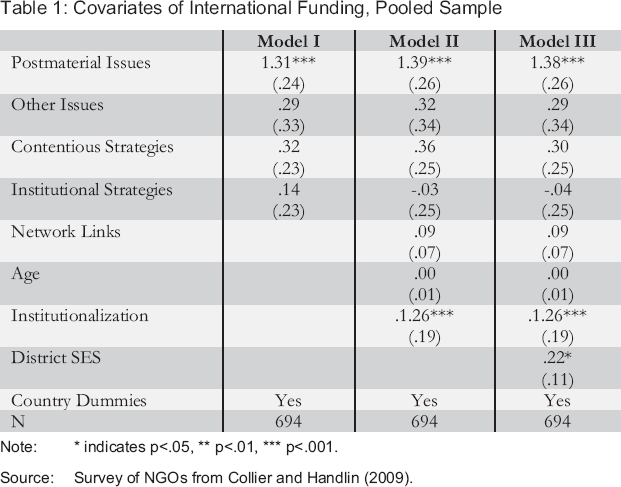
Table 1 shows the results from the analysis of the full sample. Most notably, the relationship between postmaterial issue orientation and the receipt of international funding is consistently strong across all three specifications. This strong relationship is evident in the reduced form model (which examines issue orientation and strategy choice) and remains essentially unchanged even after several control variables are introduced in the second and third models. Two secondary findings are also worth noting. First, NGO institutionalization is a very strong predictor of international funding and is on a par with postmaterial issue orientation. The strength of this relationship is not particularly surprising, given that acquiring international funding usually involves some organizational effort and capacity – such as finding funding sources and writing convincing applications – on the part of would-be recipients. Second, the socioeconomic level of communities in which NGOs operate also emerges as an important predictor of international funding. This secondary finding has greater substantive implications. Many NGOs with a material focus (for example, soup kitchens) are based in poor communities out of necessity as they must operate among their target populations. If both material orientation and location in poor communities are negatively associated with the receipt of international funding, these kinds of NGOs can be considered doubly disadvantaged.
Covariates of International Funding, Pooled Sample
Note:
indicates p<.05,
p<.01,
p<.001.
Source: Survey of NGOs from Collier and Handlin (2009).
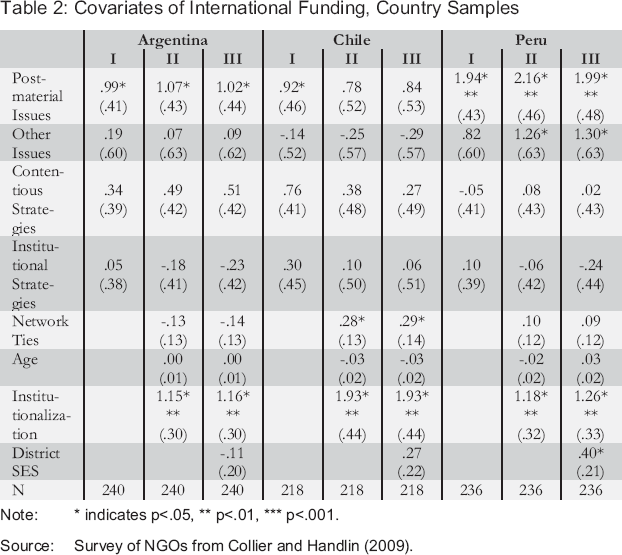
A natural concern with the analysis of this pooled sample is that the observed relationship between postmaterial issue orientation and international funding might be driven by particularly strong dynamics within a single country. Therefore, I also examine each country sample separately in order to see whether the relationships observed in the pooled sample hold. For each country, I run the same three models specified for the pooled sample (the results are reported in Table 2). The positive association between postmaterial issue orientation and the receipt of international funding holds across all models for each country sample. Estimates regarding this relationship are also statistically significant at conventional levels in eight of the nine models. These results suggest that the preference of international donors for NGOs with postmaterial agendas is not a product of any country-specific factor but rather a general tendency across Latin American countries.
Covariates of International Funding, Country Samples
Note:
indicates p<.05,
p<.01,
p<.001.
Source: Survey of NGOs from Collier and Handlin (2009).
The relative strength of the findings for the country subsamples is worth examining for several reasons. One drawback of the available data is that two of the countries, Argentina and Chile, are among the wealthiest in Latin America. In addition, the welfare states in these two countries are among the oldest and most expansive in the region. These characteristics might seem to make Argentina and Chile cases where identifying foreign funders that favor postmaterial NGOs is particularly likely. International donors might have weaker incentive to provide resources to material NGOs seeking to target the poor and to make up for shortcomings in state-provided services. Peru, on the other hand, is a considerably poorer country with a much less generous and expansive welfare state. In these respects, Peru arguably has greater similarities than Argentina or Chile to the majority of Latin American countries, not to mention those in regions such as Africa, the Middle East, or Southeast Asia. For these reasons, if I had found that international donors favored postmaterial NGOs in Argentina and Chile but not in Peru, I might have questioned the generalizability of the findings to much of the developing world.
The results instead suggest that international funders favor post-material NGOs in Peru to a greater degree than in either of the other countries. This pattern could have several explanations. It might be partly a product of sampling variance or slightly different ways in which the chain-referral sample unfolded in each country. A more substantive potential explanation involves the country's regime trajectory. Although Peru, as well as Argentina and Chile, experienced a democratic transition in the 1980s, it underwent an authoritarian reversal in the 1990s under Alberto Fujimori, whereas Argentina and Chile consolidated and maintained their democratic regimes. Indeed, the NGO survey was conducted only two years after Peru had transitioned back to democracy in 2001. This context, in which a competitive authoritarian regime had recently been in power and democracy remained unconsolidated, may have been particularly conducive to involvement by international donors concerned with democracy assistance, citizenship promotion, and support for civil society. We should not conclude, however, that this trajectory makes Peru an outlier. Indeed, these kinds of regime conditions – hybrid regimes or weakly consolidated democracies – are common in the developing world. In this sense, the regime trajectory of Peru actually makes it a good case for building theory about the support of international donors for postmaterial NGOs.
The analysis thus far suggests a powerful association between post-material issue orientation and the receipt of funding from abroad, but it tells us little about the substantive impact of these relationships. How much does having a postmaterial issue orientation change the likelihood of receiving financial support from international donors? The most direct way to answer this question is by taking predicted probabilities from the fullest model using the pooled sample while holding other variables at their means. The model predicts that a material NGO has a 7.8 percent chance of receiving international funding, whereas a postmaterial NGO has a 25.3 percent chance of obtaining funds from abroad – a substantial difference of 17.5 percentage points. In other words, post-material NGOs are over three times more likely to get international funding than otherwise identical material NGOs. Foreign funds can represent a financial lifeline for NGOs, albeit one proffered very unevenly across the NGO sector in Latin America.
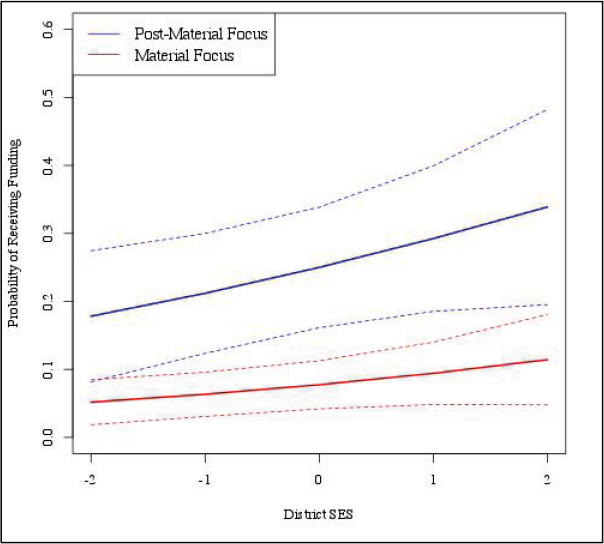
Another perspective on this question can be gained by examining the likelihood of postmaterial and material NGOs receiving international funding at different community socioeconomic levels, as shown in Figure 1. 15 This perspective is useful not only because community socioeconomic level itself emerged as an important predictor of international funding, but because this variable is related in theoretically important ways to issue orientation: NGOs pursuing certain kinds of material issues are much more likely to be located in poor neighborhoods. The solid lines in Figure 2 capture these predicted probabilities, while the dashed lines show 95 percent confidence intervals. One observation is that while both lines rise from left to right, the gap between postmaterial and material NGOs widens slightly in wealthier urban areas. 16
Probability of Receiving Foreign Funding
This figure draws upon the results of the third model presented in Table 1. Predicted probabilities are calculated assuming a Peruvian NGO with all other variables set to their means.
To explore this finding further, I specify the same model with an interaction term and find the interaction statistically insignificant and substantively minor.
More notable is the difference in predicted probabilities between post-material NGOs located in wealthier communities and material NGOs located in poorer communities. For example, the fullest model predicts that an environmental NGO based in an upper-middle-class district, a desirable and feasible location for such an organization, would have a 34 percent chance of receiving foreign funding. In contrast, an otherwise identical NGO focused on poverty alleviation and located out of necessity in a poor barrio would have about a 5 percent chance of attaining funding. Naturally, this comparison goes beyond the effect of postmaterial issue orientation on funding, taking into account location as well. In this sense, it is a secondary point for the overall purposes of this article. This point is worth stressing, however, because the contrast between postmaterial NGOs in wealthier neighborhoods and material NGOs in poorer communities is often relevant due to the strong relationship between issue orientation and location.
What is the aggregate impact of foreign donors on issue orientation within the Latin American NGO sector? To better consider this question, we should return to the original discussion of the hypothesis, which held that international donors favor postmaterial NGOs and have thus contributed to the relative proliferation of these organizations for two reasons. First, disproportionate financing to postmaterial NGOs helps those extant organizations endure and prosper. About 15 percent of NGOs in the sample receive funding from abroad, so this financing affects a meaningful portion of the NGO sector. Second, just as international financing has helped incentivize the formation of NGOs in the developing world in general (as most scholars agree), donor favoritism toward NGOs pursuing postmaterial causes is likely to disproportionately incentivize the formation of postmaterial NGOs, as potential organization founders strategically choose issues that will best allow them to tap into international funding streams. In this sense, the aggregate impact of international donors so strongly favoring postmaterial NGOs extends well beyond the subset of NGOs that actually receive funding.
It is important to note, nevertheless, that international funding is only likely to be a partial explanation for the postmaterial disjuncture. Many other factors might also plausibly contribute. Interest organizations other than NGOs, most clearly labor unions, are heavily involved in some material issues, especially those related to employment. The postmaterial disjuncture is thus likely to partly reflect a division of labor between NGOs and unions. Moreover, while postmaterial issues like the environment and human rights may not be of high salience for Latin American populations overall, those attuned to these issues may be particularly mobilized and dedicated. Finally, the postmaterial disjuncture might also be driven in part by the support of domestic sponsors – not just international ones – for postmaterial NGOs. With a phenomenon that reflects aggregate tendencies across the NGO sector, we should expect multiple causes to be at work. The analysis in this paper strongly supports the notion that the activities of foreign donors constitute one important contributing cause.
Conclusion
The multiplication of NGOs in developing regions, spurred in part by the financial assistance of international donors, represents an important change in the nature of interest organization and representation. The disjuncture between Latin American NGOs and populations with respect to postmaterial issue salience has important implications for the operation of interest politics in the region and other parts of the developing world. Yet despite the massive amount of research on NGOs in general, this issue has largely escaped the attention of scholars, most likely due to data limitations. This article sought to open a research agenda on the topic, making two primary contributions. The first was to chart and demonstrate the postmaterial disjuncture in three Latin American countries. The second was to develop and test a theory regarding one important cause, the proclivity of international donors to support postmaterial NGOs.
These topics merit more attention, especially as scholarship continues to move from documenting the proliferation of NGOs to examining their political functions. This trend has led to more sober appraisals of the efficacy and political activities of NGOs in the developing world. Surely the striking mismatch between NGOs and mass publics in terms of postmaterial issue salience also deserves further analysis. The implications for patterns of political representation appear particularly complex. One perspective might see the rapid increase in postmaterial NGOs as occurring largely independently of the activities and operation of material NGOs. In this view, greater attention to issues like gender equality and the environment might be unalloyed positives, even if such issues are of relatively low salience for mass publics. Another perspective might hold that the explosion and strengthening of postmaterial NGOs has come, to some degree at least, at the expense of NGOs pursuing material issues like poverty, health, and employment. Like all interest organizations, NGOs ultimately compete for influence over politics and to shape the public conversation in different directions. Ceteris paribus, then, a more prominent and connected postmaterial NGO sector will lead to a less influential material NGO sector. The point of this article was not to make a strong positive argument for either of these perspectives, but to suggest that this is a question worth examining.
The role of foreign donors in driving the postmaterial disjuncture also suggests some interesting theoretical extensions worth further examination. A lengthy line of scholarship has examined whether foreign aid promotes democracy and development, generally coming to mixed conclusions. But aid channeled through NGOs tends to be seen more positively. The support of NGOs and civil society – whether via governmental democracy assistance or as the local partners of INGOs or transnational advocacy networks – is often seen as having intrinsic value. One question raised by this paper is whether this aid, weighted heavily toward supporting postmaterial NGOs despite the low salience of postmaterial issues for recipient populations, also has an intrinsic cost. Foreign donors send money to developing countries with good intentions, seeking to address issues close to their own hearts such as the environment, human rights, gender equality, and the deepening of democracy. In so doing, however, they may be contributing to an interest system in which the issue orientations of NGOs often purporting to represent the public interest depart greatly from the actual issue preferences of the respective mass publics.
Further research might move productively in several directions. Most importantly, it would be useful to assess the external validity of the major claims of this paper. Is the postmaterial disjuncture present in other countries in Latin America or other regions of the developing world? Does the overrepresentation of postmaterial NGOs depend on country-level characteristics like level of development or regime trajectories? It would also be worthwhile to test the major causal hypothesis of this article on additional datasets of NGOs, especially ones offering a more detailed battery of information on international funding. How do different categories of international donors differ in their tendency to support material and postmaterial NGOs? Finally, further research might delve much deeper into the nature and implications of the postmaterial disjuncture. As mentioned above, the effects on patterns of political representation and the operation of interest politics in developing countries are not completely clear. Do the voices and preferences of post-material NGOs crowd out or otherwise compete with the voices and preferences of organizations seeking material goals? Do postmaterial and material NGOs sometimes work together for common goals, or are their efforts completely independent of each other? These sorts of questions require much deeper investigation and are well worth exploring.