




Abstract
In low-information elections, voters are likely to rely on heuristics when choosing candidates. Based on survey experiments conducted prior to Brazil's 2012 municipal elections, I examine the effect of candidates’ professional titles, such as “doctor” and “pastor,” on voting behavior. Using the “pastor” title in one's electoral name tends to decrease vote intention, although evangelical Christians respond positively while members of other religious groups are repelled. The broader atmosphere of political competition between Brazilian evangelicals and Catholics helps explain the presence of both out-group and in-group cueing effects. The “doctor” title has a positive effect on vote intention that appears to be mediated by the positive stereotypes, such as intelligence and competence, associated with members of this profession.
Introduction
For many Brazilian voters, municipal election campaigns constitute sensory overload. Such elections usually involve many competing politicians; in the median municipality in 2012, for example, 53 candidates ran for nine city council seats. Open-list proportional representation gives these candidates strong incentives to campaign individually rather than coordinating with their list-mates. The airwaves are filled with a barrage of short spots, since parties often divide their daily free advertising time among the many candidates on their lists (Albuquerque, Steibel, and Carneiro 2008). To compensate for the limited airtime, candidates turn to traditional media, littering the city with flyers, posters, buttons, and t-shirts. Since voters choose candidates by entering their number into an electronic voting machine, every advertisement seeks to link together a photograph, a name, and a unique five-digit number. Furthermore, because candidates are allowed to list nicknames on the ballot, they routinely run for office with monikers that differ from their legal names (Romero 2012).
Given these features, Brazilian city council contests are a classic example of a low-information election in which voters are asked to choose from among relatively unfamiliar options. In such circumstances, they often reach a decision by relying on heuristics or cues, including a candidate's party affiliation (Conover and Feldman 1982, 1989), gender (McDermott 1997), race (McDermott 1998), occupation (McDermott 2005), religion (McDermott 2007, 2009a), and physical attractiveness (Atkinson, Enos, and Hill 2009; Lawson et al. 2010; Lenz and Lawson 2011). Some heuristics are conveyed via the ballot, while others require a minimal level of attention to the campaign, but all are more readily available to the average voter than the details of a candidate's issue positions or policy proposals.
This paper 1 leverages an online survey with two experiments conducted prior to Brazil's 2012 municipal elections to identify the effect of religious and occupational heuristics conveyed via professional titles, such as “pastor” or “doctor,” that candidates include in their official electoral names. Given permissive electoral regulations, most Brazilian candidates use some sort of nickname or title. For example, a clergyman named Paulo Rodrigues de Souza and a doctor named Carlos Fernandes da Silva might run as “Pastor Paulo” and “Dr. Carlos,” respectively. Each experimental question asked respondents about the likelihood that they would vote for a given candidate for city council and their assessment of the candidate's intelligence, competence, and honesty. Those in the treatment group were given the candidate's electoral name with the “pastor” or “doctor” title, while those in the control group were given the candidate's legal name. Both treatments have significant effects, but in opposite directions: use of the “pastor” title tends to decrease vote intention for a candidate, whereas using the “doctor” title increases it.
Acknowledgements: For helpful comments, I am grateful to Dino Christenson, Daniel Hidalgo, Rômulo Leitão, Gregory Love, David Patel, David Samuels, Amy Erica Smith, Dominic Zarecki, Cesar Zucco, and seminar participants at Boston University. The online survey analyzed in this paper was conducted jointly with Daniel Hidalgo and Amy Erica Smith and was approved by the Institutional Review Boards of Boston University, Massachusetts Institute of Technology, and Iowa State University. The survey data and replication materials are available via the Harvard Dataverse Network (<http://thedata.harvard.edu/dvn/>).
Heuristic effects could potentially operate through two distinct mechanisms: group associations and stereotypes. I argue that group associations largely account for the effect of the “pastor” treatment on vote intention. Given the intense competition between evangelical Christians and other religious groups, identifying oneself as “pastor” generates strong and opposing heuristic effects for in-groups and out-groups. Evangelical Christians, particularly Pentecostals, are significantly more likely to vote for candidates with a “pastor” title. Those from competing religious traditions, especially Charismatic Catholics, are significantly less likely to vote for a “pastor” candidate. Treatment effects on trait evaluations also vary depending on the respondent's religion, underscoring that there are no commonly held beliefs about the competence, intelligence, or honesty of pastor-politicians. By contrast, use of the “doctor” title is more likely to influence voting behavior via positive stereotypes. Treatment effects on several trait evaluations are nearly as large as those on vote intention, suggesting that they are plausible mediators.
Most clergy and medical doctors running for city council use titles in their electoral names, so the negative average treatment effect for “pastor” candidates begs the question of why an apparently harmful practice would be so common. Differences between real-world voting procedures and the measurement of vote intention in the survey experiment provide the answer. Given Brazil's legislative electoral institutions, candidates can win office with relatively low vote shares, drawing on a narrowly defined support base. In this context, polarizing titles like “pastor” do not necessarily hurt a candidate's electoral chances. A candidate can afford to alienate a majority of voters as long as a core group of fellow believers is moved toward support.
Voters in democracies around the world are often asked to choose among relatively unfamiliar options, especially for low-profile elected positions. In such circumstances, they often reach a decision by relying on heuristics – informational shortcuts that help them infer things about a candidate's issue positions, policy proposals, or likelihood of representing their interests.
The majority of research on heuristics and voting behavior has focused on cues that are conveyed automatically to voters, independent of a candidate's campaign strategy. Party affiliation (Conover and Feldman 1982, 1989) is the classic heuristic and appears explicitly on the ballot in most elections. Other cues, including gender (McDermott 1997) or (in some cases) ethnicity, can be readily inferred from candidates’ names. Still others, such as physical attractiveness (Atkinson, Enos, and Hill 2009; Lawson et al. 2010; Lenz and Lawson 2011), are invisible on the ballot (except where candidate photos are included), but difficult for a candidate to alter in any significant way.
Other heuristics reach voters, and potentially influence their decisions, only to the extent that they are emphasized during a campaign. Occupation and religion both fall into this category. Candidates may campaign on their professional background, but it is rare for occupations to be printed on the ballot. Even in these cases, candidates typically decide how to describe themselves, and they may opt out entirely. Likewise, barring instances in which one's faith can be inferred from his or her surname, dress, or habits such as daily prayer, religion serves as a heuristic only when candidates or the media choose to emphasize it. In most instances, therefore, heuristic effects involving occupation and religion fall into the category of campaign effects. They are relevant not only to how voters choose candidates, but also to how candidates or other actors influence this choice.
Occupational and religious heuristics have received less scholarly attention than other types, but prior research has demonstrated sizable effects in a variety of low-information contexts. When asking questions about hypothetical candidates for the U.S. Congress, describing a candidate as an evangelical Christian can affect vote intention (McDermott 2009a). Candidate occupation, which is listed on the ballot in California, has been shown to affect or correlate with voting behavior in low-profile elections such as the Los Angeles Junior College Board of Trustees (Mueller 1970), Democratic and Republican Party county committees (Byrne and Pueschel 1974), state Superior Court judgeships (Dubois 1984), and positions such as treasurer and attorney general (McDermott 2005). Studies in other countries have demonstrated large occupational cuing effects in elections for local councils in Baden-Württemberg, Germany (Mechtel 2011) and Barcelona, Spain (Sajons 2011).
Existing studies of occupational and religious heuristics in these varied national contexts provide only limited insight into campaign effects in the real world. Most involve regression analysis of cross-sectional survey data or electoral results rather than methods that allow for strong causal inference. Several of the studies that have analyzed survey experiments have relied on hypothetical electoral scenarios with limited external validity (McDermott 2009a; Sajons 2011). Moreover, they tend to cue occupation or religion in isolation from other candidate characteristics, such as party affiliation (McDermott 2009a; Sajons 2011) or basic demographics (McDermott 2005; Sajons 2011), that would also be communicated to voters during a campaign. Finally, existing studies (with the exception of McDermott 2009a) have focused on a single state or city and often on particularly low-profile elections where candidates do not campaign much, if at all. Knowing about the decision process for downballot races in California may tell us something about voter psychology in one very specific electoral context, but it says little about the effects of campaigning on one's occupation more broadly.
The present study of Brazilian city council elections aims to address these limitations of the existing literature. It examines the effects of occupational and religious heuristics using an experimental design that allows for strong causal inference. The survey experiment was administered during an actual election campaign, using details from real candidates wherever possible, and it mentioned party affiliation and various personal details in addition to cuing religion and occupation. It examines elections in municipalities nationwide that draw numerous candidates competing intensely for voter support. City council may be an entry-level office in Brazil, but local governments enjoy significant power and control over resources, making municipal positions attractive (Samuels 2003). Finally, the study cues religion and occupation in the same way that candidates themselves often do: through the use of “pastor” or “doctor” titles in their official electoral names.
In addition to demonstrating heuristic effects on voting behavior in Brazil, this study aims to uncover the psychological mechanism through which these effects occur. Existing research has proposed two such mechanisms: stereotypes and group associations. When informed of a candidate's race, gender, religion, or occupation, voters might be able to infer additional information, such as party affiliation, ideology, or personal traits, that helps them make a decision (Campbell, Green, and Layman 2011; McDermott 1998, 2005, 2007, 2009a). For instance, a lawyer might be thought of as more intelligent than a taxi driver, while a woman might be considered more liberal than a man; these stereotypes would then affect voting behavior.
Implicit in the stereotyping mechanism is the notion that heterogeneous causal effects derive from different reactions to a common assumption about the candidate. In the case of gender, a female candidate is likely to attract some voters and turn others away. If stereotypes are mediating the relationship, voters should agree that a woman is more liberal, but they may reach different voting decisions in response to this inference.
Occupational and religious heuristics might also influence voting behavior via group associations. Above and beyond any effects that are mediated by stereotypes, voters might simply favor candidates who are members of their own identity group (McDermott 2009b). In-group cueing of voting behavior suggests that voters seek descriptive representation, regardless of the candidate's traits or qualifications. When group associations are at play, heuristics exert a direct effect on voting behavior; however, this effect differs, or is only present, among certain subgroups.
In some circumstances, out-group heuristics might also affect voting behavior. In the context of intense competition, the knowledge that a candidate belongs to a rival group should make voters less likely to support him or her (Nicholson 2012; Samuels and Zucco 2014). In the United States, for instance, evangelical Christian candidates tend to draw support from other evangelicals, but lose votes among antifundamentalists (Bolce and De Maio 1999a, 1999b). To avoid this backlash effect, Republican candidates often cue evangelicalism by using coded language that is recognizable only to fellow believers (Calfano and Djupe 2009).
Professional Titles in Brazil's City Council Elections
Contests for city council in Brazil are a classic example of low-information elections, given specific features of the electoral system, field of contenders, electorate, and office being sought. With the exception of the Senate, all legislative elections in Brazil use open-list proportional representation, and city council members are chosen from a single municipal district. Each coalition is allowed to present twice as many candidates as there are available seats, and Brazil's highly fragmented party system means that there are usually numerous lists to choose from. As a result, there is a dizzying array of candidates in most city council elections – 53 in the median municipality in 2012, and as many as 1,610 in Rio de Janeiro. Making a well-informed choice among so many options would be difficult in any democracy, let alone a middle-income country with many low-education voters. Voter attention to the campaign for this entry-level office is also likely to be low, especially since it is routinely overshadowed by the mayoral race. Nonetheless, participation in local elections is high (87 percent of eligible voters in 2012), partly due to fines for abstention, and the vast majority of voters (92 percent) cast a valid vote for city council.
Asked to choose from among so many candidates, voters are unlikely to decide based on knowledge of their proposals or personality traits. Rather, they will probably rely on heuristics to make a decision. However, party affiliation – the most commonly studied heuristic – is of limited utility in city council elections. Mass partisanship in Brazil is comparatively low, and party preferences are subject to change in response to government performance, scandals, and current events (Baker et al. 2010; Kinzo 2005; Winters and Weitz-Shapiro 2014). Among identifiers, party is capable of serving as a meaningful heuristic in nationallevel politics, where the same two parties have led the government and the opposition since the 1990s (Samuels and Zucco 2014). However, partisan competition is much more complex at the local level. Party coalitions for city council reflect local political dynamics, often bearing little resemblance to presidential or congressional alliances. In 2012, the Workers’ Party (PT) was allied with one or both of its national-level arch-rivals, the Party of Brazilian Social Democracy (PSDB) and the Democrats (DEM), in 19 percent of municipalities. Campaign posters and propaganda often omit party affiliation in favor of municipality-specific coalition names, such as “For a Better Rio,” that imply virtually nothing about policy positions or ideology. In federal deputy elections, which share some of these characteristics, Brazilians often report voting for a party other than the one they identify with (Nicolau 2010: 117–118). Such deviations should be even more common for city council. Moreover, even if a candidate's party affiliation does convey some relevant information, it does not help voters choose from among the multiple co-partisans on a single list.
Incumbency is another traditional heuristic that should be somewhat less useful for voter decision-making. In Brazil, as in other countries, such as India, where rent-seeking and corruption are common, incumbency status has been shown to confer an electoral disadvantage (Brambor and Ceneviva 2011; Klašnja and Titiunik 2013). Reelection rates are low; only 58 percent of incumbent city council members running for reelection were returned to office in 2012. A “throw the bums out” mentality among the electorate certainly would not prevent incumbency from serving as a voting cue. However, if effects are likely to be negative, current office-holders might avoid emphasizing their incumbency status when campaigning among the general public, limiting its heuristic effect. A different strategy should prevail when interacting with members of clientelistic networks who have benefited materially from their political careers. However, incumbency effects operate in such cases as part of an ongoing relationship rather than a decision-making shortcut that helps voters choose among otherwise unfamiliar options.
Professional titles in politicians’ official electoral names are another important way that a candidate might attract voters’ attention. Since 1997, Brazil's electoral code has placed few restrictions on the name that appears on the ballot, which has meant that candidates often use monikers that increase their recognizability or electoral appeal. In 2012, 56 percent of city council candidates’ electoral names included one or more words that were not part of their legal name. Most of these instances involve simple nicknames, but candidates with professional titles often list these on the ballot as well. In the 2012 election, 65 percent of self-identified clergy candidates for city council used “pastor” in their electoral names – a term that refers specifically to Protestant (primarily evangelical) clergy. An additional 9 percent used other titles, including “bishop,” “brother,” and “missionary,” that are generally associated with evangelicals. Eighty-four percent of candidates who were medical doctors used the “doctor” title. 2
“Doctor” can also be used to refer to other professionals with advanced degrees, such as lawyers and professors, but city council candidates with these backgrounds are less likely to use the title; only 25 percent of lawyers and less than 1 percent of professors did so in 2012.
The nature of electoral procedures in Brazil means that the effect of ballot heuristics on voting behavior is mediated by the campaign. Voting in Brazil is electronic and voters do not choose from a list of candidates on the ballot. Instead, they enter a candidate's number and are then shown a confirmation screen with that candidate's electoral name, party, and photograph. A list of names and numbers is posted at the polling place, though voters are encouraged to make up their minds in advance and come prepared with their choices. However, candidates’ campaign materials, television advertisements, and speeches routinely use the same name that they have selected for the ballot, since voters need to confirm their final selection before it is recorded and could easily become confused if an unfamiliar name appeared.
The present study examines the “pastor” and “doctor” titles not only because they are commonly employed by candidates of the corresponding profession, but also because they differ in their expected effects. Use of the “pastor” title is likely to generate strong in-group effects on vote intention, given evangelical Christians’ electoral ambitions and prior voting behavior. The share of evangelicals in Brazil's population has increased steadily from 6.6 percent in the 1980 census to 22.2 percent in 2010, and many churches have encouraged the faithful to elect like-minded politicians. As of 2012, self-identified evangelicals had claimed 12 percent of the seats in Brazil's Congress, been elected governor of states such as Rio de Janeiro, and finished third in the 2002 and 2010 presidential elections. In both presidential contests, evangelical voters were disproportionately likely to favor these fellow believers (Bohn 2004; Smith 2011). However, their voting behavior was indistinguishable from that of Catholics in 2006, when no evangelicals were running (Bohn 2007).
Identifying oneself as a “pastor” is also likely to generate out-group effects on vote intention, given the intense political competition between Brazil's evangelical Christians and those of other religious beliefs. The Catholic Church has historically wielded substantial influence in Brazilian politics, although this influence is waning as evangelicals (and also those with no religion) make inroads into Brazil's religious marketplace. In such a context, Catholic clergy – barred by Vatican policy from running for office themselves – have viewed evangelicals’ political ambitions as a threat. This stance was evident in São Paulo's 2012 mayoral election, when the Catholic Church mobilized in opposition to the candidacy of frontrunner Celso Russomanno. Though not a pastor himself, Russomanno had strong ties to the leadership of the Universal Church of the Kingdom of God (IURD), and there were concerns that he might appoint its bishops to the city government. The archbishop of São Paulo released a letter calling Russomanno a “threat to democracy,” and priests were instructed to read the letter during mass, which helped derail his candidacy.
While use of the “pastor” title should generate direct in-group and out-group effects on voting behavior, effects mediated by stereotypes seem less likely. Clergy candidates do not cluster in a single political party whose broader reputation might influence voting behavior. Instead, the open-list proportional representation system gives leaders of various parties incentives to diversify their lists by including clergy members.
Some small parties formed in recent years, such as the Brazilian Republican Party, have strong ties to evangelical churches, but they are not well known by the public at large. In terms of favorable traits, clergy candidates might normally be viewed as more honest than other politicians. However, many evangelical politicians in Brazil – including an IURD bishop and federal deputy who coordinated the church's political strategy – were implicated and even removed from office in recent corruption scandals (Gonçalves 2011).
Identifying oneself as a “doctor” during the campaign leads to very different expectations about the mechanisms underlying any heuristic effect. While other doctors might be more likely to vote for their professional colleagues, the preferences of 0.2 percent of Brazil's population could never generate a detectable or substantively important effect on voting behavior. Moreover, there is no obvious out-group in competition with doctors that should be moved to vote against them. However, positive stereotypes of doctors abound. If use of a “doctor” title affects voting behavior, it would most likely be because voters in general consider them more intelligent, competent, and so on, rather than because other doctors want to elect their own.
Research Design
In order to test the effect of professional titles on voting behavior in Brazil, I conducted an online survey with two experiments during the two-and-a-half weeks prior to Brazil's 7 October 2012 municipal elections. Internet surveys have become increasingly popular for experimental research due to their low cost and the ease and reliability with which one can administer complex treatments. The major tradeoff is that they typically involve samples of convenience and are therefore less representative than standard telephone or face-to-face surveys applied to a random sample. On the other hand, opt-in Internet samples are much more representative of nearly any population than are college students, the sample of convenience traditionally used for experimental research (Berinsky, Huber, and Lenz 2012; Samuels and Zucco 2013).
To recruit respondents for the survey, I used advertisements on Facebook, following the approach of Samuels and Zucco (2013, 2014). At the time of the 2012 municipal elections, there were 50 million Brazilian users on Facebook, which represents just over one-quarter of the country's population. Advertisements targeted all adult Brazilian Facebook users, offering a 1-in-3000 chance of winning an iPad in exchange for participating in a 15-minute university study. To avoid conditioning effects and to encourage the broadest possible opt-in sample, the advertisements said nothing about politics, and the online consent form described the research as “a study of what Brazilians think about things going on today.” Out of a total of 39,969 clicks on the advertisements, 1820 respondents met the eligibility conditions (18 years or over, registered voter, living in Brazil) and completed the survey. 3
Several hundred respondents quit the survey part-way through, but many of these answered the key questions of interest, so the valid N is somewhat higher, as noted in Figures 1 and 2.
Despite the opt-in nature of the online sample, it was quite representative of the Brazilian population as a whole on a number of variables. A full table is in the Appendix. On race and region of the country, most categories differ from 2010 census figures by no more than a few percentage points. Vote in the 2010 presidential election closely approximates the true electoral results. The distributions of party identification and frequency of church attendance are roughly comparable to those in the nationally representative 2012 AmericasBarometer survey, though the online sample has fewer respondents who identify with the PT, more who support minor parties, fewer regular churchgoers, and more who never attend.
On several other metrics, the online survey over- or under-sampled certain groups. Respondents were substantially younger, wealthier, and more likely to be male than in the national population. They also tended to come from larger towns, though their municipalities were representative in terms of the number of candidates with “pastor” or “doctor” titles. The online survey was perhaps most unrepresentative in terms of religion, but in a desirable way: it under-sampled Catholics and over-sampled every other religious group, including evangelicals, atheists/agnostics, members of another faith, and those who believe in God but do not subscribe to any organized religion. As a result, I am able to draw conclusions about certain religious minorities that would be impossible in a representative sample of this size.
The survey contained two experiments that sought to assess the effect of “pastor” and “doctor” titles on voting behavior. In the first question, respondents were provided with the following introductory text (or a variation, as described below):
Suppose that [PASTOR PAULO/PAULO RODRIGUES DE SOUZA] is running for city council for the [PARTY]. He is 45 years old, married, and has finished high school.
In the second question, they were provided a similar introduction for a different candidate:
Suppose that [DR. CARLOS/CARLOS FERNANDES DA SILVA] is running for city council for the [PARTY]. He is 50 years old, married, and has finished college.
The two experiments were orthogonal to one another. In the treatment condition of each experiment, respondents were given the fictional candidate's electoral name, with title; in the control condition, they were given the candidate's full legal name. The fictional given names and surnames were some of the most common among city council candidates in 2012; the Portuguese-origin surnames have the advantage that they do not trigger any particular racial or ethnic heuristics (as might the German, Italian, Japanese, Lebanese, or Syrian surnames that one encounters among Brazilian politicians). To make the treatment more realistic and account for state-level variation in party characteristics, each fictional candidate's party was randomly chosen from among the party affiliations of all “pastor” or “doctor” candidates for city council in the respondent's state. 4 Following this introductory text, respondents were asked to rate, on a scale from one to seven, “How likely would you be to vote for a person like this?” They were also asked to evaluate the candidate's competence, intelligence, and honesty, each on a scale from one to seven. The respective endpoints of each scale were labeled “not at all” and “very,” and the intermediate points were unlabeled.
Age, marital status, and education were the median or modal values for all “pastor” or “doctor” city council candidates in Brazil's prior (2008) municipal elections.
Having respondents evaluate a single candidate rather than choose from among several offers clear methodological advantages. This question format allows for a more sensitive, interval-level measurement of vote intention, facilitating the detection of heuristic effects that might otherwise be unobservable. Seven-point scales score highly on reliability, as they have a clear midpoint and enough response categories to accommodate respondents with in-between opinions (Alwin and Krosnick 1991). When used to gauge vote intention, interval-level measures of this sort allow respondents to express uncertainty or ambiguity and can thereby reduce the rate of blank or “don't know” responses (Burden 1997). Finally, measuring vote intention on the same scale as trait evaluations facilities comparison of treatment effects on these different outcomes. Vote intention on a seven-point scale is not interpretable as a linear measure of the probability of casting one's vote for that candidate, but the two should be monotonically related; a higher measure on the survey's scale means a more likely vote.
Given the nature of Brazil's voting procedure – entering a candidate's number on an electronic ballot rather than choosing from a list – any survey experiment measuring vote intention must compromise on external validity. In existing surveys that ask about intended vote in elections with numerous candidates, the question is almost always open-ended, which corresponds well to a voter's choice at the ballot, but rules out experimental treatments related to candidate characteristics. Selecting one person from a handful of candidates (Aguilar et al. forthcoming) might seem to approximate the list nature of the election – albeit with fewer options – but it is still unrealistic in that voters are never actually presented with a choice among the named alternatives. Evaluating a single candidate in isolation also differs from the decision on election day, yet voters often face tasks of this sort during the campaign. Given the numerous candidates and strategic complexity of competing under open-list proportional representation, campaigns routinely focus on self-promotion without reference to opponents (Desposato 2004). As voters are exposed to these individual self-promotion efforts prior to the election, they are repeatedly confronted with a question that is essentially the same as that asked in the survey.
External validity is a function not only of how the outcome is measured, but also of how the treatment is designed. To ensure that results could be generalized beyond fictional candidates, the treatment and control conditions for some respondents included customized introductory text (Boas and Hidalgo 2013). For respondents from municipalities with one or more “pastor” or “doctor” candidates competing in the 2012 election (74 percent and 80 percent of the sample, respectively), half were assigned to receive a randomly sampled “real candidate” treatment or control, with that candidate's name, party, and biographical details substituted for those of Pastor Paulo or Dr. Carlos. As shown in the Appendix, “real candidate” treatment effects are never significantly different from those in which respondents from the same set of municipalities were given fictional candidates. Hence, I pooled all observations.
As recommended by Berinsky, Margolis, and Sances (2014), the online survey included two “screener” questions, which appear similar to the rest of the survey questions, but actually ask for an unorthodox response (such as ignoring the answer choices and just pressing ‘k’ on one's keyboard). The purpose of a screener is to identify which respondents are carefully reading the question text – and are therefore exposed to the experimental stimuli – rather than skimming or answering haphazardly. As shown in the Appendix, treatment effects on vote intention or trait evaluations do not differ significantly among those who passed zero, one, or two screeners. Hence, the results presented below pool all respondents, regardless of whether they passed the screener.
Thanks to random assignment, respondents in the treatment group for each experiment were largely indistinguishable from those in the control group. A full table of balance statistics is contained in the Appendix. For the “pastor” experiment, only the percentage of Catholics in a respondent's municipality (64 percent for treatment, 63 percent for control) and a dummy variable for Charismatic Catholics (17 percent of the treatment group and 21 percent of the control group) generated KS test or t-test p-values of less than 0.05. Since religion was asked for in the survey after the experiments (as were race, party ID, income, age, and gender), it is possible that the “pastor” treatment slightly affected the probability of identifying as a Charismatic Catholic. Balance for the “doctor” experiment was similar: the treatment may have slightly increased the likelihood of identifying with the PSDB, from 3 percent to 5 percent, but there are no other major differences. The full-sample treatment effects reported below are virtually identical when controlling for these unbalanced covariates, as shown in the Appendix.
Results of the “pastor” experiment, summarized in Figure 1, provide strong evidence of heuristic effects on vote intention, most likely due to group associations. On average, use of the “pastor” title reduces vote intention by 0.32 points on the seven-point scale, significant at the 0.001 level. As expected, there is substantial evidence of both in-group and out-group cueing. For evangelical Christians, the “pastor” treatment has a positive effect of 0.31 (significant at the 0.1 level for a two-sided test). This positive effect is offset by even larger negative effects among most other groups. For Catholics, the “pastor” title decreases vote intention by 0.68 points; for agnostics and atheists, it is reduced by 0.95 points (both effects significant at the 0.01 level or better). The treatment effect for those of other religions (–0.51, significant at the 0.1 level) is also larger in magnitude than the positive effect among evangelicals.
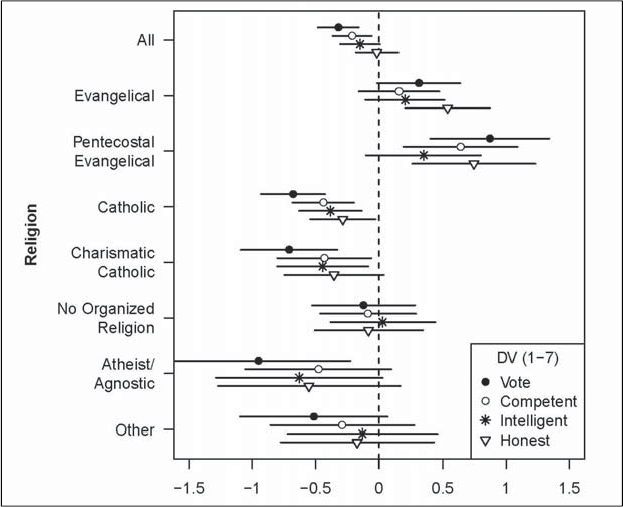
Effects of a “Pastor” Electoral Name on Vote Intention and Trait Evaluations
Particularly notable is the contrast in treatment effects between Pentecostals and Charismatic Catholics. Pentecostalism, a branch of evangelicalism that emphasizes gifts of the Holy Spirit, such as speaking in tongues and faith healing, includes the most politically active evangelical churches in Brazil, most notably the IURD (Freston 2008). The Charismatic Catholic movement is Catholicism's answer to Pentecostalism; it involves a similar theology and style of worship and draws from a comparable social base. 5 Thus, heterogeneous treatment effects among these groups are most likely to be attributable to pure political competition. Indeed, there is a large negative effect among Charismatic Catholics (–0.71, p < 0.001) and a large positive one among Pentecostals (0.87, p < 0.001). The most devout subgroups of each faith community react in an even more polarized fashion when informed that a candidate for public office is an evangelical pastor.
In the survey, Charismatics Catholics were significantly less wealthy than non-Charismatic Catholics (p = 0.003), but statistically indistinguishable from Pentecostals on this metric (p = 0.32). Each group also attends church significantly more often than other Catholics or evangelicals (p < 0.001 in each case).
Effects on candidate trait evaluations underscore that there are no commonly held stereotypes about a pastor's competence, intelligence, or honesty that might mediate the relationship between heuristic and voting behavior. Evangelicals consider “pastor” candidates to be significantly more honest, and Pentecostals also consider them significantly more competent. However, Catholics rank these same candidates as significantly less competent, intelligent, and honest. While views about their pastors’ honesty might possibly drive evangelicals’ vote intention, this belief does not constitute a widely held stereotype. Moreover, for Catholics, Charismatic Catholics, and atheists/agnostics, the heuristic effect on vote intention is much larger – sometimes twice the size – than any effect on candidate traits. While I have refrained from formal mediation analysis, which would require unrealistically strong assumptions, a comparison of direct treatment effects on an outcome and on potential mediators can offer some insights (Green, Ha, and Bullock 2010: 207). In this case, the much larger effects on vote intention suggest that something other than stereotypes – presumably, out-group cuing – is playing a major role in non-evangelicals’ voting behavior.
For its part, the “doctor” experiment provides evidence of a heuristic effect on vote intention that is more likely to be mediated by positive stereotypes. As summarized in Figure 2, the “doctor” title increases vote intention by 0.22 points on the seven-point scale (significant at the 0.05 level). While there is no effect on assessments of the candidate's honesty, effects on evaluations of intelligence (0.21, p < 0.05) and competence (0.16, p < 0.1) are close in magnitude to the effect on vote intention. As a result, it is plausible that the treatment effect on vote intention is mediated by these stereotypes. Moreover, as discussed above, group associations are unlikely to account for much of this effect.
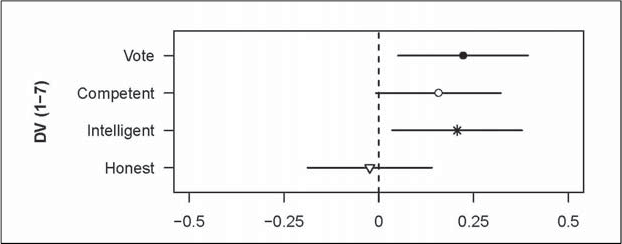
Effects of a “Doctor” Electoral Name on Vote Intention and Trait Evaluations
Brazilian candidates commonly use professional titles in their electoral names, presumably because they expect to gain some advantage from doing so. The “doctor” experiment suggests that physicians do indeed benefit from advertising their profession to voters. Yet the results for the “pastor” experiment might seem more puzzling at first glance. Given the intense competition between evangelicals and those of other faiths, polarization is to be expected, and since evangelicals are only a religious minority, an overall negative effect is not surprising. However, if use of the “pastor” title alienates more voters than it attracts, one might expect a more discrete cueing of religious leadership, in line with the coded language of evangelicalism used by many U.S. Republicans (Calfano and Djupe 2009).
The differences between the survey question on vote intention and the nature of actual voting for city council suggest that identifying oneself as “pastor” is unlikely to hurt candidates in the real world. Given the large number of contenders in most city council elections, the baseline probability of voting for any one of them is very small. It is quite possible that, for Pentecostals and other evangelicals, a candidate's use of the “pastor” title raises this baseline probability enough to affect voting decisions, while there is very little change for other groups that were unlikely to vote for the candidate to begin with. Given the unique features of Brazil's legislative electoral system – open-list proportional representation, high district magnitude, no electoral threshold, vote pooling mechanisms, and the ability of parties and coalitions to run more candidates than there are seats – politicians are routinely elected with narrow bases of support (Ames 1995). Therefore, they can afford to alienate most voters as long as they win over a large enough core group. In 2012, successful city council candidates received a median of 362 votes, or 4.6 percent of the municipal electorate. A pastor could easily draw this many votes solely from fellow believers, in part because his electoral name advertises his status as clergy.
Brazil's most politically ambitious evangelical church, the IURD, has explicitly recognized the differing implications of religious titles in plurality versus proportional representation elections. After IURD Bishop Marcelo Crivella was elected to the Senate in 2002 – running without his title, and beating out another clergyman who ran as “Pastor Manoel Ferreira” – the church took notice, according to a post-election news report:
The use of names of offices in the church hierarchy – like pastor and bishop – will be controlled during the campaign. This caution is intended to avoid rejection by voters who are not evangelical (Machado 2005: 114).
In contrast, for city council members and state and federal deputies, who are all chosen through proportional representation, the concern was that elected representatives “who use church titles in their names will shut the doors to their offices.” Candidates were not dissuaded from using religious titles during the campaign, as long as they dropped them once elected in order to appear responsive to a broader constituency.
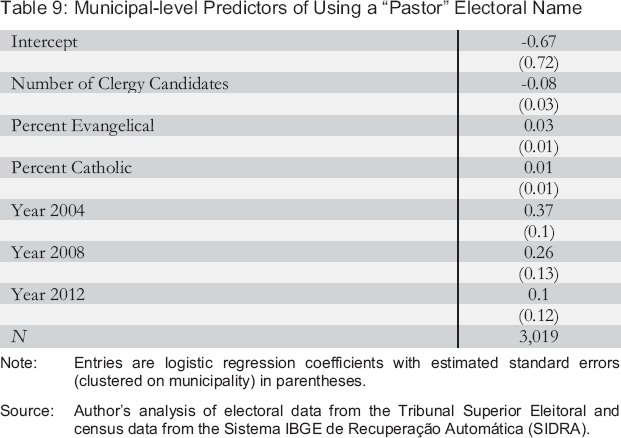
Analysis of Brazilian electoral data suggests that city council candidates who use the “pastor” title expect to gain votes from fellow evangelicals and are not concerned about alienating voters of other faiths. If clergy candidates are focused on winning evangelical votes by advertising their religious leadership, they should be more likely to run as a “pastor” when evangelicals make up a larger share of the municipal electorate and when there are fewer other clergy candidates competing for these votes. However, if evangelical clergy are concerned about a backlash effect, they should be less likely to use the “pastor” title in municipalities with larger Catholic populations. To test these hypotheses, I pooled all clergy candidates for city council from 2000–2012 and modeled the decision to use a “pastor” electoral name as a function of the percent evangelical, percent Catholic, and number of clergy candidates in the municipality (results are presented in the Appendix). 6 Use of the “pastor” title is more likely when there are more evangelicals and fewer competing clergy candidates. However, Catholics’ share of the population has no bearing on this decision.
Clergy candidates are those who list their occupation as “priest or member of a religious order or sect” when registering with electoral authorities. Data on the religious composition of municipal populations are taken from the 2000 and 2010 censuses and interpolated/extrapolated for the years 2004, 2008, and 2012.
Presenting oneself as a “pastor” during a campaign should be valuable to clergy candidates because at least part of their natural voting base is geographically dispersed, especially in municipalities with a larger evangelical population. The pastor of a particular church may draw his core support from congregants, who presumably live nearby and do not need any heuristics to identify their preferred candidate. Beyond this local network, however, lie evangelicals throughout the municipality who may not recognize a pastor candidate by name but will vote for one when they see the title. Evangelical candidates for federal deputy, like Japanese–Brazilians and others who appeal to identity-based minority groups, routinely draw small slices of support from around the state (Ames 1995). Similar patterns are likely to hold at the municipal level. For ethnic minorities, a surname may suffice to activate the identity vote; for clergy candidates, a religious title is a valuable substitute.
The present study focuses on the most readily measurable aspect of religious campaigning in Brazil, but other forms should have similar effects. A city council candidate who runs as a “pastor” is also likely to campaign from the pulpit, enlist church members as canvassers, wear a cross around his neck, offer prayers at rallies, adopt a religious slogan, or engage in any number of other activities that convey his status as clergy to potential voters. In a low-information election, these other symbols of religious identity should serve as additional heuristics, reinforcing the effect of the candidate's electoral name. However many votes a candidate picks up by running as “pastor,” the boost from full-on religious campaigning for city council is likely to be even more substantial.
How do voters choose from among an excessively large number of candidates, especially when party loyalties are weak and a candidate's party affiliation conveys little useful information? Prior research has pointed to the important role of heuristics in this decision-making process. Some heuristics are communicated independently of candidates’ efforts, but others – including occupation and religion – are typically conveyed via the campaign. Existing studies have demonstrated a relationship between both types of cues and voting behavior, but they provide only limited insight into the causal effect of emphasizing religion or occupation during actual campaigns.
This study leverages a survey experiment that was conducted just before Brazil's 2012 election and used data from real candidates wherever possible to gauge the effect of a common way that clergy and medical doctors campaign on their religion or occupation. By including a professional title in their official name for electoral purposes, pastors and doctors running for city council can readily cue stereotypes associated with each profession and identify themselves as members of a particular identity group. Candidates’ campaign materials routinely feature the same name as the one they have chosen to appear on the electronic ballot, so voters will be repeatedly exposed to it in the lead-up to the election.
Analyzing the results of the survey experiment revealed that both the “doctor” and “pastor” titles affect voting behavior in Brazil. On average, use of the “pastor” title decreases intention to vote for a candidate, whereas the “doctor” title increases it. Different mechanisms are likely to account for the effects in each case. Reactions to the “pastor” title show evidence of both in-group and out-group cueing; evangelicals, and especially Pentecostals, are much more likely to vote for a candidate who identifies himself as a pastor, while all other religious groups are less likely to do so. Polarization also extends to the effect of the “pastor” title on trait evaluations, underscoring that there are no commonly held stereotypes about a pastor's competence, intelligence, or honesty. Meanwhile, the “doctor” effect is most likely attributable to positive stereotypes. Effects on trait evaluations are close in magnitude to effects on vote intention, and it seems implausible that the voting effect is driven by doctors favoring fellow doctors.
Considering voters’ reactions to the “pastor” title in light of the incentives of Brazil's electoral institutions helps explain why polarization around religion has become so rampant in Brazil. To win election to the city council – or, for that matter, state legislatures and the federal Chamber of Deputies – candidates only need to carve out a relatively small base of support. If they can attract the requisite number of voters, they can afford to alienate many more. In contrast to the common practice among U.S. conservatives, Brazil's evangelical Christians do not need to use coded religious language to avoid a damaging backlash effect among antifundamentalists. On the contrary, they are relatively free to prime religious identity – in their electoral names as well as their campaigns – without suffering ill effects from the broader societal opposition to evangelicals’ political ambitions.
This study has demonstrated heuristic effects on voting behavior in a specific electoral context, but its findings should be more broadly relevant. Contests for city council in Brazil may constitute an unusually strong example of low-information elections, given the combination of open-list proportional representation, a low-level office, numerous candidates, and an electorate with limited education. The combination of these four features may not be encountered very often, but most of them apply to other elected offices in Brazil, and some should at least partially apply in other Latin American countries. In Chile, for example, city councils are elected from municipality-wide districts using an open-list proportional representation system with a median of 30 candidates – fewer than in Brazil, but many more than the number of candidates per district for Chile's Chamber of Deputies. The electorate is more highly educated than in Brazil, but certainly less educated than in the United States, Western Europe, and other places where heuristic effects have been demonstrated. Moreover, the electoral ambitions of medical doctors and evangelical Christians are hardly limited to Brazil. In particular, the latter group often sees itself in explicit competition with the Catholic Church in democracies around the world, so the context that gives rise to in- and out-group heuristic effects for pastor candidates in Brazil is likely to be replicated elsewhere (Freston 2001). Furthermore, while Brazilian candidates are granted unusual leeway to cue religion and occupation via their official electoral names, politicians elsewhere are still free to prime these identities in many other aspects of their campaigns.
Footnotes
Appendix
Municipal-level Predictors of Using a “Pastor” Electoral Name
| Intercept | -0.67 |
| (0.72) | |
| Number of Clergy Candidates | -0.08 |
| (0.03) | |
| Percent Evangelical | 0.03 |
| (0.01) | |
| Percent Catholic | 0.01 |
| (0.01) | |
| Year 2004 | 0.37 |
| (0.1) | |
| Year 2008 | 0.26 |
| (0.13) | |
| Year 2012 | 0.1 |
| (0.12) | |
| N | 3,019 |
Note: Entries are logistic regression coefficients with estimated standard errors (clustered on municipality) in parentheses.
Source: Author's analysis of electoral data from the Tribunal Superior Eleitoral and census data from the Sistema IBGE de Recuperação Automática (SIDRA).