



Abstract
This research investigates the reasons for the overwhelming frequency of constitutional amendments in Mexico despite the widely held academic views of its constitution's rigidity. The article introduces a novel model highlighting the core of the Mexican Constitution. This model serves as a foundational lens to understand the interplay between political institutions, preferences of political actors, and amendment provisions. The application of this model attributes the frequency of amendments to three different reasons: first, the length and inconsistency of the Mexican Constitution; second, the institutional requirements for amendments; third, the political consensus prevailing in the Mexican political scene (crucial instances, such as the onset of multipartyism with concertacesión and pivotal reforms to Articles 27 and 73, offer deeper context) makes amendments feasible. A comprehensive analysis of the 68 constitutional amendments from 2000 to 2013 corroborates these expectations concerning institutional thresholds, coalition dynamics, and amendment significance.
Introduction
Most scholars examining the amendment provisions of the Mexican Constitution commonly view it as rigid, anticipating infrequent amendments (Anckar and Karvonen, 2015; Lijphart, 2012; Lorenz, 2005; Lutz, 1994; Tsebelis, 2022; Velasco-Rivera, 2021). However, despite the stringent requirements for approval, which entail a two-thirds majority in both the House and the Senate, along with the support of a majority of the states of the Mexican Federation, the actual frequency of amendments is remarkably high (amended over 700 times since 1917; Cámara de Diputados, 2023). While most of this period was under a single-party government, in which case this party could make as many amendments as it wanted, later it became a multiparty government, and despite that, the frequency of amendments has even increased. As we report, in the period from 2000 to 2015 there have been 4026 amendment attempts, and 326 of them succeeded. This amendment rate of (326/16=) 20.31 amendments/year presents a puzzle, which is the focus of our article.
Some scholarship attributes the frequency of changes to a form of name-calling, exemplified by the term “constitutional fetishism” as described by Velasco-Rivera (2021: 1049), which suggests a belief among reformers that altering the constitutional text will solve real-life problems. Alternatively, others perceive the increasing amendment rate as a product of a “national culture” that exhibits minimal respect for the constitution (Ibarra Palafox, 2016).
The “national culture” argument is more frequent, as Ginsburg and Melton (2015: 689) find that in Mexico, “stakes of amendment are lower, and so cultural resistance to amend is less than in societies where it is infrequent.” On the other hand, other researchers attribute the frequency of amendments to the political game superseding the institutions (Negretto, 2012; Velasco-Rivera, 2021). Negretto (2012: 760) posits the argument that “The most rigid amendment procedure can become flexible in a dominant party system, as under the hegemony of the Institutional Revolutionary Party (Partido Revolucionario Institucional, PRI) in Mexico. By contrast, a flexible amendment procedure may become rigid in practice if party system fragmentation becomes very high, as has been the case in Ecuador since 1979.”
In this study, we align ourselves with the second approach, placing significant emphasis on the political game. We add a third component to Negretto's argument, which suggests that even within a fragmented party system, a consensus mode can enable parties to achieve more power and overcome institutional constraints (lifting checks and balances as one can say). We also explain why the Mexican Constitution is not as rigid as some researchers contend, as well as that its length and inconsistencies generate the need for amendments.
We analyze the amendment provisions of the Mexican Constitution by identifying its core, that is, the set of provisions that cannot be modified due to prevailing institutions and actor preferences (introduction section). Subsequently, we explore three reasons contributing to the high frequency of amendments: textual reasons that indicate the Constitution's exceptionally lengthy and contradictory nature (the core of the Mexican Constitution section); institutional reasons that explain why the actual amendment provisions are not as formidable as commonly perceived (length and inconsistencies of the Mexican Constitution section); and political reasons that demonstrate qualified majorities, as required by the Constitution, are the norm in Mexican politics, evident not only during the PRI's dominance but also in the current context of multipartyism (is the Mexican Constitution rigid section). We then scrutinize successful amendments during the period 2000–2013 and assess the prevalence of reasons III and IV (constitutional coalitions section). 1
The Core of the Mexican Constitution
The definition of a “core” that we will provide in this article is different from the one in the law literature, which considers as “core” only the constitutional provisions that are not allowed to be modified at all (Albert, 2015). Our definition is that the core of the constitution is the set of provisions that cannot be amended given the prevailing rules and the preferences of the actors involved. The reader can verify that we use a combination of the constitutional rules and the preferences of the political actors to define “core.” For example, if a constitution requires a two-thirds majority of Congress for an amendment and such a majority is impossible to be achieved, then under the current circumstances we find ourselves in the core. Under different circumstances (if the parties were less polarized or if the institutional requirements were less stringent), it would have been possible to modify the constitution (we would have been outside the core). Similarly, even if the constitution requires a simple majority and there are three political parties, none of which has the majority and they cannot agree, then again, the core of the constitution has been achieved despite the fact that, if coalitions were possible, the constitution would have been amended. On the other hand, if a party has a qualified majority (like the PRI used to have in Mexico before 1994), then, we are outside the core and the constitution can be modified at will. Let us now identify the institutional conditions for the constitutional core.
Let us assume that we have a single congress with seven legislators (for reasons of simplicity) that requires a two-thirds majority to amend the Constitution. If we assume that each one of these seven legislators has his own preferences (depicted by the location of points 1, 2, …, 7) and that each one of them prefers outcomes that are closer to his preference over outcomes that are further away, then we can calculate the qualified majority core of this “legislature” as follows. Given that the Constitution specifies a two-thirds majority for successful amendments, it requires that five of the seven members must vote in favor of revisions in order for them to pass. Figure 2(a) presents a five-sevenths core by drawing a line between two players, such that there are two points to one side of the line and five points either on or to the opposite side of the line (like lines C1C4, C2C5, C3C6, etc.). The core, for example, cannot be north of the line C2C6 because five group members (C2, C3, C4, C5, C6) will replace such a point by its projection on the line itself (which they prefer). Similarly, the core cannot be south of line C2C5, because five members (C1, C2, C5, C6, C7) will pull this point down on line C2C5. Once all such possible lines are drawn, the core is formed at the intersection of all the preferences of five points (Figure 1(a)). A similar process is followed to generate the six-sevenths core depicted in Figure 2(b). Here, lines are drawn to exclude just one point instead of two. The resulting intersection is larger than in the five-seventh case, indicating a larger core. Here again, under the six-sevenths arrangement, one should expect less constitutional revision over time. Figure 2(c) indicates that the five-sevenths core is included in the six-sevenths core.
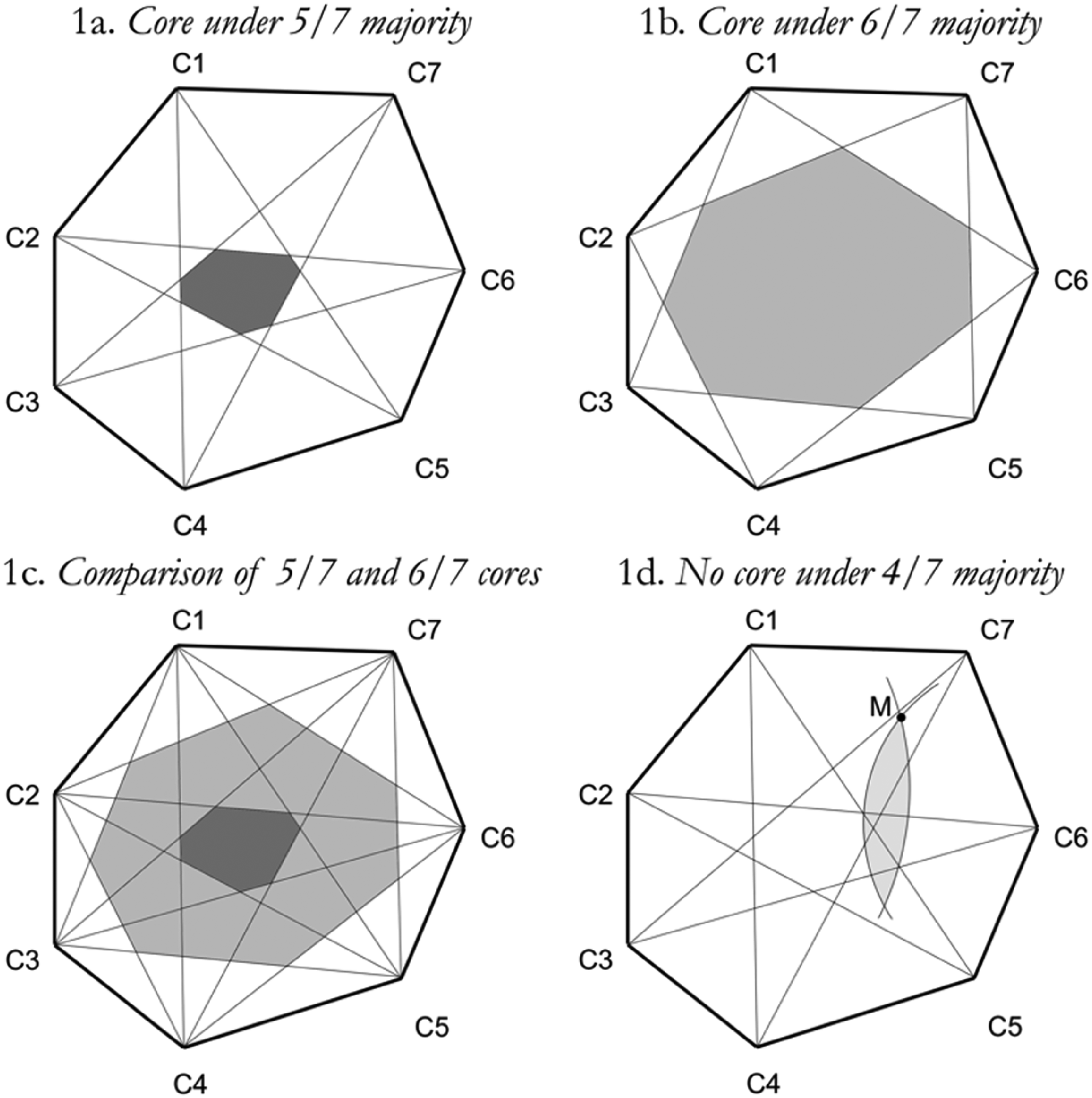
Core of a unicameral legislature under 5/7, 6/7, and 4/7 majority.
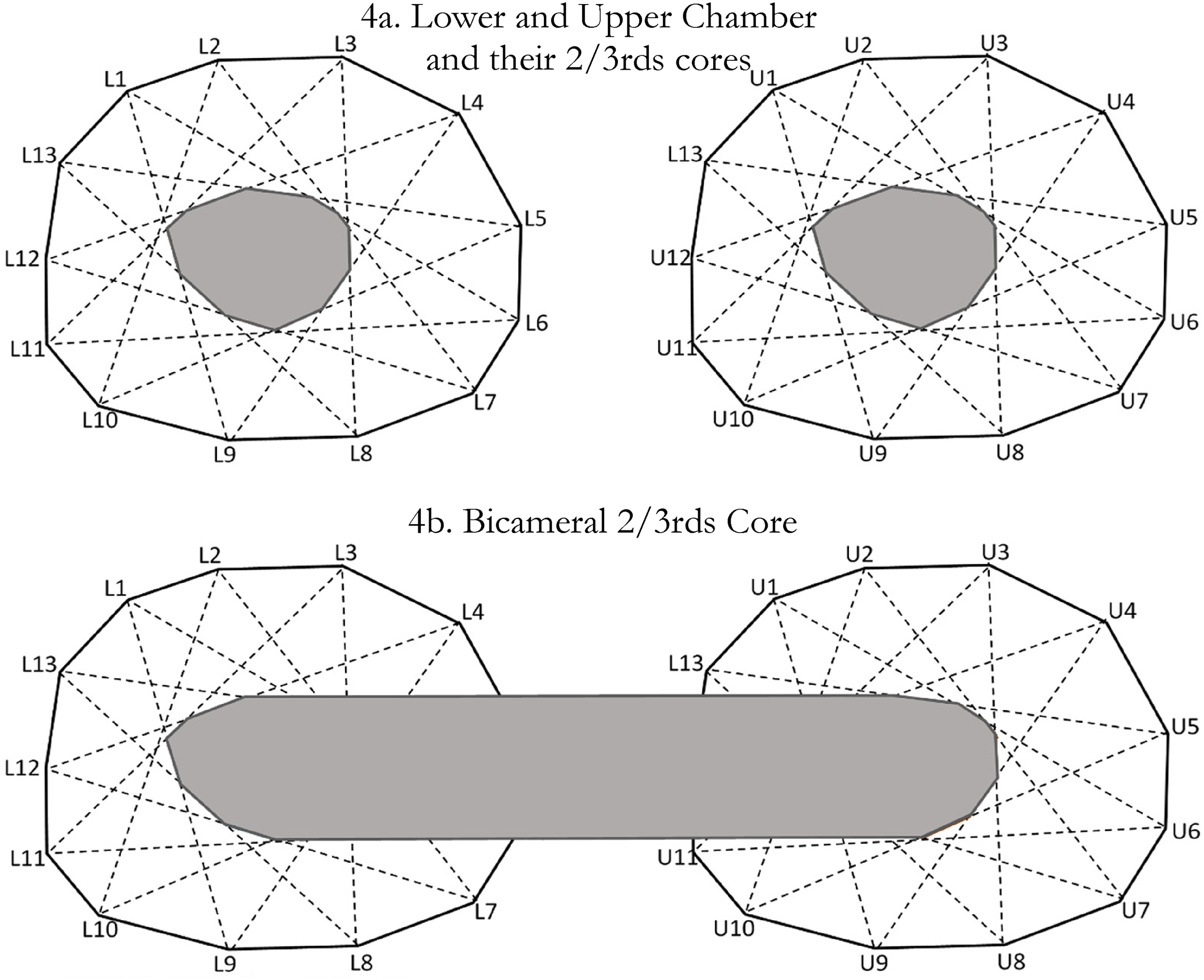
Constitutional core of Mexico, with a two-thirds majority in both chambers.
What is more interesting, however, is that if the required majority is a simple majority or less, the core ceases to exist. Indeed, if we draw a line that has a simple (not qualified) majority on one side of it, it will also have a simple majority on the other side: The line C2C6, for example, has four points on it or on one side (C1, C2, C6, and C7) and five points (C2, C3, C4, C5, C6) on it or on the other side. Consequently, the line has a majority from both sides of the line, leading to the situation that any point in this two-dimensional space can be defeated by a simple majority, or, in other words, the core is empty. Let us consider a point M north of the line C2C6. We show that this point cannot be in the core if the decision-making rule is a simple majority, that is, that it can be defeated by a simple majority. If we draw the circles C2 M and C6 M, any point in their intersection defeats M by a simple majority. Indeed, any point north of the line C2C6 is preferred over M by points C1, C2, C6, and C7; and any point south of the line is preferred by points C2, C3, C4, C5, and C6. Consequently, point M can always be defeated by a simple majority. By moving point M into different locations, we can prove that there cannot be any point that is undefeated, and therefore, the simple majority core is empty. This condition will be even more true if the required majority is even smaller than simple (say 45 or 40%).
Let us now assume that we have a bicameral Congress like in Mexico, that requires two-thirds in both chambers in order to amend the constitution. Then, the constitutional core expands significantly. Indeed, if we connect the core of one chamber with the core of the other, the whole composite area becomes the constitutional core of the country. Indeed, any point inside this area cannot be defeated by a concurrent five-sevenths majority, because it could not be moved up or down (at least three members of one chamber would object) or left or right (the whole upper or lower chamber would object).
Finally, let us simulate the actual conditions described in the Mexican Constitution: let us assume that besides the two-third majorities of both chambers, we require a simple majority of a different body: the members of the federation of the Mexican states (each state represented by one vote regardless of how it makes the decision). Now, with three different bodies, the core of the constitution expands even further, and it is the one presented in Figure 3. Again, any point inside the shaded area cannot be defeated on the basis of the existing rules because at least one of the conditions will be missing.
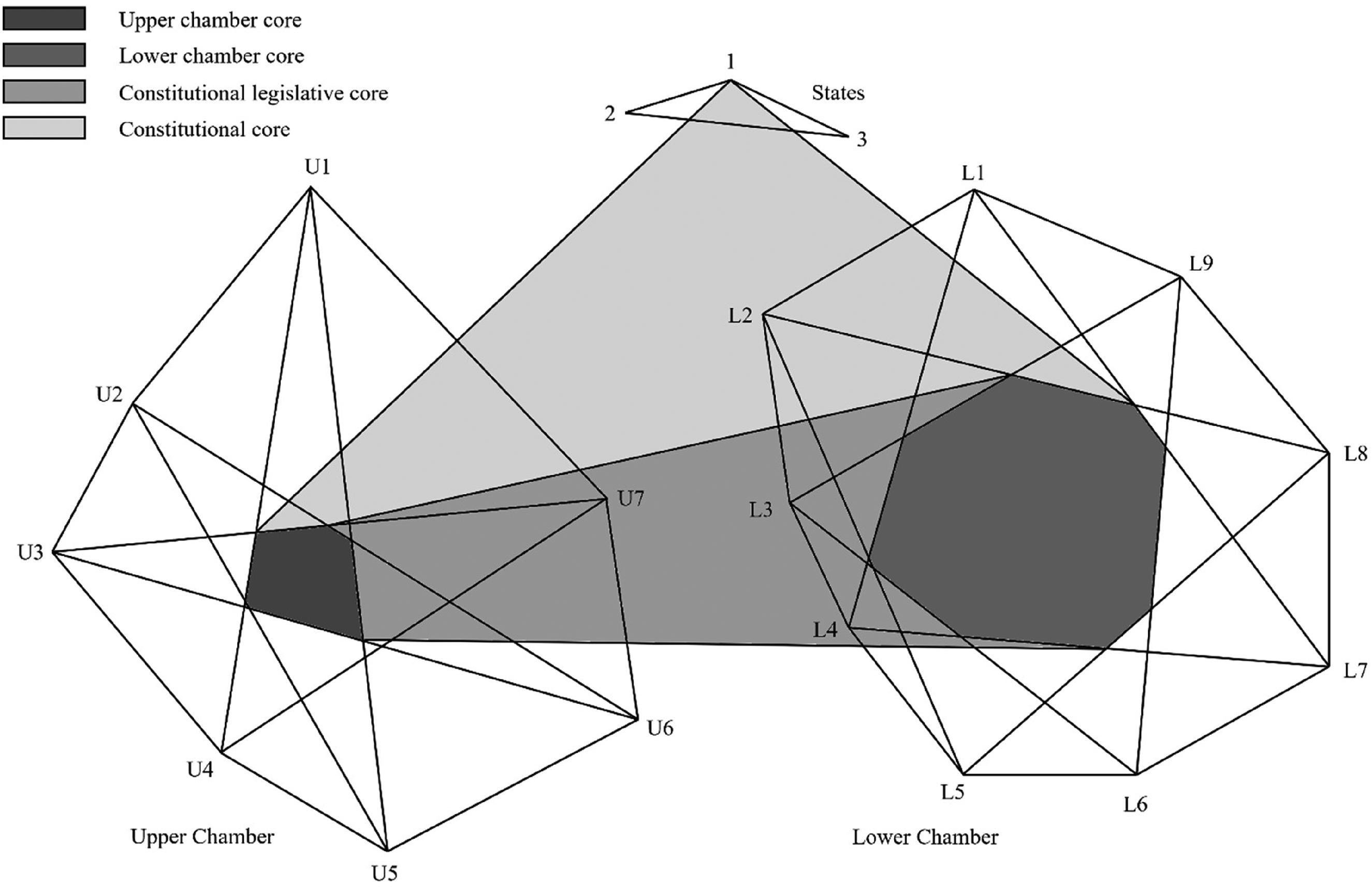
Constitutional core in Mexico with a two-thirds majority in both chambers and a majority of states.
The combination of Figures 1, 2, and 3 provides the formal justification of an intuitive understanding: as the number of required institutions increases, and the required majorities in each one of them increase, the core increases and consequently the modification of the constitution (the adoption of amendments) becomes more difficult. The added value of the exercise is that it gives the precise conditions of these impediments as a function of the institutional constraints as well as the distribution of tastes of the corresponding actors. Restricting ourselves in Mexico alone, there is no institutional variation. However, if at some point in time, the institutions change (say by adopting a three-fifths instead of two-thirds majority) the results would be immediately visible and expected outcomes easy to identify. Similarly, visible is the evaluation of comparisons between Mexico and the United States (like the one made by Velasco-Rivera, 2021: 1042 that we will discuss below). But the most interesting part is that these models connect the size of the core with the preferences of the actors.
If, for example, the three different bodies whose ascent is required were not as far away from each other as the figure represents but were closer to each other (consider that the paper was somehow elastic and the different bodies came closer to each other), then, the core would be smaller, and the possibilities would be multiplied. Also, consider the situation in Mexico before 1990 when the PRI had qualified majorities in all three bodies; then, the three bodies would have been overlapping with each other in terms of policy preferences, and the core of the constitution would have been empty, that is, the PRI would have been able to make all the constitutional revisions it desired. We will come to these issues in length and inconsistencies of the Mexican Constitution and the Mexican Constitution rigid sections of this article.
Length and Inconsistencies of the Mexican Constitution
The first argument we will make is that the Mexican constitution requires many changes; that is, the constant amendments of the constitution are an equilibrium phenomenon where the different actors behave the way it is expected of them. There are two reasons: first, the constitution is long, and second, it is inconsistent.
Length of Mexican Constitution. All comparative constitutional analyses lead to the conclusion that the length of a constitution is positively correlated with the frequency of amendments. Not only all the references in the introduction of this article, but other analyses that do not find any relationship between constitutional rigidity and frequency of amendments do find a relationship between length and frequency of amendments. For example, Ginsburg and Melton (2015: 691) dispute whether the amendment rules matter at all and “go on to develop a measure of amendment culture as an alternative to institutional factors that constrain amendment.” But they do find a positive correlation with length, and they also argue: “Along with our co-author Zachary Elkins, we have celebrated the virtues of what we might call statutory constitutions: those with flexible amendment thresholds that are fairly detailed. The constitutions of India, Mexico, and Brazil, to take three prominent examples, are amended nearly every year. Such constitutions have the virtue of being frequently changed through internal mechanisms, avoiding the costly route of a total replacement. In such countries, we argue that the stakes of amendment are lower, and so cultural resistance to amend is less than in societies where it is infrequent” (Ginsburg and Melton, 2015: 689). Similarly, Versteeg and Zackin (2016: 661) claim that “The measure [of constitutional entrenchment] does not rely on formal amendment rules because these rules are mediated so dramatically by political norms” and find a correlation between the length and frequency of amendments.
Consequently, according to all researchers, the length of a constitution is correlated with the frequency of amendments, and thus, the high frequency of constitutional amendments in Mexico is consistent with the 62,612 words it contained in 2015 (Constitute Project, 2015). However, the size of the constitution has not been the same over the years. According to the Belisario Domínguez Institute, it started as a 21,382-word document, and over the years, it kept expanding (Giles Navarro, 2018). According to Rivera Leon (2016: 24), “A good example is the case of Article 41. Originally, Article 41 consisted of a single, 7-line paragraph. Those 7 lines contained 63 words. Currently, Article 41 has more than 70 paragraphs with nearly 5000 words. The level of detail in Article 41 (which currently regulates political parties and electoral administration) is truly surprising. It defines political parties and their creation, mathematical formulas for calculating public financing for political parties, percentages and differentiations of the financing depending on the type of election. It also sets rules for precampaigns, specifies the number of minutes (honestly, the number of minutes!) political parties are entitled to on television and in the media during campaigns, describes the complete organization of the National Electoral Institute, sets up a complex network outlining the powers of the National Electoral Institute and local electoral institutes, etc. In conclusion, Article 41 is clearly set up as an Electoral Code.” The consequence of including such an extensive Article 41 is that any time a modification is necessary, the required procedure is a constitutional amendment.
Similarly, according to Orozco Pulido (2020: 209), “the original constitution of February 5th, 1917, had only nineteen transitory articles. Considering that the Constitution was written during a transitional period following a revolution, this seems to be a coherent number. The education reform of May 15th, 2019 includes eighteen transitory articles and sets complex rules related to the contents and implementation of the reform” (Orozco Pulido, 2020). Also, Orozco Pulido (2020: 206) argues that the Mexican Constitution has not respected the golden rules of writing with precision, clarity, and without ambiguity: “writing in the active voice, in the present tense, preferring shorter sentences rather than longer ones, careful wording, and using positive statements instead of negative ones.” 2 Discovering when and why this self-reinforcing constitutional expansion started would be a very interesting and worthwhile investigation. What we can say, is that it took place before our period of investigation, under the dominance of the PRI. In fact, the constitution of 2000 (the beginning of our period) had already doubled its initial size to 42,802 words (Fix-Fierro, 2017). In the is the Mexican Constitution rigid section, we will provide a plausible explanation of this expansion.
Tsebelis (2017) uses constitutional rigidity to calculate the expected frequency of amendments to a constitution. He then compares it with the actual frequency of amendment and calls the difference “time inconsistency” and finds that this variable is positively correlated with the length of a constitution (Tsebelis, 2017). We took a figure from his article and recalculated the numbers with the new constitutional rigidity index presented in Tsebelis (2022). According to this analysis, Mexico is not an exception from other countries (see Figure 4). On the basis of this figure, there is nothing to be explained! The length of the Mexican constitution accounts for the discrepancy between constitutional rigidity and the frequency of amendments! However, the data used for Tsebelis’ calculations are underestimating the frequency of amendments. 3
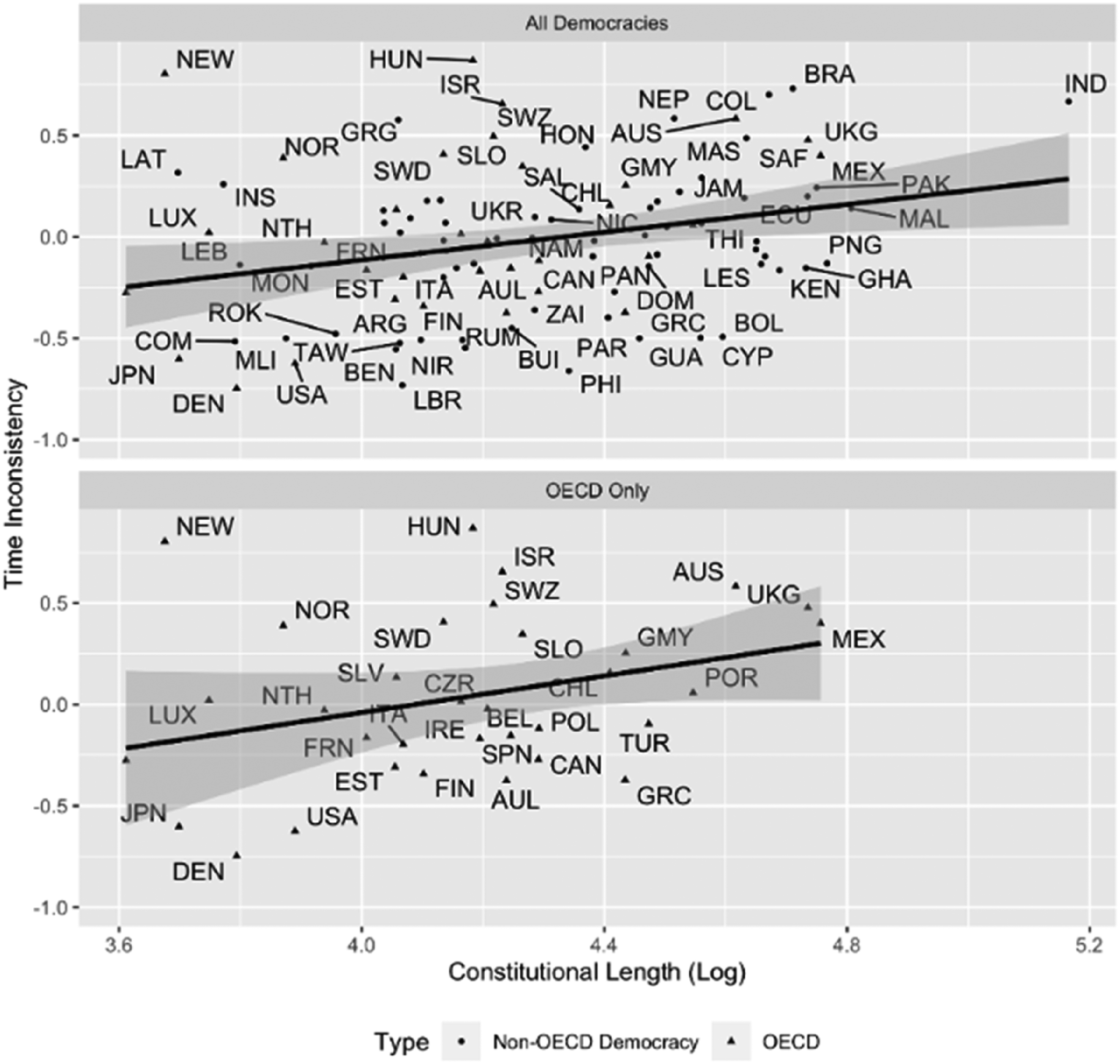
Time inconsistency and log length.
Inconsistencies of the Mexican Constitution. In principle, inconsistencies should not exist inside a legal text for the simple reason that if the different parts of an inconsistent statement become the basis of different arguments, they will lead to contradictory conclusions, and it will not be clear which one of these conclusions should prevail. However, a constitution is not just a legal document but also a political one, and it reflects the conditions that prevailed at the moment of its adoption (or the adoption of its amendments). It is possible that at the moment of the adoption of a constitution or even an amendment of a constitution, different participating groups had different opinions and they tried to resolve their differences. According to the literature, the Mexican constitution is full of inconsistencies (Fix-Fierro, 2017; Fix-Fierro and Valadés, 2015; Pou Giménez, 2018; Pou Giménez and Pozas-Loyo, 2019; Pozas-Loyo et al., 2022). Our goal is not to identify whether they were due to political compromises or to lack of care.
Fix-Fierro and Valadés (2015) have collaboratively overseen a scholarly endeavor concerning the structural organization and fortification of the Mexican Constitution. The study delineates several noteworthy observations: (1) some constitutional provisions are redundant. (2) The constitution exhibits an irregularity in the application of terminology. (3) There exists a pronounced variance in the extent of discourse on diverse subjects. (4) The constitution manifests an evident disarray in the thematic categorization of its articles. (5) The constitution presents suboptimal positioning of certain provisions. (6) The constitutional manuscript contains terminological inaccuracies. (7) Some articles, intrinsically regulatory in nature, operate akin to subsidiary directives across various domains. Overall, it can be observed that the Mexican constitution has several issues in terms of legal inconsistencies (Fix-Fierro and Valadés, 2015).
Several studies highlight the correlation between the extensive and inconsistent nature of the Mexican constitution. Fix-Fierro (2017) argues that its frequent amendments stem from political elites’ aim to define an “ideal” constitutional reality, often diverging significantly from actual societal conditions. Pou and Pozas-Loyo (2019) identify three drivers of this hyperreformism: the necessity to update numerous and potentially outdated regulations, the piecemeal approach to reform increasing complexity, contradictions inside the Constitution and further amendments, and political factions using reforms to establish credible commitments and address coordination challenges.
Pozas-Loyo et al. (2022: 3) have identified another dimension of the Mexican constitution generated by these inconsistencies: “a strong and creative judicial interpretation was made necessary by the effects hyper-reformism had on the Constitution: it made it a very long, complex, and at times inconsistent text. Under this constitution creative judicial interpretation was required for solving the many conflicts created by the very nature of the text” (Pozas-Loyo et al., 2022). The result of their analysis is that unlike other countries, in Mexico, there is a positive correlation between constitutional amendments, that is, changes to the constitution generated by the political system and judicial interpretation, that is, changes to the legal systems performed by the judiciary. 4 Pozas-Loyo et al. (2022) base their analysis on the contradictions of the Mexican constitution (they use the term eight times in their article), but they are not the only ones; other analyses share the same basis.
In conclusion, the Mexican constitution was not long and contradictory from the beginning and did not have to become such. But once it developed these characteristics it had to be amended often and the amendments had to be interpreted by the Supreme Court frequently in order to address the problems generated.
Is the Mexican Constitution Rigid?
The general impression is that it is. In Figure 3 of our model section, we presented the core of the Mexican constitution, and we show that it is a large area of the two-dimensional space and that whenever the status quo is located in the shaded area, there is no possible amendment. Some researchers consider the amendment mechanism of the Mexican Constitution quite similar to the U.S. Constitution. For example, Velasco-Rivera (2021: 1042) argues that “The constitutional amendment mechanism of the Mexican Constitution of 1857 (reproduced in the Constitution of 1917) and Article V of the U.S. Constitution are very similar in design.” Actually, the only textual difference between Article V (U.S.) and Article 135 (Mexico) is that a three-fourths majority of the states is required in the United States while a simple majority of the states is required in Mexico. In terms of Figure 3, the difference might indeed be small. But if we examine the Mexican institutions closer, we will see that the differences are wide.
The most important difference between the U.S. and Mexican reform procedures is that in Mexico, Article 63 establishes “[n]either the Chamber of Deputies nor the Chamber of Senators shall be allowed to open their sessions or perform their duties without the presence of at least half plus one of their respective members.” The result of the combination of Articles 63 and 135 is that in order to modify the Mexican constitution what is required is one-third of the members of the House and the Senate (if it happens that almost half of them are not present). Reexamining the arguments in the first section, it becomes clear that under those conditions, there is no constitutional core, and any provision can be changed (if members of the two chambers decide not to be present in the discussion and vote).
This does not mean that the composition of the final vote (who votes in favor who is against and who abstains) is not the result of political negotiations. These negotiations may include modification of initial positions into more acceptable (by the opposition) ones; they may include the elimination of conflictual issues, so that majorities will increase in size; they may include use of additional bargaining issues so that the package will become more acceptable; Tsebelis and Hahm (2014) have identified three different methods mutually exclusive ways by which majorities increase in size (in their case achieve the status of unanimity): (a) without changing the underlying policy dimensions, by finding some middle way between the different points of view (some kind of weighted average); (b) by decreasing the underlying policy dimensions, by eliminating or obscuring the differences between the different points (so that different behaviors would be consistent with the text); (c) increasing the underlying policy dimensions, by separating issues or adding new ones and permitting one side to prevail in one issue and another in another. Constitutions may adopt one of these three different methods and postpone the resolution of the issue to the future. As we will see in the next session, in Mexico the most prevalent of these three methods was method (c), while in the case of the EU that Tsebelis and Hahm investigated was method (b). 5 The contribution of Article 63 in this process is not to substitute political analysis but to make things significantly easier for the majority because it can ask opposing members to abstain instead of voting in favor of an amendment. And the analysis in the introduction section explains why the combination of Articles 63 and 135 is significantly easier than Article 135 alone.
Another critical distinction between the two countries lies in the preference distributions in the states. In Mexico, the pre-2014 electoral system hindered immediate reelection for incumbents, binding representatives tightly to their parties, which dictated their political trajectories and voting behaviors, often at the expense of constituent preferences. Consequently, Mexican state representatives typically aligned with party directives rather than voter demands. In contrast, the individual electoral competition in the United States encourages representatives to mirror their constituents’ views, fostering greater diversity across states. This divergence explains why amending the U.S. Constitution, like the failed Equal Rights Amendment, is remarkably challenging, requiring consensus across three-fourths of the states—a feat unreplicated in Mexico, where no amendment has been halted by state-level disapproval.
Empirical data supports the higher success rate of constitutional amendments in Mexico compared to the United States. As can be observed in Table 1, between 1997 and 2015, out of 4034 proposed amendments in Mexico, 326 were adopted, resulting in an 8.08% success rate. A notable increase in reform initiatives is observed transitioning from the LVII (1997–2000) to the LVIII (2000–2003) legislatures, with initiatives soaring from eight to 383 due to the shift from a one-party system to a more pluralistic political landscape. This period marks a significant uptick in constitutional activity, with over a third of all changes since the 1917 Constitution occurring post-1997, highlighting the impact of increased party diversity on reform frequency (Casar and Marván, 2014). By contrast, in the United States, the number of submitted amendments was 11,969, while the actual amendments were 27. The success rate was .0022 (Stohler et al., 2022). These results are consistent with the argument that constitutional rigidity in Mexico is much lower than that in the United States. 6
Constitutional Coalitions
With the emergence of multipartidism in Mexico, broad coalitions in the legislative arena began to be observed frequently (Casar and Marván, 2014). Originally, in 1988, this phenomenon of convergence and exchange among the political parties was named “concertacesiones.” Ortiz Gallegos (2007) contends that the neologism “concertacesión” implies a scenario where one side gives up something in exchange for an advantage provided by the other party (Ortiz Gallegos, 2007). 7 This phenomenon has been widely studied, and different explanations have been provided. For instance, Casar and Marván (2014) conducted a description of the dynamics of constitutional reform in Mexico from 1997 to 2012. Among their findings, they point out that the three most relevant political parties of that period (PRI, National Action Party [PAN], and PRD) tended to converge in broad coalitions to approve constitutional reforms. As part of their analysis, they suggest that the explanations for these broad coalitions are power distribution and ideological aspects, thereby implying that there are political reasons to reform the Constitution through broad coalitions.
In this section, we delve into why political parties in Mexico opt to elevate their agreements to the constitutional level, forming broad coalitions, and argue that political motivations outweigh institutional factors in this process. We examine various instances where parties converged to enact constitutional reforms, underscoring the interplay of political behavior and constitutional change. Our analysis includes four significant moments in Mexico's recent political history that illustrate this convergence and its impact on constitutional amendments: the rise of the multiparty system in 1988, the 1992 changes to Article 27, the centralization efforts via Article 73 reforms, and the Pact for Mexico's reinforcement on these patterns. We conclude that in a consensus-driven political landscape, incorporating agreements into the constitution represents a dominant strategy for all parties involved, thereby explaining the high rate of constitutional amendments in Mexico as a result of broad interparty consensus.
The Act of Birth of Multipartyism in Mexico
Before 1988, the PRI dominated Mexican politics, controlling the legislative branches and all governorships, exemplifying a hegemonic party system (Magaloni, 2006). The political landscape shifted dramatically by 1988 when the PRI was forced into negotiations with opposition parties following a contentious presidential election that brought Carlos Salinas de Gortari to power amid accusations of illegitimacy and electoral fraud (Becerra et al., 2011; Cantú, 2019). This period initiated a new era of “concertacesiones,” a negotiation process among parties, with a notable pact between the PRI and the PAN in 1988 being a standout example.
Given that Carlos Salinas assumed the presidency with a broad shadow of illegitimacy, he had to negotiate with the PAN to have them accept his mandate and approve a series of reforms (Ortiz Gallegos, 2007). Part of the arrangements that PAN set with Carlos Salinas was that the PRI and Salinas himself would recognize and respect their electoral victories at the gubernatorial level. This moment marked a significant turning point in negotiation strategies, as a behavior rooted in compensation mechanisms began, which persists to this day. This moment is what we call the act of birth of multipartyism in Mexico.
This era was pivotal, as evidenced by Table 2, which shows that the PRI and PAN possessed the numbers to independently pass constitutional reforms, commanding a substantial share of the votes in both legislative houses. Although the norm for passing such reforms is a two-thirds majority of members present, the combined strength of the PRI and PAN often surpassed this threshold, simplifying the passage of reforms. Despite this, as explored in the constitutional coalitions section, the two parties frequently sought to broaden their coalition to include the PRD, aiming for more inclusive governance beyond what was merely sufficient for legislative success.
Constitutional amendments in Mexico (1997–2015).
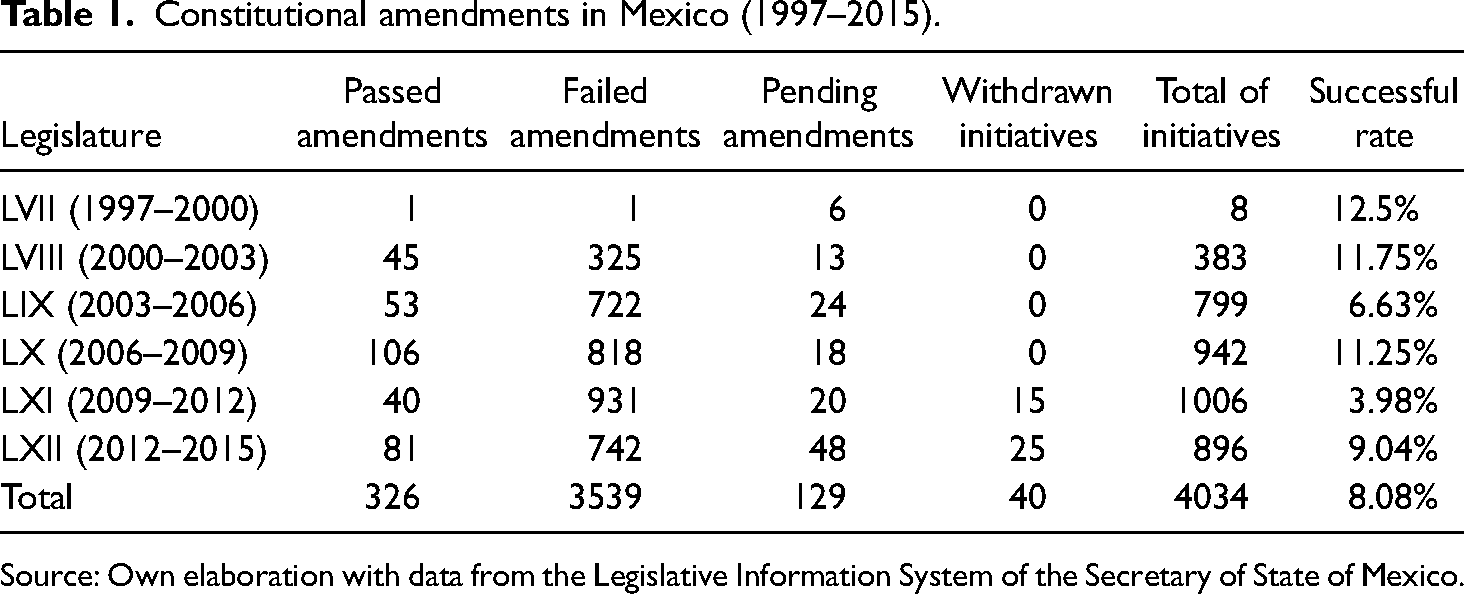
Source: Own elaboration with data from the Legislative Information System of the Secretary of State of Mexico.
Congressional Seats of Main Parties in Mexico (1997–2015).
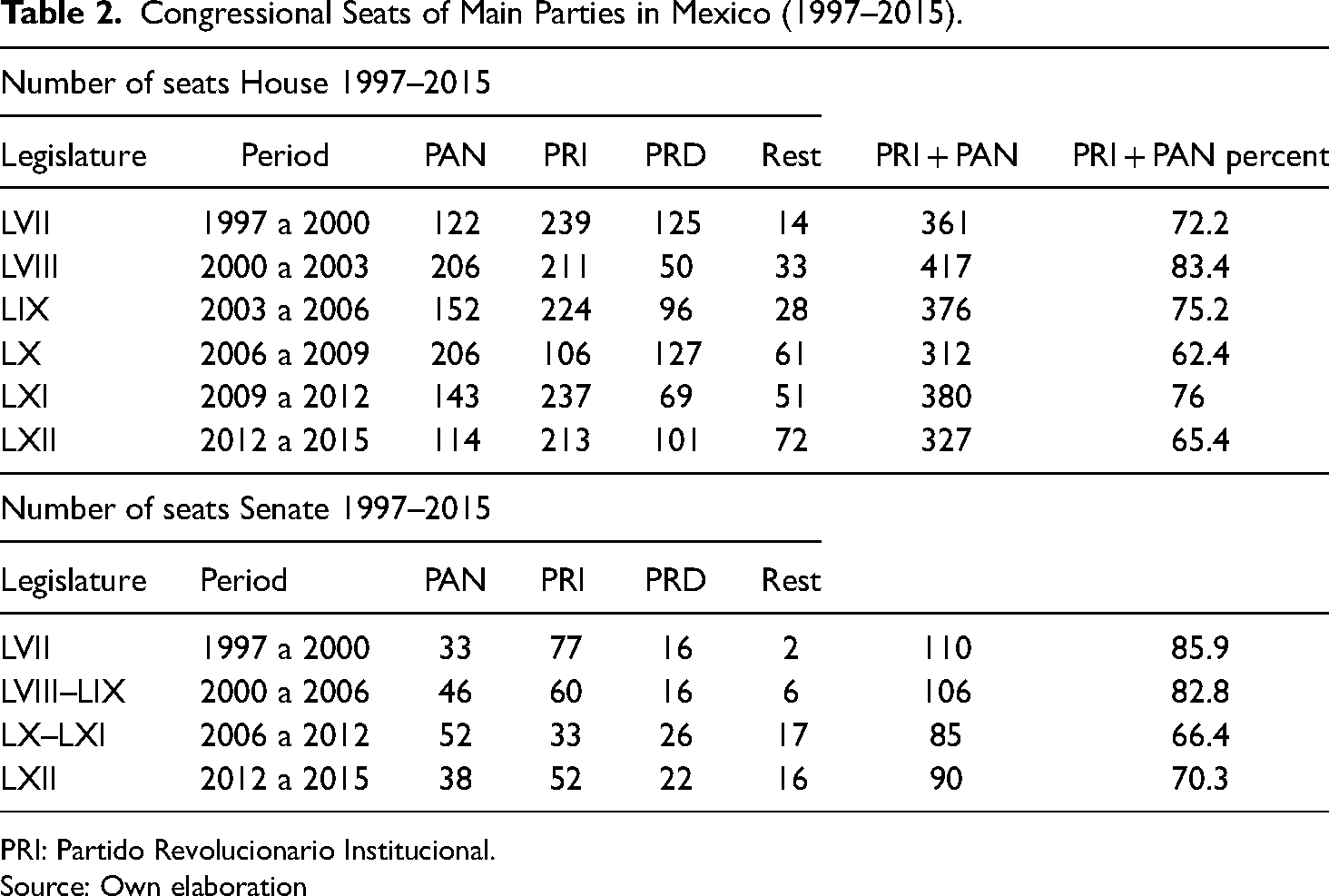
PRI: Partido Revolucionario Institucional.
Source: Own elaboration
The Reform of Article 27 of the Constitution and NAFTA
Starting in 1982, under Miguel de la Madrid, Mexico began shifting from nationalist policies toward economic liberalization, a movement intensified under Carlos Salinas de Gortari, culminating in the NAFTA agreement (Escalante Gonzalbo, 2015; Soederberg, 2005). This shift required amending the constitution to allow foreign investment in natural resources, highlighting a key moment where economic needs fostered bipartisan cooperation. The constitutional changes for NAFTA ratification marked a significant phase in Mexico's economic strategy, with the PRI and PAN forming strategic alliances, recognizing NAFTA's crucial role in Mexico's economic alignment with its North American neighbors, emphasizing a collective economic vision over party lines.
This political calculus was predicated on the understanding that NAFTA was not merely a trade agreement but a critical lever for Mexico's economic development and modernization. The constitutional impediments, specifically those within Article 27 that restricted private and foreign investment in land and natural resources, were at odds with NAFTA's liberalizing agenda (Arellanes Jiménez, 2014; Zamora, 1992). As such, a political agreement was essential for amending these provisions to align with the requirements of free trade and the attraction of foreign investment.
The formation of broad legislative coalitions was marked by the substantial majority voting for amendments: unanimously in the Senate and with a dominant majority in the Chamber of Deputies. This strategic move by the PRI and PAN underscored the vital role of economic integration in Mexico's future. Their alignment on NAFTA, more than just political expediency, reflected a commitment to propel Mexico into the global market. NAFTA acted as a catalyst for this cross-party cooperation, exemplifying how economic imperatives can drive consensus and cooperation across ideological divides in Mexican politics.
Centralization Through Article 73
The unanimous amendments to Article 73 of the Mexican Constitution by the PRI, PAN, and PRD illustrate a unified strategy to reshape power dynamics within the federation. This article, which outlines Congressional powers, saw modifications that signify a move toward centralization. It is pertinent to note that the Mexican constitutional framework, specifically Article 124, bestows residual powers to the states, akin to the Tenth Amendment of the United States Constitution (Serna de la Garza, 2016). These changes, expanding federal authority at the expense of state powers, reflect a strategic consensus among the major parties, underscoring a collective shift toward federal consolidation of legislative competencies, highlighting a concerted effort to adapt governance structures for enhanced federal coordination.
Article 73 is the most frequently amended in the history of the 1917 Constitution during the study period and one where the political parties almost unanimously agreed to amend. Between 2000 and 2013, Article 73 was modified 27 times, accounting for 39.71% of the 68 constitutional reforms observed during that period. Generally, amendments to Article 73 are instrumental in bringing about significant changes to the political system, as legislators seek to equip themselves with the requisite authority to legislate on various domains that were not explicitly addressed in the original wording of the Constitution.
To analyze the convergence pattern around Article 73, we categorized the constitutional reforms based on the nature of the modification, which can either be a direct amendment or an indirect reform aimed at bestowing additional powers to Congress by making changes to other articles of the Constitution. Out of the total reforms observed from 2000 to 2013, there were 12 direct amendments made to Article 73, constituting 44.44% of all reforms to this article. In each of these cases, the Congress expanded its powers. Notably, all 12 direct amendments were approved by the PRI–PAN–PRD coalition.
Additionally, there were 15 indirect reforms, making up 55.56% of all reforms to Article 73. It is significant to note that 14 of these 15 modifications were approved by the PRI–PAN–PRD coalition. 8 As a result of the amendments, the federal Congress was granted the authority to legislate on matters such as fossil remains, tourism, fishing, aquaculture, pyrotechnics, cooperative societies, kidnapping, personal information, and criminal legislation. Indirect modifications to Article 73 may also be viewed as a response to changing social and economic conditions, and as a means for the permanent constituent to adjust the functions of Congress accordingly.
As can be observed, there was an agreement to reform this article by the most relevant political parties of the period in 26 out of 27 reforms, implying a convergence of the three political forces in 96.3% of the cases. We suggest that these episodes of convergence can be explained by the fact that the reforms to Article 73 involve the centralization of powers in the federal Congress. In this sense, parties can generate broad agreements because the reforms to Article 73 grant more powers to political parties represented at the federal level.
The Pact for Mexico
The Pact for Mexico marked a seminal political accord, consummated by the collective resolve of the nation's three principal political forces: PRI, PAN, and PRD. This alliance, forged at the dawn of Enrique Peña Nieto's presidency, was dedicated to executing substantial and necessary reforms across a spectrum of policy areas, notably transforming the energy sector and advancing economic liberalization, each necessitating constitutional recalibration (del Tronco Paganelli and Hernández Estrada, 2017; Mayer-Serra, 2017).
Within the framework of the Pact for Mexico, a remarkable consensus was reached among the PRI, PAN, and PRD, leading to the ratification of a sweeping array of constitutional reforms (Pacto por México, 2012). These included progressive changes in different topics such as anticorruption, transparency, telecommunications, and education, demonstrating an unprecedented tripartite agreement aimed at modernizing the nation's infrastructural and institutional fabric. However, this unanimity did not extend to all reforms; notably, the electoral reform and the energy reform emerged as distinct outliers, with the latter becoming a particularly contentious issue within this tripartite alliance (del Tronco Paganelli and Hernández Estrada, 2017).
The 2013 energy reform stands out as a contentious pivot within the Pact for Mexico, primarily due to the PRD's resistance to perceived encroachments upon national sovereignty. This led to a realignment of the PRI with the PAN, which held a pro-market perspective more amenable to the reform's objectives. The PAN's strategic position enabled it to negotiate the integration of its policy preferences into the energy reform and to extract a commitment from the PRI to support an impending political-electoral reform as part of the pact's broader agenda (del Tronco Paganelli and Hernández Estrada, 2017).
The political-electoral reform, eventually ratified in late 2013, instituted a raft of significant alterations to the political system. It saw the creation of the National Electoral Institute with expanded powers, an increase in the vote threshold for proportional representation, and provisions for the consecutive reelection of legislative and municipal officials. These changes, coupled with the energy reform, which sanctioned private sector participation in energy exploitation for the first time since the 1950s, signified a substantial shift in Mexico's energy model and a move toward strengthening the nation's democratic governance (Barrientos Del Monte and Añorve Añorve, 2014).
The Pact for Mexico was a calculated political strategy that went beyond routine policymaking, crafted to build broad coalitions for constitutional reform. The near-unanimous passage of several reforms highlights the effectiveness of this strategy. These alliances were not formed out of any institutional requirement; they were the deliberate outcome of political savvy, demonstrating the capacity for negotiation and consensus even with diverse party agendas. The resulting cooperative environment stemmed from a unified commitment to national progress rather than from any institutional necessity, 9 illustrating how political will can foster substantial legislative change. Thus, the pact stands as a landmark in Mexico's political history, evidencing the power of intentional coalition-building in achieving legislative success.
Why Amend the Constitution and not Produce Ordinary Legislation?
We demonstrated that trading across issues has been a very instrumental method to generate consensus among political parties in multiparty Mexico. A major enabler of this outcome is the centralization of Mexican parties. According to Velasco-Rivera (2021), negotiations are highly centralized; thus, agreements can be reached more easily. Political parties with congressional representation demonstrate a high degree of discipline owing to the regulation exerted by the national leadership (Nacif, 2002). Given that the national leadership oversees the nomination procedures, legislators are incentivized to comply with directives from the leadership.
The consolidation of parliamentary discipline is reinforced by the institutional design inherent in the Mexican Congress. Various institutions bolster centralized decision-making. The most significant among these is the Political Coordination Board (JUCOPO), where the parliamentary leaders of political parties convene and forge consensuses. The JUCOPO is responsible for evaluating reform proposals once they have been examined by the committees and has the prerogative to schedule them for discussion on the floor once they have been previously agreed upon.
Once this consensus is achieved, enshrining it in the constitution is a dominant strategy for two reasons: First, to tie their own hands, and second, to restrict the judicial branch from altering these agreements.
Tying the political system's hands. Enshrining party agreements in the constitution effectively “locks in” these accords, insulating them from easy revision or repeal (Fix-Fierro and Valadés, 2015). Political parties converge on constitutional reforms to “protect” their pacts from the volatility of governmental changes and congressional majorities. Such constitutionalization ensures that future modifications demand a fresh consensus, erecting a sturdier barrier against changes than that faced by regular legislation (Fix-Fierro, 2017; Salazar Ugarte, 2013). The demanding process of amending constitutional provisions, far more stringent than that for ordinary laws, ensures the durability and resilience of these multiparty agreements.
Restricting checks by the Judiciary. Another advantage of constitutional amendments is the restriction of judicial interferences. Constitutional amendments cannot be superseded by the Supreme Court's decisions as ordinary legislation lies beyond the scope of the Court's scrutiny, thereby shielding the incorporated agreements from legal challenges or potential invalidation by judicial interpretation. As a result, including the agreements in the constitution ensures that they remain immune to judicial interference and reinforces their binding nature.
However, as shown in this research, none of these arguments is indisputable or even as strong in Mexico as in other countries. Constitutional amendments can be overruled by other constitutional amendments (and in Mexico are frequently) and the Supreme Court is interpreting the constitution with unusually high frequency (see the introduction section). Nevertheless, including agreements in the constitution is a dominant strategy, because it still provides them with a constitutional shield (no matter how ineffective, better than ordinary legislation, or no legislation at all). This argument is also valid for the PRI dominance period (before 2000) actually, as we argued in the core of the Mexican Constitution section the expansion of the constitution originated then.
We claim that, for the PRI, amending the constitution was a dominant strategy during its tenure of control over both Federal Congress chambers and most state legislatures. Without opposition or veto power to impede it, the PRI faced no obstacles in reforming the constitution, a process that was essentially cost-free. Furthermore, such amendments served to entrench its policies, making future modifications challenging in case of a power shift. This strategy is reflected in Figure 5, 10 which shows the constitutional text's expansion beginning even prior to our study period, highlighting the PRI's unchallenged ability to enact amendments.
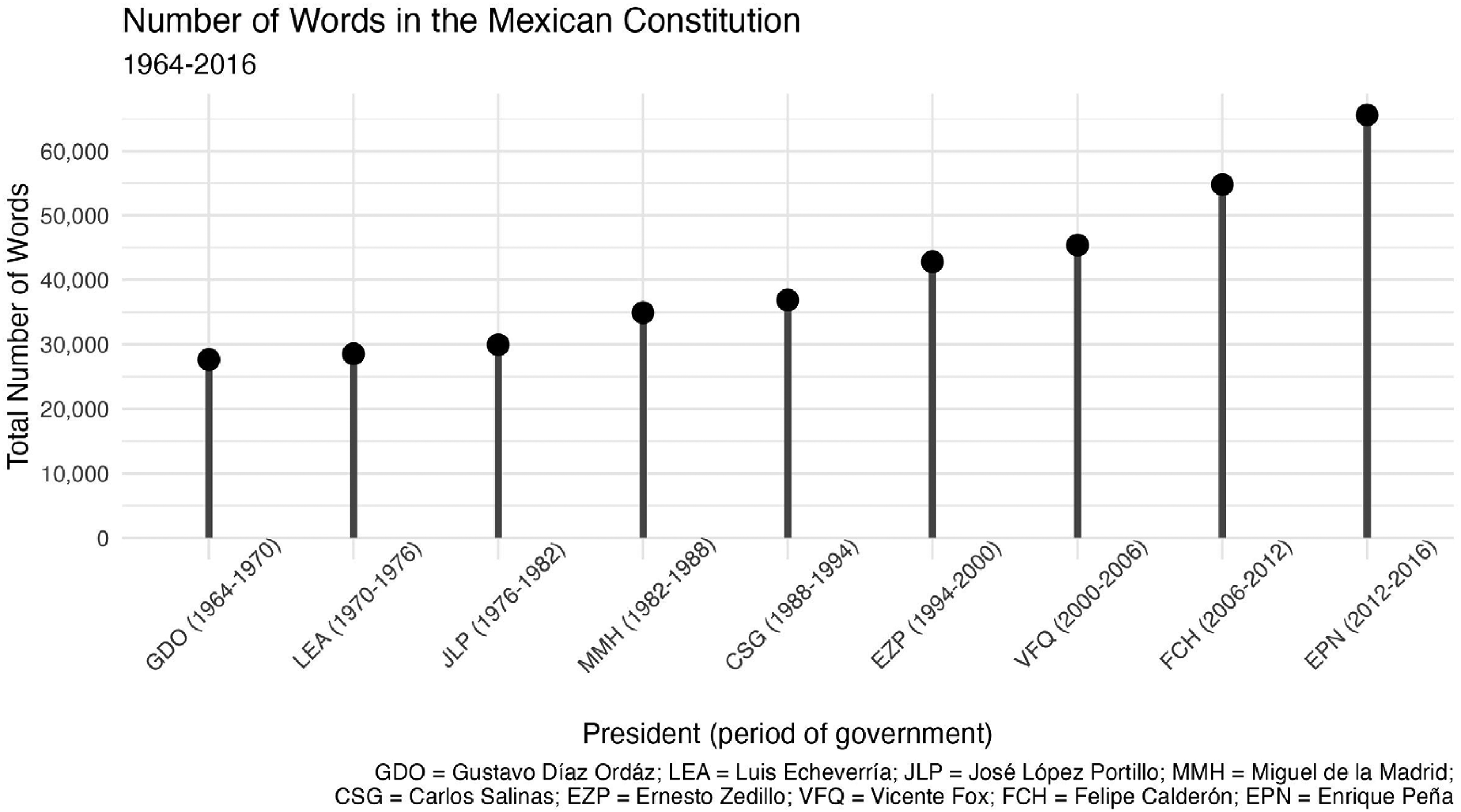
Source: Own elaboration with data from Fix-Fierro (2017).
The Frequency of Threshold-Clearing Majorities and Oversized Coalitions
In the length and inconsistencies of the Mexican Constitution section, we described under what conditions a core will or will not exist. If it exists, modification of the constitution is impossible unless the status quo is outside the core; if it does not, it is feasible. In the is the Mexican Constitution rigid section, we described how and why party coalitions emerged and included the amendment of the constitution as one of their goals. We also explained why the states did not object to anything the parties wanted, including the decisions of centralization of power (which, in principle, should have been opposed). Now it is time to synthesize all these arguments and see how often they describe the political situation in Mexico.
In Figure 6, we present the profile of the 68 constitutional amendments adopted in Mexico in the period we examine (from 2000 to 2013) 11 : the institutional thresholds achieved, the composition of the coalitions, and the significance of amendments (as a function of the number of constitutional articles affected).
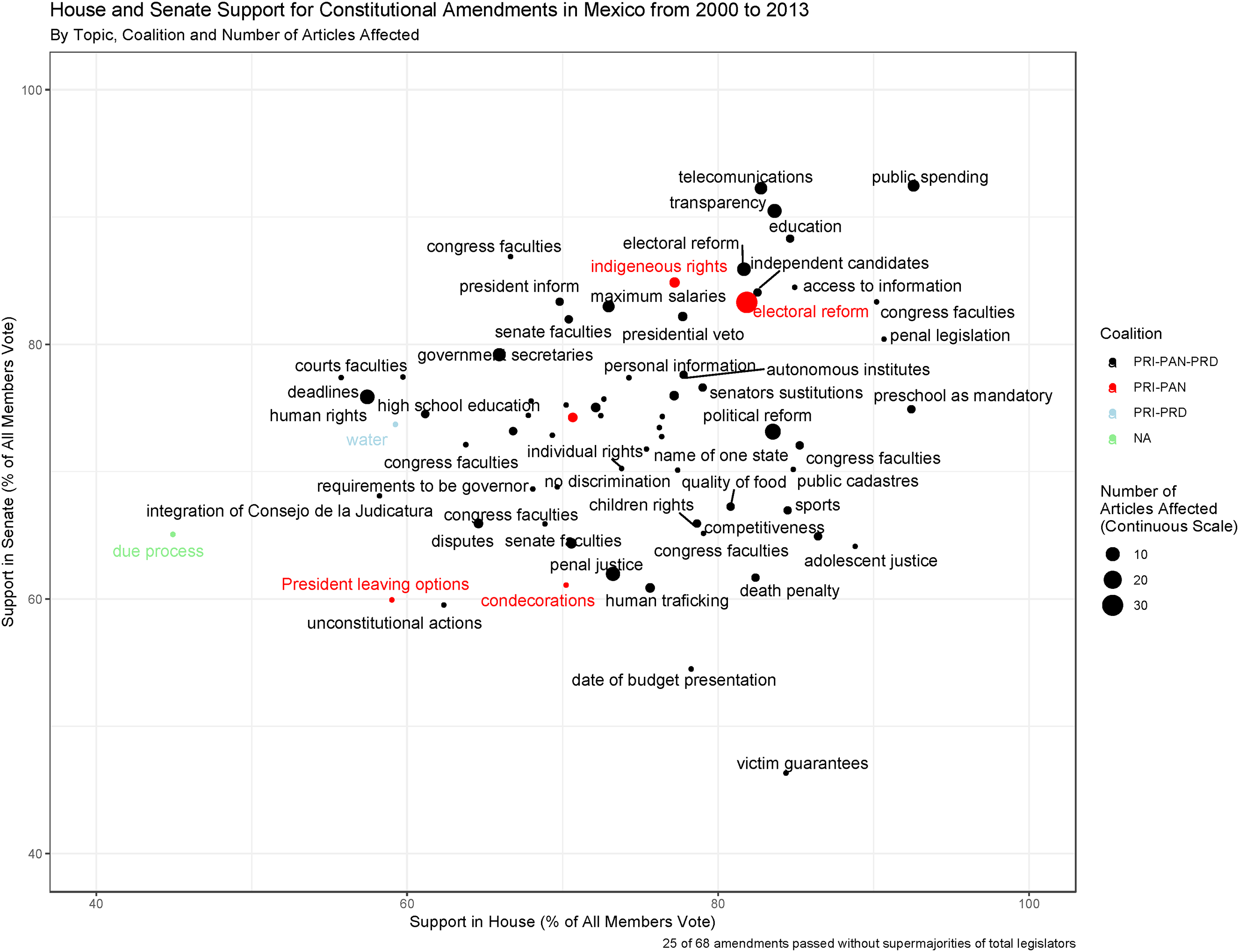
Source: Own elaboration.
Institutional constraints. The only articles that cleared a two-thirds qualified majority in both chambers of Congress are the ones in the first quadrangle of the picture. There are 44 amendments clearing both obstacles; there are four that did not clear the two-thirds restrictions to either chamber; 12 that did not clear two-thirds in the Senate; and eight that did not clear two-thirds in the House. Overall, two-thirds of the amendments occurred while there was a core (i.e., they had to clear significant restrictions in order to succeed).
Coalitions. The color of the points indicates the coalitions that promoted the amendments. We can see that the overwhelming majority of amendments, 61/68 or 90%, were the result of an agreement between the three major parties. Only five out of 68 were a PAN-PRI coalition, and two more were none of the above.
Significance. Finally, the size of the points is an approximation of the significance of the amendments: the more articles the reform affects, the greater the significance, and therefore, the size of the circles will be.
A simple observation of Figure 6 indicates that the most significant amendments were achieved by the agreement of all three major parties, with the exception of the electoral reform. This amendment although included in the Pact of Mexico (and therefore signed by all three major parties was approved in 2013 by the PRI and the PAN alone. 12 The PRD deviated from the convergence behavior, arguing that increasing the threshold for parties to maintain their registration, besides the introduction of immediate reelection, were modifications against minorities. In the record, PRD leaders claimed that PRI and PAN wanted to “… perpetuate themselves in power, but the people will know how to put an end to their lifelong ambitions” (Cámara de Diputados, 2013).
We mention only two important modifications included in this amendment that we touched on in this article: the first is the possibility of consecutive reelection of deputies (for up to four periods) and senators (for up to two) as well as the consecutive reelection of local legislators and members of the municipalities. The second was that the national voting threshold for a political party to maintain its registration was increased from 2 to 3%. The ruling of this reform was discussed by the Senate on December 3, 2013, and was approved by 107 votes in favor and 16 against. For its part, the Chamber of Deputies voted on this matter on December 5, 2013, and approved it with 409 votes in favor and 69 against it (Zamitiz Gamboa, 2017).
Conclusions
The article presents a model of the core of the Mexican constitution as the basis for understanding the interaction of the amendment provisions and the preferences of the political actors. On the basis of this model, we identify which amendments will be successful. There are three reasons for the high frequency of amendments according to our model.
First, the fact that the constitution is long and contradictory. In this regard, the literature has shown that there is a relationship between the size of the Mexican constitution and its inconsistencies (Fix-Fierro, 2017; Pou Giménez and Pozas-Loyo, 2019; Pozas-Loyo et al., 2022). Our argument is that these two features create a high demand for amendments.
Second, while the amendment provisions are stringent, as described in Article 135, specifying a two-thirds majority in both chambers and a simple majority of states, Article 63 significantly undermines the restriction by requiring a simple majority of members to be present for a valid restriction. The combination of the two articles permits a majority of one-third in each chamber as a valid restriction, which means the lack of a constitutional core. We demonstrated that one-third of the constitutional amendments of Mexico in the period 2000–2013 did not reach two-thirds of the total members of the House or the Senate.
Third, we demonstrated that just like the institutions were not decisive in the period of the single-party dominance because the required thresholds were achieved automatically, the same thing happened in the multiparty period. Parties in Mexico are very disciplined (because of the electoral law), and consequently, when they make an agreement, all their representatives (in the Chambers or local governments) comply. In the constitutional coalitions section, we demonstrate that 90% of the amendments were by agreement of all three parties.
These agreements were made for political reasons. We argued that the birth of multipartyism in Mexico was due to such an agreement. With respect to the constitution, a large part of these agreements involved the centralization of powers (Article 73). In addition, we have identified that political reasons such as the NAFTA and the Pact for Mexico could explain party convergence to amend the constitution. These are only examples that reveal that once parties have incentives, they can reach agreements. Parties can also consider the constitution as part of their domain. And as we showed, it is a dominant strategy to enshrine and shield their agreements in the constitution.
In a nutshell, the three conditions that this article identifies: not rigid institutions (despite appearances), centralized political agreements combined with the weakness of federal actors, which over time generated constitutional length and inconsistencies which now operate as an additional condition create a perfect storm which will continue to rage for the foreseeable future, involving also the Supreme Court of the country which will continue making judgments trying to save the situation but compounding the problem instead.
Footnotes
Acknowledgements
We would like to express our deepest gratitude to Mitch Bosley, Antonio González and Anna Halstenbach for extremely productive research assistance.
Declaration of Conflicting Interests
The authors declared no potential conflicts of interest with respect to the research, authorship, and/or publication of this article.
Funding
The authors received no financial support for the research, authorship, and/or publication of this article.