



Abstract
I argue that innovative development programs that require citizen participation in the production of public goods can have unexpected benefits for individuals’ dispositions toward democracy. In particular, I explore the effect of taking part in state-sponsored neighborhood development programs – direct-democracy type programs that require individuals to organize within their community as a precondition for state help – on participant dispositions toward democracy and willingness to take part in politics. To test this hypothesis, I use original survey data collected in the Mexican state of Baja California. To measure the effect of participation in neighborhood development programs, I conduct a quasi experiment via propensity score matching. I find robust evidence suggesting that participating in such programs correlates with higher levels of political participation, a better sense of community, more positive retrospective evaluations of the economy (according to both pocketbook and sociotropic measures), and overall higher support for the government.
Introduction
Participatory forms of democracy have garnered much attention since in theory they promise more responsive government and a more engaged citizenry (Barber 1984; Fung and Wright 2001). If this is true, then newer democracies that struggle with low participation or a torpid civil society might benefit by implementing direct-democracy type programs like participatory planning or community-led development programs. In practice, participatory democracy has taken many forms; perhaps the most studied and well known are participatory budgeting (PB) programs that take into account citizen input when developing community spending and investment priorities (for examples, see Avritzer 2002, 2009; Baiocchi 2001, 2003, 2005; Bolding and Wampler 2010; Selee and Peruzzotti 2009; Wampler 2007, 2008). Advocates of PB tout that such strategies affect government performance directly by making states more responsive to citizens’ needs, weakening old clientelist networks and lowering corruption, and also indirectly by affecting citizens’ attitudes, improving their dispositions toward the state and participation. However, as Bolding and Wampler (2010) note, although a broad number of studies claim that direct citizen participation leads to positive outcomes for participants, empirical evidence is hard to come by. In this paper I present evidence via a quasi field experiment and a propensity score matching analysis of how a similar program conducted in Mexico actually helps citizens develop attitudes that are consistent with political participation and democracy. I argue that by conditioning benefits on participation in collective decision-making groups, the state can help citizens learn important lessons about participation and cooperation – behaviors that play a crucial role in participative democracy.
Studies conducted in Latin America that focus on PB programs find that such innovations are improving democratic quality as they are increasing government transparency, producing citizen engagement, and increasing community stocks of social capital (for examples, see Abers 2000; Avritzer 2009; Heller 2001; Nylen 2003; Wampler 2008, 2012; Wampler and Avritzer 2004). In theory, PB affects citizens’ democratic dispositions by opening much-needed spaces where political activists can engage with the state (Nylen 2003). Once these spaces are open, individuals work with government officials to build better and more open forms of government (Abers 2000). Participants can then take the political knowledge and skills developed in the PB context and apply it to other civil society organizations (Wampler 2012). A conundrum in these studies is that such work does not tell us much about how interaction with the state changes individuals’ attitudes toward democracy and participation. At issue is that PB is mostly voluntary and those who participate self-select, presumably because they are better endowed with the attitudes and dispositions that are generally associated with participation (see Verba, Schlozman, and Brady 1995). In the context of new democracies, such studies are valuable because they prove that if government creates spaces and opportunities for individuals to engage with the state, individuals will raise their hands and take advantage of the opening (Nylen 2003; Wampler and Avritzer 2004). Yet, the endogeneity issue remains, and we know very little about how such interaction with the state affects those who otherwise would not have volunteered to take part in PB. An alternative is to look at programs or institutions that produce public goods yet compel the beneficiary – in some form or another – to participate in the production of said good.
Evidence from established democracies finds that interaction with state-sponsored poverty alleviation programs can have unexpected downstream effects on people's political attitudes. For example, studies in low socioeconomic status (SES) neighborhoods in the U.S. and in other developed countries find that participation in welfare or other social programs can influence an individual's overall political attitudes. Attitudes toward government, political attitudes in general, and willingness to participate in politics are determined in part by an individual's experience with state agencies (Katz et al. 1975; Lawless and Fox 2001; Lelieveldt 2004; Soss 1999).
How governments choose to provide benefits matters, and such choices can influence civic dispositions (see, for example, Freitag 2006; Kumlin and Rothstein 2005; Mettler 2002; Verba, Schlozman, and Brady 1995). Beyond the work done on PB, in the context of new democracies very little research has been done on how interacting with the state affects individual attitudes toward democracy or government. One notable exception is Selig-son's (1999) study of Central American countries in which she finds evidence that participation in community improvement associations is conducive to democratic behavior. Similar work in other new democracies is noticeably lacking. While research done in established democracies is discussed in terms of constituency service and responsive government, most of the work in new democracies is discussed in terms of clientelism and patronage, and tends to focus only on electoral effects (see e.g. Brusco, Nazareno, and Stokes 2004; Calvo and Murillo 2004; Diaz-Cayeros, Estevez, and Magaloni 2006; Magaloni, Diaz-Cayeros, and Estevez 2007; Nazareno, Stokes, and Brusco 2006).
Therefore, in order to assess the effects that responsive governments in new democracies can have on individuals’ attitudes toward democracy and their willingness to become involved, I present evidence from an innovative neighborhood development program that is conditional on beneficiary participation. In what follows, I start with a description of the Air Quality Improvement and Street Paving Program (PIPCA, El Programa Integral de Pavimentación y Calidad del Aire); afterwards, I explain the effect that PIPCA has on participants’ attitudes toward democracy. I pay special attention to the issue of endogeneity and present different ways in which we can go about dealing with it. Thereafter, I discuss the effects of PIPCA on attitudes toward democracy and toward the Mexican regime. And, finally, I explore the implications that programs like PIPCA have for new democracies in general.
The Program
Program Overview
The Air Quality Improvement and Street Paving Program is a unique public works project started in 2003 with the goal of paving 14.9 million meters of roads (roughly 930 miles) in the northwestern Mexican state of Baja California. The project was initially financed with 65.2 million USD put up by the State of Baja California and with a loan of 27.6 million USD from the North American Development Bank (NADB).
1
In order to qualify for an NADB loan, PIPCA had to be framed as an environmental project. However, the state government had much larger ambitions for the program: it has used PIPCA to improve neighborhood
2
infrastructure and to raise the standard of living of low-income communities in the region. For example, in 2003 the estimated paved street surface of Baja California's urban areas was between 50 and 60 percent. By the summer of 2007 the estimate was closer to 80 percent. Furthermore, according to a state press release, the objectives of PIPCA beyond “stopping environmental deterioration and improving public health” were to
improve public services, help improve the community dynamics in low-income neighborhoods that suffer from high crime rates, increase public participation, and strengthen the cooperation between the different levels of government and civil society (translated by author).
The NADB is a financial institution created by the North American Free Trade Agreement and is funded by equal contributions from the Mexican and U.S. governments. Together with the Border Environmental Cooperation Commission, the bank's goal is to finance environmental infrastructure projects along the U.S.– Mexico border (www.nadbank.org/index.html).
The term “neighborhood” is used in this context to refer to a colonia, which is different from a neighborhood in terms of size. In Spanish, a neighborhood is a vecindario, and a colonia is made up of several vecindarios.
A challenge faced by most Latin American cities is to keep up with urban growth. Due in part to the high rate of immigration from other parts of Mexico, cities in Baja California have faced significant challenges trying to provide services to continuously expanding urban areas. Some communities that seemingly sprang up overnight have gone years without sewers, running water or electricity. When and how neighborhoods were selected for infrastructure development happened in a very opaque manner. For example, under the Partido Revolucionario Institucional (PRI, Institutional Revolutionary Party) administration, infrastructure development for communities was tied to electoral support as part of the government's clientelistic machine. Such practices by local officials implicitly communicated to citizens that government largesse, like the caciques of old, was bestowed at the party's whim. As electoral openness gave opposition parties the opportunity to govern, changes in the quality of public goods began to occur (Beer 2003). Programs like PIPCA were possible because local and state governments started using different models to provide public goods. For instance, Partido Acción Nacional (PAN, National Action Party) administrations were seen by most citizens as moving away from the old PRI patronage system of providing public goods, toward focusing instead on good governance (Mizrahi 1998).
Because of the long-standing PRI practice of providing goods and services tied to electoral support, it is important to clarify why I argue that programs like PIPCA are demonstrably different from traditional patronage. First, the use of public goods as patronage – like schools, parks, and safe streets – is inefficient, generally, because it is difficult for the government to distinguish between supporters and non-supporters. For instance, if the incumbent party builds a park to reward a neighborhood for its electoral support, individuals who voted for that government as well as those who did not are equally free to enjoy the park. Here, there is no mechanism to identify supporters – and even if identification were possible, there is no mechanism to exclude non-supporters. Thus, as in any collective action issue, if the cost of not supporting the incumbent party is zero, and as long as one's neighbors come out in support of that party, an individual is free to both accept the public goods and vote for the opposition. Governments that rely on clientelistic practices to stay in power in order to avoid such conundrums opt for programs and benefits that are excludable and targeted because such goods give the state discretionary power to decide who benefits and who does not.
The second way in which programs like PIPCA are different from traditional patronage is that clientelistic program operators must have a wide array of discretionary powers to be able to target supporters and exclude non-supporters. In contrast, programmatic goods and services are designed to take discretionary power out of the hands of the politician or bureaucrat by implementing strict guidelines and thus minimizing opportunities for misuse. In the case of PIPCA, as a precondition to have a neighborhood considered for the program, the state government requires that neighbors organize in advance. How communities decide to organize happens on an ad hoc basis. However, in order for PIPCA to consider paving a street, 80 percent of the neighbors first have to agree to join the program. Once the PIPCA project is approved by 80 percent of the community it is put on a waiting list, during which time neighbors sign up those who have yet to join. Neighborhoods are serviced on a first-come-first-serve basis. Streets can be passed over if technical conditions are not met – primarily, if water, sewer, or storm drains have not been completed, or if a significant number of neighbors have yet to agree to participate.
Third, clientelistic interactions are characterized by the exchange of goods and services in return for political support. For example, the logic of vote-buying is simple: the less an individual values his or her vote relative to the expected benefit of the good or service they are to receive, the more willing they will be to take part in the transaction. In the case of PIPCA, even though the program is highly subsidized by the federal, state and municipal governments, participants have to pay 40 percent of the cost of the project. In order to minimize the cost burden, PIPCA uses the NADB resources to finance four-year, interest-free loans. This means that for an average 400-square-meter lot, with 20 meters of street-front, a family could expect to pay roughly 300 MXN (approximately 22 to 25 USD) per month over a four-year period. Despite the evident benefits of living in a community with paved streets, in a low-income neighborhood 300 MXN a month can be a steep price to pay – too steep for some. In this sense, because the program is based on the provision of a programmatic public good that is non-excludable, difficult to target, and imposes a cost on beneficiaries, PIPCA has sufficient novel characteristics that differentiate it from traditional clientelistic programs used in Mexico.
Government Expectations
In addition to the infrastructure benefits, the state government believes that PIPCA can be used to improve the provision of public services and serve as a bridge between state officials and civil society. Well-paved roads mean that the state will be able to provide better public transportation, better police and emergency services, and more frequent garbage collection. Because PIPCA requires that communities organize themselves prior to the start of the program, the state government believes that it can use PIPCA both to improve the social fabric by creating common-issue community groups and to change the preconceived beliefs of how big community projects are done, emphasizing the idea of co-responsibility. The government articulated this policy orientation in the aforementioned press release, which states:
This program is important for the life of the communities in our state, not only because of the benefits it provides, but also because it includes citizens in the process by way of public participation and consultation that makes people feel the project is theirs. With these results, we prove once more that Baja California is a participatory and resolute society, as community and government work together to bring about collective projects for the benefit of society (translated by author).
Once a neighborhood meets all the technical requirements of the program, the Baja California Department of Infrastructure and Urban Development (SIDUE, Secretaría de Infraestructura y Desarrollo Urbano del Estado de Baja California), the agency in charge of PIPCA, sends representatives to neighborhoods in an attempt to help neighbors coordinate efforts. Initial meetings with PIPCA usually take place in someone's back yard, a local classroom, or in a vacant lot. These meetings are usually late in the evening and are very informal. Most individuals who attend these meetings are in favor of PIPCA. Participants may ask questions of the SIDUE officials, who explain the costs, payment options, and what the citizens need to do in order to get PIPCA started. Once participants feel they have enough information, they map out strategies to convince others in the community to sign up for PIPCA. For instance, in a neighborhood meeting I observed, participants divided the neighborhood into sections and assigned specific streets to each attendee. Attendees then committed to a set number of houses and would later go door-to-door in a group or alone to talk to their neighbors. In other cases, participants volunteered to go talk to the neighbors they knew or were related to. Considering the significant cost of the program, organizing all of one's neighbors to agree to have the street paved can be challenging. Further meetings take place if neighbors request them. Again, there are no set rules that must be followed. Some communities might get together by themselves or they might invite a SIDUE official to answer further questions. Usually, any follow-up meetings are better attended and participants are a bit more skeptical. Once the project is finished, a high-ranking government official – typically the governor or the head of SIDUE – performs the traditional ribbon-cutting ceremony with much fanfare and local media coverage.
PIPCA's Effect on Attitudes toward Democracy
As new democracies emerge from under the shadow of authoritarianism, one of the challenges they face is incorporating large numbers of citizens into the political process. I speculate that substantive and positive contact with the state strengthens individuals’ attitudes toward democracy that go beyond simple regime legitimacy. In this context, we can imagine that people who feel better served by the state will be more willing to believe that the state works and, more important, that it works for them, thus affording it greater legitimacy. I argue that programs like PIPCA, which incorporate community participation as an integral feature, can produce much more than regime legitimacy, as they can also be potential breeding grounds for greater political participation. It stands to reason that the more a person feels the system works for him or her, the more that person can be expected to support the regime. Government programs like PIPCA can promote an increased appreciation for democracy because through the development of community groups they foment the creation of social capital.
The link between social capital and democratic quality is well established (see, for example, Putnam, Leonardi, and Nanetti 1993). Much research into the formation of social capital seems to revolve around the type of associations that foment its creation. In general, social capital has been seen as the product of social relationships that were, for the most part, the product of voluntary associations (Coleman 1988; Lin 2002; Portes 1998). However, for some scholars the focus on voluntary social relationships seemed unnecessarily narrow (Freitag 2006; Newton 1999). In this sense, Freitag (2006) argues that other forms of political and social institutions like those created by the state can have a stronger effect in conferring social capital to people because these institutions have a potential advantage in transmitting the values and norms of democracy (trust, reciprocity and cooperation). More to the point, studies of programs similar to PIPCA find that communities that organize and work with the state in the production of public goods enhance the incentives to participate, convey to members important lessons of working together and working with public agencies, and most important, create social capital that can later be used in the procurement of other public goods (Ostrom 1996). Put simply, the impact of PIPCA potentially goes beyond the benefits of paved roads: PIPCA creates a social learning space where neighbors can acquire social skills that can later be used in working within their community to find solutions to collective problems.
To assess these claims, I conducted an in-person, large-N survey study of 1,000 residents of low-income neighborhoods across Baja California during the months of July and September 2006. 3 Participants were randomly selected from nine neighborhoods in Tijuana, Mexicali, and Ensenada – which varied in their level of government-sponsored development spending but were socioeconomically equivalent. The neighborhoods in the sampling frame were randomly selected from a list of three types of low-income neighborhoods that varied depending on the level of state social-development spending. Type 1 neighborhoods were in the process of receiving social-development spending, type 2 neighborhoods had received social-development spending in the previous 18 months, and type 3 neighborhoods had not received any social spending since at least 2001. The projects themselves varied from one neighborhood to the next. Overall, the trend was to fund low-cost, highly visible projects. For instance, some neighborhoods got public areas like playgrounds, parks, and community centers repaired or restored; others benefited from projects that built infrastructure, like fences and sidewalks.
Explora S.A., a local public opinion research company, conducted the survey between 16 and 24 June 2006.
In order to report on the effect, if any, that participating in PIPCA has on individuals’ attitudes and behavior, I treat as having been exposed to the program those who, in the survey, self-reported as having attended one or more of the meetings conducted in their neighborhood. To be clear, since participants within each neighborhood were randomly selected, respondents living in neighborhoods that had completed the PIPCA process but had not personally participated in the project were coded as having not been exposed. However, respondents living in neighborhoods that were in the process of applying for PIPCA and had personally participated in meetings were coded as exposed. In other words, independent of the stage the neighborhood was in vis-à-vis the PIPCA process, I consider only those individuals who reported participating in meetings as subjects having been exposed to treatment. In the following section, I move to a discussion of the attitudinal differences between individuals who had contact with PIPCA and those who did not.
Measuring individuals’ support for democracy can be problematic as there is no one, clear-cut approach. Therefore, I tackle this issue by relying on behavioral, attitudinal, and diffuse measures that are generally agreed to be correlated directly and indirectly with democratic support. These measures are a Government Performance Index, which is composed of the following three questions: 1) How satisfied are you with the work the state government is doing to improve the conditions in your neighborhood? 2) How satisfied are you with the work the state government is doing to improve the condition of streets (for example, fixing potholes)? 3) How satisfied are you with the work the state government is doing to improve the condition of neighborhood parks and recreational areas? All three questions are on a scale from 1 to 4, 1 being least satisfied. To measure voting, participants were directly asked to self-report on whether or not they had voted in the last election. As previous research has found, self-reported measures of voting can be problematic because individuals tend to exaggerate how much they actually participated (see, for example, Katoah and Traugott 1981; Parry and Crossley 1950; Presser 1984, 1990; Silver, Anderson, and Anderson 1986).
However, as individuals in the sample voted at about the same level as the state average, I argue that overreporting might not be a large concern. Pocketbook and sociotropic evaluations of the economy were measured by asking respondents to say if they thought that their personal or the national economic situation was better or worse than (or the same as) it had been 12 months earlier. Values were coded on a 5-point scale from −2 to 2, where −2 represents a “much worse” and 2 represents a “much better” personal/national economic situation. Reliance on neighbors is an index composed of the following questions: If you had a problem, could you rely on your neighbors for help? Do you feel like a part of your neighborhood? How many of your neighbors would you miss if they moved away? Evaluations of then-governor Elorduy and then-president Fox, the state government, and PIPCA were measured using a feeling thermometer, where respondents were asked to state their opinions on a 0 to 10 scale. I argue that by looking at the behavioral and attitudinal differences between those who had contact with PIPCA and those who did not, we might be able to tell something of what effect, if any, participating in PIPCA has on individuals’ support for democracy.
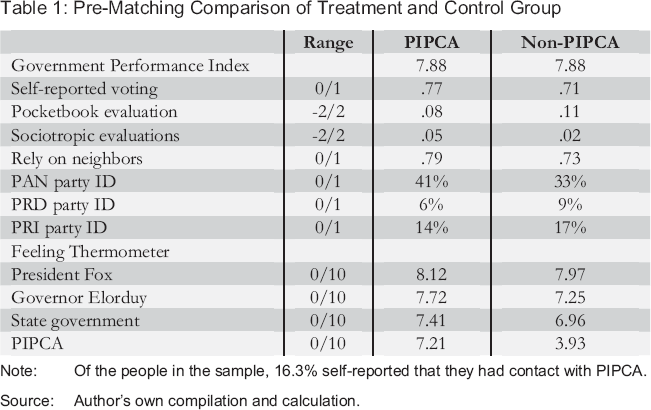
Table 1 shows simple descriptive statistics of the attitudinal and behavioral differences between beneficiaries and non-beneficiaries of PIPCA. An initial comparison between recipients and non-recipients of PIPCA shows that the effect of participating in the program is not entirely clear. Of the indicators considered, only evaluations of PIPCA show a significant difference. All other differences are not beyond the 95-percent confidence interval.
Pre-Matching Comparison of Treatment and Control Group
Pre-Matching Comparison of Treatment and Control Group
Note: Of the people in the sample, 16.3% self-reported that they had contact with PIPCA.
Source: Author's own compilation and calculation.
In order to systematically analyze the effect of substantive government contact on democratic attitudes, a key methodological concern must be addressed. At issue is the fact that individuals who had contact with PIPCA were not randomly selected into the program, but self-selected on the basis of certain unknown sociodemographic or political characteristics. Clearly, evaluating the effect of substantive government contact on democratic dispositions is complicated by the existence of endogeneity between participating in PIPCA and pre-existing attitudes. Previous research shows that those who choose to participate are different in many ways from those who choose not to participate (see, for example, Campbell et al. 1960; Coleman 1990; Kwak, Shah, and Holbert 2004; Marschall 2004; Morales Diez de Ulzurrun 2002; Schlozman, Verba, and Brady 1999; Verba and Nie 1972; Verba, Schlozman, and Brady 1995). In the next analysis, I account for the endogeneity bias by using a propensity score matching method. I begin by justifying my methodological choice.
As mentioned above, when we attempt to demonstrate that participating in PIPCA (the treatment T) affects democratic attitudes (the dependent variable Y), we must address the issues of endogeneity. In a perfect world, we would be able to collect data from a population in which the occurrence of participating in PIPCA (T) is randomly assigned within the population. More specifically, we want to find cases where the occurrence of participation (T) is exogenous to the individual characteristics of the population (X). However, we know from previous work on clientelistic spending that governments usually give substantive benefits to some individuals rather than others on a preferential basis (Kitschelt and Wilkinson 2007), and, in addition, that some people are more willing to participate than others. In other words, we should expect any explanatory variable T to be endogenously related to some of the pre-existing characteristics of the population (X). If we neglect to account for the problem of endogeneity and assume that X is independent from Y, we will undoubtedly end up with biased inferences.
Comparison of Group Differences
The standard way of dealing with issues of endogeneity has been to work at the parametric level with instrumental variables. The objective is to find a variable that is exogenous to Y (uncorrelated with the error terms of the structural equation), but at the same time correlated with T and X. If the instrumental variable satisfies these two conditions, then we expect that any endogenous effect that Y might have on T will be canceled out by the covariance of the instrumental variable and T (Wooldridge 2000). 4 The problem with parametric solutions like 2-SLS is that finding the ideal mix of instrumental variables is a post hoc operation that implies working through large numbers of different models to find one that works. Inherently, this type of research is not theory-driven and any result could be extremely model-dependent. It is not unheard of for researchers to try more than one model specification and to keep trying until they find one that corroborates theoretical expectations. In order to avoid model-specific results, I propose a non-parametric solution to the problem of endogeneity based on propensity score matching.
I unsuccessfully ran a two-stage least square approach using instrumental controls for city of residence, neighborhood type, Civic Engagement Index, and home ownership. For a more comprehensive discussion on this issue, readers can access this analysis by visiting www.trinity.edu/knishika/Katsuo_Nishikawas_website/Bridging_the_Participation_Gap_with_Government_Development_Programs.html>.
An alternative is to use a propensity score matching method that pre-treats the data before any parametric analysis is done. The goal of matching is to obtain accurate causal effect estimates that have the smallest possible variance and that are unbiased (Ho et al. 2007). Matching achieves this by preprocessing the data before any parametric analysis is done using a non-parametric approach that reduces the relationship between the treatment (T i ) and all independent variables in the model (X i ) without creating bias or increasing inefficiency (Ho et al. 2007). Bias is avoided by selecting cases on the explanatory variables (T i and X i ).
By using a matching strategy, I created a subset of the observed sample that has T i and X i unrelated as much as possible. The created subset was divided into two distinct groups differentiated by their level of contact with PIPCA. Individuals i (i = 1, …, n) who had contact with PIPCA were placed in the treatment group (T i = 1), while those who did not have contact with PIPCA were placed in the control group (T i = 0). In theory, when exact matching is used, the subsequent units in the control groups are matched with a corresponding unit from the treatment group for which all the values of X i are the same. After exact matching, any link between X i and T i is completely broken, and any effect that X i had on Y i can now be ignored because X i is held constant across each paired unit (Ho et al. 2007). In other words, any bias in Y i that is caused by T i is now eliminated. The paired subset is similar to a quasi experiment where matched units in the experiment group (T i = 1) are matched to units in the control group (T i = 0).
However, in practice, due to the large amount of the X i in my data, exact matching is insufficient because it produces inefficiencies as the pairing process discards excessive amounts of information. Fortunately, the benefits of matching can be achieved via other means (Ho et al. 2007). Consider that in order to remove the bias of X i on T i it is not necessary that we make the distributions exactly the same; matching the distributions as closely as possible is sufficient (Ho et al. 2007). If the distributions of X i in T i = 0 and T i = 1 are equivalent, then the requirements of matching are satisfied. In the following analysis, I use the nearest neighbor matching method, which in this case produces the best possible balance as it matches each treated unit to a control unit with the most similar value. The matching procedure is straightforward: units are matched on their propensity score obtained via a logistic regression of T i on X i ; then, the subsequent data are analyzed to determine if the balancing property is satisfied. Data that are well balanced show minimal differences between X i across the treatment and control groups (Ho et al. 2007).
I estimated the propensity score via a logistic regression of participating in PIPCA on 10 pre-treatment covariates. In order to have efficient estimations, I included all covariates expected to affect a person's probability of participating in PIPCA and excluded those that prove to be poor predictors. I control for institutional characteristics (city, prior levels of government-sponsored development spending), individual-level indicators (income, ideology), and instrumental controls for bias (home ownership, willingness to work with others in their community, willingness to contact government officials, attendance of neighborhood meetings dealing with community affairs). Because of the homogeneous nature of my sample, I did not need to use other covariates – like geographic determinants, education rates, share of indigenous-language-speaking inhabitants, or level of urbanization – used in similar studies conducted in Mexico (see, for example, Diaz-Cayeros, Estevez, and Magaloni 2006). After conducting a one-to-one nearest neighbor matching, the resulting dataset holds 420 respondents, of which 210 had contact with PIPCA and 210 did not. That data satisfy the balancing property across blocks of observations (Becker and Ichino 2002). 5
Readers can find a table showing the distribution of quantile-quantile (QQ) plots for each control variable used in the matching process at www.trinity.edu/knishika/Katsuo_Nishikawas_website/Bridging_the_Participation_Gap_with_Government_Development_Programs.html;.
After the matching process was accomplished, the data were analyzed using an Ordinary Least Squares (OLS) regression. In theory, a multivariate OLS model can control for any remaining bias that nearest neighbor matching did not take into account (Ho et al. 2007). In addition to the aforementioned parametric covariates, I control for trust in government. When measuring the effects that interacting with the government has on attitudes toward democracy and toward the regime, it is important that one controls for trust in government. Previous studies done in Mexico show that trust plays a crucial role in moderating how government contact is interpreted. It stands to reason that trust can be a very powerful lens through which we see government action, especially in a country with a legacy of one-party authoritarian rule. It might not take much for a person to become skeptical of government, and levels of mistrust might distort future perceptions of the state.
The parametric analysis conducted after matching adds an additional layer of robustness. As explained above, if matching is successful in producing a dataset in which T i and X i are independent of each other, we can expect that causal estimates will still be consistent even if we choose an incorrect parametric analysis. However, having the correct parametric model still produces consistent causal estimates, even if the matching process is not successful in producing a dataset in which T i and X i are independent of each other (Ho et al. 2007). Put simply, if the parametric analysis is misspecified or if the matching procedure is inadequate (but not both), the resulting estimates will still be consistent.
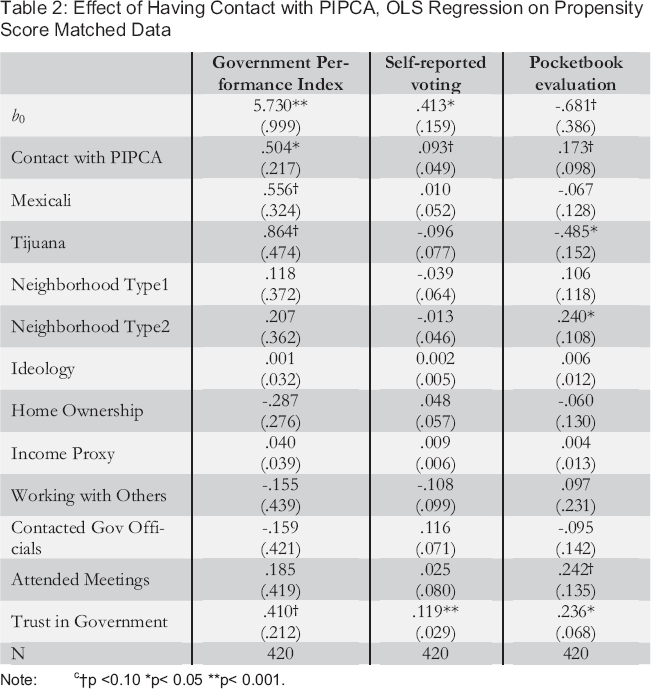
The results shown in Table 2 represent the OLS regression coefficients for our multiple dependent variables using a pre-matched dataset. These results are considerably different from those obtained using 2-SLS. 6 Such differences are not unexpected, and are due in part to the data used in calculating each set of regression coefficients. While 2-SLS will use all the information in the dataset, propensity matching will selectively prune unmatched control units based on a function of T i and X i (Ho et al. 2007). The inclusion of data from unmatched units makes 2-SLS coefficients much more sensitive to any model modifications (Ho et al. 2007). In other words, propensity score matching uses only control units that are similar to the treatment units in regards to X i , whereas 2-SLS uses all control units in the dataset, including those that might not be adequate control units for the treatment units (King and Zeng 2007). Therefore, because 2-SLS extrapolates from data units that include cases where T i and X i are not independent, its regression estimates will be sensitive to any modifications.
Effect of Having Contact with PIPCA, OLS Regression on Propensity Score Matched Data
Effect of Having Contact with PIPCA, OLS Regression on Propensity Score Matched Data
Note: c
p <0.10
p< 0.05
p< 0.001.
Readers can find 2-SLS results at www.trinity.edu/knishika/Katsuo_Nishikawas_website/Bridging_the_Participation_Gap_with_Government_Development_Programs.html;.
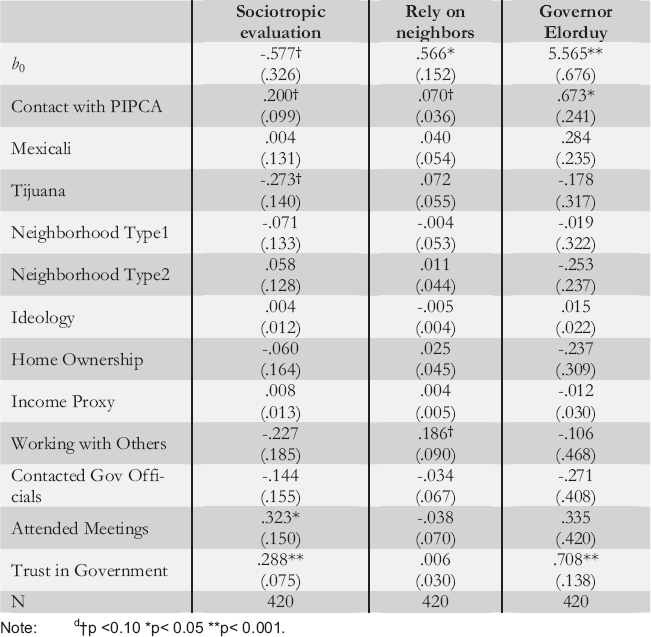
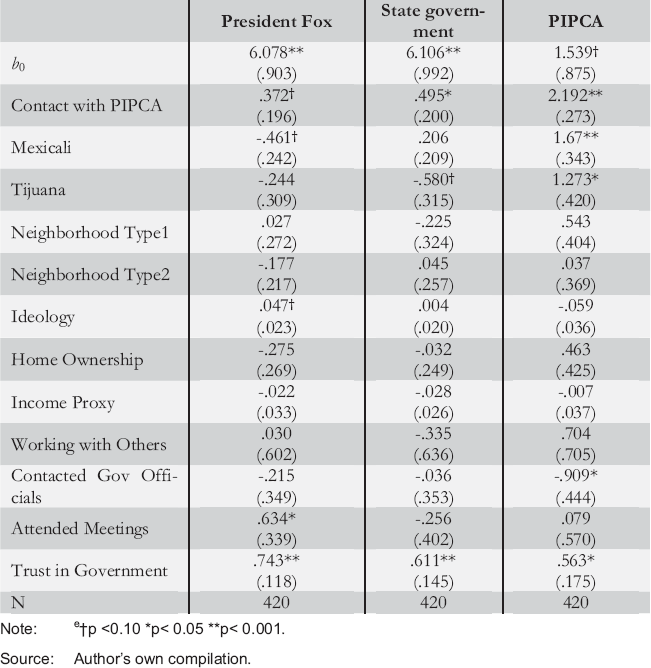
These results suggest that interacting with PIPCA correlates with a positive and significant effect on beneficiaries’ levels of satisfaction with: local services, elected officials, and government performance. The average Government Performance Index was 5.73 for individuals who had no contact with PIPCA compared to 6.23 for those who did. This is an 8.79 percent increase in satisfaction with the job the government is doing at maintaining and fixing problems in one's neighborhood. Similarly, feeling thermometer scores for then-governor Elorduy increased from an average of 5.56 among non-beneficiaries to an average of 6.23 among beneficiaries, which translates to a 12.09 percent increase in the governor's approval rating. Also, the state government's feeling thermometer improved from a 6.10 average score among non-beneficiaries to a 6.60 average score amongst beneficiaries; this is an 8.10 percent increase in feeling thermometer ratings. The improved ratings were not limited to the state and local officials: national political leaders, like then-president Fox, also received a boost among those who had contact with PIPCA. Feeling thermometer ratings for President Fox increased from a 6.07 average score among non-PIPCA participants to a 6.45 average score for PIPCA participants, reflecting a 6.12 percent increase in the president's approval rating. Furthermore, beneficiaries of PIPCA rated the program better than non-beneficiaries did. On average, those who had contact with PIPCA gave it a 3.71 rating compared to 1.53 for those who had no contact with the program, which translates to a striking 142.43 percent increase. Not surprising, people who had contact with PIPCA gave the program a much higher evaluation. These results are in line with previous studies that show programs like PIPCA tend to have positive effects on how individuals perceive government and the provision of public services (Marschall 2004).
Note: d
p <0.10
p< 0.05
p< 0.001.
Note: e
p <0.10
p< 0.05
p< 0.001.
Source: Author's own compilation.
Notably, these results suggest that PIPCA has important effects on people's attitudes toward democracy. Specifically, 50.60 percent of the people who had contact with PIPCA reported voting compared to the 41.30 percent voting rate for those who had no contact with the program. Participation in PIPCA correlates with a striking 22.51 percent increase in self-reported voting frequency. Additionally, those who had contact with PIPCA had a better outlook on both the state of the national economy and their own economic situation. Among program participants, sociotropic evaluations of the economy improved from a −0.57 average score to a −0.377 average score, representing a 34.66 percent increase. In addition, pocketbook evaluations of the economy improved from a −0.68 average score to a −0.50 average score, which represents a 25.40 percent improvement. Moreover, when asked “If you had a problem, could you rely on your neighbors for help?”, 56.60 percent of non-program participants said yes, compared to 63.60 percent amongst program participants, representing a 12.36 percent increase. The increase in political participation and in willingness to rely on others in the community point to a positive effect on social capital.
Let us now return to the issue of endogeneity. Outside of a proper field experiment, it is very difficult to claim that the differences between those who participated in PIPCA and those who did not are the result of exposure to the program, because it is always possible that those who participated were also already more likely to hold elected officials in higher esteem, think better of the government's job performance, vote more often, or take a more active role in their neighborhood. So the question is: Does participation in PIPCA make individuals more civically disposed, or are those who are already more civically disposed more likely to participate in PIPCA? I argue that the former rather than the latter is true, because by relying on parametric matching we can create an ex post facto control group that can give us an idea of what each respondent's attitude and behavior would have been if he or she had not participated in PIPCA at all. Similar to field experiments, where the control group helps us predict what the levels of the dependent variable would be in the treatment group if the exposure to the treatment had not taken place, parametric matching can be used to pair each observation in the treatment group to another in the population, thereby creating a quasi control group. In this paper, prior to running any comparison between groups, for each individual who participated in PIPCA I found a statistical doppelgänger who is equivalent to the individual who participated based on location of residence, political ideology, home ownership, standard of living, and multiple levels of civic engagement.
On the whole, these findings paint a picture in which we can see a clear improvement in people's willingness to participate, both politically and in their community; an improvement in perceptions of their standards of living; a higher regard for the government and the work it does; and a higher regard for elected officials. Conjointly, these findings strongly suggest that participating in programs like PIPCA has a significant positive effect on democratic attitudes and dispositions toward participation. Alternatively, if indeed those who are already more civically disposed were also more likely to participate in PIPCA, these results would suggest that, in the context of new democracies, institutions that practice direct forms of democracy can do a great deal to reinforce pre-existing democratic values and norms of behavior. If this is the case, then programs like PIPCA can help empower those who might need a nudge of encouragement to be more active in their community; this is a positive outcome for an innovative government program targeting low-income communities. In either case, the results bode well for advocates of direct forms of democracy and greater government openness in the areas of community development and beyond.
Mexico's new democracy, like most post-authoritarian democracies in Latin America and now in Africa and the Middle East, suffers from a political culture of non-participation. In Mexico, the lack of strong civic organizations and grass-roots institutions is not unexpected, due in part to the previous regime's policies of constraining civic participation. Most forms of citizen-based participation that could have acted as a counterweight to the state were either co-opted or suppressed. Thus, under the PRI regime, small, community-oriented groups – the type that organize around a common neighborhood problem (for example, an open sewer, crime, or the reoccupation of public spaces) – never developed and never fulfilled their potential as incubators of civic engagement. The benefits of programs like PIPCA are as follows: first, these programs provide much-needed infrastructure to the poorest members of society; second, and more important, they foment positive attitudes toward democracy and foster greater social capital. If these attitudes are real, this might suggest the possibility of tapping into them. Possessing a willingness to participate civically might be the first step in actually contacting a government official, meeting with neighbors to talk about a shared problem, or deciding to work on a community project. Taking a step back and thinking in terms of the possible ways in which the state can condition peoples’ attitudes and behaviors, evidence of a latent willingness to participate surely increases the likelihood that the state can have a positive effect on an individual's attitude toward the state and democracy, and can motivate citizens to get involved in politics and in their communities.
Government programs such as PIPCA can “motivate” people to organize where civil society can do very little. This study finds evidence to suggest that it is possible that social capital can be formed via participation in joint citizen–government development programs. Research shows that social capital forms over long periods of time as norms of reciprocity and trust penetrate deep into society. This formation process is cumulative and requires large amounts of social resources, such as human capital and pre-existing groups (voluntary associations) where such norms can develop. Attempts to engineer social capital would involve huge start-up costs that civil societies in post-authoritarian democracies are not equipped to handle. One possible solution is to rethink the role of the state.
Although the downstream benefits of participating in PIPCA are no different than those of traditional voluntary associations, the novelties of this approach are, first, that it underscores the importance of the state in bridging the gap between civil society and individuals with low social capital, and second, that it does this while engaging large numbers of citizens, something that other direct-democracy type programs cannot do well. For instance, PB programs, when they function as intended, have been found to reinforce pre-existing institutional democratic values among those who volunteer, but what about those who do not raise their hand? How are direct-democracy type programs improving communities’ democratic attitudes and dispositions toward participation? Are the benefits limited to the scarce few that participate? At the moment, with the notable exception of the work done by Brian Wampler, we know little of the possible spillover effects of such programs. As direct-democracy type innovations can be a way for new democracies to foment liberal democratic attitudes and behaviors, future research should take a closer look at how and under what conditions such programs can catalyze stronger, more participatory democracies.