



Abstract
Over the past two decades, the countries of Central America have confronted soaring crime rates. Justice systems of dubious quality provide thin shields against this crime crisis, despite substantial international and domestic investment in justice reform. Indeed, there is growing concern that crime will undermine justice reform efforts. Scholars and practitioners have pointed out that public frustration with crime, coupled with dissatisfaction with justice institutions, can lead citizens to reject reform efforts. Still, the micro-level relationships between crime and public support of the justice system have been understudied. Using public opinion data from the Latin American Public Opinion Project (LAPOP), this study aims to add to the literature by examining the effects of victimization and fear of crime on public trust in the justice system. The results indicate that crime can erode public support for the justice system, but the mechanics of this relationship vary according to national context.
Introduction
In the early 1990s, democracy advocates were optimistic when appraising political developments in Central America. After decades of civil war, insurgencies, and dictatorship, countries turned to peace accords and new constitutions to lay the foundations for democratic governance. Indeed, Costa Rica was no longer the region's exception, as its neighbors also began to settle disputes through the ballot box instead of the battlefield. Given the intensity of political violence in prior decades, Guatemala, El Salvador, Nicaragua, Panama, and Honduras established competitive elections with relative ease. Many observers hoped that these elections would be the foundation for a new era of political development in the region.
More than a decade has passed since the last of the peace accords ended the political violence. Democratization has faced difficult challenges, but at the very least free and fair elections have become the norm. Still, the enthusiasm of the 1990s has waned considerably. Democratic institutions and procedures prevail, but these fixtures are hollow, or devoid of democratic principles (O'Donnell 1998; Smith and Ziegler 2009). Diamond (1999) refers to such countries as “illiberal democracies,” as democratic institutions mask undemocratic practices. Perhaps the most glaring example of the hollowness of several Central American democracies is the weakness of the rule of law (Stotsky and Nino 1993; Alvarez 1996; Holston and Caldeira 1998; Prillaman 2000; Ungar 2002). Scholars, practitioners, politicians, and the public have noted the problems with the rule of law, bemoaning the poor state of justice institutions, the inability to curb abuses of power, as well as the uneven application of the law across the citizenry. Indeed, O'Donnell (1998) coined a new phrase, “the unrule of law,” to describe the poor state of justice in the region. Given the centrality of the rule of law to both democracy and economic development, the 1990s and the first decade of the new century were marked by efforts to reform this status quo (Carothers 2006; Correa 1999). Domestic governments and the international community poured substantial amounts of money into justice reform; however, the results of these endeavors are mixed (Hammergren 2007; Finkel 2008).
Escalating crime rates have further hampered reform efforts, as in many cases crime has replaced civil war as the key detriment to citizens’ security (Seligson 2005; Córdova, Cruz, and Seligson 2007). Not only have crime rates risen, as measured by national homicide rates, but under new democratic regimes crimes feature more prominently in media with less fear of censorship (Seligson and Azpuru 2001; Pérez 2003). Consequently, as justice institutions strive to polish their tarnished images through reforms, the crime epidemic has led many citizens to dismiss them as hopelessly ineffective, corrupt, and unfair (Cruz 2000, 2003; Pérez 2003). Justice institutions of questionable legitimacy find themselves in quicksand as their attempts to pull themselves out of their authoritarian legacies are mired by their perceived inability to address the growing crime wave. Even Costa Rica has not escaped unscathed, as recent years have witnessed a precipitous decline in public trust in the justice system (Walker 2009).
Will the current crime crisis jeopardize reforms? This article answers this question from the perspective of citizens, assessing the impact of crime on public support for the justice system. To this end, this paper examines public support for the justice system as a whole, as well as two of its primary institutions, the courts and the police. A third institution of increasing prominence is also included – the human rights ombudsmen. This analysis of public attitudes towards the justice system as a whole, as well as its separate institutions, aims to capture the varied nature of the justice system, as the term “justice system” is a broad umbrella for many diverse components. Justice institutions include a wide array of actors involved in various stages of the justice process, including inter alia: police officers, detectives, defense lawyers, prosecutors, judges, legal aides, and judicial councils. 1 The courts and the police are the institutions that feature most prominently, but they are also joined by less visible institutions such as human rights ombudsmen. Thus, this analysis assesses public attitudes towards several important actors at diverse stages of the justice system.
See Hammergren (2007: 4-5) for a thorough yet concise overview of the many diverse components of the justice system targeted by reform efforts.
This focus on public support is unique in the literature on Latin American justice systems. Many studies expertly evaluate the quality of justice systems by performance outcomes, such as case resolution rates and rulings against incumbent governments. Such judgments are undoubtedly valuable, as they can identify the strengths and weaknesses of institutional performance. For example, the Justice Studies Center of the Americas (CEJA-JSCA) the World Bank, United Nations, and Freedom House organization compile indicators of justice system performance, providing valuable tools for public policy. This article recognizes the importance of such measures, but seeks to complement them with citizens’ evaluations. The assessments of the international community, Central American political elites, and scholars have been well-documented, yet public evaluations of the justice system are understudied. It is unlikely that the average citizen would be aware of the exact percentage change in the judicial budget, or be able to quote the case resolution rate of a given year. Still, citizens do have reactions to the perceived efficiency and fairness of the justice system, either from their own personal experiences, second-hand accounts of the experiences of others, or impressions from the media.
Recent work underscores the importance of supplementing institutional measures of performance with public evaluations. For example, Hammergren (2007) notes a disjuncture between reforms and public demand, pointing out that citizens prioritize outcomes such as lowering crime and improving the quality of judicial services, while reform efforts tend to target different components of the judicial process like due process (DeShazo and Vargas 2006: 11). The United States Agency for International Development (USAID) echoes this concern, cautioning that:
Difficult economic conditions and increasing crime are diminishing the security of person and property that the rule of law is intended to protect and are contributing to dissatisfaction with reforms that seek to safeguard civil liberties, protect political rights, and ensure due process (USAID 2002: 10).
With such statements, policy makers caution that reforms might not translate into greater public support for the justice system, given current crime conditions. Easton's (1965, 1975) seminal work provides an important theoretical backdrop for understanding how crime has the potential to jeopardize justice reform. Easton (1975) differentiates between diffuse support (a durable, generalized attachment to political objects) and specific support (support for particular policy outcomes). According to Easton, diffuse support is an evaluation of “what an object is or represents […] not of what it does,” comprising:
a reservoir of favorable attitudes or good will that helps members to accept or tolerate outputs to which they are opposed. […] outputs and beneficial performance may rise and fall while this support, in the form of a generalized attachment, continues (1975: 444).
Thus, if reform efforts succeed in bolstering generalized trust in the justice system, this reservoir of goodwill can insulate the justice system from more short-term dissatisfaction with specific outputs and/or performance, such as an inability to curb crime. Still, Easton does caution that if discontent with specific outputs continues over a long period of time, “it may gradually erode even the strongest underlying bonds of attachment” (1975: 445).
While Easton (1975) argues that generalized trust is separate from support for specific policies and outcomes, there is reason to suspect that in newer regimes this is not the case. Newer systems have not had enough time to build up a sufficient amount of diffuse support to comprise a reservoir of goodwill. In these cases, citizens’ general support of the political system and its components can be quite malleable, shaped by evaluations of specific policies – particularly salient policies such as public security. As Costa Rica is the only Central American democracy with longevity, there is reason to suspect that in the remaining countries, diffuse support for the justice system will become the latest fatality of the growing crime wave.
Therefore, while diffuse support is more durable, it is not necessarily immune to short-term pressures such as those created by the current crime crisis in Central America. Particularly in newer regimes without a deep well of good will, poor performance in highly salient areas can potentially chip away at public support for the justice system. This is troubling given the importance of the public in conferring legitimacy on the justice system. Scholars have long noted that the courts find themselves particularly vulnerable, as they are “uncommonly dependent upon the goodwill of their constituents for both support and compliance” (Gibson, Caldeira, and Baird 1998). Lacking the power of the purse or sword, the judiciary relies upon a deep reservoir of goodwill for its decisions to be respected (Caldeira 1986). Legitimacy is also crucial for other components of the justice system. For example, if public trust in the police is low, citizens will hesitate to turn to the law to solve problems, registering reluctance to report crime and cooperate with police investigations. In many cases the justice system cannot act until a crime is reported. Typically police officers are the first officials to respond to reported crimes, but in Central America citizens can also turn to other justice institutions to initiate legal proceedings, such as human rights ombudsmen. The justice system includes many potential actors, but the power of these actors is constrained by public legitimacy. If the public does not trust these institutions, it is unlikely that they will be transformed into pillars for the rule of law.
To determine the impact of crime on diffuse support for the justice system and its key institutions, this analysis relies upon public opinion data gathered through the Latin American Public Opinion Project (LAPOP) in 2008. For more than two decades, LAPOP has gauged public attitudes towards local and national government, support for democracy, experiences and perceptions of crime and corruption, voting behavior, and civil society participation, among other things. Consequently, LAPOP's data are particularly valuable for the purposes of this study, using identical questions to measure public trust in the justice system across the nations of Central America, throughout the process of democratic consolidation. 2
The author would like to thank the Latin American Public Opinion Project (LAPOP), particularly director Prof. Mitchell Seligson, as well as LAPOP's major supporters (the United Stated Agency for International Development, the United Nations Development Program, the Inter-American Development Bank, and Vanderbilt University) for making the data widely available. For more information on the LAPOP surveys, see: http://www.vanderbilt.edu/lapop/.
This article proceeds in four sections. The first section provides a theoretical overview of the relationship between specific outcomes (e.g., crime control policy) and diffuse attitudes towards the justice system. The second section points to the importance of examining the linkages between specific outcomes and diffuse support in different national settings. To contextualize public attitudes, this section examines the distinct national settings of the justice systems of Central America, which vary in terms of their overall quality, efforts to reform, and the extent to which they are challenged by crime. The third section relies upon survey data to analyze the relationship between crime and support for the justice system, noting whether this individual-level relationship varies according to national context. This empirical analysis examines public trust in the justice system more broadly, as well as levels of confidence in three key institutions: the courts, the police, and human rights ombudsmen. The paper concludes with a discussion of the empirical findings and their implications.
The Public and the Justice System
Building upon Easton's (1975) distinction between diffuse and specific support, scholars of industrialized democracies have examined the linkage between public support for specific justice outputs (such as harsh sentences for convicted criminals) and diffuse support for the justice system. Much of this research has focused narrowly on the courts, particularly in the United States. For example, Caldeira and Gibson (1992) examine the relationship between specific outputs and diffuse support for the US Supreme Court, and conclude that specific outputs have little impact on diffuse support for the institution as a whole. Still, these authors do caution later that “prolonged dissatisfaction would erode levels of diffuse support” (Gibson, Caldeira, and Baird 1998: 351). Additional research has noted a reciprocal relationship between support for specific policy areas and diffuse support for justice institutions more generally (Mondak 1992; Mondak and Smithey 1997).
Gibson, Caldeira, and Baird (1998) extend the study of specific and diffuse support cross-nationally, examining diffuse support for high courts in 17 European countries and the United States. The authors find that the relationship between specific outputs and generalized support varies considerably according to national context. For example, in Russia there was no relationship between these two concepts, yet in Greece there was a strong, significant connection. Such findings underscore the need to examine the linkage between specific and diffuse support in different national contexts. For instance, it is likely that the institutions of older democracies have had sufficient time to establish their legitimacy, so that even when citizens dislike a particular outcome, they do not penalize the institution as a whole with negative evaluations. It is not clear that this same relationship will exist in newer democracies that have not had the opportunity to establish long track records of satisfactory performance. With this incomplete track record, specific outputs could carry greater immediate consequences for diffuse support.
In the context of Central America, public security has emerged as one of the most salient specific outputs of the justice system. When the 2008 LAPOP poll asked respondents to identify the most pressing problem facing their countries, crime ranked first in Guatemala, Honduras, Costa Rica, and Panama. In El Salvador citizens ranked crime second (behind economic problems), while in Nicaragua crime placed a distant sixth. 3 Increasingly, scholars have scrutinized the impact of crime on public attitudes and political behavior. In a study of Guatemala, Seligson and Azpuru (2001) find that victims of crime register significantly lower levels of support for political institutions, less interpersonal trust, and a tendency to prefer radical change (Seligson and Azpuru 2001). Cruz (2000) documents a similar trend in El Salvador, finding that both fear of crime and personal victimization reduce public confidence in the judicial system's ability to punish criminals. Still, Cruz's later work indicates that the political consequences of crime are not uniform. In an analysis of post-conflict Central American democracies, Cruz (2003) finds that crime had an impact on satisfaction with democracy in Guatemala and El Salvador, but not Nicaragua. This finding underscores the importance of embedding individual-level analyses into the appropriate national contexts.
The appendix lists the exact percentage of respondents who indicated that crime was the most pressing problem in each country, available as this article's supplementary material at the journal's website: www.jpla.org.
Measuring the Impact of Crime
To capture the different ways crime might sway trust in the justice system, this article focuses on actual experiences with crime as well as public perceptions. To this end, this analysis contains items measuring personal victimization, as well as respondents’ perceptions of crime in their neighborhoods and in the country as a whole. Finally, it also includes a measure gauging perceptions of crime control performance.
To measure personal victimization, this paper relies upon the following survey item: “Were you the victim of a type of crime in the past twelve months?” Respondents were coded as (1) yes and (0) no. This measure tests the following hypothesis:
H1: Victims will register less support for the justice system and its key institutions than non-victims.
While personal victimization is obviously an important component to examine, so is fear of crime. Fear of crime is somewhat related to victimization and objective crime rates, but is also heavily influenced by things such as socioeconomic status, trust in law enforcement, media exposure, and economic and political insecurities (Bautista 2008; Dammert and Malone 2006; Pain 2000; Walklate 2001). Fear of crime, especially in terms of personal vulnerability to violence, tends to be greater than actual risk assessment would justify (Bailey 2009). This logic may explain the high levels of fear of crime in Costa Rica despite its comparatively lower crime rate (Cruz 2008). Several scholars note that fear of crime can reduce support for democracy; therefore it is reasonable to expect that this variable would influence support for institutions so closely tied with the prosecution of crime (Ortega Hegg, Castillo Venerio, and Seligson 2007; Pérez and Seligson 2007).
This analysis includes two measures of fear of crime. The first indicator asks respondents to estimate the likelihood of their own victimization by two common types of crime: “Speaking of the neighborhood in which you live and thinking about the possibility of being the victim of an assault or robbery, do you feel (1) very safe, (2) somewhat safe, (3) somewhat unsafe, or (4) very unsafe?” This measure is a cognitive one, tapping into respondents’ personal assessments of future victimization in their immediate environment. The second indicator captures respondents’ emotive reaction to the problem of crime in the country: “Now speaking of the country as a whole, how much do you think that the level of crime we have currently represents a threat to our well-being in the future?” Responses included: (1) not at all; (2) very little; (3) somewhat; (4) a great deal. This latter question focuses on the national context, and gauges respondents’ worry about crime in general terms, not the chances of their own personal victimization.
To test the relationship between fear of crime and trust in the justice system, this paper relies upon the following two hypotheses:
H2: As fear of crime in the neighborhood increases, support for the justice system and its key institutions decreases.
H3: As fear of crime in the country increases, support for the justice system and its key institutions decreases.
In addition to examining respondents’ personal experiences with crime and their perceptions, it is also imperative to include an indicator of institutional performance. It could be that victimization and fear of crime are not enough to affect respondents’ trust in the justice system. Rather, one must take into account whether respondents will penalize the justice system for perceived failures to deal with the problem of crime decisively, instead of blaming some other institution or even the underlying causes of crime (e.g., poverty). Indeed, Bautista (2008) argues that security is an inseparable combination of facts – facts that include not just the act of delinquency itself, but also institutional responses to delinquency and perceptions of institutional capability.
To address the issue of institutional performance in the area of public security, LAPOP included two questions: “If you were the victim of a robbery or assault, how much would you trust the judicial system to punish the guilty party? (1) not at all; (2) very little; (3) somewhat; (4) very much.” This question was then repeated for the police. 4
The data analysis uses the question pertaining to the judicial system in the analysis of public support for the courts, and the question regarding the police in the model predicting support for the police. The models examining the human rights ombudsmen and justice system more broadly rely upon an additive index comprised by these two questions (Cronbach's alpha = 0.777).
H4: As specific support for justice system performance increases, diffuse support for the justice system and its key institutions will also increase.
Accounting for the Influence of the Media
To understand how these varied measures of crime can affect diffuse support, it is imperative to take into account the influence of the media. Indeed, in Gibson, Caldeira, and Baird's (1998) seminal work, the authors note that citizens who are more politically aware are more likely to perceive the justice system as neutral and objective, and register higher levels of support. Gibson, Caldiera, and Baird (1998) argue that politically aware citizens are more likely to be exposed to what they call “legitimizing symbols.” According to these authors, the judiciary in particular has great discretion in how much and what type of its proceedings are made public, and thus can portray itself as legitimate and impartial – an apolitical fixture above the political squabbling of so many other institutions. Thus, more politically attentive citizens tend to be more exposed to these selective “legitimizing images” of the court in the media, increasing their support for the judiciary.
While the literature links political awareness to higher levels of support for the justice system, there is reason to suspect that this relationship will unfold differently in the context of Central America. In place of the legitimizing symbols typically found in industrialized democracies, in many Central American countries the media often portray the justice system and its key institutions as inefficient and corrupt. Such delegitimizing images are frequently juxtaposed with sensationalist coverage of crime. In an analysis of the Guatemalan media, Krause (2009) notes that the media treat murder as entertainment, taking “advantage of the morbid and play[ing] on the public's attraction to voyeurism” (Krause 2009: 10). This trend creates “a lucrative business practice that has shifted both print and broadcast media towards more violent and sensationalist news reporting” (Krause 2009: 10). Consequently, it is doubtful that the relationship between the media and diffuse support will follow the same trajectory as that identified in prior studies of Europe and the United States. Sensationalist accounts of violence mixed with images of corrupt and inefficient officials send very different signals to citizens.
To measure the impact of media exposure on diffuse support for the justice system, this analysis utilizes three survey items that gauge respondents’ media exposure. The first question asked, “How often do you listen to the news on the radio? (1) never; (2) rarely; (3) one or two times a week; (4) every day.” This question was repeated for “watching the news on television” and “reading the news in the paper.” Due to the low inter-item correlation of these questions, they cannot be combined into a single measure and are entered separately in the regression analysis. The following hypotheses test the impact of media exposure:
H5: As attentiveness to television news increases, diffuse support for the justice system and its key institutions will decrease.
H6: As attentiveness to radio news increases, diffuse support for the justice system and its key institutions will decrease.
H7: As attentiveness to the newspaper increases, diffuse support for the justice system and its key institutions will decrease.
Additional Individual Level Factors
Finally, this analysis follows the customary practice of controlling for individual-level attributes that survey researchers find typically influence people's political attitudes. Particularly in the field of psychology, scholars have noted that individual-level characteristics are strongly tied to attitudes towards crime (Pantazis 2000; Tulloch 2000; Mesch 2000; Saldívar, Ramos-Lira, and Saltijeral 1998). Therefore, it stands to reason that these characteristics could influence attitudes towards institutions linked to crime prevention. In general, women and the elderly tend to be more concerned about crime, and therefore are theoretically more likely to penalize justice institutions for gaps in public security provision. Indeed, Walker (2008) notes that in some instances, women in Costa Rica, El Salvador, and Nicaragua are more likely to view the justice system negatively. In a different vein, in Central America respondents with higher levels of education and income are more critical of political institutions (Córdova, Cruz, and Seligson 2007), and by extension are hypothesized to have less support for the justice system as well.
To test the impact of these variables, this analysis includes variables measuring gender (men = 1; women = 0), age (in years), education (number of years of formal schooling) and income. 5 Furthermore, due to the discrepancies of justice system performance between urban and rural areas (Dodson and Jackson 2001) as well as varying rates of violent crime (Bautista 2008), this analysis also incorporates a variable measuring the size of respondents’ municipalities. 6 Based upon the relationships typically found with these socioeconomic variables, the hypotheses for each are as follows:
The income scale was calculated based upon answers to the following survey items: Do you or any member of your household have any of the following possessions? Television; car; refrigerator; telephone; cell phone; computer; microwave oven; washing machine; drinking water; sewage system. Responses were coded as (1) yes and (0) no. I created an index of personal income using a means formula that included a case if there were valid responses to at least eight of the ten items. The Cronbach's alpha for this scale is 0.805.
Size of municipality was measured as (1) rural area; (2) small city; (3) medium city; (4) large city; (5) capital.
H8: Men will be more supportive of the justice system and its key institutions than women.
H9: As age increases, support for the justice system and its key institutions will increase.
H10: As education increases, support for the justice system and its key institutions will decrease.
H11: As income increases, support for the justice system and its key institutions will decrease.
H12: As the size of respondents’ municipalities increases, support for the justice system and its key institutions will decrease.
Measuring the Dependent Variables
This article examines the impact of crime on diffuse trust in the justice system as a whole, as well as in three key institutions: the courts, police, and human rights ombudsmen. In doing so, this paper aims to capture the diverse nature of the justice system. Within the justice system, the courts and the police feature most prominently, and they are the institutions with which citizens tend to have the most contact. Human rights ombudsmen feature less prominently, but they are increasingly important as they provide citizens with a venue to voice grievances on a variety of matters, including problems with obtaining justice. Indeed, in a recent study documenting complaints addressed to ombudsmen, complaints pertaining to justice delays, due process, access to justice, and crime were at the top of the list (Pegram 2008: 6-7).
It is important to note that these institutional actors represent distinct stages of the justice process. For example, the police are most visible in the stage of prevention, apprehension, and investigation. The courts are naturally the cornerstone of a different stage of the justice process – detention, trial, and appeals. The human rights ombudsmen are involved at various stages of these processes, as they respond to citizens’ grievances.
To measure diffuse trust in the justice system and its key institutions, this paper relies upon four survey items, all of which were part of a battery of questions designed to measure institutional legitimacy. This battery of questions was preceded by the following introduction:
Now we are going to use a card. This card has a scale of seven points; each one indicates a range that goes from one (that means none) through seven (much). For example, if you were to ask you how much you trusted the news on television, if you did not trust it at all you would choose the number one. If on the contrary you trusted it a lot, you would choose number seven. If your opinion was between none at all and a lot, you would select an intermediate point.
Respondents then answered a series questions, including:
How much do you think the courts of justice in [country] guarantee a fair trial?
How much do you trust the system of justice?
How much do you trust the police?
How much do you trust the Office for Human Rights Protection? 7
This is a broad translation. Each country has its own term for this office: Defensoría de los Habitantes (Costa Rica), Defensoría del Pueblo (Panama), Procuraduría de Derechos Humanos (Guatemala), Procuraduría para la Defensa de los Derechos Humanos (El Salvador), Comisionado Nacional de los Derechos Humanos (Honduras). This question was not asked in Nicaragua, so Nicaragua will be excluded from this portion of the analysis.
These four measures of trust were analyzed separately in order to discern the impact of crime on the justice system as a whole, as well its primary components. The questions targeting the system of justice, police, and human rights ombudsmen clearly measure diffuse support, as they evaluate respondents’ generalized attachment to these political objects. The question measuring trust in the courts is a bit different, as it asks respondents to indicate their views on the fairness of trials. LAPOP developed this wording as part of its measure of “political support/alignment,” and it has been widely used in cross-national and longitudinal comparative research (Córdova, Cruz, and Seligson 2007: 43-44). While the format of this question differs from the others, it still measures public views of the primary function of the court system.
These measures of crime, media exposure, individual attributes, and diffuse support are concentrated at the individual level of measurement. However, to ascertain the impact of crime on public support of the justice system, it is important to ground these individual level factors in their respective national contexts, as these countries vary tremendously in terms of level of the crime crisis and quality of justice system. The next section provides an overview of the national trends in crime and justice in these countries.
The Importance of National Context
It is important to embed the relationship between specific and diffuse support in the appropriate national context, as this linkage can be mediated by a variety of national level factors, including the state of a country's justice institutions, extent of the crime wave, and longevity of the democratic system. For example, Diamond (1999) notes that crime can have a different impact in new democracies as opposed to older ones, arguing that in weaker, nascent states the problem of crime could be of an “entirely different order of magnitude from that in the established democracies” (Diamond 1999: 90). Crime can be far more serious particularly in new regimes emerging after civil wars in which “the country is awash with small arms and demobilized soldiers […] looking for a means to survive” (Diamond 1999: 90). This description aptly captures the democratic transitions of Guatemala, El Salvador, and Nicaragua. Bermeo cites additional reasons for the varying effects of crime, pointing out that newer democracies have had less time “to develop more effective institutions facilitating civic order,” and also tend to have fewer resources at their disposal to confront disorder (1997: 19). Since they are not well-equipped to maintain order, it is easy for social unrest and violence to escalate beyond state capacity (Chinchilla 2003).
These scholars highlight the importance of three factors: the longevity of the democratic regime, the level of crime, and the state of justice institutions. With the exception of Costa Rica, the Central American democracies do not vary substantially in terms of age. They do differ considerably according to the other two indicators, however. Relying upon national homicide rates, Figure 1 compares violent crime across the six countries. As a point of comparison, in 2007, the homicide rate in the United States was approximately 5.9 murders per 100,000 inhabitants, and the rates of European countries tend to hover at around one per 100,000. 8 As Figure 1 illustrates, Costa Rica, Nicaragua, and Panama have comparatively low homicide rates for the region, yet levels of violence are on the rise. Also, these countries have encountered problems with less violent types of crime (Ortega Hegg, Castillo, and Seligson, 2007; Pérez and Seligson 2007). According to LAPOP respondents, rates of victimization by these less violent crimes, such as burglary and robbery without physical aggression, are comparable across the Central American nations (Cruz and Argueta 2006). In the cases of Guatemala, El Salvador, and Honduras violent crime has soared, ranking these countries among the most violent in the world. In these latter countries, much of the violent crime has been related to gang activity (UNDP 2009).
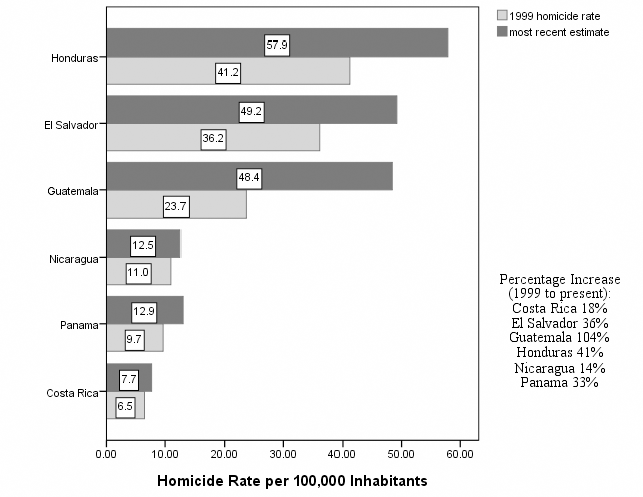
Homicide Trends (1999-present) 10
All 1999 data are from El Observatorio Centroamericano sobre Violencia (OCAVI). Additional data from OCAVI were used for the most recent estimates for Costa Rica (2006), Nicaragua (2006), Panama (2007), and Honduras (2009). The most recent estimate for Guatemala is from 2008, based on national police reports cited by Mendoza (2010). Data from El Salvador are from 2007, based on the Proyecto Democracia y Seguridad Ciudadana Cuadro de Indicadores para El Salvador (Georgetown University's Political Database of the Americas Project). Please refer to the online appendix for a complete listing of data sources for these homicide rates. The appendix also documents trends in homicide rates over time in each country, available as this article's supplementary material at the journal's website: www.jpla.org.
For global data on homicide rates and trends, see the United Nations Surveys on Crime Trends and the Operations of Criminal Justice Systems (CTS), online: http://www.unodc.org/unodc/en/data-and-analysis/United-Nations-Surveys-on-Crime-Trends-and-the-Operations-of-Criminal-Justice-Systems.html (May 28, 2010).
The problem of crime has been compounded by the state of contemporary justice systems. With the advent of democratization, fledgling institutions have struggled to rebuild themselves while simultaneously confronting skyrocketing crime rates (Frühling, Tulchin, and Golding 2003; Lafree and Tseloni 2006). Some observers have noted that such efforts are akin to “fixing a broken army in the midst of a war” (Ellingwood 2008: 1). To be sure, substantial resources and effort have been invested to fix these broken armies. 9 With the impending collapse of authoritarian governments in the mid 1980s, reformers recognized the importance of transforming authoritarian justice systems to provide strong foundations for new democratic governments (Salomón 1996; Belton 2005). In Central America, there was a pressing need to write new constitutions and legal codes and/or reform existing ones, as well as train judges, lawyers, police detectives, and other legal professionals to uphold these new features (Carothers 2006). Reform of the criminal justice system was a top priority, leading to the overhaul of the penal codes throughout the region (Chinchilla 2003; Hammergren 2007). Institutions like the courts and police required extensive updates to both their infrastructures as well as procedures, as an exclusive reliance on written proceedings created extreme backlogs and delays, and opened the door for corruption and the abuse of civil liberties. Indeed, Ungar (2002: 35) notes the region's large number of unsentenced prisoners, some of whom spend more time in pretrial detention than they would if convicted of their crimes. To rectify such problems reformers introduced oral proceedings, replacing the inquisitorial model with adversarial or mixed models (Chinchilla 2003). Police systems also required extensive overhaul, as reformers strived to combine the modernization of police practices with demilitarization and depoliticization (Call 2003; Chinchilla 2003).
Tables in the appendix list many of the domestic and international resources devoted to justice reform, available as this article's supplementary material at the journal's website: www.jpla.org.
By the mid 1990s, justice reform had become part of a broader movement promoting good governance. International financial institutions aimed to foster independent and effective judiciaries that would be capable of promoting democracy, as well as protecting property rights and enforcing contracts (Finkel 2008). Despite the resources and attention justice reform has garnered from a variety of actors, the track record of reform has been mixed. Critics cite many reasons for the problems justice reform has encountered. Failure to coordinate reform efforts with other foreign governments, international organizations, domestic governments and civil society groups ranks at the top of the list (Sarles 2001). Since international actors engage, and occasionally compete, with domestic civil society groups, justice reform has sometimes been diluted, uncoordinated, and occasionally in conflict with the agendas of other actors (Dakolias 2001). Others critique the practice of reforming just one institution at a time, instead of pursuing comprehensive or holistic reforms (Prillaman 2000). Furthermore, some types of justice reform have been prioritized over others. Prison reform is one area that has certainly languished, for example. Hammergren (2007) also points to an “excessive emphasis” on the introduction of oral trials, which can lead to the neglect of other crucial areas of reform. Finally, there is concern that efforts have not recognized that reform requires extensive cultural change as well (Belton 2005).
Figure 2 provides an overview of the performance of Central American justice systems, based upon the World Bank's Rule of Law Rankings (a component of the Governance Indicators). 11 Hammergren (2007) notes the many problems inherent in measuring the quality of justice systems, advising that such rankings must be interpreted cautiously. Still, the World Bank rankings have the advantage of relying upon numerous sources in each country for each annual score, and do provide a valuable overview (Kaufmann, Kraay, and Mastruzzi 2009). As Figure 2 indicates, the Costa Rican system performs far better than its regional counterparts, on par with European countries. Still, contemporary performance has dipped from that of the mid 1990s. Panama falls in the intermediate range; its performance has remained steady from the mid 1990s to the present, and is well above the remaining countries. Of these latter poor performing countries, only El Salvador has witnessed some improvement from the 1990s to the present.
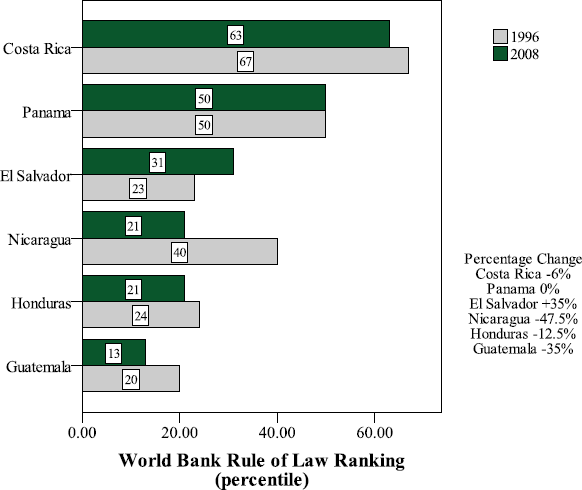
World Bank Rule of Law Rankings (1996-2008)
The appendix provides additional graphs charting the World Bank rankings over time in each country, available as this article's supplementary material at the journal's website: www.jpla.org.
Based upon this overview, the Central American countries can be classified into three groups. With low levels of violent crime and a justice system that performs well above its neighbors, the Costa Rican system emerges as the success story of the region. In contrast, the justice systems of Nicaragua and Panama rank far below that of Costa Rica, but have not faced the stiff challenge of exceedingly high rates of violent crime. In the last category are the countries confronting the twin challenges of high homicide rates and poor performing justice institutions: Guatemala, El Salvador, and Honduras.
Data Analysis
With these national differences in mind, this analysis builds upon prior work by examining the linkage of a particularly salient specific output (crime) to diffuse support in different national contexts, across distinct components of the justice system. To this end, the analysis proceeds in three parts. First, it examines the relationship between specific and diffuse support in the high crime, low performance countries of Guatemala, El Salvador, and Honduras. It then assesses this linkage in a different national context – the low performance, low crime countries of Panama and Nicaragua. Finally, the analysis turns to Costa Rica, the country with comparatively high performance and low crime.
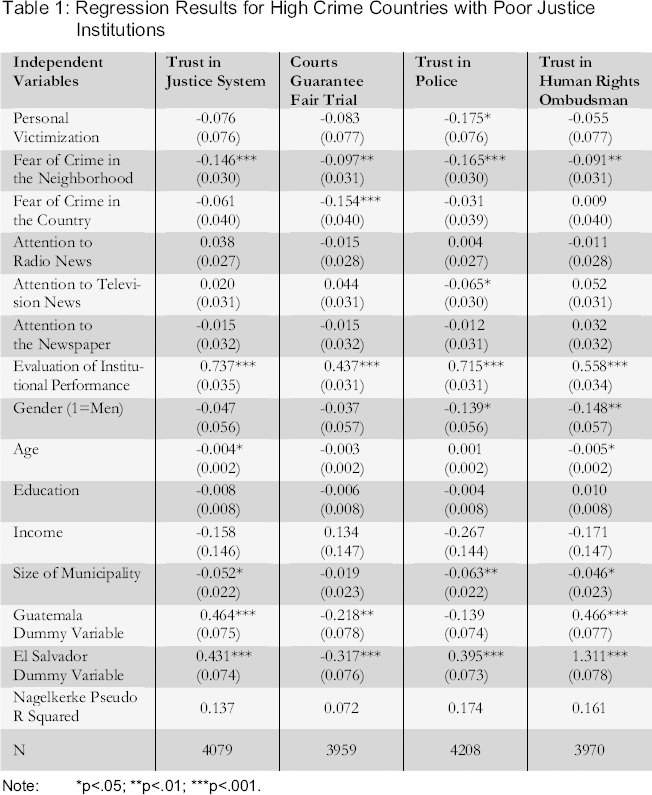
Table 1 reports the results of the data analysis of the high crime, poor performance countries, listing ordinal logistic coefficients with standard errors in parentheses. In addition to assessing the relationship between specific and diffuse support, the analysis also tests the additional hypotheses concerning the media and individual-level factors. Given the theoretical import of these factors, it is essential to control for their impact in the multivariate analysis. Dummy variables are also included to control for country-specific effects.
Regression Results for High Crime Countries with Poor Justice Institutions
Note:
p<.05;
p<.01;
p<.001.
As Table 1 indicates, there are several ways in which crime chips away at diffuse support. Most importantly, there is a strong significant relationship between evaluations of crime control performance and the four indicators of diffuse support. When respondents believe that the justice system can catch and prosecute criminals, they register higher levels of diffuse support for the courts (by 0.437), the police (by 0.715), human rights ombudsmen (by 0.558), and justice system more broadly (by 0.737). Fear of crime in the neighborhood is also important, as it is closely tied to all four measures of diffuse support in these countries. As respondents grow more fearful of victimization in their immediate environments, they are significantly less likely to support the justice system more broadly (by 0.146), as well as the courts (by 0.097), the police (by 0.165), and human rights ombudsmen (by 0.091).
While fear of crime is important, local perceptions matter far more than national ones. Fear of crime in the neighborhood is significantly tied to all four measures of diffuse support, but fear of crime in the country is significant only in the model predicting support for the courts. In this case, as fear of crime in the country increased, respondents are 0.154 less likely to think that the courts guaranteed a fair trial, holding all other variables constant.
Table 1 indicates that crime can erode public support for the justice system and its key institutions. However, what matters most are public perceptions of local crime and institutional performance, not necessarily personal experiences with victimization. Victims register significantly lower levels of trust in the police, but not in the courts, human rights ombudsmen, or justice system. 12 This is likely due to the fact that crime prevention is the principal task of the police. In contrast, courts, human rights ombudsmen, and justice systems have wider responsibilities, such as the protection of property rights and mediation of labor disputes. Consequently, victims of crime are more prone to blame the police, the most visible face of public service provision.
This lack of significance is not due to problems with multicollinearity. Despite a modest significant correlation with fear of crime in the neighborhood, victimization is insignificant even when included in models without this measure of fear of crime. Once the models control for socioeconomic factors, the impact of victimization becomes insignificant.
Surprisingly, the media exposure variables have little impact. Attention to the radio and newspaper are not significant, and exposure to television news is significant only in the model predicting support for the police. Once again, the most prominent component of crime prevention is penalized. As attention to television news increases, trust in the police decreases by 0.065, holding all other variables constant. The relationship between media exposure and the police holds only for television news, the most visual medium for graphic depictions of crime.
Most of the social identity variables also have little influence. Education and income are insignificant across all four models, and gender and age perform inconsistently. Municipality size did attain statistical significance in three models, however. As the size of the municipality increased, respondents were less likely to trust the justice system (by 0.052), police (by 0.063), and human rights ombudsmen (by 0.046). The country dummy variables indicate that compared to Honduras, support for the justice system and human rights ombudsmen is significantly higher in El Salvador and Guatemala, but trust in the courts is significantly lower. 13 Trust in the police is in a statistical tie in Honduras and Guatemala, but significantly higher in El Salvador.
Honduras is the reference category.
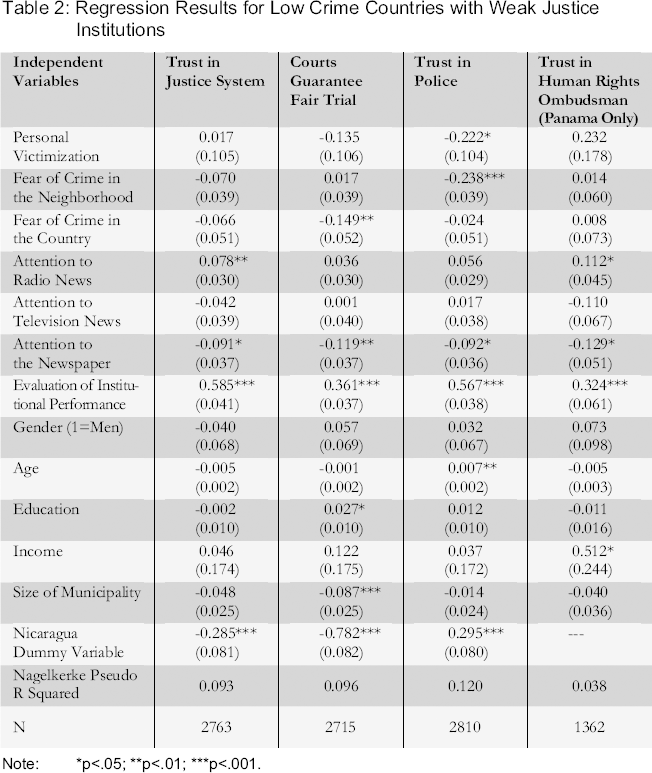
Table 2 examines these same relationships in Panama and Nicaragua, two countries with low rates of violent crime, but weak justice institutions. Despite some similarities, the relationship between specific and diffuse support differs in these national contexts. Overall, evaluations of crime control performance are far more important than victimization or fear of crime. As crime fighting efficacy increases, all four measures of diffuse support significantly increase. The magnitude of this boost ranges from a 0.324 for the human rights ombudsman to 0.585 for the justice system as a whole. In contrast, victimization and fear of crime in the neighborhood are significant only in the model predicting trust in the police. In this group of countries, both personal victimization and local fear of victimization reduce support again only for the most visible face of crime prevention, the police.
Regression Results for Low Crime Countries with Weak Justice Institutions
Note:
p<.05;
p<.01;
p<.001.
The last measure of crime, fear of crime in the country, yields similar results in Tables 1 and 2. In both cases, this national measure is significant only in the case of the courts. As fear of crime in the country increases, belief that the courts guarantee fair trials decreases by 0.149, holding all other variables constant.
In this group of countries, the media exposure variables are far more important. Attention to television news is insignificant, but heightened attention to the newspaper corresponds to decreases in trust in the justice system (by 0.091), the courts (by 0.119), the police (by 0.092) and human rights ombudsman (by 0.129). A different trend emerges for attention to radio news, however. As attention to radio news increases, trust in the justice system significantly increases by 0.078, and in the human rights ombudsman by 0.112, holding all other independent variables constant. Thus, the impact of media exposure varies tremendously across countries, as well as across media. The study of crime coverage in Central America is quite new, but appears to be a fascinating venue for future research. 14
Krause (2009) provides an excellent framework for such research with her recent analysis of Guatemalan media coverage.
The social identity variables have little impact in this group of countries. Gender is insignificant across the four models, and age, education, income, and size of municipality have isolated and sporadic effects. The Nicaragua dummy variable indicates that compared to Panama, Nicaraguans are less likely to trust the justice system (by 0.285) and the courts (by 0.782), but more likely to trust the police (by 0.295).
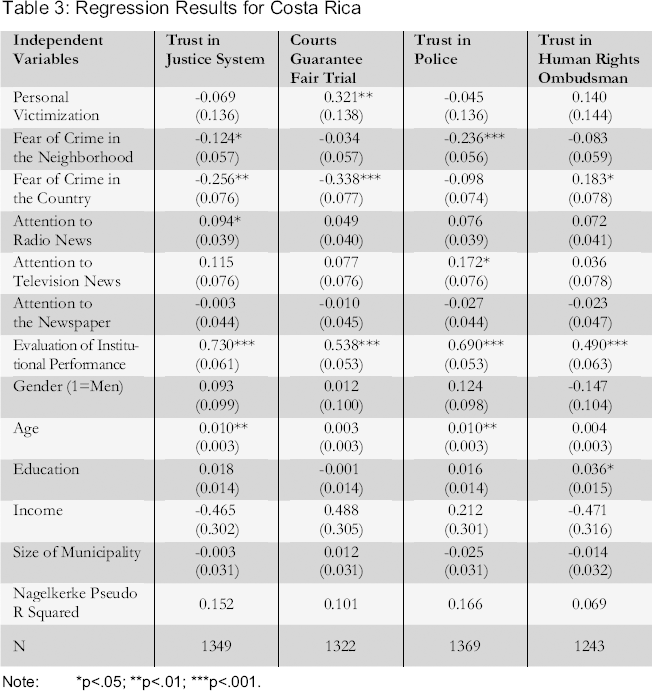
Table 3 examines the impact of crime on diffuse support in Costa Rica, the region's exception. Compared to the other cases, violent crime is low and justice performance is high. Still, it is important to remember that within this case, crime rates have risen and justice performance has declined. The national context of Costa Rica is far above the regional average, but Costa Ricans might compare contemporary crime and justice performance in terms of their own past experience and trends, not to that of their Central American neighbors.
Regression Results for Costa Rica
Note:
p<.05;
p<.01;
p<.001.
Table 3 indicates that Costa Rica diverges from the region in some interesting ways. Evaluations of crime control performance remain strong and significant predictors of all four measures of diffuse support. However, the other crime variables follow different trajectories. Fear of crime in the country emerges as much more important in the case of Costa Rica. In the models predicting support for the justice system and courts, as fear of crime in the country increases respondents are less likely to support the justice system (by 0.256) and the courts (by 0.338). In contrast, as fear of crime increases respondents are 0.183 more likely to support the human rights ombudsman. The impact of fear of crime in the country is nuanced. These findings indicate that fear of crime can erode support for the courts and the justice system as a whole, but Costa Ricans are willing to turn to other institutions in their place. Fear of crime in the neighborhood had a more moderate impact, significant only in the models predicting trust in the police and trust in the justice system.
Personal victimization exhibits a very different pattern. Victimization is significant only in the model predicting support for the courts, yet its sign is positive. Victims of crime are 0.321 more likely to believe that courts guarantee fair trials than non-victims. To explain this puzzling finding, it is helpful to examine the attitudes of crime victims in more detail. Closer examination of other LAPOP questions reveals that victims report that they are significantly more satisfied with their personal interactions with the courts than non-victims. This counter-intuitive finding provides good news for the Costa Rican courts, as it indicates that victims who have personal experience with the courts register more positive evaluations.
The effects of media exposure are small, but in the two cases where these variables are significant, increases in media attention (to radio and television news) correspond to more diffuse support (in justice system and police respectively). Social identity characteristics also have very little impact. Gender, income, and size of municipality are insignificant across all the models, while age and education are significant only in isolated cases.
Conclusion
Across the Central American countries, crime control performance is significantly linked to diffuse support for the justice system as a whole, as well as its key institutions. This relationship holds regardless of democratic longevity, justice system performance, and violent crime rates. The exact mechanism by which crime affects diffuse support varies considerably according to national context, though.
In countries with lackluster justice systems, personal experience with crime erodes diffuse support only for the police. In contrast, public fear of crime has much larger effects. In the poor-performing, high crime countries of Guatemala, El Salvador, and Honduras, fear of crime in the neighborhood has a consistent negative relationship to all measures of diffuse support. The impact of local fear of crime diminishes as the nature of the crime crisis changes, however. Fear of crime in the neighborhood has much smaller effects in the low crime countries of Nicaragua, Panama, and Costa Rica. Indeed, in Costa Rica support for the justice system and its institutions is tied more closely to fear of crime in the country, as public concerns about the national context trump those of local environments. Still, across all the countries and measures of diffuse support, institutional performance is a significant and powerful predictor. If citizens perceive justice institutions as performing poorly in the specific area of crime control, their legitimacy as a whole will suffer.
Chinchilla cautions that crime's erosion of legitimacy can make repressive measures more popular, despite the fact that they show “little effectiveness in containing the problem” (2002: 23). To counter such trends, Chinchilla advocates more comprehensive policy innovations. In particular, she argues that community security and community policing are well-suited to address the complexity of public insecurity, as such programs:
[…] emphasize the citizen as beneficiary of and participant in the design, implementation, and control of security policies. From this perspective both the objective behavior of crime and citizens’ fear of crime are matters of concern, and balanced actions are proposed not only with respect to the offenders but also with respect to the victims (Chinchilla 2002: 17).
Current trends towards decentralization facilitate such programming, creating space for citizen participation in crime control while offering mechanisms to tailor strategies to meet the needs of specific communities. Such innovations offer insights into the ways in which the rule of law can coexist with effective responses to insecurity (Chinchilla 2003).