




Abstract
In the Brazilian Chamber of Deputies, an absolute majority may bring any bill out of committee and to the floor for consideration without the committee's report by approving an urgency petition. The prevailing interpretation is that urgency petitions have been used by government majorities to get round unsupportive committees. Contrary to this interpretation, we find that only rarely petitions for executive bills are approved without consensus. We identify two reasons why government majorities in Brazil hardly ever impose their agenda on the Legislature: their common agenda is small, and majority members often enjoy informational gains from letting opposition committees examine executive bills.
Introduction
The processes of redemocratization undergone by Latin American countries have raised a large number of questions related to the possibility of institutionalization of democracy, the stabilization of the governing process, and the choice of institutions that would structure the policy-making process under the new regime. In general, what occurred was the choice of institutions that concentrate extensive agenda powers in the hands of the President, which has motivated the growth of a fertile literature that investigates the potential impact of such institutions on the pattern of executive-legislative relations (e.g., Shugart and Mainwaring 1997; Shugart and Carey 1992; Shugart and Haggard 2001). However, as Alemán and Tsebelis (2005: 3) correctly observe, constitutional provisions have received much more attention than legislative rules. Only recently comparative scholarship in Latin America has been directed to parliaments and the logic of their internal political processes (see, e.g., Alemán 2006; Morgenstern 2002). This article seeks to contribute toward filling up this gap.
We investigate the logic underlying the use of one important legislative agenda control mechanism, the urgency procedure, in the particular context of the Brazilian Chamber of Deputies. Simply put, the urgency procedure is a mechanism to force action on a bill. Its importance resides in the control of the flow of legislative business, meaning not only the capacity to bring to the floor bills that are (or may become) “stuck” in committees but also the capacity to determine what will be decided first. In Brazil, the high dominance of executive bills in the legislative agenda and the frequent use of the urgency procedure for expediting them have led analysts to conclude that this procedure is employed by the presidential majority to control the policy-making process (Figueiredo and Limongi 2000; Pereira and Mueller 2004). However, as we shall show, only rarely urgency petitions for executive bills are approved without the support of all legislative parties. Such pattern is not consistent with explanations of executive dominance based on the President's formal powers and legislative strength, thus making the Brazilian Chamber an interesting case for analysis.
In this article, we shift the analytical focus from the Executive and its powers to the legislators and the logic of the legislative process. Our explanation for the rare use of the urgency procedure by government majorities to expedite executive bills against the preference of the opposition is based on two claims. The first claim is that government majorities in Brazil most often fail to agree on a significant number of relevant policy proposals, meaning that the shared agenda of government parties is very limited, implying a small number of government bills that can be the target of urgency petitions. The second claim is that majority members often enjoy informational gains from letting opposition committees examine executive bills, thus reducing the incentive for using the urgency procedure.
Interest in the urgency procedure and the logic of its use extrapolates the Brazilian case since this agenda control mechanism is part of the institutional repertoire of several Latin American presidential democracies. 1 However, to our best knowledge, there is no significant scholarship on the use of urgency procedures outside Brazil. Because our analytical approach is sufficiently general, we believe it can easily “travel” to other legislative contexts, notwithstanding specificities due to particular rules governing the use of the procedure in certain cases. We can only hope this article will serve to stimulate further research on this subject.
For a list of the countries with urgency procedures, see Alemán (2006).
The rest of this article is organized as follows. In the following section, the Chamber's urgency rules are described and the related literature is briefly reviewed. In section 3, we provide evidence of the consensual use of urgency petitions for executive bills. In section 4, we advance our explanation for the main patterns revealed in section 3. In sections 5, we provide preliminary evidence in support for our explanation. Finally, in the last section, we conclude making some general remarks about the implications of our findings.
The urgency procedure has a prominent role in the Brazilian legislative process. The 1988 Constitution endows the President with the power to unilaterally give urgency status to bills of his own initiative, implying that the Chamber and the Senate have, successively, 45 days to vote on it, after which period the bill is automatically included in the order of the day and the deliberation on other bills is suspended, so that the voting may be concluded. Also, the Chamber's internal rules allow a majority of its members to bring any bill out of committee and to the floor for consideration at any time. Since the promulgation of the Constitution and until the end of 2005, 54 percent of all bills enacted into laws had been deemed urgent either by the President or by the Chamber. In almost all cases (50 out of 54 percent) it was the Chamber and not the President that used the urgency procedure (Figueiredo 2006: 15). For this reason, we restrict our attention to the Chamber's procedure.
Although the Chamber's urgency procedure can be traced back to the internal rules of the first democratic Congress, inaugurated in 1947 and which lasted until the military coup of 1964, its current form was defined in the internal rules adopted in September 1989, one year after the promulgation of the current Constitution. There are two urgency rules: the “simple urgency” and the “super urgency,” respectively defined in articles 154 and 155 of the Chamber's rules (Câmara dos Deputados 2007). Any bill may be the object of an urgency petition (thereafter UP). Petitions are voted on the floor during the same session (plenary meeting) they are submitted. Under the simple urgency, at least one-third of the legislators (or party leaders that represent that number) need to sign the petition and a simple majority must approve it. Once the petition is approved, the bill goes to the top of the order of the day (the floor's voting schedule) of the following session. However, article 154 cannot be applied to more than two bills at a time. The super urgency, by its turn, requires that some absolute majority of the legislators sign the petition and, then, approve it. In this case, the bill automatically goes to the top of the order of the day of the same session, allowing it to be voted on even in the same day in which the petition is approved. Probably due to the restriction on the frequency with which article 154 can be used, practically all UPs for executive bills evoke article 155, notwithstanding it requiring a larger majority.
Once a bill is proposed, it may be the object of an UP at any time during the legislative process. If an urgent bill comes to the floor and at least one of the committees responsible for examining it has not yet voted its report, a member of the floor is selected by the Chairman of the Chamber to make an oral report on the bill, in substitution to the committee. One final important aspect is that floor members cannot present individual amendments to urgent bills. The subscription of at least one-fifth of the legislators (or of party leaders that represent that number) is necessary in this case. This imposes a strong restriction not only to the influence of the individual legislators but also of the legislative parties since only rarely a single party comes to control one-fifth of the Chamber's seats.
In sum, the Chamber's urgency procedures allow any majority to bring any bill out of any committee and to the floor at any time and then to vote on it, even immediately. So, it represents an important proactive power that majorities can use against committees not under their control. Despite its importance, there are only two significant works that study the procedure: Figueiredo and Limongi (2000: 82-89) and Pereira and Mueller (2004). The first presents the most comprehensive description of the incidence of UPs, and the second offers an explanation of their use.
Figueiredo and Limongi analyze the use of UPs for the bills enacted into law from 1989 through 1994. Their main findings can be summarized as follows: the urgency procedure is employed quite frequently (for 55 percent of those bills); in most cases, the committee does not even have the opportunity to examine the bill (41.5 percent of the urgent bills were deemed so in less than 15 days after their submission); it is used more frequently but not only for non-controversial bills (for 65 percent of bills related to administrative issues, and for 47 percent of bills related to economic or social issues); and it tends to favor the Executive (53 percent of the executive bills were given urgency status, against 43 percent of bills initiated in the Chamber). The partial data available for the period 1995-1998 indicate that at least the main patterns have persisted: again, 55 percent of bills approved in the Chamber were given urgency status, and it was given for 58.5 percent of the executive bills and for 35 percent of bills initiated in the Chamber. 2
The figures for 1995-1998 were computed from Pereira and Mueller's data set. We thank them for kindly sharing the data.
The authors also describe how the urgency procedure is used to benefit the Executive: the leaders of the parties that make up the government majority submit UPs for non-controversial administrative bills that are important for the functioning of the government and for controversial bills in committees whose median preferences are not aligned with the government. But there is one crucial question the authors do not address: if committees are the legislative arenas where policy proposals may be examined and improved, why does the floor systematically prevent the committees from examining government bills?
Pereira and Mueller offer an answer to that question, based on Gilligan and Krehbiel's (1987) informational model of the legislative process which, by its turn, is an application of Crawford and Sobel's (1982) cheap-talk model. Their answer can be summarized as follows: the floor uses the urgency procedure whenever it prefers a less informed decision today to a more informed decision tomorrow. Such preference order obtains if and only if the cost of waiting for the committee's report is higher than the expected informational gain from taking into account the report. It is this last parameter the authors focus on. They make use of the main result from the cheap-talk model to conclude that the informational content of the committee's report decreases as the committee-floor divergence increases. By extension, they hypothesize that, as long as waiting for the committee's report is costly, the likelihood of an UP being approved increases as the degree of committee-floor divergence increases. As we will argue later on, however, this hypothesis is not generally valid. 3
Although the authors provide statistical evidence in support for their main hypothesis, their analysis raises more questions than answers. One important problem is that, even though most bills are sent to more than one (and up to five!) committees, the authors compute only one observation of committee-floor divergence per bill, offering no explanation as to why they omit the other observations, thus rendering their empirical findings suspicious of being contaminated by selection bias.
Common to these analyses is the conclusion that the Chamber's urgency procedure is one of the institutional mechanisms responsible for the dominance of the Executive's agenda in the policy-making process. In the words of Figueiredo and Limongi, “The executive defines the legislative agenda and determines the content of the legal output. Congress shows itself to be incapable of moving forward with its own agenda” (2000: 89). And according to Pereira and Mueller, “(…) as the president's party or coalition has the majority of seats in the House, the executive can count on party leaders to discharge proposals from the committees that it has more interest in seeing approved” (2004: 17). However, as we will show in the following section, the interpretation that the Chamber's urgency procedure has been used by governing majorities to impose the Executive's agenda on the whole Legislature against the preferences of the opposition is not consistent with the fact that UPs for executive bills only rarely are approved without consensus.
For every one of the 930 bills submitted by the Executive to the Chamber since the inauguration of President Collor (March 15, 1990) and until the end of President Lula da Silva's first term (December 31, 2006), we investigated whether an UP was approved by the Chamber floor and, if so, whether the vote on the UP was consensual or not. Before presenting our findings, we explain the criteria we used to collect the data and compute the values.
The executive bills that comprise our cases are the most common type of legislative initiative in Brazil, the ordinary bill (projeto de lei ordinária). It means that the data set does not include bills that aim at altering or complementing the Constitution, budgetary bills or presidential decrees. Instead of restricting the sample to bills that were enacted into laws, we include all bills that were submitted by the Executive, regardless of their fate. Given our interest in the incidence of UPs, which are prior to the vote on the bill, we see no reason to exclude bills that have failed to become law. The bills submitted by President Sarney are not included in our sample because the current format of the Chamber's urgency procedure was defined only six months before the end of his term. We define as consensual UPs that are approved against the votes of at most 5 percent of the legislators (or party leaders that represent that number). Due to data collection limitations, we only observed the incidence of UPs during the pre-Senate stage of the legislative process (we see no reason for this limitation to generate selection bias). All the data were collected from the Brazilian Chamber's website. 4
Online: http://www.camara.gov.br.
Our findings are summarized in Table 1. The figures in row A are the average number of executive bills submitted per year during each presidency. The frequencies with which UPs were approved with and without consensus for such bills are presented in rows B and C, respectively. Note that we only consider UPs approved for the incumbent's bills and during his term. This restriction is intended to give a more accurate picture of how much each president benefited from legislative urgency for implementing his agenda. 5 In row D, we present the overall frequency of UPs approved for executive bills. It can be seen that the Chamber floor used the urgency procedure for a little more than one-third (36.2 percent) of the bills submitted to it by the Executive. Only the Cardoso administrations deviate from the average: the first administration is well above (52.8 percent) and the second, somewhat below (27.1 percent).
Yearly Averages of Executive Bills and of UPs Approved, by Presidency
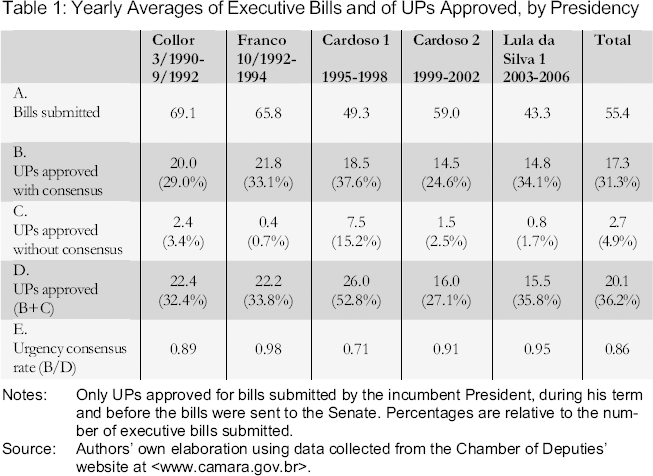
Notes: Only UPs approved for bills submitted by the incumbent President, during his term and before the bills were sent to the Senate. Percentages are relative to the number of executive bills submitted.
Source: Authors’ own elaboration using data collected from the Chamber of Deputies’ website at www.camara.gov.br.
The bills from Cardoso 1 that were deemed urgent under Cardoso 2 are computed under the former. The same is true for Lula da Silva 1 and 2. The numbers of urgent bills which were excluded because the UP was approved under a subsequent president are: Collor (11), Franco (5), and Cardoso (12). All these UPs have been approved by consensus.
More important for our purposes is the evidence, presented in row C, that the use of the urgency procedure for executive bills has been consensual. When we consider the bills submitted by the Executive during the whole period, for only 4.9 percent of them an UP was approved without consensus. This picture does not change much when we compute the rate of consensual UPs relative to the total number of UPs (row E): 86 percent of all UPs approved for executive bills were consensual. The only exception to this pattern is the first Cardoso administration, during which UPs were approved without consensus for 15.2 percent of the executive bills and the consensus rate was lower (71 percent). Note that, although higher than the other periods, even in the Cardoso administration the incidence of non-consensual UPs (thereafter, NCUPs) can be considered low.
This consensual pattern is not the result of extremely large government coalitions: the average nominal size of the government coalitions at the moment UPs were approved was 60 percent. 6 Since UPs for executive bills only rarely are approved without the support of at least 95 percent of the legislators (or party leaders representing that number), we must conclude that the evidence does not lend support to the interpretation that the Chamber's urgency procedure has been used by the Executive, through its legislative majority, in order to impose its agenda on the whole Legislature.
This average is weighted by the number of UPs approved while the coalition lasted. For the nominal sizes of the government coalitions and their duration, see Figueiredo (2006: 20).
From the above evidence we can conclude that, overall, the urgency procedure has been used for executive bills only when there is consensus regarding the bill's substantive content. After all, if some party opposes a bill then it should also oppose UPs for bringing the bill to the floor for consideration. 7 But why don't government majorities use the urgency procedure for bills that they want to see implemented but that face resistance from the opposition?
We thank an anonymous referee for pointing this out.
In order to answer this question, like Pereira and Mueller we also rely on the insights from informational models. However, our application of such models differs from theirs on several aspects, as we will make clear in the next section. In substantive terms, our results are less restrictive in what relates to the capacity of committees to provide credible information to the floor. Moreover, we also identify more restrictive conditions for some majority to be impatient about approving executive bills. These two results imply weaker incentives for the use of UPs for executive bills.
In this section, we present a non-formal application of communication models to the legislative process. Our goal is not to advance on such models, but simply to use their insights for a specific purpose: to explain the patterns discussed in the previous section. We agree with Pereira and Mueller's general proposition that an UP is approved whenever the cost of waiting for the committee's report is higher than the expected informational gain from taking into account the report. What we do next is to analyze these two parameters separately, with emphasis on the role of legislative committees in ameliorating the informational basis of floor decisions. Since the waiting cost is an exogenous parameter, we analyze it only briefly.
Our major source of inspiration is Gilligan and Krehbiel's (1987) legislative game under unrestrictive amendment procedures and without committee expertise, which is an application of Crawford and Sobel's (1982) seminal cheap-talk model. But we also incorporate insights from more recent models that build on the standard cheap-talk, endogenizing the acquisition of information (Beniers and Swank 2004; Che and Kartik 2007; Dur and Swank 2005; Eso and Galambos 2008) and incorporating multiple advisers (Gilligan and Krehbiel 1989; Krishna and Morgan 2001). Before specifying our application, we briefly highlight the main findings from this literature.
Communication models are mainly concerned with the acquisition and transmission of information. Two basic ideas motivate such models: the decision-maker (thereafter DM) is uncertain about the consequences of his or her choices, and there are collective gains from better informed decisions. In the case of the standard cheap-talk model, the central question is how much information a single informed adviser is able to credibly communicate to the DM when information is direct and cannot be verified (i.e., it is soft). The answer is that the adviser credibly communicates all his or her private information if and only if his or her ideal preference coincides with the DM's. If not, the adviser's ability to credibly share information decreases as his or her bias (i.e., the distance between his or her ideal preference and the DM's) increases. In sum, apart from the unlikely case of a non-biased adviser, in the standard cheap-talk model all communication implies some informational loss, which is increasing in the bias of the adviser.
The key factor behind the cheap-talk result is the inability of the adviser to credibly commit to fully reveal what he or she knows. Every biased adviser has an incentive to use his or her private information strategically so as to induce the DM to choose a policy closer to the ideal preference of the former. The DM cannot verify the information but he or she knows the bias of the adviser. His or her best action is then to assume the adviser acts strategically and to compensate for the bias such that his or her decision produces, in expectation, an outcome that is equal to his or her ideal preference. Knowing that the DM will compensate for his or her bias, the adviser is better off not fully revealing what he or she knows.
Our application is not restricted to the assumptions of the standard cheap-talk model. There are three important differences. First, we allow messages to contain not only soft but also hard (verifiable) information. The substantive distinction between them is that the former is made of opinions and conjectures whereas the latter is made of facts and data. Secondly, instead of assuming that the committee has a fixed amount of private information, we treat its knowledge as endogenous. Thirdly, instead of a single adviser, we consider two: the Executive and the committee. One aspect of these changes is that they make the model more realistic: committees often subsidize their recommendations with hard evidence; they often dedicate time to the acquisition of information (e.g., holding hearings) in order to become informed about specific bills; and, given the expertise of the Executive, it is natural to think of government bills as informed recommendations. More important though is the fact that the results become substantially different under these new assumptions.
If information were exogenous, then committees whose preferences are more aligned with the floor would be more informative since more biased committees have more incentive to use their information strategically. By endogenizing the information and allowing verifiable messages, that result may be reversed since more biased advisers have stronger incentives to incur the costs of searching for information that may persuade the DM to choose a policy closer to their ideal points. That first result may also be reversed when there are competing providers of information, more specifically two advisers with opposite biases, even if information is exogenous and soft. In this case, the advisers “discipline” each other's message and thus improve each other's credibility, implying that the DM benefits more from consulting both than only one of them. In the specific context of our analysis, it means that, given the recommendation from a biased executive, the floor may benefit more from consulting a committee with opposite bias than from consulting a non-biased committee.
Basic Features
There are three players in our game: the Chamber floor, the Executive and a legislative committee. The Chamber floor must choose a public policy under open amendment rule from a one-dimensional space, the result of which affects all players. However, floor members do not know the exact consequences of policies – they only have some prior belief about their likely results. 8
Our assumptions about the players’ preferences, what they know about the game and the relation between policies and outcomes are the same as in Gilligan and Krehbiel (1987).
From the median voter theorem, we know the equilibrium policy yields an outcome at the floor median's (thereafter, simply the floor) ideal point. But, given the uncertainty, that outcome is realized only in expectation, meaning that actual single observations will deviate from that ideal point, with larger deviations reflecting higher levels of uncertainty. The utility loss due to such deviations is called informational loss and is equal for all players. Besides the informational loss, biased players also incur in individual distributive losses due to the difference between their ideal preferences and the expected outcome. The distributive loss increases as the bias increases.
It seems uncontroversial to us that Brazilian legislators face a severe informational problem in the sense that the Legislature's institutional structure does not generate incentives for the endogenous and systematic acquisition of specialized information (Santos and Almeida 2006). This means that not only the floor but also the legislative committees are most often poorly informed. The Executive, due to its technocratic expertise and experience on the implementation of policies, is frequently very well informed about the consequences of the policies it proposes. We thus assume, for the sake of convenience, that both the floor and the committee are poorly informed and that the Executive is perfectly informed. However, once a bill is proposed, the committee has the option of acquiring information, which may improve its private knowledge.
Following Dur and Swank (2005), we conceive the acquisition of information by the committee as a costly and uncertain process. Information is gathered cumulatively through a sequence of activities, like holding hearings and collecting documents. Besides the opportunity cost of such activities, there is also the cost of learning the information (paying attention to the hearings, reading the documents, etc.). Compared to soft information, it is more costly to acquire hard information since the number of available sources is much more limited and the learning costs are higher. In either case, the process is uncertain because there is always the risk that the activities will not be sufficient to reveal the whole truth because the gathered information is either incomplete or wrong. That risk may be reduced by increasing the level of effort, but it cannot be eliminated.
Acquiring hard information might cost more, but only through such information can the committee reduce its distributive loss. The reason is that, unlike with soft information, the DM takes hard information at face value, regardless of the adviser's bias. By definition, hard information can be easily verified and, therefore, it cannot be misreported. It is true that it can be concealed though. But, in the context of committee-floor communication, the fact that the adviser has an incentive to conceal hard information that is unfavorable to him or her does not affect the credibility of his or her message because the DM does not know whether there exists such information or not, much less whether the adviser is withholding it or not (Milgrom 1981: 387-390).
The floor would like the committee to make its best effort in producing information. However, the committee's effort cannot be observed. Notwithstanding this restriction, the floor can take the preference of the committee median as an ex ante proxy for its level of effort. 9 The more biased the committee the more willing it is to incur the cost of acquiring hard information since it has more to gain from the reduction of its distributive loss. On the other hand, because more biased committees have less credibility they are less willing to base their recommendation on soft information. Thus, less biased committees are expected to direct their effort more to the acquisition of soft (cheap) rather than hard (costly) information, and more biased committees are expected to direct their efforts increasingly towards the acquisition of hard rather than soft information (Beniers and Swank 2004; Dur and Swank 2005; Eso and Galambos 2008).
The median ideal preference is a good proxy because all committee activities related to the acquisition of information must be approved by some majority in the committee, implying that no member whose bias is opposite to the committee median's is likely to have the means to acquire information that is contrary to the interest of the latter.
At last, we define the structure of our legislative game as follows: First, the Executive sends a policy proposal (bill) to the Chamber. The committee and the floor observe the Executive's message and then update their beliefs about the consequences of the policy. Secondly, the committee decides how much effort to put on the acquisition of information, which is inferred by the floor. Thirdly, the floor chooses whether or not to use the urgency procedure. If it does, it chooses a policy under open amendment rule based only on the information received from the Executive. Following that choice, payoffs are realized. If the floor chooses not to use the urgency procedure, the fourth stage is the committee acquiring information (conditioned on its chosen level of effort) and then sending a recommendation to the floor. Fifthly, the floor observes the committee's report, updates its beliefs, and then chooses a policy under open amendment rule, after which payoffs are realized.
Our analysis starts with the Executive sending a cheap message to the Chamber in the form of a policy recommendation (bill). 10 From the standard cheap-talk model, we know that if and only if the ideal preferences of the Executive and the floor are aligned, then the former credibly shares all its private information with the latter; if they are not, the amount of information shared by the Executive decreases in its bias.
We can consider the Executive's message as cheap by defining its bias after beliefs have been updated with any hard information revealed by it.
Consider the situation in which the bias of the Executive is insignificant. Given the assumption that the Executive is perfectly informed, and since there is no significant informational loss to the Executive's message, the floor's uncertainty after observing the Executive's recommendation is also insignificant. This implies a very weak incentive for any committee to incur the cost of acquiring information, either soft or hard. Consider now the situation in which the bias of the Executive is significant. Given the Executive's incentive to use its information strategically, it follows that the floor's uncertainty after observing the Executive's message is significant too. As the results from models with multiple advisers imply, the committee's incentive to acquire information is conditional on the locations of its ideal preference and that of the Executive, relative to the floor's (Gilligan and Krehbiel 1989; Krishna and Morgan 2001).
Suppose the biases of the committee and the Executive are on the same side. In this case, the committee has no incentive to acquire hard information since the Executive must already have disclosed all favorable hard information that is available. The committee has no incentive to acquire soft information either if its bias is at least as large as the Executive's because, in this case, it cannot send a message more credible than the Executive's. The committee has an incentive to acquire soft information only if its bias is smaller than the Executive's, and that incentive decreases as the bias of the committee increases.
Suppose now that the committee and the Executive have opposite biases. The committee then has an incentive to acquire both hard and soft information that contradicts the Executive's recommendation. In the case of hard information, the incentive is clear: to move the floor's decision towards the committee's ideal preference. In the case of soft information, the incentive is due to the committee knowing that the floor can extract more information by taking into account both the committee's and the Executive's messages, instead of only one of them. 11 So, if the committee and the Executive have opposite biases, and given the bias of the Executive, the committee's incentive to acquire information increases as its bias increases.
To be precise, this is true as long as at least one of the advisers is not an “extremist” (Krishna and Morgan 2001: 766). An adviser is considered extremist if and only if his or her bias is such that it exceeds some critical value above which his or her message does not discipline the message of the other adviser. Given the election rules for the Brazilian Executive (majority runoff, concurrent with Congress), it is very unlike that an extremist be selected.
This last result implies an important qualification to Pereira and Mueller's (2004: 28-29) main result that the informational value of the committee to the floor decreases in the bias of the former. In the case of executive bills, it is true only if the ideal points of the committee and the Executive are on the same side and the former is closer to the floor's ideal point. If only the first of these two conditions is true, then the informational value of the committee's report is null, whatever its bias. Moreover, if the committee and the Executive have opposite biases the expected relationship is generally the opposite of that hypothesized by Pereira and Mueller. So, our results imply less restrictive conditions for the committee's report to be valuable to the floor.
The acquisition of information by the committee takes time. In as much as legislators are impatient, that is, they prefer to collect the benefits of some policy sooner than later, the standard legislative process implies a positive waiting cost. The existence of such cost is a necessary condition for some majority to bring a bill out of committee. The reason is that even if the expected informational gain from the committee's report is insignificant, if there is no waiting cost it is more likely that the bill will be neglected instead of brought out of the committee and to the floor.
Tsebelis and Money (1997: 145-152) distinguish three types of legislative impatience: systemic, bill-specific, and electoral. Systemic impatience arises when the government majority faces a reasonable risk of losing its winning status due to defections, motivated especially by disagreements over policy. Bill-specific impatience arises when delaying implementation of the policy threatens government stability. This is the case, for example, of bills that aim at solving or ameliorating some pressing problem, like an economic crisis or social emergency, and bills necessary to keep the government running (e.g., authorizations for administrative actions). Finally, electoral impatience arises from the election cycle. Since at every election legislators need to present to their constituencies a positive legislative record, they tend to become more impatient to see their agendas approved as an election approaches.
According to Tsebelis and Money, legislative majorities in Brazil are expected to be very impatient for systemic reasons, for example because discipline is a problematic issue for several parties, especially the centrist Brazilian Democratic Movement Party (PMDB), which has participated in all majority government coalitions. 12 However, it does not mean that legislators are impatient about the same policies since they often have different priorities and they may fail to agree on what should be voted first. Only to the extent that the parties that form the majority government coalition are able to agree on some common set of policies they want to see implemented sooner than later, legislative impatience implies a higher frequency of UPs for executive bills. In Brazil, although government coalitions most often enjoy nominal majority status in the Legislature, the evidence that government parties are often “rolled” on floor votes suggest they have a very narrow shared agenda (Amorim Neto, Cox, and McCubbins 2003; Lyne 2008: 201-202). For this reason, we should not expect government majorities in Brazil to be able to agree very often on which relevant bills should be given urgency status.
For the rates of discipline of government coalitions, see Amorim Neto (2002: 64).
Now we have the elements to put together our explanation of the use of UPs for executive bills. First of all, we can say that for any bill to be voted out of the committee and to the floor it is necessary that there is some impatient majority. Moreover, and assuming everything else constant, the more impatient the majority the more likely that it uses the urgency procedure. But the floor also cares about its informational loss and thus takes into account the expected informational gain from letting the committee examine the bill.
The expected informational gain from the committee's report increases in the committee's incentive to collect information which, by its turn, is conditioned by the bias of the Executive and the location of the ideal points of the Executive and the committee relative to the floor. Given the cost of information, the committee collects information only if the bias of the Executive is sufficiently high (so that the floor's uncertainty is sufficiently high too) and the committee is either “opposing” or less biased than the Executive. If neither of these conditions is true, it is more likely that an UP will be approved for the bill.
Suppose the Executive and the committee have opposite biases. In this case, as the bias of the committee increases, the expected informational gain from its report also increases because it has more incentive to acquire both soft and hard information. Hence, if the Executive and the committee have opposite biases, the likelihood that an UP is approved for the bill decreases as the bias of the committee increases. Suppose now that the ideal point of the committee is located between the Executive and the floor. In this case, as the bias of the committee increases, the expected informational gain from its report decreases because it has less incentive to collect soft information and it has no incentive to collect hard information. Thus, if the ideal point of the committee is located between the Executive and the floor the likelihood that an UP is approved for the bill increases as the bias of the committee increases.
We can also identify the relation between the bias of the Executive and the likelihood that an UP is used, given the preference of the committee. In general, as the bias of the Executive increases the expected informational gain from the committee's report also increases and, hence, the likelihood that an UP is approved for the bill decreases. This is true when the committee is either “opposing” or less biased than the Executive, but it is only partly true when the ideal point of the Executive is located between the floor and the committee. The reason is that, although under this last preference configuration the bias of the Executive has no effect on the expected informational gain from the committee's report, as that bias keeps increasing it will necessarily become larger than the bias of the committee, a configuration under which we already know the bias of the Executive produces a negative effect on the likelihood of an UP being approved.
Hypotheses
The most important implications from our informational explanation are the conditional effects of the preference configurations and, given some particular configuration, the effects of the biases of the committee and the Executive. Unfortunately, we were not able yet to face the difficult task of operationalizing those preference configurations. For this reason, the hypotheses we derive from our results are at a more aggregate level.
As we have argued, the Executive is expected to be impatient about getting its policies approved when it succeeds in building a majority coalition. On the other hand, for the government coalition to use UPs it is necessary that its members agree on giving priority to the same policies or, in other words, they have a sizeable shared agenda. The concept of “legislative agenda cartel” becomes instrumental at this point. As defined by Amorim Neto, Cox, and McCubbins (2003: 552-553), a government coalition is organized into an agenda cartel if and only if it controls a majority of the seats and every single coalition member has a veto over the placement of proposals on the legislative agenda. Since, by definition, cartel members have a shared agenda, we can thus avoid the difficult task of identifying the size of the coalition's shared agenda and simply make use of the authors’ criteria for identifying agenda cartels. Moreover, the cartel model implies that the government coalition imposes its agenda on the whole Legislature. We can thus hypothesize that:
H1. UPs are used for executive bills if and only if the government coalition is an agenda cartel.
As we argued at the end of the previous section, whatever the preference configuration, we expect that, in general, the bias of the Executive negatively affects the likelihood that an UP is approved for the bill. So, we can state our second and last hypothesis as follows:
H2. The frequency with which UPs are used for executive bills decreases as the bias of the cartel increases.
Empirical Analysis
In this section, we provide a few pieces of evidence in support for our rationalization. Although we do not test most of the implications from our informational model, we believe the evidence we offer will at least render our explanation plausible.
In order to test hypothesis H1 we need first to identify whether and when government coalitions in Brazil were organized as agenda cartels. Amorim Neto, Cox, and McCubbins (2003) provide strong evidence that, from 1990 through 1998, only the coalition that supported the Cardoso administration (1995-1998) was an agenda cartel. Just during that administration the parties represented in the cabinet, aside from controlling a nominal majority in Congress, were rarely “rolled” on floor votes, unlike the opposition parties. 13 Lyne (2008: 201-202) calculated the “roll rates” until the first semester of 2005 and concluded that the government coalitions in the second Cardoso administration (1999-2002) and in the first year of the first Lula da Silva administration (2003) were agenda cartels. But we doubt the validity of her conclusion for two reasons. The first is that, even though the legislative coalition that supported President Cardoso formally broke apart only in the beginning of 2002, he could not count on the support from a sizeable section of the Liberal Front Party (PFL) at least since the beginning of 2001, after he supported the victorious candidate of his own party to the Chairmanship of the Chamber, against the interests of the PFL. Secondly, because in President Lula da Silva's first year his government coalition did not control a nominal majority in the Chamber. Curiously, Lyne includes the PMDB in that coalition, thus turning it into a majority, even though that party was not represented in the cabinet. In sum, we think it is fair to conclude that there is strong evidence that a legislative agenda cartel existed in the Brazilian Chamber from 1995 through 1998, and that it probably continued to operate until the end of 2000 but not later. 14
A party is rolled when the majority of its members votes against a bill that is approved. The authors consider that a party is rolled only rarely when this does not occur in more than 5 percent of the floor votes.
According to one journalistic account, the coalition started to break apart even earlier, in 2000, due to disagreements between Senator Antônio Carlos Magalhães (one of the leaders of the PFL) and President Cardoso (Rodrigues 2002).
Hypothesis H1 states that the existence of a legislative cartel is a necessary and sufficient condition for the incidence of UPs for executive bills. It should be noted that the hypothesis implicitly refers to bills that are relevant in the partisan sense. For this reason we consider only UPs that were approved without consensus, by which we mean those opposed by at least 5 percent of the legislators. The hypothesis is clearly consistent with the data presented in Figure 1, which depicts the yearly count of NCUPs and the non-consensus rate (1 – consensus rate) per year.
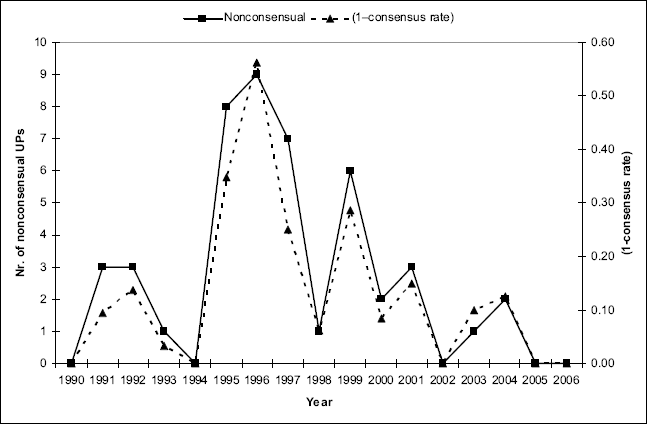
Number of NCUPs and the Non-Consensus Rate, 1990-2006
What is not clear from Figure 1 though is whether or not the return of the series to its pre-cartel level coincided with the end of the cartel, in the first months of 2001. In order to submit the data to more rigorous analysis, we used the unit-root test of a double shift in the series mean from Clemente, Montañés, and Reyes (1998). What is important about this test for our purposes is that the break points (years) in the mean are selected endogenously. Two alternative forms of shifts in the mean are taken into account: sudden changes (the additive outlier [AO] model) and gradual ones (the innovational outlier [IO] model). The test requires estimating the model:

The results from the AO and the IO models for the non-consensus rate series are reported in Table 2. The δ estimates are all significantly different from zero at the 1 percent level and in the expected directions: positive in the first change and negative in the second. The AO model identified the years 1994 and 1999 as the breakpoints, whereas the IO model identified the years 1993 and 1999. So, although the models’ results coincide in the identification of the year in which the series mean suffers a structural shift downwards (1999), they disagree about the year after which there is a structural shift upwards (either 1993, in the IO model, or 1994, in the AO). However, just by looking over Figure 1 we can clearly see that the shift that occurred in 1995 was not gradual but a sudden one. There is also another piece of evidence that suggests that the AO model fits the data better than the IO model: the unit root null hypothesis (ϱ = 1) is only barely rejected (at the 5 percent significance level) in the IO model, whereas it is rejected with strong confidence (at the 1 percent significance level) in the AO model. Since misspecification of the structural breaks leads to a lower probability of rejecting the unit root hypothesis when it is false, it is likely that the much lower confidence with which the IO model rejects the unit root hypothesis is due to its inadequate assumption that the shifts were gradual. We can thus conclude in favor of the AO model. Substantively, the result from this model indicates that, as of 1995, the yearly average of NCUPs became significantly greater than during the previous years, this new level having lasted until 1999, after which that average was significantly smaller. The fact that the downwards shift in the mean of the series of NCUPs occurred in 2000, and not in 2001, as we have “exogenously” defined, does not contradict our hypothesis.
Clemente, Montañés and Reyes’ Test of Unit-Root with Two Changes in the Mean: Non-Consensus Rate
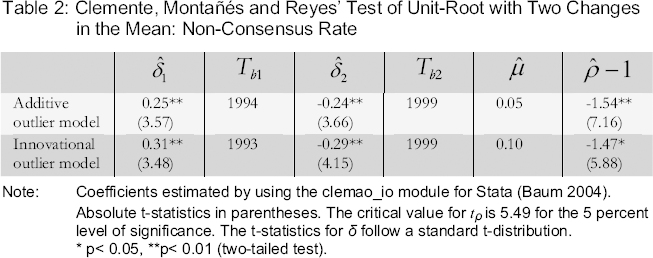
Note: Coefficients estimated by using the clemao_io module for Stata (Baum 2004). Absolute t-statistics in parentheses. The critical value for tρ is 5.49 for the 5 percent level of significance. The t-statistics for δ follow a standard t-distribution.
p< 0.05
p< 0.01 (two-tailed test).
So far, we have demonstrated that the incidence of NCUPs for executive bills was significantly higher during the cartel years (1995-2000). This evidence corroborates the sufficiency condition of our hypothesis. To check the necessary condition, we also need to test whether the incidence of NCUPs during the non-cartel years was not significantly different from zero. In order to do this, we estimated an Ordinary Least Squares (OLS) model of the non-consensus rate against an indicator for the years 1995 through 2000. The results (not reported) revealed that the constant term is not significantly different from zero, though very close to the critical value for the 10 percent significance level (t-value = 1.63), thus confirming our expectation. In sum, the results from these two tests show that that only during the cartel period there was a significant number of NCUPs for executive bills, thus corroborating hypothesis H1. 15
One possible alternative explanation is that the content of the Cardoso's policies was more conflictive (in the partisan sense). The results from a logistic model for whether or not a UP was approved without consensus, given that it was approved, corroborate the positive effect of the cartel even when controls for issue area (economy, society, etc.) and type of bill (administrative or distributive) are included. For model results please see appendix.
Unfortunately, we cannot test hypothesis H2 with the available evidence: since only during the Cardoso administration an agenda cartel formed, there is no variation in the bias of the cartel. And since H1 is not an “informational” hypothesis, we still have to provide evidence of an informational effect on the use of NCUPs for executive bills. This is what we intend to do next.
The cartel leadership had a significant (right-leaning) bias on several issues, which harmed the credibility of its recommendations to the floor. 16 So, it was in the interest of the latter that governmental policies were first examined in the committee. The committee's work could be beneficial to the Executive also, as long as it reduced the uncertainty of the floor without increasing the Executive's distributive loss. On the other hand, as much for the Executive as for its legislative allies, and only for them, the waiting cost of the implementation of several important governmental policies was high because it would take some time before they had any positive impact on the electorate. 17 Our question is then: how such constraints affected the way the cartel used the urgency procedure to expedite executive bills?
It is reasonable to assume that there was a substantial divergence between the floor median and the cartel leadership, even though the former was a member of the latter. Many legislators from the centrist PMDB were critical about one of the pillars of the Cardoso administration, the privatization of public utilities. Another coalition partner, the right-of-center Brazilian Labor Party (PTB), was also critical about the government's labor reforms and its minimum wage policy.
Velasco's interpretation of the motivation behind the approval of the UP for one of the bills regulating the telecommunications sector (PL 1287/95, a.k.a. Lei Mínima das Telecomunicações) is consistent with our assumption that cartel members were impatient. He quotes the following statement of the government leader in the Chamber, Deputado Inocêncio Oliveira, made in favor of the UP: “Mr. Chairman, almost one year ago, when we approved [by means of a constitutional amendment] the flexibilization of the telecommunications sector, we did so trusting that, by opening the country to foreign investments in the telecommunications sector, we would solve serious problems in different parts of the country. (…) one year has passed and there are many criticisms that the regulatory laws for the economy still have not been approved, preventing the country from enjoying these benefits” (2005: 211).
We claim that, instead of simply using the urgency procedure to send executive bills directly to the floor without letting the committee examine them, the cartel leadership used it in a later moment, which was however previous to the voting of the report by the committee. Specifically, once the leaders of the cartel and the floor median were able to reach an agreement over the bill's most controversial points, the urgency procedure was used to avoid that the opposition minority, through the mobilization of disloyal cartel members in the committee, succeeded either in approving a report that was less favorable to the cartel or in obstructing the voting in the committee. If our claim is correct, then we should observe that the non-consensual use of UPs for executive bills during the committee examination stage occurred more frequently under the cartel period, as compared to the other years.
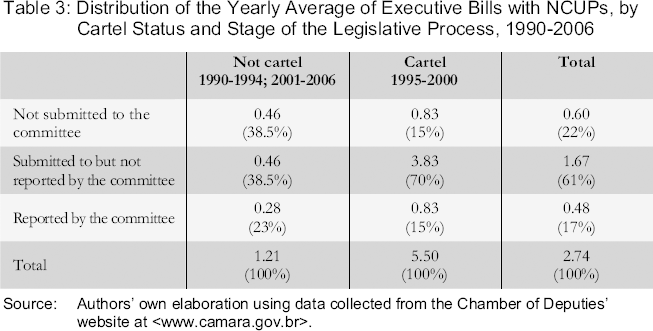
In order to check this hypothesis, for each of the 46 executive bills for which an UP was approved without consensus from 1990 through 2006, we identified the stage of the committee examination process in which the UP was approved. We classify a bill as “not submitted to the committee” when the UP is approved immediately after the bill is presented to the Chamber, giving no opportunity for the committee to examine it. Arbitrarily, we consider that this happens if the UP is approved either until seven days after the bill arrives in the first committee the bill was assigned to or before a rapporteur is designated to the bill in that committee, whichever is longer. We consider that a bill is “submitted to but not reported by the committee” when it is submitted to examination but voted on the floor without the report of at least one committee. Finally, a bill is “reported by the committee” when, at the moment of its floor vote, all committees’ reports have been approved. 18 In Table 3, we present the yearly averages of executive bills for which an UP was approved without consensus, by stage of the committee examination process and government period.
Distribution of the Yearly Average of Executive Bills with NCUPs, by Cartel Status and Stage of the Legislative Process, 1990-2006
Source: Authors’ own elaboration using data collected from the Chamber of Deputies’ website at www.camara.gov.br.
We include neither the reports from the rules committee (Comissão de Constituição, Justiça e Cidadania – CCJC) on the formal aspects of the bill nor the ones from the finance committee (Comissão de Finanças e Tributação – CFT) on the financial adequacy of the bill.
Note that, during the cartel period (1995-2000), the use of NCUPs was qualitatively different, besides being quantitatively higher. The partisan use of UPs by the cartel happened much more often during the committee examination stage, neither before nor after, whereas it is not true for the other years. While during the cartel years 70 percent of the executive bills declared urgent without consensus were at the committee examination stage when the UP was approved, during the other years the respective figure was 38.5 percent. As it may also be observed in Table 3, the higher incidence of UPs during the examination stage was accompanied by a smaller incidence of petitions before examination by the committee could even begin (15 percent under the cartel against 38.5 percent in the other years), whereas there appears to be no significant difference in the incidence of petitions after examination was completed (15 percent under the cartel against 23 percent in the other years). This is consistent with our claim that the problem for the cartel was to decide the right moment during the examination stage for approving the UP, in a way to allow the bill to be examined, thus diminishing the uncertainty of the floor, but only until the limit of the waiting cost.
In sum, the evidence lends support to our claim that there were informational constraints for the use of the urgency procedure by the cartel. Facing uncertainty amongst its members, the cartel leadership had to carefully choose the moment to bring its bills out of committee and to the floor. On one hand, it had to give the opportunity for the bill to be examined and its most controversial articles to be negotiated with its support base because, if not, the floor could choose a policy less preferred by the cartel leadership. On the other hand, however, the cartel leadership knew that its members were also impatient, what allowed the former to shorten the committee examination stage. The implication was a larger incidence of NCUPs for executive bills during that stage.
In the Brazilian Chamber of Deputies, and contrary to the existing dominant interpretation, UPs for executive bills have only rarely been used in a majoritarian fashion. Instead, they have been used in a consensual manner which, we argued, is consistent both with the qualified interpretation the agenda cartel model makes to the majority status of government coalitions in the Brazilian Chamber, on one hand, and also consistent with the positive-sum component of informational theories of legislative behavior, on the other.
Our findings indicate a much more relevant role for committees in the Brazilian Congress than previous accounts suggest. First of all, although UPs are used quite frequently, the fact that NCUPs are rare indicate that the most politically relevant bills, which are those that usually generate most disagreement, make their way through the standard legislative process. Secondly, we found less restrictive conditions for committees to provide relevant information to the floor about executive bills, in the sense that even more biased committees may have high incentives to produce information, as long as their biases are opposite to the Executive's. Last but not least, since the committee may have an incentive to produce information contrary to the interests of the Executive, and the floor may benefit from this situation, the interpretation that committees are “agents of the Executive” deserves a strong qualification.
What did we learn from our discussion on urgency petitions about the legislative performance under the Brazilian system of “coalition presidentialism”? We understand that two points deserve to be mentioned. The first one refers to the Legislature's informational problem, that is, the absence of institutional incentives for its members to specialize, implying that committees are in a handicapped position vis-à-vis the Executive. The most negative consequences of this informational asymmetry for the content of legislative decisions are likely to obtain when the preferences of the median legislator and the Executive are highly divergent and the committee has few incentives to collect information. This last condition prevails if either the preference of the Executive is located between the floor and the committee or the cost of information is high.
The second point refers to our qualification of partisan theories, specifically the cartel model of the legislative process, as applied to the Brazilian Chamber of Deputies. According to our findings, not every formal power may be viewed as pertaining to the set of agenda powers in the hands of a legislative cartel, that is, as an instrument at disposal of the majority to impose a certain agenda on the minority. From an informational perspective, the use of urgency petitions, considered by the literature an essentially majoritarian device, is in fact constrained by the legislators’ common interest on well informed decisions, thus implying a strong consensual aspect on the use of that device.
Footnotes
Appendix
As an alternative explanation for the fact that only during the years 1995 to 2000 the incidence of non-consensual UPs for executive bills was significant is that the content of Cardoso's policies was more conflictive (in the partisan sense).
In order to test the cartel effect against that alternative hypothesis, we estimated a logistic model for the variable whether (= 1) or not (= 0) the UP was approved without consensus, given that it was approved, including as independent variables a Cartel indicator for bills that had an UP approved sometime between January 1995 and December 2000, the log of the number of articles in the bill, which is a proxy for complexity, and indicators for the substantive content of the bill.
As for the content, we classified each bill as belonging to one and only one of the following issue areas: the state, the economy, society, infrastructure, and justice. The category “the state” includes policies about the organization and functioning of the direct federal administration (excluding state companies, universities, hospitals, etc.), its relationship with local governments, public servants, foreign policy, defense, and public finances. We classified under “the economy” policies aimed at productive activities (except family agriculture), monetary policy, prices and wages, employment, and taxes. The category “society” includes social and environmental policies, land reform, and emergency relief aid in response to natural calamities. “Infrastructure” includes policies about science and technology, communications, energy, mining, and transportation. Finally, “justice” includes policies about the organization and functioning of the judiciary and the police, the reform of legal codes, human rights, and anticrime legislation.
We also identified administrative bills and distributive bills. Administrative bills deal with the definition of administrative competences, procedures, and fees. Such bills cut across all issue areas, although the bulk of them are classified under “the state.” Administrative bills may belong to other issue areas, like the society (e.g., hiring more professors to a state university) and the economy (e.g., authorizing a state company to make an investment). On the other hand, bills about the state may be regulatory (e.g., defining rights and obligations of public servants) or distributive (e.g., increasing the salaries of a specific category of public servants). Distributive bills create benefits to specific populations and have diffuse costs. By specific populations we mean either particular economic or social groups (including public servants) or populations from particular geographic areas.
Bills were classified separately by issue area and type because the literature suggests that certain types, like distributive bills, generate less disagreement, which should (negatively) affect the probability of an UP being approved without consensus (Lowi 1964: 689-691).
The sample consists of the 332 executive bills initiated from March 1990 through December 2006 and for which an UP was approved until that last year. Descriptive statistics of these control variables are presented in Table A1.
When we first estimated the standard logistic model, we ran into the problem of separation in the data. Separation occurs when one or more independent variables perfectly predict the outcome of interest. In our sample, all UPs for distributive bills were approved under consensus, thus making it impractical to estimate the standard logistic model controlling for those bills. The solution was then to estimate the logistic model with Firth's (1993) penalized-likelihood correction for the separation problem (on this issue, see Zorn 2005). The results are presented in Table A2, which also portrays the differences in predicted probabilities. 19
For each binary variable, the predicted probabilities were calculated for the values 0 and 1. For the log of the number of articles, they were calculated for 1/2 standard deviation below and above the mean. In all cases, the remaining variables were fixed in their respective modes (if binary) or mean.
Even controlling for the content of the bill, the cartel dummy resulted highly significant and with a moderate substantive effect: during the cartel period (1995-2000), the probability of an UP for executive bill being approved without (instead of with) consensus increased by 33.3 percentage points (pp). Amongst the control variables, we found that bills about social issues, administrative bills, and distributive bills were significantly less likely to be approved without consensus. However, the substantive impacts of each of these characteristics were modest at best: the respective changes in predicted probabilities were −9.0 pp, −12.5 pp, and −13.1 pp. We found no significant impact of the complexity of the bill, as measured by the number of articles, as well as of issues that relate to the economy, infrastructure, or justice. We can thus conclude that the partisan use of UPs for executive bills was significant only during the cartel period, and that it was not the result of the particular content of the policy agenda of the Cardoso administration.