




Abstract
Party-based theories of agenda power contend that when majority/plurality cartels exist, they control the outcomes in both the plenary and the committees. However, this conclusion is typically based on the use of dependent variables (roll-call votes and approval rates) that do not convey information about legislator behavior during the lawmaking process, so the mechanisms and the extent to which party leaders exercise their positive agenda power remain unclear. We propose to use vote switching by legislators between committee and floor voting as a measure of positive agenda power, and, to maximize potential variation in this power due to principal-agent conflict, we analyze evidence from a legislature in a federal multiparty system: the Argentine Chamber of Deputies. Our findings show that party leaders exercise their power over cartel-sponsored bills by eliciting favorable and demobilizing switches in order to build floor coalitions, but otherwise allow legislators with conflicting incentives to play around freely with their own agenda.
Party-based theories of agenda power typically focus on how agendas are set and agenda-setting informs lawmaking outcomes. Conditional party government (CPG) theory argues that cohesive parties delegate to leaders who select items which divide the electorate along partisan lines, and are able to pass them contingent on the cohesiveness of the majority (Aldrich 1995; Aldrich and Rohde 2001; Rohde 1991). Cartel theory argues that legislators delegate to leaders so that they protect the majority party label and its record by selecting only those items which enhance that record, and which therefore pass with support from the majority's median (Cox and McCubbins, 1993, 2005). Assuming, realistically for the United States Congress, that majorities exist and have leaders endowed with gatekeeping, proposal, and vote-buying powers, these theories explain agendas by focusing on negative agenda power -measured by roll rates- and successes as contingent on majority cohesion and coalition-building through proposal and vote-buying skills (Evans 2004; Jenkins and Monroe 2016). However, while evidence on the mechanisms and outcomes of negative agenda power is solid and consistent across different institutional configurations (Alemán and Tsebelis, 2016; Calvo, 2014; Tsebelis and Alemán, 2005), it is less clear how party leaders exert positive agenda control.
This issue is particularly critical since scholars have contended that legislators may face pressures from competing principals (Carey, 2007, 2009; Crisp et al., 2004) which may affect their behavior in both committees and plenary floors, regardless of their affiliation to the cartel, and have provided solid evidence of deviation from the theoretically expected alignment with the majority for both the United States – at the national (Espino and Canon, 2009) and subnational (Harden and Kirkland, 2018) levels – and Latin America (Bonvecchi and Clerici, 2022). This literature suggests that to control the positive agenda that reaches the plenary floor in political systems with competing principals some votes may need to switch. But whose votes, under what conditions, and for what outcomes is unclear – and critically so if plurality, rather than majority, cartels are the rule.
Building on the literature about competing principals, we propose to use vote switching by legislators between committee and floor voting as a measure of positive agenda power. This allows us to shed light on how legislative cartels may exert their positive agenda power by establishing the type of bills about which cartel leaders are more likely to exert their pressure.
Competing-principals explanations of vote switching argue that, contingent on the nature of the electoral and party systems, legislators may be cross-pressured not only by cartel-party leaders within the legislature, but also by party leaders in their districts, constituents, interest groups, or executives endowed with agenda and/or budgetary powers. On these grounds, assuming that legislators always vote strategically to increase the benefits they can accrue to some principal, we argue that cartel-party leaders concentrate their pressure on legislators only about the bills with which those leaders are trying to set the agenda, in order to enforce discipline on legislators with politically-aligned principals and to obtain cooperation from non-cartel legislators. Consequently, the empirical patterns identified by cartel theory – i.e., vote switching restricted by party discipline, and government/opposition as the primary dimension in voting – would only be obtained for this subset of bills, but not necessarily for those sponsored by legislators themselves. When their own agenda is at stake, legislators would be more likely to stray from the cartel, and therefore have a higher propensity to switch their vote, even when this involves principal-agent conflict. Thus, legislative cartels would only exercise their power over the cartel's agenda, and otherwise allow legislators with conflicting incentives to play around freely with their own.
To test these arguments, we analyze evidence from a legislature in a federal presidential multiparty system: the Argentine Chamber of Deputies. This case allows us to maximize potential variation in agenda power due to party alternation in the executive, majority and plurality congresses, party and party-system levels of nationalization, executive agenda powers, and competing principals with conflicting electoral interests. As shown elsewhere, the Argentine Chamber of Deputies would be run by a party cartel (Jones and Hwang, 2005) that includes both national and subnational leaders, and frequently operates under plurality (Calvo, 2014), varying levels of nationalization of parties and party system (Calvo and Leiras, 2012; Clerici, 2021), party and coalition governments, and changing executive agenda powers (Bonvecchi and Zelaznik, 2012, 2017; Calvo, 2007). Consequently, legislators would face cross-pressure from competing principals with sometimes conflicting electoral interests, but whose power – and, hence, whose ability to enforce agenda setting – would not be a fixed feature. Therefore, we expect legislators to either vote in line, if their principals are aligned within the cartel party, or freely switch their votes otherwise, even when switching conflicts with the interests of some competing principals; and we would expect legislators from all parties to switch their votes in any direction, regardless of conflict with other principals, on non-cartel-sponsored bills. Our analysis includes all bills submitted to the Chamber between 2009 and 2019 that made it out of committees and into the plenary floor. Our findings show that the patterns of vote alignment expected by party-based theories can be corroborated for cartel-sponsored bills, but not for those promoted by legislators themselves.
The paper is organized as follows. The first section argues for the use of vote switching as a measure of positive agenda power. The second section proposes the research design. The third section presents and discusses the results of our analyses. The final section concludes.
Vote Switching and Positive Agenda Power
Party-based theories of agenda power are built upon two main claims. One: that agenda power is concentrated in the hands of the leadership of the majority party – or coalition. The other: that leaders exert this agenda power by preventing divisive issues from being voted in both committees and plenary floors. The observational consequences of these theories, as formulated by Cox and McCubbins (1993, 2005) and Aldrich and Rohde (2001) are twofold: majorities rarely lose roll-call votes in the plenary floor; and legislator votes are systematically distributed alongside the main dimension of conflict across roll-calls, which is the government/opposition divide.
The first claim has been challenged by arguing that agenda power is actually shared with other actors. These may be the chief executives or the second chambers (Alemán and Tsebelis, 2016; Tsebelis and Alemán, 2005) depending on whether and to what extent the former are endowed with veto and decree powers, and the latter with amendment and order powers. Or they may be other party leaders, constituencies, or interest groups (Carey, 2007, 2009; Crisp et al., 2004). In Carey's (2007) generalized version of the argument, chief executives, party leaders, and constituency groups are competing principals for legislators – so to the extent that those actors exert control over legislators’ careers, they would also exert at least some agenda power. The observational consequences of these arguments are also twofold: party discipline is not as perfect as party-based theories deem it to be, since many legislators frequently do not align their votes with those of party leaders; and legislator votes are typically cast along several dimensions across roll-calls.
The claim that leaders exert their agenda power by blocking divisive issues from being voted in all stages of the lawmaking process has been challenged on two counts. One concerns the limitation of its empirical basis. Scholars typically use two dependent variables that fail to convey significant information about legislator behavior during the lawmaking process: roll-call votes and approval rates. Both variables entail focusing on what legislators do at the end of this process. This is a problem, because it incurs two untenable assumptions: that only the final outcomes of the process are politically relevant; and that blocking divisive items and cajoling legislators into toeing the line are the only mechanisms by which those outcomes may be achieved. The first assumption is untenable because it ignores the fact that both legislators and their leaders also care about signaling to constituents and other principals (Carey and Shugart, 1995; Crisp, 2007; Mayhew, 1974), maintaining cooperation (Fox, 2006; Shepsle and Weingast, 1981; Weingast and Marshall, 1988), and building issue-based coalitions (Evans, 2004; Volden and Carrubba, 2004). The second assumption is untenable because it ignores that these other relevant aims can be achieved not only through rolls and successes, but also via disappointments and blocks (Jenkins and Monroe 2016), which in turn require the use of positive mechanisms, such as co-sponsorship, scheduling committee hearings, and buying, trading and switching votes.
This leads to our main objection: the claim that leaders exert their power as negative agenda power is inconsistent with the multiplicity of competing principals and the variety of institutional resources at their disposal to shape the agenda. In environments with competing principals, we assume legislators vote strategically at all stages of the lawmaking process, in order to play principals against each other and thus maximize benefits for some. If these principals, as scholars have shown, may be located in the – national or subnational – executive branch, district party organizations, interest groups, or constituencies, and endowed with resources to discipline (Pearson 2015) or buy (Snyder 1991) votes, then it is likely that these actors would attempt to exercise not only negative, but also positive, agenda power, and that they would employ the resources at their disposal – which would include eliciting vote switches in their favor.
Consequently, by sticking to the primacy of negative agenda power, and using roll-call votes and approval rates as dependent variables, the extent to which party leaders exercise positive agenda power remains unclear because we do not know if they exert pressure on legislators at other stages of the lawmaking process, whether they do so on all bills or only those sponsored by the cartel, or if they employ positive, and not just negative, mechanisms. To overcome these problems, we propose to use vote switching between committee and plenary floor as a measure of positive agenda power.
There are three main advantages in using vote switching to measure positive agenda power. Vote switching is straightforwardly linked to the exercise of agenda power. Theoretically, the decision to switch their vote on a bill is one by which legislators change their position to the benefit of somebody else's position. Given the sequential nature of lawmaking processes, committee votes inform principals of legislators’ strategic positions and open the window for influence, either through pressure or new information, towards switching their floor vote. Empirically, because, consequently, switching is a direct indication that someone has attempted to influence the agenda. Finally, the use of vote switching enables us to elucidate how positive agenda power is employed. Since, following Espino and Canon (2009), legislators may switch their votes towards supporting or opposing bills, or demobilizing through abstention or absence on the floor, by establishing the type and conditions of legislator vote switches we would be able to determine precisely the type of bills and the share of the agenda over which party leaders are more likely to exert their pressure in order to build floor coalitions.
Given these arguments, and the contributions from the literature on competing principals, our general theoretical expectations are the following. First, that vote switching by legislators who are members of the cartel party/coalition would be less likely in general, if their principals are aligned, than for legislators from other parties, particularly on bills sponsored by cartel-party leaders, unless leaders themselves switch. Second, legislators from all parties would be more likely to switch their votes on bills sponsored by non-cartel-party leaders, for which the alignment of principals would be less likely. Third, cartel-party legislators are more likely to switch in favor of cartel-sponsored legislation, whereas non-cartel legislators are more likely to switch towards demobilizing. Should the data meet these expectations, it would show that positive agenda power would be focused on cartel-sponsored bills, while legislators would be free to roam the forest on other agenda items.
Research Design
To test these arguments, we focus on the case of the Argentine Chamber of Deputies, which is particularly apt for our purpose because it allows us to maximize variation in the sources of agenda power. Unlike the US House of Representatives, where district magnitudes are equal, party and party-system nationalization are consistently high, legislative fragmentation is consistently low, the effective number of parties is constant, the number of competing principals is fixed, and party alternation in the executive is the main source of variation, in the Argentine Chamber we have varying district magnitudes, majority and plurality congresses, changing levels of party and party-system nationalization and executive agenda powers, and cross-party and cross-district variation in the number of competing principals with conflicting electoral interests. Consequently, measuring positive agenda power through vote switching in the Argentine House would enable us to explore both the effects of more sources of such power, and how party leaders exert it.
Building on previous work on vote switching in federal multiparty presidential systems (Bonvecchi and Clerici, 2022), we define our dependent variable, switching, as any form of change in position from committee to floor vote: from rejection or amendment in committee to voting yea on the floor (favorable); from support or amendment in committee to voting nay on the floor (unfavorable); or from any position in committee to abstention or absence from the floor (demobilizing).
The Argentine Chamber has 45 permanent committees, with 15 to 49 seats allocated according to the overall partisan seat distribution in the two-year term House. Since the government party typically controls the majority or plurality of House seats, it controls a majority or plurality of seats in almost all committees. Chairpersonships are allocated to parties also proportionally to their share of seats, allowing minority parties to chair some committees. However, when a party holds 50% of plenary seats, a majority bias emerges by which this party controls up to 80% of the chairs (Calvo 2014), including all key committees, such as Budget, Constitutional Affairs, and Impeachment, while lower-priority committees, like Sports or Senior Citizens’ Affairs, are typically chaired by members of smaller parties.
Committee deliberations may result in the issuance of a report on any bill to the floor, provided such report obtains the signature of a majority of committee members. Chairpersons play a critical role as gatekeepers by controlling committee agendas, which results in nearly 89% of bills either failing to be discussed or, if discussed, failing to obtain a committee report. Reports record the individual positions of every legislator present at the signing. 1 Legislators typically serve on more than one committee. However, if a bill is referred to several committees, each legislator's vote is counted once and has equal value. Legislators may support a bill (i.e., recommend that the floor enacts it as reported, regardless of amendments to the original version); support it with dissidences (total, which would indicate agreement to discuss the bill on the floor, though not to vote for it; or partial, which would indicate agreement to discuss the bill on the floor and vote for it after further amendments are introduced); reject it (i.e., recommend that the floor votes against it, or votes for a different version of the bill, as submitted in a minority report); or absent themselves from the report's signing (i.e., by not participating in committee meetings, or not signing). The reported bill is held in reserve for seven days, during which legislators from other committees may propose amendments, and then is ready for floor debate. Bills will only be scheduled if the Parliamentary Labor Committee (CLP), i.e., the Chamber's Directorate, which consists of all the parliamentary party leaders, so agrees, or if a majority is formed on the floor to include it in a given session's agenda (Calvo, 2014). The CLP serves as another gatekeeper which simultaneously strengthens party leaders’ control vis-a-vis intraparty factions, and provides a counter-majoritarian mechanism that grants minority parties influence on the agenda (Ferretti 2012). Once the bill is debated on the floor, legislators may support it (voting yea), reject it (voting nay), abstain (voting neither yea nor nay), or absent themselves from the plenary session. Legislators may therefore switch their vote at any time after the committee report is issued. Again, we assume all possible committee and floor votes to be consistent with the strategic interests of at least one principal, but not necessarily all of legislators’ principals.
We investigate vote switching by running a generalized linear model with a binomial distribution and a logit link function that estimates the probability for a legislator to switch their vote between committee report and roll-call votes, and by looking at the predicted probabilities of different types of switching. Our main independent variables are competing principals and bill sponsorship. The first variable matters because its variation is inherent to the nature of federal multiparty presidential systems, and thus provides high variation to test our arguments. The second variable matters because it is the main one used in testing party-based theories.
Legislators may be beholden to the President, the provincial governors, or factional party leaders—all of whom, in turn, may (not) be politically aligned. To measure the competing principals variable, based on Bonvecchi and Clerici (2022), we constructed a dummy indicating whether representatives are federally aligned MCs, i.e., Members of Congress (MCs) sharing party affiliation and province with a governor who is also aligned with the President (Clerici, 2020). 2 Governors may arguably be principals of legislators because they can condition their political careers through three channels. First, they are typically the local party leaders, which in a closed PR system such as Argentina's grants them significant power over candidate selection for both national and subnational offices (Jones, 2002). Second, they typically enjoy electoral control over their districts, based upon the possibility of reelection—indefinite in some provinces—and electoral systems with majoritarian bias for the legislature, which grant them power to distribute positions in provincial executives and nominations for legislative seats (Calvo and Escolar, 2005; Gibson and Calvo, 2000). Finally, governors have discretionary control over the majority of the monies transferred by the federal government, particularly the receipts from the shared-revenue system of Coparticipation, which constitutes the main financial source for provincial budgets (Bonvecchi and Lodola, 2011). Presidents, in turn, are also strong competing principals due to their national leadership, their control over significant intergovernmental transfers and the national administration's budget—which affects local interests through public works, tax credits, and social assistance programs (ibid), and their influence over candidate selection for congressional seats (Cherny et al., 2018) and appointments to executive offices. Factional party leaders can also compete for influence over legislators insofar as their factions are rooted enough in local politics to resist gubernatorial dominance (Cherny et al., 2018). Interest groups may also operate as principals; but since there is no systematic data on either campaign contributions or lobbying in committees, we cannot analyze their influence.
We expect legislators who belong to parties whose leaders are not politically aligned across levels of government to be more likely to switch their votes. These expectations are rooted in the assumption, based upon Gibson and Suárez-Cao (2010), that in federal multiparty systems opposition parties have conflicting interests with government parties due to electoral competition: national opposition parties seek to capture more seats in Congress or the presidency at the expense of national government parties; and provincial opposition parties seek to capture governorships and more seats in Congress and provincial legislatures at the expense of both national and provincial government parties. However, legislators may also be affiliated with factional leaders who support/oppose the President/governor, which would create conflict among principals if those factional leaders are not aligned simultaneously with the President and the governor, and the latter are aligned themselves. Finally, we measure bill sponsorship by distinguishing between bills initiated by the executive branch (president's bill) and those initiated by legislators, regardless of their party affiliation. We expect for legislators belonging to the cartel to switch their votes to a lesser extent than those belonging to other parties when faced with president-sponsored bills.
We consider several control variables. One is the scope of the legislative agenda in the Chamber of Deputies, which can be described as sectoral or non-sectoral. Sectoral bills are those dealing with taxation and regulation, while non-sectoral bills are those that address general issues by imposing nationwide, not sector-specific, rules. Following Carey (2007, 2009) and the application of his argument to Argentina by Bonvecchi and Mustapic (2011), we expect for competing principals to clash, and for legislators to increase their probability of switching, over bills initiated by the President that deal with sectoral issues.
We also control for informational effects using two measures. One is the passage of time, measured as the log of the number of days between the signing of committee reports and the roll-call votes (data extracted from committee reports and floor proceedings). As time passes and bills are publicly discussed, we expect switching to be more likely. The other measure considers amendments during floor debates, since they may generate new information that prompts switches by reframing debates on bills and/or accommodating changes (Bonvecchi and Clerici, 2022) (amended bill). We also control for seniority. As reelection rates in Argentina are low, we use a dummy for those representatives who were reelected at least once. 3 We expect an increase in the likelihood of switching for senior legislators compared to newbies.
Finally, we control for district competitiveness. Argentine deputies are elected for four-year terms from closed party lists using D’Hondt. One-half of the lower house is renewed every two years, with every district electing half of its legislators (or the closest equivalent). Provinces have a minimum of five representatives and the district magnitude ranges from two to 35 (with a median of three seats) according to the number of the province's inhabitants. Given that the Argentine electoral system is based upon multimember districts, we measure district competitiveness with the effective number of electoral parties (ENP) using the log of the classic Laakso and Taagepera (1979) indicator, and electoral data from the Dirección Nacional Electoral website.
We also test for the interaction of bill sponsorship (president's bill) with competing principals (federally aligned MCs). Following the literature, we expect less switching for legislators aligned with presidents and governors when considering the president's bills, and more switching for all other types of legislators when considering non-presidential bills.
Our roll-call data shows that only three percent of the legislators rejecting the president's bills between 2009 and 2019 belonged to the government party and 97 percent belonged to opposition parties. Our database comprises 633 bills (16 percent of which are cartel-sponsored) initiated both by the President and 639 legislators (38.2 percent from the government party and 61.8 from the opposition), and 22,169 observations, i.e., legislators’ positions on each bill in committee reports and roll-call votes (57.1 percent from the government party and 42.9 from the opposition). Data covers five two-year congresses from 2009 to 2019. The period under analysis includes two administrations (Cristina Fernández and Mauricio Macri) from different parties (Partido Justicialista and PRO/Cambiemos, respectively) and significant variation in the fragmentation and nationalization of the party system. Our data shows that switching took place in 18.52 percent of observations, of which 12.86 percent corresponded to favorable switching, 2.09 to unfavorable switching, and the rest, 85.05 percent, to demobilizing.
We use Jenkins and Monroe's (2016) typology of agenda-setting power measures to distinguish among successes, disappointments, rolls, and blocks. Successes are defined as bills passed with the agenda-setter's support, while disappointments correspond to bills that failed despite the agenda-setter's support. Rolls are bills passed against the opposition of the agenda-setter, whereas blocks are failed bills that the agenda-setter opposed. In our dataset, 97.48 percent of bills are categorized as successes, 2.05 percent as disappointments, and 0.47 percent as rolls. No blocks were identified. Having zero bills in this category confirms the literature's expectations: bills opposed by the cartel either do not reach the plenary or they do but the opposition fails to achieve a majority to impose them. Consistent with these authors, we focus on successes and disappointments as they concern attempts at positive agenda setting.
Results
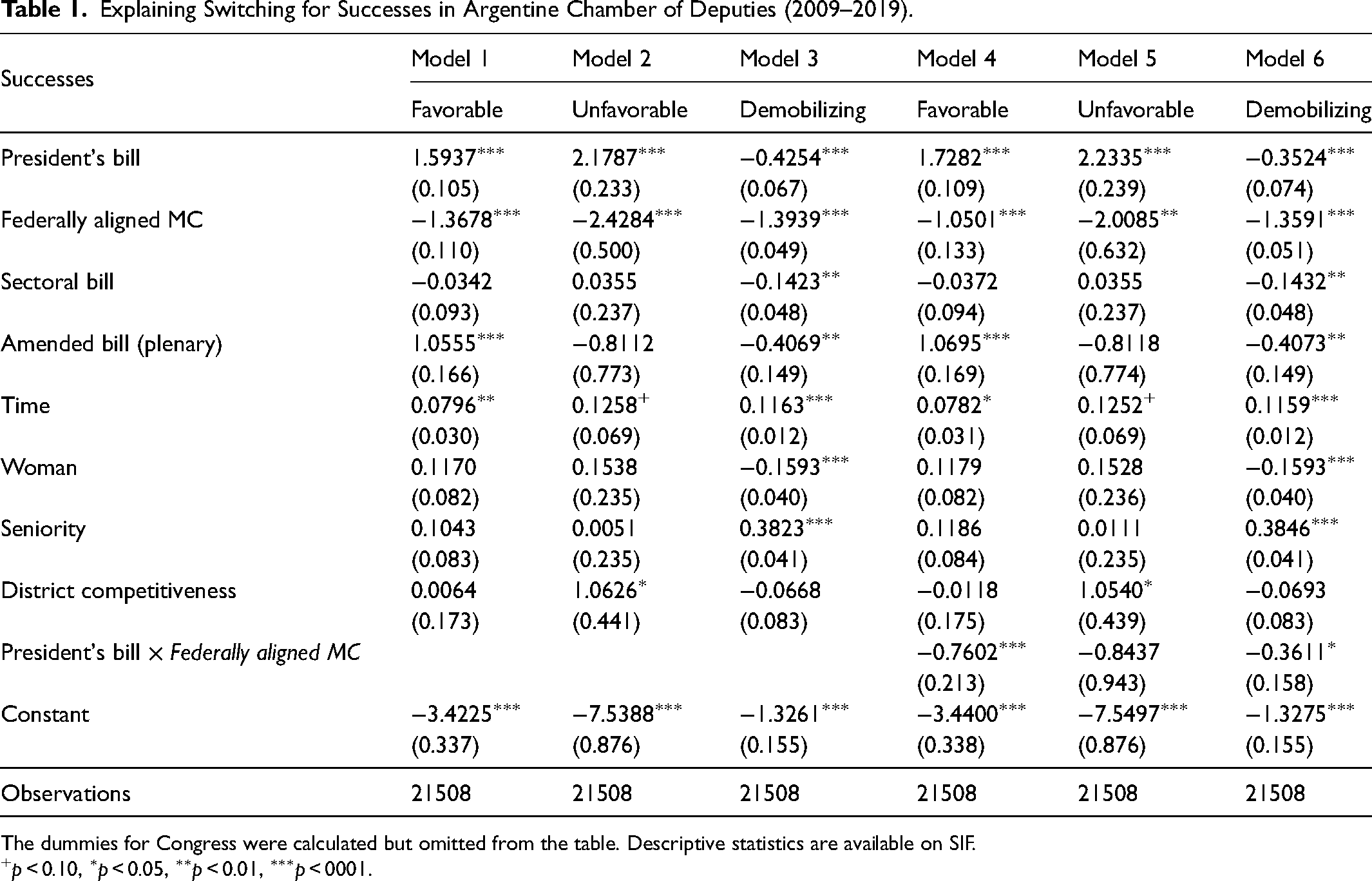
Following Jenkins and Monroe's (2016), we present separate estimates for successes and disappointments. Table 1 shows estimates for successes of the effects of our independent variables on individual legislators’ probability of
Explaining Switching for Successes in Argentine Chamber of Deputies (2009–2019).
The dummies for Congress were calculated but omitted from the table. Descriptive statistics are available on SIF.
p < 0.10, ∗p < 0.05, ∗∗p < 0.01, ∗∗∗p < 0001.
Our competing principals hypothesis claims that federally aligned MCs, i.e., those who are simultaneously aligned with their provincial governor and the President, are less likely to switch votes because their main principals are aligned. Notably, for successes, federally aligned MCs are 16.5 percentage points less likely to demobilize and 3.88 less likely to switch votes to a favorable position compared to their non-federally aligned peers. This also seems to be the case regardless of who initiates bills, as is shown in Figure 1, which presents the predicted probabilities of favorable switching, unfavorable switching, and demobilizing in the cases of successes according to bill sponsorship and competing principals. Still, we find a higher favorable switching (of around two percentage points) for federally aligned MCs when considering president's bills compared to bills authored by legislators, which suggests that for bills of interest to the cartel leaders strive to maintain voting unity. The likelihood of demobilizing increases 11 percentage points among non-federally aligned MCs in bills authored by legislators compared to executive-sponsored bills, which suggests lack of interest in the former and negotiation of absences in the latter. Finally, the likelihood of favorable switching for these MCs also increases in successful presidents’ bills, which suggests these positive votes were also secured through negotiation.
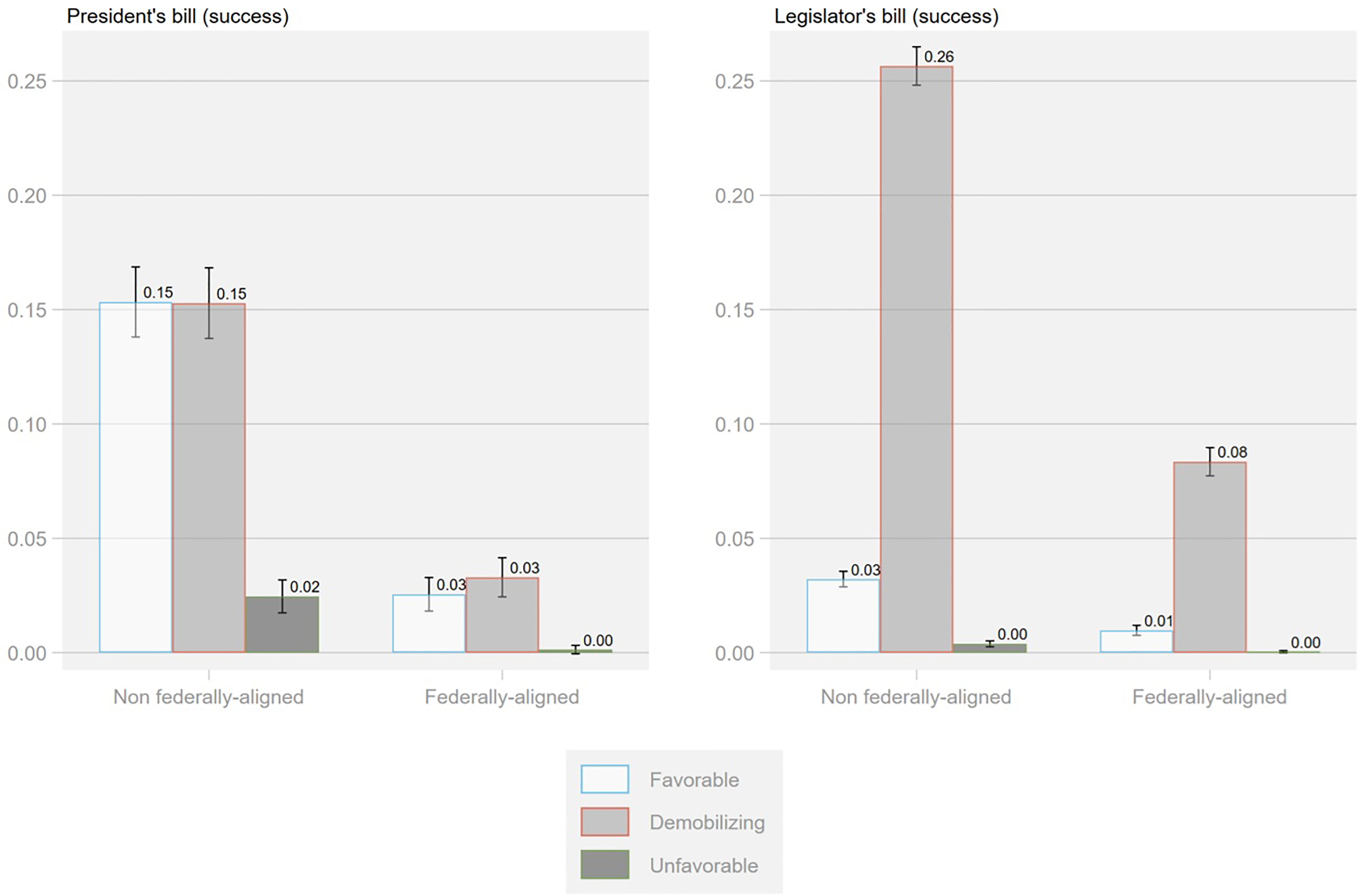
Predicted Probabilities of Favorable Switching, Unfavorable Switching, and Demobilizing According to Bill Sponsorship and Competing Principals for Successes in Argentine Chamber of Deputies (2009–2019). Note: Prepared by the Authors Based on Models 4, 5, and 6.
Sectoral bills, i.e., those dealing with taxation and regulation, decrease the likelihood of demobilizing in four percentage points consistently with previous studies (Bonvecchi and Clerici 2022). As for informational variables, time displays a positive and statistically significant effect. As expected, as more time elapses between committee and floor votes, switching is more likely; e.g., the predicted probability of favorable switching/demobilizing increases one/five percentage points when the duration of this lapse increases from one week (log 1.94) to 180 days (log 5.19). Amended bill also presents positive and statistically significant coefficients for favorable switching: legislators are 11 percentage points more likely to switch to a positive vote when bills are amended in the plenary compared to non-amended initiatives. On the contrary, demobilizing decreases by around 6.2 percentage points for amended bills. District competitiveness only is statistically significant in the unfavorable switching although the impact is minimal. There is an increase of 0.15 in the likelihood of switching in districts with four effective parties compared to those with two.
Finally, individual level variables. Seniority is positively associated with an increase in the likelihood of switching but only in the demobilizing form. Legislators reelected at least once are almost 4.4 percentage points more likely to switch compared to newbies, which is consistent with the literature's claims and with previous findings (Bonvecchi and Clerici 2022). Woman coefficients do not support our expectations as they are not statistically significant.
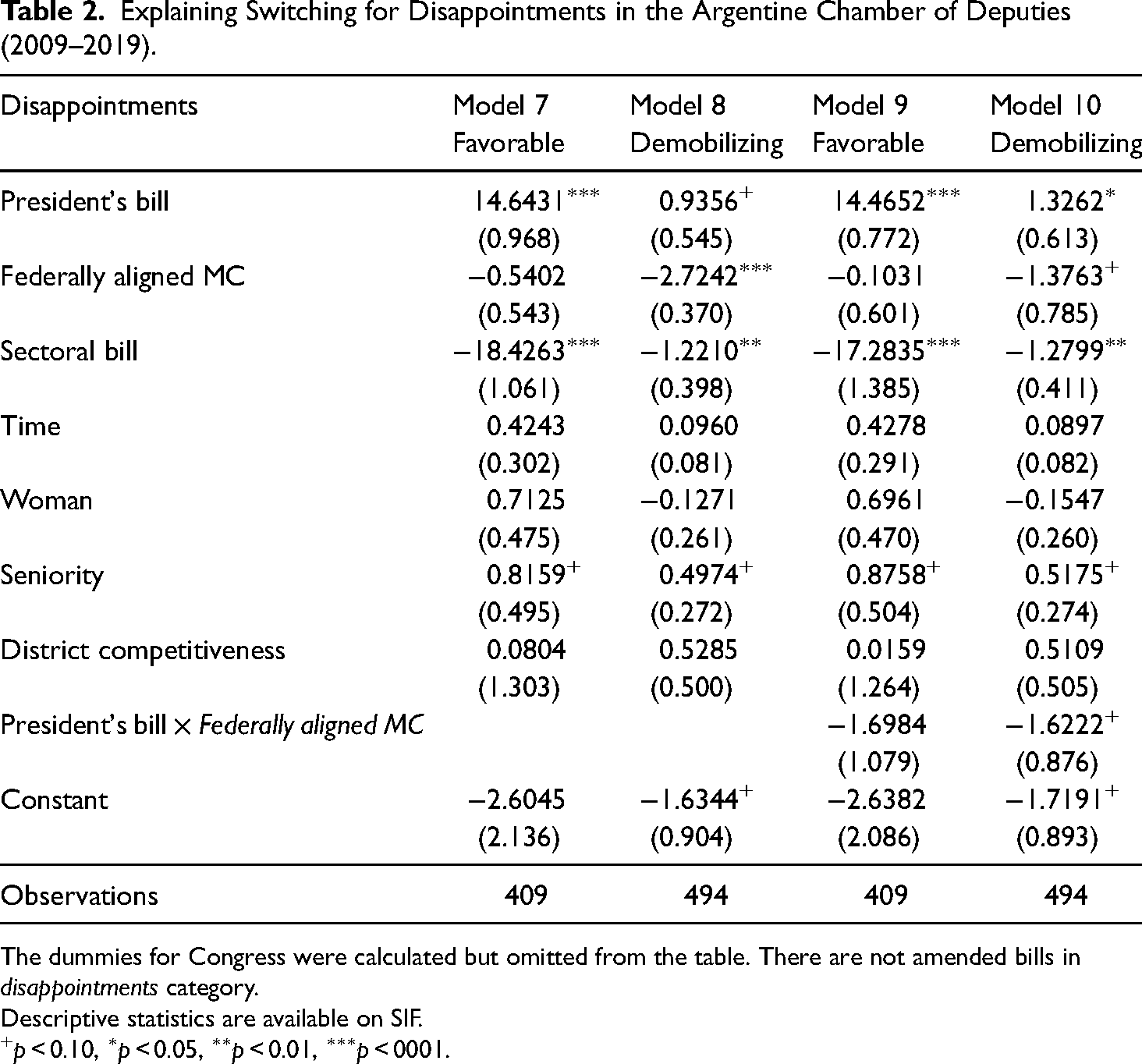
Table 2 provides estimations of the effects of our independent variables on legislators’ probability of favorable switching, unfavorable switching, and demobilizing for disappointments. Models 7 and 8 correspond to the parsimonious specifications, whereas models 9 and 10 incorporate the interaction term. Notably, there are no cases of unfavorable switching observed for disappointments. As before, all include fixed effects by Congress omitted from the table.
Explaining Switching for Disappointments in the Argentine Chamber of Deputies (2009–2019).
The dummies for Congress were calculated but omitted from the table. There are not amended bills in disappointments category.
Descriptive statistics are available on SIF.
p < 0.10, ∗p < 0.05, ∗∗p < 0.01, ∗∗∗p < 0001.
Favorable switching is 17.5 percentage points more likely for Presidents’ bills than for legislators’ bills, while Demobilizing increases for non-federally aligned MCs across all types of bills. Figure 2 presents the predicted probabilities of favorable switching and demobilizing for disappointments according to bill sponsorship and competing principals. We believe the increase in demobilizing for failed executive-sponsored initiatives indicates failed attempts at positive agenda control, while for non-presidential bills it signals disinterest.
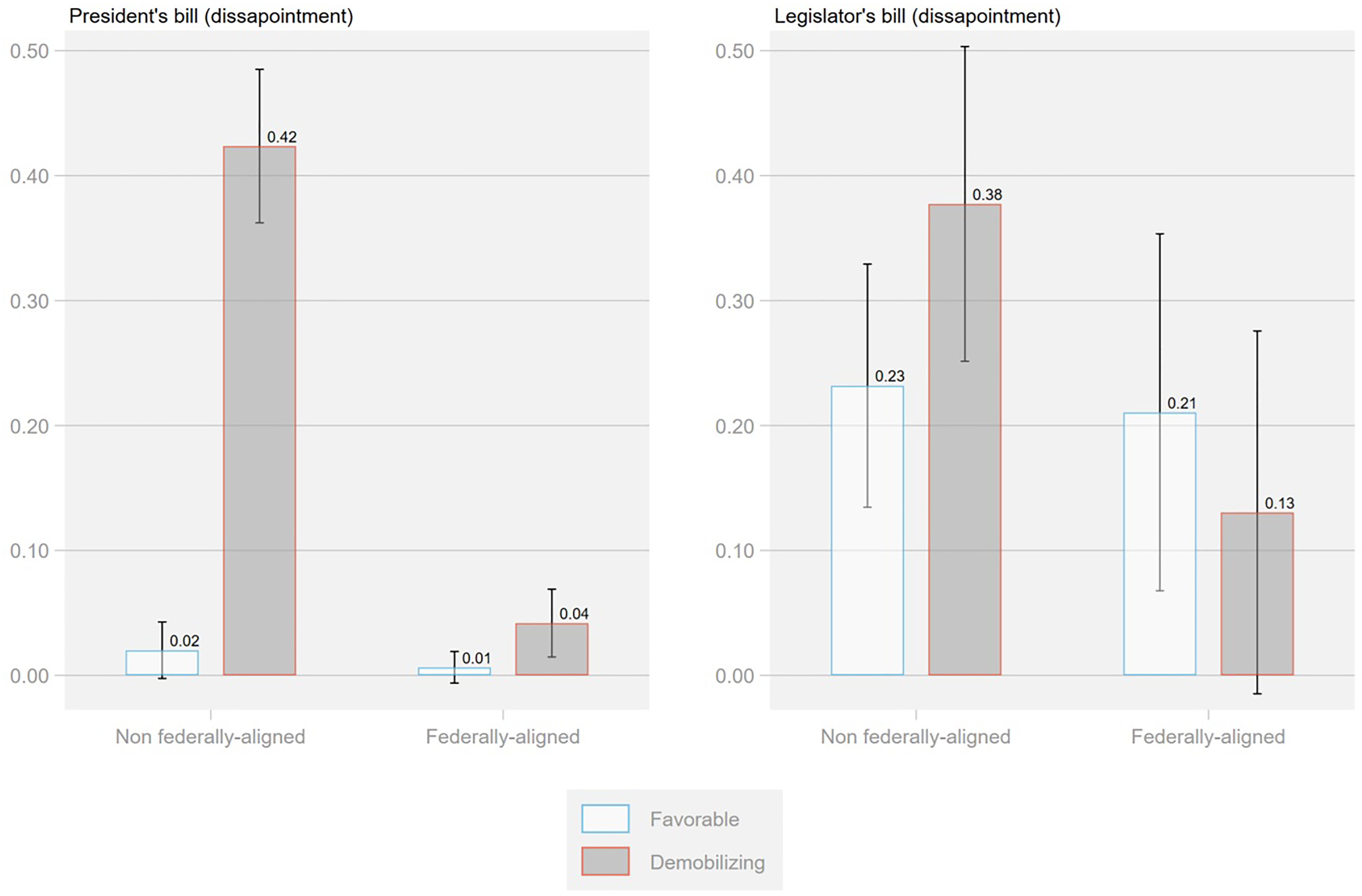
Predicted probabilities of favorable switching and demobilizing according to bill sponsorship and competing principals for disappointments in Argentine Chamber of Deputies (2009–2019). Note: prepared by the authors based on models 9 and 10.
As for controls, only sectoral coefficients are statistically significant. As with successes, bills dealing with taxation and regulation reduce the likelihood of favorable switching and demobilizing in 5.7 and 18.6 percentage points, respectively.
Conclusions
This paper has shown that using vote-switching as a measure of positive agenda power generates a more nuanced view of how party leaders exercise this power. Our results indicate a) that legislators of all types are less likely to switch votes on cartel-sponsored bills compared to non-cartel-sponsored initiatives, b) that switching is less practiced when representatives are aligned simultaneously with Presidents and governors, c) that legislators are more likely to switch votes following their leaders when considering cartel-sponsored bills in the plenary floor, but they are more likely to stray from the party line on non-cartel-sponsored initiatives, and d) that switching is more likely when more time elapses between committee and floor votes, and legislators are more senior.
These findings contribute to the literature on positive agenda power as they show that cartel leaders focus the exercise of positive agenda power on cartel-sponsored bills by minimizing switches from politically-aligned legislators, and eliciting either favorable or demobilizing switches from non-aligned legislators. In contrast, they exert their agenda power to a lesser extent on non-cartel-sponsored bills: they do not support them, but allow legislators to switch their votes for them, and even pass them on the floor.
These findings also contribute to the literature on legislative voting in general, by showing that while government-opposition may be the dominant dimension in explaining how legislators vote, this explanation would be more applicable to cartel-sponsored rather than non-cartel-sponsored initiatives, particularly in federal, presidential multiparty regimes, in which competing principals are the rule. Our findings also show that both government and opposition legislators facilitate successes by demobilizing on the floor for any type of bill, which suggests that inter-party cooperation may be aided by trading amongst competing principals. Finally, they contribute to the literature on vote switching, in general and particularly in federal multiparty systems, by showing that legislators, regardless of their party affiliation, are less likely to switch their votes when cartel-sponsored bills are up and more likely to do so when non-cartel-sponsored bills come their way. The fact that demobilizing switches on non-cartel sponsored legislation tend to predominate suggests that legislators’ disinterest in their colleagues’ agenda may facilitate its passing. In all, then, these findings show how switching indicates that positive agenda power is being exercised to build floor coalitions – mostly, but not only, to facilitate legislative successes.
This research could be pursued further in at least three ways. One, by expanding the number of years under analysis, to maximize observations and variation in the independent variables. Another, by analyzing legislatures under different regime and party-system configurations, to find out whether these affect both the likelihood of switching and the extent to which cartel leaders exercise their agenda power. Finally, by specifying how vote switches were elicited, to establish the contributions of party discipline and vote-buying to building floor coalitions.
Supplemental Material
sj-docx-1-pla-10.1177_1866802X251331071 - Supplemental material for Playing in the Forest While the Wolf Is Not Around: Vote Switching and Positive Agenda Power in Federal Multiparty Systems
Supplemental material, sj-docx-1-pla-10.1177_1866802X251331071 for Playing in the Forest While the Wolf Is Not Around: Vote Switching and Positive Agenda Power in Federal Multiparty Systems by Alejandro Bonvecchi and Paula Clerici in Journal of Politics in Latin America
Footnotes
Funding
The authors received no financial support for the research, authorship, and/or publication of this article.

Supplemental Material
Supplemental material for this article is available online.
Notes
Author Biographies
References
Supplementary Material
Please find the following supplemental material available below.
For Open Access articles published under a Creative Commons License, all supplemental material carries the same license as the article it is associated with.
For non-Open Access articles published, all supplemental material carries a non-exclusive license, and permission requests for re-use of supplemental material or any part of supplemental material shall be sent directly to the copyright owner as specified in the copyright notice associated with the article.
