




Abstract
Representative democracy hinges upon the notion of accountability. We examine the mediating effects of political context on economic accountability in a hostile environment – the developing democracies of Central America. We test whether clarity of responsibility mediates the economy's effects on citizens’ support for a president using approval ratings. In general, we find that a good economy increases public support for a president significantly more under unified government, but surprisingly, we find that a bad economy decreases public support for a president far more under divided government. Dynamic simulations show that these effects become more pronounced during sustained periods of economic expansion or contraction.
Introduction
Representative democracy hinges on the notion of accountability where citizens hold elected officials responsible for job performance. 1 If representatives perform well, voters think highly of them and reward them with political support. If they perform poorly, voters disapprove of their job performance and withdraw support. While this democratic principle is quite simple in theory, the ability of citizens to hold elected officials accountable for their actions varies across political systems because some institutional arrangements clarify lines of accountability while others cloud them. Indeed, the economic voting literature has drawn on the theory of clarity of responsibility to show that political context has a mediating effect on citizens’ ability to hold governments accountable in elections (Powell and Whitten 1993). Yet, few have looked at how it affects another important measure of accountability – presidential approval – and fewer still have tested how clarity of responsibility mediates electoral accountability in new presidential democracies or developing countries where regime instability, party system volatility, economic and political turmoil, and other idiosyncrasies may inhibit whether citizens hold their leaders accountable for job performance (see Hellwig and Samuels 2008; Samuels 2004 for exceptions). 2
We would like to thank the following people for comments on previous versions of this paper: Brian Crisp, Scott Desposato, Barbara Geddes, Aníbal Perez-Líñan, Harvey Palmer, Margit Tavits, Josh Dyck, Jason Sorens, Sal Peralta, the Faculty Workshop at the University at Buffalo, and the Political Science Methods Series at the University of Missouri. We also thank Aníbal Pérez-Liñán and German Lodola for sharing their data on political scandals with us and Laron Williams and Guy Whitten for sharing the STATA code necessary to produce dynamic simulations of the long-run effects of the economy on presidential approval. We are indebted to Charles Denton and Luis Huag at CID Gallup for giving us access to their surveys in San Jose, Costa Rica.
Following Samuels (2004: 425), we define accountability broadly as “the electorate's capacity to reward or sanction incumbent politicians.”
In this paper, we examine the mediating effect that political context has on the attribution of blame and credit for economic outcomes in Central American democracies. Powell (2000) argues that the most important indicator of clarity of responsibility is party control of government, such that if it is clear which parties control government then clarity of responsibility is high and this facilitates democratic accountability. Drawing on this, we would expect that where a single party controls both branches of government citizens should be more likely to hold the president accountable because the president and his or her party are clearly responsible for economic outcomes. Conversely, when a president's party does not control the legislature, responsibility for economic outcomes is less clear and citizens may not know who to hold accountable since the president and the opposition-controlled legislature can blame each other.
Yet, new democracies in the developing world differ substantially from industrialized democracies where this logic has most often been tested. Economies are much more volatile and political strife is common. The seemingly continuous array of problems these countries have may overwhelm any mediating effect that clarity of responsibility may have, so that citizens hold presidents accountable for economic outcomes under both unified and divided government. At the same time, the newness of democracy in the developing world may mean that the democratic mechanisms of representation and accountability are not established well enough to exhibit discernible patterns as they do in developed democracies. We examine whether citizens in Central American democracies hold presidents accountable for economic performance differently depending on clarity of responsibility. We test the mediating effect of unified and divided government on presidential approval in all six Central American countries starting as early as 1979 (in Costa Rica) through the beginning of 2007.
Our analysis finds that political context does mediate the effects of economic performance on presidential approval (i.e., generates “economic accountability”), though not exactly as clarity of responsibility theory predicts. As predicted, when the economy is good majority governments enjoy significantly higher rates of approval than minority governments, but when the economy is bad minority governments are punished far more severely than majority governments. Furthermore, dynamic simulations reveal these effects are particularly strong over the long-run. Voters attribute credit and blame for sustained economic performance and not just current economic conditions. In sum, our study offers important insights into the manner in which political context conditions democratic accountability in new democracies.
Economic Performance and Presidential Approval
The presidential approval literature finds economic conditions to be a key determinant of public support for a president. The public believes that one of the primary jobs of modern presidents is to maintain a stable and growing economy (Geddes 1994), and they expect governments to address and fix unfavorable economic conditions. Positive economic performance produces solid support for a president, while negative economic outcomes drive down presidential approval as citizens blame him or her for their economic misfortunes. U.S. President Clinton's strong approval ratings throughout his second term are often attributed to a robust economy. In sharp contrast, Argentina's prolonged recession drove President de la Rua's approval ratings below 30 percent and eventually led to riots and his resignation from office.
There are a number of measures of economic performance found in the presidential approval literature. Perhaps the most common measure is economic growth. Growth rates provide a broad indication of the state of the economy and high levels make citizens feel good about the economy and presidents are often rewarded with higher approval ratings (Cuzan and Bundrick 1997; Hibbs Jr. 1982b; Nicholson, Segura, and Woods 2002). Another common measure is inflation. Inflation has a particularly pernicious effect on poor and working class citizens in developing nations, so rising inflation reduces public support for presidents as citizens are faced with higher costs for basic necessities (Buendia 1996; Carrión 1998; Cuzan and Bundrick 1997; Kelly 2003). Other studies include measures for unemployment, changes in real wages, and citizens’ subjective evaluations of the economy (Arce 2003; Carlsen 2000; Kernell 1978; Mishler and Willerton 2003; Mueller 1970; Stokes 1996). Regardless of the indicator, poor economic outcomes drain public support for a president while strong ones boost it.
Thus, economic conditions help explain variations in public support for presidents. Their effects on approval, however, may be exacerbated or diminished in certain political contexts. Specifically, the relationship between economic outcomes and presidential approval could be dependent upon differences in clarity of responsibility.
The Mediating Effect of Clarity of Responsibility
According to Powell, “If all the resources necessary for policy making are controlled by a unified, identifiable set of elected officials, it will be easy for citizens to perceive that those officials are responsible for the policies made. On the other hand, if the resources necessary for policy making are dispersed into the control of numerous groups and individuals, citizens cannot identify who is responsible for policies” (2000: 51). The clarity of responsibility argument was popularized by Powell and Whitten (1993) in their effort to explain variations in economic voting across political contexts. They argued that mixed results for the effects of economics on vote choice resulted from a failure to account for the political context in which economic policy-making takes place. They created an index of clarity of responsibility and showed empirically that economic voting is stronger when citizens can identify the party responsible for economic conditions. 3
Powell and Whitten's (1993) index of clarity of responsibility has four key indicators: party cohesiveness, bicameral opposition, committee composition, and cabinet composition (assessing majority, coalition, or minority government).
Powell and Whitten (1993) applied their clarity of responsibility theory in the context of parliamentary systems. Some of their indicators of clarity of responsibility are directly transferable to presidential systems, but other indicators are only relevant in parliamentary systems where executive and legislative power is fused. Presidential rules introduce new concerns for clarity of responsibility – specifically, the separate election and survival of the executive and legislative branches. Powell writes, “clarity of responsibility is greatest when a single, unified political party controls both the national legislature and chief executive” (2000: 52). Under unified government, the president and his or her party control both the executive and legislative branches making it clear that the president's party is solely responsible for government performance. Under divided government, different parties control the two policy-making branches of government and leaders can diffuse their responsibility by blaming the other party for political and economic failures. Therefore, presidential control of the separate branches of government (i.e., unified or divided government) is a key indicator of clarity of responsibility in presidential systems.
Clarity of responsibility theory has received considerable empirical support in the economic voting literature (Anderson 2000; Nadeau, Miemi, and Yoshinaka 2002; Palmer and Whitten 2003; Powell 2000; for an exception see Royed, Leyden, and Borrelli 2000, but also see Whitten and Palmer 1999). Most studies have focused on parliamentary systems in developed democracies, but a few studies have examined the effect of unified and divided government on economic voting in presidential systems (Leyden and Borrelli 1995; Norpoth 2001; Samuels 2004). Leyden and Borrelli (1995) use a sample of gubernatorial elections in the United States and find that the effects of unemployment on incumbent parties is greater under unified, rather than divided, government. Examining presidential systems in a comparative context, Samuels (2004) tests whether a president's party is punished less for economic failures at election time when it controls only a minority (or coalition) of legislative seats. He finds support for this argument, but this occurs only in legislative elections held concurrently with presidential elections and not at all in presidential elections. 4
He also looks at the electoral cycle (i.e., concurrent or nonconcurrent elections) and legislative electoral rules that promote national-oriented policy behavior (for legislative elections only) as indicators of clarity of responsibility.
Clarity of responsibility theory has not been applied to presidential approval to the same extent. While not explicitly mentioning “clarity of responsibility,” Nicholson, Segura, and Woods (2002) have examined the relationship between divided government and presidential approval in the United States. They argue that divided government “muddies the informational waters” and find that citizens are less likely to blame a president for poor performance during periods of divided government than under periods of unified government. Their theory is, however, that divided government will have a direct effect on presidential approval rather than a conditioning effect via specific economic influences on approval. They do not fully theorize or test the influence of clarity of responsibility on citizens’ perceptions of incumbent presidents. Despite the durability of the concept, clarity of responsibility theory remains relatively untested in developing democracies, particularly with regards to presidential approval.
Drawing upon this rich tradition, we make an explicit link between clarity of responsibility and presidential approval. Studying presidential approval, as a measure of accountability, complements studies of election outcomes because it provides a more nuanced indicator of accountability. Presidential elections are rare events, occurring only once every four to six years depending on the country, while approval polls are taken much more frequently, often monthly or quarterly. They measure accountability via regular signals of citizen support for an incumbent president that often translates almost directly into electoral outcomes. Several studies have highlighted the significance of presidential approval as a measure of accountability (Chappell and Keech 1985; Kelly 2003). In addition, presidential approval is more vulnerable to fluctuation, and consequently, could register the mediating effect of clarity of responsibility differently than election outcomes do. Citizens may weigh the importance of divided or unified government differently when they have multiple opportunities to register their concern (i.e., in various opinion polls) than when it leads to a change in government.
We argue that presidents should be rewarded and blamed more for economic outcomes when clarity of responsibility is high. Specifically, we argue that if the economy performs poorly and the president's party controls the legislature, then presidential approval ratings should suffer because the president cannot credibly blame his opponents in the legislature for poor economic outcomes. Peruvian President Garcia's party controlled both the executive and the legislative branches during his term. Unified government coupled with the steep economic decline and political violence of the late 1980s led to the resounding defeat of the party in the 1990 elections.
Similarly, if the economy performs well during periods of unified government, the public can clearly see who is responsible and reward them. If the economy is doing well, but the president's co-partisans do not control the legislature, the public cannot be sure the president is responsible, weakening the positive effect of the economy on presidential approval. For example, Argentine President Menem's party dominated the legislature during much of his time in office, so Argentines knew who to reward for the country's economic successes of the early 1990s. This likely helped him maintain high approval ratings, and ultimately, win reelection. In sharp contrast, Brazilian presidents rarely enjoy much co-partisan support, relying instead on shifting legislative alliances. This may explain why President Cardoso, who oversaw an Argentine-like economic turnaround, never attained the heights of popularity enjoyed by Argentina's Menem.
This translates into a very clear and simple hypothesis: economic conditions should have a statistically significant and substantively strong effect on presidential approval during periods of unified government, but a statistically insignificant or substantively weak effect under divided government. We test whether this hypothesis extends to democracies in the developing world in the remainder of the paper.
An Empirical Test
One of the greatest challenges for testing this question is that comparative data on presidential approval is sparse. Although many countries conduct regular surveys of presidential popularity, most polls are not designed for comparison across countries. Some polling agencies offer five-point responses to approval questions while others use four or two-point scales. Some exclude those who did not respond while others include them. Polling agencies employ different sampling strategies, some using large samples, others small samples; some include rural areas, others stick to urban centers; and some use probability samples, while others do stratified sampling. These vast differences in survey design make comparative studies of presidential approval rare (see for exceptions, Carlsen 2000; Cuzan and Bundrick 1997).
Some theories, however, are better tested with comparative data. To fully exploit the conditioning effect of clarity of responsibility on presidential approval, we need data from more than one presidential system to increase variation on institutional clarity and increase the generalizability of our findings. We turned to CID-Gallup, a San José-based polling firm, which has conducted systematic, cross-national surveys in Central America since the late 1970s. They build a probability sample using one-on-one interviews with, on average, 1200 adults nation-wide in the six Central American countries (Costa Rica, El Salvador, Guatemala, Honduras, Nicaragua, and Panama). We use these presidential democracies for our empirical test.
The Cases
The country cases for this analysis are not only empirically relevant but theoretically relevant as well. First, most of the literature on clarity of responsibility and accountability focuses on longstanding democracies in the developed world. 5 By selecting new democracies from the developing world, we offer a test of the generalizability of existing theories. One of the key concerns with Latin America's new democracies is how accountability and representation work and whether democratic theory applies. Are voters in new democracies sophisticated enough to attribute credit and blame appropriately? Do they hold officials accountable for the economy? Is representative democracy a frail shell or does it function as democratic theory predicts? Our focus on economic accountability in Central America allows us to weigh in on some of these questions.
See Samuels (2004) and Hellwig and Samuels (2008) for notable exceptions.
Secondly, these countries allow us to study majority government in isolation from other indicators of clarity of responsibility. They do so by holding near-constant some of the other factors that may cloud clarity of responsibility. All of the cases have moderate to strong party cohesion with little incentive for legislators to stray from the party line and seek personal votes (Carey and Shugart 1995; Payne et al. 2002). Legislative elections in these countries generally use proportional representation electoral rules with closed and blocked lists meaning there is no intraparty competition in the general election. 6 This should facilitate clarity of responsibility when the executive's co-partisans do not control the legislature by legitimating executive complaints about an uncompromising, opposition legislature. All countries have unicameral legislatures so divided control of the legislature does not complicate our test, and all but El Salvador hold concurrent elections. 7 Furthermore, all of the presidents are relatively weak in terms of legislative powers and none of the presidents in these six countries could be immediately reelected during the time period of our dataset. 8 Thus, the institutional nature of executive-legislative relations is quite comparable across the cases.
Panama's electoral system is semi-closed list proportional representation (PR) with about one-third of the legislative seats elected via single-member districts (little intraparty competition) and the others in multi-member districts with open-list PR (intraparty competition). Therefore, it has more intraparty competition than the other countries. Guatemala, El Salvador, and Nicaragua also have two-tiered electoral systems with a national constituency and regional constituencies elected separately, but all three countries use closed-list PR for both tiers. Models with Panama excluded do not substantially alter our results.
Samuels (2004) found that the electoral cycle mediates economic voting since non-concurrent elections blur clarity of responsibility.
All of the presidents scored low on Shugart and Carey's (1992) scale of constitutional powers, with most of the variation occurring in the strength of the package veto (whether veto needs absolute majority to override, as in Nicaragua, or two-thirds majority, as in Guatemala) (Payne et al. 2002). Only Panama and Nicaragua give their presidents partial veto power, and none of the presidents have constitutionally-allocated executive decree authority (Carey and Shugart 1998). On the reelection dimension, Costa Rica (prior to 2003), Guatemala, and Honduras prohibit reelection entirely while Costa Rica (since 2003), El Salvador, Nicaragua, and Panama prohibit immediate reelection, but allow presidents to run again after sitting out at least one term. Nicaragua's constitution briefly allowed for immediate reelection, but this provision was changed in 1995 before any president could take advantage of it. In 2003, Costa Rica amended its constitution from prohibiting reelection entirely to allowing reelection after sitting out at least one term making room for former President Oscar Arias to run again in 2006.
Holding near-constant these other factors means that our cases represent settings where clarity of responsibility is relatively high before even considering majority government. A president cannot credibly blame an upper chamber, citizen confusion due to non-concurrent elections, or undisciplined parties for economic misfortunes. Consequently, they provide a stringent test of the mediating effect of majority government as a measure of clarity of responsibility. If we find voters do not attribute credit or blame under divided government despite the incentives to do so because of unicameralism, concurrent elections, and cohesive parties, then it suggests that these other indicators of clarity of responsibility are insufficient for accountability. If they do credit and blame a president under unified government with the same incentives from unicameralism, concurrent elections, and cohesive parties, then it underscores the primary role for majority government as an indicator of clarity of responsibility in presidential systems.
Variables
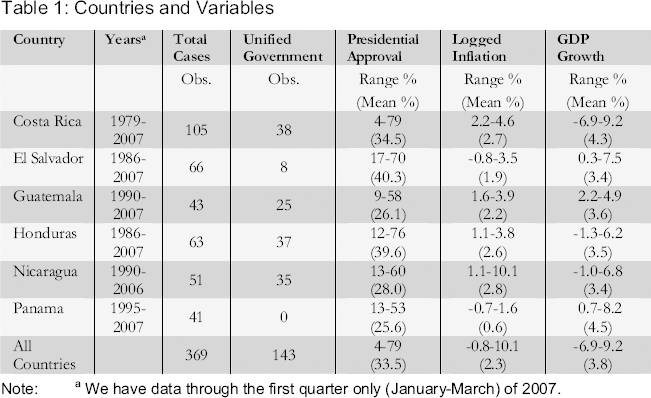
The dependent variable is the percentage of the public that approves of the president's job performance. We create this measure of presidential approval from the CID-Gallup surveys that are conducted multiple times a year in each country. 9 The surveys were often conducted three times a year (in 58 of 124 country-years in the sample), but the number of surveys and the months the surveys were taken varied substantially from year to year. The survey asks, “What is your opinion about the way [name] is fulfilling [his/her] job as president?” Respondents can choose from five response categories on a scale from “very poorly” to “very well,” with those who “do not know” or “do not respond” coded separately. We combine the percentage of respondents in the very high and high approval categories to create a measure of the percentage of respondents who approve of the president. As Table 1 shows, wide variation exists in approval rates within and across countries. Approval reaches a low of 4 percent in November 1981 under President Carazo in Costa Rica and soars to 79 percent at the end of Costa Rican President Arias’ term in 1990. El Salvador has the highest average approval with 40 percent while Guatemala and Panama have the lowest average approval ratings of only 26 percent. The range in those countries is wide providing significant variation in presidential approval.
Countries and Variables
Note:
We have data through the first quarter only (January-March) of 2007.
CID-Gallup tries to conduct one survey every four months. Some years, however, have more than three surveys while others have fewer. At least one survey was conducted every year and no more than six were conducted in any one year. Those extreme years were rare; six surveys occurred in only three years – two for Costa Rica and one for Panama; only four years had one survey only.
We measure economic performance with two indicators of economic conditions in the country – Growth and Inflation. We measure economic growth as the annual rate of change in real per capita GDP, measured in constant dollars (WDI 2007). Drawing upon the logic of Palmer and Whitten (2000), we use the annual growth rate for the year prior to the month the survey was conducted by interpolating the monthly value using the annual growth rate for the previous year and based on the assumption that the annual growth rate for a year captures growth from the last day of the previous year to the last day of the current year. More specifically, we use the following definitions (where AR[y] is the annual rate for the year “y” and AR[y, m] is the annual rate for the month “m” in the year “y”):

We expect good growth will increase presidential approval and bad growth will decrease support for the president.
Inflation represents the percentage change in the cost of goods and services consumed by the public from one month to the next (IMF Various Years). We use the average rate of inflation for the twelve-month period immediately prior to the survey and log this value due to extremely high rates of inflation in several instances. Like growth, we expect inflation to matter when unified government exists, but have little to no effect under divided government. We expect inflation's effect on approval to be negative because higher inflation indicates poor economic performance for which citizens may blame a president. Ideally, we would also include unemployment in our analysis, but comparable cross-national data for the time period under study that is both valid and reliable is simply unavailable. Table 1 shows the variation in the economic indicators.
In order to measure clarity of responsibility we include a dummy variable for Unified Government. Unified government occurs when a president's party holds a majority of seats in the legislatures (> 50 percent) and is scored a “1,” while divided government occurs when a president's party holds less than a majority of the seats and is scored a “0.” To test whether this conditions the effect of economic performance on presidential approval we then interact this dummy variable with our measures of growth and inflation. Recall, we expect economic performance should have a statistically significant and substantively strong effect on presidential approval during periods of unified government, but a statistically insignificant or substantively weak effect under divided government.
While our primary focus is on economic performance and the conditioning effects of clarity of responsibility, the extant literature shows public support for a president is also linked to political performance (Hibbs Jr. 1982b; Kernell 1978; MacKuen 1983; Mueller 1970; Pérez-Liñán 2007; Weyland 1998). To account for these political factors we include a number of political control variables. First, political scandals may affect support for a president. Davis and Langley (1995) find that citizens’ perceptions of corruption explain presidential popularity in Mexico. Similarly, the Watergate break-in and the Montesinos bribery scandal brought down the presidencies of Richard Nixon and Alberto Fujimori. We use Pérez-Liñán's (2007) data on political scandals, which assesses scandals as reported by the Latin American Intelligence Service's Latin American Weekly Report. This is a dummy variable for whether or not “the current administration was caught in one or more media scandals during this year.” A “1” indicates the administration was caught in a Scandal, while a “0” means it was not.
Secondly, a president's handling of wars and international disputes, the ability to resolve domestic civil conflicts, and the response to domestic disasters may influence public support for a president. In Peru, for example, President Fujimori saw spikes in his approval after his self-coup in April 1992 and the capture of Sendero Luminoso guerrilla leaders in September 1992, and he was hurt by ongoing political violence during the 1990s (Arce 2003; Carrión 1998; Kelly 2003; Weyland 2000). Given that three of the countries in our data set were embroiled in civil wars continuing into the 1990s (El Salvador until 1992, Guatemala until 1996, and Nicaragua until 1990), we include a variable for whether a president presided over an end to civil war – i.e., was a peacemaker. Presidents in these states were elected, in part, to resolve the civil war and were judged by their ability to do so. We score Peacemaker as a “1” in all surveys of the administration taken in the year immediately after the end of the war and a “0” otherwise.
Another political factor thought to affect approval emerges from the electoral cycle (Arce 2003; Cuzan and Bundrick 1997; Mueller 1970; Weyland 1998). A president's honeymoon period after an election often yields a “bandwagon effect” when approval ratings are strong and begin to drop only after 90 days to two years have passed. Conversely, a lame duck president late in his or her term may experience a counter-honeymoon as former allies flee in anticipation of the next election. We measure Time Since Election as the proportion of a president's term in office that has elapsed when the survey is taken. This means that a survey conducted one year into a four-year term is scored 0.25, while one taken 38 months into a five-year term is scored 0.63.
Finally, the extent to which governments respect and protect the political rights and civil liberties of citizens may also influence citizens’ perceptions of government. Approval of a president may be lower in less democratic states, as citizens express frustration with governments that only halfheartedly protect democracy and promote democratic values (Cuzan and Bundrick 1997). To control for the level of democracy we use Freedom House scores. 10 These scores range from 2 to 14 in the Freedom House data set, with lower scores representing greater political rights and civil liberties and higher scores representing fewer protections of political rights and civil liberties. In our sample scores range from 2 to 9, with Costa Rica earning a 2 or 3 in all years, while both Guatemala and Nicaragua earned 9s for various years in the early-to-mid- 1990s. 11
None of these states were considered “not free” by Freedom House for the period under study. Costa Rica and Panama were “free” during the entire period of the dataset while El Salvador was “free” from 1997-2005 and Honduras was considered “free” prior to 1992 and during 1997 and 1998. Freedom House scored Guatemala and Nicaragua as “partly free” during their time in our data set along with El Salvador (1986-1996) and Honduras (1993-1996; 1999-2007).
It is also possible that in semi-democracies the level of democracy may appear to have no effect on approval because citizens may fear government reprisals and not express their frustration openly in opinion surveys.
Methods
To test whether clarity of responsibility conditions the public's ability to assign credit and blame for economic and political performance, we use pooled time-series cross-section techniques. We estimate ordinary least squares (OLS) models with panel corrected standard errors, a lagged dependent variable, and we adjust for first order autocorrelation (Beck and Katz 1995a, 1995b). 12 This accounts for problems of heteroskedasticity and time-serial correlation in the error terms. We also include country dummy variables to ensure our results are not biased by unit-specific effects within countries.
Our data set is unbalanced because of the varying number of surveys taken in each country. STATA's xtpcse command is able to handle both balanced and unbalanced data sets.
Standard interpretation techniques of models such as this reveal predictions of the effect that economic performance has on presidential approval under unified and divided government in the “short-run” (Rueda 2005), in other words, whether economic performance at time t-1 affects approval at time t. Yet, economic performance may also have a “long-run” or cumulative effect on approval such that economic conditions at time (t-n) + (t-n+1) + … + (t-n+n) may affect approval at time t. For example, if the economy is doing poorly for several quarters in a row, citizens may blame a president more than if it just does poorly for one quarter. We test for this by drawing upon a new technique developed by Williams and Whitten (2008) that uses dynamic simulations of the statistical model's estimates to produce graphs that illustrate the long-run relationship between economic performance and presidential approval and the mediating effect of clarity of responsibility. This method builds upon the CLARIFY statistical package (King, Tomz, and Wittenberg 2000) to simulate expected values for presidential approval and confidence intervals by incorporating lagged presidential approval with each iterative estimation. It does this by using the predicted value for presidential approval where the user-specified scenario
The CLARIFY statistical package does not allow for panel-corrected standard errors. Consequently, we follow Williams and Whitten's (2008) advice and use OLS with robust standard errors clustered on administration and a lagged dependent variable. We cluster on administration to account for cross-administration heteroskedasticity. See Williams and Whitten (2008) for a more thorough technical discussion regarding the use of dynamic simulations with time-series cross-section data. The percentiles refer to the growth and inflation levels of cases included in the sample.
Results and Discussion
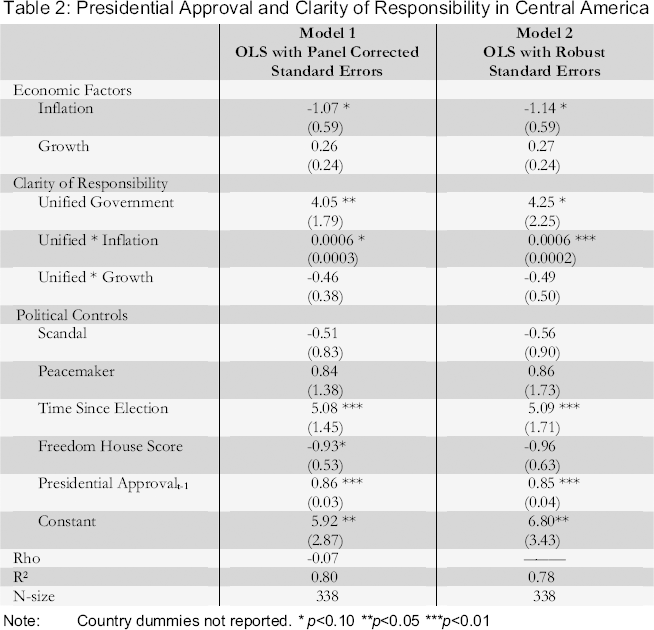
Table 2 presents the results of our analysis. In the first model (Model 1) we present the results from a statistical model using OLS with panel-corrected standard errors as described above. A cursory examination of this model shows that both growth and inflation are correctly signed, but only inflation has a statistically significant effect on presidential approval. In addition, unified governments are associated with higher rates of presidential approval than divided governments, on average. The interaction between inflation and unified government also is significant.
Presidential Approval and Clarity of Responsibility in Central America
Note: Country dummies not reported.
p<0.10
p<0.05
p<0.01
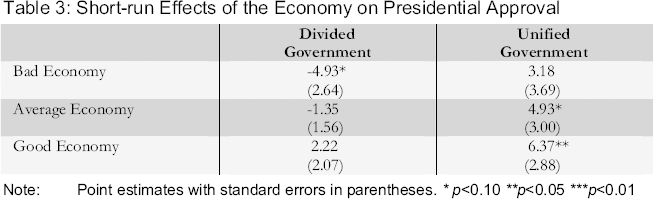
Nevertheless, it is inappropriate to interpret multiplicative interaction terms as if they were unconditional marginal effects (Brambor, Clark, and Golder 2006). Consequently, we also calculate the marginal effect and conditional standard errors of a Bad Economy, an Average Economy, and a Good Economy on presidential approval depending on clarity of responsibility (see Table 3). Following the same methodology that we will use in the dynamic simulations, a bad economy is one where growth is low (5th percentile) and inflation is high (95th percentile), an average economy is one where growth and inflation are average (50th percentile), and a good economy is one where growth is high (95th percentile) and inflation is low (5th percentile). Here we see that economic performance is conditionally related to presidential approval and that the economic effects are mediated by clarity of responsibility, though not always as we predicted. Supporting Powell and Whitten's contention regarding economic accountability, we find that a good economy has a strong positive and significant effect on approval when the president's party controls a majority in the legislature, meaning clarity of responsibility is high. A good economy has no significant effect on presidential approval when the president's party lacks a majority of seats in the legislature. In stark contrast, a bad economy drastically reduces support for a president, but only when the president's party holds a minority of seats in the legislature. In the short-run, a good economy only helps majority governments, while a bad economy only hurts minority governments.
Short-run Effects of the Economy on Presidential Approval
Note: Point estimates with standard errors in parentheses.
p<0.10
p<0.05
***p<0.01
In order to test for the long-run effects of the economy on presidential approval, we estimate a second model using OLS with robust standard errors (Model 2). 14 We then run the dynamic simulation that produces the results shown in Figures 1 and 2. Figure 1 shows the predicted long-run effects of a good economy on presidential approval for two cases: (1) when there is unified government and (2) when there is divided government. The figure reveals that, in addition to the short-run effects noted above, economic performance does have different long-run effects under unified and divided government. The different effects emerge after the economy has been strong for four quarters. In other words, starting in the fifth quarter, the effect of a good economy on presidential approval is conditioned by clarity of responsibility, with unified governments enjoying much higher levels of support. This sustains Powell and Whitten's expectations regarding the mediating effects of clarity of responsibility on economic performance.
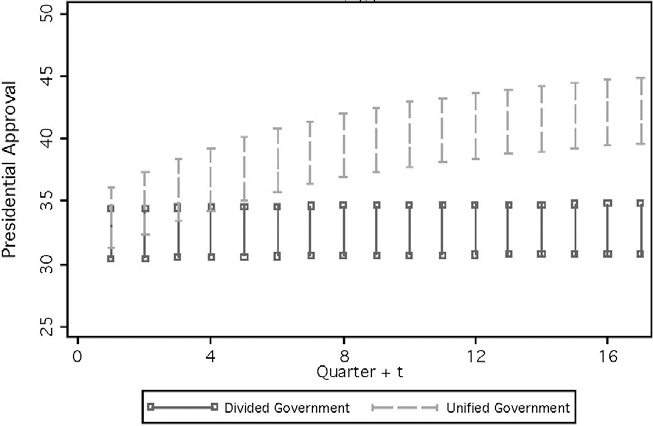
Long-run Effects of a Good Economy on Presidential Approval Depending on Clarity of Responsibility Note: Bars depict 95 percent confidence intervals
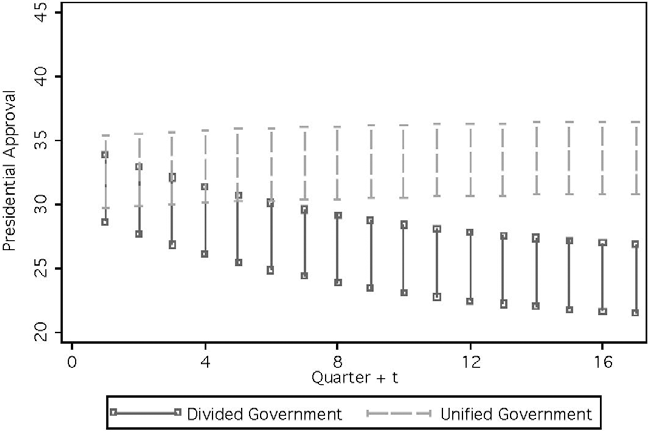
Long-run Effects of a Bad Economy on Presidential Approval Depending on Clarity of Responsibility Note: Bars depict 95 percent confidence intervals
CLARIFY does not generate simulations of predicted effects from models that use panel-corrected standard errors making it impossible to estimate the dynamic simulations from Model 1. Thus, we have to use Model 2 as a substitute. As Table 2 shows, both models produce very similar results.
Moving on to examine the effects of a bad economy on public support for a president, Figure 2 shows the predicted presidential approval for the same two scenarios: (1) when there is unified government and (2) when there is divided government. Here, long-run effects also exist, but they are only different for unified and divided governments after six quarters of poor economic performance. Further, during sustained economic downturns it is under divided government, and not unified government that presidents suffer the public's wrath. Approval declines as the number of quarters of poor economic performance increase under divided government while unified governments that oversee a bad economy see their approval ratings remain surprisingly steady in the long-run. This shows that clarity of responsibility does condition the effect that poor economic performance has on approval in the long-run, but only after six quarters of a struggling economy and in the opposite direction from what we expected. Clarity of responsibility theory suggests that poor economic conditions should depress approval more during periods of unified government, yet we find that it depresses approval under divided government.
What might explain this counterintuitive finding? Why do citizens reward governments for a job well done when clarity of responsibility is high, but punish governments for doing a poor job when clarity of responsibility is low? Given that citizens’ willingness to change opinions is predicated on their hearing and accepting new information (Zaller 1992), one explanation may lie in the ability of majority governments to use the media to “spin” economic conditions in a positive way. In Central America, an elite oligarchy that is often tightly tied to political elites exerts significant control over the media (Kodrich 2008; Rockwell and Janus 2003). In fact, nearly three-quarters of the population thinks that mass media is “influenced” by the government rather than “independent” of it (Latin Barometer 2004). Significant influence over the press (Freedom House various years) combined with a citizenry that lacks political sophistication may allow majority governments to spin economic conditions in a way that favors them. Consequently, when the economy performs well, a president can use the media to heap praise on himself leading to higher approval. Even when the economy performs poorly, presidents can use the media to spin the situation into something less bad than it is. Citizens do not punish presidents as much as they would otherwise. Minority presidents may not have the same control over or support from the media, especially if the economy is doing poorly, which may lead both the media and the public to turn on a president.
Another explanation may be that clarity of responsibility theory works a bit differently when explaining presidential approval rather than electoral support. Presidential approval is measured throughout a president's term in office and is an assessment of how citizens feel a president is doing his job. Approval polls do not require citizens to compare a president to other possible candidates or require them to weigh the job a president and his or her party are doing against the job the opposition parties are doing. Under divided government, the president and the legislature may blame each other for poor economic performance and try to confuse citizens about who is responsible, but with presidential approval surveys, citizens do not have to decide which side is responsible – they can punish both sides with lower approval. The fact that citizens face both a downtrodden economy and an ineffective government that is spending more time laying blame than solving the economic crisis may lead to even lower approval ratings than a president might face under unified government. This outcome is unlikely with electoral support, however. In most systems, citizens have to choose between the incumbent and the opposition at election time meaning that they cannot simply blame both groups. Instead they have to distribute the blame to one side or the other lessening the impact that it has on the incumbent's vote. Thus, our findings suggest that clarity of responsibility may play a different role conditioning presidential approval than electoral support. In either case, additional research is warranted.
Beyond the economic and clarity of responsibility variables, we find little support for the notion that political factors affect approval in Central America. Political scandals have no effect on approval in either model, and the three presidents that governed in the aftermath of three bloody civil wars saw no boost in their approval figures. As expected, a failure to meet democratic standards appears to reduce support for a president. Surprisingly, the amount of time that has passed since a president's election has a positive and significant effect on presidential approval. In other words, approval increases during a president's term, all else equal, rather than decreases as is usually expected. It appears that there is more of a counter-honeymoon occurring than a traditional honeymoon effect. Mirroring this, approval in the previous quarter has a positive and significant effect on approval. Approval in one quarter is not entirely independent from approval in the previous quarter.
While these political controls have little effect on presidential approval, we also considered an additional series of political control factors. First, given concerns regarding media independence we included Freedom House's press freedom scores. Secondly, certain parties, like El Salvador's Nationalist Republican Alliance (ARENA), won several consecutive elections, so we measured the number of consecutive times the party in power won reelection, as well as a simple dummy variable for all administrations serving consecutive terms. Finally, there are some concerns that political sophistication and knowledge may influence the public's capacity to reward and sanction political leaders. Because there are no measures of political sophistication and knowledge for the years and countries included in our study we collected data on illiteracy rates in Central America. Much like the political controls used in the models found in Table 2, we find little evidence that these variables influence public support for the president. 15 Only the number of consecutive terms is statistically significant, though surprisingly this effect is positive, meaning presidential approval increases the longer a party has been in power. Models including these additional controls produced statistically and substantively similar results regarding both the short and long-run effects of economic performance on presidential approval under unified versus divided government. Consequently, it appears that citizens in Central America prize economic performance when evaluating their presidents and that most political factors have no independent effect on presidential approval.
Models available upon request.
Conclusions
We set out to test whether economic performance is conditioned by political context in developing democracies such as those found in Central America. After collecting an original time-series cross-sectional data set for the six states in the region, we tested whether accountability, measured as presidential approval, is conditioned by unified versus divided government. We used standard cross-section time-series techniques and dynamic simulations to examine the long-run effects of economic performance and clarity of responsibility on presidential approval. Clarity of responsibility does condition the attribution of credit and blame, but not always as theorized. When the economy is good majority presidents do enjoy significantly higher approval rates, just as Powell and Whitten (1993) predicted. However, when the economy is bad, which is quite common in developing democracies, it is minority presidents that receive lower approval ratings. On one hand, this could result from the sway that majority presidents have over the media and their ability to make both positive and negative economic performance look good (or at least better than it might be in reality). On the other hand, it could imply that clarity of responsibility theory works differently for accountability measured regularly throughout a president's term than it does for accountability measured solely at the end of a president's term.
Our findings also illustrate that economic performance affects presidential approval both in the short-term and the long-run and that both short-run and long-run relationships are conditional upon clarity of responsibility. Strong economic performance under unified government leads to an uptick in approval in the short-run and poor economic performance under divided government lowers approval in the short-run. At the same time, economic performance also has cumulative effects on approval over several quarters. When the economy is good, that cumulative effect takes hold after three quarters of solid economic performance. When the economy is bad, the cumulative effect of poor performance takes longer to generate significant differences in approval ratings under unified and divided governments. Thus, economic conditions not only help explain presidential approval at any given point in a president's term, but they have a cumulative effect as well.
In general, our findings also bode well for those concerned with democratic stability in new democracies such as those of Central America. Low levels of approval have not led to military takeovers or restricted democratic rights, and instead, citizens openly criticize the performance of government registering their frustration within the democratic process. Democracy has endured in the region despite obvious dissatisfaction with some political leaders. Citizens also respond to strong and weak economic performance much as those from more developed countries do – they reward and blame the president. This speaks to the quality of democracy in Central America. The relationships between elected officials and their constituents may be stronger than observers often suggest.