



Abstract
The electoral victory of President Ferdinand Marcos Jr. has been attributed to a range of factors such as misinformation, patronage, and populism. We argue that Marcos’ electoral victory should not be treated as an isolated instantaneous event, but rather a result of a shift in the country's political narrative due to the legacy of his predecessor. The shift to illiberal populism is tied to the public's continued support for Duterte's flagship policies as well as in the proliferation of populist rhetoric on social media. Using a non-probability survey of 1500 Filipinos, we find that support for President Duterte and his policies as well as trust in social media are significantly correlated with votes for Marcos Jr. It appears like Marcos Jr.'s investment in a social media campaign has paid off not just in terms of votes received but also in strengthening his image as a populist leader.
Introduction
Two years after the largest election victory in post-EDSA Philippines and under the campaign promise of unity, recent news suggest an ongoing rift between President Ferdinand Marcos Jr. and his running mate Vice President Sara Duterte-Carpio. The conflict, involving former President Rodrigo Duterte, includes allegations of drug use, calls for the secession of Mindanao from the Philippines by the Duterte camp, and even rumours of a potential coup (Morella and Jackson, 2024). Vice President Duterte-Carpio had publicly claimed that she received ‘despicable treatment’ from the President's allies after being denied her preferred position as Defense Secretary. She also decried the denial of her demand for billions of pesos’ worth of confidential funds after an expose that her office has spent a total of 2.2 million dollars in just a span of 11 days (Aspinwall, 2024). Meanwhile, President Marcos Jr. signalled a decisive shift from his predecessor's policy orientation. He resumed peace talks with communist rebels, a move criticised by the Vice President as a pact with the devils (Reuters, 2023), pivoted foreign policy back to the United States after Duterte's close ties with China (Rabena, 2023), and even considered rejoining the International Criminal Court wherein Rodrigo Duterte has a pending case for human rights violations (Gavilan, 2024).
These developments stand in stark contrast to the united front portrayed by the Marcos-Duterte alliance in the 2022 campaign. It was this union of two of the most influential political dynasties in the Philippines that secured votes from crucial bailiwicks in the north (or Marcos’ Ilocos) and south (or Duterte's Davao and Mindanao). Throughout the campaign season, Marcos Jr. professed continuing the legacy of former President Duterte as a way to pave unity and healing for the country (Tamayo, 2021). This political style, in combination with patronage politics, delivered a resounding vote for the Marcos-Duterte coalition. Empirical evidence shows that those who strongly approve of Duterte are six times more likely to vote for Marcos Jr. compared to those who strongly disapprove of Duterte (Dulay et al., 2023).
In the absence of programmatic political parties that could have connected Marcos and Duterte through long-term loyalties and shared policy orientations, what could stand as channels for continuity in the eyes of the Filipino people? There is a need to empirically evaluate the factors that contributed to public perception of Marcos Jr. as a continuity candidate of former President Duterte, and how this perception has secured a victory for the former. Using an online non-probability survey of 1500 Filipino voters, we revisit the Filipino people's attitudes and perceptions of continuity during the 2022 campaign period. We argue that regime continuity can manifest itself through the vote choice and the policy preferences of citizens, and that these choices are largely shaped by their views on the regime narrative of the country.
In developed democracies where political parties can reliably act as information shortcuts for political information, voters have the option to reward and continue favourable performance by voting for candidates belonging to the incumbent's party, or to punish and reverse unsatisfactory performance by voting for the opposition (Campbell et al., 1960; Kernell, 1977; Stoll, 2015). Political parties then become long-standing conduits of support, especially for citizens whose vote choice and policy preferences are heavily influenced by party loyalty (Druckman et al., 2004; Lavine et al., 2012; Taber and Lodge, 2006).
When these mechanisms are absent, voters are compelled to navigate the electoral arena through cues gathered from inferences about the political order of their country (Teehankee, 2016). They tend to gravitate towards candidates whose narratives and policies reflect their own satisfaction with the current regime. Information sources then play a pivotal role in shaping electoral outcomes. Since the 2016 elections where social media played a significant role in campaigns, the online disinformation landscape has evolved into something more systematic. Rather than simply churning out news that favour politicians at the expense of their rivals, online disinformation aims to build an entire political narrative that hardens the loyalties of political fans and weaponises their resentment and anxiety into political behaviour (Fallorina et al., 2023).
The prevailing political order in post-EDSA Philippines fluctuates between liberal reformism where democratic tenets of human rights, citizen empowerment and good governance are valued in policymaking, and illiberal populism where the country seems to tilt towards authoritarian values of strongman politics, weakened human rights protection, and conformity to the status quo (Arugay and Baquisal, 2023; Thompson, 2016). With Duterte's remarkable popularity extending beyond his term, a campaign strategy that can successfully evoke his populist narrative can gain support from Filipino voters. Indeed, pre-election surveys already highlighted the preference for a candidate that continues Duterte's leadership (Dulay et al., 2023; Quismorio, 2022). We argue in this study that Ferdinand Marcos Jr., by coattailing on the personal popularity of Duterte and investing in Duterte's tried-and-tested social media campaign strategy of disinformation, polarisation and fanaticism, portrayed himself as the rightful successor to Duterte's brand of illiberal populism. We proceed in five parts. First, we discuss regime continuity in the Philippines. We then examine informational cues, with a focus on presidential approval and trust in media sources, for policy continuity in the second section. The third section briefly discusses the data and methodology of the study. The results of our analysis are then laid down in the fourth section. We find that presidential approval and social media are key determinants of voting for President Marcos Jr., and that presidential approval, sources of information, and perceived national urgency are key factors that citizens consider when voting for policy continuity. Finally, the fifth section concludes with a summary of our findings and how these relate to the current political terrain in the country.
Personalities and Policies as Regime Continuity
Based on the relational approach to studying presidential legitimacy, the performance of presidents cannot be evaluated individually. Rather, presidencies are assessed based on their relationship with the prevailing political order (Skowronek, 2011; Thompson, 2014; 2016). After decades of a Marcos Sr. dictatorship, the 1987 Constitution was created to ‘institutionalise People Power’ by outlining a policy agenda for good governance, citizen participation, separation of powers, and the rule of law (Pangalangan, 2002). It is under this context that liberal reformism became the predominant political order promoted by post-1987 Philippine presidents. Politicians bank on moral appeals by promising good governance and democratic values while labeling political rivals as corrupt (Case, 2003; Jaca, 2016). In 2016, the election of President Rodrigo Duterte challenged the hegemony of liberal reformism by popularising a political narrative of strongman politics and regionalism (Teehankee, 2016; Thompson, 2016). Illiberal populism refers to media-based appeals that unite the poor against oppressive elites, and is characterised by a strongman leader undermining liberal institutions to promise swift government response.
Understanding Duterte's rise to power as a populist leader would entail an evaluation of the state of liberal reformism before his presidency. Thompson (2016) offers an interesting account here. Former President Benigno Aquino Jr., Duterte's predecessor, rose to power as a moral leader and maintained this public image throughout his term with decent approval ratings. However, his administration also encountered numerous corruption scandals such as the 2014 pork barrel scam involving almost 200 legislators most notably, as well as issues of road traffic in Manila, smuggling, slow disaster aid response, and economic inequality amidst promising economic growth. Despite prosecuting then former President Gloria Macapagal Arroyo for plunder, there was a perception that Aquino's Daang Matuwid (Straight Path) policy did little to prop up liberal reformism's narrative of good governance and democracy. Despite being led by a president who embodies the very tenets of liberal reformism, a liberal political system has failed on its many promises. Citizens became disillusioned with what they perceived as a bourgeois political narrative that advocates for self-righteousness and due process while skirting substantive questions of equality, local autonomy, and social justice (Curato, 2016; Teehankee, 2016; Thompson, 2016).
Much of Duterte's appeal to the people stems from a purposive communication strategy that undermines the political rhetoric of liberal reformism. Duterte's rhetoric discourages criticism in the name of discipline, and promotes the disregard of human rights in favour of swift justice. Within the first 100 days of his presidency, Duterte ordered the burial of late dictator Marcos Sr. in the Libingan ng mga Bayani (Heroes’ Cemetery) (Flores, 2016). One of Duterte's largest campaign contributors, Antonio Floirendo Jr., was also the son of a Marcos crony and the former chairman of the pro-Marcos party Kilusang Bagong Lipunan in Davao (Reyes, 2019).
When his daughter Sara Duterte-Carpio then agreed to run as Vice President to the presidential bid of the son of Marcos Sr., Ferdinand ‘Bongbong’ Marcos Jr., the alliance made complete sense for their supporters. The alliance has been called by Arguelles (2023) as a coalition of old order restorationists that rose from three decades of undermining the ideals and legacy of the People Power movement. With keen awareness of the political landscape, the Marcos-Duterte alliance goes beyond a mere marriage of convenience to attract voters. The landslide vote for the tandem in 2022 put a nail on the coffin to the ‘death of liberal reformism’ when Duterte was installed in power in 2016 (Teehankee, 2016). Marcos Jr assumed the presidency just 36 years after his father was overthrown from power in 1986.
Apart from vote choice, regime continuity can also be observed in the longevity of the institutional agenda of incumbents beyond their terms. Scholars of presidential rhetoric emphasise that policymaking itself is a rich discursive process of negotiation over the nation's agenda and shared identity (Fischer, 2003). Thus, policies are not merely output factors of one's presidency. By enforcing symbolic hierarchies and synthesising priorities in the use of government resources, policies also become signifiers that uphold the regime narrative of the state (Asen, 2010). Beyond their utility to the people, policies are deemed effective based on how well they build the legitimacy of the ruling order. Policies are therefore a constitutive force that shapes the social reality of a country according to the president's worldviews (Zarefsky, 2004).
Duterte capitalised on both the symbolism and impacts of his policies. He rose to power by aligning himself with the frustrations of the people and claiming to fight against the roots of inequality and injustice. Barely a year into public office, Duterte laid down the policy agenda of his administration: ‘No to Drugs, Yes to Federalism’ (Office of the Press Secretary, 2017). The war on drugs was proposed as a ‘catch-all’ solution to crime, corruption, and poverty in the Philippines, and was enforced immediately after he took office through the presidential directive of ‘Oplan Tokhang’. 1 Despite extrajudicial killings of around 12,000 to 30,000 deaths (International Criminal Court, 2021) and Filipinos recognising that there have been grave human rights abuses in its implementation (Social Weather Stations, 2020), 82% of Filipinos were still satisfied with the war on drugs in 2019 (Social Weather Stations, 2019). Meanwhile, the shift to federalism was promised to give more power to local governments, curb insurgency, and promote peace as well as to facilitate economic equity across Philippine regions (Holmes, 2016). Compared to the war on drugs, there is low support and even awareness for federalism. The federalism agenda gained little momentum with 69% of citizens saying they have little to no knowledge of federalism (Pulse Asia, 2018). After two years of government campaigns, the agenda was put on hold (Teehankee, 2018).
Despite varying success in the public, both of Duterte's campaign promises embody the political order of illiberal populism by undermining democratic institutions and reinforcing social divides. Proclamations of a drug war have been used as a common populist trope in Indonesia, Bangladesh, and Sri Lanka as a strategy for populists to legitimise their rule by dramatising a crisis (Lasco, 2020). Kenny and Holmes (2020) find that populist attitudes are also linked with support for the war on drugs and extrajudicial killings in the Philippines. Federalism, not in itself an illiberal policy, was premised on brewing resentment towards the ‘imperial Manila’ by promising to redistribute resources and opportunities across all provinces (Teehankee, 2016). Montiel and Uyheng (2020) evaluated collective emotions among Filipinos toward Duterte's federalism and found that citizens attribute populist sentiments to the federalism campaign with the majority of its supporters expressing hope for change and vindictive contempt against the status quo.
These suggest that the continuity of illiberal populism is tied to policies that pander to promises of regime change. Votes for Marcos Jr. not only signifies support for the continuation of Duterte's flagship policies but are also tied to the legitimacy of regime change. This study therefore aims to examine the circumstances that prompt support for illiberal populism in the 2022 elections. Moving beyond issues of policy performance commonly evaluated in conventional literature, the following section instead evaluates discursive factors as drivers of support for the continuity of illiberal populism.
Channels of Regime Continuity in the Philippines
Conventional studies would point to policy urgency as well as demographics as drivers of vote choice. Citizens tend to vote for programs and candidates that address their immediate concerns, and candidates frame their policies as urgent and effective in order to garner public support (Druckman et al., 2004). Moreover, previous empirical analyses of policy and presidential support in the Philippines have drawn on demographics such as age, ethnicity, gender, religion, educational attainment, and income levels (Canare et al., 2021; Dulay et al., 2023; Kenny and Holmes, 2020). Yet beyond these material considerations about vote choice and policy utility, we turn to sources of information that citizens rely on to make sense of politics. In this study, we introduce two main sources that complement these conventional views: the Philippine president and media.
President Duterte ended his administration with outstanding satisfaction ratings (CNN Philippines, 2022; Social Weather Stations, 2022), signifying wide support for his brand of populism. In line with the relational approach, it is likely that Filipinos satisfied with Duterte's presidency voted for campaign narratives that would extend his illiberal regime.
Aside from public polls, citizens rely on various networks of information to gauge public discussions. These range from informal and tight-knit communities such as the family, friends, and neighbors to broader channels of communication such as mass media and social media. Among all these, there is an innate tendency for discussions to be systematically biased to favour majority views (Mutz, 1998; Toff, 2018). A series of experimental studies have shown that exposure to majority views can influence citizens towards policy conformity (Furth-Matzkin and Sunstein, 2018). Thus, the type of ‘majority view’ framed by information networks matters. Evidence for this majority view reinforcing itself has been found in the bandwagon effect in approval for Duterte among poor communities in Metro Manila (Canare et al., 2021). Within tight-knit communities where informal discussions prevail, conversations about the elections are confined within subjective narratives that emphasise the political order rather than candidate performance and policy priorities. Filipinos understand politics through campaign narratives and political imagery (Teehankee, 2010). This is echoed in social media wherein grassroots stories and personal perspectives are voiced out. After being elected in the first social media campaign in 2016, Duterte continued his rhetoric that prioritises false and stylised claims over facts on a national scale, and thus institutionalised disinformation as a political communication strategy (Alba, 2018; Tuquero, 2022). Marcos Jr. would later on reap the rewards of this strategy with a campaign heavily invested in a networked propaganda machine that feeds false narratives (Fallorina et al., 2023; Teehankee, 2023). Amidst what historians refer to as the whitewashing of history and revisionism, the Marcos campaign successfully made use of social media to overturn public sentiment to their favour by downplaying the recorded abuses of the Marcos Sr. administration and romanticising that rule as the ‘golden era’ of the Philippines.
Through social media, populist leaders distort facts to shape and sway public opinion. A 2018 survey by Statista Research (2021) found that in both Luzon and Visayas areas, respondents report changing their political views because of information from social media. In addition, the perceived ‘majority view’ can be reinforced through echo chambers. Those who are engaged in political discussions online are more likely to converse only with those who have similar political opinions (Bunquin, 2020). With repetition ingrained in social media algorithms (Pariser, 2011; Sunstein, 2019), we can expect that these views are amplified as the perceived ‘majority view’ of the country for some Filipinos. Possibly, users who consume information from online sources would be steeped in pro-administration narratives and will be more likely to throw support behind its policies.
On the other hand, mainstream media is mandated to cover politics more holistically in a way that is based on evidence, government insiders, and expert opinions. During the Duterte administration, mainstream media has employed three dominant frames of government policies: the character degradation frame which highlights Duterte's ties with shady political actors, the pro-establishment frame which echoes the optimistic pronouncements by the government, and the non-editorial frame which criticises the media's watchdog function (Ragragio, 2020). Duterte has responded with efforts to discredit the Philippine media as biased, elite-owned, and even receiving funds from foreign influences (Beltran, 2017). News outfits known to criticise the administration have either been revoked their franchise, as seen in the case of ABS-CBN, or publicly vilified by the President himself as seen in the case of Rappler. These actions compromised the legitimacy of mainstream media in the public and ultimately restricted the public's access to ‘alternative views’ that could make the illiberal populist identity of the President subject to criticisms or doubts.
Marcos Jr. would then again benefit from Duterte's efforts when he refused to attend media interviews and debates during his campaign. While critics see it as an effort to preserve his image and not jeopardise his frontrunner status, Marcos Jr. claimed that the questions will just be the same questions he and his family has faced in decades, and that he would rather talk directly with the people (Corrales, 2022). Former President Duterte echoed these sentiments and described these debates as just for show in exchange for the media's profit (Parrocha, 2022). We can then expect that citizens who subscribe to mainstream media may have a more nuanced understanding of electoral issues beyond the simplified ‘us vs. them’ that populists use to stoke division and polarisation in the population.
Methodology and Sampling
This study utilised an online structured questionnaire administered for 16 days, from 29 November to 14 December 2021, through the Philippine online panel of Rakuten Insight, an independent research firm. The survey recorded 1500 valid responses from Filipino citizens nationwide aged 18 and above; quotas were set on responses per region to achieve a nationally-representative sample. Survey weights were then computed using the quotas on sex, region, and age from the 2015 National Census of Population by the Philippine Statistics Authority. The analysis is limited by the representativeness of the sample and Rakuten Insight's panel of 315,000 Filipinos.
The descriptive statistics summarising the variables of interest can be seen in Table 1. This table includes support and satisfaction on flagship policies of the Duterte administration, presidential approval, information sources, while demographics and the perceived urgency of flagship policies are included as control variables and can be found in Table A2 in the appendix.
Survey Questions, Responses, and Descriptive Statistics for Primary Variables of Interest.
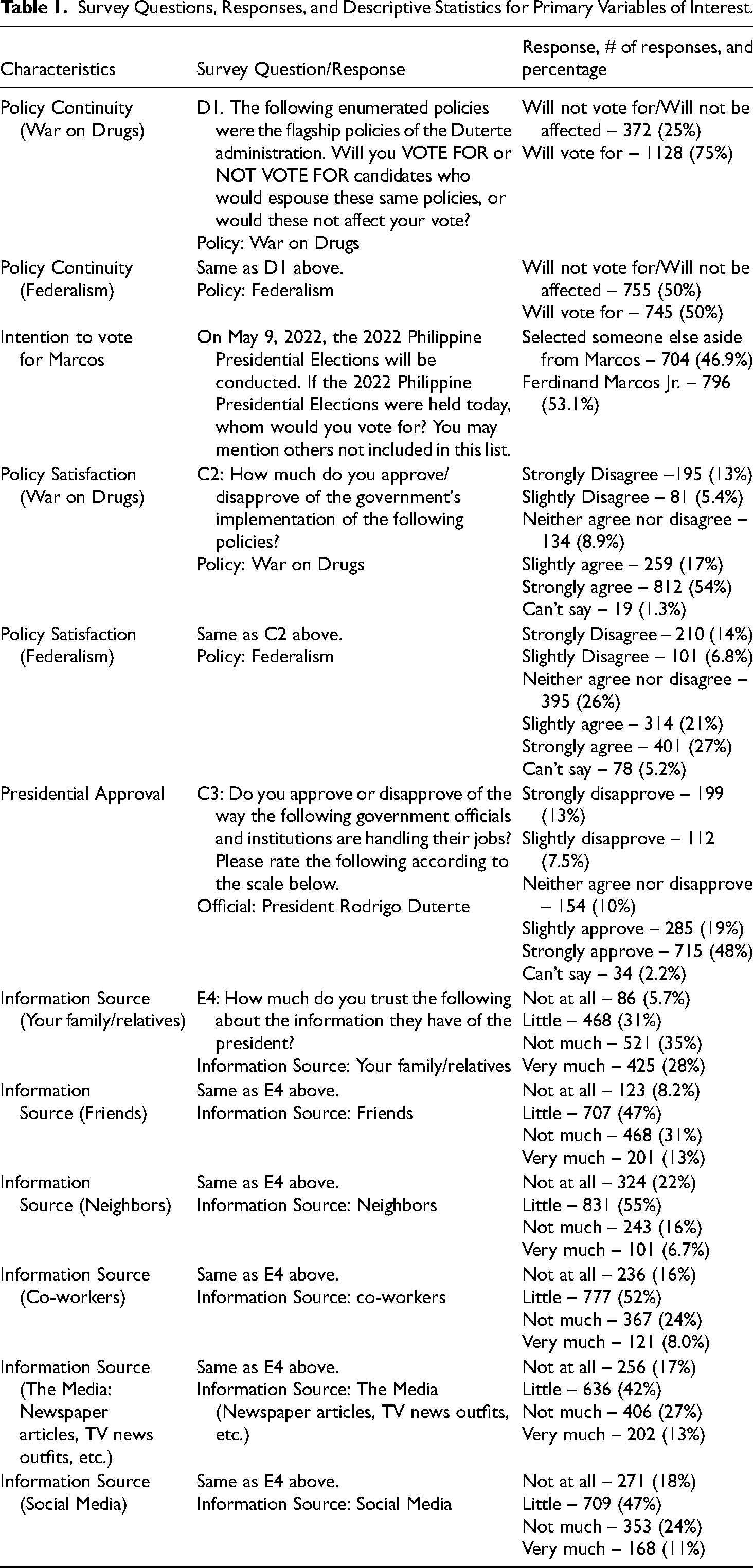
Support for continuing Duterte's policies are strong for the War on Drugs (75%), but divisive for Federalism, in which only 50% will support candidates that espouse the issue. The trends are similar when asked about their satisfaction on policy performance. 71% of respondents strongly or slightly approve of the war on drugs and 49% for federalism. Coinciding with the high satisfaction of the War on Drugs is the sentiment that the proliferation of illegal drugs is one of the most pressing issues faced by the country today. 37% of respondents included ‘eliminating the sale of illegal drugs’ in their top 5 most important issues to be addressed, while only 9% included ‘changing the constitution’. It also shows that 53.1% intended to vote for Marcos Jr. for President, which is close to the 58.7% he received in May 2022. Table 1 also shows that 67% strongly or slightly approve of Duterte's handling of his job in government. For information sources, respondents trust their family and relatives the most (28% responded ‘very much’), then the media (13%), their friends (13%), social media (11%), co-workers (8%) and neighbors (7%).
We use a logistic regression model to examine the relationship of policy continuity and the intention to vote for Marcos Jr with the other hypothesised determinants. Given the operationalisation of the dependent variable, we chose to use a survey-weighted generalised linear model with a logistic canonical link function, which is primarily used to analyse survey data. This allows us to estimate the increased (or decreased) odds of the respondents’ likelihood for supporting policy continuity with each of the determinants. The survey questions that were included in the model are the ones shown in Table 1. The statistical model was implemented in R (version 4.0.3) using the ‘survey’ package (version 4.1.1). We operationalise the research question using the following equations: Model 1: Policy Continuity/Intention to vote for Marcos Jr = Presidential Approval (C3) + C Model 2: Policy Continuity/Intention to vote for Marcos Jr = Information Source (E4) + Issue Urgency (C1) + Demographics + C Model 3: Policy Continuity/Intention to vote for Marcos Jr = Presidential Approval (C3) + Information Source (E4) + Issue Urgency (C1) + Demographics + C
Results
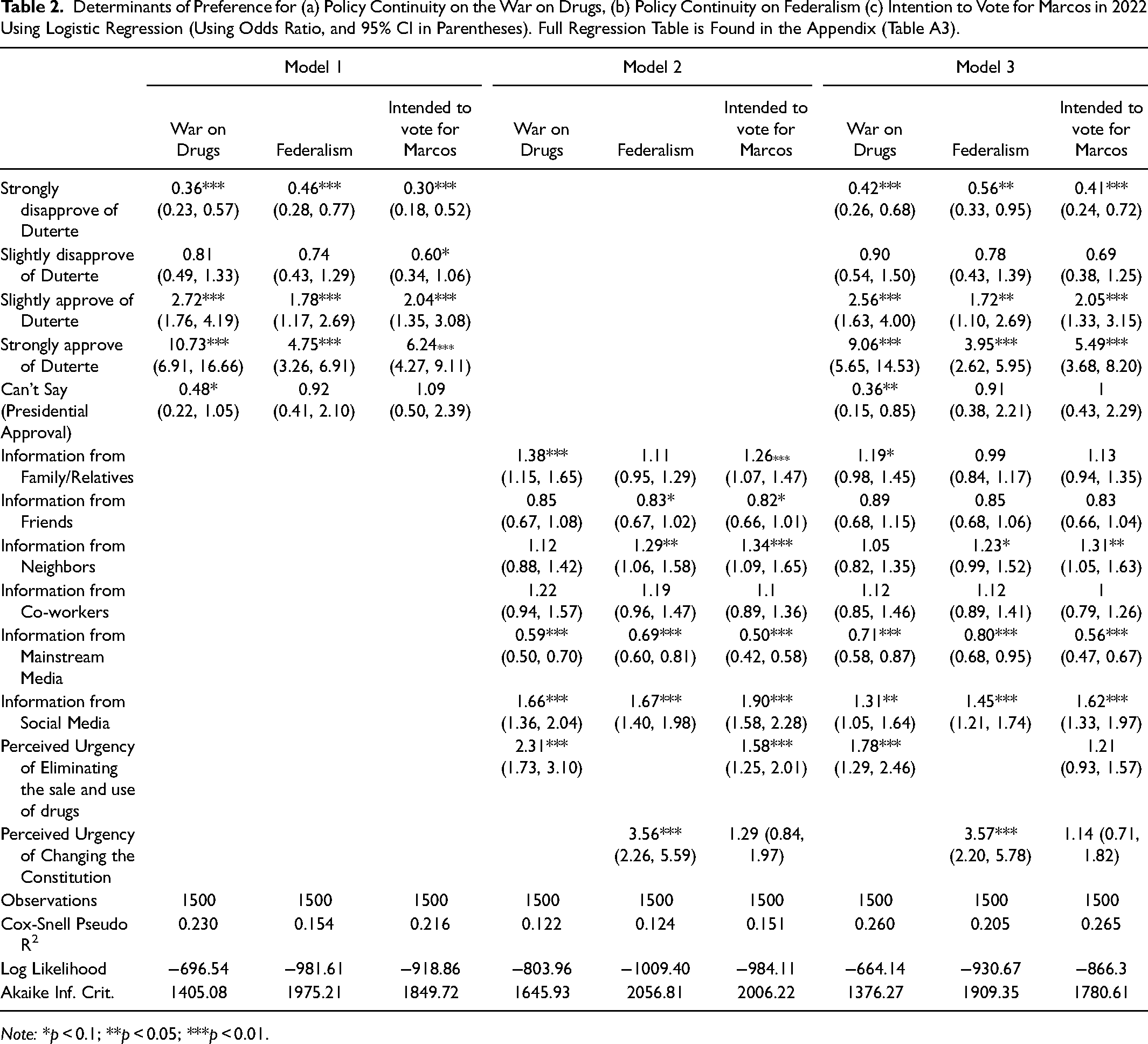
Table 2 below shows the results of the study. As Filipino voters become more satisfied with the performance of President Duterte, they become more likely to vote for a presidential candidate that seeks to continue Duterte's flagship policies and are also more likely to vote for Marcos Jr. This trend is most obvious with support for the continuation of the war on drugs, where respondents who strongly approve of President Duterte are 9.06 times more likely to vote for a candidate that supports the policy compared to those who neither approve nor disapprove of the President. Likewise, the odds ratios are also high for federalism. Respondents who strongly approve of the President are 3.95 more likely to vote for a candidate that supports federalism. The above trend is also true for those who strongly disapprove of President Duterte. Odds ratios show that those who strongly disapprove of the President are less likely to support the policies versus those who neither approve nor disapprove of Duterte (OR, same order as above: 0.42, 0.56). Those who strongly approve of Duterte are also 5.49 times more likely to intend to vote for Marcos Jr in the 2022 elections.
Determinants of Preference for (a) Policy Continuity on the War on Drugs, (b) Policy Continuity on Federalism (c) Intention to Vote for Marcos in 2022 Using Logistic Regression (Using Odds Ratio, and 95% CI in Parentheses). Full Regression Table is Found in the Appendix (Table A3).
Note: *p < 0.1; **p < 0.05; ***p < 0.01.
Satisfaction with the President is also found to be directly correlated with satisfaction with his main flagship policies. Table A1, which summarises policy satisfaction instead of support for policy continuity as a measure, supports these results as odds ratios for each policy are similarly high when presidential satisfaction is high (OR: 8.25, 5.19). There remains widespread support for President Duterte's flagship policies at the near-end of his term, and the consistent correlation between approval and preference for continuity shows that these may have affected voter preferences in the 2022 national elections. From Thompson's relational approach, these results suggest that affiliation with Duterte's brand of illiberal populism can strengthen the image of politicians among Filipinos. This mechanism allows for coattailing to take place even without political parties nor dynasties. Instead continuity through coattailing can be traced to the relative positioning of candidates with the current political order.
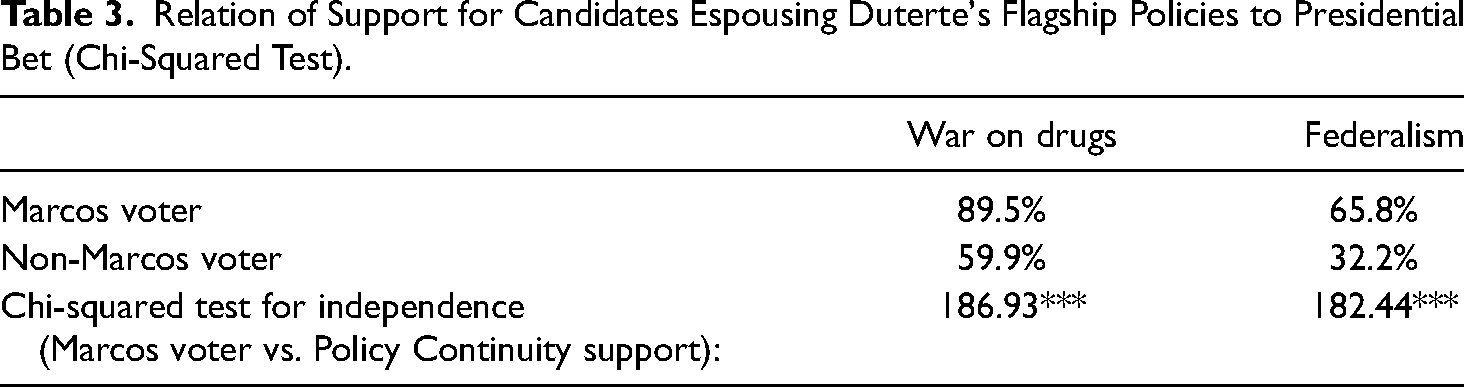
We confirm previous studies and add to growing empirical evidence that supporters of Duterte viewed Marcos Jr. as the ‘successor’ of the Duterte administration: 56% of those who planned to vote for Marcos believed that he had Duterte's endorsement, 22% believed he had no endorsement, while 22% were unsure. This shows that there is indeed an image of Marcos as the continuity of the Duterte administration. Table 3 illustrates the correlation between the preference for continuity of Duterte's War on Drugs and Federalism to the candidate they are most likely to vote for. Respondents who would vote for candidates espousing the Duterte administration's flagship policies go on to vote for Bongbong Marcos: 89.5% of those who support candidates espousing the War on Drugs supported Bongbong Marcos’ bid for the presidency, while 65.8% of those who supported Federalism were likely to vote the same.
Relation of Support for Candidates Espousing Duterte's Flagship Policies to Presidential Bet (Chi-Squared Test).
Meanwhile, evidence for the relationship between information sources and preference for policy continuity is not consistent. We hypothesised that informal information networks such as relatives, friends, neighbors, co-workers, and social media would amplify majority views that focused on how key policies were tied to Duterte's strongman populist brand of leadership. We find partial and weak support for this in the direct correlations between a respondent's trust in relatives for political information and their preference to continue the administration's war on drugs (OR: 1.19). Trust in neighbors is also directly correlated to voting for a candidate that will continue federalism (OR: 1.23), which makes sense given that the framing of federalism is a spatial issue between the country's capital and underdeveloped regions, and vote for Marcos Jr. (OR: 1.31) given the regionality of command votes in Philippine politics. These show that information networks matter in policy support but that the skewed ‘majority view’ may differ among respondents. Further studies can then look into what majority view is being echoed within these networks to explain our findings.
However, we find more consistent results in the opposing influence between social media and mainstream media on preference for policy continuity and voting for Marcos Jr. We find that increased trust in social media is linked to increased likelihood of supporting both flagship policies (OR, war on drugs: 1.31, OR, federalism: 1.45), as well as voting for Marcos Jr (OR: 1.62). Trust in social media as a source for political information can also make Filipinos vulnerable to news that are purposefully skewed to encourage support for illiberal populism. Contrary to intimate informal information networks such as families or friends wherein the ‘majority view’ is created in isolation from the experiences of others, social media systematically propagates a ‘majority view’ that favours the president and is believed to represent a wider public (Pariser, 2011; Sunstein, 2019). Thus, exposure to social media news can be linked to higher support for regime continuity.
Respondents who trust traditional media are linked to a decreased likelihood of supporting the war on drugs (OR: 0.71) and federalism (OR: 0.80), as well as decreased likelihood of voting for Marcos Jr (OR: 0.56). This can be expected given the evidence-based narratives put together by mainstream media and its coverage of a wider array of policy circumstances and implications for the audience, resulting in a more critical, diverse, and objective viewpoint on these policies. With a broader perspective of political events, the political brand of Duterte as an illiberal populist is weakened and becomes less appealing which could lower preference for policy continuity. In addition, the bulk of fact-checking initiatives and Marcos’ absence from mainstream media coverage himself compromised the exposure of an illiberal populist narrative that supports Marcos Jr.
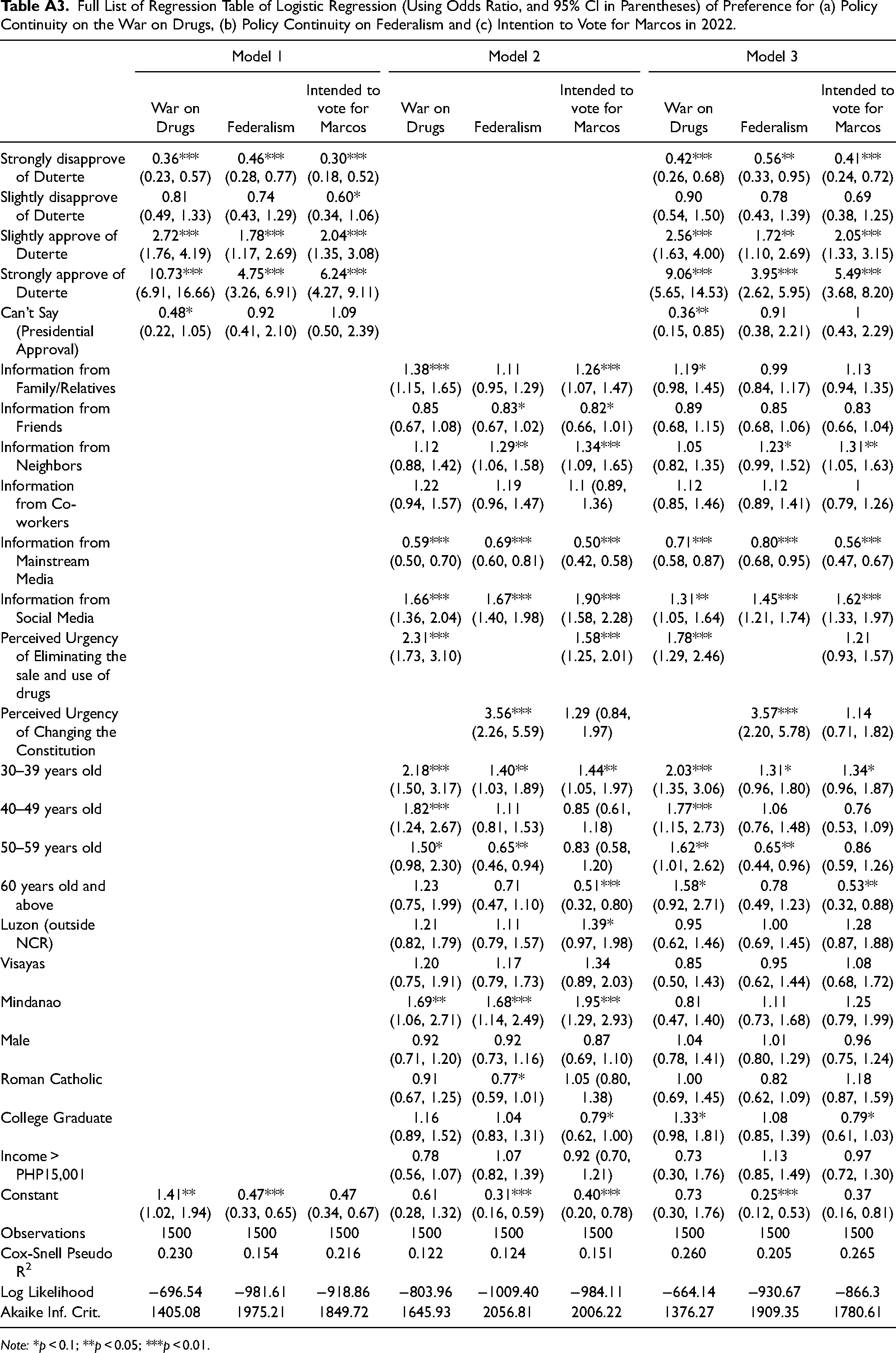
Among the demographics, only age had a consistently significant correlation with policy continuity. Those aged 30–39 are 3.03 times more likely to vote for a candidate that supports the war on drugs than the younger generation or those aged 18–29. Meanwhile, those aged 50–59 are less likely to support a politician endorsing federalism compared to those who are 18–29. Perceived urgency of an issue is also positively correlated with preference for continuity. Respondents who perceive controlling illegal drugs as an urgent issue, e.g., part of their top 5 national policy issues, are 1.78 times more likely to vote for a candidate that supports the war on drugs. Those who perceive changing the constitution as an urgent policy issue are also 3.57 times more likely to vote for a candidate that supports federalism.
While we can assume that this is an obvious trajectory inherent in policy support, what is interesting about these results is that the correlation between presidential approval and policy continuity preference is much stronger compared to the link between urgency and policy continuity. It can then be said that, in a country like the Philippines wherein personalities and political regimes take on the role of ideologies as information shortcuts, Filipinos evaluate policy continuity based on their support for the political personality behind it rather than their own personal belief of those issues needing policy responses.
Conclusion
High public support for illiberal populism embodied by former President Duterte has spilled over onto votes for Marcos Jr. during the 2022 national elections. For Dulay et al. (2023), this indicates that Duterte supporters voting for Marcos Jr. ‘perceive Bongbong in a similar role – the latest manifestation of the sort of “strong” leader for which Filipinos still yearn’ (p. 6). Indeed, there seems to be some continuity in the flagship policies of Duterte under the Marcos Jr. administration. Even though Marcos Jr. vowed a bloodless war on drugs when he took office in 2022, an average of one person per day has been killed in the drug war (Conde, 2024). Marcos Jr. has also been pushing for the devolution of certain powers from the executive branch to local governments as a first step of federal government in the country (Bajo, 2023). But whether Marcos Jr himself became a ‘populist’ leader with an illiberal agenda in his sleeves, is a question that has seen unexpected twists and turns.
Two years in the presidency, Marcos Jr has not displayed the features of a ‘populist’ as defined in the literature, nor emulated Duterte's style of populist leadership. What stands out, however, is that these illiberal populist policies seem to be reframed and incorporated into the ruling narrative as a way to again strengthen the legitimacy of the President. Marcos Jr.'s testament to a bloodless war on drugs and his new strategy of a gradual push to federalism seem to adopt the policies into a narrative that departs from the violence and recklessness of Duterte's illiberal populism. Indeed, Duterte and their social media supporters have now ironically branded the president to be a ‘weak leader’. Marcos Jr himself lacked the firebrand charismatic persona that is emblematic of populist leaders like Duterte and has refrained from making divisive rhetorics. Marcos himself continues to ‘rebrand’ himself as committed to human rights citing the decreased trend in crimes and human rights violations under his term (Mendoza, 2024) and the creation of the Special Committee on Human Rights Coordination.
This study adds to existing research that shows how Filipinos are more likely to align their support of policies with personalities and politicians behind them, rather than personal beliefs in the utility of these policies. In short, this study confirms what we already know about the personality-oriented nature of politics and public policy in the Philippines. But what this study further demonstrates is that given the insidious nature of populism and manipulative nature of social-media sourced information, these factors amplify the appeal of illiberal populism over a long period of time. This also means that populist leaders can devise illiberal policies with little resistance and scrutiny, as well as render irrelevant mechanisms of vertical accountability. The result of this study further highlights the relationship between populism and information sources in reshaping the nature of political legitimacy. Most studies focus on elite competition over command votes, or votes gathered from networks of influence by politicians and their allies in the form of patronage, vote-buying, and even election-related violence. This research shows how media, in the contrasting influence of mainstream and social media, contributes to the dynamics of elite competition over market votes, voter preferences, and competition over underlying regime narratives in the Philippines.
Overall, this research illustrates the possibility of regime continuity in a country wherein personalities and political rhetoric override performance, ideologies, and policy utility. Results of this study are relevant especially for other electoral democracies facing a similar wave of populist support, as many nations face declining democratic values in the face of rising authoritarianism (Quraishi, 2021). We find empirical evidence that presidential approval and information sources are linked to the orientation of Filipino voters towards policy preferences and the general political order. The contestation between regime narratives of liberal reformism and illiberal populism are embedded in these elements – and therefore the fate of any possibility for democratic renewal. The irony in Marcos Jr's electoral victory is that it was facilitated by a continuing appeal of populism, and yet this administration might also be the one to disrupt this populist wave as a strategy for political survival. As cracks start to show in the Marcos-Duterte tandem in the Philippines, there is hope that this populist cycle can be disrupted. We suggest further studies on how elite competition can restore confidence in mainstream media and why leadership pivots as a countermeasure to populism.
Footnotes
Declaration of Conflicting Interests
The authors declared no potential conflicts of interest with respect to the research, authorship, and/or publication of this article.
Funding
The authors disclosed receipt of the following financial support for the research, authorship, and/or publication of this article: This work was supported by the United States Agency for International Development (grant number 72049220CA00007).
Notes
Author Biographies
Appendix
Full List of Regression Table of Logistic Regression (Using Odds Ratio, and 95% CI in Parentheses) of Preference for (a) Policy Continuity on the War on Drugs, (b) Policy Continuity on Federalism and (c) Intention to Vote for Marcos in 2022.
| Model 1 | Model 2 | Model 3 | |||||||
|---|---|---|---|---|---|---|---|---|---|
| War on Drugs | Federalism | Intended to vote for Marcos | War on Drugs | Federalism | Intended to vote for Marcos | War on Drugs | Federalism | Intended to vote for Marcos | |
| Strongly disapprove of Duterte | 0.36*** (0.23, 0.57) |
0.46*** (0.28, 0.77) |
0.30*** (0.18, 0.52) |
0.42*** |
0.56** |
0.41*** |
|||
| Slightly disapprove of Duterte | 0.81 |
0.74 |
0.60* |
0.90 |
0.78 |
0.69 |
|||
| Slightly approve of Duterte | 2.72*** |
1.78*** |
2.04*** |
2.56*** |
1.72** |
2.05*** |
|||
| Strongly approve of Duterte | 10.73*** |
4.75*** |
6.24*** |
9.06*** |
3.95*** |
5.49*** |
|||
| Can’t Say (Presidential Approval) | 0.48* |
0.92 |
1.09 (0.50, 2.39) | 0.36** |
0.91 |
1 |
|||
| Information from Family/Relatives | 1.38*** |
1.11 |
1.26*** |
1.19* |
0.99 |
1.13 |
|||
| Information from Friends | 0.85 |
0.83* |
0.82* |
0.89 |
0.85 |
0.83 |
|||
| Information from Neighbors | 1.12 |
1.29** |
1.34*** |
1.05 |
1.23* |
1.31** |
|||
| Information from Co- workers | 1.22 |
1.19 |
1.1 (0.89, 1.36) | 1.12 |
1.12 |
1 |
|||
| Information from Mainstream Media | 0.59*** |
0.69*** |
0.50*** |
0.71*** |
0.80*** |
0.56*** |
|||
| Information from Social Media | 1.66*** |
1.67*** |
1.90*** |
1.31** |
1.45*** |
1.62*** |
|||
| Perceived Urgency of Eliminating the sale and use of drugs | 2.31*** |
1.58*** |
1.78*** |
1.21 |
|||||
| Perceived Urgency of Changing the Constitution | 3.56*** |
1.29 (0.84, 1.97) | 3.57*** |
1.14 |
|||||
| 30–39 years old | 2.18*** |
1.40** |
1.44** |
2.03*** |
1.31* |
1.34* |
|||
| 40–49 years old | 1.82*** |
1.11 |
0.85 (0.61, 1.18) | 1.77*** |
1.06 |
0.76 (0.53, 1.09) | |||
| 50–59 years old | 1.50* |
0.65** |
0.83 (0.58, 1.20) | 1.62** |
0.65** |
0.86 (0.59, 1.26) | |||
| 60 years old and above | 1.23 |
0.71 |
0.51*** |
1.58* |
0.78 |
0.53** |
|||
| Luzon (outside NCR) | 1.21 |
1.11 |
1.39* |
0.95 |
1.00 |
1.28 |
|||
| Visayas | 1.20 |
1.17 |
1.34 |
0.85 |
0.95 |
1.08 |
|||
| Mindanao | 1.69** |
1.68*** |
1.95*** |
0.81 |
1.11 |
1.25 |
|||
| Male | 0.92 |
0.92 |
0.87 |
1.04 |
1.01 |
0.96 |
|||
| Roman Catholic | 0.91 |
0.77* |
1.05 (0.80, 1.38) | 1.00 |
0.82 |
1.18 (0.87, 1.59) | |||
| College Graduate | 1.16 |
1.04 |
0.79* |
1.33* |
1.08 |
0.79* |
|||
| Income > PHP15,001 | 0.78 |
1.07 |
0.92 (0.70, 1.21) | 0.73 |
1.13 |
0.97 (0.72, 1.30) | |||
| Constant | 1.41** |
0.47*** |
0.47 |
0.61 |
0.31*** |
0.40*** |
0.73 |
0.25*** |
0.37 |
| Observations | 1500 | 1500 | 1500 | 1500 | 1500 | 1500 | 1500 | 1500 | 1500 |
| Cox-Snell Pseudo R2 | 0.230 | 0.154 | 0.216 | 0.122 | 0.124 | 0.151 | 0.260 | 0.205 | 0.265 |
| Log Likelihood | −696.54 | −981.61 | −918.86 | −803.96 | −1009.40 | −984.11 | −664.14 | −930.67 | −866.3 |
| Akaike Inf. Crit. | 1405.08 | 1975.21 | 1849.72 | 1645.93 | 2056.81 | 2006.22 | 1376.27 | 1909.35 | 1780.61 |
Note: *p < 0.1; **p < 0.05; ***p < 0.01.