




Abstract
This research note considers the effects of electoral system reform in Bolivia. In 1995, Bolivia moved from a list-proportional to a mixed-member proportional electoral system. The intervening years saw growing regional polarization of politics and a collapse of the existing party system. Using statistical analysis of disaggregated electoral data (at department, municipality, and district level), this paper tests whether electoral system reforms may have contributed to the current political crisis. Research findings show that regional cleavages existed prior to electoral system reform, but suggest that reforms aggravated their effects. Such evidence gives reason to question the recent popularity of mixed-member proportionality.
Introduction
After nearly two decades of remarkable political stability, Bolivia now (since 2003) faces ongoing political conflict. The events of the past few years – particularly following the election of Evo Morales, a coca farmer and leader of MAS (Movement Towards Socialism) – have been described alternatively as evidence of reaction by Bolivians against globalization and neoliberalism, as part of Latin America's “left turn,” as a return to a previous tradition of instability, as a sign of a new “social revolution,” or as evidence of a new rising power of indigenous-popular social movements.
This research note takes a different approach, focusing instead on institutional reforms, exploring an interesting paradox proposed by Scott Mainwaring (2006). Contrary to common perceptions of a “crisis of representation” in the Andes, Mainwaring suggests that political representation improved throughout the Andes due to institutional reforms implemented in the 1990s. Mainwaring thus proposes a “paradox of representation” – that institutional reforms meant to increase participation may lead to political instability. Bolivia suggests an interesting case to explore this assertion. Despite a difficult transition to democracy, stable multiparty competition and alternation of power were the norm in Bolivia by 1990. During the 1990s, many scholars saw Bolivia as a model of democratic stability and institutional reform. Only later, beginning in 2000 and accelerating after 2002, did Bolivia enter a political crisis. This research note offers only a preliminary assessment of the possible relationship between electoral reform, party system instability, and increased regional polarization. Nevertheless, it also offers an empirical analysis based on micro-level data.
The Research Puzzle
How Bolivia went from a model of successful democratic consolidation under inhospitable socioeconomic context (poverty, underdevelopment, ethnic pluralism) to a conflict-prone polarized polity is an important research question. The puzzle is complicated by significant institutional reforms undertaken by Bolivia's political class in the 1990s. These reforms were explicitly aimed at making the Bolivian state more representative and responsive to citizens. Why, then, did Bolivia's stable multiparty democracy unravel within a decade of such reforms?
Most conventional accounts of contemporary Bolivia focus on emerging social movements that mobilized the “losers” of globalization and neoliberal policies (e.g., the poor, the indigenous, organized labor). Without discounting the value of such perspectives, I suggest that it is important to consider the timing of the emergence of these social forces. The social impact of neoliberal reforms was strongest in the 1980s, after the Paz Estenssoro government implemented an orthodox structural adjustment program in 1985. The late 1980s did see the emergence of “populist” outsider political movements, but by the late 1990s these had been accommodated (or co-opted) into the existing political system. Similarly, US-led coca eradication programs began in the 1980s, yet no significant cocalero political movement emerged until the late 1990s (when U.S. counternarcotics efforts were arguably “milder”). In fact, the 1980s and early 1990s saw a steady decline in support for leftist parties; indigenous katarista parties were unable to win more than 3 percent of the popular vote throughout this same period. Meanwhile, the 1990s saw real annual GDP grow by 4 percent each year, while per capita income grew by about 6 percent each year during the same period – though income inequality also increased during this period. The economy went into recession in 1999, but by 2000 had recovered and was back to steady (if somewhat sluggish) growth. In other words, socioeconomic conditions alone cannot easily explain why indigenous-popular movements emerged with such force so recently, rather than in the 1980s.
The 1990s did, however, see significant institutional reforms. Two reforms stand out: the 1994 Popular Participation Law (LPP) and the adoption of a mixed-member proportional (MMP) electoral system. The LPP decentralized the country and devolved substantial authority and fiscal responsibilities to more than 300 newly created municipal governments (currently 327), each with a mayor and municipal council elected directly by voters and with real fiscal and policy responsibilities. The adoption of MMP gave Bolivian voters their first opportunity (since the 1940s) to directly elect (“uninominal”) legislative representatives (about half of the lower house Chamber of Deputies) in single-member, winner-take-all districts (SMDs). Both reforms significantly altered the country's political landscape, creating new local arenas for political competition. An early study by Gloria Ardaya (2003) suggested that parties’ “programmatic content” had radically changed after the adoption of MMP. This research note explores whether the timing of institutional reforms – particularly the adoption of MMP – can help explain the decline of “traditional” political parties and the sharpening of a regional cleavage.
Presidentialism, Social Cleavages, Party System Stability, and Mixed-member Proportionality
Bolivia's electoral system reform occurred within a unique constitutionally defined institutional context identified as “parliamentarized” presidentialism (Mayorga 1997). In this system, Bolivian presidents (unless they could muster an absolute majority of the popular vote, as only Evo Morales did in December 2005) were elected through multiparty legislative coalitions. Such “pacted” coalitions guaranteed presidents legislative majorities and were widely considered the cornerstone of the country's political stability. The adoption of MMP and other constitutional reforms in the 1990s neither eliminated nor significantly altered the key norms of parliamentarized presidentialism. The National Congress was now restricted to selecting a president from among the top two runners-up (rather than the top three), but otherwise there were no other changes. The period between 1985 and 2002 continued to be dominated by the three so-called “systemic” parties: MNR (National Revolutionary Movement), ADN (Democratic National Action), and MIR (Movement of the Revolutionary Left).
The years after the adoption of MMP saw important changes to the party system. While the effective number of parties had declined throughout the 1980s and early 1990s, it began to increase sharply in the late 1990s. In particular, new parties began to gain important footholds, challenging the systemic parties’ political hegemony. The 2002 election was the first clear indication that Bolivia's systemic parties were in trouble. That year, the MNR's Gonzalo Sánchez de Lozada was the only “systemic” candidate to emerge as a presidential contender (with 22.5 percent of the vote), followed closely by Evo Morales (with 20.9 percent); the MIR and ADN candidates placed fourth and seventh, respectively. Because vote shares were so dispersed, the 2002 coalition formation process was a difficult ordeal. The fragile, heavily clientelistic coalition was short-lived, and weeks of sustained social unrest drove Sánchez de Lozada from office in October 2003. In the 2005 elections the systemic parties virtually disappeared, with only the MNR offering a slate of candidates (and winning a paltry 6.5 percent of the vote).
A focus on Bolivia's electoral system reform is appropriate because “electoral engineering” reforms have been widely encouraged by political scientists since the 1990s. In recent years, a number of countries have adopted mixed-member systems, hailed because they “allow nations to tailor their electoral systems so as to potentially have their cake and eat it too” (Shugart and Wattenberg 2001: 1). There remain, of course, good reasons to be optimistic about electoral system reforms and their ability to strengthen democracy. But as a growing number of countries rush to adopt some type of mixed-member system, it is important to understand the reforms’ potential unintended consequences. To assess the impact of MMP in Bolivia, I consider three dimensions: presidentialism, social cleavages, and party system stability.
A consistent criticism leveled at Latin American democracies is their reliance on presidential systems, particularly the combination of presidentialism with proportional representation (PR) electoral systems for their legislatures. It is unclear how MMP would lessen the negative effects of presidentialism combined with PR. There is also no reason to believe that MMP would reduce the number of political parties or promote multiparty coalitions any better than other forms of PR. In fact, there are reasons to believe MMP would increase executive-legislative antagonisms by raising the visibility of directly elected SMD legislators and decreasing party discipline. For all MMP's other strengths, correcting for the deficiencies of Latin American presidentialism does not seem to be one of them.
A number of scholars have suggested that democracy is more difficult in “deeply divided” societies and have recommended electoral system reforms meant to reduce the effects of powerful social cleavages (see Reilly 2001). Such recommendations often promote some form of preferential voting system (such as Instant-Runoff Voting or Single Transferable Vote), while warning against plurality (or “first-past-the-post”) systems. Plurality systems, it is often argued, promote winner-take-all politics and contribute to polarization. If so, there is reason to suspect that MMP reforms that introduce a plurality component (SMDs) into legislative elections may encourage political parties and candidates to shift resources toward securing a local “base” and away from building broad, multi-group constituencies.
Where MMP is more likely to be successful is in strengthening party systems by better connecting parties to voters. If we accept the claim that political parties are “indispensable” for democracy (Lipset 2000), we should seek electoral reforms that strengthen both the legitimacy and effectiveness of parties and party systems as instruments for channeling civil society's preferences. And though plurality SMD elections may be problematic, because MMP allocates the remaining “list” seats in compensatory fashion – retaining proportionality – proponents are optimistic that MMP balances that; giving voters a direct link to representation while retaining proportional interest group representation. Yet hindsight suggests that it may be possible for the SMD portion of the ballot to “infect” the electoral system, leading to the same kinds of problems often associated with plurality systems.
Mixed-member systems are often adopted to correct for some form of “extreme” electoral system (either too proportional or too majoritarian). If so, understanding the particular (or perceived) flaws of the existing electoral system before engaging in electoral engineering. Bolivia's pre-reform electoral system fit neither extreme: assigning seats in department-wide districts, Bolivia's list-PR was not highly proportional; yet the use of PR clearly did not make it majoritarian, either. Instead, the primary motivation behind the reform – which was encouraged by foreign experts – was to strengthen the representational legitimacy of the country's political parties. However, the electoral record of the last few years suggests that Bolivia's party system suffered a crisis of legitimacy. This research note suggests that adopting MMP exacerbated some of the very kinds of problems that electoral engineers seek to solve: problems associated with presidentialism, social cleavages, and weak party systems.
Hypotheses and Research Design
This research note primarily tests whether the adoption of MMP may have contributed to the crisis of Bolivia's party system. Between 1985 and 2005, Bolivia's party system went through a significant transformation. While the three systemic parties captured 73.9 percent of the presidential vote in 1985, they captured only 42.2 percent in 2002, and only 6.5 percent in 2005. Not surprisingly, the decline in support for system parties coincided with increases in the effective number of parties and electoral volatility. The timing of this sharp decline suggests a possible relationship between electoral system reform and party system instability.
Sub-national election data provides a second hypothesis. As early as 1985, one noticed differences in voting patterns between western “Andean” departments and eastern lowland departments of the so-called “Media Luna” (support for systemic parties was higher in the latter). Such differences increased significantly in recent years. Other indicators of party system stability also declined across the Media Luna, but at a slower rate than in the Andean regions. The timing of this regional divergence suggests that institutional reforms encouraged a new “regionalization” of politics that put additional strain on a weak political system.
We may formulate the hypotheses thus:
Hypothesis 1: Electoral reform is associated with a sharp decline in party system stability.
Hypothesis 2: The decline in party system stability was higher in Andean regions than in the Media Luna.
While national and department-level observations seem to confirm both hypotheses, this study tests them more carefully by looking at a representative panel of 32 municipalities (see Appendix). Additionally, this study looks at voting trends at the SMD level by comparing voting trends across the country's “uninominal” districts. This approach allows us to look at micro-level trends in voting patterns to test whether the changes observed at the national and department-level are statistically significant, when attempting to control for other intervening factors, across the country's six general elections.
Data and Method
This study uses electoral data provided by Bolivia's CNE (National Electoral Court) and the FUNDEMOS (1998) dataset (see Appendix). In addition to publicly available data, CNE staff members kindly provided “plurinominal” (the presidential and list-PR portion of the ballot) data disaggregated to the SMD level for the 1997, 2002, and 2005 elections, as well as municipal-level data for 2002. In total this looked at six general elections: 1985, 1989, 1993, 1997, 2002, and 2005. Of these, the first half took place before electoral reform and the second half took place after.
This study employs two sets of panel data at different levels of observation (municipal and SMD) across the six general elections held between 1985 and 2005. It employs two different kinds of panel-estimated regression models to test the relationship between electoral reforms, regional cleavages, and party system stability at the sub-national level. To test for the relationship between electoral system reforms on party system stability within each unit of analysis (municipality and SMD), between-effects models are used. To test for differences in party system stability across Bolivia's Andean and Media Luna regions, random-effects models are used. Simply put, between-effects models estimate correlations among independent and dependent variables between panels and across time using panel means; it holds panels “constant” and estimates differences between panels (or units of analysis). In contrast, random-effects models estimate correlations between independent and dependent variables within panels and across time; it tracks changes over time within each panel and estimates parameters for the model as a whole. Correspondingly, the reported N in between-effects models refers to the number of panels (each municipality or SMD is counted only once); in random-effects models the reported N refers to the total number of units of observation (each municipality or SMD is counted at each election year).
Municipal panel data is drawn from a representative sample of 32 municipalities (see Appendix), providing 192 possible observations across five election years. Because the 2005 election was such a dramatic departure from previous elections and arguably occurred after the complete collapse of the party system, municipal-level models do not include the 2005 election. This prevents 2005 from over-determining results in favor of the research hypotheses. SMD panel data includes all uninominal SMD districts (see Appendix), providing 206 possible observations across the three elections in which MMP was used. SMD panel data does include 2005, but each consecutive election pair (1997-2002 and 2002-2005) is treated separately.
Dependent Variables
The dependent variable, party system stability, is measured along five distinct dimensions: voter turnout, percent of blank or null ballots, effective number of parties, electoral volatility, and support for systemic parties. There are noticeable differences in measures for each of these dimensions across time and regions; this study hopes to test whether such differences are systematic.
Measures for voter turnout and blank or null ballots come directly from CNE and FUNDEMOS data. While these figures may not say much about voters’ preferences, increases in either or both suggest increasing voter discontent with the political system.
The effective number of parties was calculated based on vote shares using the formula developed by Markku Laakso and Rein Taagepera (1979). Alone, such measures tell us little about party system stability. But looking across elections tells us whether the number of parties is expanding, shrinking, or remaining stable.
The measures for electoral volatility were constructed following Mogens Pederson (1979); see Appendix for details. High electoral volatility indicates that a party system is not stable, since voters are changing their preferences between elections, even though the effective number of parties may remain the same. A caveat: Because electoral volatility measures require two consecutive elections, measures for 1985 are not available for municipal-level data. Additionally, electoral volatility measures are not available for SMD-level data for 1997 (the first year MMP was used), but are available for 2002 and 2005.
The measure of support for systemic parties simply aggregates votes for the three parties (MNR, ADN, and MIR). A reduction in votes for these parties as an aggregate suggests a decline in voter confidence that the party system – long identified with these parties – is able to effectively channel civil society's demands. For 2005, the measure of support for systemic parties combines support for MNR and PODEMOS (Social Democratic Power), the political vehicle of Jorge Quiroga (Banzer's 1997 ADN vice-presidential candidate who assumed the presidency in 2001 after Banzer resigned for health reasons); while PODEMOS represented a “new” political vehicle, a large number of its candidates were drawn from the systemic parties and the party was widely seen to represent “systemic” interests.
Independent and Control Variables
The first independent variable is electoral reform, and particularly the adoption of MMP. This is measured using a simple dummy variable that codes as “1” elections following institutional reforms (“post-reform”), and codes as “0” those that preceded them (“pre-reform”). This is clearly an imperfect approach, since it does not distinguish between the effects of LPP and MMP reforms (though there is reason to assume their effects are similar and mutually reinforcing).
I also look at the effects of district magnitude using the “effective threshold” measure proposed by Arend Lijphart (1994). Because the adoption of MMP increased each department's effective threshold (since the number of seats distributed by PR decreased), this controls for any differences produced by changes in effective thresholds, typically cited as a significant factor in (lowering) the effective number of parties in PR systems. Additionally, looking at the effective threshold also serves as a proxy for differences in electoral “weight” across departments.
The second independent variable is region. This is measured using a simple dummy variable that codes as “1” observations from the four Media Luna departments (Santa Cruz, Tarija, Beni, and Pando), and codes as “0” observations from four “Andean” departments (La Paz, Cochabamba, Oruro, and Potosí). Observations from Chuquisaca (which does not easily fit either description) are not coded and left out of most models (reducing the N).
Additionally, I control for other geographic factors. At the municipal level, I control for an urban-rural variable that codes as “1” the nine department capitals plus the city of El Alto, and codes as “0” all other municipalities (considered “rural”). At the SMD level, I control for a “metropolitan” effect by coding as “1” SMDs located in the hyper-urban metropolises of La Paz-El Alto, Cochabamba, and Santa Cruz (which together contain nearly 60 percent of the country's population). These variables control for any observed regional differences (at the department level) that may be driven by urban-rural variations.
Finally, although socioeconomic variables were not specifically introduced in this study (an obvious limitation), the selection of the 32 municipalities aimed to allow for sufficient variation along a number of socioeconomic dimensions (percent of indigenous population, degree of “ruralness,” poverty rates, etc.).
Preliminary Findings and Limitations
Preliminary results presented in the following tables suggest support for both research hypotheses. While noticeable regional differences existed between Andean and Media Luna municipalities preceding the mid-1990s electoral reforms, these differences increased significantly in the three elections following them. Although party system stability decreased noticeably after the mid-1990s across both regions, suggesting a crisis of the party system, this crisis was particularly acute in the Andean highlands. This suggests that the current Bolivian crisis – which is dominated by the regional divide between the autonomy movement in the Media Luna and Morales's supporters in the Andean highlands – is at least in part fueled by an electoral system that preferences regional cleavages.
A look at municipal-level models (see Tables 1-3) shows that regional differences were consistently more significant than urban-rural differences. Table 1 shows the results of between-effects municipal models. When comparing across municipalities, the department's effective threshold had no effect on any party system stability variable. In contrast, regional differences mattered: Media Luna municipalities had lower rates of blank or null votes, had fewer effective political parties, were more likely to vote for systemic parties, and had lower electoral volatility. Urban-rural differences were only statistically related to voter turnout (higher in urban municipalities) and blank or null votes (lower in urban municipalities).
Between-effects Municipal Panel-estimated Regression Models, 1985-2002
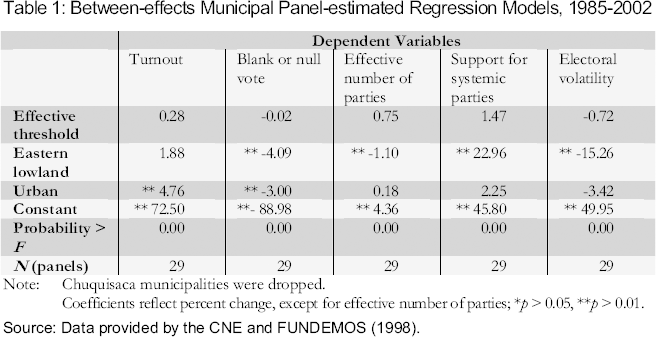
Note: Chuquisaca municipalities were dropped.
Coefficients reflect percent change, except for effective number of parties
*> 0.05
p > 0.01.
Source: Data provided by the CNE and FUNDEMOS (1998).
Random-effects Municipal Panel-estimated Regression Models, 1985-2002
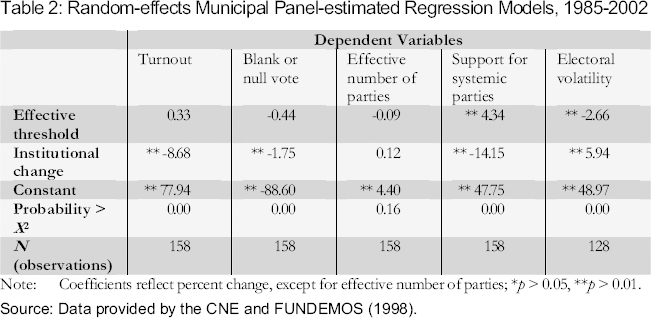
Note: Coefficients reflect percent change, except for effective number of parties
*p > 0.05
p > 0.01.
Source: Data provided by the CNE and FUNDEMOS (1998).
Regional Random-effects Municipal Regression Models, 1985-2002
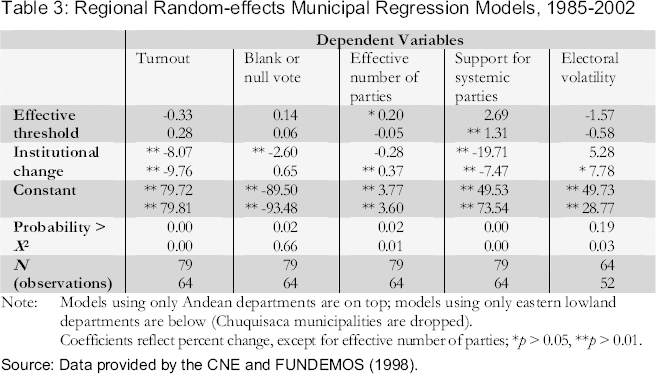
Note: Models using only Andean departments are on top; models using only eastern lowland departments are below (Chuquisaca municipalities are dropped).
Coefficients reflect percent change, except for effective number of parties
p > 0.05
p > 0.01.
Source: Data provided by the CNE and FUNDEMOS (1998).
Table 2 shows the results of random-effects models. When looking at differences within municipalities over time, changes in effective thresholds (with the adoption of MMP) mattered; higher effective thresholds increased support for systemic parties and decreased electoral volatility (both results positively consistent with the expectations of the reform's designers). However, these were offset by much larger changes over time pre-reform and post-reform elections: Post-reform elections (1997 and 2002) saw significant decreases in voter turnout, increases in blank or null votes, decreased support for system parties, and increased electoral volatility.
Finally, Table 3 looks at two separate random effects models, which divides the municipalities into two panels (Andean and Media Luna) and treats them separately. The results show that changes in effective thresholds were mixed. Changes in effective thresholds significantly increased the effective number of parties in Andean municipalities (but had no effect in Media Luna ones), increased support for systemic parties in Media Luna municipalities (but had no effect in Andean ones), and had no effect on electoral volatility in either region. Post-reform elections saw significant decreases in voter turnout in both regions (similar in magnitude), but other relationships were mixed. Post-reform elections saw significant decreases in blank or null votes only in Andean municipalities; meanwhile, post-reform elections saw significant increases in the effective number of parties and increase in electoral volatility only in Media Luna municipalities. Support for systemic parties fell in post-reform elections in both regions, but the magnitude of the average decrease in Andean municipalities was almost three times larger than in Media Luna municipalities.
A look at SMD-level models (see Tables 4-5) provides a slightly different picture, but one that also confirms the patterns seen in the municipal panel models. It is important to note an essential limitation of SMD models: Because SMDs did not exist prior to the adoption of MMP, no comparison is possible between pre-reform and post-reform elections using SMD-level data. Nevertheless, the more “standardized” SMDs (each department's SMDs are roughly equal in population size) allow for a stronger comparison between “metropolitan” and other districts. Additionally, because the introduction of MMP creates two different ballots (“plurinominal” list-PR and “uninominal” SMD), it allows for tests of “split-ticket voting” (measured as inter-ballot volatility). These models limit themselves to looking at effective number of parties and support for systemic parties.
Between-effects Panel Regression Models, Using SMD Uninominal ballots
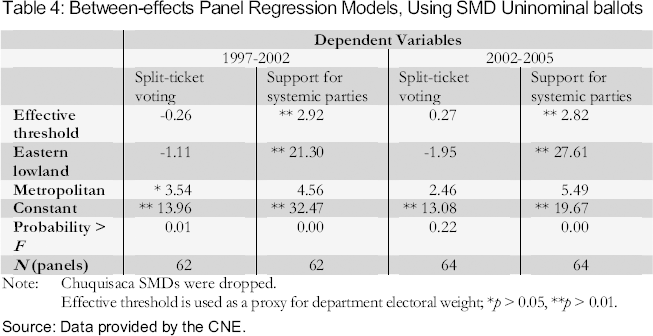
Note: Chuquisaca SMDs were dropped.
Effective threshold is used as a proxy for department electoral weight
p > 0.05
p > 0.01.
Source: Data provided by the CNE.
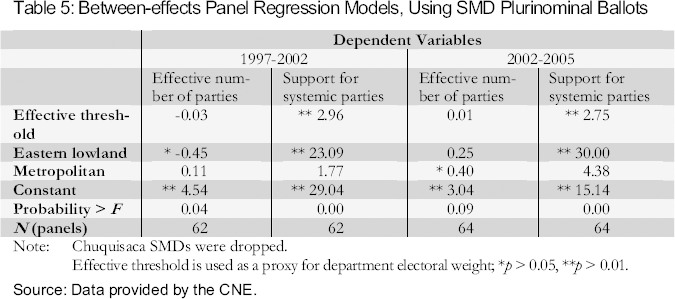
Between-effects Panel Regression Models, Using SMD Plurinominal Ballots
Note: Chuquisaca SMDs were dropped.
Effective threshold is used as a proxy for department electoral weight
p > 0.05
p > 0.01.
Source: Data provided by the CNE.
Table 4 shows the results of between-effects SMD models that look at “plurinominal” ballots (those cast for presidential candidates, which are also used to determine the compensatory seats awarded to each party under MMP). When comparing across SMDs, differences in the department's effective threshold matter (they significantly increase support for systemic parties) fairly consistently across both election pairs. Differences between metropolitan and other SMDs were noticeable between the 2002-2005 election pair (the effective number of parties increased in metropolitan SMDs), but not between the 1997-2002 one. Differences in support for systemic parties between Andean and Media Luna SMDs were significant across both election pairs, though they were more pronounced in the 2002-2005 period.
Table 5 shows the results of between-effects SMD models that look at “uninominal” ballots (those cast specifically for SMD candidates). When comparing across SMDs, differences between Andean and Media Luna SMDs are consistent with plurinominal ballot results: SMDs in departments with higher effective thresholds and Media Luna SMDs were more likely to support systemic party candidates. There was also little evidence of split-ticket voting, although metropolitan SMDs were more likely to have split-ticket voting in the 1997-2002 period.
Overall, the statistical analysis supports the research hypotheses. Regional differences in voting patterns did exist prior to the electoral reforms, but these increased in the post-reform period. Additionally, post-reform elections saw a significant decrease in party system stability.
It is important to point out some limitations of this study. While the selection of 32 municipalities (approximately 10 percent of all municipalities) sought to be representative (see Appendix), it might have been better to use all municipalities and include socioeconomic data for more precise controls. This has its own limitations, however: Census data are collected only ever decade, while elections occur on a more frequent schedule; changes within socioeconomic indicators (due to migration or other factors) between election years might not be reflected in the data. Another problem with census data is that it is not publicly available below the municipal level, which means that it does not provide for differences within municipal units. This is particularly problematic for metropolitan SMDs, which may vary significantly along socioeconomic indicators. Nevertheless, the author is pursuing this option in his on-going research.
Conclusions
Observers of Bolivian politics are only recently beginning to pay attention to regional cleavages within Bolivia. Yet the evidence presented here demonstrates that differences between the Andean and Media Luna regions existed long before the current political crisis and that these differences increased significantly in the post-reform period. If so, this suggests that institutional reformers would do well to pay more careful attention to how electoral reforms (such as MMP) may promote regional cleavages and foster the logic of politics in “divided societies.”
While electoral reforms aimed to improve both the legitimacy of the existing party system and the representative nature of Bolivian politics, it put tremendous strain on the political system. Why? One explanation is that the use of plurality SMD districts tied parties closer to specific constituent interests. In Bolivia's multiparty system, most SMD legislators were elected by small pluralities (the mean was around 20 percent), not majorities. This may have encouraged candidates and parties to target their electoral message to a narrow base in order to better win SMD seats. Bolivian politics (prior to 2002) had a centripetal tendency, pulling parties closer to the political center (where they formed “pacts”). In contrast, politics since 2002 has powerful centrifugal tendencies and a high degree of polarization. Such a shift has negative consequences for political stability, as well as for future democratic prospects.
The Bolivian case also suggests that electoral system reforms alone may not be enough to strengthen or legitimize an existing party system (a key goal of Bolivian reformers) in the absence of broader institutional reforms (such as state-building), a more effective political class (one more interested in policy-making than rent-seeking), or a better macro-institutional context (such as international support or economic stability and growth).
This should not automatically condemn future attempts at “constitutional engineering” in new democracies. Participación Popular was, on the whole, an important success. If anything, Bolivia's current political climate suggests that citizens want more (not less) such reforms. Calls for different kinds of “autonomy” come not only from the Media Luna departments, but also from traditional indigenous communities and sub-department regions (such as Chaco in Tarija). The new Bolivian constitution approved in 2009 further decentralized the state and devolved even more authority (political and economic) to lower levels. But the findings presented here suggest that such reforms may exacerbate regional divisions. Discussions about “two Bolivias” in media and scholarly accounts suggest that such divisions are becoming reified. At present, the key task is to develop institutions that both increase representation and promote moderate politics.
Footnotes
Municipal-level data
Municipal level data was compiled using the FUNDEMOS (1998) published dataset, which is disaggregated to the sub-canton level (in many cases to the village level). The LPP standardized municipal boundaries, frequently (but not always) using provincial “sections” as the base unit. In some cases a municipality comprised a single section; in others a municipality comprised two or more sections. I manually added up election results to construct pre-reform municipal units. Election data at the municipal level for post-reform elections was made available by the CNE.
Because the number of municipalities expanded from 311 in 1994 to 327 by 2004, I exclude from the potential sample any municipality that did not remain territorially consistent from 1994 through 2004. These also had to be readily identifiable from the FUNDEMOS dataset. From these, I created a representative sample of 32 municipalities drawn from the country's nine departments. I drew at least three municipalities from each department (including its capital and two or more others).
This sample represents a wide range of municipalities across a wide range of dimensions (population size, economic output, degree of “ruralness,” percent of indigenous population, geographic location, etc.).