




Abstract
In this paper, we examine the political factors that explain state responses to demands for indigenous territorial autonomy in Ecuador and Bolivia. Specifically, we aim to explain why the 2009 Bolivian constitution limited indigenous territorial autonomy to the departmental level, not allowing indigenous peoples to establish autonomous regions that lay beyond a single departmental jurisdiction, whereas the 2008 Ecuadorian constitution allows indigenous jurisdictions to exceed provincial boundaries. We argue that, in Bolivia, a strong conservative autonomy movement led by the country's eastern departments forced state officials to negotiate with regional elites, thus limiting the window of opportunity for indigenous movements and their allies to demand territorial autonomy. In the absence of a strong territorialized threat in Ecuador, indigenous movements and their allies had larger windows of opportunity to press their claims for territorial autonomy. This study contributes to comparative research on how states have simultaneously affirmed and limited indigenous autonomy.
Introduction
Since the 1980s when indigenous social movement organizations emerged in force throughout the Americas, they have demanded self-governance and territorial autonomy. In the last thirty years, Latin American nation-states have enacted a host of laws and ratified international treaties with respect to indigenous rights. In some states, where indigenous social movement organizations were especially strong, such as Ecuador and Bolivia, rights to territorial autonomy and self-governance were enshrined in new constitutions.
In this paper, we examine the political factors that explain state responses to demands for indigenous territorial autonomy in Ecuador and Bolivia. Specifically, we aim to explain why the 2009 Bolivian constitution limited indigenous territorial autonomy to the departmental level, not allowing indigenous peoples to establish autonomous regions that lay beyond a single departmental jurisdiction, whereas the 2008 Ecuadorian constitution allows indigenous jurisdictions to exceed provincial boundaries, even while limiting territorial autonomy for other social actors. We argue that, in Bolivia, the presence of an internal territorialized threat from the conservative autonomy movement led by the country's eastern departments forced state officials to the negotiating table with regional elites, and became an important factor that limited the window of opportunity for indigenous movements and their allies to demand territorial autonomy. In the absence of a strong regional territorialized threat, indigenous movements and their allies in Ecuador had larger windows of opportunity to press their claims for territorial autonomy. We compare Bolivia and Ecuador given the similarity of their contextual characteristics and the strength of their indigenous movements. Indigenous movements in both Bolivia and Ecuador have demanded territorial autonomy within the boundaries of their respective states.
Our analysis makes two main contributions to the existing literature on indigenous autonomy in Latin America. First, by focusing on the political factors that led similar states to respond differently to autonomy demands, scholars can better understand de jure autonomy. Specifically, studying state-imposed territorial limits on indigenous autonomies is crucial for assessing the degree to which indigenous groups have been able to effectively reconstruct their ancestral territories. Second, our study furthers understanding of how nonindigenous movements have influenced their respective states’ responses to indigenous autonomy demands as an important factor to consider. More generally, this study contributes to comparative research on the politics of recognition and how states have simultaneously affirmed and limited indigenous autonomy in territorial and jurisdictional terms (see Cameron and Plata, 2023; Coulthard, 2014).
In the following section, we provide a literature review on multiculturalism and multicultural policies (MCPs), 1 looking specifically at territorial autonomy. In the third, we present our argument for why Bolivia and Ecuador responded to indigenous demands by imposing different limits on territorial autonomy in the face of nonindigenous territorial threats. In the fourth section, we present our research design and case selection. In the fifth and sixth sections, we analyze the cases of Ecuador and Bolivia, followed by concluding remarks.
Multicultural Reforms and Autonomy in the Americas
Indigenous demands for territorial autonomy are demands for multicultural rights, of a particularly robust type. In general, they can be conceived of as “the recognition of self-governance within a specific territory, free from central government influence, where indigenous people can establish their own norms and procedures” (Alberti, 2019: 50). Scholars have proposed different explanations for why states grant MCPs. Some studies have emphasized regime change in Latin America as a condition for MCP passage. Democracy shifted the political opportunity structure for indigenous and Afro Descendant peoples, as it opened up associational space and access to political power (Van Cott, 2000; Yashar, 2005). Scholars have also underscored the fact that MCPs were passed in the context of neoliberal restructuring across the Americas. Ironically, the diminishment of state subsidies and the privatization of land and resources beginning in the late 1980s across the continent, led to the strengthening of indigenous organizations (Yashar, 2005). Lucero (2013) refers to these social movement pressures as “incentives from below” that motivated the adoption of MCPs.
Other scholars have emphasized shifting international norms and legislation that put pressure on Latin American governments to enact MCPs. In the wake of the United Nations’ Declaration of the Rights of Indigenous Peoples, indigenous movements across the Americas organized transnational networks, exchanging experiences and meeting at international conferences (Brysk, 2000). Many observers point to the impact of the International Labor Organization's Convention 169 promulgated in 1989 as the most progressive and far-reaching single document on indigenous rights to date (González, 2015: 13–14).
Political elites across the continent made their own calculations regarding indigenous demands for MCPs, and often promoted and supported them for their own interests. MCPs were granted in the context of profound political and economic crises; elites saw the granting of MCPs as a way to restore democracy legitimacy and shore up support for weak democracies in the 1990s. In cases of extreme crisis, MCPs were adopted in the context of constitutional creation (Van Cott, 2000). In some states, autonomy was granted in the context of peace negotiations when regimes faced serious challenges to political or territorial control (Van Cott, 2001a). In other cases, federal-level political leaders calculated that granting power to indigenous authorities through decentralization policies would weaken regional elites, opening political opportunities for indigenous organizations (Van Cott, 2001a). Critics of MCPs argue that Latin American states granted cultural rights as a substitute for socio-economic guarantees that these same states took away as they adopted policies championing markets and downplaying state-led development (Hale, 2002).
More broadly, states around the globe have granted autonomy to indigenous peoples, but at the same time have restricted this right. Indeed, as Coulthard (2014) posits, the politics of recognition are simply another way that states assert their dominion over indigenous peoples, which is premised on the dispossession of their lands and political authority. In effect, as Cameron and Plata (2023) state, countries such as Bolivia, Colombia, Nicaragua, Panama, and Canada have passed laws that recognize the right to autonomy while simultaneously constraining it, and even neutralizing it, through the implementation of a series of bureaucratic obstacles that weaken broader visions of territorial autonomy.
Argument: Indigenous Autonomy, Conservative Movements, and Territorial Limits
We aim to explain state responses to autonomy demands in Bolivia and Ecuador by examining why the constitutions of these countries establish different limits to this right, in spite of facing similar bottom-up pressures from indigenous social movements. In both cases, strong movements demanded autonomy rights and participated in their countries’ constitutional assemblies. Moreover, the Bolivian and Ecuadorian governments of the time espoused indigenous demands and supported the right to autonomy. Nonetheless, indigenous autonomies in Bolivia are limited by departmental boundaries, whereas such limits do not apply to indigenous autonomous territories in Ecuador.
We seek to explain this variation by drawing on the concept of opportunity structure. Political opportunity structures refer to the openness or closure of political access, the stability—or lack thereof—of political alliances, the availability and strategies of potential allies, and political conflicts within and among elites (Della Porta and Diani, 2015; Tarrow, 2011). Thus, open opportunities provide formal and informal mechanisms to facilitate mobilization and incorporate social movements into the political process. By contrast, closed opportunities increase the costs of mobilization and exclude movements from the policy process (Císař, 2015). Although constitutional processes in which indigenous people participate and have allies in government open opportunities for the recognition of autonomy rights, we argue that additional variables can contribute to either amplify or reduce these opportunity structures, affecting the level of that autonomy.
While several of the factors highlighted previously affect how states respond to autonomy demands, we focus on one particular factor that altered the opportunity structure for indigenous movements during the constitutional processes in Bolivia and Ecuador: The threat posed by conservative autonomy movements that made territorial demands to the central government. According to Eaton (2011), conservative autonomy movements promote right-of-center ideas and mobilize to demand greater independence within their states in order to secure fiscal autonomy, freedom to establish economic policies, and control of political institutions. Territorial politics are instrumental for these movements to build an identity and enlist supporters for their cause, and to ensure a space in which their own rules apply. The threat these conservative autonomy movements posed for the central government during constitutional reform processes had consequential effects on the endorsement of indigenous territorial rights. Specifically, the fact that these movements made a claim over a particular territorial level (i.e., department in Bolivia and province in Ecuador) clashed with indigenous demands to eliminate administrative boundaries in order to reconstruct ancestral territories. Moreover, these movements clashed in more substantive terms, as conservative autonomy movements rejected the proindigenous agenda in both countries’ constitutional assemblies. National governments were thus faced with two movements that pulled in diametrically different directions. However, only strong conservative autonomy movements could force their government to negotiate, thereby reducing the opportunity structure for indigenous movements to obtain the autonomy rights they demanded.
In effect, when conservative movements are strong, as in Bolivia, they have the capacity to advance their demands both through institutional channels and contentious mobilization. Thus, in the context of constitutional reform processes, strong conservative autonomy movements operate within constitutional assemblies and mobilize supporters on the streets to force proindigenous governments and their representatives to negotiate with them, incorporating their territorial demands. At the same time, however, proindigenous representatives in the assembly will advocate for indigenous autonomy while also seeking to weaken conservative movements. Consequently, the resulting constitution will enshrine autonomy rights for indigenous and conservative movements alike. Nonetheless, negotiations with strong nonindigenous autonomy movements will result in the establishment of administrative boundaries for indigenous autonomies that do not coincide with indigenous ancestral territories, but rather with those negotiated with conservative movements.
Conversely, a proindigenous government and its representatives in the constitutional assembly that do not face strong territorial threats from conservative autonomy movements, as is the case of Ecuador, are not forced to impose limits on indigenous autonomy. In these cases, the opportunity structure for indigenous movements and their representatives remains more open, as proindigenous political forces need not negotiate with conservative challengers. Indigenous movements are therefore granted autonomous territories not limited by the administrative boundaries defended by nonindigenous autonomy movements.
Methodology, Case Selection, and Alternative Explanations
We explore the effect of territorialized threats on indigenous autonomy from conservative movements by comparing the cases of Bolivia and Ecuador. Specifically, we draw on the most similar systems design, which compares cases that are similar on the most relevant control variables but differ on the independent and dependent variables (Gerring, 2006). Table 1 summarizes the main control variables of the two selected cases. We collected information from a variety of sources, including interviews, records of Bolivia and Ecuador's constituent assemblies, media outlets, indigenous organizations’ public documents, and secondary literature.
Main Control Variables.
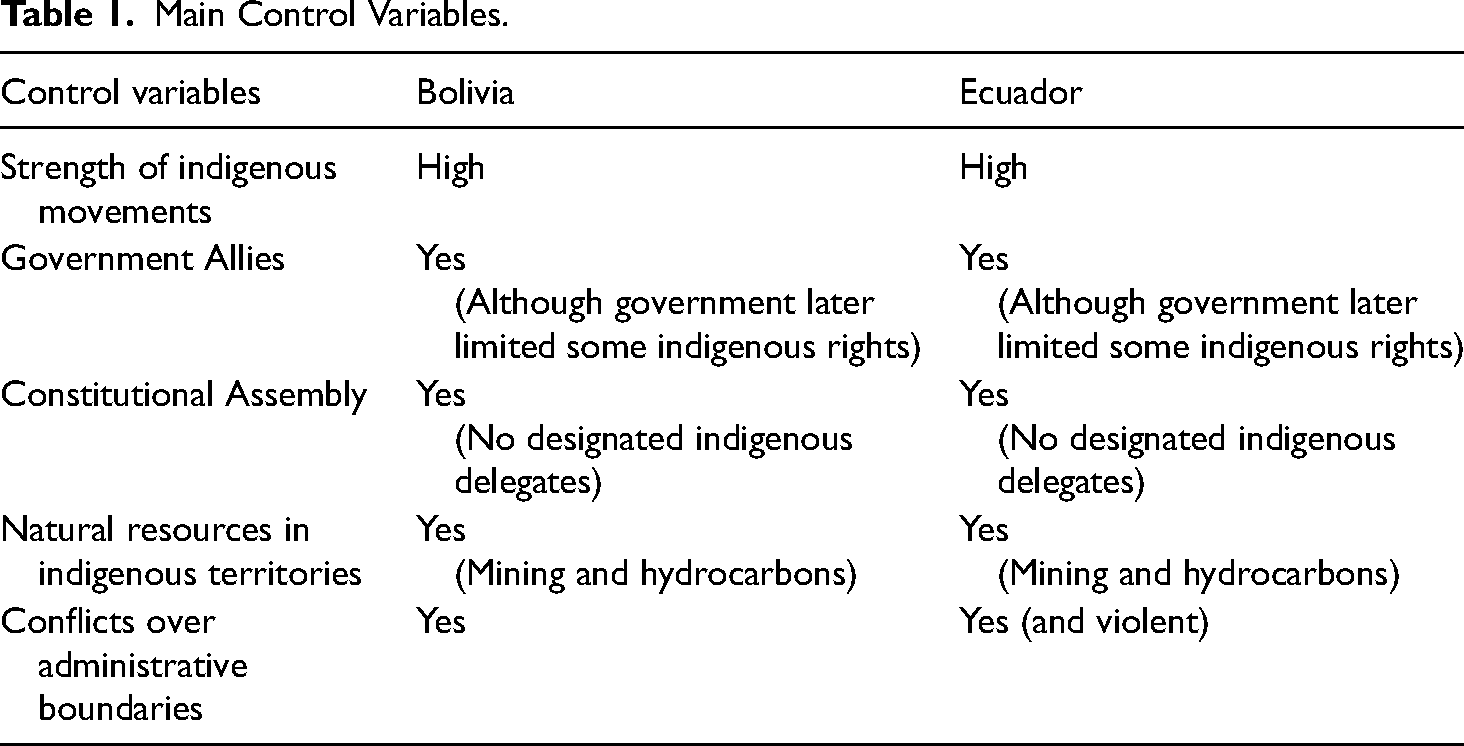
First, important sectors of the population self-identified as indigenous in Bolivia and Ecuador at the time of constitutional drafting. While in Bolivia the majority of the population self-identified as indigenous, an important minority did so in Ecuador. 2 More important, as existing research has noted, the strength of social movements is a key variable for explaining pressures from below that led to the adoption of MCPs. Powerful indigenous organizations and mass indigenous mobilizations have been present in both countries since the early 1990s. In Bolivia, these movements contributed to the ousting of President Sánchez de Lozada in the aftermath of the 2000 water war and the 2003 gas war (Centellas, 2013), whereas in Ecuador, they directly participated in the ousting of Presidents Jamil Mahuad and Abdalá Bucarám (Becker, 2011; Rice, 2012). In Bolivia, strong regional indigenous movements have mobilized to demand access to the state and respect for their rights. Organizations such as the Confederación Sindical Única de Trabajadores Campesinos de Bolivia [CSUTCB] (Unitary Syndical Confederation of Peasant Workers of Bolivia), Confederación Nacional de Mujeres Campesinas Indígenas Originarias de Bolivia - Bartolina Sisa (National Confederation of Peasant-Indigenous-First Nation Women of Bolivia - Bartolina Sisa), the Consejo Nacional de Ayllus y Markas del Qullasuyu (CONAMAQ) (Council of Ayllus and Markas of Qullasuyu), the Confederación Sindical de Comunidades Interculturales de Bolivia (Syndicalist Confederation of Intercultural Communities of Bolivia), and the Confederación de Pueblos Indígenas de Bolivia (CIDOB) (Confederation of Indigenous Peoples of Bolivia) are the main vehicles that represent indigenous groups in the country (Lucero, 2008; Van Cott, 2005; Yashar, 2005). In 2004, these organizations united under a national umbrella organization, the Unity Pact, which elaborated a joint proposal for the constitutional assembly (Alberti, 2019). Ecuador has a strong national indigenous organization, the Confederación de Nacionalidades Indígenas del Ecuador (CONAIE) (Confederation of Indigenous Nationalities of Ecuador), which gathers three regional organizations: Ecuador Runakunapak Rikcharimuy from the Andes, Confederación de las Nacionalidades Indígenas de la Amazonía Ecuatoriana (Confederation of Indigenous Nationalities of the Ecuadorian Amazon) from the Amazon, and Confederación de Nacionalidades Indígenas de la Costa Ecuatoriana (Confederation of Indigenous Nationalities of the Ecuadorian Coast) from the coastal areas (Lucero, 2008; Van Cott, 2005; Yashar, 2005).
Second, the presence of indigenous movements’ allies in governments is highlighted as one of the main factors “from above” to explain the granting of indigenous rights. In both Bolivia and Ecuador, candidates with proindigenous agendas won the 2005 and 2006 presidential elections, respectively. In Bolivia, Evo Morales and the Movimiento al Socialismo (MAS) came to power with the support of the main indigenous-peasant organizations of the country and an agenda that combined an antineoliberal stance and indigenous demands (Madrid, 2008). Once in power, Morales announced that the “era of the indigenous peoples” had begun in Bolivia (Azcui, 2006). Likewise, when Rafael Correa assumed power in Ecuador, he promised that his would be “the government of the indigenous people” (Madera, 2007). Although CONAIE created its own political party, Pachakutik, and competed against Correa in the first round of the 2006 elections, Pachakutik supported him in the second round and during the constituent assembly. Thus, despite the conflicts between Correa and the indigenous movements, once in office, he promoted a number of legal changes that favored their demands. It should be noted, however, that despite this outspoken commitment to indigenous demands, both Morales and Correa later adopted similar policies that weakened indigenous rights, such as territorial autonomy. For instance, the MAS has been criticized for not supporting the implementation of the right to autonomy, as it has imposed a series of bureaucratic obstacles that have made the conversion to indigenous autonomy jurisdictions a difficult process (Tockman and Cameron, 2014). The MAS also weakened the right to prior consultation through a series of decrees (Falleti and Riofrancos, 2018). Indeed, the controversy in the Isiboro Secure Indigenous Territory and National Park [TIPNIS] over the construction of a highway across the park patently illustrates the Morales government's contradictions with regard to indigenous rights and the division between highland and lowland indigenous groups. TIPNIS communities and indigenous organizations demanded that the government respect their decision-making institutions and processes in the prior consultation process. The government's unwillingness to do so led these communities, along with CIDOB and CONAMAQ, to organize a series of marches, which were met with government repression and intransigence. Moreover, the MAS claimed that TIPNIS protesters were resisting development, as opposed to Andean groups who embraced modernity (Postero, 2017).
Correa in Ecuador followed a similar strategy. The government also passed a number of decrees that reduced the reach of consultations (Falleti and Riofrancos, 2018). The passing of the 2009 mining law, which permitted large-scale mining, triggered open conflicts with CONAIE. Additionally, the government limited CONAIE's participation in the National Directorate for Intercultural Bilingual Education by not allowing it to elect its leaders (Martínez Novo, 2014). Correa also publicly criticized indigenous organizations, especially CONAIE, claiming that they were saboteurs, infantile, and foreign-funded, and complained about indigenous autonomy (Alberti, 2019).
Third, and related, scholars have described both Morales and Correa as radical populists who initiated constitutional reform processes in order to demolish the institutions of prior regimes in their respective countries (Montúfar, 2013). Bolivia held a constitutional assembly from August 2006 to December 2007, while Ecuador's assembly met between November 2007 and October 2008. While neither of these constitutional assemblies included the direct election of indigenous delegates, many members self-identified as indigenous, which consequently gave indigenous people direct access to decision-making arenas. The resulting constitutions in both countries thus included a wide array of indigenous rights (Centellas, 2013; Lupien, 2011).
Fourth, although the presence of natural resources in indigenous territories might have affected the granting of the right to autonomy, in both countries indigenous territories coincide with the location of natural resources and extraction sites of minerals and hydrocarbons (Bebbington, 2012; Martínez Novo, 2014). At the same time, in both countries, the state owns/administers nonrenewable natural resources (see Art. 317 in Ecuador and Art. 311 in Bolivia).
Fifth, both countries have experienced conflicts over the delimitation of administrative units. In Bolivia, boundary disputes between municipalities and departments have triggered particularly violent confrontations between citizens and politicians, as illustrated by the conflicts between the ayllus Jucumani and Layme, in Potosí, and Qaqachaqa, in Oruro, over the delimitation of their territories (Albó, 2020). This conflict took a particularly violent turn between 1998 and 2000, leaving at least 50 people dead and many others injured. Morales's 2014 Law of Interdepartmental Delimitation between Oruro and Potosí put an end to the confrontations (Ariñez, 2014). We believe that this past history of violent conflicts over departmental limits might have also served as an additional motivation for the MAS government to negotiate with the conservative autonomy movement in order to prevent tensions from escalating even further, especially since members of this movement had been involved in violent confrontations with MAS supporters. Ecuador's administrative organization has also been plagued by ambiguities, which affects the implementation of basic administrative tasks and the communities’ sense of identity, leading to the emergence of socio-spatial conflicts (Sánchez-Ayala, 2015). The National Committee of Internal Limits (CONALI) identified 962 boundary conflicts, which included disputes between provinces, cantons, and parroquias. Between 2013 and 2015, CONALI managed to solve 98 percent of such conflicts, although 12 of the 22 interprovincial disputes remained open (El Telégrafo, 2016). While mobilizations and low-scale confrontations in the disputed areas have characterized these conflicts, these have not reached the violence experienced in Bolivia.
Bolivia and Ecuador are thus similar in terms of the variables that might affect the granting of indigenous autonomy. In addition, the responsibilities assigned to local autonomous governments are similar in both states. For instance, according to Bolivia's constitution (Art. 304), indigenous autonomous territories are responsible for the elaboration of budgets, local planning, construction and maintenance of roads and infrastructure, administration of renewable natural resources, development of democratic institutions according to customary law procedures, and conflict resolution, among others. Indigenous autonomous governments also assume the responsibilities of municipal governments. Likewise, Ecuador's Código Orgánico de Organización Territorial, Autonomía y Descentralización (COOTAD) (Organic Code of Territorial Organization, Autonomy, and Decentralization) states that indigenous autonomies have specific responsibilities, while simultaneously assuming those corresponding to the administrative level to which they belong (i.e., parroquia, canton, province). Thus, if the transition to indigenous autonomy occurs at the level of the province, these new governments are also responsible for developing and fostering local infrastructure and roads, local planning, productive activities, providing public services, and implementing institutions of democratic participation, to name a few. The law also states that these territories will implement constitutionally enshrined collective rights.
Crucially however, there is variation in how these states have responded to indigenous autonomy demands regarding territorial limits, which we take up in the following sections.
Indigenous Autonomy in Bolivia
The Sanctity of Departmental Limits
The 2009 constitution granted the right to indigenous autonomy following longstanding demands from indigenous movements (Cooke, 2013; Tockman and Cameron, 2014). The constitution and the 2010 Ley Marco de Autonomías y Descentralización (LMAD) (Framework Law of Autonomies and Decentralization) established three routes to indigenous autonomy. First, the municipal path establishes that existing municipalities may be converted into autonomous indigenous government via the approval of a referendum. Second, legally recognized indigenous territories, such as Territorio Indígena Originario Campesino (TIOC) (Peasant Native Indigenous Territories), may become indigenous autonomy jurisdictions through the implementation of a consultation process following the customary law procedures already in use in the TIOC. Lastly, indigenous autonomy jurisdictions may be created through existing autonomous regions, by implementing either a referendum or a consultation process following customary law procedures.
Despite their differences, these three types of autonomy have one thing in common: None of them may transcend departmental boundaries. By definition, the municipal path to autonomy is not expected to go beyond departmental limits. Nonetheless, the constitution and the LMAD are explicit about the impossibility of altering existing departmental limits for the TIOCs and regional routes. Indeed, Article 29 of the LMAD establishes that TIOCs that transcend departmental limits must be divided. Furthermore, the law states that these indigenous autonomy jurisdictions may later create a mancomunidad, that is, “a voluntary association between autonomous territorial entities, municipal, regional, or indigenous—first-nation—peasant, to develop joint actions in the framework of the legally assigned tasks of its component parts” (Article 29.I). The article thus entails that existing TIOCs that do not coincide with departmental boundaries, corresponding to approximately 18 percent of established TIOCS and 19 percent of those still in process of obtaining the status, are forced to split their territories and form separate indigenous autonomy jurisdictions within their respective departments (Fundación TIERRA, 2010). See Figure 1 for a depiction of the TIOCs that crossover departmental limits. According to Martínez de Bringas (2018), since the mancomunidades are only created for administrative purposes the issue of sovereignty remains unsolved. By the same token, both the constitution and the LMAD state that regions may not transcend departmental boundaries (Article 280 of the constitution—Article 19—LMAD). In turn, Articles 293 and 295 allow the revision of municipal limits for the TIOC and regional routes. Consequently, the sanctity of the departmental limit contradicts Article 290 in the constitution, which states that “the constitution of indigenous–first-nation–peasant autonomy is based on the ancestral territories currently occupied by these peoples and nations.”
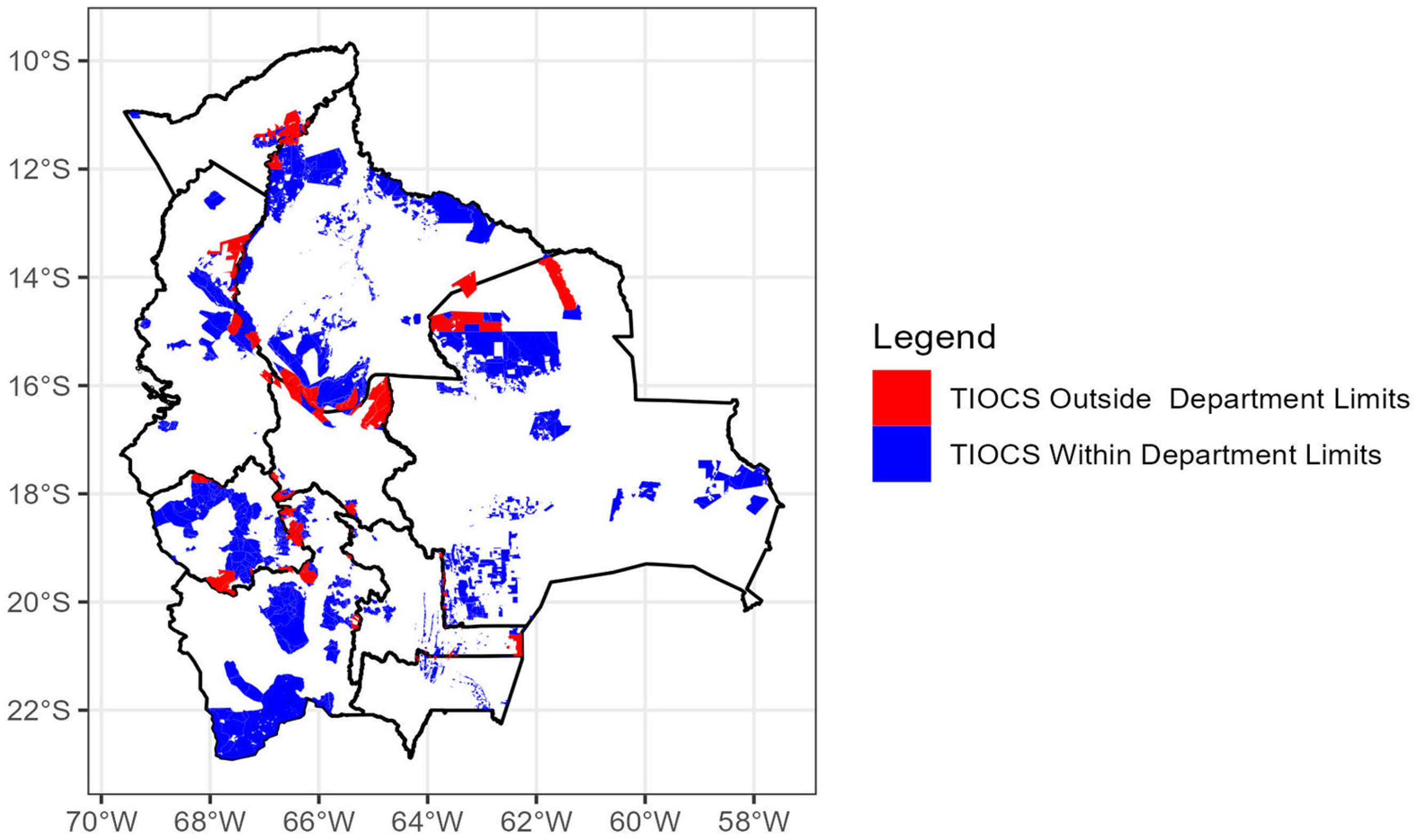
TIOCs and Departmental Limits
Conservative Movements in Bolivia: The Halfmoon Region and the Clash of Autonomies
Since the MAS seized power in 2006, it was challenged by the radicalization of a conservative movement that united several departments located in the eastern lowlands of the country, consolidating a larger territorial bloc, the Media Luna (Halfmoon) region. This region comprises the departments of Santa Cruz, Pando, Tarija, and Beni, and demanded autonomy at the departmental level (Centellas, 2013; Eaton, 2011). Demands for autonomy in the eastern departments have a long history. Since the early national period, Santa Cruz has voiced strong discontent with the national government, demanding better access to markets and advocating for a productive model based on capitalist agriculture. Moreover, in the aftermath of the Chaco War (1932–1935), the department was allowed to collect an 11 percent tax on hydrocarbons extracted in its territory as a result of the mobilization of Santa Cruz's elite sectors. Later, during the 1952 revolution, Santa Cruz responded to the Movimiento Nacionalista Revolucionario's redistributive agenda by creating the Pro-Santa Cruz Committee to protect the department's economic interests. Over time, the movement has continuously underscored specific issues, such as geography and historical marginalization, ethnic differences, economic expansion, and opposition to redistribution (Fabricant, 2009). The movement grew in strength during the early 2000s, as indigenous groups and other sectors demanded the nationalization of the country's natural resources, which represented a direct threat to the economic interests of Media Luna departments as main hydrocarbon producers. With the MAS gaining increasing political influence, and the inability of traditional parties to defend liberal economic policies, Santa Cruz crafted a discourse of departmental autonomy as a strategy to defend their interests against the MAS (Cooke, 2013). Indeed, this movement has been classified as conservative because its core constituents come primarily from the country's economic elite. Nonetheless, they have used territorial identity, incorporating individuals from all classes and ethnicities, in order to defend the status quo. They have done so by emphasizing their distinct regional identity, the camba, or lowlander, which is different from the coya, or highlander, and emphasizing what they perceive to be an unfavorable fiscal regime, which results in them subsidizing the rest of the country. In this context, many in the Media Luna region perceived the MAS as a threat to the region's culture and economic model. For them, MAS was a party that mainly represented highlanders, and they rejected its redistributive and interventionist policies (Eaton, 2011; Kohl, 2010; Postero, 2017).
The Media Luna's demand for autonomy led thousands to the streets to demand a nationwide referendum on autonomy in 2004. In June 2005, then-president Carlos Mesa agreed to hold a referendum on autonomy and the direct election of prefects, the main departmental political authority. The results of the autonomy referendum evinced a deep divide in the country: 57.6 percent of voters opposed the departmental autonomy option, while 42.4 percent supported it. However, support for departmental autonomy across Media Luna departments was significantly higher than in the rest of the departments (Mayorga, 2020). Following the election of Evo Morales in December 2005, tensions between Media Luna departments and MAS escalated even further. Fulfilling one of his campaign promises to “refound” Bolivia, Morales called for a constitutional assembly, which delegates from the Media Luna region would use to defend their demand for departmental autonomy. Although the MAS's campaign during the elections for the constituent assembly centered on winning two-thirds of the seats, the party obtained 53 percent of the 255 seats (Lehoucq, 2008). These results did not secure the party the two-thirds necessary to approve a constitution of its liking, and MAS was thus forced to negotiate with the opposition, headed by Podemos, with 60 seats.
In this context, the opposition that supported departmental autonomy used the institutional channels provided by the constituent assembly to advance their demands. Tensions around the autonomy issue soon emerged. Opposition delegates supported the demands of Media Luna, especially Podemos, and pushed for the approval of departmental autonomy (Zegada et al., 2011). This departmental autonomy was conceived without paying much attention to the demands of the indigenous groups that lived in the Media Luna, and focused primarily on political, administrative, and fiscal considerations (Mayorga, 2006). Moreover, Halfmoon's leaders insisted that departmental autonomy had to take precedence over indigenous autonomy (Postero, 2017). In effect, the report written by the minority parties of the Commission on Autonomies, Decentralization, and Territorial Organization, proposed that “the departmental governments should hold full powers to improve the areas referred to as Tierras Comunitarias de Origen (Community Lands of Origin) and indigenous municipalities, as well as to redesign their limits within the existing boundaries of the departments” (Bolivia: Magna Asamblea Constituyente and Comisión de Autonomías, Descentralización y Ordenamiento Territorial, 2007: 11). Putting additional pressure on the process, the leader of the Pro-Santa Cruz Committee, Branko Marinkovic, further added that “a Constitution that leaves Santa Cruz and autonomy out will not work […] the Constitution must respect, without tricks, the autonomy we voted for” (Agencia de Noticias Fides, 2007). In short, Halfmoon's proposal hinged on the maintenance of departmental boundaries. As Alejandra Anzaldo, Director of Beni's office of the Peasant Research and Promotion Center (CIPCA) noted, the civic committees “are highly articulated and exert their power at the departmental level,” which is why “they defend departmental autonomy and feel very disturbed by any transgression of this autonomy.” 3
Indigenous leaders opposed this project as a direct attack on their demands for the reconstruction of indigenous territories. To illustrate, Pedro Nuni, then CIDOB's Vice-president, claimed that “they do not want autonomies other than the departmental one, or that those that do exist be subordinated […] We want to have the authority to administer our own resources, but they do not want it, they will never let us have rights” (Rojas, 2007). For the government, Halfmoon's proposal meant, in essence, the division of the country (Deheza, 2008), and it supported indigenous autonomy as a way to counterbalance the demands advanced by lowland elite and conservative sectors (Rousseau and Manrique, 2019). These irreconcilable positions between those who supported departmental autonomy and those who proposed an indigenous autonomy that sought to redefine—and possibly eliminate—existing administrative boundaries, made negotiations in the constituent assembly a difficult task. The government pushed for the approval of the constitutional draft in detail in a meeting in the city of Oruro, with only 162 representatives in attendance. In response to this political move, the opposition parties representing Media Luna rejected the draft approved by MAS and declared their departments autonomous (Deheza, 2008).
Representatives from Media Luna region also used noninstitutional channels to press for the incorporation of their demands in the new constitution. Proautonomy movements in the four Media Luna departments organized autonomy referenda in December 2007 to approve the statutes that the Autonomy Assemblies had recently drafted. The autonomy referenda that were to take place in May and June of 2008 however, were not sanctioned by the National Electoral Court and were boycotted by the rural MAS supporters in those departments. Still, the four Halfmoon departments approved their Autonomy Statutes (Kohl, 2010; Uggla, 2009). Meanwhile, episodes of racist violence became more common in the region, as groups such as the Nación Camba and the Unión Juvenil Cruceñista (Santa Cruz Youth Union) attacked indigenous people as well as the MAS and nongovernmental organizations offices. In the midst of these tensions, the government agreed to carry out a recall referendum that would include President Morales and Vice-President García Linera, as well as the prefects of the nine departments. The results of this referendum were paradoxical, as support for Morales and García-Linera, as well as the prefects of all the Media Luna departments, increased (Kohl, 2010).
Mobilizations by proautonomy supporters in the Media Luna resumed, which included strikes, occupations of public buildings, and attacks against MAS supporters, among others (Zegada et al., 2011). Notwithstanding, Morales decided to pass a decree to schedule a referendum to approve the constitution. The National Council in Defense of Democracy, which also supported the Media Luna region, called for national mobilizations and civil resistance (Uggla, 2009). The leader of Podemos, Jorge Quiroga, claimed that the decree was a call to a “civil war” (Zegada et al., 2011: 79). The most violent episode of these confrontations took place in the department of Pando in September 2008, when a group of pro-MAS protesters was heavily attacked, allegedly by groups close to then prefect Leopoldo Fernández, leaving at least 18 people dead and many others wounded (Kohl, 2010; Uggla, 2009). After this tragic episode, negotiations between the government and the opposition resumed, under the auspices of the Unión Sudamericana de Naciones, and served as the basis for the drafting of the final version of the constitution. The Legislative Assembly, where MAS held 55 percent of the seats followed by Podemos with 33 percent, became the centerstage of negotiations over the constitutional text. Under the lead of Minister Carlos Romero—and with Podemos Senator Carlos Borth leading the opposition—an agreement was finally reached and a draft was approved in October 2008 (Regalsky, 2010). The constitution was later submitted to the popular vote on January 25, 2009, and approved by a 60 percent margin (Postero, 2017).
Thus, as a result of this deep social and political crisis, the MAS made important concessions to assuage the lowland departments. Indeed, according to Vice-president García Linera, “the Constituent [Assembly] is kidnapped, blackmailed, and pressured by a circumstantial alliance of these three minorities” (Deheza, 2008: 65). Minister Romero further claimed that the government accepted all of the requests made by Halfmoon departments in the 2008 negotiations, which included the prohibition to alter departmental boundaries (Schavelzon, 2012: 422). Moreover, in 2010, Romero, who had been appointed Minister of the newly created Ministry of Autonomies, responded to indigenous movements that demanded the implementation of autonomies across departmental limits that such measure “is not allowed by the Constitution. Speaking about that at this time entails blocking an agreement on autonomies that was negotiated with great difficulties” (Quiroga, 2010). Similarly, that same year, Morales responded to CIDOB's requests for transdepartmental autonomy, saying that “it is not possible to eliminate the departmental boundaries; that is not in the constitution. The implementation of the autonomies must be based on the constitution” (Mendoza, 2010).
The fear that Media Luna's intransigence over the issue of departmental autonomy would lead Bolivia to the verge of a civil war, also led some indigenous delegates to accept limitations to indigenous autonomy. For instance, Tomás Huanacu, head of CONAMAQ's international relations commission, asserted that they agreed to the modifications negotiated in order to contribute to the country's pacification. Huanacu further added that, despite the fact that some parts of the constitution related to autonomy do not favor them, “because of the natural, strategic alliance we have with the government, we have accepted that the new constitutional text be approved as is” (Rojas, 2008). This is particularly surprising since CONAMAQ was a fierce defender of the reconstruction of indigenous territories, which by definition transcend departmental lines. Indeed, for Raúl Prada, CONAMAQ's advisor and member of the constituent assembly, the agreements reached on indigenous autonomy deeply reduced the reach of this right, as “there is indigenous and regional autonomy, but it is not possible to cross the department's limits. How is it possible then to ensure the continuity of indigenous territories?” (Prada cited in Martínez, 2011).
Consequently, the threat posed by conservative autonomy movements, both through institutional and noninstitutional channels, forced the government to negotiate on the issue of autonomy. As Aymara researcher Wilfredo Plata posits, “in the context of the political struggle of that period, the government favored the demand for departmental autonomies” as it “meant a very strong political power.” 4 In the end, the final version of the constitution guaranteed increased powers to departmental autonomies and subordinated indigenous autonomies to respect for existing departmental boundaries (Regalsky, 2010). Critics have complained that MAS betrayed the revolutionary potential of the constituent assembly and failed to confront lowland departments, as the substance of their demands regarding territorial autonomy was met (Postero, 2017). In effect, the constitution approved, with little or no modification, the type of autonomy proposed by Media Luna departments (Centellas, 2013).
Indigenous Autonomy in Ecuador
Regional Autonomy for Indigenous Peoples
The drafters of the 2008 constitution drew on the Circunscripción Territorial Indígena (Indigenous Territorial Circumscription) in order to enact indigenous autonomy, which was a legal category that had been established in the 1998 constitution, albeit never implemented (González, 2015). According to Article 257 of the 2008 constitution, CTIs can be established at different levels, including parroquias, cantons, and provinces, 5 where indigenous people form the majority of the population. The 2010 COOTAD provided more detailed legislation for the construction and implementation of indigenous autonomy (Bringas, 2018). Indeed, Articles 94 and 95 lay out the procedures to form a CTI. According to these articles, indigenous communities or peoples may petition the National Electoral Council to initiate a consultation process, provided that they are supported by 10 percent of the population living in the respective territory or the absolute majority of the authorities of the communities’ governments. Additionally, the legislature of the corresponding administrative level may request that the National Electoral Council conduct a consultation process to establish a CTI with the support of three-quarters of its members. For a CTI to be implemented, the consultation must be approved by two-thirds of the voters listed in the electoral registry of the respective jurisdiction.
Regarding the territorial limits of the CTIs, both the constitution and the COOTAD establish that CTIs may be implemented at the parroquia, canton, and province level. However, in addition, the COOTAD enables the fusion of CTIs, regardless of the level at which they were constituted, with the goal of reconstructing indigenous ancestral territories. In effect, Article 96 specifies the procedures by which two or more CTIs can merge to form a new CTI, and does not impose a limit on either the level or number of CTIs that can fuse. What is more, the COOTAD also allows for the fusion of cantons and parroquias (see articles 23 and 27, respectively), but does not permit the fusion of provinces that are not CTIs. Only the CTIs that have been implemented at the provincial level are legally entitled to merge with other CTIs, which gives indigenous autonomous governments more robust territorial rights than nonindigenous administrative units. More importantly, this legal framework does not force indigenous territories to divide, as Bolivia's 2010 law does regarding TIOCs, and although reconstructing ancestral territories based on CTIs is not an easy task, the law entitles indigenous territories that are located in different provinces to merge via the fusion of CTIs. In short, unlike the department in Bolivia, Ecuador's autonomy regime, by allowing the fusion of CTIs, does not establish the province as the ultimate limit for indigenous autonomy.
Territorial Threat: The Guayas Autonomy Movement
The emergence of regionalist demands in the province of Guayas can be traced back to the early Republican period. After the 1895 Liberal Revolution, Quito and Guayaquil became the poles of the country's political competition as the highland and coastal regions turned into relatively autonomous spaces. Guayas elite regionalist demands and anticentralism were boosted by their participation in the global cacao market and later as exporters of bananas, as well as their control over the regional financial system. This led these sectors to support a more liberal economic model and oppose central government intervention. The election of former President León Febres Cordero as mayor of Guayaquil in 1992 further mobilized this regional appeal and laid the groundwork for the conservative autonomy project (Burbano de Lara, 2009).
The collapse of the banking system in Guayaquil in 1999 triggered widespread protests, which led to an increase in support for the autonomy movement. These protests had a marked anti Quito stance, blaming the country's political and economic centralism for the crisis, and advocating for regional autonomy (Almeida Vinueza, 1999). Moreover, the business sector rejected the government's plan to increase revenues due to the drop in oil prices, which included increasing taxes and the prices of fuel, energy, and gas. This was perceived as yet another attempt by the central government to transfer resources from the regions to support a large and bloated central state (Burbano de Lara, 2009). These two crises triggered numerous mobilizations. The movement Fuerza Ecuador began collecting signatures to enable Guayas's prefect Nicolás Lapentti to ask the Electoral Tribunal to hold a popular consultation on autonomy. This petition was subsequently approved and scheduled to take place on January 23, 2000. The consultation received widespread support in the province, with over 80 percent of the electorate voting in favor of autonomy (Eaton, 2011). Leaders of the autonomy movement increasingly saw the indigenous movement, which had gained momentum in the debate over the territorial organization of the country, as a threat. Autonomy movement leaders consequently sought to build a common identity to sustain their demand, and drew on the idea of “unity in diversity,” but opposed the plurinationality discourse pushed forward by CONAIE (Burbano de Lara, 2009). Consequently, the foundation of the Guayas autonomy movement lies in an attempt to maintain a liberal economic model, thus reducing central government intervention in the region's economy.
Despite success in the popular consultation, the national government systematically ignored Guayas's autonomy demand. Hence, and under the lead of Guayaquil's mayor Jaime Nebot, the movement organized several protests to defend the autonomy process (Eaton, 2011). The election of Rafael Correa to the presidency in 2007 did not improve the prospects for autonomy and was seen as a menace to the movement. In effect, Correa dismissed Guayas's demand for autonomy as a strategy of the region's economic elites, who sought to defend a market-driven economic model (Eaton, 2011). In turn, the president supported—at least initially—indigenous autonomy as a demand of a traditionally excluded group that supported his rise to power (Burbano de Lara, 2009; Martínez Novo, 2014).
Unlike the Halfmoon region in Bolivia, the Guayas autonomy movement in Ecuador did not pose a particularly strong threat to the center, as the regional movement was weakened by a series of internal and external factors (Eaton, 2011). First, Rafael Correa's government could not be framed as a menace to the province's interests in the same way as Morales's rise was perceived in Bolivia's eastern departments. The fact that Correa came from Guayaquil and did not self-identify as indigenous made it impossible for autonomy movement leaders to play the identity card against the president to the same degree as in Bolivia. Second, the main indigenous party in the country, Pachakutik, had obtained weak electoral support in the 2006 presidential elections and, therefore, could not be used as a reason to fuel the regional autonomy movement. Third, economically, radical market reforms had not been implemented in Ecuador to the same extent as in Bolivia, which made the threat posed by Correa not strong enough to marshal support for autonomy. Relatedly, although Guayas is the most vibrant economic region in the country, it is not as rich in hydrocarbons as Bolivia's Halfmoon region, and many of the province's companies were dependent on state-owned companies related to the oil sector, which reduced support for autonomy. Accordingly, the material basis of this region's demands was not as strong as the Halfmoon's. Fourth, the civic and business organizations that supported autonomy were divided on several grounds (see Eaton, 2011). Lastly, the autonomy movement could not follow in the footsteps of Bolivia's Halfmoon region and form a larger bloc of the five coastal provinces of El Oro, Esmeraldas, Guayas, Los Ríos, and Manabí, as only two of those provinces, Guayas and Manabí, had been ruled by opposition forces, whereas pro-Correa prefects led the other three. Additionally, although four provinces were governed by the Partido Social Cristiano [PSC] (Social Christian Party), an opposition party, they are scattered throughout the country, which makes the building of either a territorial or identity-based alliance rather difficult (Eaton, 2014).
The weakness of the autonomy movement and its low capacity to mobilize through institutional channels became evident in their weak representation in the constitutional assembly. Guayas traditionally supported the PSC, which remained the main electoral force in the province, even in the midst of the country's worst political crises (Burbano de Lara, 2009). However, it performed poorly in the 2007 elections to form the constituent assembly. Indeed, Acuerdo País, a coalition that united Alianza País, the ruling party, and other left-wing forces, such as Nuevo País (New Country) and Alternativa Democrática Nacional (National Democratic Alternative), obtained 80 out of the 130 seats in the constituent assembly. In turn, the PSC received the lowest vote share in its history (Freidenberg, 2008), gaining only 5 seats. Moreover, in the commission that was charged to discuss the country's territorial organization, the ruling coalition also had a majority.
The consequence of this imbalance between Acuerdo País and all other political forces, especially those that supported the Guayas autonomists, was that the movement could be easily disregarded (Eaton, 2011). As President Correa stated, “we will not allow my hometown [Guayaquil] to separate from Ecuador […] which is the plan the oligarchy has always had; it is the same as Santa Cruz's oligarchy in Bolivia” (Ayala Samaniego, 2007). Guayaquil's mayor, Jaime Nebot, further claimed that in the assembly, “everything is already precooked so that whatever one presents is subjected to discussion and superficially socialized, but at the end of the day, the majority imposes its criterion” (El Universo, 2008c). Similarly, according to Joffre Campaña, mayor Nebot's advisor, “the Montecristi Assembly only sought to implement Rafael Correa's will, the rest did not matter in Ecuador, and, of course, Guayaquil's ideas were worthless” (Dávila Morillo, 2015: 86). For some, the government's influence on the Assembly was so strong that they referred to it as the “steamroller” (aplanadora). Indeed, as Martha Roldón, an assembly member of the Red Ética y Democracia Party, asserts, the debates turned into mere procedure, and there was not enough time for the proposals, including that of Guayaquil, to be introduced at the plenary sessions (El Universo, 2008d). Correa's Minister Rafael Poveda concurs, and claims that the Guayas movement “completely lost its strength” and that “the constitution was elaborated with only one vision.” 6
The autonomy movement's lack of effective institutional leverage to make their proposals heard in the constituent assembly was not paired with a strength similar to that of the Halfmoon in Bolivia, which could mobilize social sectors in such a way as to force the government to negotiate with them. Indeed, under the lead of Jaime Nebot, the movement organized a mass protest in Guayaquil in January 2008, demanding respect for their autonomy (El Universo, 2008a). Later that year, Guayas assembly members Eduardo Maruri and Diana Acosta criticized a number of reforms that weakened autonomy and claimed that protests were likely to emerge to defend autonomy. Moreover, Eduardo Maruri feared that something “similar to what happened in Bolivia may occur [in Ecuador] if the will of the people is not considered” (El Universo, 2008b). These expectations and fears turned out to be unfounded. The conflict over autonomy in Ecuador did not reach the intensity that affected Bolivia during the entire period that this issue was debated in the constituent assembly.
The final outcome of the constitutional debate was not favorable for the autonomy movement. With national support at 63.93 percent, the result of the September 2008 referendum on the new constitution yielded a solid victory for the government (Lupien, 2011). Guayaquil was the only important city in which the “no” option succeeded. However, the new constitution was approved even in the province of Guayas, reinforcing the idea that the autonomy movement was not particularly strong. Prefects and mayors from other provinces who had supported the autonomy thesis also withdrew support for decentralization and finally backed Alianza País's proposal (Burbano de Lara, 2009; Eaton, 2014).
The resulting legal framework of autonomy did not include the Guayas proposition. In contrast, indigenous movements’ demands for autonomy were extensively included. According to indigenous leader and assembly member Monica Chuji, the inclusion of collective rights in the constitution is one of the most significant gains of the indigenous movement (Lupien, 2011). For indigenous leader Apawki Castro, the granting of these rights was not affected by the pressure of the Guayas autonomy movement, but rather it was the result of the indigenous movements’ mobilizations. 7 CONAIE's proposal for the constitutional assembly explicitly stated that the autonomy model proposed by the right-wing parties, is “grounded on elite groups from rich territories” and that they sought to “eradicate the regionalist, separatist proposals” (CONAIE, 2007). CONAIE posited that their demand for self-governance based on ancestral territories cannot be equated to a last-minute autonomy proposal crafted by privileged groups (Ospina Peralta, 2010).
Although CONAIE's proposal was not fully taken into consideration and not all Alianza País assembly members entirely supported indigenous autonomy, including president Correa (Altmann, 2016; Martínez Novo, 2014), these tensions responded to different views on collective rights within the leftist bloc and not to the threat from the Guayas autonomy movement. Consequently, neither the government nor the assembly members who supported indigenous autonomy saw the need to impose a territorial limit in order to assuage and contain a competing autonomy movement.
Conclusion
Indigenous autonomy is one of the most robust collective rights Latin American states have granted in their constitutions. There is nevertheless considerable variation in terms of the territorial reach of indigenous autonomy across the region's legal frameworks. Specifically, we focus on two countries, Bolivia and Ecuador to understand the factors that shaped their responses to autonomy demands. Particularly, we attempt to explain why Bolivia's indigenous autonomy jurisdictions cannot transcend departmental limits, whereas indigenous Territorial Circumscriptions in Ecuador are legally allowed to go beyond provincial boundaries.
In this paper, we focus on one important factor that may explain these differences, and argue that the threat of nonindigenous citizens demanding territorial autonomy in Bolivia's Media Luna eastern departments forced President Evo Morales and proindigenous representatives in the constitutional assembly to negotiate and make compromises that reduced indigenous movements’ window of opportunity to demand territorial autonomy. Ultimately, these compromises limited the reach of territorial autonomy in Bolivia's constitution. In contrast, the absence of a strong regional, territorialized threat in Ecuador, meant that indigenous organizations and their allies in the constitutional assembly had a larger window to demand territorial autonomy. President Rafael Correa did not have to compromise with regional elites and territorial autonomy was granted at a higher level in Ecuador's constitution than in Bolivia's.
Our argument thus contributes to existing research on indigenous autonomy in Latin America. We see our contribution as underscoring the strength and strategies of nonindigenous actors and their backlash against indigenous mobilization. While our focus is to explain state responses to indigenous autonomy in these two cases, we believe that it is only by considering the inter-related actions of indigenous groups, state actors, and nonindigenous movements that it is possible to fully understand variation in the reach of collective rights across Latin American states.
Supplemental Material
sj-docx-1-pla-10.1177_1866802X231183453 - Supplemental material for State Responses to Autonomy Demands: Indigenous Movements and Regional Threats in Bolivia and Ecuador
Supplemental material, sj-docx-1-pla-10.1177_1866802X231183453 for State Responses to Autonomy Demands: Indigenous Movements and Regional Threats in Bolivia and Ecuador by Carla Alberti and Shannan Mattiace in Journal of Politics in Latin America
Footnotes
Acknowledgments
We thank Anella Guzmán, Florencia Olivares, Francisca Koppmann, Soledad Araya, Daniel Alcatruz, and Zoe Zabala for their research assistance. We are grateful to the three anonymous reviewers and the Editor for their valuable comments. The research for this project was approved by the Pontificia Universidad Católica de Chile IRB (Protocol 190331001).
Declaration of Conflicting Interests
The author(s) declared no potential conflicts of interest with respect to the research, authorship, and/or pblication of this article.
Funding
The author(s) disclosed receipt of the following financial support for the research, authorship, and/or publication of this article: This work was supported by ANID Fondecyt Iniciación 11191136, ANID—Millennium Science Initiative ICS2019_025, ANID—Millennium Science Initiative Program ICN17_002.

Supplemental Material
Supplemental material for this article is available online.
Notes
Author Biographies
References
Supplementary Material
Please find the following supplemental material available below.
For Open Access articles published under a Creative Commons License, all supplemental material carries the same license as the article it is associated with.
For non-Open Access articles published, all supplemental material carries a non-exclusive license, and permission requests for re-use of supplemental material or any part of supplemental material shall be sent directly to the copyright owner as specified in the copyright notice associated with the article.
