



Abstract
The theme of this article is to scrutinize the entropy rate in hydromagnetic flow of Reiner–Philippoff nanofluid by a stretching surface. Energy equation is developed through first law of thermodynamic with dissipation and Joule heating. Furthermore, random and thermophoretic motion is discussed. Additionally, binary reaction is discussed. Physical feature of irreversibility analysis is discussed. Nonlinear expression is obtained by suitable transformation. The obtained systems are solved through the numerical method (bvp4c). Variation of entropy rate, thermal field, velocity profile, and concentration against sundry variables are discussed. Computational outcomes of thermal and mass transport rate for influential parameters are studied in tabularized form. A reverse effect holds for thermal field and velocity through magnetic variable. Higher Bingham number leads to a rise in velocity field. An intensification in thermal field and concentration is noted for thermophoretic variable. An enhancement in fluid variable leads to augments velocity. An increment in entropy analysis is seen for magnetic effect. Larger estimation of diffusion variable improves entropy rate. A reduction in concentration is noticed for reaction variable.
Keywords
Introduction
Non-Newtonian fluids have achieved much consideration due to their innovative application in the field of biosciences, physiological, technological, industrial, and engineering processes. Non-Newtonian liquids are distinguished due to two characteristic viscosity and normal stress differences behaviors. Cement, blood, paints, custard, shampoo, greases, ketchup, and honey are example of non-Newtonian liquids. One constitutive relation (Navier–Stokes) is insufficient to characterize these non-Newtonian liquids with their complicated characteristics. As a result, many models for examining the rheological features of non-Newtonian liquids have been proposed in the literature. Reiner–Philippoff fluid is most important model which is a three-variable liquid phase that relates shear stress to a gradient of velocity. Boundary layer flow analysis of Reiner–Philippoff liquid is studied in Refs. 1 and 2. Numerical analysis of Reiner–Philippoff liquid flow subject towards a stretched sheet is demonstrated in Refs. 3 and 4. Hayat et al. 5 studied the thermal transport analysis for third grade nanofluid due to rotating disks. Cattaneo–Christov thermal flux in non-Newtonian (Reiner–Philippoff) liquid with Ohmic heating is illustrated by Kumar et al. 6 Some appropriate studies about non-Newtonian (Reiner–Philippoff) liquid are given in Refs. 7–25.
The significant thermal energy losses as a result of heat transfer, molecular vibration, Joule Thomson effect, diffusion effects, and fluid friction occur in everyday applications including heat transfer in porous medium. This energy loss is known as entropy generation. The efficiency of energy can be measured in terms of entropy generation which depends on simultaneous application of thermodynamics first and second laws. Entropy production assessment is commonly employed to differentiate between irreversible and reversible processes. Entropy minimization is an important objective for scientists and researchers in recent era. This minimization principle is utilized in numerous daily life activities such as energy storage systems, nuclear reactor cooling, refrigeration, solar energy, hybrid-powered engines, air conditioners, bio sensors, micro-manufacturing, radiators, microelectronics, and many others. Initially, Bejan26–28 discussed the entropy minimization in convective flow with thermal transportation. Khan et al. 29 explored the irreversibility analysis for radiative nanoliquid flow with melting effect. Entropy analysis for Casson liquid flow with radiation effect past a vertical cylinder is analyzed by Reddy et al. 30 Irreversibility analysis for a combined forced convection of a viscous fluid within the channel is discussed by Sicily and Nejmeh. 31 Few relevant advancements regarding entropy analysis are presented in Refs. 32–49.
From the above study, we noticed that there is scarce research work existed in literature to scrutinize the entropy generation in Reiner–Philippoff nanofluid flow subject to stretched surface. In this communication, we deliberate the irreversibility analysis in hydromagnetic Reiner–Philippoff nanoliquid flow by a stretchable surface. Joule heating and viscous dissipation are addressed in heat equation. Effect of Brownian and thermophoresis motion are also discussed. Physical feature of irreversibility analysis is discussed. Additionally, binary chemical reaction is also accounted. Partial differential equations are transmitted to ordinary one by similarity variables. The obtained systems are solved by numerical technique (bv4c method). Impact of influential parameters on entropy rate, thermal field, concentration, and velocity are graphically studied. Performance of thermal and mass transport rates versus involved variables are numerically discussed through tables.
Mathematical formulation
Consider two-dimensional hydromagnetic flow of Reiner–Philippoff nanofluid over a stretchable sheet. Heat attribution is scrutinized through Joule heating and dissipation. Furthermore, thermophoretic and random diffusion impacts are addressed. Entropy analysis is also to be accounted. Additionally, first order reaction is also addressed. Constant magnetic force of strength Flow sketch.
The shear stress and deformation rate relation for Reiner–Philippoff liquid model satisfy (2) and (3)

In above equation,
Governing equations satisfy (2)–(7)



Here,
Considering
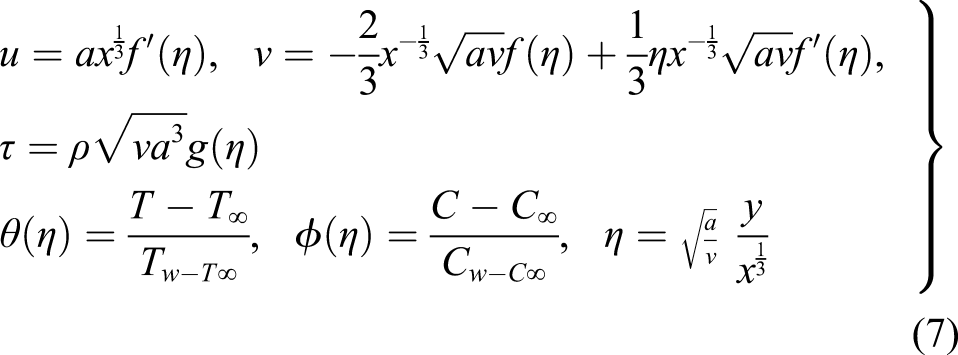


in which,
Entropy generation
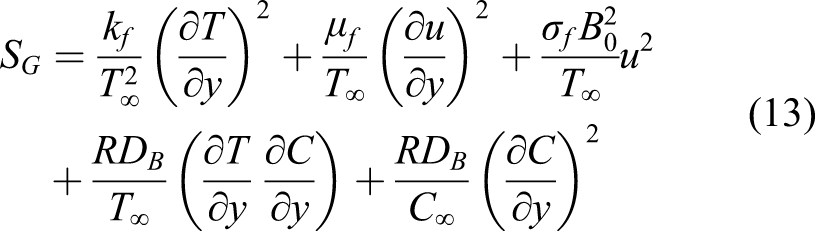
Here entropy generation created due to fluid friction irreversibility, thermal transport irreversibility, Joule heating irreversibility, and mass transport rate irreversibility subject to stretching sheet. Mathematically it can be written as29–35
or

Here,
Quantities of interest
Physical quantities of interest (mass and thermal transport rates) are expressed as


Numerical scheme
The resultant equations (8)–(11) subject to boundary conditions (12) are numerically solved by numerical approach (bvp4c). First, we convert the nonlinear ordinary system to first order system through following variables





Discussion
Impact of velocity, thermal field, concentration, and entropy rate versus influential variables are discussed. Numerical outcomes of thermal and mass transport rates are deliberated through tables.
Velocity
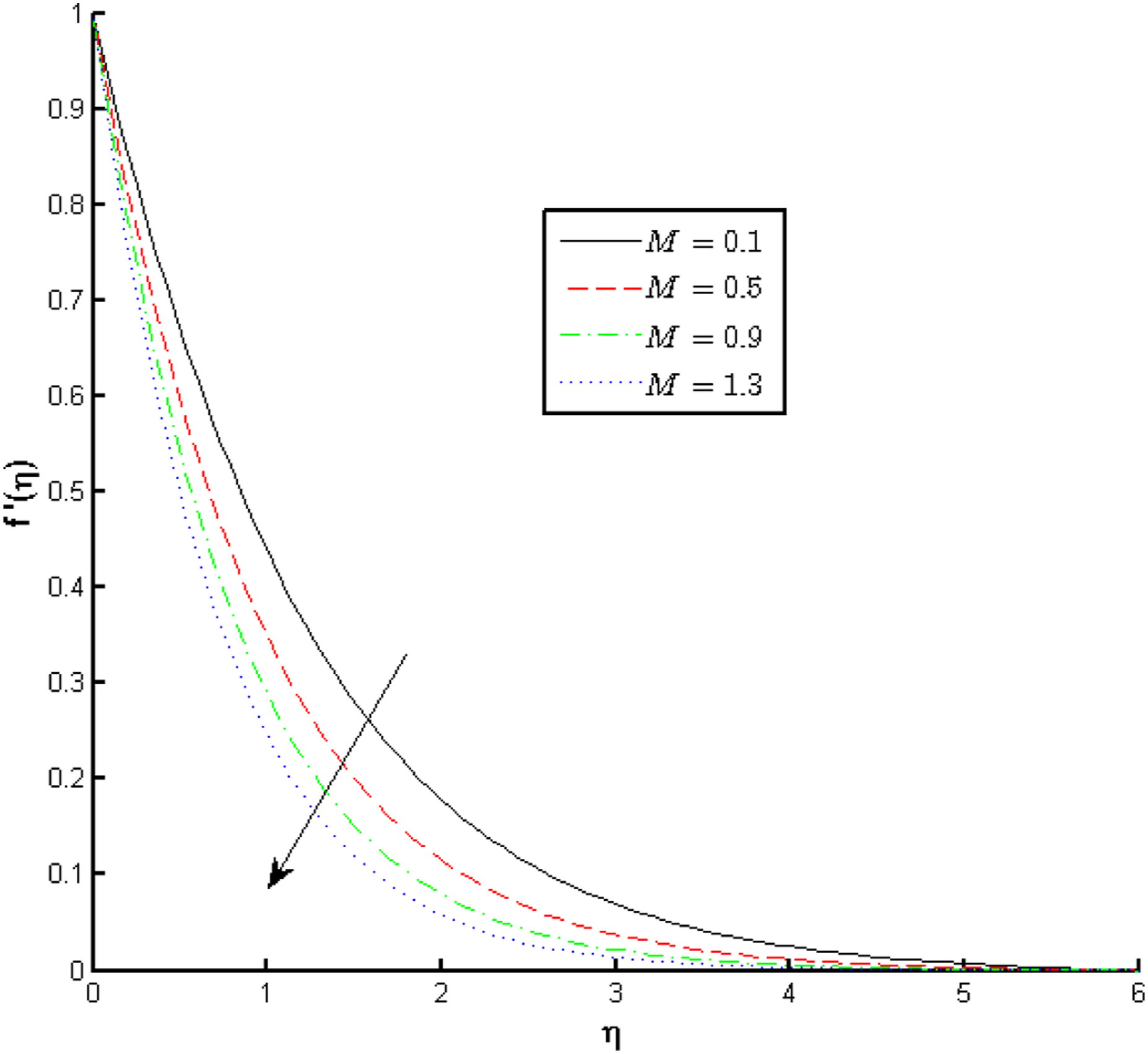
Impact of Bingham number on


Temperature
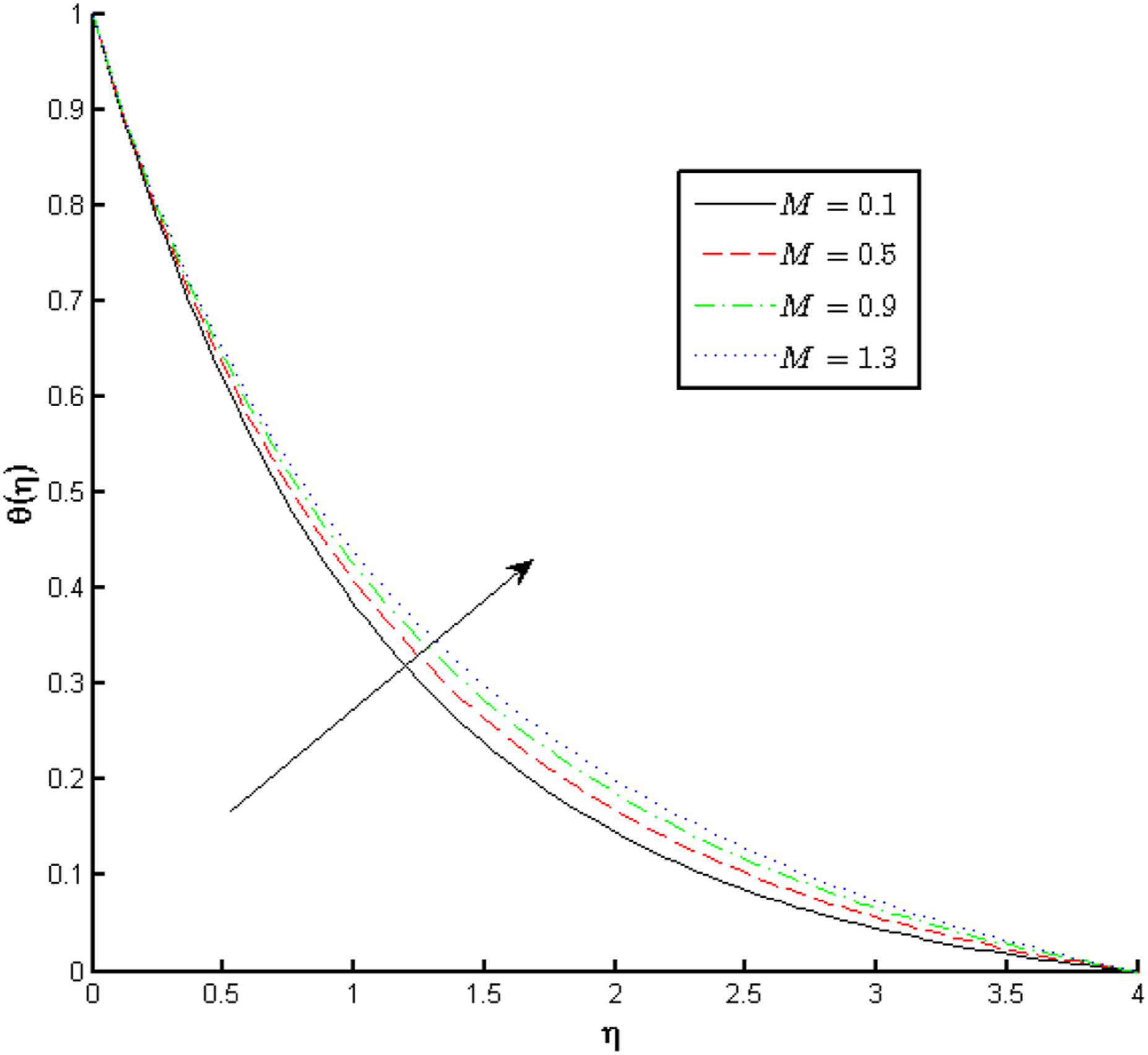
Influence of 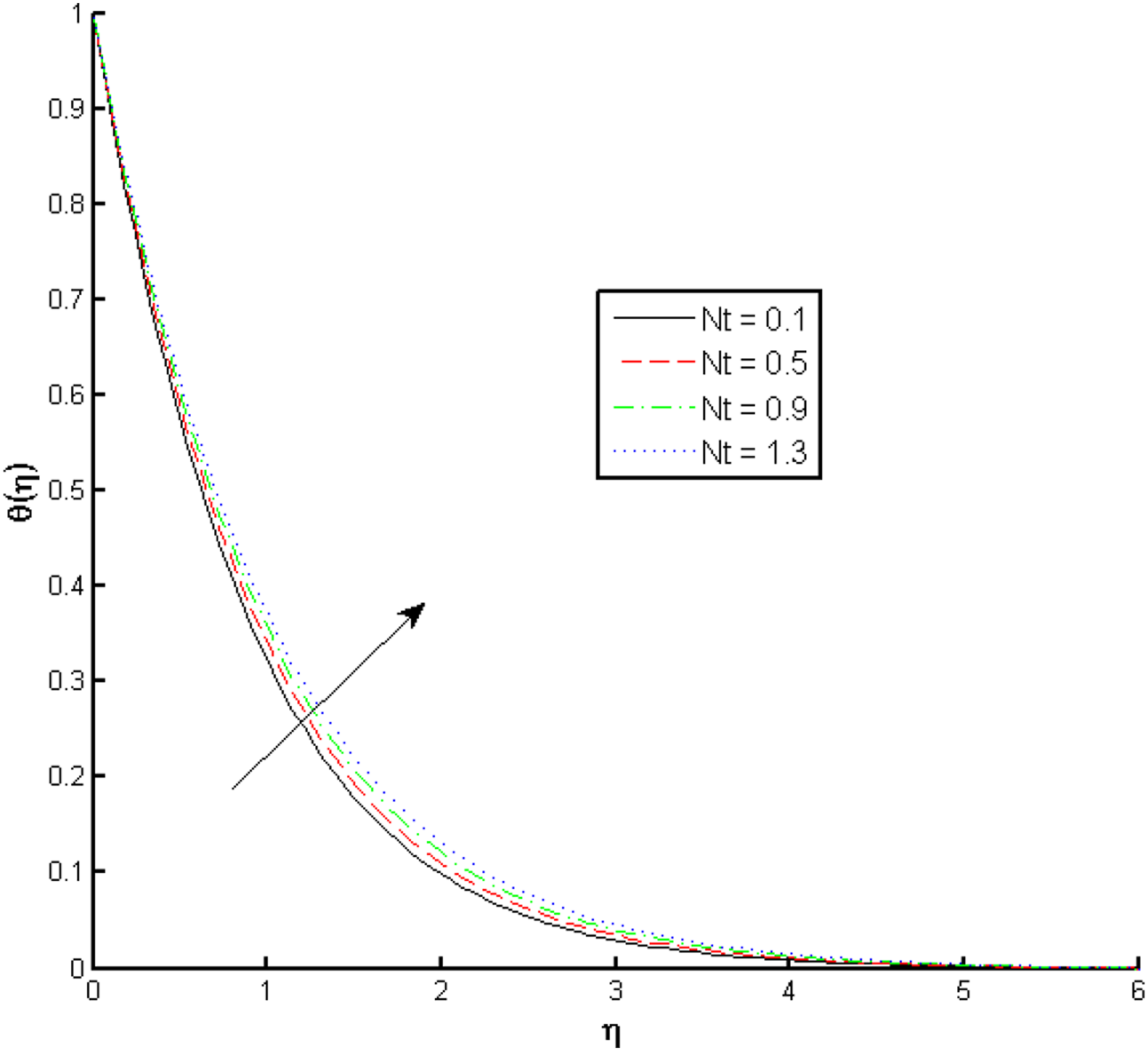


Concentration
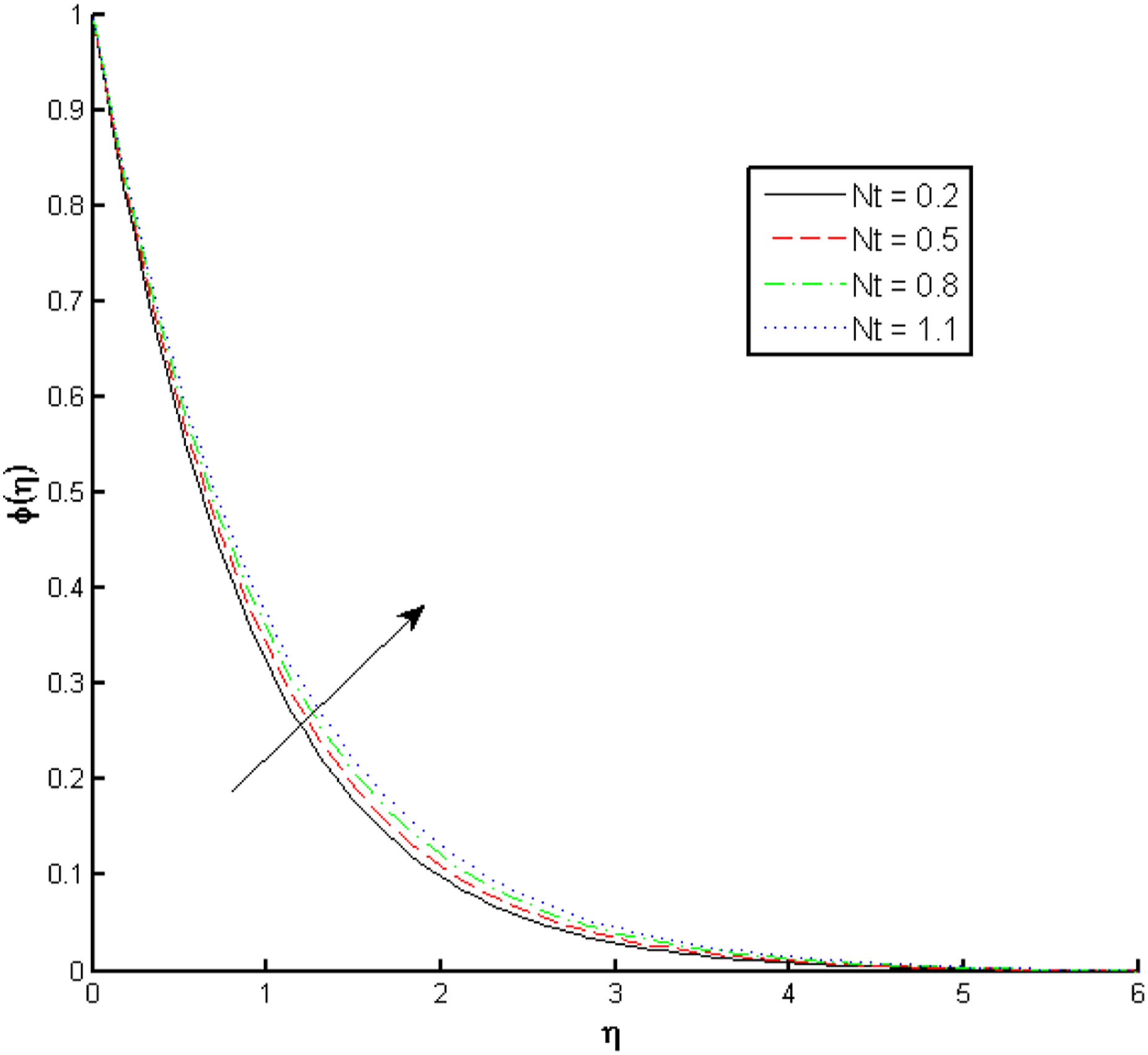
Performance of



Entropy optimization
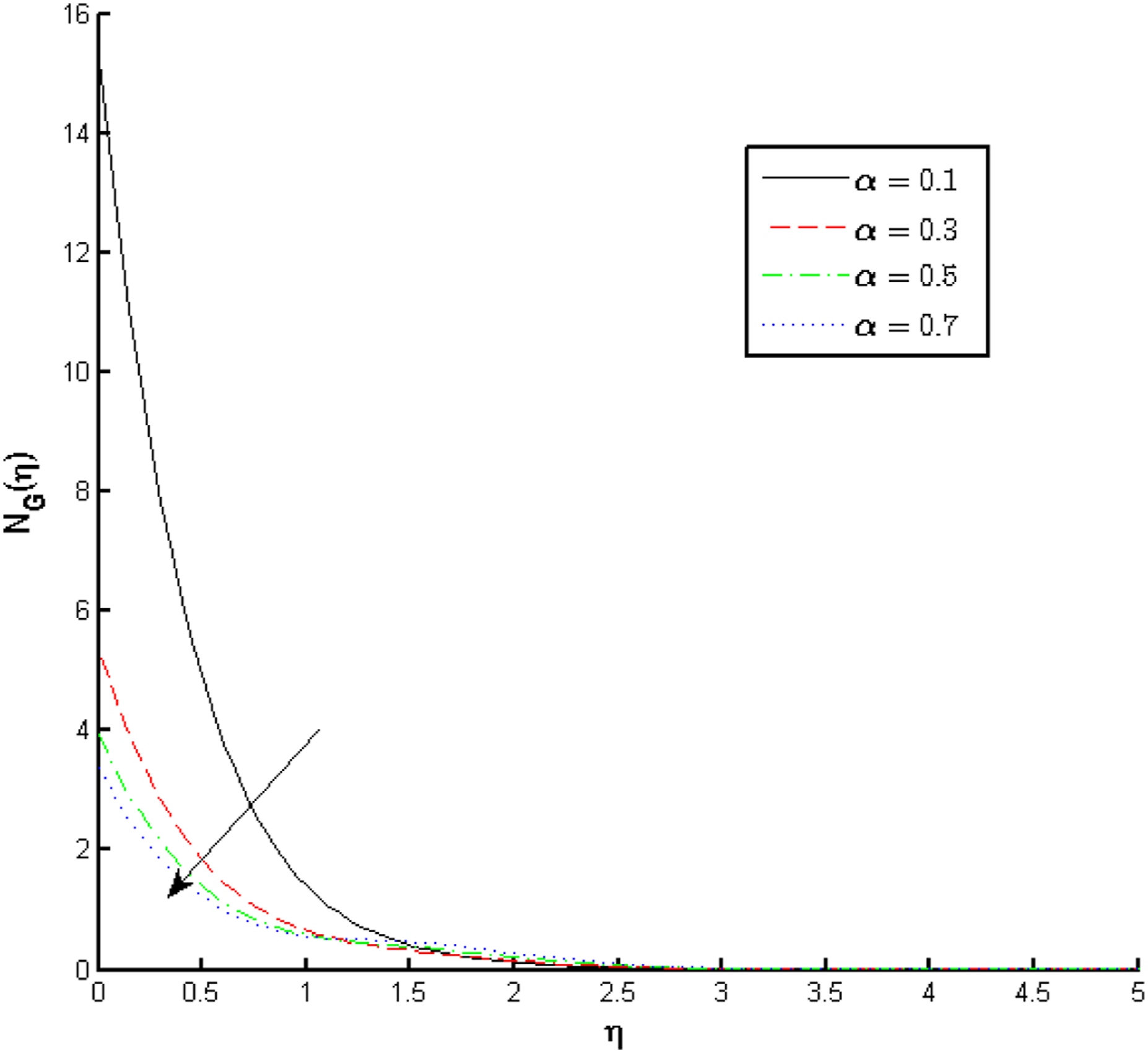
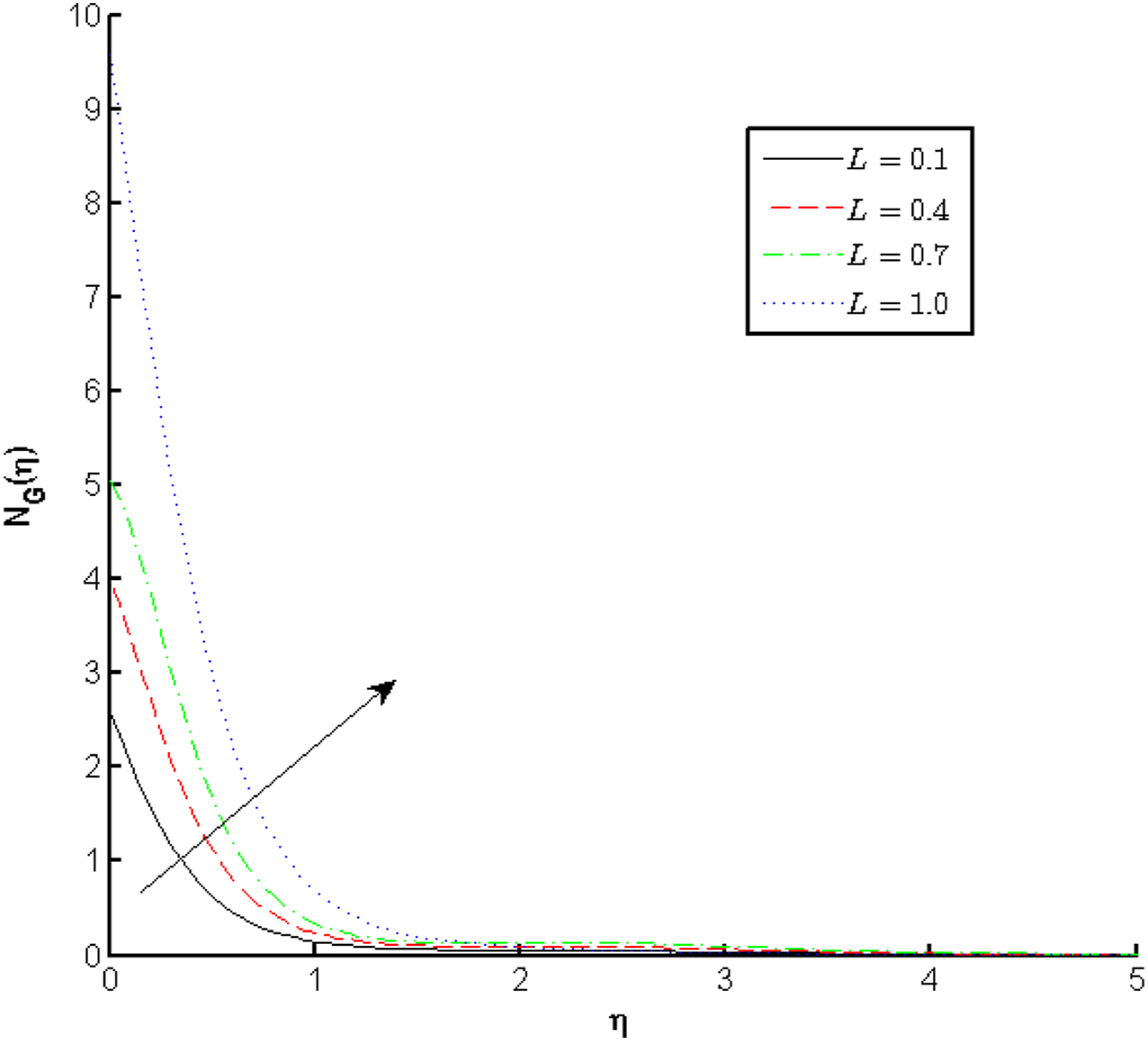
Impact of entropy rate


Engineering quantities
Variation of physical quantities
Nusselt number
Numerical outcomes of Nusselt number.

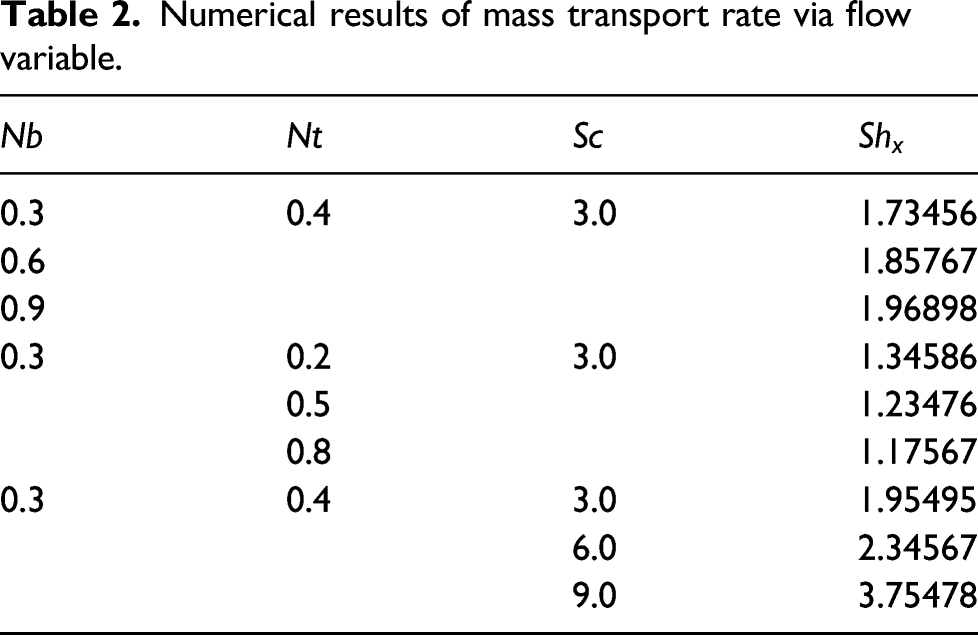
Sherwood number
Numerical results of mass transport rate via flow variable.
Conclusions
Key observations of present analysis are given below. An opposite trend holds for velocity through Bingham number and fluid variable. Larger magnetic variable reduces the velocity field. Temperature is boosted for increasing thermophoresis parameter, while opposite behavior is observed for thermophoresis variable. An opposite effect is noticed for thermal field through Prandtl number and magnetic effect. Concentration profile decays for random motion variable, while reverse trend is noted for thermophoresis variable. Concentration decays for both Reiner–Philippoff liquid and reaction variables. Reduction in entropy rate is observed through Bingham number. An augmentation occurs in entropy rate for magnetic and diffusion variables. Larger Brinkman number improves entropy generation. An increment in thermal transport rate is noted through Prandtl number and random motion variable, while opposite effect is observed for thermophoresis variable. An opposite effect holds for mass transport rate through thermophoretic and random motion variables. Higher Schmidt number rises the mass transport rate.
Footnotes
Declaration of conflicting interests
The author(s) declared no potential conflicts of interest with respect to the research, authorship, and/or publication of this article.
Funding
The author(s) received no financial support for the research, authorship, and/or publication of this article.
