




Abstract
Analytical solutions of temperature distributions and flow formation of joint buoyancy and electroosmotic flow in a vertical microtube formed by two concentric microcylinders are presented. The central equations describing flow formations and thermal energy are offered and solved in closed-form in terms of modified Bessel’s function of first and second kinds. These solutions have significant application in predicting and analyzing flow formation and thermal behavior of Newtonian fluids in micropumps and microchips. Based on the exact solutions obtained, the effects of flow parameters are clearly explained with the use of line graphs. Based on the simulation of results using MATLAB, it is found that fluid temperature distributions and fluid velocity in the vertical microannulus could be enhanced by increasing the radius ratio of the concentric microcylinders.
Introduction
The study of electroosmotic flow (EOF) gains its relevance in micro geometries, due to the comparable channel width to the electric double layer length. This phenomenon is generated by the combined application of low electric voltage at the surfaces of the microchannel and the interaction between the walls and the charged fluid. A lot has been discussed over the years about this phenomenon owing to its significance in micromechanical systems (MEMS). Experimental existence of the phenomenon and theoretical background were respectively presented by Reuss 1 and Probstein. 2 Since then, many applicable extensions for this phenomenon have been carried out in the literature. Rice and Whitehead 3 in a narrow cylindrical capillary, discussed the significance of electrokinetic flow in the presence of low zeta potential. Kang et al. 4 revisited the work of Rice and Whitehead 3 in the presence of with high zeta potentials. The electrokinetic flow in ultrafine capillary slits was carried out by Burgreen and Nakache 5 while Debye and Hückel 6 offered a linearized form of the nonlinear Poisson equation governing the electric potential in the EDL for low electric potential. Also, Tsao 7 examined the EOF in an annulus, whereas, Wang et al. 8 gave an analytical solution of EOF in a semi-circular microchannel. In all these articles, the influence of buoyancy force induced by unequal heating at the surfaces of the microcylinders was not accounted for. Other related articles can be seen in Refs.9–17
The natural convection flow (NCF) is a kind of flow generated as a consequence of unequal density induced by unequal wall temperature. This kind of heat transfer is significant in cooling nuclear reactors, automobiles and other devices at microlevel. The investigation of NCF in microgeometries extends its applicability in cooling microchips and micro-electro-mechanical systems (MEMS). Some of the earliest works on this phenomenon include the works of Elenbaas, 18 Ostrach, 19 Sparrow and Gregg 20 and Bodoia and Osterle 21 where they respectively studied the NCF in parallel plates, with and without heat sources, in vertical plate with uniform heat flux and uniform temperature. Later, Aung 22 and Aung et al. 23 analyzed respectively the fully developed and developing free convection flow between vertical flat plates. Since then, many articles on different physics of flows have been published. To mention a few, Weng and Chen 24 studied the drag reduction of NCF in vertical microchannel while Weng and Chen 25 investigated the NCF in a vertical microchannel. Jha and Oni 26 studied the time-dependent NCF in a vertical annulus heated/cooled asymmetrically. Jha et al. 27 scrutinized the mixed convection flow in a vertical microannulus with heat source/sink. They gave separate solutions for the heat source/sink cases and concluded that heat generating case has higher velocity and fluid temperature compared with the case of heat sink in the microannulus. Other related articles on NCF in an annular geometry include Refs.28–33
In spite the contributions above, precise theory of electroosmotic flow in vertical microannulus with buoyancy force and asymmetric heat flux is still rare. Such solution has significant application in chemical separation at microlevel, which could be used in drug delivery to a targeted cell in the body. In view of this, the purpose of this article is to discuss the role of asymmetric zeta-potential on NCF in a vertical microannulus with electroosmotic and Joule heating effect. The novelty of this article is the presentation of analytical mathematical models to predict flow formation and skin-friction at the surfaces of the microcylinders of NCF in a vertical microannulus with electroosmotic effect.
Mathematical study
Consider the flow on an incompressible balance
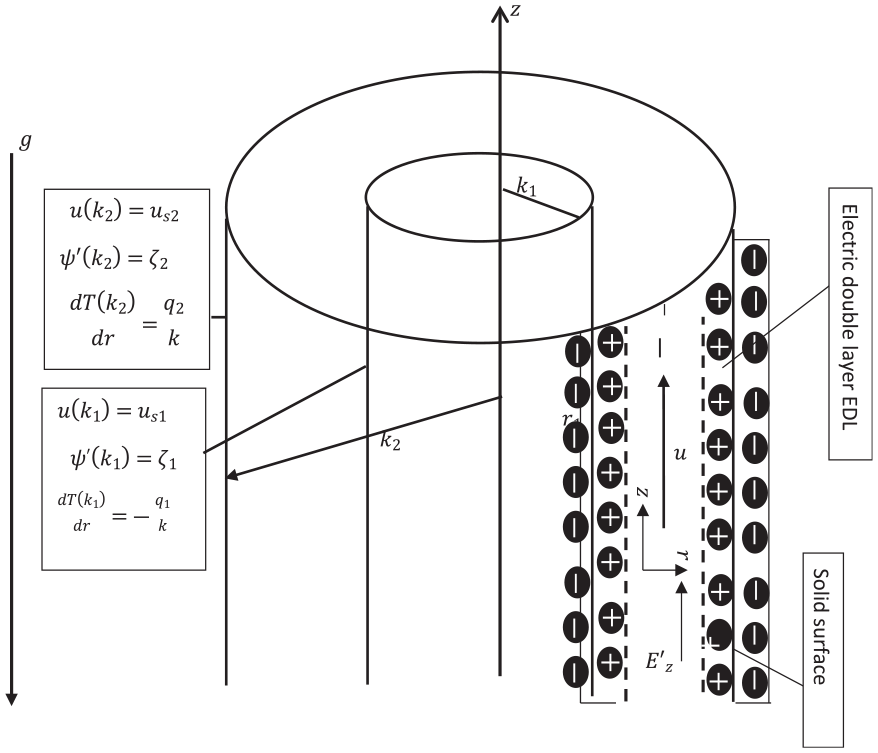
Schematic diagram of the problem.
The flow is presumed to be hydrodynamically and thermally fully developed. Other assumptions made include:
(i) The flow is laminar with equivalent Reynolds number less than unity.
(ii) The charge in the EDL agrees with the Boltzmann distribution and the Debye length is strictly smaller than the annular gap.
(iii) The EDL width is not affected by the temperature gradients.
(iv) The temperature jump effect as well as the velocity slip are incorporated at the microannulus surfaces.
For fully developed flow, the flow becomes unidirectional (



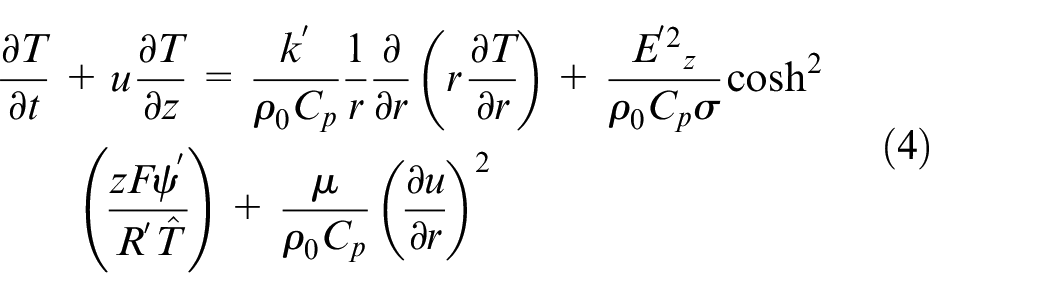
subject to
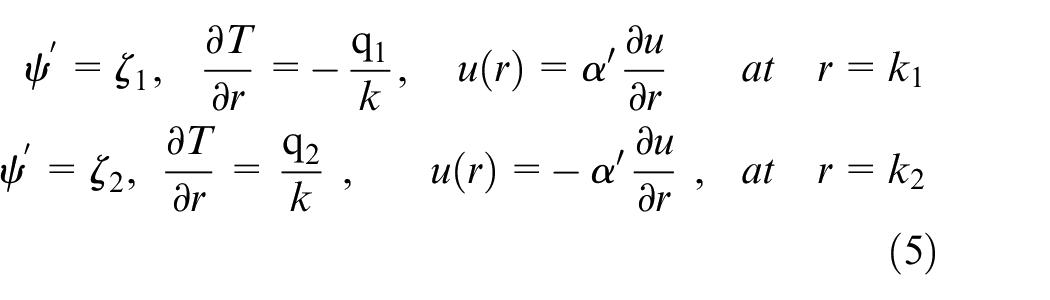
where
Introducing the following dimensionless quantities and parameters 13 :
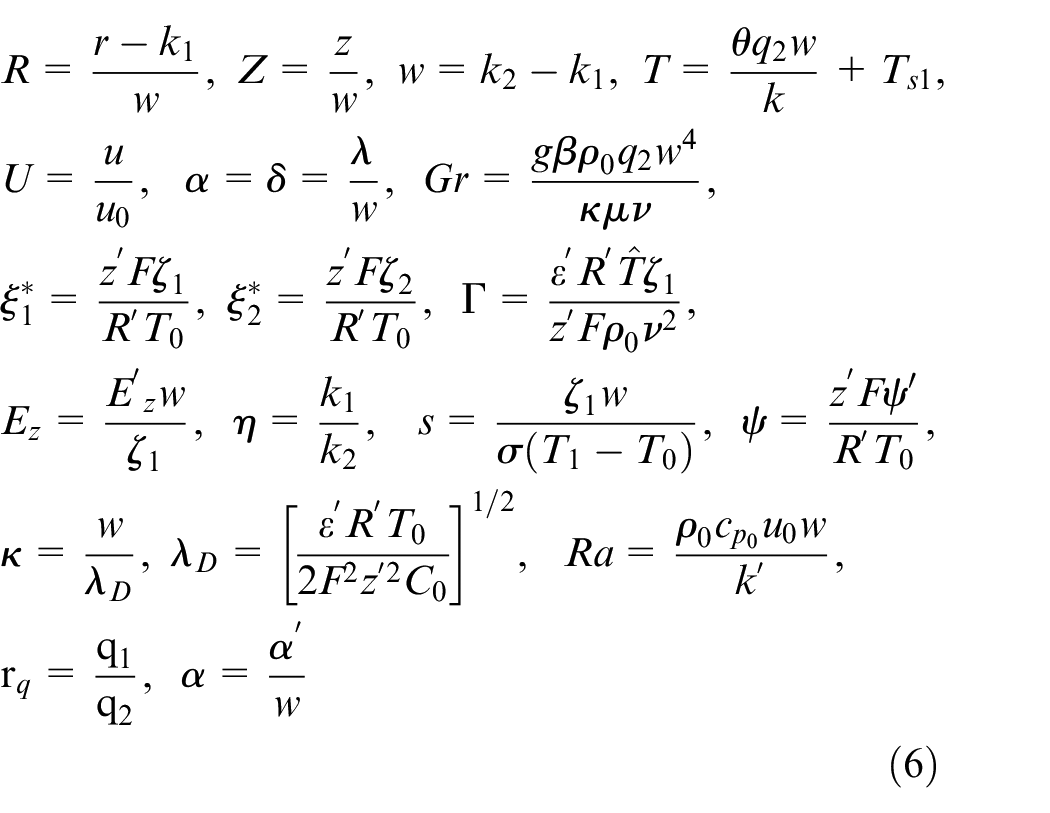
Considering the steady, fully developed region and a very small EDL size relative to
Subject to
By using the transformation



Subject to:
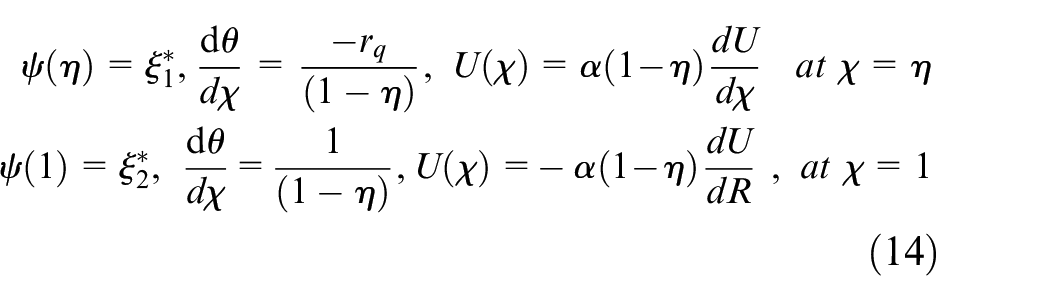
where
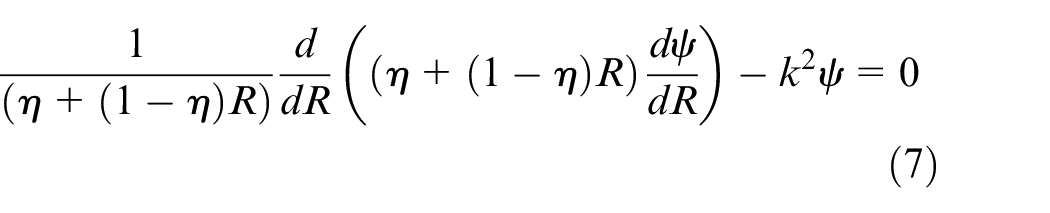
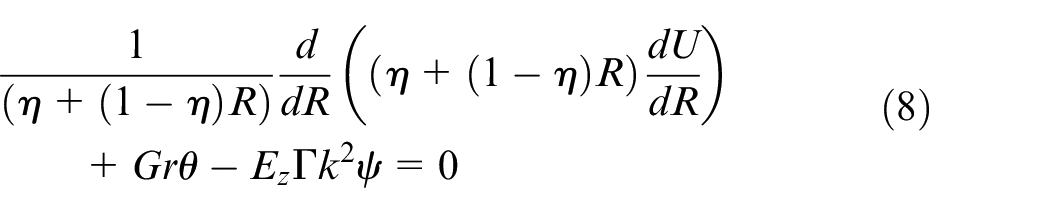
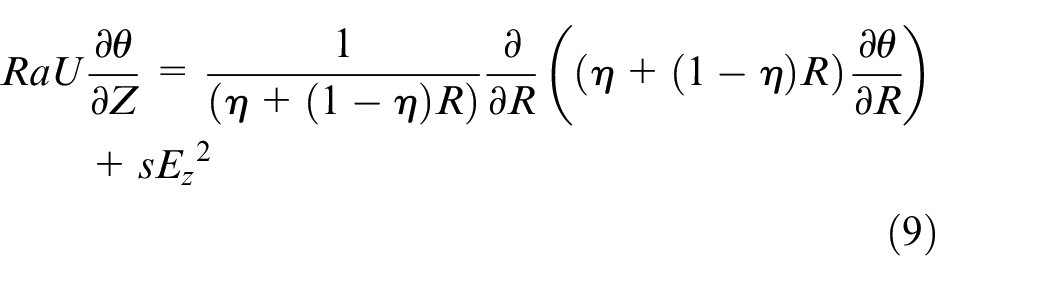
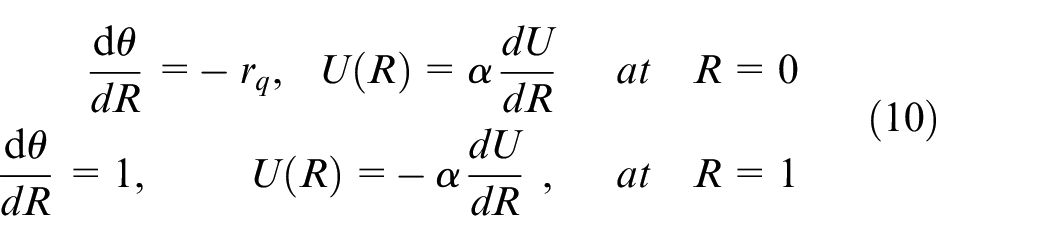
The equations above describe the mathematical equations governing electroosmotic NCF in a vertical microannulus with Joule heating effect. The term
For fully developed flow, the expression

So that equation (13) becomes:

The solution of equation (11) with boundary condition (14) can be conveniently written in form of modified Bessel’s function of first and second kinds of order zero as (Olver et al. 35 ):

where
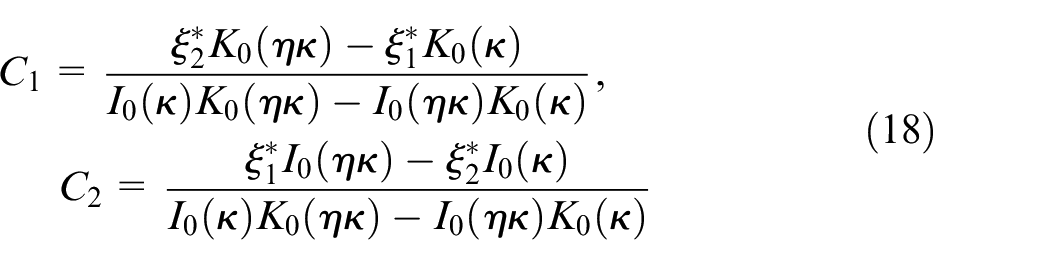
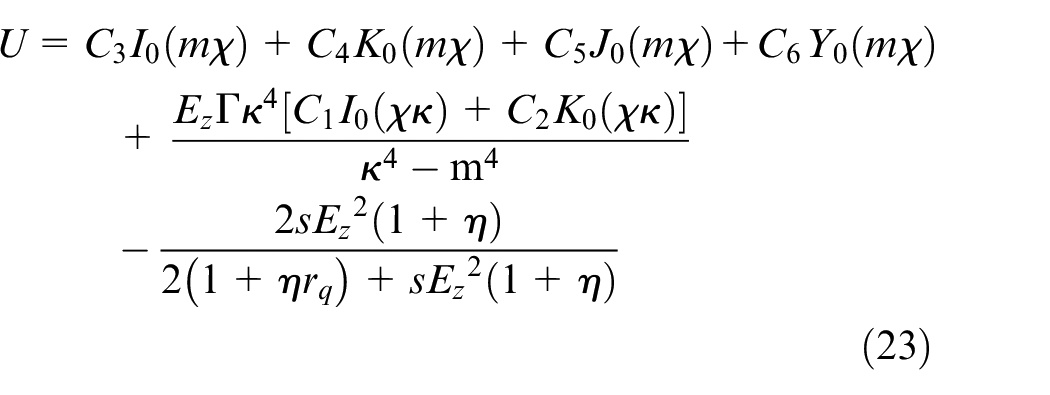
Equations (12) and (16) are the mathematical models governing the velocity profile and temperature distributions in the microannulus respectively. These equations are coupled and linear, so that their solutions are obtained by first making

So that on applying the operator
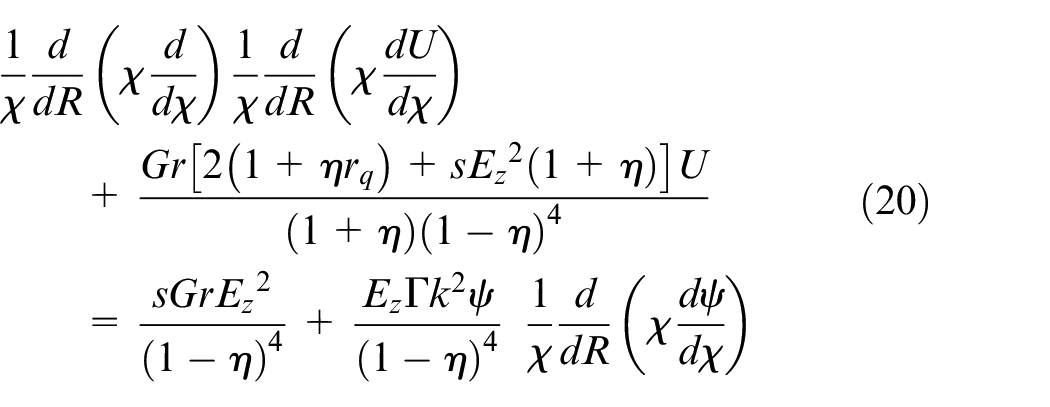
The homogeneous part of equation (20) can be written as:

where
So that equation (21) becomes:
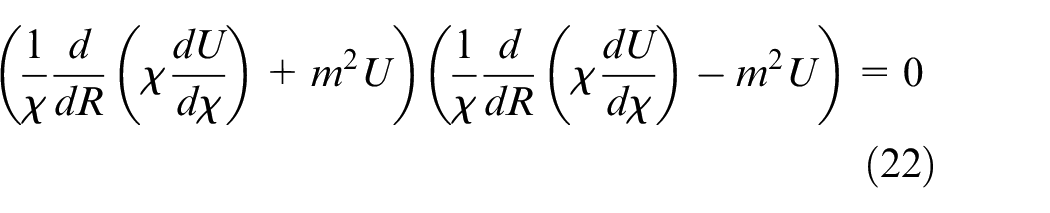
Equation (22) is the combination of standard Bessel’s function and modified Bessel’s function. On solving equation (20) with boundary conditions (14), we obtained the velocity profile in closed form as:
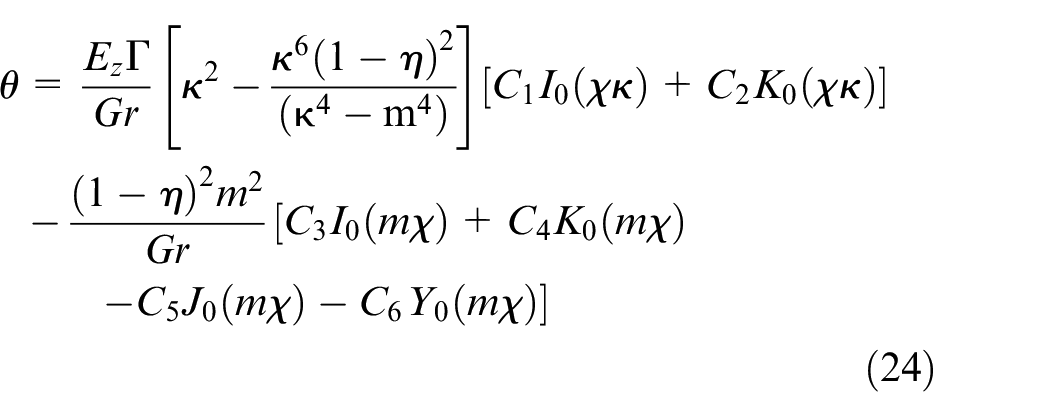
By using equation (19), the temperature distributions in the microannulus is obtained as:
By putting the boundary conditions in equations (14) on equations (23) and (24), the constants
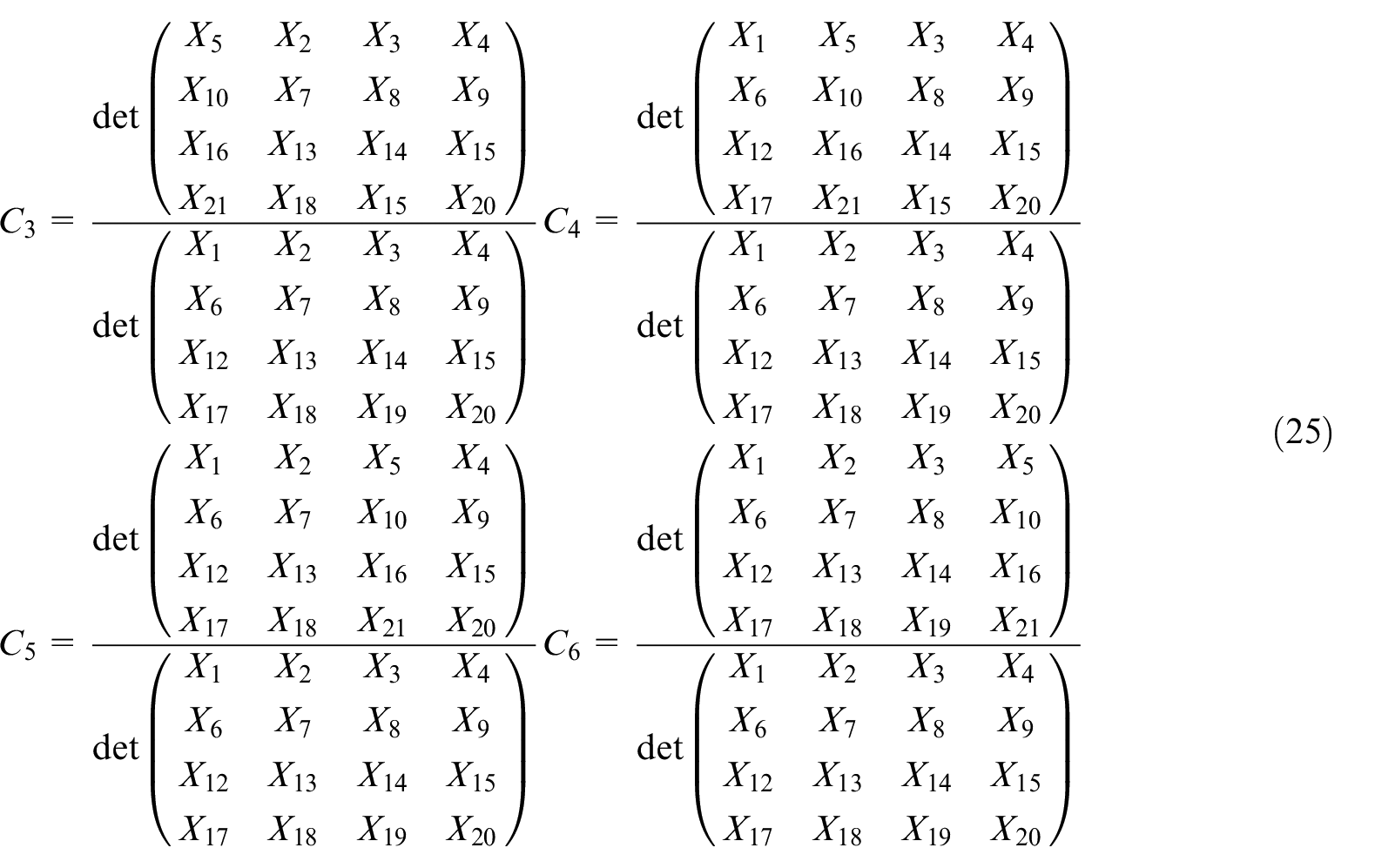
where det represents the determinant of the matrix and
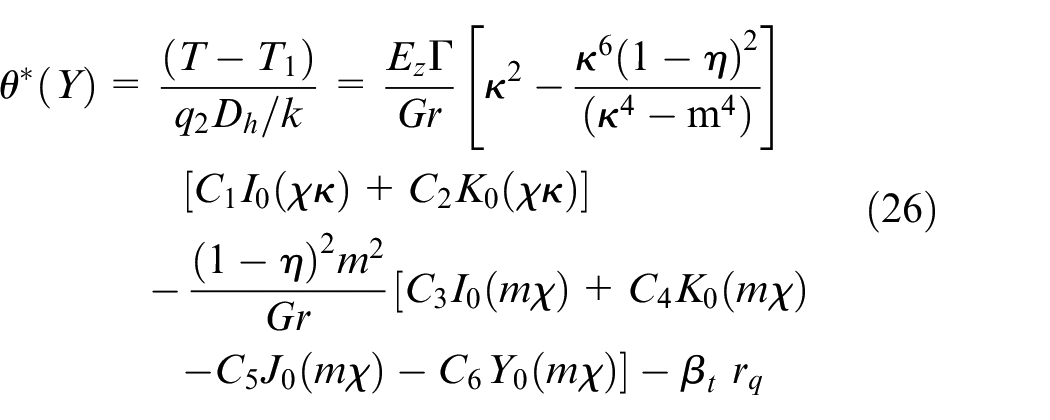
In order to incorporate the temperature jump effect, following (Avci and Aydin 36 ), the temperature distribution in the vertical microchannel is obtained as:
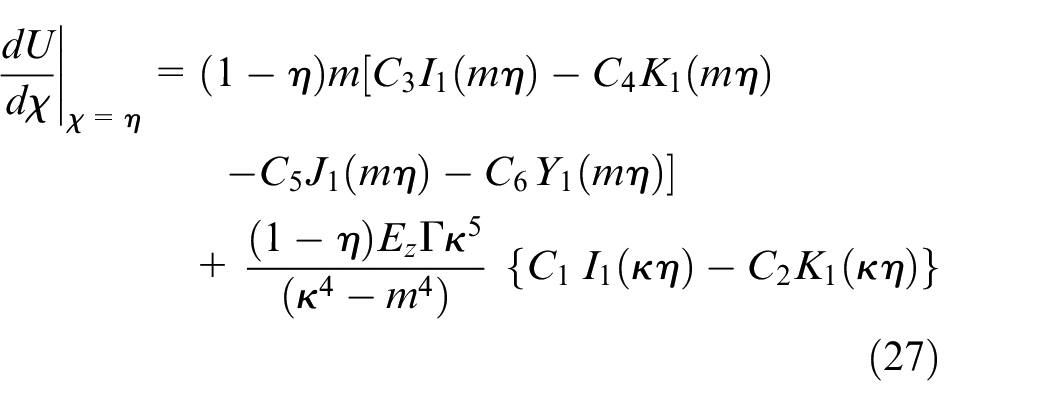
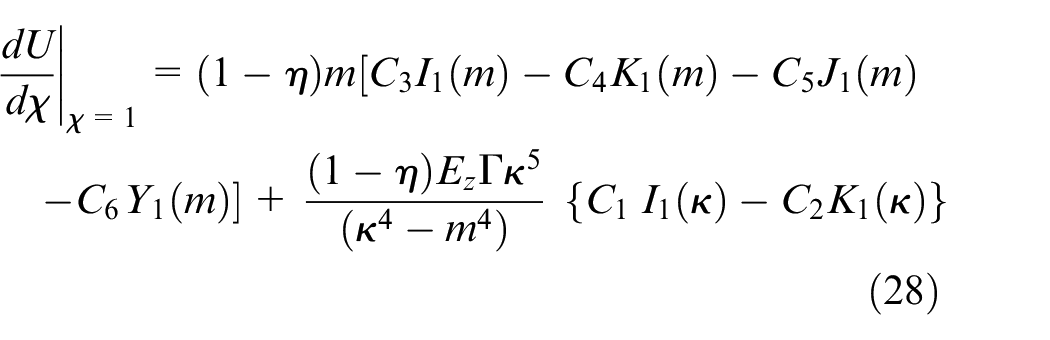
From the velocity solution obtained, the skin frictions at the micro-annular surfaces are given as:
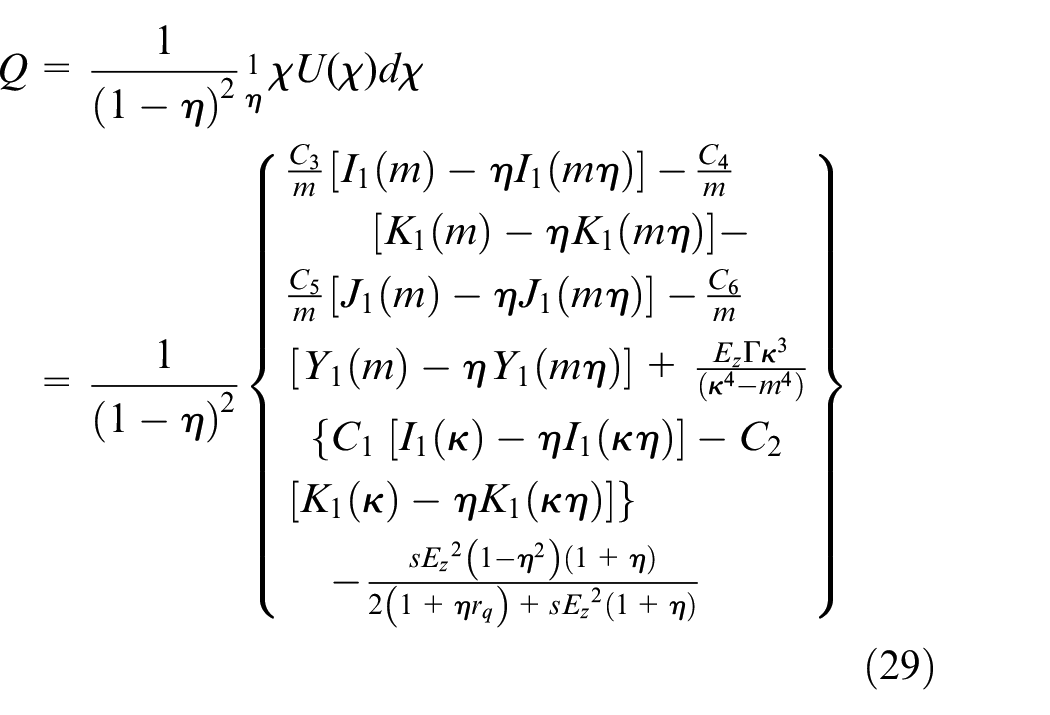
Also, the volumetric flow-rate in the microannulus is obtained as:
Results and discussion
The discussion of results for electroosmotic NCF in a vertical microannulus with asymmetric zeta-potentials at the surfaces of the microcylinders in the existence of Joule heating is carried out in the section. The solutions gotten showed that the sundry parameters influencing flow formations are ratio of radii
Figures 2 and 3 respectively depict the fluid temperature and velocity profile in the vertical microannulus as functions of radius ratio and asymmetry in wall zeta-potential for constant value of other leading parameters. It is noticeable that fluid temperature as well as velocity respond noticeably to change in
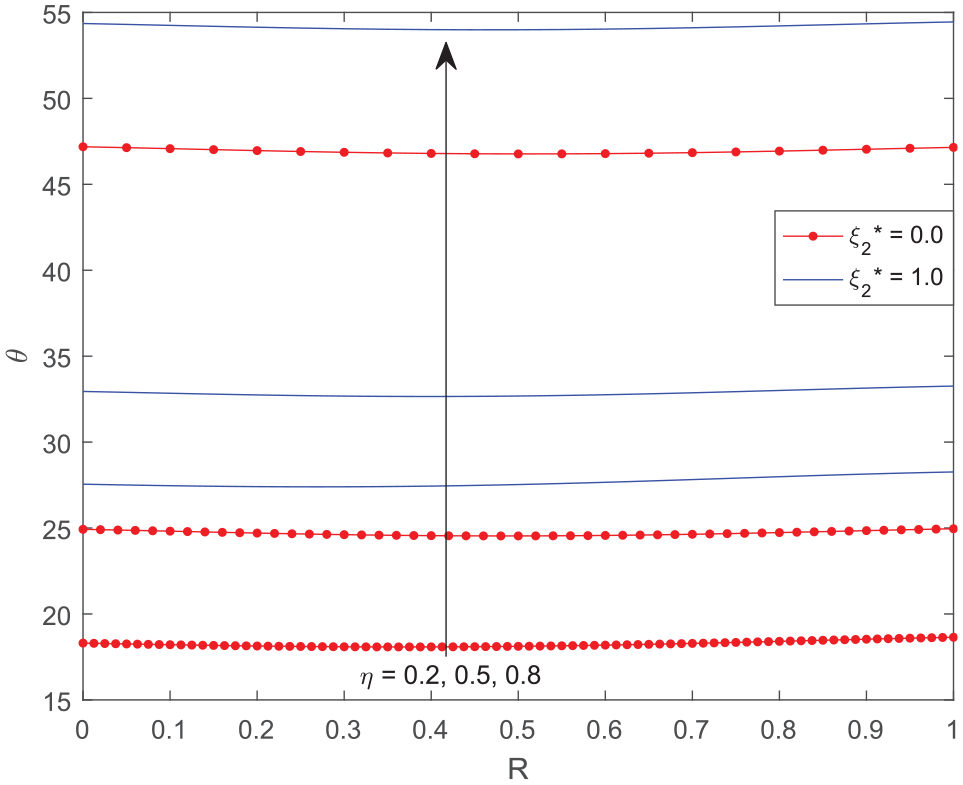
Temperature distributions for different values of
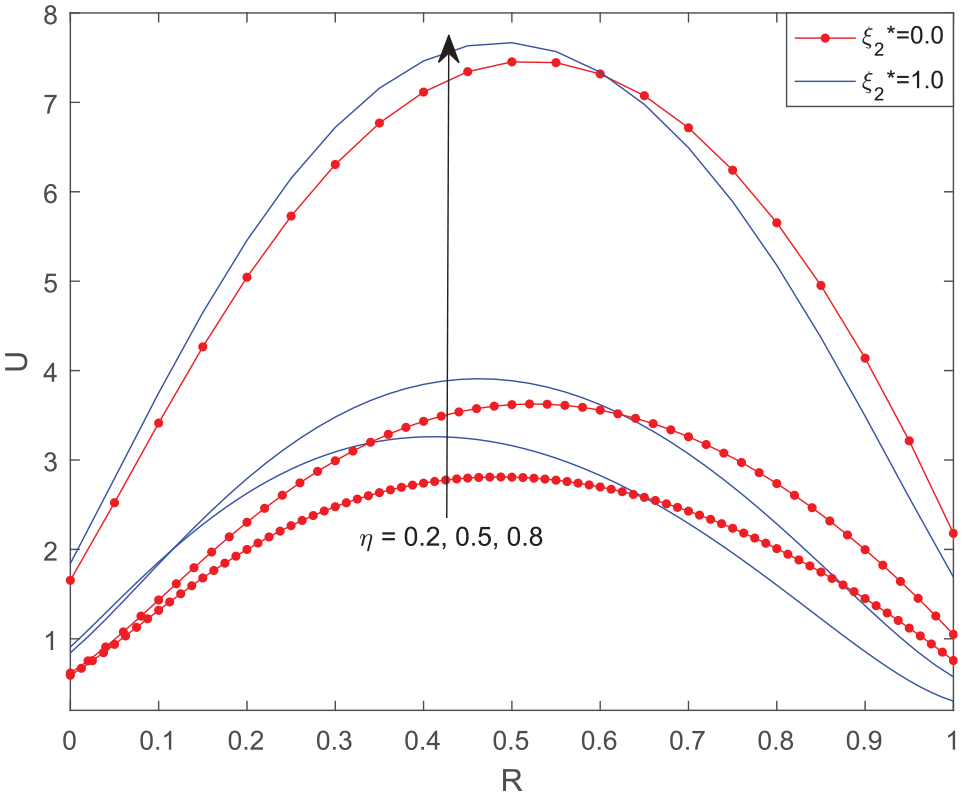
Velocity profile for different values of
In addition, while the parabolic nature of fluid velocity is preserved, we found a nearly constant temperature throughout the microannulus.
It is pertinent to also understand the role of buoyancy term on temperature distributions as well as velocity profile in the microannulus. To this end, Figures 4 and 5 respectively represent the temperature distributions and fluid velocity as functions of Grashof number
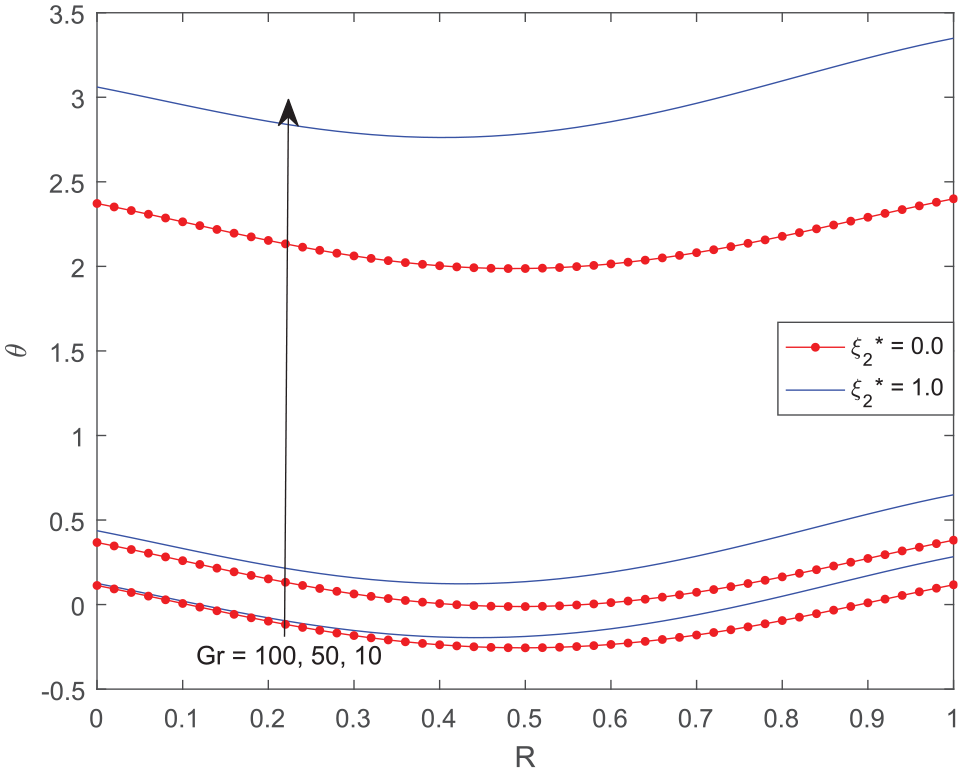
Temperature distributions for different values of
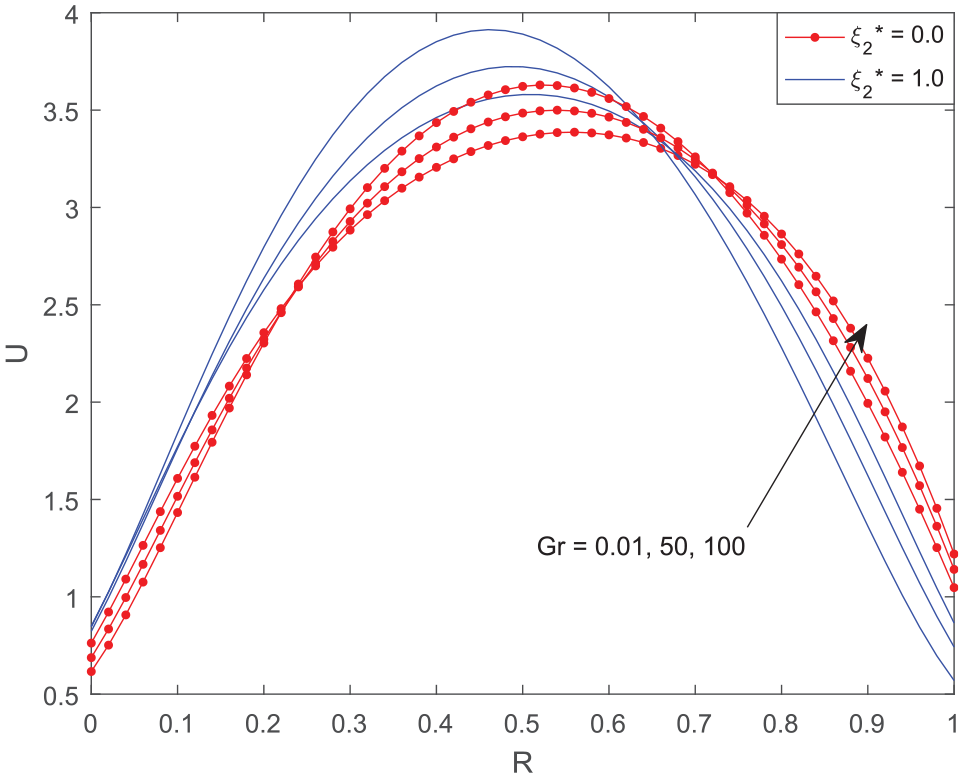
Velocity profile for different values of
For proper investigation of the impact of sundry parameters on volumetric flow-rate, Figures 6 to 8 depict the effect of various leading parameters on the amount of fluids passing through the microannulus (volumetric flow-rate). This phenomenon has significant importance in optimization of flow rate in design of micropumps and drug targeting. Figure 6 revealed that the maximum volumetric flow-rate can be achieved by exposing the microannulus surfaces to equal wall zeta-potentials. Also, flow-rate is found to first increase for small values of
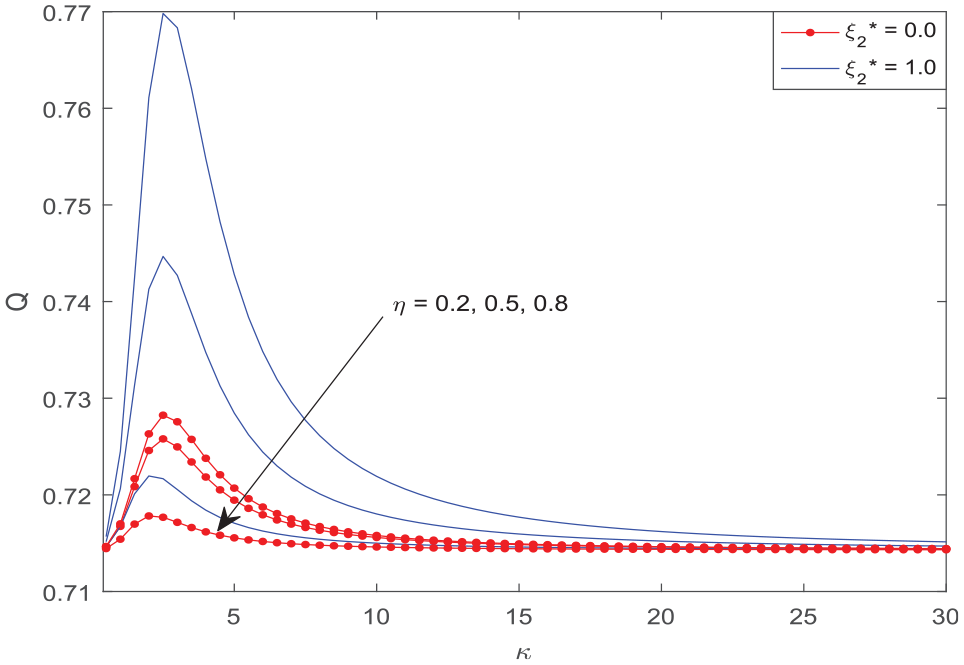
Volumetric flow-rate for different values of
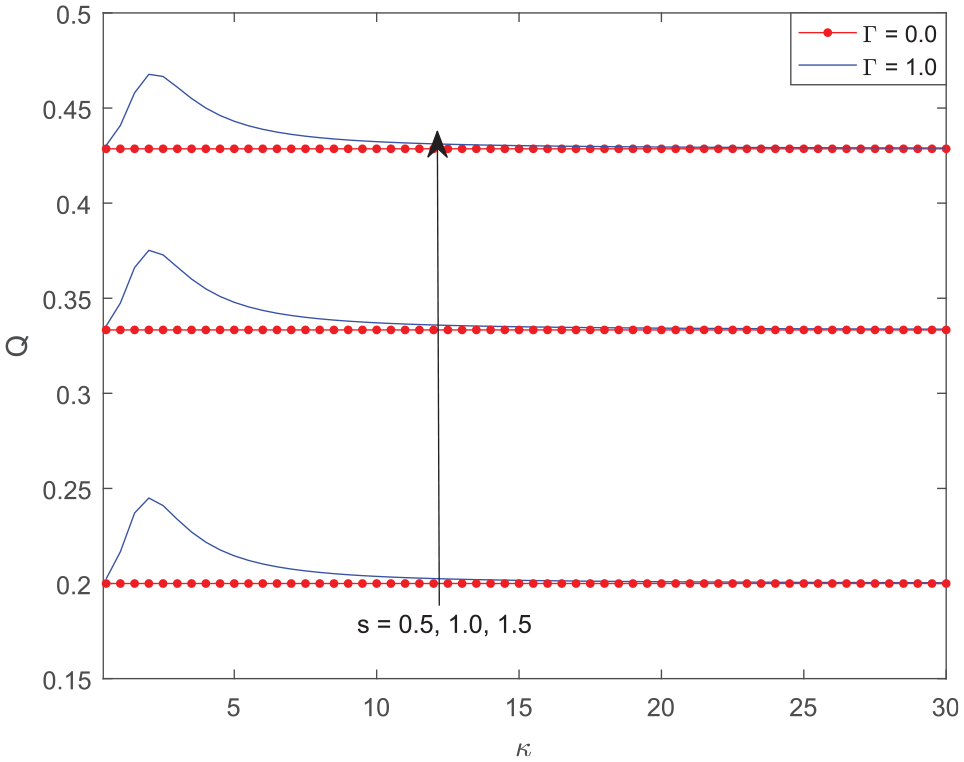
Volumetric flow-rate for different values of
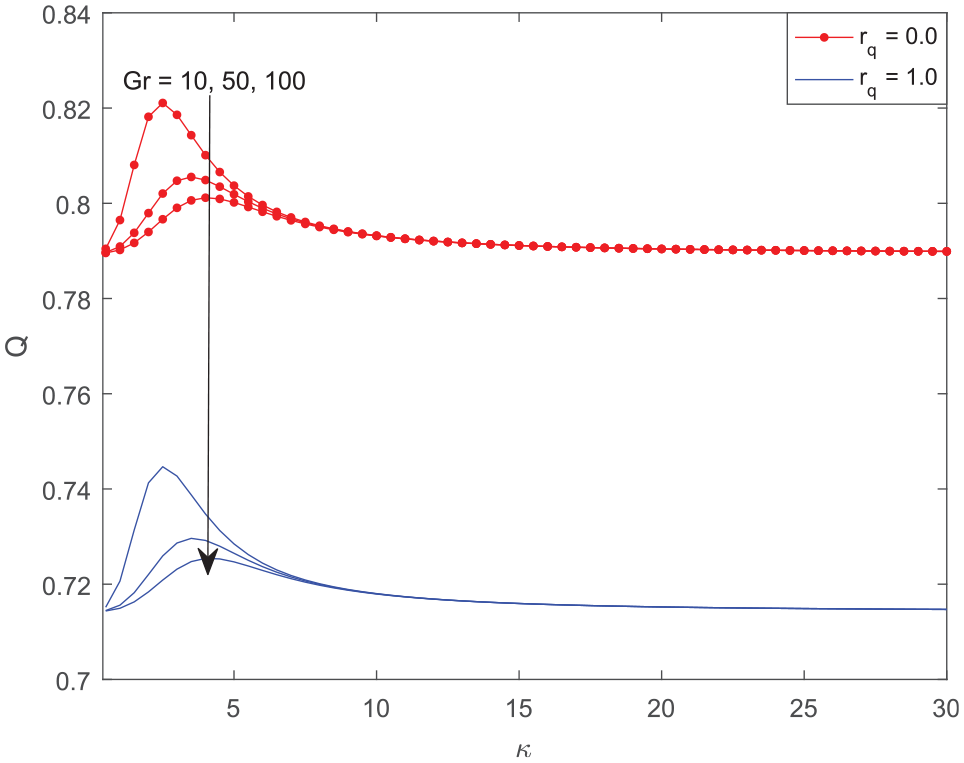
Volumetric flow-rate for different values of
Figure 7 also discussed the volumetric flow-rate as functions of
Figure 8 portrays the influence of
Figure 9 shows the effect of unequal wall zeta-potentials, EDL size and ratio of radiuses on skin-frictions at the outer surface of inner cylinder. This figure discloses that the skin-friction for the symmetric wall zeta potential
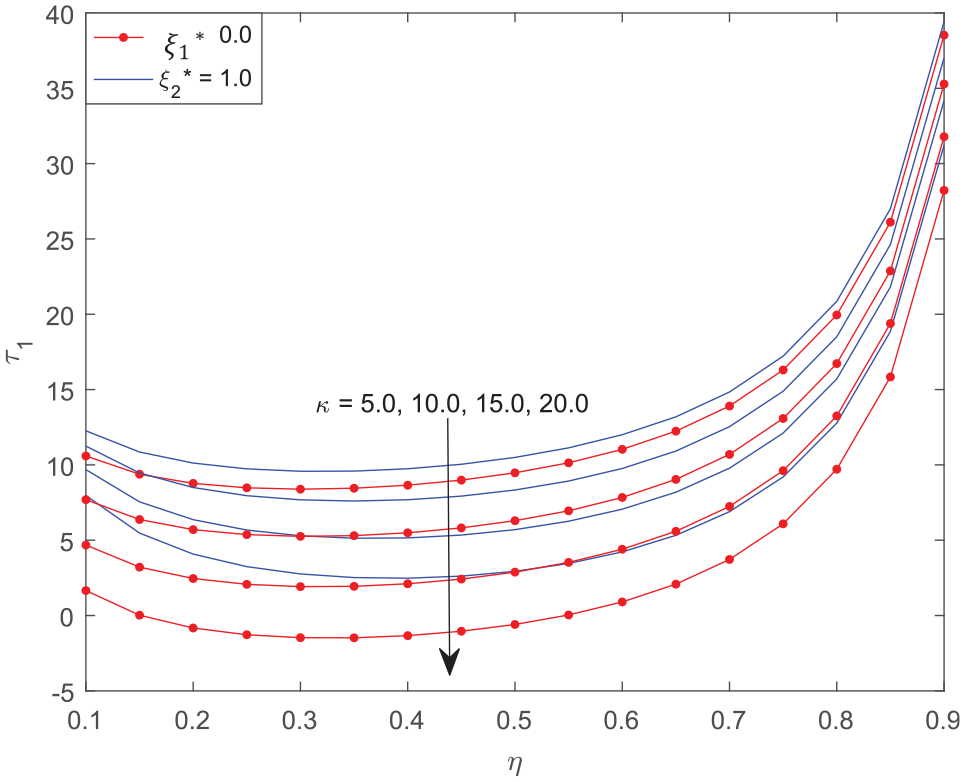
Skin-friction at the wall
Figure 10 depicts the combined impact of slip parameter, magnitude of electroosmotic force and radius ratio on skin-friction at the outer surface of inner cylinder. It is observed from this figure that the role of electroosmotic force is to reduce skin-friction at this surface regardless of the flow regime. Also, the slip flow (which is a closed to real life physics of flow in microannulus) is found to further has a lower skin-friction compared to the no-slip case. This outcome clearly demonstrated that the skin-friction at this surface would have been overestimated, if the surface slip-parameter was not put into consideration.
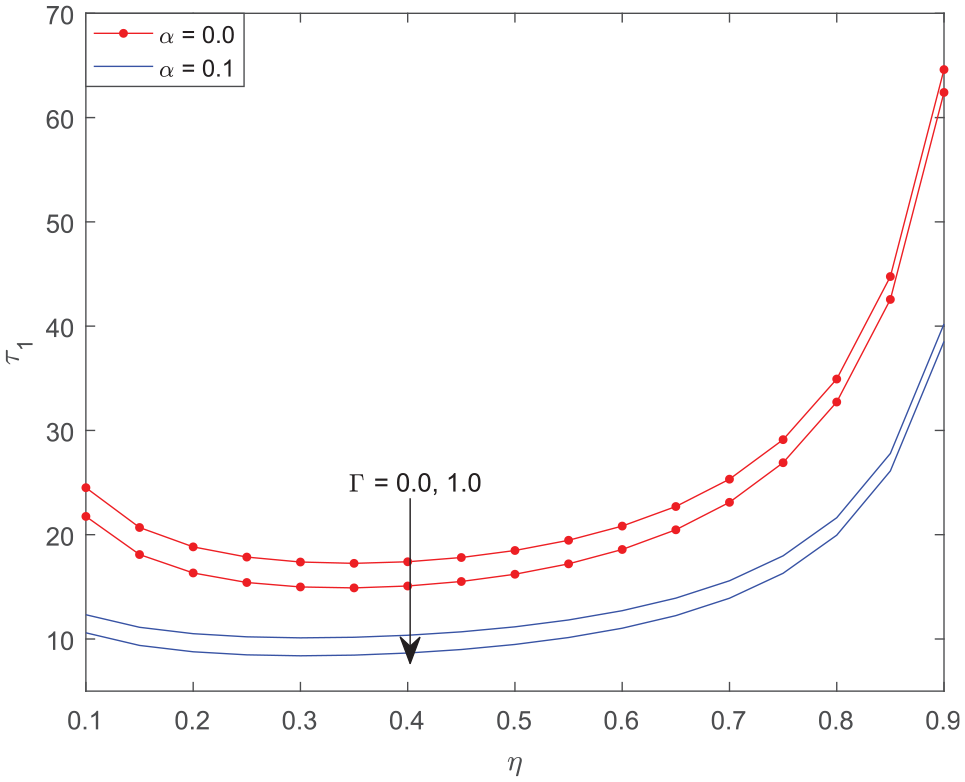
Skin-friction at the wall
Figure 11 displays the role of
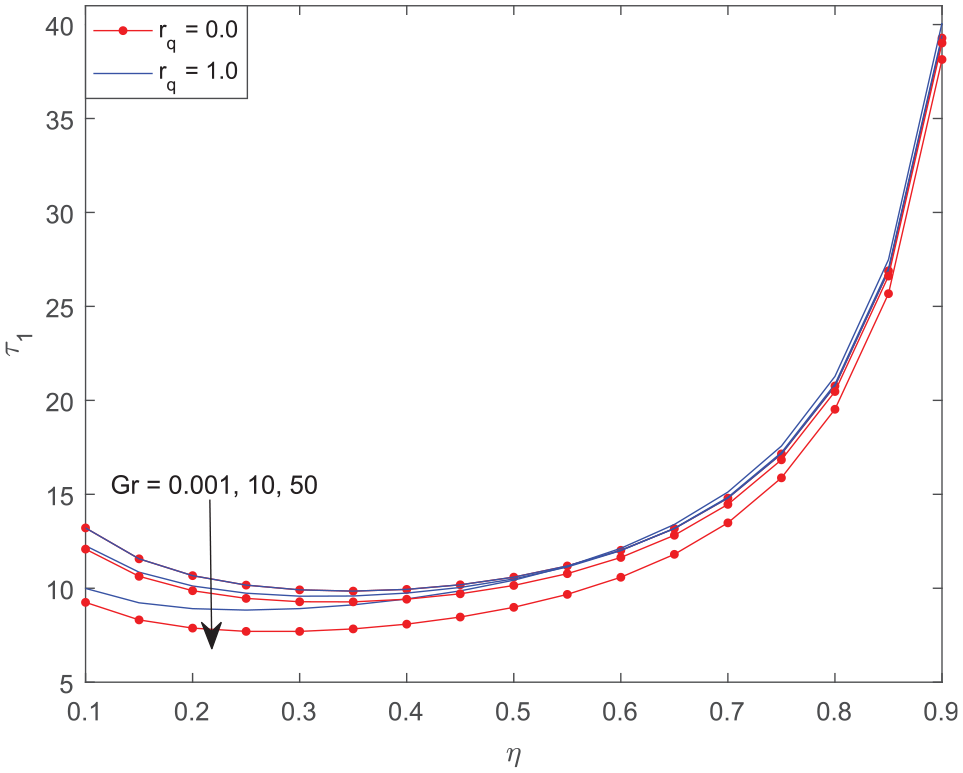
Skin-friction at the wall
It is noteworthy to mention that in the absence of electroosmotic force and joule heating effect, this work corresponds to the work of Avci and Aydin
33
when the radius ratio
Conclusion
Analytical solution for electroosmotic NCF in a vertical microannulus with asymmetric zeta-potential and Joule heating is presented in this section. The equation of motion, electric potential, temperature distributions are derived and solved exactly. The influences of relevant parameters are presented using line graphs generated by MATLAB. The major conclusions are:
Fluid velocity, temperature, skin-friction and volumetric flow rate respond sharply to asymmetry in zeta-potential.
The volumetric flow rate as well as the skin-friction would have been erroneously calculated should the EDL as well as the slip parameters had not been put into consideration.
Fluid temperature and velocity profiles in the vertical microannulus increase with increase in radius ratio.
The role of electroosmotic force is to increase volumetric flow-rate and decrease skin-friction.
Footnotes
Appendix
Acknowledgements
The authors are thankful to the University as well as the Department.
Author contributions
Author Roles: M.O.O. solve the problem, prepared the writeups, write the codes and generates all figures. B.K.J. formulated the problem and proofread.
Declaration of conflicting interests
The author(s) declared no potential conflicts of interest with respect to the research, authorship, and/or publication of this article.
Funding
The author(s) received no financial support for the research, authorship, and/or publication of this article.
