



Abstract
In current paper, we considered the 3-D occurrence of magneto Williamson fluid subjected to linear penetrating expanding sheet. The Williamson liquid is taken into account under the essence of bio convection bordering with Joule heating, heat production. Moreover, Brownian movement combined with thermophoresis diffusion was also analyzed in current study. Central PDEs are modified into system of ODEs on the basis of appropriate similarity transformation utilization. For solution purpose, an optimal approach namely HAM was opted. The critical review based on all involved multifarious constraints across the non- dimensional velocity contour
Keywords
Introduction
On account of extensive functional relevance in multitudinous Industrial as well as Engineering procedures multiple researchers have kept in view on the exploration of convective heat transportation analysis and steady occurrence under consideration of incompressible fluids. The standard relevance to conclusive product is heavily based on the rate of thermal transportation and also skin friction at the surface. Investigation of Williamson liquids with bio convection applications gives a multidisciplinary scheme bridging biology, fluid mechanics, and applied mathematics. It provides both practical applications as well as fundamental understanding in the fields ranging from biotechnology to environmental science. Moreover, mathematical modeling with the imposition of bio convection phenomena along with Williamson liquid helps in understanding and predicting complex liquid microorganism interaction. These models considered pivotal in optimizing procedures and also predicting outcomes in numerous engineering and biological applications. Bio convection within the Williamson liquid can be affected by environmental factors such as chemical gradients or temperature gradients. Furthermore, in biotechnological procedures involving microorganisms, understanding of their demeanor toward the non-Newtonian fluids is most significant. Applications owing to the microbial procedures efficiency dependence on fluid rheology, could range from bioreactors to the environmental remediation.
Shah et al. 1 examined the radial magnetized Williamson liquid bounded by unsteady penetrating expanding sheet. An optimal computation in accordance to 3-D Darcy Forchheimer Williamson Nano fluidic occurrence past over an expanding surface by invoking convective conditions was performed by Dawar et al. 2 Gul et al. 3 explored the thermal transportation in reference to flow demeanor of thin film specifically of Williamson fluid subjected to oscillatory and also inclined spinning plate. Rasool et al. 4 aims to investigate the chemically reactive magneto-Williamson Nano-liquid flow demeanor across the non-linear permeable surface. Shafiq et al. 5 implemented the novel numerically computation solver namely artificial neural networks (ANN) for the examination of electrically conducting and unsteady Williamson liquid across a radial surface. Prasad et al. 6 analyzed the mixed convected 2-D hydro-magnetic Williamson Nano liquid occurrence exposed to spinning disk with the imposition of zero mass flux condition. Thermal transportation concerning to radial Williamson liquid occurrence exposed to expandable curvy geometry was studied by Raza et al. 7 Entropy optimization was conducted by Khan et al. 8 toward the Williamson hybrid Nano liquid occurrence influenced by Joule heating together with viscous dissipation across the thin vertical shape needle. Moreover, the problem appertaining to Williamson liquid was addressed under the impacts of thermal source/sink and investigated the mass and also thermal transportation in consideration of convective conditions bounded by oscillatory extending geometry. Song et al. 9 focused on the investigation of magneto-Williamson liquid comprising of motile organisms across the bilateral non-linearly expanding geometry. Computational aspects was explored by Khan et al. 10 in accordance to variable viscosity toward the Williamson Nano fluidic occurrence owing to solutal and also thermal stratification across the non-linear expanding geometry.
Thermal transmission together with mass diffusion analyzed by Khan et al. 11 based on magnetized Casson fluid exposed to variable viscosity under the assumption of convective conditions. Shah et al. 12 study based on the examination of second grade liquid flow demeanor in the dispersion of thermophoretic particles influenced by variable concentration diffusivity, varying thermal conductivity and also variable viscosity with the imposition of convective conditions. Thermal efficiency appertaining to mixed convected couple stress Darcy-Forchheimer specified by ternary hybrid Nano liquid occurrence bounded by non-linear extending surface was reported by Gul and Saeed. 13 Mebarek-Oudina et al. 14 discussed the magnetized thermal naturally convected stability across the molten metal filled inclined cylindrical annulus. Thermal transfer toward the chemically reactive convected Casson liquid occurrence subjected to Darcy-Forchheimer media was studied by Bilal et al. 15 Unsteady 3-D bioconvected occurrence based on chemically reactive Maxwell Nano liquid past over exponentially extending surface exposed to varying thermal conductivity was analyzed by Ahmad et al. 16 Flow and also thermal transfer has been investigated by Khan et al. 17 in accordance to occurrence of bio-convected hybrid Nano liquid influenced by triple stratification impacts. Mixed convected occurrence based on micropolar Hybrid Nano liquid bounded by Riga surface subjected to permeable medium analyzed mathematically by Ahmad et al. 18 Wakif et al. 19 numerically investigated the thermal convection produced by internal heating exposed to spinning medium in accordance to radial nano liquid.
Magnetic field also show vast impactness on the fluid and flow in case of both natural and industrial processes. Earth magnetic field working as a shield in front of the fatal radiations. Solar magnetic field considered to be source of production for sunspots and sun flares. We entitled all above phenomenon with single word as Magnetohydrodynamics (MHD). Mass as well as thermal transportation across the magnetized thin film specifically of second grade possessing variable features bounded by extending surface exposed to thermophoresis impacts together with thermal radiation was addressed by Khan et al. 20 3-D Casson Nano fluidic thin film occurrence across the inclined spinning disk under consideration of heat production/consumption and also thermal radiation impacts was addressed by Saeed et al. 21
The connective motion owing to density gradient specifically at microscopic level is termed as Bioconvection initially in correspondence to motile organisms. These self-driven motile organisms in specified direction intensified the density of fluid and hence instigating bioconvection. Magnetized bioconvection Nano fluidic occurrence under the combine impacts of Joule heating along with viscous dissipation impacts was covered by Jawad et al. 22 Moreover, Jawad et al. 23 also optimized the entropy approach within the magneto bioconvection 3-D Darcy-Forchheimer occurrence specifically of Casson Nano liquid configured by spinning disk. Saeed and Gul 24 aims to explore the Darcy Forchheimer across the 3-D bioconvection radial Casson Nano fluidic flow demeanor in terms of spinning disk influenced by Arrhenius activation energy. Similarly, Bioconvectional Nano fluidic occurrence was scrutinized by Gul et al. 25 owing to the gyrotactic microorganisms and also thermophoresis impacts amongst the cone and disk gap. Shah et al. 26 inspected the chemically reactive mixed bioconvection occurrence concerning to magnetized third-grade fluid under dispersion of Nano-size particles and also gyrotactic microorganisms subjected to expanding sheet influenced by Arrhenius activation energy together with viscous dissipation impacts. Hayat et al. 27 considered the combined impacts of Joule heating along with thermal radiation based on third grade liquid occurrence toward the radiative surface. Rasool et al. 28 numerically computed the magnetized water based hybrid Nano fluidic occurrence under consideration of viscous dissipation along with Joule heating impacts subjected to a penetrating sheet. Khan et al. 29 analyzed the Joule heating as well as chemical response toward the magnetized Carreau-Yasuda Nano liquid flow demeanor bounded by non-linear extending sheet with the imposition of slip and also convective conditions. Entropy approach across the dissipative occurrence appertains to hybrid Nano liquid in the existence of Joule heating together with thermal radiation impacts was investigated by Xia et al. 30 Malik et al. 31 numerically examined the Williamson fluid occurrence induced by expanding cylinder and thermal transmission exposed to varying thermal conductivity and also heat production/absorption. An extensive analysis was performed by Awais et al. 32 across the unsteady Williamson liquid configured by melting wedge in the existence of heat absorption/production impacts. 3-D hydromagnetic convected flow demeanor under the chemical response together with non-uniform heat production/absorption impacts within the Williamson fluid was explored by Kumar et al. 33 Magnetized Williamson fluid and also heat transmission bounded by non-linear extending sheet embedded in a permeable medium influenced by viscous dissipation together with heat generation effects was discussed by Abbas et al. 34 Mishra et al. 35 investigated the magnetized Williamson micropolar liquid occurrence past over a non-linearly expanding sheet with the imposition of heat production/absorption impacts. Thermophoresis is the force generated on account of temperature gradient amongst the hot gas and cold wall influence the particular movement toward the cold wall. In 1827, Robert Brown examines the arbitrary movement of particles of pollen grains in water. The random movement of suspended particles in liquid results from the collection with the fast-moving molecules within the liquid. Owing to collision, Brownian movement is the arbitrary movement of particles which have an origin from Greek word “Leaping.” Naveed et al. 36 has given a unique idea by exploring the impacts of Thermophoresis and also Brownian movement in consideration of Blasius flow demeanor appertains to Nano fluid over a curved geometry. Obalulu et al. 37 work based on analysis of Brownian movement along with thermophoresis diffusion within the reactive Casson-Williamson Nano-size liquid configured by vertically moving cylinder. Asjad et al. 38 investigated the influence of activation energy toward the magnetized Williamson liquid occurrence in the existence of bio convection. Abdal et al. 39 explored the combined features of bio convection along with thermal radiation exposed to Williamson Nano size liquid transportation due to cone rotation. Priyadharshini et al. 40 studied the bio convection together with the magneto hydrodynamic features across the symmetrically shrinking sheet.
In general, the novelty lies within the combination of bio convection phenomena with the non-Newtonian rheology specified by Williamson fluid, provides understanding of how fluid characteristics influenced the biological procedures at the microscale. This interdisciplinary scheme bridges rheology, fluid dynamics, and biological sciences offering advanced avenues for both practical applications and also theoretical exploration.
Mathematical modeling
Here, our analysis based on unsteady 3-D incompressible Williamson liquid occurrence configured by linear expanding sheet. Moreover, sheet is supposed to be stretched in the direction of

Geometry problem.
Under consideration of boundary layer approximation, the continuity and also momentum equations for Williamson liquid are as follows:


Here,
Mathematically, the expression for Williamson liquid are represented by41–44:


Where,


Where,


Assume

Where, components of extra stress tensor are as follows:


For considered assumptions, the mathematical modeling expressed as follows:





Here,
Moreover, the radiative heat flux expressed as follows:

Here,

The equivalent prior conditions for the presumed problem are demonstrated as follows:

Here,
In accordance to above mentioned equations, similarity variables expressed as follows:

Keeping in view equation (18), equation (9) satisfies whereas, equations (10), (11), (16), (13), (14), and (17) are given as:


With prior conditions:

Here,
The drag force in mathematical form:


Where, after usage of boundary layer approximation, equation (24) represents shear stress rate and also skin friction coefficient whereas the skin friction in non-dimensional form is given as follows:


Heat transfer efficiency in mathematical form defined as:

Where, the external heat transportation is:

With the utilization of equation (18), the preceding solution in reduced form is as follows:

Sherwood number defined as follows:

Here, surface mass flow defined as:

With the utilization of equation (18), above equation in dimensionless version is:

Moreover, microorganism density is defined as follows:

Here,

With the utilization of equation (18), above equation in dimensionless version is:

Where, local Reynolds number owing to stretching velocity
Methodology
An analytical method for resolving nonlinear differential equations is the Optimal Homotopy Analysis Method (OHAM).45–48 Modifying convergence control settings minimizes approximation error and produces more precise and adaptable solutions by combining homotopy analysis with optimization techniques. The OHAM (Optimal Homotopy Analysis Method) is utilized in order to rectify the modeled system of streaming simulations (ODEs) by invoking BCs. Boundary physical constraints have inefficient paired ODE structure. By invoking OHAM technique to our obtained homotopy solutions, which converges.45–48
The following auxiliary operators and initial deformations are appropriate for OHAM solutions:


The preceding set of linear operators is followed:
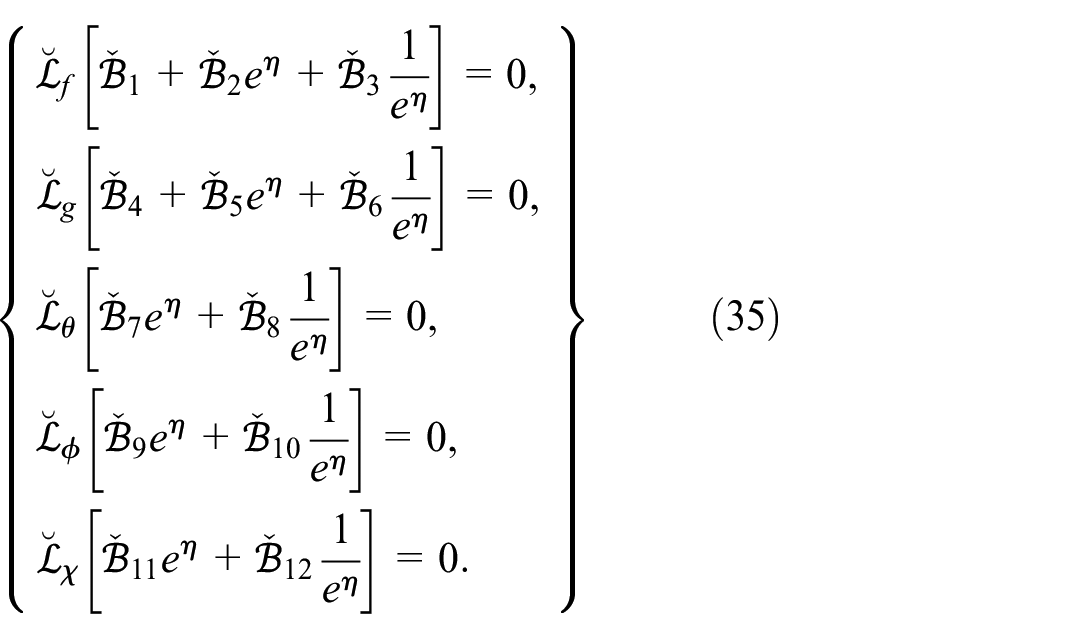
Where





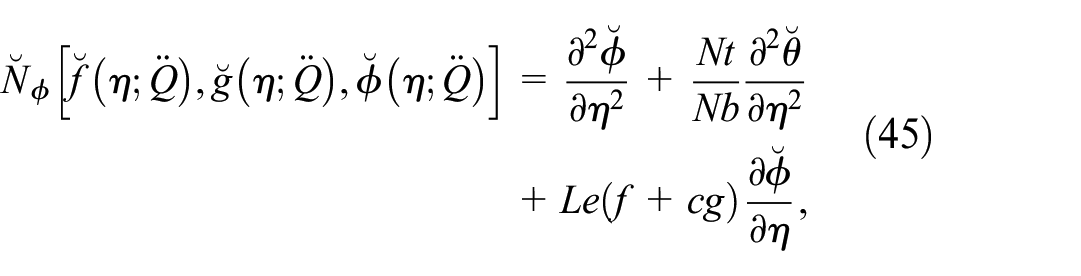
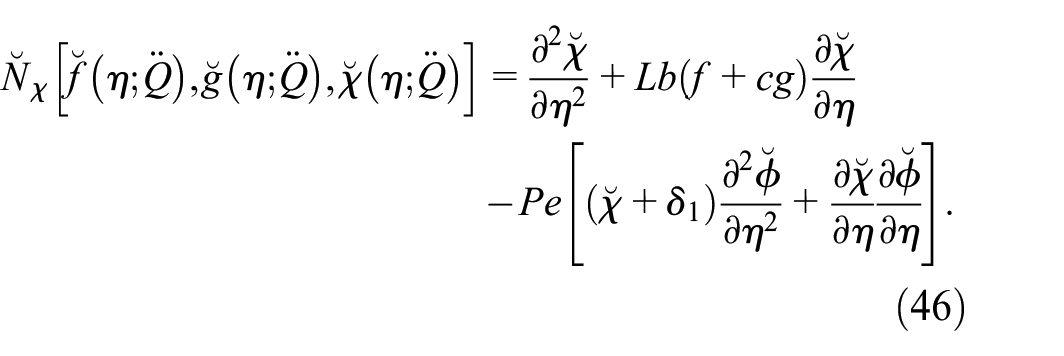
In the axioms overhead,




When


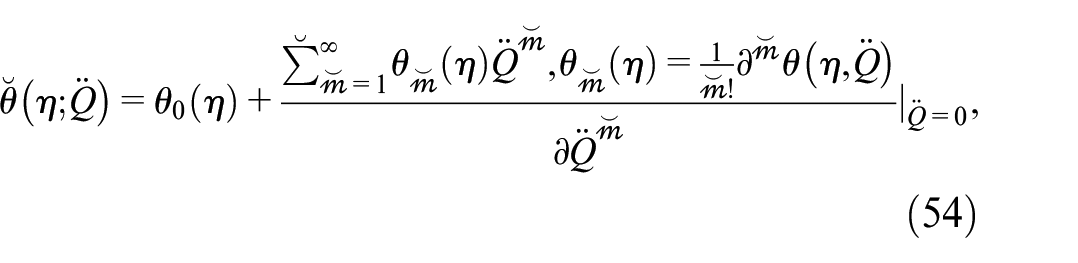


The convergence of equations (52)–(56) powerfully is dependent on production the right conclusions of





The


Convergence analysis


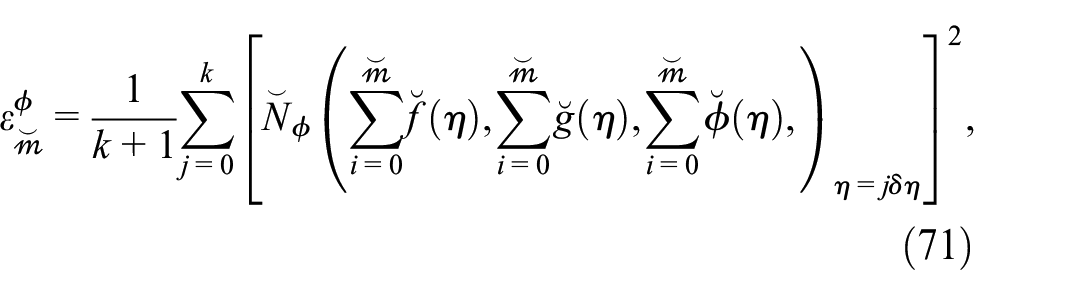

Succeeding Liao 49 :

Working procedure of OHAM
Optimal Homotopy analysis method (OHAM) is most powerful analytical approach utilized to compute non-linear differential equations that may not provide direct analytical solutions. Below is the general outline of working process of the OHAM
Firstly, consider the non-linear differential equation in order to get the solution of that equation. For instance, consider an equation expressed in the version of
As a second step, we introduce and designed auxiliary linear operator • Original non-linear equation in the form •
Here,
3. As a third step, construct a homotopy

4. Series solution construction
• In terms of

• Utilizing this series into
5. Solve the obtained system of coupled algebraic equations in order to obtain the coefficients
6. Evaluate the solution
Sum the series solution
7. Check and verify:
• Compare the obtained solution with original solution and ensure it satisfies the initial conditions.
• By adjusting the required number of terms in the series solution or utilization of advanced techniques if necessary.
Discussion and results
The modified non-dimensional ODEs (19)–(23) are solved by utilization of OHAM approach. The results are validated graphically and also interpreted in tabular form. The outcomes of current analysis are interpreted graphically through Figures 2 to 25. In this section, Figures 2 to 9 interpret the influence of
Figures 16 and 17 are constructed to witness the involved parameters such as Prandtl number
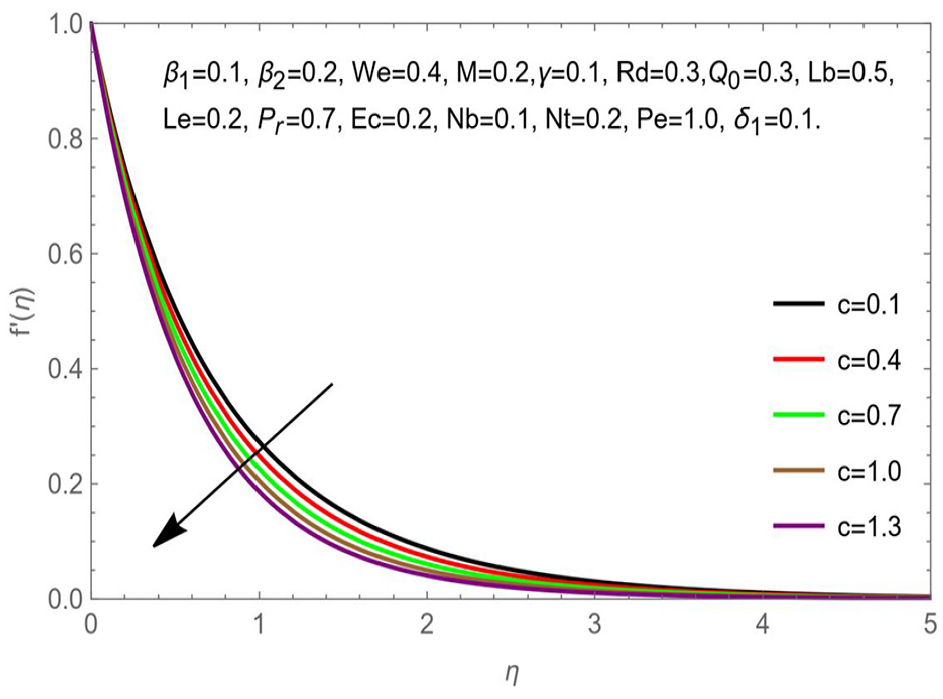
Variation of

Variation of Williamson constraint

Variation of porosity constraint

Variation of magnetic constraint

Variation of

Variation of Williamson constraint
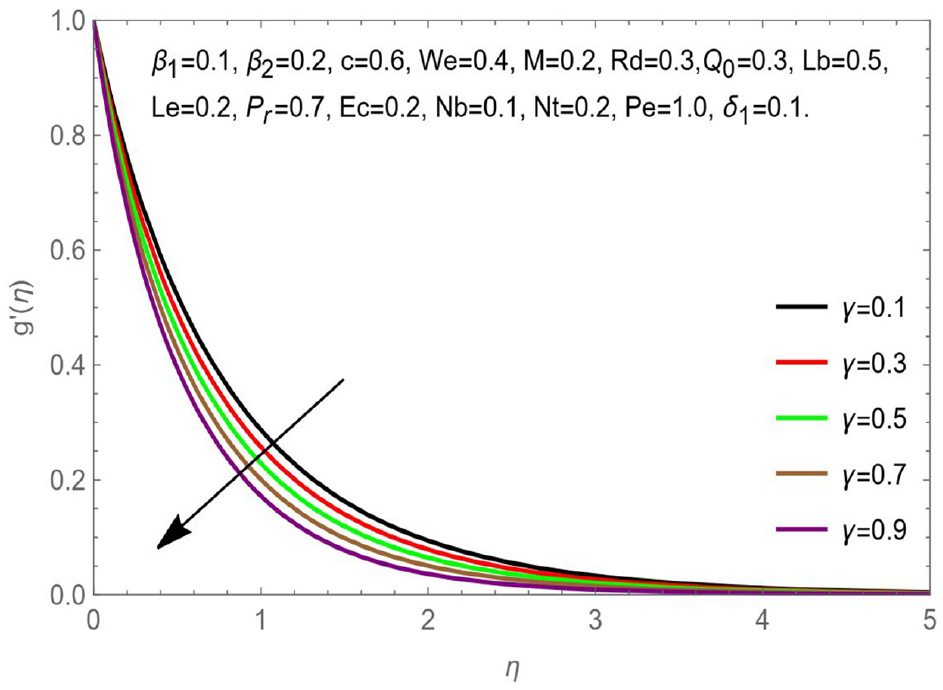
Variation of porosity constraint
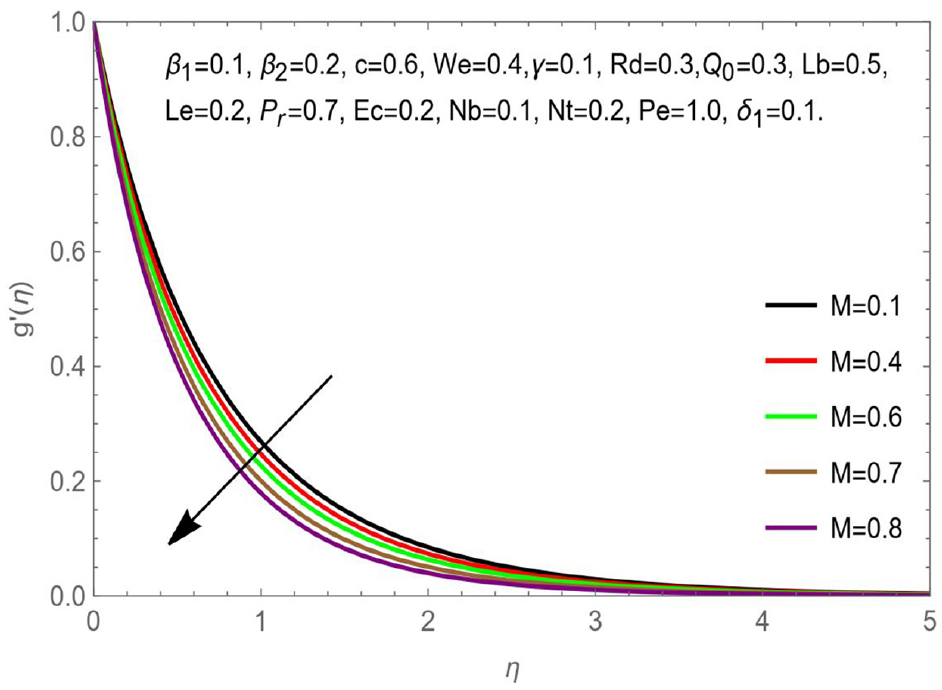
Variation of magnetic constraint

Variation of magnetic constraint

Variation of radiation constraint

Variation of Brownian constraint
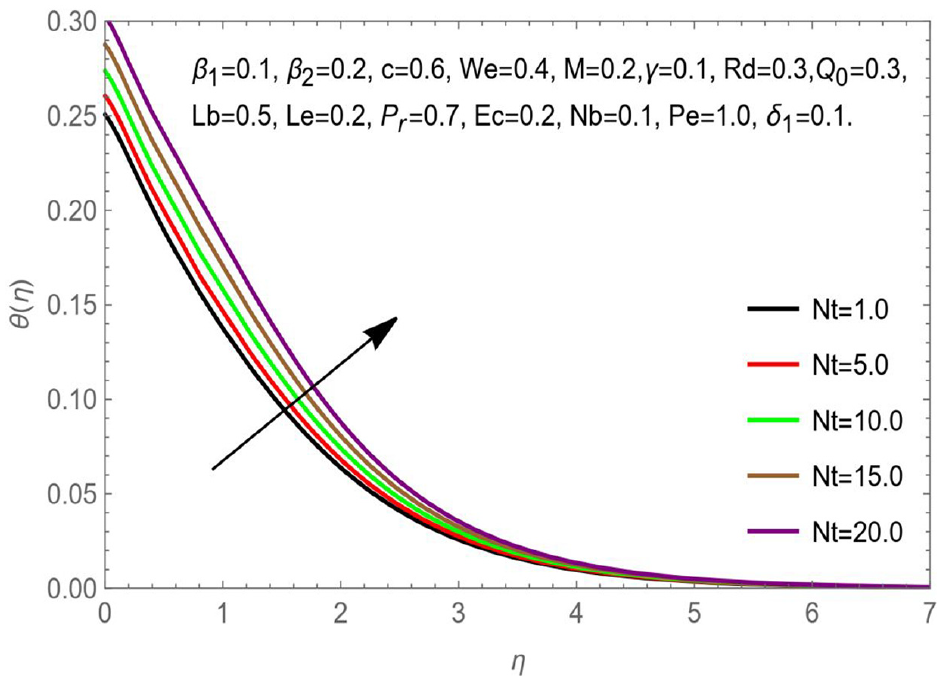
Variation of thermophoresis constraint

Variation of heat generation constraint

Variation of Eckert number

Compartment in Prandtl number

Compartment in
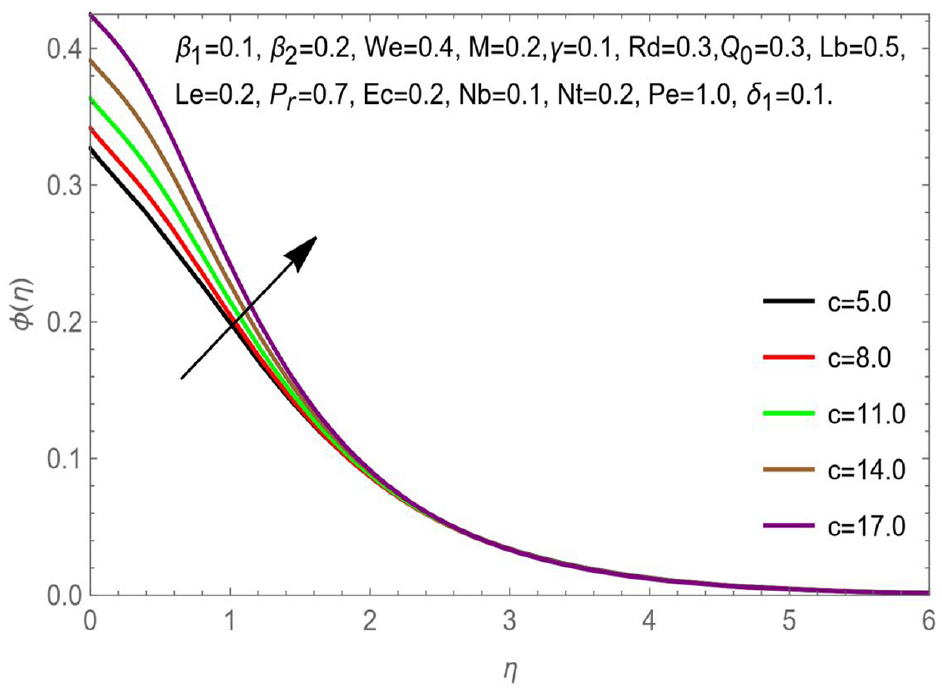
Compartment in

Variation of thermophoresis constraint

Variation of Brownian constraint
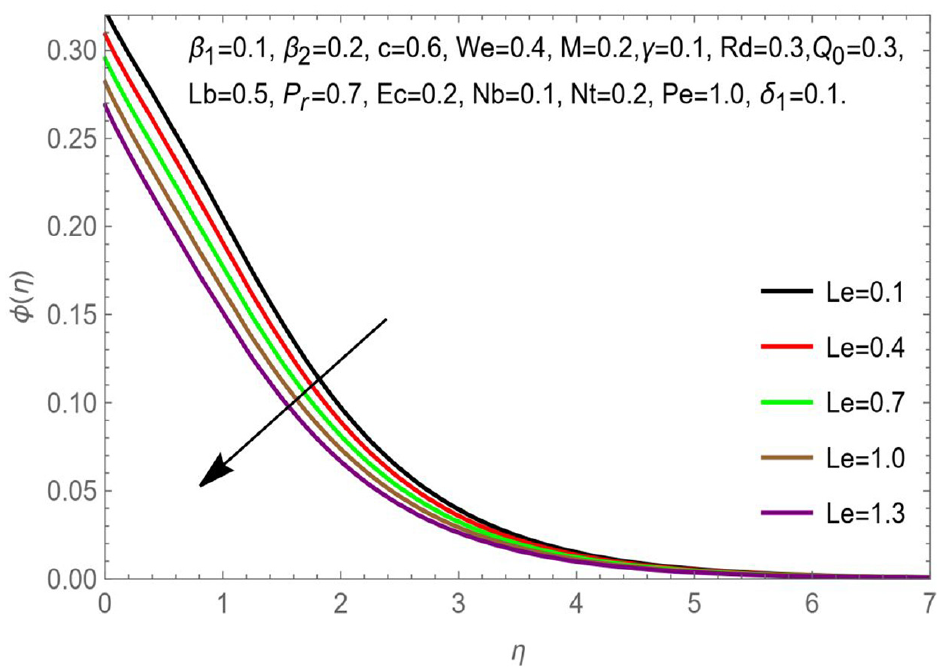
Variation of Lewis number

Variation of bio convection Lewis number
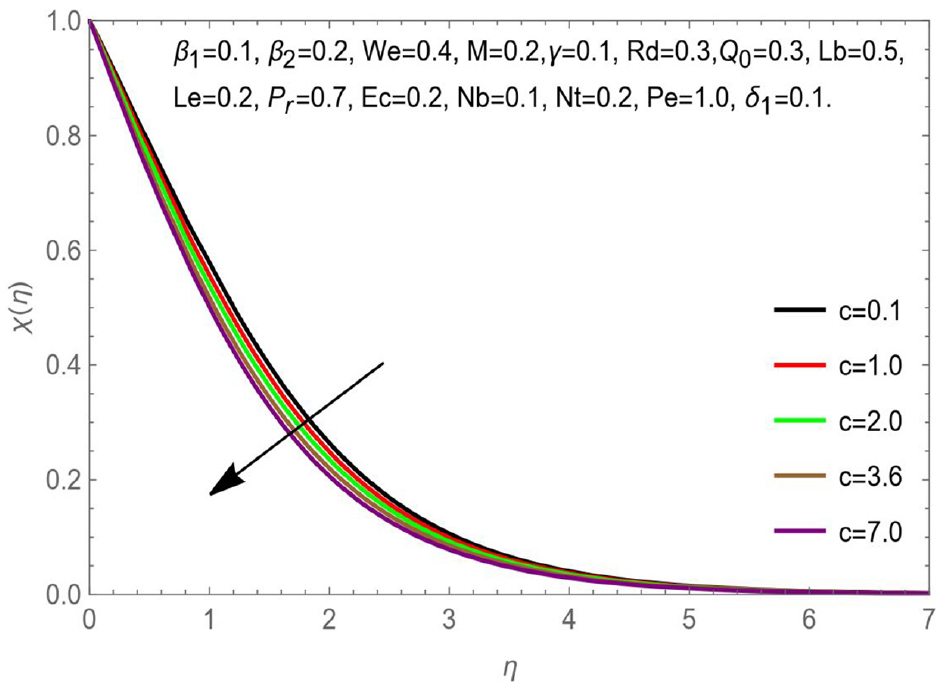
Variation of
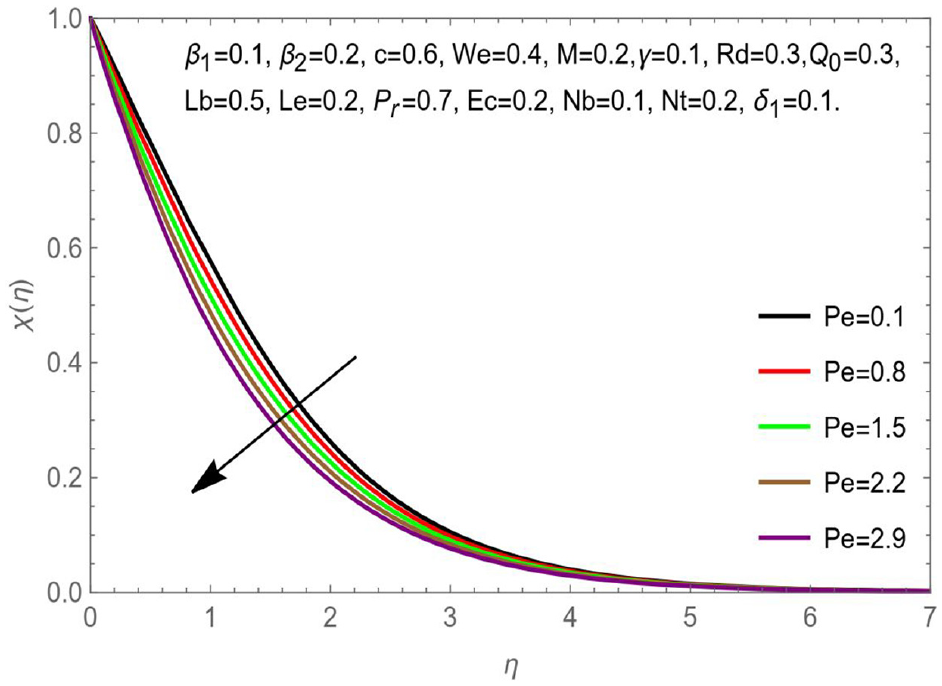
Variation of Peclet number

Variation in distinct temperature difference constraint
Numerically computed values of Drag force against the distinct values of the involved parameters.

Numerically computed values of Nusselt number against the distinct values of the involved parameters.

Numerically computed values of Sherwood number against the distinct values of the involved parameters.

Numerically computed values of motile microorganism against the distinct values of the involved parameters.

Comparative analysis with Shah et al. 50 for heat transfer rate values expressed numerically for various embedded parameters.

Conclusion
In this analysis, unsteady, incompressible three-dimensional Williamson liquid exposed to linear expanding sheet is numerically analyzed by invoking optimal approach namely HAM. The pivotal conclusions of the investigation are as follows:
The velocity distribution
Energy distribution pointedly enhanced with
Concentration profile is augmented under the consequences of constraints like
Motile organisms profile shows reduced behavior for
Drag force
The results of Nusselt number in Table 3 represents enhancement with the augmented values of
The results of Sherwood number is depicted via Table 3 and it illustrates augmented demeanor for
Motile organism density in Table 4 depicts enhancement under consideration of involved parameters like
Footnotes
Handling Editor: Chenhui Liang
Author contributions
Sana Akbar (S.A): Writing-original draft preparation; writing-editing; methodology; analysis; investigation; revision and writing-reviewing; data curation; original draft preparation. Muhammad Sohail (M.S): Investigation and graphical abstract; supervision; revision and writing-reviewing; project administration; conceptualization; analysis. Syed Tehseen Abbas (S.T.A): Conceptualization; analysis; investigation. Nacer Badi (N.B): Investigation and graphical abstract; funding acquisition.
Declaration of conflicting interests
The author(s) declared no potential conflicts of interest with respect to the research, authorship, and/or publication of this article.
Funding
The author(s) received no financial support for the research, authorship, and/or publication of this article.
Availability of data and material
The datasets used and/or analyzed during the current study available from the corresponding author on reasonable request.
