




Abstract
One of the applications of nano-carbon is a support material of platinum (Pt) catalyst for fuel cells. In this study, the nano-carbon was successfully synthesized by in-liquid plasma in ethanol. The synthesized nano-carbon was characterized by the transmission electron microscope and the Raman spectroscopy. Moreover, the nano-carbon was applied to a support material of Pt catalyst for a proton exchange membrane fuel cell. The formation of the Pt particles on the nano-carbon was also carried out using the in-liquid plasma. The formed Pt/nano-carbon worked as a catalyst of the fuel cell. The fuel cell, fabricated with the Pt/nano-carbon catalyst, generated the maximum output power of 580 mW.
Keywords
Introduction
The proton exchange membrane fuel cell (PEMFC) is a promising power source for the vehicular and the stationary applications, because it has the high-efficiency energy conversion and cleanliness. 1 –4 The PEMFC usually operates at a temperature range less than 100°C, which allows rapid start-up. However, the low operating temperature causes to low-speed electrochemical reactions in both the anode and the cathode electrodes and to low output power from the PEMFC. Therefore, the platinum (Pt) and/or the Pt-based alloy catalyst was generally applied to the electrodes to increase the output power.
These Pt catalysts are usually supported on high-surface carbon and/or nano-carbon such as Vulcan XC-72, and so on. 5 –8 The support carbon materials are manufactured from the hydrocarbons such as natural gas or oil fractions by the pyrolysis process. These support carbon materials are commonly used for the PEMFC at present. However, it is still required to develop the carbon material, which has higher surface area, to support the Pt catalyst with a smaller diameter.
In-liquid plasma process is one of the candidate methods to synthesize the nano-carbon, 9,10 which is suited as the Pt support material. This process generates the plasma in an organic substance by applying high voltage between electrodes. The generated plasma decomposes the molecules of the organic substance and synthesizes nano-carbons from them. Moreover, it has been reported that the triple-phase plasma system was used to generate the in-liquid plasma. 11 –13 Electrodes in this system were positioned to sandwich the gas–liquid boundary in the synthesis reactor. The upper electrode was placed in the gas phase. The lower electrode was immersed in the liquid phase. These electrodes generated in the triple phase between the gas phase, the gas–liquid boundary phase, and the liquid phase. The generated in-liquid plasma enables to synthesize nanographene at high growth rate. 11
In this study, the nano-carbon was synthesized by the in-liquid plasma which is generated by applying high voltage between carbon electrodes in ethanol. This synthetic method has advantage of simplicity comparing with other in-liquid plasma method. The synthesized nano-carbon was characterized by the transmission electron microscope (TEM) and the Raman spectroscopy. Moreover the nano-carbon was applied to a support material of Pt catalyst for the PEMFC. The fuel cell was fabricated with this Pt/nano-carbon catalyst and its output power was characterized.
Experiments
Synthesis of nano-carbon by in-liquid plasma
Figure 1 shows the schematic diagram of the in-liquid plasma equipment used for synthesis of nano-carbon. A glass beaker with the volume of 50 ml was used as a vessel in which the in-liquid plasma is generated. The ethanol of 40 ml was filled into the beaker as a source substance of the nano-carbon. A carbon rod (glassy carbon (GC-20), Tokai carbon Co. Ltd, Tokyo, Japan) was used as an electrode. It is 3 mm of diameter, 50 mm of length, and 40–45 × 10−4 Ω cm of resistivity. A pair of carbon rod was placed in the ethanol. The distance of the electrodes was 1 mm. The pulse voltage of 4 kV was applied between them in the ethanol using a pulsed high-voltage supply with a maximum current of 4 A (Pekuris MPP04-A4-30, Kurita Seisakusyo Co. Ltd, Kyoto, Japan ). The frequency and the pulse width of unipolar pulse voltage were 30 kHz and 4 μs, respectively. This pulse voltage generated the plasma in the ethanol with a pulse grow discharge. The generated plasma decomposes the ethanol molecule and synthesizes nano-carbon. During this process, the ethanol was stirred using a magnetic stirrer. Moreover, the ethanol was kept below the temperature of 45°C. The synthesis time of the nano-carbon by the in-liquid plasma was varied up to 60 min. In this experiment, the pulsed high-voltage supply approximately consumed electric power of 250 W to decompose the ethanol and synthesize nano-carbon.
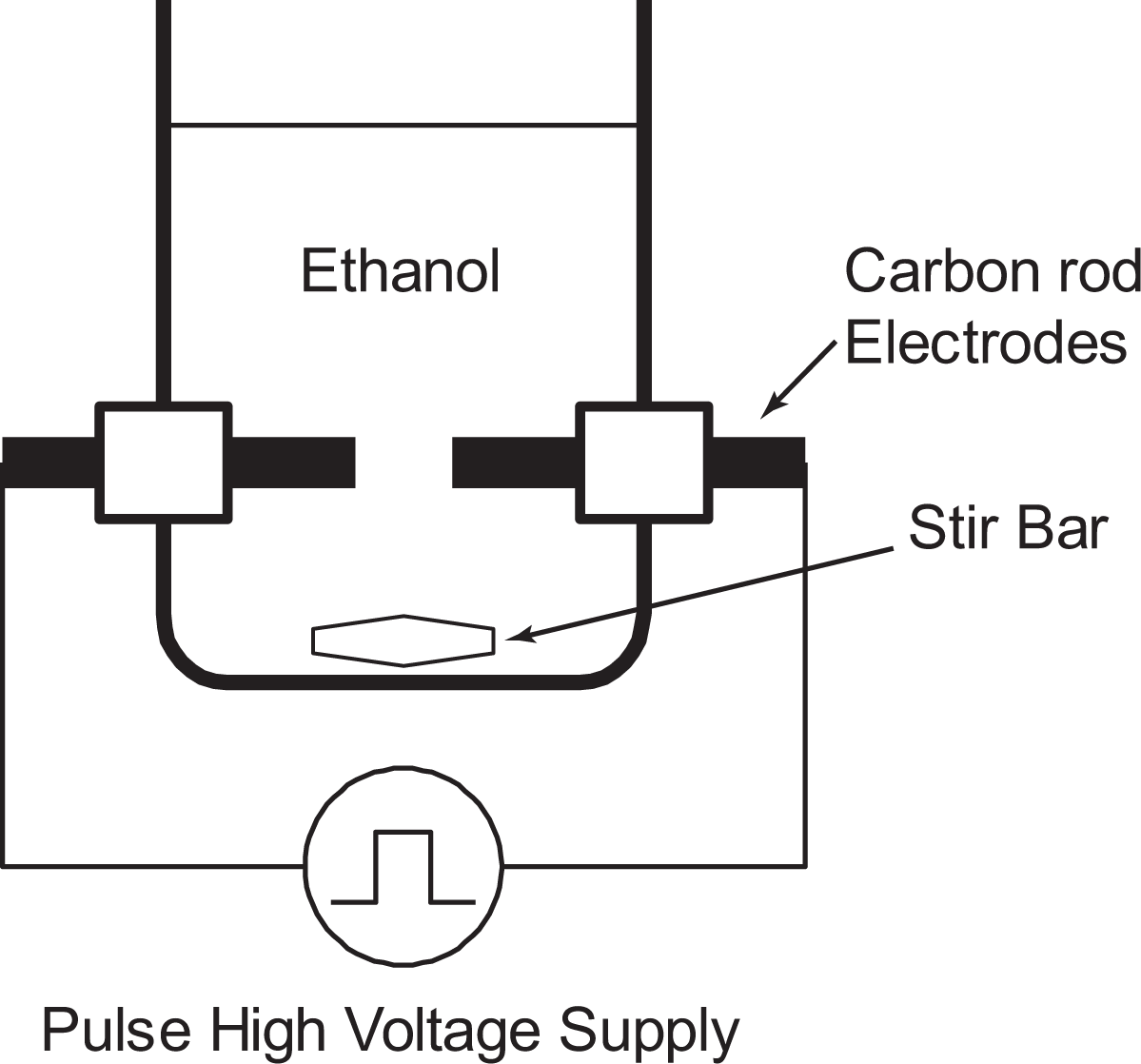
Schematic diagram of the in-liquid plasma equipment used for the synthesis of nano-carbon.
The morphology of the synthesized nano-carbon was characterized by the TEM (HF-2000TU, Hitachi High-Technologies Corporation Tokyo, Japan) with accelerating voltage of 200 kV. Moreover, the crystal structure was investigated by the Raman spectroscopy (XploRA, Horiba Ltd, Kyoto, Japan) with a green laser of 532 nm, 20 mW.
Application of nano-carbon to a support material of Pt catalyst for fuel cell
The nano-carbon synthesized in the “Synthesis of nano-carbon by in-liquid plasma” section was applied to a support material for Pt catalyst. The Pt particles were formed as a catalyst on the nano-carbon by the following procedure using the in-liquid plasma. 14,15
The nano-carbon synthesized in the “Synthesis of nano-carbon by in-liquid plasma” section is dispersed in the ethanol. The ethanol of the nano-carbon dispersion was evaporated in the air atmosphere at 150°C. The dried nano-carbon was dispersed again in water in dispersion medium. The Brij S100 (Sigma-Aldrich Japan, Tokyo, Japan) was dissolved into water at the concentration of 1% as a dispersion assistant. The dispersion medium of the nano-carbon was replaced from ethanol to water by this process.
The in-liquid plasma was generated in the above water-based nano-carbon dispersion using Pt wire electrodes with the diameter of 1 mm and the length of 50 mm. The in-liquid plasma spatters the surface of Pt wire electrodes and forms the Pt particles on the nano-carbon. The Pt with the weight of 17 mg was spattered for 20 min. The weight of spattered Pt was measured by checking the weight change before and after the in-liquid plasma treatment. The average particle size of Pt on the nano-carbon, synthesized in this study, was 4 nm, which is similar in value as the Pt particle formed on commercial nano-carbon (Vulcan XC-72, Cabot Corporation, MA, USA). 15 By this process, the nano-carbon-supported Pt (Pt/nano-carbon) was formed and it was stably dispersed in water.
The Pt/nano-carbon was applied to a catalyst of the PEMFC. The fabrication process and the characterization conditions of a PEMFC were previously reported. 14,15
Results and discussion
Synthesis of nano-carbon by in-liquid plasma method
The nano-carbon was synthesized by the in-liquid plasma generated by applying the high voltage between electrodes in the ethanol. Figure 2(a) shows the photograph of the plasma in the ethanol. The plasma was generated in the vapor of ethanol, which is formed by the Joule heating and emitted blue–green light. Li et al. 9,10 reported that the plasma generated in benzene and toluene showed optical emissions with the wavelength of 470–480, 510–520, and 560–565 nm, which belong to excited C2. The emissions of these wavelength are blue and green in the color. Therefore, the in-liquid plasma, generated in this study, is expected to form the excited C2 in the ethanol. The detailed study on the synthesis mechanism of the nano-carbon is undertaken at present.

Photographs of (a) the plasma in the ethanol and (b) the ethanol after the in-liquid plasma process.
The ethanol was changed from transparent to black by the in-liquid plasma, because the nano-carbon was synthesized from the ethanol. Figure 2(b) shows the ethanol after the in-liquid plasma process. The synthesized nano-carbon was uniformly dispersed in the ethanol. The sedimentation of the nano-carbon was not observed.
Figure 3 shows the TEM image of the nano-carbon synthesized by the in-liquid plasma method. This image indicates that the nano-carbon particles with the diameter of less than 100 nm are aggregated.

TEM image of the nano-carbon synthesized by the in-liquid plasma process in the ethanol. TEM: transmission electron microscope.
Figure 4 shows the Raman spectrum for the nano-carbon synthesized by the in-liquid plasma method. The nano-carbon showed the broad Raman signals around 1600 and 1344 cm−1. These signals are called the G- and the D-lines, respectively. 16, 17 The G-line is assigned to in-plane bond-stretching motion of pairs of C sp 2 atoms in graphite lattice. On the other hand, the D-line corresponds to the disorder in graphite lattice. Similar Raman signals are observed for the graphite. The highly oriented pyrolytic graphite shows the strong sharp G-lines at 1581 cm−1. 18 When graphite changes to monocrystalline graphite, the G-line moves from 1581 cm−1 to 1600 cm−1. 16 Therefore, the Raman investigation indicates that the nano-carbon synthesized by the in-liquid plasma method consists of graphite lattice with defects.

Raman spectrum for the nano-carbon synthesized by the in-liquid plasma process in the ethanol.
Application of nano-carbon to a support material for Pt catalyst of fuel cell
The nano-carbon, which was synthesized and characterized in the “Synthesis of nano-carbon by in-liquid plasma method” section, was applied to the support material of the Pt catalyst. Moreover, the PEMFC was fabricated with the formed Pt/nano-carbon catalyst. In this study, the fuel cell was fabricated with the nano-carbon, which did not form the Pt catalyst on it, for comparison. As a result, this fuel cell did not generate the electricity.
The fuel cell fabricated with the Pt/nano-carbon catalyst showed the output voltage and the output power. Figure 5 shows the dependence of the output current on (a) the output voltage and (b) the electric power for the fuel cell fabricated with the Pt/nano-carbon catalyst. In this experiment, the synthesis time of the nano-carbon by the in-liquid plasma method was varied up to 60 min, although the loaded Pt catalyst on the nano-carbon was fixed at the weight of 17 mg. These fuel cells showed 0.82 V in the open voltage. The open voltage did not depend on the synthesis time of nano-carbon. This open voltage is close in value as fuel cells fabricated with a commercially available Pt catalyst, which is supported on a carbon black. 1

Dependence of the output current on (a) the output voltage and (b) the electric power for the fuel cell fabricated with the Pt/nano-carbon catalyst. The synthesis time of the nano-carbon, used as the support material, was varied. In this experiment, the loaded Pt particle was fixed at the weight of 17 mg. Pt: platinum.
This decrease in the output voltage occurs with flowing cuurent in the internal resistance of the fuel cell, which is called the IR (voltage) drop. Although the loaded Pt catalyst on the nano-carbon was the same weight, the IR drop decreased with an increase in the synthesis time of nano-carbon. This result indicates that the internal resistance of the fuel cell decreases with an increase in the synthesis time of nano-carbon. The maximum output power of 22 mW cm−2 was observed from the fuel cell with the nano-carbon which was synthesized for 15 min. The maximum output power increased with an increase in the synthesis time of nano-carbon.
From the above experiments, it is revealed that the Pt particles were formed on the nano-carbon surface in water-based dispersion using the in-liquid plasma method. Moreover, electric power was observed for the fuel cell, which used Pt/nano-carbon as the catalyst. In this study, the in-liquid plasma was generated in the ethanol without the replacement from ethanol medium to water, for comparison. This procedure also forms the Pt particles on the nano-carbon surface. However, the electric power was not observed from the fuel cell with this Pt/nano-carbon. This result indicates that the Pt particles formed in ethanol medium do not work as a catalyst of fuel cell. This is because the in-liquid plasma decomposes the ethanol medium, and the decomposed ethanol molecules contaminate the surface of the formed Pt particles. It is reported that the Pt particles contaminated with carbon monoxide molecules do not work as the catalyst because of the poisoning. 19 Therefore, it is a key parameter to use water-based nano-carbon dispersion to form the nano-carbon-supported Pt (Pt/nano-carbon) catalyst without the poisoning.
Figure 6 shows the dependence of the synthesis time of nano-carbon on (a) the weight of the synthesized nano-carbon and (c) the maximum output power for the fuel cells. Moreover, the parallel resistance (R p) and the series resistance (R s) for the fuel cells are also shown in Figure 6(b). The measurement and analytical method for these resistances in the fuel cell was previously reported in the literature. 15, 19 –23
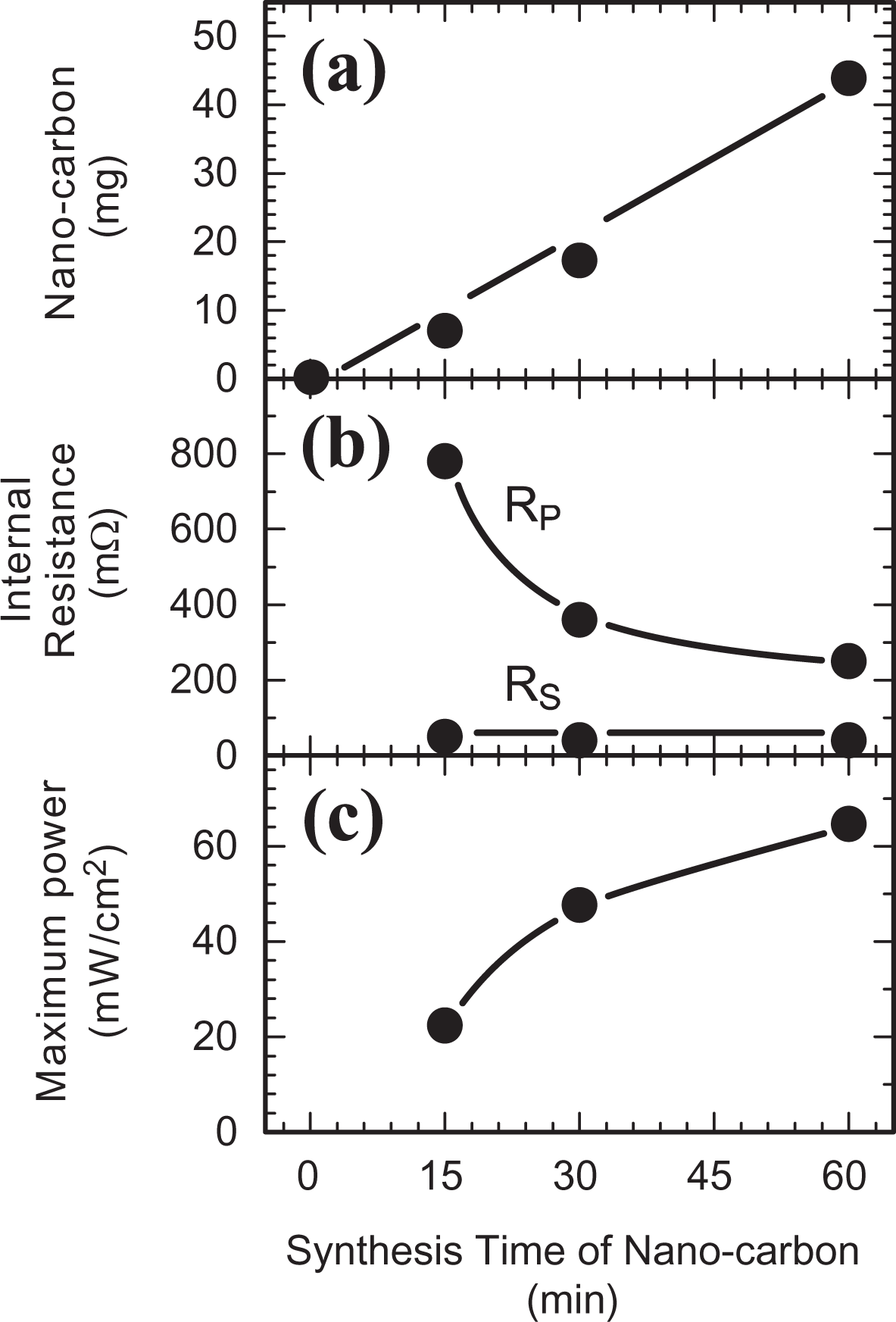
Dependence of the synthesis time of nano-carbon on (a) the weight of the synthesized nano-carbon, (b) the R p and the R s, and (c) the maximum output power for fuel cells. The loaded Pt particle was fixed at the weight of 17 mg. Pt: platinum; R p: parallel resistance; R s: series resistance.
The nano-carbon synthesized by the in-liquid plasma for 15 min was 9 mg in the weight as shown in Figure 6(a). When the synthesis time was increased to 60 min, the weight of nano-carbon was linearly increased up to 42 mg. The synthetic rate of the nano-carbon was 0.7 mg min−1. This rate is similar in value as the synthetic rate of nanographene using in-liquid plasma generated by triple-phase plasma system. 11
The fuel cell fabricated with the nano-carbon, which was synthesized for 15 min, showed that the R s and the R p were 40 and 800 mΩ, respectively. Although the synthesis time was increased, the R s was almost the same value. On the other hand, the R p was reduced to 250 mΩ by increasing the synthesis time of nano-carbon up to 60 min. The R p originated from the charge transfer resistance, which was provided mainly by the catalytic activity of the Pt particles. 15 Therefore, the reduction of the R p indicates that the catalytic activity of the Pt particles was increased by the increase of the synthesis time of nano-carbon. The maximum output power increased from 22 mW cm−2 to 65 mW cm−2 by an increase in the synthesis time of nano-carbon from 15 min to 60 min, although the loaded Pt catalyst on the nano-carbon was the same weight. However, the observed electric power was lower than that of the fuel cell fabricated by the same fabrication process and the same weight of the loaded Pt on carbon black or the carbon nanotube. 14,15
The fuel cell fabricated with Pt/nano-carbon, which was formed in this study, generated the electricity. This result shows that the synthesized nano-carbon is electrically conductive and is able to support the Pt particles on it. Moreover, the Pt particles on the nano-carbon show the catalytic activities for the hydrogen and the oxygen molecules, which play an important role in the generation of electric power for the fuel cells. On the other hand, the nano-carbon synthesized in this study does not work as a catalyst, because the electric power was not observed from the fuel cell fabricated with as-synthesized nano-carbon, without the Pt particles. Therefore, the nano-carbon works as the support material of the Pt catalyst.
In this study, the weight of the nano-carbon, which was used for the support material, was varied from 9 mg to 42 mg depending on the synthesis time, although the loaded Pt catalyst on it was the same weight of 17 mg. An increase in the weight of the nano-carbon causes the support area for the Pt catalyst to be increased. It decreases the density of the Pt particles on the nano-carbon surface, although the loaded Pt is the same weight. The low density of the Pt particles prevents their aggregation and maintains the surface area of Pt catalyst in a high state. The high surface area of the Pt catalyst enhances the electrochemical reactions between the hydrogen and the oxygen molecules. Therefore, the increase in the synthesis time of nano-carbon reduces the R p. Moreover, the reduction of the R p increases the output power from the fuel cell.
Summary
The nano-carbon was successfully synthesized by the in-liquid plasma method from ethanol. The synthesized nano-carbon was less than 100 nm in the diameter and consisted of graphite lattice. The nano-carbon was able to support the Pt particles on its surface. Pt/nano-carbon worked as the catalyst of fuel cell. The maximum output power of 65 mW cm−2 was generated by the fuel cell using the Pt/nano-carbon catalyst which was formed by the in-liquid plasma method.
Footnotes
Acknowledgment
The author would like to thank Mr Y Miyamoto of the Technical Service Coordination Office, Tokai University, for the TEM investigation.
Declaration of conflicting interests
The author(s) declared no potential conflicts of interest with respect to the research, authorship, and/or publication of this article.
Funding
The author(s) received no financial support for the research, authorship, and/or publication of this article.
