




Abstract
Recently, within the emerging framework of “lab-on-fiber” technologies, we successfully demonstrated the integration of phase-gradient plasmonic metasurfaces on the tip of an optical fiber. The resulting optical-fiber “meta-tips” promise to empower the typical fiber-optics application scenarios (e.g. sensing, telecommunications, imaging, etc.) with the advanced light-manipulation capabilities endowed by metasurfaces. Here, we explore more in detail the possibility to exploit this platform in label-free biological or chemical sensing applications. Specifically, we carry out a parametric study of the surface sensitivity and show that phase-gradient metasurfaces generally outperform their gradient-free counterparts, without imposing additional fabrication complexity. Therefore, the phase gradient can be effectively exploited as an additional degree of freedom in the design of high-sensitivity devices.
Introduction
Plasmonic nanosensors, exploiting the local electromagnetic field enhancement and the ultra-sensitivity of surface plasmon resonances to variations of the surrounding environment, nowadays represent the state-of-the-art platforms for biological and chemical sensing applications. Nevertheless, the field is rapidly evolving driven by the strong push for improved sensitivity, in terms of increased wavelength shift and/or spectral selectivity of the resonances. 1,2 Typical routes to enhance the sensitivity mainly rely on the optimized design of the nanostructure, as well as tailoring the plasmon coupling and inducing amplification effects via nanoparticle growth. 3
Moreover, recently emerged technological paradigms such as “lab-on-fiber” 4 –6 strongly push toward the integration of nanoplasmonic sensing platforms in optical fibers, leading to a novel generation of advanced “all-in-fiber” miniaturized optrodes.
Within this framework, in our previous study, 7 we demonstrated the first integration of phase-gradient plasmonic metasurfaces (MSs) on the tip of an optical fiber. The resulting fiber-optic “meta-tips” represent a major breakthrough in the lab-on-fiber technology roadmap. Optical MSs are 2-D implementations of metamaterials, 8 much easier to fabricate than their 3-D counterparts, and allow to integrate exceptional light-manipulation capabilities within miniaturized photonics platforms. Our proposed meta-tips provide a very promising bridge between the fiber-optic technologies and the emerging field of “flat” optics and photonics, 9 –11 with a plethora of potential applications to imaging, 12,13 sensing, 14,15 processing, and computing. 16,17
Inspired by reflect/transmit-array radio-frequency antennas, 18,19 optical MSs are based on 2-D arrays of heterogeneous resonators which can locally impart abrupt phase and amplitude variations in an impinging wave front. Reliance on plasmonic 20 or high-index dielectric nanoantennas 21 allows maintaining a deeply subwavelength profile. After the groundbreaking proposal by Yu et al., 22 where generalized Snell’s laws were formulated and implemented via MSs based on V-shaped plasmonic nanoantennas, the field of MSs has rapidly developed and currently represents one of the most active and fast-pacing research areas (see, e.g. previous studies 23 –35 for a sparse sampling of key contributions and recent reviews).
As the interest in metamaterials and MSs for sensing applications is steadily growing, 14,36 our work 7 put forward the idea of exploiting phase-gradient MSs, showing that the phase modulation represents an important additional degree of freedom, which can yield sensible enhancements of the surface sensitivity with little or no additional complexity.
Starting from this promising result, this article is entirely devoted to the study of the effect of the phase gradient on the local sensitivity and to the comparison of the sensitivity of phase-gradient MSs with the corresponding gradient-free benchmark. This study will aid in the design of a high-sensitivity meta-tip for label-free biological and chemical sensing applications.
MS design
Our fiber-optic meta-tip
7
is schematized in Figure 1(a). We assume a phase-gradient MS located at the interface (in the transverse x-y plane) separating the incidence region (fiber) and an exterior medium. The transmission (


(a) Schematic of a fiber-optic meta-tip. (b), (c) Geometry of the phase-gradient MS macrocell and the corresponding (gradient-free) benchmark, respectively; both of them are based on aperture antennas on a gold layer. MS: metasurface.
where
The generalized Snell’s laws have also been exploited to convert a propagating plane wave into a surface wave. 37,38 However, it was recently demonstrated 39,40 that this approach, based on a simple phase correction stemming from ray optics, suffers from very low efficiency due to the local impedance mismatch on the surface. Hence, one should consider the full-wave electromagnetic problem and solve for the surface impedance required for perfect conversion. 39 –41 In previous research, 40,41 it was shown that, to realize perfect refraction with lossless constituents, spatial dispersion is needed in the form of artificial magnetism and bianisotropic omega coupling. 42
Our chosen configuration, based on a single layer of plasmonic antennas, does not provide enough degrees of freedom to tailor the needed polarizabilities. Therefore, acknowledging the implied limitations, we followed the simplified approach based on the generalized Snell’s laws.
Accordingly, to drive a normally impinging plane wave to the evanescent range (surface wave) in transmission, we need to exceed the grazing condition

A similar condition applies for the reflection scenario. In our MS, the phase gradient is implemented by an infinite repetition along x and y of a 1 × N macrocell, where the full phase range of 2π along x is sampled by N nanoantennas, featuring a uniform phase difference Δϕ in the transmission (and reflection) coefficients, separated by a distance d, so that

The nanoantenna distance d cannot be arbitrarily reduced beyond a certain value to limit the intercoupling effects. For our wavelength range of interest (1.2 to 2.4/μm), we estimated from numerical simulations that a minimum distance of 100nm must be kept from any antennas. Hence, to further increase the phase gradient, we can reduce the number N of antennas per macrocell, which is equivalent, at fixed d, to increasing the sampling step of the phase profile, Δϕ. At fixed γ, equations (2) and (3) can be solved for the minimum wavelength at which the transmitted field couples to a surface wave, namely

In a similar way, the minimum wavelength at which the reflected field couples to a surface wave can be evaluated.
We highlight that

where ν is the SPP launching order; it also appears that
As in the earlier study, 7 we considered Babinet-inverted plasmonic rectangular nanoantennas, that is, rectangular aperture antennas in a gold film, rotated by 45° in the x-y plane. Plasmonic antennas (and their Babinet-inverted configuration), based on the excitation of two resonant modes, can achieve the full phase excursion in the transmission (and reflection) coefficient only on the cross-polarized field. This is possible in view of the property of plasmonic antennas, according to which a rotation by 90° of the antenna in its plane introduces a π phase shift in the cross-polarized scattered light. 22
Hence, a normally incident, linearly polarized field forming an angle α with the x-axis yields two transmitted beams: an ordinary one, co-polarized, and (ideally) experiencing zero phase gradient; and an anomalous one, with polarization direction rotated by an angle
The minimum number of antennas per macrocell is two, corresponding to Δϕ = π, which is the maximum sampling step allowing a correct reconstruction of the linear phase profile, though with an uncertainty in the sign of the gradient. This configuration is particularly simple and interesting, since the corresponding macrocell is composed of two antennas with equal dimensions, differing only by a rotation of 90°, which determines a π phase difference in the cross-polarized scattered light. Remarkably, this phase shift is independent on the operation wavelength. 45
The geometry of the macrocell is shown in Figure 1(b), where the two antennas have the same sidelengths and are rotated by 90°, so that the phase gradient is γ = π/d. As noted in previous study, 7 this configuration admits a simple benchmark which is useful in our study, that is, a gradient-free standard array, consisting of the same antennas but equally oriented; this preserves the properties inherent of the single antenna geometry, but removes the phase-gradient effects. The macrocell of the benchmark array is shown in Figure 1(c).
In our previous research, 7 we showed that a plasmonic Babinet-inverted MS composed by the macrocell in Figure 1(b) (with antenna sidelengths 400 nm and 120 nm, and gold-film thickness t = 50 nm) exhibited a sensitivity to local refractive-index variations higher than the corresponding gradient-free benchmark. Here, starting from this result, we carry out a parametric study, in order to assess the effect of the phase gradient and its advantages on gradient-free standard plasmonic arrays. This study will draw the guidelines for the design of high-sensitivity devices based on MSs for label-free biological and chemical sensing applications.
Results and discussion
Our numerical study related to the sensing performance pertaining to phase-gradient and benchmark (gradient-free) configurations is based on the evaluation, from the reflectivity spectral response, of the surface sensitivity S in terms of resonant-wavelength shift due to local refractive changes occurring at the sensor surface. The local refractive changes, here, considered rely on the deposition of a thin (40 nm) SiO x (refractive index = 1.7) overlay.
Although the selected overlay might not be representative of specific biological molecules, we preferred to maintain the same values we used earlier, 7 in order to facilitate the comparison of the simulated structures with the fabricated ones. However, we verified that the specific values of parameters do not affect qualitatively the results we illustrate hereafter.
All numerical results are obtained by means of a public-domain 2-D implementation (https://sourceforge.net/projects/rcwa-2d/) of the Rigorous Coupled-Wave Analysis.
46
In the simulations, we consider the MS laid over an infinite (lossless and nondispersive) silica substrate (refractive index = 1.45), while the exterior region is assumed to be air. We use a standard dispersion model for gold
47
and a lossless and nondispersive model for SiOx. The spectra and field profiles are computed by assuming a normally incident plane wave with x-polarized electric field; the convergence is achieved using 51 × 51 modes. In our previous study,
7
this model was found to be in good agreement with experimental results obtained on actual fabricated meta-tip prototypes. The dimensions of the rectangular nanohole antennas (see Figure 1) affect the resonance wavelength (and its visibility), which can be roughly estimated analytically.
48
We maintain fixed such dimensions to 400 nm and 120 nm, in order to focus on the effect of the phase gradient. Specifically, we vary the distance d between the antennas to tune the phase gradient γ, according to equation (3), and the wavelength
We considered the largest ranges of interest for d and t, and we show the results in terms of sensitivities for d = 530, 700, 1000 nm, and for t = 15, 30, 50, 80 nm. We verified that sampling in a denser way those ranges does not add any useful information.
For all the combinations of chosen values for d and t, we compute numerically the MS and BC sensitivities, defined as

where
Since we are mainly interested to assess the role of phase gradients on the sensing performances of plasmonic arrays, the attention has been focused on the evaluation of the sensitivity gain achieved when using phase-gradient MSs instead of zero-gradient arrays. In Table 1, the values of the sensitivity gain
Numerically computed sensitivity S MS [10−3 nm−1] of the phase-gradient MS (top), and sensitivity gain of the phase-gradient MS with respect to the benchmark S MS/S BC (bottom), for different values of the gold-film thickness t and antenna distance d.
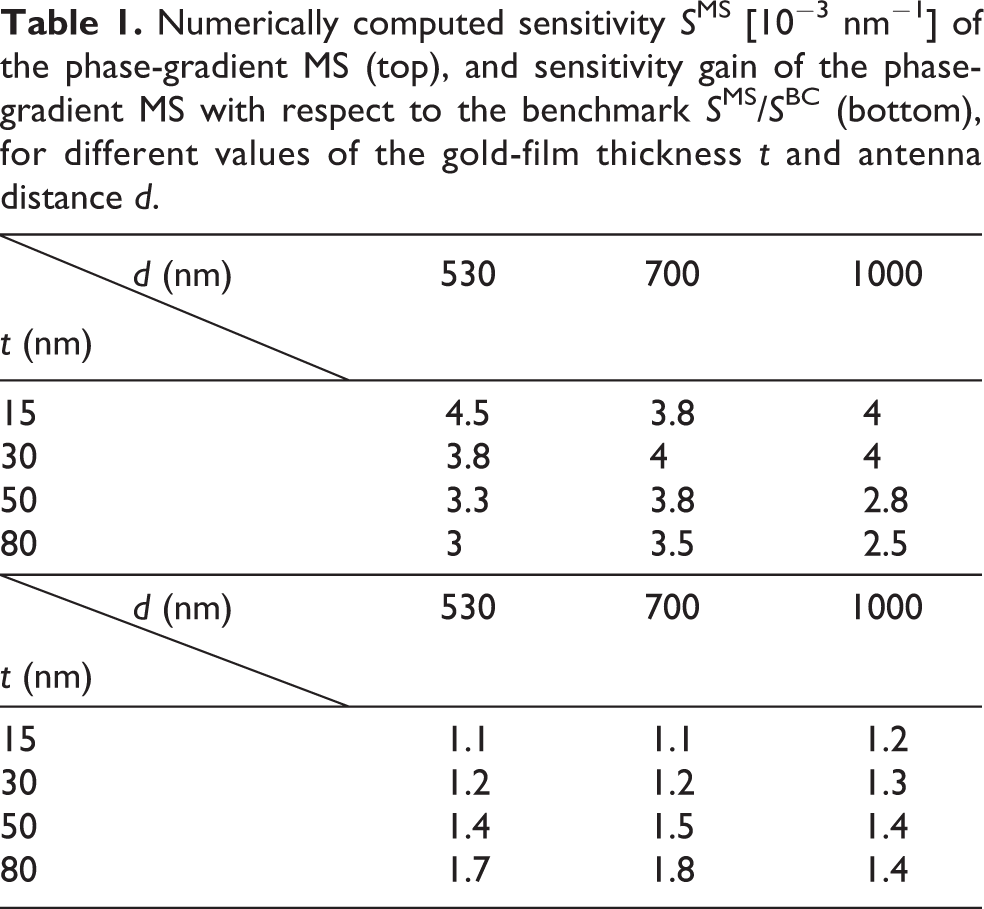
As the gold thickness decreases, the resonance wavelengths shift toward higher values,
49
as expected, and, for the MS, they fall at different distances from

Refraction (solid line) and reflection angle (dashed line) versus wavelength according to equation (1) for d = 530 nm (left); d = 700 nm (center); d = 1000 nm (right).The bullets indicate the resonance wavelength of the MS for the different thickness values t considered in Table 1; the black arrow indicates the direction of increasing t. MS: metasurface.

Numerically evaluated reflectivity spectra of the MS ((a) to (c)) and the BC ((d) to (f)), assuming a normally incident plane wave with x-polarized electric field, for gold-film thickness t = 15 nm, and three values of the distance between antennas d = 530 nm (a and d); d = 700 nm (b and e); d = 1000 nm (c and f). Red-dash-dotted and black-dashed curves pertain to structures with and without the deposition of a 40-nm overlay of SiO x (refractive index: 1.7). MS: metasurface.

As in Figure 3, but for gold-film thickness t = 50 nm.
The gain in sensitivity is likely attributable to a field enhancement on the surface of the structure, 7 as it can be observed in Figure 5, where the field intensity profile over a single antenna is shown for d = 530 nm and t = 15 and 80 nm. A larger ratio between the maxima of the field profiles of the MS and the BC configurations corresponds to a higher sensitivity gain. Indeed, the higher the field, the stronger its interaction with the external environment, and hence the higher the wavelength shift (see e.g. Harrington’s textbook 51 ).
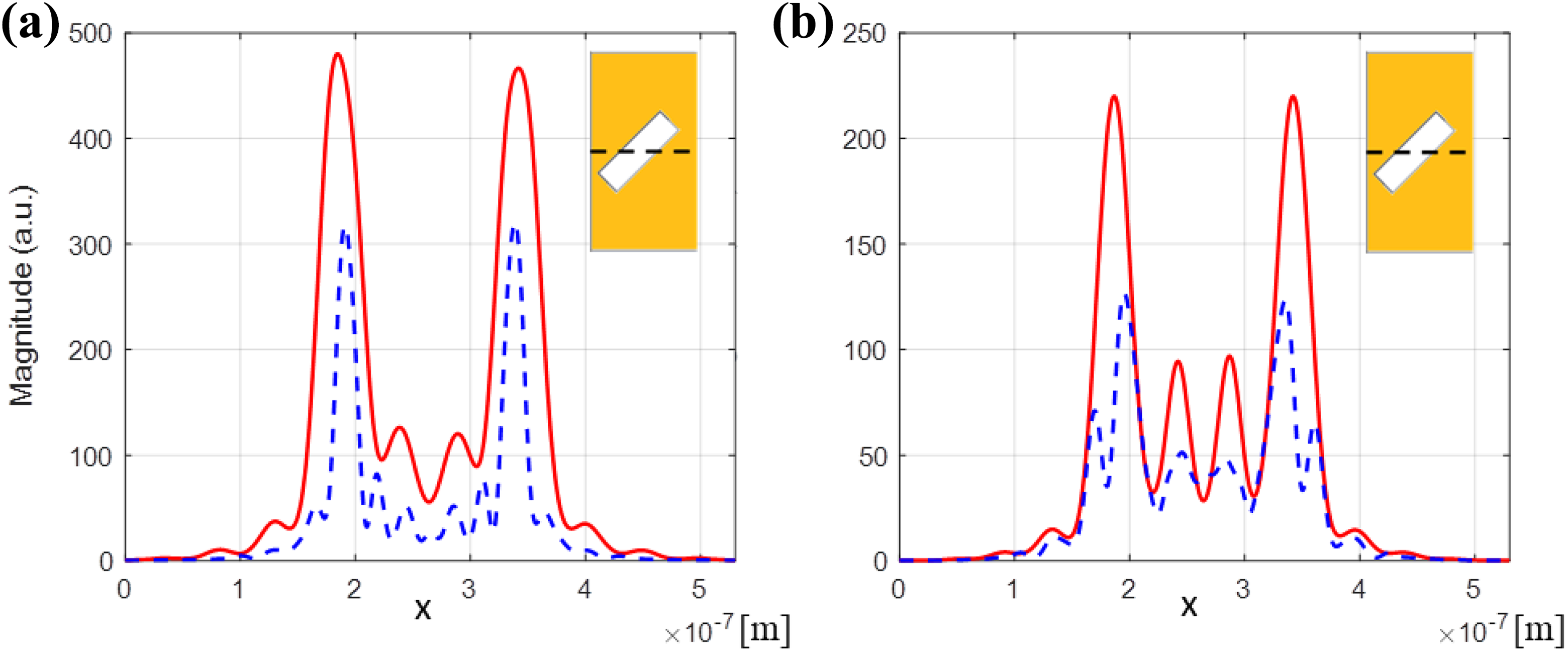
Numerically evaluated electric field intensity profile over the dashed line on the antenna (inset) at the gold–air interface for gold thickness t = 15 nm (a), and t = 80 nm (b) for the MS (red solid) and the BC (blue dashed). MS: metasurface.
In Figures 3 and 4, the spectra computed for the MS and the BC for t = 15, 50 nm and d = 530, 700, and 1000 nm are shown. The other spectra are omitted for brevity.
From the inspection of these spectra, it is clear that the MS outperforms the BC also in terms of fringe visibility and width of the resonance band, especially for d = 530 nm and t = 15, 30 nm, for which also the reflected anomalous beam couples to a surface wave (see Figure 2). This effect might be due to the interplay between the surface waves excited at the two sides of the metal film.
To sum up, the results from this study confirm that the phase gradient can be effectively exploited as an additional degree of freedom in the design of high-performance sensors based on plasmonic arrays. Indeed, we show that the simple introduction of a constant phase gradient always yields a gain with respect to the corresponding zero-gradient benchmark. The gain in sensitivity increases as the resonance wavelength approaches
Conclusions
Building upon our previous results, 7 we have conducted a parametric study to evaluate the effect of a linear phase profile in plasmonic MS on the surface sensitivity, to pave the way for using fiber-optic meta-tips for label-free biological and chemical sensing. For fixed antenna dimensions, we have varied the (constant) phase gradient to couple the impinging field to a surface wave, by varying the distance between antennas, and the distance between the resonance wavelength of the structure and the surface-wave-coupling wavelength. To assess the role of the phase gradient, we have compared the sensing performance with those pertaining to a gradient-free benchmark structure. Our results indicate that the phase-gradient MS always exhibits a sensitivity gain, which increases as the resonance wavelength approaches the grazing-refraction condition. When the resonance wavelength also approaches the grazing-reflection condition, there is a sensible improvement in the spectral width and visibility of the resonance.
These outcomes indicate that the phase gradient represents an additional useful degree of freedom in the design of a meta-tip sensing platform, by generally improving the figures of merit and adding only very mild complexity to the fabrication process.
This study provides several hints, summarized above, and specifically that the phase-gradient MS always exhibits a sensitivity gain for different values of the gold-film thickness and antenna distance. Based on these results, it will be possible to design high-sensitivity MS-based devices for specific biochemical sensing applications, including a specific external environment and a specific range where the resonance wavelengths must lie.
In particular, as standard (gradient-free) plasmonic fiber tip–based biosensors have been demonstrated to be able to reach ultimate performance (e.g. femtomolar and picomolar limits of detection) in different cancer biomarker detection applications, 52,53 our results pave the way to the design and development of extremely high-sensitivity optical fiber meta-tips that could potentially outperform already reported gradient-free fiber-based devices.
Footnotes
Declaration of conflicting interests
The author(s) declared no potential conflicts of interest with respect to the research, authorship, and/or publication of this article.
Funding
This work was supported in part by PRIN project “Lab on fIber technology For advanced optical nanoprobEs - LIFE” and by Progetto POR Campania “Nanofotonica Per La Lotta Al Cancro - NANOCAN”.