




Abstract
To improve the photocatalytic activity of titanium dioxide, a novel nanocomposite was prepared via axial coordination of zinc porphyrin on the semiconducting titanium dioxide surface modified with axial coordinating ligand functionality, pyridine. The obtained product (zinc porphyrin/titanium dioxide) was characterized by Fourier transform infrared spectroscopy, X-ray diffraction, fluorescence, thermogravimetric analysis, and Raman spectroscopic techniques. The photocatalytic performance of the samples was investigated by photodegradation of rhodamine B in aqueous solution. The attached zinc porphyrin on the surface can act as a small bandgap semiconductor to absorb visible light, resulting in the formation of electron–hole separation and an improved photocatalytic activity for the nanocomposite.
Introduction
As a potential solution to the severe problems of energy shortages and environment crises, photocatalysis for the degradation of organic pollutants has gained increasing attention due to its inexpensive, highly efficient, and environmental friendly properties. 1 –3 Titanium dioxide (TiO2) is known to be a kind of photoactive material, capable of exhibiting several interesting properties such as self-cleaning and pollution abatement, and has become the most widely used photocatalyst. 4 –6 However, the photocatalytic activity of TiO2 is limited by the light absorption region. It is excited by ultraviolet light, which only accounts for 4–6% of the solar spectrum. 7 Positive activity of a photocatalyst is crucial to utilize the solar energy. 8 Hence, there is a need to develop an efficient visible light-responsive photocatalyst to extend its spectral response to higher absorption wavelength. Metalloporphyrin is a prominent material for photochemical energy conversion and storage due to its excellent visible light-harvesting properties. 9 Indeed, the TiO2 has been successfully sensitized by metalloporphyrin for its visible light photosensitivity and semiconductivity, resulting in its wide use as photocatalyst by extending the light response of TiO2 to visible light. 4,10 Some studies concerning the effect of metalloporphyrin have been investigated in the photodegradation of rhodamine B (RhB), 4 but the photocatalytic performances of TiO2 functionalized by axially coordinated metal porphyrins remains largely unexploited thus far, although the photocatalytic performances of a range of tin porphyrin axially functionalized TiO2 nanoscale composite materials have been explored. 11 –13
Encouraged by these considerations, the preparation, characterization, and photocatalytic activity of the TiO2, zinc porphyrin (ZnTpp), and ZnTpp/TiO2 nanocomposite are of interest and focused in this study. Their photocatalytic activities were evaluated by the photodecomposition of RhB in aqueous medium. The influence of axially coordinated ZnTpps on the photocatalytic activity of TiO2 was analyzed, and the possible photocatalytic mechanism was also proposed. The photocatalysis experiment for decomposition of RhB indicated that the ZnTpp/TiO2 nanocomposite can be used as an efficient photocatalyst. To the best of our knowledge, this is the first investigation of the photocatalytic performance of TiO2 functionalized by axially coordinated ZnTpps.
Experimental section
Materials and reagents
TiO2 nanoparticles (98% anatase from Sinopharm Chemical Reagent Co., Ltd, China) were used as received without further purification. Tetrahydrofuran (THF) and N,N′-dimethylformamide (DMF) (supplied by Shanghai Sinopharm Chemical Reagent Co., Ltd,) were dried and distilled before use. Other chemicals were used as received unless otherwise stated. Deionized water was used throughout the preparation process of materials. 5,10,15,20-Tetraphenylporphinato zinc (II) (ZnTpp) was prepared according to the literature reported by D’Souza et al. (2002). 14
Instruments and measurements
Fourier transform infrared (FTIR) spectra were carried out with a MB154S-FTIR spectrometer (Bomem, Canada) using spectroscopic grade potassium bromide pellets in the range 4000–400 cm−1. Raman spectra were recorded at room temperature on a Renishaw inVia Raman microscope (Renishaw, Britain), excitation at 532 nm with an argon ion (Ar+) laser. The laser light was focused onto samples using a microscope equipped with a 100× objective. Ultraviolet–visible (UV-Vis) spectra were recorded using a Varian Cary 500 spectrophotometer (Agilent, America) equipped with a diffuse reflectance accessory at room temperature in the range 200–800 nm. A barium sulfate pellet was used as a reflectance standard. Thermogravimetric analysis (TGA) was run on a PerkinElmer Pyris 1 system (Waltham, Massachusetts, USA) from 50°C to 800°C under nitrogen purge with a heating rate of 10°C min−1. Fluorescence spectra were measured using a Fluoromax-P spectrofluorometer (Horiba, Japan). X-ray powder diffraction (XRD) experiments were carried out at room temperature on a XD-3 diffractometer (Beijing Purkinje General Instrument Co. Ltd, China) using Cu Kα radiation (λ = 0.15418 nm).
The photocatalytic activities of the samples were investigated by the photocatalytic degradation of RhB in aqueous solution. A 350 W xenon (Xe)-lamp (Nanshen, Shanghai, China) was used as light source at room temperature. The average intensity of the incident light was ca. 35.8 mW cm−2. In a typical procedure, some catalyst (ca. 50 mg) was suspended in 50 mL RhB aqueous solution (0.5 mM, pH 7) in a pyrex reactor surrounded by circulating water to cool the lamp. Prior to the light was turned on, the suspension was stirred in the dark for about 30 min to complete the adsorption–desorption equilibrium between RhB and catalyst. After irradiation, about 3.0 mL of the reaction suspension was sampled at given irradiation time intervals, and separated by centrifugation. The concentration of RhB was determined by monitoring the changes in the absorbance maximized at ca. 554 nm. The degradation of RhB was evaluated in term of C/C 0, where C 0 and C are the concentration of RhB before and after irradiation, respectively.
Preparation of ZnTpp/TiO2
ZnTpp/TiO2 was prepared according to the general procedure: in a typical preparation, a certain amount of TiO2 (0.15 g) was suspended in THF (10 mL), then isonicotinic acid (0.5 g) and N,N’-dicyclohexylcarbodiimide (DCC; 0.1 g) were added to the solution. The suspension was stirred for 3 days under reflux to afford the isonicotinic acid-functionalized TiO2. To prepare ZnTpp/TiO2, the obtained isonicotinic acid-functionalized TiO2 (40 mg) was suspended in DMF (6 mL), and then ZnTpp (25 mg) was added to the warm solution. The suspension was maintained at 80°C for 2 days. The resultant composite was collected by centrifugation, washed with distilled water several times followed by a rinsing in dichloro methane, and then dried under vacuum at room temperature for 12 h resulting in the desired products.
Results and discussion
In our synthetic strategy, the preparation of ZnTpp/TiO2 proceeded via the synthesis of the key precursors ZnTpp and isonicotinic acid-functionalized TiO2. ZnTpp was obtained according to the previously reported method. 14 The isonicotinic acid-functionalized TiO2 was obtained by the direct condensation of surface hydroxyl groups with isonicotinic acid having terminal carboxyl groups using DCC as a condensing agent. ZnTpp/TiO2 was prepared by the axial coordination of the nitrogen atom present in the pyridine groups of the appropriate isonicotinic acid-functionalized TiO2 with the zinc atom of ZnTpp in DMF.
Confirmation of ZnTpp functionalization of the TiO2 was obtained by FTIR spectroscopy. Figure 1 displays the FTIR spectra of the bare TiO2, ZnTpp, and ZnTpp/TiO2 nanocomposite. Pristine TiO2 displays a strong absorption around 481 cm−1, corresponding to the vibration of the Ti–O–Ti bonds. 15 The absorption bands at 3437 and 1643 cm−1 are related to the O–H stretching and bending vibrations of hydroxyl group on the surface of TiO2, respectively, which plays an important role in the linkage of isonicotinic acid onto TiO2 to prepare axially coordinated metal porphyrins-functionalized TiO2. 16 Comparing with the bare TiO2, some characteristic bands of porphyrins are observed for the ZnTpp/TiO2 nanocomposite, which proves successful functionalization of the TiO2. In addition, an FTIR band is observed below 1000 cm−1 for the ZnTpp/TiO2 nanocomposite; compared to the corresponding band in TiO2, it is both broader and shifted to high wave number resulting from the chemical interaction of TiO2 with porphyrins. This broad characteristic peak of TiO2 obscures the fingerprint regions in the ZnTpp/TiO2 nanocomposite, and thus rendering them difficult to assign uniquely.
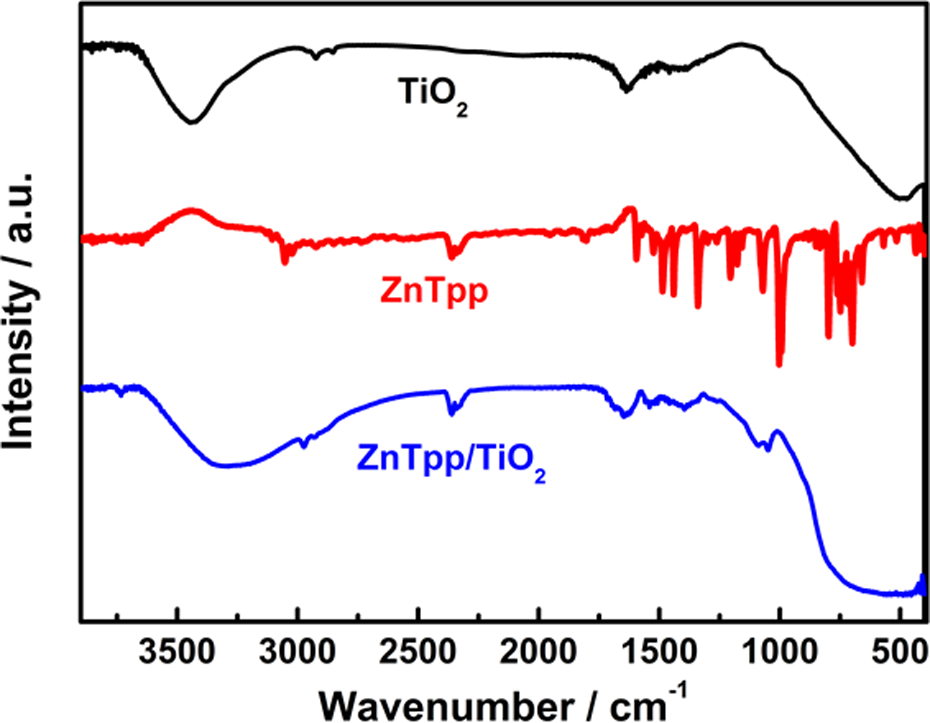
FTIR spectra of the bare TiO2, ZnTpp and ZnTpp/TiO2 nanocomposite. FTIR: Fourier transform infrared; TiO2: titanium dioxide; ZnTpp: zinc porphyrin.
Raman spectra can distinguish between rutile and anatase phases, which were used to characterize the ZnTpp/TiO2 nanocomposite as well as the pristine TiO2 (Figure 2). For the ZnTpp/TiO2 nanocomposite, several characteristic bands were observed at ca. 147, 398, 517, and 642 cm−1, corresponding to the E g(1), B 1g(1), A 1g + B 1g(2), and E g(2) modes of anatase TiO2, respectively. 17 Interestingly, we found a broad band at 1870 cm−1 appearing in Raman spectrum of the ZnTpp/TiO2 nanocomposite due to the fluorescence emission of the porphyrin moieties. The intensity of the Raman characteristic bands for ZnTpp/TiO2 decreased obviously in the region 50–900 cm−1 due to the introduction of axially coordinated metal porphyrins when compared to TiO2, which may increase the disorder of the catalyst surface. XRD patterns were also used to investigate the crystalline phase of TiO2 samples and the effect of ZnTpp on the crystal structure of TiO2, the results being shown in Figure 3. It is clear that the bare TiO2 and the ZnTpp/TiO2 nanocomposite exhibit similar XRD patterns. The reflections in the XRD patterns of both samples can be indexed to anatase TiO2 (Joint Committee on Powder Diffraction Standards card no. 21-1272) 18 ; no rutile or brookite impurities were detected in this work, consistent with the results of Raman spectra. Similar XRD patterns from different samples suggest that the incorporation of ZnTpp has little influence on the phase structure of TiO2. The average sizes of the anatase phase nanoparticles, which were calculated using the Debye–Scherrer equation based on full width at half-maximum of the diffraction peaks, are 3.9 and 7.0 nm for ZnTpp/TiO2 and TiO2, respectively. Generally, smaller crystallite sizes of catalysts yielded larger surface areas. It could be found that the average anatase grain size of ZnTpp/TiO2 is smaller in comparison with that of the pristine TiO2, which may improve the degree of dispersion of the active component leading to the better photocatalytic performances. 19

Raman spectra of the bare TiO2 and ZnTpp/TiO2 nanocomposite. TiO2: titanium dioxide; ZnTpp: zinc porphyrin.

XRD patterns of the bare TiO2 and ZnTpp/TiO2 nanocomposite. XRD: X-ray diffraction; TiO2: titanium dioxide; ZnTpp: zinc porphyrin.
The UV-Vis diffuse reflectance spectra of the as-prepared samples are presented in Figure 4. The bare TiO2 only has a good absorption on the wavelength of light less than 400 nm, whereas the ZnTpp/TiO2 nanocomposite exhibits the characteristic peaks of ZnTpp through the entire visible light region with intense and excellent visible light absorption properties. This suggests that ZnTpp has been successfully grafted onto the TiO2 surface with the integrated porphyrin framework and the increased visible light harvest of TiO2. The ZnTpp peaks diminish in intensity in the ZnTpp/TiO2 nanocomposite compared to that in the absorption spectrum of ZnTpp, resulting from the influence of the extreme light scattering. 20 In addition, the spectral absorption bands of ZnTpp/TiO2 are obviously redshift in comparison with that of ZnTpp, which can be explained by the interactions between ZnTpp and the TiO2 surface. Based on above observations and discussions, it could be hypothesized that the strong interactions between ZnTpp and the TiO2 surface might induce a synergetic effect for improving the photoactivity of ZnTpp /TiO2.
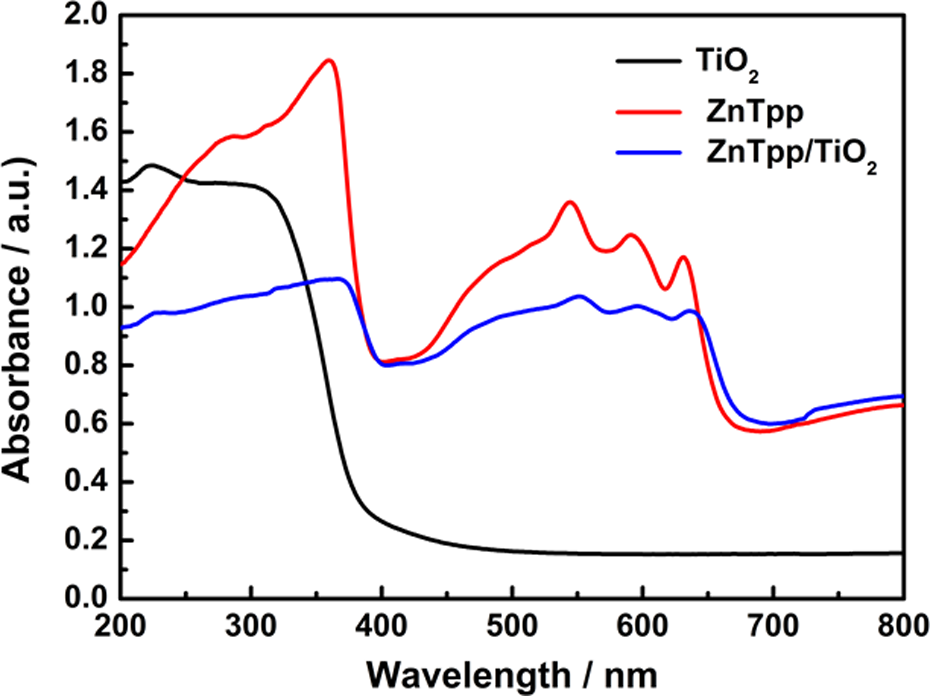
UV-Vis diffuse reflectance absorption spectra of the bare TiO2, ZnTpp and ZnTpp/TiO2 nanocomposite. UV-Vis: ultraviolet–visible; TiO2: titanium dioxide; ZnTpp: zinc porphyrin.
The photocatalytic activities of different photocatalysts were determined by comparing the degradation efficiency of RhB in aqueous solution under identical conditions. Figure 5 displays the temporal UV-Vis spectral changes during the photodegradation of RhB solutions in the presence of the ZnTpp/TiO2 nanocomposite. The maximum absorbance at ca. 554 nm decreased gradually with prolonging the irradiation time and almost completely disappeared after 105 min. Figure 6 displays the changes in RhB relative concentration (C/C 0) as a function of irradiation time using a Xe lamp in the presence of ZnTpp/TiO2, ZnTpp, and TiO2 photocatalysts. For comparison, direct photolysis (absence of any photocatalyst) of the dye solution is investigated under the same conditions. As shown in Figure 6, controlled experiments demonstrated that the photolysis of RhB can be negligible (only 5%) if no catalyst exists in the solution. Similarly, only 10% of the RhB is photolyzed in the presence of ZnTpp after 105 min irradiation. The minimal degradation may be due to the singlet oxygen generation. 21 In contrast, the ZnTpp/TiO2 nanocomposite can photodegrade RhB efficiently under irradiation of Xe lamp, which can be confirmed by the continual fading of RhB solution (as displayed in the online Supporting Information). An enhanced photocatalytic activity was observed for this nanocomposite when compared to bare TiO2. Therefore, the photocatalytic activity in RhB degradation reaction is ZnTpp/TiO2 > bare TiO2 > ZnTPP > blank, indicating that binding of the sensitizer to the TiO2 is required for photodegradation. The improved photocatalytic activities may be due to the synergistic effect between TiO2 and ZnTpp, and not its individual components. 7,10,22
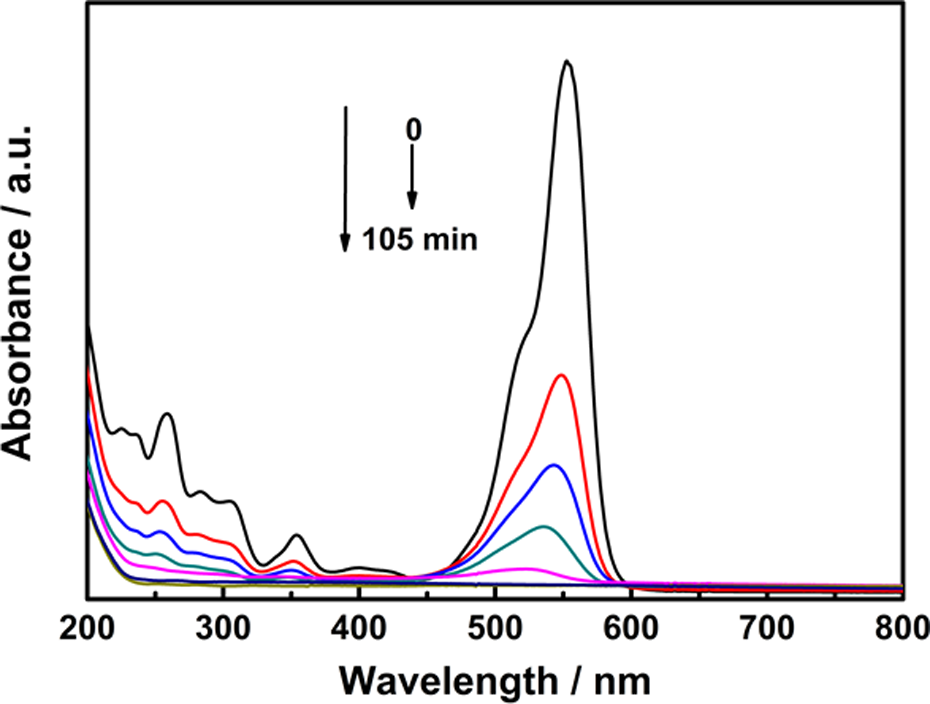
UV-Vis spectral changes of RhB aqueous solutions in the presence of the ZnTpp/TiO2 nanocomposite as a function of irradiation time. UV-Vis: ultraviolet–visible; RhB: rhodamine B; TiO2: titanium dioxide; ZnTpp: zinc porphyrin.
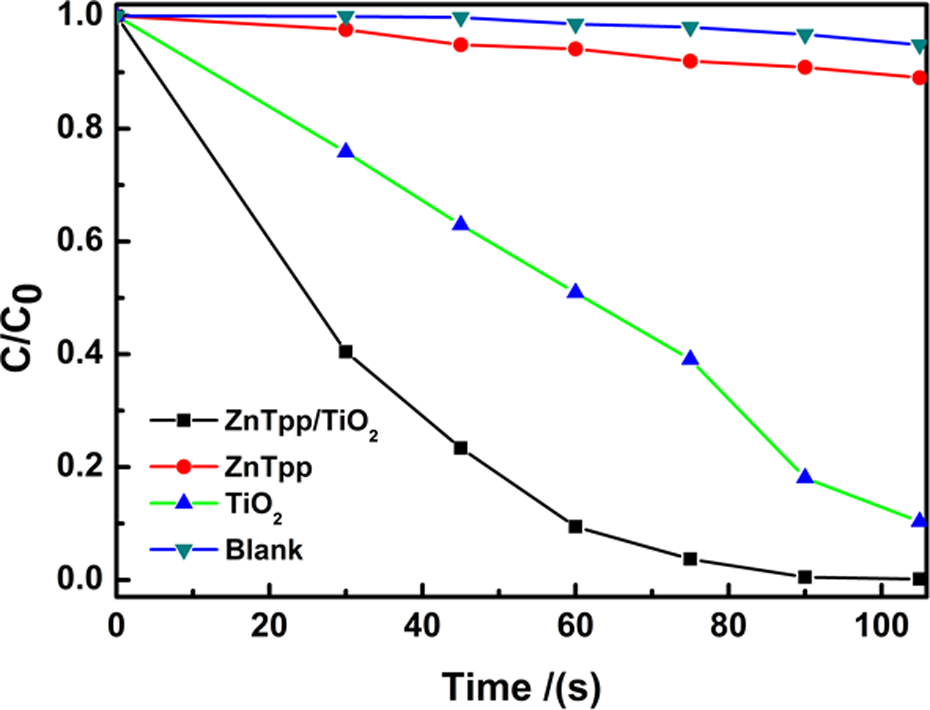
Photocatalytic degradation curves of RhB in the presence of ZnTpp/TiO2, ZnTpp and TiO2 photocatalysts. (RhB solution: 50 mL, 0.5 mM; catalyst 50 mg; 350 W Xe-lamp). RhB: rhodamine B; TiO2: titanium dioxide; ZnTpp: zinc porphyrin.
For nanostructured materials, photoluminescence spectra are a useful probe of the efficiency of charge carrier trapping, immigration, transfer, and the fate of electron–hole pairs. 23 Figure 7 shows the emission photoluminescence spectra of the bare TiO2, ZnTpp, and ZnTpp/TiO2 nanocomposite. Upon excitation at 420 nm, the photoluminescence spectra of the ZnTpp/TiO2 nanocomposite are similar to that of bare TiO2 but with different intensity in the region 450–575 nm. It should be noted that a broad band around 593 nm was observed for the ZnTpp/TiO2 nanocomposite in comparison with those of TiO2 and ZnTpp, possibly resulting from the interactions between TiO2 and ZnTpp. The oxide particles with a high density of oxygen vacancies can give rise to in-gap states or surface states that yield a continuum of below bandgap absorbances. 24,25 Such defects may be the origin of the observed photoluminescence in the wavelength range from 450 nm to 575 nm. There is a decrease in photoluminescence intensity in proceeding from bare TiO2 to the nanocomposite sample expect to a broad band around 593 nm. This may be attributed to the fact that photo-produced electrons of the bare TiO2 may transfer effectively to ZnTpp molecules, which inhibit the recombination of the electrons and holes. If the photoluminescence is mainly ascribed to the recombination of excited electrons and holes, the low photoluminescence intensity suggests a decrease in recombination efficiency of the electrons and holes. This reasonably results in a higher photocatalytic activity due to the fact that the photodegradation reactions are evoked by these charge carriers.

Emission photoluminescence spectra of the TiO2, ZnTpp and ZnTpp/TiO2 nanocomposite. TiO2: titanium dioxide; ZnTpp: zinc porphyrin.
Conclusions
In summary, a novel TiO2 coupled with ZnTpp photocatalyst, ZnTpp/TiO2, with enhanced photocatalytic efficiency for the oxidation of RhB was prepared. The formation of ZnTpp/TiO2 was confirmed by FTIR, optical absorption, Raman, XRD, and TGA (online Supporting Information) spectra. UV-Vis analysis of the prepared nanocomposites suggested that the grafted porphyrin moieties extended the absorption of TiO2 to the visible region. The photoluminescence spectra suggest that the grafting of ZnTpp onto TiO2 leads to a decrease in recombination efficiency of the electrons and holes, resulting in a higher photocatalytic activity in the degradation of RhB than TiO2 and ZnTpp. This work provides a practical approach by combining two different photocatalysts to extend their visible light absorption, and provides useful insights to enhance the performance of traditional photocatalysts by virtue of the synergistic photocatalytic mechanism.
Footnotes

Declaration of conflicting interests
The author(s) declared no potential conflicts of interest with respect to the research, authorship, and/or publication of this article.
Funding
The author(s) disclosed receipt of the following financial support for the research, authorship, and/or publication of this article: This research was supported financially by the National Key Technology Support Program (2015BAD21B06), the National Natural Science Foundation of China (51506077), the Natural Science Foundation of Jiangsu Province (BK20150488), the Natural Science Foundation of Jiangsu High School (15KJB430007, 15KJB610003) and Research Foundation of Jiangsu University (13JDG066, 15JDG156).