




Abstract
In the evolving landscape of higher education, identifying key drivers of organizational performance is crucial. This study investigates the impact of intellectual capital on knowledge management and innovation and how these factors collectively enhance organizational performance. Conducted among top leaders at 21 state universities in Indonesia, this quantitative research used structured questionnaires validated by prior studies. The high response rate strengthens the reliability of findings analyzed using SPSS for descriptive statistics and Structural Equation Modeling (SEM) with SmartPLS 3.0 for hypothesis testing. The results indicate intellectual capital significantly influences knowledge management and innovation, which in turn positively affect organizational performance. Intellectual capital enhances both knowledge management and organizational performance, while effective knowledge management fosters innovation, further contributing to improved performance. The novelty of this research lies in its comprehensive integration of intellectual capital, knowledge management, and innovation within the context of higher education, providing empirical evidence of their interconnectedness and collective impact on organizational performance, which has been largely unexplored in previous studies. This study’s practical implications encourage strategic investments in intellectual capital and knowledge management, ultimately contributing to improved organizational performance and providing valuable insights for policy and decision-making in the higher education sector.
Keywords
Introduction
Managing an organization today is an incredibly intricate task due to the highly uncertain and constantly evolving environment in which organizations operate. 1 This complex landscape requires innovative methods of managing human capital and equipping them to handle the daily challenges and problems they encounter. 2 To navigate these dynamics effectively, organizations need to adopt a collaborative and inclusive approach to decision-making and human resource management. Developing a responsive and adaptive work culture is essential for bolstering organizational competitiveness amidst growing challenges. 3 Thus, it is critical for an organization to focus on its performance.
Organizational performance reflects an organization’s ability to meet stakeholder needs and succeed within its environment, showcasing the outcomes of actions or activities undertaken by its members to gauge the extent to which organizational goals have been achieved. 4 The increasing competition, need for effective and efficient performance, cost control, and productivity have made the evaluation of higher education institutions a significant issue. 5 Evaluating organizational performance involves assessing outcomes based on the organization’s vision, goals, and developmental standards. 6 In higher education, performance indicators are often used for evaluation purposes. For economic assessments in educational institutions, performance indicators prove to be more beneficial than conventional techniques. 7 A basic conceptual framework views a university as a process transforming input into output, positioning it within a broader economic and social process. 8
Intellectual capital comprises intangible assets that enable an organization to convert its material, financial, and human resources into competitive advantages. 9 It is a vital driver of organizational performance and competitive advantage, allowing organizations to create, innovate, and adapt to changing market conditions. Intellectual capital has been shown to contribute to improved financial performance, market value, and competitive advantage. Effective management and utilization of intellectual capital are critical for an organization’s long-term success. 10 Intellectual capital includes the collective knowledge possessed by all members of an organization, providing a competitive edge. This encompasses intellectual material, knowledge, information, intellectual property, and experience that can be utilized to generate wealth. 11 Previous research 12 highlight intellectual capital as one of the most crucial resources for organizational performance, influencing innovation and overall success. The concept of intellectual capital is regarded as an unseen yet valuable asset and a powerful competitive weapon impacting innovation performance. 13
Innovation is a multi-dimensional concept encompassing various aspects of creativity, entrepreneurship, and technological advancement. It involves the development of new products, services, processes, or business models that create value for society. Innovation can be classified into various types, such as incremental innovation, radical innovation, and disruptive innovation, each with its characteristics and market impact. Innovation is essential for achieving superior performance.14,15 Numerous studies have demonstrated the relationship between organizational innovation and performance, with innovation being crucial for sustainable success and economic growth.16–19
Knowledge management is a strategic approach aimed at discovering, capturing, sharing, and applying knowledge within an organization to create structures capable of retaining, generating, and utilizing knowledge. This approach supports problem-solving and aids in achieving organizational goals. 20 Knowledge management involves identifying, organizing, storing, and disseminating information within an organization. 21 It is supported by a knowledge base that provides a centralized location to store and easily access information. Enhancing knowledge management increases value creation within the organization, leading to improvements in the business model. Similarly, intellectual capital is a fundamental factor for value creation as it mirrors the evolution of business practices in new business models. 22
Previous research 23 argue that innovation also has the potential to generate economic value for organizations. Innovation as the creation of new opportunities for added value. 24 Transformational leadership is considered one of the most influential predictors that directly and indirectly affect innovation capability.25,26 Leadership and leadership behavior are pivotal in fostering innovation capability. 19 By nurturing a culture of innovation and supporting knowledge management practices, organizations can enhance their capacity to innovate and improve overall performance.
Universities, as organizations, face various challenges due to global competition, rapid changes in educational technology, and increased pressure regarding cost control and financing. 27 Indonesian state universities also lag significantly compared to their global counterparts. The disparity between national and global rankings reflects a significant challenge for Indonesian state universities in achieving international excellence standards. This issue is not only a challenge for Universitas Indonesia but also for all state universities in Indonesia. In the context of global competition in higher education, achieving higher global rankings has become an urgent necessity. To address this challenge, a comprehensive approach is required, and improving organizational performance becomes a strategic key. By implementing positive changes at the organizational level, Indonesian state universities can establish a strong foundation to achieve better global rankings, enhance competitiveness, and elevate Indonesia’s standing in international higher education. Organizational performance is regarded as the organizational capacity to access and manage various resources to achieve its goals and objectives. 28 Therefore, identifying and addressing relevant factors to improve organizational performance is crucial.
The novelty of this research lies in its comprehensive integration of intellectual capital, knowledge management, and innovation within the context of higher education, providing empirical evidence of their interconnectedness and collective impact on organizational performance, which has been largely unexplored in previous studies. This study’s practical implications encourage strategic investments in intellectual capital and knowledge management, ultimately contributing to improved organizational performance and providing valuable insights for policy and decision-making in the higher education sector.
Furthermore, the research questions (RQs) of this study are designed to reflect and also align with the hypotheses being tested, ensuring a comprehensive examination of the interconnectedness between intellectual capital, knowledge management, innovation, and organizational performance within universities. (1) RQ1: How does intellectual capital impact knowledge management practices within universities? (2) RQ2: In what ways does intellectual capital influence innovation in higher education institutions? (3) RQ3: What is the relationship between intellectual capital and organizational performance in the context of universities? (4) RQ4: How does effective knowledge management foster innovation within universities? (5) RQ5: What role does knowledge management play in enhancing the organizational performance of higher education institutions? (6) RQ6: How does innovation contribute to the overall organizational performance of universities?
Theoretical foundation and hypotheses formulation
Knowledge-based view as a strategies for competitive advantage in higher education
In the context of universities, the Knowledge-Based View (KBV) theory emphasizes that knowledge is a critical asset for creating new value, diversification, and competitive advantage.29–31 Previous research 32 asserts that knowledge is the only resource capable of providing a sustainable competitive advantage. Researchers 33 highlight that intangible factors like management capabilities, technical expertise, and organizational routines are crucial in determining university performance. In dynamic environments, knowledge-based resources are often more influential on performance than physical resources. 34
The knowledge management process, involving the identification, acquisition, storage, and dissemination of both tacit and explicit knowledge, is vital. 35 Emphasizing knowledge management in universities reflects top management’s support for knowledge creation activities, reinforcing the importance of these initiatives. It also enhances organizational members’ awareness of academic initiatives and supports IT strategies and projects reliant on intellectual resources. 36
Organizational performance in the university’s context is a complex and multifaceted concept, defined in various ways, including financial terms like revenue and expenditures, and non-financial terms such as efficiency, effectiveness, and the quality of education and services. 37 Another research 38 notes that without objective data, measuring university performance is challenging, but it can be approximated through staff and student perceptions of effectiveness, efficiency, job satisfaction, turnover, and loyalty. 39 A comprehensive understanding of university performance involves considering both financial and non-financial aspects, measured through various indicators, including staff and student perceptions.
Organizational performance encompasses financial, social, environmental, and global dimensions, which are interconnected and mutually influential. The concept of performance is future-oriented and tailored to reflect each university’s unique characteristics, making it subjective and context-dependent. 40 Understanding the internal and external factors that influence university performance, such as leadership, staff and student motivation, and academic culture, is crucial for universities striving to improve their performance and achieve their goals in a rapidly evolving global environment.
Intellectual capital in the university context
Intellectual capital is a set of intangible assets that enable an organization to transform its material, financial, and human resources into competitive advantages. 9 In the context of universities, research findings22,41 suggest that intellectual capital significantly influences aspects related to knowledge management. The influence of intellectual capital on knowledge management, which is a crucial aspect of handling organizational knowledge within academic institutions. 41 Similarly, another research 22 demonstrate that intellectual capital also affects knowledge management in universities. These findings collectively indicate that intellectual capital has the potential to influence knowledge management practices within academic settings. Consequently, there are strong theoretical reasons to believe that intellectual capital significantly impacts knowledge management in universities. Investigating the relationship between intellectual capital and knowledge management will provide a deeper understanding of how intellectual capital affects the management of knowledge within universities.
Moreover, studies by42,43 have established that intellectual capital is a primary driver of innovation in academic institutions. The effective utilization of intellectual capital can inspire and facilitate innovation processes by optimizing the knowledge, skills, and experience of individuals within the university. 42 Another research also emphasizes the significant positive correlation between intellectual capital and the level of innovation and value creation within university contexts. 43 These findings underscore the crucial role of intellectual capital in promoting innovation and enhancing a university’s ability to adapt and develop. Hence, the hypothesis that intellectual capital positively influences innovation is supported by these research findings.
On the other hand, the previous research results 44 indicate that intellectual capital does not have a significant effect on university performance. In contrast, another research 45 found that components of intellectual capital, such as human capital and organizational capital, significantly and positively influence university performance. These differing results suggest that the impact of intellectual capital on organizational performance may vary. Therefore, this research aims to empirically test the positive and significant influence of intellectual capital on university performance, drawing from these varied findings. Based on the discussed findings, the following hypotheses will be tested:
Intellectual capital positively affects knowledge management.
Intellectual capital positively affects innovation.
Intellectual capital positively affects organizational performance in universities.
Knowledge management in university context
Knowledge Management (KM) is the practice of creating value by leveraging intangible assets. 46 In the context of universities, its primary goal is to efficiently maintain and transfer crucial knowledge to faculty, staff, and students. 47 According to previous research, 48 KM functions within a university encompass intermediation, externalization, internalization, cognition, and measurement. Essentially, KM is the process of creating, sharing, using, and managing an institution’s knowledge and information to achieve its academic and operational goals. This comprehensive process involves identifying, acquiring, organizing, storing, retrieving, sharing, and utilizing knowledge and information. 49 Despite its benefits, KM faces several challenges, such as the need for a supportive environment that promotes KM at all university levels, fostering creative, critical-thinking, independent, and lifelong learners. As a result, KM is a multifaceted concept playing a vital role in stimulating educational improvement, technological progress, and economic growth. Understanding KM requires recognizing its various types, the challenges encountered, and the environments that nurture its development.
Previous research50,51 lays a strong theoretical foundation for exploring the relationship between KM and university performance (UP). Previous research 50 conducted a systematic literature review across various academic institutions and locations, revealing a consistently positive and significant relationship between KM and UP. Similarly, another research 51 conducted empirical studies analyzing the impact of different KM practices on university performance, finding that KM positively influences university performance. This underscores the importance of KM in enhancing university performance across different contexts and sectors. However, previous research 50 also highlight limitations in the existing literature, particularly regarding the diversity of research contexts and locations. Thus, further research is necessary to reinforce previous findings and deepen the understanding of how KM impacts university performance in diverse contexts.
KBV theory also provides a framework for studying the impact of KM on innovation within universities. KBV posits that knowledge is a critical resource that can grant universities a competitive advantage. Effective KM, which involves identifying, managing, and leveraging institutional knowledge, is crucial for fostering academic and administrative innovation. By creating an environment conducive to idea exchange, collaboration, and the application of new knowledge, KM drives innovation. Previous studies52,53 found that KM positively impacts innovation, while another research 54 confirms that KM significantly enhances innovation. These findings collectively indicate that improvements in KM can positively influence a university’s innovation levels. Based on these findings, the following hypotheses are proposed:
knowledge management positively affects innovation.
knowledge management positively affects organizational performance in universities.
Innovation in university context
Previous research 55 shows that innovation intensity has a positive effect on university performance. These findings provide a theoretical basis for proposing the hypothesis that innovation has a significant and positive effect on university performance. The results of this study show the importance of innovation in improving university performance, which directly supports the proposed hypothesis. In addition, another research 56 also found that innovation contributes positively to university performance. These findings indicate that innovation plays an important role in improving university performance. Thus, the results of this study provide additional support for the hypothesis that innovation has a positive effect on university performance.
On the other hand, another research 57 found that a data-driven culture in universities has a significant moderating impact on academic innovation and process improvement, which in turn improves overall university performance. These results provide additional support for the hypothesis that innovation has a positive effect on university performance. Therefore, this research aims to strengthen previous findings and expand understanding of the relationship between innovation and university performance by directly testing the hypothesis that innovation has a significant and positive effect on university performance. So the following hypothesis is suggested:
innovation positively affects organizational performance in universities.
Based on references from the literature and hypotheses created after analyzing the latest literature, a research framework has been proposed as depicted in Figure 1. Research model hypothesis.
Methodology
Research design
This research employs a quantitative approach to measure the impact of intellectual capital, knowledge management, and innovation on organizational performance. A thorough literature review was conducted to design a questionnaire that accurately captures these variables. The questionnaire uses a five-point likert scale to measure respondents’ perceptions and attitudes. Structural Equation Modeling (SEM) analysis was utilized to test the hypotheses, given its ability to assess complex relationships between multiple variables simultaneously. 58 The SEM approach allows for a comprehensive analysis of the direct and indirect effects of intellectual capital, knowledge management, and innovation on organizational performance, providing robust and reliable results. 59
Participants of the research
The population of this study consists of top-level leaders at 21 state universities in Indonesia, chosen due to their strategic roles and decision-making capabilities. A total of 150 respondents were targeted, ensuring a representative sample size. Of these, 137 respondents provided complete responses, resulting in a response rate of 91.3%. This high response rate enhances the validity and reliability of the study findings. 60 The sampling technique employed was purposive sampling, aiming to select individuals who are most knowledgeable about the topics under investigation. Data were analyzed using SPSS software for descriptive analysis to profile the respondents and Structural Equation Modeling (SEM) with SmartPLS 3.0 for hypothesis testing. 61 This dual approach ensures that the data are not only accurately described but also rigorously tested for causal relationships.
Research instruments and variable measurements
The data for this study were obtained through structured questionnaires designed based on established scales and validated in prior research.
62
The questionnaire covered five variables: intellectual capital, knowledge management, innovation, and organizational performance, each with multiple indicators. (1) Intellectual Capital: The indicators for human, structural, and relational capital were drawn from previous research,63,64 who have extensively validated these measures in various organizational contexts. These components comprehensively capture the essence of intellectual capital by encompassing the knowledge, systems, and relationships crucial for effective organizational functioning. (2) Knowledge Management: The indicators for knowledge acquisition, dissemination, and utilization were based on the framework proposed by previous research,
65
which is widely recognized for its robust application in knowledge management research. These indicators are pivotal in understanding how knowledge processes are managed and leveraged within organizations. (3) Innovation: The measures for administrative, product, and process innovation were adapted from several previous research,56,66 whose work provides a comprehensive approach to assessing innovation in organizational settings. These indicators ensure that all aspects of innovation, from internal administrative changes to external product and process developments, are considered. (4) Organizational Performance: The indicators for faculty work utilization, external engagement, global partnership collaboration, and internationally accredited programs were adapted from IKU PTN Kemendikbud and previous research.
67
These indicators were selected because they provide a holistic view of performance metrics relevant to higher education institutions, encompassing both internal efficiencies and external collaborations.
Variable metrics and measurements.

In this study, all variables was treated as a second-order construct. For example, Intellectual Capital (IC) composed of three first-order sub-variables: Human Capital, Structural Capital, and Relational Capital. The results for these sub-variables were aggregated to reflect their contribution to the overall Intellectual Capital construct using a second-order confirmatory factor analysis (CFA). This approach allows us to capture the relationship between the sub-variables and the overarching construct of Intellectual Capital.
To ensure that the three sub-variables properly represent the second-order variable, we employed a reflective-reflective model. For example, the sub-variables reflect Intellectual Capital, and each sub-variable was measured through its respective items. This method helps us statistically validate how well Human, Structural, and Relational Capital contribute to Intellectual Capital as a whole. Through this, the significant influence of Intellectual Capital on other variables in the study can be understood as the combined effect of its sub-components. This hierarchical structure allows for a more nuanced understanding of how each element of Intellectual Capital impacts outcomes like Knowledge Management and Organizational Performance.
The questionnaires were distributed electronically to ensure a high response rate and to facilitate easier data collection. Electronic distribution also allowed for efficient tracking and follow-up with respondents to maximize participation. 68 Participants were assured of the confidentiality and anonymity of their responses to encourage honest and accurate answers. The electronic format ensured accessibility and convenience for respondents, allowing them to complete the survey at their convenience. This method also enabled the researchers to collect data quickly and efficiently, ensuring timely analysis and reporting.
Results
Validity and reliability testing
To ensure the validity and reliability of the research instruments, a pilot test was conducted with a small sample of respondents. This initial testing helped identify any ambiguities or issues with the questionnaire items, allowing for necessary revisions before full deployment. 69 The Cronbach’s Alpha coefficient was calculated to assess the internal consistency of the questionnaire items, with values above 0.7 indicating acceptable reliability. 70 Additionally, Exploratory Factor Analysis (EFA) was performed to verify the construct validity of the variables, ensuring that each set of items measured the intended construct accurately. 71
Cronbach’s alpha, composite reliability and AVE.

For Intellectual Capital (X1), the Human Capital (X1.1) indicator has item loadings between 0.698 and 0.712. These items measure faculty and staff experience (0.712), skills (0.708), training (0.698), idea generation (0.701), and creativity in solving challenges (0.701). Structural Capital (X1.2) has item loadings from 0.808 to 0.821, covering operational efficiency (0.808), adaptability (0.820), accessibility of information (0.827), innovation support (0.819), organizational culture (0.819), investment in new fields (0.820), and inter-departmental cooperation (0.821). Relational Capital (X1.3) has item loadings ranging from 0.730 to 0.736, evaluating communication (0.735), stakeholder interactions (0.735), relationship-building (0.730), partner reliability (0.734), and strategic partnerships (0.736).
In Knowledge Management (Y1), Knowledge Acquisition (Y1.1) has very high item loadings between 0.939 and 0.948, assessing the university’s ability to recruit new knowledge (0.947), create an open environment for learning (0.947), adopt best practices (0.939), gather relevant information (0.942), document knowledge (0.948), and acquire knowledge from various sources (0.948). Knowledge Dissemination (Y1.2) shows high item loadings, ranging from 0.949 to 0.960, focusing on knowledge sharing within the university (0.958), information exchange (0.958), development of information systems (0.960), inter-departmental knowledge sharing (0.959), and communication between administrators and faculty (0.949). Knowledge Utilization (Y1.3) has item loadings between 0.809 and 0.844, evaluating the university’s ability to analyze knowledge (0.844), apply knowledge (0.839), protect knowledge (0.844), further develop knowledge (0.809), and integrate various knowledge sources (0.838).
Innovation (Y2) is measured through Administrative Innovation (Y2.1), which has very high item loadings of 0.930, assessing the implementation of new structures (0.930), ability to try new working methods (0.930), adaptability to administrative changes (0.930), and team collaboration (0.930). Product Innovation (Y2.2) has item loadings ranging from 0.889 to 0.899, assessing the development of new programs (0.889), training methods (0.899), and services (0.892). Process Innovation (Y2.3) shows item loadings between 0.834 and 0.850, focusing on technological development (0.850), adoption of new techniques (0.850), and acquisition of new equipment (0.834).
Lastly, Organizational Performance (Y3) is measured through Faculty Work Utilization and Recognition (Y3.1), with item loadings from 0.819 to 0.832, assessing research outputs (0.832), community service participation (0.823), and faculty recognition (0.819). Faculty External Engagement (Y3.2) shows loadings between 0.867 and 0.932, measuring scientific publications (0.867), joint research projects (0.908), and faculty collaborations (0.932). Global Partnership Collaboration (Y3.3) has high loadings between 0.921 and 0.940, evaluating student exchanges (0.921), international cooperation (0.939), and student feedback (0.940). Internationally Accredited Programs (Y3.4) items load between 0.876 and 0.880, focusing on faculty experience abroad (0.880), internationally recognized courses (0.876), and student participation in global programs (0.876).
Discriminant Validity (Square root of the AVE).
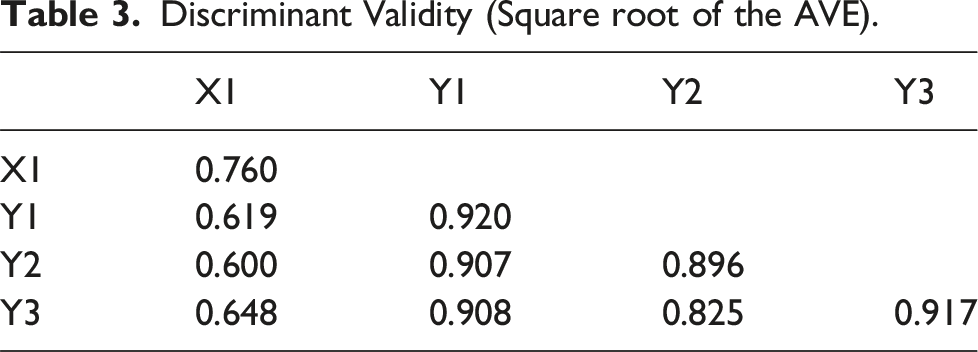
Table 3 provides the discriminant validity results for the constructs used in this study, including intellectual capital (X1), knowledge management (Y1), innovation (Y2), and organizational performance (Y3). The diagonal elements in the table represent the square root of the average variance extracted (AVE) for each construct, while the off-diagonal elements represent the correlation coefficients between the constructs. The values on the diagonal (0.760 for X1, 0.920 for Y1, 0.896 for Y2, and 0.917 for Y3) are the square roots of the AVE for each construct. According to previous research,
72
discriminant validity is confirmed if the square root of the AVE of each construct is greater than the highest correlation of that construct with any other construct. In this table: • The square root of the AVE for intellectual capital (0.760) is greater than its correlations with knowledge management (0.619), innovation (0.600), and organizational performance (0.648). • The square root of the AVE for knowledge management (0.920) is greater than its correlations with intellectual capital (0.619), innovation (0.907), and organizational performance (0.908). • The square root of the AVE for innovation (0.896) is greater than its correlations with intellectual capital (0.600), knowledge management (0.907), and organizational performance (0.825). • The square root of the AVE for organizational performance (0.917) is greater than its correlations with intellectual capital (0.648), knowledge management (0.908), and innovation (0.825).
These results indicate that each construct shares more variance with its own indicators than with other constructs. Consequently, the criteria for discriminant validity as set by previous research 72 are met, confirming that the constructs in this study are both valid and reliable.
Goodness-of-fit testing
Goodness of fit results.

Hypothesis testing results
Hypothesis testing results.

Furthermore, intellectual capital shows a positive and strong relationship with organizational performance, with a path coefficient of 0.600. The high t-statistic (9.245) and low p-value (0.000) indicate that this influence is statistically significant. Knowledge management also has a significant impact on innovation, with a path coefficient of 0.307. Although the effect is moderate, the t-statistic of 4.098 and p-value of 0.023 indicate statistical significance. The influence of knowledge management on organizational performance is also significant, with a path coefficient of 0.520. The high t-statistic (7.196) and low p-value (0.000) affirm the statistical significance of this relationship. Lastly, innovation has a strong positive impact on organizational performance, with a path coefficient of 0.403. The t-statistic of 5.738 and the very low p-value (0.000) indicate that this relationship is statistically significant.
In conlusion, this analysis shows that intellectual capital, knowledge management, and innovation all have significant impacts on organizational performance, both directly and through inter-variable relationships. Every hypothesis tested in this model is accepted, underscoring the importance of these three factors in enhancing organizational performance. The results of hypothesis testing summarized in Table 5 below.
Discussion
Hypothesis 1: Intellectual capital positively affects knowledge management
The findings of this study confirm Hypothesis 1, demonstrating that intellectual capital exerts a significant and positive effect on knowledge management. This result is consistent with earlier studies22,41 that also identified intellectual capital as a key driver in enhancing knowledge management practices. Comprised of human, structural, and relational elements, intellectual capital is essential for optimizing knowledge management systems in universities, enabling more efficient knowledge acquisition, dissemination, and utilization.
Intellectual capital, which includes human, structural, and relational components, plays a crucial role in effective knowledge management. Human capital enhances the ability to acquire, interpret, and apply knowledge, while structural capital provides the necessary systems and frameworks for knowledge storage and dissemination. 22 Relational capital, through external networks and collaborations, allows organizations to access new insights and integrate them with internal knowledge. Together, these elements enable universities to optimize their knowledge management processes, aligning with previous research that highlights the significant impact of intellectual capital on knowledge practices.22,41
The synergy of these three components—human, structural, and relational capital—creates a comprehensive and effective knowledge management system. When these elements are well-developed and integrated, universities can efficiently acquire, store, disseminate, and utilize knowledge, leading to better decision-making, innovation, and overall performance. The positive impact of intellectual capital on knowledge management highlights the strategic importance of managing intangible assets in the academic sector. Universities that recognize the value of intellectual capital and invest in its development are better positioned to navigate complex environments, adapt to changes, and maintain a competitive edge.
Hypothesis 2: Intellectual capital positively affects innovation
The results of this study support Hypothesis 2, demonstrating that intellectual capital positively influences innovation. This finding is consistent with previous research by, 42 which identified intellectual capital as a critical driver of innovation in educational settings. Intellectual capital fosters innovation within universities by enhancing knowledge processes and creating an environment conducive to the generation and implementation of new ideas.
Human capital provides the creative input necessary for innovation. Universities with skilled and knowledgeable faculty and staff are better equipped to generate innovative ideas and develop new academic programs and research initiatives. This aligns with the previous findings, 23 who emphasized the importance of human capital in fostering innovation in academic institutions. Structural capital ensures that innovative ideas can be systematically developed and implemented. Universities with efficient processes, supportive organizational cultures, and advanced IT systems can facilitate the seamless flow of knowledge and support innovative activities.
Previous research 42 highlighted that structural capital plays a crucial role in optimizing the use of knowledge, skills, and experiences within universities to drive innovation. Relational capital provides external connections and collaborative opportunities that support innovative activities. Universities that maintain strong relationships with industry partners, academic collaborators, and research institutions can access new ideas, technologies, and market trends, which can be integrated into their innovation processes. Another research 23 emphasized the importance of relational capital in creating a supportive environment for innovation.
The positive impact of intellectual capital on innovation underscores the importance of strategically managing intangible assets. Universities that recognize the value of intellectual capital and invest in its development are better positioned to foster a culture of continuous innovation. This strategic focus on intellectual capital aligns with the dynamic capabilities framework, which emphasizes the need for organizations to continuously reconfigure their resources and capabilities to address rapidly changing environments. 1
Hypothesis 3: Intellectual capital positively affects organizational performance in universities
The results of this study confirm Hypothesis 3, demonstrating that intellectual capital has a significant and positive impact on organizational performance. This finding aligns with previous research 45 and contrasts with the another results, 44 who found no significant effect. To understand this relationship more deeply, it is important to explore how intellectual capital as a comprehensive asset enhances organizational performance within universities.
Intellectual capital plays a pivotal role in enhancing organizational performance within universities. 45 By fostering a highly skilled workforce, streamlining internal processes, and cultivating strong external networks, intellectual capital contributes to improved decision-making, innovation, and overall productivity. The Resource-Based View 29 highlights intellectual capital as a key asset that provides competitive advantage, particularly in knowledge-driven sectors like academia. Universities that effectively manage and leverage their intellectual resources—through continuous development of human capital, efficient systems, and robust external collaborations—are better positioned to excel in performance, ensuring sustainable growth and adaptability in a rapidly changing environment.
Hypothesis 4: Knowledge management positively affects innovation
The results of this study support Hypothesis 4, indicating that knowledge management (KM) has a significant and positive influence on innovation. This relationship aligns with previous research,52,53 who found that effective KM practices enhance innovation within organizations. Knowledge management involves the systematic processes of acquiring, disseminating, and utilizing knowledge within a university, fostering continuous learning and innovation.
Knowledge acquisition entails gathering relevant information from both internal and external sources, forming the foundation for new ideas. Dissemination involves sharing this knowledge across various organizational levels and departments, ensuring that it reaches those who can use it to innovate. Utilization is the application of this knowledge to solve problems, improve processes, and develop new academic programs or research initiatives. The KBV of the firm posits that knowledge is a fundamental resource for achieving competitive advantage. 30 Effective KM processes support the creation of an innovative environment within universities.
Previous reseach 52 emphasized that KM practices such as knowledge sharing and collaboration significantly enhance an organization’s innovative capacity. When faculty and staff have access to a broad base of knowledge and are encouraged to share insights and collaborate, they are more likely to engage in creative problem-solving and generate innovative solutions. Similarly, 53 found that KM processes facilitate the development of new products and services by ensuring that relevant knowledge is accessible and actionable.
KM fosters a culture of continuous learning and improvement, which is critical for sustaining innovation. Universities that prioritize KM create an environment where faculty and staff are encouraged to seek out new knowledge, share what they learn, and apply this knowledge to their work. This culture supports the generation of new ideas and ensures that these ideas are refined and implemented effectively. The positive impact of KM on innovation highlights the importance of strategic management of knowledge processes in universities.
Hypothesis 5: Knowledge management positively affects organizational performance in universities
The study’s results support Hypothesis 5, demonstrating that KM positively affects organizational performance. This finding aligns with previous research,50,51 which highlighted the positive impact of KM on organizational performance. Effective KM enhances organizational performance by improving decision-making, increasing operational efficiency, and fostering a culture of continuous improvement.
Decision-making is improved when faculty and staff have access to comprehensive and accurate knowledge, enabling them to make more informed choices. KM systems that store and disseminate critical information ensure that decision-makers at all levels have the data they need to respond to challenges and opportunities effectively. Operational efficiency is enhanced through the streamlined processes and reduced redundancies that effective KM practices promote. By ensuring that knowledge is easily accessible and shared across the university, KM helps to eliminate duplicated efforts and improve coordination, resulting in smoother operations, faster response times, and reduced costs.
Fostering a culture of continuous improvement is another crucial way in which KM impacts organizational performance. Universities that prioritize KM create an environment where faculty and staff are encouraged to continually seek out new knowledge and apply it to their work, leading to ongoing enhancements in processes, academic programs, and research initiatives. Previous research50,51 found that universities with strong KM practices are better able to adapt to market changes and maintain competitive advantage.
The relationship between KM and organizational performance can also be understood through the lens of the KBV of the firm, which posits that knowledge is a fundamental resource for achieving competitive advantage. 30 KM directly contributes to the learning and growth of the university by enhancing faculty and staff capabilities and fostering a culture of continuous improvement. This, in turn, positively impacts internal business processes, student satisfaction, and overall institutional performance.
Hypothesis 6: Innovation positively affects organizational performance in universities
The findings of this study confirm Hypothesis 6, indicating that innovation has a significant and positive impact on organizational performance. This conclusion is supported by previous research,55–57 all of which found that innovation contributes positively to organizational performance. Innovation drives organizational performance by enabling the development of new and improved academic programs, research initiatives, and administrative processes that meet stakeholder needs and create value.
Universities that prioritize innovation are better positioned to introduce unique offerings that differentiate them from competitors, thereby enhancing student satisfaction and institutional reputation. This competitive advantage is essential for capturing market share and driving enrollment growth. Moreover, innovation enhances operational performance by improving efficiency and effectiveness. Innovative processes and technologies can streamline operations, reduce costs, and increase productivity. For instance, the implementation of advanced educational technologies or innovative administrative practices can lead to significant improvements in efficiency and cost savings.
Innovation fosters a culture of continuous improvement, which is crucial for sustaining long-term success. Universities that encourage innovative thinking and problem-solving create an environment where faculty and staff are motivated to identify and implement improvements continuously. This proactive approach ensures that the university remains agile and responsive to changing educational demands and market conditions.
The relationship between innovation and organizational performance is further supported by the KBV of the firm, which posits that knowledge and innovation capabilities are fundamental resources for achieving competitive advantage. 30 By fostering innovation, universities enhance their dynamic capabilities, enabling them to adapt to new challenges and opportunities more effectively. Previous research 55 highlighted the role of innovation in driving overall institutional success, showing that universities with higher levels of innovation activity tend to perform better across various performance metrics.
In practical terms, these findings underscore the importance of fostering an innovative culture within universities. Leaders should prioritize investment in innovation, create supportive environments that encourage creative thinking, and implement processes that facilitate the development and execution of new ideas. By doing so, universities can harness the power of innovation to drive performance and achieve sustained success.
Implications of the research
Theoretical implications
This research provides substantial theoretical contributions to the KBV by empirically validating the positive impacts of intellectual capital, knowledge management, and innovation on organizational performance within the context of universities. By demonstrating the intricate relationships among these variables, this study enhances the understanding of how intangible assets drive competitive advantage and performance in higher education. The findings confirm that intellectual capital is a multifaceted resource that significantly influences innovation and performance, supporting the KBV theory’s assertion that knowledge is a critical organizational resource. Additionally, the study highlights the role of knowledge management in fostering innovation and improving organizational outcomes, further solidifying the KBV framework’s relevance in contemporary management research within academic institutions.
Practical implications
From a practical perspective, the findings underscore the importance of investing in and strategically managing intellectual capital and knowledge management to enhance innovation and organizational performance in universities. University leaders should prioritize developing human capital through continuous training and professional development to foster a skilled and knowledgeable faculty and staff. Furthermore, investing in robust structural capital, such as advanced IT systems and efficient processes, is crucial for supporting knowledge sharing and innovative activities within the university. Building strong relational capital through external partnerships and networks can provide valuable insights and resources that drive innovation in academic settings.
Universities are encouraged to create a culture that values continuous learning, knowledge sharing, and innovation. This involves implementing policies and practices that support knowledge management processes and encourage faculty and staff to engage in creative problem-solving. University leaders should focus on fostering an environment where innovation is embedded into the organizational fabric, ensuring that new ideas are continuously generated, refined, and implemented.
Conclusions
This study confirms the significant and positive impacts of intellectual capital and knowledge management on innovation and organizational performance, thereby validating the KBV theory within the context of universities. Intellectual capital, encompassing human, structural, and relational assets, provides a foundation for universities to generate, develop, and implement innovative ideas. Effective management of intellectual capital ensures that these resources are utilized optimally, fostering an environment conducive to continuous improvement and creativity. The study found that intellectual capital positively influences knowledge management, which in turn enhances innovation and organizational performance. By facilitating knowledge flow and collaboration, knowledge management enhances decision-making processes, operational efficiency, and overall organizational performance. Additionally, the findings confirm that innovation has a significant and positive impact on organizational performance, driving the development of new and improved academic programs, research initiatives, and administrative processes that meet the needs of students and other stakeholders.
The positive relationships identified in this study highlight the strategic importance of investing in intangible assets and cultivating a culture that values continuous learning and innovation in universities. Institutions that prioritize the development and management of intellectual capital and knowledge management systems are likely to maintain a competitive edge in today’s dynamic educational environment. This strategic focus enables universities to adapt to new challenges, seize opportunities for growth, and achieve sustained success. Moreover, the study underscores the necessity for university leaders to foster an innovative culture. By creating environments that encourage risk-taking, experimentation, and knowledge sharing, leaders can drive the innovation process and ensure that their institutions remain agile and competitive. The findings also emphasize the need for ongoing investment in training and development programs to enhance human capital, the implementation of advanced systems and processes to strengthen structural capital, and the cultivation of strong external relationships to build relational capital.
Research limitations
While this study provides valuable insights, several limitations should be acknowledged. First, the cross-sectional design of the study limits the ability to draw causal inferences between the variables. Longitudinal studies would provide a better understanding of the causal relationships and the dynamic nature of intellectual capital, knowledge management, and innovation over time. Second, the research was conducted within a specific university context, which may limit the generalizability of the findings to other educational institutions or geographical regions. Future research should consider diverse contexts to enhance the generalizability of the results. Third, the reliance on self-reported data may introduce biases such as social desirability or common method bias. Employing multiple data sources and methods, such as qualitative interviews or objective performance metrics, could mitigate these biases.
Recommendations for future research
Future research should expand the research context to include different types of educational institutions and geographical regions to enhance the generalizability of the findings. Exploring how intellectual capital and knowledge management practices vary across different universities and cultural contexts can provide a more comprehensive understanding of their impacts on innovation and performance. Additionally, incorporating multiple data sources and methods, such as qualitative approaches or objective performance metrics, can provide a richer and more nuanced understanding of the phenomena under study. For example, qualitative interviews with university leaders and faculty can offer deeper insights into how intellectual capital and knowledge management practices are implemented and perceived within academic institutions.
Exploring the potential moderating or mediating effects of other variables, such as organizational culture, leadership styles, or external environmental factors, would offer deeper insights into the mechanisms driving the relationships among intellectual capital, knowledge management, innovation, and performance. Understanding how these factors interact can help universities tailor their strategies to maximize the benefits of their intellectual capital and knowledge management investments.
Footnotes
Declaration of conflicting interests
The author(s) declared no potential conflicts of interest with respect to the research, authorship, and/or publication of this article.
Funding
The author(s) received no financial support for the research, authorship, and/or publication of this article.
