



Abstract
In the industrial field, one of the most widespread KPIs is represented by the Overall Equipment Effectiveness (OEE), first introduced by Seiichi Nakajima within the Total Productive Maintenance (TPM) theory and aimed at identifying the inefficiencies of industrial assets. While OEE has been objective of several studies, the relationship between the Overall Equipment Effectiveness and the role of the human factor in achieving its high levels of values has not been extensively investigated. In recent years few scientific studies have investigated the relationship, showing that there is a link between OEE and human factors, even significant, but not clearly identified yet. In order to examine this relationship, our study proposes a framework to clarify the links between human factors, OEE parameters, the industrial sector, and the degree of automation. This framework is then validated through the application of the Analytic Hierarchy Process (AHP) methodology. As a result, 13 aspects related to the human factor were identified. Finally, the study provides practical guidance and implications for maximizing the outcomes of the investigation, with the goal of improving an organization’s overall manufacturing performance. By understanding the impact of the human factor on OEE, organizations can make informed decisions to optimize their operations and achieve higher levels of productivity.
Introduction
Overall Equipment Effectiveness (OEE), first introduced by Nakajima in 1988 within the TPM theory, is a key performance indicator extensively adopted in the manufacturing context. 1 Its huge diffusion can be linked to the easiness of reading and to the capability to sum up several metrics generally monitored by companies.2,3 Considering the number of scientific articles published in the last years, the role of the OEE within industrial and scientific context appears clear and recognized: the scientific publications regarding the Overall Equipment Effectiveness and the improvement of the indicators itself are increasing.
In this context, although Nakajima underlines the main role of manpower in the achievement of a high rate of the KPI, 1 by reviewing the existing literature it is possible to understand how the relationship between the performance indicator and human factor has not been deepened. In conclusion, the ways in which people carry out operational activities exerts an influence on the KPI and can play a key role in achieving high OEE values – and therefore to the achievement of corporate effectiveness improvement – have not been appropriately deepened in the literature.4,5 Considering the points discussed, the aim of our study is represented by the investigation of the existing relationship between human factors and OEE and understand how the human activities can exert an influence on reaching high levels of OEE. To our knowledge, no other scientific contribution has proposed a deep dive on the human activities able to influence the Overall Equipment Effectiveness.
In the context of industrial manufacturing, the influence of the human factor plays a significant role in the overall efficiency and productivity of the production processes. Manufacturing operations often involve complex machinery, automated systems, and intricate workflows, but it is the human element that ultimately governs and interacts with these systems. As a result, understanding and addressing the impact of human factors is crucial for optimizing operational performance, ensuring quality output, and maximizing the overall equipment efficiency (OEE). In this context, human factors encompass a wide range of elements, including but not limited to the skills, capabilities, knowledge, experience, training, and behavior of the individuals involved in the manufacturing process. These factors can have both positive and negative effects on the various parameters that contribute to OEE.
By linking human factors to each parameter of OEE, organizations can gain a comprehensive understanding of how human-related aspects influence equipment efficiency and overall manufacturing performance. This understanding enables them to implement targeted strategies and interventions to optimize human performance, address potential weaknesses, and capitalize on strengths. It also underscores the importance of investing in ongoing training and development programs, fostering a positive safety culture, improving communication and collaboration, and implementing ergonomic design principles to create a harmonious interaction between humans and the manufacturing systems. According to this reasoning, the paper discusses the following research question: RQ: Which are the main human factors influencing the achievement of high levels of OEE? What is their relationship with the indicator?
The paper is hence arranged as follows, in order to answer to the aforedescribed research question. Background is dedicated to the definition of the OEE, its background and the relationship with human factors; Method is dedicated to the introduction of the methodology used for the research work; Analysis of the OEE and human factor in the scientific literature is aimed at identifying and clarifying the relationship between human factors impacting OEE; Analysis of the human factors affecting OEE elements through the adoption of ISO 22400 standard taxonomy and Relationship between human factor, industrial sector and degree of automation reports in order the analysis conducted for the identification of the elements of the KPI impacted by the human factors and the relationship between human factors, degree of automation and industrial sector. The validation of the results is shown in AHP analysis, results and discussions, where Analytic Hierarchy Process (AHP) analysis has been performed and its results analyzed. Lastly Conclusions reports the conclusions of the article.
Background
The Overall Equipment Effectiveness is as a Key Performance Indicator (KPI) that integrates three distinct indicators, namely Availability, Performance Efficiency, and Quality.
1
The definition of the indicator is elaborated as follows:

Specifically, as reported by
2
: • Availability refers to the portion of scheduled time that is utilized after accounting for all the time losses due to major machinery stoppages, eliminating losses caused by failures, downtime, and setup losses; • Performance Efficiency indicates the proportion of operating time that is utilized after accounting for all the time losses caused by minor machinery stoppages or reductions in speed, including idling and minor stoppages, reduced speed, and reduced yield; • Quality Rate indicates the percentage of net operating time that is utilized after accounting for time losses resulting from work activities for processing of non-sellable units (such as production waste or rework of defective units).
World-class level target values.

However, the scientific literature does not always concur with these values. Kotze 3 contends that, unlike Nakajima, an OEE of 50% or less is a more realistic benchmark due to variations in industrial realities. Conversely, Ericsson, 4 suggests that an OEE ranging from 30% to 80% can be an effective reference benchmark. These discrepancies may arise from difficulties in evaluating and comparing OEE across various production processes and industries. 5
Consequently, several authors have proposed alternative methods for calculating the OEE indicator, tailored to specific industries or production processes, leading to ambiguity in implementing the indicator in manufacturing settings. To provide KPI definitions that are independent of a company’s production and operational context, the International Organization for Standardization (ISO) introduced the ISO22400 standard (“Key performance indicators (KPIs) for manufacturing operations management”) for manufacturing operations management.6,7 The standard includes two definitions of Overall Equipment Effectiveness referred to as “Model A” and “Model B,” which were discussed in detail by Schiraldi and Varisco in 2020, 8 who analyzed their consistency with Nakajima’s original definition. 1 Thus, significant efforts have been made to develop comprehensive definitions and frameworks for implementing OEE to enable continuous improvement and streamline production processes and performances: manufacturing organizations have the chance to improve their production processes and performance by evaluating the factors that affect OEE, allowing them to re-engineer, standardize and streamline their operations. 9
While attention was originally focused on assessing equipment, machinery, and other tangible factors in manufacturing processes, investigating the relationship between human factors and Overall Equipment Effectiveness has become crucial to achieving a competitive advantage. 10 As stated by Nakajima, 1 even highly automated plants cannot eliminate the positive and negative impact of manpower on manufacturing outcomes. For example, manual maintenance and retooling activities can affect execution times, Performance Efficiency, or Quality Rate during visual inspection. The scientific literature proposes a classification of operational losses due to human actions, 11 which includes:
Certain influence of operators on wasted time
Losses where the duration of downtime, starting from the occurrence of a fault until the machinery resumes operation, is influenced by the actions performed by the operators;
Uncertain influence of operators on wasted time
Losses that may have varying duration of downtime based on the activities carried out by the operators;
No influence of operators on wasted time
Losses in which the duration of downtime is not influenced by the activities performed by the operators.
In a similar approach, human errors affecting plant performance are classified into six categories by, 12 including operating errors, assembly errors, design errors, inspection errors, installation errors, and maintenance errors. Furthermore, the importance of the relationship between workers' skills, competences, and attitudes and OEE is gaining attention.13,14 The human element is now considered a source of competitiveness, 15 owing to the intangible characteristics of human nature, including organizational knowledge, skills, attitudes, and knowledge. 16 Chen et al.’s research 17 on the attitudes of human resources in large manufacturing companies identifies the main elements and factors that can be leveraged to improve operational productivity. Some publications recommend performance improvement through the implementation of approaches, such as TPM, where the central role of the human factor is acknowledged but do not detail the human elements that affect performance. 18 Other publications describe specific cases where manpower has significantly influenced operational activities. 19
Therefore, it is evident from the literature review that there is a link between business performance and human activities. However, this relationship is not fully elucidated regarding the human factor's influence on OEE. As a result, this study aims to explore the relationship between OEE and the human factor, providing a comprehensive framework and organizational guidance to improve manufacturing performance.
Method
A procedure was created to identify the human activities that impact the Overall Equipment Effectiveness, as illustrated in Figure 1. flow of the proposed procedure.
The initial stage of this study involves conducting an extensive literature review to assess the current state of knowledge on the link between human factors and OEE. This process entails examining articles from key databases, such as Scopus and Web of Science. Once the literature portfolio is defined, the identified human elements are categorized into macro-categories based on a hierarchical structure, which is necessary for the next phase of the procedure.
Next, the second phase of the study involved collecting opinions from experts in Operations Excellence, with the aim of confirming or rejecting the identified relationships and determining the relevance and hierarchy of importance of the human elements in relation to OEE performance. This was accomplished through a questionnaire administered to a Think Tank in Operations Excellence, 1 and the opinions collected of 13 involved experts were analyzed using the Analytic Hierarchy Process (AHP) methodology. According to Saaty, 20 the Analytic Hierarchy Process (AHP) is a multi-criteria method used to obtain pairwise comparison scales for continuous and discrete factors. Developed at the Wharton School of Business, it provides decision support in situations where problem structuring is difficult, rationality is limited, and there are multiple decision-making criteria that may be in contrast with each other. It enables both tangible and intangible factors, such as experiences and values of the decision-maker, to be included in the choice among solution alternatives. It can also overcome deficiencies in the description of the problem/criteria and accept contributions from decision-makers (e.g., situations involving different areas). 21
Thus, the categorization of human factors influencing OEE was used to determine the AHP questionnaire, which was compiled by experts. The questionnaire aimed to define a comparison of the importance of human macro-factors in influencing OEE values and to compare the sub-factors within the same macro-category. The experts' responses were then used to validate the human factors and quantitatively identify the factors that can significantly affect the achievement of a high degree of OEE. Indeed, expert opinions and subjective judgments were gathered through pairwise comparisons, where the relative importance of each human factor within a specific OEE parameter is assessed. Participants ranked the factors in terms of their impact, using a numerical scale, considering criteria such as expertise, experience, and knowledge. The collected judgments have then been used to calculate weightings for each factor using mathematical algorithms, such as the Saaty's eigenvector method. These weightings reflect the relative importance of the human factors within each OEE parameter. Once the weightings have been established, they were applied to the respective OEE parameters to quantify the influence of the human factor on each parameter. This allows for a numerical evaluation and comparison of the impact of different human factors on the overall efficiency of the manufacturing process.
Analysis of the OEE and human factor in the scientific literature
The procedure begins with a review of the current state of research aimed at identifying the primary human factors that impact OEE values. The analysis focuses on articles that consider OEE in specific production contexts, both from a theoretical and practical standpoint. To accomplish this, the search for articles within major scientific databases incorporates the keyword “OEE,” along with other specific terms associated with improvement activities such as Lean Manufacturing and Six Sigma. These terms include “Improvement,” “SMED,” “TPM,” “Fishbone diagram,” “WCM,” and “Performance measurement management”.
The selected publications were then assessed to determine their usefulness in identifying human activities that influence OEE. The reference dataset used in this study solely comprises scientific articles that identify how human actions impact plant, machine, or line performance at the OEE level. The resulting dataset analyzed in this study comprises 34 scientific articles, which are listed in Appendix A. The bibliographic portfolio analysis was then conducted to identify and categorize the hierarchical structure of human factors affecting OEE, as outlined in Table 1. The model is structured into three hierarchical levels:
1° hierarchical level
the first level identifies the macro-categories of human factors that impact achieving high OEE values. These macro-categories are grouped by impact area;
2° hierarchical level
The second level identifies the specific human factors that influence performance indicator values, categorized according to the reference category;
3° Hierarchical level
The third hierarchical level involves identifying the factors that may impact the accurate execution of manual activities and contribute to achieving higher OEE levels. These factors are classified as either “Personal Features,” which includes Personal Abilities, Experience, and Training, or “Human Interaction with the Environment,” which comprises Low Noise Intensity, Proper Illumination, Proper Temperature and Humidity Conditions, Low Exposure to Vibrations, Electromagnetic Fields, Artificial Optical Radiation, Infrasound and Ultrasound, and Hyperbaric Atmospheres.
Analysis of the human factors affecting OEE elements through the adoption of ISO 22400 standard taxonomy
In order to identify a strong relationship between the human factors and the Overall Equipment Effectiveness, the influence that each human factor exerts on the KPI has been underlined through the analysis of the specific OEE elements. For this reason, the starting point is represented by the study of the Overall Equipment Effectiveness following the two definitions of the KPI,
Within the ISO22400 standard, two different definitions are provided for Overall Equipment Effectiveness, for which the convention for the definition of “Model A” and “Model B” will be adopted. In the first definition (Model A), OEE is defined as that indicator representing “the KPIs of work unit availability, work unit efficiency and quality rate integrated into a single indicator”.
6
In formulas:






Elements characterizing OEE models as per ISO 22400 standard.
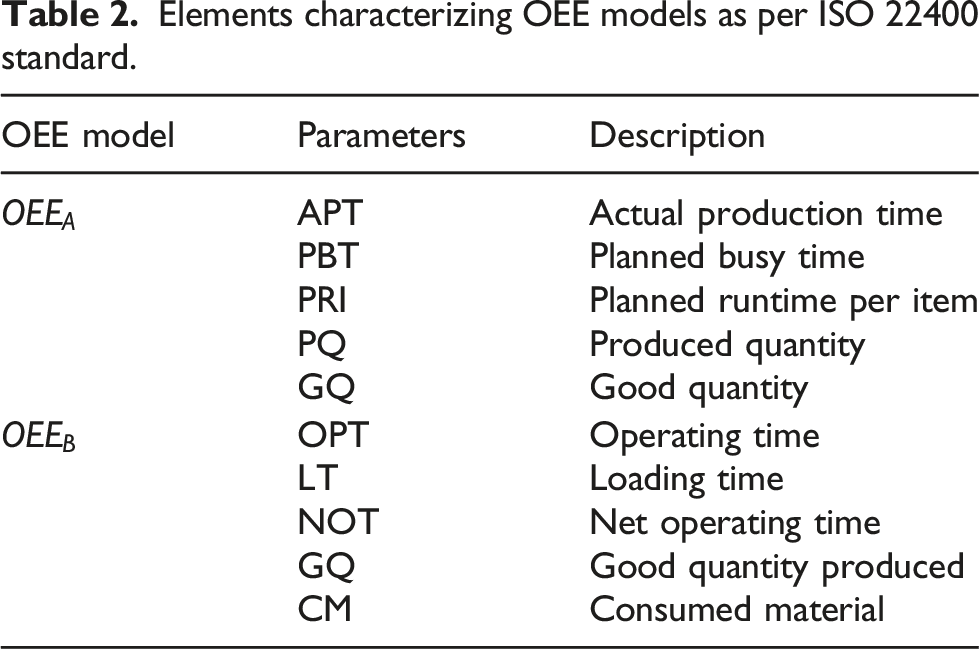
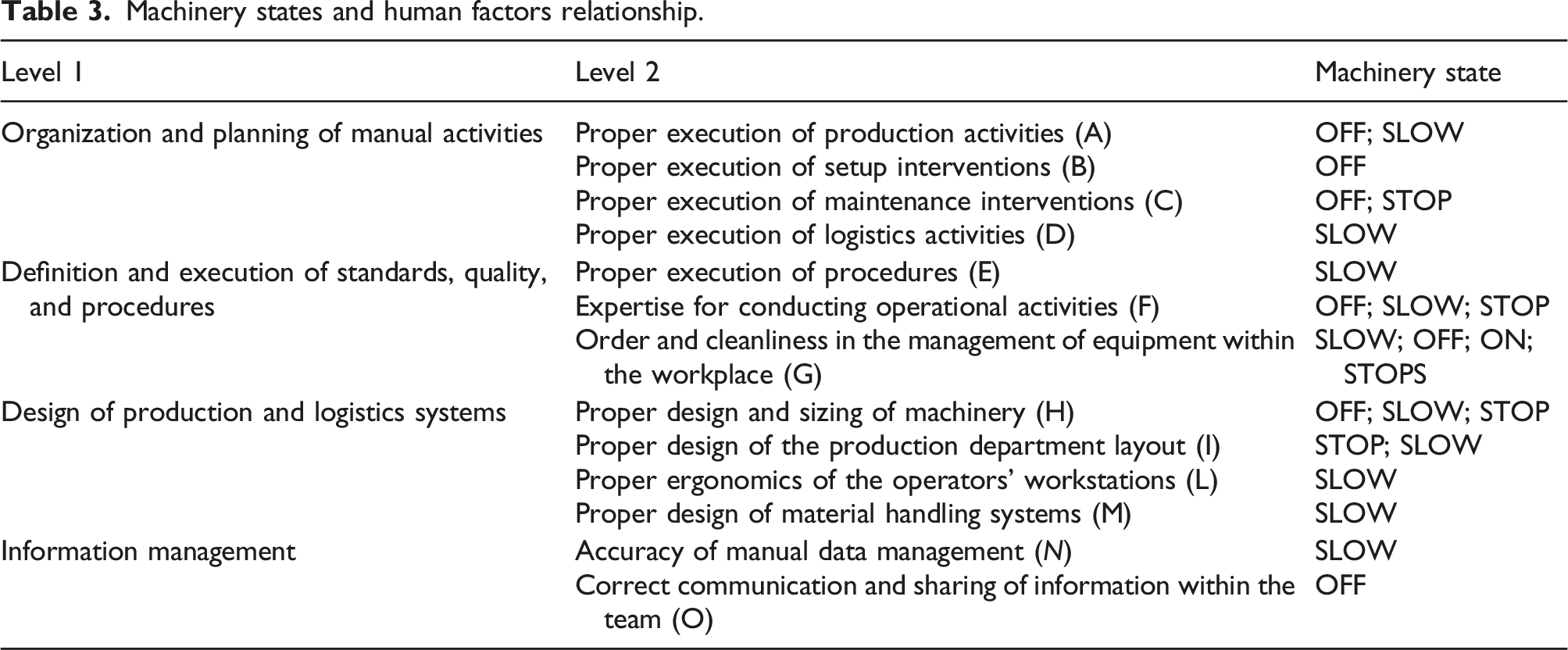
After the identification of all the parameters configuring the OEE, the human factors have been linked to each parameter considering the influence that they exert. The rationale behind this approach is to gain a comprehensive understanding of how human-related aspects impact the efficiency of equipment, for both types of OEE. This understanding can help in optimizing processes and improving overall efficiency by addressing human factors appropriately. Indeed, by linking human factors to each parameter, organizations can make informed decisions and take appropriate actions to optimize their processes, reduce downtime, enhance performance, and improve the quality of their output.
The results are showed in the following table:
Machinery states and human factors relationship.
Relationship between human factor, industrial sector and degree of automation
An additional evaluation has been carried out to determine the combined relationship between human factors impacting OEE, industrial sector and degree of automaton of the company. Indeed, in this way it is possible to identify the most relevant elements to be considered for the specific organization under assessment.
In order to perform the analysis on the basis of the industrial sector of reference, the International Standard Industrial Classification of All Economic Activities (ISIC) was used. ISIC proposes an international reference classification of production activities, the purpose of which is to propose various categories of activities that can be used for the collection and reporting of statistical research based on these activities.
Starting from the papers identified in the literature within which the impact of human activities on OEE was observed (Table A.1), the reference industrial sector was analysed for each paper according to the ISIC classification. For the analysis of the relationship between human factors and OEE parameters according to the degree of automation typical of the specific production plant, the same dataset of scientific publications was used. As in the industrial sector, also in the case of the analysis in relation to the degree of automation, it was not possible for all publications to identify the specific production mode: in several scientific articles, in fact, the parameter in question was not specified. In the latter case, the objective was to identify if a specific human factor was impacting in either the context of an automatic production system, or a semi-automatic production system, or a manual one. However, it is possible to point out that OEE is considered to be more suitable for semi-automatic and automatic processes 11 and, on the contrary, not recommended for performance measurement with regard to manual and semi-automatic assembly processes. 1 For these reasons, the analysis was conducted with the objective of analysing only the degree of semi-automatic and automatic automation.
Relationship between the human factors, industrial sector and degree of automation.

Looking at the results shown in Table 4, it is possible to highlight the presence of three critical factors for each industry sector of reference and for each degree of automation: • Proper execution of production activities; • Proper execution of maintenance interventions; • Proper execution of setup interventions.
Those three factors refer to the category of “Organization and planning of manual activities” and these results could derive from the need, regardless of the company’s configuration by degree of automation and reference industrial sector, for the scheduling by companies of production activities, maintenance activities and setup interventions.
On the other hand, when analysing the factors identified for companies characterised by a semi-automated degree of automation, it can be observed that there are two human factors that are repeated for each industrial sector. The parameters in question are the Expertise for conducting operational activities and Proper execution of procedures, that is, the operator's ability to identify anomalies, such as possible signs of machine failure or non-conforming products, and training, that is, the degree of instruction on the processes and methods for carrying out the activities learned within the enterprise.
AHP analysis, results and discussions
To determine the importance of the different levels of human factors, an AHP questionnaire based on the proposed hierarchical structure has been developed to determine the levels 1-2 factors weights. The questionnaire was filled by the Operations Excellence Think Tank members and required participants to perform pairwise comparisons between level 1 and level 2 criteria, as well as hierarchical ranking of level 3 criteria.
Saaty’s AHP semantic scale 22 was used for the pairwise comparisons, while experts ranked the level 3 criteria based on their impact on the specific level 2 factor, with position one representing the highest ranking.
The responses were then averaged to identify the most relevant personal features and environmental conditions. Each respondent was assigned a Consistency Ratio (CR) for further analysis of the level 1-2 factor weights. The results for the level 1 factors are presented below:
Weights of the level 1 factors.

Average ranking of the level 3 factor “personal features”(for Each of the Impacted Level 2 Factor).

Average ranking of the level 3 factor “Human Interaction With the Environment” (for each of the impacted level 2 factor).

It is possible to observe that for the greater part of the level 2 factors, “Training” and “Proper illumination” are assessed as the most important elements for increasing the Overall Equipment Effectiveness. Hence, this result allows to state that personal characteristics and the soft side of people are actually evaluated by decision-makers as relevant towards the reaching of excellence in operations performances, supporting the considerations of the shift from Operational Excellence to Human Excellence theory 23 and showing the required need for an individualized Human Resource Management. 14
Moreover, it must be noted that some of the obtained responses show a medium-high CR level, due to the limited number of gathered responses. Managing a high consistency ratio in AHP matrices is an important aspect of ensuring the reliability and validity of the analysis. Indeed, several strategies can be employed to mitigate this effect: 1. Reviewing and revising judgments; 2. Increasing the number of participants; 3. Conducting sensitivity analysis; 4. Expert consultation and consensus building; 5. Training and calibration sessions.
By employing these strategies, researchers and practitioners can effectively manage and mitigate the impact of a high consistency ratio in AHP matrices, leading to more robust and trustworthy findings in the assessment.
Conclusions
The objective of this study is to establish the correlation between Overall Equipment Effectiveness (OEE) and the human factors that have the greatest influence on this key performance indicator. To achieve this scope, the study aims to identify the activities or elements related to manpower that impact OEE performance and, if appropriately controlled and managed, could result in achieving high OEE values. The study relies on a comprehensive literature review to identify four categories of human factors that directly affect OEE values and two categories that indirectly affect the indicator. In total, twenty human factors were identified and organized into a hierarchical structure to better understand their impact on the OEE indicator. Those human factors can be assessed and evaluated, for instance, through the adoption of Key Activity Indicators (KAIs), which can be used also for the evaluation of activities related to the human sphere.
The Analytic Hierarchy Process (AHP) methodology was adopted to validate the identified relationships. A questionnaire was developed and completed by experts from an Operations Excellence Think Tank. The analysis of the results helped determine the relative importance of the different human factors and provided guidelines for improving OEE. The study concluded that the “definition and execution of standards, qualities, and procedures” and the “Design of production and logistics systems” are the main areas requiring attention, particularly regarding the expertise and training of operators.
However, the results of the analysis were characterised by responses that were not always perfectly consistent and by matrices of pairwise comparisons with Consistency Ratios above the threshold value of 0.1. For these reasons, in the future, it might be advisable to carry out an AHP analysis in the first instance, presenting answers that are as consistent as possible. Alternatively, it might be advisable to carry out an analysis for the validation of the results that takes into consideration a wider range of respondents, thus being able to perform statistical analyses of the results.
Additionally, the identified human factors have been related to the OEE models described by the ISO 22400 standard, which represents the international norm categorizing KPIs in Manufacturing Operations Management, and successively to the specific company’s industrial sector and degree of automation. Indeed, within the study human factors were also classified according to the industrial sector of reference and the degree of automation typical of the production plant of reference. In this sense, it could also be interesting to validate the results obtained through a case study that takes these variables into consideration.
hierarchical structure of the human factors impacting the KPI.

Analysis of human factors and OEE elements.

Weights of the level 2 factors (for Level 1 Factor “Organization and Planning of Manual Activities”).

Weights of the level 2 Factors (for Level 1 factor “definition and Execution of Standards, Qualit y, and Procedures”).

Weights of the level 2 factors (for Level 1 Factor “Design of Production and Logistics Systems”).

Footnotes
Declaration of conflicting interests
The author(s) declared no potential conflicts of interest with respect to the research, authorship, and/or publication of this article.
Funding
The author(s) received no financial support for the research, authorship, and/or publication of this article.

Note
Appendix
selected bibliographic portfolio.
ID
Reference
Title
Journal
Year
1
(Xiang & feng, 2021)
Implementing total productive maintenance in a manufacturing Small or medium-Sized enterprise
Journal of industrial engineering and management
2021
2
(Di Luozzo, et al., 2021)
The human performance impact on OEE in the adoption of New production technologies
Applied Sciences
2021
3
(Heng, et al., 2019)
Automatic estimate of OEE considering uncertainty
52nd CIRP conference on manufacturing systems
2019
4
(Dal, et al., 2000)
Overall equipment effectiveness as a measure of operational improvement- a practical analysis
International journal of operations & production management
2000
5
(Fakhri, et al., 2019)
Overall equipment effectiveness (OEE) analysis to improve the effectiveness of vannamei (Litopenaeus vannamei) shrimp freezing machine performance at PT. XY, Situbondo-east java
IOP conference Series: Earth and environmental Science
2019
6
(Tsarouhas, 2018)
Improving operation of the croissant production line through overall equipment effectiveness (OEE)
International journal of productivity and performance management
2018
7
(Huang, et al., 2010)
Manufacturing productivity improvement using effectiveness metrics and simulation analysis
International journal of production response
2010
8
(Zuashkiani, et al., 2011)
Mapping the dynamics of overall equipment effectiveness to enhance asset management practices
Journal of quality in maintenance engineering
2011
9
(Zennaro, et al., 2018)
Micro downtime - data collection, analysis and impact on OEE in bottling lines the San benedetto case study
International journal of quality & reliability management
2018
10
(Tsarouhas, 2020)
Overall equipment effectiveness (OEE) evaluation for an automated ice cream production line
International journal of productivity and performance management
2020
11
(Soltanali, et al., 2021)
Measuring the production performance indicators for food processing industry
Measurement
2021
12
(Castro & oliveira de Arujo, 2012)
Proposal for OEE (overall equipment effectiveness) indicator deployment in a beverage plant
Brazilian journal of operations & production management
2012
13
(Muchiri & pintelon, 2008)
Performance measurement using overall equipment effectiveness (OEE): Literature review and practical application discussion
International journal of production research
2008
14
(Hansson & Lycke, 2003)
Managing commitment: Increasing the odds for successful implementation of TQM, TPM or RCM
International journal of quality & reliability management
2003
15
(Phogat & Gupta, 2017)
Identification of problems in maintenance operations and comparison with manufacturing operations: A review
Journal of quality in maintenance engineering
2017
16
(Mansour, et al., 2013)
Evaluation of operational performance of workover rigs activities in oilfield
International journal of productivity and performance management
2013
17
(Gupta & Vardhan, 2016)
Optimizing OEE, productivity and production cost for improving sales volume in an automobile industry through TPM: a Case study
International journal of production research
2016
18
(Kshantra, et al., 2020)
Calculation and improving the overall equipment effectiveness for textile industry machine
International journal of emerging trends in engineering research
2020
19
(Ohunakin & Leramo, 2012)
Total productive implementation in a beverage industry: A case study
Journal of engineering and applied Science
2012
20
(Rasib, et al., 2021)
Non-conformance time As the component of time loss measures in assembly processes
Journal of physics: Conference Series
2021
21
(Li & rong, 2009)
The reliable design of one-piece flow production system using fuzzy ant colony optimization
Computers & operations research
2009
22
(Hedman, et al., 2016)
Analysis of critical factors for automatic measurement of OEE
Procedia CIRP
2016
23
(Martomo & Laksono, 2018)
Analysis of total productive maintenance (TPM) implementation using overall equipment effectiveness (OEE) and six big losses: A case study
3rd international conference on industrial mechanical, electrical, and chemical engineering, ICIMECE 2017
2018
24
(Nayak, et al., 2013)
Evaluation of OEE in a continuous process industry on an insulation line in a cable manufacturing unit
International journal of innovative research in Science, engineering and technology
2013
25
(Sousa, et al., 2018)
Applying SMED methodology in cork stoppers production
Procedia manufacturing
2018
26
(Tsarouhas, 2007)
Implementation of total productive maintenance in food industry: a Case study
Journal of quality in maintenance engineering
2007
27
(Trattner, et al., 2020)
Why slow down? Factors affecting speed loss in process manufacturing
The international journal of Advanced manufacturing technology
2020
28
(Hopp & Spearman, 2008)
Factory physics: Foundations of manufacturing management
McGraw-Hill
2008
29
(Strauch, 2002)
Investigating human error: Incidents, Accidents, and complex systems
CRC press
2002
30
(Nakajima, 1988)
Introduction to TPM
Productivity press
1988
31
(Benjamin, et al., 2010)
Scrap loss reduction using the 5-whys analysis
International journal of quality & reliability management
2010
32
(Dhillon, 2014)
Human error in maintenance: An investigative study for the future
IOP conf. Series: Materials Science and engineering
2014
33
(Dhillon & Liu, 2007)
Evaluation of operational performance of workover rigs activities in oil field
Journal of quality in maintenance engineering
2007
34
(Aboutaleb, 2015)
Empirical study of the effect of stochastic variability on the performance of human-dependent flexible flow lines
Published PhD thesis
2015