



Abstract
Investment decision is one of the most essential factors in today’s stock market. People make investment decisions based on different fundamental and technical tools. There are various factors which affect the investor towards investment, but one of the important factors which affect the investor is their emotional intelligence. So, the present study focuses on the how emotional intelligence influences the investment decision. This study is based on the emotional intelligence of investors so that the market can know the beat of the speculator and continue as required. The data was collected from 930 investors who make investment in NSE in Andhra Pradesh. The data was analyzed with the help of correlation analysis. The study reveals that there is a positive relation among the various dimensions of emotional intelligence and investment decisions. This study will help the investment advisors to advise the investors to invest according to their emotional intelligence capability. The usual actuality for stock market investments is subject to not only in making investment decisions in high volatile market circumstances and informational haziness but also by the need to be meticulous in earning something on a consistent basis. The substantial reason is the emotions are part of the evolved mental processes; human beings have for managing uncertainty and competition. Words expressing emotions and feelings such as Dissatisfied, Depressed, Sad, Happy, Cheerful, Satisfied, Fear, Worry, Disappointment, and Trust similarly succeed in the interview scheduling sessions with respondents. Different emotions can be sensed through their connected action tendencies. Fear is, for example, associated with the inclination for flight and love with the trend for an approach. The market moves against the investor. Having never stared at unrealized losses, tell themselves that all their ideas will eventually work. This research examined the relationship between risk-taking behaviour and high levels of extraversion
Introduction
Are there the emotions recognized while or after trading by the market participant mainly as a stock market investor? To find answers, the research on emotional finance would help in enhanced understanding – emotional finance is a field of study that applies emotional, cognitive psychological theory to conventional economics and finance. 1 The researcher in this chapter explored some fundamental concepts that emotional finance specialists believe that they contribute to irrational financial decision making. 2
Investors’ emotions
Emotions are probably that every person reading this research has experienced and can easily replicate on the feelings and state of affairs associated with their lives. Emotions appear to be inseparably related to – that amusing feeling in the stomach – sweaty palms and a pounding heart, which the person did not consciously want it to happen and which are hard to explain in a cogent way. On the other hand, not all unmanageable reactions of our body are emotions. 3 Consider that when we are exposed to extreme physical activity, our hearts begin to race against our will, so. 4
The difference to an emotional response is that emotions are not instantaneously necessary for the physical survival of the body (at least so it seems). Emotions are more than plainly reactions to physiological changes in our body.
5
To this outlook, emotions are different interactions. Different emotions can be sensed through their connected action tendencies. Fear is, for example, associated with the inclination for flight and love with the trend for an approach.
6
Whether action propensities are the optimal way of defining emotions is disgraceful. Some emotions do not have an (apparent) action propensity.
7
To summarise, emotion is practiced when an event significant to our concerns (Charts 1–3), purposes, or preferences is evaluated.
8
Concept of emotional intelligence. Flowchart of emotional intelligence. Proposed method flowchart.

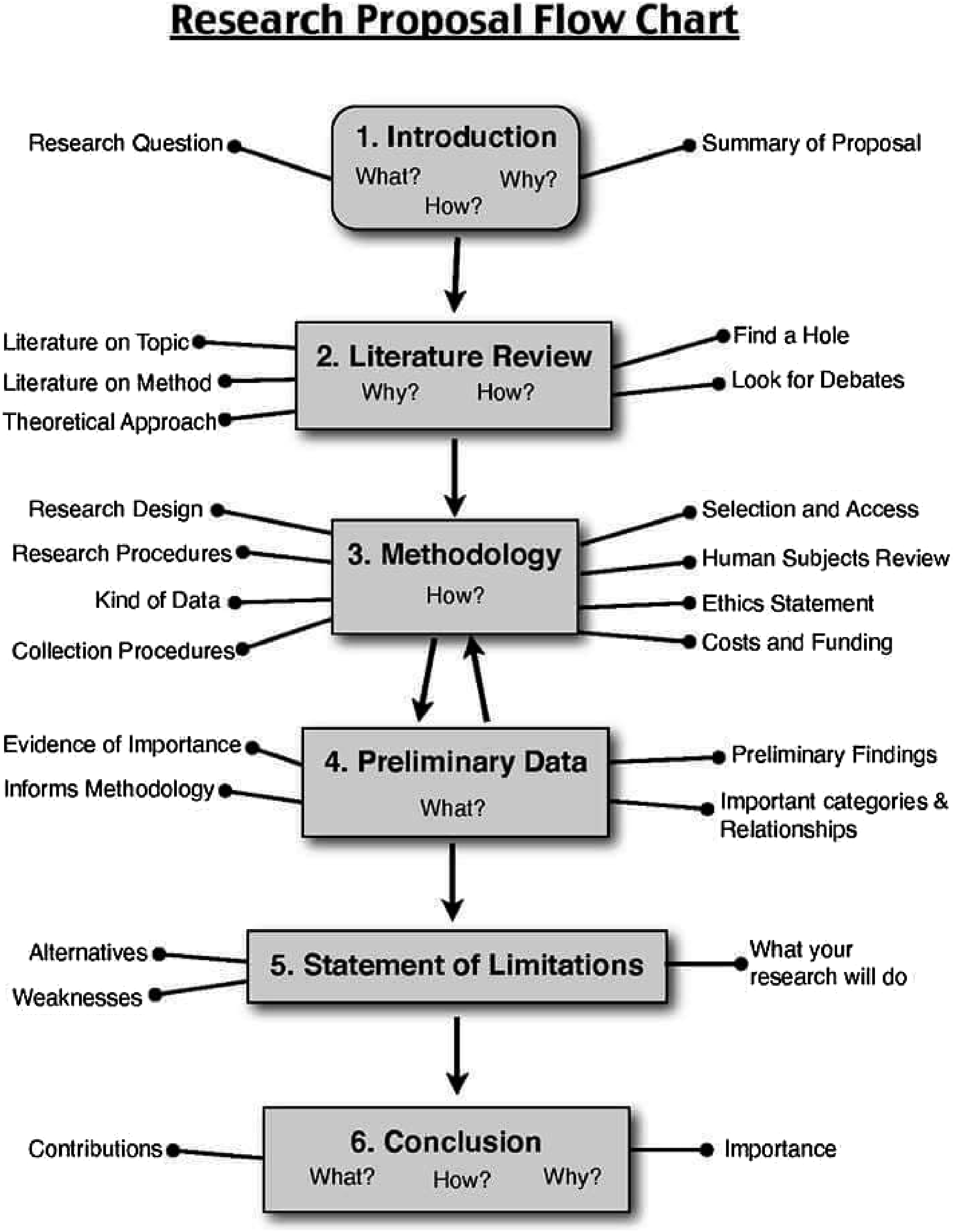
This assessment then leads to a multifaceted reaction, resulting in emotions. 1. Optimism – A positive outlook encourages us about the future, leading us to buy stocks. 2. Excitement –After seeing some of the initial ideas working, the investor begins considering what the market success could allow accomplishing. 3. Thrill – At this point, the investor cannot believe his success and begins to comment on how smart he is. 4. Euphoria – At this point is the maximum financial risk. Having seen each decision result in quick, easy profits, investor begins to ignore risk and expects every move to be profitable. 5. Anxiety – the market moves against the investor. Having never stared at unrealized losses, they tell themselves that all their ideas will eventually work. 6. Denial – When markets have not rebounded, yet the investor does not know how to respond, he begins denying either that he made poor choices or that things will not improve shortly. 7. Fear – The market realities become confusing. The investor believes that the stocks he owns will never move in his favour. 8. Desperation – Not knowing how to act, he grasps at any idea that will allow getting back to breakeven. 9. Panic – Having exhausted all ideas, an investor is at a loss for what to do next. 10. Capitulation – Deciding his portfolio will never increase again, he sells all his stocks to avoid any future losses. 11. Despondency – After exiting the markets, he does not want to buy stocks ever again. This often marks the moment of most excellent financial opportunity. 12. Depression – Not knowing how he could be so foolish, trying to understand his actions. 13. Hope – Eventually investor returns to the realization that markets move in cycles, and he begins looking for his next opportunity. 14. Relief – Having bought a stock that turned profitable, the investor renews his faith that there is a future in investing.
Personality traits of the best investors
1. We need the appropriate mindset to be successful investors.
We need the correct personality if we want to make every effort to attain good investment results. 9 We must recognize that temperament is distinct from knowledge, intelligence, observation, and judgement. This comprises the following:
• Restraint:
There is a lot of truth in Warren Buffett’s comment that patience is necessary since some things simply require time.
• The willingness and capacity to stick to a plan despite ignoring the crowd:
If we have a solid grasp of financial history and can identify what is effective, the investor needs to possess the inner fortitude to stay committed. The opinion of the general public should not sway the investor.
• The ability to emotionally separate market fluctuations from underlying real value the investor should overlook any stocks or portfolios that produce passive income through dividends, bonuses, etc., and not accept the transaction in a panic.
2. They must be able to value businesses in order to be great investors.
Understanding how to determine an asset's intrinsic worth is essential for any investor. It initially appears impossible and utterly perplexing. Yet if choices are regularly made and 90 or 95 out of 100 investment options are rejected, it will help to make a small number of wise investment selections.
3. You must have a proper awareness of risks, both implicit and explicit, in order to be a great investor. One can increase the likelihood of avoiding dumb errors that could harm the financial stability of the investor family by developing a deeper grasp of the human psychology that affects individual investors’ investment decisions.
The propensity to think we have control over something we don’t is known as the ‘illusion of control’. Investments made on the stock market are likewise susceptible to control delusions. Although investors put in a lot of effort before purchasing stocks in the hope that their careful research and expertise would allow them to have a say in how their investments perform in the future. The following crucial aspects of the trading environment are especially conducive to the expansion of illusions of control: Loud feedback (information geniality). The following factors contribute to stress: competition and implemental attitude (focus on goals mindset), workload, time constraints, visibility and uncertainty with few options for control, anxiety, choice, involvement, and familiarity (highly identified with the instruments or markets in their area of expertise). There is a persistent misconception that having more information equates to having better information.
And as we well know, overconfidence is a significant detractor from investing performance. Hence, the 80/20 rule is accurate: the first 80% of the information that is available is obtained in the first 20% of the time spent. The illusion of control or the belief that people can influence the outcome of uncontrollable events is one possible explanation for this tendency. As a person becomes increasingly involved in an undertaking, the feeling of control becomes greater. And, if a decision turns out confident, it is attributed to skill.
Review of the literature
Abdel-Raheem F. Fares and Faisal G. Khamis (2011): 10 In this article, four behavioural elements that affected investors’ trading decisions have been found. The stock market was significantly and favourably impacted by the investor's age, education, and internet access. The broker variable showed a negative sign, suggesting that in order to gain clients’ trust, analysts must be highly trained and experienced.
Chandu, V., Reddy, K.P., Srilakshmi, S., and Shifaly 2022: 4 In this study, the authors claim the pre-investment perception on stock market. This is based on the idea that market prices are fair and that investors will act rationally when making investment decisions. Investors in the stock market are educated to make logical conclusions. Pre-investment perception of investors towards the security market in the Indian context.
Erb, C. B., Harvey, C. R., and Viskanta, T. E. (1997): 11 Demographics and international investments, Financial Analysts Journal, 53(4), 14–28. – The impact of population demography on the time-series and cross-section of predicted asset returns has been investigated. In this study, the impact of population demography on global stock investments was examined. Investors demand higher premiums for equity market investments as they approach retirement because they become more risk averse.
Fares, A. R. F. and Khamis, F. G. (2011): 10 Individual investors’ stock trading behaviour at Amman Stock Exchange, International Journal of Economics and Finance, 3(6), 128–134. In this article, four behavioural elements that affected investors’ trading decisions have been found. The stock market was significantly and favourably impacted by the investor’s age, education, and internet access. The broker variable showed a negative sign, suggesting that in order to gain clients’ trust, analysts must be highly trained and experienced.
Hassan, E. U., Shahzeb, F., Shaheen, M., Abbas, Q., Hameed, Z., and Hunjra, A. I. (2013): 12 Impact of affect heuristic, fear, and anger on the decision making of individual investor: A conceptual study, World Applied Sciences Journal, 23(4), 510–514. In this study, the authors claim that the efficient market hypothesis is supported by financial theories. This is based on the idea that market prices are fair and that investors will act rationally when making investment decisions. Investors in the stock market are educated to make logical conclusions. Many behavioural finance research studies, however, have shown issues with the notions of market efficiency and investor rationality. These research’ empirical data support the conclusion that psychological factors and behavioural biases affect investors’ assessments and decision making. The current study sheds light on how heuristic, fear, and wrath affect a person's judgement and decision making as an investor. The conclusion of the overall discussion is that investors’ decision making is influenced by behavioral biases.
Pan, C. H. and Statman, M. (2012): 13 Questionnaires of risk tolerance, regret, overconfidence, and other investor propensities, SCU Leavey School of Business Research Paper, (10–05). We examined the relationship between risk-taking behaviour and high levels of extraversion and openness but found that risk-taking behaviour was low when high levels of conscientiousness were present. Furthermore, overconfidence is correlated with high extraversion while low confidence is correlated with high agreeability. Investors with high levels of extraversion have a low tendency for regret, while investors with high levels of conscientiousness have a high propensity for regret. Roopadarshini, S. (2014) 14 : A study on implication of behavioral finance towards investment decision making on stock market, Asia Pacific Journal of Management & Entrepreneurship Research, 3(1), 202. In this study, they analyze the influences on investors' decision making and the elements that determine their behaviour in the Indian stock market. Also, it describes the consequence of a stock market contact between an investor and manager. Behaviour finance instead emphasizes the need to take the appropriate precautions to avoid illusions, which affect the process of decision making for investing, rather than claiming that every investor will experience a similar illusion.
Riaz, L. and Hunjra, A. I. (2015): 15 Relationship between psychological factors and investment decision making: The mediating role of risk perception, Pakistan Journal of Commerce and Social Sciences, 9(3), 968–981. It had an objective of evaluating the impact of several psychological elements on Pakistani investors’ decision to invest. By the mediating function of risk perception, a study model has been established to explain the impact of risk propensity, asymmetric information, and problem framing on investor behaviour while making decisions. It also establishes how much importance each independent variable receives from investors when they make decisions.
Thaler, R. H. (1999): 16 Mental accounting matters, Journal of Behavioral decision making, 12(3), 183–206. The study claimed that a person and a family use a set of cognitive operations known as mental accounting to organise, assess, and record financial transactions. According to their source of income, it describes how people tend to divide their income into several mental accounts. Individuals make investment decisions based on the source of their income and the purpose of each account, which helps the decision-makers choose a trustworthy reference point for the account that determines gains or losses.
Gap analysis
A thorough assessment of the literature revealed that investments have been abstracted in a variety of ways. 17 Since each piece of research is carried out according to a different protocol, using various measures of investor behaviour and market conditions under various circumstances, it is difficult to determine the current state of knowledge regarding behavioural influence and trading difficulty due to the presence of various conceptualizations. 18 A few evaluations focused on the factors that affect trading performance, while others examined the causes and effects of emotional influence on a variety of international investments as well as opportunities for global investment. 19
According to the review's findings, the majority of investors lack suitable investment strategies and exhibit self-defeating behaviours during the investment process, regardless of the condition or setting. This result shows that many investors do not enjoy bad investments and derive little meaning from what they do for a living or additional money, which is disheartening but perhaps not all that surprising. 20 However, a study of the literature found a paucity of in-depth studies on the identification of self-defects, such as emotional influence and how to manage it, that have an impact on investors’ trading performance in the money and capital markets, particularly in stock market investments in India. 21
The study was chosen to be undertaken in the stock market investments as a part of secondary market owing to this reason. Second, an emotional influence of investors in stock market investments mainly in tier II cities in India is probably the least explored concept to date. Review of extensive literature further suggested that not much emphasis has been given on comprehensively recognizing the emotional factors and personality traits inclusive of investor optimism and effort and illusions of control influencing investor’s ability, decision-making process, and their trading performance.
These research gaps have been identified and addressed through this study. Hence, this research results would help the traders to regulate their emotional part in stock market investments and targeting higher trading performance.
Research methodology
In this study, the researchers investigated the opportunity of the third model, Emotional Finance, which highlights the critical task of the emotions being a key driving force in decision making, affecting the trading performance of individual investors with special reference to stock market investments in Vijayawada city. This study could appreciably help reduce the psychological biases of stock market participants and improve the quality of their investment decisions. Subconscious emotions have a significant impact on investment choices and market behaviour. 22
It is common that all human beings have emotions. There are emotions such as happiness and sadness and intense feelings such as greed or fear, thrill, anxiety, denial, optimism, excitement, panic, dependency, depression, hope, relief, and so on. 23 These emotions always play a part of a role in our lives. While some may have more intense emotions, others show only a little in similar situations or events. 24 Also, there are concealed emotions, and emotional flow from an individual is based on the personality type of a person and one’s mood. Whenever the human intellect finds itself in the grip of mild or intense emotions, such as greed or fear, the choices made get influenced. 25
The turbulence in the economy also hits the stock market often and makes it swing due to a myriad of situations including changing political conditions, government policies, unforeseen natural disasters, or the influence of other economies. Of course, these reasons are much beyond the investors’ control. The algorithmic trading facilitates the stock market participants to execute larger orders using automated pre-programmed trading instructions relating to a time of the trade, at the price point, and the volume to buy/sell. There are various security analysis techniques available like fundamental analysis, technical analysis, and analyzing market psychology on which a stock market investor can work on for their portfolio choices. 26
Moreover, stock market participants are also aided by recommendation/advice of professional investors/broker, or they can get advice or recommendations from friends, family, and peers. Also, there is information in media and diverse forecasting techniques accessible. In spite of all these conveniences, a fair amount of portfolio losses could be traced back to the investor’s choices and their trading performance.
Problem statement
The researcher’s goal in this study is to determine the causes of such portfolio losses in stock market investing. There are several instances in which investors unintentionally cause issues based on feelings and sentiments rather than knowledge. There is sufficient data to demonstrate that investors don’t always act logically. Individual personality and emotions are crucial factors in the consequence of investment decision. Participants in the market’s emotions and other moods have an impact on how each investor makes financial decisions. Participants in the market can create and maintain a strong portfolio by judiciously using their emotional understanding, which will also help them achieve their investing goals.
When making financial decisions when financing in share market, investors should take number of aspects into account in order to get the desired results. This study examines market psychology, investor emotions, investor personality traits, and demographic factors to see how much they affect investing choices.
The most important theoretical contribution of this research study is a critical examination of the unshakable presence of emotional factors. Second, the study aims to establish how the personality traits influence the investment performance through the intervention of positive and negative mood. Third, the influence of different portfolio analysis methods as a choice of investment decision was observed.
The study also examines the various investment factors such as investment objectives, the purpose behind the investment, and the source of investment and risk appetite of stock market investors with respect to their demographic characteristics. Finally, this study extends to discover the illusions of control, trading strategies handled, and trading performance of stock market investors in Vijayawada city. This study focuses on individual stakeholders who are retrieving stocks with special reference to Vijayawada city. This study could significantly help reduce the losses faced by a majority of the retail stock market investors by improving awareness of their decision-making process of their stock market investments.
Objectives
1. To identify the emotions in trading: trader’s emotion in financial markets – with special reference to stock market investments. 2. To identify the purpose and pattern of investments and risk appetite. 3. To identify and confirmation of different personality traits and moods prevailing among Indian investors – with reference to Vijayawada city. 4. To find whether the security analysis helps them in decision making.
Research design
• The descriptive research design was chosen and used for this study based on the research strategy. With a process of data collecting that enables them to represent the condition of affairs more thoroughly than was possible without using the descriptive research design approach, descriptive research aims to shed light on existing difficulties or problems. • Measures of central tendency help you find the middle, or the average, of a dataset. The 3 most common measures of central tendency are the mode, median, and mean. Mode: the most frequent value. Median: the middle number in an ordered dataset. Mean: the sum of all values divided by the total number of values. In the data analysis part, table number 3 indicates Mean Rank for Factors Influence to Invest in Particular Stock and table number 4 indicates the ranks of Descriptive Statistics of security analysis methods. • While descriptive research can include a variety of variables, just one variable is necessary to carry out a descriptive study, which is a key distinguishing feature of descriptive research in comparison to other types of studies. Descripting, analyzing, and confirming study findings might be outlined as the three main goals of descriptive investigations. The data for the current study were gathered using a survey method. • Sample size: 930 investors provided the information. • Sampling area: The investors who trade on the NSE in the state of Andhra Pradesh were the focus of this study’s investigation. • Sampling method: In this study, convenience sampling was used. The field survey was conducted using a well-designed, structured questionnaire. • Data sources: A questionnaire (interview schedule) used to gather primary facts desirable for the study from Vijayawada city's stock market investors who trade on both the BSE and NSE exchanges. In order to discuss the goals chosen for the study, an interview schedule was held among stock market investors in Vijayawada.
The secondary data regarding the theoretical framework of the emotional influence of investment decisions, the psychological biases of investors, and the stock industry profile were obtained from various published records, annual reports, bulletins, booklets, journals, magazines, websites, etc. With the aid of a questionnaire, primary data were gathered from investors for this study, while secondary data came from a survey of the literature as well as journals, books, and websites.
Pilot study
A pilot study employing a tenth of the sample size was conducted to evaluate the reliability statistics. The data was deemed to be credible because the Cronbach alpha was found to be 0.857, which is higher than 0.6. Financial judgement and emotional intelligence both have average scores that have been evaluated.
Hypothesis
H1: Emotional intelligence has a substantial influence on investment decisions. H01: Investors’ investment decisions and emotional intelligence do not significantly correlate. H1(a): Investors’ self-awareness and investment choices are significantly correlated. H0: The mean emotional trading scores were unaffected by the respondents' marital status.
Data analysis
Gender has a vital role in investments which heavily involve emotions. Generally, when compared to females, sometimes male respondents may have different strategies for the investment: they may pose different risk-bearing ability, may have different choices of investments, etc. Hence, gender has also been given importance in the present analysis.
The emotions, the assertiveness, and perception of investors towards the information and their investment choices probably vary depending on their age. The investment decision making may be different among the youngsters when compared to the middle-age or old-aged people. Thus, age is considered as an important factor in the present study.
Demographic profile.

Occupational status
This demographic factor of the respondents may act as a guide in the choice of investment proposals, timing of investment, holding period, low and high price, market movements, and selection of particular stock to invest in because the respondents get a lot of exposure due to which more knowledge obtained from the environment they work in.
Emotional trading score and demographic factors of the respondents.

Mean rank for factors influence to invest in particular stock.

Descriptive statistics of security analysis methods.

Investment decision.

Summary of hypothesis testing results of H01a factors.
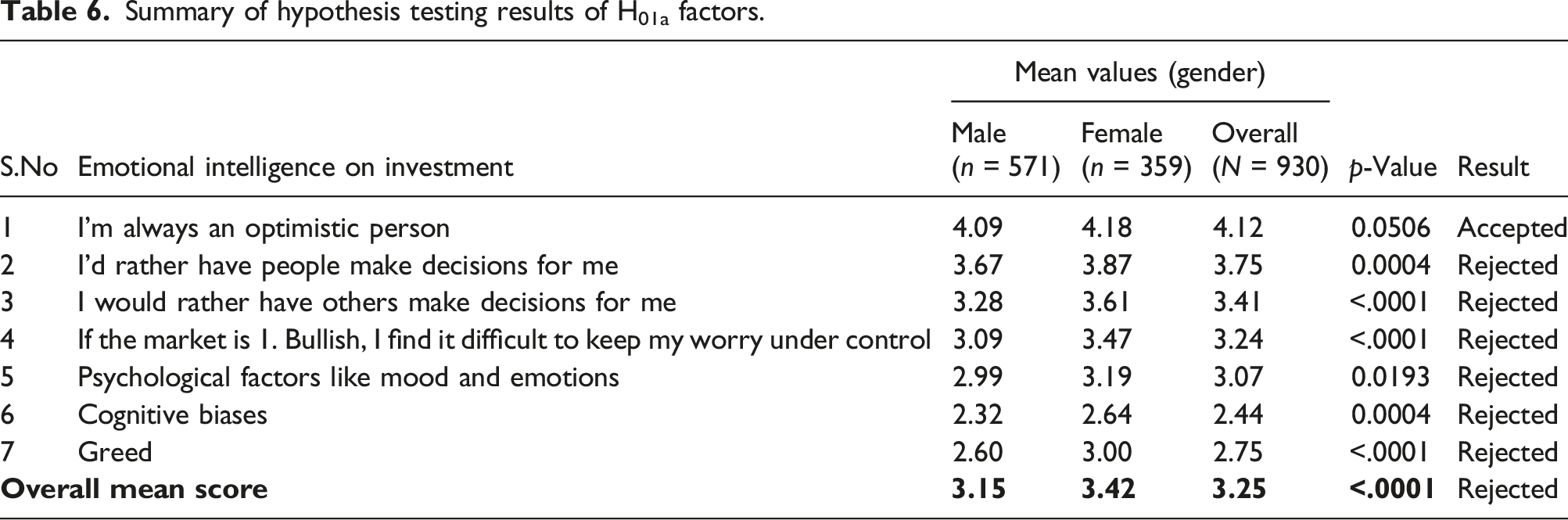
Summary of hypothesis testing results of H01d factors.

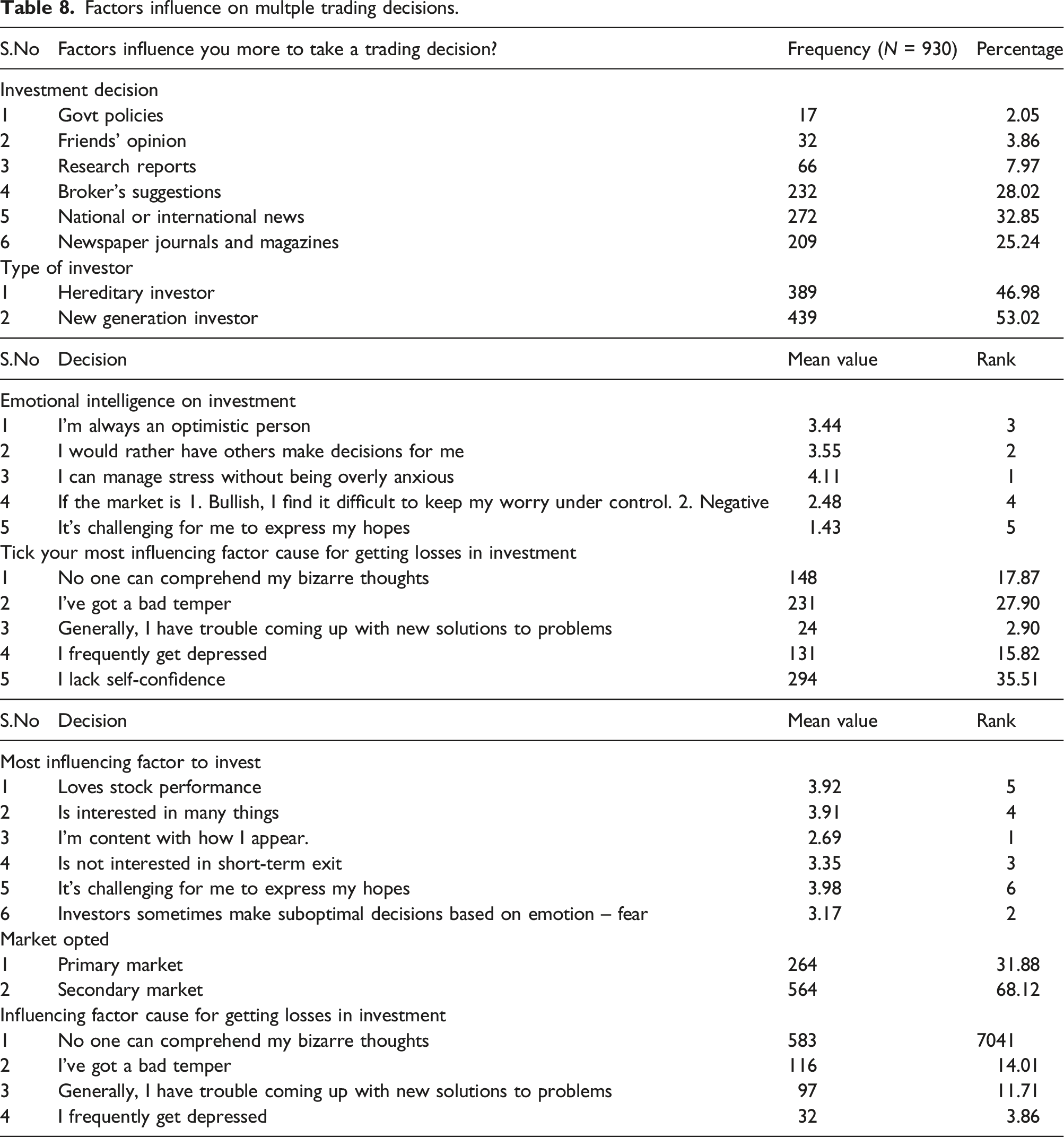
Factors influence on multple trading decisions.
Relationship status
The respondents’ average score for marital status was determined individually. The table reveals that the mean score for respondents who are married is 44.32, which is higher than the mean scores of respondents who are single (43.11). The following hypothesis was put forth and put to the test in order to determine whether the mean scores significantly vary depending on the respondents’ marital status. H0: The respondents’ marital status did not significantly affect the mean emotional trading scores.
Result
The t-test for mean equality was used to examine the aforementioned proposition. This demonstrates that there is a substantial variation in the respondents’ marital status in the emotional trading scores. As a result, the hypothesis is disproved.
Occupation: Respondents who fall into the category of a housewife and respondents who are self-employed (10.00). The average score of private sector workers (48.53), professionals (24.27), and students (23.27) comes next (19.33). The self-employed person has the lowest mean score. H0: The respondents’ jobs did not significantly affect the mean emotional trading scores. This demonstrates that there is a substantial variation in the respondents’ marital status in the emotional trading scores. As a result, the hypothesis is disproved.
The lowest mean rank for the items “Derivatives” and “Mutual funds” which are determined to be the most significant factors influencing the respondents’ investment.
Findings and conclusion
The study population consisted of 65% men and 59% married individuals; 43% of respondents are between the ages of 45 and 60; those whose source of investment is an inherited sum and who monitor their investments on a daily basis have significantly higher emotional trading scores than investors with other sources of investment.
The respondents whose purpose behind investments, the percentage of income invested, the average value of the portfolio, and the experience in investment in the capital market do not show any significant difference in the emotional trading scores. The study discloses the ability of investment ranks is significantly associated with the personal demographic factors and investment-related variables of respondents except for gender, marital status, and experience in investing. A majority of the investors invest their money through secondary markets, new generation investor investment based on brokers' suggestions and national and international news, and most of the investor’s short-term investment.
Conclusion
In the process of investing in stock markets, the investors enter into various emotional states of mind which are revealed through this study. ‘Trading with instinct’, emotional surges’, ‘strategy diversions’, and ‘unmindful of risks’ are identified as the key emotional groups among the respondents taken for study.
These emotions are found to be detrimental to the success of their stock market investments. Investors ‘gut’ feelings through their over-optimism are profoundly contributing to trading performance and annual income of the investors. The personalities of investors are dominated by positive and negative moods, which results in affecting the investment outcomes either positively or negatively.
The researchers suggested to understand emotions in investing, to properly handle instincts, to have rationale for strategy diversions, lower the temptations to jump into trades, being truthful to oneself, to take risk according to financial responsibilities, to do homework of security analysis, staying diversified, lessen illusions of control, and to follow emotional regulation techniques. The bottom line is while analyzing markets, investors need to have an objective perspective and never allow emotions to override their decision-making process.
Hence, to augment more favourable decisions under uncertainty which cannot be altered, the investors could recognize their emotions which affect their investments and to handle their emotions as suggested while trading in stock market investments. Finally, appropriate measures as suggested have to be taken by the investors to keep in check emotions and illusions of control in the trading activity.
The present study will advise investors to be positive, without panicking and staying calm without fear, to stay informed and focused, to wait for market recoveries, to make rational decisions with emotional consciousness, reducing debt, and to choose stocks wisely for an improved trading experience.
The present study will help to do further research on how emotional intelligence helps in constructing a profitable portfolio, as well as whether there is any relation between sentimental analysis and emotional decision-making that leads to picking the wrong security in the portfolio.
Footnotes
Declaration of conflicting interests
The author(s) declared no potential conflicts of interest with respect to the research, authorship, and/or publication of this article.
Funding
The author(s) received no financial support for the research, authorship, and/or publication of this article.
