




Abstract
Understanding the determinants of student learning outcomes and their academic performance is never being easy. Most of the studies examined the impact of emotional intelligence (EI) and intelligence quotient (IQ) on academic performance discretely, and their combined influence was not studied. The study identifies various dimensions of EI and IQ and investigates their impact on university business students’ academic performance comparatively among private and public university students. The data relevant to this study were collected from 416 students of various Business Colleges of Saudi central province universities, using online survey questionnaire. Structural equation modeling analysis using SPSS AMOS was used to evaluate the data. The private students possess a significant IQ, and their academic performance is primarily driven by IQ and with high EI; whereas public sector students possess moderate EI with insignificant IQ levels and tend to perform average in their academics. All the measurement items of EI and IQ explained only 43.6% of variance in public student’s performance and 56.3% in private student’s performance. The study argues the cognitive intelligence is very purposive in academics but narrow in nature and does not extend the horizon of student’s lifelong learning. Therefore, EI is vital and plays a prominent role in supporting their IQ as well. The study is limited to only business students; therefore, findings may not be generalized to other academic domains and for master level students. It suggests to conduct further studies to explore relationship among various exogenous variables.
Introduction
The widespread of global phenomena of international education have made it more challenging for academicians to understand the cognitive and emotional intelligence (EI) of university undergraduate students even from the domestic perspective, as it will always have a pragmatic effect on student’s learning process and achievements. Therefore, most of the employers evaluate quality of graduated applicants from various viewpoints of intelligence and operational competencies. However, these days it is very commonly noticed among the young generation who engaged in managerial jobs, consistently facing job insecurity with insufficient managerial skills despite being a management or business student in their academics. Hence, this study attempts to explore their level of EI and intelligence quotient (IQ) in the preparatory period of their future job search and advises them to improve their abilities pertinent to various job positions. While several abilities like worldly knowledge, logical and analytical thinking, continuous reasoning, and memory are represented by IQ, the EI is attributed by diligence, intuitiveness, teamwork, self-control, integrity, adaptability, patience, ability to listen, influencing others, empathy, self-confidence, controlling and evaluating self and others; feelings, identifying and conveying emotions, and using those emotions in social life can influence one’s individual and academic success as well. Also the academic learning outcomes predominantly relies on various psychometric tests associated with student’s IQ. Yet most of the research studies demonstrated EI is also equally significant in their long-term success. Most of the past studies categorized the set of abilities and capabilities as hard and soft skills. Where the former can be inculcated to some extent through a persistent learning process, but the latter do come with inherent qualities from family members. Goleman 1 argued academic intelligence itself is not sufficient to anticipate a person’s success, and their IQ stands secondary even in the job performance. But it is imperative how one can handle themselves and others in the society. Therefore, the intelligent individual is one who has ability to understand intricate ideas, develops adaptation in any situation, learn from their experiences, and generates alternatives by being emotionally sound. 2
Gardner and Stough 3 stated the theory of EI and its application in university business graduate programs mainly emphasized on individual’s rational and verbal skills with least importance to spatial, empathy, self-awareness, motivation, and emotions management. Also Nasheeta Adams 4 investigated the impact of EI on business undergraduate students in higher education and found there exists a statistically significant difference in EI among undergraduate university students based on gender and age but not on race. Among the respondents’ female and high age group students have higher EI than male and lower age students group respectively. Although the past studies examined the students’ academic performance (AP) either by considering IQ or EI discretely, a fair review of literature could not identify studies with a comparative influence on Saudi business students. Producing a competent graduate with a fair learning outcome being one of the main purposes of any Higher Educational Institutions (HEIs), most of those institutions thrive to produce students with good academic achievement and Grade Point Average (GPA). Although scoring a high GPA these days fetches a good opportunity for any university student either for future employment or to pursue further higher education, the study by Hassan and Al-Razgan 5 stated that even the Saudi students with high GPAs fail to get admission in university level due to poor score in entrance test. Hence, the present study did not focus much on current graduates’ GPAs except to understand if their cumulative GPA supports students’ performance in EI- and IQ-based test. Rather it challenges to consider students’ core intelligence which drives them to flourish in academic achievements from various dimensions of intelligences. In other words, the theoretical framework spotlights the gap between present state of intelligence and a future desired intelligence levels. Also extant Saudi literature evidently stated the quality of education in private institutions is superior than in public sector. 6 Therefore, this study attempts to explore whether there exist any remarkable differences in the level of IQ and EI among public and private undergraduate business students driving them toward their overall AP. In the next section of literature, various dimensions of EI and IQ were identified to develop a research model for the study and also present the need to examine the private and public university students distinctly. Research methodology elucidates the development of survey questionnaire, data collection, and analysis. The study employed structural equation modeling (SEM) tool to understand multiple interrelationships among the variables along with their path coefficients. The findings of this study are expected to contribute to business students in understanding and prepare themselves for the upcoming challenges in their early professional lives, and also to academicians to strategically work on reinforcing the quality of business students and improve the undergraduate curriculum as per job market requirements.
Literature
In current years, most of the governments across the world are avoiding the burden of funding on higher education. This reason has escalated to introduce an alternative system of private universities which can also decrease the issues of government funding. 7 The extant literature has developed multiple perspectives in comparison of private and public universities and stated that the private sector differs to their counterpart in terms of funding, ownership, orientation including teaching, research, resources and accreditations, the wider access, and quality of higher education. 8 –10 Yussra Jamjoom 6 in their study specified the Saudi private universities heavily depend on tuition fees with a very limited assistance from the government scholarships, and from this perspective, they offer more number of programs to attract new admissions, deliver high quality of education, and the same is expected with students’ learning outcome and AP. The author also provided a deep insight on the entry phase of students into private higher education from two views. Both private and public higher education institutions in Saudi Arabia differ mainly in admission requirements and the tuition fee. While admission in public sector depends on the combination of standardized eligibility tests (general aptitude test) also known as “Qiyas” and GPA of secondary school grades, the private sector is less strict on these admission requirements. Normally, the students who are less competent and fail to fulfill these requirements in public sector seek to get an admission in private sector. There exist a lot of notions on why students opt private institutions. The author noted that the private students see themselves in a prestigious environment and most of them belong to the same social class and cultural background with a positive effect on their ability to communicate and socialize as they are much exposed to outside world, where this is not possible in public sector because of more diversified students from rural areas. On the controversy, the author also added over the period of time many private students reported there exists a high competition among the students for scholarships and are more concerned about their studies. Even the admission criteria are becoming stricter in the recent years. After multiple interviews with the university graduates and employers, the author concluded that the use of English in classroom instructions is the major attraction in private HEIs giving access to updated learning resources unlike public universities and such private institutions contributing in delivering high-quality education. It was very evident from multiple respondents that public sector graduates since long time were attributed as incompetent and getting rejected in the job market, while the private academicians stated their students’ confidence, enthusiasm, and English speaking skills were their biggest asserts in securing the jobs in global economy. Al-Munajjed 11 further added the Saudi public universities fail to prepare Saudi women for any potential competitive roles and restrict them only for teaching and the jobs in service sector. However, private universities address such issues and groom their students toward good academic achievement from different perspectives. In connection to this, the study aimed to explore the differences between EI and IQ of public and private sector university business graduates and presents the retrospective analysis of EI and IQ and association between both of them from global viewpoint.
Emotional intelligence
Mayer et al. 12 proved EI is the strong determinant of individual’s outcomes when compared to IQ. The author added, IQ basically drives on various facets and information available, and EI works primarily on perception, personal, and social emotions. Similarly, students with low EI are prone to experience pressure and complications in their studies. Researchers found EI can serve as an arbitrator in conjunction with IQ in academic achievements. There are many critical factors of EI that are associated directly as an integral part of learning process, student’s commitment, classroom motivation, and engagement. 13,14 By considering the five aspects of academic EI of Mayer and Salovey’s 15 study, namely self-motivation, self-awareness, empathy, emotional management, and interpersonal skills; Azizi Y. et al. 16 studied the effect of these measures and showed self-awareness, empathy, and emotional management had an overall significant influence on academic achievement and demonstrated a constant increase in total variance on dependent variable using stepwise regression. The author noticed the growth in the level of students’ EI helped in the improvement of their intellectual skills, and this upsurge must be reflected in the classroom teaching and learning process. Professor Howard Gardner classified seven different intelligences into intrapersonal and interpersonal intelligence, where the former is the ability to control oneself by including their own psychological feelings and the latter is to consider others psychological state. Krouse and Krouse 17 and Brown and Langer 18 stated the students who lack self-discipline, enthusiasm, self-confidence, and attitude have low EI and thus the low AP. Rode et al. 19 also asserted those who have high EI can perform well in studies, because such achievements comprise huge uncertainty and need lot of self-direction and self-management.
Many other studies also ascertained, apart from observing IQ-related items in students, EI skills also determine their academic achievements, and those students relatively with low EI skills display externalizing behavior than others and face adjustment problems in studies. The EI model of Mayer and Salovey 20 suggested students can be taught these EI skills using various EI programs which clearly focuses on emotional ability to recognize, realize, and control emotions. While showing empathy, morality, and respect toward elder are important qualities of EI, different children and adolescents have different ways to develop those skills in them. 21 The scientific report by Goleman 22 stated the pupil with self-discipline, understanding fellow feeling, and self-confidence have a positive influence on their behavior and is true in their AP and forthcoming employment opportunities also. The study conducted by Parker et al. 23 on understanding the role of EI in academic achievements proved the high achieving students hold high EI and had superior interactive capability, good school attendance, adaptableness, and good stress management skills than others, while medium percentile group had considerably high grades than low-level achievement students. It is proved hypothetically and scientifically that pupil with extraordinary EI abilities are better able to possess empathy, attention and success in academics, improved interpersonal relationship with peer and teachers, and enhanced opportunities to get employed. 24 Although there are numerous recent studies who considered the five dimensions of EI as subfactors, this study adapted those relevant items from Mayer and Salovey. 15
Intelligence quotient
Principally IQ is the capability of significantly answering the questions with the available piece of information in a logical manner. This word was first termed by William Stern, a German psychologist. According to the author, human intelligence can be quantified by their psychological age to that of their chronological age. IQ being an individual’s reasoning ability and is measured based on students’ short- and long-term memory, flow of knowledge, and logical ideas who may shift their brains between intensive thoughtfulness and mind wandering. This kind of mind functioning varies from person to person and there exists only few super intelligent as a result of their inheritance from family members. In understanding what determines human IQ, many neuro studies identified both genetic and nongenetic factors as main contributors. While genetics are inheritance from parents and grandparents which will also increase with age, accounts for 50% of individuals IQ and the nongenetic includes both collective and unshared environment resulting to 25% and 20%, respectively, with 5% error during evaluation in the former. 25 The author conducted multiple IQ tests included numerous measurement items such as quantitative reasoning, specific knowledge, vocabulary and expressive language, visual spatial processing skills, working memory, motor coordination, and perceptual skills. 25,26 They also argued other EI variables like tension and unfamiliarity during test process, emotional anxiety may also have direct association with IQ score. Veena Yesikar et al. 27 proved the students with average IQ work hard and perform even better than the high IQ students but with extra preparation hours for their academics. Whereas, the high IQ students are sincere to the classes and spend less time in their self-study. Goleman 1 articulated that in determining the success, IQ accounts only 20%, and there are several other determining factors which need to be identified. The study of Neisser et al. 2 stated that the children with high score in IQ tests are inclined to reflect the knowledge which is been taught to them in school. It is also proved these students also clear the most difficult competitive exams who basically belong to the upper class of socioeconomic and whose parents are well educated, particularly their mother’s possessing high qualification than others. Therefore, it is clearly understood the family atmosphere, the way parents groom and nourish their children, and genetic inheritance will have a significant impact on the adolescent intelligence. 28 Veena Yesikar et al.’s 27 study on IQ analysis on medical students’ performance revealed that average IQ students work hard toward their academic achievements in comparison to high IQ pupil. For any competitive or entrance test, a student’s IQ should not be taken as source because it may be injustice to other students who are from low socioeconomic and poor environment. Therefore, the excellence in previous academics must also to be considered for a rational merit evaluation, along with various EI aspects. Therefore, the various subfactors relevant to IQ construct were adapted from the studies of Weinberg RA 25 and Bain SK and Allin JD 26 .
EI versus IQ
Uzsalyné Pécsi’s 21 study on comparison between EI and IQ states the trend of technological progression in modern era ruminates the academic intelligence over EI and supersedes those qualities in children which are essential for personality development. From this perspective, IQ has gained central focus with an ever projecting role in the education system. However, this kind of education system overshadows the determinants of EI which are very important in the later success of professional life. As a result of this IQ-based education system, the present society, university graduates’, and also professionals are encountering the individuals with hostile behavior, lack of interest, no adaptable skills particularly when working with teams are examples just to name the few. Therefore, Uzsalyné Pécsi 21 argues many primary and preschools proactively inculcate these academic skills in students in early childhood, else there may not be time for these developmental activities later on. Goleman 29 demonstrates that an individual’s success is measured by grades to state if he or she is extremely good in achievements, but these dimensions do not explain physical dexterity, various capabilities, and how they react to the fluctuations in their lives. Based on the thorough literature review, the study proposed the below theoretical model to understand the impact of EI and IQ on students’ AP.
Academic performance
There is a substantial literature which considers GPA as a significant predictor of AP. A study by Platt et al. 30 among US students, Wharrad et al. 31 among UK students, and Ayyaf and Magzoub 32 among Saudi students explained a positive relationship between high GPA and AP. Although many studies validated the traditional approach of measuring the AP, they ignored the dimensions of IQ and EI and practiced standardized measures of cognitive skills and high GPA in predicting students’ AP. On the other hand, many recent studies explored the importance of multiple elements of intelligences and demonstrated strong relationship between IQ and EI with AP and found they are also the significant predictors of AP. 4,15,19,20,22 Mayer and Salovey 15 were the first to present their findings to academics on EI and categorized into five aspects of dominance. Another study by Parker et al. 23 confirmed EI will have a strong relationship with AP as students face substantial stressors in terms of emotional and social issues as they have to develop new relationships and act independently at university level. It was found these stress levels are much high in the initial year than the subsequent academic years. Such students gradually develop high EI and are also successful in their academics. The theory of EI also provides a significant contribution to career counsellors at higher education establishments. Similarly, Alan et al. 33 and Akbar et al. 34 proposed those students with an IQ of 85 and above can flourish with high grades. Uzsalyné Pécsi 21 asserted the prominent role of IQ in education and such students with good IQ will positively represent good AP.
Research model and hypotheses
The comprehensive review of literature has provided robustness in developing the below research model for the present study as shown in Figure 1. All the measurement items of both EI and IQ were adapted from various studies as mentioned above. According to the purposes of the study, to explore the influence of undergraduate business students’ emotional and cognitive intelligences on their AP among public and private universities, the following four hypotheses were formulated.

Research methodology
Survey instrument
The measurement elements used to operationalize the latent constructs in the above model were adapted from Weinberg RA, 25 Bain SK and Allin JD, 26 and Mayer and Salovey. 15 However, an online questionnaire in English with demographic information, various EI dimensional questions on a five-point Likert-type scale, and IQ dimensional multiple choice questions were developed to test the multiple intelligences of business students. They were asked to answer the set of questions with a time limit of 50 min. Later on, the test scores of each dimension were synthesized and standardized to rate the performance on a five-point Likert-type scale (1 = Very poor; 3 = Average; 5 = Excellent performers) and also to use easily in further data analysis.
Sampling method and data collection
As the segregation of male and female is strictly practiced in Saudi Arabian universities, the study used convenience sampling in combination of quota sampling so as to maintain the proportionate male and female students’ responses. With the help of teaching faculty members, the online survey questionnaire was sent to the current fulltime business students of five public and private Saudi Arabian universities, respectively, in the Riyadh province. The efforts resulted in 458 responses, but only 416 found to be complete and useful for the data analysis. Further the data were tabulated separately as two data sets for public and private universities in SPSS version 21.0.
Data analysis
The demographic profile of the respondents was portrayed in Table 1. The study evaluates the data in two phases. First, the tests of robustness of the constructs’ measures through measurement model were conducted and then examine the casual relationship between exogenous and endogenous constructs by path analysis. The IBM SPSS version 21.0 was used to analyze the data stagewise using AMOS version 21.0. From Table 1, it is observed that the responses from both public and private universities accounted almost in the same ratio with male respondents representing 52.40% and female 47.59% with majority of them being singles and from second and fourth years in their bachelor degree.
Respondents demographic profile.

SEM approach
According to Gerbing and Anderson, 35 SEM is a second generation multivariate data analysis technique, very popularly used in behavioral and social sciences. Unlike the first generation regression models, namely linear regression, analysis of variance, and so on, the SEM has the ability to investigate multiple interrelationships in a single and comprehensive analysis and loads the observed items on their respective latent variables (measurement model) and evaluates the expected causation among set of dependent and independent variables (structural model). While the former is accomplished by confirmatory factor analysis, the latter is done by path analysis. Therefore, this analysis is done using IBM SPSS AMOS version 21.0 followed by the results and discussed as below.
The measurement model
Table 2 presents the mean, variance, and standard deviation derived for the constructs. The measurement model exposed a robustness of the constructs’ measures as represented by the internal consistency reliability (composite reliability), and as recommended by Nunnally, 36 these values of reliability exceed a threshold of 0.70 and range from 0.85 to 0.92 for public universities and 0.83 to 0.87 for private universities students as presented in Table 2. Furthermore, the average variance extracted (AVE) estimates the quantity of variance captured by a set of items in a scale relative to the measurement error. Fornell and Larcker 37 suggested a cutoff value of 0.50 for AVE, also here these values are within acceptable range from 0.862 to 0.896 for public university and 0.862 to 0.884 for private university students. The overall fitness of the proposed model found to hold a good fit by observing various fit indices, namely relative χ 2 1.645 at p < 0.001, GFI = 0.913, AGFI = 0.877, CFI = 0.926, RMSEA = 0.036, RMR = 0.005, and SRMR = 0.0135. Further, an advanced test of the measures using convergent and discriminant validity test was executed to inspect the construct validity. As stated by Gerbing and Anderson, 35 the results of convergent validity demonstrated the factor loading and cross-loading of the indicators load on to their respective constructs with lower limit of 0.70 and upper limit of 0.926. Whereas, the discriminant validity was conducted through the comparison of the square root of AVE of individual latent variable to the standard correlation coefficient among two constructs. 37
Estimation of measurement model.

AVE: average variance extracted.
The structural model
The outcomes of structural model are well demonstrated in Tables 3 and 4. The summarized results of structural model were also demonstrated in Figure 2. The path coefficient values in red color represent the public university and that in green color represent for private university students. Since this study only proposed to identify the direct influence of each exogenous variable on the endogenous variables, the β values of path coefficient were observed along with their significance level. These β values are separately noted for both public and private university students. The results exhibited among public university students show that IQ has insignificant impact on AP with β = 0.182 at p > 0.05; so the hypothesis (H1) was rejected as the data did not support the hypothesis; while EI was positive and moderately significant with β = 0.257 at p ≤ 0.01, the hypothesis (H2) was accepted. On the other hand, among private university students, IQ was positive and moderately significant with β = 0.462 at p ≤ 0.01, and the hypothesis (H3) was accepted; and EI was highly positive significant on AP with β = 0.549 at p ≤ 0.001, therefore the hypothesis (H4) was accepted. Also the IQ and EI of public sector students have explained only 43.6% of variance (R 2) on AP; while among private sector students, IQ and EI have explained 56.3% of variance (R 2) on the endogenous construct.
Path coefficients of structural model.a

a p ≤ 0.001 (*** = highly significant); p ≤ 0.01 (** = moderately significant); p > 0.05 (γ = not significant).
Correlation coefficients.a

QR: quantitative reasoning; SK: specific knowledge; CS: communication skills; VSP: visual spatial processing; M: memory; MC: motor coordination; PS: perceptual skills; SM: self-motivation; SA: self-awareness; E: empathy; EM: emotional management; IS: interpersonal skills.
a p ≤ 0.001 (*** = highly significant); p ≤ 0.01 (** = moderately significant); p ≤ 0.05 (* = low significant); p > 0.05 (γ = not significant).
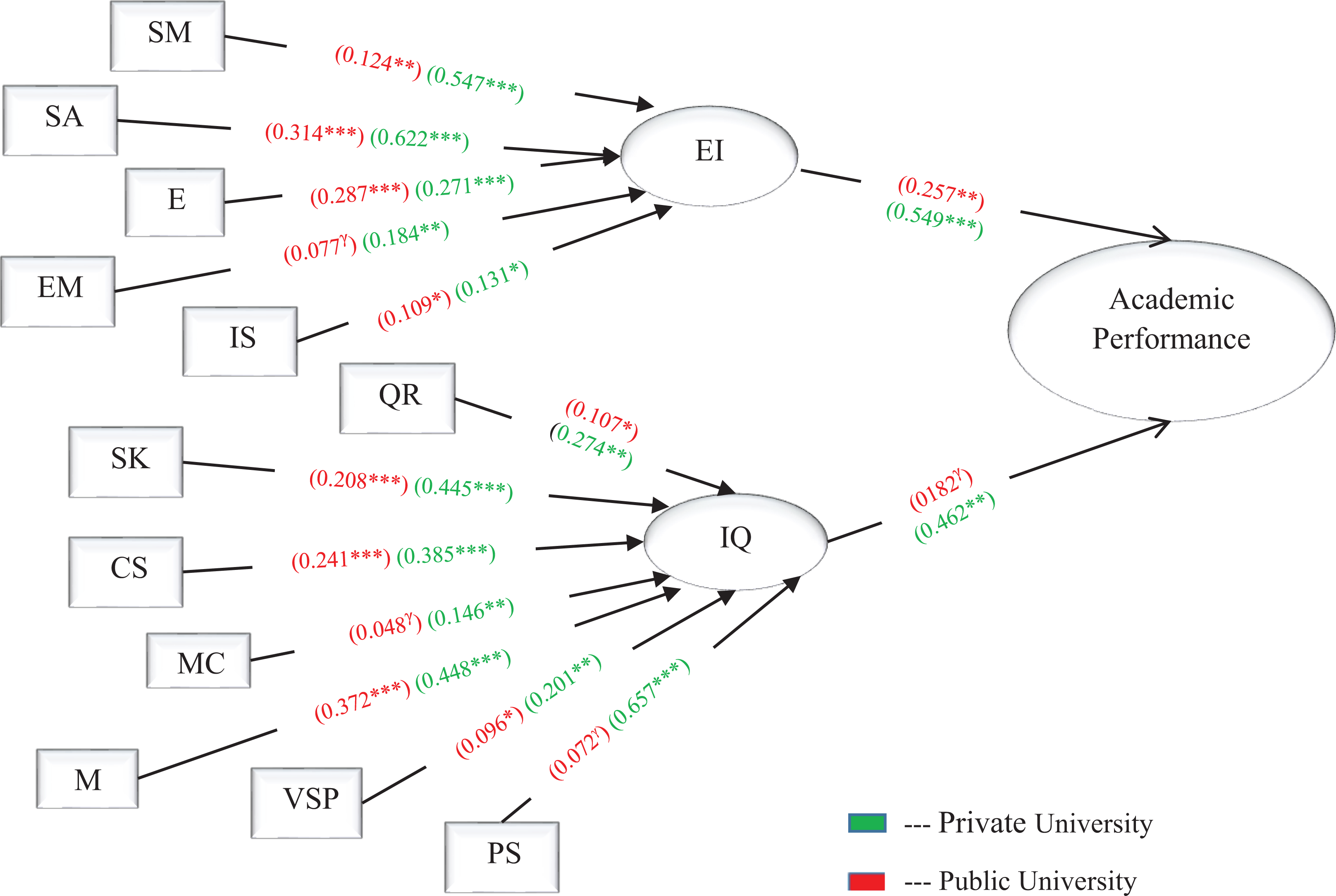
Path coefficients of structural model. Note: p ≤ 0.001 (*** = highly significant); p ≤0.01 (** = moderately significant); p ≤ 0.05 (* = low significant); p > 0.05 (γ = not significant).
The correlation of coefficients (r) in Table 4 revealed motor coordination (MC), perceptual skills (PS), and emotional management (EM) among public university students are insignificant with r = 0.048, 0.072, and 0.077, respectively, at p > 0.05 indicating this group of students have poor motor coordination and perceptual skills where they are unable to use multiple body parts same time for certain tasks and also not able to grasp and organize the information that is been taught in the classroom. Also these students do not hold emotional management skills within them and not able to promote individual understanding to others and vice versa. The quantitative reasoning (QR), visual spatial processing (VSP), and interpersonal skills (IS) are low significant with r = 0.107, 0.096, and 0.109, respectively, at p ≤ 0.05 illustrate they are somewhat able to use their mathematical skills in their specific disciplines, understand the results in the practical scenario, and draw conclusions that are relevant to their courses but at a slow pace. While self-motivation (SM) has r = 0.124 at p ≤ 0.01 states only 18.6% of them are able to communicate well with their peer and faculty members to develop a rapport among the people around them. It also shows these students also have an attitude to work collaboratively and adapt themselves in teamwork activities and specific knowledge (SK), communication skills (CS), memory (M), self-awareness (SA), and empathy (E) are highly significant with r = 0.208, 0.241, 0.372, 0.314, and 0.287, respectively, at p = 0.001 exemplifies that these students have significant knowledge in their subject and can learn, express, and memorize their ideas, various concepts, and theories well and also reflect them during examinations, which are assertive for them in scoring moderate to high grades. This group has high self-awareness and confident in performing well in their academics.
Similarly, the correlation of coefficients among private university students for IS was 0.131 at p > 0.05 indicating they do not interact much with others as they are much self-oriented. The QR, VSP, MC, and EM are moderately significant with r = 0.274, 0.201, 0.146, and 0.184 at p ≤ 0.01, which portrays they are fairly good in mathematical application and interpret various concepts and are able to use the mental and physical motors simultaneously in various tasks. They also manage their own emotions and of other as well. While SK, CS, M, PS, SM, SA, and E have r = 0.445, 0.385, 0.448, 0.657, 0.0547, 0.622, and 0.271, respectively, at p < 0.001, show more than 55% of private students possess sufficient theoretical knowledge, and address various subject relevant questions posed to them. To a great extent, this group can memorize the concepts in a powerful way provided if those activities are repeated again and again and leave a practical implication in their minds. They have a great asset of motivating themselves in any kind of situations and know themselves well to that what to do, when and how to accomplish better in their AP.
Findings and discussion
The study identified that there exists a significant difference between private and public sector students. It is observed that the public university students have a temporary approach in achieving their GPAs as their memory has high correlation coefficient value among other IQ variables; however, their IQ is not significantly influencing their AP. Nevertheless, they possess a substantial EI in them. On the counterpart, the private students possess sufficient IQ and a high positive EI within them. According to many previous theories and research studies, these kinds of pupil will succeed both in their academics and in professional lives as well. This finding is also consistent with the study of Azizi Y. et al., 16 which states the significant EI can augment the IQ of students and therefore supports in the improvement of overall AP. This study develops an assumption that to some extent, the IQ is gained based on the hereditary from parents and grandparents. The students’ performance in the test found that even the high cumulative GPA students scored comparatively less than low cumulative GPA students. Therefore, the cumulative GPA of the present ongoing undergraduation program did not support the test results. However, this study did not explore the effect of their past academics’ GPAs (secondary school/preparatory year GPA). Since the undergraduation students come from different fields of study in their secondary and preparatory years and most of them from Arabic medium of instruction, with almost same IQ and EI levels except for those who have strong genetic inherent. And it is understood those cognitive and noncognitive learning processes are improved while pursuing graduation studies. Among them, the study noticed the private student’s cognitive skills are better than public sector. This tendency can be reasoned by the fact they exist in better learning environment with quality infrastructure, well-equipped learning resources, more choice of relevant but new courses than traditional one’s, and knowledge sharing peers and faculty members. Nevertheless, it can be expected the public students can also possess same IQ and EI levels provided the same environment and infrastructure. So it may be implicit apart from the level of IQ and EI, the quality of education, past GPAs, exposure to outside world, learning environment, and quality of students will also have positive effect on the overall AP. But in comparison of different years of bachelor degree students’ IQ and EI, 62% of fourth year students found to hold better level of intelligences and hold above average emotional feelings in them. This positive outcome is expected since they already undergone through some learning process at university level, while second and third year students ranged from average to above average level of IQ, but their level of EI are almost same. The first year students have just completed their preparatory year program and new to higher education system and are still in the adjustment stage and learning to develop expressive communication with their faculty members. These students scored below average in the test. Therefore, their IQ and EI found to be very poor and expected to improve in future by a systematic learning process. However, more than 60% of students stated they are not much bothered about the preparation for daily classes. Also the sub-item, M in IQ construct for public students is highly positive significant than any other sub-items with 0.372. It may be assumed the subject knowledge they gain is only a temporary approach. This finding is also consistent with Yussra Jamjoom’s 6 study that explored the quality of students in private and public sector. Therefore, the study recommends to implement a subtle approach by addition of logical, reasoning, application kind of questions, and learning through critical incident method to bring out the best possible prospects of sustaining managerial skills and personality qualities in graduates to inculcate in them the employability skills that are prerequisite for their professional life. Also, the best way to inculcate EI in students is to conduct some class or college activities like role modeling, case studies which can develop sharing, and the environment of empathy and support among each other. These findings were also reconcilable with many other studies that steered in understanding students’ IQ and their academic achievement. 38 Although most of the today’s business schools in Saudi universities implement such learning approaches, unfortunately many students comply them for the sake of completion of graduation and score high GPA, but the core values of such methods were not being recognized. The study suggests the Saudi business schools to strictly embrace and adhere to the core purposes by putting these practices in academic programs and not just for academic approvals and accreditations. Also this can create an opportunity for various colleges/universities to be the pioneers in delivering best business education and reduce the dependency on foreign education, where it is very commonly observed these days to provide academic scholarships to Saudi citizens by sending them to Western countries for high-quality education purpose. Although this study could not gather any kind of information from graduated students on their salary levels, there are some evidences from recent studies conducted by Sania Khan 39 and Sami 40 demonstrating the work performance of Saudi students after their graduation. This was the perspective from Saudi industries that indicated 66% of fresh graduates do not possess potential competencies in them and are disqualified to get employed. Also 77% of local employers are uncertain about graduates’ work performance since they lack technical and analytical skills, inability to work under pressure, and most of them are not customer oriented. Therefore, the findings of this study provides significant inferences to university graduates in terms of developing intelligence and emotional values that are required to inculcate in them to possess a good academic record. This study also contributes in adding value to the literature and addresses many existing research questions on to what extent the Saudi private university business students are perceived to be different from the public university students.
Limitations
The findings of the study are limited to the business colleges in Saudi Arabia. The sample size is comparatively small in number to that of those pupil who currently registered in the universities. The data were collected directly from the current students based on their self-report, therefore the input of other members like faculty, student academic affairs, alumni, and management is missing which may be required to present the broader perspectives of students. The study attempted to recognize the present students’ intelligence and its influence on their AP. So various other factors which influences their overall performance was not studied. Similarly, the past academic GPAs were not considered to test if the GPA supports the test results. Hence, the results may not be generalized in understanding the dynamic behavior of the future business students and also from other field of study. Similarly, the results may not be applicable to master-level students whose admission process for this program has a different criterion, where the students need to comply with high language skills like IELTS, TOEFL, and also general management aptitude tests.
Conclusion
The study attempted to understand the most influencing intelligence that effects undergraduate business students’ AP. Toward this, it collects the pertinent factors and subfactors of EI and IQ. Only specific knowledge, communication skills, memory, self-awareness, and empathy found to be the most significant predictors of public students’ performance. Therefore, the study recommends the ways to improve the government university academic curriculum and adapt cutting-edge approaches to stimulate and inculcate various intelligences in the students. Similarly, the quantitative reasoning and interpersonal skills found to be slightly low positive among private students. The study identifies public university students possess insignificant IQ but a significant EI with them. However, it is generally known that EI without sufficient IQ in academics cannot help the students to perform well and such approach is very narrow and hinders in lifelong learning and professional achievements. On the other hand, the private university students possess a fair and sufficient IQ with a high EI in them, indicating they will flourish with good GPAs and also in their professional lives. Private students are also the most potential candidates in the job market with rational employability skills in them. It further indicates that industry can target private university graduates for hiring new employees at beginners’ level. It is concluded that students need to possess more emotional values than the cognitive, as these intelligences will assist them to be more successful in both academics and in their professional career, which also builds an image and reputation to the school they graduated from. Further, the study recommends to conduct comparative studies with international students to give a holistic view and inspire the Saudi business students. This idea can also bring in various intelligence dimensions to be instilled in Saudi students appropriately with foreign students and bring them on a common platform of knowledge management. Also subtler approaches may help in exploring the pupils’ intelligence consistency with their expected learning outcomes. Further research studies can also be conducted by understanding any indirect effect of EI and IQ in conjunction with other factors as mentioned by various past researchers.
Footnotes
Declaration of conflicting interests
The author(s) declared no potential conflicts of interest with respect to the research, authorship, and/or publication of this article.
Funding
The author(s) received no financial support for the research, authorship, and/or publication of this article.
