




Abstract
Digital Innovation Hubs (DIHs) are ecosystems bolstering European companies to overtake innovation hindrances and drive Europe to become the world leading innovator in the industry digital revolution. Each of such organizations can provide a certain list of services, that can be classified and grouped in five macro-classes according to the Data-driven Business-Ecosystem-Skills-Technology (D-BEST) reference model, able to decode DIHs’ service portfolio and to shape collaborative networks in the Industry 4.0 age. However, to support an easier codification of DIH support actions, which also directly entails the engagement of enterprises in the DIH ecosystems, a method able to analyze typical Customer Journeys (CJs) is needed. Therefore, this paper proposes the D-BEST based DIH CJ analysis method, able to configure DIHs’ unique value proposition, mapping on the five macro-classes of services of the D-BEST the digital transformation processes of the two main categories of DIH customers (technology end-users and technology providers). The method analyses the service provision process of single DIHs, evidencing their strengths and weaknesses, and is also effective in suggesting possible collaborations and joint service provision in a network of multiple DIHs, being able to unveil the commonalities and complementarities among the different journeys.
Keywords
Introduction
Technology is increasingly playing a key role in today’s business, both product- and service-based. 1 The acceptance and employment of new digital technologies and applications is related to the companies’ maturity to use them in their manufacturing plants and processes. The digital transformation path is a constant journey, 2 influenced by the different company’s divisions, functions and areas of interests (as the business strategy, the supply chain management, the operating model and the business model3,4) progressively guiding the company to reach a high maturity in the Industry 4.0 (I4.0) domain.5–8 However, often digital transformation requires the support of intermediaries, boundary organizations9,10 able to align the divergent interests of science and politics,11–13 to facilitate synergies between scientists and non-scientists by remaining liable to both, 11 and to make collaboration possible by enrolling actors on the basis of their convergent interests. 9
In this context, Digital Innovation Hubs (DIHs), 14 intended as innovation ecosystems 15 capable to play a boundary role, 16 are aimed to bolster European companies (especially SMEs) flanking them in the different complex steps of the digitalization path. Through the provision of a set of services, able also to directly connect them with stakeholders as universities and research centres, 17 companies are pushed towards an easier and faster digital growth.18,19 DIHs work as a one-stop-shop, and can play four main functions: support to find investments, skills and training, test before investing, innovation ecosystem and networking. 20 The achievement of each of these functions is enabled by the combination of assets (knowledge, skills, competences, technologies and resources) owned by the DIH and by their capability to provide a certain set of services. 21 The role of DIHs to push Europe as a world leading innovator in the Fourth Industrial Revolution context is progressively raising, grounded on the several funding initiatives launched by the European Commission (EC) (e.g. ICT Innovation for Manufacturing SMEs (I4MS), Smart Anything Everywhere (SAE), Digitizing European Industry (DEI)).20,22,23 Among the projects funded by the EC in the recent years, DIH4CPS 24 is running to develop a collaborative network of DIHs and solution providers in the cyber-physical and embedded systems (CPES) area, supported by an integrated platform, tangling competences, 25 assets and technologies from multiple domains, and connecting regional clusters with the pan-European expert pool of DIHs. By now, one of the most important results of the project is the Data-driven Business-Ecosystem-Skills-Technology (D-BEST) reference model, able to decode DIHs’ service portfolio and to shape collaborative networks in the I4.0 age. The model can be useful for multiple purposes: to classify DIHs’ service portfolios and characterize the overall portfolio of a network of collaborating DIHs, to help to plan their service pipelines, and to unveil opportunities for synergies among DIHs with the aim of supporting the creation of a pan-European DIH.
However, to support an easier codification of the DIH support actions, which also directly entails the engagement of customer enterprises in the innovative DIH ecosystems, a method able to codify DIH Customer Journeys (CJ) is needed. Indeed, as usually done in the company context by service design,26,27 to successfully design, manage and deliver services, it would be important to evaluate the service delivery process from a customer’s perspective. This has been demonstrated in service design 28 with the introduction of service blueprinting, a method grounded on flowcharts that visually clarifies the steps involved in a service delivery process, shaping how it should be understood and analyzed. The service blueprinting technique can be used for building at the same time the CJ and the service provider processes 29 in a versatile way. Among others, 30 CJ is the most utilized visual method in service design and has been widely adopted in the design of both public and business services. 31 Based on its versatility, CJs can also support the analysis of the service provision process for DIHs. However, tailored templates of the digitization path, split in well-defined phases, with gates and related blocking-points, need also to be built.
So far, CJ templates tailored for DIHs do not exist. Blueprinting is a general structure to design service provision. However, DIHs need of codified and systematized journeys, which they should refer to in the digitalization support process of SMEs, allowing them to better realize which is their own unique value proposition and how they could better engage their customers. Therefore, this paper proposes the D-BEST-based DIH CJ analysis method, able to configure DIHs’ unique value proposition, mapping on the five macro-classes of services of the D-BEST the digital transformation processes of the two main categories of DIH customers, Technology end-Users (TU) and Technology Providers (TP). The research answers to the research question: How to configure DIHs’ unique value proposition to bolster their support action towards SMEs throughout the digitalization path? The model is also able to detect the similarities among the different DIHs composing a given network of collaborating DIHs, unveiling attitudes and inclinations of each DIH towards specific macro-classes of services and CJ steps. This analysis open rooms for possible collaborations among the DIHs composing the network, based on the strengths and weaknesses detected for each of them.
The paper is structured as follows. The Research context: the D-BEST reference model for DIH service portfolio configuration and the customer journey method presents the research context, introducing the D-BEST reference model for configuring DIH service portfolios. The Research Methodology shows the research method adopted and The D-BEST based DIH Customer Journeys analysis method provides the results, proposing the D-BEST based DIH CJ analysis method and the analysis deriving by its application to the network of the DIH4CPS project. The Discussion discusses the results obtained and The Final concludes the paper also unveiling its limitations and the research opportunities triggered.
Research context: the D-BEST reference model for DIH service portfolio configuration and the customer journey method
The D-BEST reference model for Service Portfolio configuration
The D-BEST-based DIH CJ analysis method, as the D-BEST reference model on which it is grounded, is the result of the work of multiple projects of the third and fourth wave of I4MS.24,32,33 The evolution of the D-BEST Reference Model grounds on the threefold Ecosystem-Technology-Business (ETB) I4MS 20 service model, developed in the context of the Access to I4MS (XS2I4MS) proposal (a support action to advance the I4MS ecosystem) 34 and actually used in all the DIHNET.eu 35 projects. The three categories composing the ETB model have been elaborated based on the experience of DIH stakeholders and also from the past experimented research in the frame of several projects from the EC’s I4MS calls. The D-BEST model, explained in detail in, 36 extends and customizes the ETB to the particular domain of CPES. As a result, the D-BEST reference model is grounded on five main macro-classes (Ecosystem, Technology, Business, Skills, Data), representing the main contexts in which the DIH can operate delivering services to its stakeholders, and is aimed at configuring the services composing the service portfolio of DIHs.
Service portfolio is defined as the identification of the set of services provided by a DIH. These services will be classified in the five macro-classes of services of the D-BEST model and will be allocated along the different steps of the CJ.37–39 Each one of the service types composing the macro-classes can be further detailed in service classes and instances. In this research, the level of description of the services composing the DIHs service portfolio reaches a more specific level, providing the overview of the specific instances of services offered by each of the DIHs composing the DIH4CPS network. The intention is to clarify how the services of each DIH can be classified and contributes to build their CJ.
Service Design: the Customer Journey (CJ) method
In service design, two different states of a service are considered: the static potential state is reported in the blueprint while the kinetic state is represented by the CJ, that is the actual rendering of the service. 28 Considering both in the service design is key to detect deviances of the process from the blueprint. Indeed, CJs can be described as visual illustrations of the events of the provision of a service represented in a timeframe as experienced by the customer, and can be shown on a service blueprint. 28 While blueprinting is functional to the static representation of a service, enabling the proactive identification of stages, phases, issues and fail/blocking points, and showing how services often happen, 29 it does not support the service process individualisation for customers. On the other side, the use of CJs is functional to foster customer orientation rather than as a tool for service design and evaluation.
So far, the CJ approach has been introduced in service ecosystems with the goal of increasing value creation for the customer and value capture for the provider 40 but has still to be proposed into the DIH domain to map existing services and represent (together with a sort of blueprinting) the typical steps and failing points of the digitalization journey along which the different types of DIH customers can interact during the service delivery process.
For this reason, this paper proposes in the DIH domain a blueprinting model (i.e. the static templates composed by the main phases and blocking points of the digital path) in the CJ analysis method. The phases represent the actual steps that customers experience from the moment they identify a need, until the moment in which they implement the solution for it, collaborating with the DIH and benefitting of its service portfolio.41,42 The two main categories of customers detected for DIHs are the TU (i.e. those companies using technologies to best perform their business, typically manufacturing companies) and the TP (i.e. those companies whose business is to develop new technologies, typically digital technologies developers). In addition, with the templates, per each phase of the journey are proposed blocking points, intended as barriers for TU and TP that block them along the digital transformation journey,43,44 causing customers to abandon earlier their digital transformation journey.
Research methodology
The D-BEST based DIH CJ analysis method has been improved and validated in the DIH4CPS project to identify typical digital transformation processes for the two main categories of DIH customers (TU and TP).
This section is aimed at describing how the method has been applied to build the CJs of the DIH composing the DIH4CPS ecosystem. The input of this work is the result coming from the survey previously conducted in the DIH4CPS project, based on the D-BEST reference model 36 and aimed at obtaining a preliminary configuration of the service portfolios of the DIHs belonging to the project’s ecosystem. In particular, this research has been applied first to the pilot case, the Politecnico di Milano (Polimi) DIH. The experiment conducted in this pilot case has been used to develop and refine the D-BEST based DIH CJ analysis method, useful to systematically build the CJs of TU and TP of a DIH. Therefore, this method has been then applied to the other 11 DIHs belonging to the DIH4CPS ecosystem.
The pilot case: the POLIMI DIH
The D-BEST based DIH CJ analysis method has been developed and refined through an iterative process in the POLIMI DIH. A first iteration to build the two CJs was conducted only by the main representative of the DIH. However, it came out that a second iteration was needed to figure out and provide a better vision of the entire digitalization path done by the customers interacting with the DIH. Thus, it was required to involve in a brainstorming session both the main managerial and operative users (Project Manager, Research Coordinator, Business Developer) of the DIH. The results of the pilot case are in part reported in Sassanelli, Gusmeroli and Terzi (2021).
The 11 cases of the DIH4CPS network
Cases having a DIH involved in the research.

The application of the method proposed in this paper starts from the result of the survey previously conducted in the DIH4CPS project to configure the service portfolio of the network. After their retrieval, the first activity has been the organization of a workshop with the representatives of each of the DIHs involved in the research to explain them the research objectives and the needed output, and to ask for a complete and detailed overview of the service portfolio. Indeed, the different DIHs service portfolios configurations, previously obtained with the survey, did not actually provided the instances proper of the single DIHs (see Appendix A1). Therefore, it was asked to the DIHs representatives to brainstorm with the main managerial and operative users of their DIHs (Project Manager, Research Coordinator, Business Developer) to specify and detail the results coming from the previous survey (composed by generic instances of the services composing the D-BEST model) into a set of services actually characterizing the single DIHs of the DIH4CPS network. For conducting this activity, a table was provided to each of them (see Appendix A1), presenting the related configuration of the DIH service portfolio previously obtained through the survey. In this table, structured in “Service macro-class”, “type”, “class of service” and “service instance”, it was asked to the DIH representatives to fill the last column, named “DIH service instance”, only where the service instance field was marked as provided. Of course, in this step, it was possible for each DIH representative to further brainstorm on the information previously provided during the survey and better define which services are actually provided by their DIH. Then, a second workshop with the same main representatives of the DIHs has been organized to: (1) check the output provided by each of them, (2) explain the main phases of the CJ and the related blocking points (both for TU and TP), (3) present the functionalities of the Mural platform (App.mural.co), the online collaborative platform chosen to build the CJs, and provide to each of the DIHs representatives the two links to the platform with their dedicated pages where they could find the two templates of the CJ for TU and TP on which they were supposed to work (see Figure 1 and Figure 2 in Section 2), (4) ask them to allocate, through the Mural platform, the services composing the complete and detailed service portfolios previously defined, in the two templates presenting the 5-steps of the CJs (for TU and TP), also detailing per each step: (a) the blocking points unlocked through the provision of the services allocated, (b) the granularity of the average time (days/weeks/months/years) foreseen (based on their experience) to move from a step to the following one. (5) to detect the typical paths of the customers along the CJs through the use of arrays linking the different services. In this step, it will be also defined if any service usually triggers and activates another (or a set of) service(s).
Finally, a last workshop was set up to perform a Question and Answer (Q&A) session about the building of the CJs on the Mural platform and to ask each DIH representative to provide a full description of their CJs in text format, explaining why the single services are important to pursue the five steps of the CJs.
The D-BEST based DIH Customer Journeys analysis method
This section has the aim of introducing the D-BEST based DIH CJ analysis method and the results obtained through its application to the DIH4CPS project. In detail, part of the results of the pilot case conducted for the development of this method, the POLIMI DIH, have been presented in. 45 Therefore, Sub-present the method itself, detailing the journey templates and blocking points respectively for TUs and TPs, while Annex three shows the results obtained in two of the 11 DIHs.
Technology end-User (TU): Customer Journey template and blocking points
The TU CJ is composed of five steps (Observation, Awareness, Experimentation, Experience, and Adoption), chaperoning the manufacturers towards a higher level of digital maturity. 8 During Observation manufacturers access to content in a passive way, driven by wonder or by individuals looking for information on the digitization concept, through popular information channels. Then, the Awareness phase follows, once the contact company-DIH has materialized, accessing to this network. In this phase, the company actively looks for targeted information with an open up behaviour to new chances. In this moment, the company needs to know its digital maturity level and plan for a roadmap to be pursued in the following experimentation phase. The DIH provides here technological or informative services as events, webinars, demo rooms, experience centres, courses and basic training on the I4.0. Therefore, during the Experimentation, the DIH and its own network sews the customized digital dress to the company: new technological solutions and competences are proposed to meet the opportunities and the expected benefits of digital change. Services here support the new digital solutions concepts development, delivering proofs of concepts (PoC) and testing them in provided facilities (max TRL 4–5). In the Experience phase, the technologies are shifted in the company’s facility at the structured level, limited at a test/pilot scale. Service provided are here typically training of personnel (upskilling/re-skilling), support for organizational change (operational, decision-making and information management processes), technological development of customized solutions according to the real environment of the enterprise and definition of structured KPIs of the digital transformation. Finally, in the Adoption phase occurs the decision of developing the new solution at the whole company level, flanked by investments in the innovation of the entire company. Services supporting the definition of new business models, together with strategic consulting, support for massive deployment and new project management methods.
Blocking points for TUs.


TU Customer Journey Template (developed on MURAL platform).
Technology Providers (TP): Customer Journey template and blocking points
For TPs, the CJ is a skill-demanding process model going through five main phases leading to the final product market launch (Ideation, Design and Engineering, MVP, Verification and Validation, Go to Market).
During Ideation the business idea is conceived (flanked by preliminary architecture of the solution to be implemented and by the key technical milestones and (functional and non-functional) requirements to be addressed in the following stages), through a creative process (through methods as Brainstorming, Creative thinking, Creative matrix, Wall of idea, etc.). Services offered to TP are workshops/webinars on design thinking, SWOT analysis, idea market positioning, hackathons. Once consolidated the business idea, the Design and Engineering phase starts with the design phase and the specifications for its technical development. Tools that could be useful in this phase are: Technical pills, Dockers, Kubernetes, visual analytics, UX, UI, an assessment about how to validate the solution or customer discovery (validation of the idea to see if the idea has a market). In this phase there could be some deviations from the original business idea since current software components cannot meet the requirements or new functionalities can be added without cost increases. A comprehensive Market Requirements Document (MRD) needs to be prepared in this phase (to articulate the new product plan including customers, buyers, goals, use-cases, requirements, and specification sizing), leading to a more streamlined Minimum Viable Product (MVP) definition, useful for the company to validate products value and growth hypotheses as fast as possible. MVP needs to be experimented to be confirmed or refuted. Tools such as FIWARE Lab, credit from Google/Amazon cloud, 3D Printers, sensors, etc., can be provided in this stage as well as any service to find economical support for subcontracting to realize the final MVP and elaborating the business part programme. Verification and validation are essential parts of the product development process. 46 On one hand, verification (e.g. automated tests, integration tests and code review) checks if the solution confirms the specification and looks for mistakes made in the model. On the other hand, validation assures the satisfaction of user needs and conformity with the solution intended use, also involving the revision of the market requirements (e.g. on-site surveys/questionnaires, user interaction monitoring and tracking) and the funds finding. The last phase, go to market, deals with the commercialization of the product to be launched. Typical activities are the definition of a commercialization strategy (depending on the milestones to be reached and covering issues in the legal domain as IPR protection and management, management of legal aspects), of a communication and marketing plan, with the identification of channels for distribution and the definition of the revenue model.
Blocking points for TPs.


TP Customer Journey Template (developed on MURAL platform) (E:Ecosystem, T:Technology, B: Business, S: Skills, D: Data).
Discussion
Based on the multiple analysis of the 12 DIHs composing the DIH4CPS network, this section is aimed to understand the nature of the single DIHs and to unveil both the common features and the degree of complementarity among them. Indeed, future collaborations among the DIHs are raised up, envisaged, and suggested. Through these collaborations, daily operations of the single DIHs in supporting the SMEs towards digital technologies adoption can be eased. Indeed, joint provision, development or matchmaking of a needed service among different DIHs, characterized by different inclinations towards specific macro-classes of services of the D-BEST model, can enhance the effectiveness of DIHs in the digitalization CJs.
Updated service portfolio overviews of the DIHs composing the DIH4CPS network (E:Ecosystem, T:Technology, B:Business, S:Skills, D:Data).

It is interesting to look at how these services are distributed (or delivered) along the different steps that compose the digitalisation journeys of the two customers, TU and TP. As shown in the Figure 3 and Figure 4 (respectively per TU and TP), the number and types of services employed in the CJs are different per each step and reflect how the DIHs support their customers along the digital transition. For instance, in the TU CJ, it is worth mentioning the relevance that Ecosystem services have for the first step and the second step. In the third and fourth step, the most predominant services are Technology and Data services, while Business services have relevance in every step after the first one. Regarding the TP CJ, the Business services are delivered in almost all the steps, while Ecosystem services mostly in the first and last steps. It is also notable that DIHs support TU and TP in a different way, since they employ different sets of services to support the digital transition of these two kinds of customers. However, Steps 1 and 3 of the two journeys unveil some similarities in terms of types and distribution of services provided. Total number of services utilized by DIHs in each step of the TU CJ (E:Ecosystem, T:Technology, B: Business, S: Skills, D: Data). Total number of services utilized by DIHs in each step of the TP CJ (E:Ecosystem, T:Technology, B: Business, S:Skills, D: Data).

In the following, first in sub-Technology Users CJ, the TU CJs of the 11 DIHs are analysed, considering the services offered, blocking points solved and the timeline in which the whole CJ takes place. In Technology Providers CJ, the same analysis is presented for the TP CJs and in TU and TP CJ: a comparison TP and TU CJs are compared. For both TP and TU analyses, the details (e.g. percentages of DIHs addressing blocking points in each step) have not been reported for space limitations. Later, in DIH groups, an overall perspective of the DIH4CPS network is taken. Here, the CJs are analyzed to understand which are the different ways in which DIHs use to offer their services and to group in relevant clusters the DIHs acting in a similar way with a specific type of customer. The clustering can help to detect possible overlaps, synergies and complementarity conditions between the DIHs composing the DIH4CPS network.
Technology Users CJ
Number of services and time lapse per each step of TU CJ (E:Ecosystem, T:Technology, B:Business, S: Skill, D: Data).

Switching to Step 2, Ecosystem services leave some space to the provision of more business skills and technology services. In this specific phase, Skills services are very important and few data services (i.e. collaborative decision support systems and data analytics) begin to be provided to enhance the awareness of specific technologies. The time lapse starts to decrease (being in the order of magnitude of weeks/months). Finally, the blocking points unlocked are mainly of the types of Capital assets and Access to knowledge. Dealing with Step 3 (Experiment), Technology and Data services are the most dominant. The time lapse is still of the order of weeks/months. Finally, the blocking points unlocked are mainly of the Technological support type, but also Capital assets and pressure on results are important. In Step 4 (Experience), still Technology and Data services are the most delivered ones but also skills (under the shape of training activities), business (consortia development) and ecosystem services are supporting this phase. The time lapse is always of the order of weeks/months (with one exception of year), and the blocking points unlocked are mainly of the Organizational changes type. In the last step, Step 5 (Adoption), Business services are very important to support the adoption of the technology. All the other services are also delivered in this phase but with a lower impact. The time lapse in this phase gets longer (becomes of the order of months/years). The blocking points unlocked in this phase are more of the Maintenance type (lack of skills and competences to carry out and continue to deliver the given solution), than Technological support.
Number of services and time lapse per each step of TP CJ (E:Ecosystem, T:Technology, B:Business, S: Skill, D: Data).

Technology Providers CJ
TU CJ analysis: services utilized, time-lapse, blocking points.

In Step 2 (Design & Engineering), there is a good balance between Ecosystem, Business and Technology services. From this phase onward, Skills services are less important since the path is aimed at the development of a technological solution. Also data services begin to be provided, paired with Technology services. The time lapse ranges from weeks to months and the most unlocked blocking points are more in the Customer and products domain (Identification of customer’ needs and Find partners to validate the product) than Team Management. Concerning Step 3 (MVP), similarly to the TU CJ, Technology and Data services are dominant. The time lapse is still of the order of weeks/months. Finally, the main blocking points unlocked are the High testing costs. In Step 4 (Verification and Validation) Business and Technology services, flanked also by Data and Ecosystem ones, are the most delivered. Few cases of Skills empowerment services are also occurring in this phase. The time lapse is always of the order of weeks/months (with one exception of year) and the main blocking points unlocked is to Find the right target group for testing. In the last step, Step 5 (Go to Market), Business services are very important to support the adoption of the technology. All the other services are also delivered in this phase but with a lower impact. The time lapse in this phase gets longer (becomes of the order of months/years). The blocking points unlocked in this phase are more of the Business method type (Business process for tech people is hard to understand and find the right partners) than Final Product (Way from prototype to product).
TP CJ analysis: services utilized, time-lapse, blocking points.

TU and TP CJ: a comparison
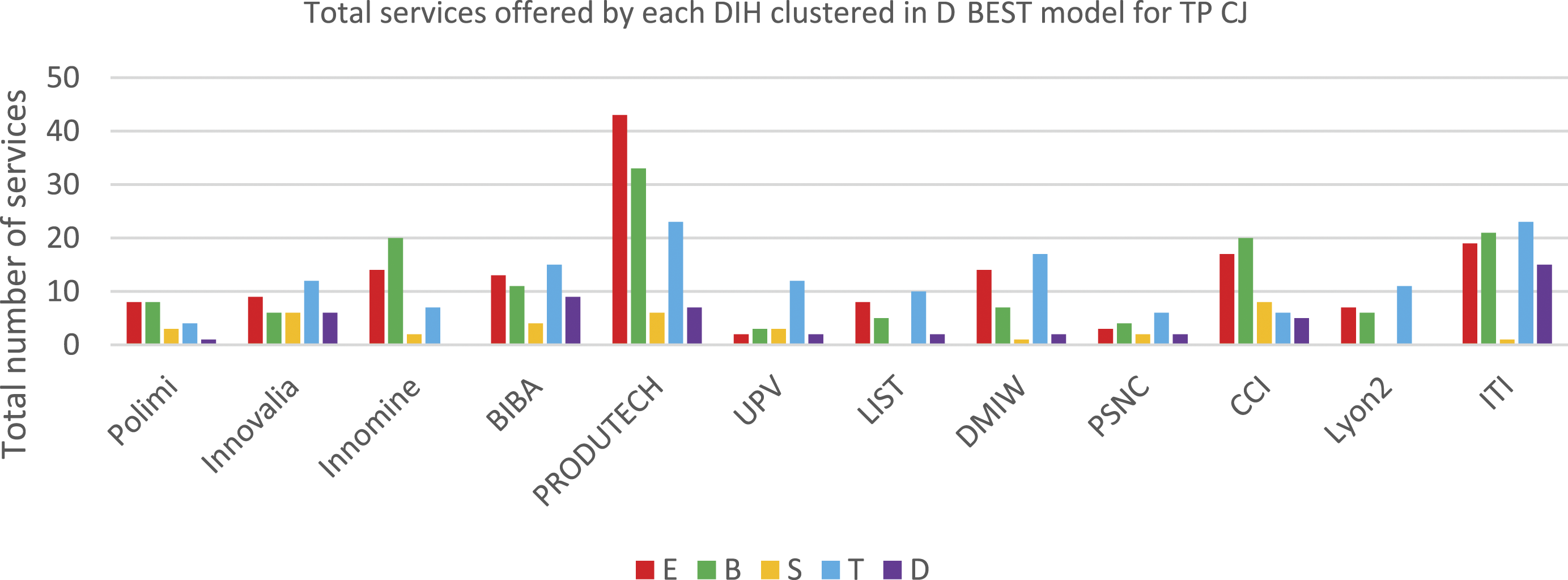
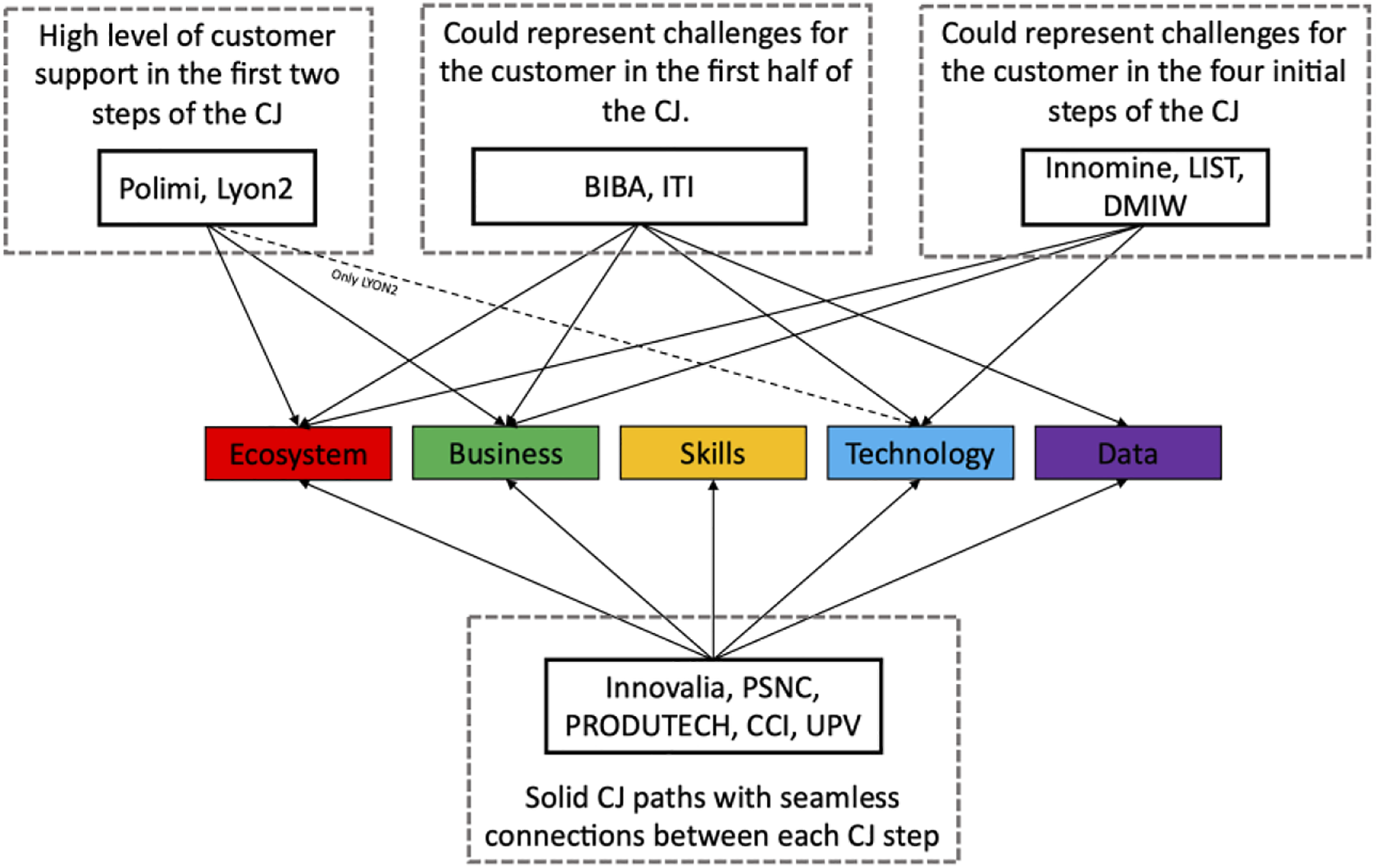
A comparison between the characteristics of TU’s and TP’s CJs has also been performed. Looking at Tables 6 and 8, it emerged that the number and types of services employed in the CJs are different per each step and reflect how the DIHs support each type of customer along the digital transition. In the case of TU’s CJ, Ecosystem services are relevant for the first step and the second step. In the third and fourth step, the most predominant services are Technology and Data services, while Business services have relevance in every step after the first one. Instead, in the TP’s CJ, the Business services are delivered in almost all the steps, while Ecosystem services mostly in the first and fifth steps. Thus, DIHs support TU and TP employing different sets of services for their digital transition. However, Step 1 (driven by Ecosystem services aimed at enlarging and empowering the network or new stakeholders procurement) and Step 3 (where the major effort is focused on the technological and data support of digital solutions) of the two journeys unveil some similarities in terms of types and distribution of services. Total services offered by each DIH clustered in D-BEST model for TU CJ ( E: Ecosystem, T: Technology, B: Business, S: Skill, D: Data). Clusters of DIHs strengths based on TU CJ analysis (E:Ecosystem, T: Technology, B: Business, S:Skills, D:Data). Total services offered by each DIH clustered in D-BEST model for TP CJ (E: Ecosystem, T: Technology, B: Business, S: Skill, D: Data). Clusters of DIHs strengths based on TP CJ analysis (E:Ecosystem, T: Technology, B: Business, S:Skills, D:Data).

DIH groups
With the intention to better understand the CJ dynamics for both TP and TU cases, the total number of services offered by each DIH clustered with the D-BEST model were plotted (Figure 5). This, in combination with the CJ from each DIH, were utilized to identify similarities between the paths of the DIHs’ customers.
Through the analysis of the TU CJ for Innovalia, ITI and PRODUTECH, it is possible to identify that these DIHs can support their customers in the whole CJ path, offering an equilibrated set of services in each cluster of the D-BEST model. From the CJ results, it is also possible to identify that the connection between the services through the CJ path follows a consistent flow, which represents a clear gain for the customer as it will boost the speed of development and adoption. On the other hand, INNOMINE and Polimi lack a defined path that connects the services offered to the customer in the last two steps of the TU CJ. It is clear from the results, that these DIHs are not technology- and data-driven, and that they focus their efforts on ecosystem, business, and skills support for their TU customers. Considering this, it can be identified that INNOMINE and Polimi can offer a high level of support to their customers in the first three steps of the CJ, but that could be supported in the last steps by some other DIHs in the ecosystem that have a stronger technological and data driven perspective. Is similar the case of Lyon2, but in it, even with a small number of services offered in the step 4, the DIH can offer a complete CJ path until this step. Nevertheless, it can also be supported in the last step of the CJ as it only has one data service that do not supports completely the customer in the adoption step. It was identified that BIBA is a DIH centred mainly in ecosystem, business, and technology services. Nevertheless, it offers complementary services in data and skills areas that represent an advantage for the customer as they complement the set of services that represent the strength of the DIH. DMIW shares a similar behaviour to BIBA, but it can be identified that it lacks a complete set of services in the data cluster of the D-BEST model. This means that the DIH can have some issues in the middle and last phases of the CJ due to the limited data services that can be offered. However, this opens the possibility to collaborate with DIHs that are strongly data driven such as ITI, LIST, UPV or PRODUTECH. In the same way, CCI can also take the same approach as it does not count with a set of data services. Similar to BIBA, UPV shows a strong defined path that customers can follow to complete the adoption of a technology. Nevertheless, UPV does not support their customers from a business perspective through the CJ path. For this reason, some DIHs such as POLIMI that are part of the network and are known for their strength in business, have the possibility to collaborate with UPV to create better service for their customers as this cluster of services is vital for the second and last phase of the CJ. LIST is an exceptional case with a CJ centred mainly in technology and data services. The lack of services from the ecosystem, business and skills clusters can represent a weakness in the first, second and fifth steps of the CJ path. For this reason, strong DIHs in the previously mentioned clusters such as CCI, POLIMI or PRODUTECH can support LIST to offer a consistent and smooth CJ.
TU CJ: Strengths, weaknesses and collaboration opportunities among the groups of DIHs.

The same analysis was performed for the TP CJs. Initially, a plot of the services offered by each DIHs classified in the D-BEST clusters was made (Figure 7).
Following the same methodology previously made for the TU CJs, the analysis was made by closely examining the path that the TP customer follows in the CJ defined by each DIH. Starting from CCI, Innovalia and PRODUTECH, these CJ paths show a solid set of services almost evenly distributed in the D-BEST model clusters and in the different steps of the CJ. This permits a continuous flow of activities of the customer through the CJ path. In a similar way, BIBA and ITI have well founded CJs but with lack of skills services. In the case of BIBA, even with only one type of skill service offered, it has the capacity to support the customer through the whole path of the CJ. The implementation of additional skill services that this DIH has available but that is not currently offering could further support the process. Nevertheless, the single skill service offered also permits a seamless flow through the CJ path. In the case of ITI, a further collaboration with other partner of the network could create a better support for their customers through the CJ, as it could represent a challenge in the first three steps of the same. On the other hand, DMIW, Innomine and LIST show a lack of skills and data centred services. This can create a flaw in the third step of the CJ due to the lack of the pivot that data services represent in the adoption of new technologies. Data services act as catalysers for decision making processes and validations. As data, skills services are also vital for the third and the next steps of the CJ. These services support the customer to understand and design the new technology (first three steps of the CJ). This lack of services can also open the possibility to collaborate with data-driven DIHs such as ITI or BIBA. As in the TU CJ, UPV is also a technology-driven DIH in the TP case. In this case, the DIH can successfully guide their customers through the whole CJ path. Nevertheless, further collaboration or implementation of additional ecosystem and business services could be considered to complement the services already offered in each step of the CJ. PSNC is an exceptional case that shows a simple and limited service portfolio that offers a seamless flow through the CJ. With a low number of services of each cluster offered in each path, it complements the process to create a clear path for the customer. Lastly, it was found that POLIMI could further implement services in the last steps of the customer journey with the intention to offer a better guidance for their customers. The collaboration with other partners such as PRODUTECH or ITI could be one of the best alternatives to an internal development of services. In a similar way, Lyon2 is a data driven DIH, with null services offered in the skills cluster, nevertheless a strong ecosystem and business support for the first two steps of the CJ. This represents a challenge for customers in the last two steps of the CJ and in the development of skills related with the technology, but in the same way it represents a challenge, it also opens a new opportunity of collaboration with DIHs with strong services offering in the last two steps of the CJ and with strong skills services offer such as CCI and PRODUTECH.
TP CJ: Strengths, weaknesses and collaboration opportunities among the groups of DIHs.

The results obtained through this research confirm that different DIHs play different roles in supporting European companies along the digital transformation journey, addressing a specific combination of the four typical categories of functionalities characterizing this kind of innovation ecosystems according to the EC.
This difference in DIHs' behaviour can depend either on: a) their nature (i.e. their public or private organization and structure), leading them to ensure a fit with their current service and capabilities portfolio; or b) by choice or needs, to address the expectations of their stakeholders. The heterogeneity of such ecosystems fits with the main aim of the EC in fostering their development, attempting to expand the already existing network and to create an integrated platform for DIHs from different, especially digitally underdeveloped, sectors and regions. The envisioned result by the EC would be an extended pan-European ecosystem of DIHs. Each of them would have a different nature, would be located in different regions and would be focusing on diverse industries and digital technologies. The resulting pan-European DIH ecosystem would be able to activate innovation-driven collaboration and cooperation dynamics through the joint development, provision, and matchmaking of services among its partners. The successful achievement of such a result would avoid single DIHs to strive to concurrently fill all the four functionalities and focus more on the most characterizing one/s. Indeed, “DIHs’ inner characteristics (e.g. founding members’ profiles, mission, staff, technological specialization and credibility among local recipients) and the types of knowledge (e.g. technical, relational or territorial) that are shared, help to determine the sets of products, service providers, technologies and know-how to which SMEs have access”. 47 In addition, it has not to be neglected that these innovation ecosystems perform a digital imprinting action for European SMEs, due to their twofold role of knowledge brokers and knowledge sources. As a result, the type of DIH customer journeys toward digital transformation, either technological providers or end-users companies, is strongly related to the characteristics of the DIHs, to their service portfolios, 36 and to the type of relationships existing with their partners. For instance, on the one hand, some DIHs are indeed more inclined to support the test before invest functionality, developing and commercialising new digital technologies together with SMEs. On the other hand, other DIHs are instead by nature more suitable to the creation of awareness and organization of investments in the demand side of the marketplace. For sure, this must be reconducted to the strong either public or private nature of these ecosystems.
Conclusions
In this paper, the D-BEST based DIH CJ Analysis method has been proposed and tested in the DIH4CPS project. 24 The method has the paramount aim of defining flexible service workflows for DIH customers, by combining D-BEST services of the catalogue towards the implementation of DIHs Unique Value Proposition, also allowing to share success stories and best cases. Moreover, process gates have been defined along the two digital transformation paths of TU and TP, leading to the definition of the two 5-step paths towards the full digital maturity and awareness of the DIH customers. For each of these steps, the typical blocking points that SMEs might have to cope with when going through the digital transition have been gathered and proposed. In particular, the research presented how the network of the DIH4CPS project has implemented the D-BEST based DIH CJ Analysis model to its 12 DIHs. The final purpose has been to detect typical paths of the DIH customers (both TU and TP) while they interplay with the DIHs. As a result, it has been discussed how in the network some DIHs are more targeting the development and commercialisation of new CPS technologies, whereas others are more interested in creating awareness and investments in the demand side of the marketplace. The analysis has also unveiled how the DIHs composing the network could improve their collaboration based on the similarities and complementarities among the single DIH CJs. Finally, based on the CJ defined through the application of the method, the typical paths between TPs and TUs with the DIH have been codified, allowing to share success stories and best cases. A limitation of this research is the application of the method only to the DIHs composing the DIH4CPS network. However, the method is being applied also in the AI REGIO 48 and HUBCAP 49 projects and it will be applied again to the DIHs that will join the DIH4CPS project in its second open call. This research is strictly connected with several future activities. Indeed, the method proposed and applied in this research will be used in the future to assess the DIHs that will join the DiH4CPS project network through the open calls, allowing to evaluate the evolution of the inclination of the DIHs composing the network throughout the time. The method could also be used in the future in different projects (both in the CPS and other technological domains) to assess other DIHs but also in different kinds of ecosystems as start-ups incubators (for instance, REACH 50 data incubator has shown interest in exploring the use of the D-BEST service model to organise the service offer of the incubation programme). In addition, the method proposed not only assesses the role of DIHs in catalysing the digitalization dynamics of SMEs but could also support the definition of the service pipeline of the single DIHs, unveiling further possible collaborations among DIHs in the future based on the services that are planned to be developed. Finally, the results obtained in this research (the unique value proposition of the single DIHs constituting the DIH4CPS network) represent an input for the definition of the entire DIH4CPS network value proposition. Indeed, the sustainability of DIHs and of networks of DIHs is still an unexplored theme 51 that needs to be addressed to allow to give continuity to the precious and strategic support action of DIHs to the digital transition of European companies. Digital platforms, as in the case of HUBCAP project,52–54 can be a strategic asset in sustaining the economic sustainability of such networks, giving the possibility to directly propose to the customers the suitable assets depending on their needs and industries. For sure, the role of boundary organization of DIHs could be better investigated based on the results provided with this research.
Supplemental Material
Supplemental Material - The D-BEST Based digital innovation hub customer journey analysis method: Configuring DIHs unique value proposition
Supplemental Material for The D-BEST Based digital innovation hub customer journey analysis method: Configuring DIHs unique value proposition by Claudio Sassanelli and Sergio Terzi in International Journal of Engineering Business Management
Footnotes
Declaration of conflicting interests
The author(s) declared no potential conflicts of interest with respect to the research, authorship, and/or publication of this article.
Funding
The author(s) received no financial support for the research, authorship, and/or publication of this article.

Supplemental Material
Supplemental material for this article is available online.
References
Supplementary Material
Please find the following supplemental material available below.
For Open Access articles published under a Creative Commons License, all supplemental material carries the same license as the article it is associated with.
For non-Open Access articles published, all supplemental material carries a non-exclusive license, and permission requests for re-use of supplemental material or any part of supplemental material shall be sent directly to the copyright owner as specified in the copyright notice associated with the article.
