




Abstract
Online retailers are providing customized logistics service to meet heterogeneous customer demand. However, the value of customized logistics service is not clear. We study conceptually and empirically how customized logistics service influences online customer post-purchase behavior, specifically e-satisfaction and e-loyalty. Primary data on customized logistics service were collected from an online field study involving direct observation. Secondary data on e-satisfaction and e-loyalty were collected from Bizrate.com. We used hierarchical multiple regression analyses and constrained nonlinear regression for empirical analysis. The results indicate that customized logistics service contributes significantly to e-satisfaction and, in turn, to e-loyalty. Furthermore, shipping rates significantly moderate the indirect effect of customized logistics service on e-loyalty through e-satisfaction. This research contributes to the understanding of the nature and consequences of customized logistics service in online retailing. Our findings underscore the effect of customized logistics service on e-satisfaction and e-loyalty, and the critical moderation effects of shipping rate on these relationships. Results from this study hold implications for the way online service operations managers employ logistics service strategy.
Keywords
Introduction
The development of information technology in recent years has promoted the expansion of online retail sales around the world. The Census Bureau of the United States Department of Commerce 1 indicated that the U.S. retail e-commerce sales for the third quarter of 2021 at $214.6 billion, an increase of 6.6% from the third quarter of 2020. In a publication by Analysys (in Chinese), 2 it was reported that in China, e-commerce sales for the first quarter of 2021 were $251.8 billion, a 27.9% increase from the first quarter of 2020. A fast-growing online retail market provides customers 3 with more convenience but makes competition among online retailers fiercer.4,5 Also, with the accumulation of high volume of data in the online e-commerce environment, enterprises can develop data analytics capabilities in managing their e-commerce processes to become more competitive globally.6, 7 Accordingly, customer retention rates are crucial for online retailers’ success, 8 and how to improve customer loyalty has become an essential question for online retailers. E-service quality has been found to be an important factor that affects customers’ purchase intentions, satisfaction and loyalty in online retailing.9–11 Therefore, to be competitive, as well as providing products with excellent quality at reasonable prices, online retailers must improve e-service quality to ensure that the online transaction process is responsive and convenient for customers.
As an important component in online retailing, logistics service fulfills orders and realizes the transaction between sellers and customers. 12 Logistics service significantly impacts online retailers’ revenue and profitability.12,13 Online retailers usually deliver products to customers themselves or outsource logistics services to a third-party. Recent studies have explored the relationship between logistics service and online customers’ post-purchase behavior. For example, Mentzer et al. 14 argue that as an important marketing component, the quality of logistics service is helpful for creating customer satisfaction. Huang et al. 13 conclude that logistics service quality indirectly affects customer loyalty via customer satisfaction. It can be seen from these studies that logistics service is a vital factor that affects customer post-purchase behavior.
The fast growth of online retailing and the fierce competition in the online market make logistics service attract more attention from online retailers. 15 To better meet customers’ needs, online retailers are increasingly allowing customers to customize their logistic services. Online customers can choose logistics service provider and delivery time. Some retailers also allow customers to pick up orders themselves. For example, customers of JD.com, a Chinese B2C online retailer, can choose to pick up their order or choose among different shipping methods and speeds. Providing customized logistics would bring more cost and management complexities, whether it is valuable for online retailers to select this strategy is not clear. How do different delivery services, which are called customized logistics service (CLS) in this study, impact e-satisfaction and e-loyalty? Little research has covered this topic and the answer remains unknown. As such, the goal of this study is to explore how CLS influences e-satisfaction and e-loyalty as well as whether the relationships among them are moderated by shipping rates.
The contributions of this study are threefold. First, it provides a conceptual framework of CLS, which is missing in previous research. Second, based on signaling theory and relevant customer behavior literature, this study hypothesizes and examines the relationships between CLS and customer post-purchase behavior. Third, our research questions have strong implications for logistics service operations management. The results of this study will help online retailers to make logistics service strategy and decide shipping rate.
The remainder of the paper is organized as follows. Theoretical foundations contains a discussion of the conceptual foundations of CLS and signaling theory. Following the theoretical foundations, we present the research hypotheses in Research framework. The research method is then presented, followed by the data analyses and model results in Methodology and Results. Finally, the paper presents concluding remarks in Discussion on the study’s contributions, limitations, and directions for future research.
Theoretical foundations
Customized logistics service (CLS)
Customization is the tailoring of products and services to individual needs and preferences. 16 Research on mass customization has evolved significantly in the customization literature.17,18 The central idea behind mass customization is to provide personalized products/services through modular product/service design and produce them by flexible manufacturing cells and integration of supply chain members. 17 Information technology and the internet broaden the realm of customization beyond mass customization. Digitization and networking capabilities enable manufacturers and retailers to better understand customers’ needs and tailor products/services to individual customers. Online retailers can reduce customer frustration and confusion by providing customization strategies. 8 Thirumalai and Sinha 16 argued that the customization of the online purchase process consists of decision customization in the decision-making sub-process (which involves customer need identification) and the transaction customization in the transaction sub-process (which involves the execution of the product purchase activities).
Two kinds of service customization are recognized in the online purchase process. By providing customers with different choices for different services, such as payment method and shipping method, online retailers allow customers to specify elements of their service. For example, http://loccitane.com provides different choices of payment methods, such as Visa, MasterCard, and Paypal, to customers. Then customers are able to choose the payment method of interest. Another kind of customization involves collaborative filtering to determine what product or service to recommend to customers via email or homepage. 16 On Amazon.com, the web application identifies the customer and the searches and purchases that he or she has made. The system then recommends products that the customer might be interested in on the website as the customer logs in.
In the online market, CLS, provided online by retailers for improving customer convenience, involves combination of different logistics service elements, such as logistics service provider, delivery time and self-pick-up, to meet heterogeneous customer logistics demand. With CLS, customers are provided with different options for logistics service, and each customer can choose the kind of logistics service he or she prefers. Figure 1 shows that on http://loccitane.com, a customer can choose to pick up their purchase in a store or have the order shipped in the logistics service process. If the customer chooses to have order shipped, there are several options for shipping speed. The shipping rate varies based on the shipping method. Shipping methods and rates vary from online retailer to online retailer. In this study, a higher level of CLS means that more shipping options are provided. Customized logistics service from loccitane.com.
Signaling theory
Signaling theory is developed from the field of information economics and describes when sellers and buyers have asymmetric information in a market interaction, where retailers know the quality of their goods or services, whereas customers are uncertain about the quality of the retailers’ goods or services. 19 Signaling theory provides a framework for understanding how signals convey product or service information to customers, thereby reducing uncertainty and influencing customers’ purchase intention.20,21 Signals, which include brand names, prices, warranties, and advertising expenditures, play an important role in helping customers to distinguish bad retailers from good retailers.19,22 According to Kirmani and Rao, 23 signals can be classified into two categories: default-independent signals and default-contingent signals.
Marketing signals help customers evaluate online retailers, and also function as a way of reducing risk for customers and influencing customers’ purchase intensions. Signals can influence not only pre-purchase behavior, but also post-purchase customer evaluation of online service performance. 24 In general, attention has been paid to the pre-purchase stage in transactions between online retailers and customers. For example, McCollough and Gremler 24 suggest that service guarantees have a positive effect on customer overall satisfaction.
If online retailers have the same signals, customers will consider the credibility of those signals before making purchase decisions. High signal credibility occurs when customers believe the online retailer can provide the service or product as indicated by the signal. 21 Furthermore, signal credibility is positively related to perceived quality.25,26 Accordingly, higher levels signal credibility imply that a customer is certain of the integrity of the online retailer who sends the signals and perceives the online retailer’s quality to be higher. On the other hand, lower levels of signal credibility imply that a customer is uncertain of the integrity of the online retailer who sends the signals and would perceive the quality of the online retailer to be lower.
From the perspective of signaling theory, in the online market, CLS, enables customers to reduce the uncertainty of logistics service quality and acts as a marketing signal. Shipping rates can be considered as signal credibility. Shipping rates can help customers to discern whether an online retailer can provide logistics service as it states because higher shipping rates lead to higher service quality. 12 Therefore, within a certain reasonable range, the higher the shipping rates, the higher the signal credibility.
Online retailers are increasingly allowing customers to customize their logistic services. Our review of relevant academic literature, however, yielded few theoretical or empirical insights to help evaluate the effectiveness of CLS in online retailing in general and how CLS influences e-satisfaction and e-loyalty in particular.
Research framework
Perceived control has been identified as an important factor that impacts customer behavior,27–29 and perceived control plays an especially important role in self-service settings. 30 Online shopping can be considered as self-service. Rose et al. 29 pointed out that online shopping website customization positively influences customers’ perceived control. Similarly, by providing CLS, online retailers enable the customer to have more control over the logistics service quality. In addition, service customization is correlated to perceived service quality. 31 Both perceived control and perceived quality in the online service process is positively related to e-satisfaction.32,33
E-loyalty refers to a customer’s favorable attitude towards an online retailer that results in repeat purchase behavior. 8 Prior studies have revealed that customer satisfaction positively influences customer loyalty.34–38 In the online market, if customers are satisfied with a transaction, they perceive that they are getting a greater value than they would get from the online retailer’s competitor. 39 Further, they will be more likely to come back to the online retailer’s website and make a purchase again and to recommend the online retailer to other potential customers.39–41 Consequently, we propose the following hypotheses.
H1: CLS has a positive effect on e-satisfaction.
H2: E-satisfaction has a positive effect on e-loyalty.
H3: E-satisfaction mediates the positive effect of CLS on e-loyalty.
If an online retailer is able to customize logistics service for individual customers, it can increase the probability that customers will find the logistics service to meet their needs. Thus, the attractiveness of the online retailer will be higher than the online retailer’s competitor, and the customers will be more likely to make future transactions with the online retailer. Service customization also can signal high service quality, 31 thus increasing customer loyalty.42,43 Therefore, an effect of CLS on customer loyalty can be expected to emerge:
H4: CLS has a positive effect on e-loyalty.
In e-service, CLS is different from other kinds of e-service customization, such as website customization and recommendations because customers usually have to pay for the customized logistics service while other kinds of e-service customization are typically free. Rabinovich & Bailey 12 find that market prices for physical distribution service (PDS) positively influence PDS quality. However, these researchers do not discuss how PDS price will influence customer behavior. Moon et al. 44 report that price premium of personalized products does not affect customer purchase intentions. In addition, prior studies have demonstrated a moderating effect of service price. 44 For example, Voss et al. 45 find that service price and performance consistency moderates the relationship between pre-purchase expectation and post-purchase satisfaction. How does shipping rate influence customer behavior?
Prior studies have demonstrated a moderating effect of signal credibility. For example, Wells et al. 21 find that signal credibility moderates the relationship between website quality (signal) and a customer’s perception of product quality. Shipping rate, as the signal credibility of CLS, is a potential moderator of the relationship between CLS and customer post-purchase behavior. When a customer’s perception of an online retailer’s signal credibility is higher, the customer has increased expectations about the online retailer’s service quality and becomes more likely to be satisfied and to become a repeat customer. 46 This is due to the fact that the customer would prefer to trust an online retailer who has a higher signal credibility and thus, can provide better service. In summary, CLS increases customer e-satisfaction and e-loyalty, and increasing shipping rates would make the effects stronger. Thus, we offer the following hypotheses:
H5a: Shipping rate moderates the relationship between CLS and e-satisfaction. That is, CLS will have a greater positive effect on e-satisfaction when shipping rate is higher as compared to when shipping rate is lower.
H5b: Shipping rate moderates the mediation effect of e-satisfaction on the relationship between CLS and e-loyalty. That is, the mediation effect of e-satisfaction on the relationship between CLS and e-loyalty will be greater when shipping rate is higher as compared to when shipping rate is lower.
H5c: Shipping rate moderates the relationship between CLS and e-loyalty. That is, CLS will have a greater positive effect on e-loyalty when shipping rate is higher as compared to when shipping rate is lower.
H5d: Shipping rate moderates the total effect (direct effect and indirect effect) of CLS on e-loyalty.
Figure 2 presents our empirical model. In this model, CLS is assumed to affect e-loyalty directly and also indirectly through its mediator, e-satisfaction. Specifically, we consider the moderation effect of shipping rate. Research model.
Methodology
Sampling and data collection
Items used in this study reported by Bizrate.com.

Details of the study sample (n = 235).

Variables
The dependent variable in this study is e-loyalty. The http://Bizrate.com items “would shop here again” and “recommend to others” are both considered as indicators of e-loyalty in studies.39,41 We calculated e-loyalty as (would shop here again + likelihood to recommend)/2. The independent variable of interest in this study, logistics service customization (CLS), was measured by the number of shipping methods provided by an online retailer, especially the level of CLS increases with the number of shipping methods. The mediator, e-satisfaction, was measured by the overall satisfaction. The moderator variable in our study is shipping rate. The shipping rate refers to the cost the customer has to pay for the logistics service. We calculated shipping rate as the mean of shipping rates for different shipping methods provided by each online retailer
1
, i.e.
We also accounted for potential variations in the dependent variable caused by the control variable, product type. The variable product type refers to the product category that describes the product sold by the online retailer. Studies point out that in an online market, customer behavior is often influenced by product type.48,49 Burke 50 also suggests that ratings of shopping experience vary significantly across product categories. In an empirical study of order fulfillment process in B2C transactions, Thirumalai and Sinha 48 find that customer satisfaction is influenced by product type. Under different principles, products are classified differently. For example, products can be classified into search goods and experience goods,44,51 consumable and non-consumable, 28 or convenience goods, shopping goods, and specialty goods. 48 In this study, we used the convenience goods, shopping goods, and specialty goods classification scheme. Online purchases of convenience goods, such as groceries and office supplies, tend to be in high volumes, with low unit costs and at high frequencies. Customers’ expectations of logistics service for convenience goods are likely to be low. Online purchases of shopping goods, such as handbags and apparel, tend to be in lower volumes, with higher unit costs and at lower frequencies than that of convenience goods. Customers’ expectations of logistics service for specialty goods are likely to be higher than for convenience goods. Online purchases of specialty goods, such as digital cameras and laptops, tend to be in lower volumes, with higher unit costs and at lower frequencies than that of shopping goods. Customers’ expectations of logistics service for specialty goods are likely to be the highest among the three kinds of product types. The three product types —convenience goods, shopping goods, and specialty goods —in this study were represented by 1, 2 and 3, respectively.
Results


Descriptive statistics and correlations of variables in the study.

**Correlation is significant at the 0.01 level (2-tailed).
Number of observations, n=235.
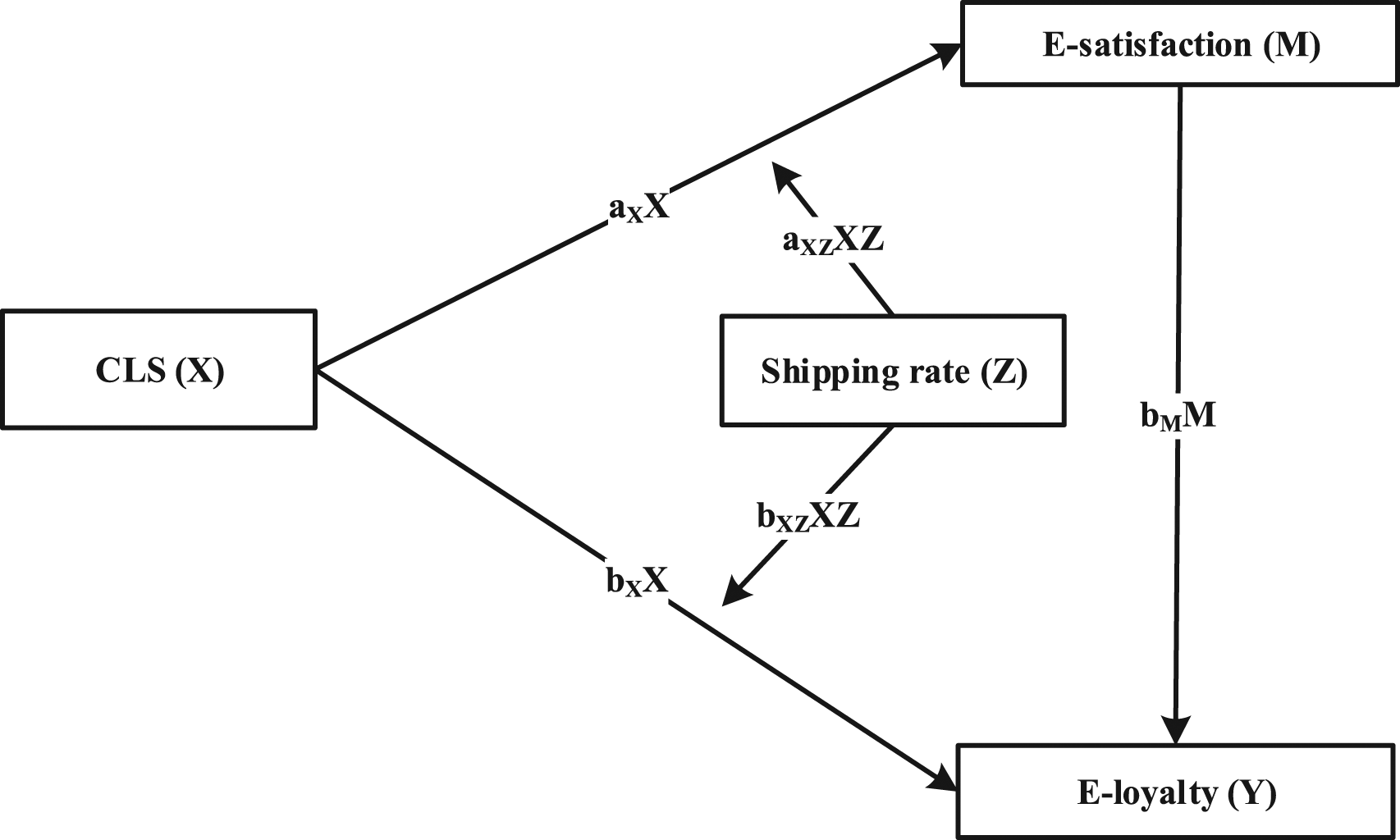
Direct and first stage moderation model.
Substituting equations (1) into (2) produces the following reduced form equation (3) in terms of simple paths
Regression analysis.

β=Standardized regression estimates; *Significant at the 0.05 level; **Significant at the 0.01 level.
Coefficient estimates.

*Significant at the 0.05 level (2-tailed);
**Significant at the 0.01 level (2-tailed).
Number of observations, n=235.
In Table 4, model 1 shows that unstandardized regression coefficient that relates CLS to e-satisfaction is 0.156 and significant (p < 0.01), and providing strong support for H1, which indicates that CLS has a positive effect on e-satisfaction. Also, model 1 presents that shipping rate significantly (p < 0.01) moderates the relationship between CLS and e-satisfaction. Therefore, H1 and H5a are supported. The coefficient estimates in model 2 show us the effect of CLS on e-loyalty is not significant, while the effects of e-satisfaction on e-loyalty (p < 0.01) and the interaction effect of CLS and shipping rate on e-loyalty (p < 0.05) are significant. Thus, H2 is supported. However, the interaction effect is not consistent with H5c. There is no information on how shipping rate moderates the indirect effect and total effect (direct and indirect) of CLS on e-loyalty. For this reason, the indirect and total effects, which contained the products coefficients, are estimated with biased corrected confidence intervals based on the bootstrap coefficient estimates generated by the CNLR model. 52
Analysis of simple effects.

*Correlation is significant at the 0.05 level (2-tailed);
**Correlation is significant at the 0.01 level (2-tailed).
Number of observations, n=235.

Plots of simple paths and effects with shipping rate as the moderator variable.
Differences in the effects for low and high shipping rates indicate that the first stage of the indirect effect is stronger for a higher shipping rate (p < 0.01), and the differences lead to a significantly stronger indirect effect for a higher shipping rate (p < 0.01). H3 and H5b are supported. The direct effect is negative and stronger for a higher shipping rate (p < 0.05), and when added to the indirect effect, the differences in the total effects for low and high shipping rates are not significant. H4 and H5d are not supported.
Figure 4(a–d) show the differences in simple slopes for low and high shipping rates. Figure 4(a) demonstrates that, for the first stage of the indirect effect, the relationship between CLS and e-satisfaction is steeper for high shipping rates than for low shipping rates. Similarly, as presented in Figure 4(c), the relationship between CLS and e-loyalty is steeper for high shipping rates than for low shipping rates. Figure 4(c) shows that the mediation effect of e-satisfaction is stronger for high shipping rates than for low shipping rates. Figure 4(d) shows differences in simple slopes for low and high shipping rates are not sufficient to produce a significant total effect. Comparing Figure 4(b) and Figure 4(c) further shows that negative difference in slopes for the direct effect and positive difference in slopes for the indirect effect are the primary reason for the non-significant difference in slopes for the total effect in Figure 4(d). Hence, shipping rate moderates the direct and indirect effect of CLS on e-loyalty, but not on the total effect. H5d is not supported.
Discussion
This paper explores how CLS influences online shoppers’ e-loyalty directly and indirectly through e-satisfaction, and whether these effects are moderated by shipping rates (as shown in Figure 2). Data were collected from the website of online retailers in our sample and http://Bizrate.com, which is a market research firm that records and provides customers’ dynamic ratings of online retailers publicly. Hierarchical multiple regression analyses and constrained nonlinear regression (CNLR) were conducted to analyze the data.
The results indicate that CLS positively impacts e-satisfaction, i.e. increasing the level of CLS leads to customers’ higher e-satisfaction level. Also, shipping rate moderates the relationship between CLS and e-satisfaction. Higher shipping rate would strengthen the link between CLS and e-satisfaction. Further, e-satisfaction positively affects e-loyalty. This is in accordance with prior studies. E-satisfaction acts as a mediator between CLS and e-loyalty, and the indirect effect of CLS on e-loyalty will be stronger with increasing shipping rate. The data also reveal that the main effect of CLS on e-loyalty is not significant, while the interaction effect of CLS and shipping rate on e-loyalty is highly significant. However, Figure 4(b) shows that CLS has a greater negative effect on e-loyalty when shipping rates are higher as compared to when shipping rates are lower. A potential reason for this result is that higher shipping rates would make customers click away because the low switching costs, which include those that are monetary, behavioral, search, and learning related, 41 may be lower than the shipping rate gap. Moreover, the results do not provide strong support for the moderation effect of shipping rate on the total effect. Accordingly, shipping rates do not significantly affect the total effect of CLS on e-loyalty.
Theoretical implications
This research contributes to the understanding of the nature and consequences of CLS in online retailing. From an academic perspective, we assessed a research model of CLS in online retailing. The findings of this study relate to and extend the extant literature in several ways. First, CLS has received extremely limited attention in past research. Significant work remains to be done in order to understand CLS from the perspective of service marketing in online retailing. We posit that signaling theory provides a fresh and robust theoretical foundation for explaining why and how CLS affects customer post-purchase behavior: e-satisfaction and e-loyalty. Second, unlike other kinds of e-service, CLS is not free, that is, customers may have to pay for the service they prefer. Thus, shipping rate becomes a key factor that can affect customer behavior. The present study highlights the importance of shipping rate to the e-service literature. Previous research has examined the impact of market prices for logistics service on the logistics service quality, 12 while the present study represents the first empirical investigation of how shipping rate influences online customer post-purchase behavior. Our findings underscore the effect of CLS on e-satisfaction and e-loyalty, and the critical moderation effects of shipping rate on these relationships.
Practical implications
Results from this study hold implications for the way online service operations managers employ logistics service strategy. As the number of online retailers increases, competition in this market becomes fiercer. In order to increase customer loyalty and attract new customers, online retailers must make customers satisfied with their purchases--not only the products but also the logistics service. Logistics service is an important service in online shopping. It acts as the bridge between online retailers and customers. To better meet customers’ needs and be more competitive, online retailers are providing CLS. Most online retailers in China just provide one kind of logistics service and customers do not have other choices, while most online retailers in America provide more than one kind. Whether increasing the level of CLS is an effective service strategy is a question waiting to be answered. This study answers this question and finds that CLS creates customer e-satisfaction and customer e-loyalty. Therefore, online retailers should provide elevated level CLS to customers. Additionally, this study finds that the higher the shipping rate, the stronger the positive effect of CLS on e-satisfaction and the indirect effect of CLS on e-loyalty. Thus, online retailers should consider the moderating effect of shipping rate when providing CLS, and lower shipping rate is not a rational strategy. Customers’ requirements are different from individual to individual. Thus, providing elevated level of CLS is hard and costly for online retailers themselves. In practice, most online retailers do not deliver orders to customers by themselves. Instead, they outsource logistics service to third-party providers. Thus, the online retailers do not have direct control over the quality of logistics service. In order to increase online shoppers’ satisfaction level, online retailers should take steps to improve their abilities in logistics service quality control, either building their own logistics network or establishing relationship with well-known third-party logistics service providers. Only when online retailers are capable of controlling logistics service quality, can they have the option to provide customers with higher levels of CLS. Furthermore, online retailers should negotiate with third-party logistics providers about distinct levels of logistics service instead of one kind and their shipping rates.
Limitations and future directions
This study opens the way for other studies related to CLS. As with other research, this study has limitations, and the limitations also provides direction for further investigations. A first limitation of the current study is the way the online retailer price their logistics service. In practice, some online retailers offer free shipping or lower shipping rates than the actual shipping rate they are paying for the third-party logistics service because the online retailers bundle all or part of the shipping rate into the product price. That results in inaccurate shipping rates displayed on the retailers’ websites, which are the shipping rates used in this study. Customers perceive the shipping rate is lower; however, bundling the shipping cost in the product price would also affect customer behavior. Therefore, future research could consider and examine whether adding a part or all of the shipping rate to the product price would affect customer behavior. Are consumers more sensitive to shipping rate or product price?
A second limitation of the current study is that the sample does not cover all levels of CLS. JD.com, a Chinese online retailer, offers customers a much higher level of CLS. Customers of JD.com can choose a specific delivery period, for instance, 9:00am-12:00am on March 21, 2022. As shown in Figure 4(a) and Figure 4(c), it is possible that higher levels of CLS may lead to higher levels of satisfaction even though the shipping rate is high. Future study could overcome this limitation of our study by broadening the sample and evaluating the trend as shown in Figure 4(a) and Figure 4(c).
In addition, internet and digital technologies enable firms and consumers to come together and create many innovative and interesting business models, such as Uber and Airbnb. Alibaba is trying to integrate most third-party logistics service providers in China to create a successful logistics service network. Similarly, examining how firms should cooperate with other parties, such as firms and consumers, to realize low cost but high efficiency logistics service would be fruitful.
Footnotes
Declaration of conflicting interests
The author(s) declared no potential conflicts of interest with respect to the research, authorship, and/or publication of this article.
Funding
The author(s) disclosed receipt of the following financial support for the research, authorship, and/or publication of this article: The author gratefully acknowledges the support of the Social Science Youth Foundation of the Ministry of Education of China (Grant No. 20YJC630054). This study was supported by the Villanova University’s Sabbatical for Dr. Peggy E. Chaudhry and Dr. Sohail S. Chaudhry.
